Specifying Designing and Proportioning Concrete Mixtures Design and



- Slides: 91
Specifying, Designing and Proportioning Concrete Mixtures Design and Control of Concrete Mixtures CHAPTER 15
Overview • • • Prescriptive and Performance Based Specifications Mix Design Mixture Proportioning Examples of Mixture Proportioning Concrete for Small Jobs Mixture Review
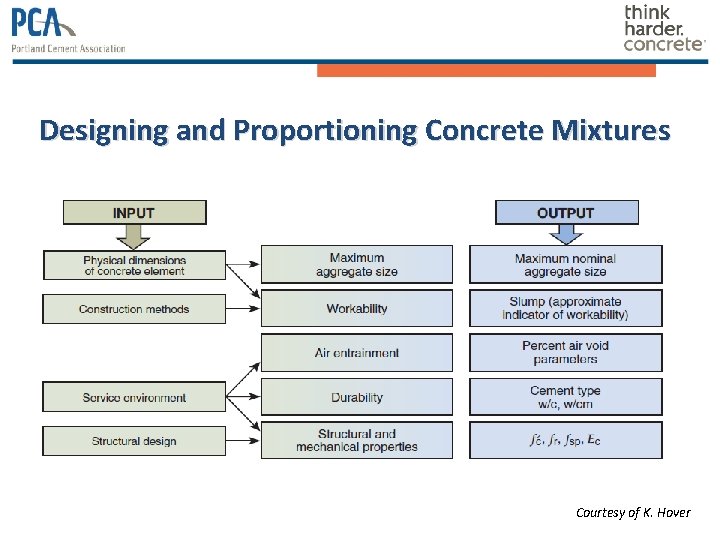
Designing and Proportioning Concrete Mixtures Courtesy of K. Hover
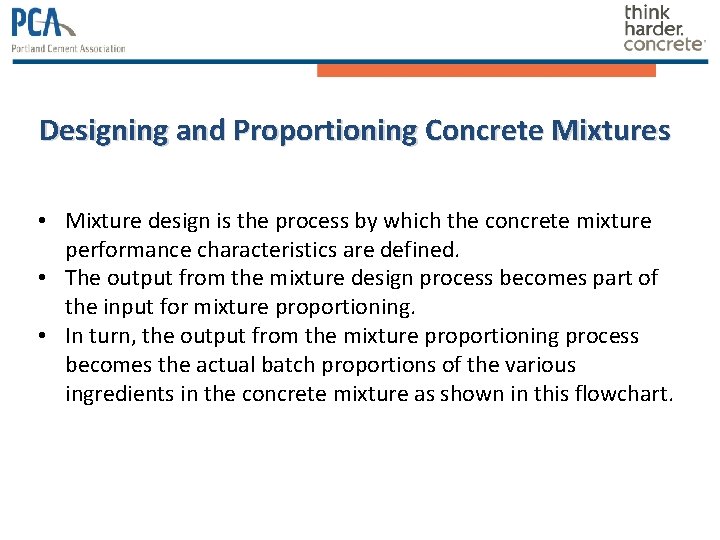
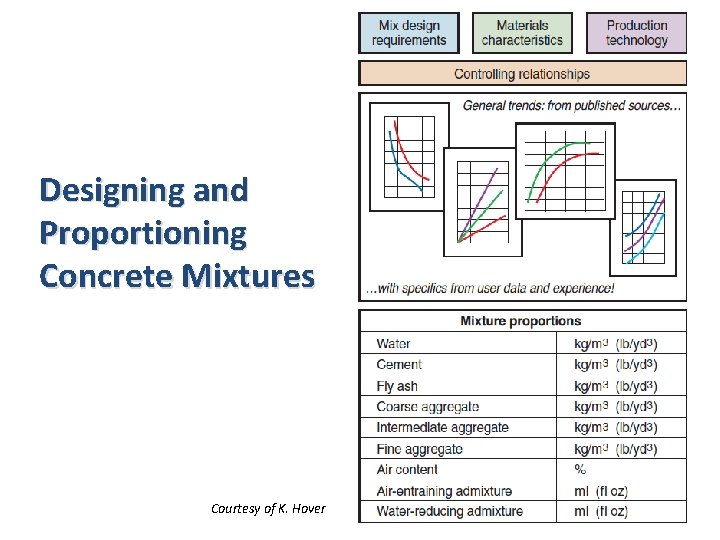
Designing and Proportioning Concrete Mixtures • Mixture design is the process by which the concrete mixture performance characteristics are defined. • The output from the mixture design process becomes part of the input for mixture proportioning. • In turn, the output from the mixture proportioning process becomes the actual batch proportions of the various ingredients in the concrete mixture as shown in this flowchart.
Designing and Proportioning Concrete Mixtures Courtesy of K. Hover
Designing and Proportioning Concrete Mixtures • Concrete materials are themselves variable, and the relationships among proportions are mixture-andmaterials-specific. • Any set of proposed mixture proportions is referred to as a “trial mixture, ” until satisfactory performance has been demonstrated through laboratory or field testing.
Mix Design • Characteristics selected based on: – Intended use – Exposure conditions – Dimensions of elements – Required physical properties • Strength and durability
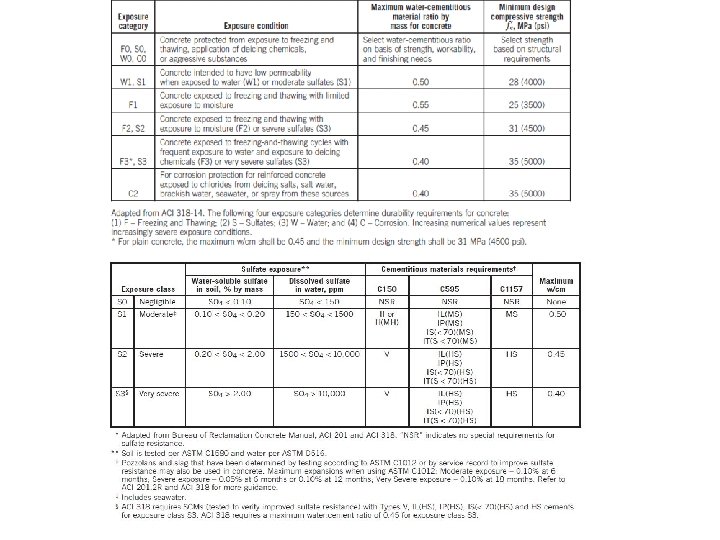
Prescriptive and Performance Based Specifications Some of the properties that may be required when specifying by performance are as follows: • Strength (compressive, flexural, or tensile) • Drying shrinkage • Rheology specific to placing methods • Early age strength • Volume stability • • Coefficient of thermal expansion Permeability Frost Resistance Deicer scaling resistance Sulfate resistance Corrosion resistance Resistance to alkali-aggregate reactivity
Concrete Strength • Strength (compressive or flexural) is the most universally used performance measure for concrete quality • Within the normal range of strengths used in concrete construction, the compressive strength is inversely related to the water-cementitious materials ratio. • For fully compacted concrete made with clean, sound aggregates, the strength and other desirable properties of concrete under given job conditions are governed by the quantity of mixing water used per unit of cement or cementing materials.
Concrete Strength Differences in concrete strength for a given water cementing materials ratio may result from: 1. Changes in the aggregate size, grading, surface texture, shape, strength, and thickness 2. Differences in types and sources of cementing materials 3. Entrained-air content 4. The presence of admixtures 5. The length of curing time and temperature
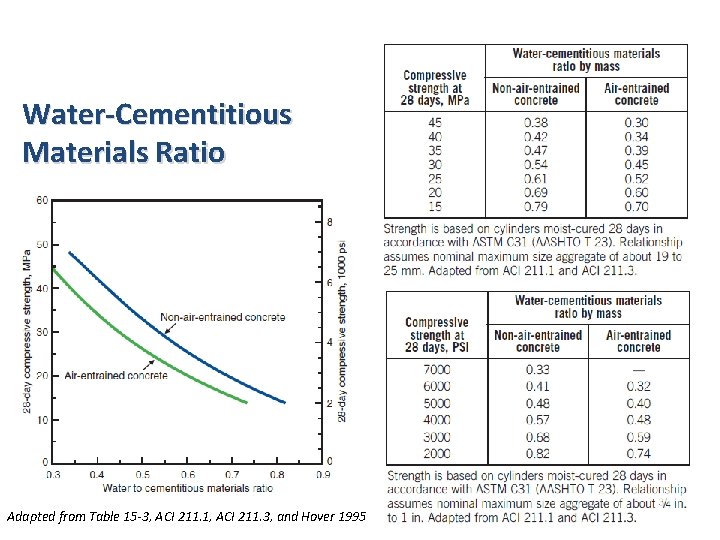
Water-Cementitious Materials Ratio Adapted from Table 15 -3, ACI 211. 1, ACI 211. 3, and Hover 1995
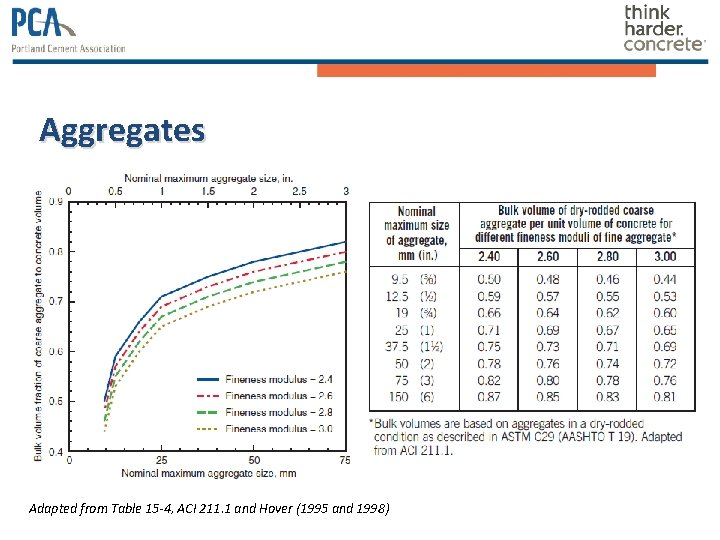
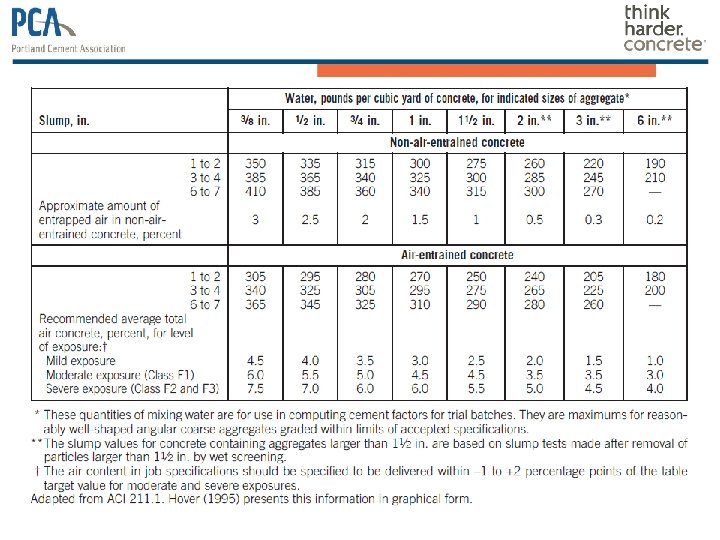
Aggregates Adapted from Table 15 -4, ACI 211. 1 and Hover (1995 and 1998)
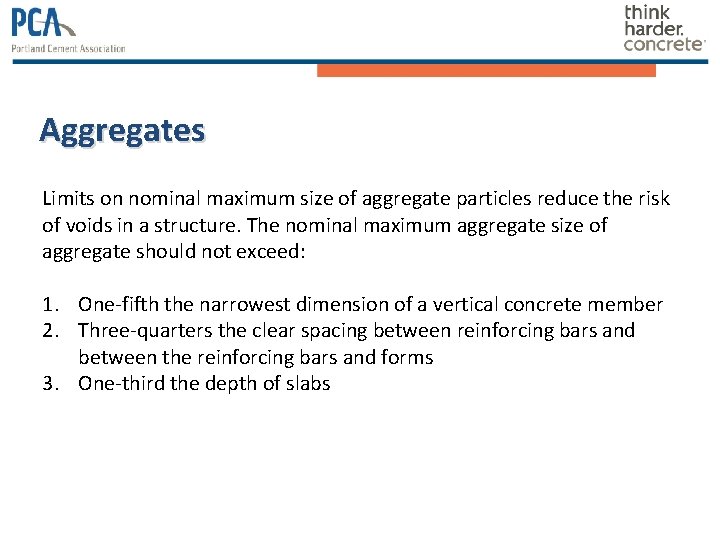
Aggregates Limits on nominal maximum size of aggregate particles reduce the risk of voids in a structure. The nominal maximum aggregate size of aggregate should not exceed: 1. One-fifth the narrowest dimension of a vertical concrete member 2. Three-quarters the clear spacing between reinforcing bars and between the reinforcing bars and forms 3. One-third the depth of slabs
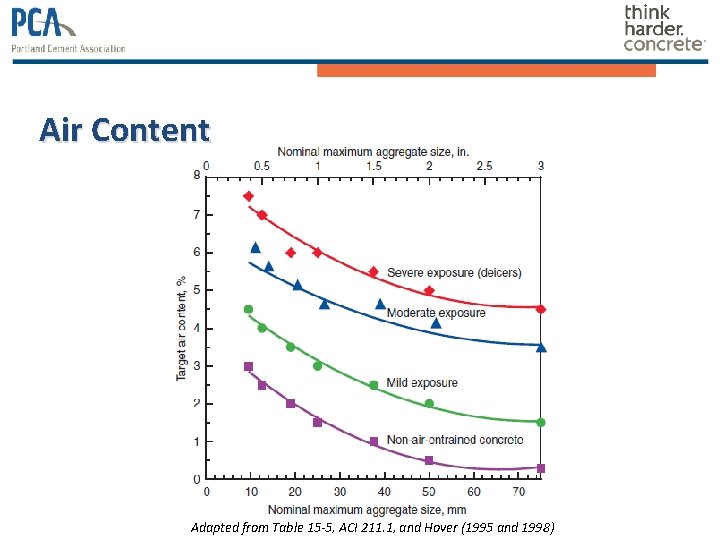
Air Content Adapted from Table 15 -5, ACI 211. 1, and Hover (1995 and 1998)
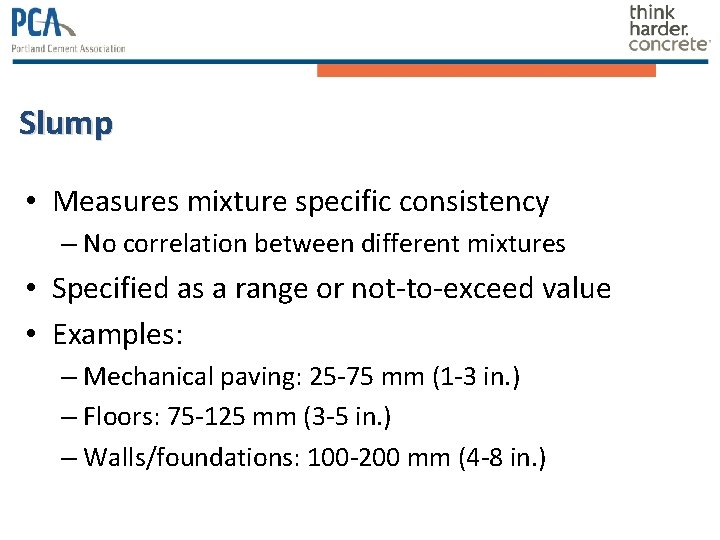
Slump • Measures mixture specific consistency – No correlation between different mixtures • Specified as a range or not-to-exceed value • Examples: – Mechanical paving: 25 -75 mm (1 -3 in. ) – Floors: 75 -125 mm (3 -5 in. ) – Walls/foundations: 100 -200 mm (4 -8 in. )
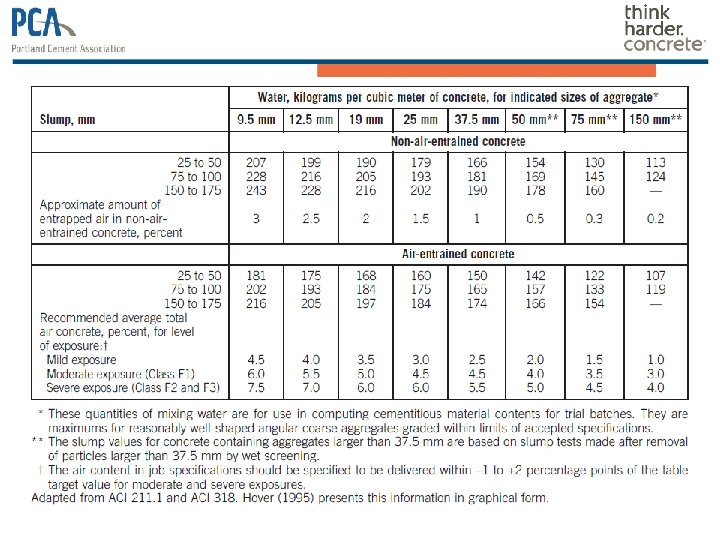
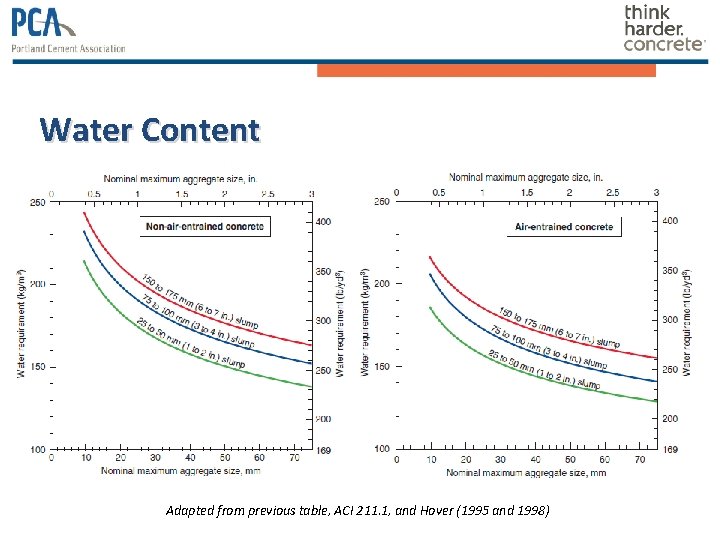
Water Content Adapted from previous table, ACI 211. 1, and Hover (1995 and 1998)
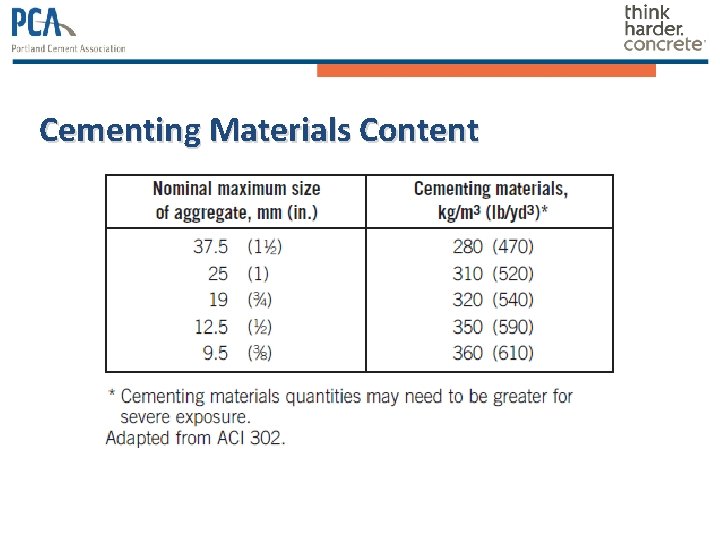
Cementing Materials Content
Cementing Materials Content Minimum cement content requirements serve to • ensure satisfactory durability and finishability • to improve wear resistance of slabs • to guarantee a suitable appearance of vertical surfaces.
Cementing Materials Content Steps to minimize water and cement requirements include: 1. The stiffest practical mixture 2. The largest practical size of aggregate 3. The optimum ratio of fine-to-coarse aggregate
Cementing Materials Content
Chemical Admixture • Water-reducing admixtures are added to concrete to: − reduce the water-cementing materials ratio − reduce cementing materials content, reduce water content reduce paste content − to improve the workability of a concrete without changing the water-cementing materials ratio.
Chemical Admixture • Water reducers will usually decrease water contents by 5% to 10% and some will also increase air contents by 0. 5 to 1 percentage points. • Retarders may also increase the air content. • High-range water reducers (plasticizers) reduce water contents between 12% and 30% and some can simultaneously increase the air content up to 1 percentage point; others can reduce or have no affect the air content
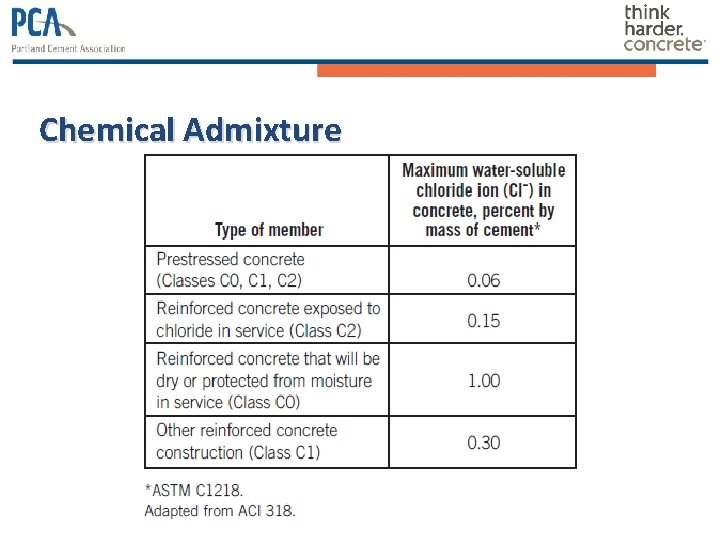
Chemical Admixture
Proportioning • Weight proportioning methods are fairly simple and quick for estimating mixture proportions using an assumed or known weight of concrete per unit volume. • A more accurate method, absolute volume, involves use of relative density (specific gravity) values. • The absolute volume method will be illustrated.
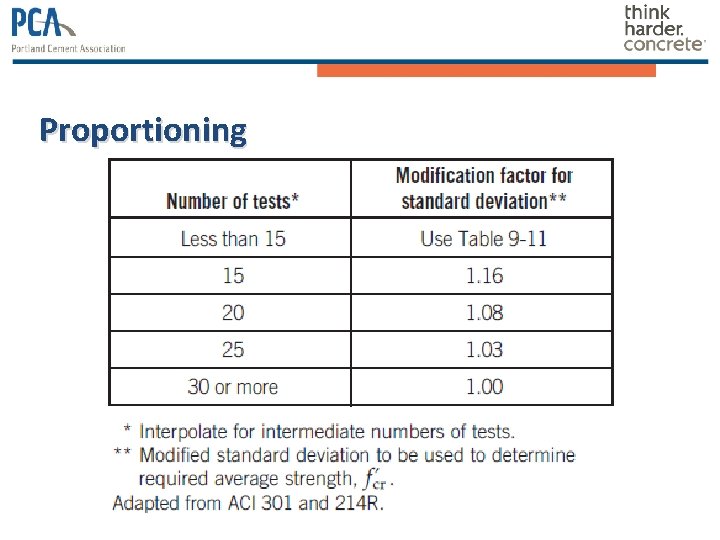
Proportioning
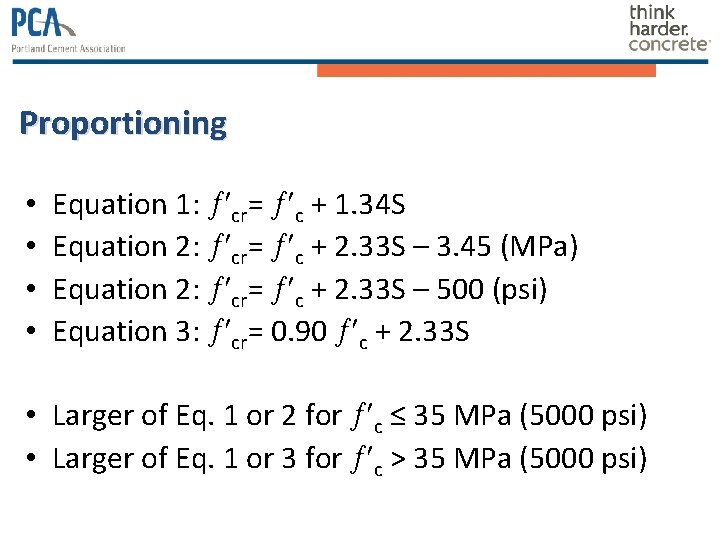
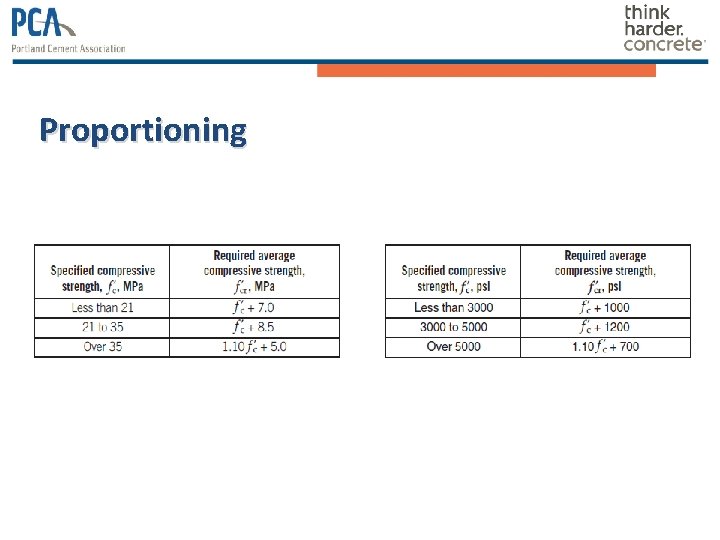
Proportioning • • Equation 1: cr= c + 1. 34 S Equation 2: cr= c + 2. 33 S – 3. 45 (MPa) Equation 2: cr= c + 2. 33 S – 500 (psi) Equation 3: cr= 0. 90 c + 2. 33 S • Larger of Eq. 1 or 2 for c ≤ 35 MPa (5000 psi) • Larger of Eq. 1 or 3 for c > 35 MPa (5000 psi)
Proportioning
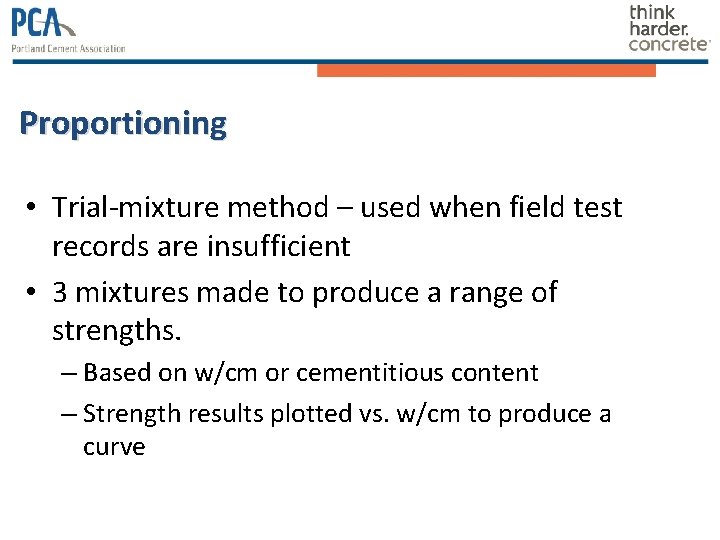
Proportioning • Trial-mixture method – used when field test records are insufficient • 3 mixtures made to produce a range of strengths. – Based on w/cm or cementitious content – Strength results plotted vs. w/cm to produce a curve
Proportioning A number of different methods of proportioning concrete ingredients have been used including: • Arbitrary assignment (1: 2: 3), volumetric • Void ratio • Fineness modulus • Surface area of aggregates • Cement content
Proportioning Parameters for concrete trial-mixtures 1. Required strength 2. Minimum cementing materials content or maximum water-cementing materials ratio 3. Nominal maximum size of aggregate 4. Air content 5. Desired slump
Measurements and Calculations
Measurements and Calculations The volume of concrete in a batch can be determined by either of two methods: (1) if the relative densities of the aggregates and cementing materials are known, these can be used to calculate concrete volume (2) if relative densities are unknown, or they vary, the volume can be computed by dividing the total mass of materials in the mixer by the density of concrete.
Measurements and Calculations
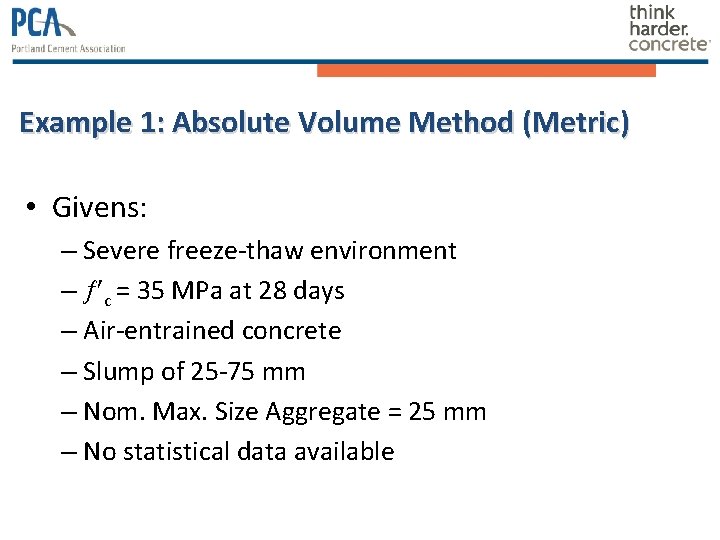
Example 1: Absolute Volume Method (Metric) • Givens: – Severe freeze-thaw environment – c = 35 MPa at 28 days – Air-entrained concrete – Slump of 25 -75 mm – Nom. Max. Size Aggregate = 25 mm – No statistical data available
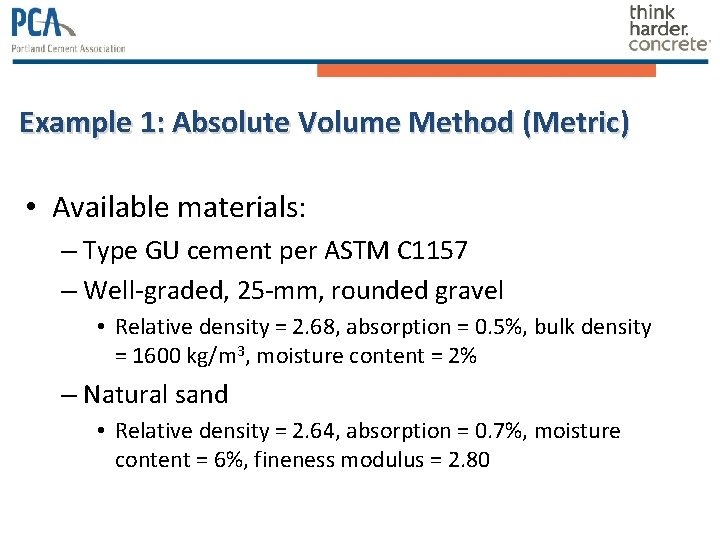
Example 1: Absolute Volume Method (Metric) • Available materials: – Type GU cement per ASTM C 1157 – Well-graded, 25 -mm, rounded gravel • Relative density = 2. 68, absorption = 0. 5%, bulk density = 1600 kg/m 3, moisture content = 2% – Natural sand • Relative density = 2. 64, absorption = 0. 7%, moisture content = 6%, fineness modulus = 2. 80
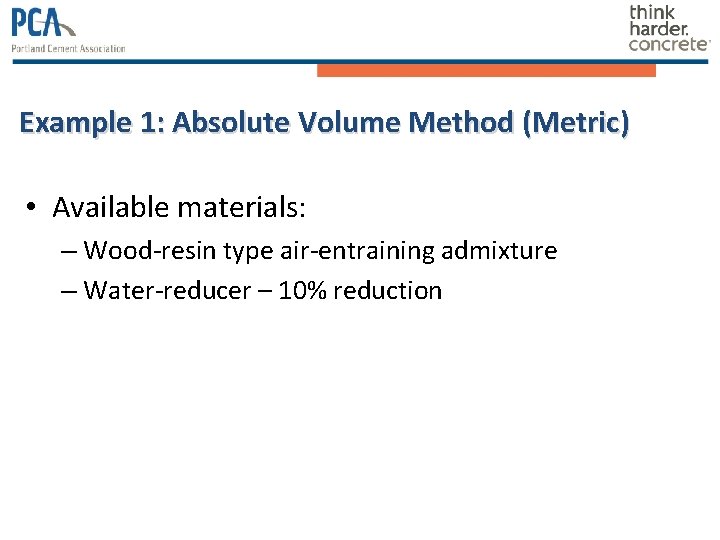
Example 1: Absolute Volume Method (Metric) • Available materials: – Wood-resin type air-entraining admixture – Water-reducer – 10% reduction
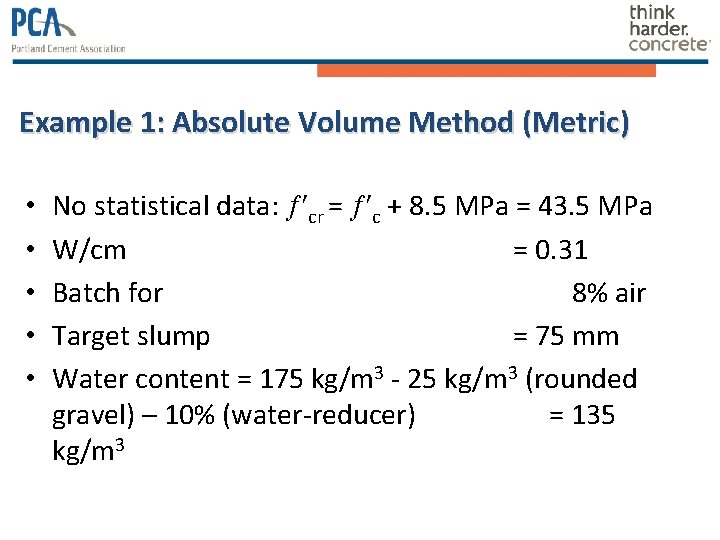
Example 1: Absolute Volume Method (Metric) • • • No statistical data: cr = c + 8. 5 MPa = 43. 5 MPa W/cm = 0. 31 Batch for 8% air Target slump = 75 mm Water content = 175 kg/m 3 - 25 kg/m 3 (rounded gravel) – 10% (water-reducer) = 135 kg/m 3
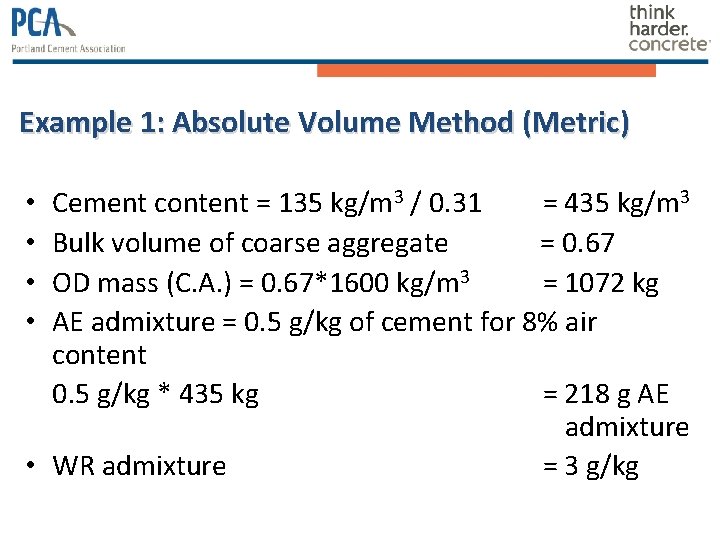
Example 1: Absolute Volume Method (Metric) Cement content = 135 kg/m 3 / 0. 31 = 435 kg/m 3 Bulk volume of coarse aggregate = 0. 67 OD mass (C. A. ) = 0. 67*1600 kg/m 3 = 1072 kg AE admixture = 0. 5 g/kg of cement for 8% air content 0. 5 g/kg * 435 kg = 218 g AE admixture • WR admixture = 3 g/kg • •
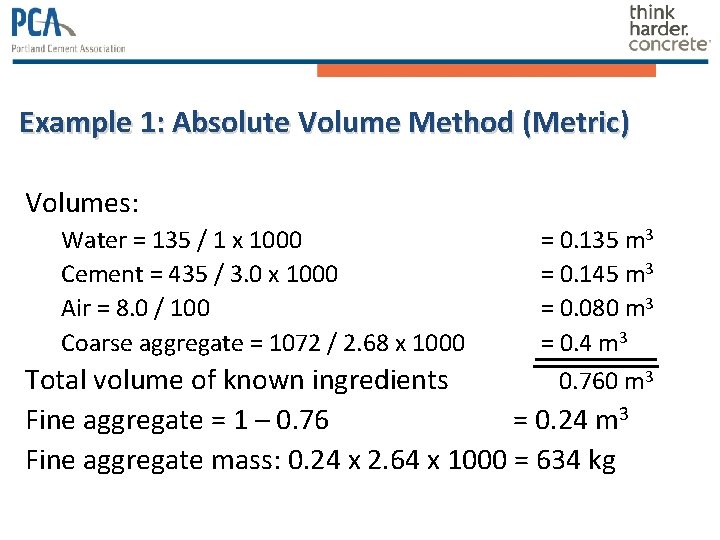
Example 1: Absolute Volume Method (Metric) Volumes: Water = 135 / 1 x 1000 Cement = 435 / 3. 0 x 1000 Air = 8. 0 / 100 Coarse aggregate = 1072 / 2. 68 x 1000 = 0. 135 m 3 = 0. 145 m 3 = 0. 080 m 3 = 0. 4 m 3 0. 760 m 3 Total volume of known ingredients Fine aggregate = 1 – 0. 76 = 0. 24 m 3 Fine aggregate mass: 0. 24 x 2. 64 x 1000 = 634 kg
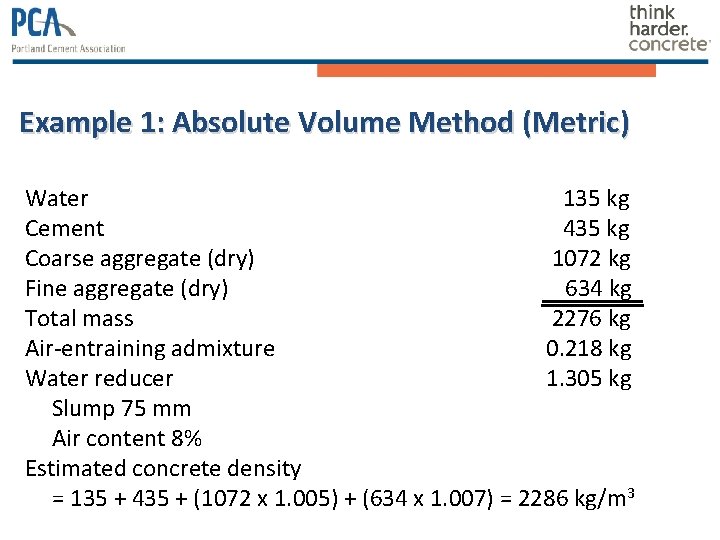
Example 1: Absolute Volume Method (Metric) Water 135 kg Cement 435 kg Coarse aggregate (dry) 1072 kg Fine aggregate (dry) 634 kg Total mass 2276 kg Air-entraining admixture 0. 218 kg Water reducer 1. 305 kg Slump 75 mm Air content 8% Estimated concrete density = 135 + 435 + (1072 x 1. 005) + (634 x 1. 007) = 2286 kg/m 3
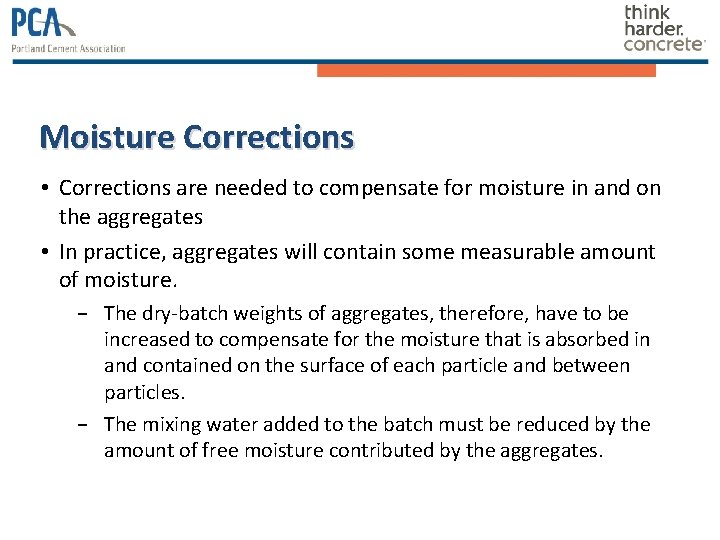
Moisture Corrections • Corrections are needed to compensate for moisture in and on the aggregates • In practice, aggregates will contain some measurable amount of moisture. − The dry-batch weights of aggregates, therefore, have to be increased to compensate for the moisture that is absorbed in and contained on the surface of each particle and between particles. − The mixing water added to the batch must be reduced by the amount of free moisture contributed by the aggregates.
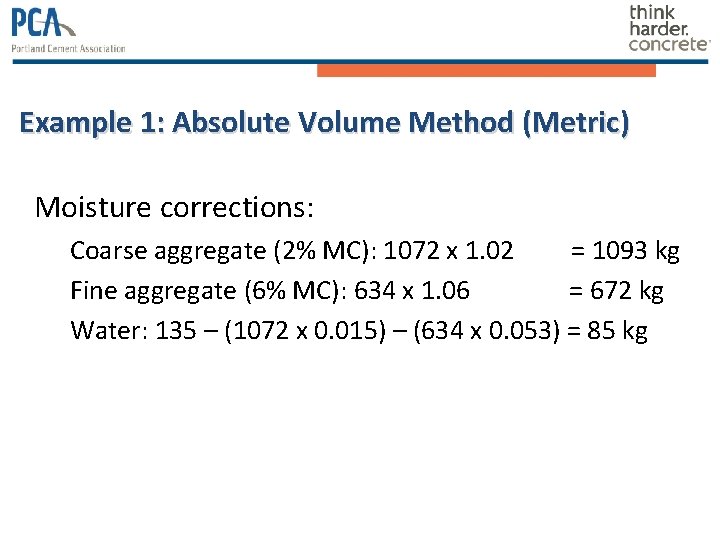
Example 1: Absolute Volume Method (Metric) Moisture corrections: Coarse aggregate (2% MC): 1072 x 1. 02 = 1093 kg Fine aggregate (6% MC): 634 x 1. 06 = 672 kg Water: 135 – (1072 x 0. 015) – (634 x 0. 053) = 85 kg
Example 1: Absolute Volume Method (Metric) First Trial Batch: • At this stage, the estimated batch weights should be checked by means of trial batches or by full-size field batches. • Enough concrete must be mixed for appropriate air and slump tests and for casting the three cylinders required for 28 -day compressive-strength tests, plus beams for flexural tests if necessary.
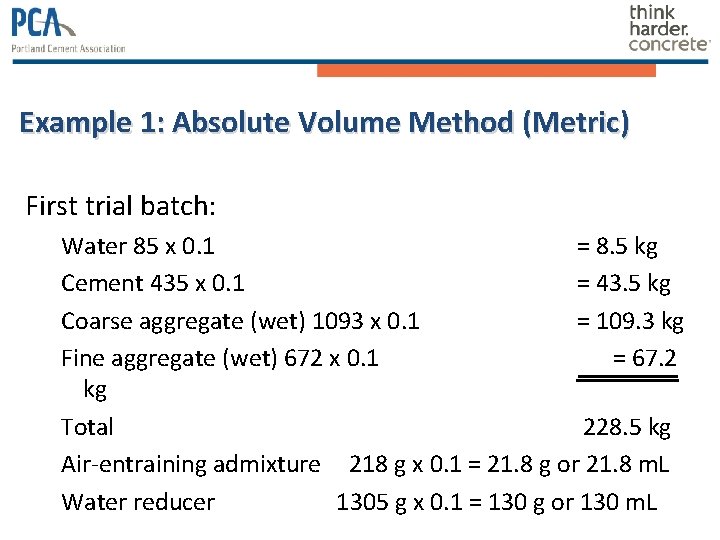
Example 1: Absolute Volume Method (Metric) First trial batch: Water 85 x 0. 1 = 8. 5 kg Cement 435 x 0. 1 = 43. 5 kg Coarse aggregate (wet) 1093 x 0. 1 = 109. 3 kg Fine aggregate (wet) 672 x 0. 1 = 67. 2 kg Total 228. 5 kg Air-entraining admixture 218 g x 0. 1 = 21. 8 g or 21. 8 m. L Water reducer 1305 g x 0. 1 = 130 g or 130 m. L
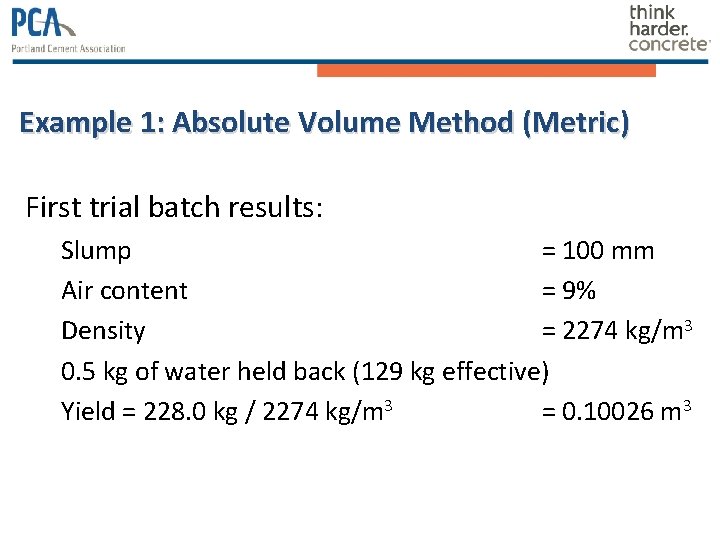
Example 1: Absolute Volume Method (Metric) First trial batch results: Slump = 100 mm Air content = 9% Density = 2274 kg/m 3 0. 5 kg of water held back (129 kg effective) Yield = 228. 0 kg / 2274 kg/m 3 = 0. 10026 m 3
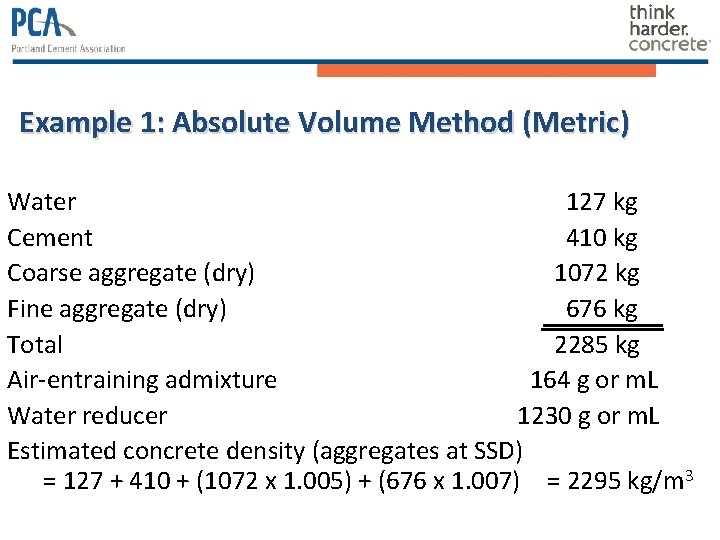
Example 1: Absolute Volume Method (Metric) Water 127 kg Cement 410 kg Coarse aggregate (dry) 1072 kg Fine aggregate (dry) 676 kg Total 2285 kg Air-entraining admixture 164 g or m. L Water reducer 1230 g or m. L Estimated concrete density (aggregates at SSD) = 127 + 410 + (1072 x 1. 005) + (676 x 1. 007) = 2295 kg/m 3
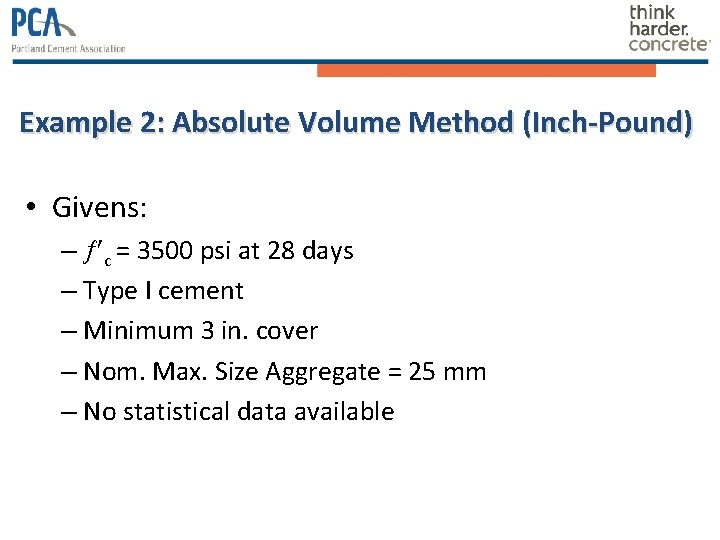
Example 2: Absolute Volume Method (Inch-Pound) • Givens: – c = 3500 psi at 28 days – Type I cement – Minimum 3 in. cover – Nom. Max. Size Aggregate = 25 mm – No statistical data available
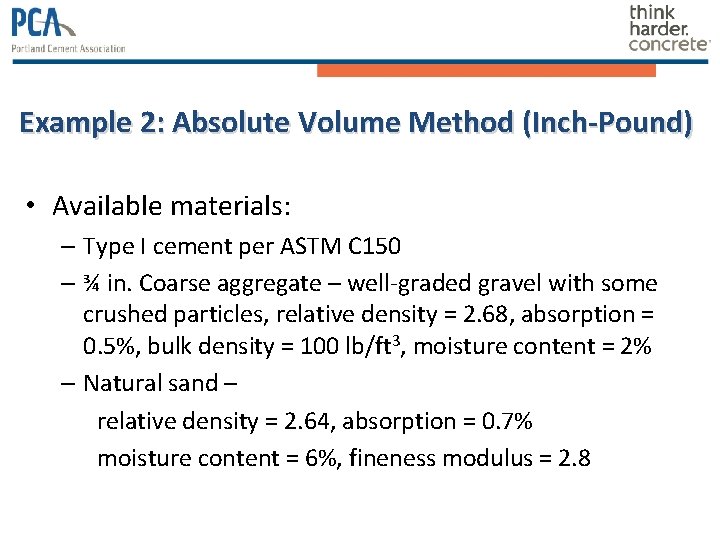
Example 2: Absolute Volume Method (Inch-Pound) • Available materials: – Type I cement per ASTM C 150 – ¾ in. Coarse aggregate – well-graded gravel with some crushed particles, relative density = 2. 68, absorption = 0. 5%, bulk density = 100 lb/ft 3, moisture content = 2% – Natural sand – relative density = 2. 64, absorption = 0. 7% moisture content = 6%, fineness modulus = 2. 8
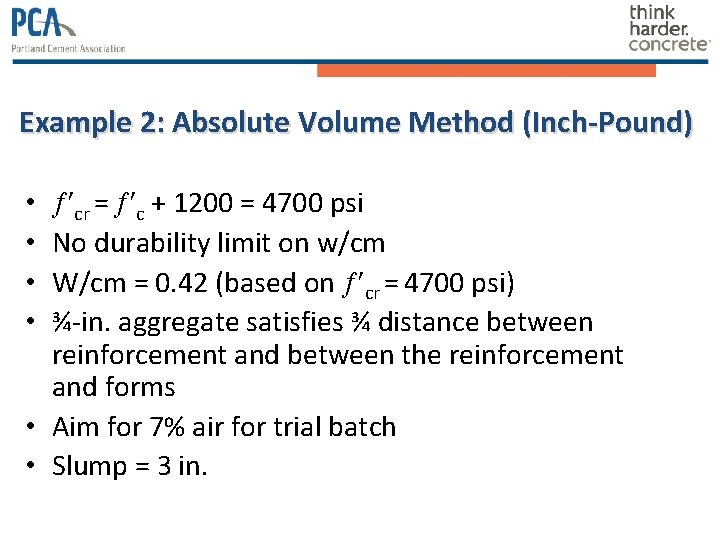
Example 2: Absolute Volume Method (Inch-Pound) cr = c + 1200 = 4700 psi No durability limit on w/cm W/cm = 0. 42 (based on cr = 4700 psi) ¾-in. aggregate satisfies ¾ distance between reinforcement and between the reinforcement and forms • Aim for 7% air for trial batch • Slump = 3 in. • •
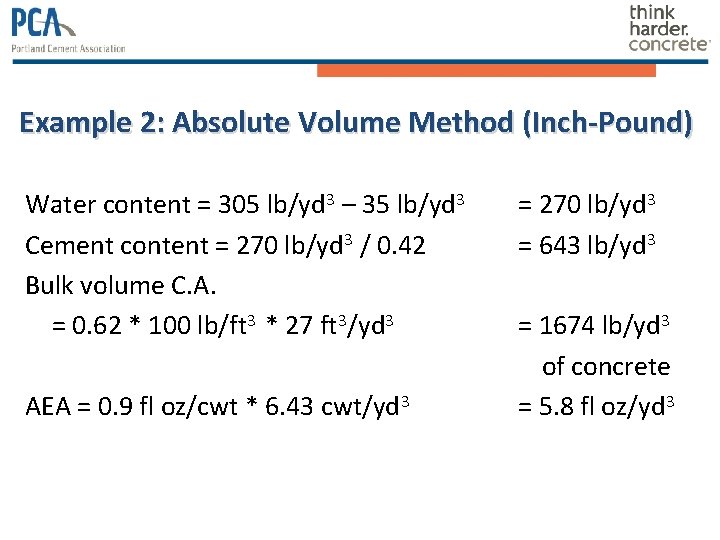
Example 2: Absolute Volume Method (Inch-Pound) Water content = 305 lb/yd 3 – 35 lb/yd 3 Cement content = 270 lb/yd 3 / 0. 42 Bulk volume C. A. = 0. 62 * 100 lb/ft 3 * 27 ft 3/yd 3 AEA = 0. 9 fl oz/cwt * 6. 43 cwt/yd 3 = 270 lb/yd 3 = 643 lb/yd 3 = 1674 lb/yd 3 of concrete = 5. 8 fl oz/yd 3
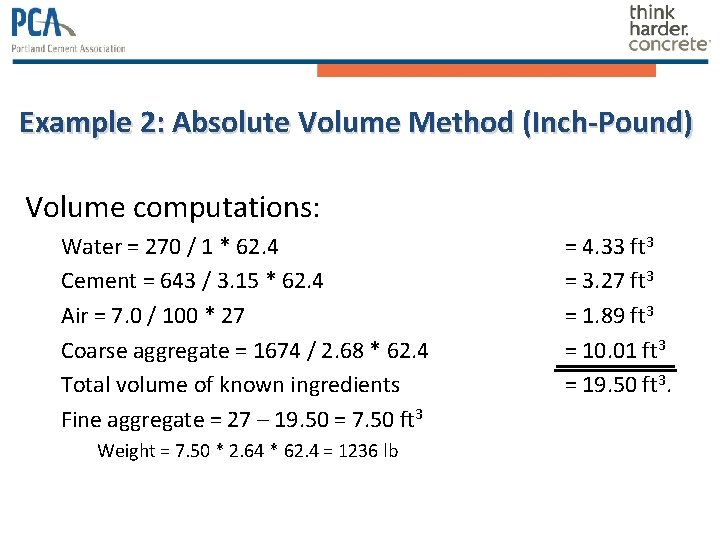
Example 2: Absolute Volume Method (Inch-Pound) Volume computations: Water = 270 / 1 * 62. 4 Cement = 643 / 3. 15 * 62. 4 Air = 7. 0 / 100 * 27 Coarse aggregate = 1674 / 2. 68 * 62. 4 Total volume of known ingredients Fine aggregate = 27 – 19. 50 = 7. 50 ft 3 Weight = 7. 50 * 2. 64 * 62. 4 = 1236 lb = 4. 33 ft 3 = 3. 27 ft 3 = 1. 89 ft 3 = 10. 01 ft 3 = 19. 50 ft 3.
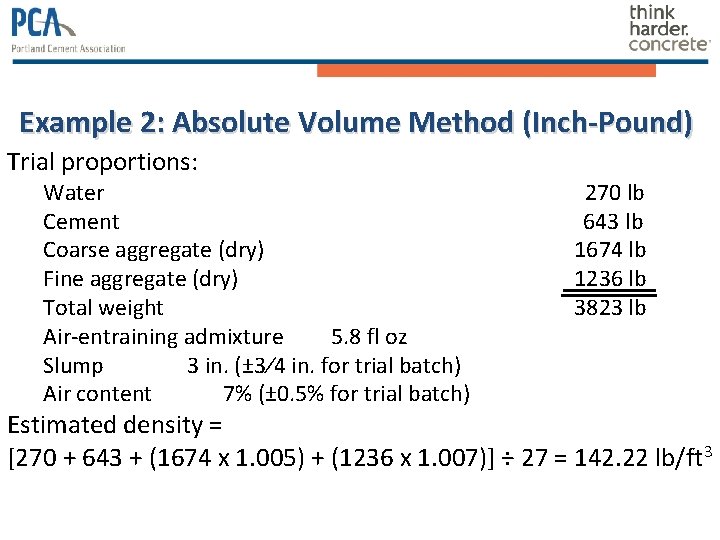
Example 2: Absolute Volume Method (Inch-Pound) Trial proportions: Water Cement Coarse aggregate (dry) Fine aggregate (dry) Total weight Air-entraining admixture 5. 8 fl oz Slump 3 in. (± 3⁄4 in. for trial batch) Air content 7% (± 0. 5% for trial batch) 270 lb 643 lb 1674 lb 1236 lb 3823 lb Estimated density = [270 + 643 + (1674 x 1. 005) + (1236 x 1. 007)] ÷ 27 = 142. 22 lb/ft 3
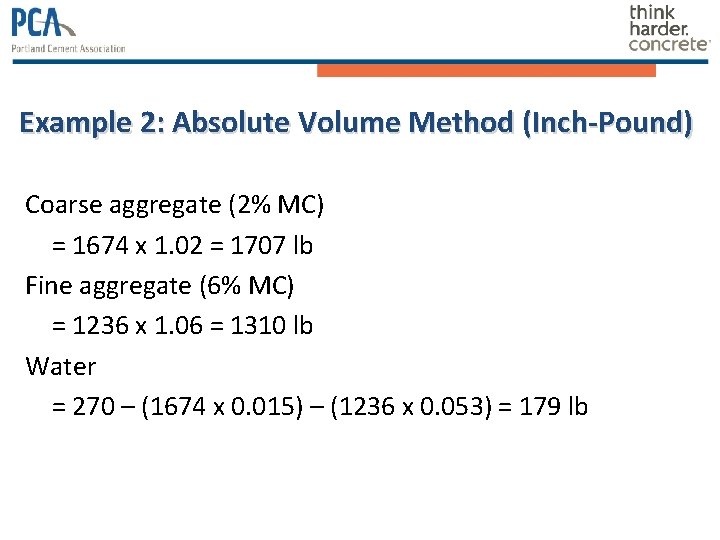
Example 2: Absolute Volume Method (Inch-Pound) Coarse aggregate (2% MC) = 1674 x 1. 02 = 1707 lb Fine aggregate (6% MC) = 1236 x 1. 06 = 1310 lb Water = 270 – (1674 x 0. 015) – (1236 x 0. 053) = 179 lb
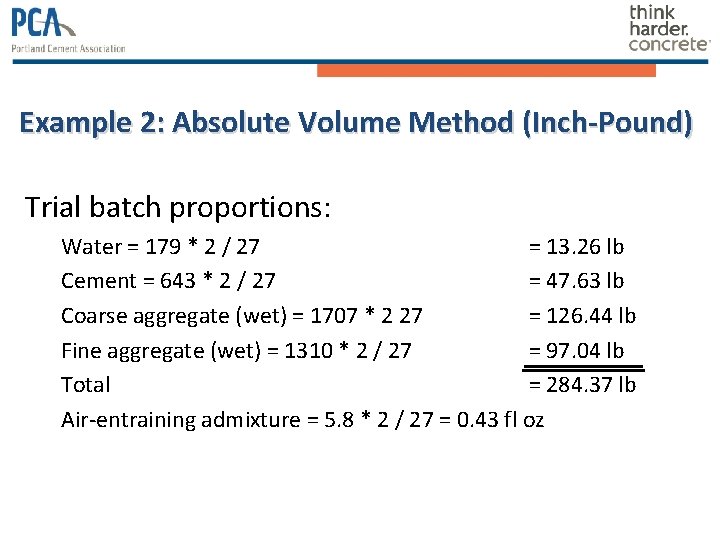
Example 2: Absolute Volume Method (Inch-Pound) Trial batch proportions: Water = 179 * 2 / 27 = 13. 26 lb Cement = 643 * 2 / 27 = 47. 63 lb Coarse aggregate (wet) = 1707 * 2 27 = 126. 44 lb Fine aggregate (wet) = 1310 * 2 / 27 = 97. 04 lb Total = 284. 37 lb Air-entraining admixture = 5. 8 * 2 / 27 = 0. 43 fl oz
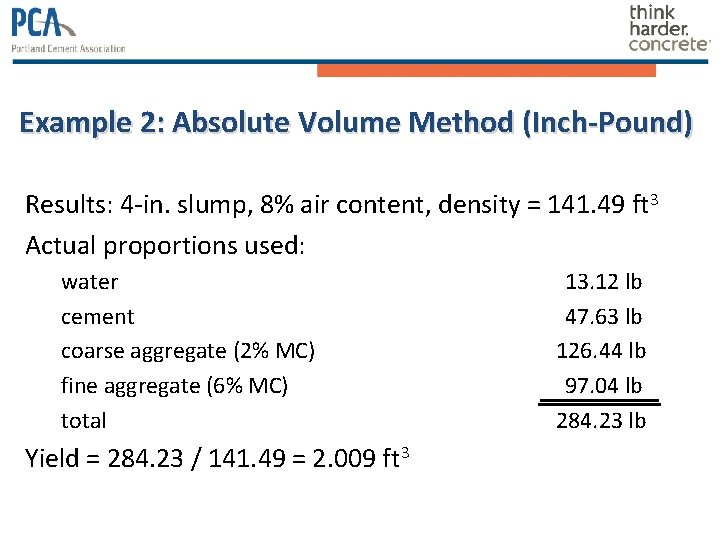
Example 2: Absolute Volume Method (Inch-Pound) Results: 4 -in. slump, 8% air content, density = 141. 49 ft 3 Actual proportions used: water cement coarse aggregate (2% MC) fine aggregate (6% MC) total Yield = 284. 23 / 141. 49 = 2. 009 ft 3 13. 12 lb 47. 63 lb 126. 44 lb 97. 04 lb 284. 23 lb
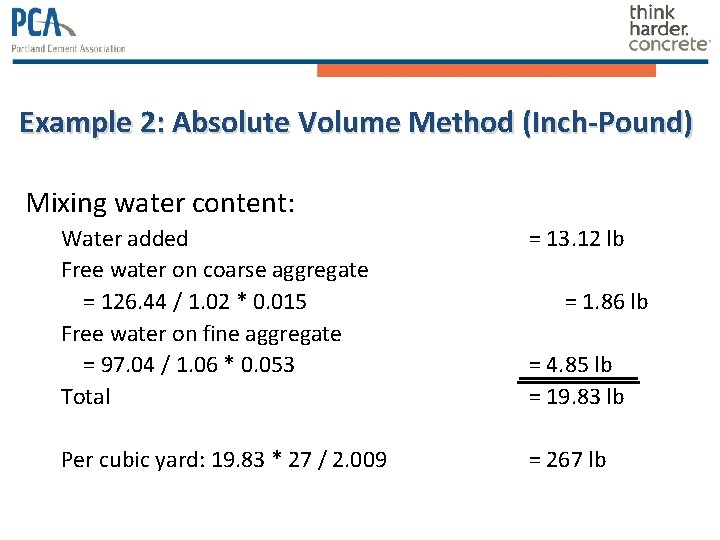
Example 2: Absolute Volume Method (Inch-Pound) Mixing water content: Water added Free water on coarse aggregate = 126. 44 / 1. 02 * 0. 015 Free water on fine aggregate = 97. 04 / 1. 06 * 0. 053 Total = 13. 12 lb Per cubic yard: 19. 83 * 27 / 2. 009 = 267 lb = 1. 86 lb = 4. 85 lb = 19. 83 lb
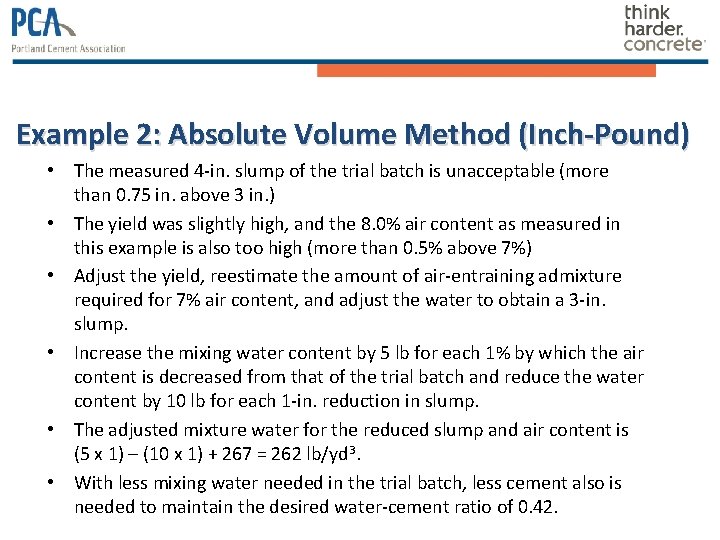
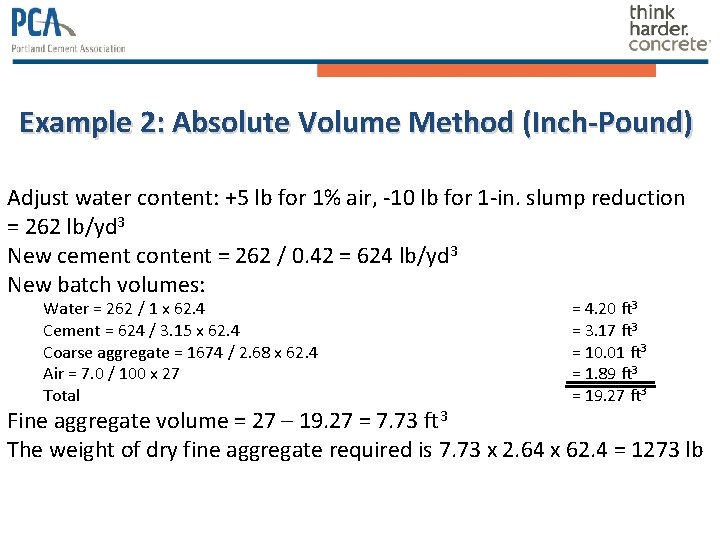
Example 2: Absolute Volume Method (Inch-Pound) • The measured 4 -in. slump of the trial batch is unacceptable (more than 0. 75 in. above 3 in. ) • The yield was slightly high, and the 8. 0% air content as measured in this example is also too high (more than 0. 5% above 7%) • Adjust the yield, reestimate the amount of air-entraining admixture required for 7% air content, and adjust the water to obtain a 3 -in. slump. • Increase the mixing water content by 5 lb for each 1% by which the air content is decreased from that of the trial batch and reduce the water content by 10 lb for each 1 -in. reduction in slump. • The adjusted mixture water for the reduced slump and air content is (5 x 1) – (10 x 1) + 267 = 262 lb/yd 3. • With less mixing water needed in the trial batch, less cement also is needed to maintain the desired water-cement ratio of 0. 42.
Example 2: Absolute Volume Method (Inch-Pound) Adjust water content: +5 lb for 1% air, -10 lb for 1 -in. slump reduction = 262 lb/yd 3 New cement content = 262 / 0. 42 = 624 lb/yd 3 New batch volumes: Water = 262 / 1 x 62. 4 Cement = 624 / 3. 15 x 62. 4 Coarse aggregate = 1674 / 2. 68 x 62. 4 Air = 7. 0 / 100 x 27 Total = 4. 20 ft 3 = 3. 17 ft 3 = 10. 01 ft 3 = 1. 89 ft 3 = 19. 27 ft 3 Fine aggregate volume = 27 – 19. 27 = 7. 73 ft 3 The weight of dry fine aggregate required is 7. 73 x 2. 64 x 62. 4 = 1273 lb
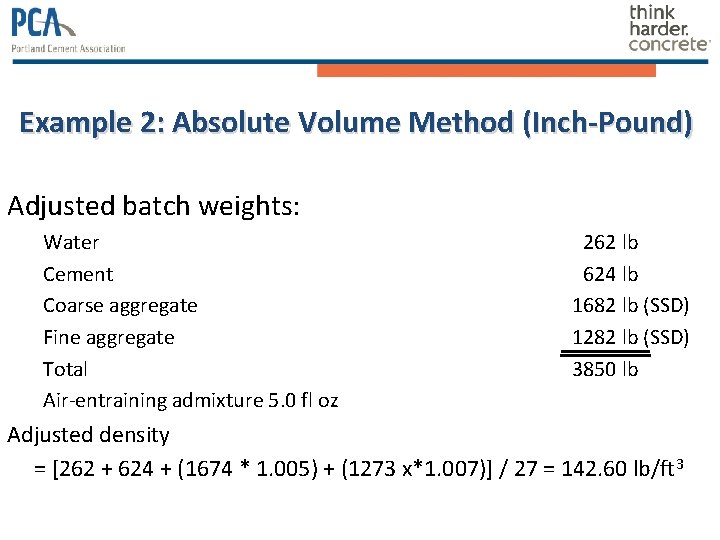
Example 2: Absolute Volume Method (Inch-Pound) Adjusted batch weights: Water Cement Coarse aggregate Fine aggregate Total Air-entraining admixture 5. 0 fl oz 262 lb 624 lb 1682 lb (SSD) 1282 lb (SSD) 3850 lb Adjusted density = [262 + 624 + (1674 * 1. 005) + (1273 x*1. 007)] / 27 = 142. 60 lb/ft 3
Example 3: Laboratory Trial Mixture (Metric)
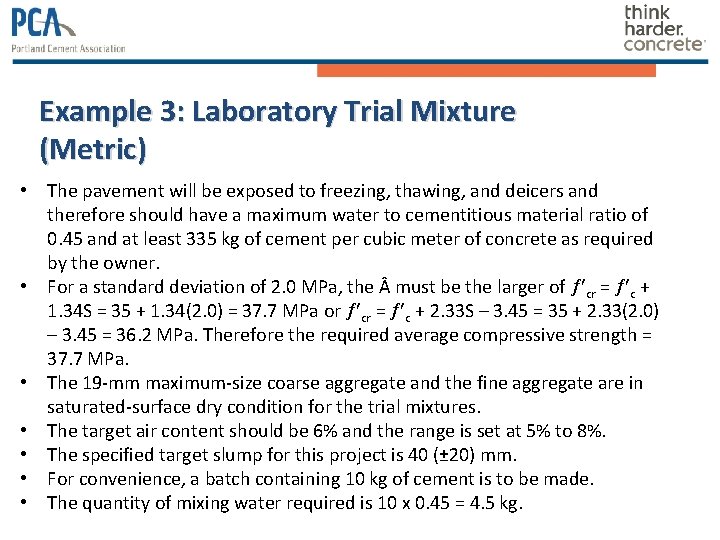
Example 3: Laboratory Trial Mixture (Metric) • The pavement will be exposed to freezing, thawing, and deicers and therefore should have a maximum water to cementitious material ratio of 0. 45 and at least 335 kg of cement per cubic meter of concrete as required by the owner. • For a standard deviation of 2. 0 MPa, the must be the larger of cr = c + 1. 34 S = 35 + 1. 34(2. 0) = 37. 7 MPa or cr = c + 2. 33 S – 3. 45 = 35 + 2. 33(2. 0) – 3. 45 = 36. 2 MPa. Therefore the required average compressive strength = 37. 7 MPa. • The 19 -mm maximum-size coarse aggregate and the fine aggregate are in saturated-surface dry condition for the trial mixtures. • The target air content should be 6% and the range is set at 5% to 8%. • The specified target slump for this project is 40 (± 20) mm. • For convenience, a batch containing 10 kg of cement is to be made. • The quantity of mixing water required is 10 x 0. 45 = 4. 5 kg.
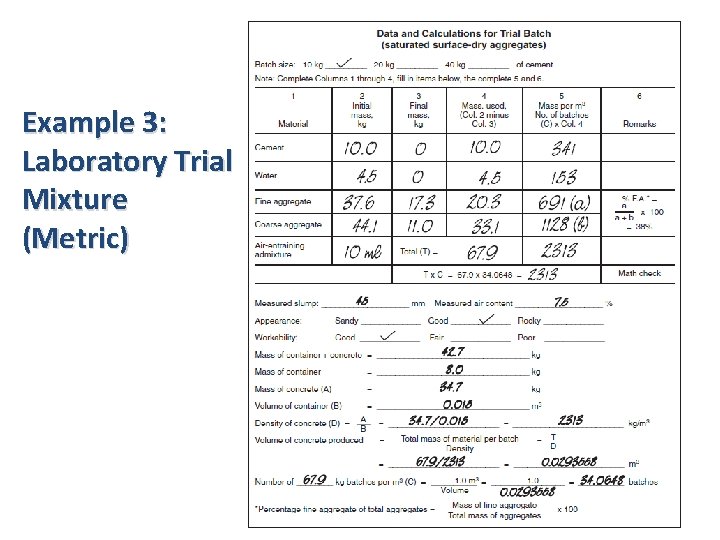
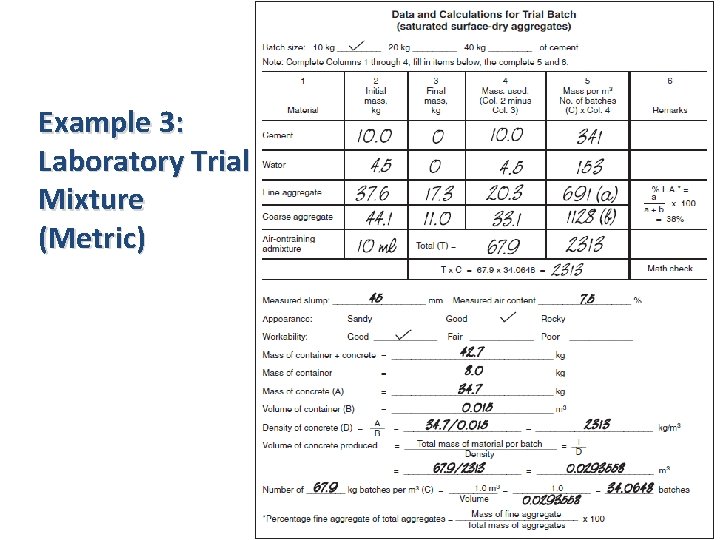
Example 3: Laboratory Trial Mixture (Metric) • Representative samples of fine and coarse aggregates are measured in suitable containers. • The values are entered as initial mass in Column 2 of the trial-batch data sheet. • All of the measured quantities of cement, water, and air-entraining admixture are used and added to the mixer. • Fine and coarse aggregates, previously brought to a saturated, surface-dry condition, are added until a workable concrete mixture with a slump deemed adequate for placement is produced. • The relative proportions of fine and coarse aggregate for workability can readily be judged by an experienced concrete technician or engineer.
Example 3: Laboratory Trial Mixture (Metric)
Example 3: Laboratory Trial Mixture (Metric)
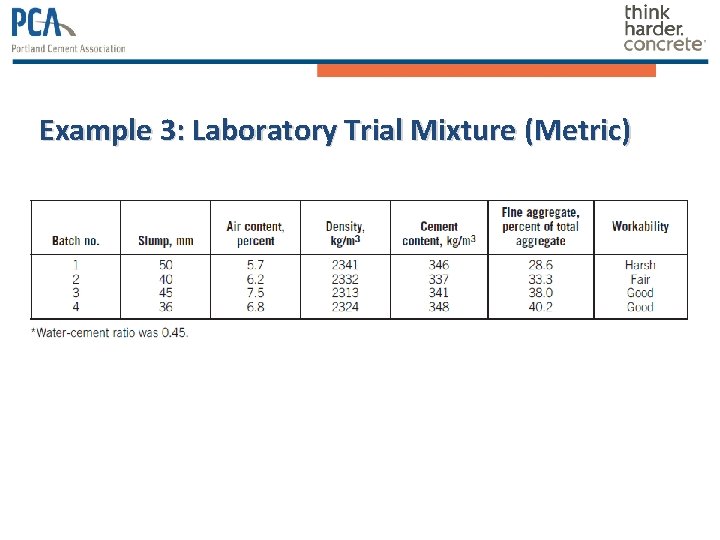
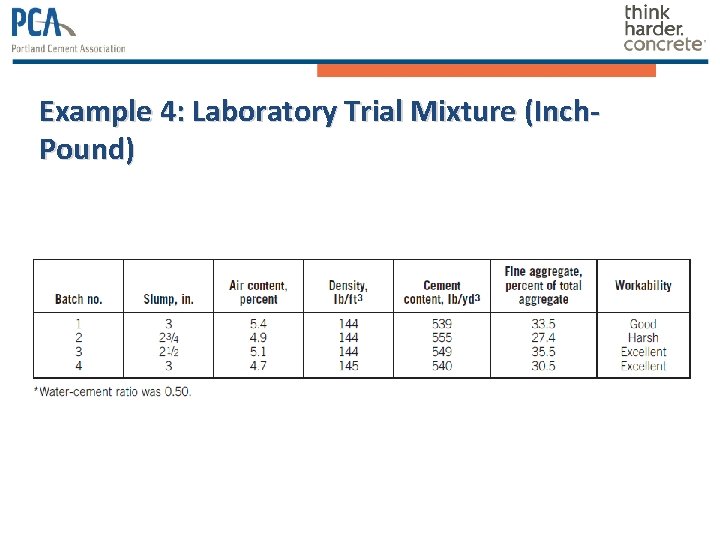
Example 3: Laboratory Trial Mixture (Metric) • The percentage of fine aggregate by mass of total aggregate is also calculated. • In this trial batch, the cement content was 341 kg/m 3 and the fine aggregate made up 38% of the total aggregate by mass. • The air content and slump were acceptable. • The 28 -day strength was 39. 1 MPa, greater than cr. • The mixture in Column 5, along with slump and air content limits of 40 (± 20) mm and 5% to 8%, respectively, is now ready for submission to the project engineer.
Example 4: Laboratory Trial Mixture (Inch. Pound)
Example 4: Laboratory Trial Mixture (Inch-Pound)
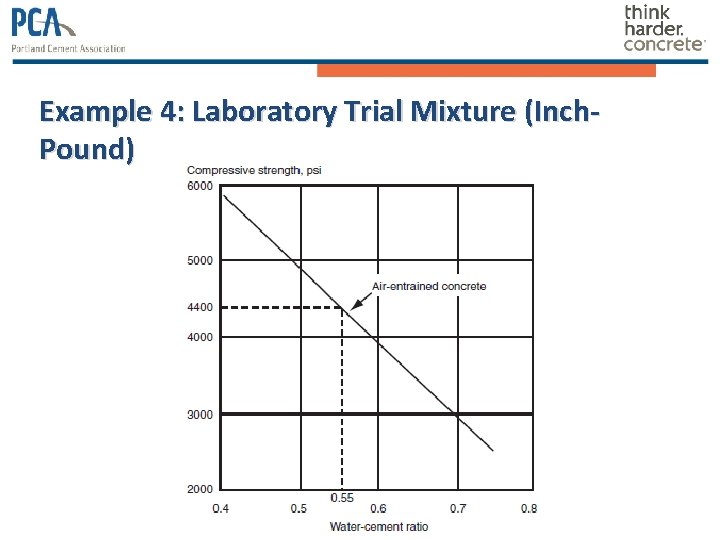
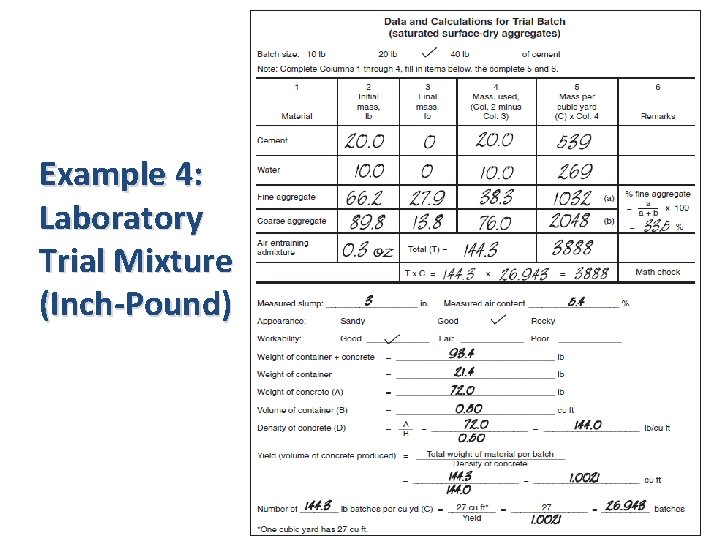
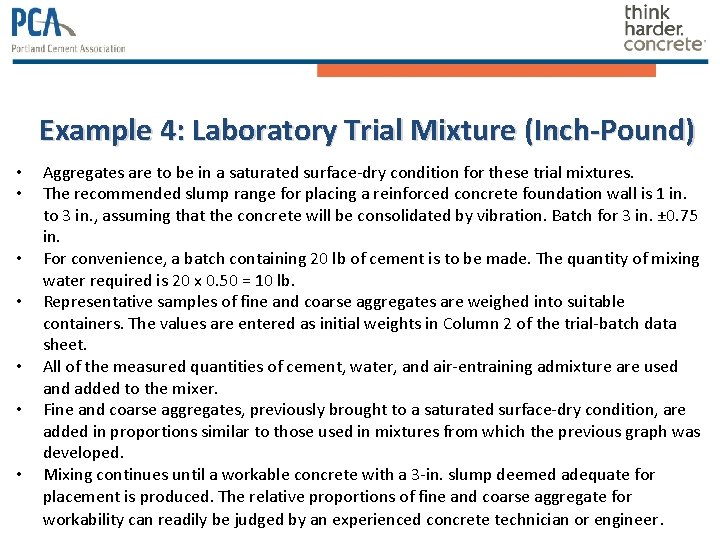
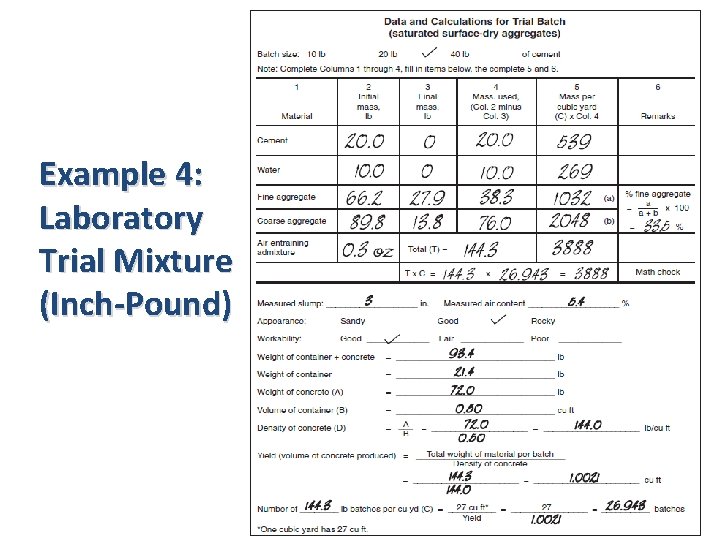
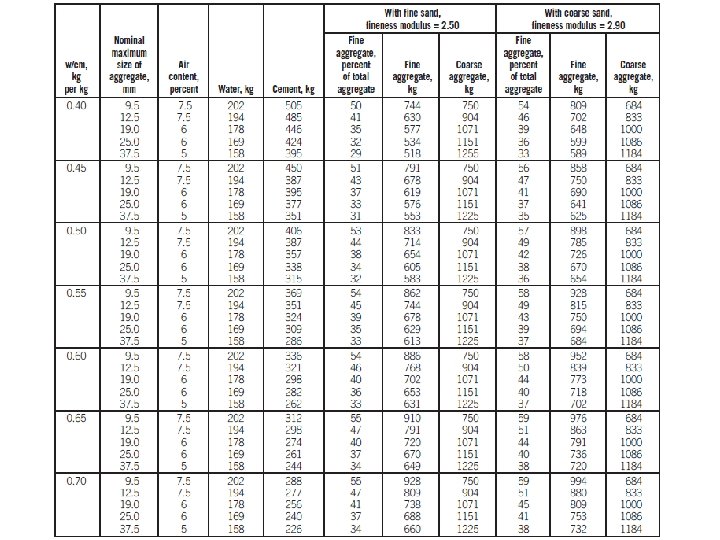
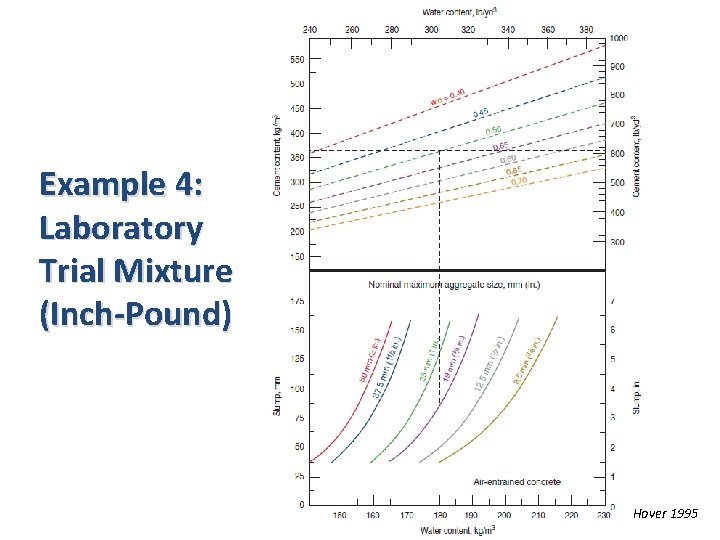
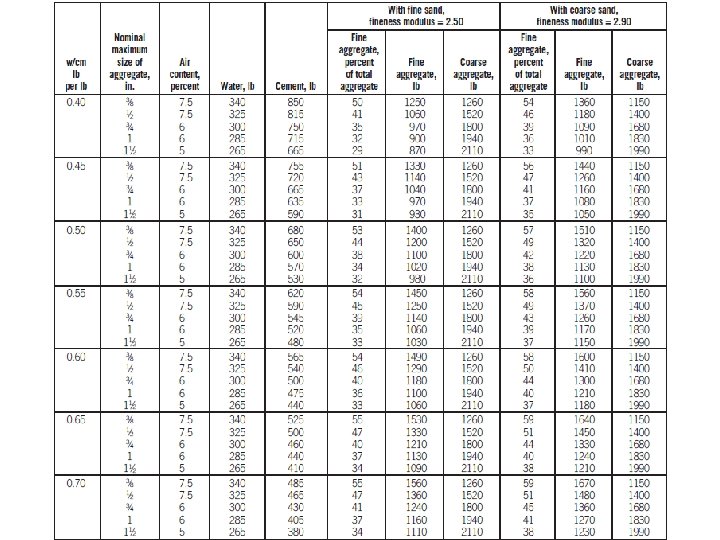
Example 4: Laboratory Trial Mixture (Inch-Pound) • • Aggregates are to be in a saturated surface-dry condition for these trial mixtures. The recommended slump range for placing a reinforced concrete foundation wall is 1 in. to 3 in. , assuming that the concrete will be consolidated by vibration. Batch for 3 in. ± 0. 75 in. For convenience, a batch containing 20 lb of cement is to be made. The quantity of mixing water required is 20 x 0. 50 = 10 lb. Representative samples of fine and coarse aggregates are weighed into suitable containers. The values are entered as initial weights in Column 2 of the trial-batch data sheet. All of the measured quantities of cement, water, and air-entraining admixture are used and added to the mixer. Fine and coarse aggregates, previously brought to a saturated surface-dry condition, are added in proportions similar to those used in mixtures from which the previous graph was developed. Mixing continues until a workable concrete with a 3 -in. slump deemed adequate for placement is produced. The relative proportions of fine and coarse aggregate for workability can readily be judged by an experienced concrete technician or engineer.
Example 4: Laboratory Trial Mixture (Inch-Pound)
Example 4: Laboratory Trial Mixture (Inch. Pound)
Example 4: Laboratory Trial Mixture (Inch-Pound) Hover 1995
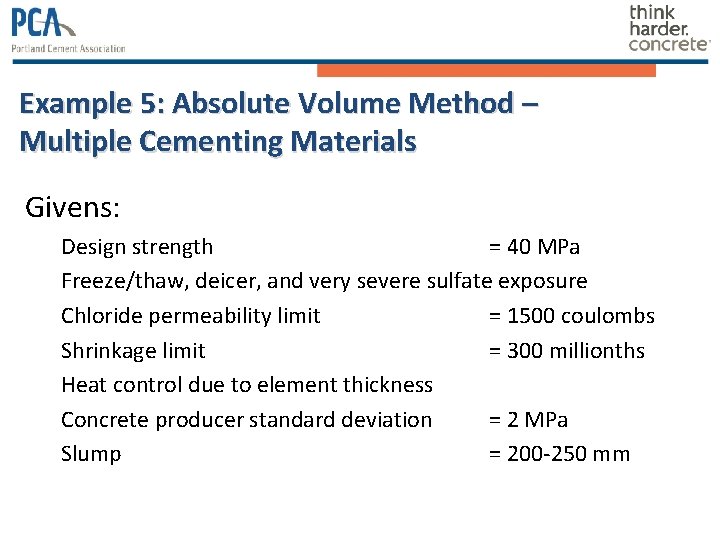
Example 5: Absolute Volume Method – Multiple Cementing Materials Givens: Design strength = 40 MPa Freeze/thaw, deicer, and very severe sulfate exposure Chloride permeability limit = 1500 coulombs Shrinkage limit = 300 millionths Heat control due to element thickness Concrete producer standard deviation = 2 MPa Slump = 200 -250 mm
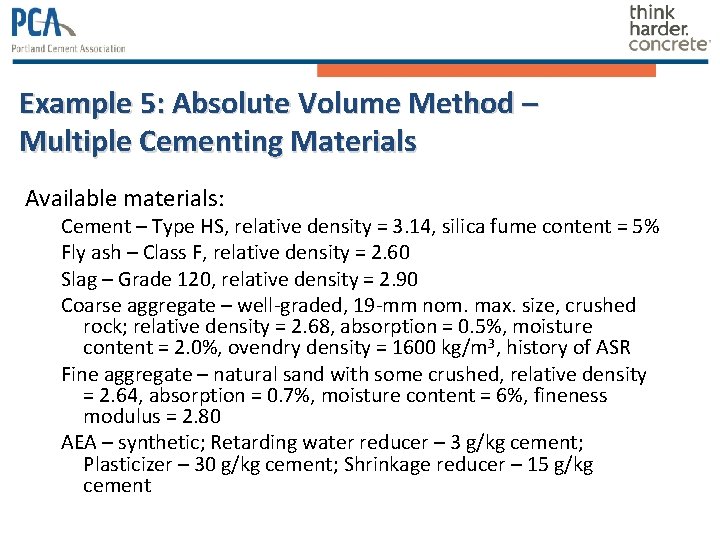
Example 5: Absolute Volume Method – Multiple Cementing Materials Available materials: Cement – Type HS, relative density = 3. 14, silica fume content = 5% Fly ash – Class F, relative density = 2. 60 Slag – Grade 120, relative density = 2. 90 Coarse aggregate – well-graded, 19 -mm nom. max. size, crushed rock; relative density = 2. 68, absorption = 0. 5%, moisture content = 2. 0%, ovendry density = 1600 kg/m 3, history of ASR Fine aggregate – natural sand with some crushed, relative density = 2. 64, absorption = 0. 7%, moisture content = 6%, fineness modulus = 2. 80 AEA – synthetic; Retarding water reducer – 3 g/kg cement; Plasticizer – 30 g/kg cement; Shrinkage reducer – 15 g/kg cement
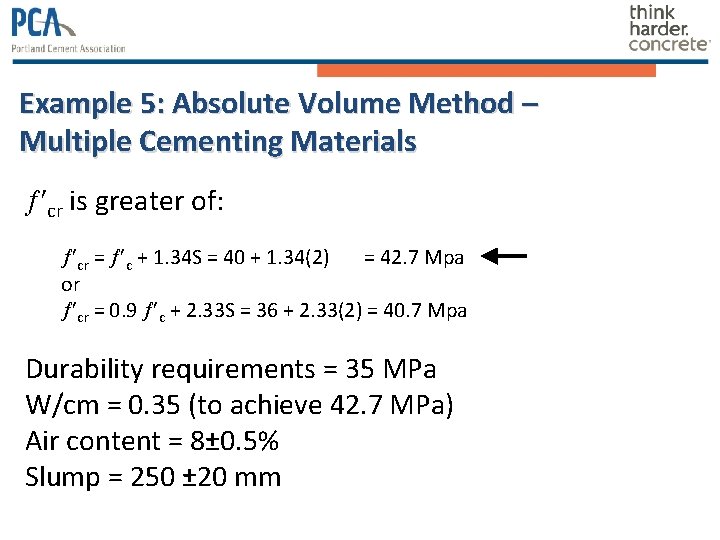
Example 5: Absolute Volume Method – Multiple Cementing Materials cr is greater of: cr = c + 1. 34 S = 40 + 1. 34(2) = 42. 7 Mpa or cr = 0. 9 c + 2. 33 S = 36 + 2. 33(2) = 40. 7 Mpa Durability requirements = 35 MPa W/cm = 0. 35 (to achieve 42. 7 MPa) Air content = 8± 0. 5% Slump = 250 ± 20 mm
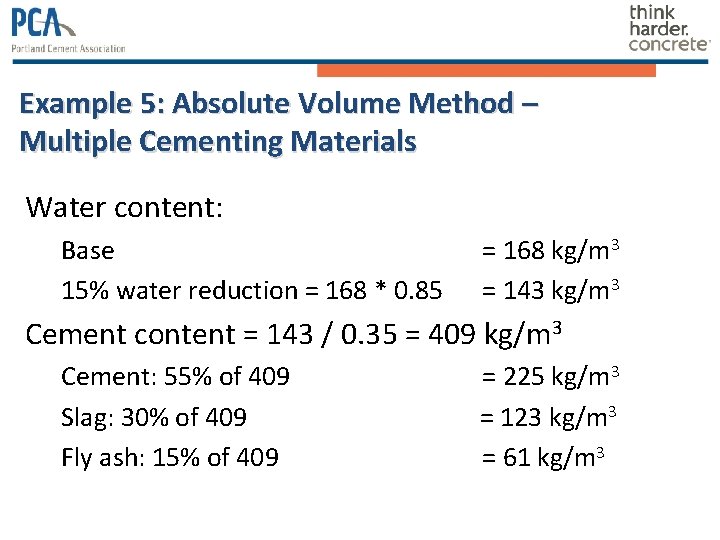
Example 5: Absolute Volume Method – Multiple Cementing Materials Water content: Base 15% water reduction = 168 * 0. 85 = 168 kg/m 3 = 143 kg/m 3 Cement content = 143 / 0. 35 = 409 kg/m 3 Cement: 55% of 409 Slag: 30% of 409 Fly ash: 15% of 409 = 225 kg/m 3 = 123 kg/m 3 = 61 kg/m 3
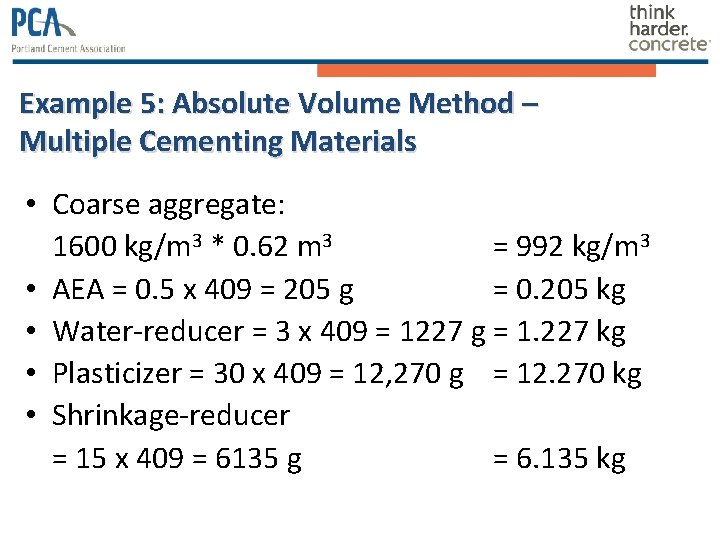
Example 5: Absolute Volume Method – Multiple Cementing Materials • Coarse aggregate: 1600 kg/m 3 * 0. 62 m 3 = 992 kg/m 3 • AEA = 0. 5 x 409 = 205 g = 0. 205 kg • Water-reducer = 3 x 409 = 1227 g = 1. 227 kg • Plasticizer = 30 x 409 = 12, 270 g = 12. 270 kg • Shrinkage-reducer = 15 x 409 = 6135 g = 6. 135 kg
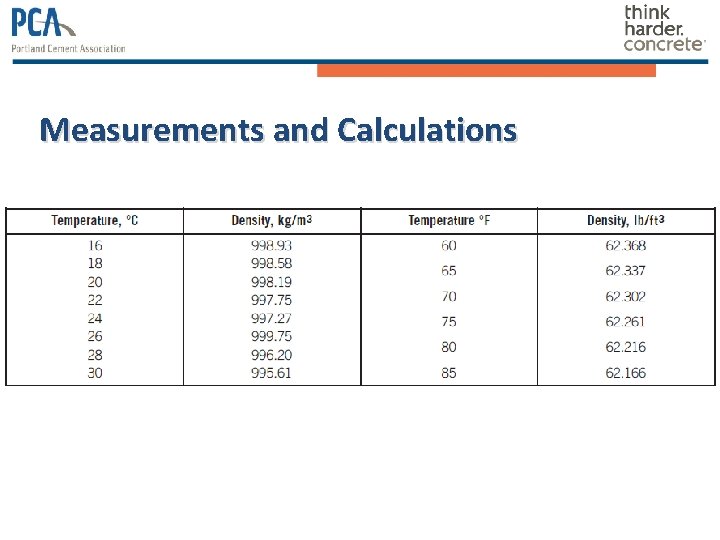
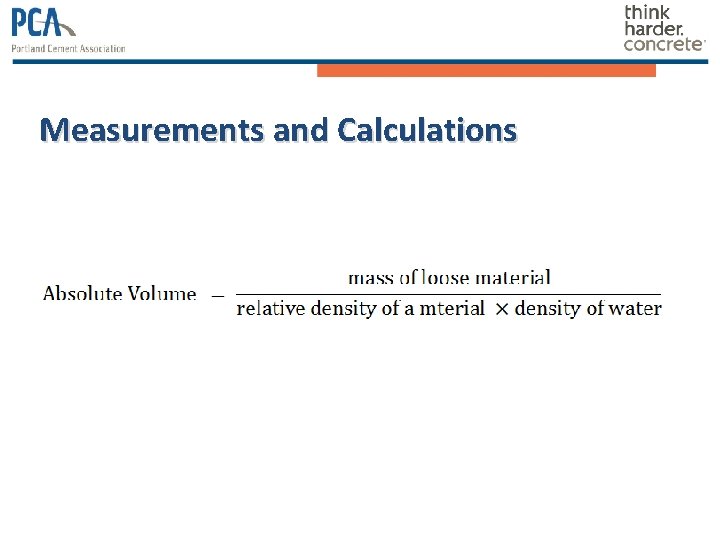
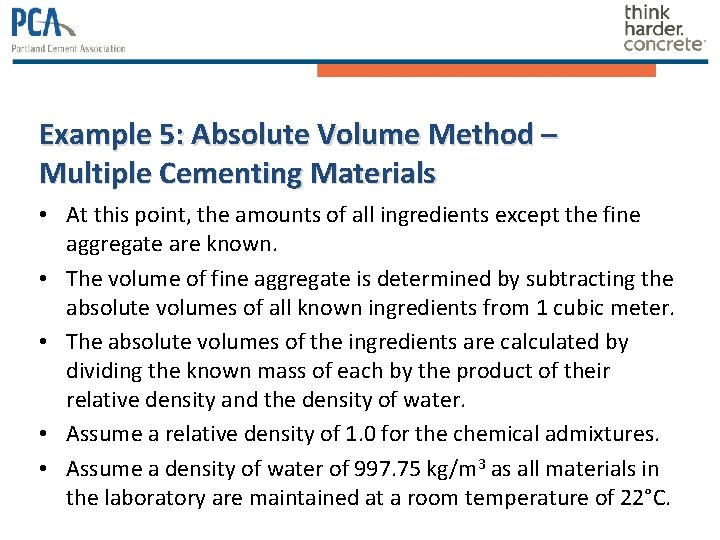
Example 5: Absolute Volume Method – Multiple Cementing Materials • At this point, the amounts of all ingredients except the fine aggregate are known. • The volume of fine aggregate is determined by subtracting the absolute volumes of all known ingredients from 1 cubic meter. • The absolute volumes of the ingredients are calculated by dividing the known mass of each by the product of their relative density and the density of water. • Assume a relative density of 1. 0 for the chemical admixtures. • Assume a density of water of 997. 75 kg/m 3 as all materials in the laboratory are maintained at a room temperature of 22°C.
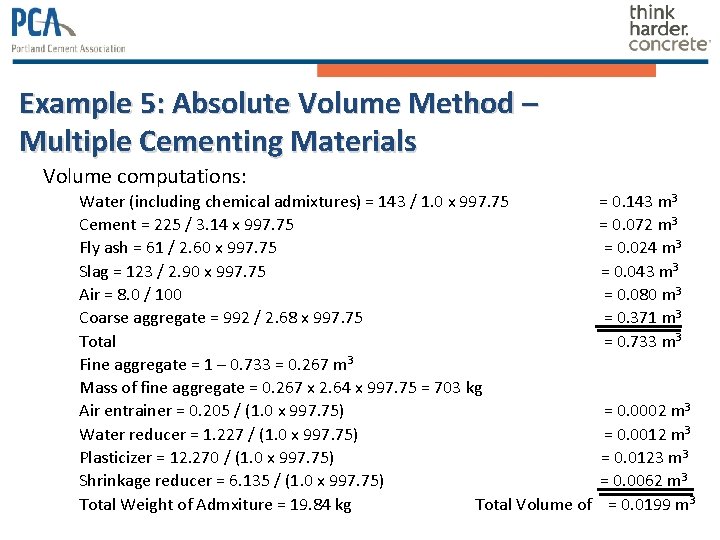
Example 5: Absolute Volume Method – Multiple Cementing Materials Volume computations: Water (including chemical admixtures) = 143 / 1. 0 x 997. 75 Cement = 225 / 3. 14 x 997. 75 Fly ash = 61 / 2. 60 x 997. 75 Slag = 123 / 2. 90 x 997. 75 Air = 8. 0 / 100 Coarse aggregate = 992 / 2. 68 x 997. 75 Total Fine aggregate = 1 – 0. 733 = 0. 267 m 3 Mass of fine aggregate = 0. 267 x 2. 64 x 997. 75 = 703 kg Air entrainer = 0. 205 / (1. 0 x 997. 75) Water reducer = 1. 227 / (1. 0 x 997. 75) Plasticizer = 12. 270 / (1. 0 x 997. 75) Shrinkage reducer = 6. 135 / (1. 0 x 997. 75) Total Weight of Admxiture = 19. 84 kg Total Volume of = 0. 143 m 3 = 0. 072 m 3 = 0. 024 m 3 = 0. 043 m 3 = 0. 080 m 3 = 0. 371 m 3 = 0. 733 m 3 = 0. 0002 m 3 = 0. 0012 m 3 = 0. 0123 m 3 = 0. 0062 m 3 = 0. 0199 m 3
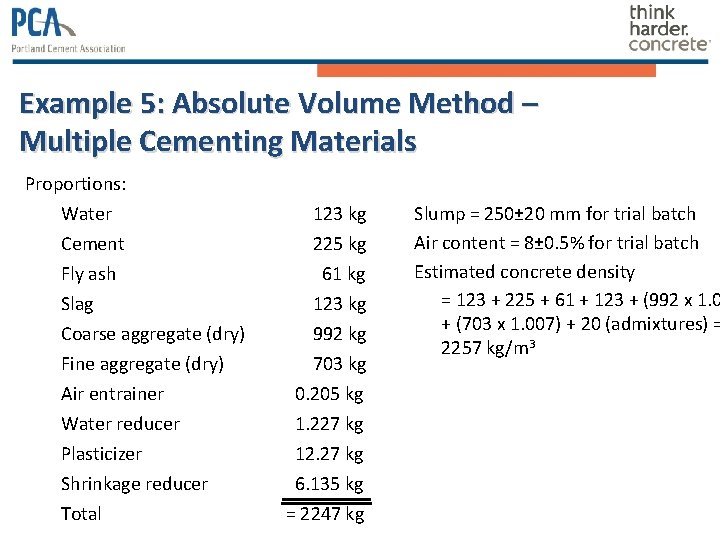
Example 5: Absolute Volume Method – Multiple Cementing Materials Proportions: Water Cement Fly ash Slag Coarse aggregate (dry) Fine aggregate (dry) Air entrainer Water reducer Plasticizer Shrinkage reducer Total 123 kg 225 kg 61 kg 123 kg 992 kg 703 kg 0. 205 kg 1. 227 kg 12. 27 kg 6. 135 kg = 2247 kg Slump = 250± 20 mm for trial batch Air content = 8± 0. 5% for trial batch Estimated concrete density = 123 + 225 + 61 + 123 + (992 x 1. 0 + (703 x 1. 007) + 20 (admixtures) = 2257 kg/m 3
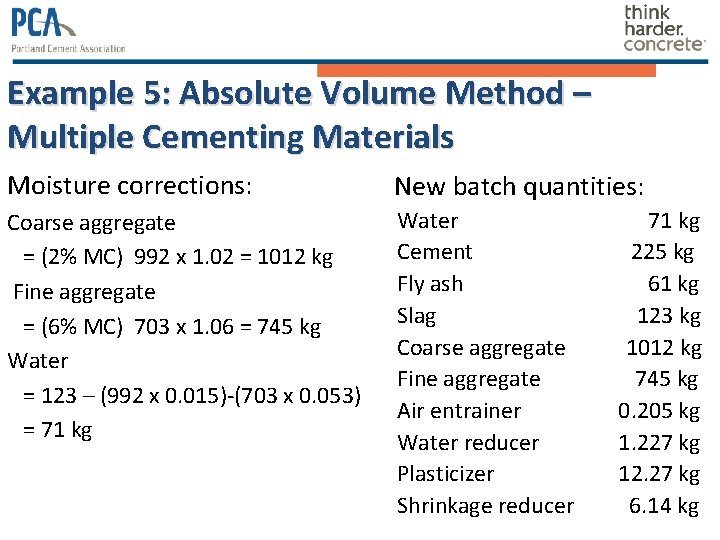
Example 5: Absolute Volume Method – Multiple Cementing Materials Moisture corrections: New batch quantities: Coarse aggregate = (2% MC) 992 x 1. 02 = 1012 kg Fine aggregate = (6% MC) 703 x 1. 06 = 745 kg Water = 123 – (992 x 0. 015)-(703 x 0. 053) = 71 kg Water Cement Fly ash Slag Coarse aggregate Fine aggregate Air entrainer Water reducer Plasticizer Shrinkage reducer 71 kg 225 kg 61 kg 123 kg 1012 kg 745 kg 0. 205 kg 1. 227 kg 12. 27 kg 6. 14 kg
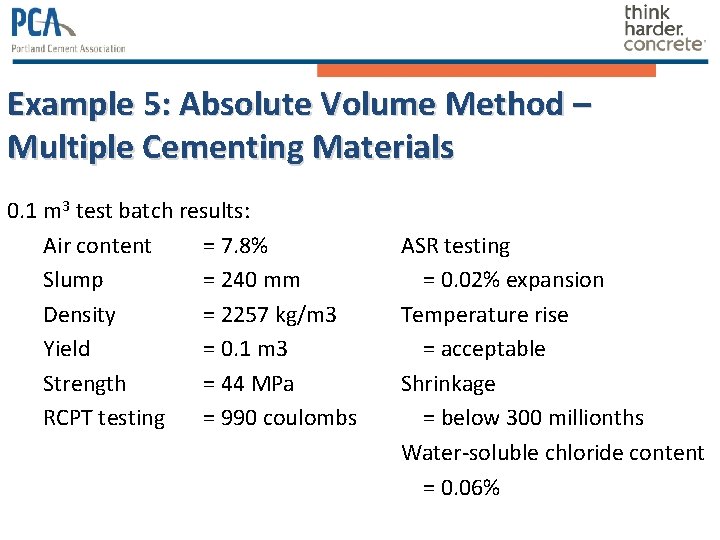
Example 5: Absolute Volume Method – Multiple Cementing Materials 0. 1 m 3 test batch results: Air content = 7. 8% Slump = 240 mm Density = 2257 kg/m 3 Yield = 0. 1 m 3 Strength = 44 MPa RCPT testing = 990 coulombs ASR testing = 0. 02% expansion Temperature rise = acceptable Shrinkage = below 300 millionths Water-soluble chloride content = 0. 06%
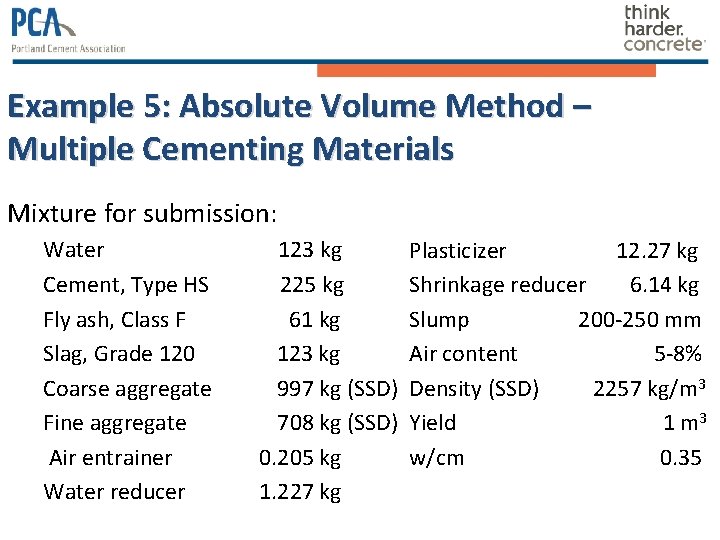
Example 5: Absolute Volume Method – Multiple Cementing Materials Mixture for submission: Water Cement, Type HS Fly ash, Class F Slag, Grade 120 Coarse aggregate Fine aggregate Air entrainer Water reducer 123 kg 225 kg 61 kg 123 kg 997 kg (SSD) 708 kg (SSD) 0. 205 kg 1. 227 kg Plasticizer 12. 27 kg Shrinkage reducer 6. 14 kg Slump 200 -250 mm Air content 5 -8% Density (SSD) 2257 kg/m 3 Yield 1 m 3 w/cm 0. 35
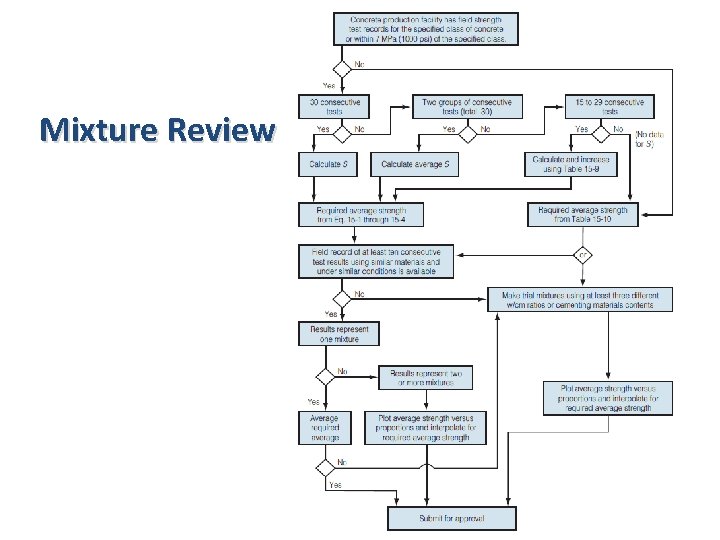
Mixture Review
Summary • • Mix Design Proportioning Concrete for Small Jobs Mixture Review
Questions ?