
Brain Teaser l l Read the short article
Brain Teaser l l Read the short article on Blood Answer the following: l l What are the advantages and disadvantages of artificial blood being made? Is research going to be a factor in your life for the future?
What’s the Matter with Matter?
Thinking about Matter l Sort the following into two categories, matter and not matter. l l Peanut butter, water, fish, garbage, time, motion, the human brain, carbon dioxide gas, yourself, an idea, tree, energy. How did you distinguish between the categories?
What is Matter? l Matter is anything that has mass and volume
What forms does matter come in? l l Solid Liquid Gas Plasma

States of Matter l Solid l l has definite shape and definite volume. Solid animation - Ice
States of Matter l Liquid l l has undefined shape but defined volume Liquid Animation - Water
States of Matter l Gas l l has undefined shape and undefined volume. Gas Animation - Steam
States Of Matter l Plasma l l l very hot gasses undefined shape and volume only exist at high temperatures (i. e. the sun)
Physical Properties l Characteristics of a substance that can be observed without altering the identity of the substance. l State, density, color, odor, melting point, boiling point, luster, conductivity, brittleness, malleability.
Chemical Properties l Characteristics of a substance that cannot be observed without altering the identity of the substance. l Reactivity, flammability, reaction types
Closure l l Draw pictures that represents a solid, a liquid, and a gas. Explain each drawing.
Physical and Chemical Changes l Physical Changes l Do not alter the identity of a substance l l Crushing, tearing, changes of state (solid to liquid to gas) Chemical Changes l Alter the identity or chemistry of a substance l Burning, cooking, rusting
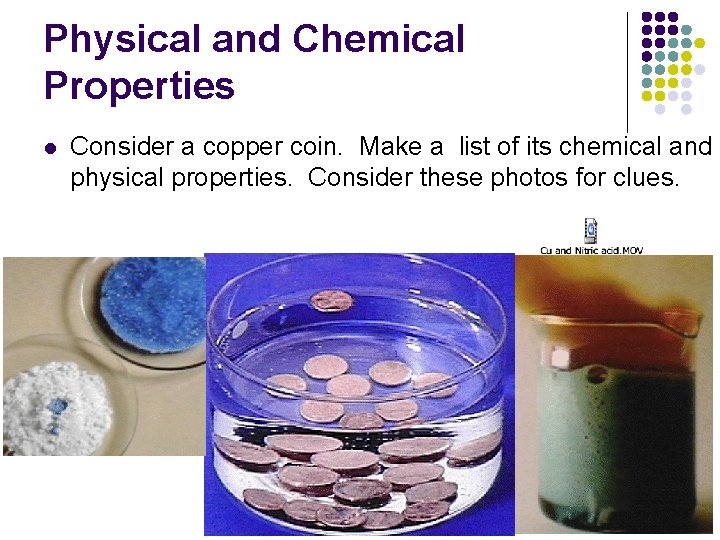
Physical and Chemical Properties l Consider a copper coin. Make a list of its chemical and physical properties. Consider these photos for clues.
Practice l Physical vs. Chemical
Brain Teaser List the properties that identify whether a matter goes through physical or chemical change. l Observe the Demo: What is happening? Is this a chemical or physical change? Why? l
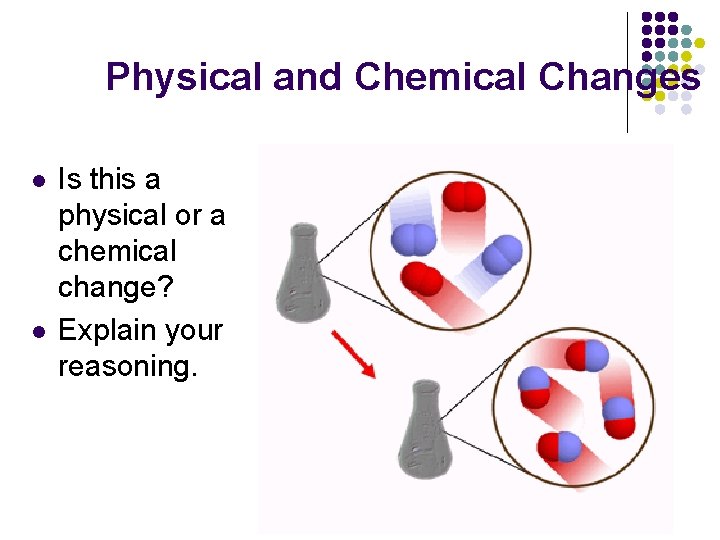
Physical and Chemical Changes l l Is this a physical or a chemical change? Explain your reasoning.
Lab- Physical vs. Chemical Change l l Station Rotation How do you know a chemical change has occurred? l What are the indicators?
Classification of Matter Laboratory l l Station Rotation Write down the Chemical Formula Name of substance Describe the appearance of the substance. Be very specific!!
Classification of Matter Laboratory l Developing the classification scheme l Look for patterns l l l In formulas, names, appearance Be able to use your classification scheme to describe all of the substances you looked at. Remember to start broad and get more specific as you go through the chart.
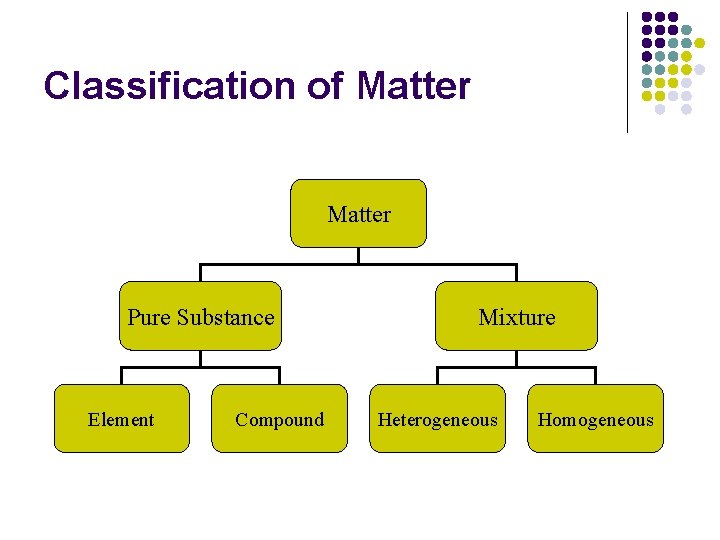
Classification of Matter Pure Substance Element Compound Mixture Heterogeneous Homogeneous
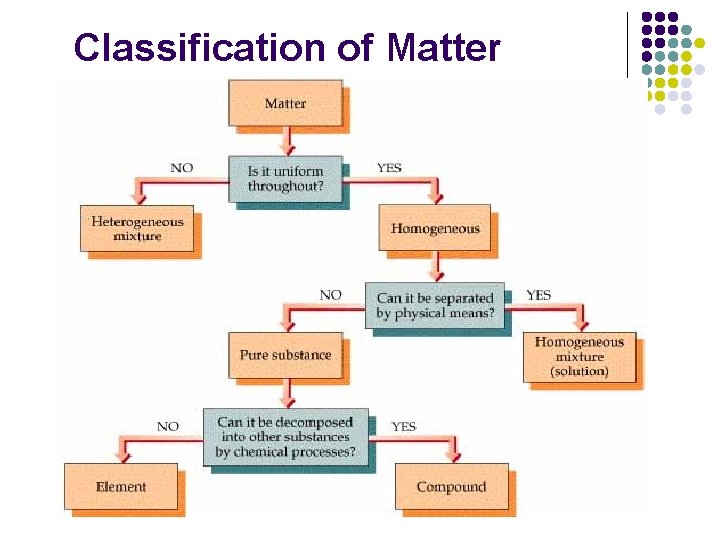
Classification of Matter
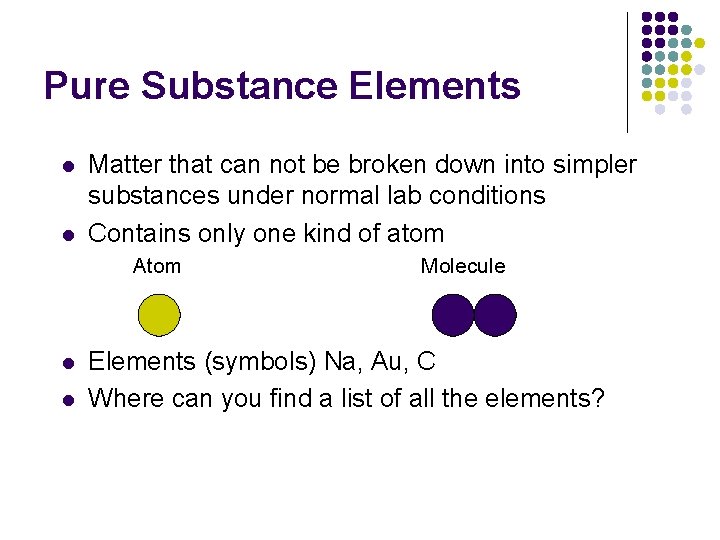
Pure Substance Elements l l Matter that can not be broken down into simpler substances under normal lab conditions Contains only one kind of atom Atom l l Molecule Elements (symbols) Na, Au, C Where can you find a list of all the elements?
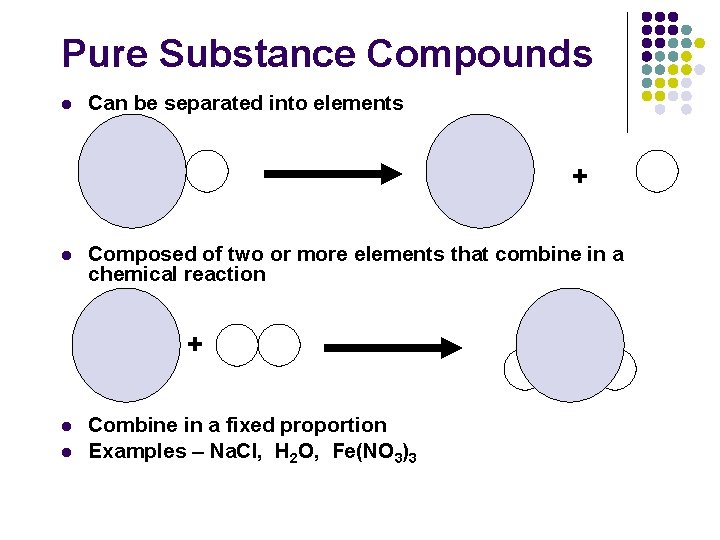
Pure Substance Compounds l Can be separated into elements + l Composed of two or more elements that combine in a chemical reaction + l l Combine in a fixed proportion Examples – Na. Cl, H 2 O, Fe(NO 3)3
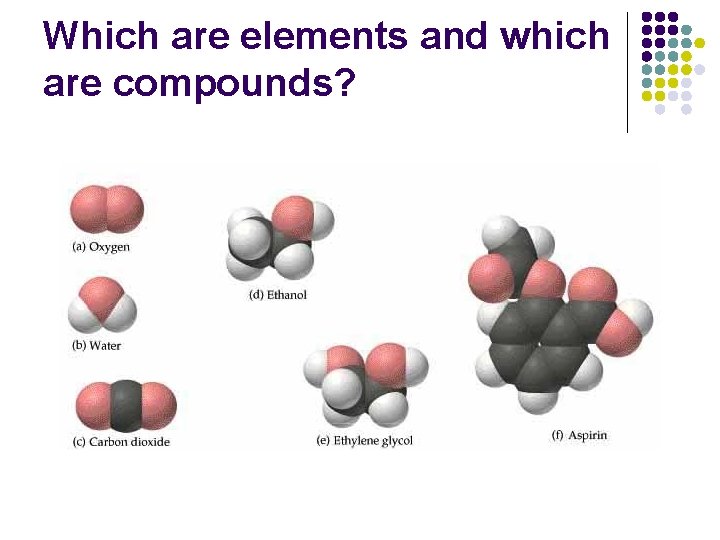
Which are elements and which are compounds?
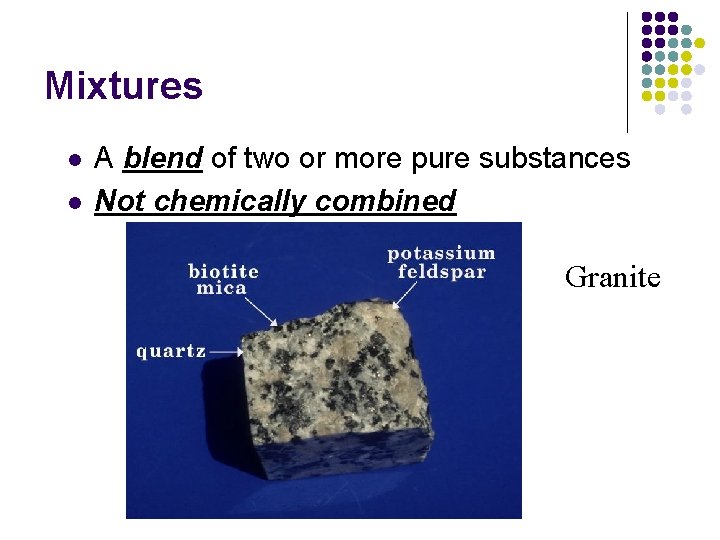
Mixtures l l A blend of two or more pure substances Not chemically combined Granite
Mixtures Heterogeneous l Mixture with visibly different parts. l l l Sand + water Salt + Pepper M & M’s
Mixtures Homogeneous l Mixture with no visibly different parts. l l Sea water H 2 O + Na. Cl Air N 2 + O 2 + CO 2
Practice Classifying Matter l Make a list of 3 things (and their parts) found in the classroom. Classify these as l l l solid, liquid, or gas pure substances and mixtures homogeneous or heterogeneous elements or compounds Be prepared to share your classifications?
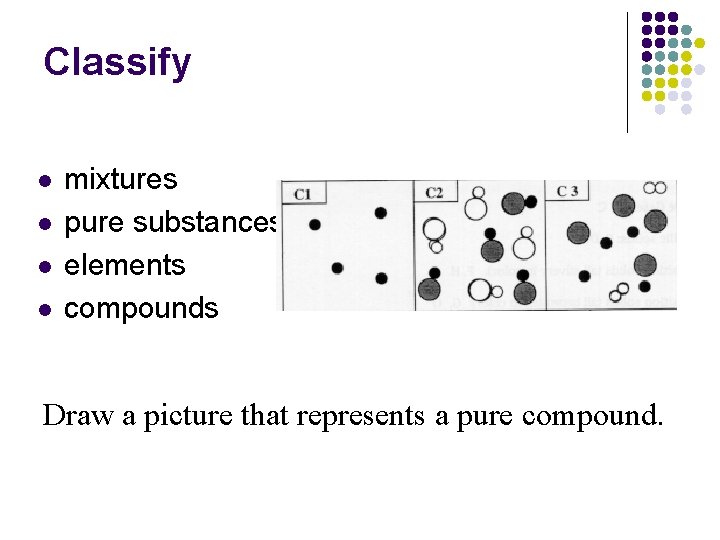
Classify l l mixtures pure substances elements compounds Draw a picture that represents a pure compound.
Classify each of the following as, a homogenous or heterogeneous mixture, pure substance, element or compound, atom or molecule. 1. CH 4 2. KMn. O 4 3. Co 4. Al + H 2 O Draw atomic level pictures of each substance.
Classification of Matter Lab Quiz
Closure l Draw an atomic level picture of a mixture of compounds.
Agenda August 10 th, 2005 l l l l Warm-up Review Homework- Grade Quiz Chemistry Lab Book Format Lab - “Reaction of Solutions” Post Lab discussion Lab write-up Intro to atomic representations Homework: Atoms, Molecules, etc…
WARM-UP l 1) 2) 3) 4) 5) Briefly describe each of the following separation techniques. Identify the only techniques that can separate a compound into its elements. Filtration Crystallization (evaporation) Chromatography Electrolysis Distillation
Grade MATTER POST LAB QUIZ
Introduction to “Reaction of Ions in Solutions” Lab l PURPOSE l l Why am I doing this lab? Must connect to the title “The purpose of this lab is to …”
Introduction to “Reaction of Ions in Solutions” Lab l BACKGROUND INFORMATION l l l The “stuff” you need to know before conducting the lab. Terms, Cautions, Chemicals, Concepts, ect. Paragraph form
Introduction to “Reaction of Ions in Solutions” Lab l l l l BACKGROUND INFORMATION D. W. Distilled Water Ions – Charged particles Precipitate- solid forms Pb(NO 3)2 – Lead Nitrate KI – Potassium Iodide Na. Cl – Sodium Chloride Na 2 SO 4 – Sodium Sulfate
Introduction to “Reaction of Ions in Solutions” Lab l MATERIALS AND APPARATUS List all the materials and equipment to be used and draw the apparatus set up. Petri Dish Flask with D. W. Pipettes Pb(NO 3) 2 KI Na. Cl Na 2 SO 4
Introduction to “Reaction of Ions in Solutions” Lab l l l Procedure Add enough distilled water to cover the bottom of the petri dish Add 20 drops of each solution Make observations
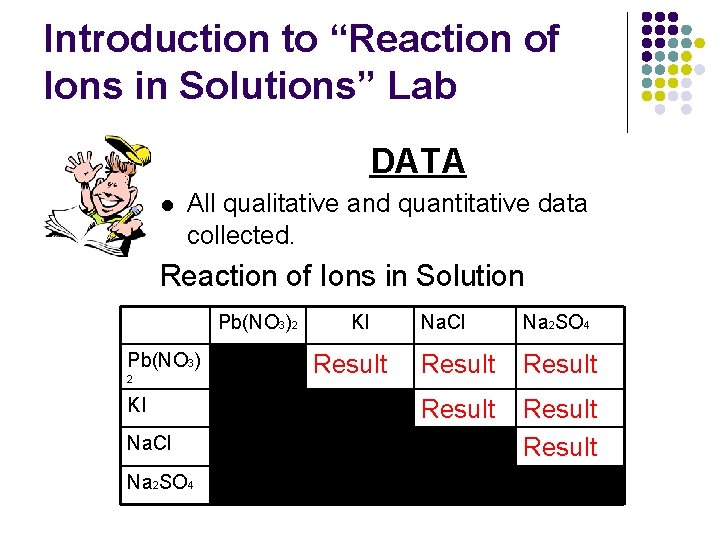
Introduction to “Reaction of Ions in Solutions” Lab DATA l All qualitative and quantitative data collected. Reaction of Ions in Solution Pb(NO 3)2 Pb(NO 3) 2 KI Na. Cl Na 2 SO 4 KI Result Na. Cl Na 2 SO 4 Result Result
Post Lab Discussion: “Reaction of Ions in Solutions” Lab l l l DATA ANALYSIS OR RESULTS Paragraph form Explain the data collected Analyze your results Lead Nitrate is mixed with potassium Iodide and a yellow precipitate forms. Final sentences discuss why you learned about the reactivity of certain substances
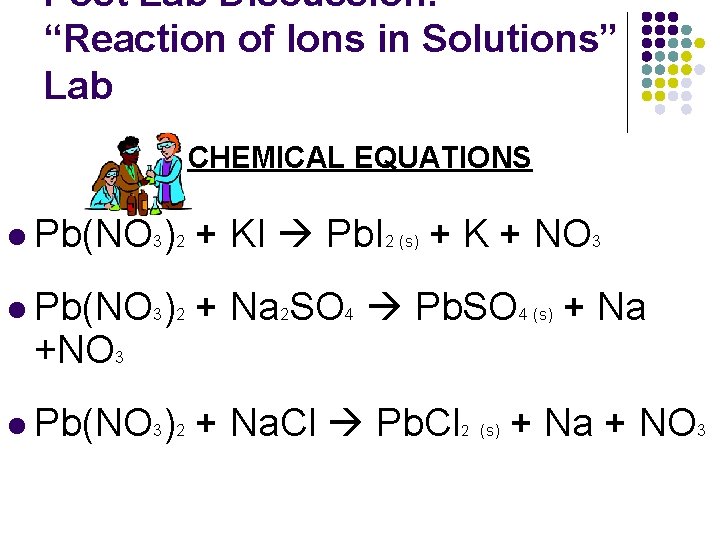
Post Lab Discussion: “Reaction of Ions in Solutions” Lab CHEMICAL EQUATIONS l Pb(NO 3)2 + KI Pb. I 2 (s) + K + NO 3 l Pb(NO 3)2 + Na 2 SO 4 Pb. SO 4 (s) + Na l Pb(NO 3)2 + Na. Cl Pb. Cl +NO 3 2 (s) + Na + NO 3
Post Lab Discussion: “Reaction of Ions in Solutions” Lab CONCLUSION What does it all mean? ! Overall Summary of the Lab l WHY DID YOU GET THESE RESULTS? l
NEW TERMS l l l l l Ion Petri Dish Medicine dropper/Pipette Beaker Flask (Erlemnmeyer) Diffusion Precipitate (ppt) Distilled Water Soluble Insoluble
CLOSURE Match the following: l l l l l NO 3 SO 4 Pb(NO 3)2 KI Pb. I 2 Na. Cl Na 2 SO 4 Pb. Cl 2 l l l l l Potassium Iodide Lead Sulfate Sodium Sulfate Lead Chloride Nitrate Lead Nitrate Sodium Chloride Lead Iodide
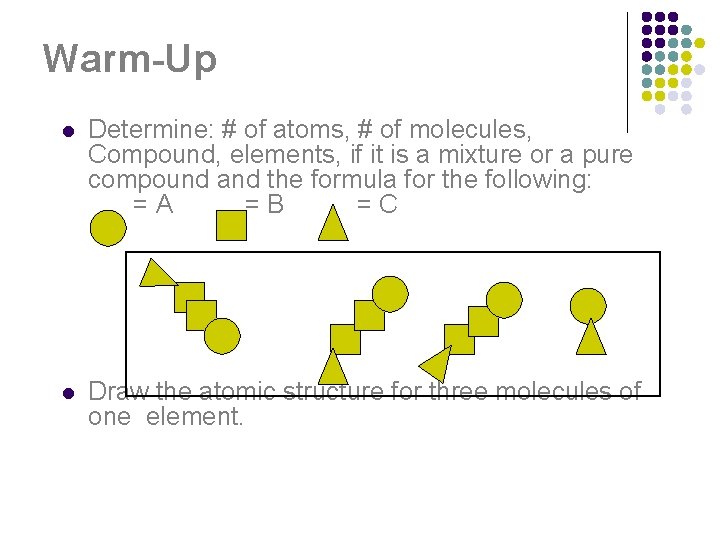
Warm-Up l Determine: # of atoms, # of molecules, Compound, elements, if it is a mixture or a pure compound and the formula for the following: =A =B =C l Draw the atomic structure for three molecules of one element.
Lab Quiz l When Finished Pick up l Atoms, Molecules, Elements, compounds
Rally Table l l l You and ONE (1) partner Alternate problems Use different color ink
Work Time l l l Finish Conclusion Work on 2 -5 Review and Reinforcement Work on Study Guide
Atomic level Quiz
Design your own! l l l You must make a key for the symbols You must make some pure substances and mixtures You must describe your drawing!
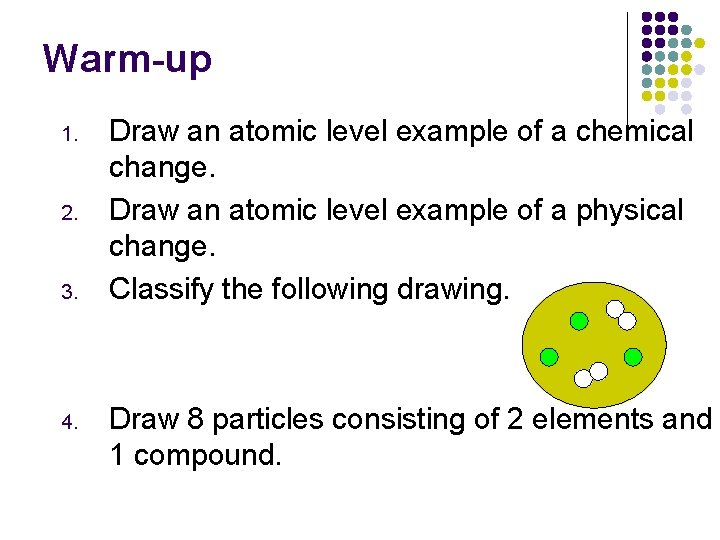
Warm-up 1. 2. 3. 4. Draw an atomic level example of a chemical change. Draw an atomic level example of a physical change. Classify the following drawing. Draw 8 particles consisting of 2 elements and 1 compound.
Honors Chemistry Agenda-August 17 th 2005 l l Warm-up Review Study Guide Test – Matter After Test l Turn in H. W. Packet l Read Book pg. 58 -63 l Complete W. S. l l l Measurements in Chemistry Significant Figures Homework l Complete W. S. l Safety Poster Due 8/22
- Slides: 55