resources and activities to use with very young





- Slides: 104
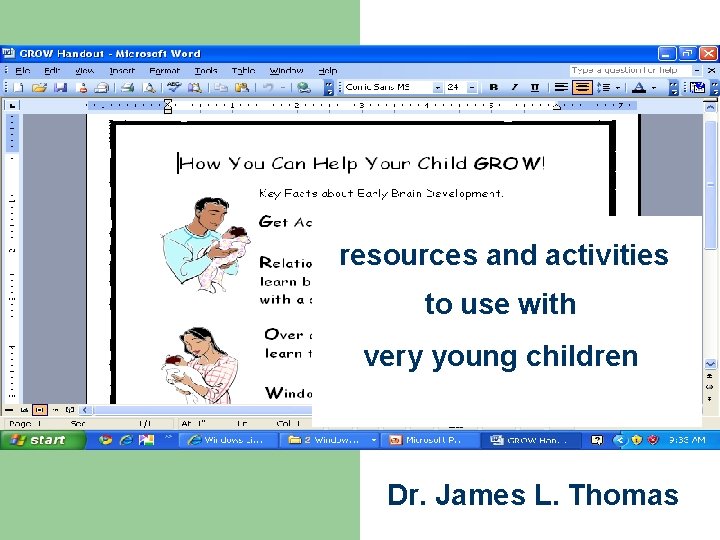
resources and activities to use with very young children Dr. James L. Thomas
Thanks… for attending today!
Thanks to Travis and Campfire for the invitation!
Who is Dr. James L. Thomas? “Mr. Jim”
a story, a story why such passion for early literacy?
Ready to Read! (reading readiness) Language Play for Infants The Young and the Restless (1 s) Making Story Times Memorable for 2 s, 3 s, and 4 s
“Hello my friends…” …won’t you sing with me; sing with me? Won’t you sing with me? Hello, my friends, won’t you sing with me? Won’t you come and sing with me? -clap -march -read
-how I evaluate a workshop- one good idea that I can and will use
ask questions! make comments, please
who makes a difference in a young child’s life? -parents -grandparents -relatives -children’s librarians -early childhood care providers
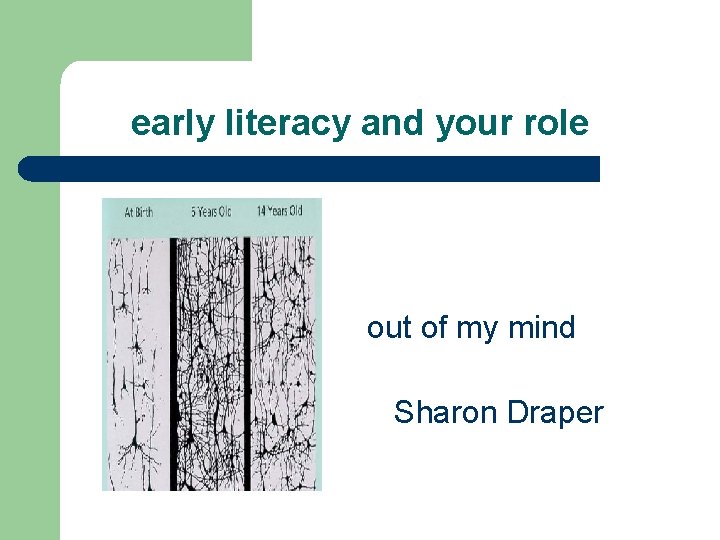
early literacy and your role out of my mind Sharon Draper
essentials for young children books/reading music finger plays signing
why books/reading with young children? introduces the left/right reading process l exposes the child to an exciting, new world through stories and informational titles l allows the child to hear the linguistic patterns of his/her language l connects a child with an adult l
why music/singing with young children? l l l powers the brain: connects neural pathways* influences: stimulates creativity connects: brings diverse groups together transports: in time and emotion comforts: security and memories* from “Sing into Reading” by Nancy Stewart
why finger plays with young children? promotes love of rhythm and movement l helps children to develop creativity l encourages greater self-esteem l promotes & encourages verbal and motor skills l teaches concepts (body parts, counting, colors, up/down) l helps a child observe and follow along/focus* l
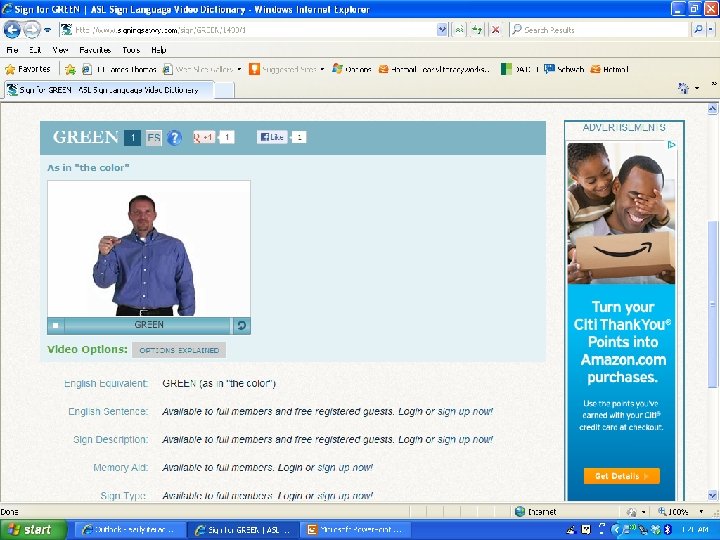
why sign with young children? l l l reduces frustration and provides a means to express themselves* increases parent-child bonding lets babies communicate vital information
children who learn sign actually talk and comprehend language better than those who don’t l 2 year-olds who were taught sign, have a bigger vocabulary and were able to put together significantly longer sentences than those who did not learn sign l
other necessities for young children playing talking writing
Early Literacy Practices l l l Playing: represents one of the primary ways children learn about the world and gain understanding about stories Talking: helps children learn oral language, one of the most critical early literacy skills Writing: helps children learn that letters and words stand for sounds and that print has meaning
This presentation is based on information from l l l National Institute of Child Health and Human Development Public Library Association for Library Service to Children
Purpose The purposes of this presentation are to enable adults -to understand the needs for early literacy -to help children (ages birth – 5 years) become aware of and comfortable with language
Learning Outcomes Participants will be able to -define “early literacy” -describe ways in which reading and early literacy can nurture brain development -list the six essential early literacy skills and describe ways to incorporate them into daily routines -practice ways to read picture books the promote language development -understand apply the dialogic reading method when sharing a picture book
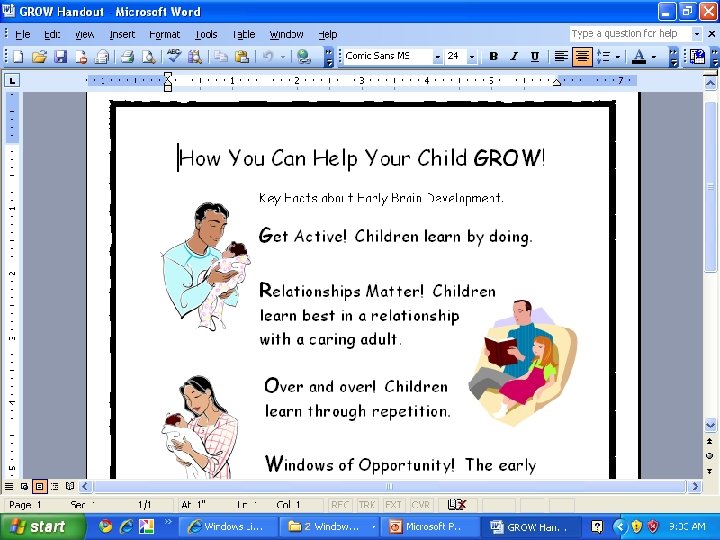
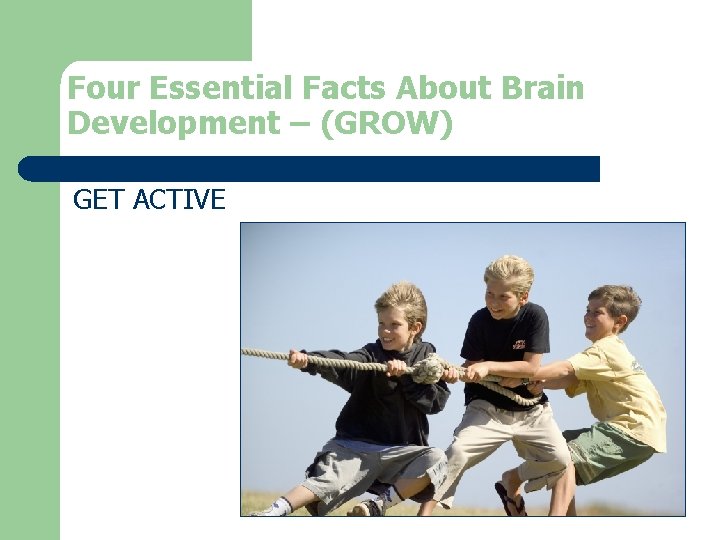
Four Essential Facts About Brain Development – (GROW) GET ACTIVE
G = Get Active early childhood—time of incredible growth l children learn by doing/repeatedly! (“Welcome today friends of mine”) l children learn best using all five senses; therefore, activities we provide should engage as many of the senses as possible (use of touch for infants: “Up, up…”) l
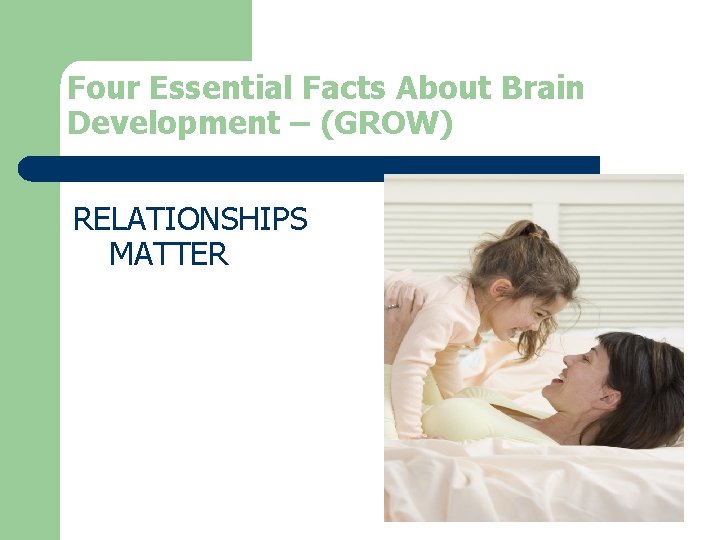
Four Essential Facts About Brain Development – (GROW) RELATIONSHIPS MATTER
R = relationships matter! l l learning happens best in a relationship with a caring adult having fun with young children is still the best way to promote learning and brain development! Hand, hand, fingers, thumb* active involvement in a stimulating, challenging and loving environment causes the brain to grow and flourish babies seek to imitate, and they imitate YOU!
Four Essential Facts About Brain Development – (GROW) OVER AND OVER
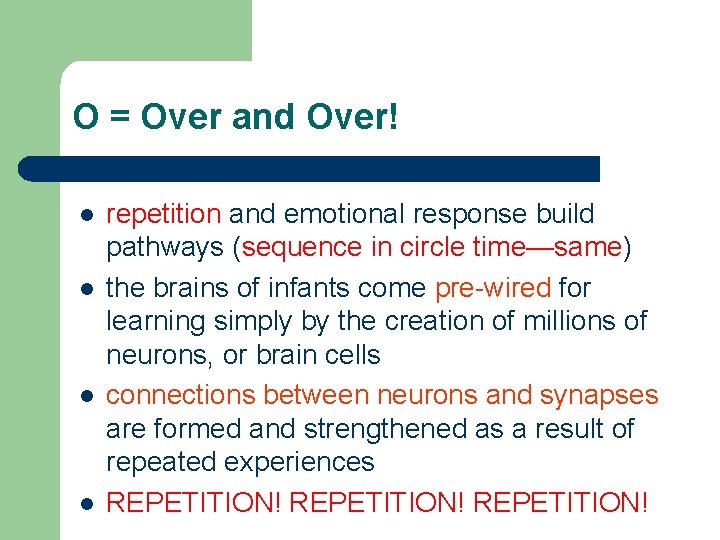
O = Over and Over! l l repetition and emotional response build pathways (sequence in circle time—same) the brains of infants come pre-wired for learning simply by the creation of millions of neurons, or brain cells connections between neurons and synapses are formed and strengthened as a result of repeated experiences REPETITION!
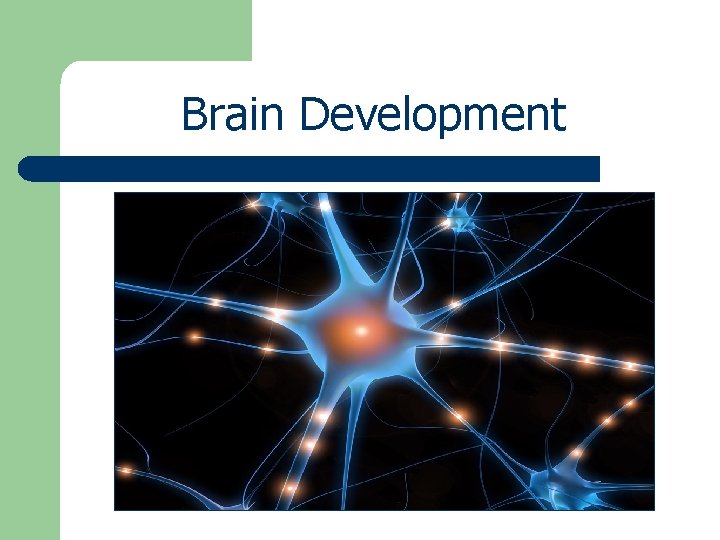
Brain Development
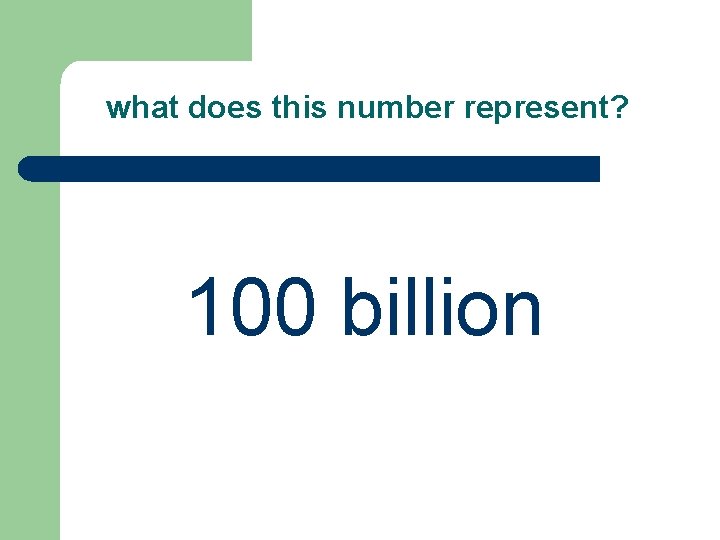
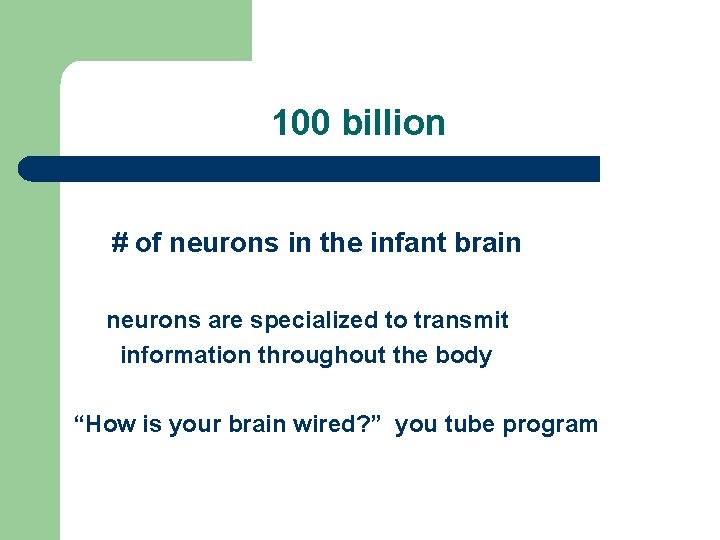
what does this number represent? 100 billion
100 billion # of neurons in the infant brain neurons are specialized to transmit information throughout the body “How is your brain wired? ” you tube program
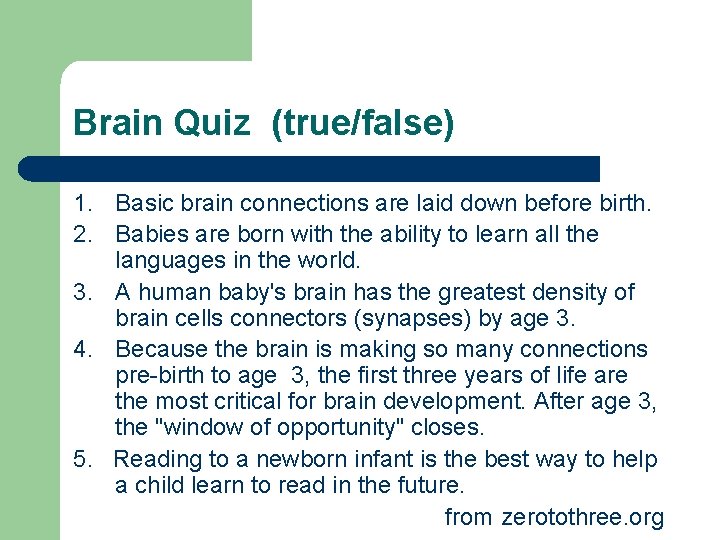
Brain Quiz (true/false) 1. Basic brain connections are laid down before birth. 2. Babies are born with the ability to learn all the languages in the world. 3. A human baby's brain has the greatest density of brain cells connectors (synapses) by age 3. 4. Because the brain is making so many connections pre-birth to age 3, the first three years of life are the most critical for brain development. After age 3, the "window of opportunity" closes. 5. Reading to a newborn infant is the best way to help a child learn to read in the future. from zerotothree. org
synapse comparison
Brain Development – PET Scan O = Over and Over!
RESEARCH FINDINGS
an infant 45 minutes old will imitate an adult sticking our his/her tongue
at five months, an infant will learn sequence and anticipate between two: one three times and one twice
at five months, an infant is able to discriminate between 2 mouths: one making a noise and the other not; looks and focuses on the one making the noise 10 times longer
Four Essential Facts About Brain Development – (GROW) WINDOWS OF OPPORTUNITY
W = Windows of Opportunity! l l the early years are the most critical for literacy development recent research has demonstrated there are some times which are more opportune for certain types of learning than others
Windows continued… the brain of a one-year-old is more like an adult brain than an infant brain, but is two times as active! SHOWN IN BODY MOVEMENT – children are born with the ability to hear the sounds of all of the world’s languages, this is why children are wired for learning multiple languages in the early years (exposure to words from various languages with one-year-olds) –
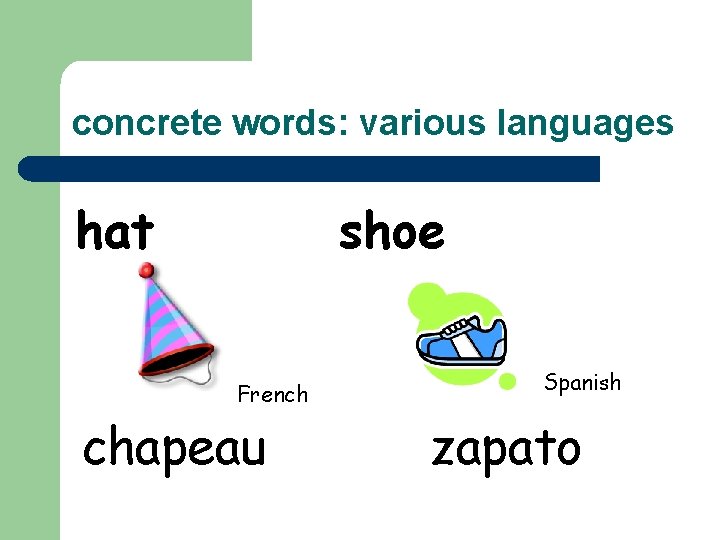
concrete words: various languages hat shoe French chapeau Spanish zapato
Group Activity
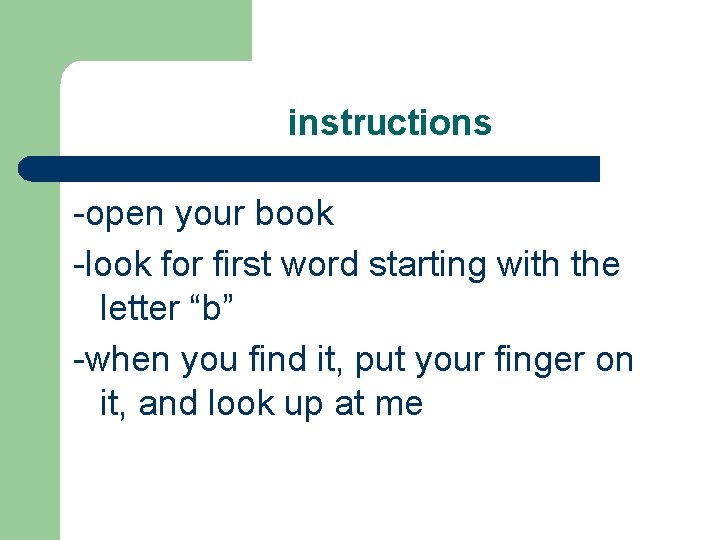
instructions -open your book -look for first word starting with the letter “b” -when you find it, put your finger on it, and look up at me
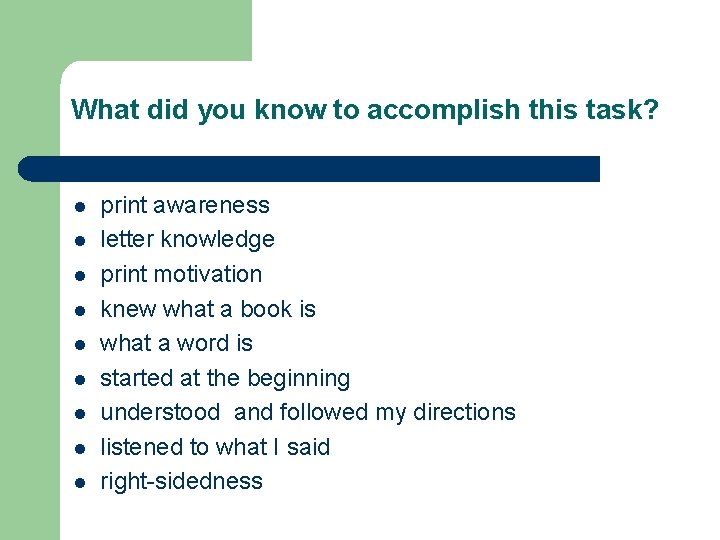
What did you know to accomplish this task? l l l l l print awareness letter knowledge print motivation knew what a book is what a word is started at the beginning understood and followed my directions listened to what I said right-sidedness
early literacy defined “early literacy” is what children learn about reading and writing BEFORE they can actually read or write
RESEARCH FINDINGS
-by age 3, children have already developed many literacy skills and attitudes*
-children who are read to have a large vocabulary and better language skills when they start school
-early literacy skills are a predictor of later reading success
The 6 Early Literacy Skills l l l Print Motivation Print Awareness Vocabulary Narrative Skills Letter Knowledge Phonological Awareness
The 6 Early Literacy Skills MUST be combined with developmentally appropriate practices!
developmentally appropriate + early literacy = reading infants -hearing our language first, a child attends ones -making sense of a our language then, he remembers twos and up -responding to our language helps him understand
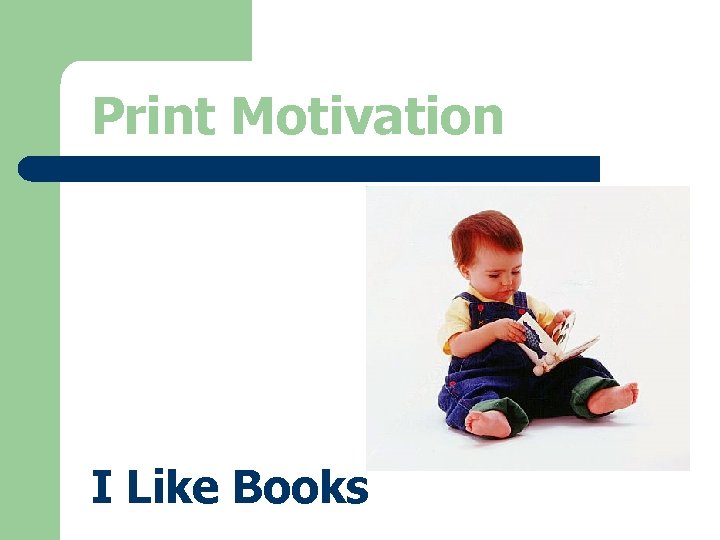
Print Motivation I Like Books
Print Motivation/Loving Books -a child’s interest in, and enjoyment of, books
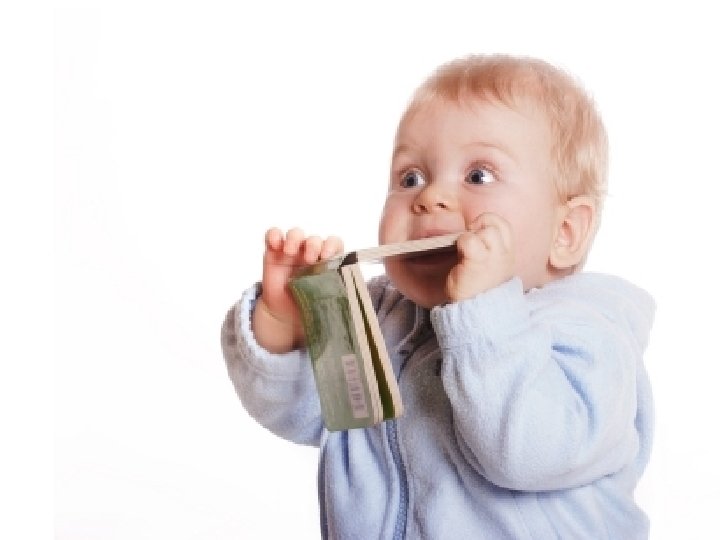
What can you do? Read often. l Let children see you reading. l Read with enthusiasm. l Keep reading materials lying around. l Treat books as toys. l Read nursery rhymes in book form. l Visit the library. most important? l
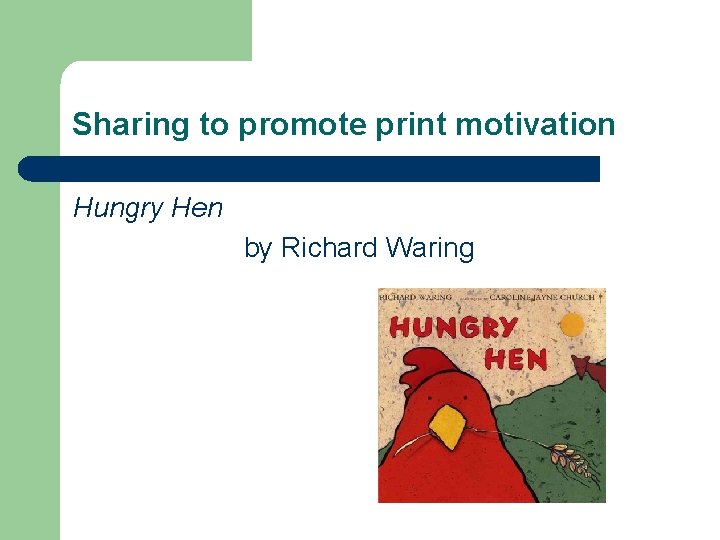
Sharing to promote print motivation Hungry Hen by Richard Waring
Print Awareness I See Words
Print Awareness/Using Books -noticing print everywhere -knowing how to handle a book -knowing how to follow the words on a page
What can you do? l l l Point to words and signs around you and say the words. ( STOP or EXIT)* Read books with your children, and let them handle the books and turn the pages. Occasionally follow the words on the page with your hand (sweeping action). Make a game of putting a book right side up; backwards, etc. Give children access to paper and writing tools.
Vocabulary I Know Words
Vocabulary/Understanding Words -knowing the names of things
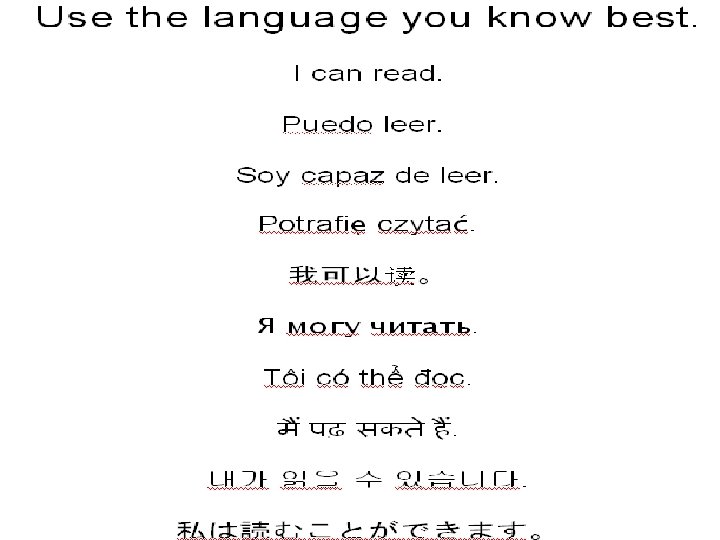
What can you do? Use many words and a variety of words. l Talk and read with your child. “baby, baby what do you see? ” l Explore the feelings/emotions in words. “hurt” l Pause in your reading to explain unfamiliar words. l Use your home language to develop complex neural connections. l
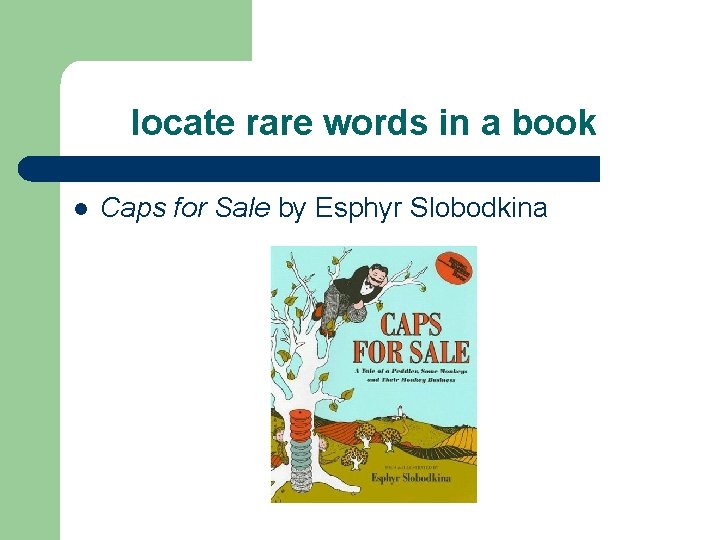
locate rare words in a book l Caps for Sale by Esphyr Slobodkina
Narrative Skills I Can Tell a Story
Narrative Skills/Story Awareness -understanding and telling stories -describing things -talking with others/conversation
What can you do? l l l l Name things and add description. Listen as children try to talk. (Amanda’s shoes)* Tell children stories. Narrate your life and theirs. Label things and talk about them. (in the home)* Encourage interaction. Encourage a infant’s listening.
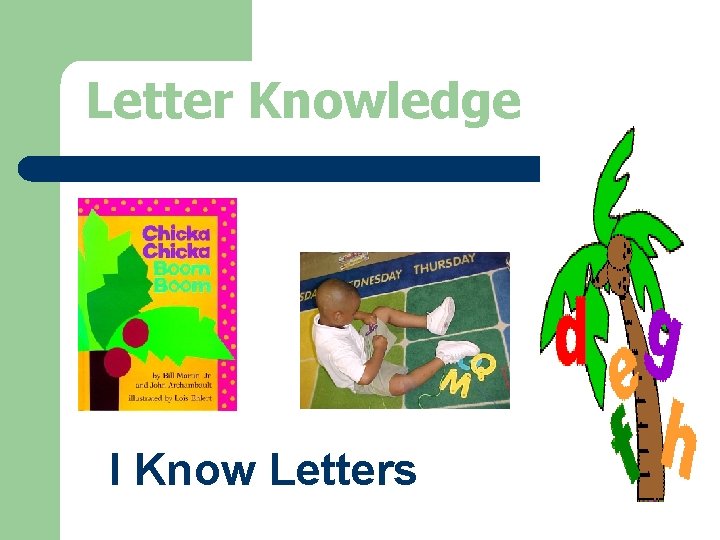
Letter Knowledge I Know Letters
Letter Knowledge/Understanding Letters -letters are different from each other -letters have different names -letters make different sounds
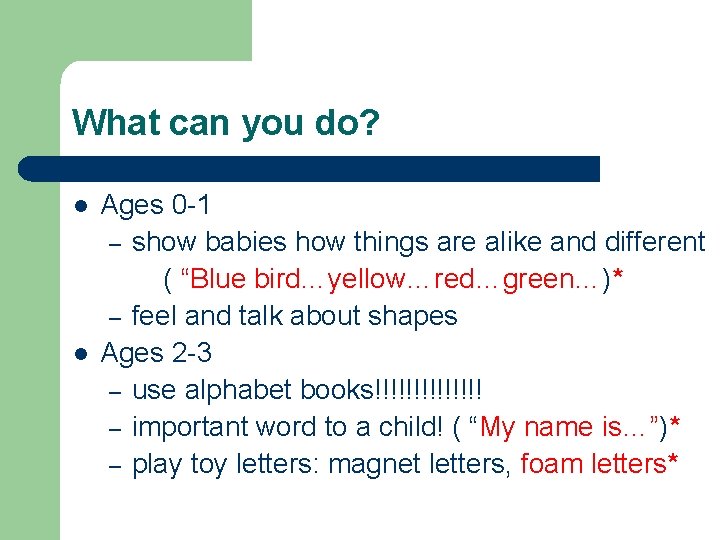
What can you do? l l Ages 0 -1 – show babies how things are alike and different ( “Blue bird…yellow…red…green…)* – feel and talk about shapes Ages 2 -3 – use alphabet books!!!!!!! – important word to a child! ( “My name is…”)* – play toy letters: magnet letters, foam letters*
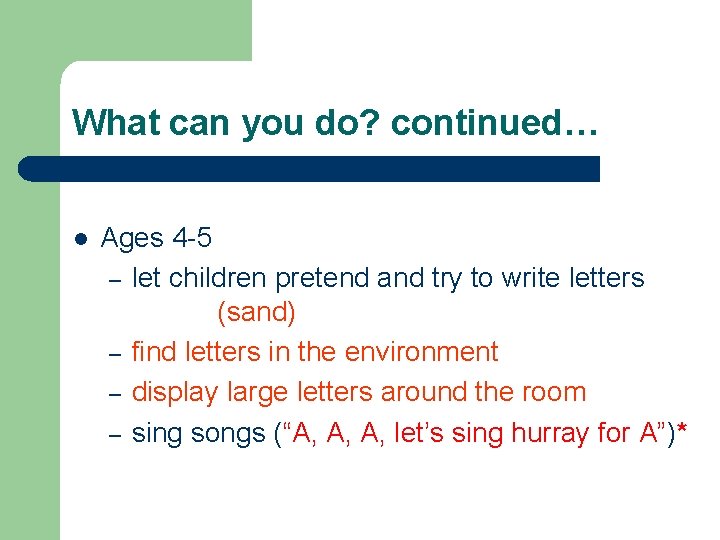
What can you do? continued… l Ages 4 -5 – let children pretend and try to write letters (sand) – find letters in the environment – display large letters around the room – sing songs (“A, A, A, let’s sing hurray for A”)*
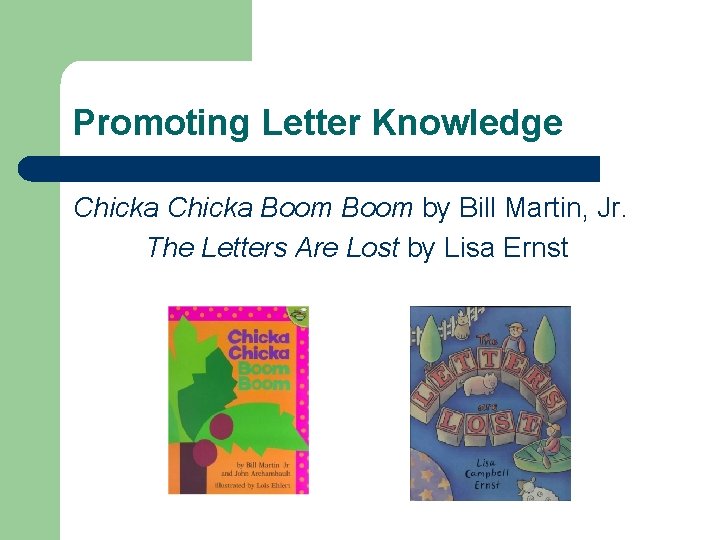
Promoting Letter Knowledge Chicka Boom by Bill Martin, Jr. The Letters Are Lost by Lisa Ernst
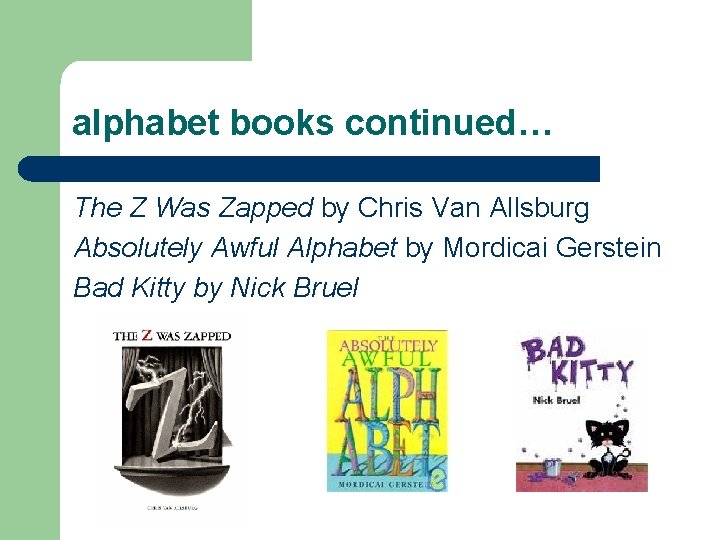
alphabet books continued… The Z Was Zapped by Chris Van Allsburg Absolutely Awful Alphabet by Mordicai Gerstein Bad Kitty by Nick Bruel
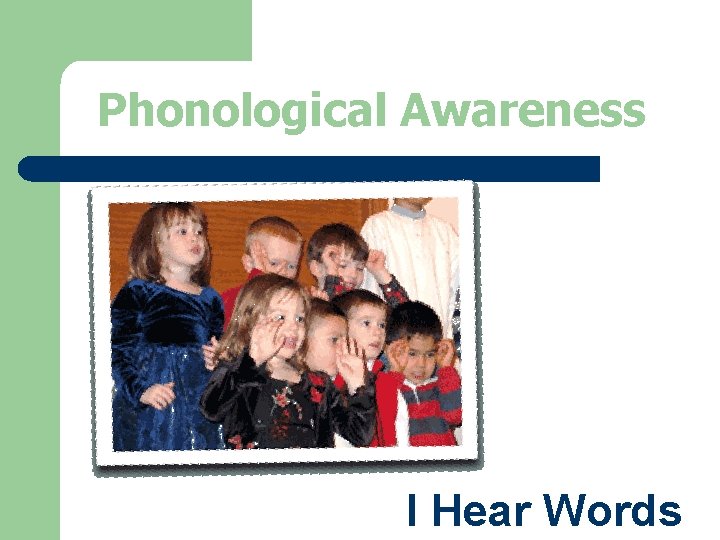
Phonological Awareness I Hear Words
Phonological Awareness/ Understanding Sounds -identifying and hearing sounds in words -ability to recognize compound parts
What can you do? l l Ages 0 -3 – sing songs that a become familiar – share rhyming books Brown Bear, Brown Bear Ages 4 -5 – say tongue twisters – read rhyming books We’re Going on a Bear Hunt – play word games – use your own language
What’s That Sound? At home, or while out and about, point out or make sounds, and ask ones to imitate the sounds (if old enough), including: -sounds in the environment -sounds you create -sounds animals make “When dogs get up in the morning” song* -sounds that people make
Say It Slow, Say It Fast choose a word with two beats, “doorbell” l tell your child the word, and have your child say it back to you l say the word slowly/fast, carefully separating the beats “door…bell” l have your child repeat the word slowly; now say it fast l use three-beat words (or even more!) “alligator” and clap the beat with each beat l
clapping and stomping to make the beats Steg-o-saur-us, In a swamp, In a swamp. Spikes upon his tail, Sharper than a nail, Stomp, stomp, stomp! (tune: Are you sleeping? )
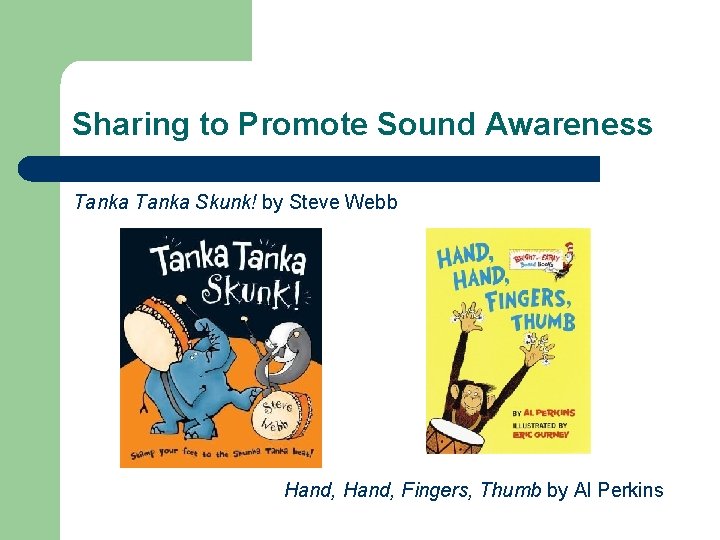
Sharing to Promote Sound Awareness Tanka Skunk! by Steve Webb Hand, Fingers, Thumb by Al Perkins
Dialogic reading method -conversation or dialog between the child and adult sharing the book -demonstration of pragmatic skills: listening, formulation of questions, and responding
Part I: Tips to Build Vocabulary ask “what” questions -follow answers with another question -repeat what the child says -help the child as needed with responses -give answers and child repeats -praise and encourage the child
Part II: Tips to Build Sentence Skills -ask “open-ended” questions: What’s going on here? Tell me what you see on the page? -follow answers with another question: Why did it happen that way? I wonder how…? How did that happen? What do you think? -expand what the child says: add another piece of information
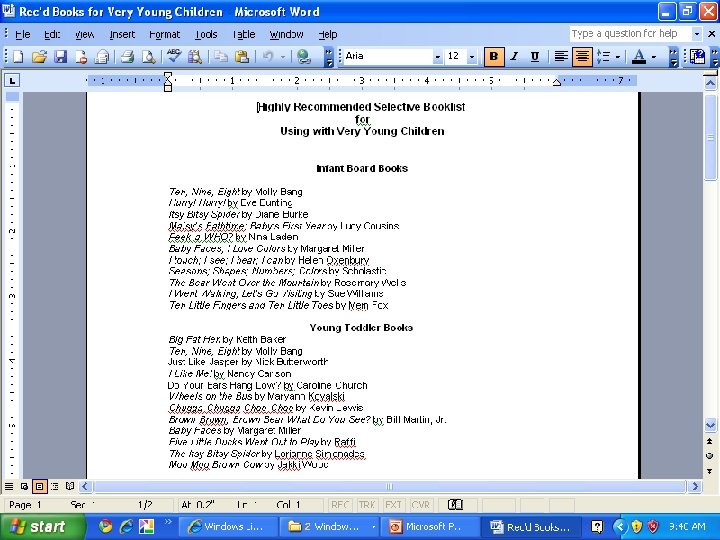
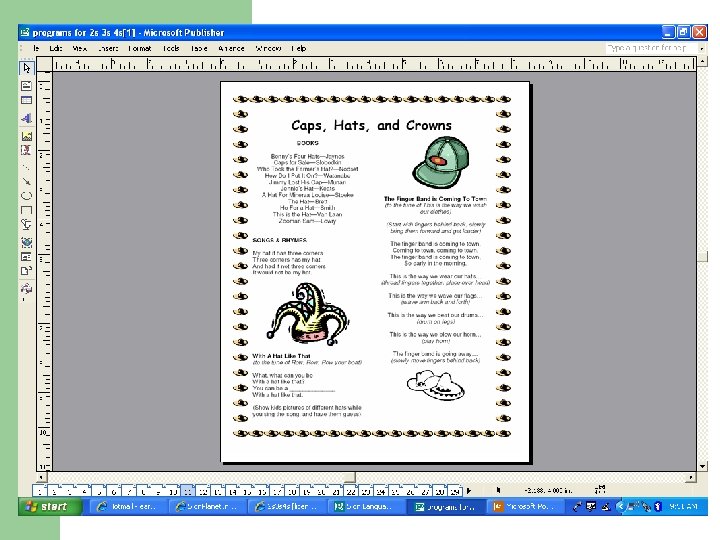
handouts let’s take a look
book and CD
Ready to Read skills for all ages (3 pages)
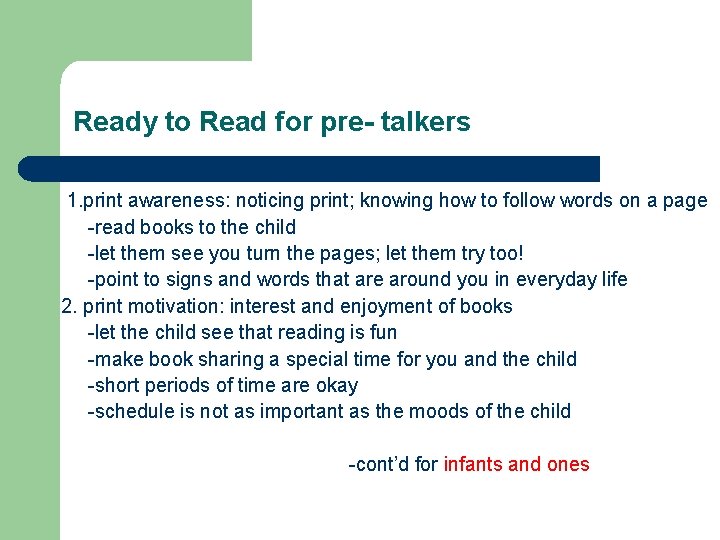
Ready to Read for pre- talkers 1. print awareness: noticing print; knowing how to follow words on a page -read books to the child -let them see you turn the pages; let them try too! -point to signs and words that are around you in everyday life 2. print motivation: interest and enjoyment of books -let the child see that reading is fun -make book sharing a special time for you and the child -short periods of time are okay -schedule is not as important as the moods of the child -cont’d for infants and ones
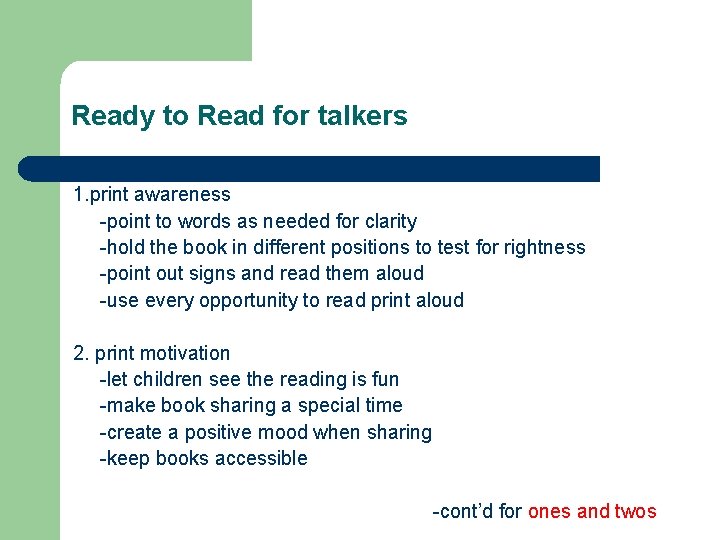
Ready to Read for talkers 1. print awareness -point to words as needed for clarity -hold the book in different positions to test for rightness -point out signs and read them aloud -use every opportunity to read print aloud 2. print motivation -let children see the reading is fun -make book sharing a special time -create a positive mood when sharing -keep books accessible -cont’d for ones and twos
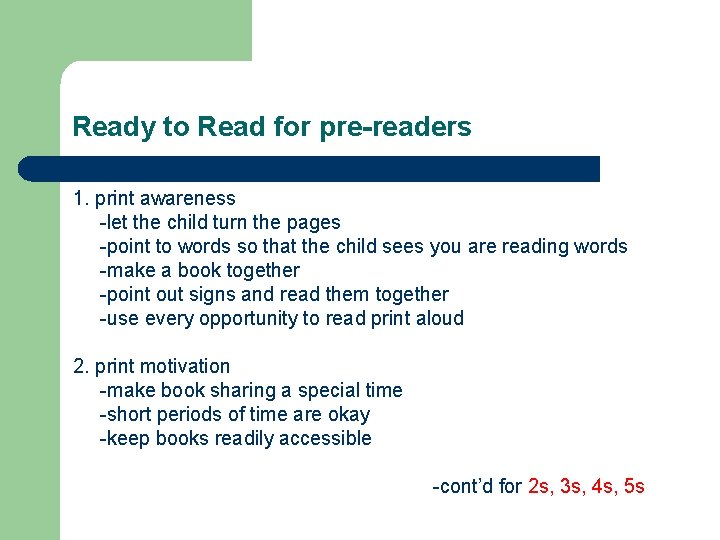
Ready to Read for pre-readers 1. print awareness -let the child turn the pages -point to words so that the child sees you are reading words -make a book together -point out signs and read them together -use every opportunity to read print aloud 2. print motivation -make book sharing a special time -short periods of time are okay -keep books readily accessible -cont’d for 2 s, 3 s, 4 s, 5 s
END