Current resistance and electromotive force Current is a

- Slides: 22
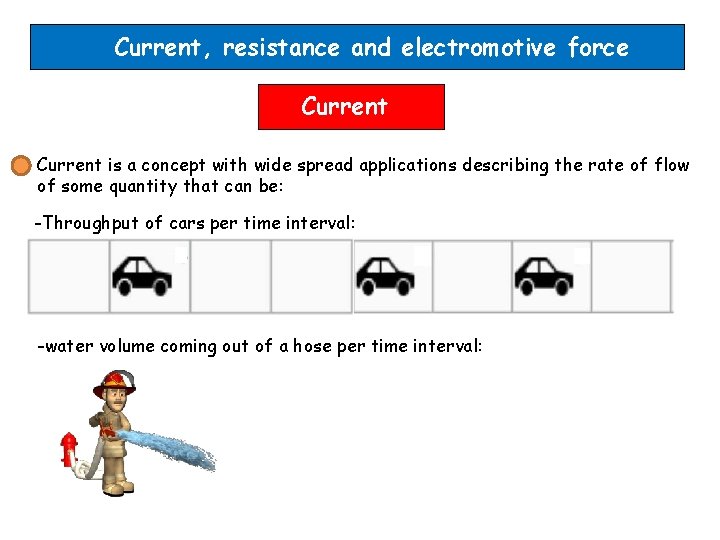
Current, resistance and electromotive force Current is a concept with wide spread applications describing the rate of flow of some quantity that can be: -Throughput of cars per time interval: -water volume coming out of a hose per time interval:
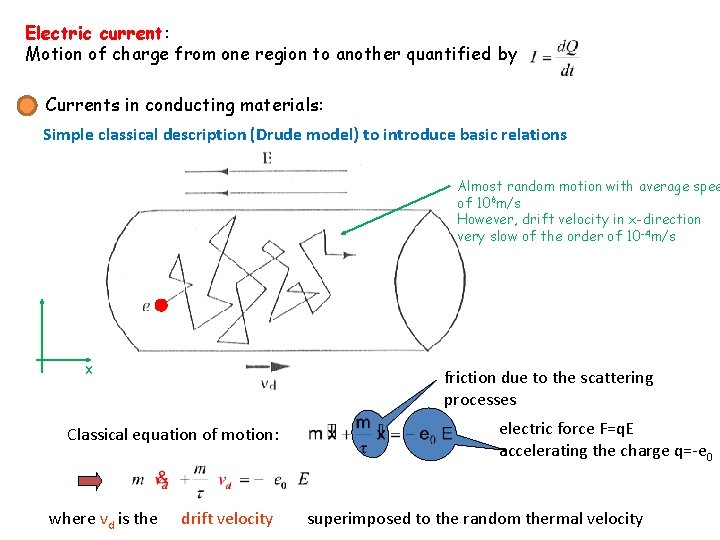
Electric current: Motion of charge from one region to another quantified by Currents in conducting materials: Simple classical description (Drude model) to introduce basic relations Almost random motion with average spee of 106 m/s However, drift velocity in x-direction very slow of the order of 10 -4 m/s x friction due to the scattering processes Classical equation of motion: where vd is the drift velocity electric force F=q. E accelerating the charge q=-e 0 superimposed to the random thermal velocity
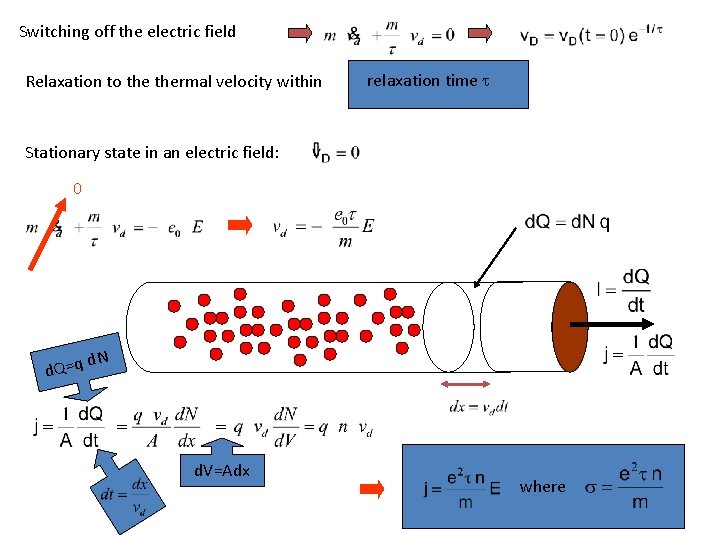
Switching off the electric field Relaxation to thermal velocity within relaxation time Stationary state in an electric field: 0 d d. Q=q N d. V=Adx where
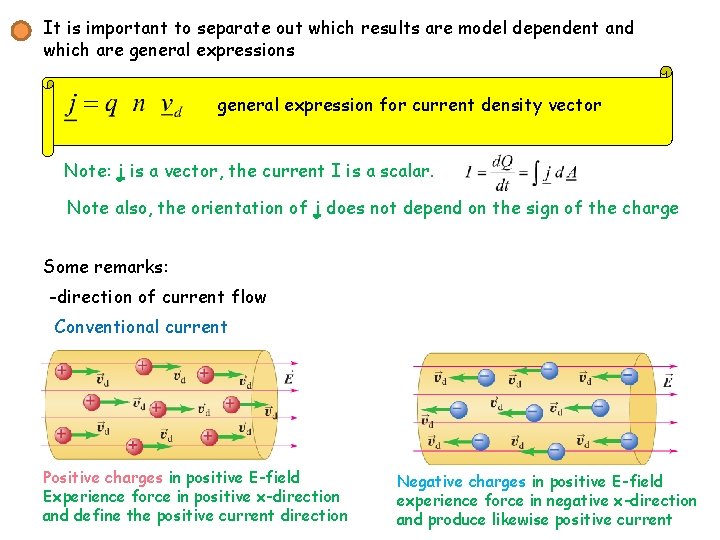
It is important to separate out which results are model dependent and which are general expressions general expression for current density vector Note: j is a vector, the current I is a scalar. Note also, the orientation of j does not depend on the sign of the charge Some remarks: -direction of current flow Conventional current Positive charges in positive E-field Experience force in positive x-direction and define the positive current direction Negative charges in positive E-field experience force in negative x-direction and produce likewise positive current
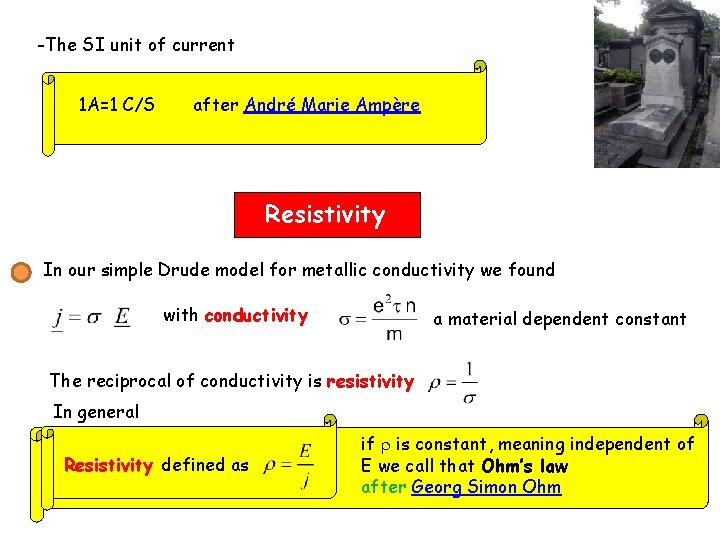
-The SI unit of current 1 A=1 C/S after André Marie Ampère Resistivity In our simple Drude model for metallic conductivity we found with conductivity a material dependent constant The reciprocal of conductivity is resistivity In general Resistivity defined as if is constant, meaning independent of E we call that Ohm’s law after Georg Simon Ohm
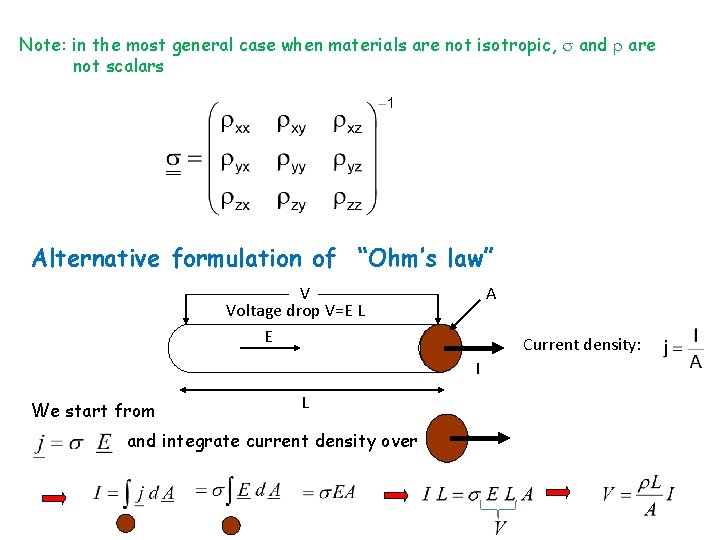
Note: in the most general case when materials are not isotropic, and are not scalars Alternative formulation of “Ohm’s law” A V Voltage drop V=E L E Current density: I We start from L and integrate current density over
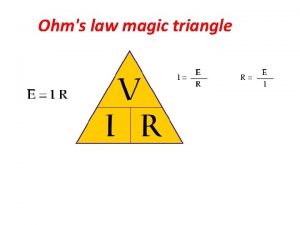
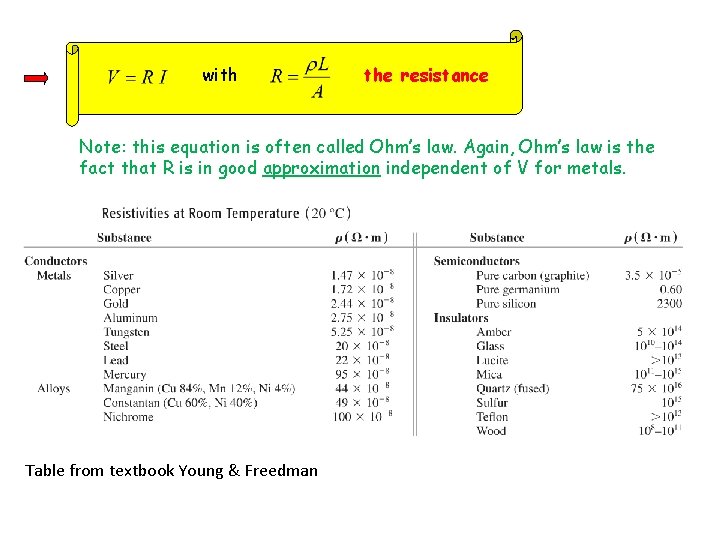
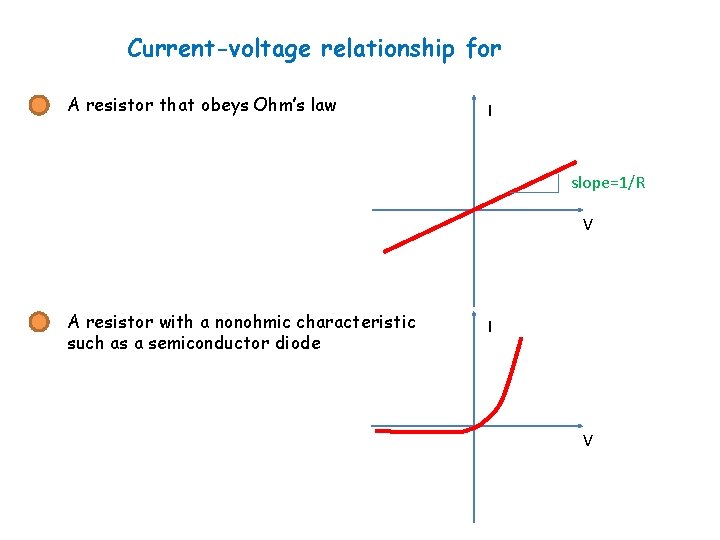
with the resistance Note: this equation is often called Ohm’s law. Again, Ohm’s law is the fact that R is in good approximation independent of V for metals. Table from textbook Young & Freedman
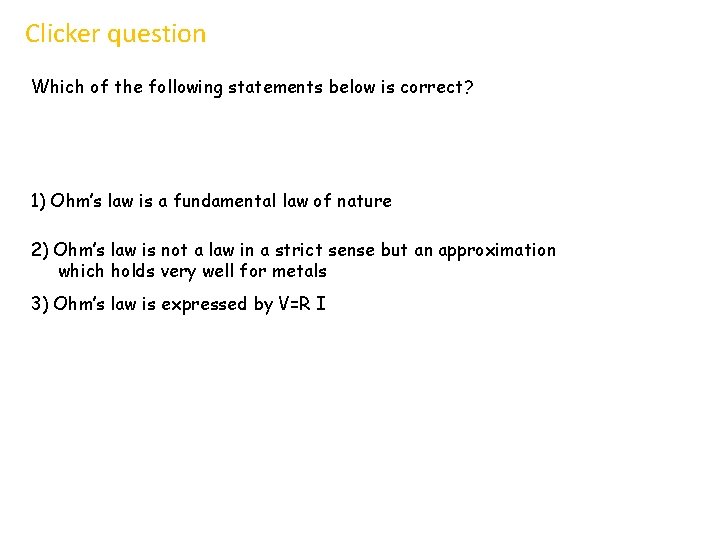
Clicker question Which of the following statements below is correct? 1) Ohm’s law is a fundamental law of nature 2) Ohm’s law is not a law in a strict sense but an approximation which holds very well for metals 3) Ohm’s law is expressed by V=R I
Current-voltage relationship for A resistor that obeys Ohm’s law I slope=1/R V A resistor with a nonohmic characteristic such as a semiconductor diode I V
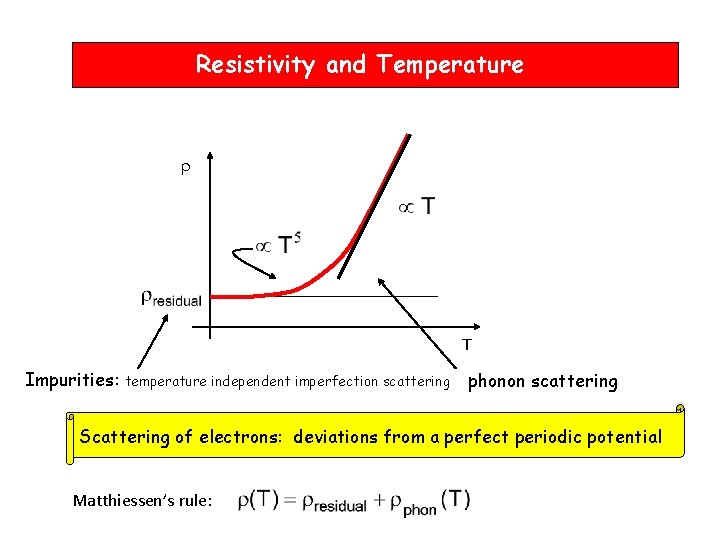
Resistivity and Temperature T Impurities: temperature independent imperfection scattering phonon scattering Scattering of electrons: deviations from a perfect periodic potential Matthiessen’s rule:
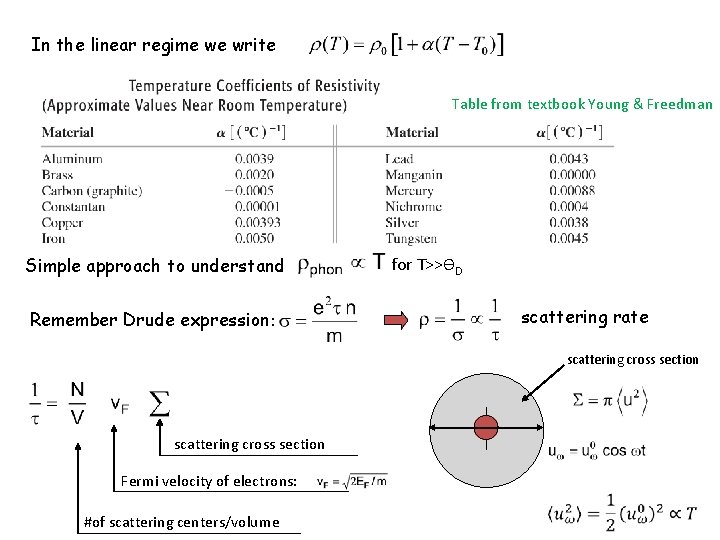
In the linear regime we write Table from textbook Young & Freedman Simple approach to understand Remember Drude expression: for T>>ӨD scattering rate scattering cross section Fermi velocity of electrons: #of scattering centers/volume
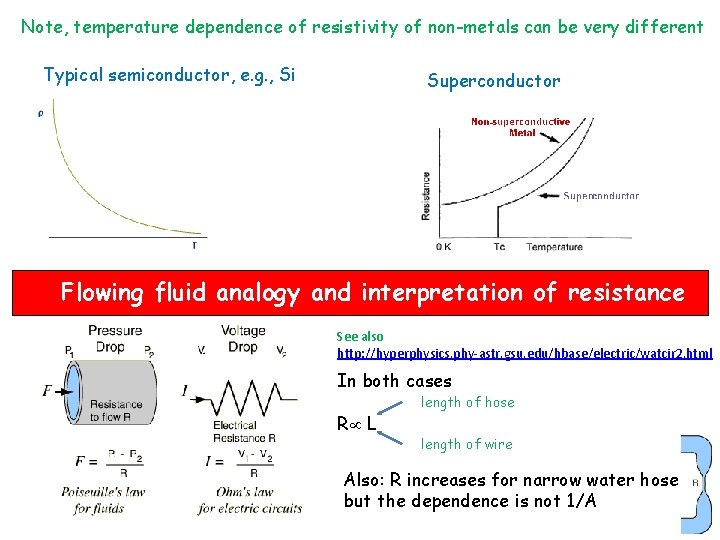
Note, temperature dependence of resistivity of non-metals can be very different Typical semiconductor, e. g. , Si Superconductor Flowing fluid analogy and interpretation of resistance See also http: //hyperphysics. phy-astr. gsu. edu/hbase/electric/watcir 2. html In both cases R L length of hose length of wire Also: R increases for narrow water hose but the dependence is not 1/A
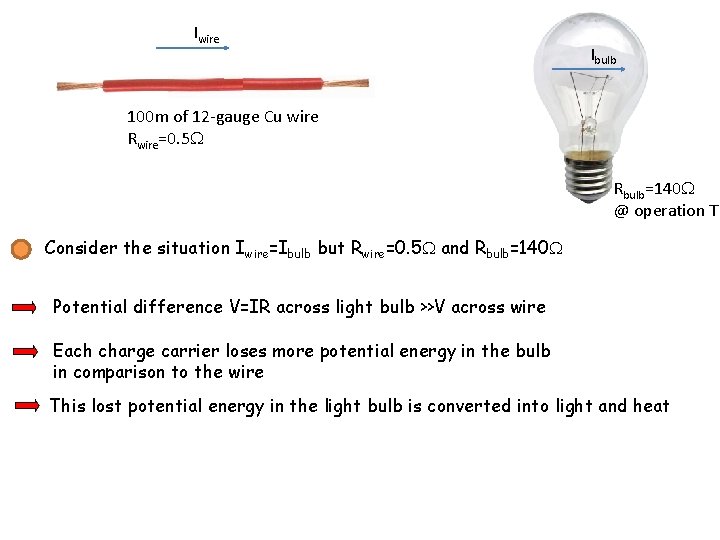
Iwire Ibulb 100 m of 12 -gauge Cu wire Rwire=0. 5 Rbulb=140 @ operation T Consider the situation Iwire=Ibulb but Rwire=0. 5 and Rbulb=140 Potential difference V=IR across light bulb >>V across wire Each charge carrier loses more potential energy in the bulb in comparison to the wire This lost potential energy in the light bulb is converted into light and heat
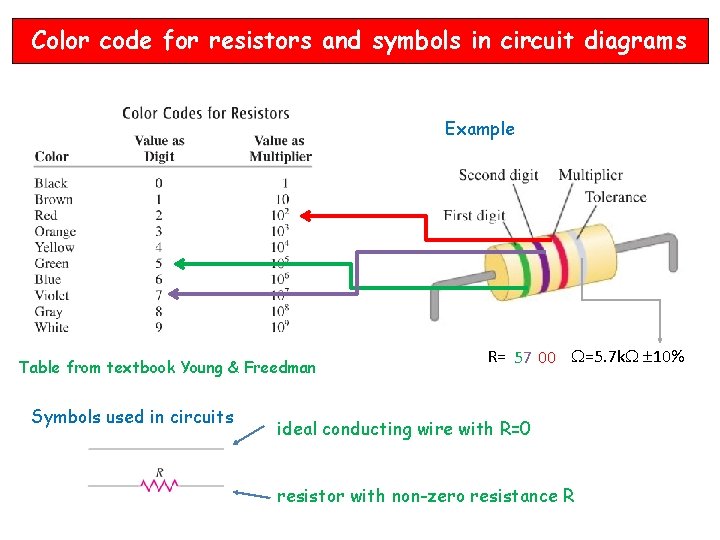
Color code for resistors and symbols in circuit diagrams Example Table from textbook Young & Freedman Symbols used in circuits R= 57 00 =5. 7 k 10% ideal conducting wire with R=0 resistor with non-zero resistance R
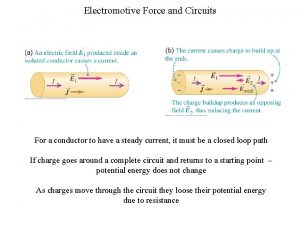
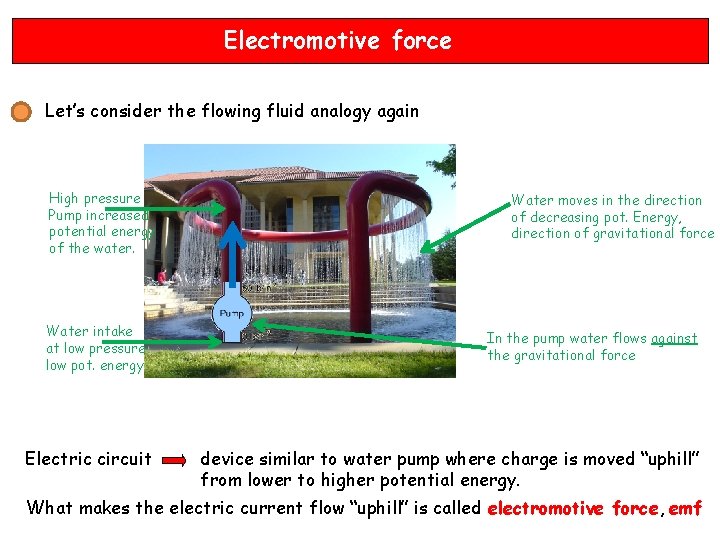
Electromotive force Let’s consider the flowing fluid analogy again High pressure Pump increased potential energy of the water. Water intake at low pressure low pot. energy Electric circuit Water moves in the direction of decreasing pot. Energy, direction of gravitational force In the pump water flows against the gravitational force device similar to water pump where charge is moved “uphill” from lower to higher potential energy. What makes the electric current flow “uphill” is called electromotive force, emf
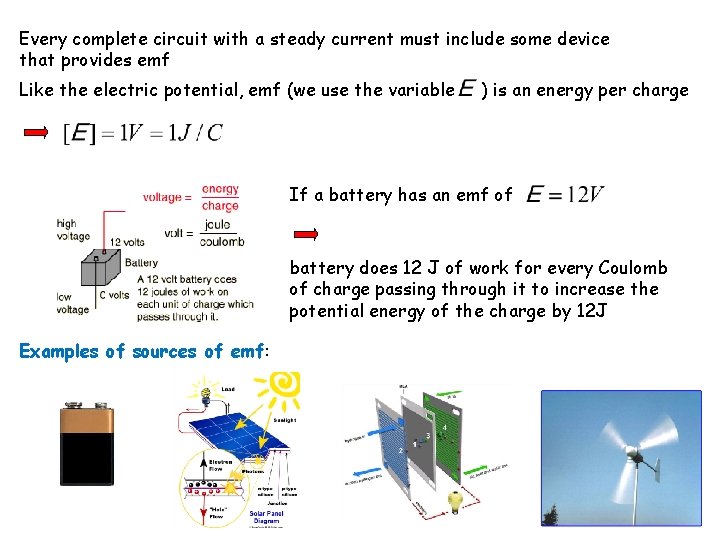
Every complete circuit with a steady current must include some device that provides emf Like the electric potential, emf (we use the variable ) is an energy per charge If a battery has an emf of battery does 12 J of work for every Coulomb of charge passing through it to increase the potential energy of the charge by 12 J Examples of sources of emf:
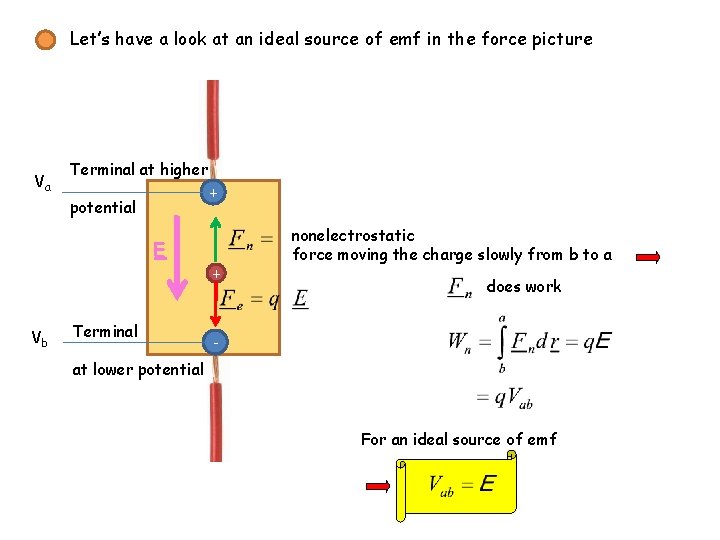
Let’s have a look at an ideal source of emf in the force picture Va Terminal at higher + potential E Vb Terminal + nonelectrostatic force moving the charge slowly from b to a does work - at lower potential For an ideal source of emf
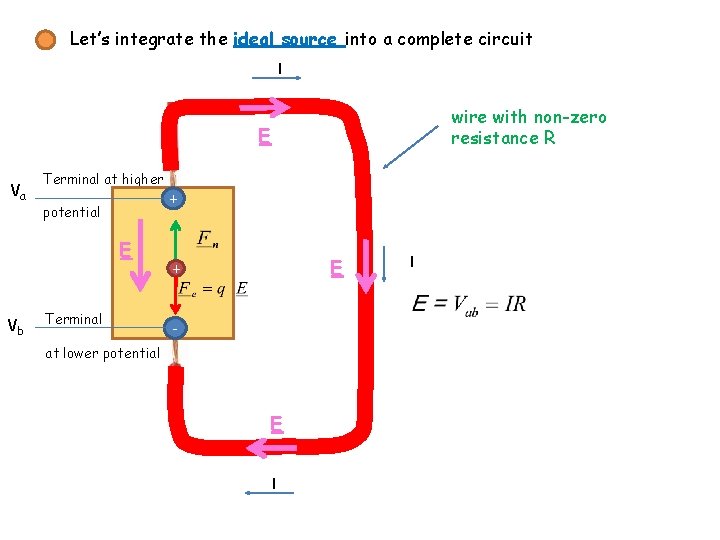
Let’s integrate the ideal source into a complete circuit I wire with non-zero resistance R E Va Terminal at higher potential E Vb Terminal + E + - at lower potential E I I
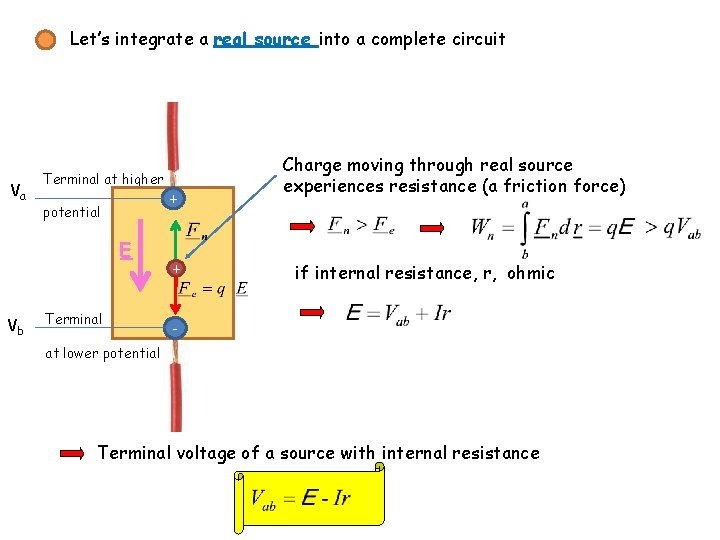
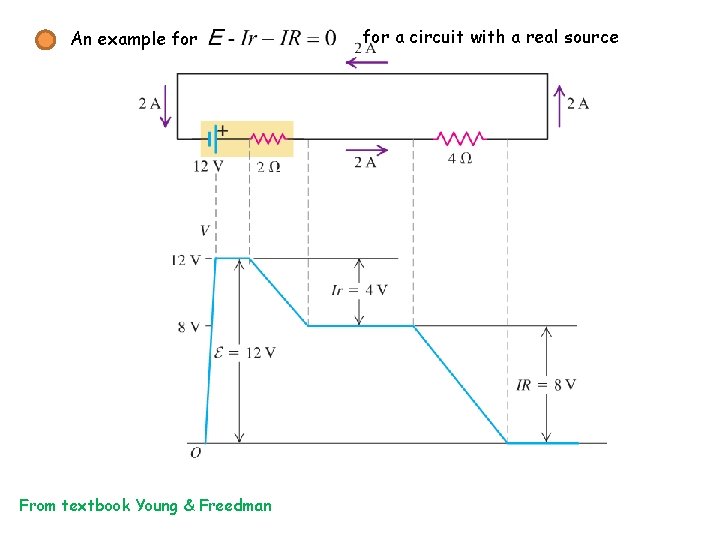
Let’s integrate a real source into a complete circuit Va Terminal at higher potential E Vb Terminal + + Charge moving through real source experiences resistance (a friction force) if internal resistance, r, ohmic - at lower potential Terminal voltage of a source with internal resistance
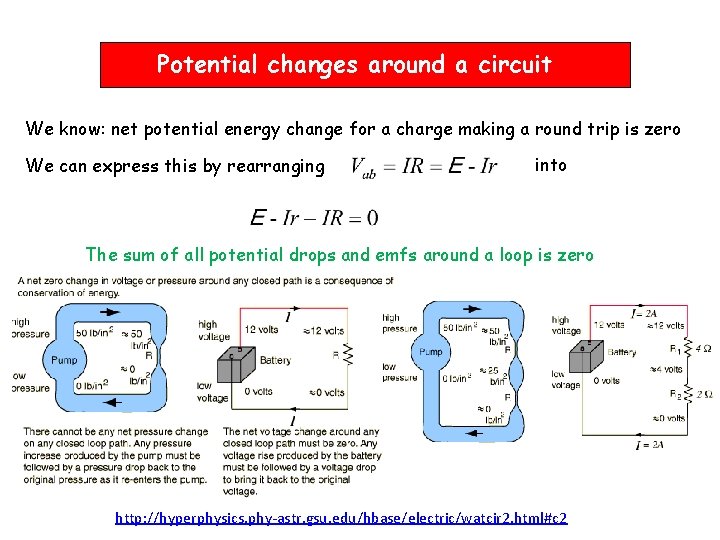
Potential changes around a circuit We know: net potential energy change for a charge making a round trip is zero We can express this by rearranging into The sum of all potential drops and emfs around a loop is zero http: //hyperphysics. phy-astr. gsu. edu/hbase/electric/watcir 2. html#c 2
An example for From textbook Young & Freedman for a circuit with a real source