Putting it all Together Linda R Greene RN
- Slides: 55
Putting it all Together Linda R. Greene, RN, MPS, CIC, FAPIC Barbara Russell, MPH, BS, RN, CIC, FAPIC
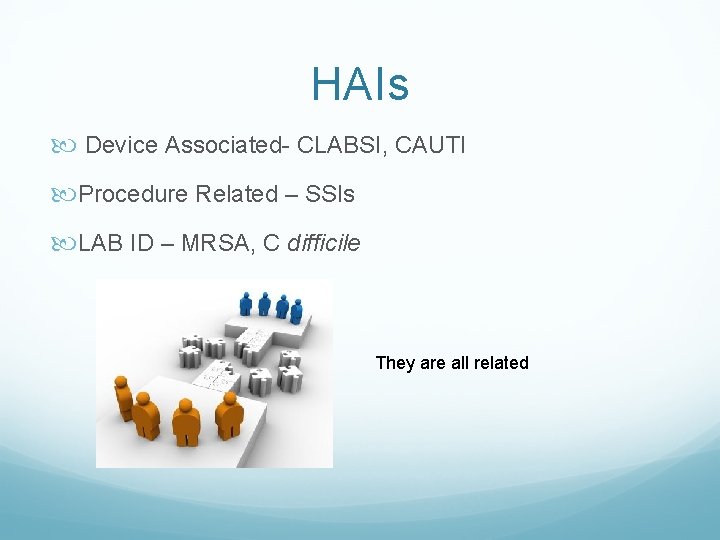
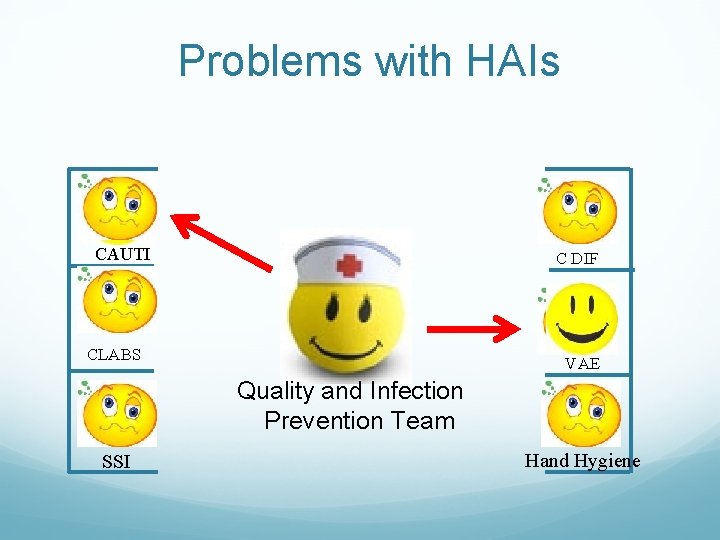
HAIs Device Associated- CLABSI, CAUTI Procedure Related – SSIs LAB ID – MRSA, C difficile They are all related
Basic Practices Cross all Domains
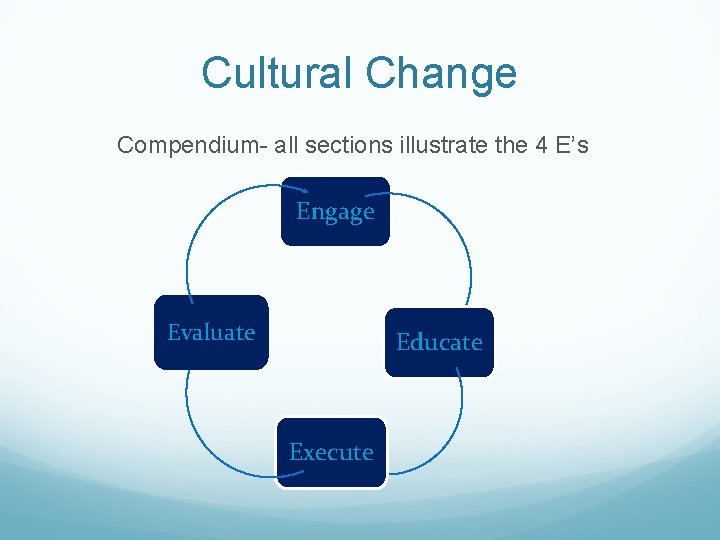
Cultural Change Compendium- all sections illustrate the 4 E’s Engage Evaluate Educate Execute
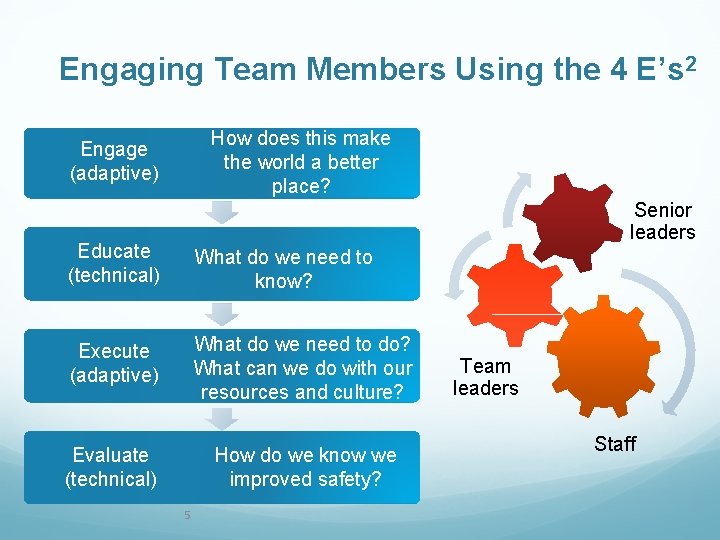
Engaging Team Members Using the 4 E’s 2 How does this make the world a better place? Engage (adaptive) Senior leaders Educate (technical) What do we need to know? Execute (adaptive) What do we need to do? What can we do with our resources and culture? Evaluate (technical) How do we know we improved safety? 5 Team leaders Staff
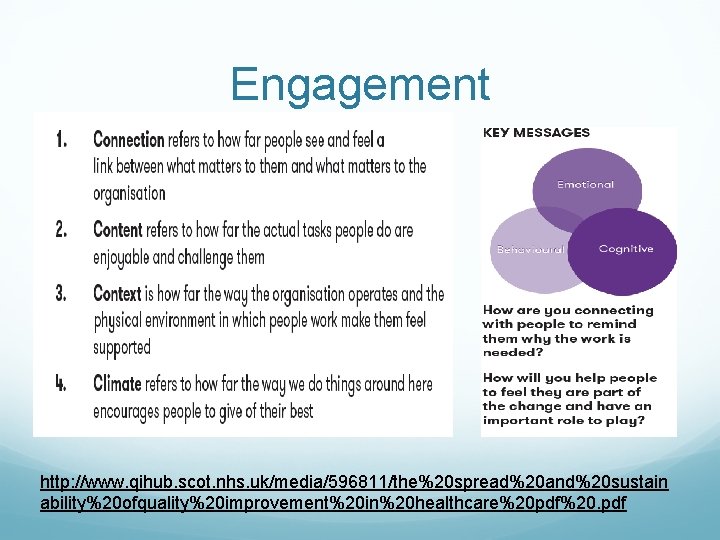
Engagement http: //www. qihub. scot. nhs. uk/media/596811/the%20 spread%20 and%20 sustain ability%20 ofquality%20 improvement%20 in%20 healthcare%20 pdf%20. pdf
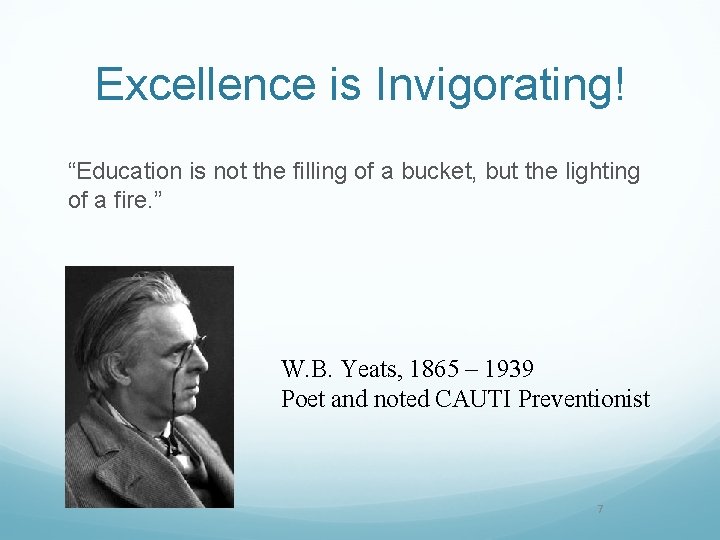
Excellence is Invigorating! “Education is not the filling of a bucket, but the lighting of a fire. ” W. B. Yeats, 1865 – 1939 Poet and noted CAUTI Preventionist 7
Engagement: Eyes on the Prize Center everything on the PATIENT Preventable harm is unacceptable If you cannot get agreement here, your house is built on sand. Make it PERSONAL Tell your own story Use a name… even a face… or names and faces! A million deaths is a statistic http: //www. ahrq. gov/professionals/education/curriculumtools/teamstepps/instructor/videos/ts_Sue_Sheridan/Sue_Sheridan-400 -300. html 8
Engagement: The Frontline The trick to engagement is: engaging! How are we going to hurt the next patient? What can we do to prevent that? Light that fire… and follow through. Listen: meetings, Executive rounds Act: Concrete changes. Credit where due. Report: advertise changes & successes 9
Positive Reinforcement Adopting frontline ideas Poster displays Unit Safety Champion of the Month Underperformance? Non punitive approach to error Must address at the source: Attack the problem not the worker 10
Are You Discouraged Yet? Valuing dissent: Every comment is helpful. Thank You for ___ Opportunity to engage Opportunity to learn… 11
Engaging Stakeholders Strategy #1: Surprise! Strategy #2: FYI, I am changing your workflow Strategy #3: Consultation with experts We need your help with something You’re a recognized leader on ____. How do you think ___ is going? How would you ___, or correct me on ___. How can we assist you with ____?
Engaging: Administration Align Project and Institutional Aims and Existing projects Executive Adoption Skin in the game 13
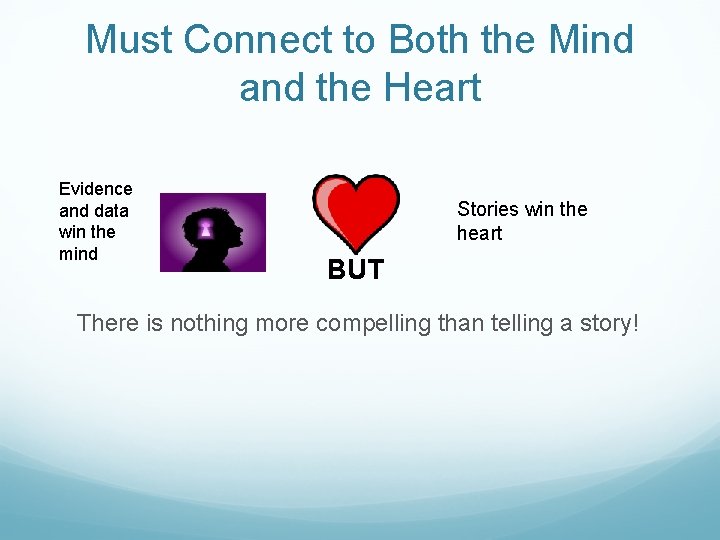
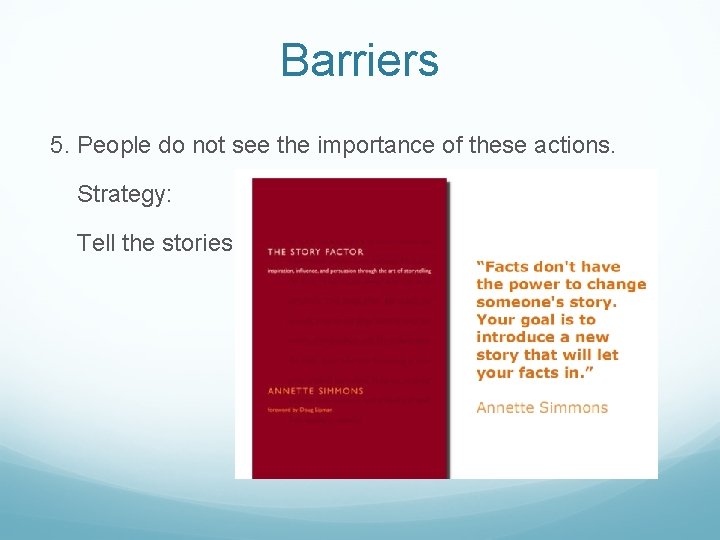
Must Connect to Both the Mind and the Heart Evidence and data win the mind Stories win the heart BUT There is nothing more compelling than telling a story!
The Power of Connection "Facts bring us to knowledge, but stories lead to wisdom. " Dr. Rachel Naomi Remen
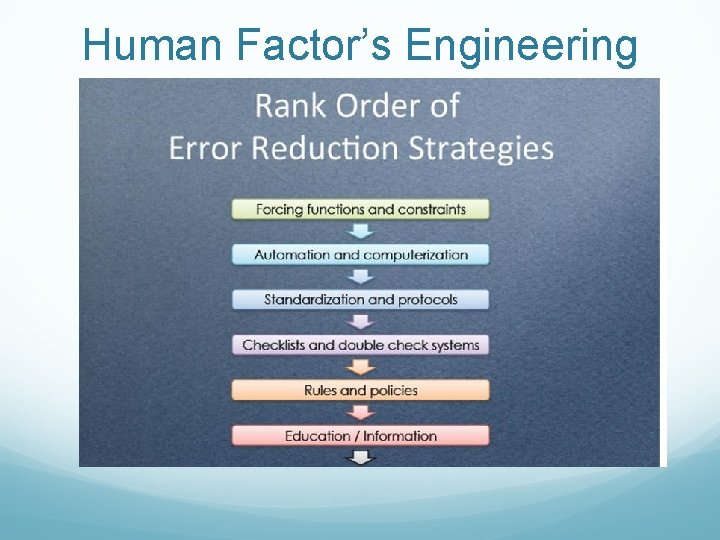
Human Factor’s Engineering
Problems with HAIs CAUTI C DIF CLABS VAE Quality and Infection Prevention Team SSI Hand Hygiene
Technical Challenges Can be solved with existing science or technology “knowledge based” Issues or challenges for which there is “an answer” Examples: Summarizing the evidence Educating staff and senior leaders Evaluation: Are patients safer? Heifetz, Leadership Without Easy Answers (Cambridge: Harvard University Press, 1994) 18
Adaptive Challenges Require a change of values, attitudes or beliefs “Behavior based” Examples: Engagement Execution 19
The Work of Adaptive Change Determining the direction – what must change Determining the methods - how to change Local wisdom tapped
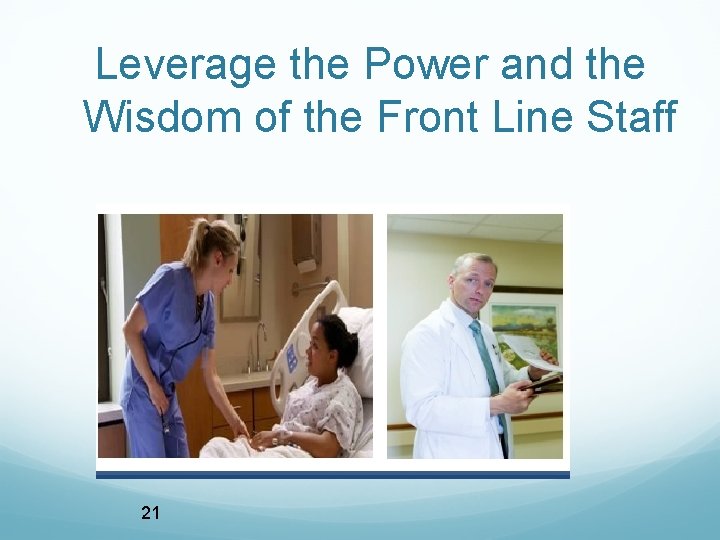
Leverage the Power and the Wisdom of the Front Line Staff 21
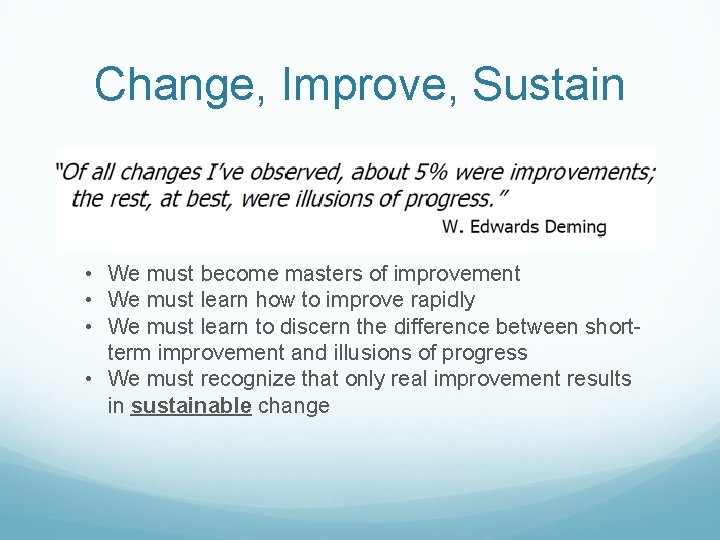
Change, Improve, Sustain • We must become masters of improvement • We must learn how to improve rapidly • We must learn to discern the difference between shortterm improvement and illusions of progress • We must recognize that only real improvement results in sustainable change
Sustainability 23
Sustainability • Desired health benefits are maintained or improved • The innovation loses its separate identity and becomes part of regular activities (institutionalization) • Staff provide ongoing support and expertise (building capacity)
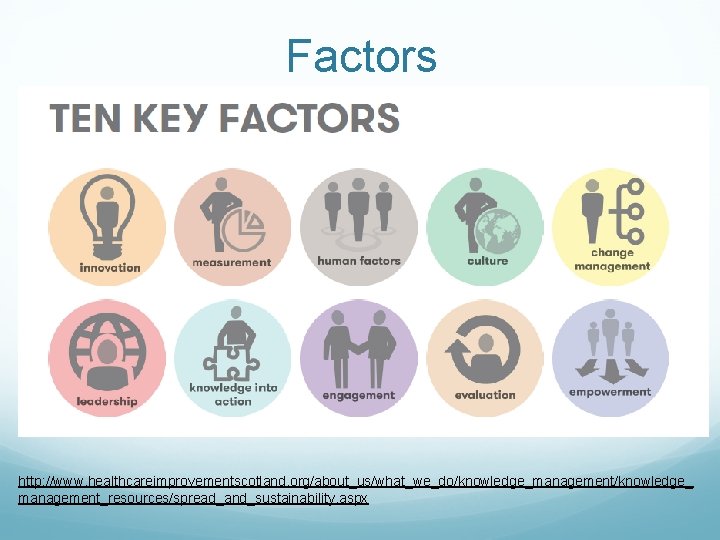
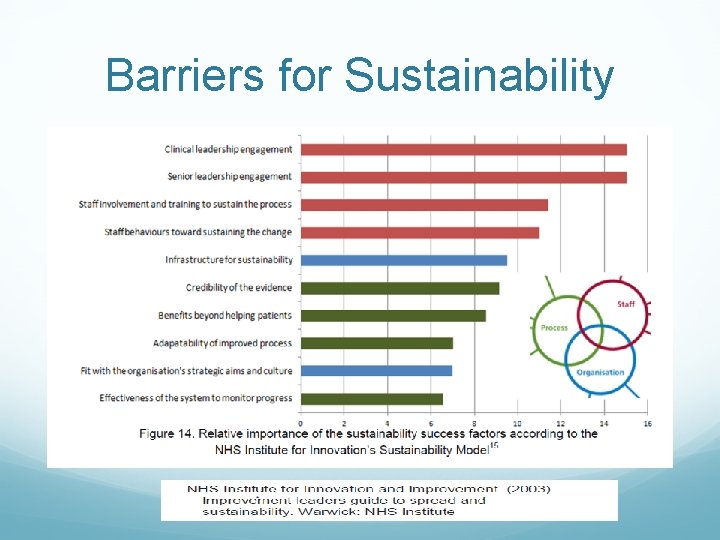
Factors http: //www. healthcareimprovementscotland. org/about_us/what_we_do/knowledge_management/knowledge_ management_resources/spread_and_sustainability. aspx
Why Plan for Sustainability? Why worry about the distant future? What you can anticipate: − Turnover of staff − New projects/distractions − Complacency − Emergencies and complex cases (someone will call for exceptions to be made)
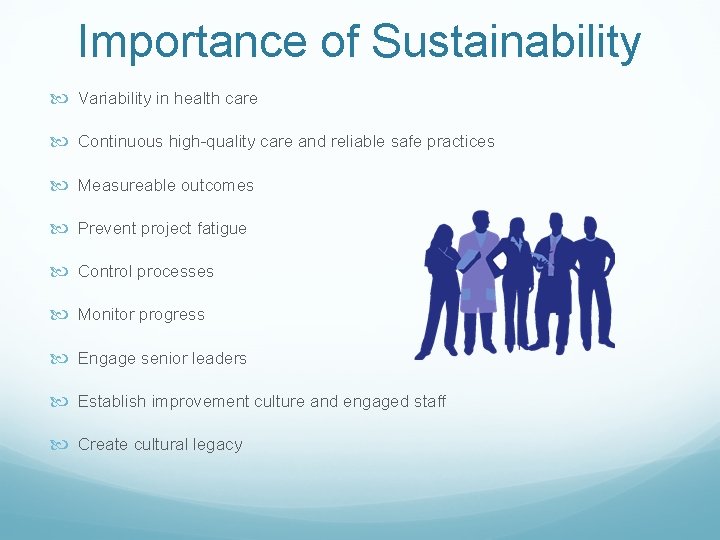
Importance of Sustainability Variability in health care Continuous high-quality care and reliable safe practices Measureable outcomes Prevent project fatigue Control processes Monitor progress Engage senior leaders Establish improvement culture and engaged staff Create cultural legacy
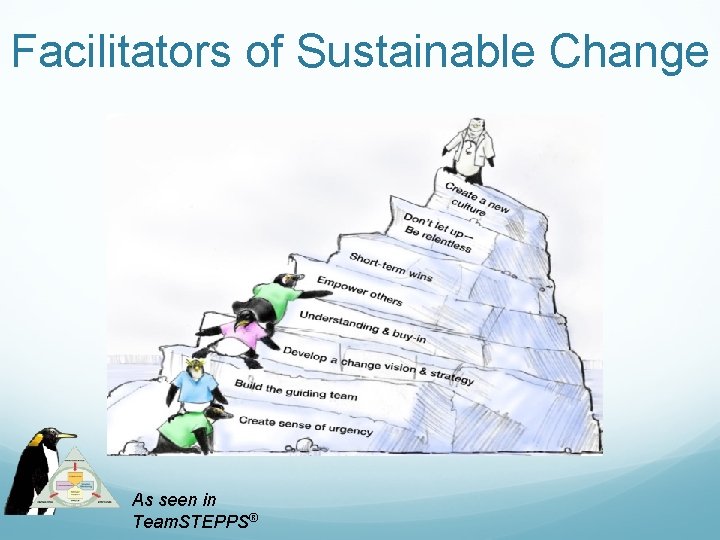
Facilitators of Sustainable Change As seen in Team. STEPPS®
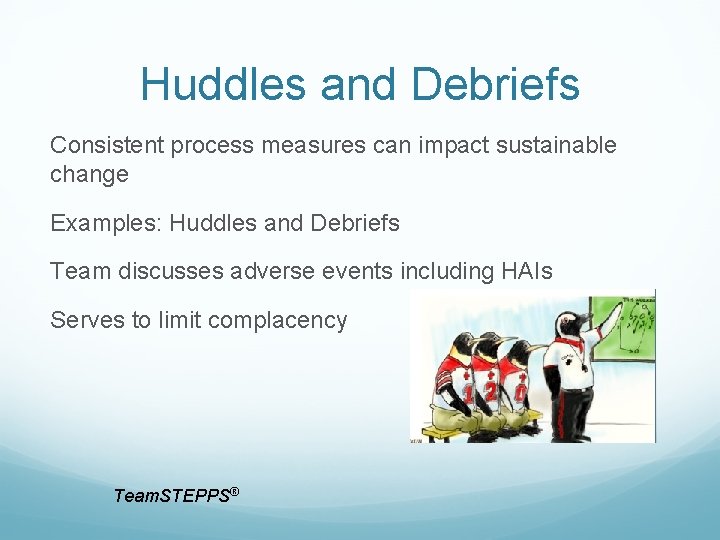
Huddles and Debriefs Consistent process measures can impact sustainable change Examples: Huddles and Debriefs Team discusses adverse events including HAIs Serves to limit complacency Team. STEPPS®
Steps to Creating a Sustainability Plan 1. Identify and develop program champion(s) 2. Build the implementation team 3. Empower frontline staff 4. Establish a sustainability measurement plan 5. Identify and address barriers to sustainability 6. Engage staff with stories 7. Recognize and celebrate success
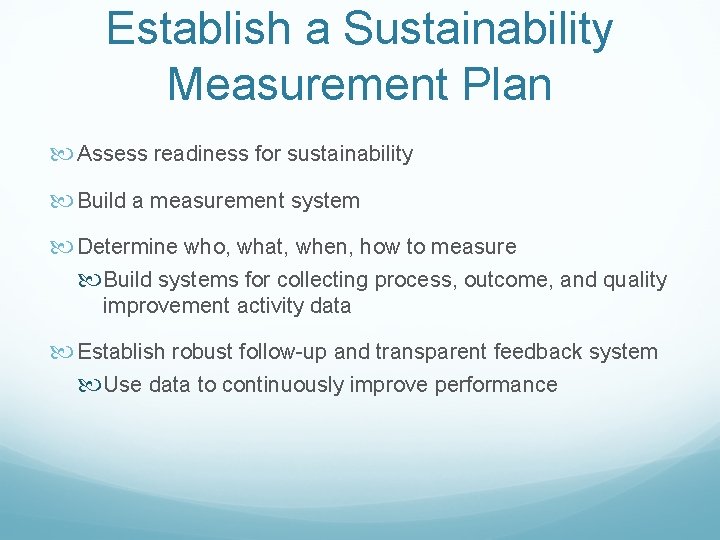
Establish a Sustainability Measurement Plan Assess readiness for sustainability Build a measurement system Determine who, what, when, how to measure Build systems for collecting process, outcome, and quality improvement activity data Establish robust follow-up and transparent feedback system Use data to continuously improve performance
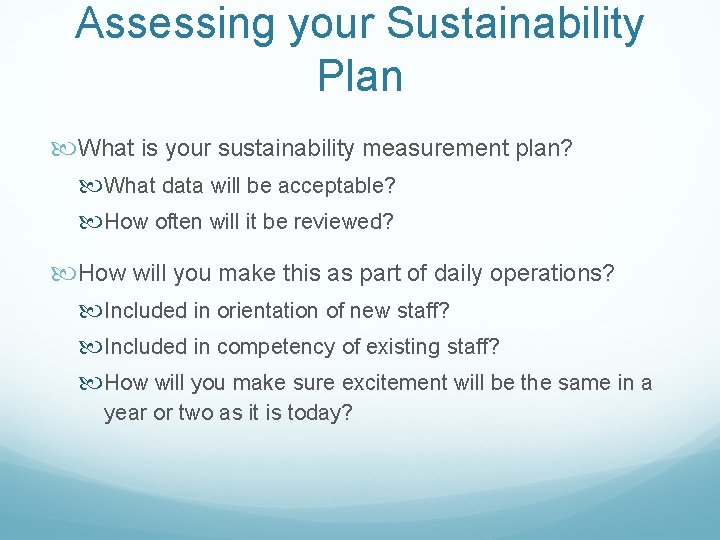
Assessing your Sustainability Plan What is your sustainability measurement plan? What data will be acceptable? How often will it be reviewed? How will you make this as part of daily operations? Included in orientation of new staff? Included in competency of existing staff? How will you make sure excitement will be the same in a year or two as it is today?
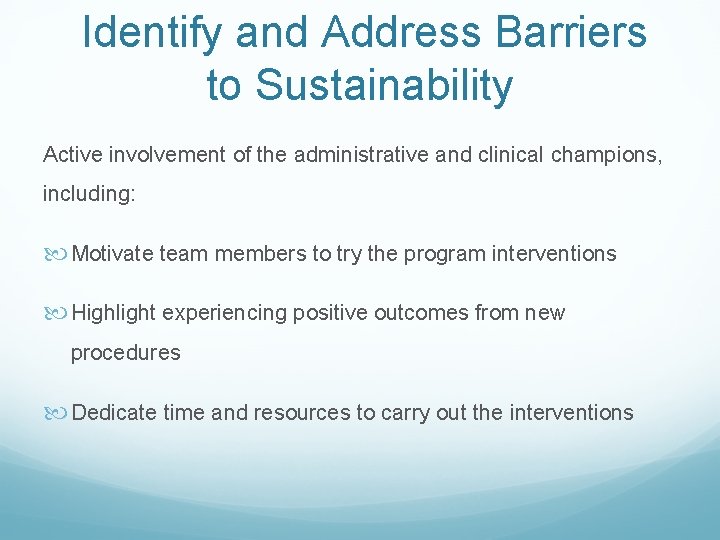
Identify and Address Barriers to Sustainability Active involvement of the administrative and clinical champions, including: Motivate team members to try the program interventions Highlight experiencing positive outcomes from new procedures Dedicate time and resources to carry out the interventions
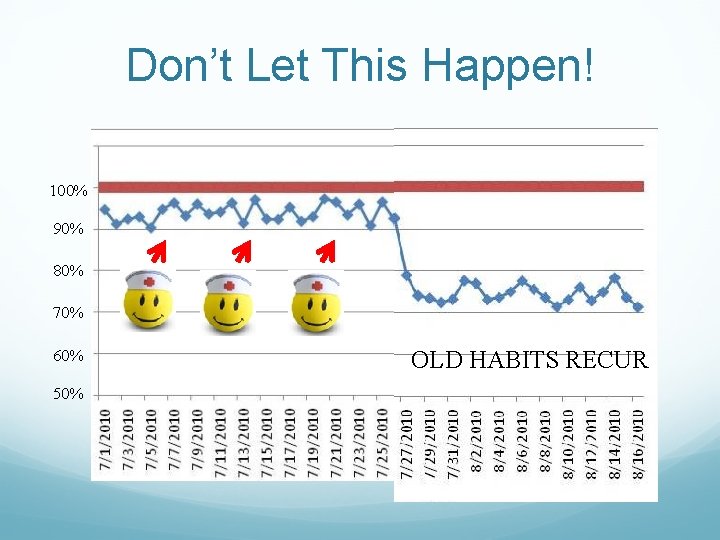
Don’t Let This Happen! 100% 90% 80% 70% 60% 50% OLD HABITS RECUR
The Sustainability Team Include all stakeholders that are impacted. Review current results, and consider: Is the intervention in the final stage of development? Is there room for improvement? Are the measurements demonstrating real improvement? Who cares about the improvement? Is the solution representative of wider views of those involved? What policy or technology changes may render solution redundant or obsolete?
How to Sustain the Gains: Set an Aim May not vary greatly from prior work Seek to improve performance: set lower and lower goals Write it down: What, Who, How, When
How To Sustain the Gains : How To Sustain the Measure Progress Gains: Measure Progress Continue to measure performance Measure often Regular review by leaders
Maintenance Strategies Keep the meetings going Keep listening, keep acting on suggestions - “must be easy and pleasant to achieve” Keep the feedback (and praise) coming Keep the patient in the picture Keep it positive - Even with the fallouts
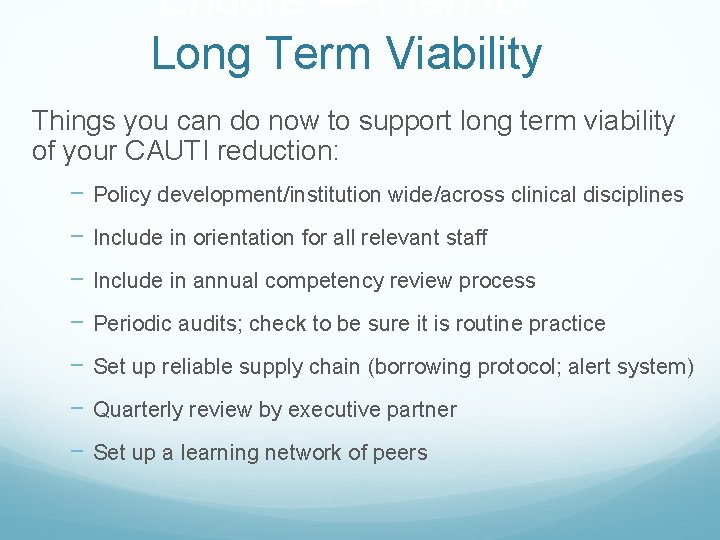
Endure — Plan for Long Term Viability Things you can do now to support long term viability of your CAUTI reduction: − Policy development/institution wide/across clinical disciplines − Include in orientation for all relevant staff − Include in annual competency review process − Periodic audits; check to be sure it is routine practice − Set up reliable supply chain (borrowing protocol; alert system) − Quarterly review by executive partner − Set up a learning network of peers
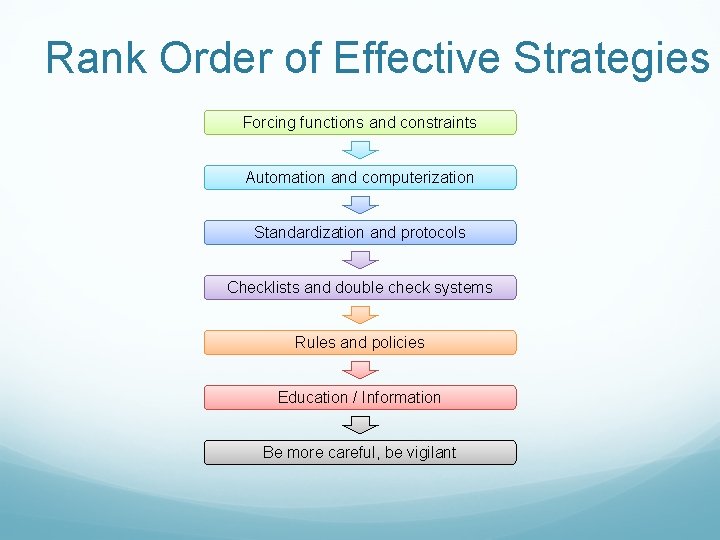
Rank Order of Effective Strategies Forcing functions and constraints Automation and computerization Standardization and protocols Checklists and double check systems Rules and policies Education / Information Be more careful, be vigilant
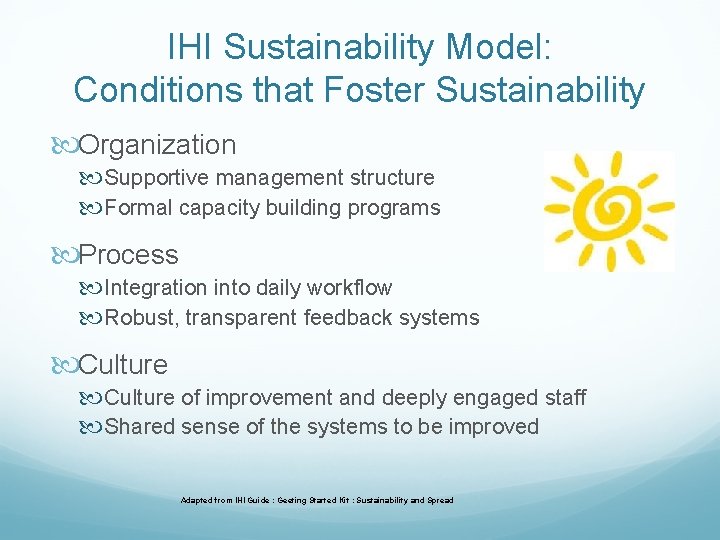
IHI Sustainability Model: Conditions that Foster Sustainability Organization Supportive management structure Formal capacity building programs Process Integration into daily workflow Robust, transparent feedback systems Culture of improvement and deeply engaged staff Shared sense of the systems to be improved Adapted from IHI Guide : Geeting Started Kit : Sustainability and Spread
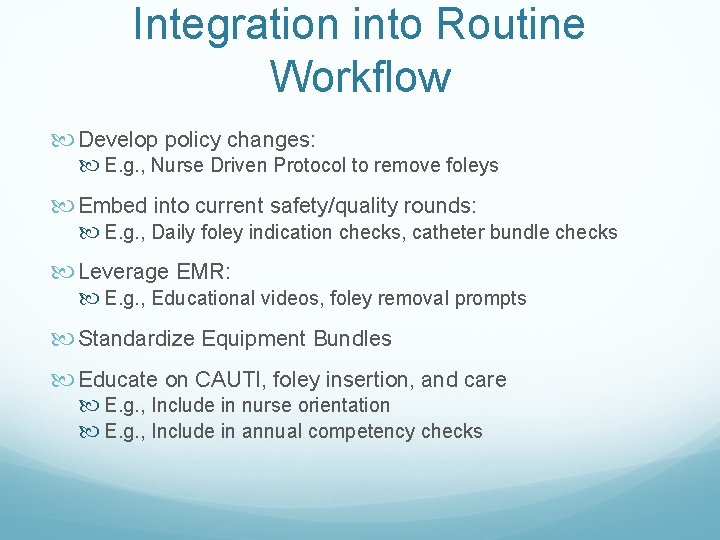
Integration into Routine Workflow Develop policy changes: E. g. , Nurse Driven Protocol to remove foleys Embed into current safety/quality rounds: E. g. , Daily foley indication checks, catheter bundle checks Leverage EMR: E. g. , Educational videos, foley removal prompts Standardize Equipment Bundles Educate on CAUTI, foley insertion, and care E. g. , Include in nurse orientation E. g. , Include in annual competency checks
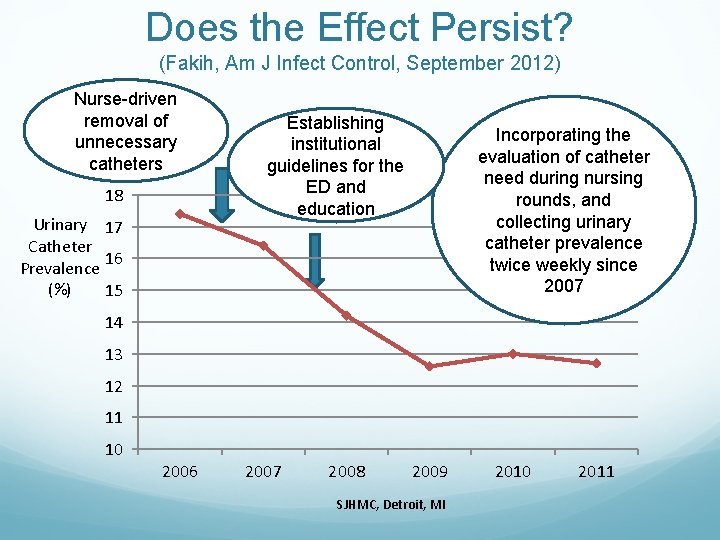
Does the Effect Persist? (Fakih, Am J Infect Control, September 2012) Nurse-driven removal of unnecessary catheters 18 Urinary 17 Catheter 16 Prevalence (%) 15 Establishing institutional guidelines for the ED and education Incorporating the evaluation of catheter need during nursing rounds, and collecting urinary catheter prevalence twice weekly since 2007 14 13 12 11 10 2006 2007 2008 2009 SJHMC, Detroit, MI 2010 2011
Barriers for Sustainability
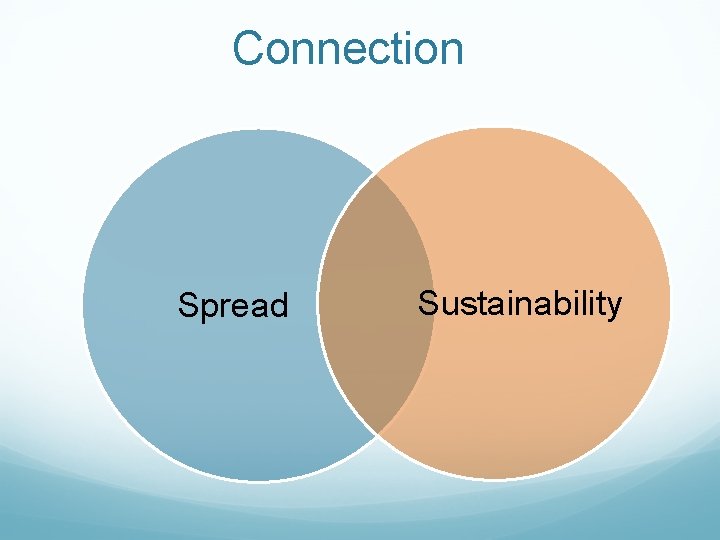
Connection Spread Sustainability
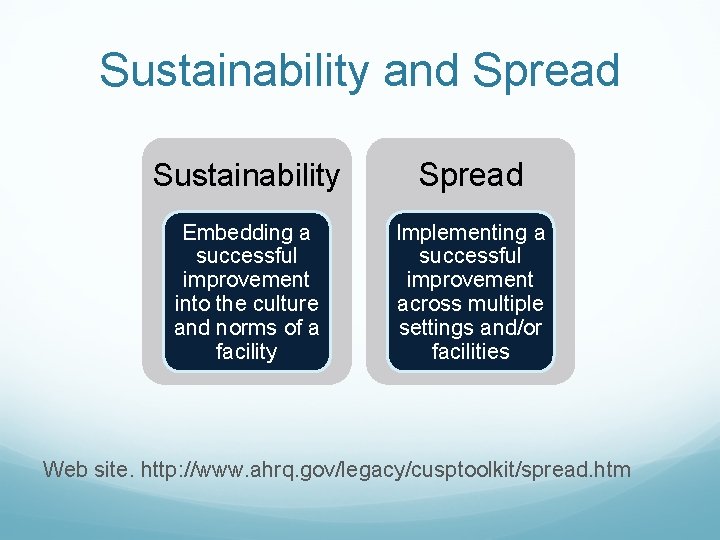
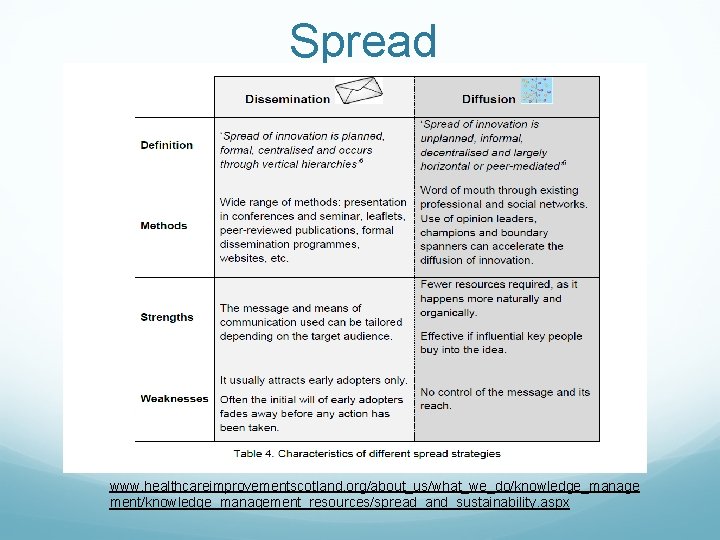
Sustainability and Spread Sustainability Spread Embedding a successful improvement into the culture and norms of a facility Implementing a successful improvement across multiple settings and/or facilities Web site. http: //www. ahrq. gov/legacy/cusptoolkit/spread. htm
Spread www. healthcareimprovementscotland. org/about_us/what_we_do/knowledge_manage ment/knowledge_management_resources/spread_and_sustainability. aspx
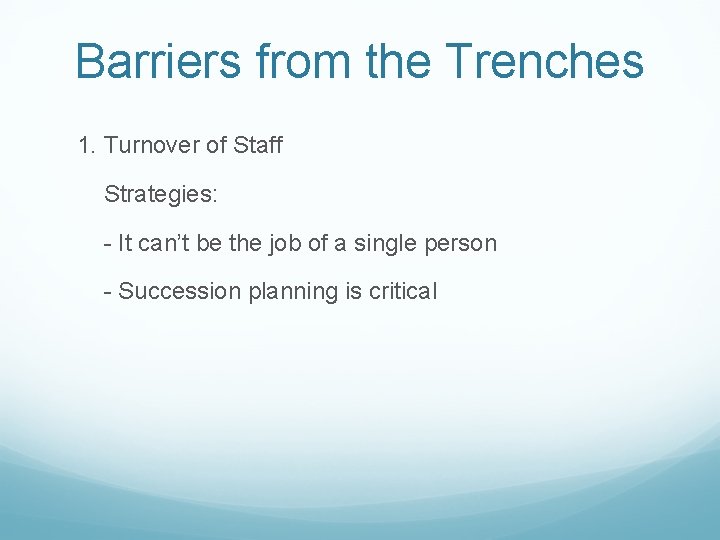
Barriers from the Trenches 1. Turnover of Staff Strategies: - It can’t be the job of a single person - Succession planning is critical
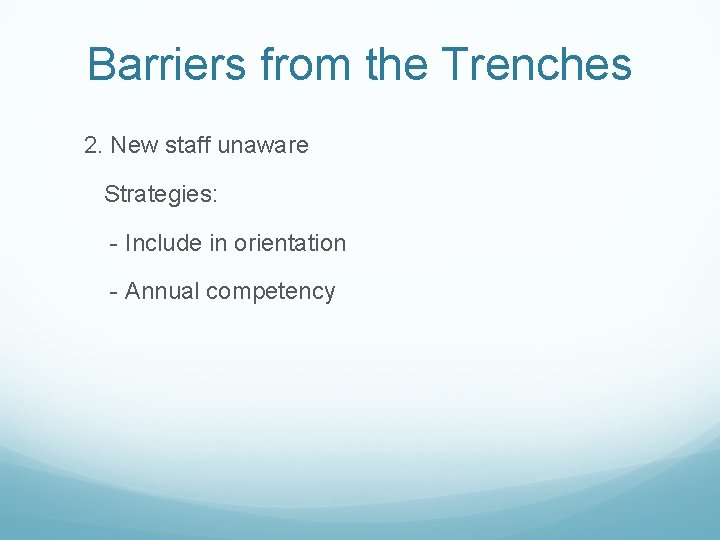
Barriers from the Trenches 2. New staff unaware Strategies: - Include in orientation - Annual competency
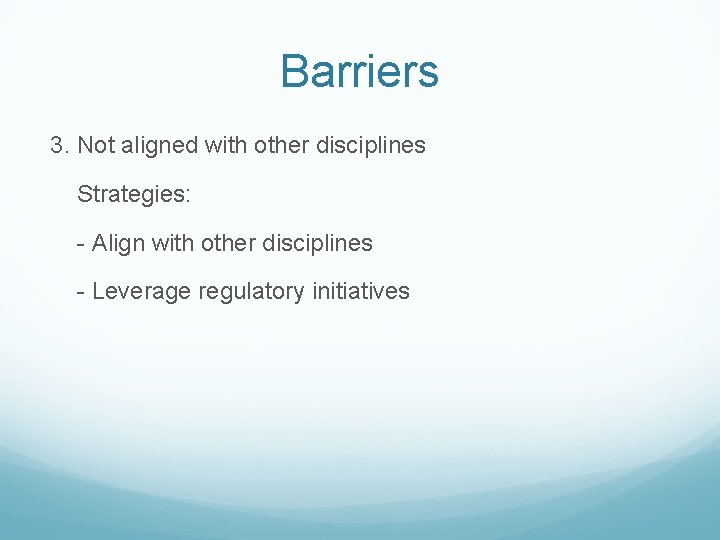
Barriers 3. Not aligned with other disciplines Strategies: - Align with other disciplines - Leverage regulatory initiatives
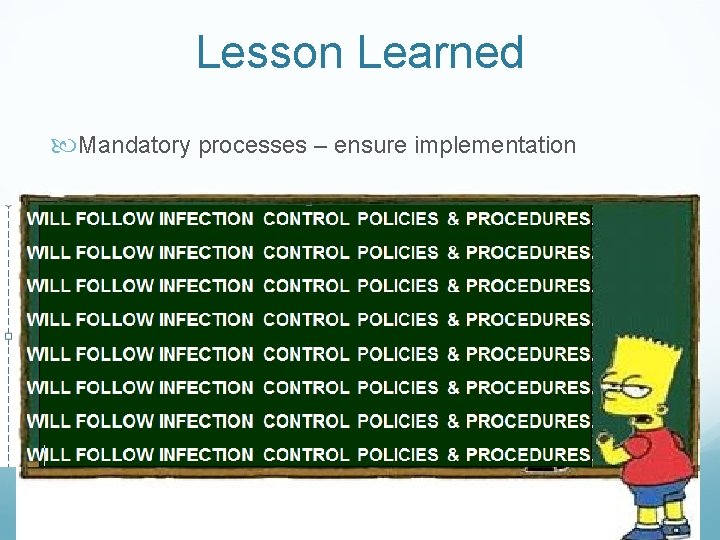
Lesson Learned Mandatory processes – ensure implementation
Barrier – Over Culturing i. e. C. difficile specimens Urine cultures Strategies: – Develop protocols. Align with electronic health record
Barriers 5. People do not see the importance of these actions. Strategy: Tell the stories
Summary No magic bullets Most recent publications review implementation strategies “Back to the basics” is important Increased emphasis on behavioral change
Questions