PartofSpeech Tagging A Canonical FiniteState Task 600 465
- Slides: 47
Part-of-Speech Tagging A Canonical Finite-State Task 600. 465 - Intro to NLP - J. Eisner 1
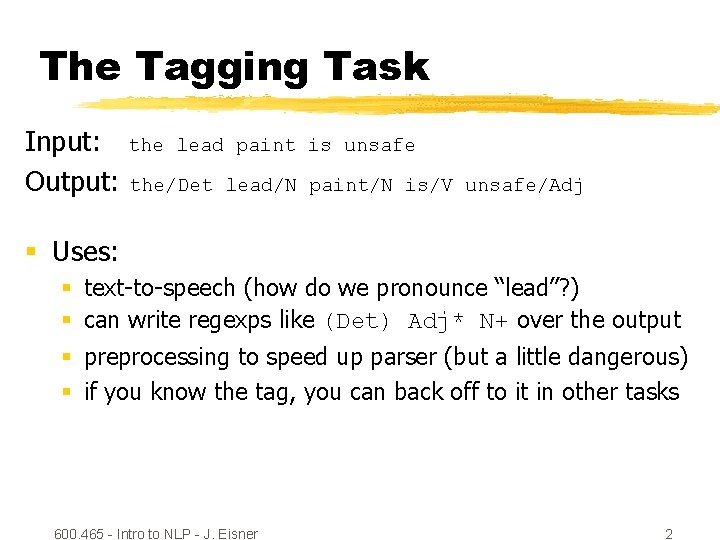
The Tagging Task Input: the lead paint Output: the/Det lead/N is unsafe paint/N is/V unsafe/Adj § Uses: § text-to-speech (how do we pronounce “lead”? ) § can write regexps like (Det) Adj* N+ over the output § preprocessing to speed up parser (but a little dangerous) § if you know the tag, you can back off to it in other tasks 600. 465 - Intro to NLP - J. Eisner 2
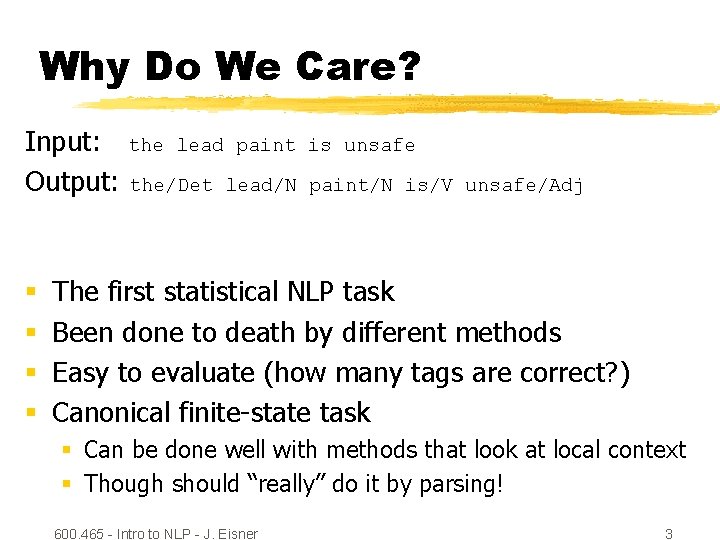
Why Do We Care? Input: the lead paint Output: the/Det lead/N § § is unsafe paint/N is/V unsafe/Adj The first statistical NLP task Been done to death by different methods Easy to evaluate (how many tags are correct? ) Canonical finite-state task § Can be done well with methods that look at local context § Though should “really” do it by parsing! 600. 465 - Intro to NLP - J. Eisner 3
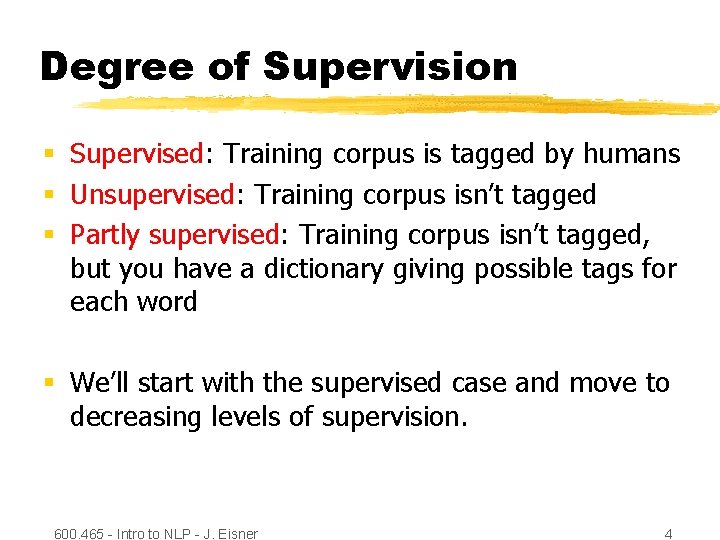
Degree of Supervision § Supervised: Training corpus is tagged by humans § Unsupervised: Training corpus isn’t tagged § Partly supervised: Training corpus isn’t tagged, but you have a dictionary giving possible tags for each word § We’ll start with the supervised case and move to decreasing levels of supervision. 600. 465 - Intro to NLP - J. Eisner 4
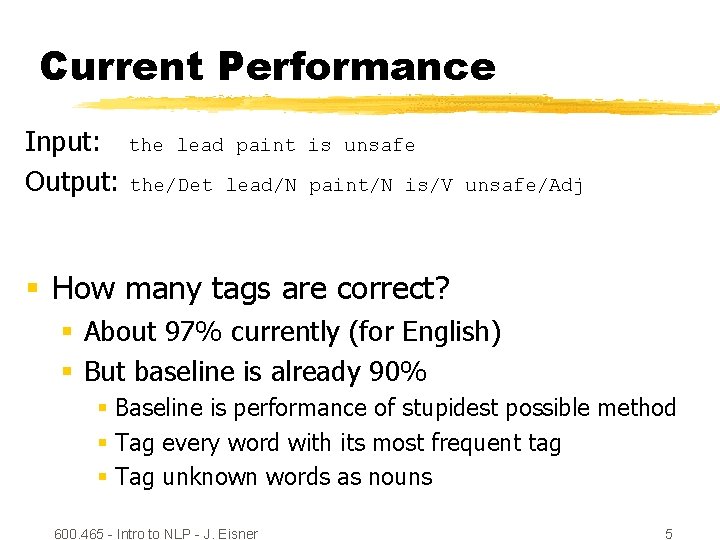
Current Performance Input: the lead paint Output: the/Det lead/N is unsafe paint/N is/V unsafe/Adj § How many tags are correct? § About 97% currently (for English) § But baseline is already 90% § Baseline is performance of stupidest possible method § Tag every word with its most frequent tag § Tag unknown words as nouns 600. 465 - Intro to NLP - J. Eisner 5
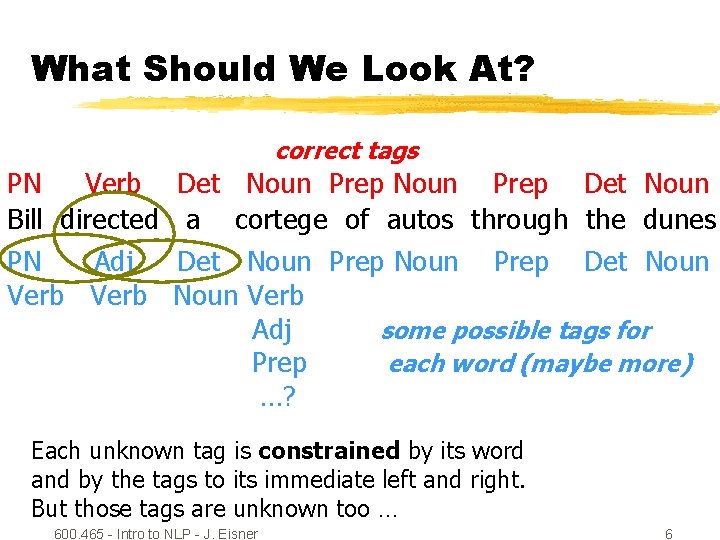
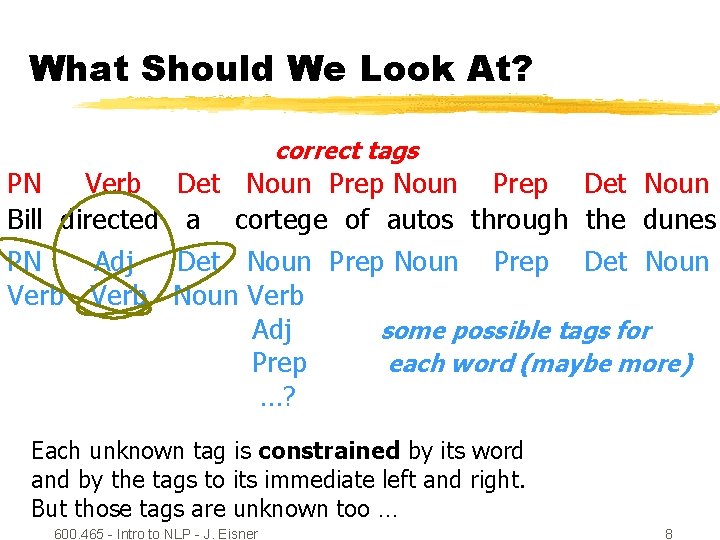
What Should We Look At? correct tags PN Verb Bill directed PN Adj Verb Det Noun Prep Det Noun a cortege of autos through the dunes Det Noun Prep Det Noun Verb Adj some possible tags for Prep each word (maybe more) …? Each unknown tag is constrained by its word and by the tags to its immediate left and right. But those tags are unknown too … 600. 465 - Intro to NLP - J. Eisner 6
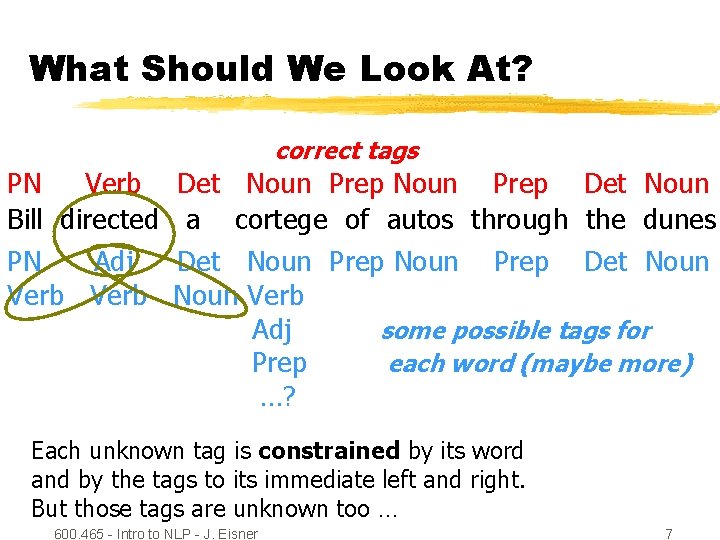
What Should We Look At? correct tags PN Verb Bill directed PN Adj Verb Det Noun Prep Det Noun a cortege of autos through the dunes Det Noun Prep Det Noun Verb Adj some possible tags for Prep each word (maybe more) …? Each unknown tag is constrained by its word and by the tags to its immediate left and right. But those tags are unknown too … 600. 465 - Intro to NLP - J. Eisner 7
What Should We Look At? correct tags PN Verb Bill directed PN Adj Verb Det Noun Prep Det Noun a cortege of autos through the dunes Det Noun Prep Det Noun Verb Adj some possible tags for Prep each word (maybe more) …? Each unknown tag is constrained by its word and by the tags to its immediate left and right. But those tags are unknown too … 600. 465 - Intro to NLP - J. Eisner 8
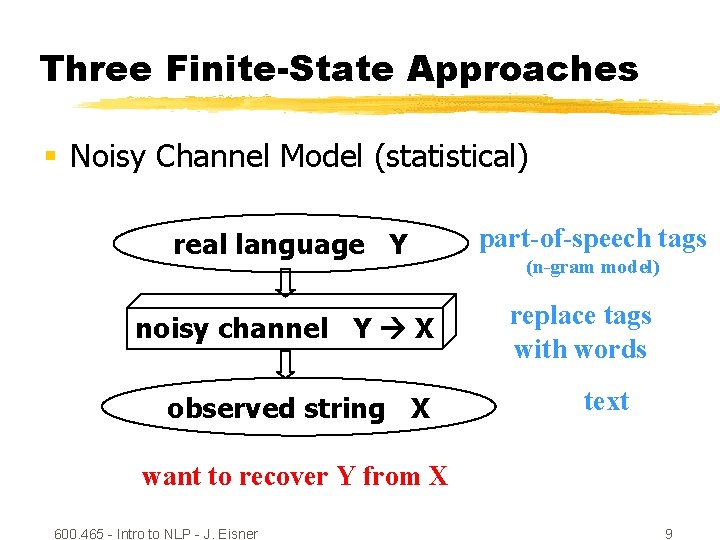
Three Finite-State Approaches § Noisy Channel Model (statistical) real language Y noisy channel Y X observed string X part-of-speech tags (n-gram model) replace tags with words text want to recover Y from X 600. 465 - Intro to NLP - J. Eisner 9
Three Finite-State Approaches 1. Noisy Channel Model (statistical) 2. Deterministic baseline tagger composed with a cascade of fixup transducers 3. Nondeterministic tagger composed with a cascade of finite-state automata that act as filters 600. 465 - Intro to NLP - J. Eisner 10
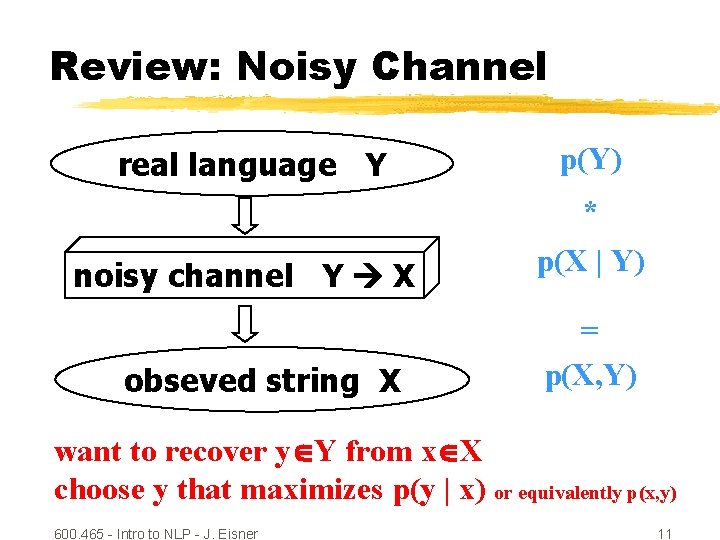
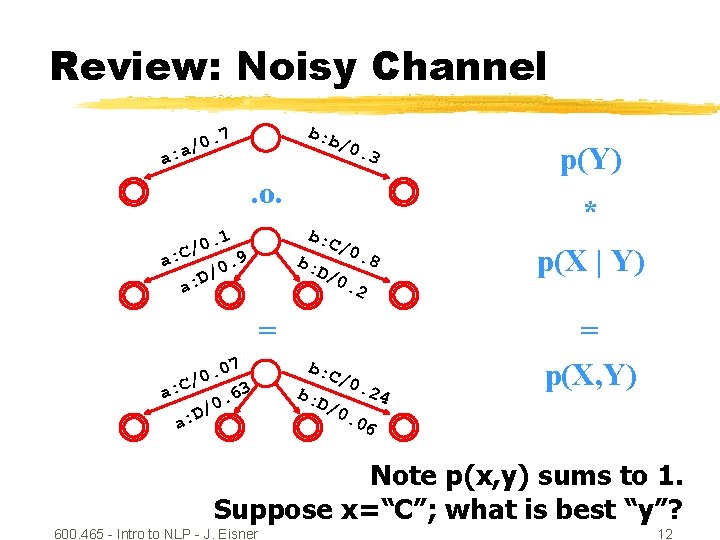
Review: Noisy Channel real language Y p(Y) * noisy channel Y X obseved string X p(X | Y) = p(X, Y) want to recover y Y from x X choose y that maximizes p(y | x) or equivalently p(x, y) 600. 465 - Intro to NLP - J. Eisner 11
Review: Noisy Channel b: b . 7 0 / a a: /0. 3 . o. b: C . 1 0 / 9 a: C 0. / D a: b: D/ * /0. 8 0. b: C b: p(X | Y) 2 = 07. 0 / a: C 63. /0 D a: p(Y) D/ /0. 24 = p(X, Y) 06 Note p(x, y) sums to 1. Suppose x=“C”; what is best “y”? 600. 465 - Intro to NLP - J. Eisner 12
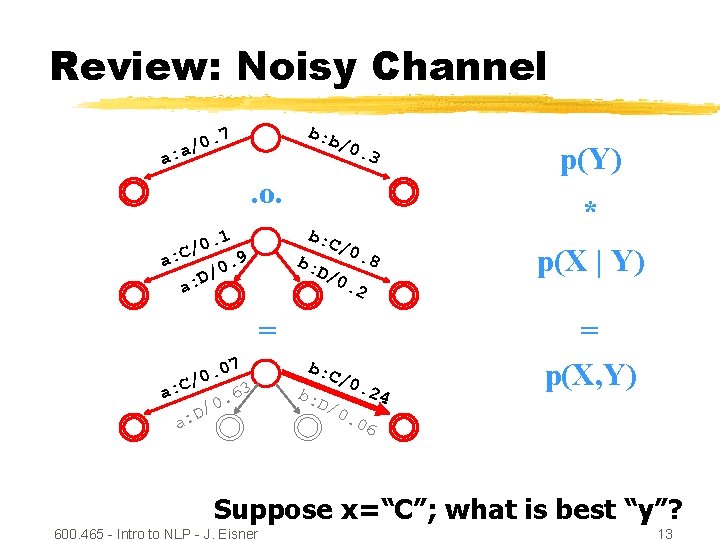
Review: Noisy Channel b: b . 7 0 / a a: /0. 3 . o. b: C . 1 0 / 9 a: C 0. / D a: b: D/ * /0. 8 0. b: C b: p(X | Y) 2 = 07. 0 / a: C 63. /0 D a: p(Y) D/ /0. 24 = p(X, Y) 06 Suppose x=“C”; what is best “y”? 600. 465 - Intro to NLP - J. Eisner 13
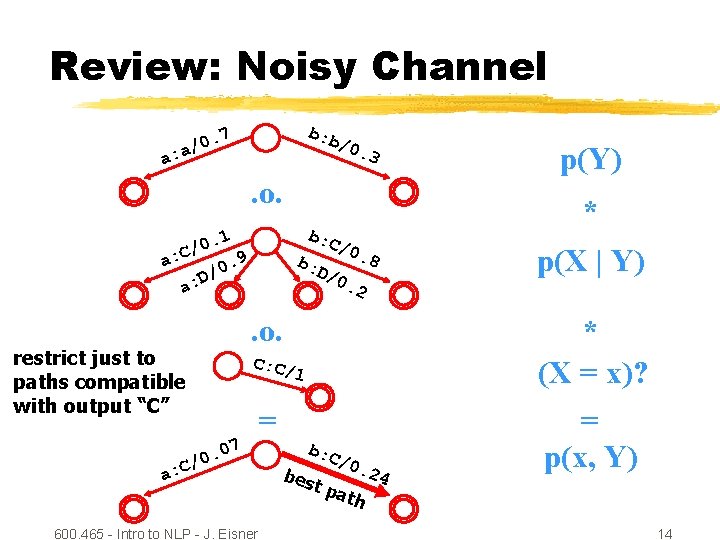
Review: Noisy Channel b: b . 7 0 / a a: /0. 3 . o. b: C . 1 0 / 9 a: C 0. / D a: b: D/ * /0. 8 0. C: C/ 1 = 7 . 0 0 / C a: 600. 465 - Intro to NLP - J. Eisner b: C bes p(X | Y) 2 . o. restrict just to paths compatible with output “C” p(Y) /0. t pa th 24 * (X = x)? = p(x, Y) 14
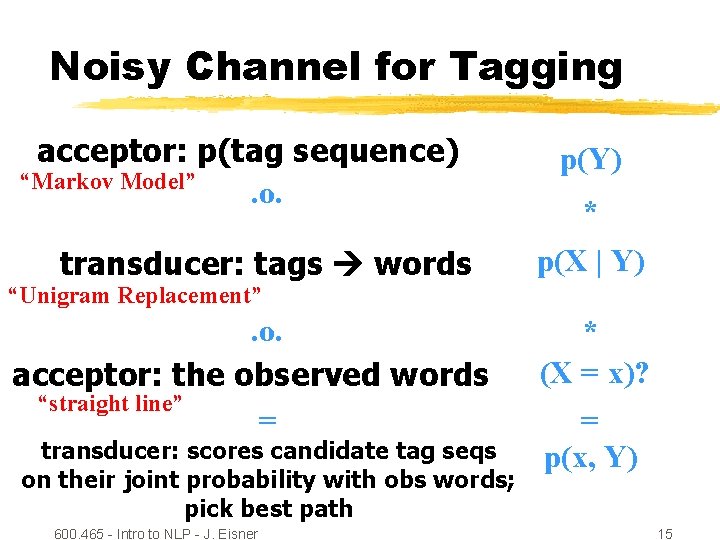
Noisy Channel for Tagging. 7 0 / a b: b /0. : 3 acceptor: p(tag sequence) a “Markov Model”. o. . 1 0 / 9 a: C 0. / : D a Replacement” b: C /0. 8 transducer: tags. D/ words 0. “Unigram b: * p(X | Y) 2 . o. C: C/ 1 acceptor: the observed words “straight line” = b: C 07 transducer: scores candidate tag seqs. 0 / / 0. 24 : C b a e on their joint probabilityst with obs words; pat pick best pathh 600. 465 - Intro to NLP - J. Eisner p(Y) * (X = x)? = p(x, Y) 15
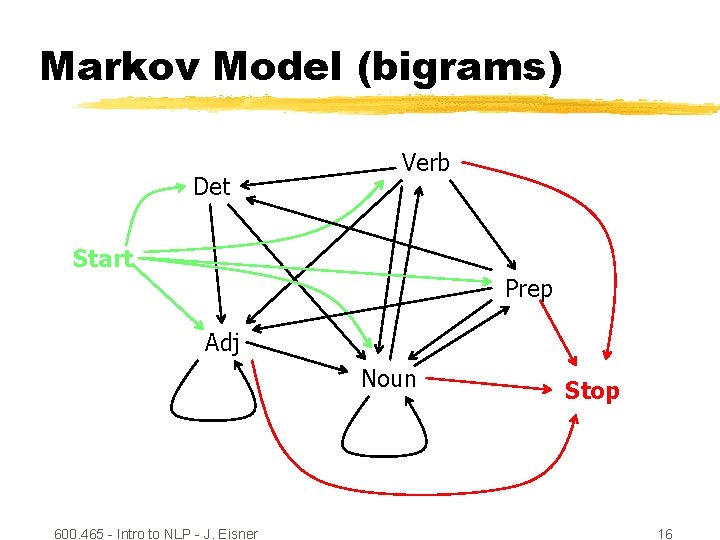
Markov Model (bigrams) Det Verb Start Prep Adj Noun 600. 465 - Intro to NLP - J. Eisner Stop 16
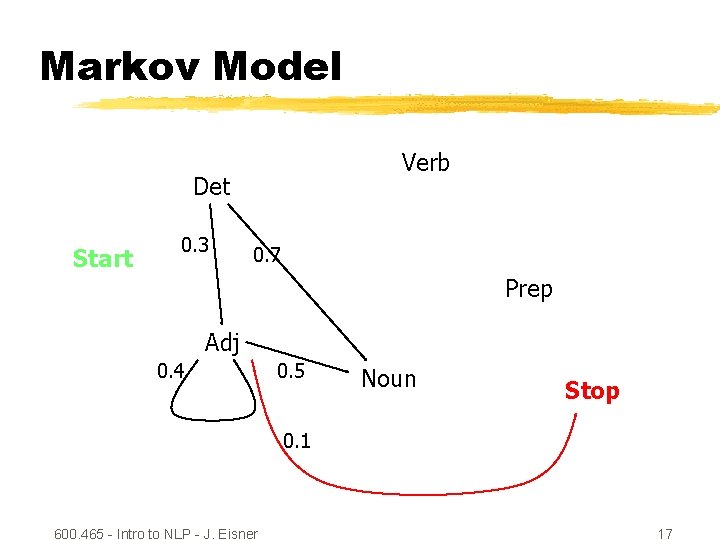
Markov Model Verb Det Start 0. 3 0. 7 Prep Adj 0. 4 0. 5 Noun Stop 0. 1 600. 465 - Intro to NLP - J. Eisner 17
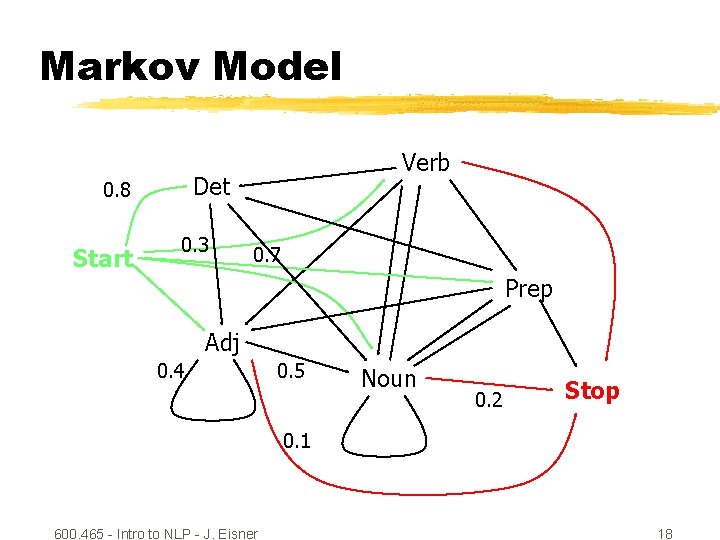
Markov Model Det 0. 8 Start Verb 0. 3 0. 7 Prep Adj 0. 4 0. 5 Noun 0. 2 Stop 0. 1 600. 465 - Intro to NLP - J. Eisner 18
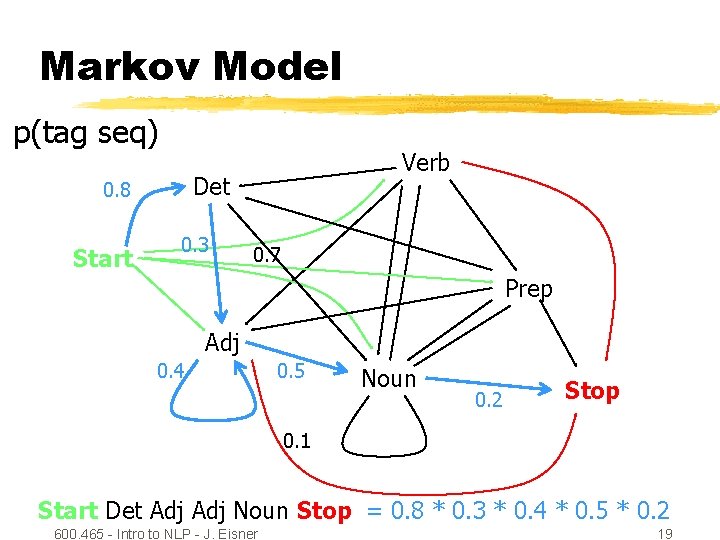
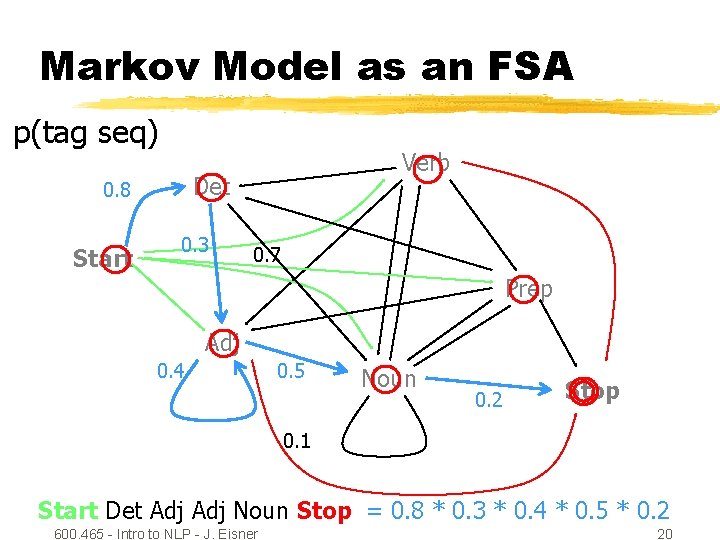
Markov Model p(tag seq) Det 0. 8 Start Verb 0. 3 0. 7 Prep Adj 0. 4 0. 5 Noun 0. 2 Stop 0. 1 Start Det Adj Noun Stop = 0. 8 * 0. 3 * 0. 4 * 0. 5 * 0. 2 600. 465 - Intro to NLP - J. Eisner 19
Markov Model as an FSA p(tag seq) Det 0. 8 Start Verb 0. 3 0. 7 Prep Adj 0. 4 0. 5 Noun 0. 2 Stop 0. 1 Start Det Adj Noun Stop = 0. 8 * 0. 3 * 0. 4 * 0. 5 * 0. 2 600. 465 - Intro to NLP - J. Eisner 20
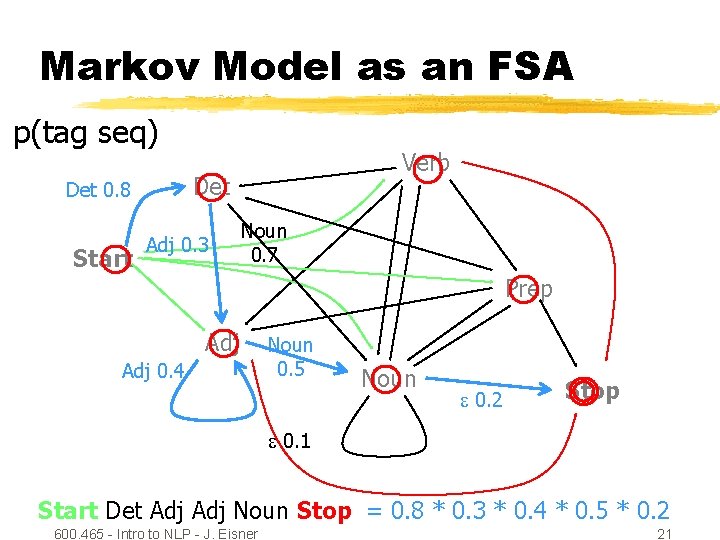
Markov Model as an FSA p(tag seq) Det 0. 8 Start Verb Adj 0. 3 Noun 0. 7 Prep Adj 0. 4 Noun 0. 5 Noun 0. 2 Stop 0. 1 Start Det Adj Noun Stop = 0. 8 * 0. 3 * 0. 4 * 0. 5 * 0. 2 600. 465 - Intro to NLP - J. Eisner 21
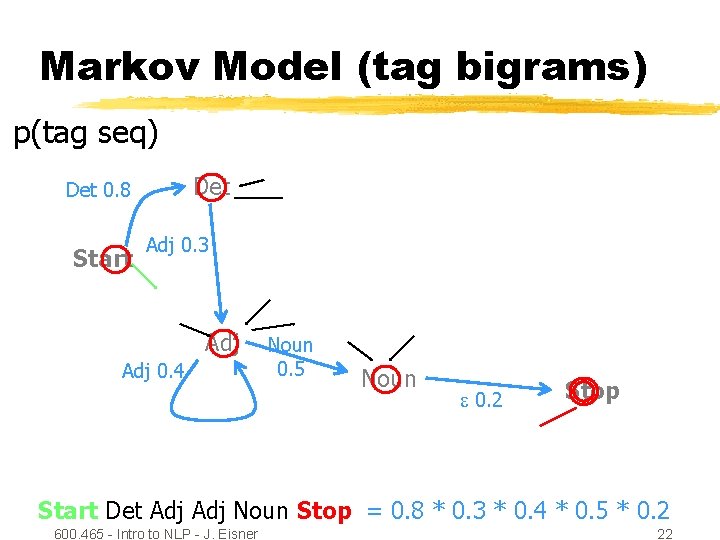
Markov Model (tag bigrams) p(tag seq) Det 0. 8 Start Adj 0. 3 Adj 0. 4 Noun 0. 5 Noun 0. 2 Stop Start Det Adj Noun Stop = 0. 8 * 0. 3 * 0. 4 * 0. 5 * 0. 2 600. 465 - Intro to NLP - J. Eisner 22
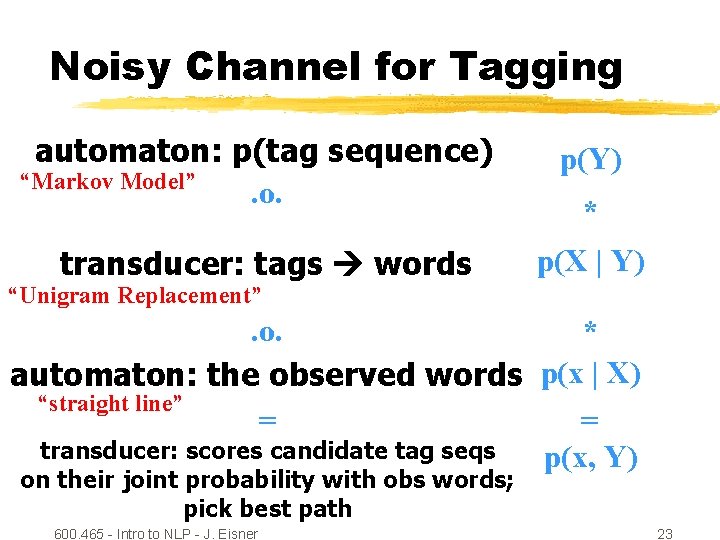
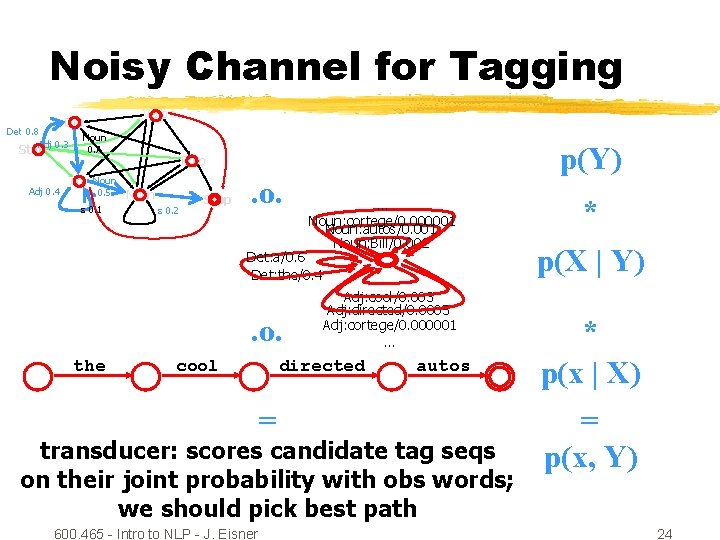
Noisy Channel for Tagging automaton: p(tag sequence) “Markov Model”. o. p(Y) transducer: tags words p(X | Y) * “Unigram Replacement” . o. * automaton: the observed words p(x | X) “straight line” = = transducer: scores candidate tag seqs p(x, Y) on their joint probability with obs words; pick best path 600. 465 - Intro to NLP - J. Eisner 23
Noisy Channel for Tagging Verb Det 0. 8 Adj 0. 3 Start Adj 0. 4 Noun 0. 7 Adj Noun 0. 5 0. 1 p(Y) Prep Noun 0. 2 Stop . o. … Noun: cortege/0. 000001 Noun: autos/0. 001 Noun: Bill/0. 002 Det: a/0. 6 Det: the/0. 4 . o. the cool Adj: cool/0. 003 Adj: directed/0. 0005 Adj: cortege/0. 000001 … directed = autos transducer: scores candidate tag seqs on their joint probability with obs words; we should pick best path 600. 465 - Intro to NLP - J. Eisner * p(X | Y) * p(x | X) = p(x, Y) 24
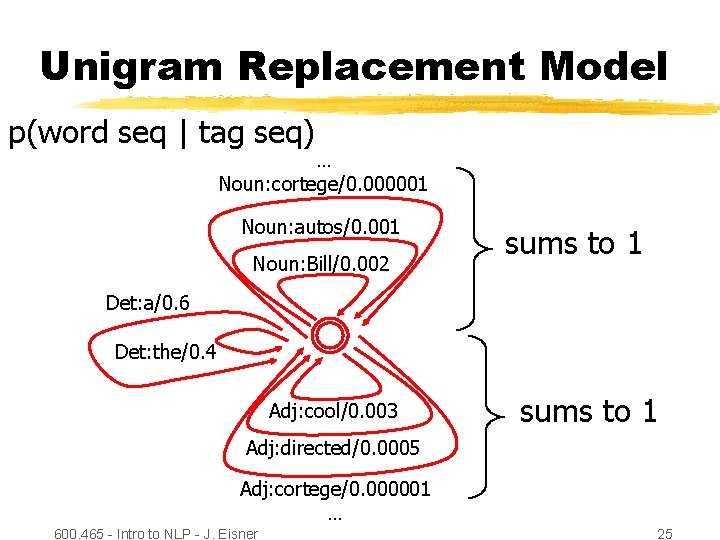
Unigram Replacement Model p(word seq | tag seq) … Noun: cortege/0. 000001 Noun: autos/0. 001 Noun: Bill/0. 002 sums to 1 Det: a/0. 6 Det: the/0. 4 Adj: cool/0. 003 sums to 1 Adj: directed/0. 0005 Adj: cortege/0. 000001 … 600. 465 - Intro to NLP - J. Eisner 25
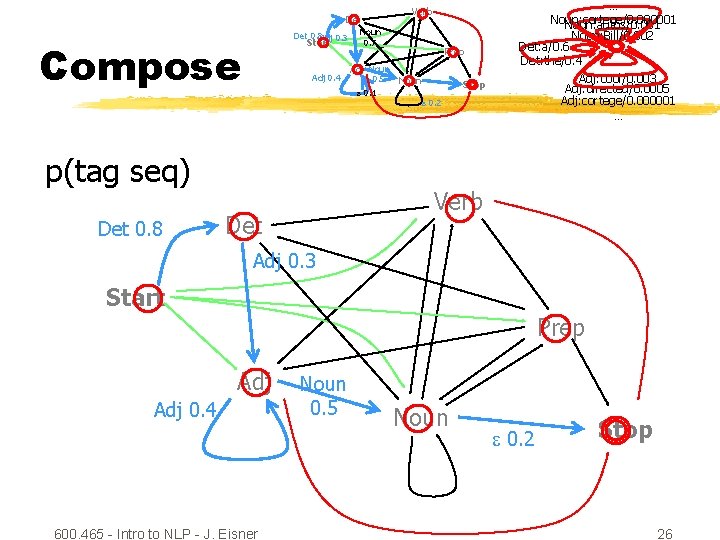
Verb Det 0. 8 Adj 0. 3 Compose Start Adj 0. 4 Adj Noun 0. 5 0. 1 p(tag seq) Det 0. 8 Noun 0. 7 Prep Noun Stop 0. 2 … Noun: cortege/0. 000001 Noun: autos/0. 001 Noun: Bill/0. 002 Det: a/0. 6 Det: the/0. 4 Adj: cool/0. 003 Adj: directed/0. 0005 Adj: cortege/0. 000001 … Verb Det Adj 0. 3 Start Prep Adj 0. 4 600. 465 - Intro to NLP - J. Eisner Noun 0. 5 Noun 0. 2 Stop 26
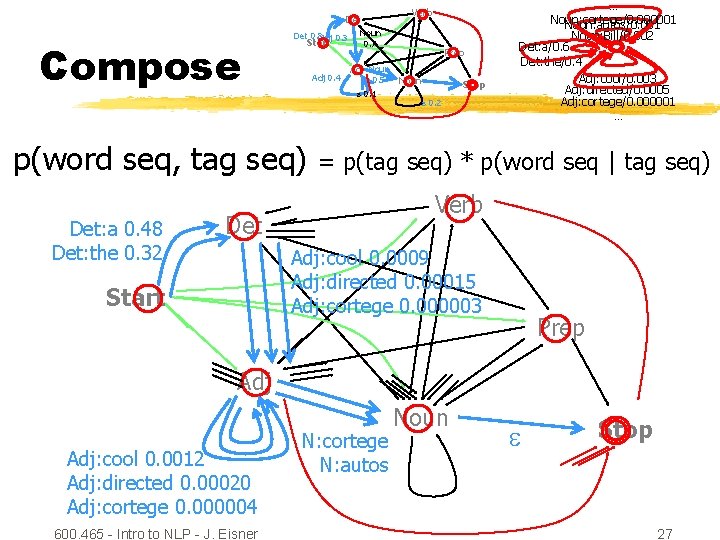
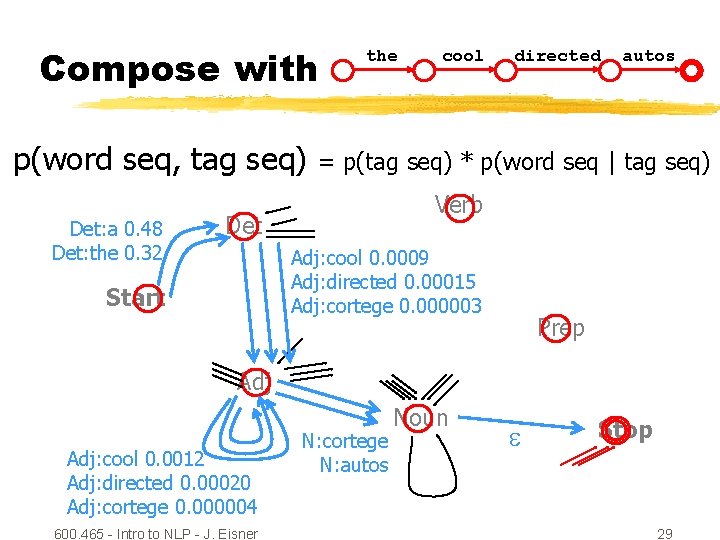
Verb Det Compose Det 0. 8 Adj 0. 3 Start Adj 0. 4 Adj Noun 0. 5 0. 1 p(word seq, tag seq) Det: a 0. 48 Det: the 0. 32 Noun 0. 7 Prep Noun Stop 0. 2 … Noun: cortege/0. 000001 Noun: autos/0. 001 Noun: Bill/0. 002 Det: a/0. 6 Det: the/0. 4 Adj: cool/0. 003 Adj: directed/0. 0005 Adj: cortege/0. 000001 … = p(tag seq) * p(word seq | tag seq) Verb Det Adj: cool 0. 0009 Adj: directed 0. 00015 Adj: cortege 0. 000003 Start Prep Adj: cool 0. 0012 Adj: directed 0. 00020 Adj: cortege 0. 000004 600. 465 - Intro to NLP - J. Eisner N: cortege N: autos Noun Stop 27
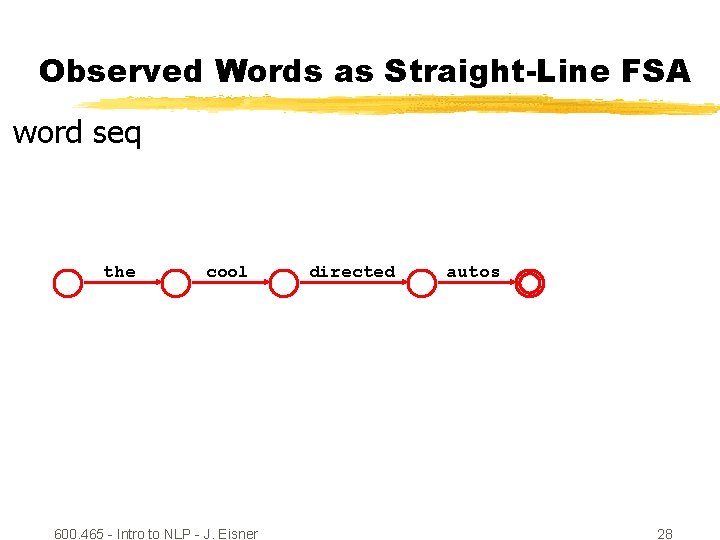
Observed Words as Straight-Line FSA word seq the cool 600. 465 - Intro to NLP - J. Eisner directed autos 28
Compose with p(word seq, tag seq) Det: a 0. 48 Det: the 0. 32 the cool directed = p(tag seq) * p(word seq | tag seq) Verb Det Adj: cool 0. 0009 Adj: directed 0. 00015 Adj: cortege 0. 000003 Start autos Prep Adj: cool 0. 0012 Adj: directed 0. 00020 Adj: cortege 0. 000004 600. 465 - Intro to NLP - J. Eisner N: cortege N: autos Noun Stop 29
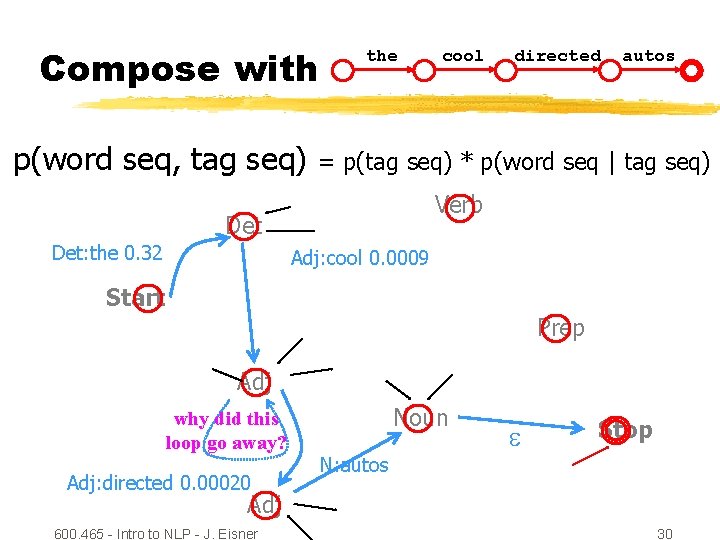
Compose with p(word seq, tag seq) the directed autos = p(tag seq) * p(word seq | tag seq) Verb Det: the 0. 32 cool Adj: cool 0. 0009 Start Prep Adj why did this loop go away? Adj: directed 0. 00020 Noun N: autos Stop Adj 600. 465 - Intro to NLP - J. Eisner 30
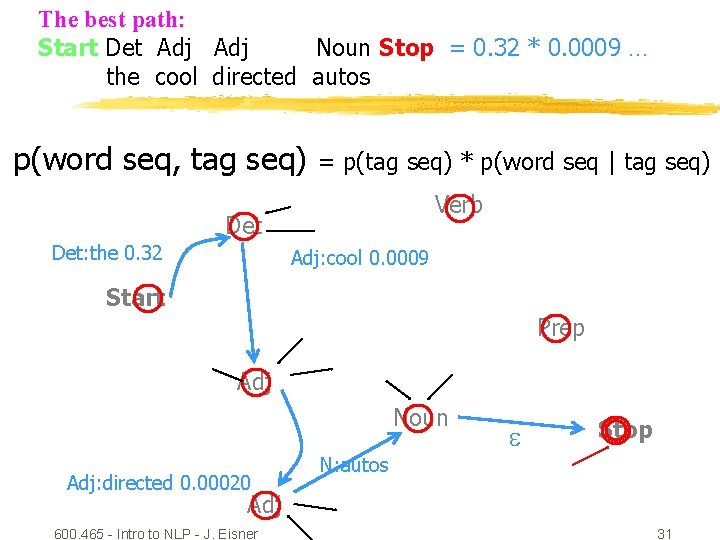
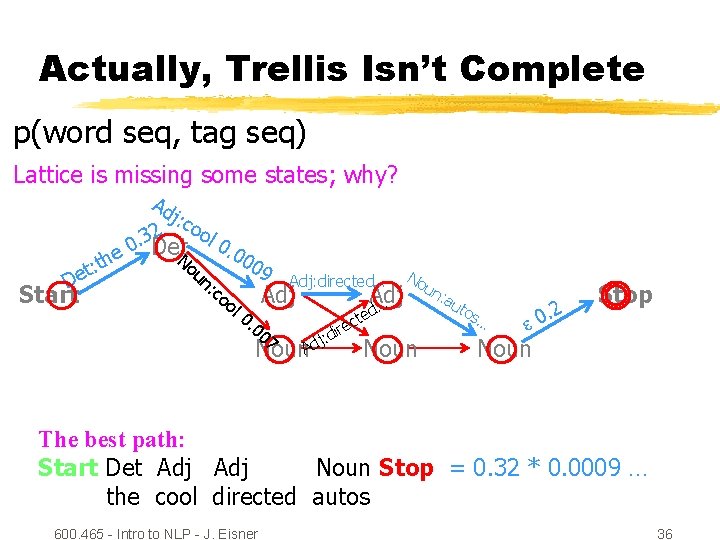
The best path: Start Det Adj Noun Stop = 0. 32 * 0. 0009 … the cool directed autos p(word seq, tag seq) = p(tag seq) * p(word seq | tag seq) Verb Det: the 0. 32 Adj: cool 0. 0009 Start Prep Adj Noun Adj: directed 0. 00020 N: autos Stop Adj 600. 465 - Intro to NLP - J. Eisner 31
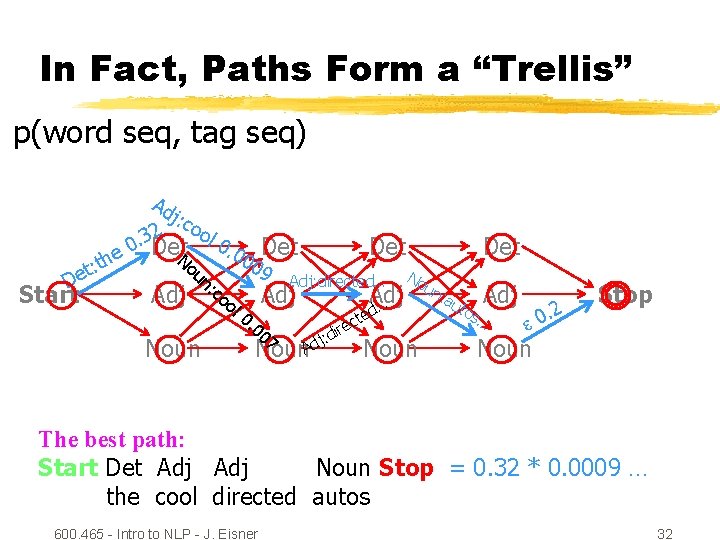
In Fact, Paths Form a “Trellis” p(word seq, tag seq) Ad j: c oo l. 32 0 e h t et: D Start Det N ou Adj 0. 0 n: co 00 Det 9 Noun ol Det Adj: directed… Adj 0. 00 7 Adj … Det No ed Noun. Ad j: d ct ire Noun un : au Adj tos … . 2 0 Stop Noun The best path: Start Det Adj Noun Stop = 0. 32 * 0. 0009 … the cool directed autos 600. 465 - Intro to NLP - J. Eisner 32
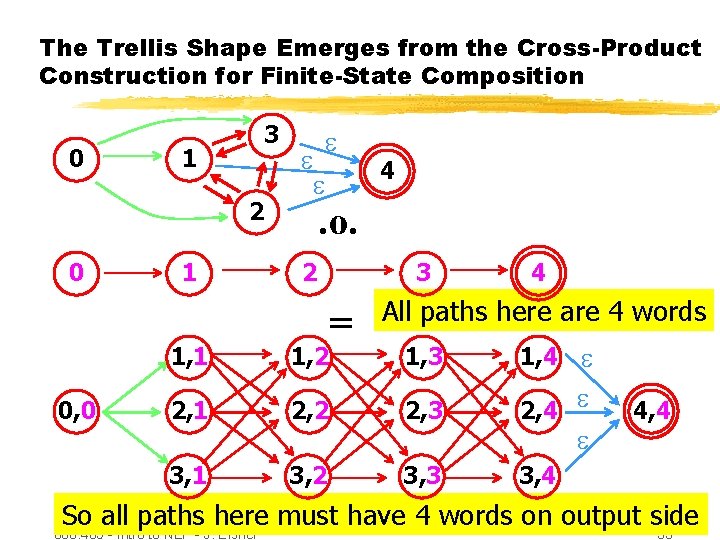
The Trellis Shape Emerges from the Cross-Product Construction for Finite-State Composition 0 3 1 2 0 0, 0 1 4 . o. 2 3 = 4 All paths here are 4 words 1, 3 1, 4 2, 2 2, 3 2, 4 3, 2 3, 3 3, 4 1, 1 1, 2 2, 1 3, 1 4, 4 So all paths here must have 4 words on output side 600. 465 - Intro to NLP - J. Eisner 33
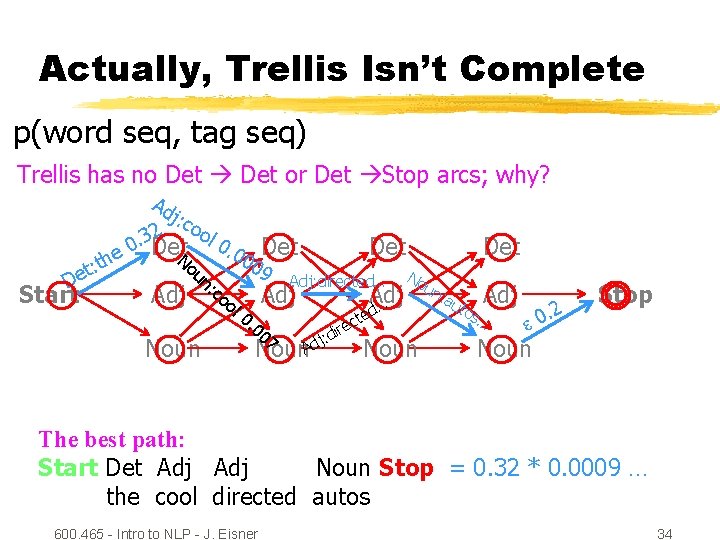
Actually, Trellis Isn’t Complete p(word seq, tag seq) Trellis has no Det or Det Stop arcs; why? Ad j: c oo l. 32 0 e h t et: D Start Det N ou Adj 0. 0 n: co 00 Det 9 Noun ol Det Adj: directed… Adj 0. 00 7 Adj … Det No ed Noun. Ad j: d ct ire Noun un : au Adj tos … . 2 0 Stop Noun The best path: Start Det Adj Noun Stop = 0. 32 * 0. 0009 … the cool directed autos 600. 465 - Intro to NLP - J. Eisner 34
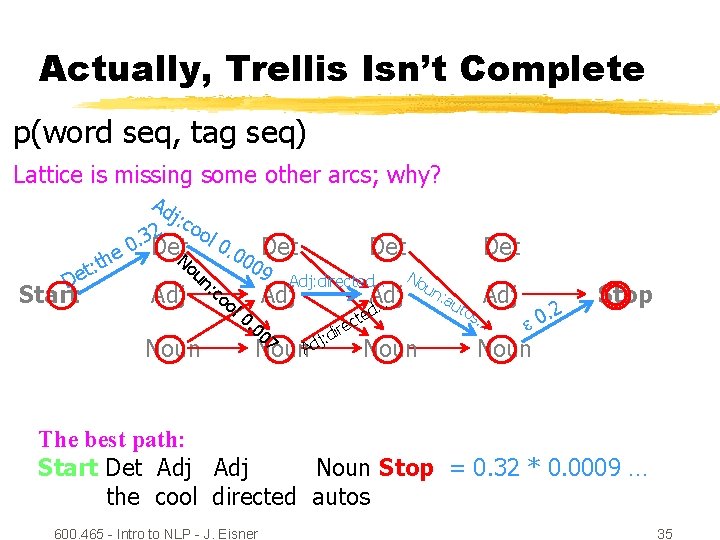
Actually, Trellis Isn’t Complete p(word seq, tag seq) Lattice is missing some other arcs; why? Ad j: c oo l. 32 0 e h t et: D Start Det N ou Adj 0. 0 n: co 00 Det 9 Noun ol Det Adj: directed… Adj 0. 00 7 Adj … Det No ed Noun. Ad j: d ct ire Noun un : au Adj tos … . 2 0 Stop Noun The best path: Start Det Adj Noun Stop = 0. 32 * 0. 0009 … the cool directed autos 600. 465 - Intro to NLP - J. Eisner 35
Actually, Trellis Isn’t Complete p(word seq, tag seq) Lattice is missing some states; why? Ad j: c oo l. 32 0 e h t et: D Start Det N ou 0. 0 n: co 00 ol 9 Adj: directed… Adj 0. 00 7 Adj … No ed Noun. Ad j: d ct ire Noun un : au tos … . 2 0 Stop Noun The best path: Start Det Adj Noun Stop = 0. 32 * 0. 0009 … the cool directed autos 600. 465 - Intro to NLP - J. Eisner 36
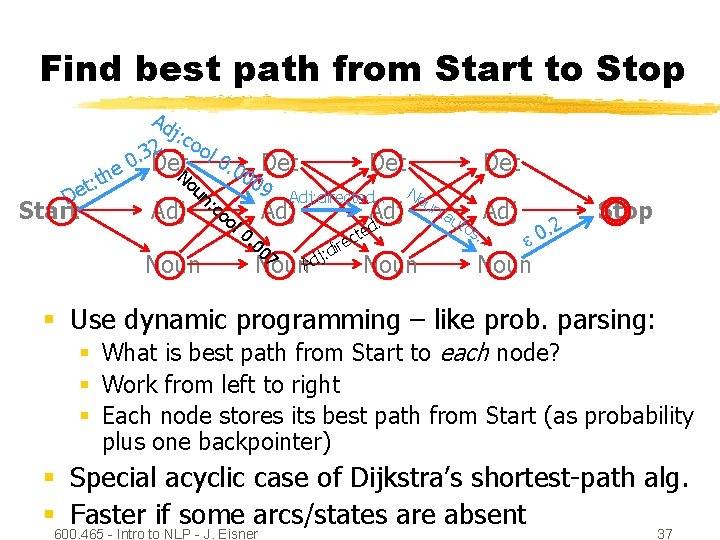
Find best path from Start to Stop Ad j: c oo l. 32 0 e h t et: D Start Det N ou Adj n: 0. 0 Noun co 00 Det 9 ol Det Adj: directed… Adj 0. 00 7 Adj … Det No ed Noun. Ad j: d ct ire Noun un : au Adj tos … . 2 0 Stop Noun § Use dynamic programming – like prob. parsing: § What is best path from Start to each node? § Work from left to right § Each node stores its best path from Start (as probability plus one backpointer) § Special acyclic case of Dijkstra’s shortest-path alg. § Faster if some arcs/states are absent 600. 465 - Intro to NLP - J. Eisner 37
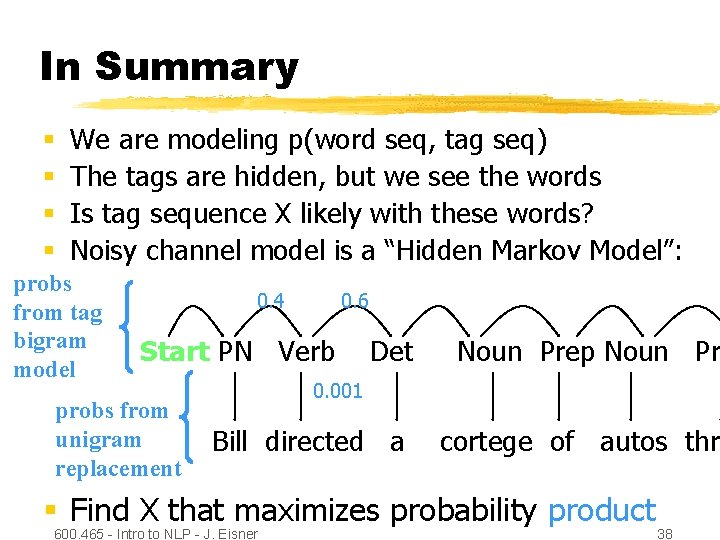
In Summary § § We are modeling p(word seq, tag seq) The tags are hidden, but we see the words Is tag sequence X likely with these words? Noisy channel model is a “Hidden Markov Model”: probs from tag bigram model 0. 4 0. 6 Start PN Verb probs from unigram replacement Det Noun Prep Noun Pr Bill directed a cortege of autos thr 0. 001 § Find X that maximizes probability product 600. 465 - Intro to NLP - J. Eisner 38
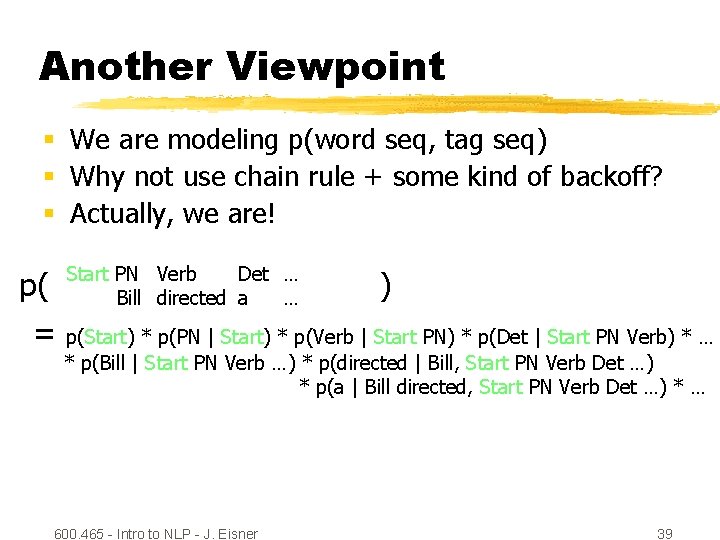
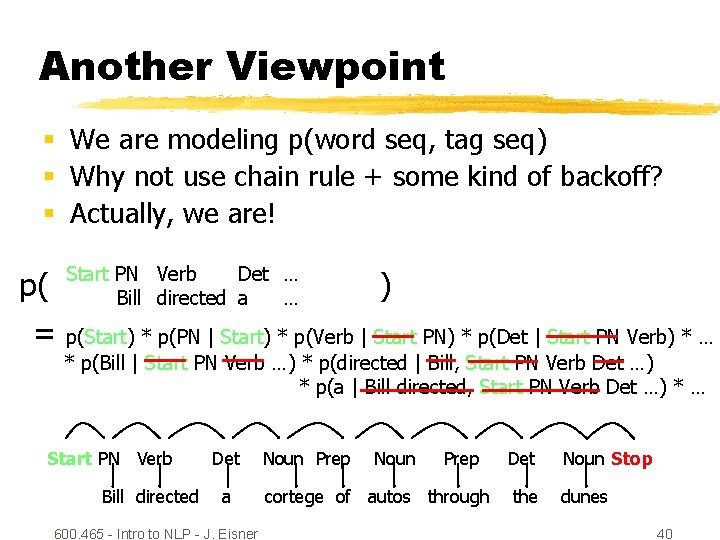
Another Viewpoint § We are modeling p(word seq, tag seq) § Why not use chain rule + some kind of backoff? § Actually, we are! p( = Start PN Verb Det … Bill directed a … ) p(Start) * p(PN | Start) * p(Verb | Start PN) * p(Det | Start PN Verb) * … * p(Bill | Start PN Verb …) * p(directed | Bill, Start PN Verb Det …) * p(a | Bill directed, Start PN Verb Det …) * … 600. 465 - Intro to NLP - J. Eisner 39
Another Viewpoint § We are modeling p(word seq, tag seq) § Why not use chain rule + some kind of backoff? § Actually, we are! p( = Start PN Verb Det … Bill directed a … ) p(Start) * p(PN | Start) * p(Verb | Start PN) * p(Det | Start PN Verb) * … * p(Bill | Start PN Verb …) * p(directed | Bill, Start PN Verb Det …) * p(a | Bill directed, Start PN Verb Det …) * … Start PN Verb Bill directed Det a 600. 465 - Intro to NLP - J. Eisner Noun Prep cortege of autos through Det Noun Stop the dunes 40
Three Finite-State Approaches 1. Noisy Channel Model (statistical) 2. Deterministic baseline tagger composed with a cascade of fixup transducers 3. Nondeterministic tagger composed with a cascade of finite-state automata that act as filters 600. 465 - Intro to NLP - J. Eisner 41
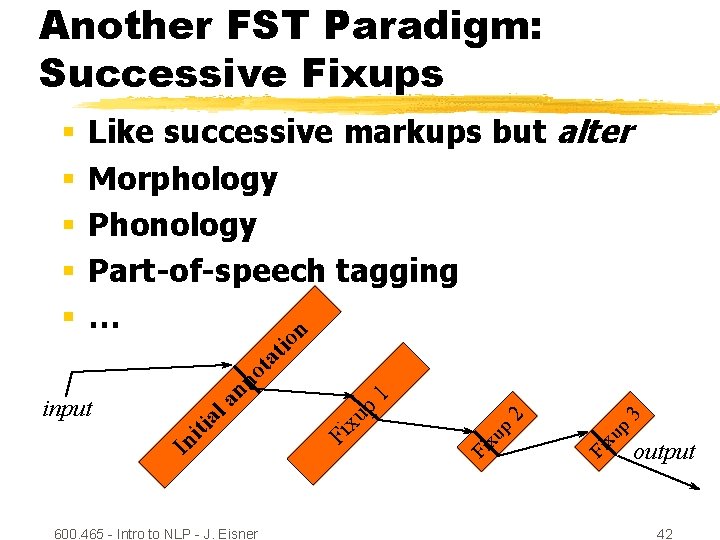
Another FST Paradigm: Successive Fixups n Like successive markups but alter Morphology Phonology Part-of-speech tagging … 600. 465 - Intro to NLP - J. Eisner 3 p Fi xu p 2 1 p xu Fi al In iti input an no ta tio § § § output 42
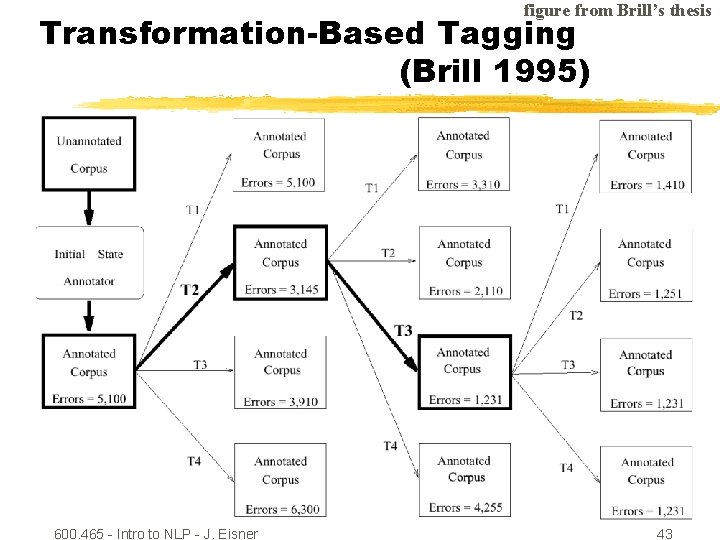
figure from Brill’s thesis Transformation-Based Tagging (Brill 1995) 600. 465 - Intro to NLP - J. Eisner 43
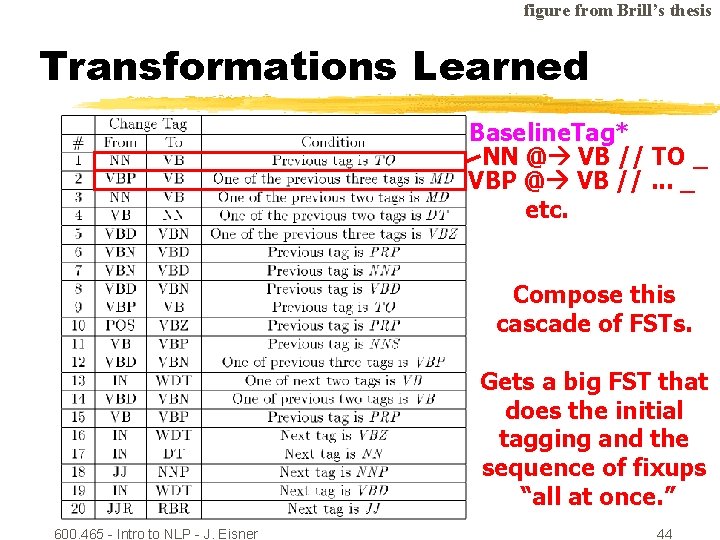
figure from Brill’s thesis Transformations Learned Baseline. Tag* NN @ VB // TO _ VBP @ VB //. . . _ etc. Compose this cascade of FSTs. Gets a big FST that does the initial tagging and the sequence of fixups “all at once. ” 600. 465 - Intro to NLP - J. Eisner 44
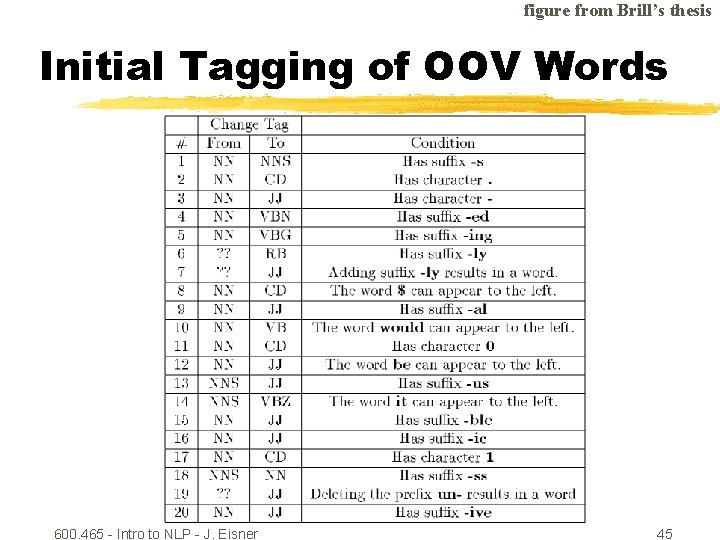
figure from Brill’s thesis Initial Tagging of OOV Words 600. 465 - Intro to NLP - J. Eisner 45
Three Finite-State Approaches 1. Noisy Channel Model (statistical) 2. Deterministic baseline tagger composed with a cascade of fixup transducers 3. Nondeterministic tagger composed with a cascade of finite-state automata that act as filters 600. 465 - Intro to NLP - J. Eisner 46
Variations § Multiple tags per word § Transformations to knock some of them out § How to encode multiple tags and knockouts? § Use the above for partly supervised learning § Supervised: You have a tagged training corpus § Unsupervised: You have an untagged training corpus § Here: You have an untagged training corpus and a dictionary giving possible tags for each word 600. 465 - Intro to NLP - J. Eisner 47