
ECE 453 CS 447 SE 465 Software Testing
- Slides: 22
ECE 453 – CS 447 – SE 465 Software Testing & Quality Assurance Instructor Kostas Kontogiannis 1
Overview èIntegration Testing èDecomposition Based Integration èCall Graph Based Integration èPath Based Integration èDiscussion Ref: “Object-Oriented Software Engineering – Using UML, Patterns and Java”, Bernd Bruegge, Allen H. Dutoit 2 and Software Testing A Craftsman's Approach 2 nd edition, Paul C. Jorgensen
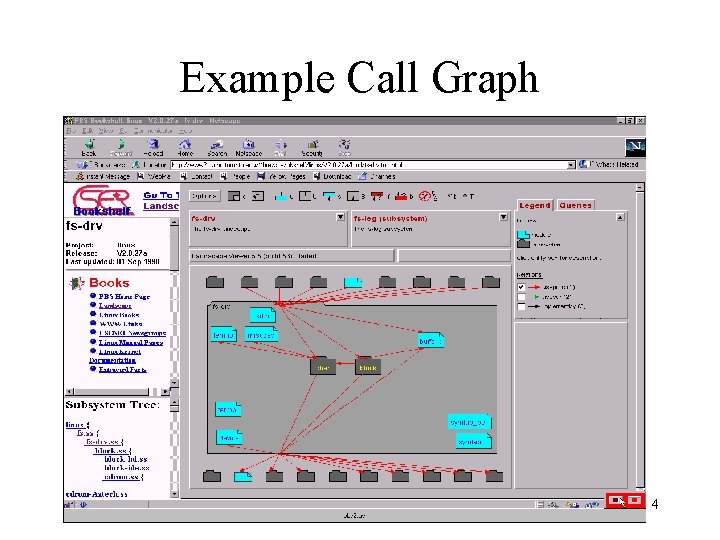
Functional Decomposition • Functional Decomposition is defined as a method in which a problem is broken up into several independent task units, or functions, which can be run either sequentially and in a synchronous call-reply manner or simultaneously on different processors • This method is used during planning, analysis and design, and creates a functional hierarchy for the software • A model by which we represent functional decomposition in a system is the call graph or call tree • A call graph is a directed labeled graph where nodes represent functional units and edges represent call events or specific requests of resources • If we exclude back edges then we have a call tree – decomposition tree 3
Example Call Graph 4
Integration Testing Strategy • The entire system is viewed as a collection of subsystems (sets of classes) determined during the system and object design • The order in which the subsystems are selected for testing and integration determines the testing strategy – Big bang integration (Nonincremental) – Bottom up integration – Top down integration – Sandwich testing – Variations of the above • For the selection use the system decomposition from the System Design 5
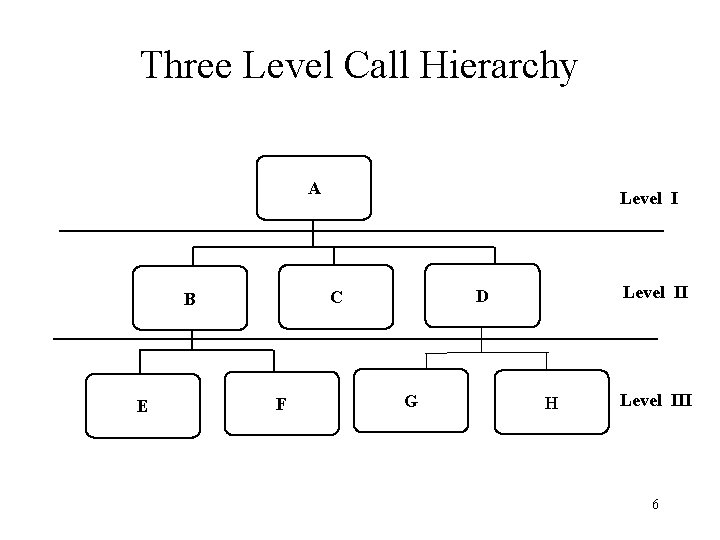
Three Level Call Hierarchy A F Level II D C B E Level I G H Level III 6
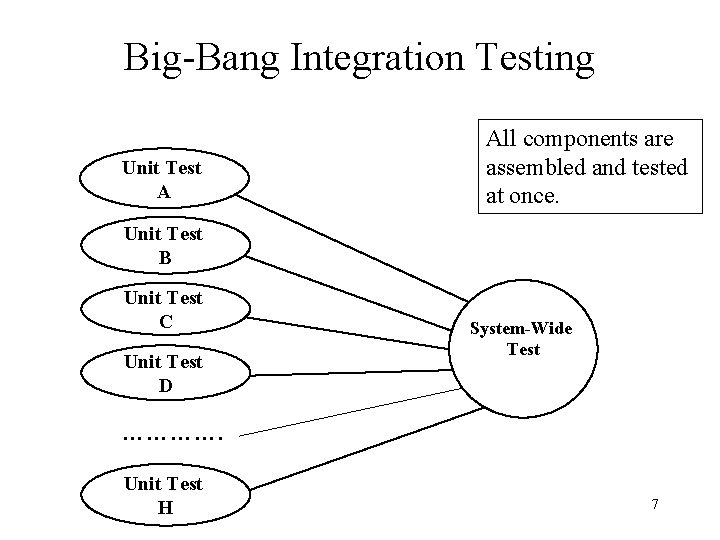
Big-Bang Integration Testing Unit Test A All components are assembled and tested at once. Unit Test B Unit Test C Unit Test D System-Wide Test …………. Unit Test H 7
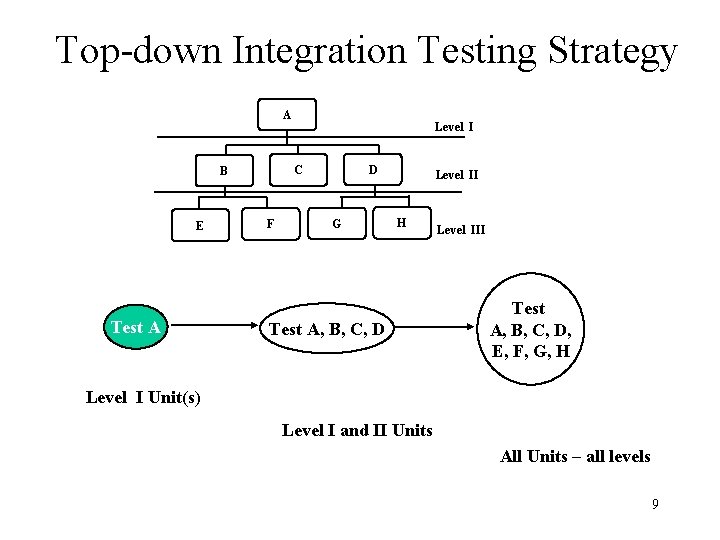
Top-Down Integration Testing Strategy • Top-down integration strategy focuses on testing the top layer or the controlling subsystem first (i. e. the main, or the root of the call tree) • The general process in top-down integration strategy is to gradually add more subsystems that are referenced/required by the already tested subsystems when testing the application • Do this until all subsystems are incorporated into the test • Special program is needed to do the testing, Test stub: – A program or a method that simulates the input-output functionality of a missing subsystem by answering to the decomposition sequence of the calling subsystem and returning back simulated or “canned” data. 8
Top-down Integration Testing Strategy A Test A D C B E Level I F G Level II H Test A, B, C, D Level III Test A, B, C, D, E, F, G, H Level I Unit(s) Level I and II Units All Units – all levels 9
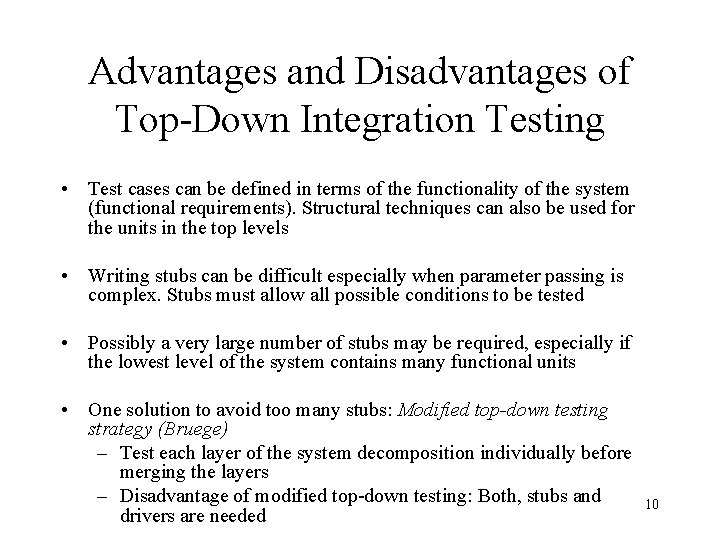
Advantages and Disadvantages of Top-Down Integration Testing • Test cases can be defined in terms of the functionality of the system (functional requirements). Structural techniques can also be used for the units in the top levels • Writing stubs can be difficult especially when parameter passing is complex. Stubs must allow all possible conditions to be tested • Possibly a very large number of stubs may be required, especially if the lowest level of the system contains many functional units • One solution to avoid too many stubs: Modified top-down testing strategy (Bruege) – Test each layer of the system decomposition individually before merging the layers – Disadvantage of modified top-down testing: Both, stubs and drivers are needed 10
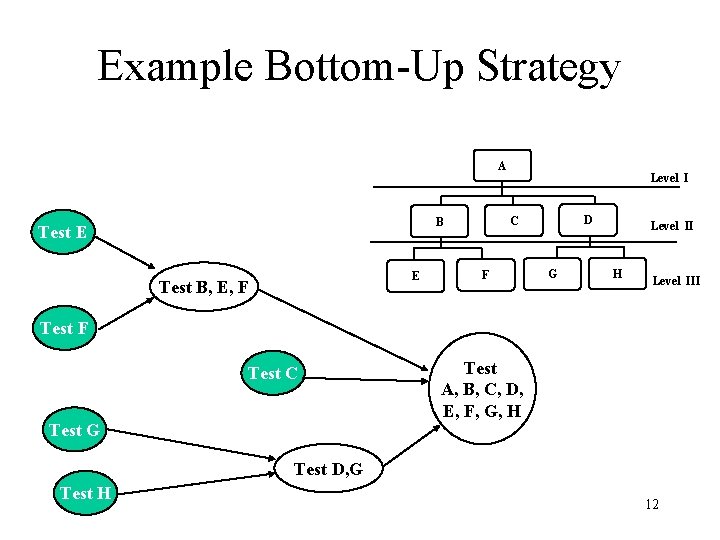
Bottom-Up Integration Testing Strategy • Bottom-Up integration strategy focuses on testing the units at the lowest levels first (i. e. the units at the leafs of the decomposition tree) • The general process in bottom-up integration strategy is to gradually include the subsystems that reference/require the previously tested subsystems • This is done repeatedly until all subsystems are included in the testing • Special program called Test Driver is needed to do the testing, – The Test Driver is a “fake” routine that requires a subsystem and passes a test case to it 11
Example Bottom-Up Strategy A E Test B, E, F D C B Test E Level I F G Level II H Level III Test F Test C Test G Test A, B, C, D, E, F, G, H Test D, G Test H 12
Advantages and Disadvantages of Bottom-Up Integration Testing • Not optimal strategy for functionally decomposed systems: – Tests the most important subsystem (UI) last • Useful for integrating the following systems – Object-oriented systems – Real-time systems – Systems with strict performance requirements 13
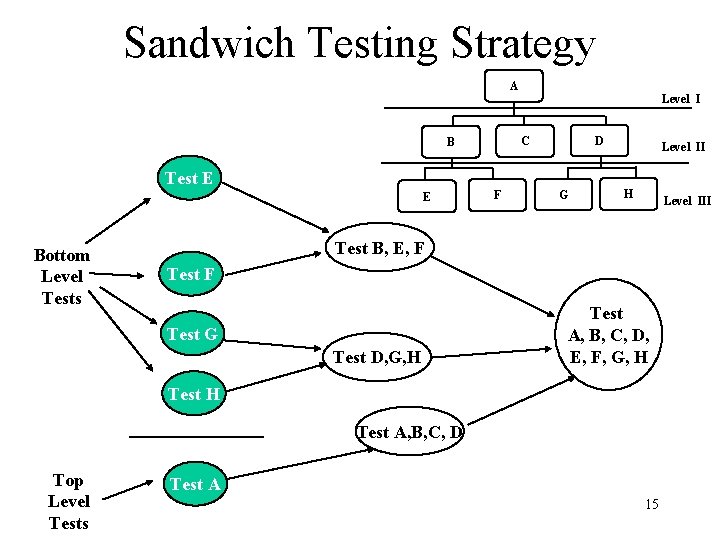
Sandwich Testing Strategy • Combines top-down strategy with bottom-up strategy • The system is view as having three layers – A target layer in the middle – A layer above the target – A layer below the target – Testing converges at the target layer • How do you select the target layer if there are more than 3 layers? – Heuristic: Try to minimize the number of stubs and 14 drivers
Sandwich Testing Strategy A Level I D C B Test E E Bottom Level Tests F G Level II H Level III Test B, E, F Test G Test D, G, H Test A, B, C, D, E, F, G, H Test A, B, C, D Top Level Tests Test A 15
Advantages and Disadvantages of Sandwich Integration Testing • Top and Bottom Layer Tests can be done in parallel • Does not test the individual subsystems thoroughly before integration • Solution: Modified sandwich testing strategy (Bruege) 16
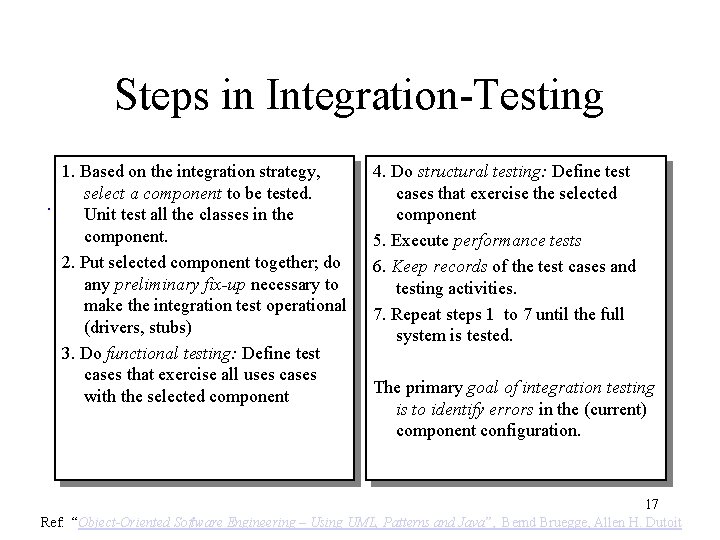
Steps in Integration-Testing. 1. Based on the integration strategy, select a component to be tested. Unit test all the classes in the component. 2. Put selected component together; do any preliminary fix-up necessary to make the integration test operational (drivers, stubs) 3. Do functional testing: Define test cases that exercise all uses cases with the selected component 4. Do structural testing: Define test cases that exercise the selected component 5. Execute performance tests 6. Keep records of the test cases and testing activities. 7. Repeat steps 1 to 7 until the full system is tested. The primary goal of integration testing is to identify errors in the (current) component configuration. 17 Ref: “Object-Oriented Software Engineering – Using UML, Patterns and Java”, Bernd Bruegge, Allen H. Dutoit
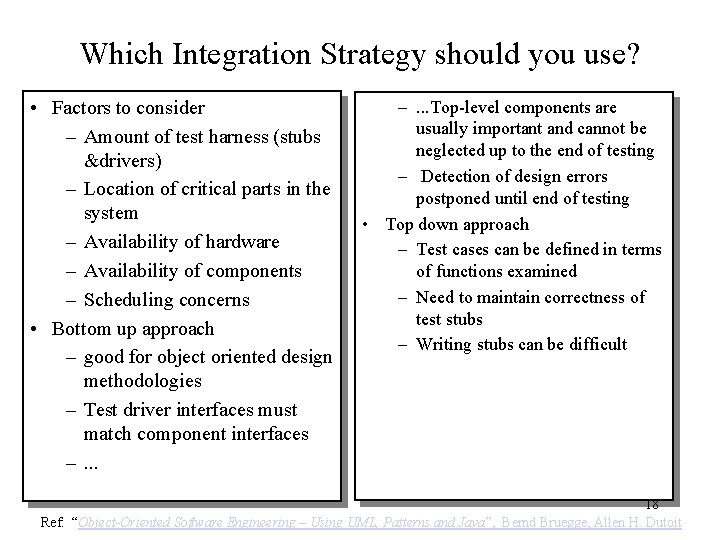
Which Integration Strategy should you use? • Factors to consider – Amount of test harness (stubs &drivers) – Location of critical parts in the system – Availability of hardware – Availability of components – Scheduling concerns • Bottom up approach – good for object oriented design methodologies – Test driver interfaces must match component interfaces –. . . Top-level components are usually important and cannot be neglected up to the end of testing – Detection of design errors postponed until end of testing • Top down approach – Test cases can be defined in terms of functions examined – Need to maintain correctness of test stubs – Writing stubs can be difficult 18 Ref: “Object-Oriented Software Engineering – Using UML, Patterns and Java”, Bernd Bruegge, Allen H. Dutoit
Call Graph Based Integration • The basic idea is to use the call graph instead of the decomposition tree • The call graph is a directed, labeled graph • Two types of call graph based integration testing – Pair-wise Integration Testing – Neighborhood Integration Testing 19
Pair-Wise Integration Testing • The idea behind Pair-Wise integration testing is to eliminate the need for developing stubs/drivers • The objective is to use actual code instead of stubs/drivers • In order no to deteriorate the process to a big-bang strategy, we restrict a testing session to just a pair of units in the call graph • The result is that we have one integration test session for each edge in the call graph 20
Neighborhood Integration Testing • We define the neighborhood of a node in a graph to be the set of nodes that are one edge away from the given node • In a directed graph means all the immediate predecessor nodes and all the immediate successor nodes of a given node • The number of neighborhoods for a given graph can be computed as: Interior. Nodes = nodes – (Source. Nodes + Sink. Nodes) Neighborhoods = Interior. Nodes + Source. Nodes Or Neighborhoods = nodes – Sink. Nodes • Neighborhood Integration Testing reduces the number of test sessions 21
Advantages and Disadvantages of Call-Graph Integration Testing • Call graph based integration techniques move towards a behavioral basis • Aim to eliminate / reduce the need for drivers/stubs • Closer to a build sequence • Neighborhoods can be combined to create “villages” • Suffer from the fault isolation problem especially for large neighborhoods • Nodes can appear in several neighborhoods 22