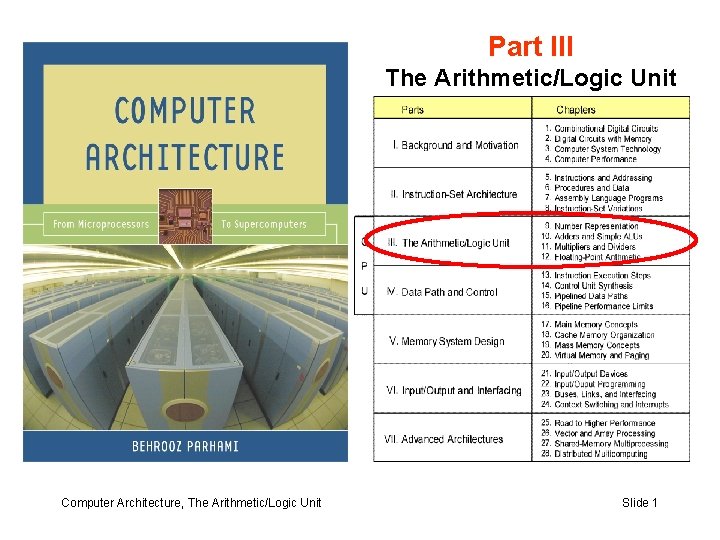
Part III The ArithmeticLogic Unit Computer Architecture The

- Slides: 45
Part III The Arithmetic/Logic Unit Computer Architecture, The Arithmetic/Logic Unit Slide 1
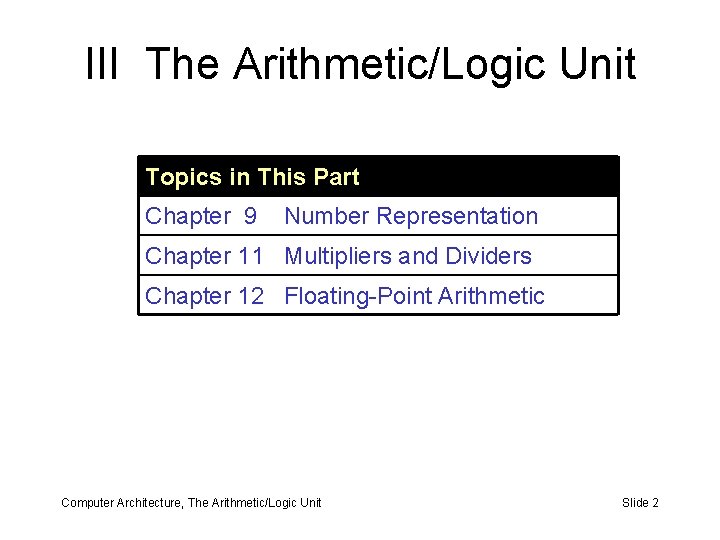
III The Arithmetic/Logic Unit Topics in This Part Chapter 9 Number Representation Chapter 11 Multipliers and Dividers Chapter 12 Floating-Point Arithmetic Computer Architecture, The Arithmetic/Logic Unit Slide 2
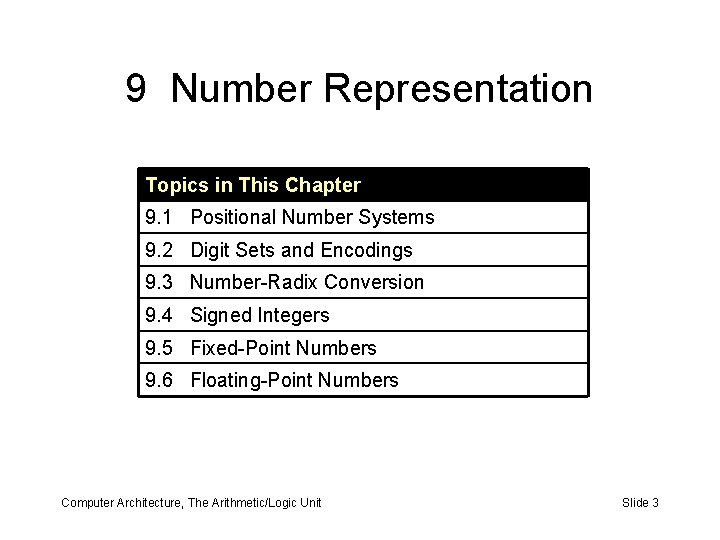
9 Number Representation Topics in This Chapter 9. 1 Positional Number Systems 9. 2 Digit Sets and Encodings 9. 3 Number-Radix Conversion 9. 4 Signed Integers 9. 5 Fixed-Point Numbers 9. 6 Floating-Point Numbers Computer Architecture, The Arithmetic/Logic Unit Slide 3
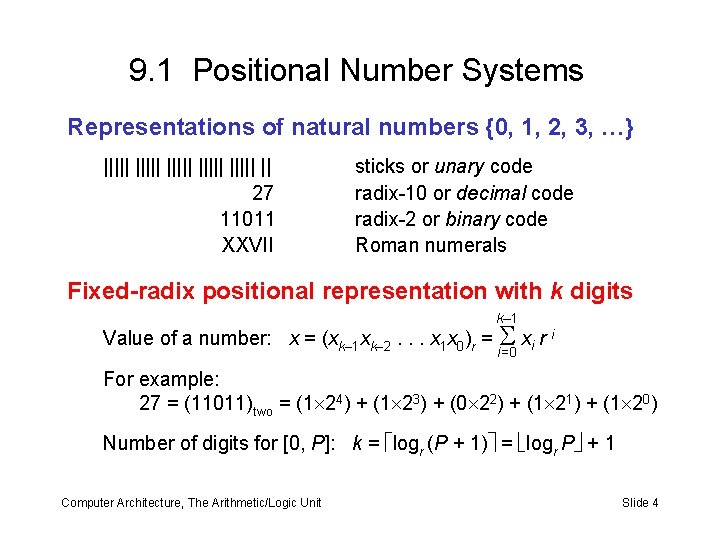
9. 1 Positional Number Systems Representations of natural numbers {0, 1, 2, 3, …} ||||| ||||| || 27 11011 XXVII sticks or unary code radix-10 or decimal code radix-2 or binary code Roman numerals Fixed-radix positional representation with k digits k– 1 Value of a number: x = (xk– 1 xk– 2. . . x 1 x 0)r = S xi r i i=0 For example: 27 = (11011)two = (1 24) + (1 23) + (0 22) + (1 21) + (1 20) Number of digits for [0, P]: k = logr (P + 1) = logr P + 1 Computer Architecture, The Arithmetic/Logic Unit Slide 4
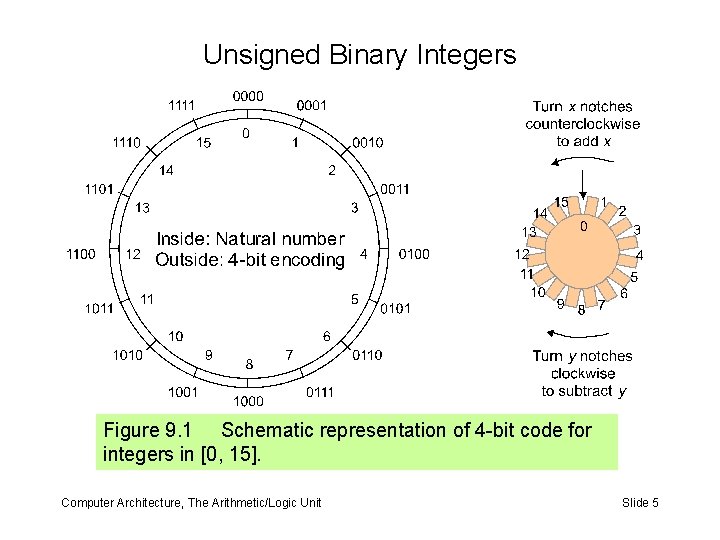
Unsigned Binary Integers Figure 9. 1 Schematic representation of 4 -bit code for integers in [0, 15]. Computer Architecture, The Arithmetic/Logic Unit Slide 5
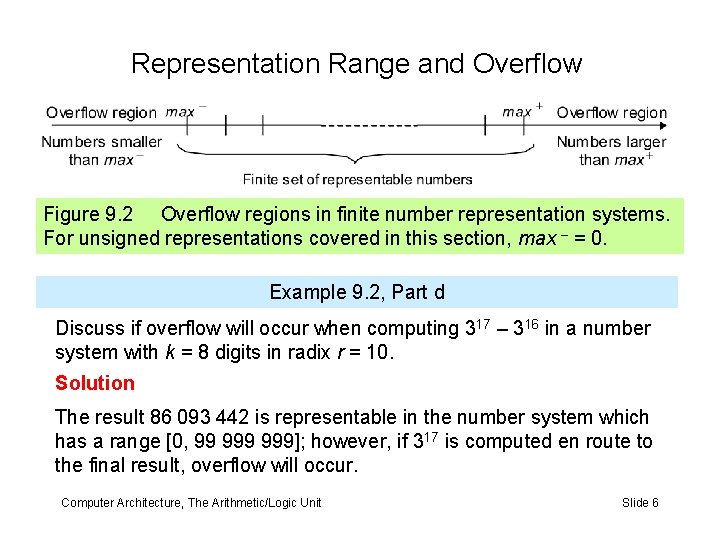
Representation Range and Overflow Figure 9. 2 Overflow regions in finite number representation systems. For unsigned representations covered in this section, max – = 0. Example 9. 2, Part d Discuss if overflow will occur when computing 317 – 316 in a number system with k = 8 digits in radix r = 10. Solution The result 86 093 442 is representable in the number system which has a range [0, 99 999]; however, if 317 is computed en route to the final result, overflow will occur. Computer Architecture, The Arithmetic/Logic Unit Slide 6
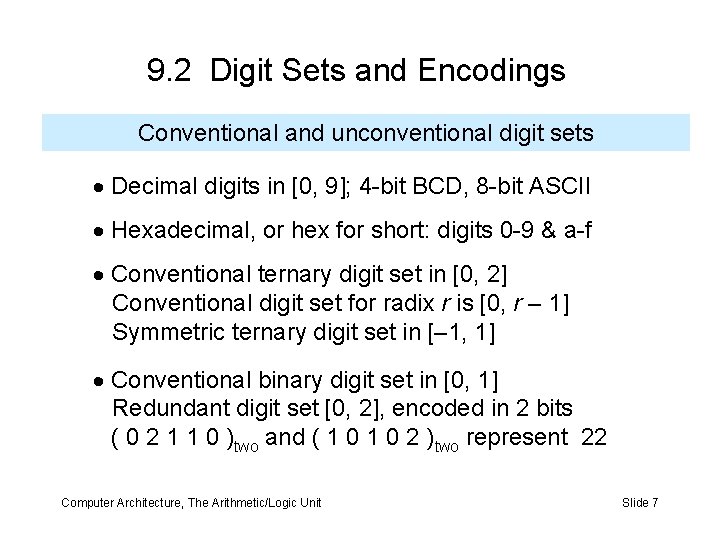
9. 2 Digit Sets and Encodings Conventional and unconventional digit sets Decimal digits in [0, 9]; 4 -bit BCD, 8 -bit ASCII Hexadecimal, or hex for short: digits 0 -9 & a-f Conventional ternary digit set in [0, 2] Conventional digit set for radix r is [0, r – 1] Symmetric ternary digit set in [– 1, 1] Conventional binary digit set in [0, 1] Redundant digit set [0, 2], encoded in 2 bits ( 0 2 1 1 0 )two and ( 1 0 2 )two represent 22 Computer Architecture, The Arithmetic/Logic Unit Slide 7
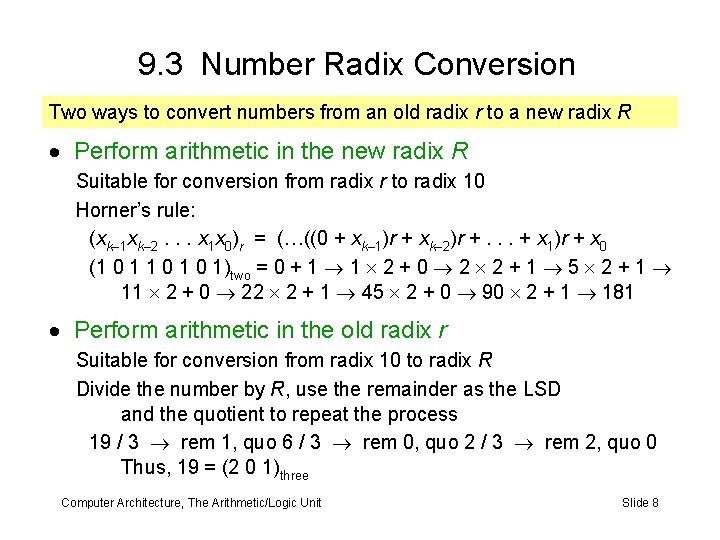
9. 3 Number Radix Conversion Two ways to convert numbers from an old radix r to a new radix R Perform arithmetic in the new radix R Suitable for conversion from radix r to radix 10 Horner’s rule: (xk– 1 xk– 2. . . x 1 x 0)r = (…((0 + xk– 1)r + xk– 2)r +. . . + x 1)r + x 0 (1 0 1 0 1)two = 0 + 1 1 2 + 0 2 2 + 1 5 2 + 1 11 2 + 0 22 2 + 1 45 2 + 0 90 2 + 1 181 Perform arithmetic in the old radix r Suitable for conversion from radix 10 to radix R Divide the number by R, use the remainder as the LSD and the quotient to repeat the process 19 / 3 rem 1, quo 6 / 3 rem 0, quo 2 / 3 rem 2, quo 0 Thus, 19 = (2 0 1)three Computer Architecture, The Arithmetic/Logic Unit Slide 8
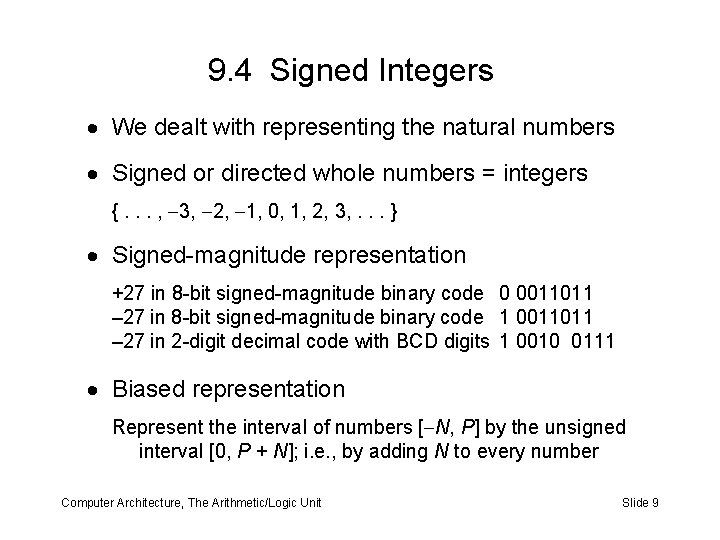
9. 4 Signed Integers We dealt with representing the natural numbers Signed or directed whole numbers = integers {. . . , -3, -2, -1, 0, 1, 2, 3, . . . } Signed-magnitude representation +27 in 8 -bit signed-magnitude binary code 0 0011011 – 27 in 8 -bit signed-magnitude binary code 1 0011011 – 27 in 2 -digit decimal code with BCD digits 1 0010 0111 Biased representation Represent the interval of numbers [-N, P] by the unsigned interval [0, P + N]; i. e. , by adding N to every number Computer Architecture, The Arithmetic/Logic Unit Slide 9
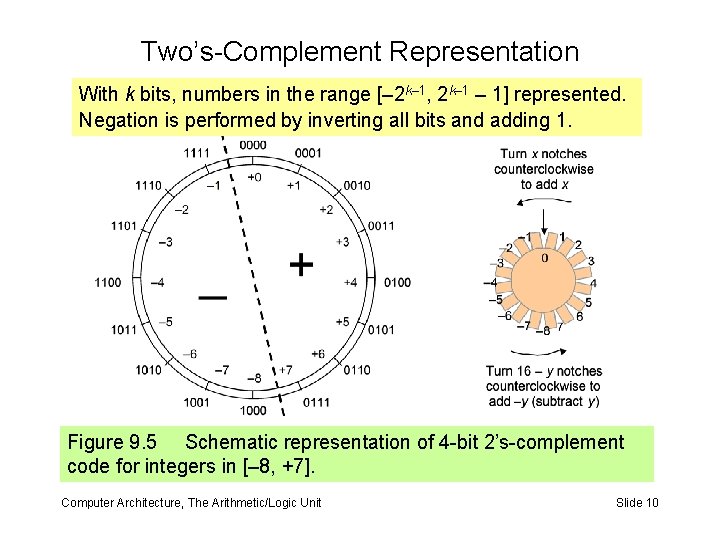
Two’s-Complement Representation With k bits, numbers in the range [– 2 k– 1, 2 k– 1 – 1] represented. Negation is performed by inverting all bits and adding 1. Figure 9. 5 Schematic representation of 4 -bit 2’s-complement code for integers in [– 8, +7]. Computer Architecture, The Arithmetic/Logic Unit Slide 10
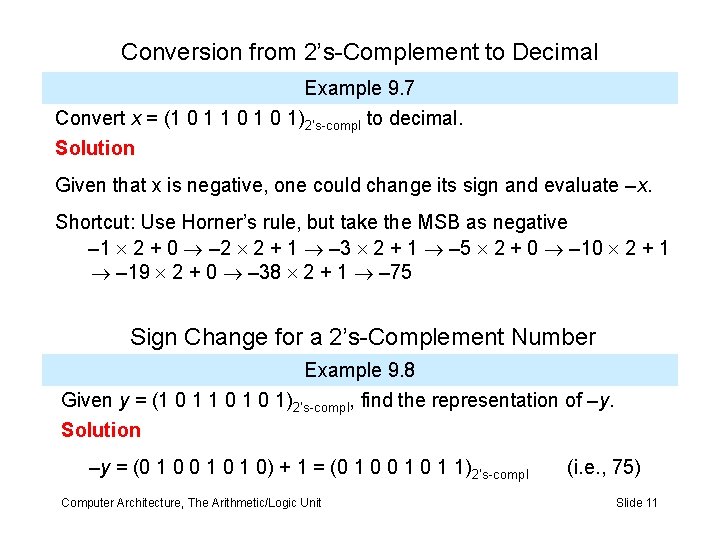
Conversion from 2’s-Complement to Decimal Example 9. 7 Convert x = (1 0 1 0 1)2’s-compl to decimal. Solution Given that x is negative, one could change its sign and evaluate –x. Shortcut: Use Horner’s rule, but take the MSB as negative – 1 2 + 0 – 2 2 + 1 – 3 2 + 1 – 5 2 + 0 – 10 2 + 1 – 19 2 + 0 – 38 2 + 1 – 75 Sign Change for a 2’s-Complement Number Example 9. 8 Given y = (1 0 1 0 1)2’s-compl, find the representation of –y. Solution –y = (0 1 0 1 0) + 1 = (0 1 0 1 1)2’s-compl Computer Architecture, The Arithmetic/Logic Unit (i. e. , 75) Slide 11
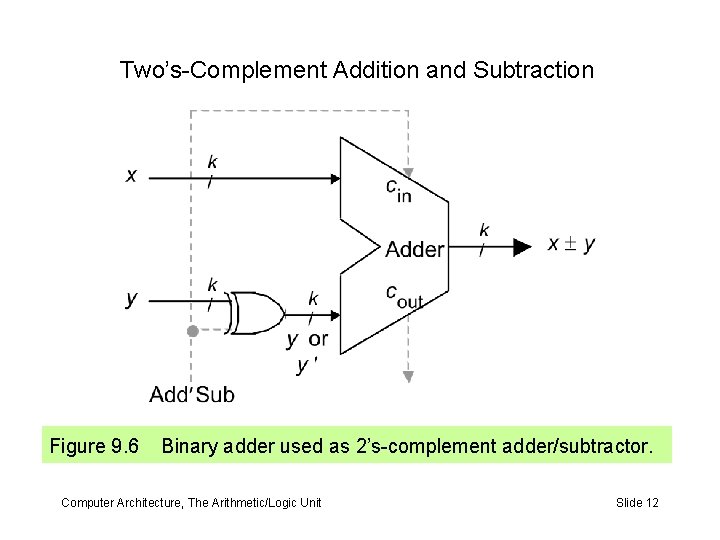
Two’s-Complement Addition and Subtraction Figure 9. 6 Binary adder used as 2’s-complement adder/subtractor. Computer Architecture, The Arithmetic/Logic Unit Slide 12
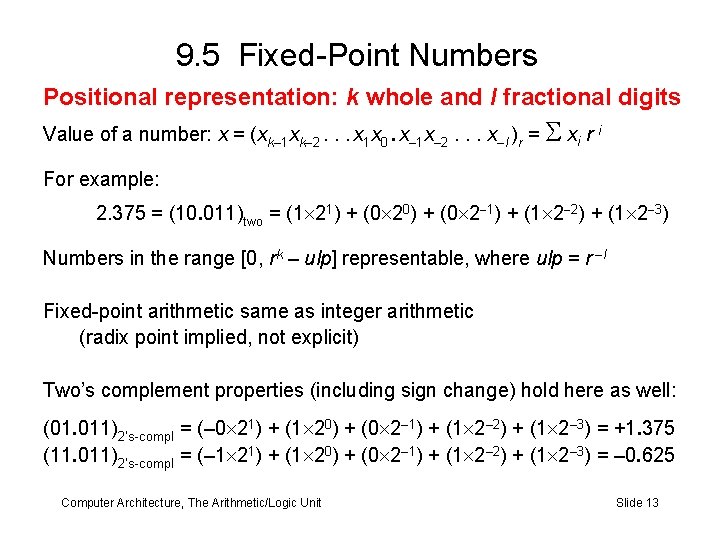
9. 5 Fixed-Point Numbers Positional representation: k whole and l fractional digits Value of a number: x = (xk– 1 xk– 2. . . x 1 x 0. x– 1 x– 2. . . x–l )r = S xi r i For example: 2. 375 = (10. 011)two = (1 21) + (0 20) + (0 2 -1) + (1 2 -2) + (1 2 -3) Numbers in the range [0, rk – ulp] representable, where ulp = r –l Fixed-point arithmetic same as integer arithmetic (radix point implied, not explicit) Two’s complement properties (including sign change) hold here as well: (01. 011)2’s-compl = (– 0 21) + (1 20) + (0 2– 1) + (1 2– 2) + (1 2– 3) = +1. 375 (11. 011)2’s-compl = (– 1 21) + (1 20) + (0 2– 1) + (1 2– 2) + (1 2– 3) = – 0. 625 Computer Architecture, The Arithmetic/Logic Unit Slide 13
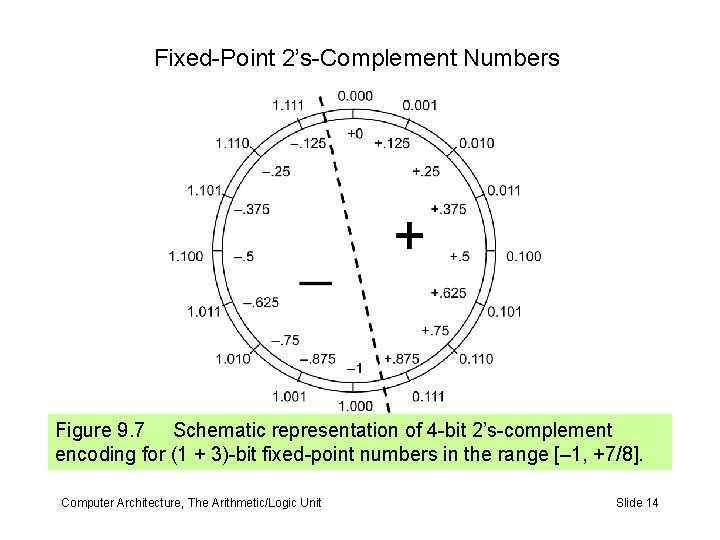
Fixed-Point 2’s-Complement Numbers Figure 9. 7 Schematic representation of 4 -bit 2’s-complement encoding for (1 + 3)-bit fixed-point numbers in the range [– 1, +7/8]. Computer Architecture, The Arithmetic/Logic Unit Slide 14
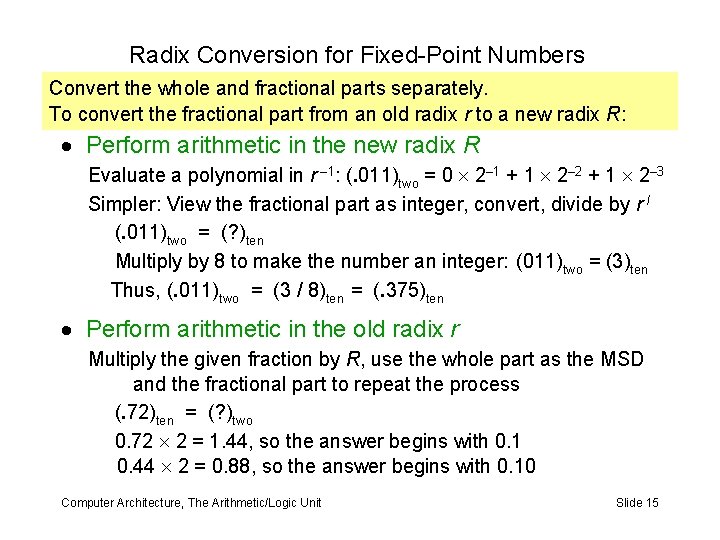
Radix Conversion for Fixed-Point Numbers Convert the whole and fractional parts separately. To convert the fractional part from an old radix r to a new radix R: Perform arithmetic in the new radix R Evaluate a polynomial in r – 1: (. 011)two = 0 2– 1 + 1 2– 2 + 1 2– 3 Simpler: View the fractional part as integer, convert, divide by r l (. 011)two = (? )ten Multiply by 8 to make the number an integer: (011)two = (3)ten Thus, (. 011)two = (3 / 8)ten = (. 375)ten Perform arithmetic in the old radix r Multiply the given fraction by R, use the whole part as the MSD and the fractional part to repeat the process (. 72)ten = (? )two 0. 72 2 = 1. 44, so the answer begins with 0. 1 0. 44 2 = 0. 88, so the answer begins with 0. 10 Computer Architecture, The Arithmetic/Logic Unit Slide 15
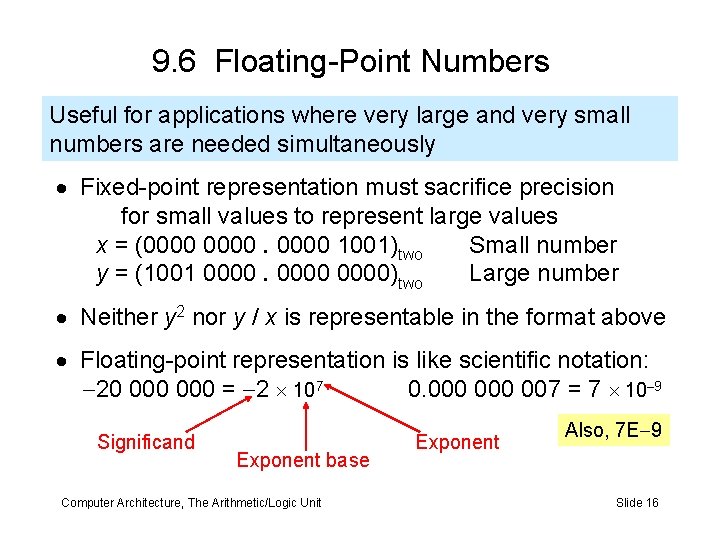
9. 6 Floating-Point Numbers Useful for applications where very large and very small numbers are needed simultaneously Fixed-point representation must sacrifice precision for small values to represent large values x = (0000 1001)two Small number y = (1001 0000)two Large number Neither y 2 nor y / x is representable in the format above Floating-point representation is like scientific notation: -20 000 = -2 10 7 0. 000 007 = 7 10– 9 Significand Exponent base Computer Architecture, The Arithmetic/Logic Unit Exponent Also, 7 E-9 Slide 16
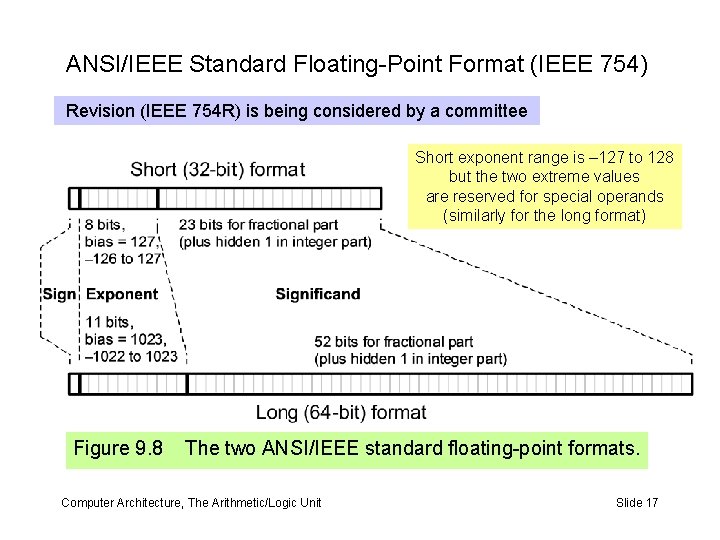
ANSI/IEEE Standard Floating-Point Format (IEEE 754) Revision (IEEE 754 R) is being considered by a committee Short exponent range is – 127 to 128 but the two extreme values are reserved for special operands (similarly for the long format) Figure 9. 8 The two ANSI/IEEE standard floating-point formats. Computer Architecture, The Arithmetic/Logic Unit Slide 17
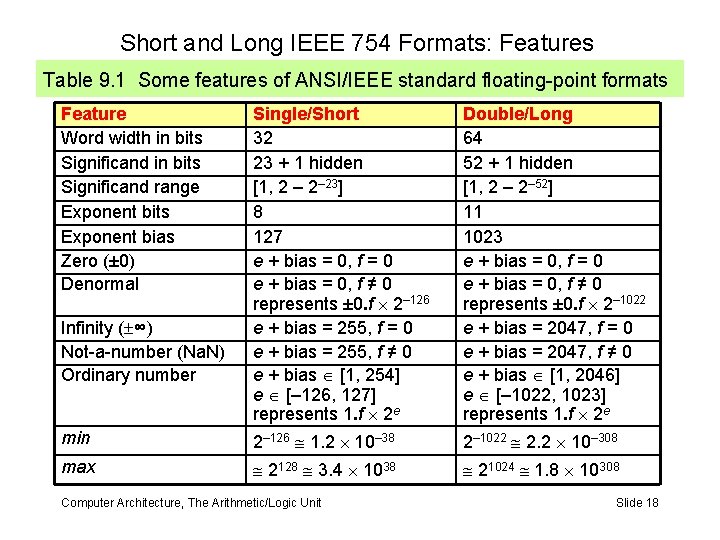
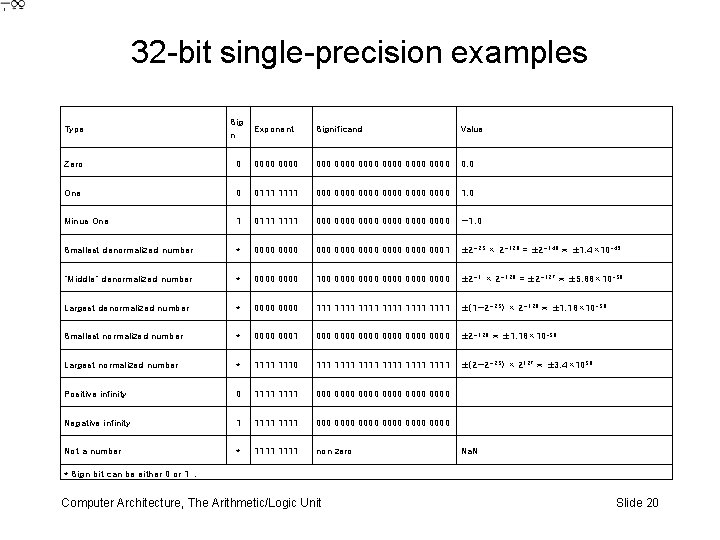
Short and Long IEEE 754 Formats: Features Table 9. 1 Some features of ANSI/IEEE standard floating-point formats Feature Word width in bits Significand range Exponent bits Exponent bias Zero (± 0) Denormal Single/Short 32 23 + 1 hidden [1, 2 – 2– 23] 8 127 e + bias = 0, f = 0 e + bias = 0, f ≠ 0 represents ± 0. f 2– 126 e + bias = 255, f = 0 e + bias = 255, f ≠ 0 e + bias [1, 254] e [– 126, 127] represents 1. f 2 e Double/Long 64 52 + 1 hidden [1, 2 – 2– 52] 11 1023 e + bias = 0, f = 0 e + bias = 0, f ≠ 0 represents ± 0. f 2– 1022 e + bias = 2047, f = 0 e + bias = 2047, f ≠ 0 e + bias [1, 2046] e [– 1022, 1023] represents 1. f 2 e min 2– 126 1. 2 10– 38 2– 1022 2. 2 10– 308 max 2128 3. 4 1038 21024 1. 8 10308 Infinity ( ∞) Not-a-number (Na. N) Ordinary number Computer Architecture, The Arithmetic/Logic Unit Slide 18
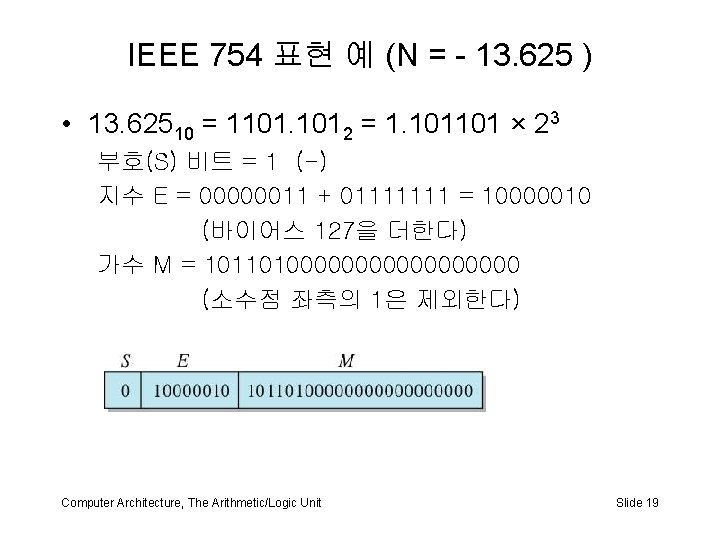
IEEE 754 표현 예 (N = - 13. 625 ) • 13. 62510 = 1101. 1012 = 1. 101101 × 23 부호(S) 비트 = 1 (-) 지수 E = 00000011 + 01111111 = 10000010 (바이어스 127을 더한다) 가수 M = 101101000000000 (소수점 좌측의 1은 제외한다) Computer Architecture, The Arithmetic/Logic Unit Slide 19
32 -bit single-precision examples Type Sig n Exponent Significand Value Zero 0 0000 0000 0. 0 One 0 0111 1111 0000 0000 1. 0 Minus One 1 0111 1111 0000 0000 − 1. 0 Smallest denormalized number * 0000 0000 0001 ± 2− 23 × 2− 126 = ± 2− 149 ≈ ± 1. 4× 10 -45 "Middle" denormalized number * 0000 100 0000 0000 ± 2− 1 × 2− 126 = ± 2− 127 ≈ ± 5. 88× 10 -39 Largest denormalized number * 0000 1111 1111 ±(1− 2− 23) × 2− 126 ≈ ± 1. 18× 10 -38 Smallest normalized number * 0000 0001 0000 0000 ± 2− 126 ≈ ± 1. 18× 10 -38 Largest normalized number * 1111 1110 1111 1111 ±(2− 2− 23) × 2127 ≈ ± 3. 4× 1038 Positive infinity 0 1111 0000 0000 Negative infinity 1 1111 0000 0000 Not a number * 1111 non zero Na. N * Sign bit can be either 0 or 1. Computer Architecture, The Arithmetic/Logic Unit Slide 20
11 Multipliers and Dividers Topics in This Chapter 11. 1 Shift-Add Multiplication 11. 2 Hardware Multipliers 11. 3 Programmed Multiplication 11. 4 Shift-Subtract Division 11. 5 Hardware Dividers 11. 6 Programmed Division Computer Architecture, The Arithmetic/Logic Unit Slide 21
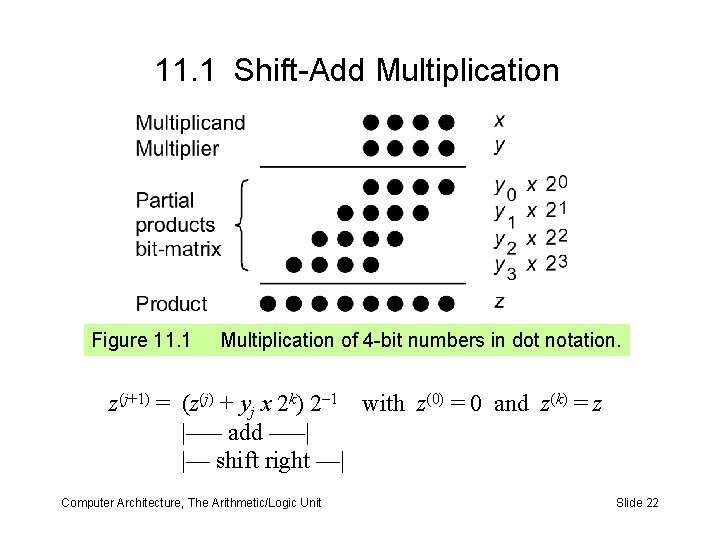
11. 1 Shift-Add Multiplication Figure 11. 1 Multiplication of 4 -bit numbers in dot notation. z(j+1) = (z(j) + yj x 2 k) 2– 1 with z(0) = 0 and z(k) = z |––– add –––| |–– shift right ––| Computer Architecture, The Arithmetic/Logic Unit Slide 22
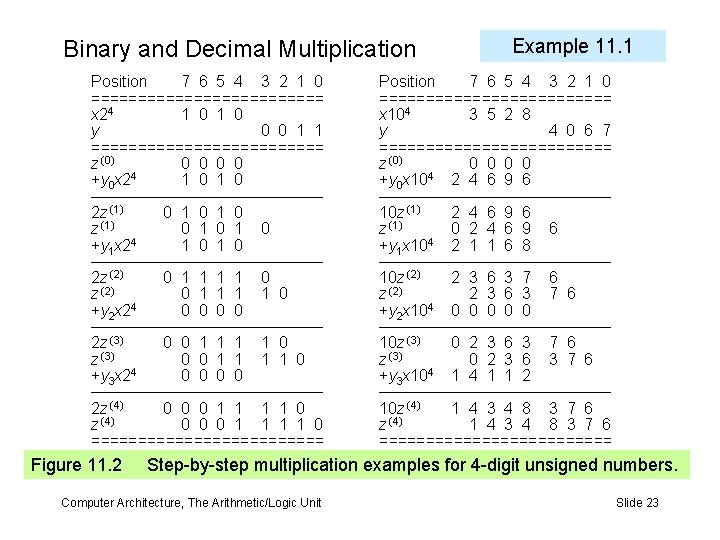
Binary and Decimal Multiplication Position 7 6 5 4 3 2 1 0 ============= x 24 1 0 y 0 0 1 1 ============= z (0) 0 0 4 +y 0 x 2 1 0 ––––––––––––– 2 z (1) 0 1 0 (1) z 0 1 0 4 +y 1 x 2 1 0 ––––––––––––– 2 z (2) 0 1 1 0 (2) z 0 1 1 0 4 +y 2 x 2 0 0 ––––––––––––– 2 z (3) 0 0 1 1 0 (3) z 0 0 1 1 0 4 +y 3 x 2 0 0 ––––––––––––– 2 z (4) 0 0 0 1 1 0 (4) z 0 0 0 1 1 0 ============= Figure 11. 2 Example 11. 1 Position 7 6 5 4 3 2 1 0 ============= x 104 3 5 2 8 y 4 0 6 7 ============= z (0) 0 0 4 +y 0 x 10 2 4 6 9 6 ––––––––––––– 10 z (1) 2 4 6 9 6 (1) z 0 2 4 6 9 6 4 +y 1 x 10 2 1 1 6 8 ––––––––––––– 10 z (2) 2 3 6 3 7 6 (2) z 2 3 6 3 7 6 4 +y 2 x 10 0 0 ––––––––––––– 10 z (3) 0 2 3 6 3 7 6 (3) z 0 2 3 6 3 7 6 4 +y 3 x 10 1 4 1 1 2 ––––––––––––– 10 z (4) 1 4 3 4 8 3 7 6 (4) z 1 4 3 4 8 3 7 6 ============= Step-by-step multiplication examples for 4 -digit unsigned numbers. Computer Architecture, The Arithmetic/Logic Unit Slide 23
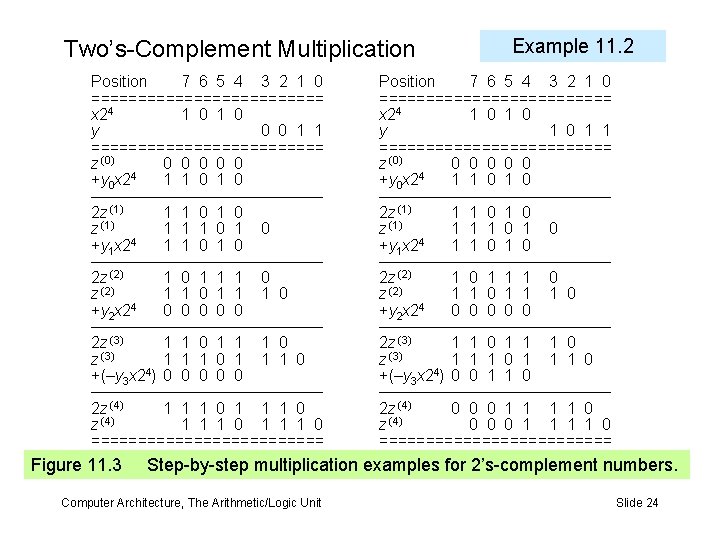
Two’s-Complement Multiplication Position 7 6 5 4 3 2 1 0 ============= x 24 1 0 y 0 0 1 1 ============= z (0) 0 0 0 4 +y 0 x 2 1 1 0 ––––––––––––– 2 z (1) 1 1 0 (1) z 1 1 1 0 4 +y 1 x 2 1 1 0 ––––––––––––– 2 z (2) 1 0 1 1 1 0 (2) z 1 1 0 1 1 1 0 4 +y 2 x 2 0 0 0 ––––––––––––– 2 z (3) 1 1 0 1 1 1 0 (3) z 1 1 1 0 4 +(–y 3 x 2 ) 0 0 0 ––––––––––––– 2 z (4) 1 1 1 0 (4) z 1 1 1 0 ============= Figure 11. 3 Example 11. 2 Position 7 6 5 4 3 2 1 0 ============= x 24 1 0 y 1 0 1 1 ============= z (0) 0 0 0 4 +y 0 x 2 1 1 0 ––––––––––––– 2 z (1) 1 1 0 (1) z 1 1 1 0 4 +y 1 x 2 1 1 0 ––––––––––––– 2 z (2) 1 0 1 1 1 0 (2) z 1 1 0 1 1 1 0 4 +y 2 x 2 0 0 0 ––––––––––––– 2 z (3) 1 1 0 1 1 1 0 (3) z 1 1 1 0 4 +(–y 3 x 2 ) 0 0 1 1 0 ––––––––––––– 2 z (4) 0 0 0 1 1 0 (4) z 0 0 0 1 1 0 ============= Step-by-step multiplication examples for 2’s-complement numbers. Computer Architecture, The Arithmetic/Logic Unit Slide 24
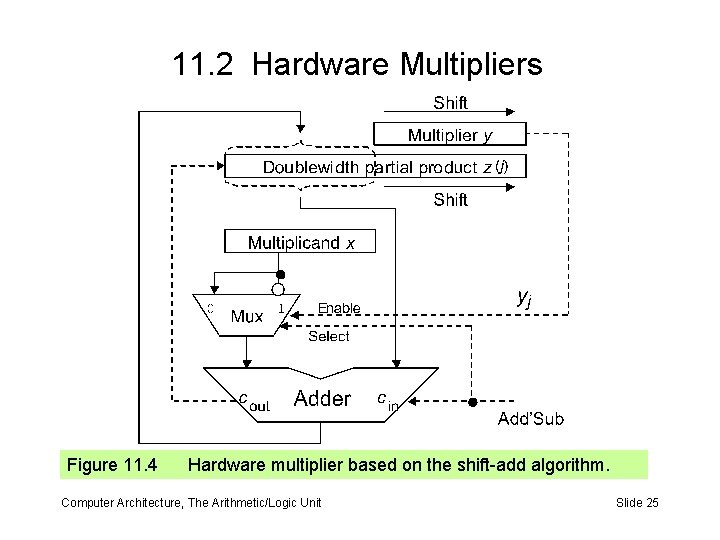
11. 2 Hardware Multipliers Figure 11. 4 Hardware multiplier based on the shift-add algorithm. Computer Architecture, The Arithmetic/Logic Unit Slide 25
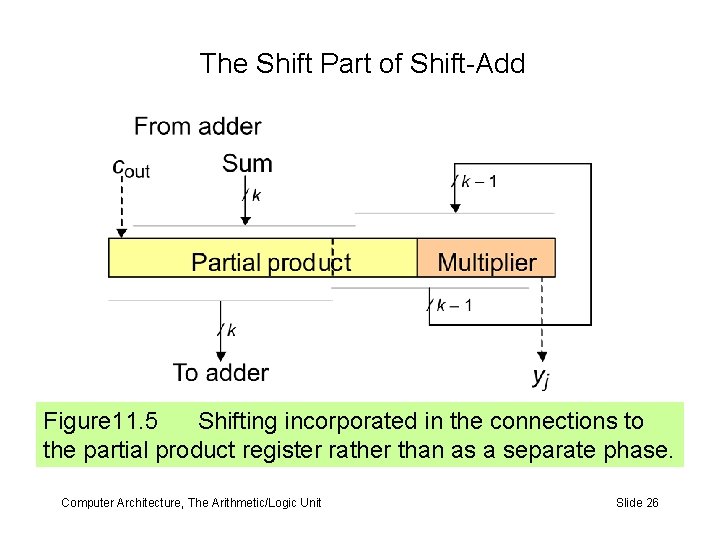
The Shift Part of Shift-Add Figure 11. 5 Shifting incorporated in the connections to the partial product register rather than as a separate phase. Computer Architecture, The Arithmetic/Logic Unit Slide 26
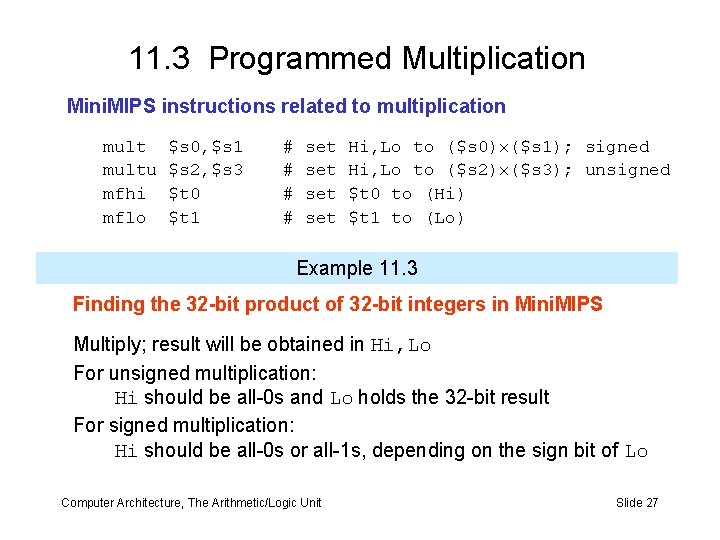
11. 3 Programmed Multiplication Mini. MIPS instructions related to multiplication multu mfhi mflo $s 0, $s 1 $s 2, $s 3 $t 0 $t 1 # # set set Hi, Lo to ($s 0) ($s 1); signed Hi, Lo to ($s 2) ($s 3); unsigned $t 0 to (Hi) $t 1 to (Lo) Example 11. 3 Finding the 32 -bit product of 32 -bit integers in Mini. MIPS Multiply; result will be obtained in Hi, Lo For unsigned multiplication: Hi should be all-0 s and Lo holds the 32 -bit result For signed multiplication: Hi should be all-0 s or all-1 s, depending on the sign bit of Lo Computer Architecture, The Arithmetic/Logic Unit Slide 27
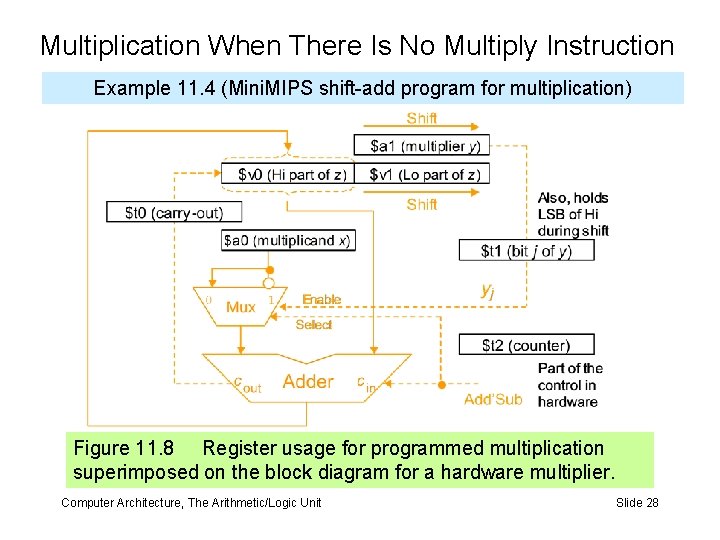
Multiplication When There Is No Multiply Instruction Example 11. 4 (Mini. MIPS shift-add program for multiplication) Figure 11. 8 Register usage for programmed multiplication superimposed on the block diagram for a hardware multiplier. Computer Architecture, The Arithmetic/Logic Unit Slide 28
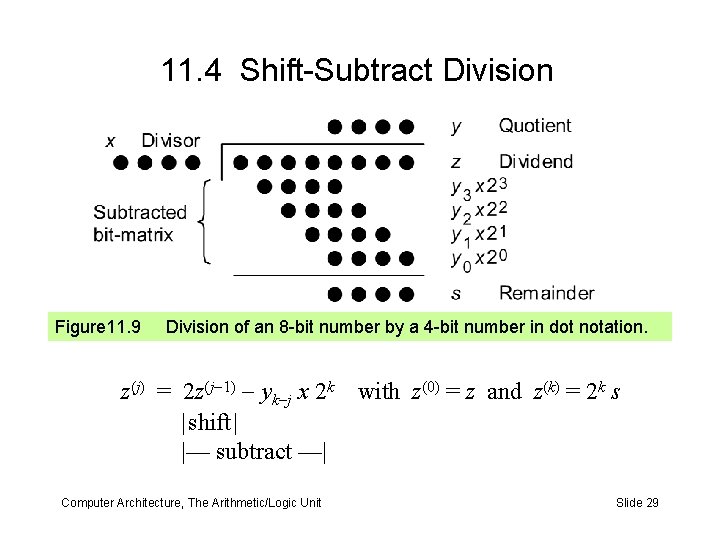
11. 4 Shift-Subtract Division Figure 11. 9 Division of an 8 -bit number by a 4 -bit number in dot notation. z(j) = 2 z(j-1) - yk-j x 2 k with z(0) = z and z(k) = 2 k s | shift | |–– subtract ––| Computer Architecture, The Arithmetic/Logic Unit Slide 29
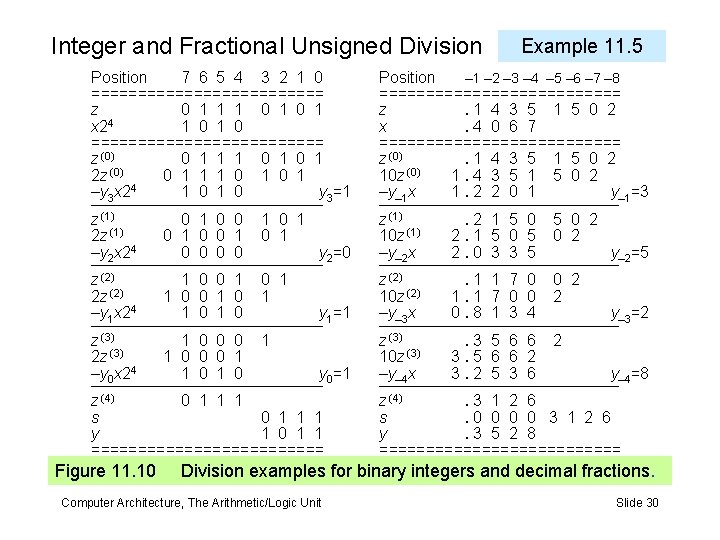
Integer and Fractional Unsigned Division Position 7 6 5 4 3 2 1 0 ============= z 0 1 1 1 0 1 4 x 2 1 0 ============= z (0) 0 1 1 1 0 1 (0) 2 z 0 1 1 1 0 1 4 –y 3 x 2 1 0 y =1 ––––––––––––– 3 z (1) 0 1 0 1 (1) 2 z 0 1 0 1 4 –y 2 x 2 0 0 y =0 ––––––––––––– 2 z (2) 1 0 0 1 (2) 2 z 1 0 0 1 4 –y 1 x 2 1 0 y =1 ––––––––––––– 1 z (3) 1 0 0 0 1 (3) 2 z 1 0 0 0 1 4 –y 0 x 2 1 0 y =1 ––––––––––––– 0 z (4) 0 1 1 1 s 0 1 1 1 y 1 0 1 1 ============= Figure 11. 10 Example 11. 5 Position – 1 – 2 – 3 – 4 – 5 – 6 – 7 – 8 ============= z. 1 4 3 5 1 5 0 2 x. 4 0 6 7 ============= z (0). 1 4 3 5 1 5 0 2 (0) 10 z 1. 4 3 5 1 5 0 2 –y– 1 x 1. 2 2 0 1 y =3 –––––––––––––– 1 z (1). 2 1 5 0 2 (1) 10 z 2. 1 5 0 2 –y– 2 x 2. 0 3 3 5 y =5 –––––––––––––– 2 z (2). 1 1 7 0 0 2 (2) 10 z 1. 1 7 0 0 2 –y– 3 x 0. 8 1 3 4 y =2 –––––––––––––– 3 z (3). 3 5 6 6 2 (3) 10 z 3. 5 6 6 2 –y– 4 x 3. 2 5 3 6 y =8 –––––––––––––– 4 z (4). 3 1 2 6 s. 0 0 3 1 2 6 y. 3 5 2 8 ============= Division examples for binary integers and decimal fractions. Computer Architecture, The Arithmetic/Logic Unit Slide 30
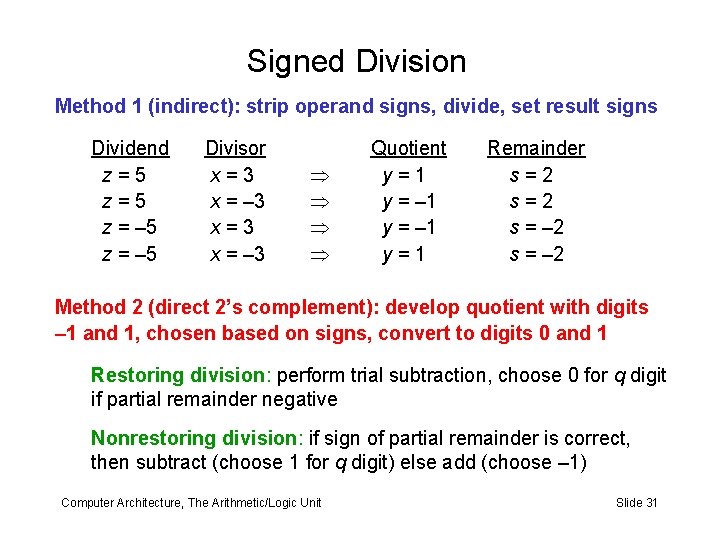
Signed Division Method 1 (indirect): strip operand signs, divide, set result signs Dividend z=5 z = – 5 Divisor x=3 x = – 3 Quotient y=1 y = – 1 y=1 Remainder s=2 s = – 2 Method 2 (direct 2’s complement): develop quotient with digits – 1 and 1, chosen based on signs, convert to digits 0 and 1 Restoring division: perform trial subtraction, choose 0 for q digit if partial remainder negative Nonrestoring division: if sign of partial remainder is correct, then subtract (choose 1 for q digit) else add (choose – 1) Computer Architecture, The Arithmetic/Logic Unit Slide 31
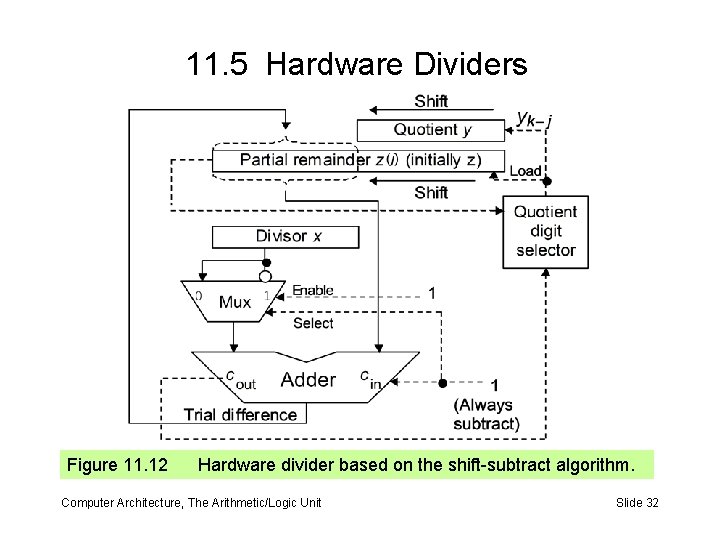
11. 5 Hardware Dividers Figure 11. 12 Hardware divider based on the shift-subtract algorithm. Computer Architecture, The Arithmetic/Logic Unit Slide 32
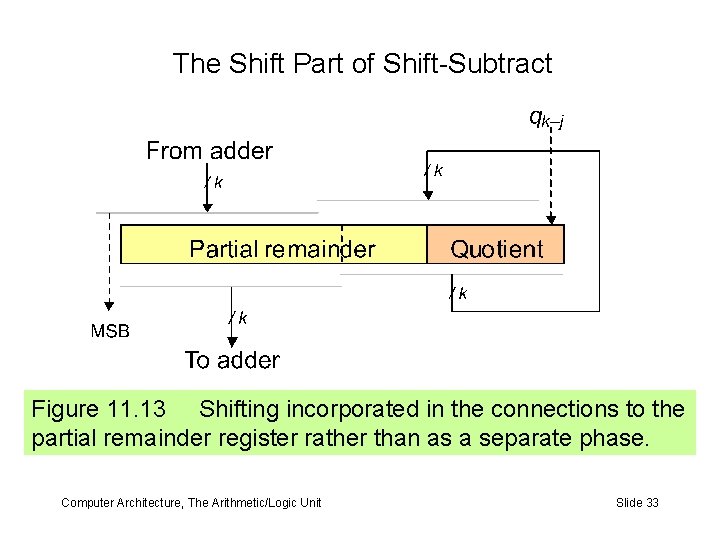
The Shift Part of Shift-Subtract Figure 11. 13 Shifting incorporated in the connections to the partial remainder register rather than as a separate phase. Computer Architecture, The Arithmetic/Logic Unit Slide 33
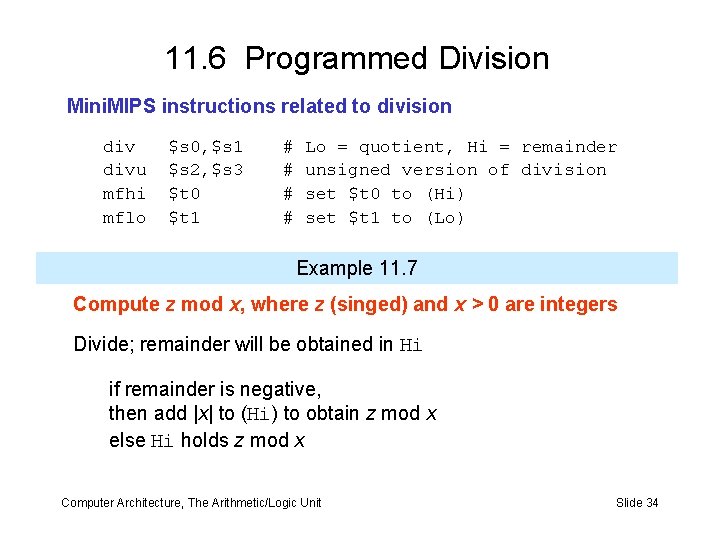
11. 6 Programmed Division Mini. MIPS instructions related to division divu mfhi mflo $s 0, $s 1 $s 2, $s 3 $t 0 $t 1 # # Lo = quotient, Hi = remainder unsigned version of division set $t 0 to (Hi) set $t 1 to (Lo) Example 11. 7 Compute z mod x, where z (singed) and x > 0 are integers Divide; remainder will be obtained in Hi if remainder is negative, then add |x| to (Hi) to obtain z mod x else Hi holds z mod x Computer Architecture, The Arithmetic/Logic Unit Slide 34
Division via Repeated Subtractions Example 11. 8 (Mini. MIPS shift-add program for division) Figure 11. 15 Register usage for programmed division superimposed on the block diagram for a hardware divider. Computer Architecture, The Arithmetic/Logic Unit Slide 35
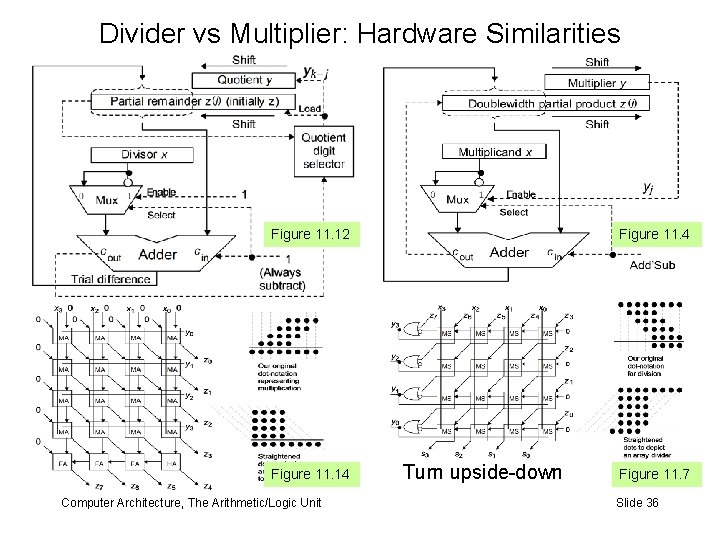
Divider vs Multiplier: Hardware Similarities Figure 11. 12 Figure 11. 14 Computer Architecture, The Arithmetic/Logic Unit Figure 11. 4 Turn upside-down Figure 11. 7 Slide 36
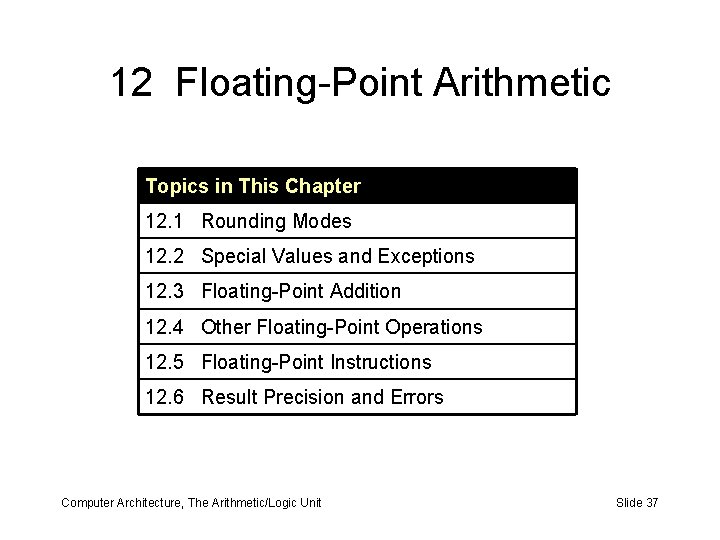
12 Floating-Point Arithmetic Topics in This Chapter 12. 1 Rounding Modes 12. 2 Special Values and Exceptions 12. 3 Floating-Point Addition 12. 4 Other Floating-Point Operations 12. 5 Floating-Point Instructions 12. 6 Result Precision and Errors Computer Architecture, The Arithmetic/Logic Unit Slide 37
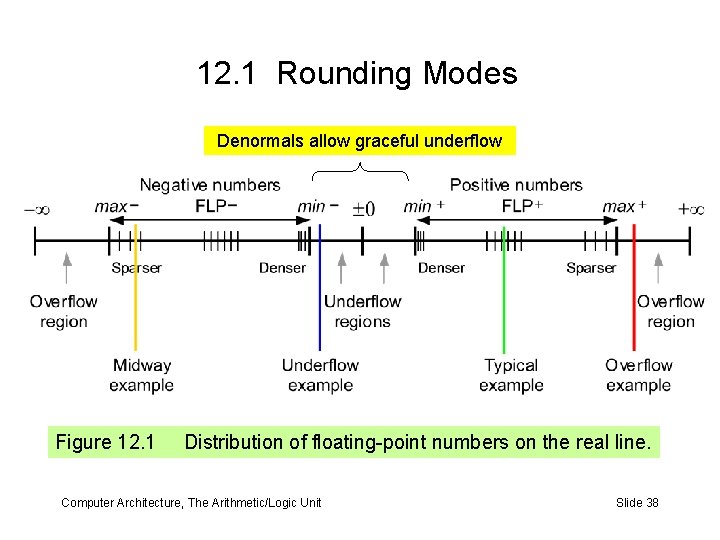
12. 1 Rounding Modes Denormals allow graceful underflow Figure 12. 1 Distribution of floating-point numbers on the real line. Computer Architecture, The Arithmetic/Logic Unit Slide 38
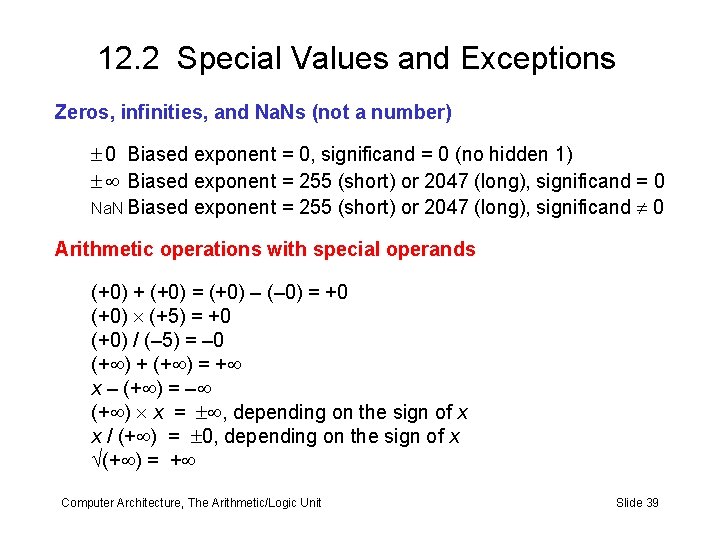
12. 2 Special Values and Exceptions Zeros, infinities, and Na. Ns (not a number) 0 Biased exponent = 0, significand = 0 (no hidden 1) Biased exponent = 255 (short) or 2047 (long), significand = 0 Na. N Biased exponent = 255 (short) or 2047 (long), significand 0 Arithmetic operations with special operands (+0) + (+0) = (+0) – (– 0) = +0 (+0) (+5) = +0 (+0) / (– 5) = – 0 (+ ) + (+ ) = + x – (+ ) = – (+ ) x = , depending on the sign of x x / (+ ) = 0, depending on the sign of x (+ ) = + Computer Architecture, The Arithmetic/Logic Unit Slide 39
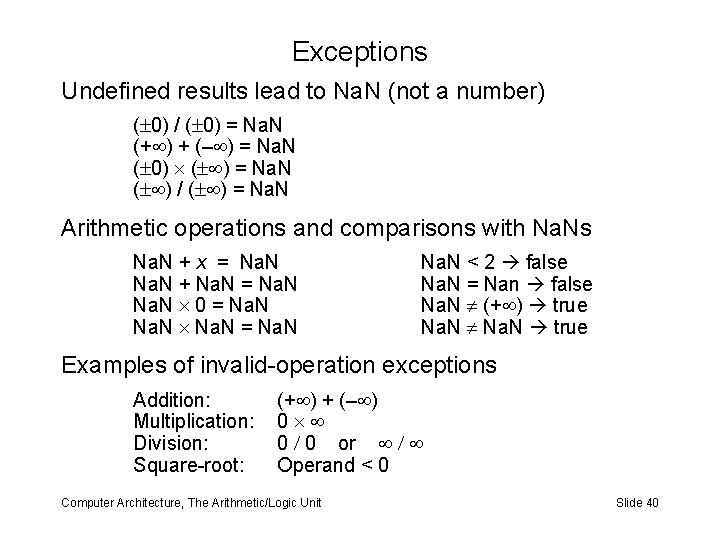
Exceptions Undefined results lead to Na. N (not a number) ( 0) / ( 0) = Na. N (+ ) + (– ) = Na. N ( 0) ( ) = Na. N ( ) / ( ) = Na. N Arithmetic operations and comparisons with Na. Ns Na. N + x = Na. N + Na. N = Na. N 0 = Na. N = Na. N < 2 false Na. N = Nan false Na. N (+ ) true Na. N true Examples of invalid-operation exceptions Addition: Multiplication: Division: Square-root: (+ ) + (– ) 0 0 / 0 or / Operand < 0 Computer Architecture, The Arithmetic/Logic Unit Slide 40
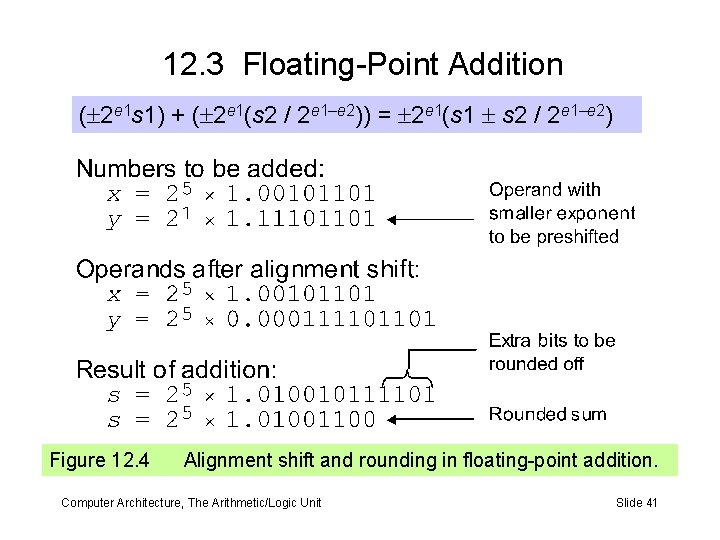
12. 3 Floating-Point Addition ( 2 e 1 s 1) + ( 2 e 1(s 2 / 2 e 1–e 2)) = 2 e 1(s 1 s 2 / 2 e 1–e 2) Figure 12. 4 Alignment shift and rounding in floating-point addition. Computer Architecture, The Arithmetic/Logic Unit Slide 41
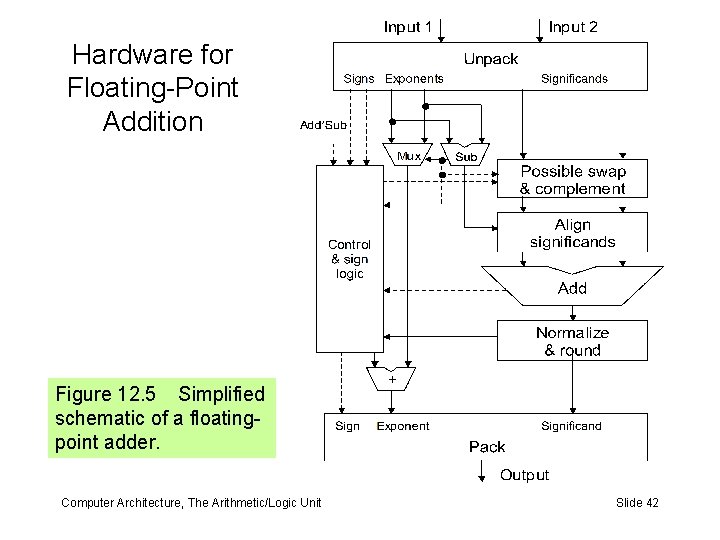
Hardware for Floating-Point Addition Figure 12. 5 Simplified schematic of a floatingpoint adder. Computer Architecture, The Arithmetic/Logic Unit Slide 42
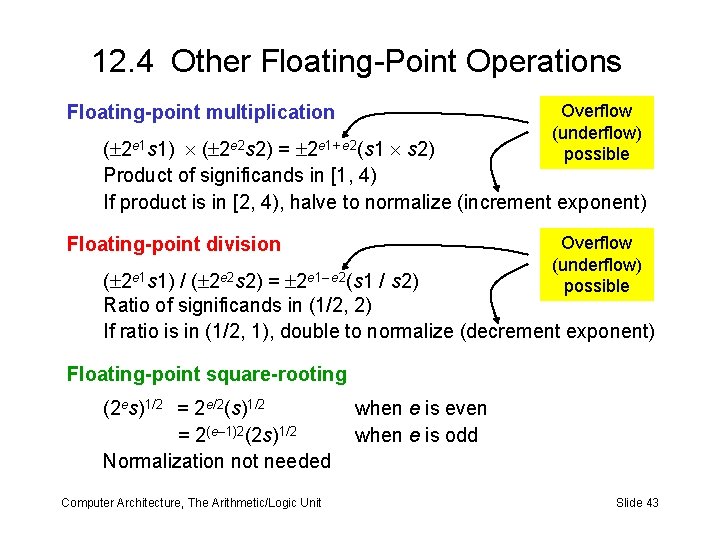
12. 4 Other Floating-Point Operations Overflow (underflow) possible Floating-point multiplication ( 2 e 1 s 1) ( 2 e 2 s 2) = 2 e 1+ e 2(s 1 s 2) Product of significands in [1, 4) If product is in [2, 4), halve to normalize (increment exponent) Overflow (underflow) possible Floating-point division ( 2 e 1 s 1) / ( 2 e 2 s 2) = 2 e 1– e 2(s 1 / s 2) Ratio of significands in (1/2, 2) If ratio is in (1/2, 1), double to normalize (decrement exponent) Floating-point square-rooting (2 es)1/2 = 2 e/2(s)1/2 = 2(e– 1)2(2 s)1/2 Normalization not needed Computer Architecture, The Arithmetic/Logic Unit when e is even when e is odd Slide 43
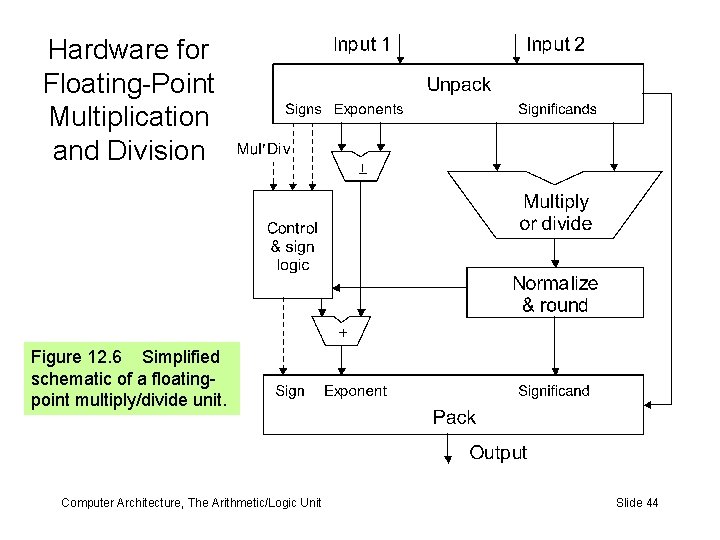
Hardware for Floating-Point Multiplication and Division Figure 12. 6 Simplified schematic of a floatingpoint multiply/divide unit. Computer Architecture, The Arithmetic/Logic Unit Slide 44
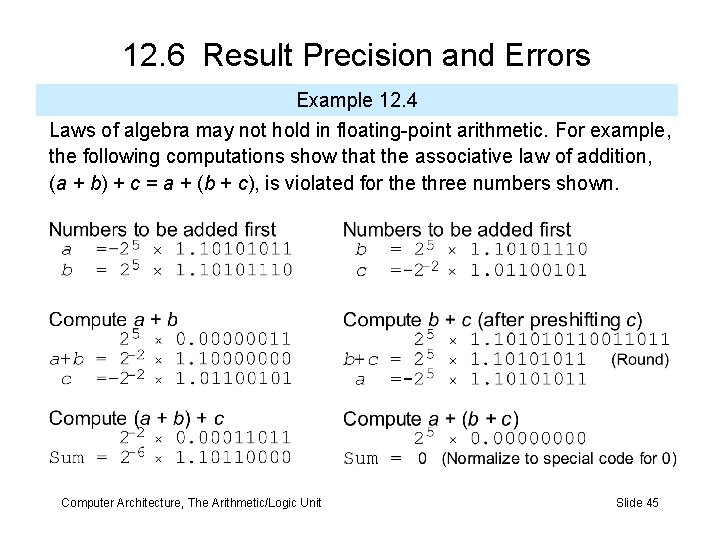
12. 6 Result Precision and Errors Example 12. 4 Laws of algebra may not hold in floating-point arithmetic. For example, the following computations show that the associative law of addition, (a + b) + c = a + (b + c), is violated for the three numbers shown. Computer Architecture, The Arithmetic/Logic Unit Slide 45