Organic Chemistry 5 th Edition L G Wade
- Slides: 48
Organic Chemistry, 5 th Edition L. G. Wade, Jr. Chapter 5 Stereochemistry Unit 4
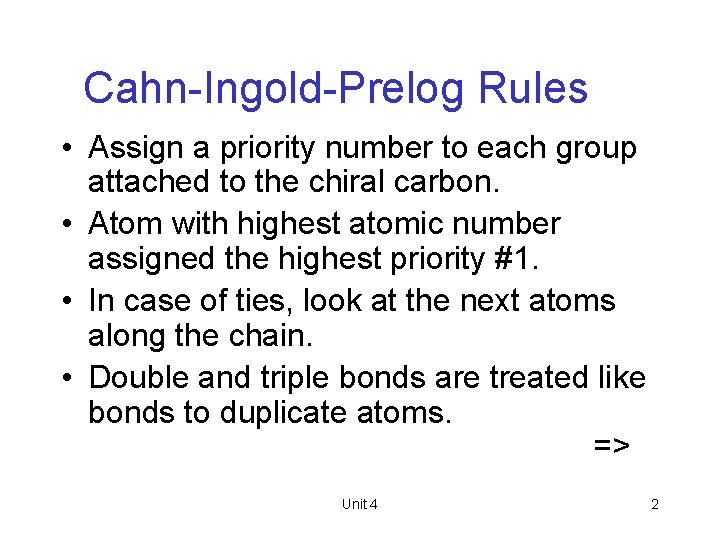
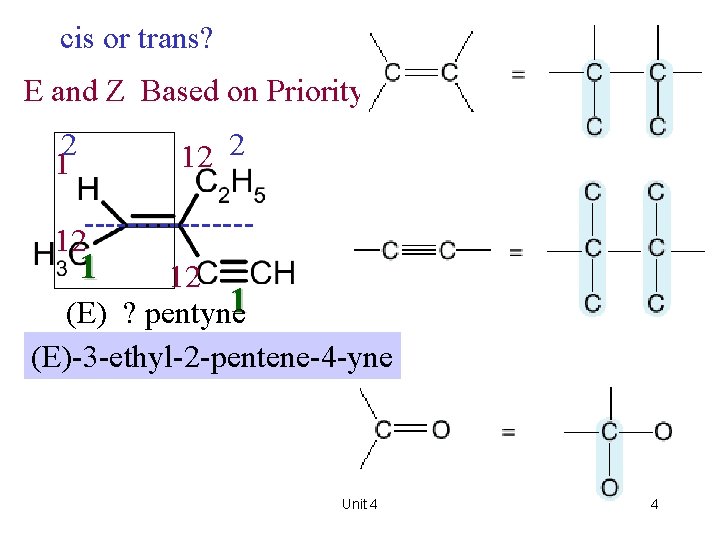
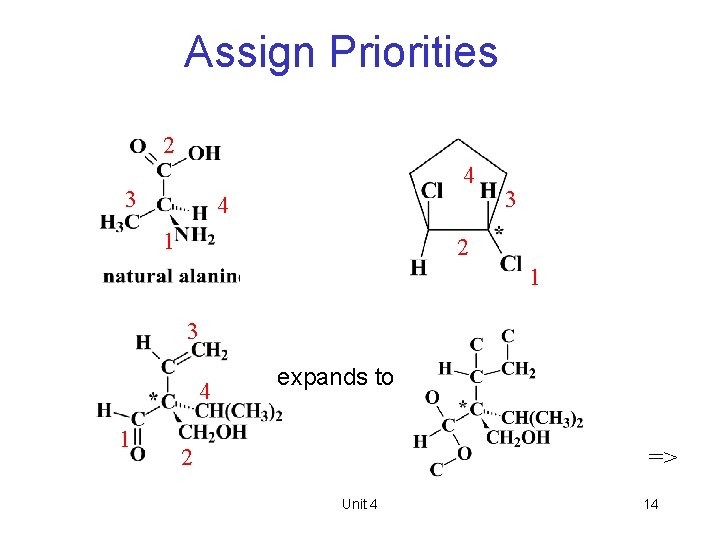
Cahn-Ingold-Prelog Rules • Assign a priority number to each group attached to the chiral carbon. • Atom with highest atomic number assigned the highest priority #1. • In case of ties, look at the next atoms along the chain. • Double and triple bonds are treated like bonds to duplicate atoms. => Unit 4 2
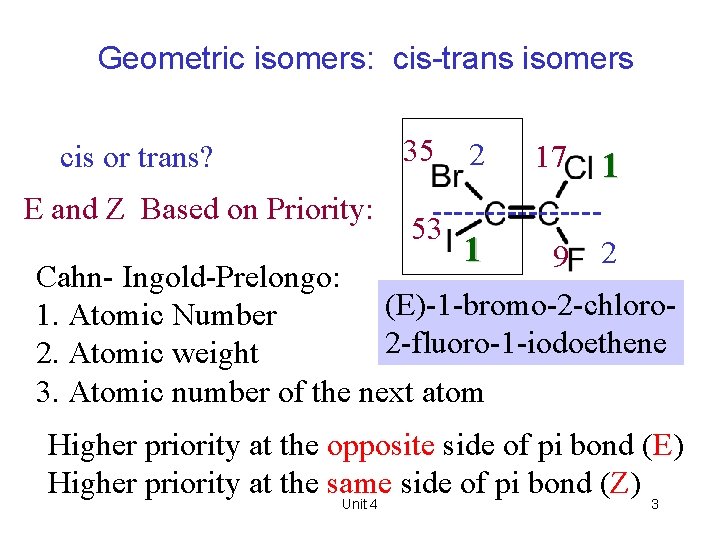
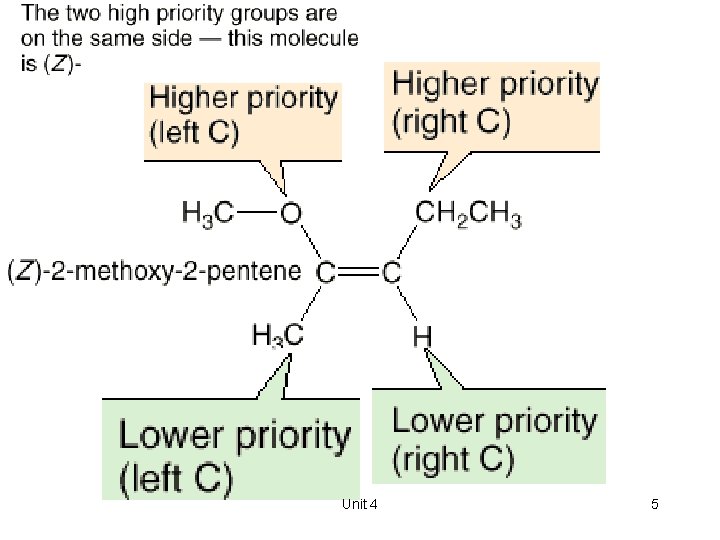
Geometric isomers: cis-trans isomers 35 cis or trans? E and Z Based on Priority: 2 17 1 --------53 1 9 2 (E)-1 -bromo-2 -chloro(E) ? ethane 2 -fluoro-1 -iodoethene Cahn- Ingold-Prelongo: 1. Atomic Number 2. Atomic weight 3. Atomic number of the next atom Higher priority at the opposite side of pi bond (E) Higher priority at the same side of pi bond (Z) Unit 4 3
cis or trans? E and Z Based on Priority: 2 1 12 2 --------12 1 (E) ? pentyne (E)-3 -ethyl-2 -pentene-4 -yne Unit 4 4
Unit 4 5
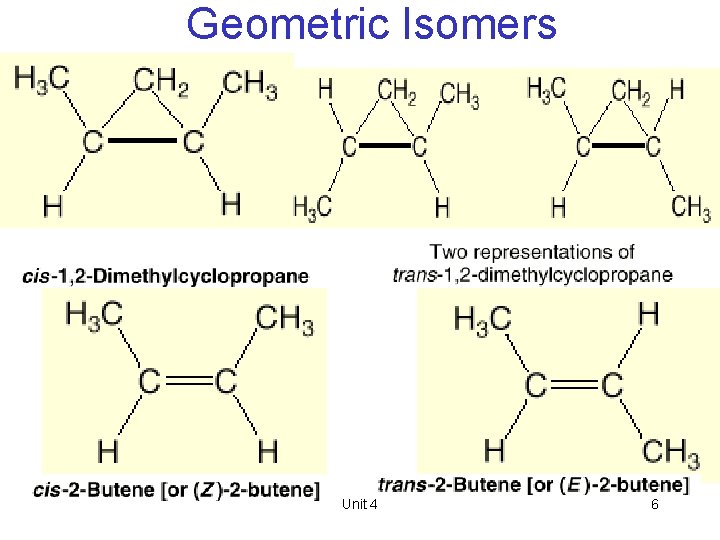
Geometric Isomers Unit 4 6
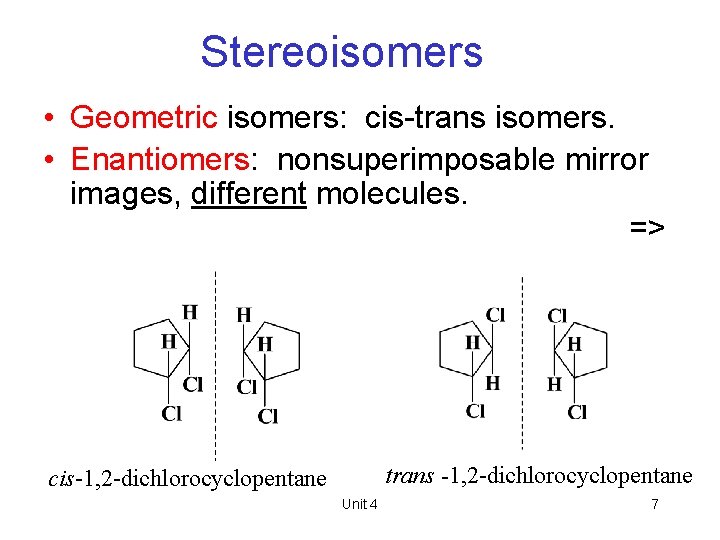
Stereoisomers • Geometric isomers: cis-trans isomers. • Enantiomers: nonsuperimposable mirror images, different molecules. => trans -1, 2 -dichlorocyclopentane cis-1, 2 -dichlorocyclopentane Unit 4 7
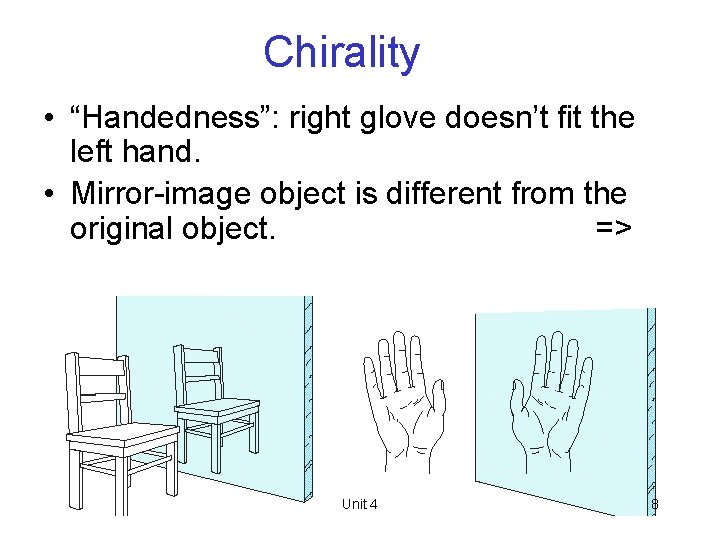
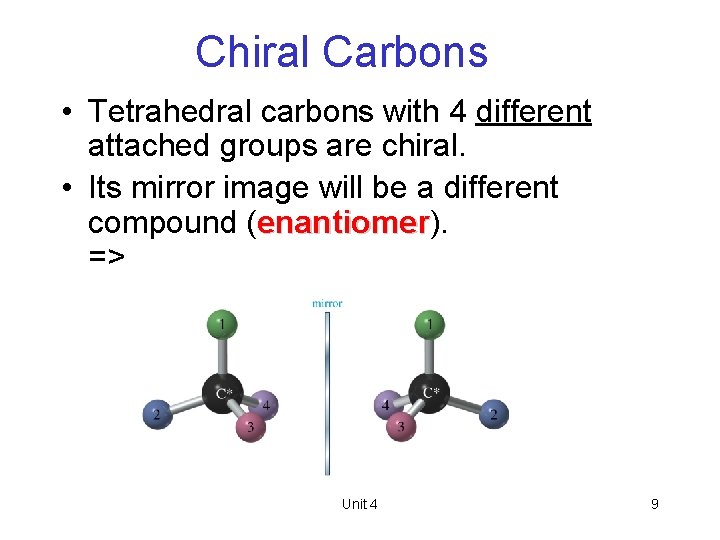
Chirality • “Handedness”: right glove doesn’t fit the left hand. • Mirror-image object is different from the original object. => Unit 4 8
Chiral Carbons • Tetrahedral carbons with 4 different attached groups are chiral. • Its mirror image will be a different compound (enantiomer). enantiomer => Unit 4 9
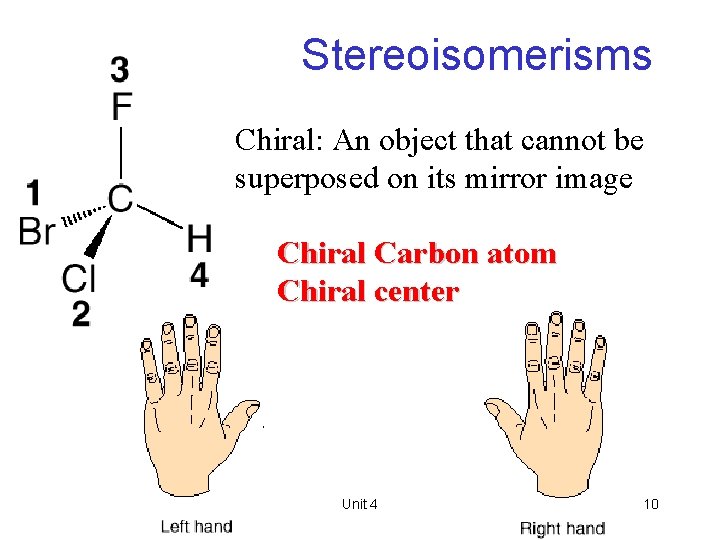
Stereoisomerisms Chiral: An object that cannot be superposed on its mirror image Chiral Carbon atom Chiral center Unit 4 10
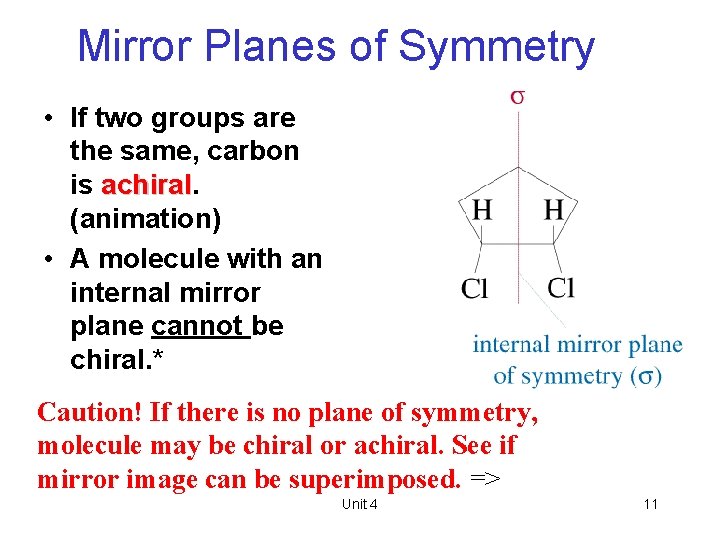
Mirror Planes of Symmetry • If two groups are the same, carbon is achiral (animation) • A molecule with an internal mirror plane cannot be chiral. * Caution! If there is no plane of symmetry, molecule may be chiral or achiral. See if mirror image can be superimposed. => Unit 4 11
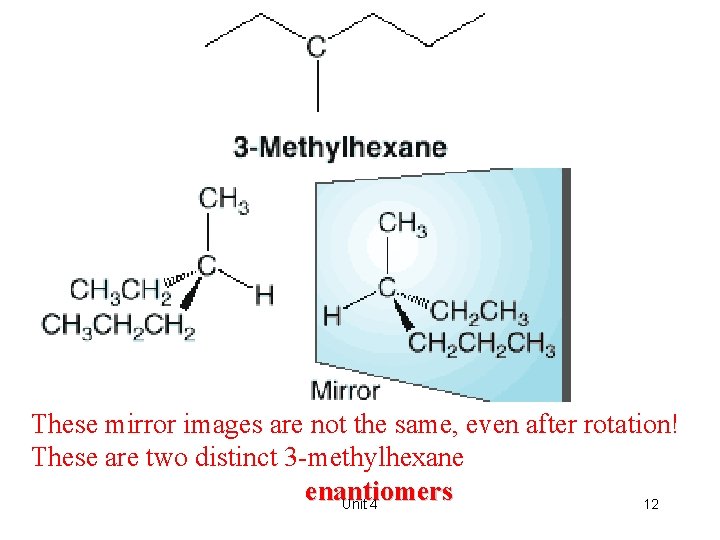
These mirror images are not the same, even after rotation! These are two distinct 3 -methylhexane enantiomers Unit 4 12
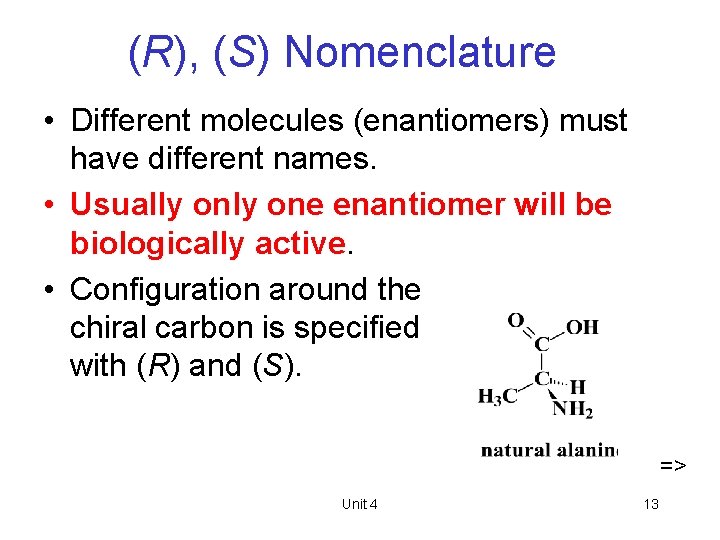
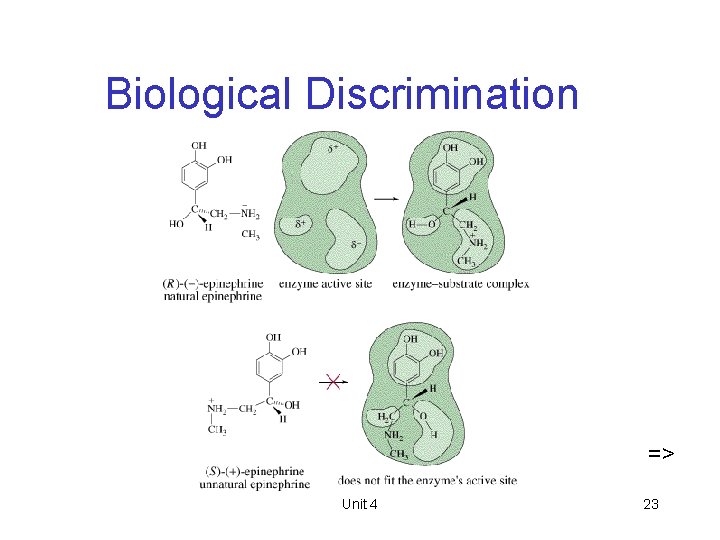
(R), (S) Nomenclature • Different molecules (enantiomers) must have different names. • Usually one enantiomer will be biologically active. • Configuration around the chiral carbon is specified with (R) and (S). => Unit 4 13
Assign Priorities 2 4 3 4 1 3 2 1 3 4 1 expands to 2 => Unit 4 14
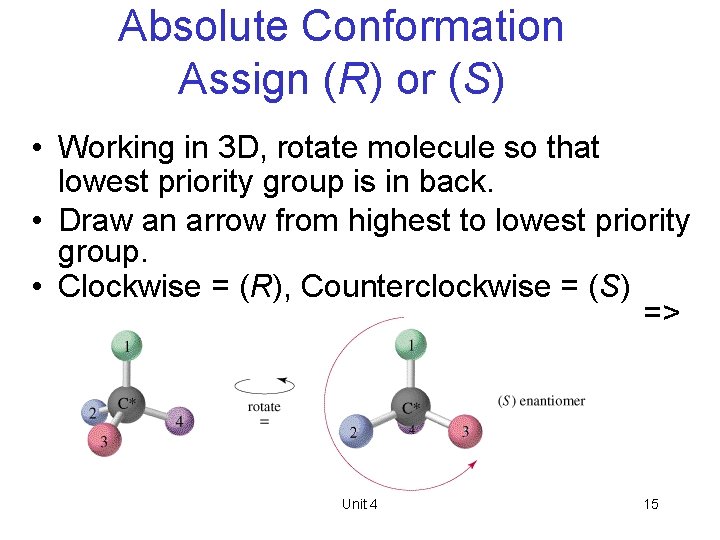
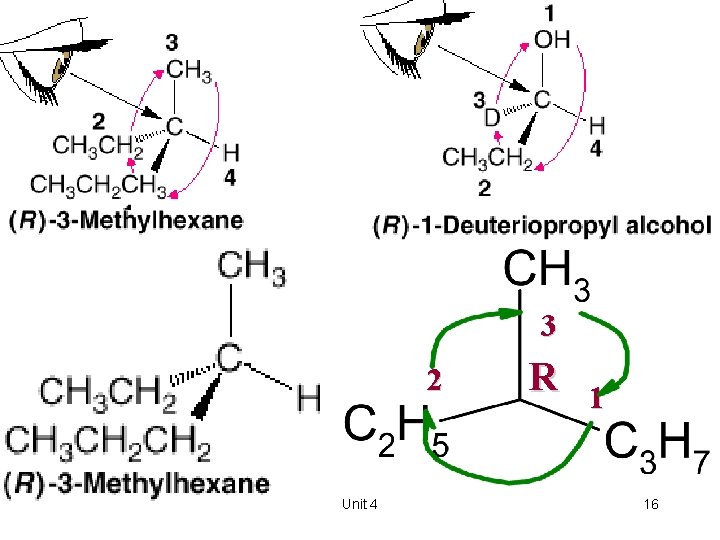
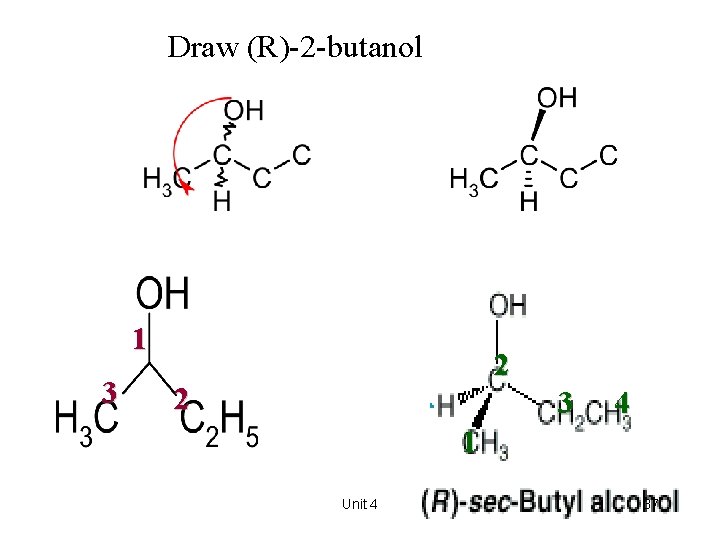
Absolute Conformation Assign (R) or (S) • Working in 3 D, rotate molecule so that lowest priority group is in back. • Draw an arrow from highest to lowest priority group. • Clockwise = (R), Counterclockwise = (S) => Unit 4 15
3 2 Unit 4 R 1 16
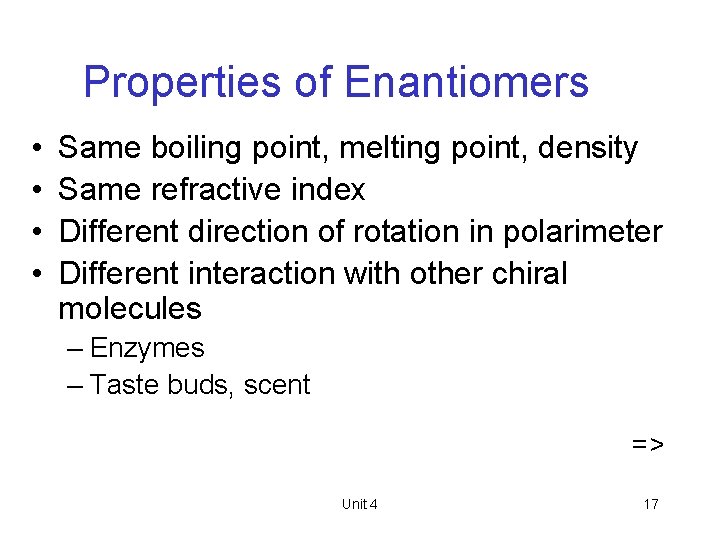
Properties of Enantiomers • • Same boiling point, melting point, density Same refractive index Different direction of rotation in polarimeter Different interaction with other chiral molecules – Enzymes – Taste buds, scent => Unit 4 17
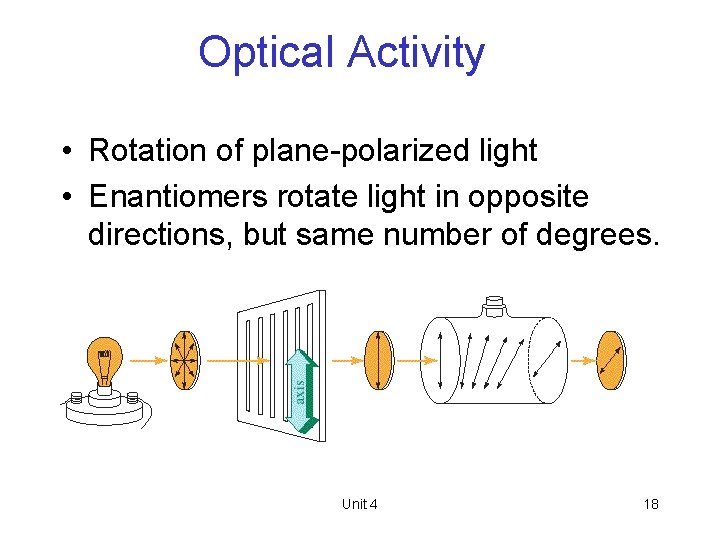
Optical Activity • Rotation of plane-polarized light • Enantiomers rotate light in opposite directions, but same number of degrees. => Unit 4 18
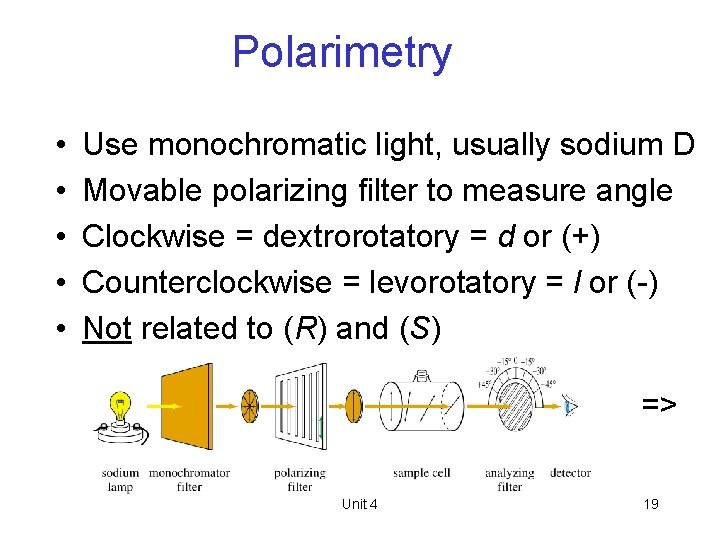
Polarimetry • • • Use monochromatic light, usually sodium D Movable polarizing filter to measure angle Clockwise = dextrorotatory = d or (+) Counterclockwise = levorotatory = l or (-) Not related to (R) and (S) => Unit 4 19
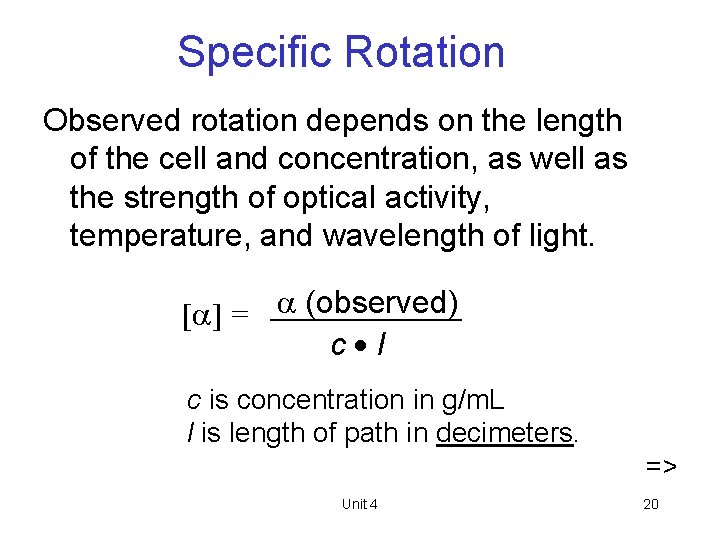
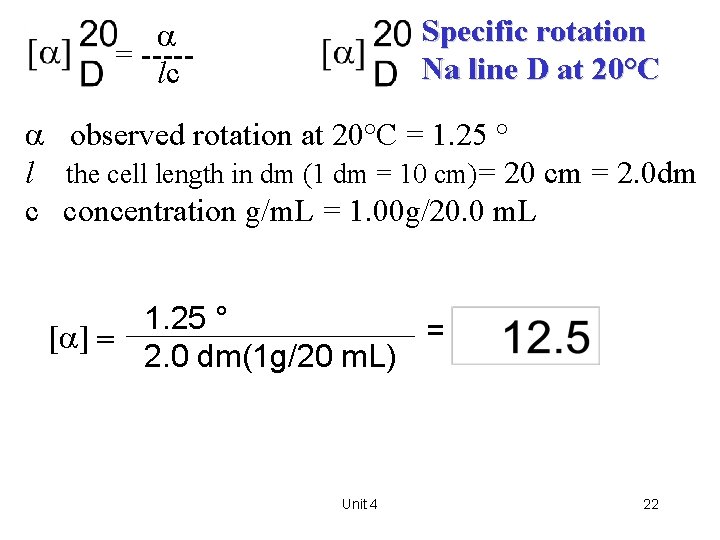
Specific Rotation Observed rotation depends on the length of the cell and concentration, as well as the strength of optical activity, temperature, and wavelength of light. [ ] = (observed) c l c is concentration in g/m. L l is length of path in decimeters. => Unit 4 20
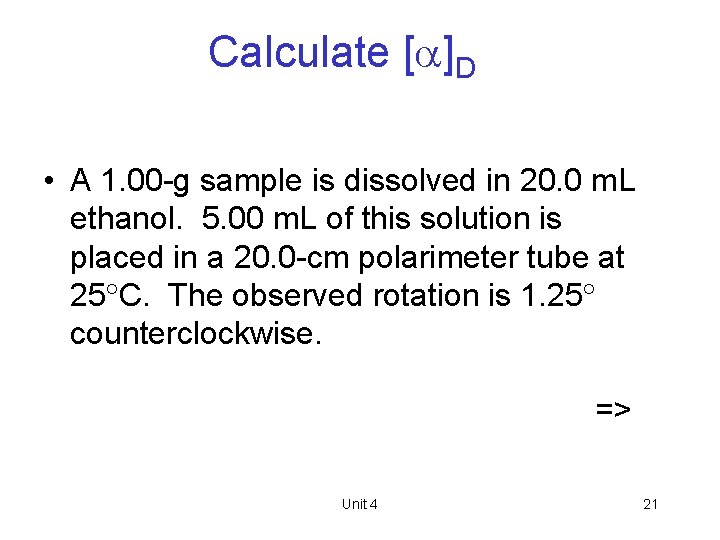
Calculate [ ]D • A 1. 00 -g sample is dissolved in 20. 0 m. L ethanol. 5. 00 m. L of this solution is placed in a 20. 0 -cm polarimeter tube at 25 C. The observed rotation is 1. 25 counterclockwise. => Unit 4 21
Specific rotation Na line D at 20°C = ----lc observed rotation at 20°C = 1. 25 ° l the cell length in dm (1 dm = 10 cm)= 20 cm = 2. 0 dm c concentration g/m. L = 1. 00 g/20. 0 m. L 1. 25 ° = [ ] = 2. 0 dm(1 g/20 m. L) Unit 4 22
Biological Discrimination => Unit 4 23
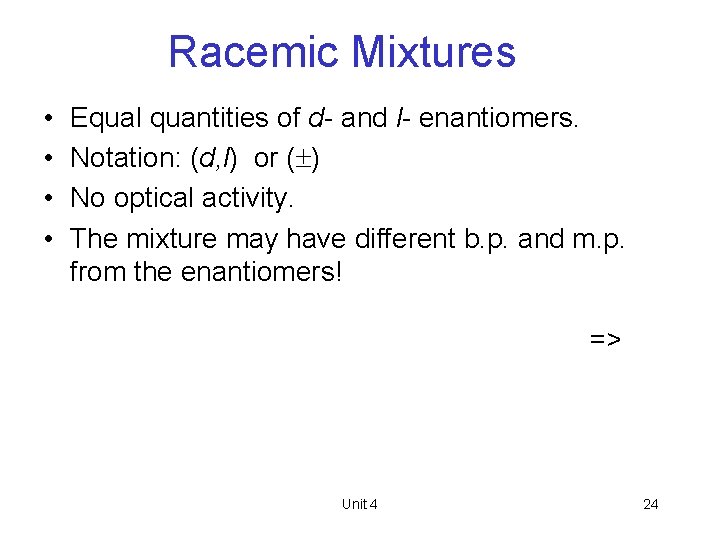
Racemic Mixtures • • Equal quantities of d- and l- enantiomers. Notation: (d, l) or ( ) No optical activity. The mixture may have different b. p. and m. p. from the enantiomers! => Unit 4 24
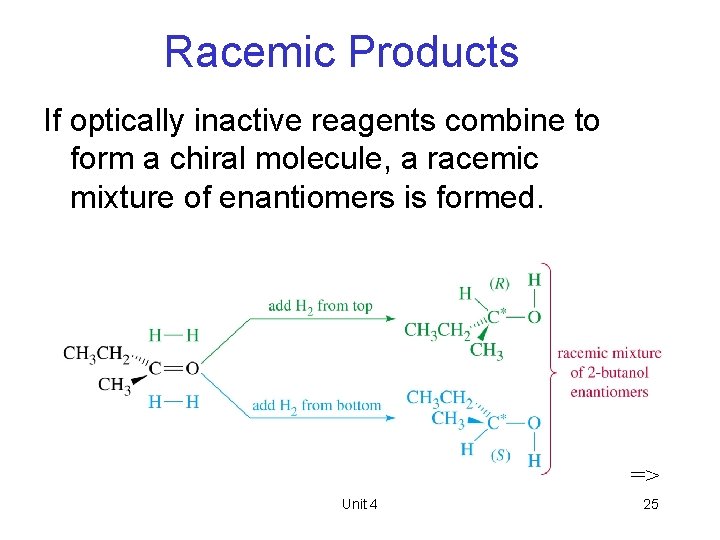
Racemic Products If optically inactive reagents combine to form a chiral molecule, a racemic mixture of enantiomers is formed. => Unit 4 25
Optical Purity • Also called enantiomeric excess. • Amount of pure enantiomer in excess of the racemic mixture. • If o. p. = 50%, then the observed rotation will be only 50% of the rotation of the pure enantiomer. • Mixture composition would be 75 -25. => Unit 4 26
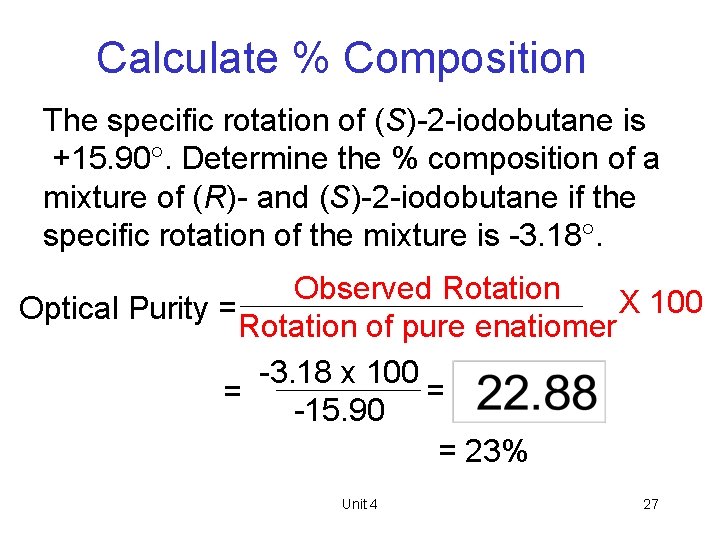
Calculate % Composition The specific rotation of (S)-2 -iodobutane is +15. 90. Determine the % composition of a mixture of (R)- and (S)-2 -iodobutane if the specific rotation of the mixture is -3. 18. Observed Rotation X 100 Optical Purity = Rotation of pure enatiomer -3. 18 x 100 = = -15. 90 = 23% Unit 4 27
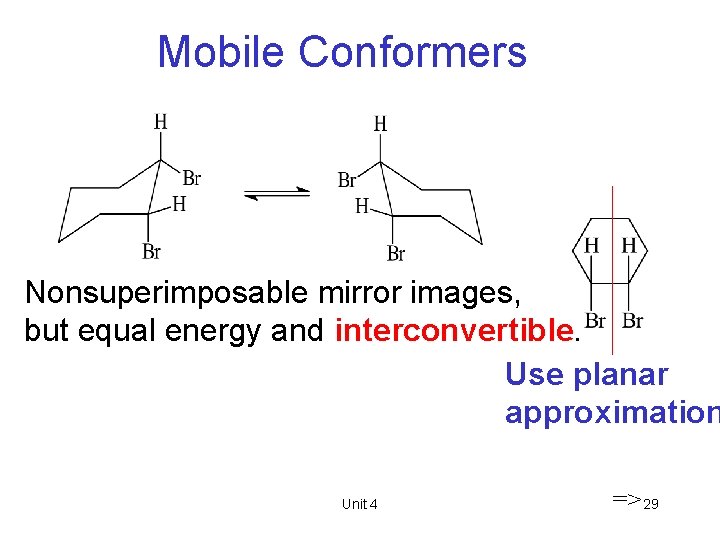
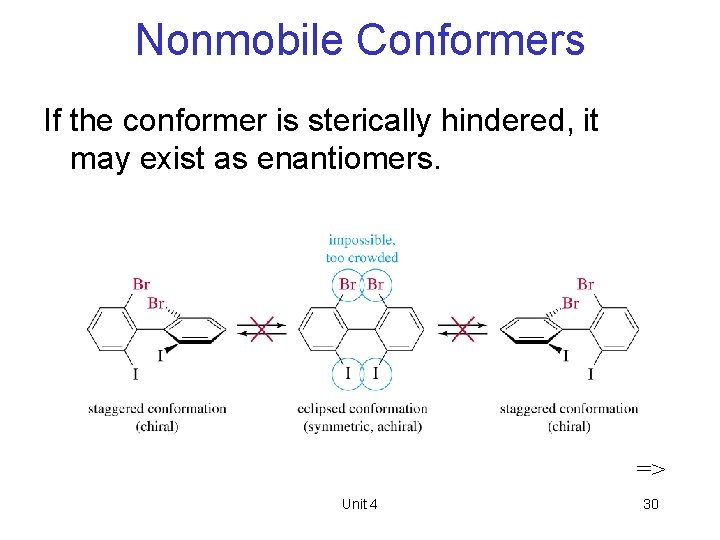
Chirality of Conformers • If equilibrium exists between two chiral conformers, molecule is not chiral. • Judge chirality by looking at the most symmetrical conformer. • Cyclohexane can be considered to be planar, on average. => Unit 4 28
Mobile Conformers Nonsuperimposable mirror images, but equal energy and interconvertible. Use planar approximation Unit 4 => 29
Nonmobile Conformers If the conformer is sterically hindered, it may exist as enantiomers. => Unit 4 30
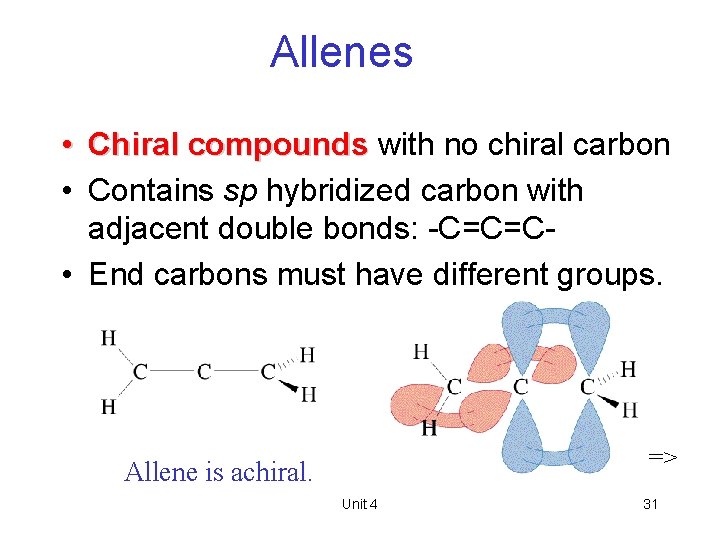
Allenes • Chiral compounds with no chiral carbon • Contains sp hybridized carbon with adjacent double bonds: -C=C=C • End carbons must have different groups. => Allene is achiral. Unit 4 31
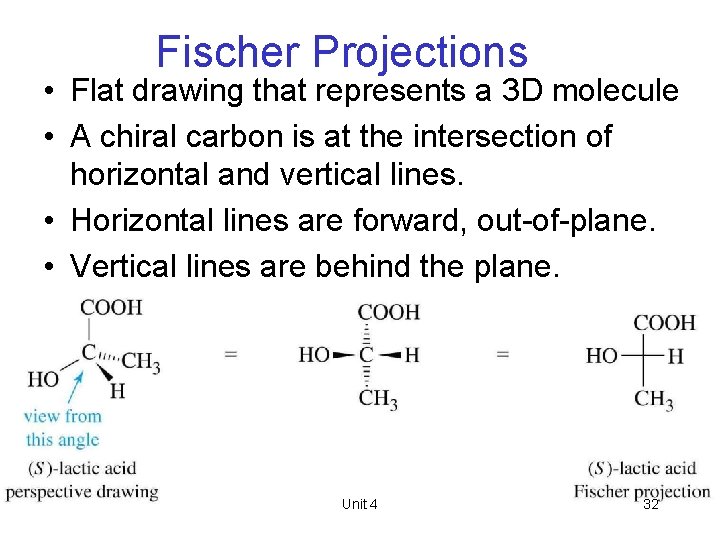
Fischer Projections • Flat drawing that represents a 3 D molecule • A chiral carbon is at the intersection of horizontal and vertical lines. • Horizontal lines are forward, out-of-plane. • Vertical lines are behind the plane. Unit 4 32
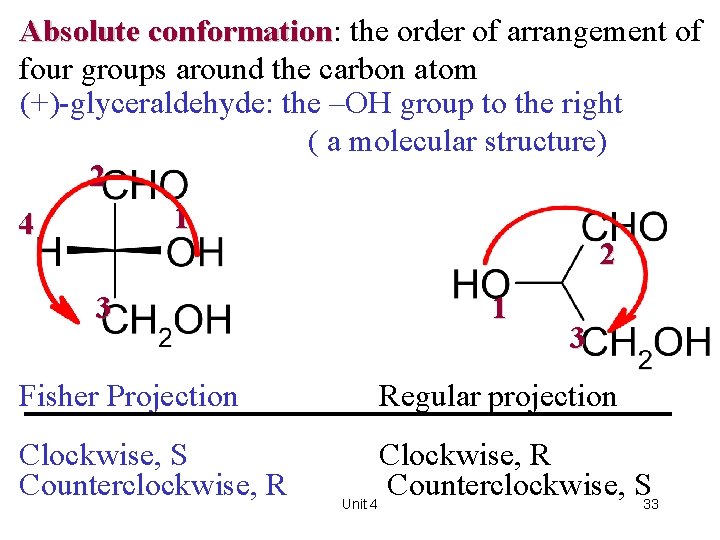
Absolute conformation: conformation the order of arrangement of four groups around the carbon atom (+)-glyceraldehyde: the –OH group to the right ( a molecular structure) 2 1 4 2 3 Fisher Projection Clockwise, S Counterclockwise, R 1 3 Regular projection Clockwise, R Counterclockwise, S Unit 4 33
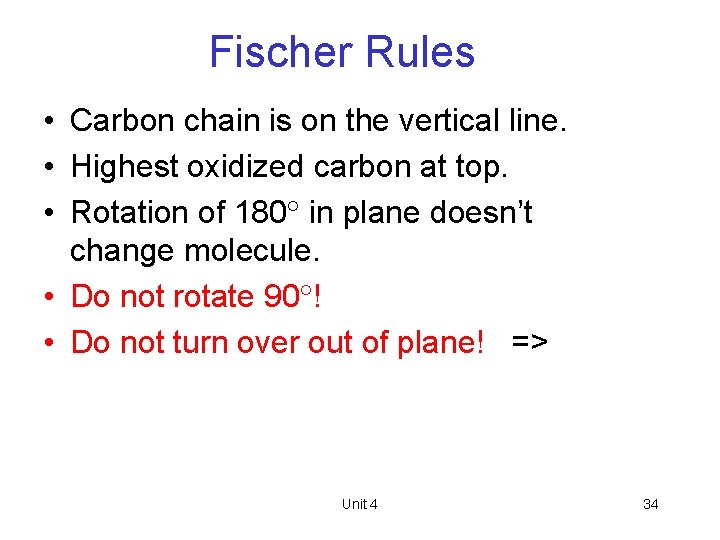
Fischer Rules • Carbon chain is on the vertical line. • Highest oxidized carbon at top. • Rotation of 180 in plane doesn’t change molecule. • Do not rotate 90 ! • Do not turn over out of plane! => Unit 4 34
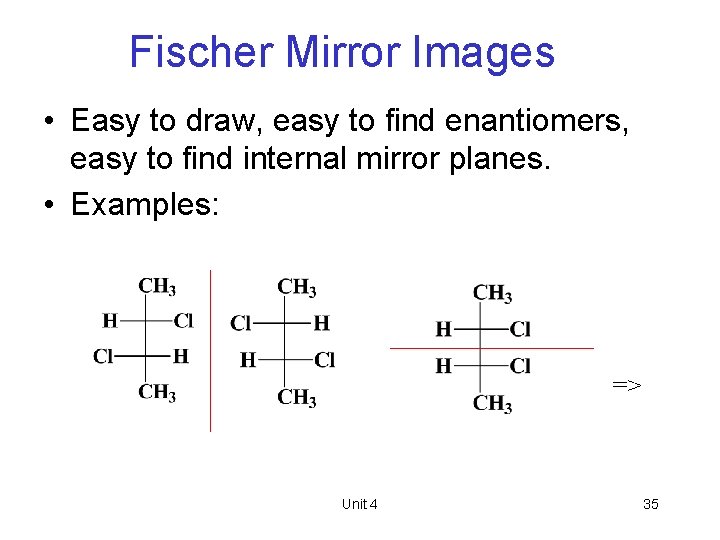
Fischer Mirror Images • Easy to draw, easy to find enantiomers, easy to find internal mirror planes. • Examples: => Unit 4 35
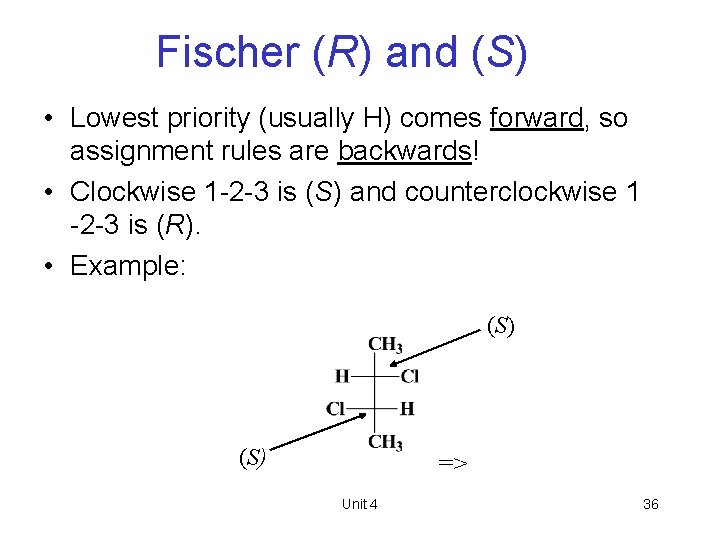
Fischer (R) and (S) • Lowest priority (usually H) comes forward, so assignment rules are backwards! • Clockwise 1 -2 -3 is (S) and counterclockwise 1 -2 -3 is (R). • Example: (S) => Unit 4 36
Draw (R)-2 -butanol 1 3 2 2 3 4 1 Unit 4 37
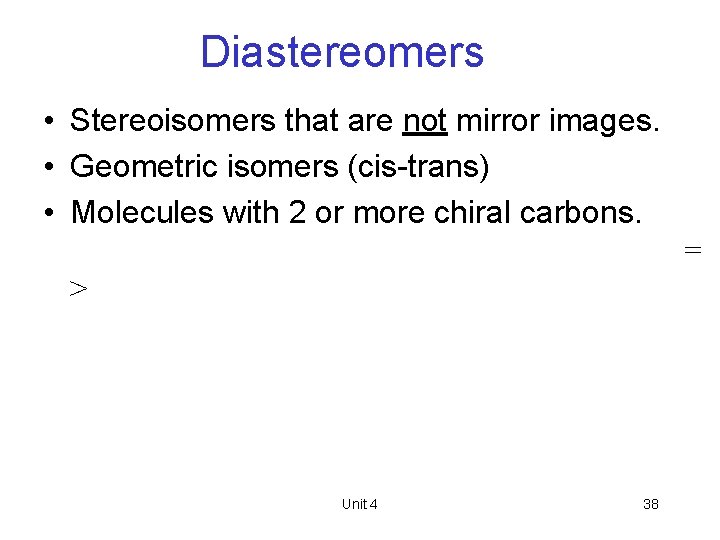
Diastereomers • Stereoisomers that are not mirror images. • Geometric isomers (cis-trans) • Molecules with 2 or more chiral carbons. = > Unit 4 38
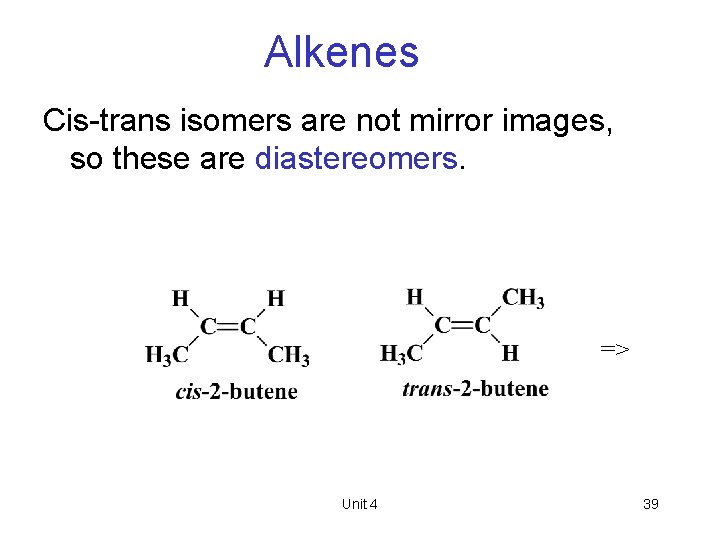
Alkenes Cis-trans isomers are not mirror images, so these are diastereomers. => Unit 4 39
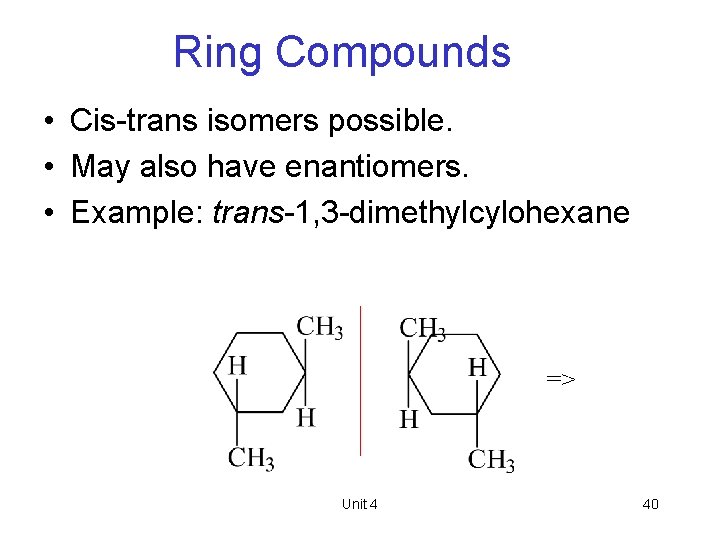
Ring Compounds • Cis-trans isomers possible. • May also have enantiomers. • Example: trans-1, 3 -dimethylcylohexane => Unit 4 40
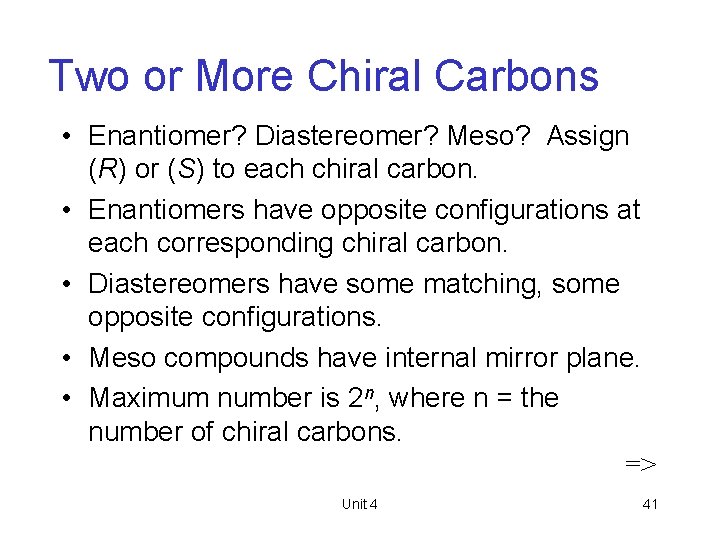
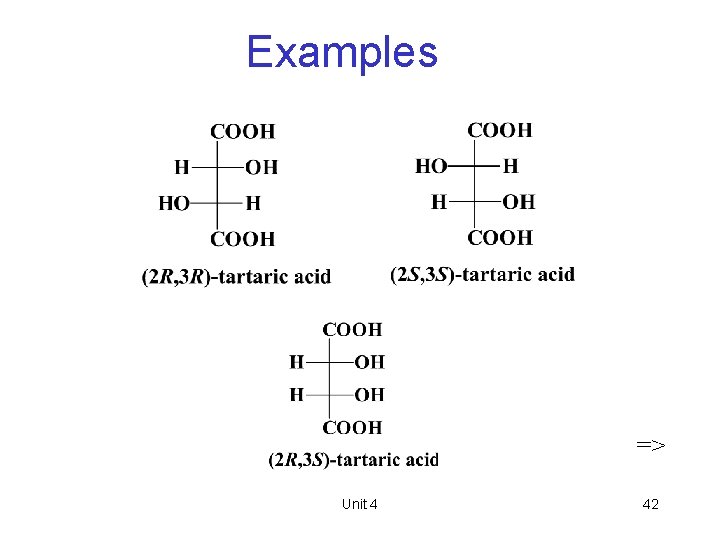
Two or More Chiral Carbons • Enantiomer? Diastereomer? Meso? Assign (R) or (S) to each chiral carbon. • Enantiomers have opposite configurations at each corresponding chiral carbon. • Diastereomers have some matching, some opposite configurations. • Meso compounds have internal mirror plane. • Maximum number is 2 n, where n = the number of chiral carbons. => Unit 4 41
Examples => Unit 4 42
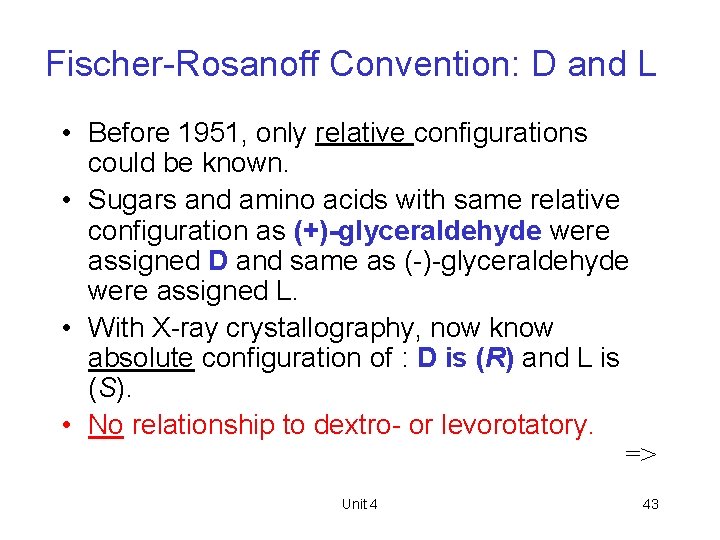
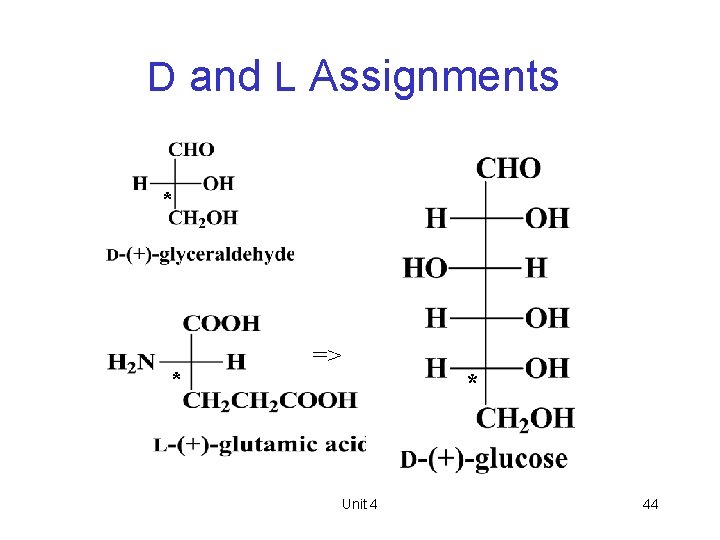
Fischer-Rosanoff Convention: D and L • Before 1951, only relative configurations could be known. • Sugars and amino acids with same relative configuration as (+)-glyceraldehyde were assigned D and same as (-)-glyceraldehyde were assigned L. • With X-ray crystallography, now know absolute configuration of : D is (R) and L is (S). • No relationship to dextro- or levorotatory. => Unit 4 43
D and L Assignments * * => * Unit 4 44
Properties of Diastereomers • Diastereomers have different physical properties: m. p. , b. p. • They can be separated easily. • Enantiomers differ only in reaction with other chiral molecules and the direction in which polarized light is rotated. • Enantiomers are difficult to separate. => Unit 4 45
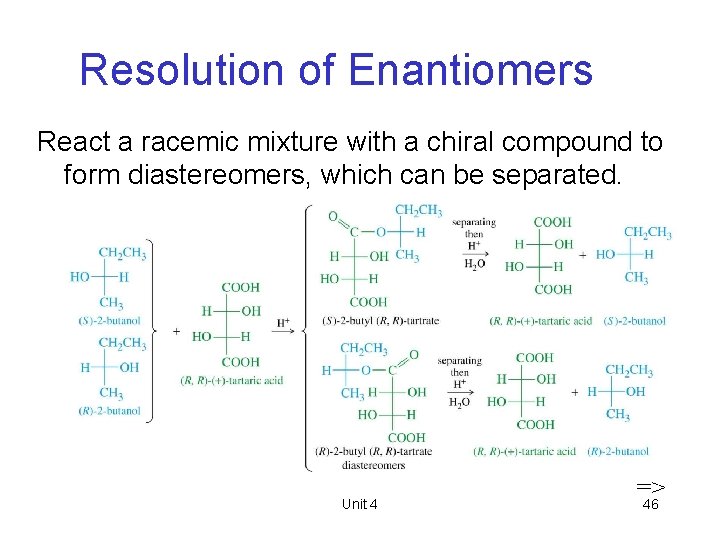
Resolution of Enantiomers React a racemic mixture with a chiral compound to form diastereomers, which can be separated. Unit 4 => 46
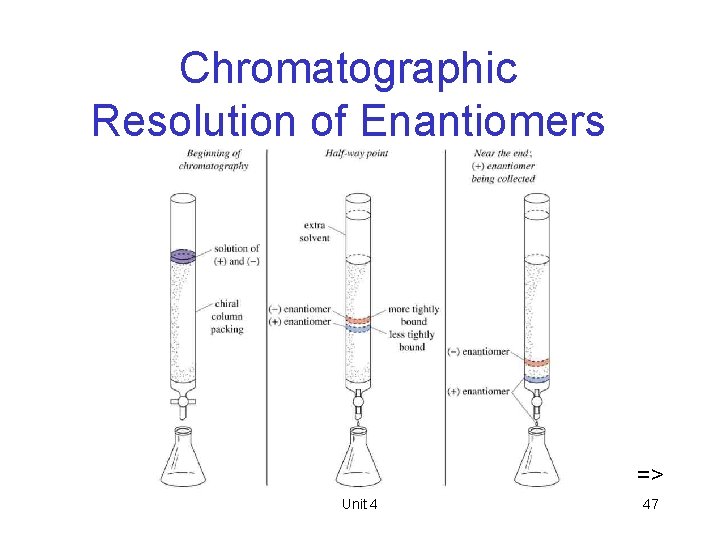
Chromatographic Resolution of Enantiomers => Unit 4 47
End of Chapter 5 Unit 4 48