Med Chem Antidepressants ADs P 2 PHRM 610


- Slides: 66
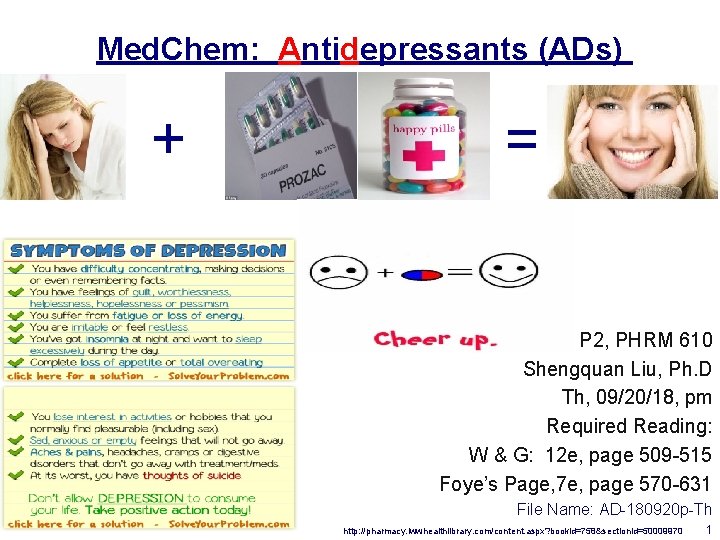
Med. Chem: Antidepressants (ADs) + = P 2, PHRM 610 Shengquan Liu, Ph. D Th, 09/20/18, pm Required Reading: W & G: 12 e, page 509 -515 Foye’s Page, 7 e, page 570 -631 File Name: AD-180920 p-Th http: //pharmacy. lwwhealthlibrary. com/content. aspx? bookid=758§ionid=50009970 1
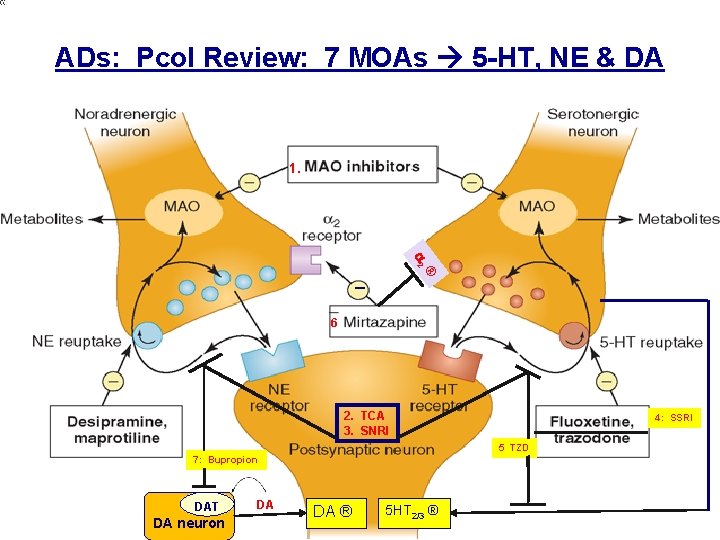
ADs: Pcol Review: 7 MOAs 5 -HT, NE & DA 1. a 2 ® _ 6 2. TCA 3. SNRI 4: SSRI 5 TZD 7: Bupropion DAT DA neuron DA DA ® 5 HT 2/3 ®
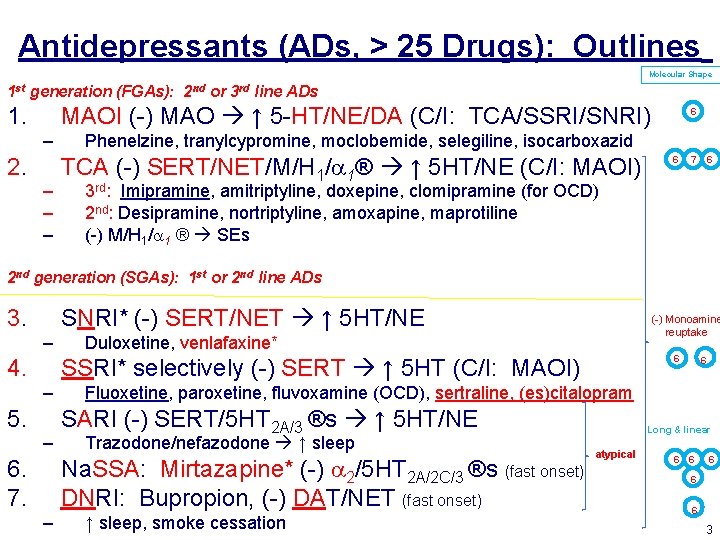
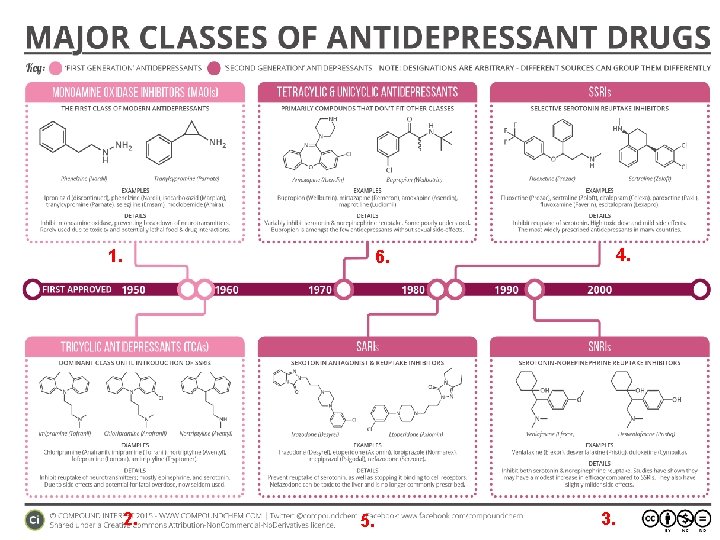
Antidepressants (ADs, > 25 Drugs): Outlines Molecular Shape 1 st generation (FGAs): 2 nd or 3 rd line ADs 1. MAOI (-) MAO ↑ 5 -HT/NE/DA (C/I: TCA/SSRI/SNRI) – 2. – – – 6 Phenelzine, tranylcypromine, moclobemide, selegiline, isocarboxazid TCA (-) SERT/NET/M/H 1/a 1® ↑ 5 HT/NE (C/I: MAOI) 6 7 6 3 rd: Imipramine, amitriptyline, doxepine, clomipramine (for OCD) 2 nd: Desipramine, nortriptyline, amoxapine, maprotiline (-) M/H 1/a 1 ® SEs 2 nd generation (SGAs): 1 st or 2 nd line ADs 3. SNRI* (-) SERT/NET ↑ 5 HT/NE – 4. (-) Monoamine reuptake Duloxetine, venlafaxine* 6 SSRI* selectively (-) SERT ↑ 5 HT (C/I: MAOI) – 5. – 6. 7. – 6 Fluoxetine, paroxetine, fluvoxamine (OCD), sertraline, (es)citalopram SARI (-) SERT/5 HT 2 A/3 ®s ↑ 5 HT/NE Trazodone/nefazodone ↑ sleep Na. SSA: Mirtazapine* (-) a 2/5 HT 2 A/2 C/3 ®s (fast onset) DNRI: Bupropion, (-) DAT/NET (fast onset) ↑ sleep, smoke cessation Long & linear atypical 6 6 6 3
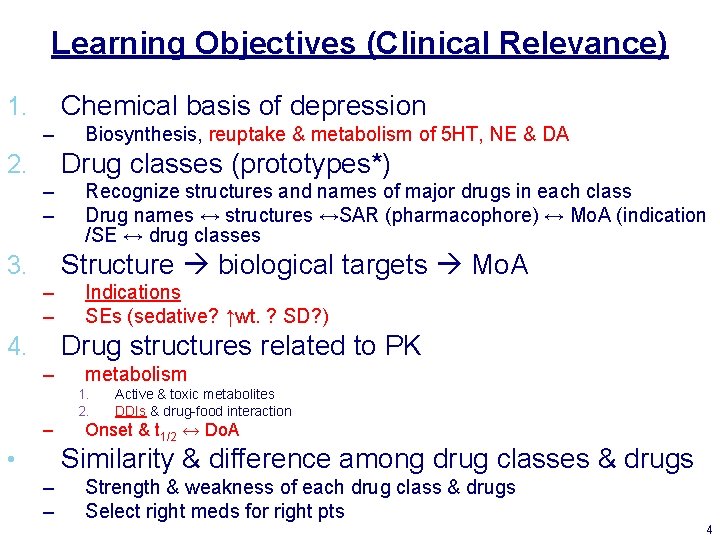
Learning Objectives (Clinical Relevance) Chemical basis of depression 1. – Biosynthesis, reuptake & metabolism of 5 HT, NE & DA Drug classes (prototypes*) 2. – – Recognize structures and names of major drugs in each class Drug names ↔ structures ↔SAR (pharmacophore) ↔ Mo. A (indication /SE ↔ drug classes Structure biological targets Mo. A 3. – – Indications SEs (sedative? ↑wt. ? SD? ) Drug structures related to PK 4. – metabolism 1. 2. – Active & toxic metabolites DDIs & drug-food interaction Onset & t 1/2 ↔ Do. A Similarity & difference among drug classes & drugs • – – Strength & weakness of each drug class & drugs Select right meds for right pts 4
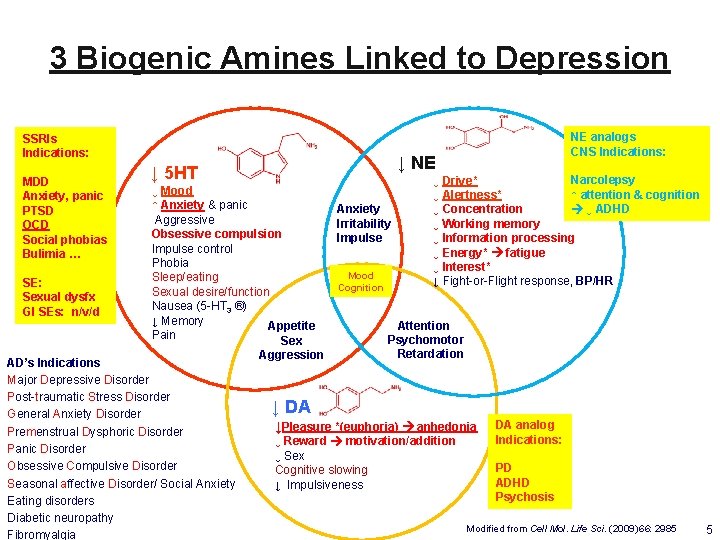
3 Biogenic Amines Linked to Depression SSRIs Indications: MDD Anxiety, panic PTSD OCD Social phobias Bulimia … SE: Sexual dysfx GI SEs: n/v/d ↓ NE ↓ 5 HT ↓ Mood ↑ Anxiety & panic Aggressive Obsessive compulsion Impulse control Phobia Sleep/eating Sexual desire/function Nausea (5 -HT 3 ®) ↓ Memory Appetite Pain Sex AD’s Indications Major Depressive Disorder Post-traumatic Stress Disorder General Anxiety Disorder Premenstrual Dysphoric Disorder Panic Disorder Obsessive Compulsive Disorder Seasonal affective Disorder/ Social Anxiety Eating disorders Diabetic neuropathy Fibromyalgia NE analogs CNS Indications: Aggression Anxiety Irritability Impulse Mood Cognition Narcolepsy ↓ Drive* ↑ attention & cognition ↓ Alertness* ↓ ADHD ↓ Concentration ↓ Working memory ↓ Information processing ↓ Energy* fatigue ↓ Interest* ↓ Fight-or-Flight response, BP/HR Attention Psychomotor Retardation ↓ DA ↓Pleasure *(euphoria) anhedonia ↓ Reward motivation/addition ↓ Sex Cognitive slowing ↓ Impulsiveness DA analog Indications: PD ADHD Psychosis Modified from Cell Mol. Life Sci. (2009)66: 2985 5
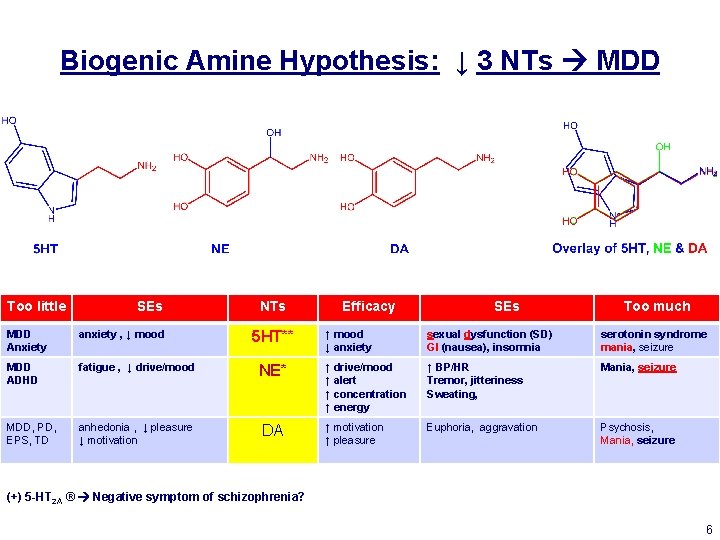
Biogenic Amine Hypothesis: ↓ 3 NTs MDD Too little SEs MDD Anxiety anxiety , ↓ mood MDD ADHD fatigue , ↓ drive/mood MDD, PD, EPS, TD anhedonia , ↓ pleasure ↓ motivation NTs Efficacy SEs Too much ↑ mood ↓ anxiety sexual dysfunction (SD) GI (nausea), insomnia serotonin syndrome mania, seizure NE* ↑ drive/mood ↑ alert ↑ concentration ↑ energy ↑ BP/HR Tremor, jitteriness Sweating, Mania, seizure DA ↑ motivation ↑ pleasure Euphoria, aggravation Psychosis, Mania, seizure 5 HT** (+) 5 -HT 2 A ® Negative symptom of schizophrenia? 6
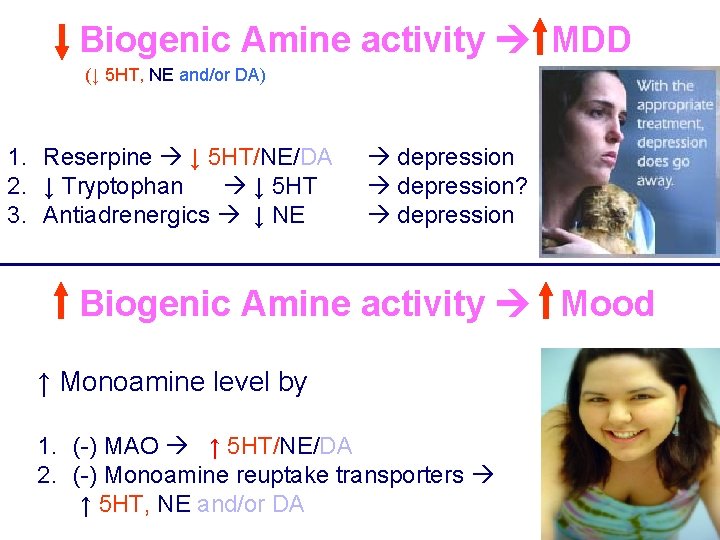
Biogenic Amine activity MDD (↓ 5 HT, NE and/or DA) 1. Reserpine ↓ 5 HT/NE/DA 2. ↓ Tryptophan ↓ 5 HT 3. Antiadrenergics ↓ NE depression? depression Biogenic Amine activity Mood ↑ Monoamine level by 1. (-) MAO ↑ 5 HT/NE/DA 2. (-) Monoamine reuptake transporters ↑ 5 HT, NE and/or DA 7
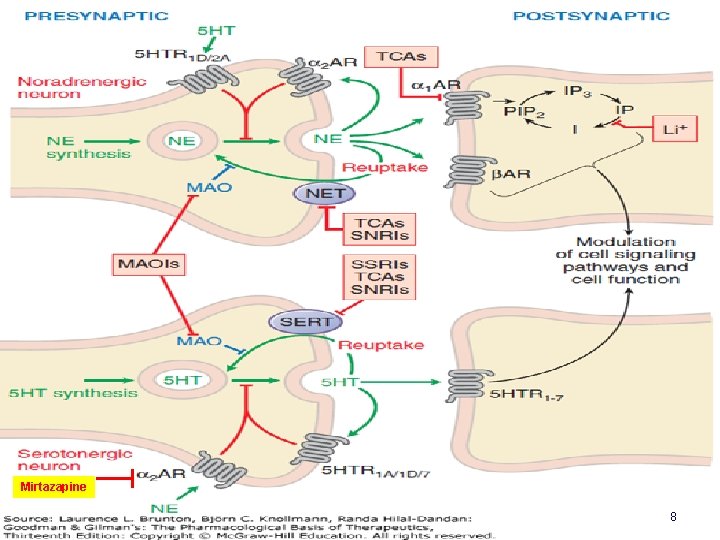
Mirtazapine 8
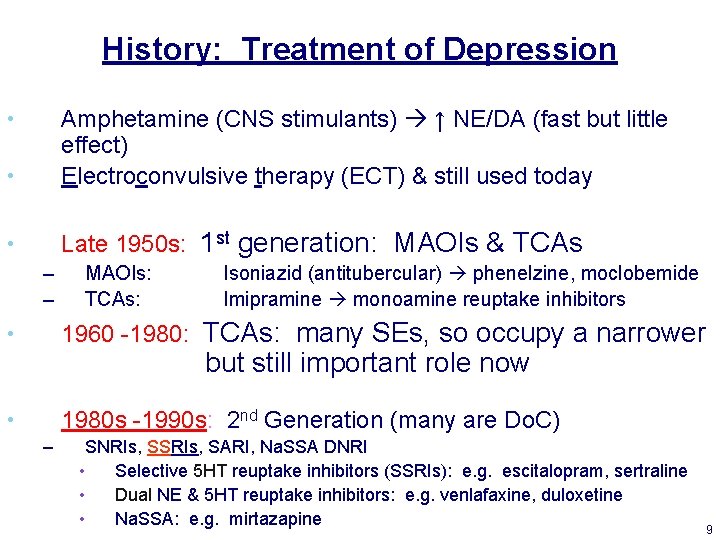
History: Treatment of Depression • Amphetamine (CNS stimulants) ↑ NE/DA (fast but little effect) Electroconvulsive therapy (ECT) & still used today • Late 1950 s: 1 st generation: MAOIs & TCAs • – – MAOIs: TCAs: Isoniazid (antitubercular) phenelzine, moclobemide Imipramine monoamine reuptake inhibitors 1960 -1980: TCAs: many SEs, so occupy a narrower • but still important role now 1980 s -1990 s: 2 nd Generation (many are Do. C) • – SNRIs, SSRIs, SARI, Na. SSA DNRI • Selective 5 HT reuptake inhibitors (SSRIs): e. g. escitalopram, sertraline • Dual NE & 5 HT reuptake inhibitors: e. g. venlafaxine, duloxetine • Na. SSA: e. g. mirtazapine 9
1. 2. 6. 5. 4. 3.
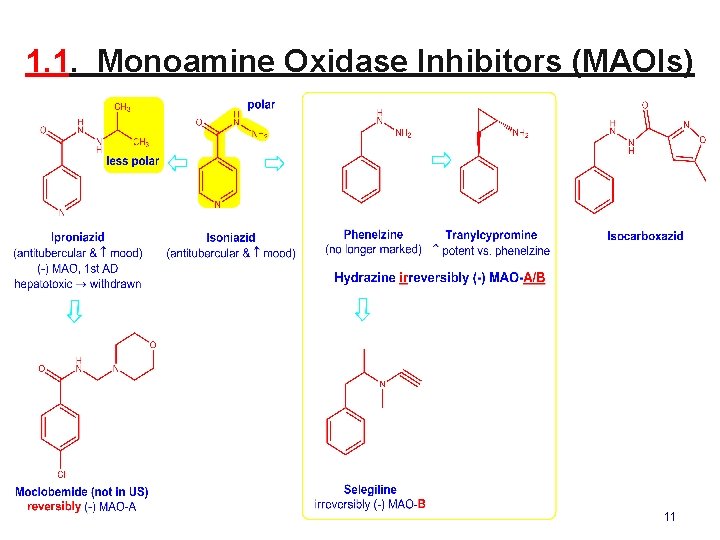
1. 1. Monoamine Oxidase Inhibitors (MAOIs) 11
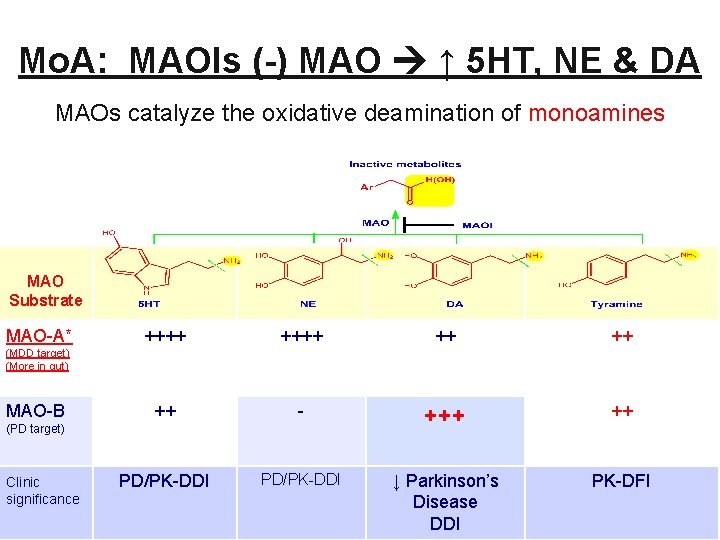
Mo. A: MAOIs (-) MAO ↑ 5 HT, NE & DA MAOs catalyze the oxidative deamination of monoamines MAO Substrate MAO-A* ++++ ++ - +++ ++ PD/PK-DDI ↓ Parkinson’s Disease DDI PK-DFI (MDD target) (More in gut) MAO-B (PD target) Clinic significance 12
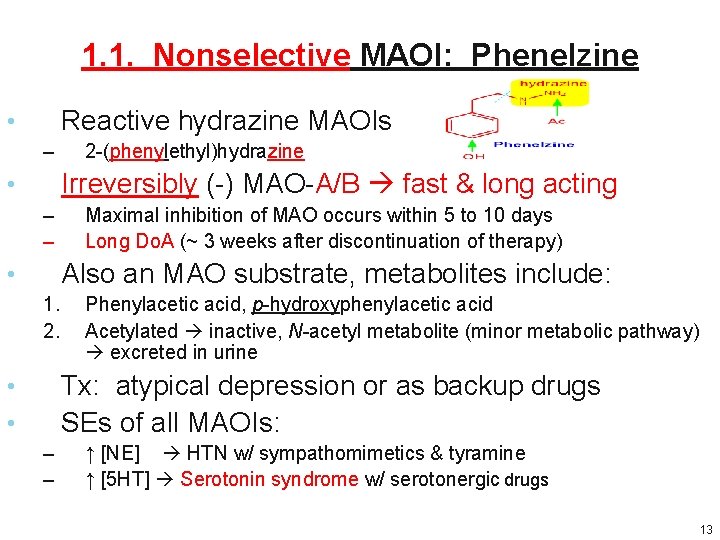
1. 1. Nonselective MAOI: Phenelzine Reactive hydrazine MAOIs • – 2 -(phenylethyl)hydrazine Irreversibly (-) MAO-A/B fast & long acting • – – Maximal inhibition of MAO occurs within 5 to 10 days Long Do. A (~ 3 weeks after discontinuation of therapy) Also an MAO substrate, metabolites include: • 1. 2. Phenylacetic acid, p-hydroxyphenylacetic acid Acetylated inactive, N-acetyl metabolite (minor metabolic pathway) excreted in urine Tx: atypical depression or as backup drugs SEs of all MAOIs: • • – – ↑ [NE] HTN w/ sympathomimetics & tyramine ↑ [5 HT] Serotonin syndrome w/ serotonergic drugs 13
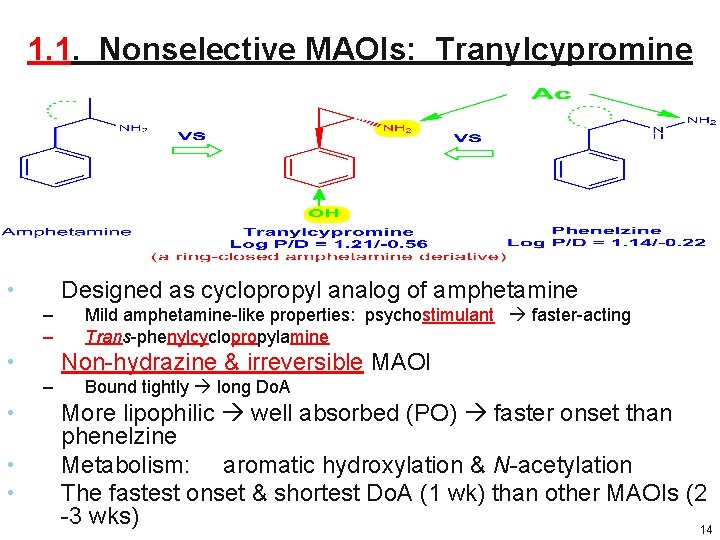
1. 1. Nonselective MAOIs: Tranylcypromine Designed as cyclopropyl analog of amphetamine • – – Non-hydrazine & irreversible MAOI • – • • • Mild amphetamine-like properties: psychostimulant faster-acting Trans-phenylcyclopropylamine Bound tightly long Do. A More lipophilic well absorbed (PO) faster onset than phenelzine Metabolism: aromatic hydroxylation & N-acetylation The fastest onset & shortest Do. A (1 wk) than other MAOIs (2 -3 wks) 14
MAOIs: Tyramine ↑ BP “Cheese Effect” 15
1. 1. MAOIs: “Cheese Effect” Tyramine (NE releaser) • – – Exists in ripe cheese & some protein foods Normally metabolized by MAOs in gut wall & liver, and so never enters the systemic circulation MAOIs • – Irreversibly (-) intestinal & hepatic MAO • • • – (-) tyramine degradation Excessive amount of natural tyramine is absorbed from food Free to circulate in body ↑ NE release ↑ BP Also enhance adrenergic system by inhibiting the re-uptake of NE into the presynaptic nerve acute HTN severe headaches 16
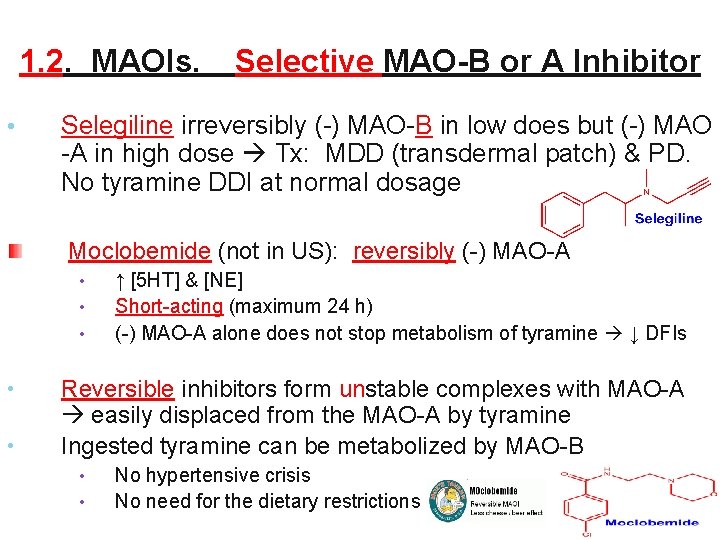
1. 2. MAOIs. • Selective MAO-B or A Inhibitor Selegiline irreversibly (-) MAO-B in low does but (-) MAO -A in high dose Tx: MDD (transdermal patch) & PD. No tyramine DDI at normal dosage Moclobemide (not in US): reversibly (-) MAO-A • • • ↑ [5 HT] & [NE] Short-acting (maximum 24 h) (-) MAO-A alone does not stop metabolism of tyramine ↓ DFIs Reversible inhibitors form unstable complexes with MAO-A easily displaced from the MAO-A by tyramine Ingested tyramine can be metabolized by MAO-B • • No hypertensive crisis No need for the dietary restrictions
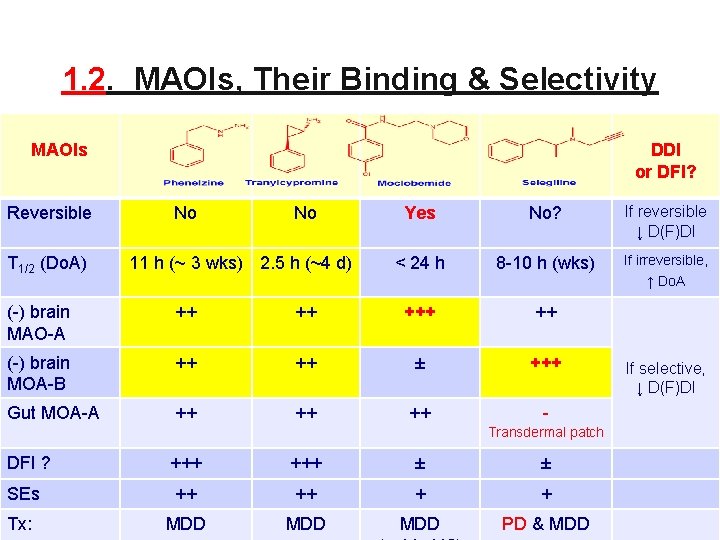
1. 2. MAOIs, Their Binding & Selectivity MAOIs Reversible T 1/2 (Do. A) DDI or DFI? No No 11 h (~ 3 wks) 2. 5 h (~4 d) Yes No? If reversible ↓ D(F)DI < 24 h 8 -10 h (wks) If irreversible, ↑ Do. A (-) brain MAO-A ++ ++ ++ (-) brain MOA-B ++ ++ ± +++ Gut MOA-A ++ ++ ++ - If selective, ↓ D(F)DI Transdermal patch DFI ? +++ ± ± SEs ++ ++ + + Tx: MDD MDD PD & MDD 18
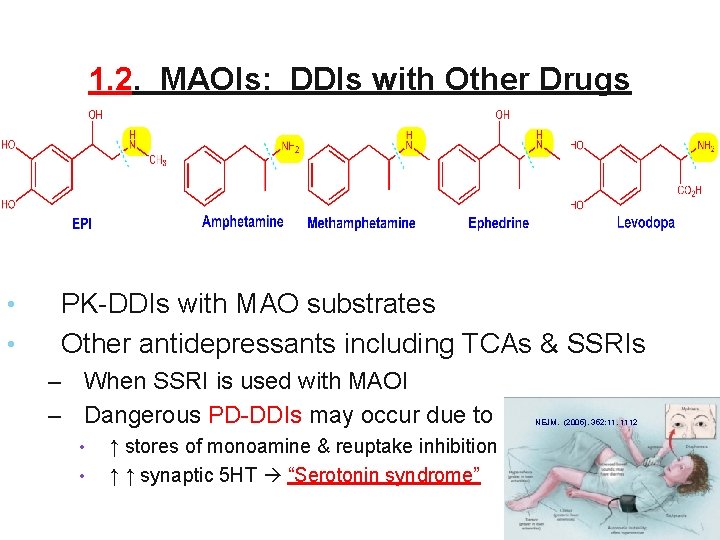
1. 2. MAOIs: DDIs with Other Drugs • • PK-DDIs with MAO substrates Other antidepressants including TCAs & SSRIs – When SSRI is used with MAOI – Dangerous PD-DDIs may occur due to • • NEJM. (2005), 352; 11, 1112 ↑ stores of monoamine & reuptake inhibition ↑ ↑ synaptic 5 HT “Serotonin syndrome” 19
1. 2. MAOIs: Onset, Do. A, & Indications • • • Onset: a few days to several months Do. A: effects may persist for up to 3 weeks following discontinuance of therapy Tx: atypical (exogenous) depression with phobia or psychotic feature or pts unresponsive to other ADs Rarely a drug of 1 st choice due to SEs & many DDIs & drug-food interactions (DFIs) How to ↓ DFIs? Similar Mo. A, but different targets. 20
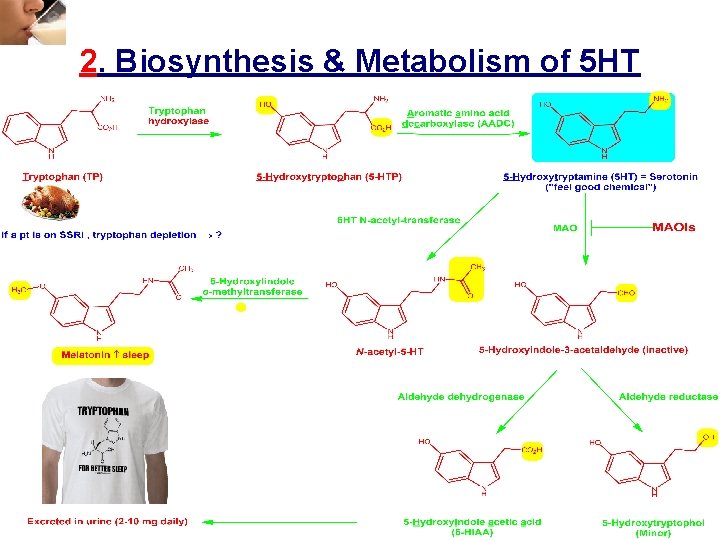
2. Biosynthesis & Metabolism of 5 HT
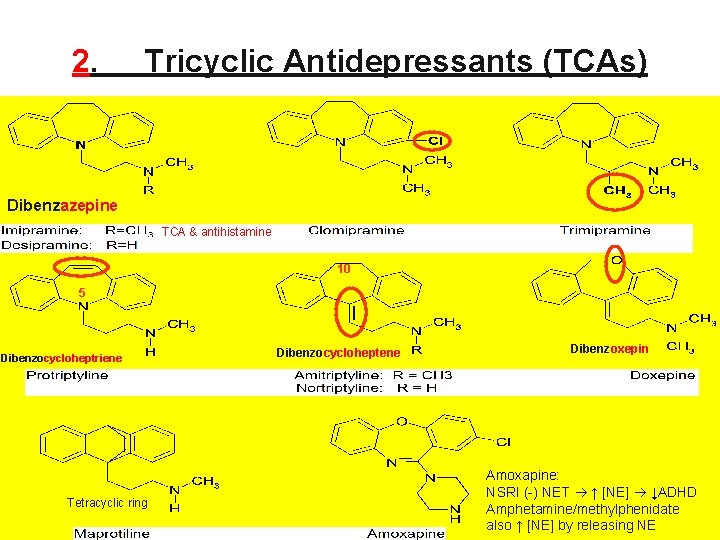
2. Tricyclic Antidepressants (TCAs) Dibenzazepine TCA & antihistamine 10 5 Dibenzocycloheptriene Tetracyclic ring Dibenzocycloheptene Dibenzoxepin Amoxapine: NSRI (-) NET ↑ [NE] ↓ADHD Amphetamine/methylphenidate 22 also ↑ [NE] by releasing NE
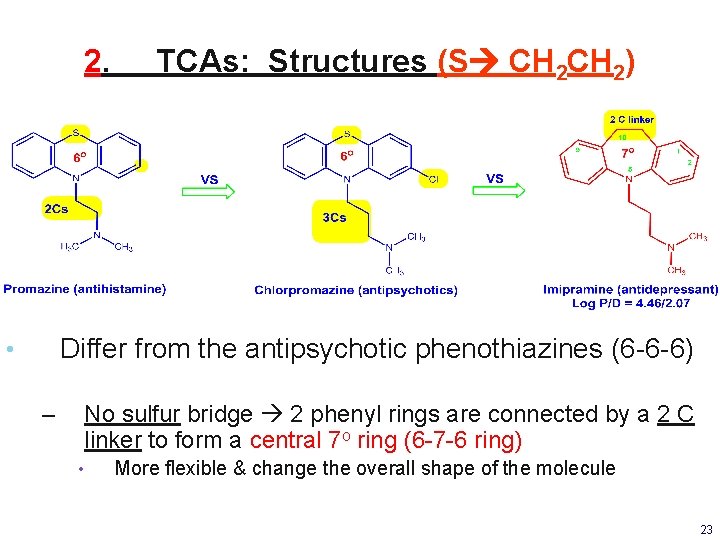
2. TCAs: Structures (S CH 2) Differ from the antipsychotic phenothiazines (6 -6 -6) • – No sulfur bridge 2 phenyl rings are connected by a 2 C linker to form a central 7 o ring (6 -7 -6 ring) • More flexible & change the overall shape of the molecule 23
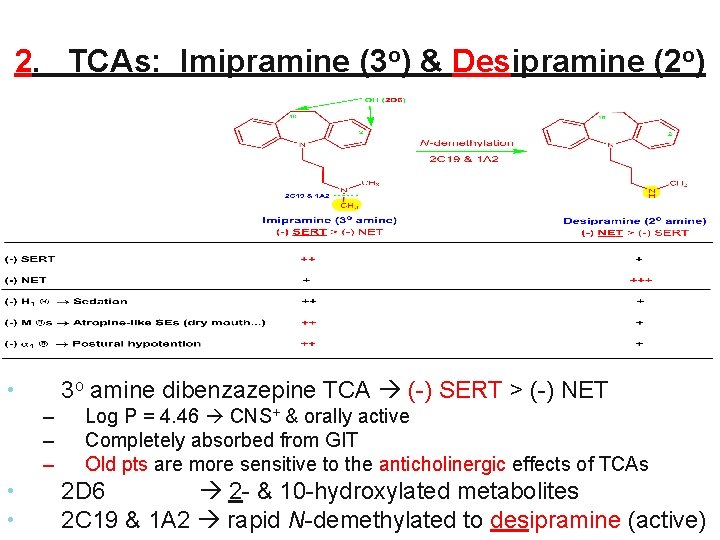
2. TCAs: Imipramine (3 o) & Desipramine (2 o) 3 o amine dibenzazepine TCA (-) SERT > (-) NET • – – – • • Log P = 4. 46 CNS+ & orally active Completely absorbed from GIT Old pts are more sensitive to the anticholinergic effects of TCAs 2 D 6 2 - & 10 -hydroxylated metabolites 2 C 19 & 1 A 2 rapid N-demethylated to desipramine (active)
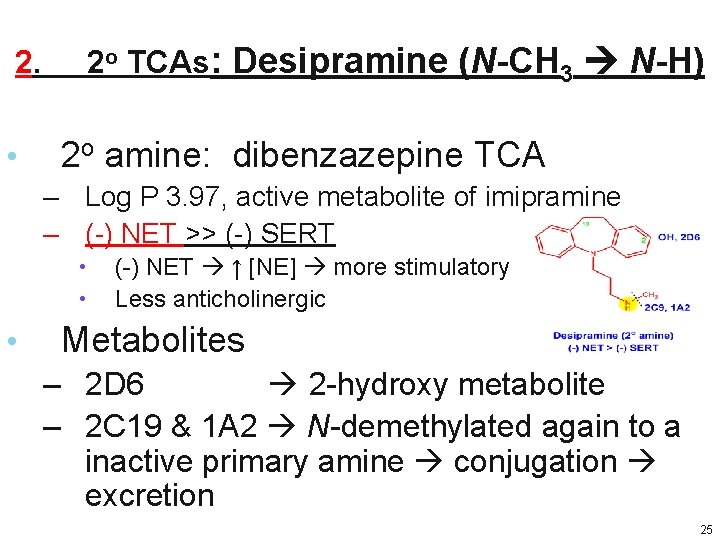
2 o TCAs: Desipramine (N-CH 3 N-H) 2. • 2 o amine: dibenzazepine TCA – Log P 3. 97, active metabolite of imipramine – (-) NET >> (-) SERT • • • (-) NET ↑ [NE] more stimulatory Less anticholinergic Metabolites – 2 D 6 2 -hydroxy metabolite – 2 C 19 & 1 A 2 N-demethylated again to a inactive primary amine conjugation excretion 25
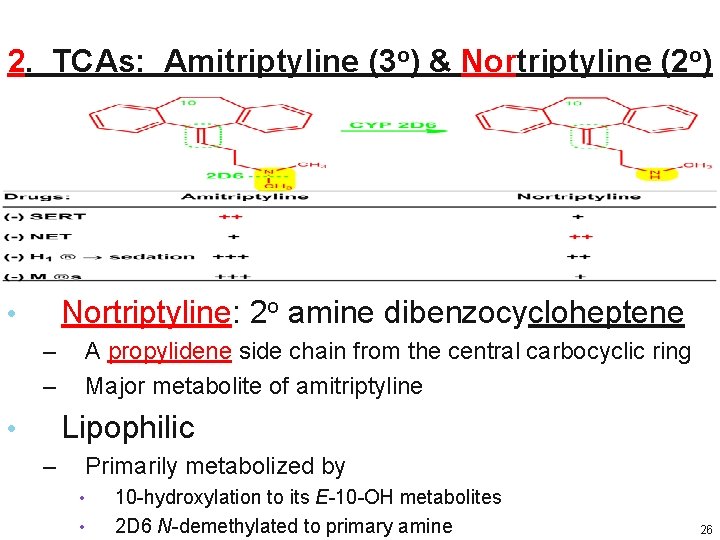
2. TCAs: Amitriptyline (3 o) & Nortriptyline (2 o) Nortriptyline: 2 o amine dibenzocycloheptene • – – A propylidene side chain from the central carbocyclic ring Major metabolite of amitriptyline Lipophilic • – Primarily metabolized by • • 10 -hydroxylation to its E-10 -OH metabolites 2 D 6 N-demethylated to primary amine 26
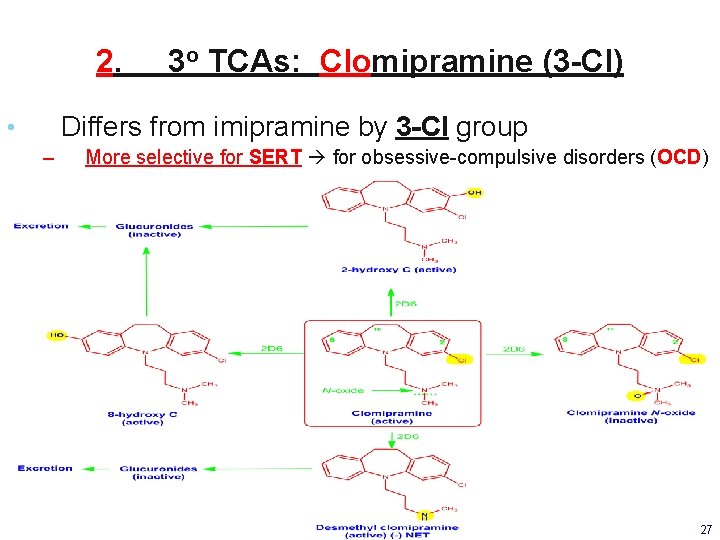
2. 3 o TCAs: Clomipramine (3 -Cl) Differs from imipramine by 3 -Cl group • – More selective for SERT for obsessive-compulsive disorders (OCD) 27
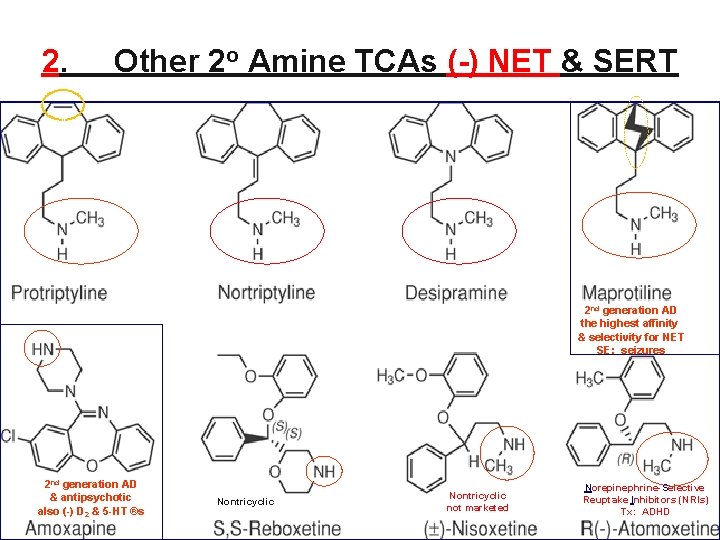
2. Other 2 o Amine TCAs (-) NET & SERT 2 nd generation AD the highest affinity & selectivity for NET SE: seizures 2 nd generation AD & antipsychotic also (-) D 2 & 5 -HT ®s Nontricyclic under FDA review Nontricyclic not marketed Norepinephrine-Selective Nontricyclic Reuptake Inhibitors (NRIs) Marketed in 2003 Tx: ADHD 28
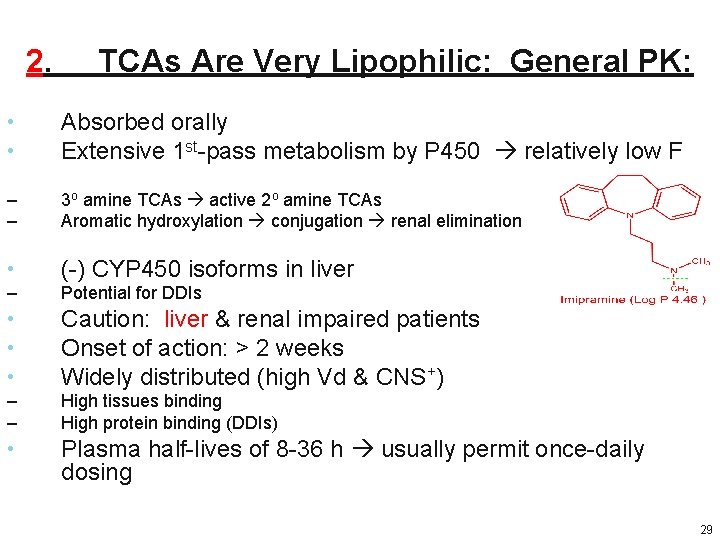
2. TCAs Are Very Lipophilic: General PK: • • Absorbed orally Extensive 1 st-pass metabolism by P 450 relatively low F – – 3 o amine TCAs active 2 o amine TCAs Aromatic hydroxylation conjugation renal elimination • (-) CYP 450 isoforms in liver – Potential for DDIs • • • Caution: liver & renal impaired patients Onset of action: > 2 weeks Widely distributed (high Vd & CNS+) – – High tissues binding High protein binding (DDIs) • Plasma half-lives of 8 -36 h usually permit once-daily dosing 29
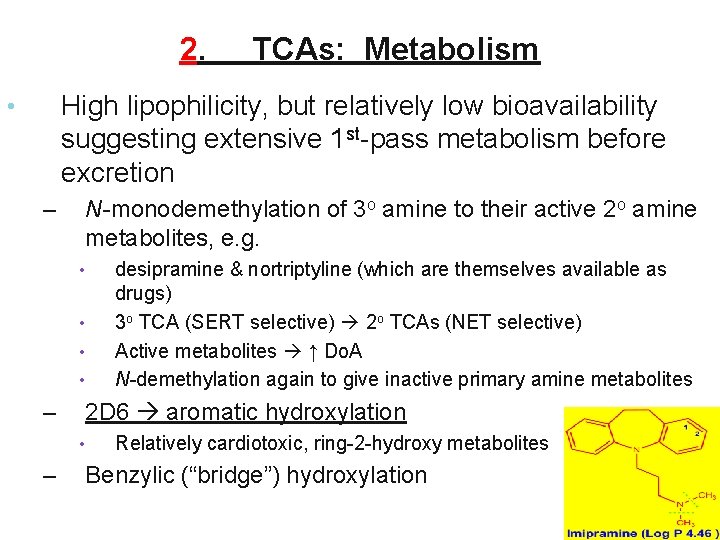
2. TCAs: Metabolism High lipophilicity, but relatively low bioavailability suggesting extensive 1 st-pass metabolism before excretion • – N-monodemethylation of 3 o amine to their active 2 o amine metabolites, e. g. • • – 2 D 6 aromatic hydroxylation • – desipramine & nortriptyline (which are themselves available as drugs) 3 o TCA (SERT selective) 2 o TCAs (NET selective) Active metabolites ↑ Do. A N-demethylation again to give inactive primary amine metabolites Relatively cardiotoxic, ring-2 -hydroxy metabolites Benzylic (“bridge”) hydroxylation 30
2. TCAs: Mo. A • Dual (-) of both SERT & NET ↑ both [5 HT] & [NE] in synaptic cleft • 3 o TCAs are less potent inhibitors than the SSRIs for SERT & have more & greater SEs Long-term effects: • – – – • • Altered NE and 5 HT ® density or sensitivity Altered receptor-®-G protein coupling Cyclic nucleotide signaling & (+) neurotrophic factors ↑ Neurogenesis & synaptogenesis…… Many SEs: “ 5 drugs wrapped into one” Once 1 st line therapy now 2 nd or 3 rd line therapy 31
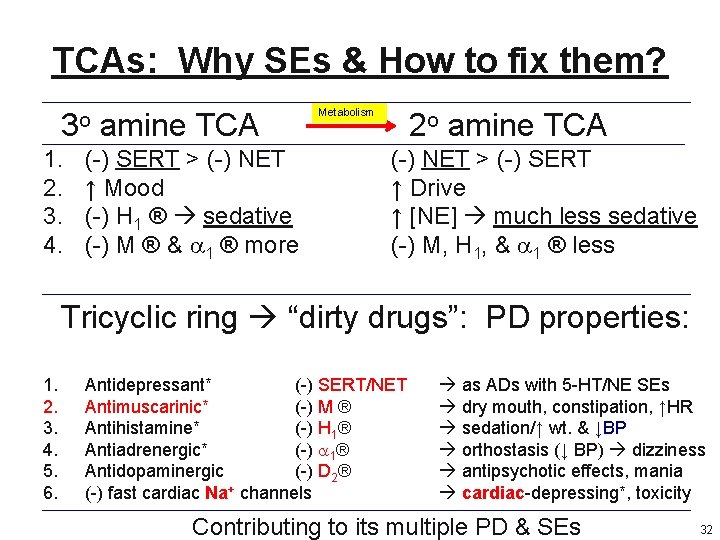
TCAs: Why SEs & How to fix them? 3 o 1. 2. 3. 4. amine TCA (-) SERT > (-) NET ↑ Mood (-) H 1 ® sedative (-) M ® & a 1 ® more Metabolism 2 o amine TCA (-) NET > (-) SERT ↑ Drive ↑ [NE] much less sedative (-) M, H 1, & a 1 ® less Tricyclic ring “dirty drugs”: PD properties: 1. 2. 3. 4. 5. 6. Antidepressant* (-) SERT/NET Antimuscarinic* (-) M ® Antihistamine* (-) H 1® Antiadrenergic* (-) a 1® Antidopaminergic (-) D 2® (-) fast cardiac Na+ channels as ADs with 5 -HT/NE SEs dry mouth, constipation, ↑HR sedation/↑ wt. & ↓BP orthostasis (↓ BP) dizziness antipsychotic effects, mania cardiac-depressing*, toxicity Contributing to its multiple PD & SEs 32
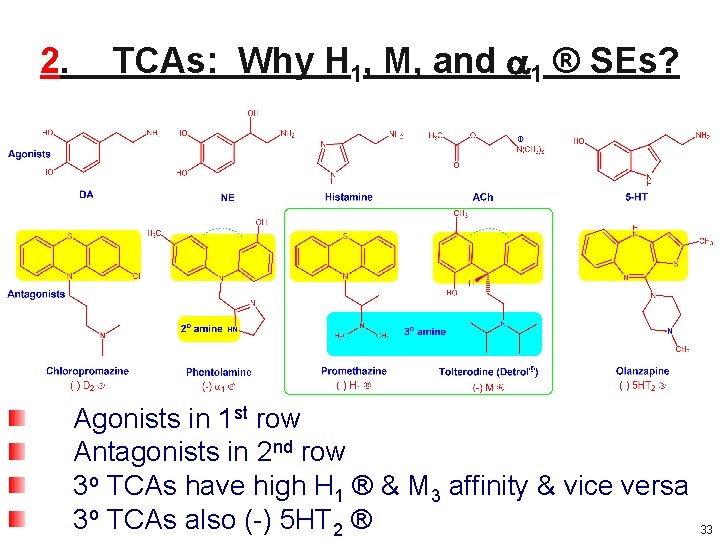
2. TCAs: Why H 1, M, and a 1 ® SEs? Agonists in 1 st row Antagonists in 2 nd row 3 o TCAs have high H 1 ® & M 3 affinity & vice versa 3 o TCAs also (-) 5 HT 2 ® 33
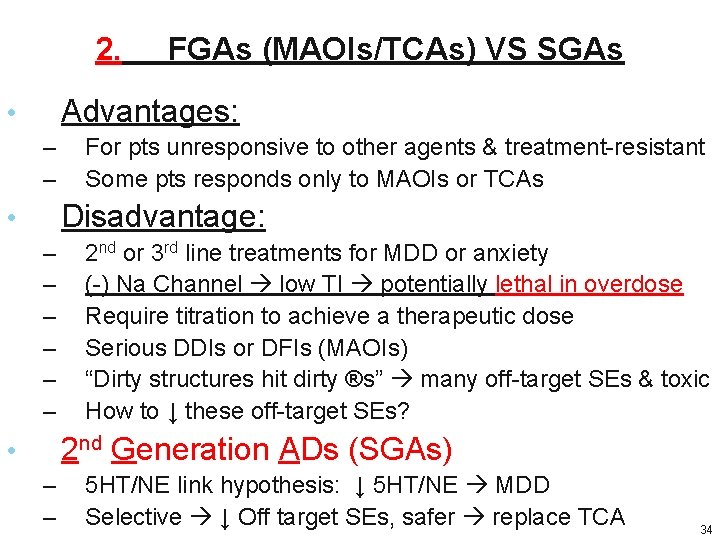
2. FGAs (MAOIs/TCAs) VS SGAs Advantages: • – – For pts unresponsive to other agents & treatment-resistant Some pts responds only to MAOIs or TCAs Disadvantage: • – – – 2 nd or 3 rd line treatments for MDD or anxiety (-) Na Channel low TI potentially lethal in overdose Require titration to achieve a therapeutic dose Serious DDIs or DFIs (MAOIs) “Dirty structures hit dirty ®s” many off-target SEs & toxic How to ↓ these off-target SEs? 2 nd Generation ADs (SGAs) • – – 5 HT/NE link hypothesis: ↓ 5 HT/NE MDD Selective ↓ Off target SEs, safer replace TCA 34
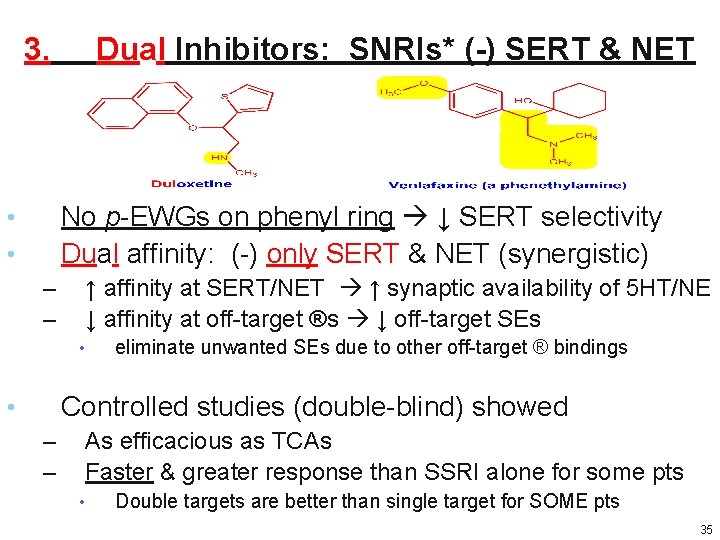
3. Dual Inhibitors: SNRIs* (-) SERT & NET No p-EWGs on phenyl ring ↓ SERT selectivity Dual affinity: (-) only SERT & NET (synergistic) • • – – ↑ affinity at SERT/NET ↑ synaptic availability of 5 HT/NE ↓ affinity at off-target ®s ↓ off-target SEs • eliminate unwanted SEs due to other off-target ® bindings Controlled studies (double-blind) showed • – – As efficacious as TCAs Faster & greater response than SSRI alone for some pts • Double targets are better than single target for SOME pts 35
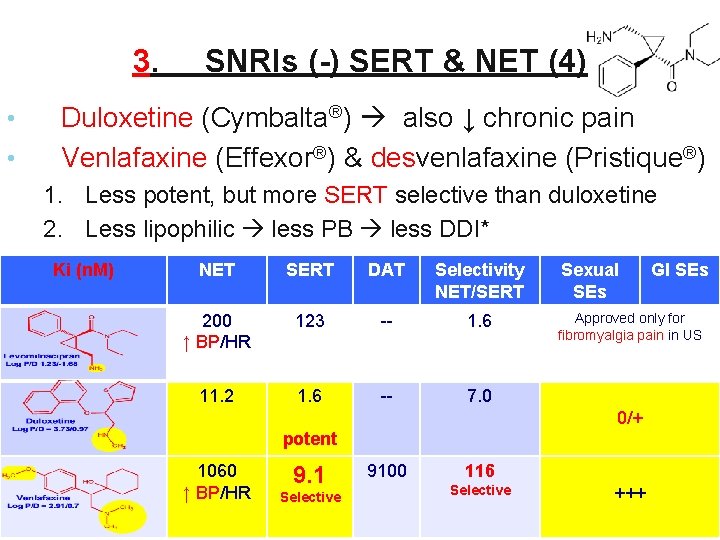
3. • • SNRIs (-) SERT & NET (4) Duloxetine (Cymbalta®) also ↓ chronic pain Venlafaxine (Effexor®) & desvenlafaxine (Pristique®) 1. Less potent, but more SERT selective than duloxetine 2. Less lipophilic less PB less DDI* Ki (n. M) NET SERT DAT Selectivity NET/SERT 200 ↑ BP/HR 123 -- 1. 6 11. 2 1. 6 -- 7. 0 Sexual SEs GI SEs Approved only for fibromyalgia pain in US 0/+ potent 1060 ↑ BP/HR 9. 1 Selective 9100 116 Selective +++ 36
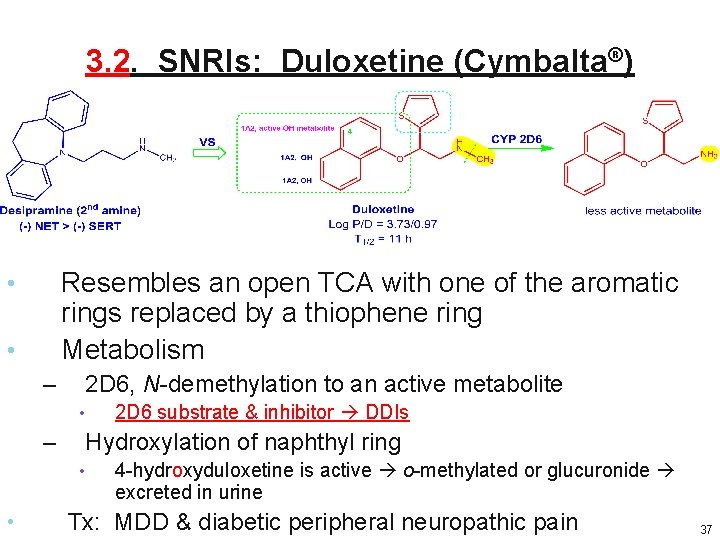
3. 2. SNRIs: Duloxetine (Cymbalta®) Resembles an open TCA with one of the aromatic rings replaced by a thiophene ring Metabolism • • – 2 D 6, N-demethylation to an active metabolite • – Hydroxylation of naphthyl ring • • 2 D 6 substrate & inhibitor DDIs 4 -hydroxyduloxetine is active o-methylated or glucuronide excreted in urine Tx: MDD & diabetic peripheral neuropathic pain 37
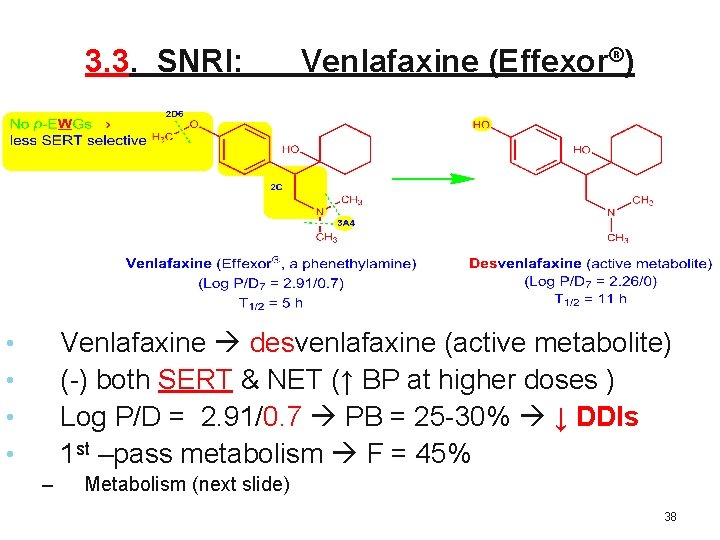
3. 3. SNRI: Venlafaxine (Effexor®) Venlafaxine desvenlafaxine (active metabolite) (-) both SERT & NET (↑ BP at higher doses ) Log P/D = 2. 91/0. 7 PB = 25 -30% ↓ DDIs 1 st –pass metabolism F = 45% • • – Metabolism (next slide) 38
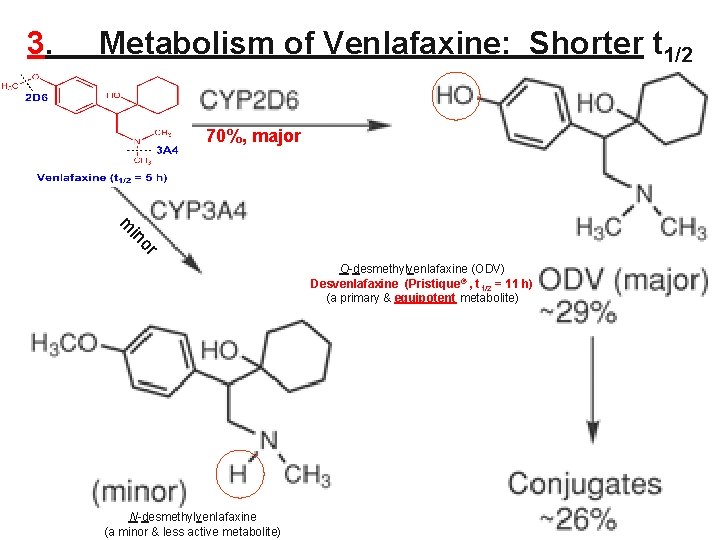
3. Metabolism of Venlafaxine: Shorter t 1/2 70%, major or in m O-desmethylvenlafaxine (ODV) Desvenlafaxine (Pristique® , t 1/2 = 11 h) (a primary & equipotent metabolite) N-desmethylvenlafaxine (a minor & less active metabolite) 39
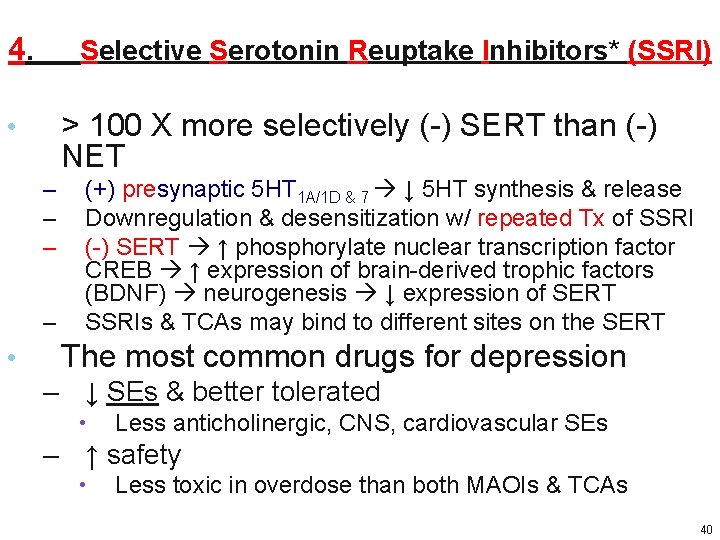
4. Selective Serotonin Reuptake Inhibitors* (SSRI) > 100 X more selectively (-) SERT than (-) NET • – – • (+) presynaptic 5 HT 1 A/1 D & 7 ↓ 5 HT synthesis & release Downregulation & desensitization w/ repeated Tx of SSRI (-) SERT ↑ phosphorylate nuclear transcription factor CREB ↑ expression of brain-derived trophic factors (BDNF) neurogenesis ↓ expression of SERT SSRIs & TCAs may bind to different sites on the SERT The most common drugs for depression – ↓ SEs & better tolerated • Less anticholinergic, CNS, cardiovascular SEs – ↑ safety • Less toxic in overdose than both MAOIs & TCAs 40
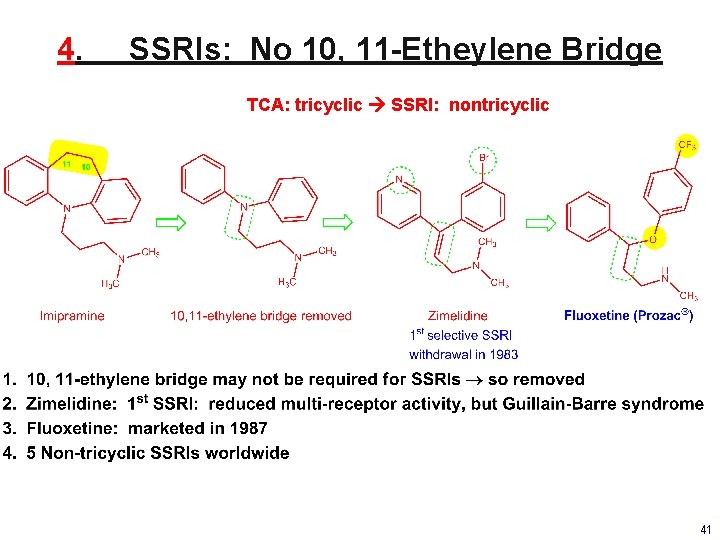
4. SSRIs: No 10, 11 -Etheylene Bridge TCA: tricyclic SSRI: nontricyclic 41
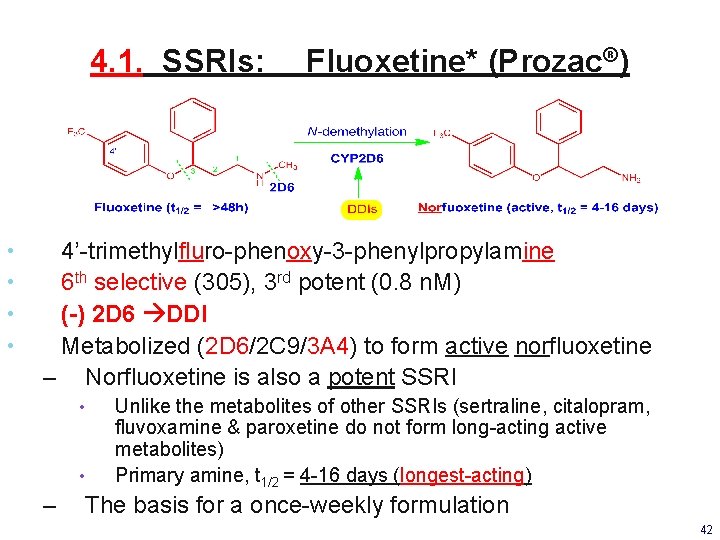
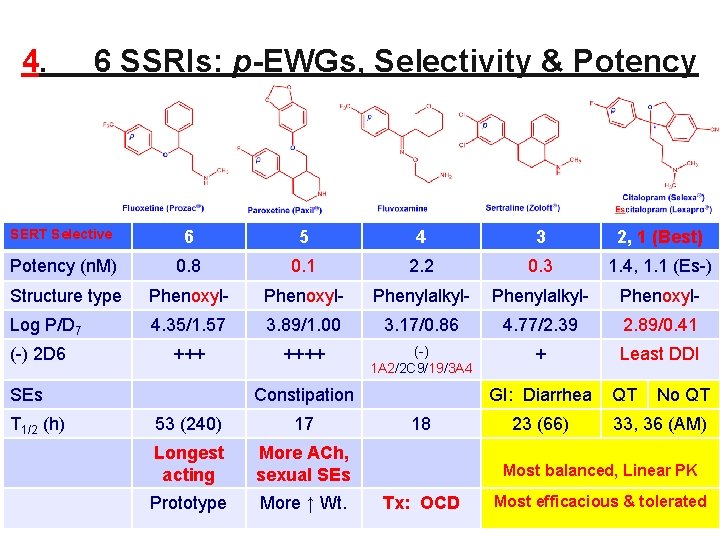
4. 1. SSRIs: • • Fluoxetine* (Prozac®) 4’-trimethylfluro-phenoxy-3 -phenylpropylamine 6 th selective (305), 3 rd potent (0. 8 n. M) (-) 2 D 6 DDI Metabolized (2 D 6/2 C 9/3 A 4) to form active norfluoxetine – Norfluoxetine is also a potent SSRI • • – Unlike the metabolites of other SSRIs (sertraline, citalopram, fluvoxamine & paroxetine do not form long-acting active metabolites) Primary amine, t 1/2 = 4 -16 days (longest-acting) The basis for a once-weekly formulation 42
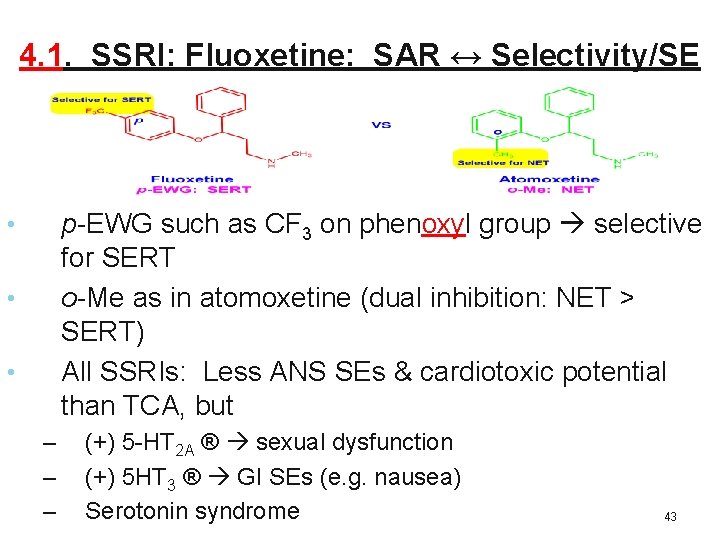
4. 1. SSRI: Fluoxetine: SAR ↔ Selectivity/SE p-EWG such as CF 3 on phenoxyl group selective for SERT o-Me as in atomoxetine (dual inhibition: NET > SERT) All SSRIs: Less ANS SEs & cardiotoxic potential than TCA, but • • • – – – (+) 5 -HT 2 A ® sexual dysfunction (+) 5 HT 3 ® GI SEs (e. g. nausea) Serotonin syndrome 43
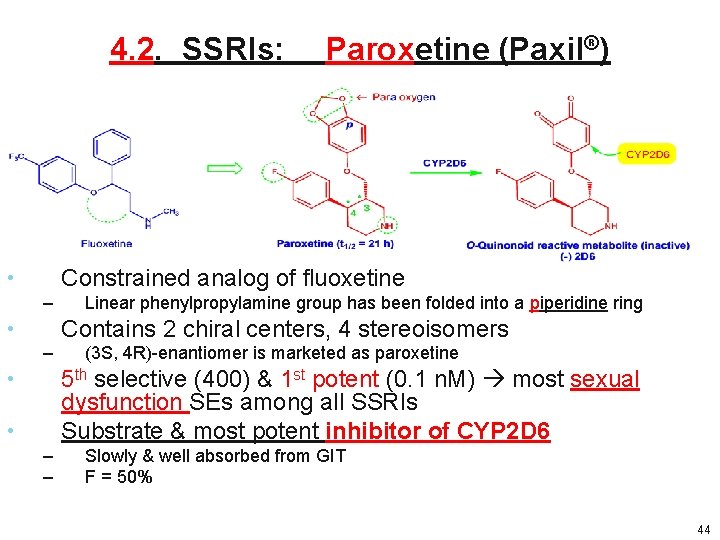
4. 2. SSRIs: Paroxetine (Paxil®) Constrained analog of fluoxetine • – Linear phenylpropylamine group has been folded into a piperidine ring Contains 2 chiral centers, 4 stereoisomers • – (3 S, 4 R)-enantiomer is marketed as paroxetine 5 th selective (400) & 1 st potent (0. 1 n. M) most sexual dysfunction SEs among all SSRIs Substrate & most potent inhibitor of CYP 2 D 6 • • – – Slowly & well absorbed from GIT F = 50% 44
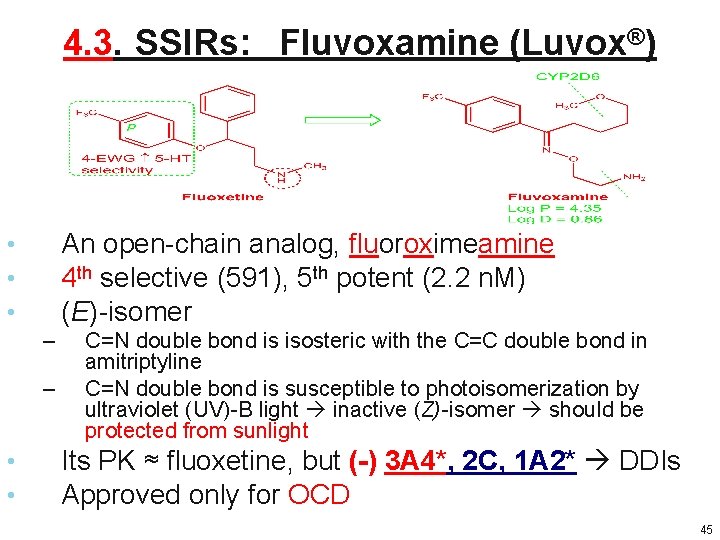
4. 3. SSIRs: Fluvoxamine (Luvox®) An open-chain analog, fluoroximeamine 4 th selective (591), 5 th potent (2. 2 n. M) (E)-isomer • • • – – • • C=N double bond is isosteric with the C=C double bond in amitriptyline C=N double bond is susceptible to photoisomerization by ultraviolet (UV)-B light inactive (Z)-isomer should be protected from sunlight Its PK ≈ fluoxetine, but (-) 3 A 4*, 2 C, 1 A 2* DDIs Approved only for OCD 45
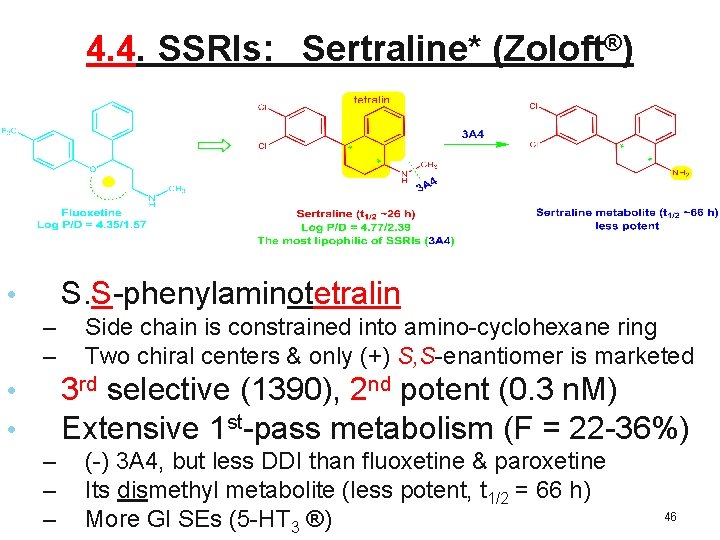
4. 4. SSRIs: Sertraline* (Zoloft®) S. S-phenylaminotetralin • – – Side chain is constrained into amino-cyclohexane ring Two chiral centers & only (+) S, S-enantiomer is marketed 3 rd selective (1390), 2 nd potent (0. 3 n. M) Extensive 1 st-pass metabolism (F = 22 -36%) • • – – – (-) 3 A 4, but less DDI than fluoxetine & paroxetine Its dismethyl metabolite (less potent, t 1/2 = 66 h) More GI SEs (5 -HT 3 ®) 46
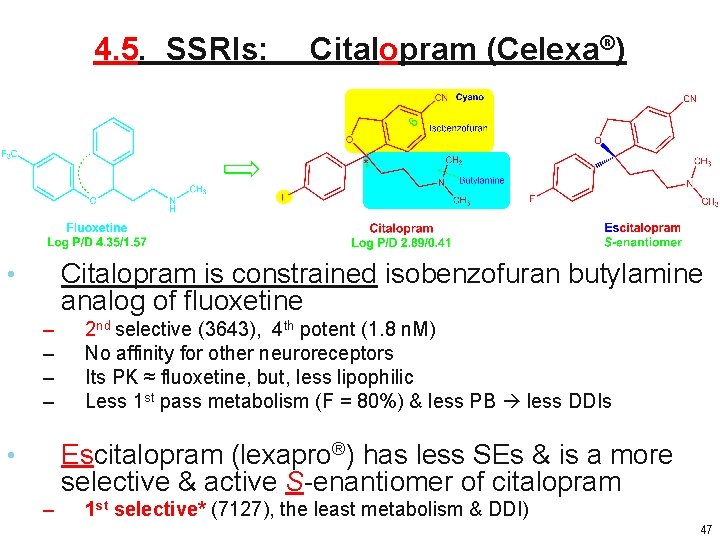
4. 5. SSRIs: Citalopram (Celexa®) Citalopram is constrained isobenzofuran butylamine analog of fluoxetine • – – 2 nd selective (3643), 4 th potent (1. 8 n. M) No affinity for other neuroreceptors Its PK ≈ fluoxetine, but, less lipophilic Less 1 st pass metabolism (F = 80%) & less PB less DDIs Escitalopram (lexapro®) has less SEs & is a more selective & active S-enantiomer of citalopram • – 1 st selective* (7127), the least metabolism & DDI) 47
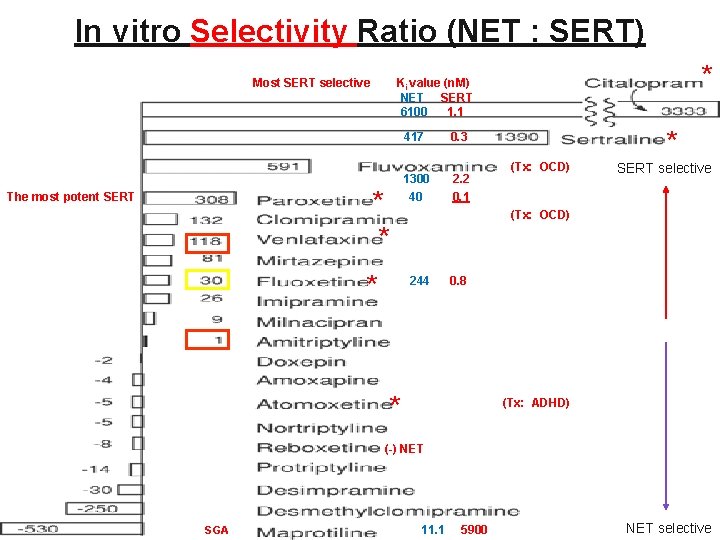
In vitro Selectivity Ratio (NET : SERT) Most SERT selective * * The most potent SERT * Ki value (n. M) NET SERT 6100 1. 1 * 417 0. 3 1300 40 2. 2 0. 1 * (Tx: OCD) SERT selective (Tx: OCD) 244 0. 8 * (Tx: ADHD) (-) NET SGA 11. 1 5900 48 NET selective
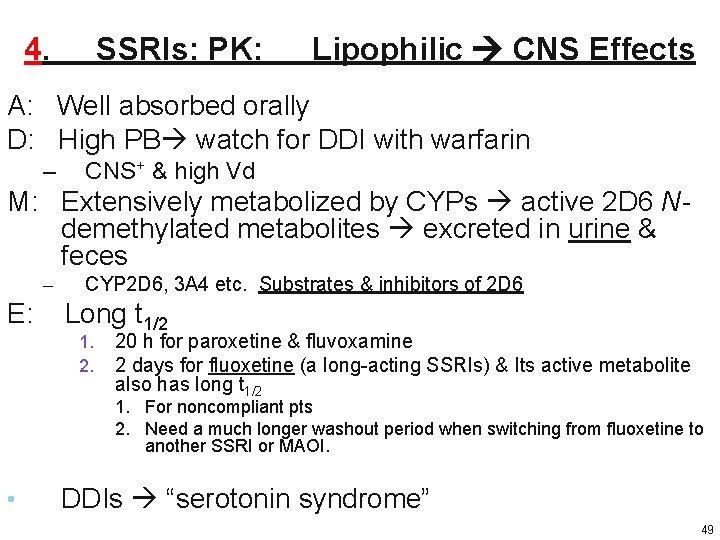
4. SSRIs: PK: Lipophilic CNS Effects A: Well absorbed orally D: High PB watch for DDI with warfarin – CNS+ & high Vd M: Extensively metabolized by CYPs active 2 D 6 Ndemethylated metabolites excreted in urine & feces – E: CYP 2 D 6, 3 A 4 etc. Substrates & inhibitors of 2 D 6 Long t 1/2 1. 2. 20 h for paroxetine & fluvoxamine 2 days for fluoxetine (a long-acting SSRIs) & Its active metabolite also has long t 1/2 1. For noncompliant pts 2. Need a much longer washout period when switching from fluoxetine to another SSRI or MAOI. • DDIs “serotonin syndrome” 49
4. 6 SSRIs: p-EWGs, Selectivity & Potency SERT Selective 6 5 4 3 2, 1 (Best) Potency (n. M) 0. 8 0. 1 2. 2 0. 3 1. 4, 1. 1 (Es-) Structure type Phenoxyl- Phenylalkyl- Phenoxyl- Log P/D 7 4. 35/1. 57 3. 89/1. 00 3. 17/0. 86 4. 77/2. 39 2. 89/0. 41 ++++ (-) 1 A 2/2 C 9/19/3 A 4 + Least DDI (-) 2 D 6 SEs T 1/2 (h) Constipation 53 (240) 17 Longest acting More ACh, sexual SEs Prototype More ↑ Wt. GI: Diarrhea 18 23 (66) QT No QT 33, 36 (AM) Most balanced, Linear PK Tx: OCD Most efficacious & tolerated
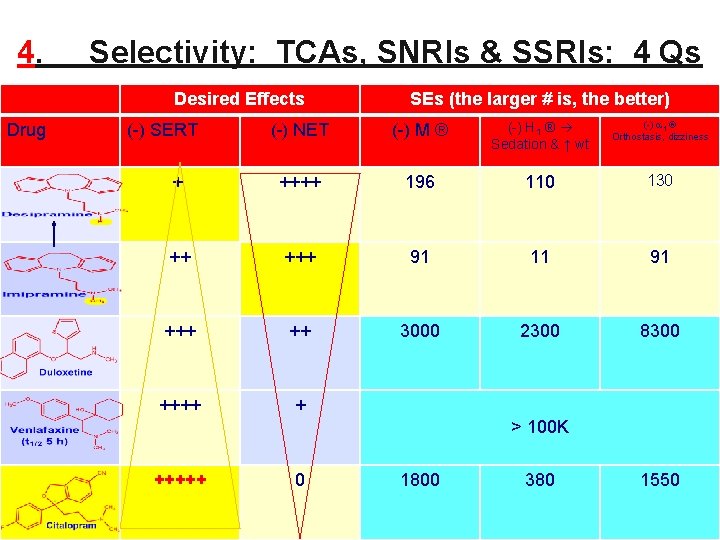
4. Selectivity: TCAs, SNRIs & SSRIs: 4 Qs Desired Effects Drug SEs (the larger # is, the better) (-) NET (-) M ® (-) H 1 ® Sedation & ↑ wt (-) a 1 ® Orthostasis, dizziness + ++++ 196 110 130 ++ +++ 91 11 91 +++ ++ 3000 2300 8300 ++++ + (-) SERT > 100 K +++++ 0 1800 380 1550 51
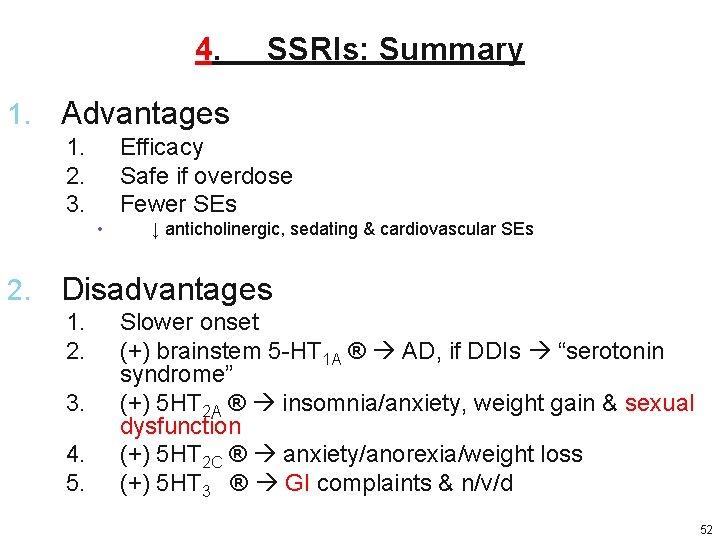
4. 1. Advantages 1. 2. 3. Efficacy Safe if overdose Fewer SEs • 2. SSRIs: Summary ↓ anticholinergic, sedating & cardiovascular SEs Disadvantages 1. 2. 3. 4. 5. Slower onset (+) brainstem 5 -HT 1 A ® AD, if DDIs “serotonin syndrome” (+) 5 HT 2 A ® insomnia/anxiety, weight gain & sexual dysfunction (+) 5 HT 2 C ® anxiety/anorexia/weight loss (+) 5 HT 3 ® GI complaints & n/v/d 52
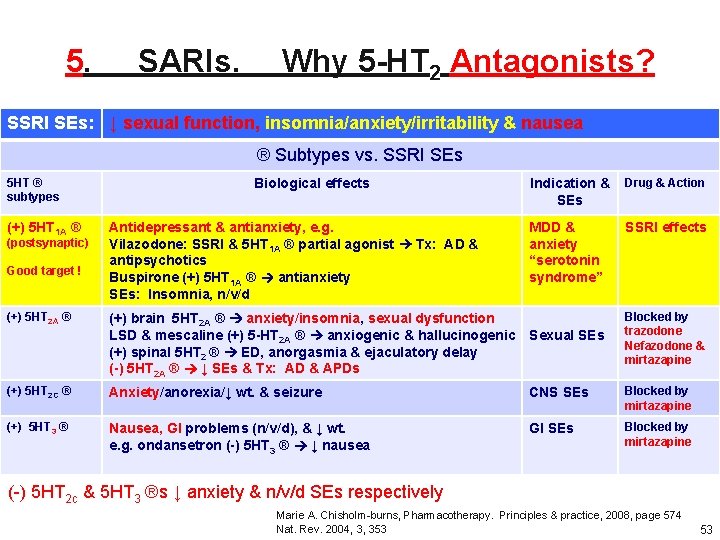
5. SARIs. Why 5 -HT 2 Antagonists? SSRI SEs: ↓ sexual function, insomnia/anxiety/irritability & nausea ® Subtypes vs. SSRI SEs 5 HT ® subtypes Indication & SEs Drug & Action MDD & anxiety “serotonin syndrome” SSRI effects (+) 5 HT 2 A ® (+) brain 5 HT 2 A ® anxiety/insomnia, sexual dysfunction LSD & mescaline (+) 5 -HT 2 A ® anxiogenic & hallucinogenic Sexual SEs (+) spinal 5 HT 2 ® ED, anorgasmia & ejaculatory delay (-) 5 HT 2 A ® ↓ SEs & Tx: AD & APDs Blocked by trazodone Nefazodone & mirtazapine (+) 5 HT 2 C ® Anxiety/anorexia/↓ wt. & seizure CNS SEs Blocked by mirtazapine (+) 5 HT 3 ® Nausea, GI problems (n/v/d), & ↓ wt. e. g. ondansetron (-) 5 HT 3 ® ↓ nausea GI SEs Blocked by mirtazapine (+) 5 HT 1 A ® (postsynaptic) Good target ! Biological effects Antidepressant & antianxiety, e. g. Vilazodone: SSRI & 5 HT 1 A ® partial agonist Tx: AD & antipsychotics Buspirone (+) 5 HT 1 A ® antianxiety SEs: Insomnia, n/v/d (-) 5 HT 2 c & 5 HT 3 ®s ↓ anxiety & n/v/d SEs respectively Marie A. Chisholm-burns, Pharmacotherapy. Principles & practice, 2008, page 574 Nat. Rev. 2004, 3, 353 53
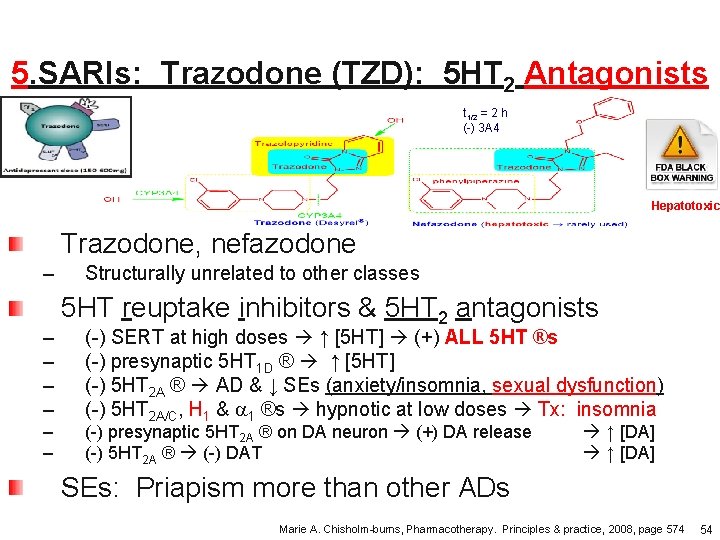
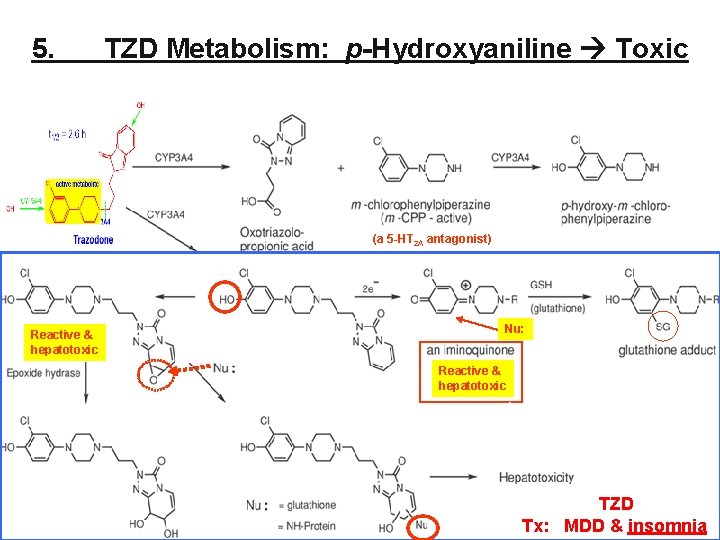
5. SARIs: Trazodone (TZD): 5 HT 2 Antagonists t 1/2 = 2 h (-) 3 A 4 Hepatotoxic Trazodone, nefazodone – – – – Structurally unrelated to other classes 5 HT reuptake inhibitors & 5 HT 2 antagonists (-) SERT at high doses ↑ [5 HT] (+) ALL 5 HT ®s (-) presynaptic 5 HT 1 D ® ↑ [5 HT] (-) 5 HT 2 A ® AD & ↓ SEs (anxiety/insomnia, sexual dysfunction) (-) 5 HT 2 A/C, H 1 & a 1 ®s hypnotic at low doses Tx: insomnia (-) presynaptic 5 HT 2 A ® on DA neuron (+) DA release (-) 5 HT 2 A ® (-) DAT ↑ [DA] SEs: Priapism more than other ADs Marie A. Chisholm-burns, Pharmacotherapy. Principles & practice, 2008, page 574 54
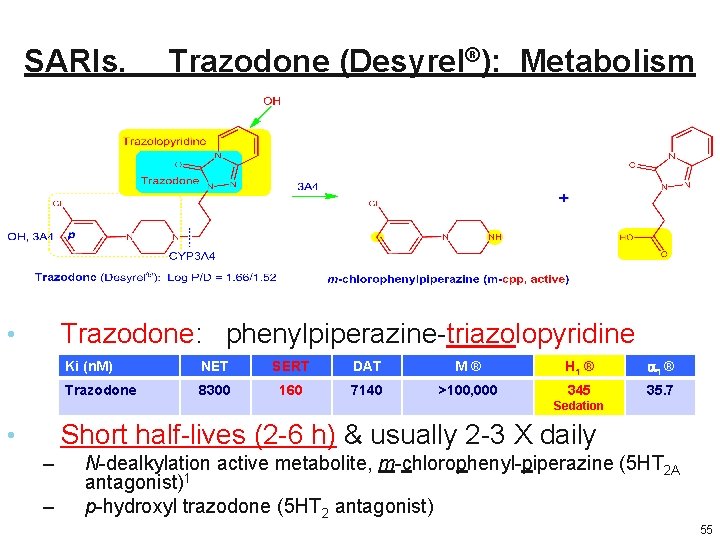
SARIs. Trazodone (Desyrel®): Metabolism Trazodone: phenylpiperazine-triazolopyridine • Ki (n. M) NET SERT DAT M® H 1 ® a 1 ® Trazodone 8300 160 7140 >100, 000 345 35. 7 Sedation Short half-lives (2 -6 h) & usually 2 -3 X daily • – – N-dealkylation active metabolite, m-chlorophenyl-piperazine (5 HT 2 A antagonist)1 p-hydroxyl trazodone (5 HT 2 antagonist) 55
5. TZD Metabolism: p-Hydroxyaniline Toxic (a 5 -HT 2 A antagonist) Reactive & hepatotoxic Nu: Reactive & hepatotoxic TZD 56 Tx: MDD & insomnia
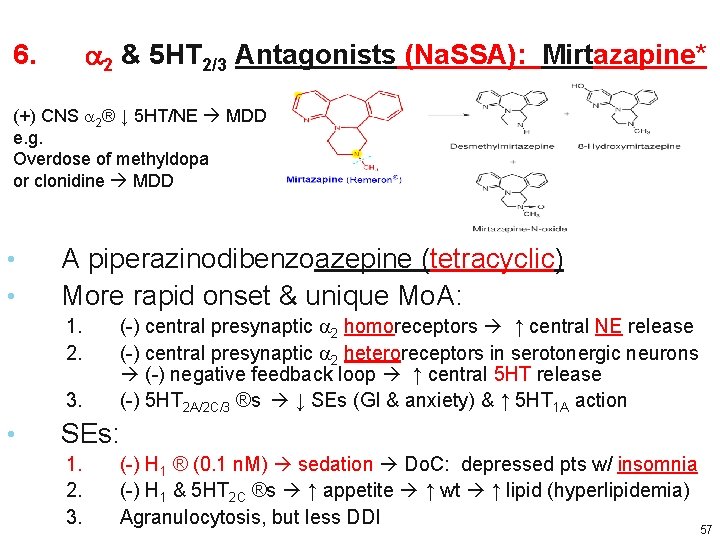
a 2 & 5 HT 2/3 Antagonists (Na. SSA): Mirtazapine* 6. (+) CNS a 2® ↓ 5 HT/NE MDD e. g. Overdose of methyldopa or clonidine MDD • • A piperazinodibenzoazepine (tetracyclic) More rapid onset & unique Mo. A: 1. 2. 3. • (-) central presynaptic a 2 homoreceptors ↑ central NE release (-) central presynaptic a 2 heteroreceptors in serotonergic neurons (-) negative feedback loop ↑ central 5 HT release (-) 5 HT 2 A/2 C/3 ®s ↓ SEs (GI & anxiety) & ↑ 5 HT 1 A action SEs: 1. 2. 3. (-) H 1 ® (0. 1 n. M) sedation Do. C: depressed pts w/ insomnia (-) H 1 & 5 HT 2 C ®s ↑ appetite ↑ wt ↑ lipid (hyperlipidemia) Agranulocytosis, but less DDI 57
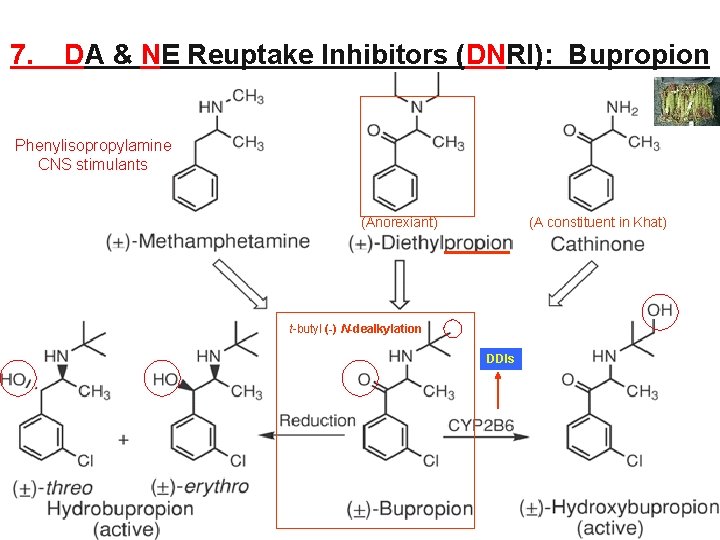
7. DA & NE Reuptake Inhibitors (DNRI): Bupropion Phenylisopropylamine CNS stimulants (Anorexiant) (A constituent in Khat) t-butyl (-) N-dealkylation DDIs 58
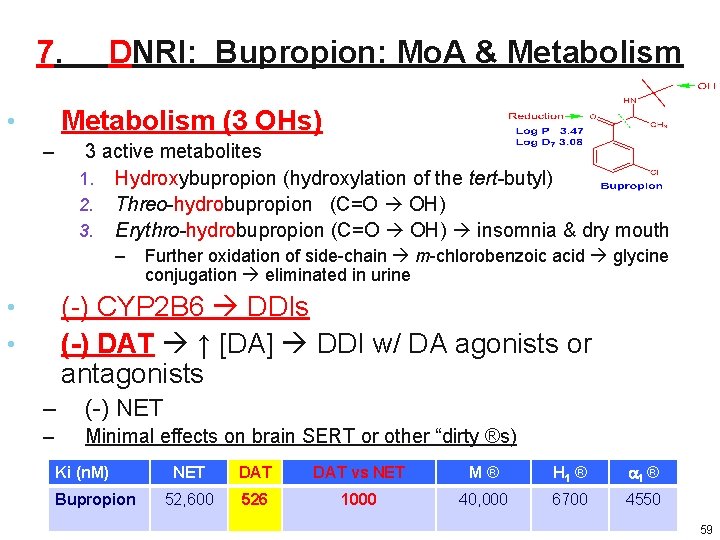
7. DNRI: Bupropion: Mo. A & Metabolism (3 OHs) • – 3 active metabolites 1. Hydroxybupropion (hydroxylation of the tert-butyl) 2. Threo-hydrobupropion (C=O OH) 3. Erythro-hydrobupropion (C=O OH) insomnia & dry mouth – Further oxidation of side-chain m-chlorobenzoic acid glycine conjugation eliminated in urine (-) CYP 2 B 6 DDIs (-) DAT ↑ [DA] DDI w/ DA agonists or antagonists • • – (-) NET – Minimal effects on brain SERT or other “dirty ®s) Ki (n. M) Bupropion NET DAT vs NET M® H 1 ® a 1 ® 52, 600 526 1000 40, 000 6700 4550 59
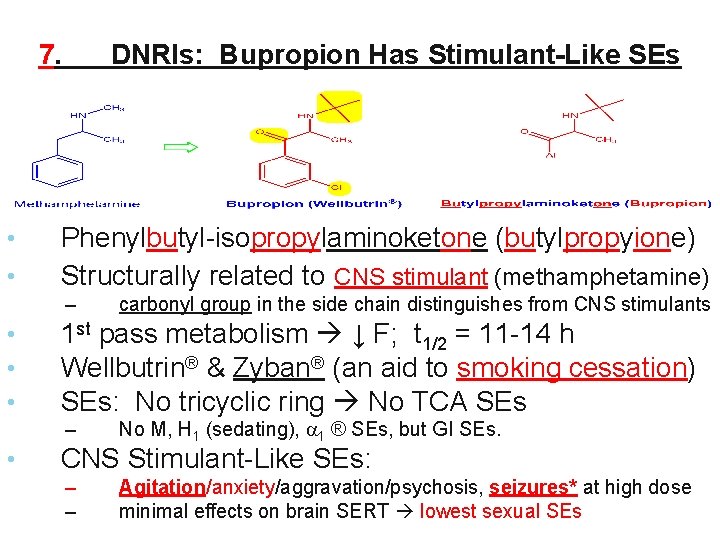
7. • • DNRIs: Bupropion Has Stimulant-Like SEs Phenylbutyl-isopropylaminoketone (butylpropyione) Structurally related to CNS stimulant (methamphetamine) – • • • 1 st pass metabolism ↓ F; t 1/2 = 11 -14 h Wellbutrin® & Zyban® (an aid to smoking cessation) SEs: No tricyclic ring No TCA SEs – • carbonyl group in the side chain distinguishes from CNS stimulants No M, H 1 (sedating), a 1 ® SEs, but GI SEs. CNS Stimulant-Like SEs: – – Agitation/anxiety/aggravation/psychosis, seizures* at high dose minimal effects on brain SERT lowest sexual SEs
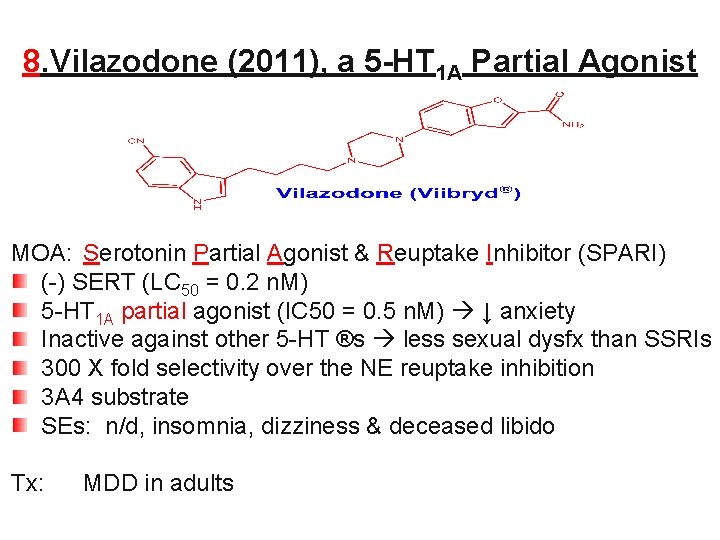
8. Vilazodone (2011), a 5 -HT 1 A Partial Agonist MOA: Serotonin Partial Agonist & Reuptake Inhibitor (SPARI) (-) SERT (LC 50 = 0. 2 n. M) 5 -HT 1 A partial agonist (IC 50 = 0. 5 n. M) ↓ anxiety Inactive against other 5 -HT ®s less sexual dysfx than SSRIs 300 X fold selectivity over the NE reuptake inhibition 3 A 4 substrate SEs: n/d, insomnia, dizziness & deceased libido Tx: MDD in adults
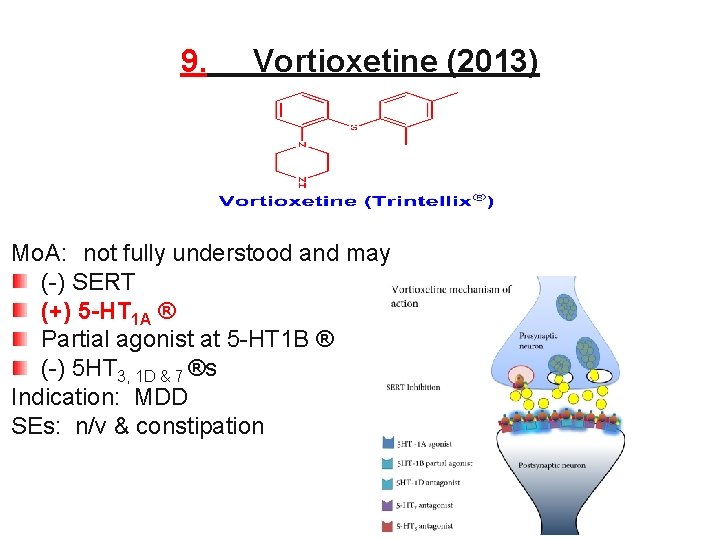
9. Vortioxetine (2013) Mo. A: not fully understood and may (-) SERT (+) 5 -HT 1 A ® Partial agonist at 5 -HT 1 B ® (-) 5 HT 3, 1 D & 7 ®s Indication: MDD SEs: n/v & constipation
General PK: Lipophilic & Basic CYP+ All ADs are of equal efficacious PO: rapid & well absorbed High PB (plasma & tissues) High Vd CNS active Metabolism: in general – 1 A 2 & 2 D 6 aromatic hydroxylation – 3 A 3/4 N-dealkylation & N-oxidation – When an antidepressant is metabolized by more than one CYP isoform in parallel, it is unlikely to be affected by DDI via CYP isoform inhibition • If the drug is metabolized primarily by CYP 3 A 4 or the polymorphic CYP 2 D 6 isoforms watch for DDIs Metabolites excreted via urine & feces (minor) 63
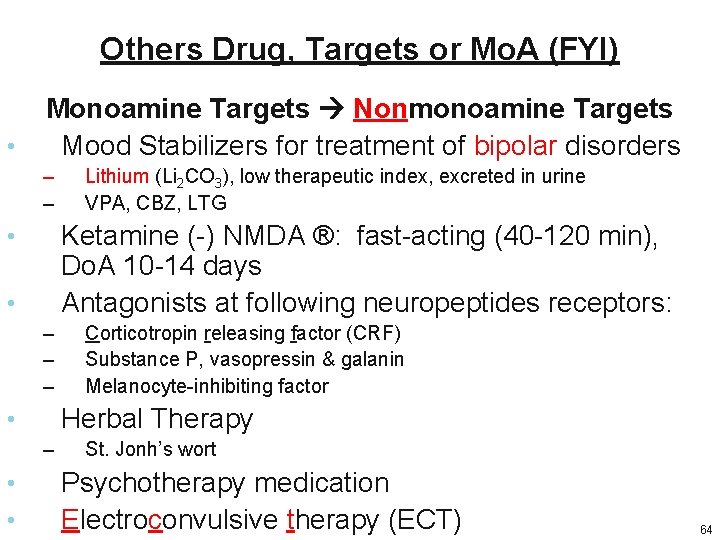
Others Drug, Targets or Mo. A (FYI) • Monoamine Targets Nonmonoamine Targets Mood Stabilizers for treatment of bipolar disorders – – Ketamine (-) NMDA ®: fast-acting (40 -120 min), Do. A 10 -14 days Antagonists at following neuropeptides receptors: • • – – – Corticotropin releasing factor (CRF) Substance P, vasopressin & galanin Melanocyte-inhibiting factor Herbal Therapy • – • • Lithium (Li 2 CO 3), low therapeutic index, excreted in urine VPA, CBZ, LTG St. Jonh’s wort Psychotherapy medication Electroconvulsive therapy (ECT) 64
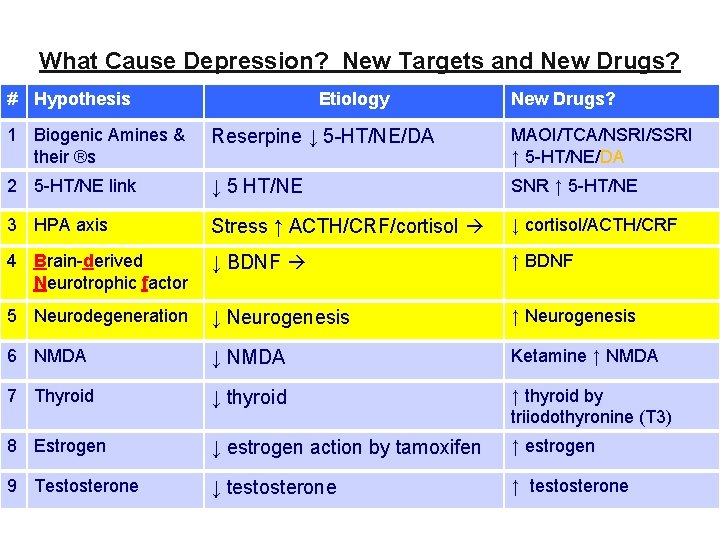
What Cause Depression? New Targets and New Drugs? # Hypothesis Etiology New Drugs? 1 Biogenic Amines & their ®s Reserpine ↓ 5 -HT/NE/DA MAOI/TCA/NSRI/SSRI ↑ 5 -HT/NE/DA 2 5 -HT/NE link ↓ 5 HT/NE SNR ↑ 5 -HT/NE 3 HPA axis Stress ↑ ACTH/CRF/cortisol ↓ cortisol/ACTH/CRF 4 Brain-derived Neurotrophic factor ↓ BDNF ↑ BDNF 5 Neurodegeneration ↓ Neurogenesis ↑ Neurogenesis 6 NMDA ↓ NMDA Ketamine ↑ NMDA 7 Thyroid ↓ thyroid ↑ thyroid by triiodothyronine (T 3) 8 Estrogen ↓ estrogen action by tamoxifen ↑ estrogen 9 Testosterone ↓ testosterone ↑ testosterone
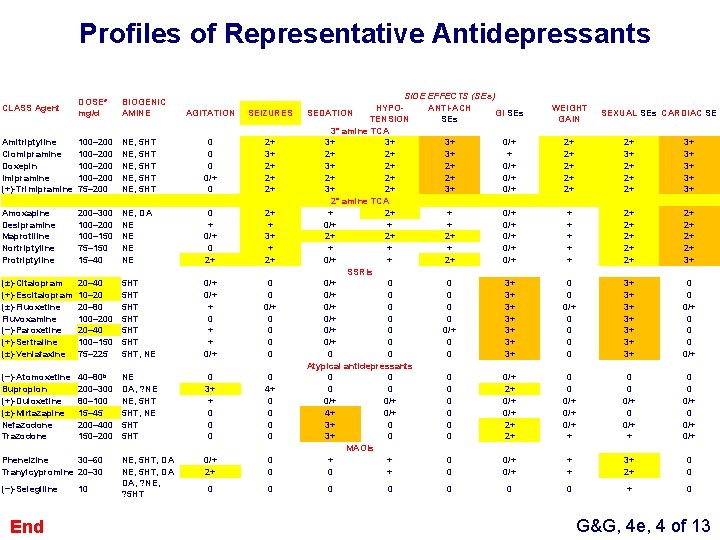
Profiles of Representative Antidepressants CLASS Agent DOSEa mg/d BIOGENIC AMINE Amitriptyline Clomipramine Doxepin Imipramine (+)-Trimipramine 100– 200 75– 200 Amoxapine Desipramine Maprotiline Nortriptyline Protriptyline AGITATION SEIZURES NE, 5 HT NE, 5 HT 0 0/+ 0 2+ 3+ 2+ 200– 300 100– 200 100– 150 75– 150 15– 40 NE, DA NE NE 0 + 0/+ 0 2+ 2+ + 3+ + 2+ (±)-Citalopram (+)-Escitalopram (±)-Fluoxetine Fluvoxamine (−)-Paroxetine (+)-Sertraline (±)-Venlafaxine 20– 40 10– 20 20– 80 100– 200 20– 40 100– 150 75– 225 5 HT 5 HT, NE 0/+ + 0/+ 0 0 0 0 (−)-Atomoxetine Bupropion (+)-Duloxetine (±)-Mirtazapine Nefazodone Trazodone 40– 80 b 200– 300 80– 100 15– 45 200– 400 150– 200 NE DA, ? NE NE, 5 HT, NE 5 HT 0 3+ + 0 0 4+ 0 0 NE, 5 HT, DA DA, ? NE, ? 5 HT 0/+ 2+ 0 0 Phenelzine 30– 60 Tranylcypromine 20– 30 (−)-Selegiline End 10 SIDE EFFECTS (SEs) HYPOANTI-ACH SEDATION GI SEs TENSION SEs 3° amine TCA 3+ 3+ 3+ 0/+ 2+ 2+ 3+ 2+ 2+ 0/+ 2+ 2+ 2+ 0/+ 3+ 2+ 3+ 0/+ 2° amine TCA + 2+ + 0/+ 2+ 2+ 2+ 0/+ + 2+ 0/+ SSRIs 0/+ 0 0 3+ 0/+ 0 0/+ 3+ 0/+ 0 0 3+ 0 0 0 3+ Atypical antidepressants 0 0/+ 0 0 0 2+ 0/+ 0 0/+ 4+ 0/+ 0 0/+ 3+ 0 0 2+ MAOIs + + 0 0/+ 0 0 0 0 WEIGHT GAIN SEXUAL SEs CARDIAC SE 2+ 2+ 2+ 3+ 3+ 3+ + + 2+ 2+ 2+ 3+ 0 0 0/+ 0 0 3+ 3+ 0 0 0/+ 0/+ + 0 0 0/+ + + 3+ 2+ 0 0 0 + 0 G&G, 4 e, 4 of 13