
Chapter 18 AcidBase Equilibria 18 1 Acids and
Chapter 18 : Acid-Base Equilibria 18. 1 Acids and Bases in Water 18. 3 Proton Transfer and the Brønsted-Lowery Acid-Base Definition 18. 9 Electron-Pair Donation and the Lewis Acid. Base Definition 18. 2 Autoionization of Water and the p. H Scale 18. 4 Solving Problems Involving Weak-Acid Equilibra 18. 5 Weak Bases and Their Relation to Weak Acids 18. 7 Acid-Base Properties of Salt Solutions
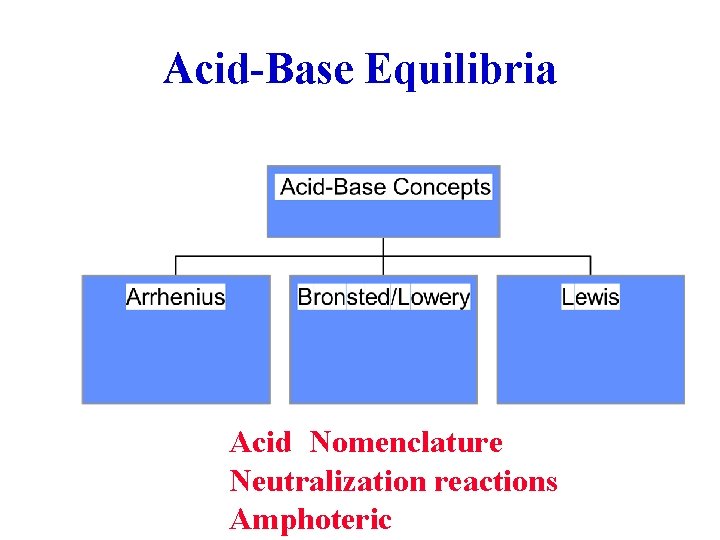
Acid-Base Equilibria Acid Nomenclature Neutralization reactions Amphoteric
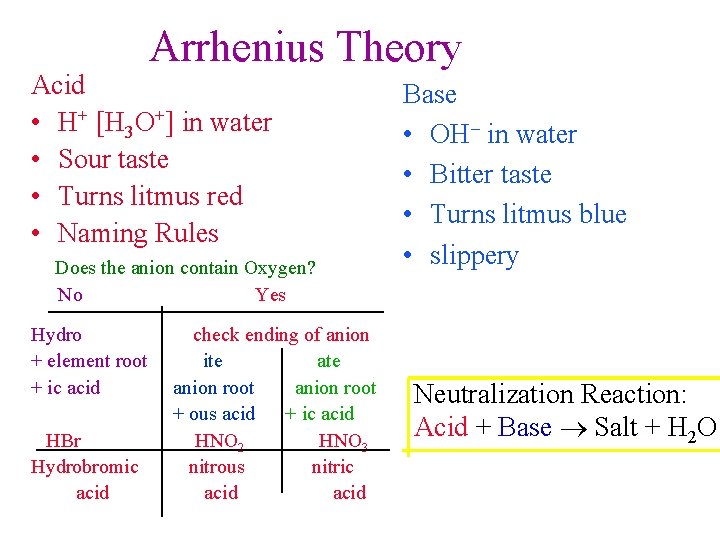
Arrhenius Theory Acid • H+ [H 3 O+] in water • Sour taste • Turns litmus red • Naming Rules Does the anion contain Oxygen? No Yes Hydro + element root + ic acid HBr Hydrobromic acid check ending of anion ite anion root + ous acid + ic acid HNO 2 HNO 3 nitrous nitric acid Base • OH– in water • Bitter taste • Turns litmus blue • slippery Neutralization Reaction: Acid + Base Salt + H 2 O
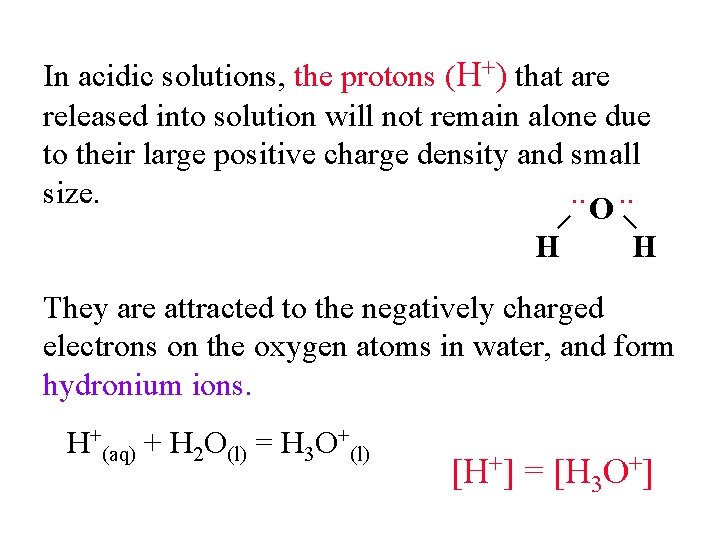
In acidic solutions, the protons (H+) that are released into solution will not remain alone due to their large positive charge density and small size. . . O H H They are attracted to the negatively charged electrons on the oxygen atoms in water, and form hydronium ions. H+(aq) + H 2 O(l) = H 3 O+(l) [H+] = [H 3 O+]
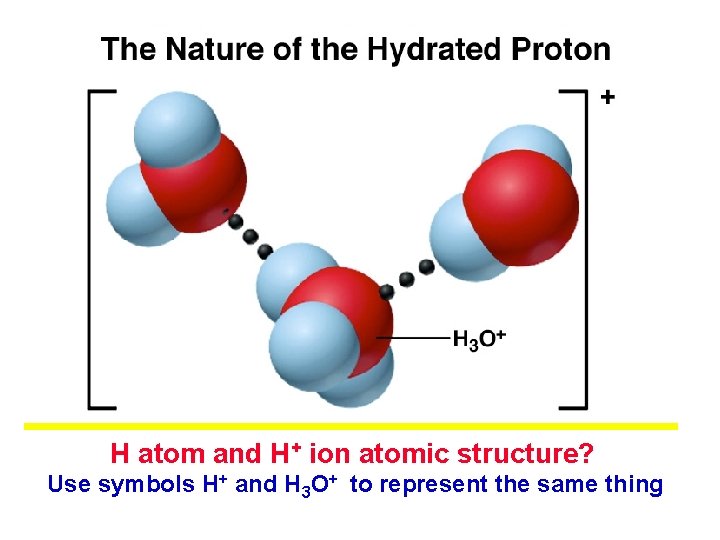
H atom and H+ ion atomic structure? Use symbols H+ and H 3 O+ to represent the same thing
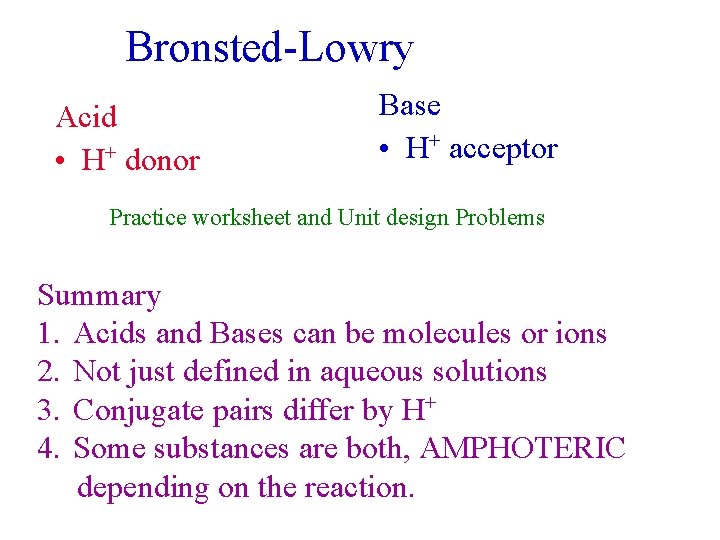
Bronsted-Lowry Acid • H+ donor Base • H+ acceptor Practice worksheet and Unit design Problems Summary 1. Acids and Bases can be molecules or ions 2. Not just defined in aqueous solutions 3. Conjugate pairs differ by H+ 4. Some substances are both, AMPHOTERIC depending on the reaction.
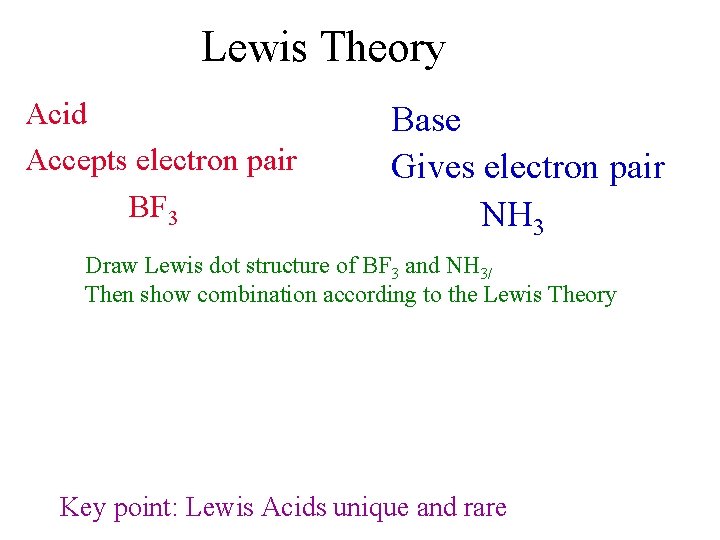
Lewis Theory Acid Accepts electron pair BF 3 Base Gives electron pair NH 3 Draw Lewis dot structure of BF 3 and NH 3/ Then show combination according to the Lewis Theory Key point: Lewis Acids unique and rare
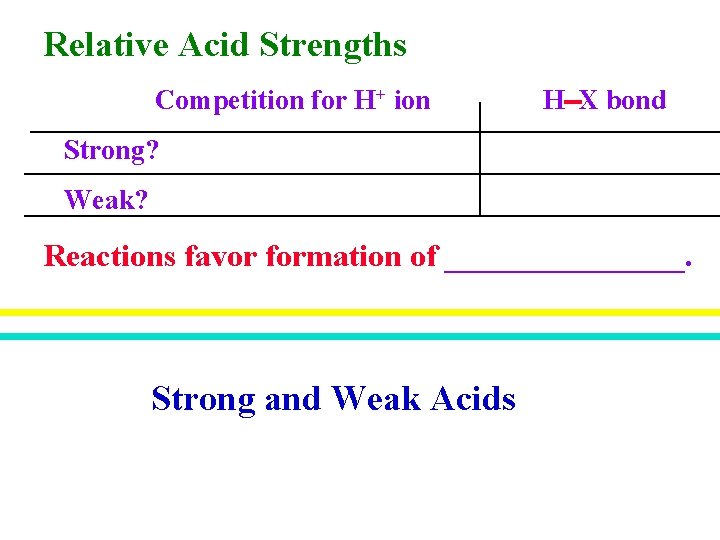
Relative Acid Strengths Competition for H+ ion H X bond Strong? Weak? Reactions favor formation of ________. Strong and Weak Acids
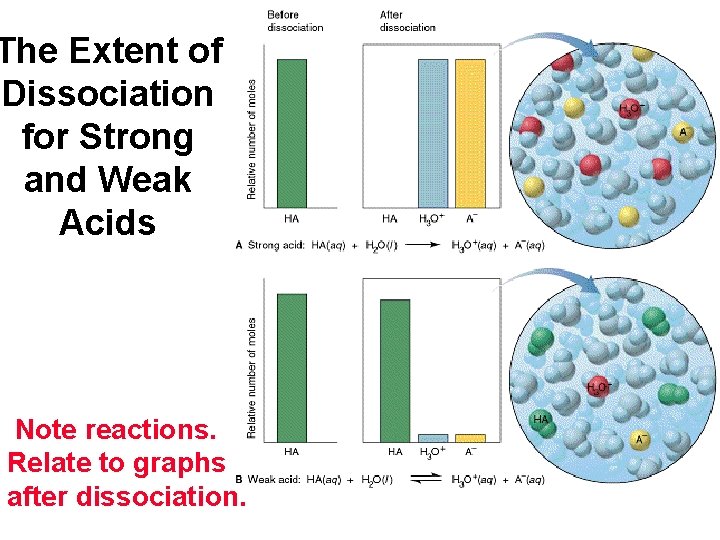
The Extent of Dissociation for Strong and Weak Acids Note reactions. Relate to graphs after dissociation.
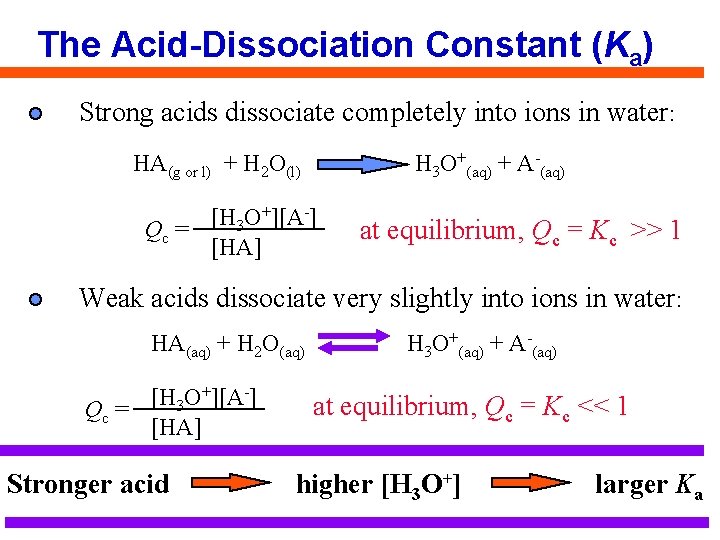
The Acid-Dissociation Constant (Ka) Strong acids dissociate completely into ions in water: HA(g or l) + H 2 O(l) H 3 O+(aq) + A-(aq) +][A-] [H O 3 Qc = [HA] at equilibrium, Qc = Kc >> 1 Weak acids dissociate very slightly into ions in water: HA(aq) + H 2 O(aq) +][A-] [H O 3 Qc = [HA] Stronger acid H 3 O+(aq) + A-(aq) at equilibrium, Qc = Kc << 1 higher [H 3 O+] larger Ka
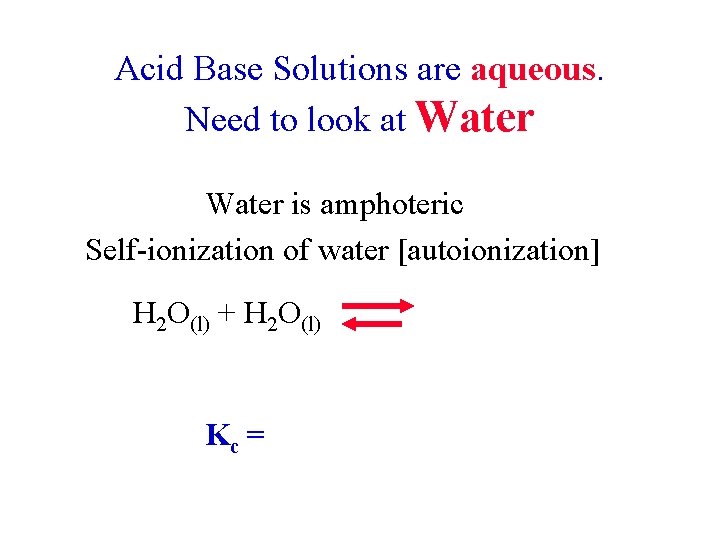
Acid Base Solutions are aqueous. Need to look at Water is amphoteric Self-ionization of water [autoionization] H 2 O(l) + H 2 O(l) Kc =
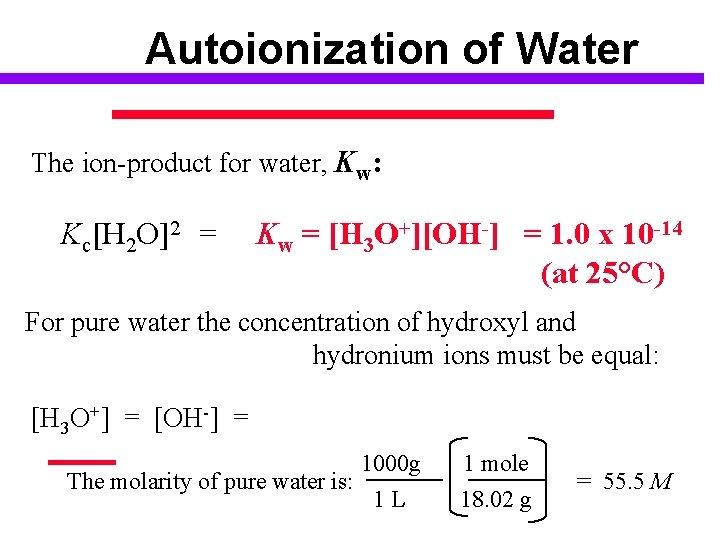
Autoionization of Water The ion-product for water, Kw: Kc[H 2 O]2 = Kw = [H 3 O+][OH-] = 1. 0 x 10 -14 (at 25°C) For pure water the concentration of hydroxyl and hydronium ions must be equal: [H 3 O+] = [OH-] = 1000 g The molarity of pure water is: 1 L 1 mole 18. 02 g = 55. 5 M
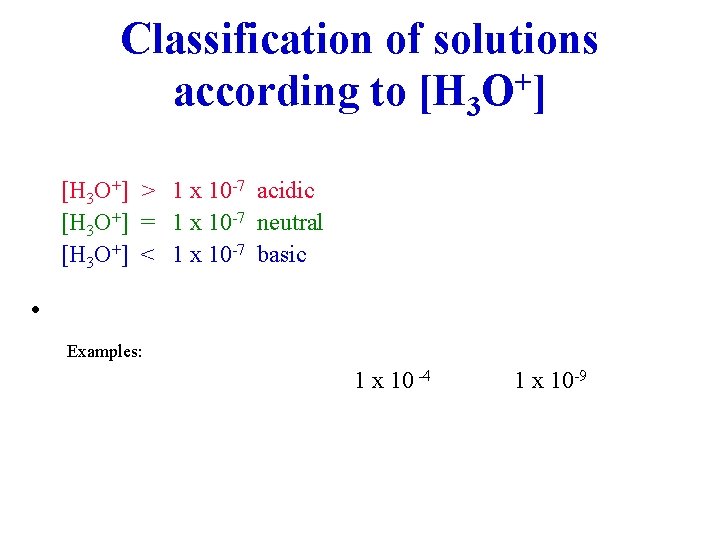
Classification of solutions according to [H 3 O+] > 1 x 10 -7 acidic [H 3 O+] = 1 x 10 -7 neutral [H 3 O+] < 1 x 10 -7 basic • Examples: 1 x 10 -4 1 x 10 -9
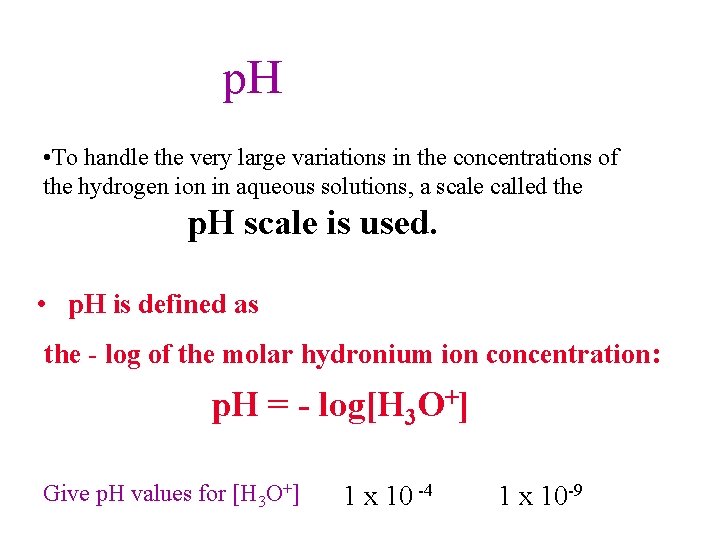
p. H • To handle the very large variations in the concentrations of the hydrogen ion in aqueous solutions, a scale called the p. H scale is used. • p. H is defined as the - log of the molar hydronium ion concentration: p. H = - log[H 3 O+] Give p. H values for [H 3 O+] 1 x 10 -4 1 x 10 -9
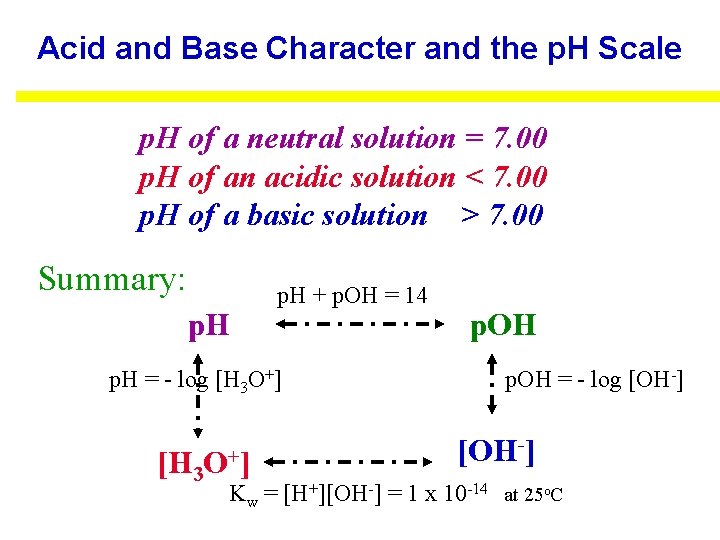
Acid and Base Character and the p. H Scale p. H of a neutral solution = 7. 00 p. H of an acidic solution < 7. 00 p. H of a basic solution > 7. 00 Summary: p. H + p. OH = 14 p. H = - log [H 3 O+] [H 3 O +] p. OH = - log [OH-] Kw = [H+][OH-] = 1 x 10 -14 at 25 o. C
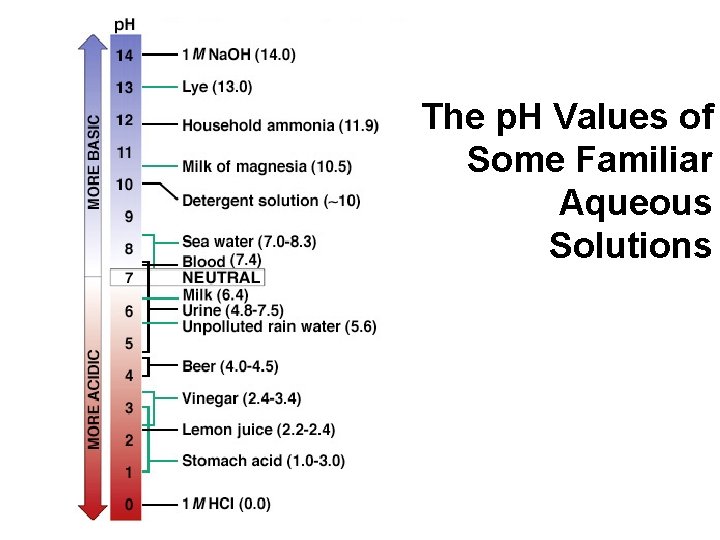
The p. H Values of Some Familiar Aqueous Solutions
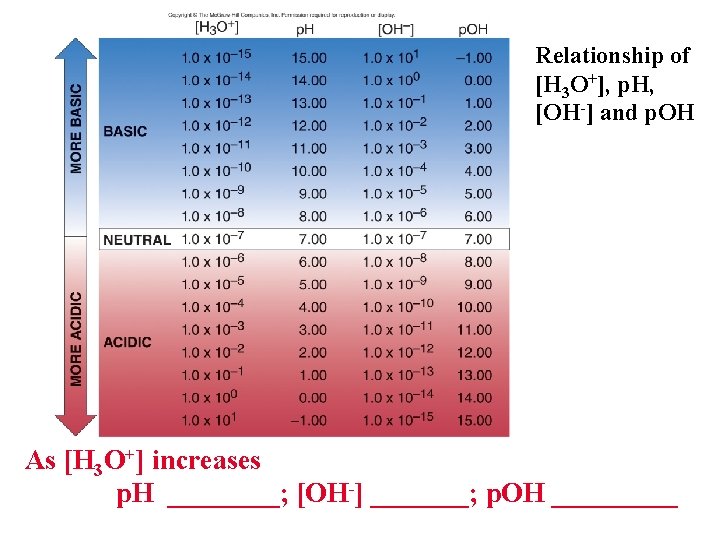
Relationship of [H 3 O+], p. H, [OH-] and p. OH As [H 3 O+] increases p. H ____; [OH-] _______; p. OH _____
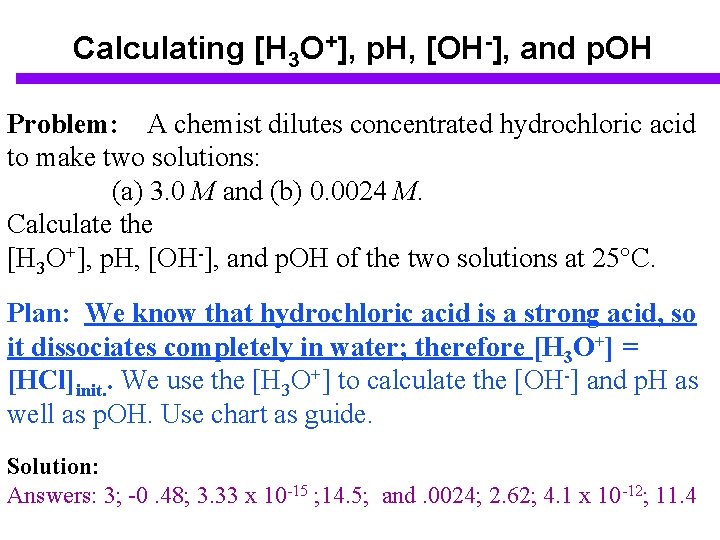
Calculating [H 3 O+], p. H, [OH-], and p. OH Problem: A chemist dilutes concentrated hydrochloric acid to make two solutions: (a) 3. 0 M and (b) 0. 0024 M. Calculate the [H 3 O+], p. H, [OH-], and p. OH of the two solutions at 25°C. Plan: We know that hydrochloric acid is a strong acid, so it dissociates completely in water; therefore [H 3 O+] = [HCl]init. . We use the [H 3 O+] to calculate the [OH-] and p. H as well as p. OH. Use chart as guide. Solution: Answers: 3; -0. 48; 3. 33 x 10 -15 ; 14. 5; and. 0024; 2. 62; 4. 1 x 10 -12; 11. 4
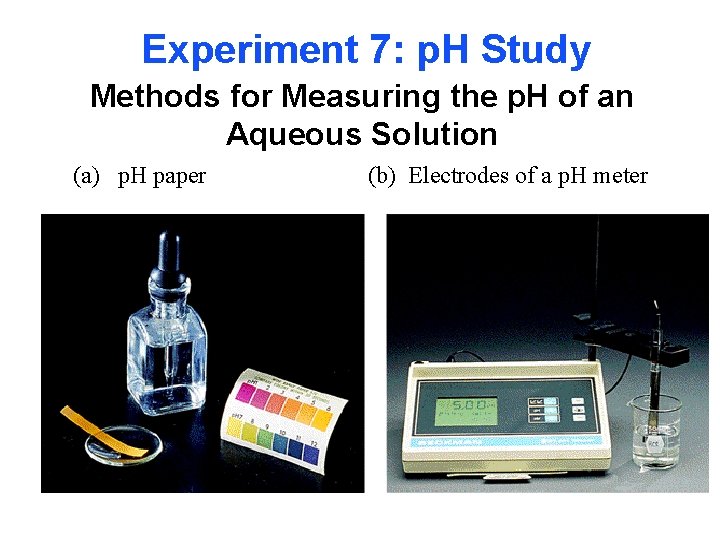
Experiment 7: p. H Study Methods for Measuring the p. H of an Aqueous Solution (a) p. H paper (b) Electrodes of a p. H meter
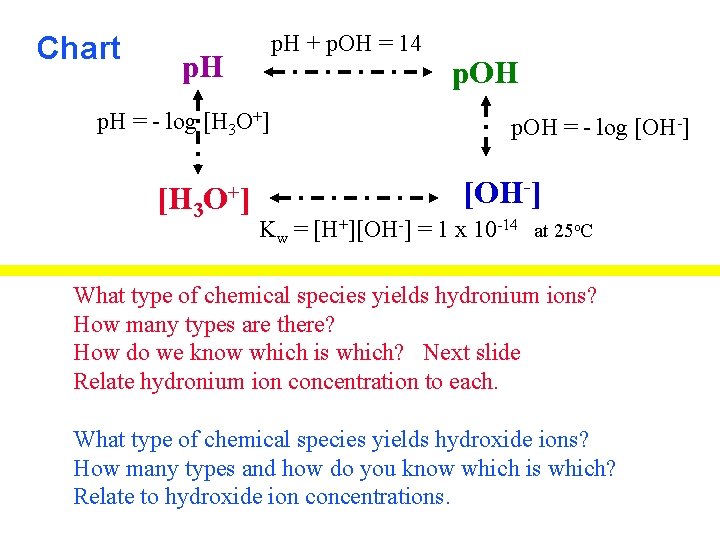
Chart p. H + p. OH = 14 p. H = - log [H 3 O+] [H 3 O +] p. OH = - log [OH-] Kw = [H+][OH-] = 1 x 10 -14 at 25 o. C What type of chemical species yields hydronium ions? How many types are there? How do we know which is which? Next slide Relate hydronium ion concentration to each. What type of chemical species yields hydroxide ions? How many types and how do you know which is which? Relate to hydroxide ion concentrations.
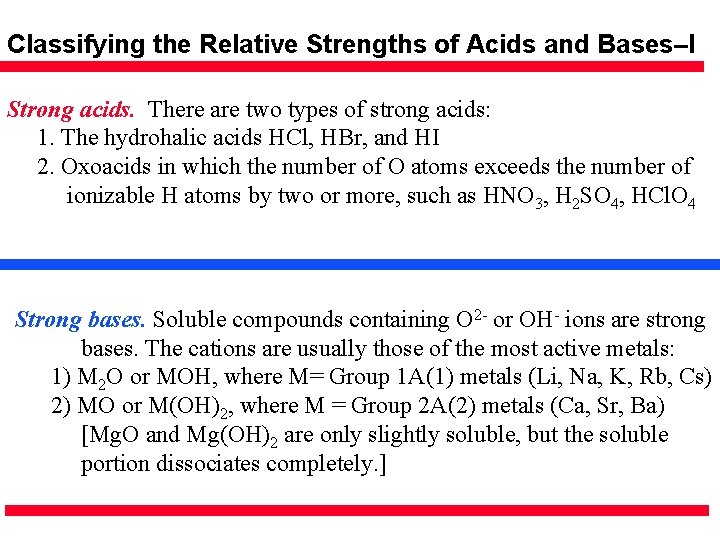
Classifying the Relative Strengths of Acids and Bases–I Strong acids. There are two types of strong acids: 1. The hydrohalic acids HCl, HBr, and HI 2. Oxoacids in which the number of O atoms exceeds the number of ionizable H atoms by two or more, such as HNO 3, H 2 SO 4, HCl. O 4 Strong bases. Soluble compounds containing O 2 - or OH- ions are strong bases. The cations are usually those of the most active metals: 1) M 2 O or MOH, where M= Group 1 A(1) metals (Li, Na, K, Rb, Cs) 2) MO or M(OH)2, where M = Group 2 A(2) metals (Ca, Sr, Ba) [Mg. O and Mg(OH)2 are only slightly soluble, but the soluble portion dissociates completely. ]
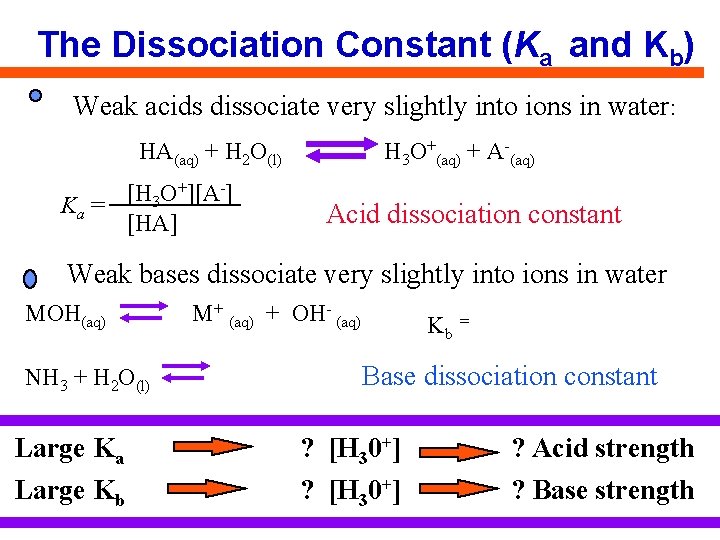
The Dissociation Constant (Ka and Kb) Weak acids dissociate very slightly into ions in water: HA(aq) + H 2 O(l) +][A-] [H O 3 Ka = [HA] H 3 O+(aq) + A-(aq) Acid dissociation constant Weak bases dissociate very slightly into ions in water MOH(aq) NH 3 + H 2 O(l) Large Ka Large Kb M+ (aq) + OH- (aq) Kb = Base dissociation constant ? [H 30+] ? Acid strength ? Base strength
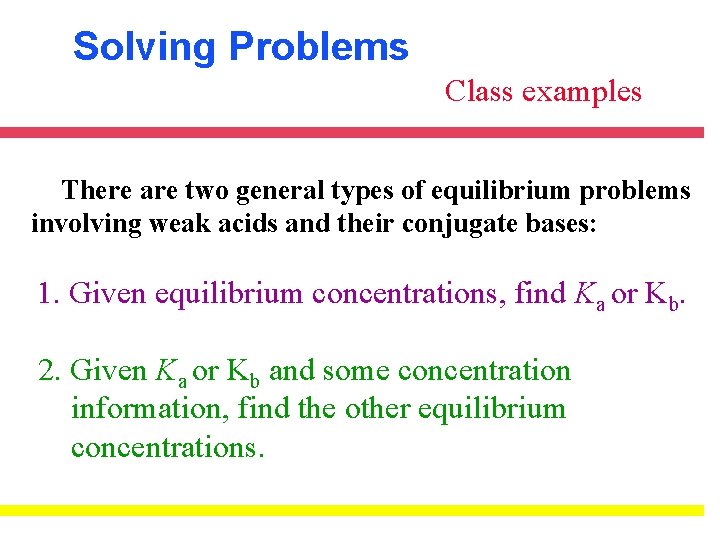
Solving Problems Class examples There are two general types of equilibrium problems involving weak acids and their conjugate bases: 1. Given equilibrium concentrations, find Ka or Kb. 2. Given Ka or Kb and some concentration information, find the other equilibrium concentrations.
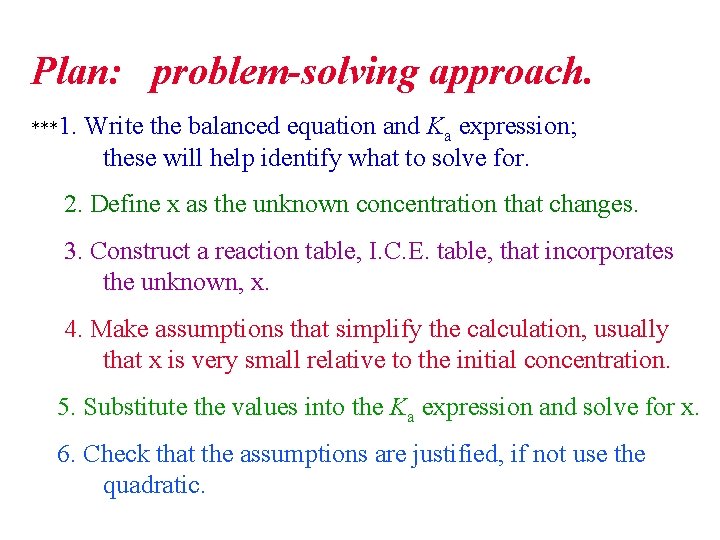
Plan: problem-solving approach. ***1. Write the balanced equation and Ka expression; these will help identify what to solve for. 2. Define x as the unknown concentration that changes. 3. Construct a reaction table, I. C. E. table, that incorporates the unknown, x. 4. Make assumptions that simplify the calculation, usually that x is very small relative to the initial concentration. 5. Substitute the values into the Ka expression and solve for x. 6. Check that the assumptions are justified, if not use the quadratic.
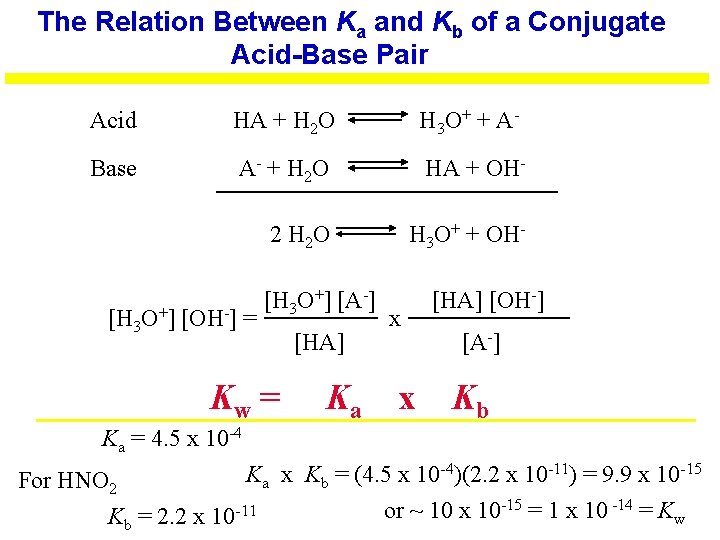
The Relation Between Ka and Kb of a Conjugate Acid-Base Pair Acid HA + H 2 O H 3 O + + A - Base A- + H 2 O HA + OH- 2 H 2 O H 3 O+ + OH- [H 3 O+] [OH-] = [H 3 O+] [A-] Kw = [HA] Ka x x [HA] [OH-] [A-] Kb Ka = 4. 5 x 10 -4 For HNO 2 Ka x Kb = (4. 5 x 10 -4)(2. 2 x 10 -11) = 9. 9 x 10 -15 Kb = 2. 2 x 10 -11 or ~ 10 x 10 -15 = 1 x 10 -14 = Kw
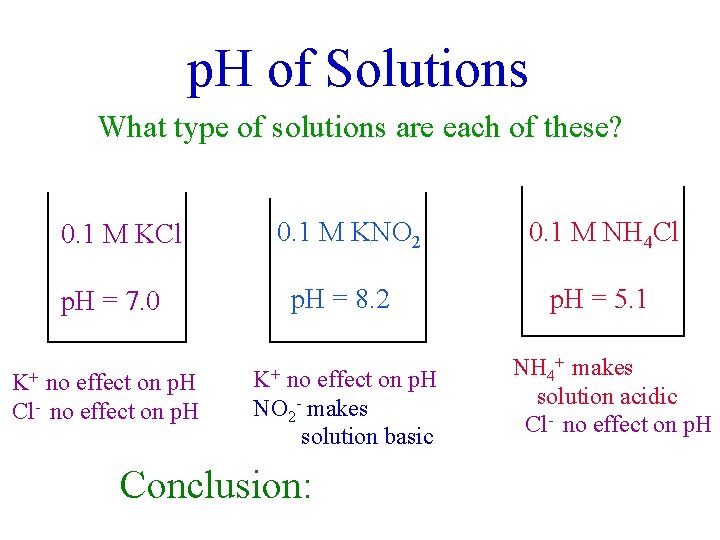
p. H of Solutions What type of solutions are each of these? 0. 1 M KCl 0. 1 M KNO 2 p. H = 8. 2 p. H = 7. 0 K+ no effect on p. H Cl- no effect on p. H K+ no effect on p. H NO 2 - makes solution basic Conclusion: 0. 1 M NH 4 Cl p. H = 5. 1 NH 4+ makes solution acidic Cl- no effect on p. H
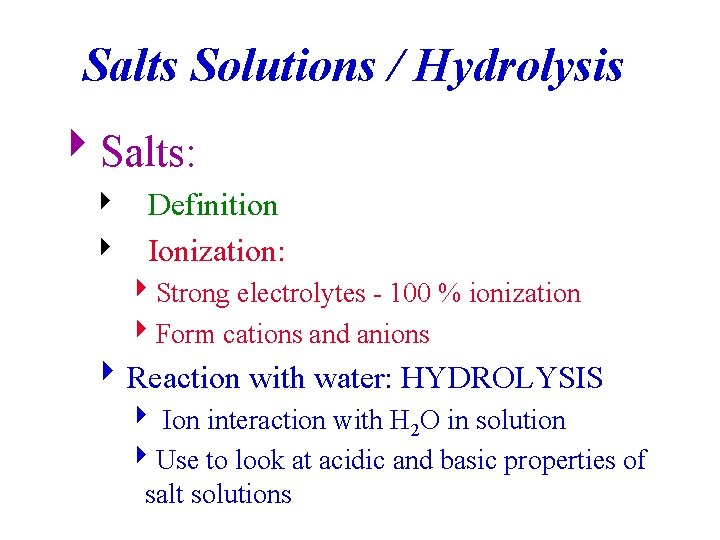
Salts Solutions / Hydrolysis 4 Salts: 4 Definition 4 Ionization: 4 Strong electrolytes - 100 % ionization 4 Form cations and anions 4 Reaction with water: HYDROLYSIS 4 Ion interaction with H 2 O in solution 4 Use to look at acidic and basic properties of salt solutions
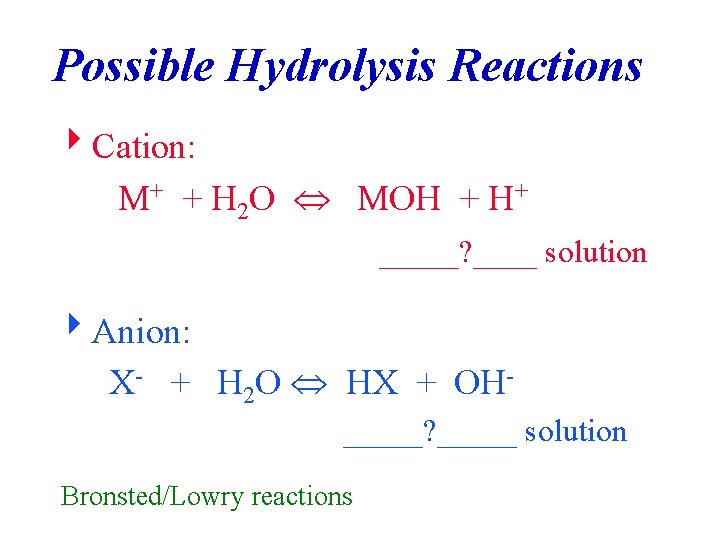
Possible Hydrolysis Reactions 4 Cation: M+ + H 2 O MOH + H+ _____? ____ solution 4 Anion: X- + H 2 O HX + OH_____? _____ solution Bronsted/Lowry reactions
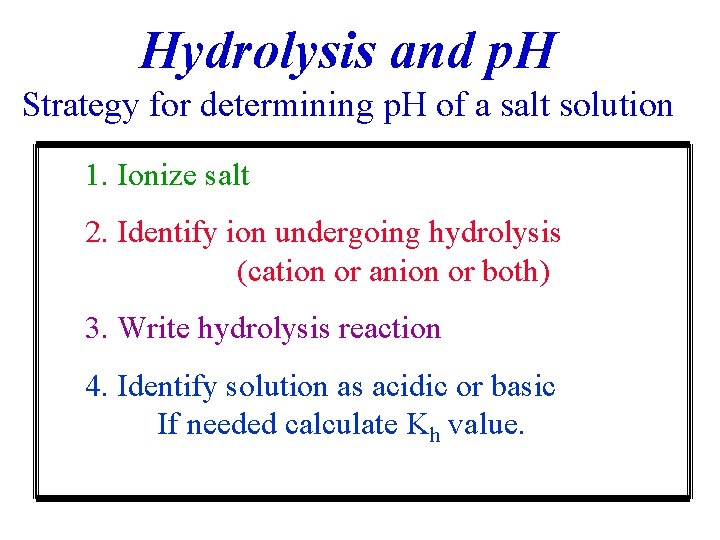
Hydrolysis and p. H Strategy for determining p. H of a salt solution 1. Ionize salt 2. Identify ion undergoing hydrolysis (cation or anion or both) 3. Write hydrolysis reaction 4. Identify solution as acidic or basic If needed calculate Kh value.
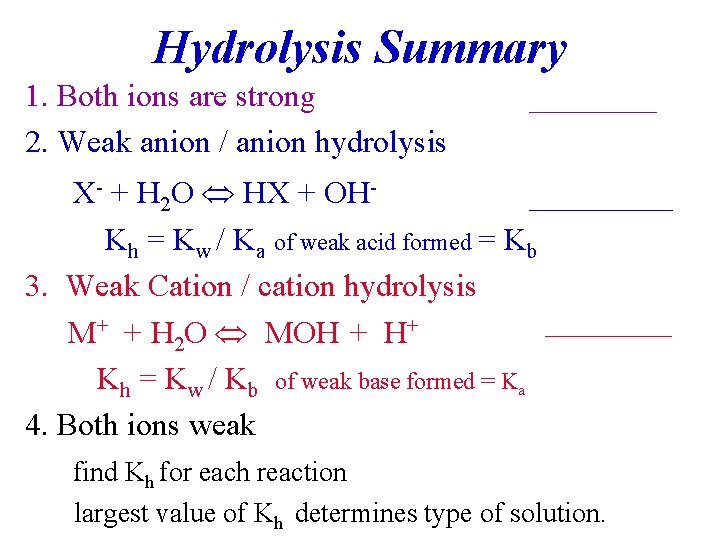
Hydrolysis Summary 1. Both ions are strong 2. Weak anion / anion hydrolysis ____ X- + H 2 O HX + OH____ Kh = Kw / Ka of weak acid formed = Kb 3. Weak Cation / cation hydrolysis ______ M+ + H 2 O MOH + H+ Kh = Kw / Kb of weak base formed = Ka 4. Both ions weak find Kh for each reaction largest value of Kh determines type of solution.
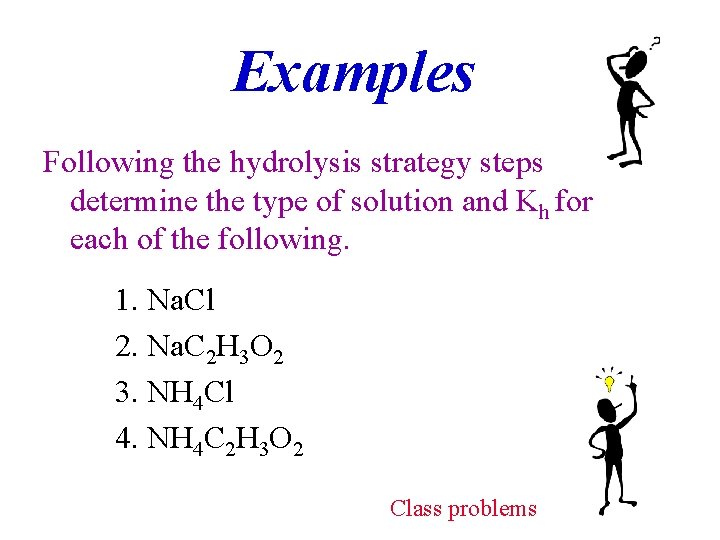
Examples Following the hydrolysis strategy steps determine the type of solution and Kh for each of the following. 1. Na. Cl 2. Na. C 2 H 3 O 2 3. NH 4 Cl 4. NH 4 C 2 H 3 O 2 Class problems
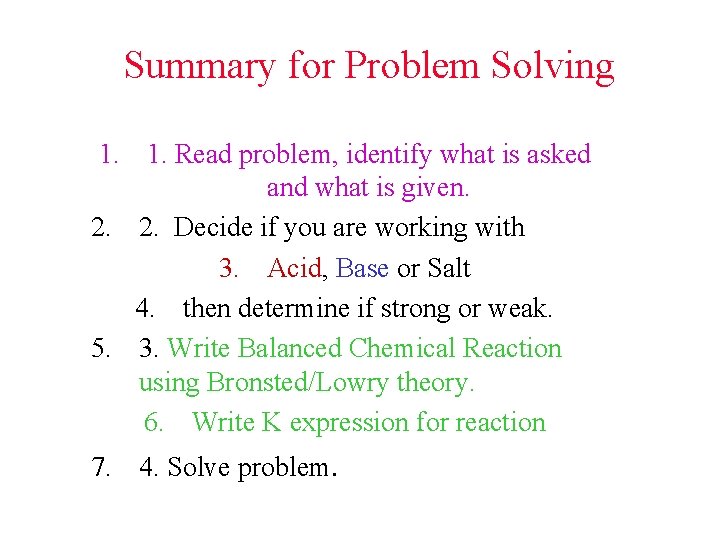
Summary for Problem Solving 1. 1. Read problem, identify what is asked and what is given. 2. 2. Decide if you are working with 3. Acid, Base or Salt 4. then determine if strong or weak. 5. 3. Write Balanced Chemical Reaction using Bronsted/Lowry theory. 6. Write K expression for reaction 7. 4. Solve problem.
- Slides: 32