
Todays Goals Assignment Read pg 260 266 Do
- Slides: 14
Today’s Goals Assignment: Read pg 260 -266 Do: In text pg 266 1 -8. n n n Learn to think more like a chemist Learn to describe chemical changes Learn the shorthand language chemists use and how to translate it. Learn what a chemical reaction is. Learn what chemical equations really mean.
Today is a day of Words Some are normal, some are weird and some are changed to shorthand. Our copy color today is green.
Here’s some: Leggio wins!! Bills win? ? Brinclhof I bring clay for our new home. Horses need oats for clear brown eyes. Have no fear of ice cold beer.
What’s dis? mmmmmm foamy! Another one! Can you describe this?
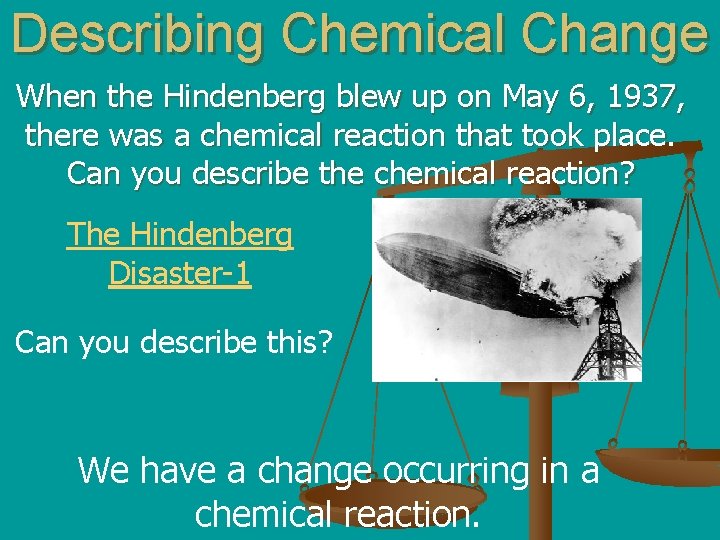
Describing Chemical Change When the Hindenberg blew up on May 6, 1937, there was a chemical reaction that took place. Can you describe the chemical reaction? The Hindenberg Disaster-1 Can you describe this? We have a change occurring in a chemical reaction.
Chemical changes occur during chemical reactions. But----What is a chemical reaction? A chemical reaction is the process by which one or more substances change into one or more new substances whose chemical and physical properties differ from those of the original substances. How are chemical reactions described in chemistry? With shorthand!! Let’s see this
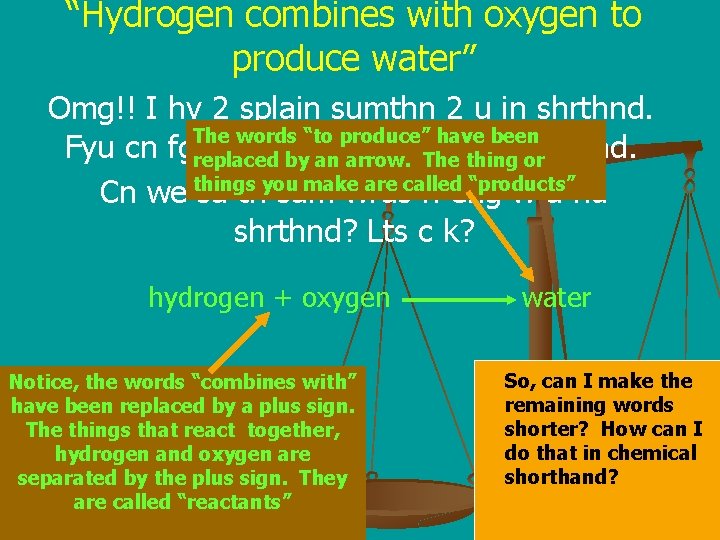
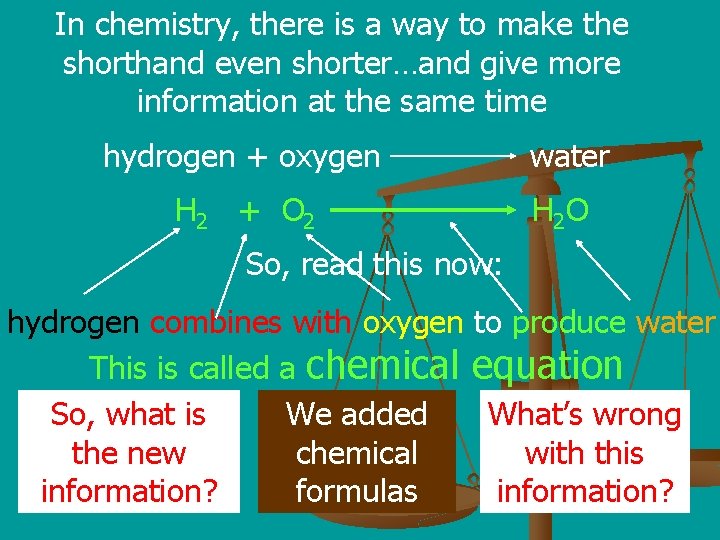
“Hydrogen combines with oxygen to produce water” Omg!! I hv 2 splain sumthn 2 u in shrthnd. The words “to produce” have been Fyu cn fgre it out u arrow. wl lern replaced by an Thekem thing shrthnd. or make are called “products” Cn we things sa thyou sam wrds n eng w a nu shrthnd? Lts c k? hydrogen + oxygen Notice, the words “combines with” have been replaced by a plus sign. The things that react together, hydrogen and oxygen are separated by the plus sign. They are called “reactants” water So, can I make the remaining words shorter? How can I do that in chemical shorthand?
A point of clarification: Please take note of what the equation doesn’t mean. The arrow does not mean the chemicals go anywhere. They are “mixing” in one place (in this case the air). So at the beginning you have hydrogen and oxygen, and at the end all of the hydrogen and all of the oxygen in the container were used up to make the water. The arrow has to do with time and activity more than location.
In chemistry, there is a way to make the shorthand even shorter…and give more information at the same time hydrogen + oxygen H 2 + O 2 water H 2 O So, read this now: hydrogen combines with oxygen to produce water This is called a chemical equation So, what is We added What’s wrong the new chemical with this information? formulas information?
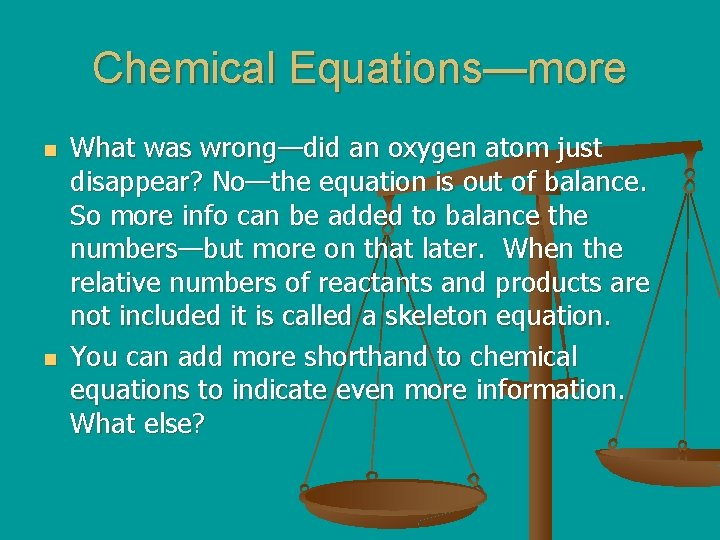
Chemical Equations—more n n What was wrong—did an oxygen atom just disappear? No—the equation is out of balance. So more info can be added to balance the numbers—but more on that later. When the relative numbers of reactants and products are not included it is called a skeleton equation. You can add more shorthand to chemical equations to indicate even more information. What else?
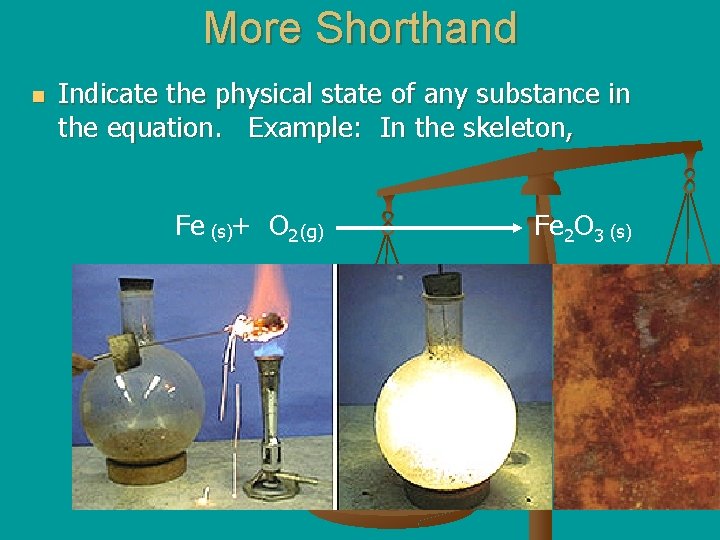
More Shorthand n Indicate the physical state of any substance in the equation. Example: In the skeleton, Fe (s)+ O 2 (g) Fe 2 O 3 (s)
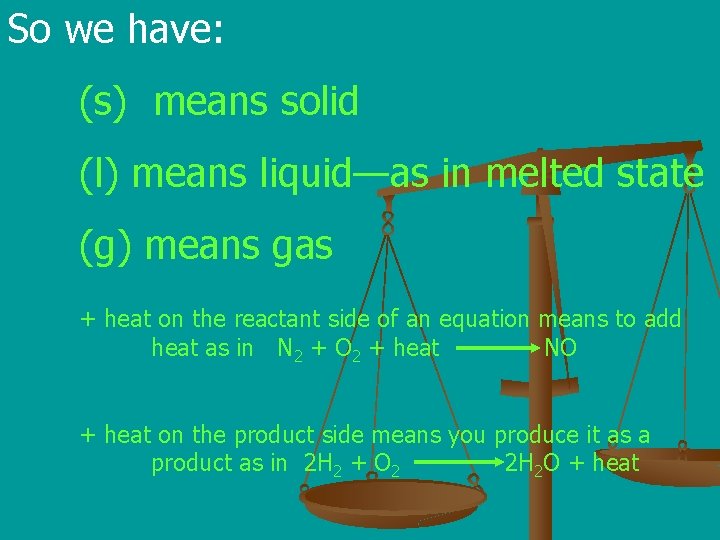
So we have: (s) means solid (l) means liquid—as in melted state (g) means gas + heat on the reactant side of an equation means to add heat as in N 2 + O 2 + heat NO + heat on the product side means you produce it as a product as in 2 H 2 + O 2 2 H 2 O + heat
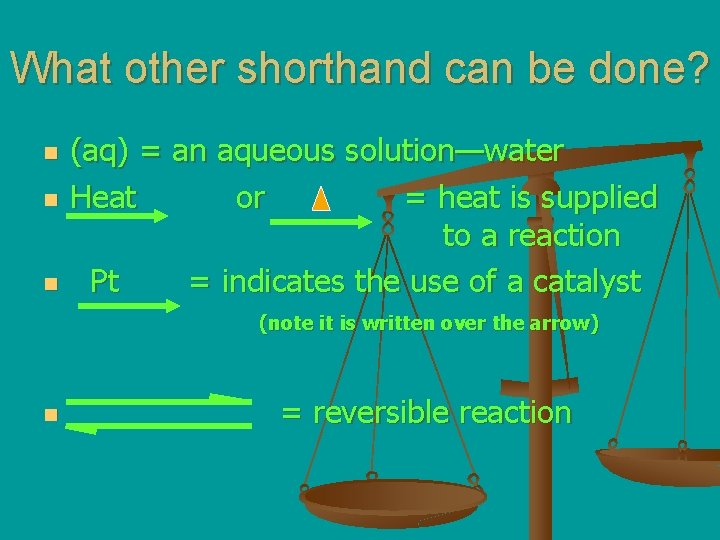
What other shorthand can be done? n n n (aq) = an aqueous solution—water Heat or = heat is supplied to a reaction Pt = indicates the use of a catalyst (note it is written over the arrow) n = reversible reaction
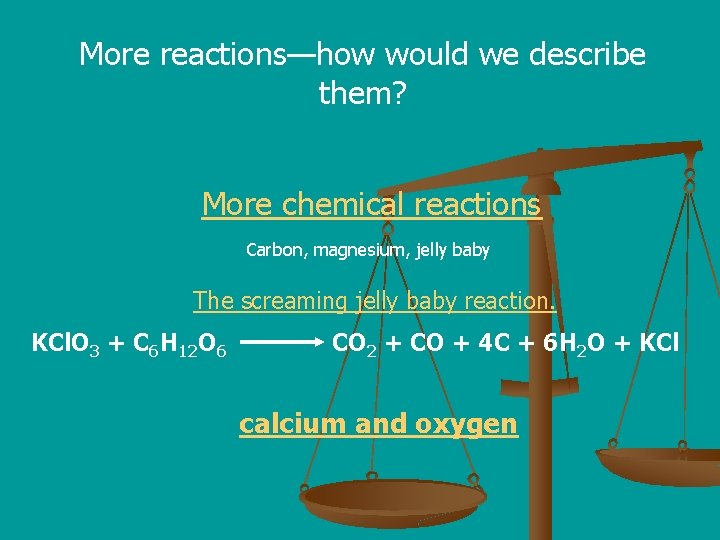
More reactions—how would we describe them? More chemical reactions Carbon, magnesium, jelly baby The screaming jelly baby reaction. KCl. O 3 + C 6 H 12 O 6 CO 2 + CO + 4 C + 6 H 2 O + KCl calcium and oxygen