Introduction to Nuclear physics The nucleus a complex

- Slides: 43
Introduction to Nuclear physics; The nucleus a complex system Héloïse Goutte CEA, DAM, DIF Heloise. goutte@cea. fr Héloïse Goutte CERN Summer student program 2009
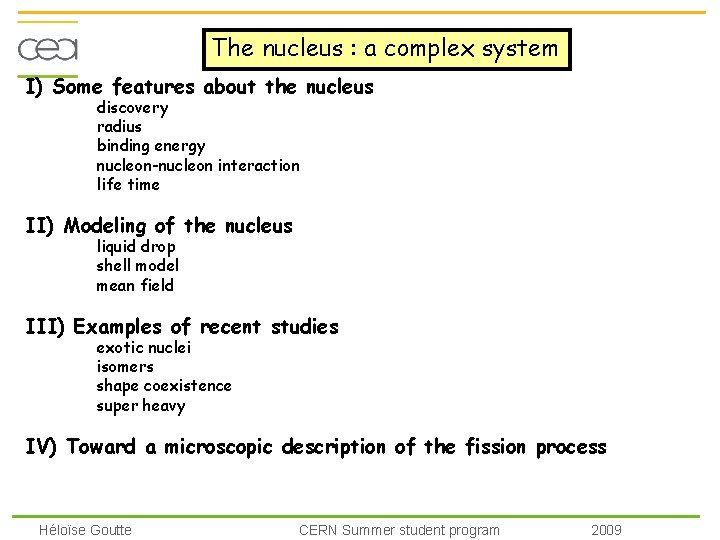
The nucleus : a complex system I) Some features about the nucleus discovery radius binding energy nucleon-nucleon interaction life time II) Modeling of the nucleus liquid drop shell model mean field III) Examples of recent studies exotic nuclei isomers shape coexistence super heavy IV) Toward a microscopic description of the fission process Héloïse Goutte CERN Summer student program 2009
IV) Nuclear fission Héloïse Goutte CERN Summer student program 2009
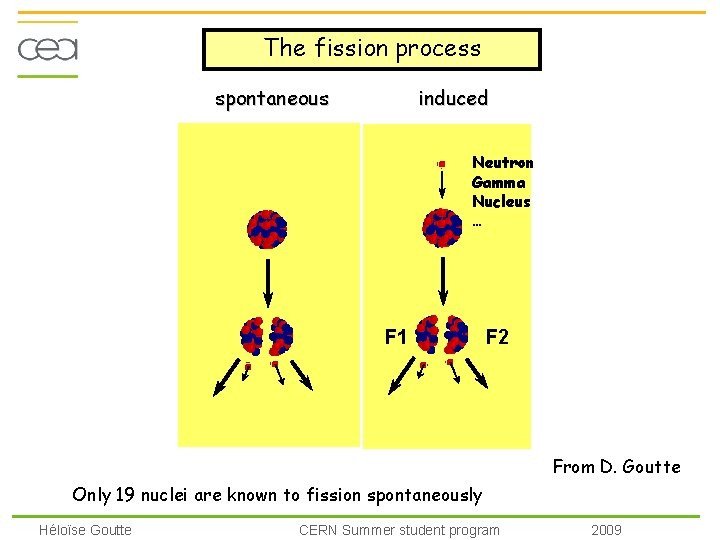
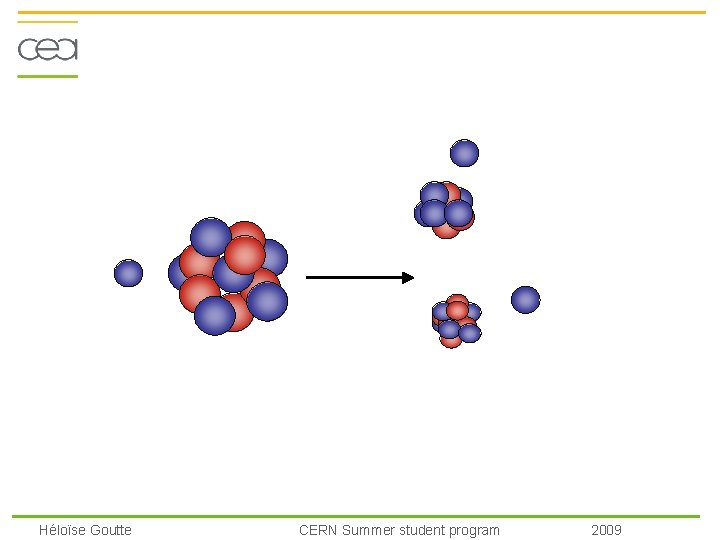
The fission process spontaneous induced Neutron Gamma Nucleus … F 1 F 2 From D. Goutte Only 19 nuclei are known to fission spontaneously Héloïse Goutte CERN Summer student program 2009
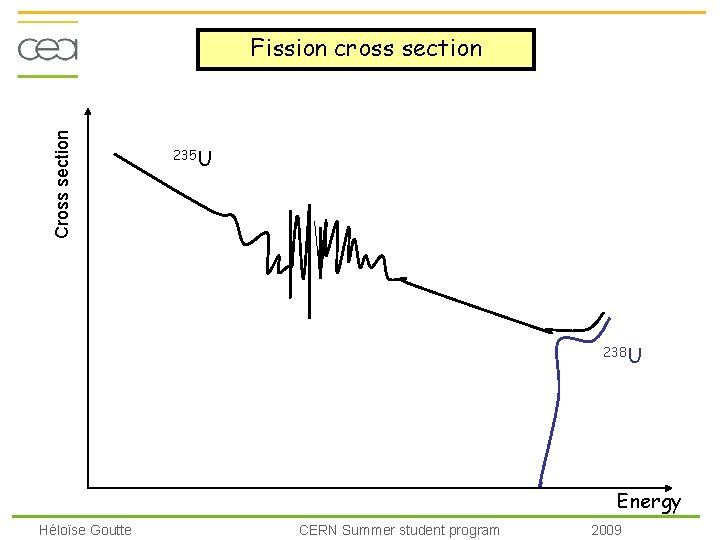
Cross section Fission cross section 235 U 238 U Energy Héloïse Goutte CERN Summer student program 2009
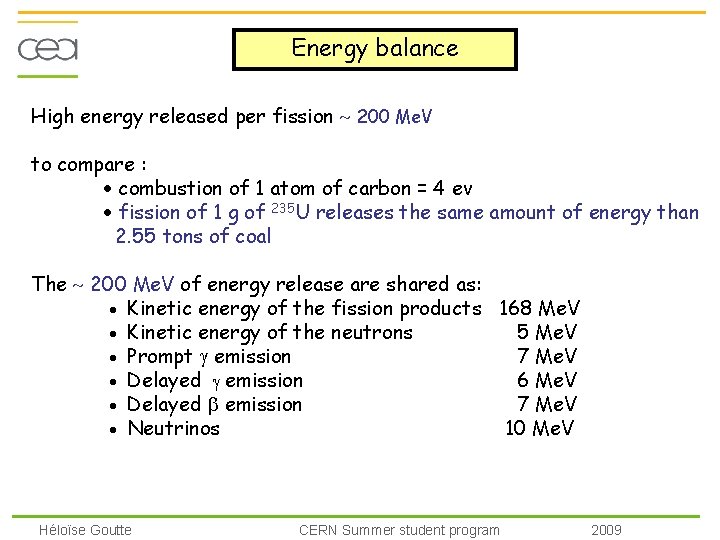
Energy balance High energy released per fission 200 Me. V to compare : combustion of 1 atom of carbon = 4 ev fission of 1 g of 235 U releases the same amount of energy than 2. 55 tons of coal The 200 Me. V of energy release are shared as: Kinetic energy of the fission products 168 Me. V Kinetic energy of the neutrons 5 Me. V Prompt emission 7 Me. V Delayed emission 6 Me. V Delayed emission 7 Me. V Neutrinos 10 Me. V Héloïse Goutte CERN Summer student program 2009
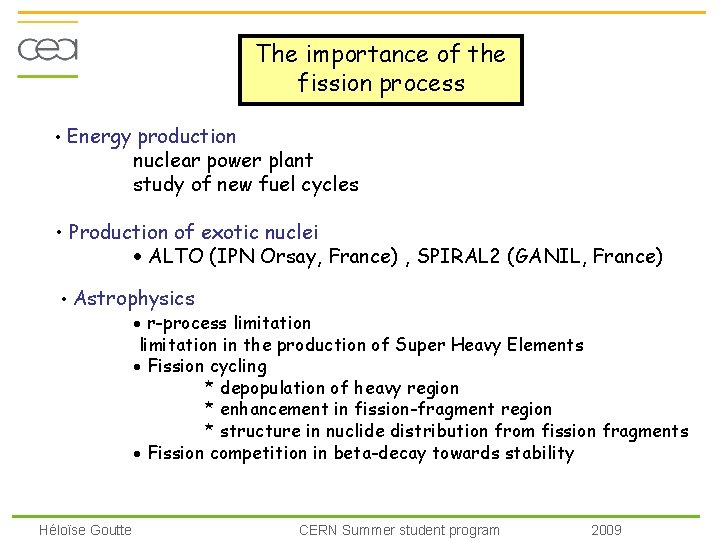
The importance of the fission process • Energy production nuclear power plant study of new fuel cycles • Production of exotic nuclei ALTO (IPN Orsay, France) , SPIRAL 2 (GANIL, France) • Astrophysics r-process limitation in the production of Super Heavy Elements Fission cycling * depopulation of heavy region * enhancement in fission-fragment region * structure in nuclide distribution from fission fragments Fission competition in beta-decay towards stability Héloïse Goutte CERN Summer student program 2009
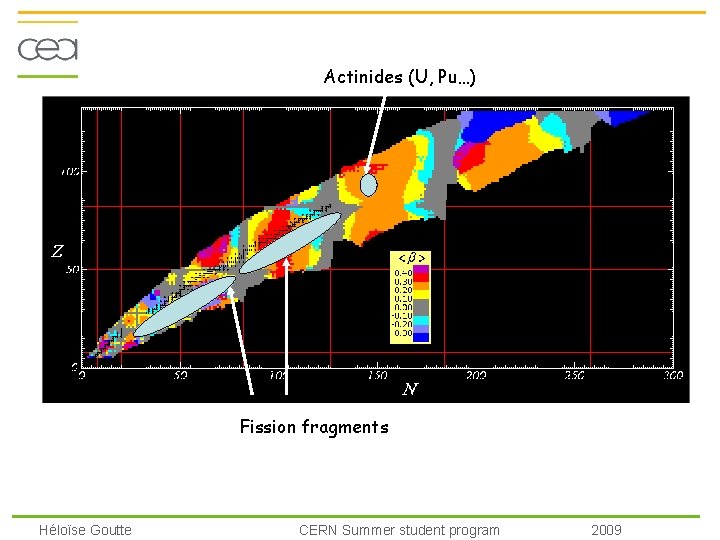
Actinides (U, Pu…) Fission fragments Héloïse Goutte CERN Summer student program 2009
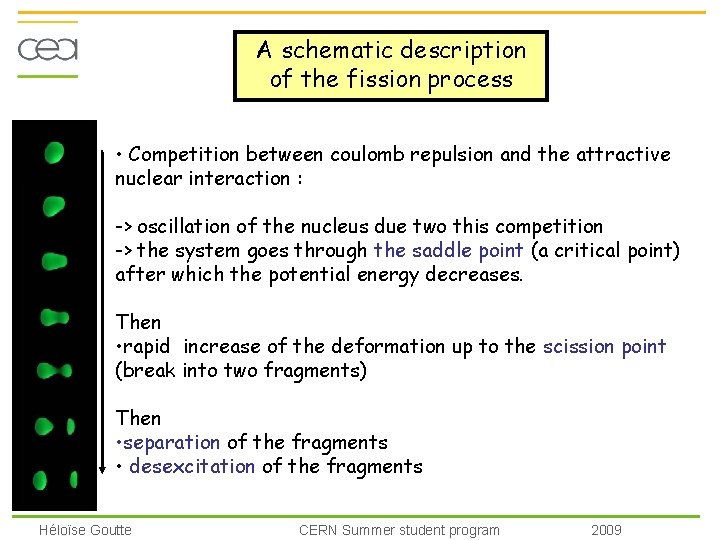
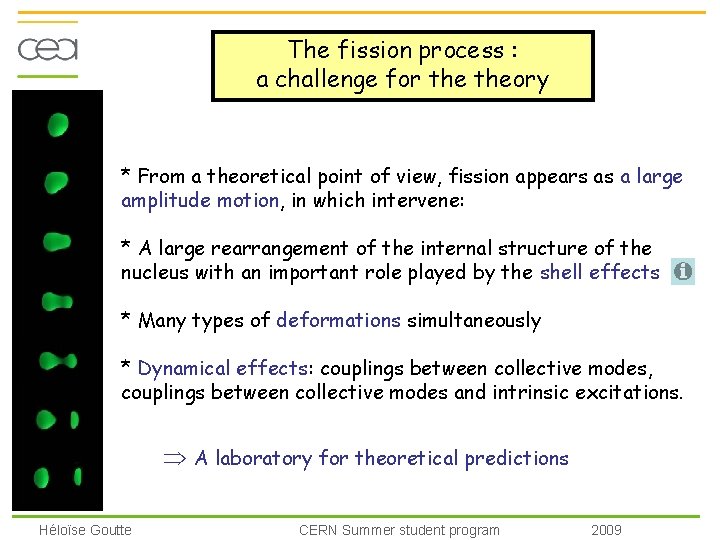
A schematic description of the fission process • Competition between coulomb repulsion and the attractive nuclear interaction : -> oscillation of the nucleus due two this competition -> the system goes through the saddle point (a critical point) after which the potential energy decreases. Then • rapid increase of the deformation up to the scission point (break into two fragments) Then • separation of the fragments • desexcitation of the fragments Héloïse Goutte CERN Summer student program 2009
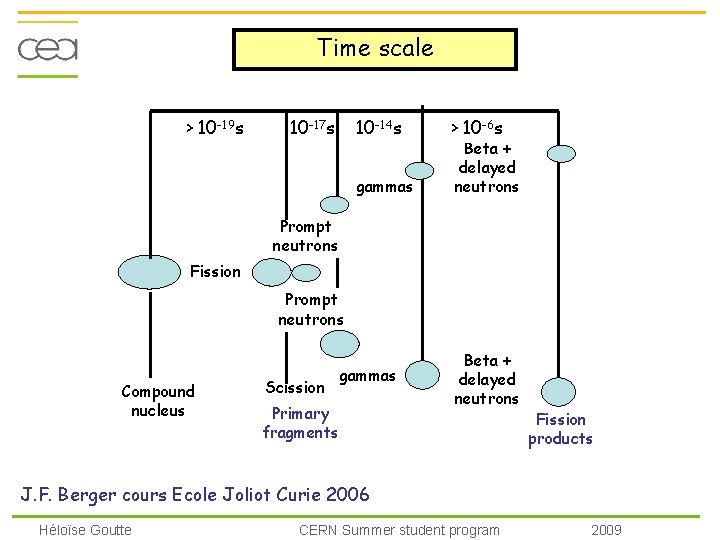
Time scale > 10 -19 s 10 -17 s 10 -14 s gammas > 10 -6 s Beta + delayed neutrons Prompt neutrons Fission Prompt neutrons Compound nucleus Scission gammas Primary fragments Beta + delayed neutrons Fission products J. F. Berger cours Ecole Joliot Curie 2006 Héloïse Goutte CERN Summer student program 2009
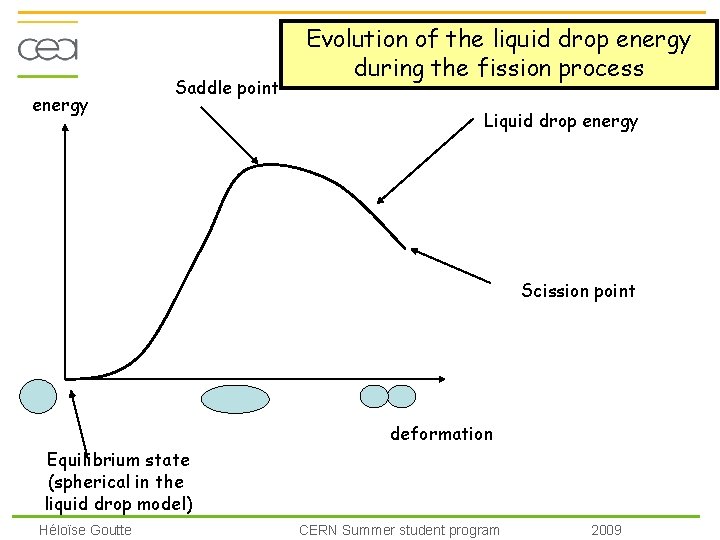
energy Saddle point Evolution of the liquid drop energy during the fission process Liquid drop energy Scission point deformation Equilibrium state (spherical in the liquid drop model) Héloïse Goutte CERN Summer student program 2009
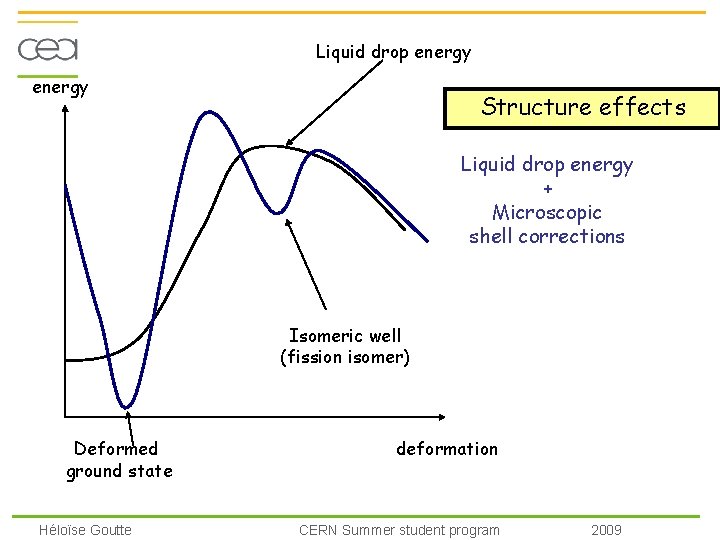
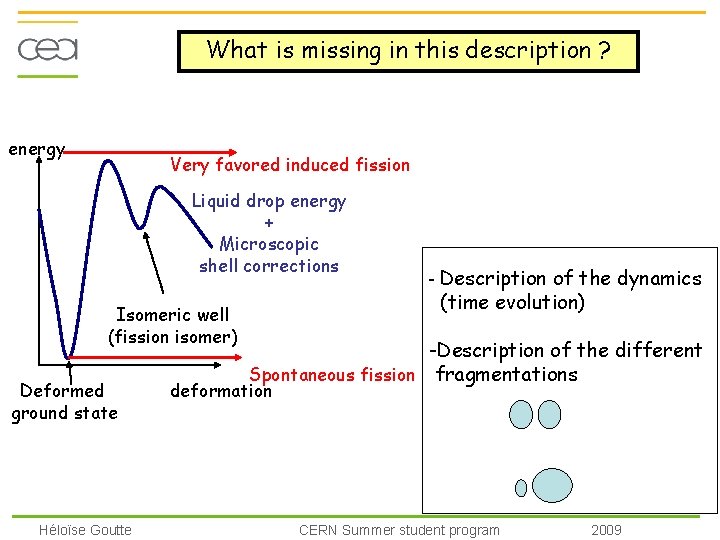
Liquid drop energy Structure effects Liquid drop energy + Microscopic shell corrections Isomeric well (fission isomer) Deformed ground state Héloïse Goutte deformation CERN Summer student program 2009
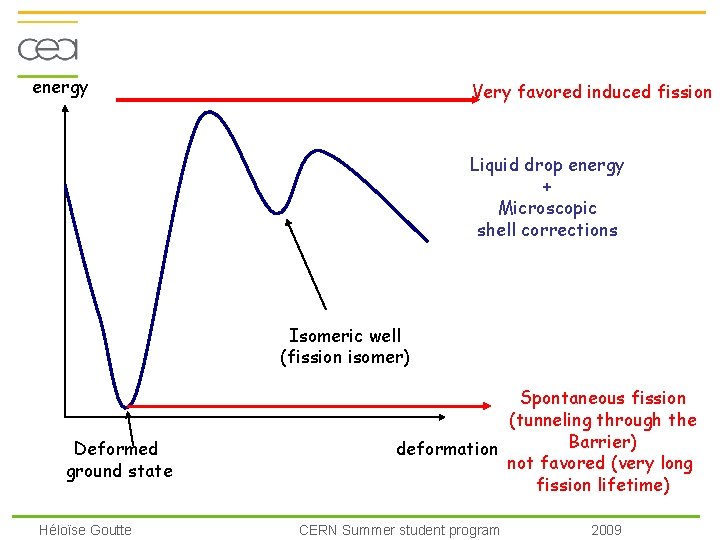
energy Very favored induced fission Liquid drop energy + Microscopic shell corrections Isomeric well (fission isomer) Deformed ground state Héloïse Goutte Spontaneous fission (tunneling through the Barrier) deformation not favored (very long fission lifetime) CERN Summer student program 2009
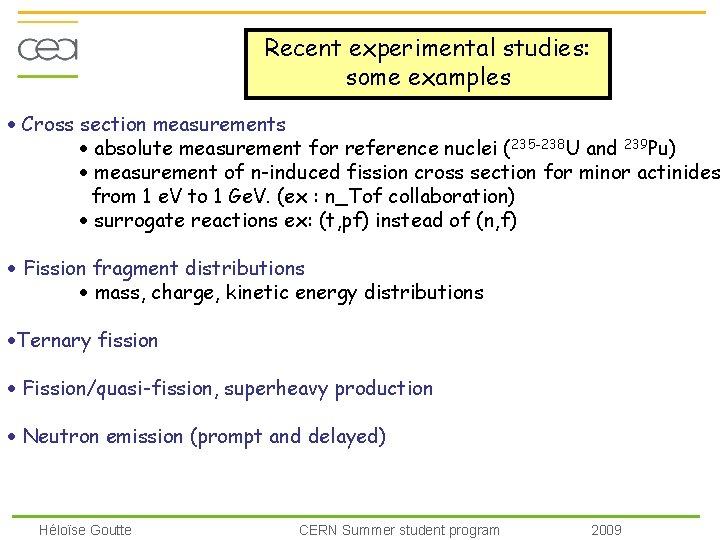
Recent experimental studies: some examples Cross section measurements absolute measurement for reference nuclei (235 -238 U and 239 Pu) measurement of n-induced fission cross section for minor actinides from 1 e. V to 1 Ge. V. (ex : n_Tof collaboration) surrogate reactions ex: (t, pf) instead of (n, f) Fission fragment distributions mass, charge, kinetic energy distributions Ternary fission Fission/quasi-fission, superheavy production Neutron emission (prompt and delayed) Héloïse Goutte CERN Summer student program 2009
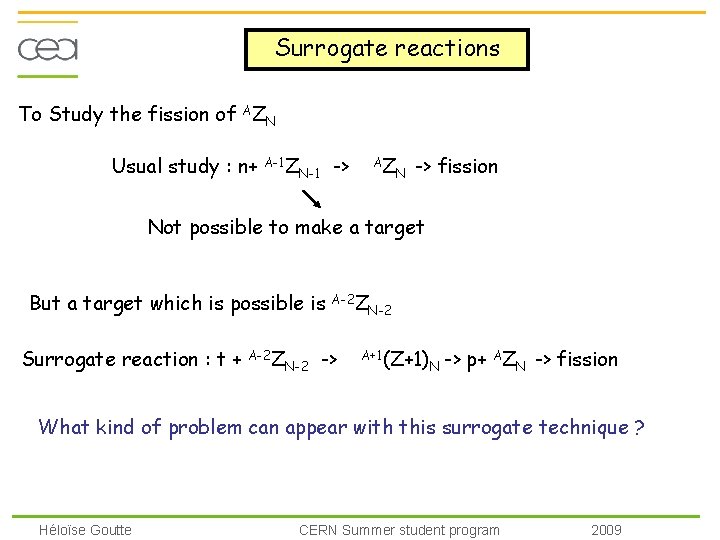
Surrogate reactions To Study the fission of AZN Usual study : n+ A-1 Z N-1 -> AZ N -> fission Not possible to make a target But a target which is possible is A-2 ZN-2 Surrogate reaction : t + A-2 Z N-2 -> A+1(Z+1) N -> p+ AZN -> fission What kind of problem can appear with this surrogate technique ? Héloïse Goutte CERN Summer student program 2009
Héloïse Goutte CERN Summer student program 2009
The fission process : a challenge for theory * From a theoretical point of view, fission appears as a large amplitude motion, in which intervene: * A large rearrangement of the internal structure of the nucleus with an important role played by the shell effects * Many types of deformations simultaneously * Dynamical effects: couplings between collective modes, couplings between collective modes and intrinsic excitations. A laboratory for theoretical predictions Héloïse Goutte CERN Summer student program 2009
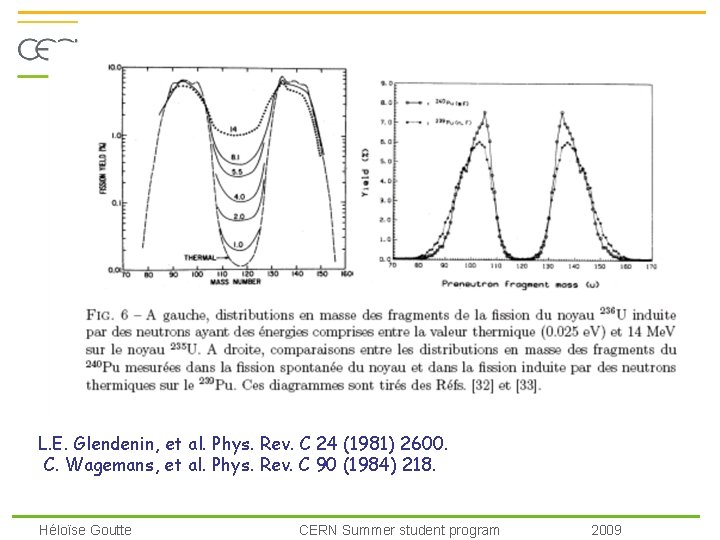
L. E. Glendenin, et al. Phys. Rev. C 24 (1981) 2600. C. Wagemans, et al. Phys. Rev. C 90 (1984) 218. Héloïse Goutte CERN Summer student program 2009
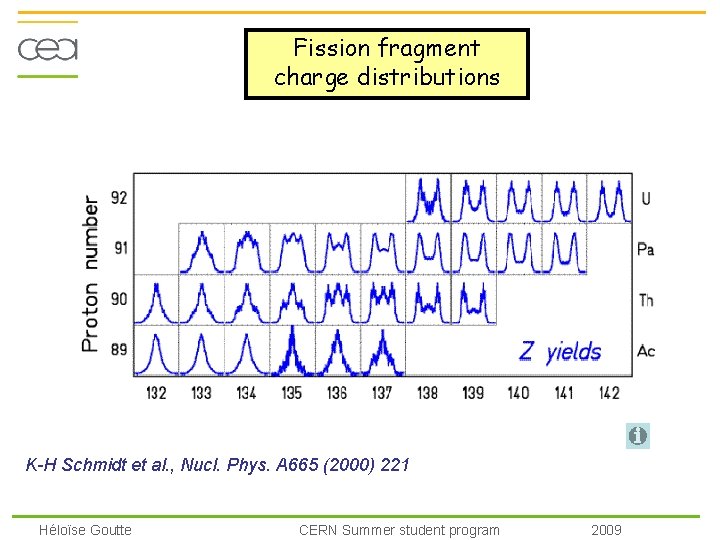
Fission fragment charge distributions K-H Schmidt et al. , Nucl. Phys. A 665 (2000) 221 Héloïse Goutte CERN Summer student program 2009
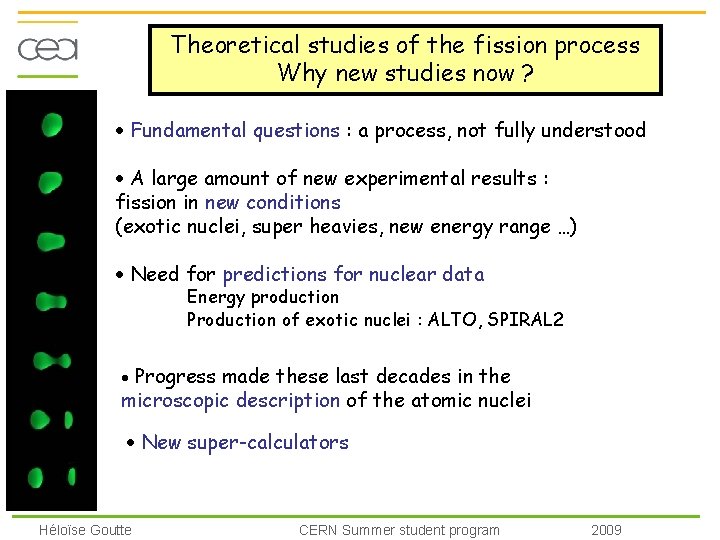
Theoretical studies of the fission process Why new studies now ? Fundamental questions : a process, not fully understood A large amount of new experimental results : fission in new conditions (exotic nuclei, super heavies, new energy range …) Need for predictions for nuclear data Energy production Production of exotic nuclei : ALTO, SPIRAL 2 Progress made these last decades in the microscopic description of the atomic nuclei New super-calculators Héloïse Goutte CERN Summer student program 2009
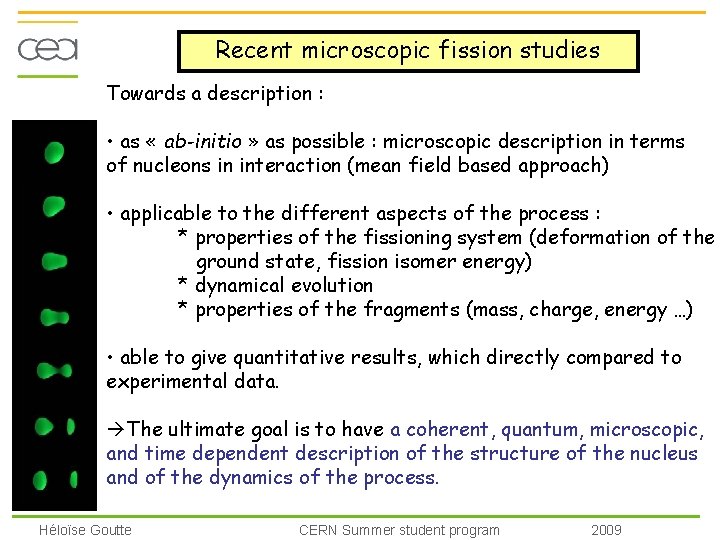
Recent microscopic fission studies Towards a description : • as « ab-initio » as possible : microscopic description in terms of nucleons in interaction (mean field based approach) • applicable to the different aspects of the process : * properties of the fissioning system (deformation of the ground state, fission isomer energy) * dynamical evolution * properties of the fragments (mass, charge, energy …) • able to give quantitative results, which directly compared to experimental data. The ultimate goal is to have a coherent, quantum, microscopic, and time dependent description of the structure of the nucleus and of the dynamics of the process. Héloïse Goutte CERN Summer student program 2009
What is missing in this description ? energy Very favored induced fission Liquid drop energy + Microscopic shell corrections Isomeric well (fission isomer) Deformed ground state Héloïse Goutte - Description of the dynamics (time evolution) -Description of the different Spontaneous fission fragmentations deformation CERN Summer student program 2009
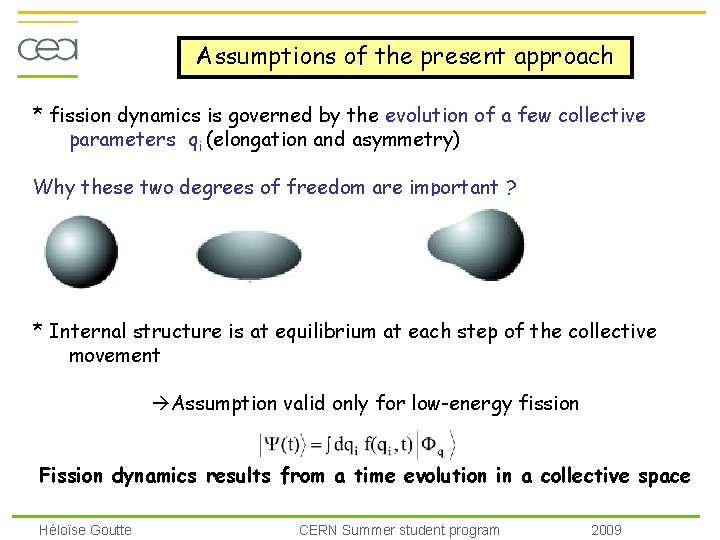
Assumptions of the present approach * fission dynamics is governed by the evolution of a few collective parameters qi (elongation and asymmetry) Why these two degrees of freedom are important ? * Internal structure is at equilibrium at each step of the collective movement Assumption valid only for low-energy fission Fission dynamics results from a time evolution in a collective space Héloïse Goutte CERN Summer student program 2009
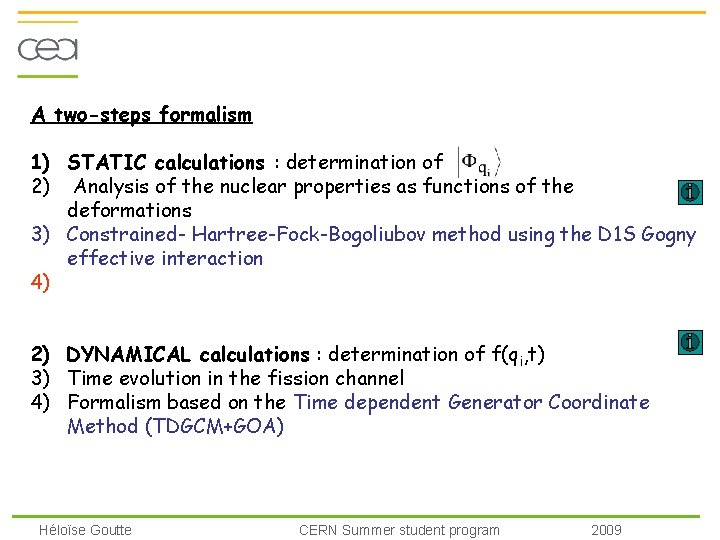
A two-steps formalism 1) STATIC calculations : determination of 2) Analysis of the nuclear properties as functions of the deformations 3) Constrained- Hartree-Fock-Bogoliubov method using the D 1 S Gogny effective interaction 4) 2) DYNAMICAL calculations : determination of f(qi, t) 3) Time evolution in the fission channel 4) Formalism based on the Time dependent Generator Coordinate Method (TDGCM+GOA) Héloïse Goutte CERN Summer student program 2009
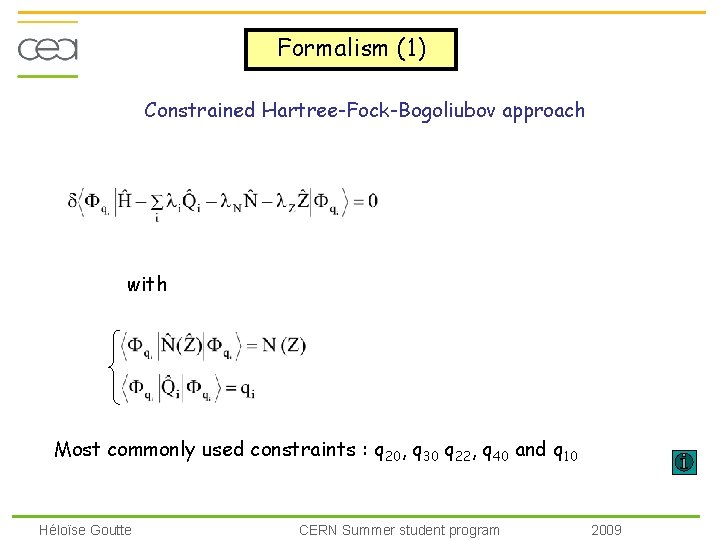
Formalism (1) Constrained Hartree-Fock-Bogoliubov approach with Most commonly used constraints : q 20, q 30 q 22, q 40 and q 10 Héloïse Goutte CERN Summer student program 2009
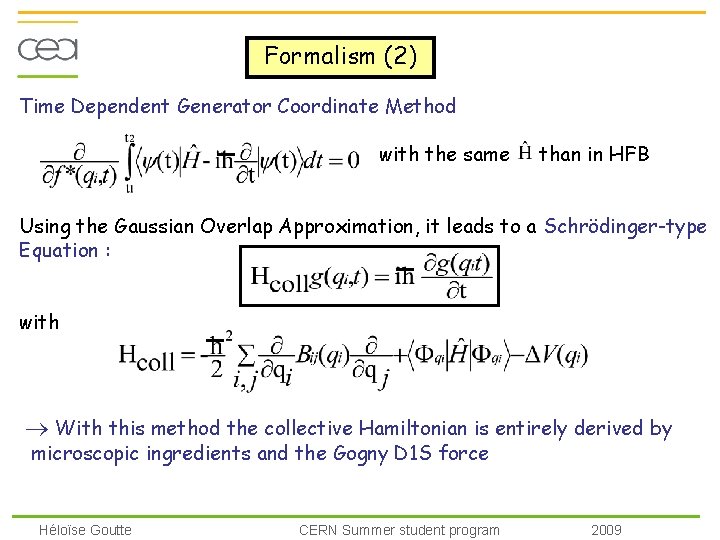
Formalism (2) Time Dependent Generator Coordinate Method with the same than in HFB Using the Gaussian Overlap Approximation, it leads to a Schrödinger-type Equation : with ® With this method the collective Hamiltonian is entirely derived by microscopic ingredients and the Gogny D 1 S force Héloïse Goutte CERN Summer student program 2009
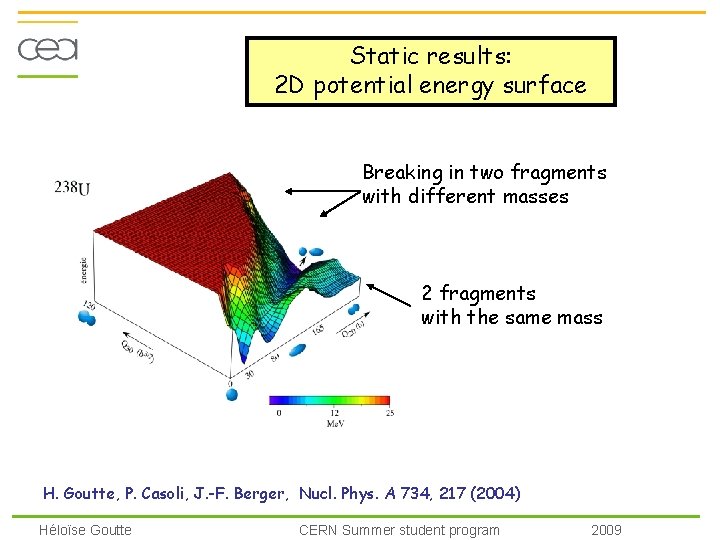
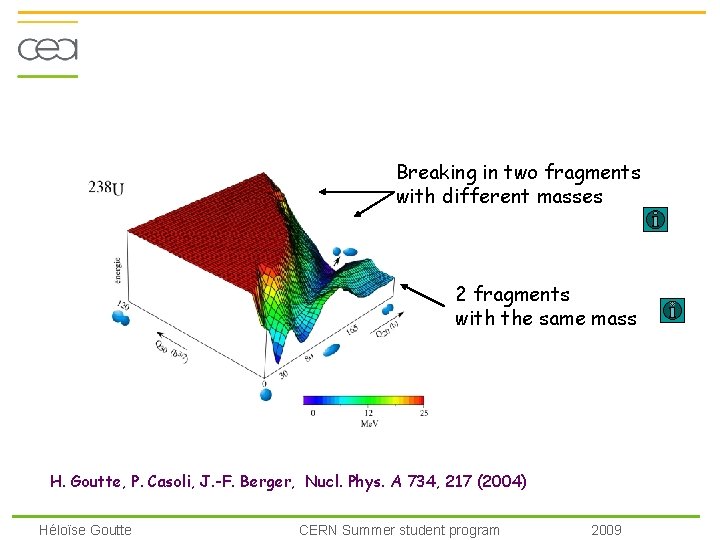
Results 1) Static results: * Properties of the fissioning system potential energy landscape of the fissioning system * Properties of the fragments definition of the scission configurations total kinetic energy deformation number of evaporated neutrons 2) Dynamical results fission fragment mass distributions Héloïse Goutte CERN Summer student program 2009
Static results: 2 D potential energy surface Breaking in two fragments with different masses 2 fragments with the same mass H. Goutte, P. Casoli, J. -F. Berger, Nucl. Phys. A 734, 217 (2004) Héloïse Goutte CERN Summer student program 2009
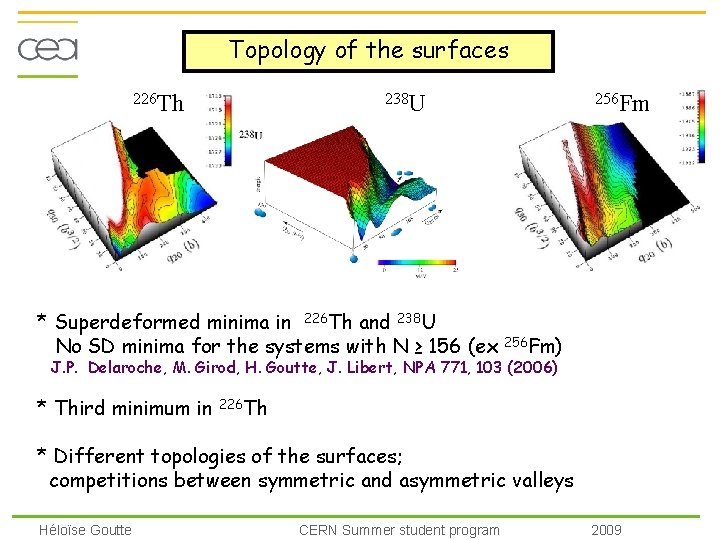
Topology of the surfaces 226 Th 238 U * Superdeformed minima in 226 Th and 238 U No SD minima for the systems with N ≥ 156 (ex 256 Fm) J. P. Delaroche, M. Girod, H. Goutte, J. Libert, NPA 771, 103 (2006) * Third minimum in 226 Th * Different topologies of the surfaces; competitions between symmetric and asymmetric valleys Héloïse Goutte CERN Summer student program 2009
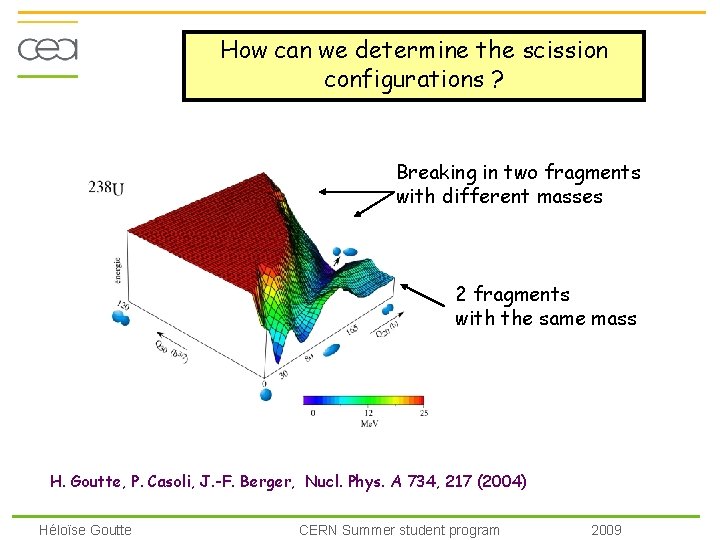
How can we determine the scission configurations ? Breaking in two fragments with different masses 2 fragments with the same mass H. Goutte, P. Casoli, J. -F. Berger, Nucl. Phys. A 734, 217 (2004) Héloïse Goutte CERN Summer student program 2009
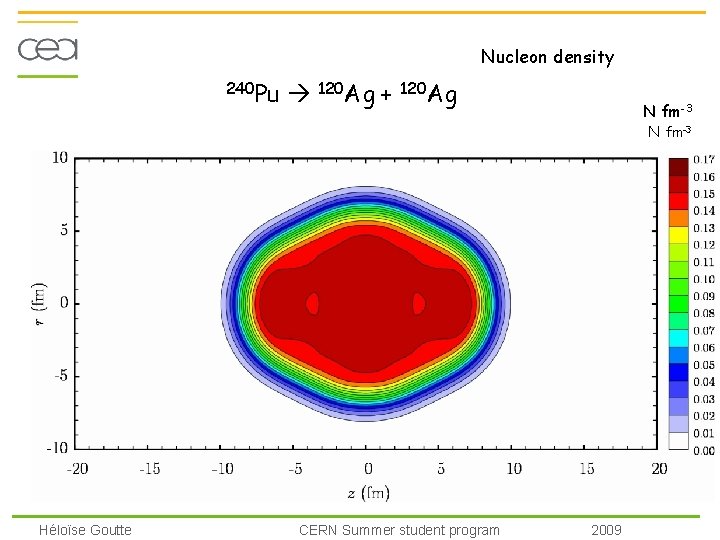
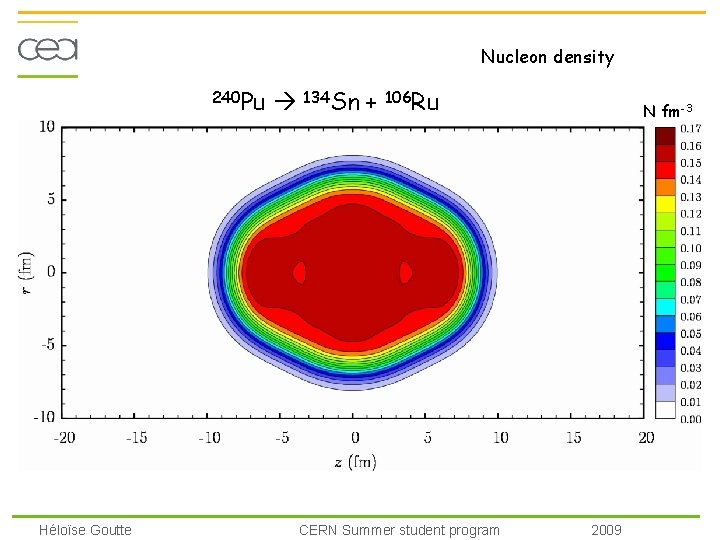
Scission configurations No topological definition of the exit points Different prescriptions : * Enucl less than 1% of Ecoul L. Bonneau et al. , PRC 75 064313 (2007) * “low density” in the neck + energy drop ( 15 Me. V) + decrease of the hexadecapole ( 1/3) J. -F. Berger et al. , NPA 428 23 c (1984) Héloïse Goutte CERN Summer student program 2009
Breaking in two fragments with different masses 2 fragments with the same mass H. Goutte, P. Casoli, J. -F. Berger, Nucl. Phys. A 734, 217 (2004) Héloïse Goutte CERN Summer student program 2009
Nucleon density 240 Pu 120 Ag + 120 Ag N fm-3 Héloïse Goutte CERN Summer student program 2009
Nucleon density 240 Pu 134 Sn + 106 Ru N fm-3 Héloïse Goutte CERN Summer student program 2009
For the different scission configurations we determine : ‣ masses and charges of the fragments, ‣ distance between the fragments ‣ deformations of the fragments, ‣. . . We can derive : ‣ kinetic energy distributions ‣ « 1 D static» mass and charge distributions, ‣ fragment deformation energy, ‣ polarisation of the fragments, ‣. . . Héloïse Goutte CERN Summer student program 2009
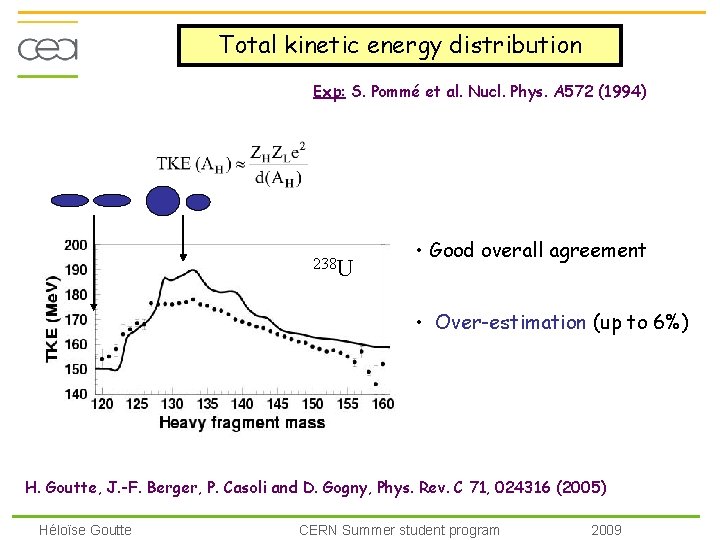
Total kinetic energy distribution Exp: S. Pommé et al. Nucl. Phys. A 572 (1994) 238 U • Good overall agreement • Over-estimation (up to 6%) H. Goutte, J. -F. Berger, P. Casoli and D. Gogny, Phys. Rev. C 71, 024316 (2005) Héloïse Goutte CERN Summer student program 2009
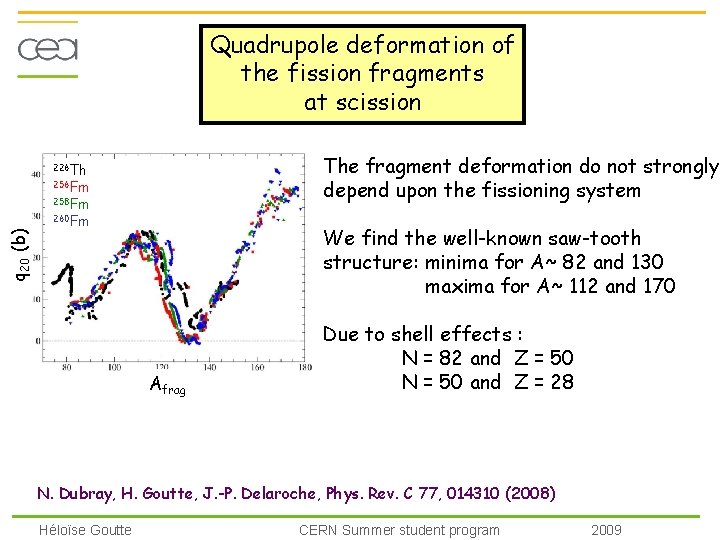
Quadrupole deformation of the fission fragments at scission The fragment deformation do not strongly depend upon the fissioning system 226 Th 256 Fm q 20 (b) 258 Fm 260 Fm We find the well-known saw-tooth structure: minima for A~ 82 and 130 maxima for A~ 112 and 170 Afrag Due to shell effects : N = 82 and Z = 50 N = 50 and Z = 28 N. Dubray, H. Goutte, J. -P. Delaroche, Phys. Rev. C 77, 014310 (2008) Héloïse Goutte CERN Summer student program 2009
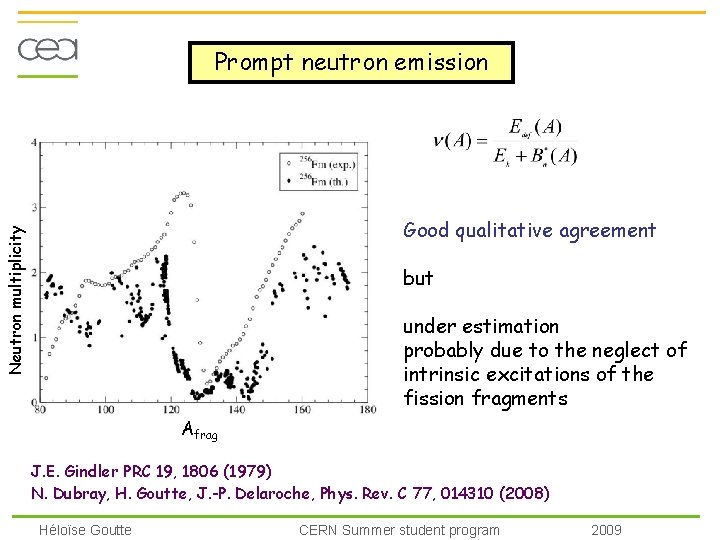
Prompt neutron emission Neutron multiplicity Good qualitative agreement but under estimation probably due to the neglect of intrinsic excitations of the fission fragments Afrag J. E. Gindler PRC 19, 1806 (1979) N. Dubray, H. Goutte, J. -P. Delaroche, Phys. Rev. C 77, 014310 (2008) Héloïse Goutte CERN Summer student program 2009
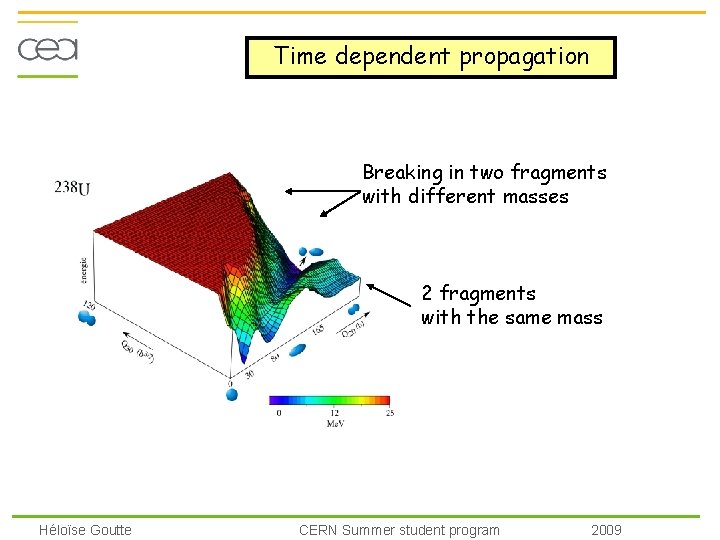
Time dependent propagation Breaking in two fragments with different masses 2 fragments with the same mass Héloïse Goutte CERN Summer student program 2009
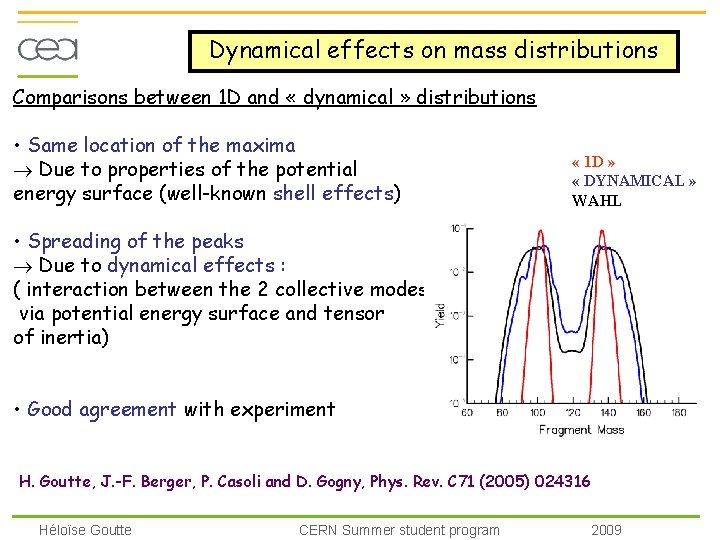
Dynamical effects on mass distributions Comparisons between 1 D and « dynamical » distributions • Same location of the maxima ® Due to properties of the potential energy surface (well-known shell effects) Yield • Spreading of the peaks ® Due to dynamical effects : ( interaction between the 2 collective modes via potential energy surface and tensor of inertia) « 1 D » « DYNAMICAL » WAHL • Good agreement with experiment H. Goutte, J. -F. Berger, P. Casoli and D. Gogny, Phys. Rev. C 71 (2005) 024316 Héloïse Goutte CERN Summer student program 2009
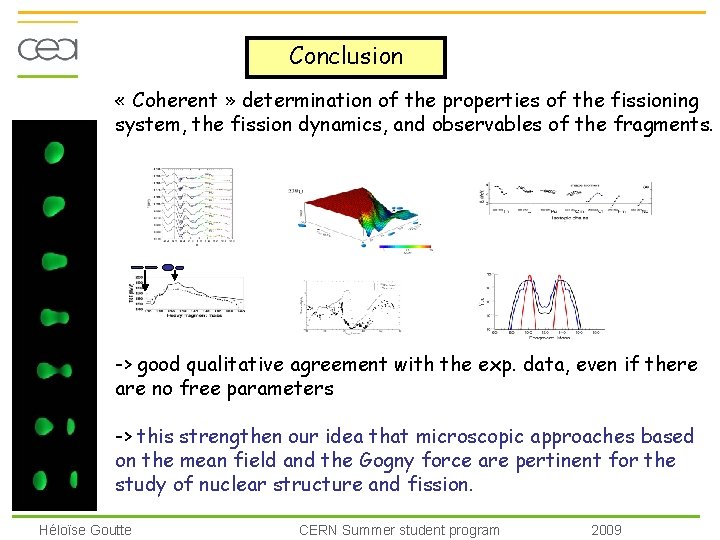
Conclusion « Coherent » determination of the properties of the fissioning system, the fission dynamics, and observables of the fragments. -> good qualitative agreement with the exp. data, even if there are no free parameters -> this strengthen our idea that microscopic approaches based on the mean field and the Gogny force are pertinent for the study of nuclear structure and fission. Héloïse Goutte CERN Summer student program 2009
Experiments important for our studies Static properties of the fissioning systems * spectroscopy of heavy nuclei R. D. Herzberg et al. Nature (London) 442 (2006), 896. Collective dynamics * fission fragment distributions (influence of the incident energy, of the mass of the fissioning system, fission modes, odd-even effects …) Properties of the fragments * measurements correlated in kinetic energy, mass, charge, neutron emission in which each fragment is identified in Z and A. * spectroscopy of the fission fragments -> Need for existing facilities (CERN-n. TOF, ISOLDE, SPIRAL, GSI, ILL, …) and future (FAIR, SPIRAL 2, EURISOL, …) Héloïse Goutte CERN Summer student program 2009
SOME GENERAL CONCLUSIONS ABOUT THE NUCLEAR PHYSICS Current subjects under study in the community (non exhaustive list) * Structure of exotic nuclei * to improve theoretical approaches for the many-body problem * to develop the same approach for both nuclear structure and nuclear reaction (ex: fission process) *… To my opinion, nuclear physics both experimental and theoretical is a very fantastic subject Don’t hesitate to contact me for Ph. D or post doc or any question Heloise. goutte@cea. fr Héloïse Goutte CERN Summer student program 2009