HYPERHIDROSIS A Comprehensive Review Dina Hamadi R N















- Slides: 107
HYPERHIDROSIS: A Comprehensive Review Dina Hamadi, R. N. , B. S. N. Alverno College: Master’s of Science in Nursing
Navigating the Tutorial Ø will take you to the next slide Ø will take you to the previous slide Ø will take you to the home page
Objectives Understand the pathophysiology of sweating Identify diagnostic criteria for Hypherhidrosis Identify treatment options for the Hyperhidrosis patient
Choose the Topic! Ø Sweat glands Ø What makes me sweat? Ø What is Hyperhidrosis? Ø Treatment Options
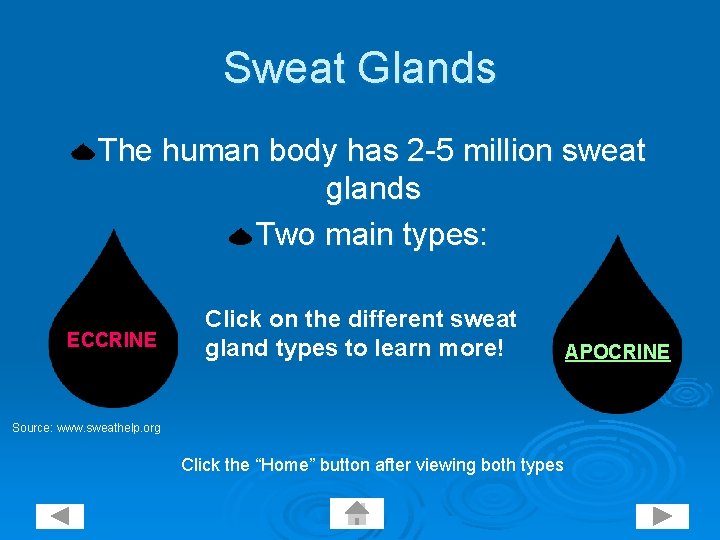
Sweat Glands The human body has 2 -5 million sweat glands Two main types: ECCRINE Click on the different sweat gland types to learn more! Source: www. sweathelp. org Click the “Home” button after viewing both types APOCRINE
Eccrine Sweat Glands Ø Approximately 3 million eccrine sweat glands Ø Secrete a clear, odorless fluid Ø Aid in regulating body temperature Ø Areas of concentration: l Facial, plantar, and axillae Source: www. sweathelp. org CLICK HERE
Apocrine Sweat Glands Inactive until puberty Produce thick fluid Secretions come in contact with bacteria on the skin and produce characteristic “body odor” Found in axillary and genital areas Source: www. sweathelp. org CLICK HERE
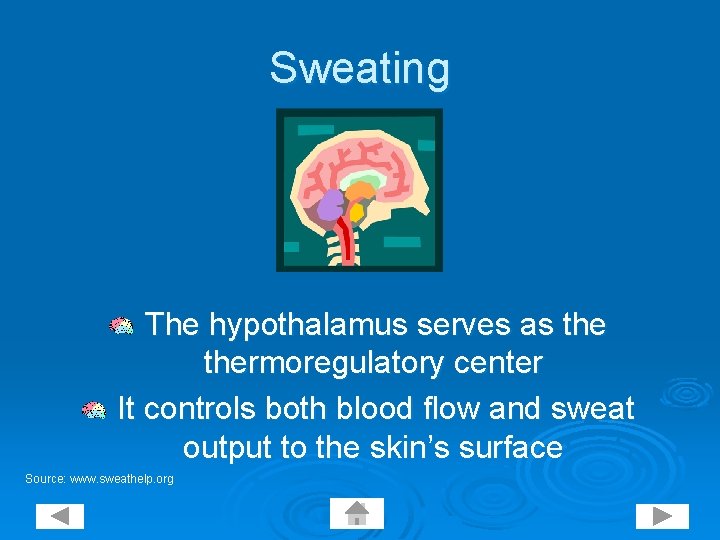
Sweating The hypothalamus serves as thermoregulatory center It controls both blood flow and sweat output to the skin’s surface Source: www. sweathelp. org
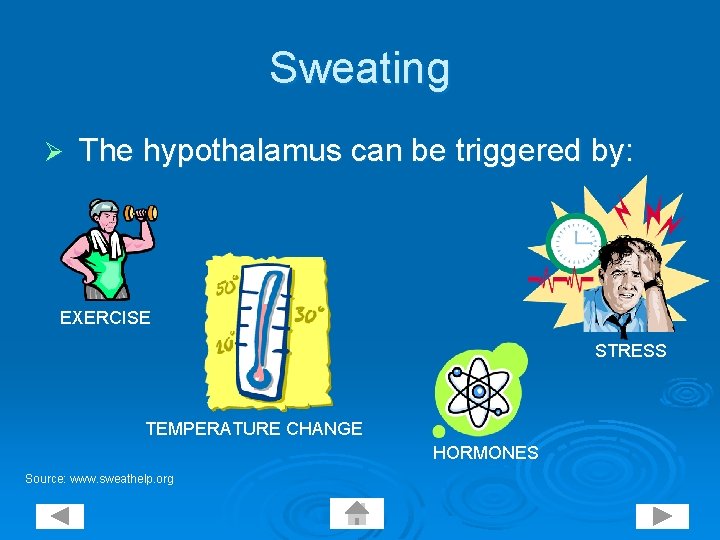
Sweating Ø The hypothalamus can be triggered by: EXERCISE STRESS TEMPERATURE CHANGE HORMONES Source: www. sweathelp. org
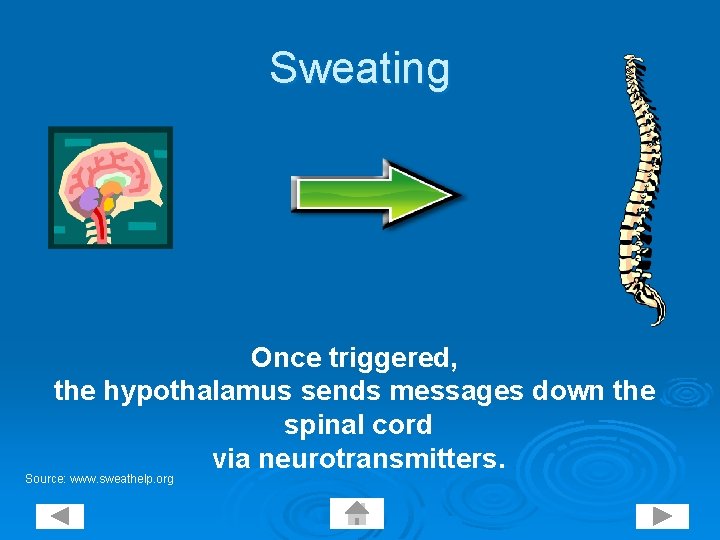
Sweating Once triggered, the hypothalamus sends messages down the spinal cord via neurotransmitters. Source: www. sweathelp. org
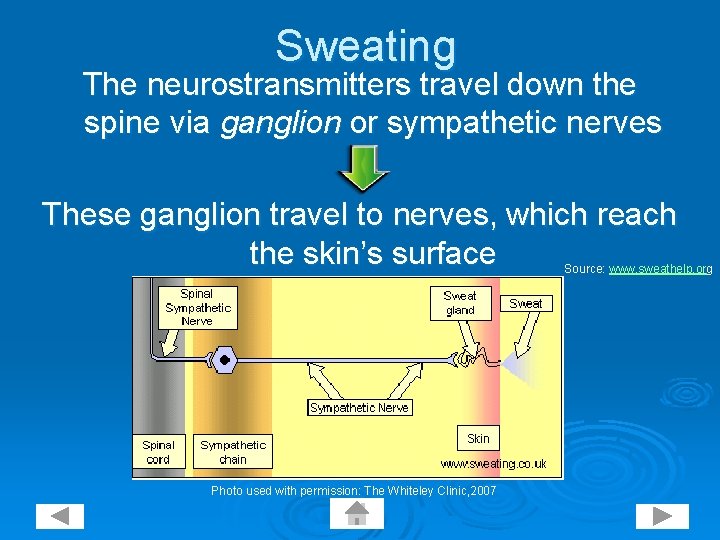
Sweating The neurostransmitters travel down the spine via ganglion or sympathetic nerves These ganglion travel to nerves, which reach the skin’s surface Source: www. sweathelp. org Photo used with permission: The Whiteley Clinic, 2007
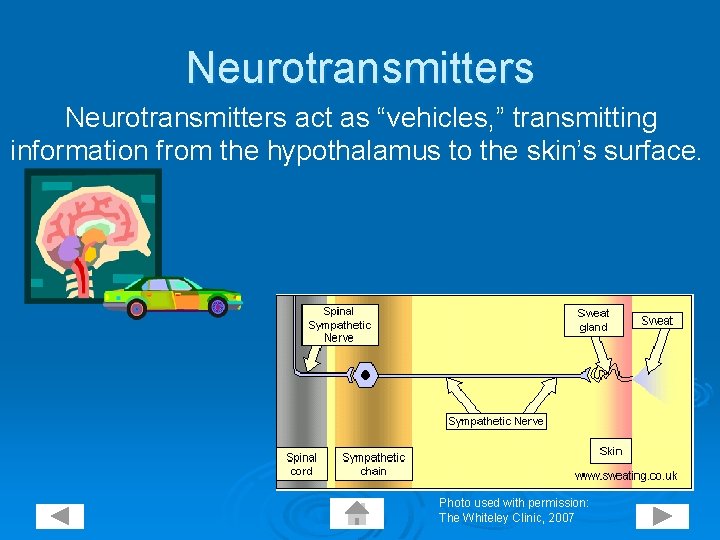
Neurotransmitters act as “vehicles, ” transmitting information from the hypothalamus to the skin’s surface. Photo used with permission: The Whiteley Clinic, 2007
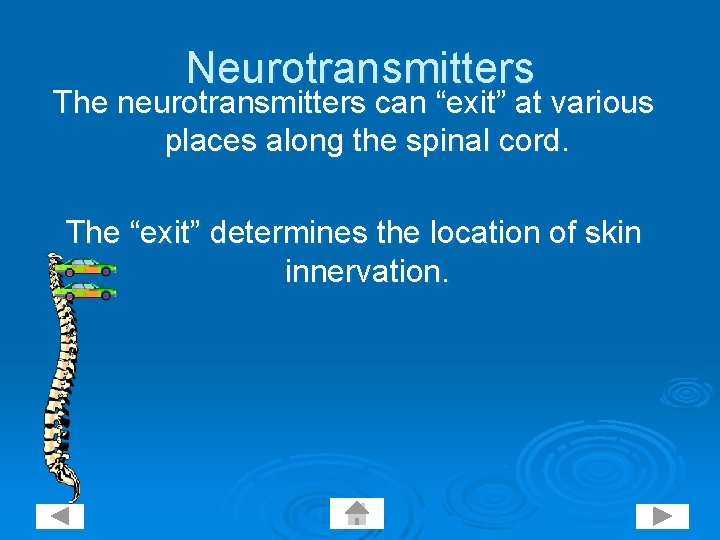
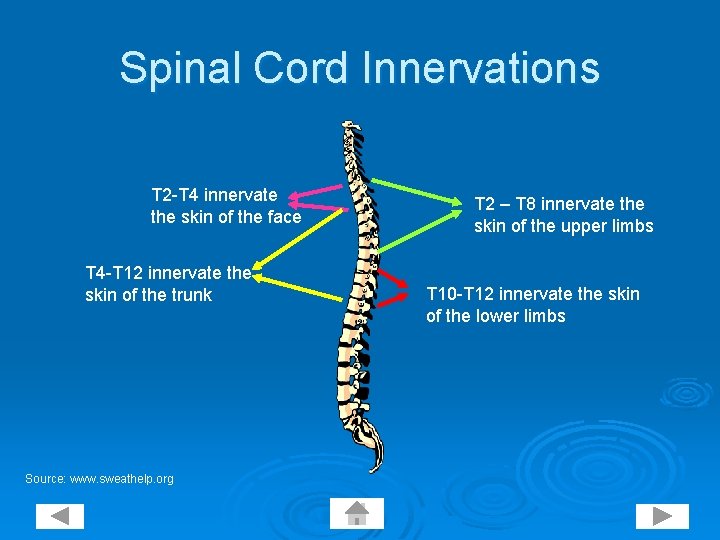
Neurotransmitters The neurotransmitters can “exit” at various places along the spinal cord. The “exit” determines the location of skin innervation.
Spinal Cord Innervations T 2 -T 4 innervate the skin of the face T 4 -T 12 innervate the skin of the trunk Source: www. sweathelp. org T 2 – T 8 innervate the skin of the upper limbs T 10 -T 12 innervate the skin of the lower limbs
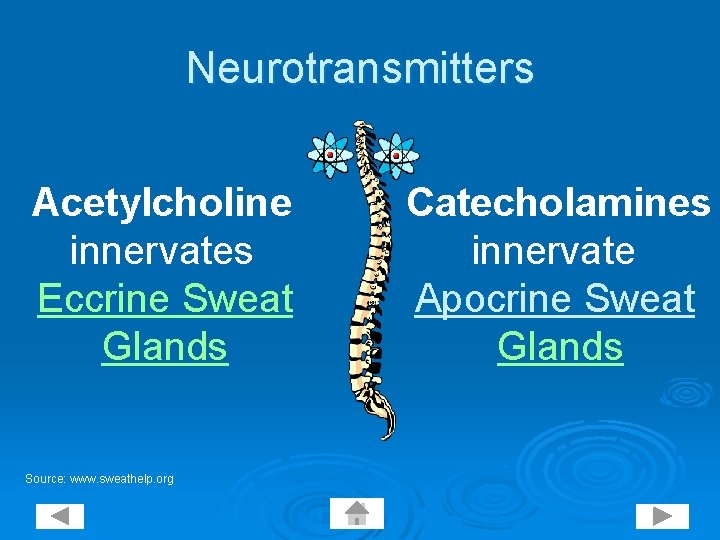
Neurotransmitters Acetylcholine innervates Eccrine Sweat Glands Source: www. sweathelp. org Catecholamines innervate Apocrine Sweat Glands
Sweating Once innervated, the apocrine and eccrine glands will produce …. Source: www. sweathelp. org SWEAT! Click on the picture to take the “Sweating Quiz” Click on the “Home” button to return to the topic choices
Question 1 What serves as the body’s thermoregulatory center? The hypothalamus b. The adrenal cortex c. The frontal lobe a.
CONGRATULATIONS! The hypothalamus regulates sweat output and blood flow to the skin’s surface! Take me to question 2!
SORRY…. TRY AGAIN! What regulates blood flow and sweat output to the skin’s surface? a. The hypothalamus b. The adrenal cortex c. The frontal lobe
Question 2 What neurotransmitter innervates eccrine sweat glands? Acetylcholine b. Catecholamine c. Glucose a.
You’re Right!! Take me to question 3!
Try Again! Hint: Catecholamines innervate apocrine sweat glands! Let me try question 2 again!
Question 3 The hypothalamus can be triggered by all these except: a. Stress b. Exercise c. Obesity d. Temperature change
CORRECT!! You have successfully completed this section of the tutorial. Return home!
Try Again! Return to question 3!
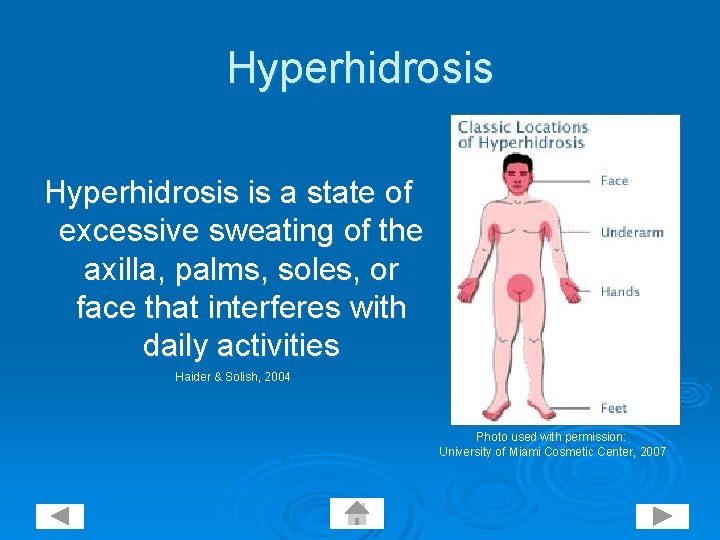
Hyperhidrosis is a state of excessive sweating of the axilla, palms, soles, or face that interferes with daily activities Haider & Solish, 2004 Photo used with permission: University of Miami Cosmetic Center, 2007
Two Types Ø Primary or idiopathic Ø Secondary: Resulting from respiratory/heart failure, malignancy, drug/alcohol abuse, hyperthyroidism, infection Haider & Solish, 2004
Fun Facts Ø Diagnosed in 2. 8% of the U. S. population Ø 70% of those with symptoms do not consult a physician Ø Peaks in early adulthood Haider & Solish, 2004
Diagnostic Criteria: Primary Hyperhidrosis MUST HAVE 1. Focal, visible, excessive sweating 2. 6 months duration 3. No apparent cause TWO OR MORE: 1. Bilateral and symmetric sweating 2. Impairment of daily activities 3. At least one episode per week 4. Onset of less than 25 years 5. Positive family history Hornberger, 2004
What is Hyperhidrosis? Involves the eccrine sweat glands, however: Sweat glands are NORMAL No change in size No change in shape No change in number Haider & Solish, 2004
Cause Ø Exact cause is unknown Ø Familial or genetic? Ø Excessive Sympathetic Activity? Click on the raindrops to learn more about this theory!
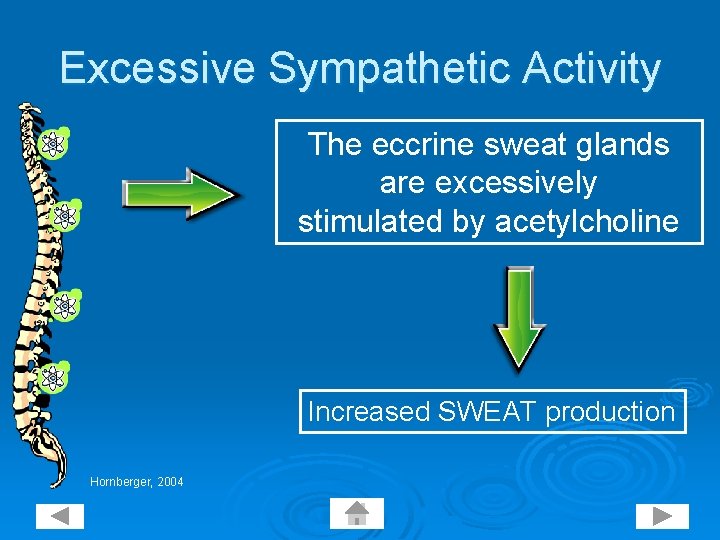
Excessive Sympathetic Activity The eccrine sweat glands are excessively stimulated by acetylcholine Increased SWEAT production Hornberger, 2004
Excessive Sympathetic Activity Because the sweat glands are continuously stimulated, they are stuck in the position Hornberger, 2004
QUIZ TIME! Those diagnosed with hyperhidrosis have abnormal eccrine sweat glands. TRUE FALSE
GOOD JOB! The sweat glands are normal, with no variance in size, shape, or number! Take me to Question 2!
SORRY! Try again…. Click on the sad face to try again!
Question 2 Hyperhidrosis involves which sweat gland type? Apocrine Eccrine
Oops! Take me back to the question!
YES!! Hyperhidrosis involves the eccrine sweat glands! You have successfully completed this section of the tutorial. You may return Home!
Treatment Options Rules to Follow: Different treatment for areas affected Always start with least invasive treatment option
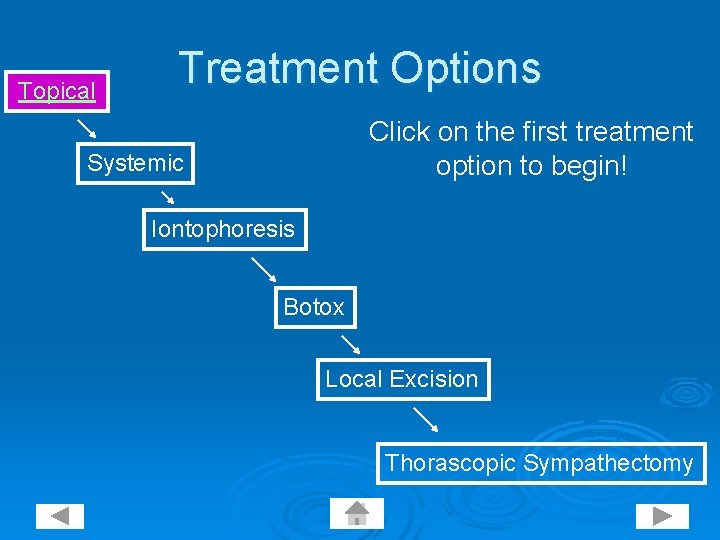
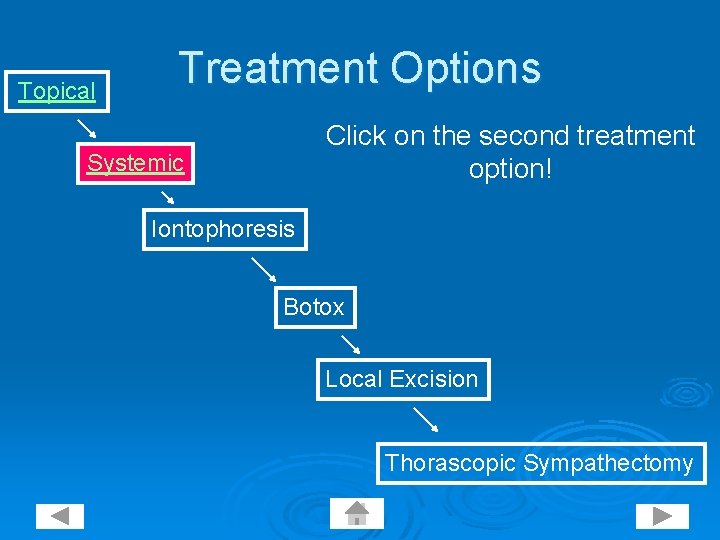
Topical Treatment Options Click on the first treatment option to begin! Systemic Iontophoresis Botox Local Excision Thorascopic Sympathectomy
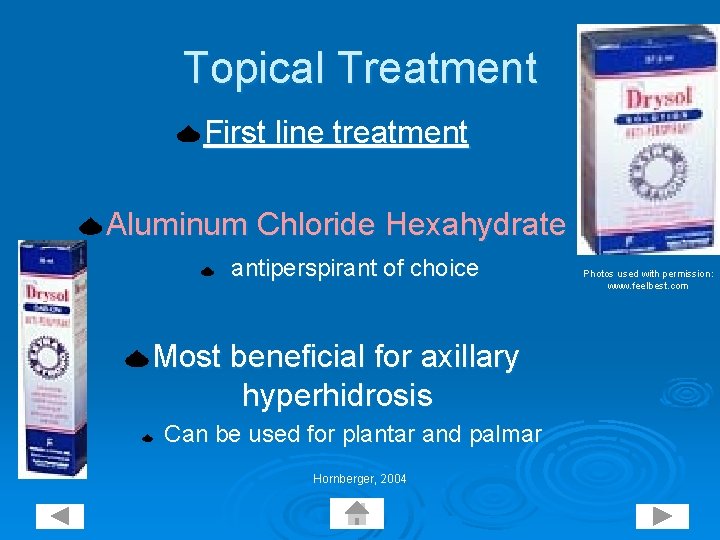
Topical Treatment First line treatment Aluminum Chloride Hexahydrate antiperspirant of choice Most beneficial for axillary hyperhidrosis Can be used for plantar and palmar Hornberger, 2004 Photos used with permission: www. feelbest. com
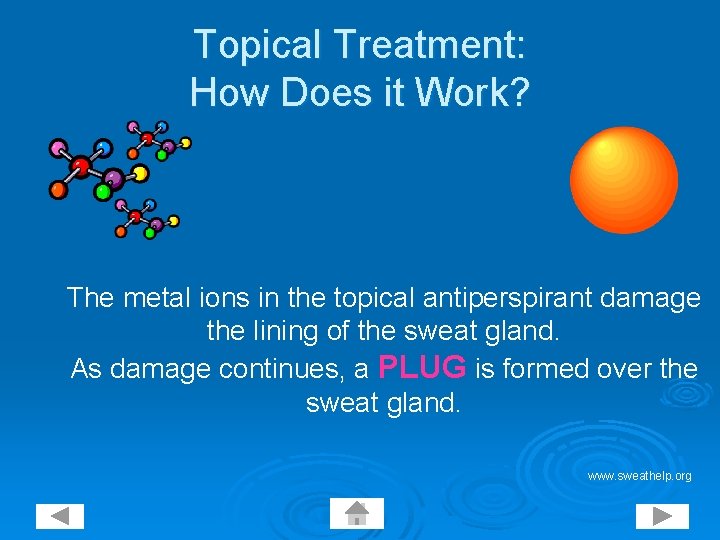
Topical Treatment: How Does it Work? The metal ions in the topical antiperspirant damage the lining of the sweat gland. As damage continues, a PLUG is formed over the sweat gland. www. sweathelp. org
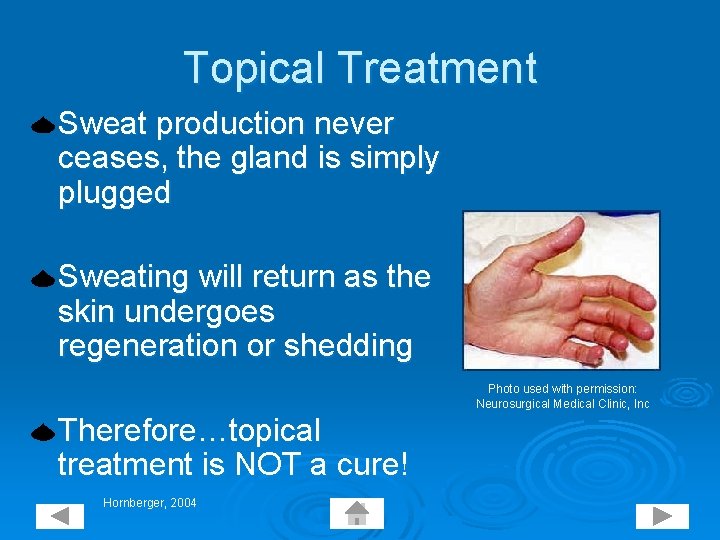
Topical Treatment Sweat production never ceases, the gland is simply plugged Sweating will return as the skin undergoes regeneration or shedding Photo used with permission: Neurosurgical Medical Clinic, Inc Therefore…topical treatment is NOT a cure! Hornberger, 2004
Topical Treatment: How to Use Best to apply before bedtime Allow to remain on skin for 6 – 8 hours Apply every 24 – 48 hours until sweating diminishes Maintenance applications needed every 13 weeks Hornberger, 2004
Topical Treatment: Pros and Cons – n No Hornberger, 2004 a v in e v i s Itch ing and at a bur ppl icat ning o f sk ion Tim in site & e-c ons um Tem ing & por ary reli ef
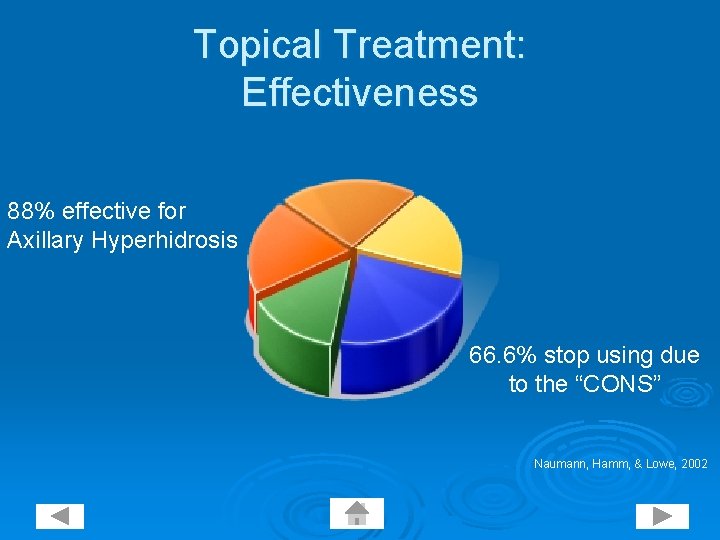
Topical Treatment: Effectiveness 88% effective for Axillary Hyperhidrosis 66. 6% stop using due to the “CONS” Naumann, Hamm, & Lowe, 2002
QUICK REVIEW! Fill in the Blank! Topical Treatments work by ____ sweat glands. Destroying Plugging Melting
That’s Right! Topical Treatments PLUG the sweat gland Take me to the next treatment option!
Sorry! HINT: Sweat production never stops, the output is simply blocked! Take me back to the question!
Topical Treatment Options Click on the second treatment option! Systemic Iontophoresis Botox Local Excision Thorascopic Sympathectomy
Systemic Treatment Anticholinergics can be used in treating hyperhidrosis Most effective for cranio-facial hyerhidrosis Robinul – drug of choice Haider & Solish, 2004
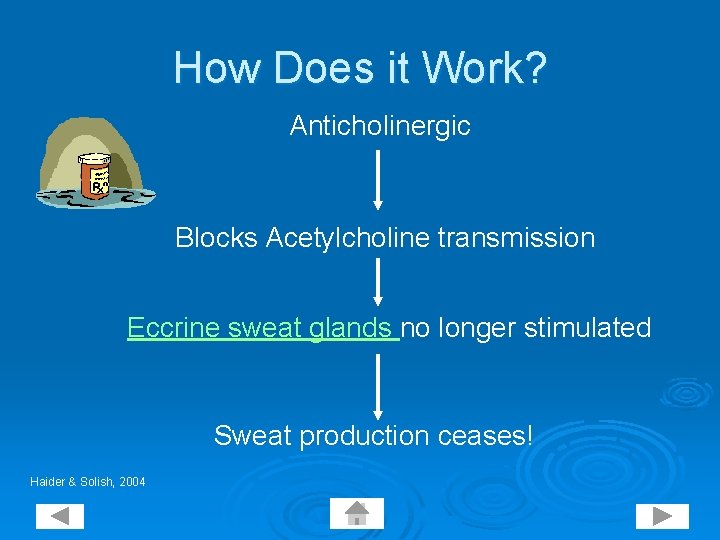
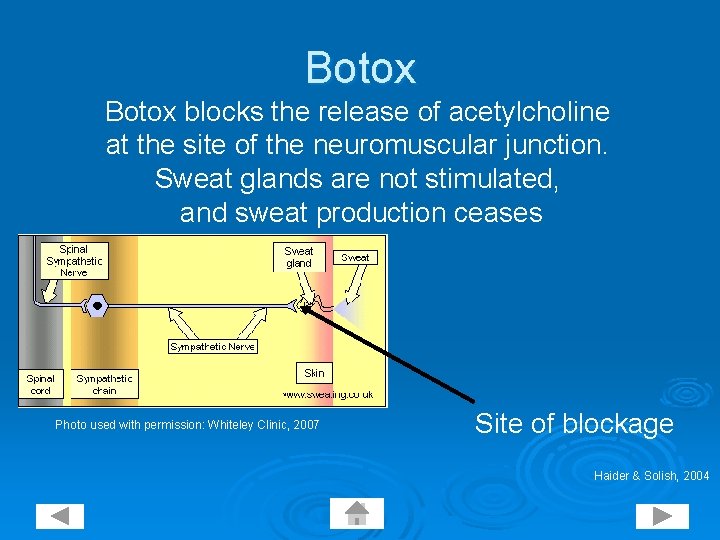
How Does it Work? Anticholinergic Blocks Acetylcholine transmission Eccrine sweat glands no longer stimulated Sweat production ceases! Haider & Solish, 2004
Anticholinergics Ø Long term therapy is required Ø Major side effects: l l l Dry mouth Dry eyes Constipation Blurred vision Difficulty with urination Thomas, Brown, & Vafaie, 2004
Anticholinergics Ø Limited use in treating hyperhidrosis Ø Only 21% effective Ø 69. 7% stop using due to side effects Hamm, Naumann, & Kowalski, 2006
Review Anticholinergics block transmission of ? Catecholamines b. Epinephrine c. Acetylcholine a.
Yes!! Acetylcholine transmission is blocked! Take me to the next treatment option!
Sorry! Click on the picture to try again!
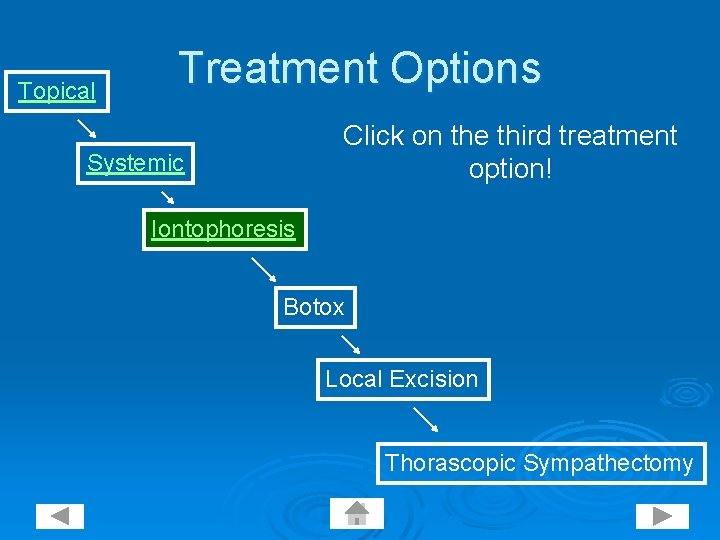
Topical Treatment Options Click on the third treatment option! Systemic Iontophoresis Botox Local Excision Thorascopic Sympathectomy
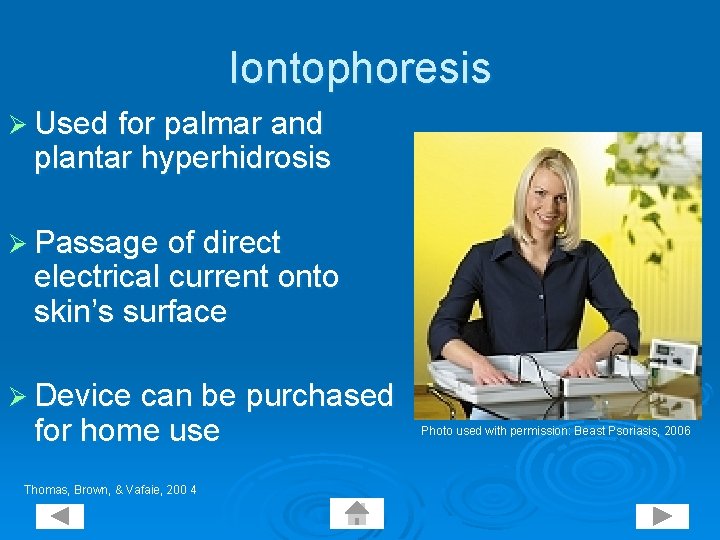
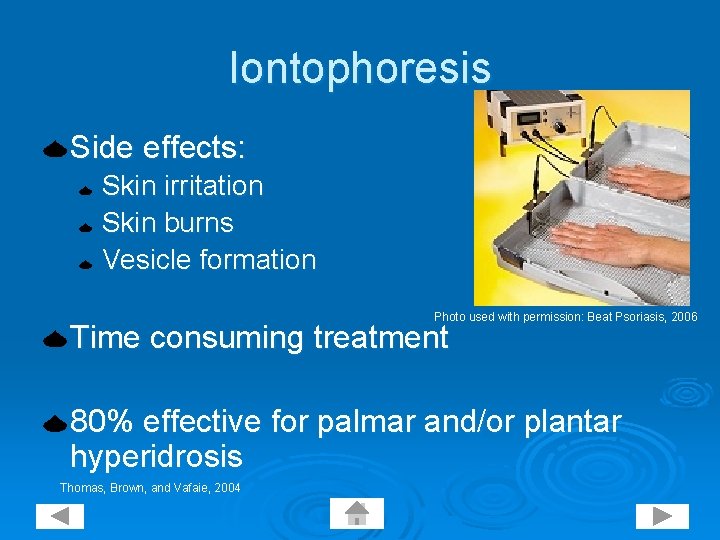
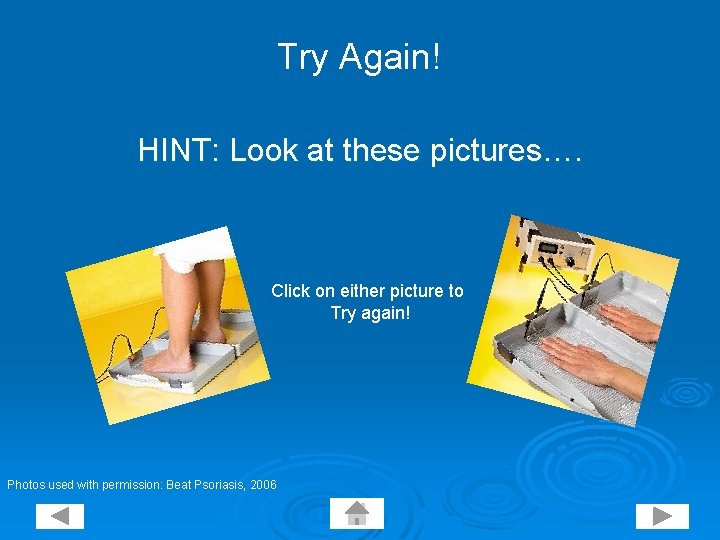
Iontophoresis Ø Used for palmar and plantar hyperhidrosis Ø Passage of direct electrical current onto skin’s surface Ø Device can be purchased for home use Thomas, Brown, & Vafaie, 200 4 Photo used with permission: Beast Psoriasis, 2006
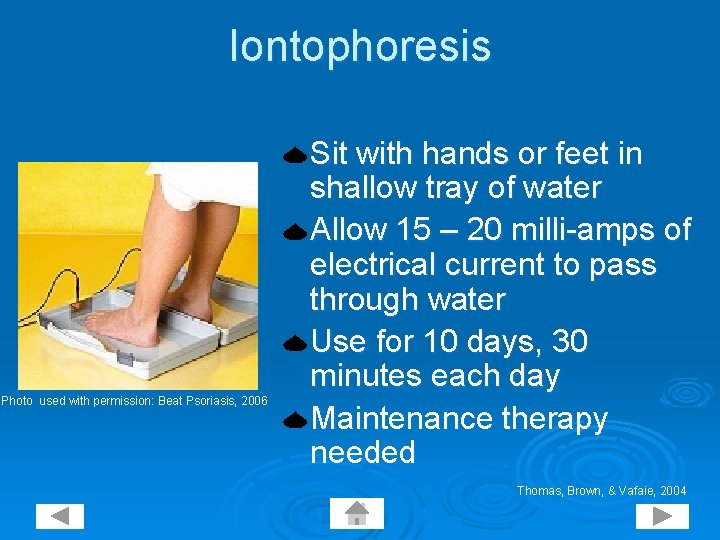
Iontophoresis Photo used with permission: Beat Psoriasis, 2006 Sit with hands or feet in shallow tray of water Allow 15 – 20 milli-amps of electrical current to pass through water Use for 10 days, 30 minutes each day Maintenance therapy needed Thomas, Brown, & Vafaie, 2004
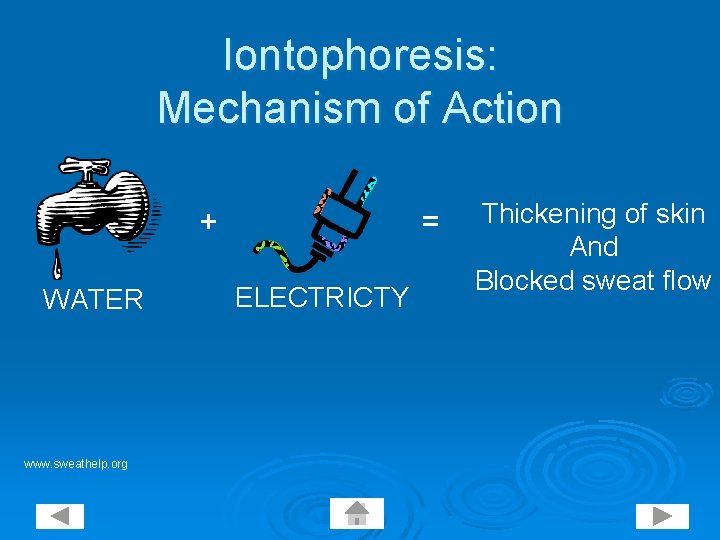
Iontophoresis: Mechanism of Action + WATER www. sweathelp. org = ELECTRICTY Thickening of skin And Blocked sweat flow
Iontophoresis Side effects: Skin irritation Skin burns Vesicle formation Photo used with permission: Beat Psoriasis, 2006 Time consuming treatment 80% effective for palmar and/or plantar hyperidrosis Thomas, Brown, and Vafaie, 2004
Iontophoresis Contraindicated in those: 1. Who are pregnant 2. Have pacemakers 3. Have metal implants 4. Have cardiac conditions 5. Have epilepsy
Question…. Iontophoresis is NOT used in treating which type of hyperhidrosis? Palmar b. Axillary c. Plantar a.
Yes! Iontophoresis can be used in treating Palmar and/or Plantar hyperhidrosis Take me to the next treatment option
Try Again! HINT: Look at these pictures…. Click on either picture to Try again! Photos used with permission: Beat Psoriasis, 2006
Topical Treatment Options Click on the fourth treatment option! Systemic Iontophoresis Botox Local Excision Thorascopic Sympathectomy
Botox Ø Botox injections can be used to treat axillary, palmar, and plantar hyperhidrosis Ø Analgesic applied prior to injection Ø Nerve block applied to ulnar or radial nerve prior to palmar injection Haider & Solish, 2004
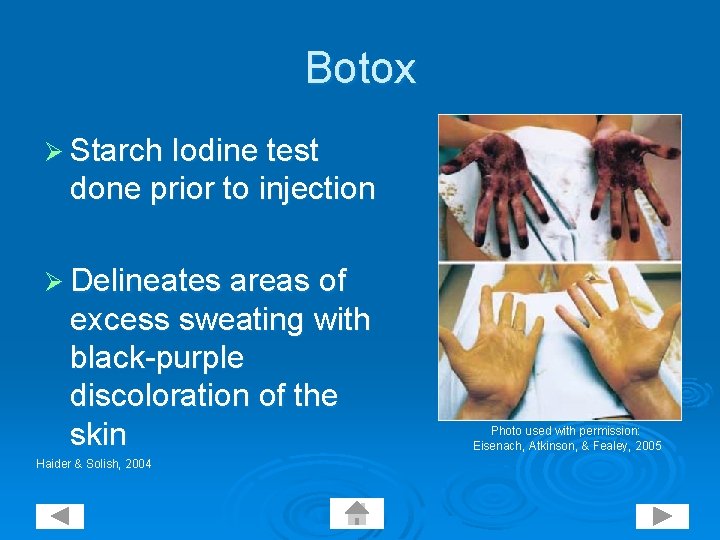
Botox Ø Starch Iodine test done prior to injection Ø Delineates areas of excess sweating with black-purple discoloration of the skin Haider & Solish, 2004 Photo used with permission: Eisenach, Atkinson, & Fealey, 2005
Botox blocks the release of acetylcholine at the site of the neuromuscular junction. Sweat glands are not stimulated, and sweat production ceases Photo used with permission: Whiteley Clinic, 2007 Site of blockage Haider & Solish, 2004
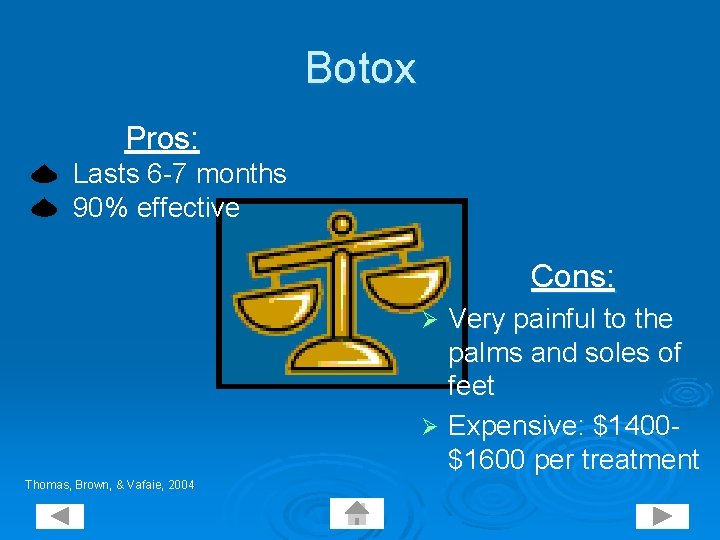
Botox Pros: Lasts 6 -7 months 90% effective Cons: Very painful to the palms and soles of feet Ø Expensive: $1400$1600 per treatment Ø Thomas, Brown, & Vafaie, 2004
Quick Review A Starch-Iodine test is done prior to botox injection. True False
Correct! This test highlights areas of excessive sweating! Take me to the next treatment option
Try Again! Hint: The test gives a “map, ” highlighting areas of excessive sweating Click on the picture to try again!
Topical Treatment Options Click on the fourth treatment option! Systemic Iontophoresis Botox Local Excision Thorascopic Sympathectomy
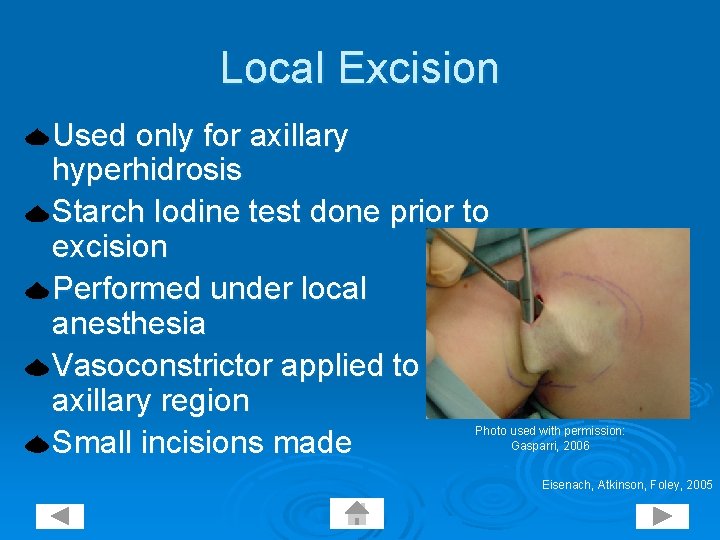
Local Excision Used only for axillary hyperhidrosis Starch Iodine test done prior to excision Performed under local anesthesia Vasoconstrictor applied to axillary region Small incisions made Photo used with permission: Gasparri, 2006 Eisenach, Atkinson, Foley, 2005
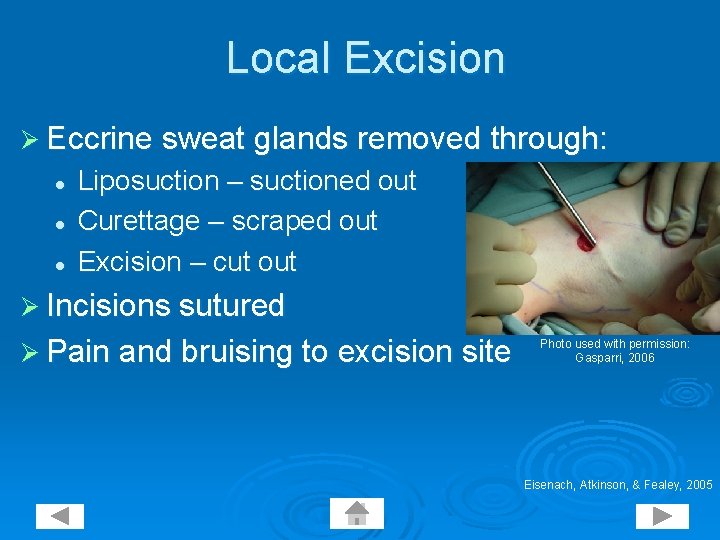
Local Excision Ø Eccrine sweat glands removed through: l l l Liposuction – suctioned out Curettage – scraped out Excision – cut out Ø Incisions sutured Ø Pain and bruising to excision site Photo used with permission: Gasparri, 2006 Eisenach, Atkinson, & Fealey, 2005
Local Excision Ø Starch Iodine tests done post excision show 80% - 90% decrease in sweating Ø Has a potential for scarring Eisenach, Atkinson, & Fealey, 2005
Review! Local Excision is used for what type of hyperhidrosis? Plantar b. Palmar c. Axillary a.
Correct! Local Excision is used for axillary hyperhidrosis! Take me to the next treatment option!
Try Again! Click on the picture to try again!
Topical Treatment Options Click on the fourth treatment option! Systemic Iontophoresis Botox Local Excision Thorascopic Sympathectomy
Endoscopic Thoracic Sympathectomy (ETS) Ø Last treatment option Ø PERMANENT Ø Surgery performed under general anesthesia Haider & Solish, 2004
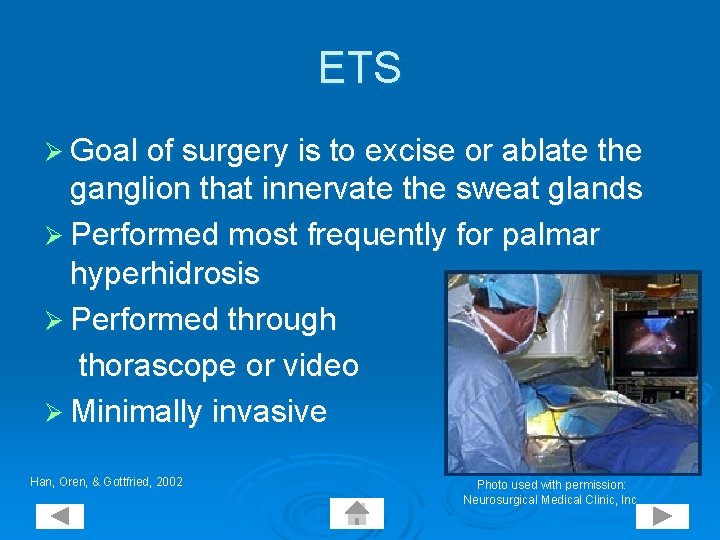
ETS Ø Goal of surgery is to excise or ablate the ganglion that innervate the sweat glands Ø Performed most frequently for palmar hyperhidrosis Ø Performed through thorascope or video Ø Minimally invasive Han, Oren, & Gottfried, 2002 Photo used with permission: Neurosurgical Medical Clinic, Inc
ETS Ø Small incision made laterally under each axilla Ø Incision made through intercostal space Ø Surgery can be performed on outpatient basis Ø However, some patients remain in hospital for one night Han, Oren, & Gottfried, 2002
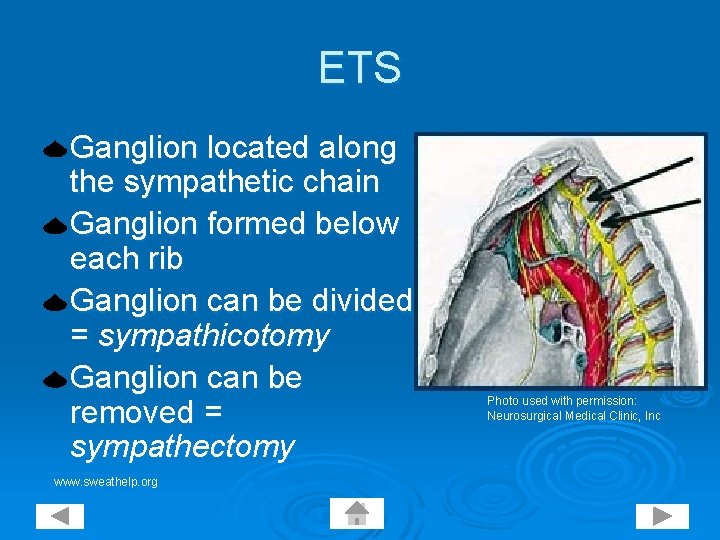
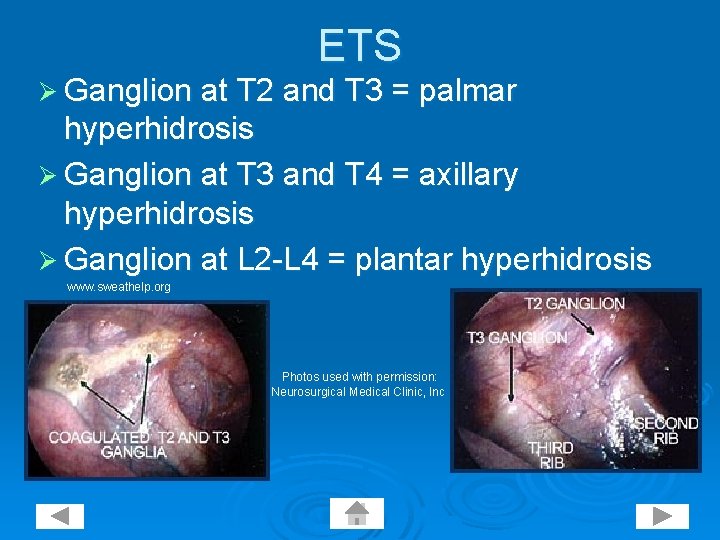
ETS Ganglion located along the sympathetic chain Ganglion formed below each rib Ganglion can be divided = sympathicotomy Ganglion can be removed = sympathectomy www. sweathelp. org Photo used with permission: Neurosurgical Medical Clinic, Inc
ETS Ø Ganglion at T 2 and T 3 = palmar hyperhidrosis Ø Ganglion at T 3 and T 4 = axillary hyperhidrosis Ø Ganglion at L 2 -L 4 = plantar hyperhidrosis www. sweathelp. org Photos used with permission: Neurosurgical Medical Clinic, Inc
ETS Cannot surgically excise or ablate L 2 -L 4 for plantar hyperhidrosis due to sexual side effects 95% success rate in curing palmar hyperhidrosis Success rates slightly lower for axillary hyperhidrosis Eisenach, Atkinson, & Fealey, 2005
ETS Ø Plantar hyperhidrosis resolves in 50% - 75% of cases when T 2 and T 3 are excised, though L 2 -L 4 ganglion are never surgically treated Ø Mechanism is unknown! Eisenach, Atkinson & Fealey, 2005
ETS: Side Effects Ø Surgical complications: l l l Hemo-pneumothorax requiring chest tube placement – 1% Atelectasis Intercostal neuralgia – 1% Horner’s Syndrome – 1% Compensatory Sweating – 60% Eisenach, Atkinson, & Fealey, 2005
Horner’s Syndrome Ø Stellate ganglion – fusion of C 8 and T 1 l Innervates the face Ø If Stellate ganglion is damaged, Horner’s Syndrome will occur l l May be mistaken for T 2 and T 3 May receive electrical current from cautery of T 2 and T 3 www. sweathelp. org
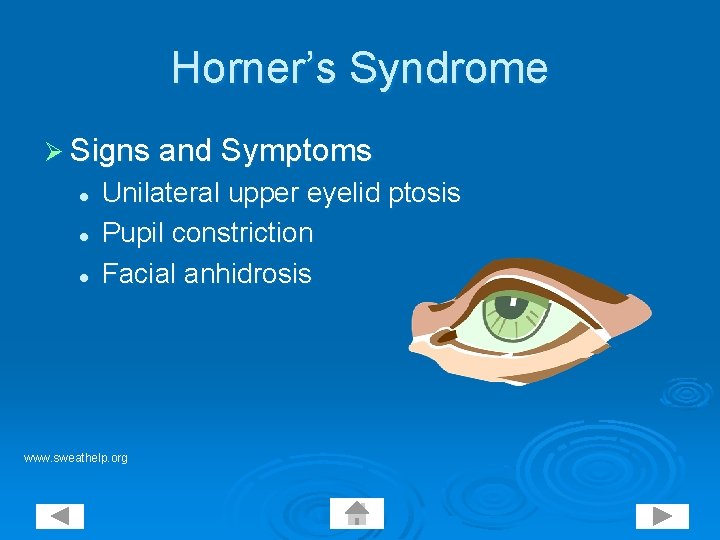
Horner’s Syndrome Ø Signs and Symptoms l l l Unilateral upper eyelid ptosis Pupil constriction Facial anhidrosis www. sweathelp. org
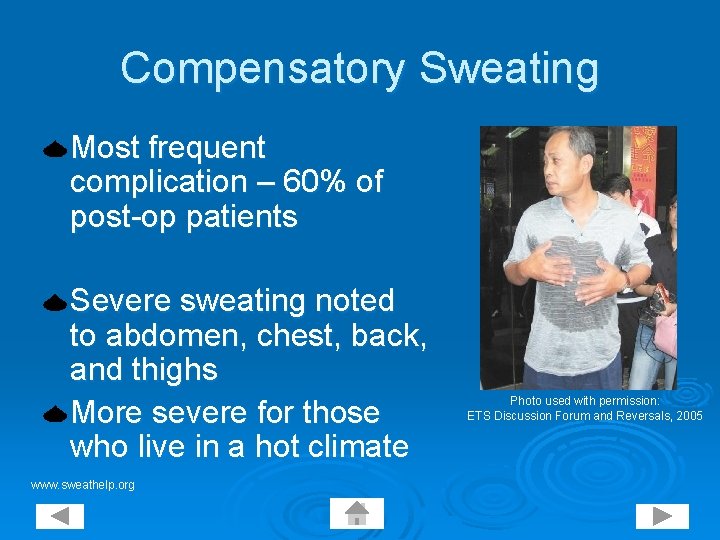
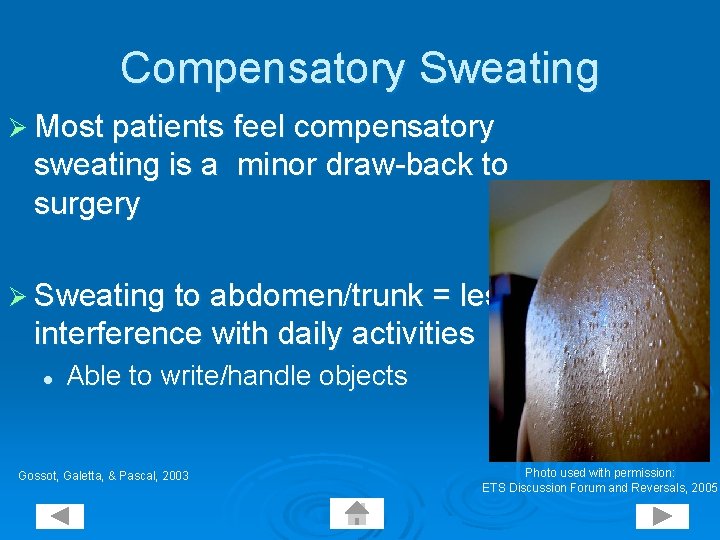
Compensatory Sweating Most frequent complication – 60% of post-op patients Severe sweating noted to abdomen, chest, back, and thighs More severe for those who live in a hot climate www. sweathelp. org Photo used with permission: ETS Discussion Forum and Reversals, 2005
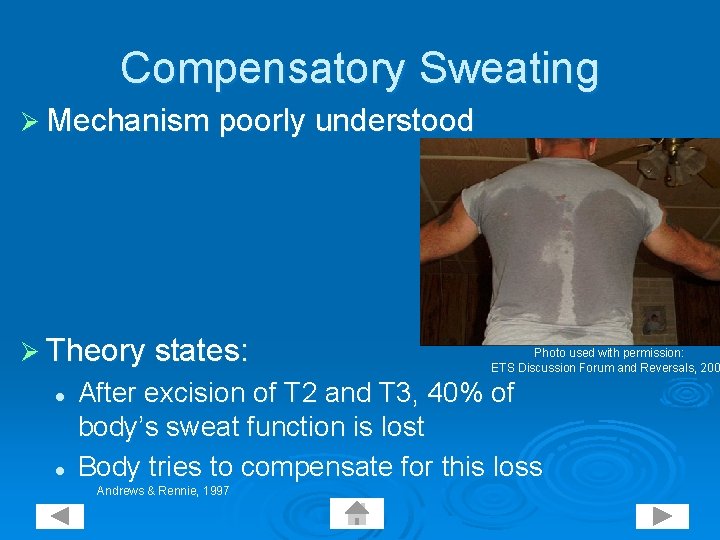
Compensatory Sweating Ø Mechanism poorly understood Ø Theory states: l l Photo used with permission: ETS Discussion Forum and Reversals, 200 After excision of T 2 and T 3, 40% of body’s sweat function is lost Body tries to compensate for this loss Andrews & Rennie, 1997
Compensatory Sweating Ø Most patients feel compensatory sweating is a minor draw-back to surgery Ø Sweating to abdomen/trunk = less interference with daily activities l Able to write/handle objects Gossot, Galetta, & Pascal, 2003 Photo used with permission: ETS Discussion Forum and Reversals, 2005
Let’s Review ETS is performed most often for what type of hyperhidrosis: Axillary b. Palmar c. Plantar a.
CORRECT! ETS is performed for palmar hyperhidrosis! Take me to the next question!
TRY AGAIN! Click on the picture to try again!
Question 2 What is the most significant side effect of ETS? Hemo-pneumothorax b. Horner’s Syndrome c. Compensatory Sweating a.
That’s Right! Compensatory Sweating can occur in 60% of post-op patients! Take me to the next activity!
Sorry! Horner’s Syndrome and Hemopneumothorax only occur in 1% of the cases! Click on the face to try again!
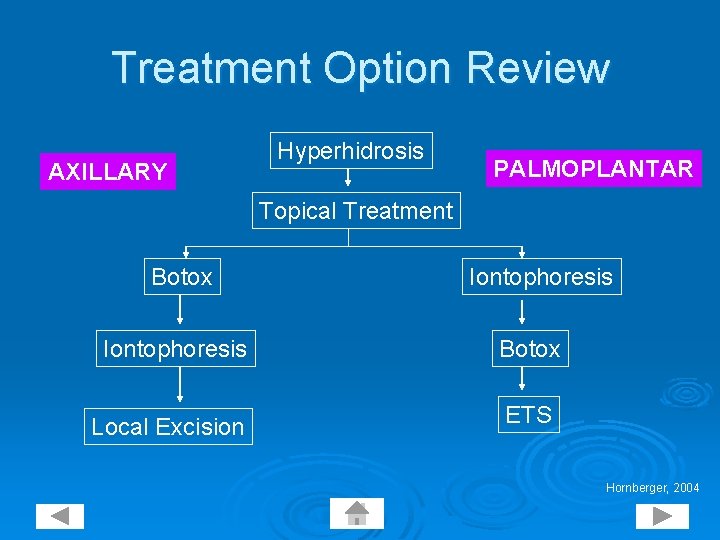
Treatment Option Review AXILLARY Hyperhidrosis PALMOPLANTAR Topical Treatment Botox Iontophoresis Local Excision Iontophoresis Botox ETS Hornberger, 2004
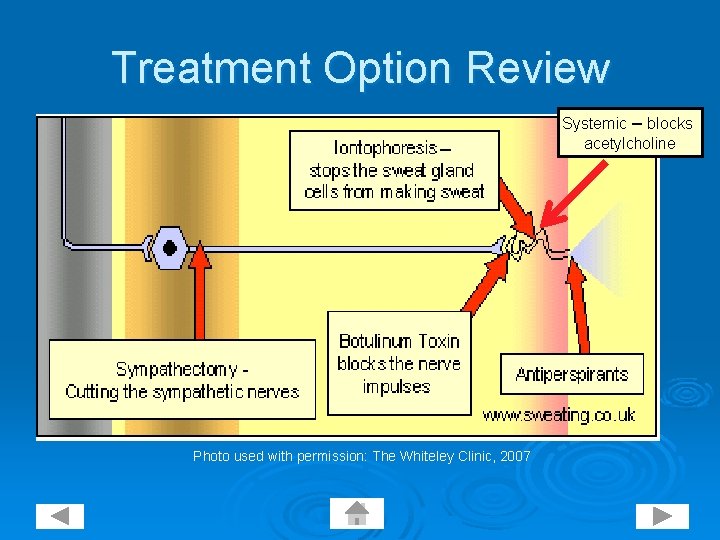
Treatment Option Review Systemic – blocks acetylcholine Photo used with permission: The Whiteley Clinic, 2007
CONGRATUALTIONS!! YOU HAVE SUCCESSFULLY COMPLETED THIS TUTORIAL!!
References Andrews, B. T. & Renni, J. A. (1997). Predicting changes in the distribution of sweating following thorascopic sympathectomy. The British Journal of Surger, 84(12), 1702 -1704. Beat Psoriasis. (2006). What is hyperhidrosis or excessive sweating? Retrieved March 22, 2007, from www. beatpsoriasis. com. Canada’s Largest Online Health and Beauty Aids. (n. d. ). Retrieved April 12, 2007, from www. feelbest. com. Eisenach, J. , Atkinson, J. , & Fealey, R. (2005). Hyperhidrosis: Evolving therapies for a well-established phenomenon. Mayo Clinic Proceedings, 80(5), 657 -666. ETS Discussion Forum and Reversals. (2005). Compensatory sweating after ets. Retrieved March 22, 2007, from http: //p 069. ezboard. com/fetsandreversalsfrm 37. show. Message? topic. I D=1. topic Gasparri, M. (2006). Photography, Medical College of Wisconsin. Gossot, D. , Galetta, D. , & Pascal, A. (2003). Long-term results of endoscopic thoracic sympathectomy for upper limb hyperhidrosis. The Society of Thoracic Surgeons, 75, 1075 -1079. Haider, A. & Solish, N. (2004). Hyperhidrosis: An approach to diagnosis and management. Dermatology Nursing, 16(6), 515 -523.
References Hamm, H. , Naumann, M. , & Kowalski, J. (2006). Primary focal hyperhidrosis: Disease characteristics and functional impairment. Dermatology, 212. 343 -353. Hornberger, J. (2004). Recognition, diagnosis, and treatment of primary focal hyperhidrosis. Journal of the American Academy of Dermatology, 51(2), 274 -286. International Hyperhidrosis Society. (2007). About hyperhidrosis: Physiology of normal sweating. Retrieved March 7, 2007, from http: //www. sweathelp. org. Naumann, M. K. , Hamm, H. , & Lowe, J. (2002). Effects of botulinim toxin type A on quality of life measures in patients with excessive axillary sweating: A randomized controlled trial. British Journal of Dermatology, 147, 1218 -1226. Neurosurgical Medical Clinic, Inc. (n. d. ). Neurosurgical Diseases: Hyperhidrosis. Retrieved March 23, 2007, from www. sdneurosurgeon. com/diseases/hyperhidrosis. html. Thomas, I. , Brown, J. & Vafaie, J. (2004). Palmoplantar hyperhidrosis: A therapeutic challenge. American Family Physician, 69(5, ) 1117 -1120. Unatrributed Clip Art: Microsoft Office, 2006. University of Miami Cosmetic Center. (2007). Botox for Hyperhidrosis. Retrieved April 10, 2007, from www. derm. net/bo_hyperhidrosis. shtml. Whiteley Clinic. (2007). The latest treatment in excessive sweating. Retrieved April 2, 2007, from www. sweating. co. uk.