Flash Crowds And Denial of Service Attacks Characterization


- Slides: 31
Flash Crowds And Denial of Service Attacks: Characterization and Implications for CDNs and Web Sites Aaron Beach Cs 395 network security
OVERVIEW • • • What is a “Flash Event? ” (FE) What is a “Denial of Service Attack? ” What is the difference? How can we distinguish between them? What is/are the solution(s)? – Adaptive Content Distribution Networks? – Others? – Do you have any ideas? ? ? Think about it
Flash Events • A flash event (FE) is a large surge in traffic to a particular Web site causing a dramatic increase in server load and putting severe strain on the network links leading to the server, which results in considerable increase in packet loss and congestion • “Flash crowds”
Denial of Service Attack (Do. S) • An explicit attempt by attackers to prevent legitimate users of a service from using that service • Their definition: – any attempt to undermine a Web site • What do you think?
The Major Differences • Flash Events represent legitimate traffic to a website. This often means the website wants to service these requests as well as possible, while Do. S attacks our unwanted and should not be serviced, but ignored or controlled.
Distinguishing Between Them • 3 main characteristics – Traffic patterns – Client characteristics – File reference characteristics
Traffic Patterns • Overall traffic volume determines how much a server should provision resources to keep the site operational • Servers can shut down from over use • Studying these patterns allows us to articulate the period when an unusually large number of clients can overwhelm a site • We also can understand how and in what time pattern the server must defend against these rises in traffic
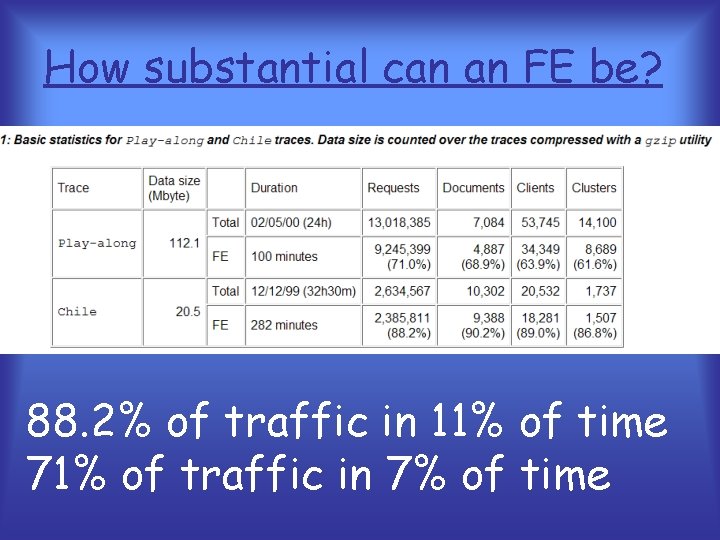
How substantial can an FE be? 88. 2% of traffic in 11% of time 71% of traffic in 7% of time
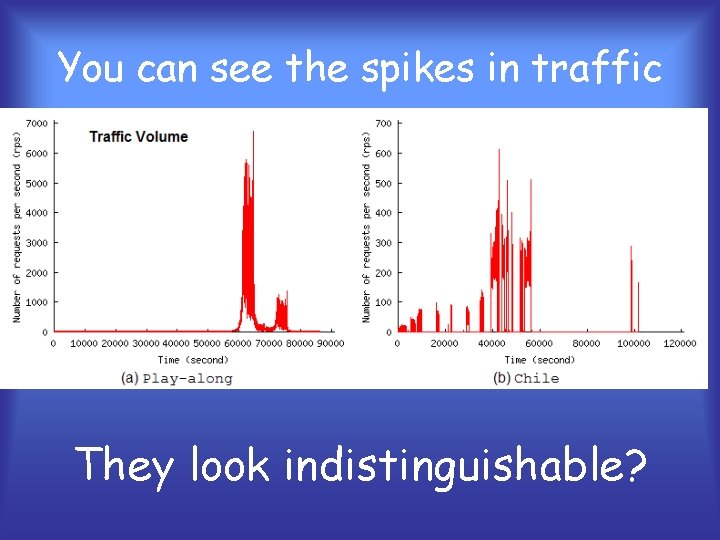
You can see the spikes in traffic They look indistinguishable?
Now do they look the same? Quite different… however
Behavior of traffic • • First fifteen minutes They both rise, one over a period of One over 70 minutes One over 40 seconds
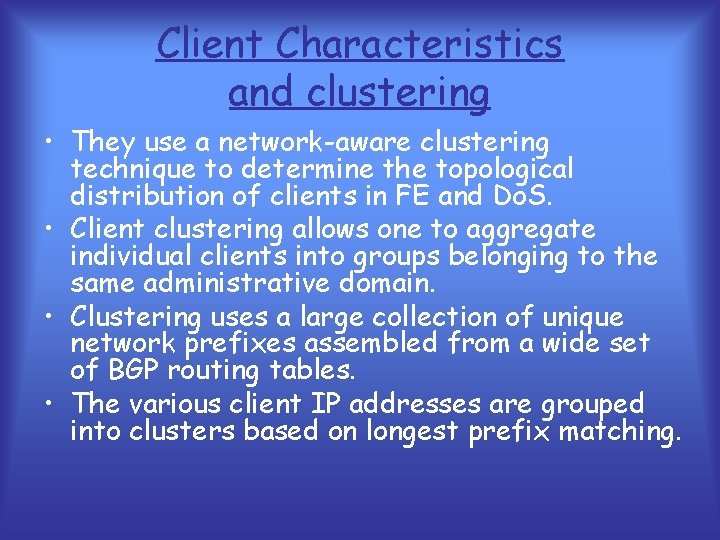
Client Characteristics and clustering • They use a network-aware clustering technique to determine the topological distribution of clients in FE and Do. S. • Client clustering allows one to aggregate individual clients into groups belonging to the same administrative domain. • Clustering uses a large collection of unique network prefixes assembled from a wide set of BGP routing tables. • The various client IP addresses are grouped into clusters based on longest prefix matching.
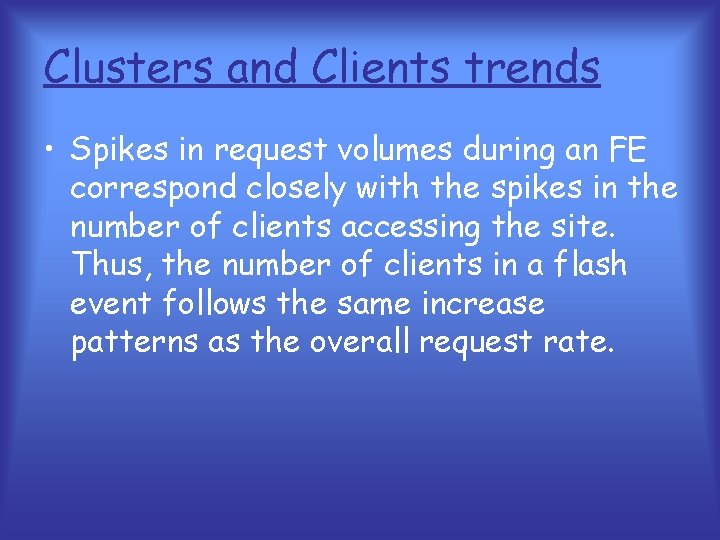
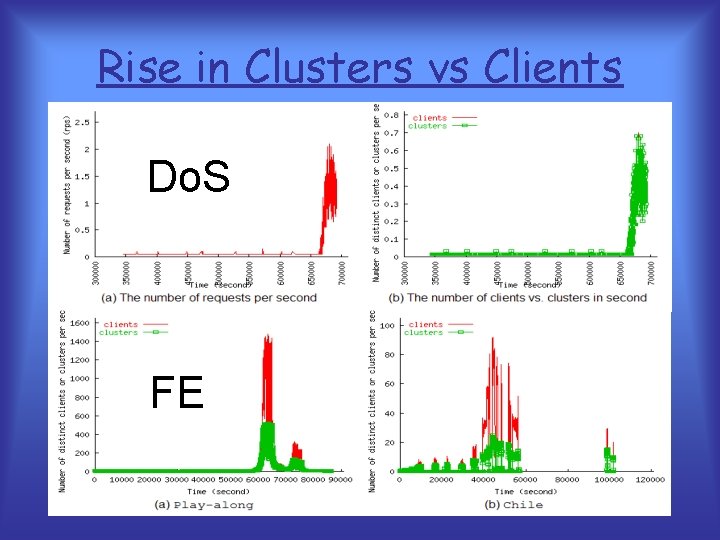
Clusters and Clients trends • Spikes in request volumes during an FE correspond closely with the spikes in the number of clients accessing the site. Thus, the number of clients in a flash event follows the same increase patterns as the overall request rate.
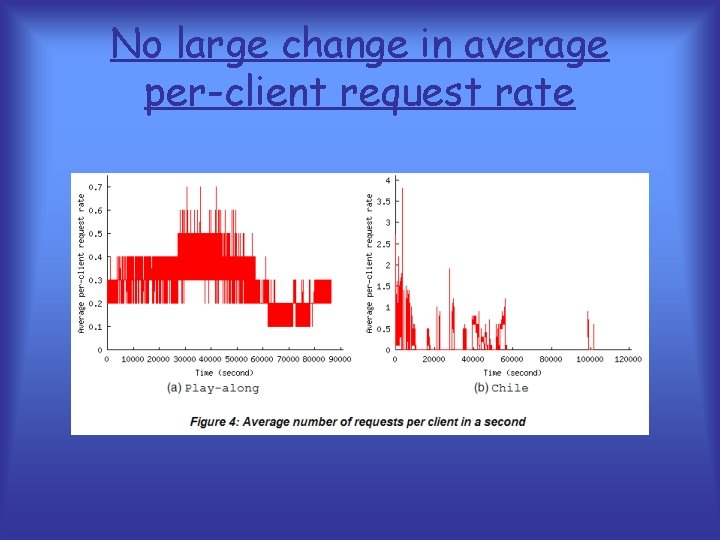
No large change in average per-client request rate
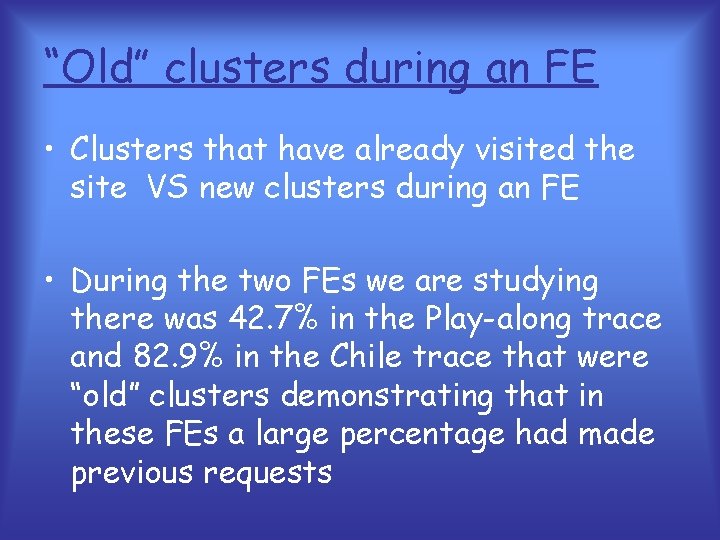
“Old” clusters during an FE • Clusters that have already visited the site VS new clusters during an FE • During the two FEs we are studying there was 42. 7% in the Play-along trace and 82. 9% in the Chile trace that were “old” clusters demonstrating that in these FEs a large percentage had made previous requests
File Reference Characteristics • Locality of reference enables a reduction of server load through caching. • They use these characteristics in designing an “adaptive CDN. ” • We consider: – aggregate file references – reference patterns of individual clients – reference patterns of client clusters.
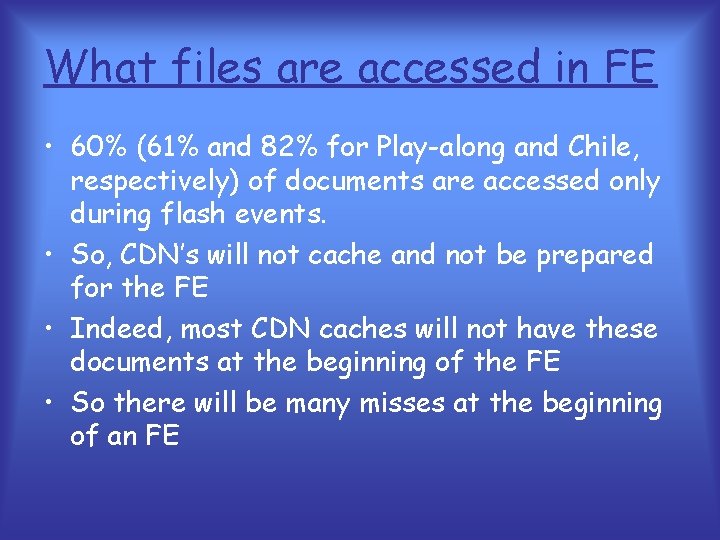
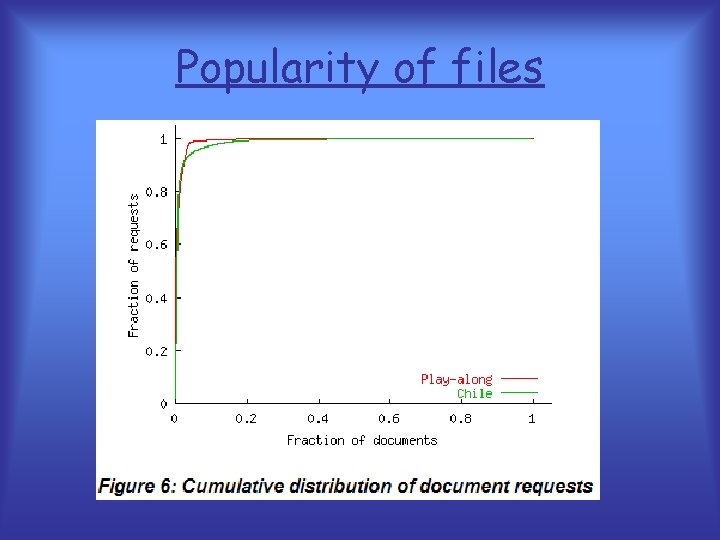
What files are accessed in FE • 60% (61% and 82% for Play-along and Chile, respectively) of documents are accessed only during flash events. • So, CDN’s will not cache and not be prepared for the FE • Indeed, most CDN caches will not have these documents at the beginning of the FE • So there will be many misses at the beginning of an FE
Popularity of files
Also about clusters and file popularity • Requests for documents come from many different Clusters… • This means that current CDNs will result in many different serves getting requests for the same file… resulting in more misses for the files popular only during FEs
Password cracking • Much like Do. S attacks • We must detect early and stop them • Detect “ 401 unauthorized” messages
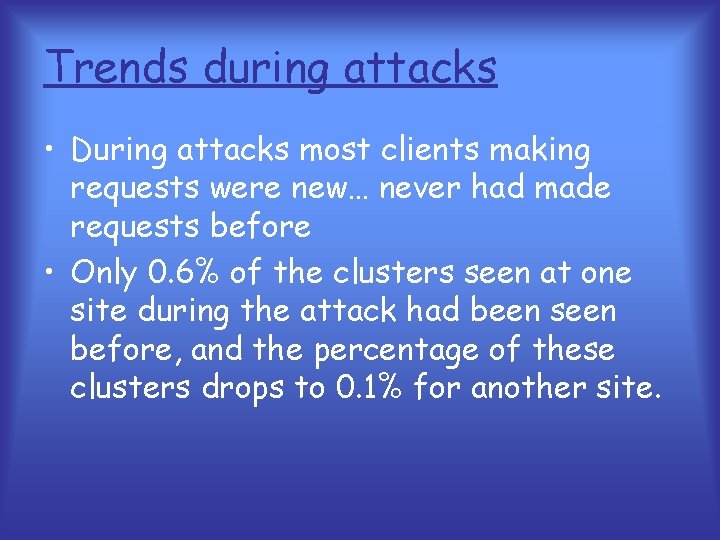
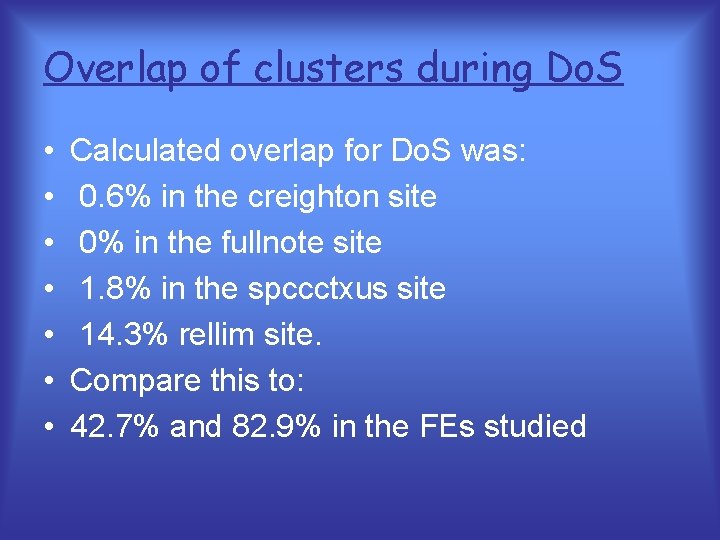
Trends during attacks • During attacks most clients making requests were new… never had made requests before • Only 0. 6% of the clusters seen at one site during the attack had been seen before, and the percentage of these clusters drops to 0. 1% for another site.
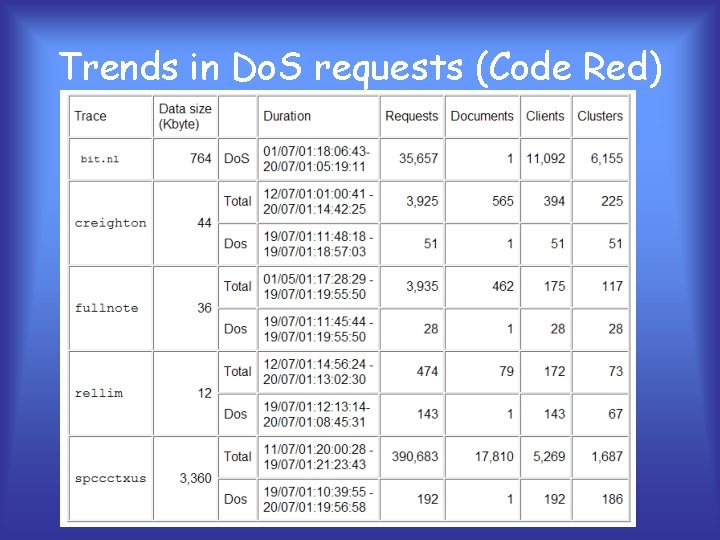
Trends in Do. S requests (Code Red)
Rise in Clusters vs Clients Do. S FE
Overlap of clusters during Do. S • • Calculated overlap for Do. S was: 0. 6% in the creighton site 0% in the fullnote site 1. 8% in the spccctxus site 14. 3% rellim site. Compare this to: 42. 7% and 82. 9% in the FEs studied
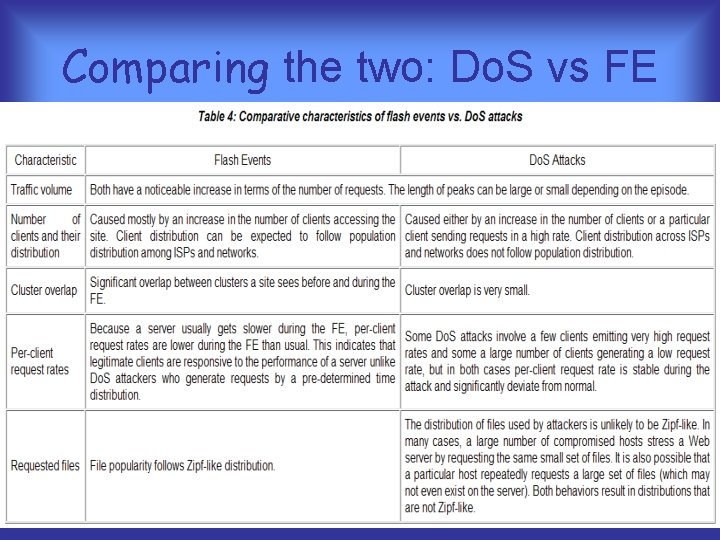
Comparing the two: Do. S vs FE
SOLUTION TIME!!! • What should the server do when it is being overwhelmed? ? – Discard “more malicious” requests • How? – Monitor users and average request rate – Periodically “cluster” addresses – When overwhelmed… drop malicious addresses (must belong to old clusters and continue “normal” request rates - Solution not too taxing on processes and you can implement it in an filtering accept() function
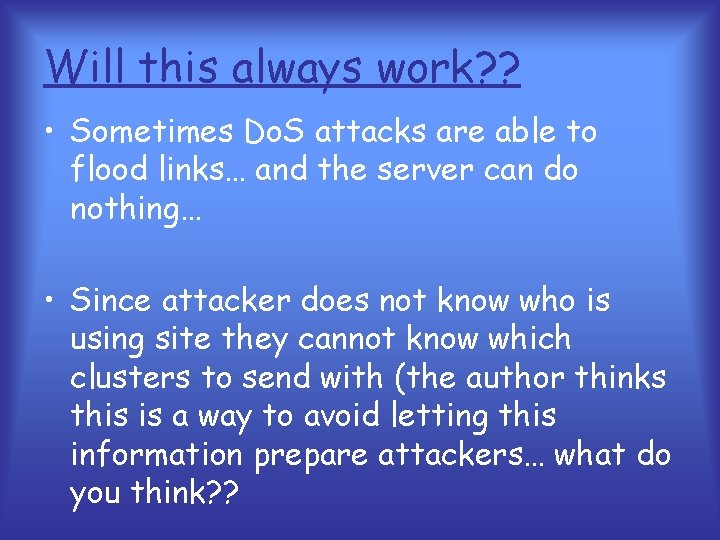
Will this always work? ? • Sometimes Do. S attacks are able to flood links… and the server can do nothing… • Since attacker does not know who is using site they cannot know which clusters to send with (the author thinks this is a way to avoid letting this information prepare attackers… what do you think? ?
What about FEs? • If we know how to deal with Do. S attacks… we still have the problem of what to do when flash events happen • Solution:Adaptive CDN
Adaptive CDN • “Dynamic Delegation” • The more caches the more requests, so make less caches with more space • Have primaries and delegates… • When a FE is detected the DNS servers sends requests to delegates first and they go to primaries… • Only primaries can make requests to origin server, clustering caches
Algorithm for Dynamic Delegation • When a node “P” is overloaded it redirects packets to another node that has a low load, using it as a “delegate” • When a node goes low it stops using delegates • Tests show this lowered load on origin server by: a factor of 50 in one test and 30 in the other… without too high load distribution in the caches.
Review • • • Flash Event (Flash Crowd) FE vs Do. S Difference and Detection Detecting and stopping Dealing with FE using adaptive CDN