
Cache Attacks and Countermeasures the Case of AES

- Slides: 28
Cache Attacks and Countermeasures: the Case of AES Dag Arne Osvik, Adi Shamir and Eran Tromer Presented by Ophir Arbiv ophirarb@post. tau. ac. il
Sources [1] Cache Attacks and Countermeasures: the Case of AES (Extended Version), 2005, Dag Arne Osvik, Adi Shamir and Eran Tromer. [2] theory. csail. mit. edu/~tromer/SKC 2006/cacheskc 06. ppt – Tromer’s lecture in MIT. [3] www. l-sec. be/calit/present/Adi. Shamir. pdf - Adi Shamir’s lecture in Weizman Inst.
AES – Advanced Encryption Standard • 1997 - DES becoming outdated NIST announces competition to design a successor. • Evaluation criteria - Security, Cost, Algorithm & Implementation Characteristics • 21 Algorithms were received. In 2001 - NIST selected Rijndael as the proposed AES algorithm. • Rijndael was proposed by Dr. Vincent Rijmen and Dr. Joan Daemen from Belgium • Properties: – Symmetric – Block Cipher – Based in finite mathematics – 128 bit Data and Key size of 128, 192 and 256 bits. – Resistant to known attacks.
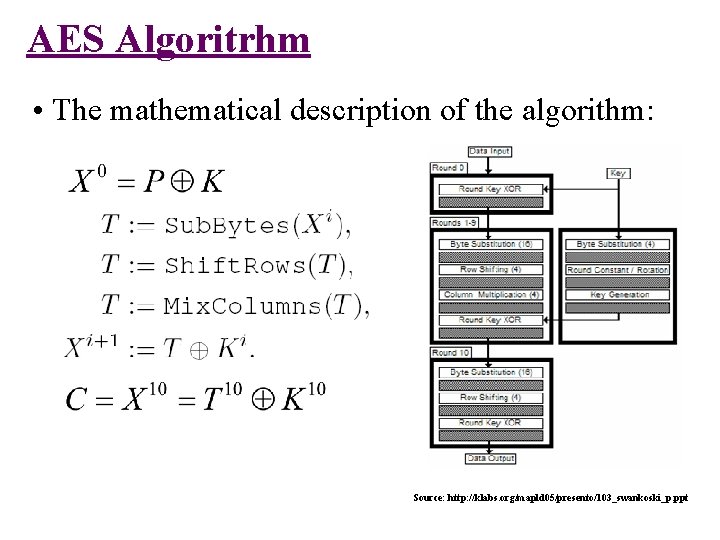
AES Algoritrhm • The mathematical description of the algorithm: Source: http: //klabs. org/mapld 05/presento/103_swankoski_p. ppt
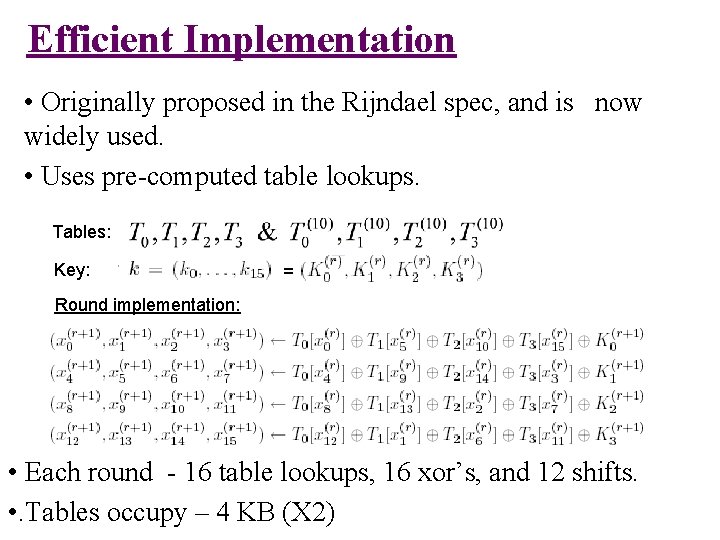
Efficient Implementation • Originally proposed in the Rijndael spec, and is now widely used. • Uses pre-computed table lookups. Tables: Key: = Round implementation: • Each round - 16 table lookups, 16 xor’s, and 12 shifts. • . Tables occupy – 4 KB (X 2)
AES - summary • During AES selection, only branch statements, arithmetic, and data-dependent shift were considered vulnerable. • Proposed Algorithms was widely analyzed. • Apparently, since it uses only table lookup, xor & shift, NIST declared Rijndael “not vulnerable to timing attacks. • 2003 - NSA declared AES-128 can be used to protect all US Government data except Top Secret data which needs AES-256 (at least). • No known direct attacks as for today. • Expected to be the standard for 20+ years.
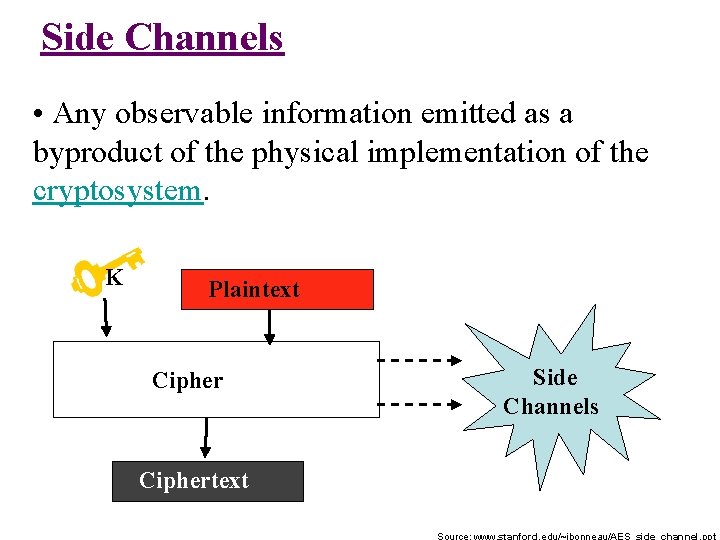
Side Channels • Any observable information emitted as a byproduct of the physical implementation of the cryptosystem. K Plaintext Cipher Side Channels Ciphertext Source: www. stanford. edu/~jbonneau/AES_side_channel. ppt
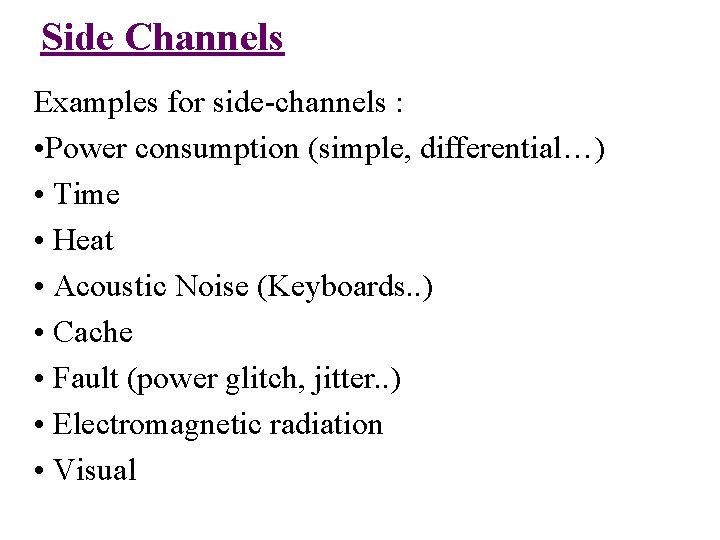
Side Channels Examples for side-channels : • Power consumption (simple, differential…) • Time • Heat • Acoustic Noise (Keyboards. . ) • Cache • Fault (power glitch, jitter. . ) • Electromagnetic radiation • Visual
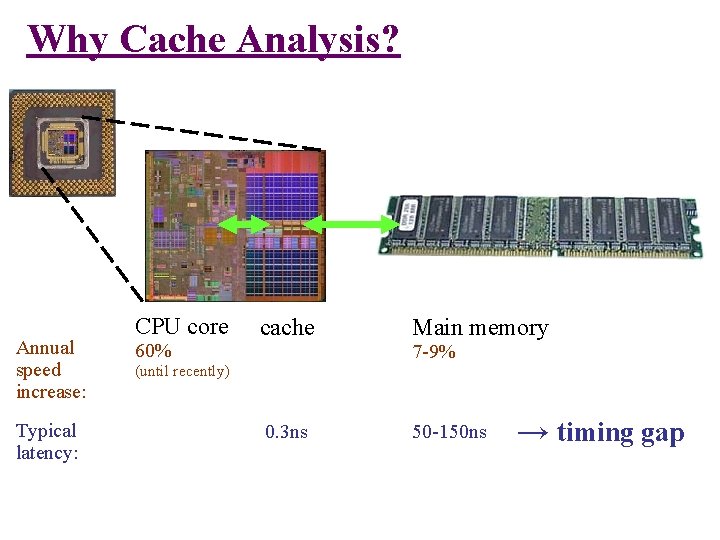
Why Cache Analysis? Annual speed increase: Typical latency: CPU core 60% cache Main memory 7 -9% (until recently) 0. 3 ns 50 -150 ns → timing gap
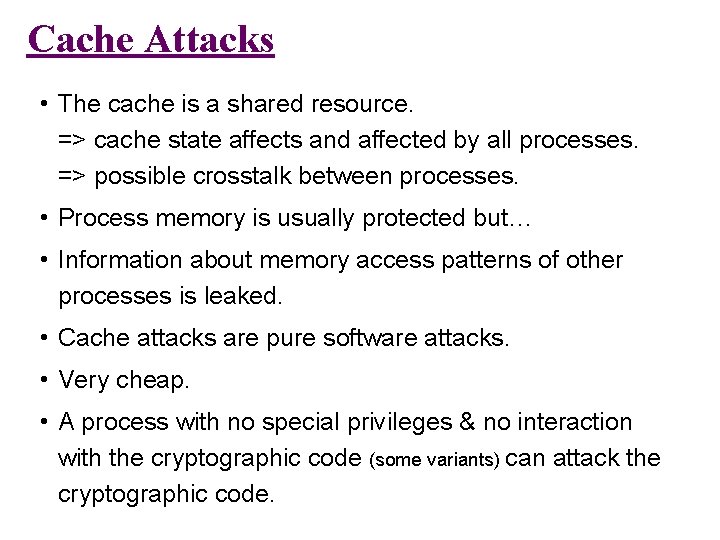
Cache Attacks • The cache is a shared resource. => cache state affects and affected by all processes. => possible crosstalk between processes. • Process memory is usually protected but… • Information about memory access patterns of other processes is leaked. • Cache attacks are pure software attacks. • Very cheap. • A process with no special privileges & no interaction with the cryptographic code (some variants) can attack the cryptographic code.
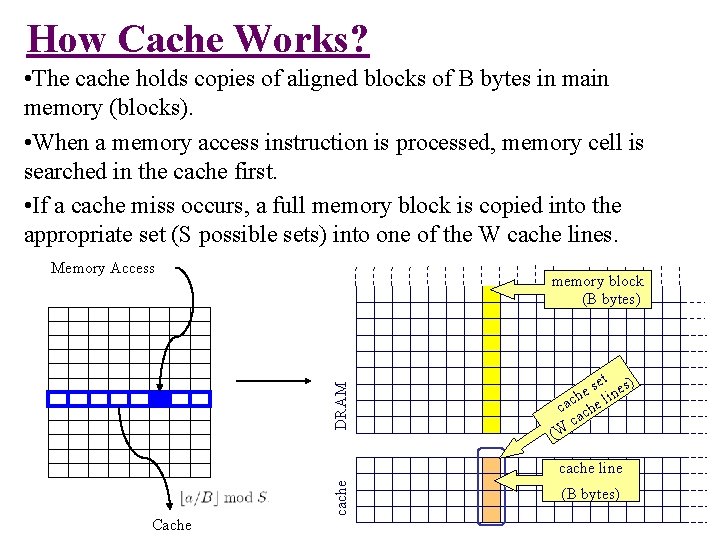
How Cache Works? • The cache holds copies of aligned blocks of B bytes in main memory (blocks). • When a memory access instruction is processed, memory cell is searched in the cache first. • If a cache miss occurs, a full memory block is copied into the appropriate set (S possible sets) into one of the W cache lines. Memory Access DRAM memory block (B bytes) et es) s he lin c a c che ca (W Cache cache line (B bytes)
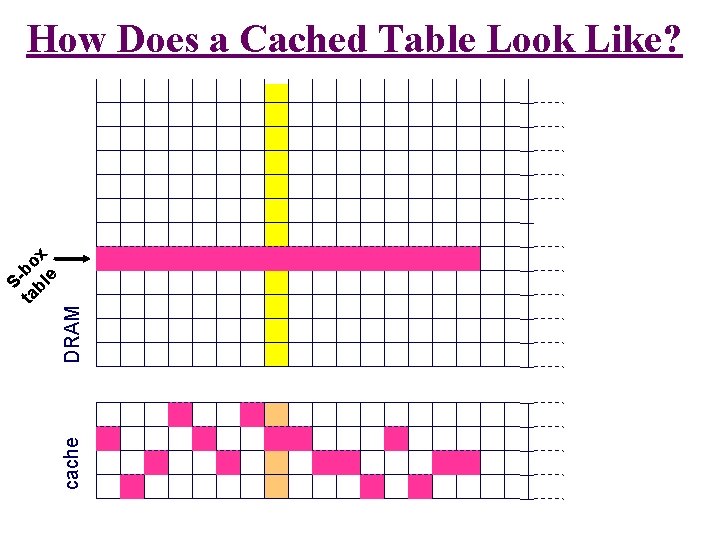
DRAM cache Sta bo bl x e How Does a Cached Table Look Like?
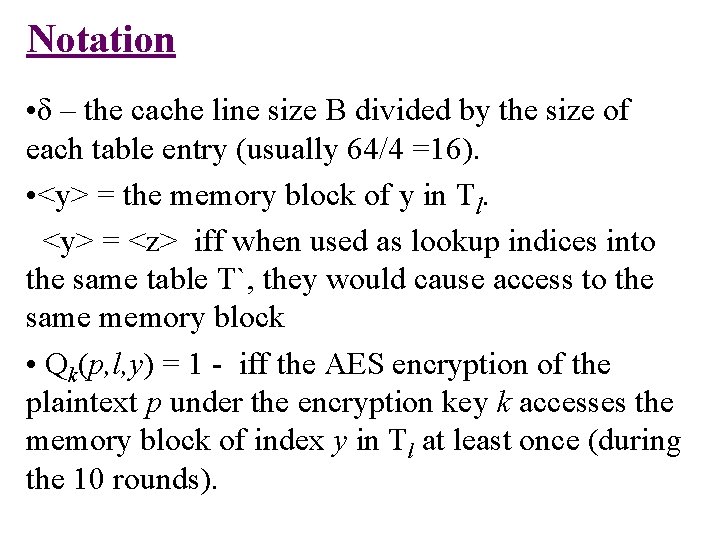
Notation • δ – the cache line size B divided by the size of each table entry (usually 64/4 =16). • <y> = the memory block of y in Tl. <y> = <z> iff when used as lookup indices into the same table T`, they would cause access to the same memory block • Qk(p, l, y) = 1 - iff the AES encryption of the plaintext p under the encryption key k accesses the memory block of index y in Tl at least once (during the 10 rounds).
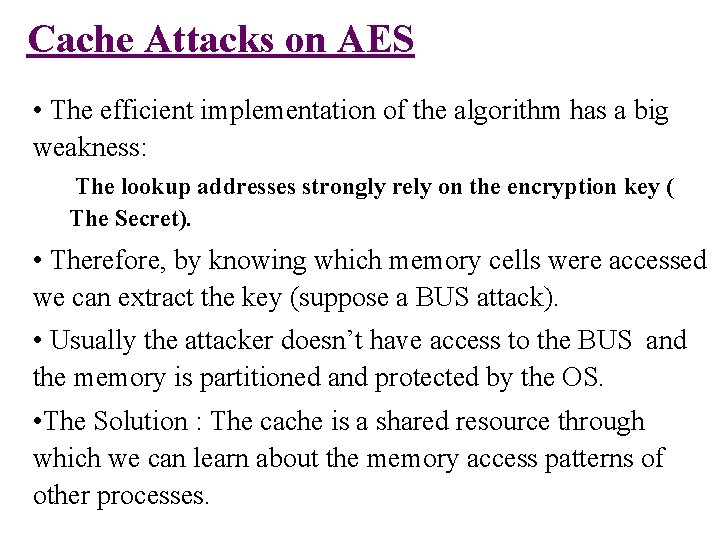
Cache Attacks on AES • The efficient implementation of the algorithm has a big weakness: The lookup addresses strongly rely on the encryption key ( The Secret). • Therefore, by knowing which memory cells were accessed we can extract the key (suppose a BUS attack). • Usually the attacker doesn’t have access to the BUS and the memory is partitioned and protected by the OS. • The Solution : The cache is a shared resource through which we can learn about the memory access patterns of other processes.
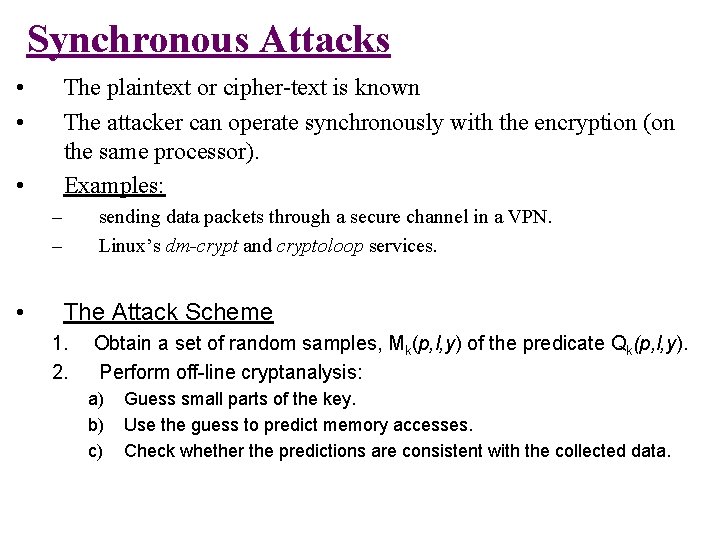
Synchronous Attacks • • The plaintext or cipher-text is known The attacker can operate synchronously with the encryption (on the same processor). Examples: • – – • sending data packets through a secure channel in a VPN. Linux’s dm-crypt and cryptoloop services. The Attack Scheme 1. 2. Obtain a set of random samples, Mk(p, l, y) of the predicate Qk(p, l, y). Perform off-line cryptanalysis: a) b) c) Guess small parts of the key. Use the guess to predict memory accesses. Check whether the predictions are consistent with the collected data.
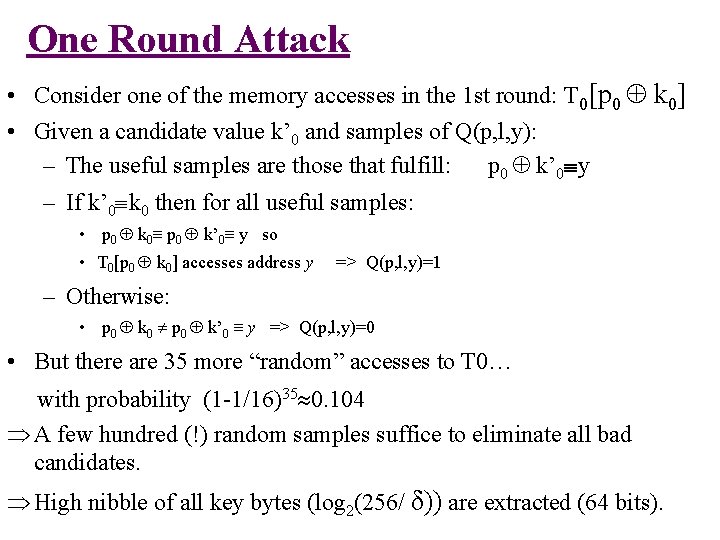
One Round Attack • Consider one of the memory accesses in the 1 st round: T 0[p 0 k 0] • Given a candidate value k’ 0 and samples of Q(p, l, y): – The useful samples are those that fulfill: p 0 k’ 0 y – If k’ 0 k 0 then for all useful samples: • p 0 k 0 p 0 k’ 0 y so • T 0[p 0 k 0] accesses address y => Q(p, l, y)=1 – Otherwise: • p 0 k 0 p 0 k’ 0 y => Q(p, l, y)=0 • But there are 35 more “random” accesses to T 0… with probability (1 -1/16)35 0. 104 Þ A few hundred (!) random samples suffice to eliminate all bad candidates. Þ High nibble of all key bytes (log 2(256/ δ)) are extracted (64 bits).
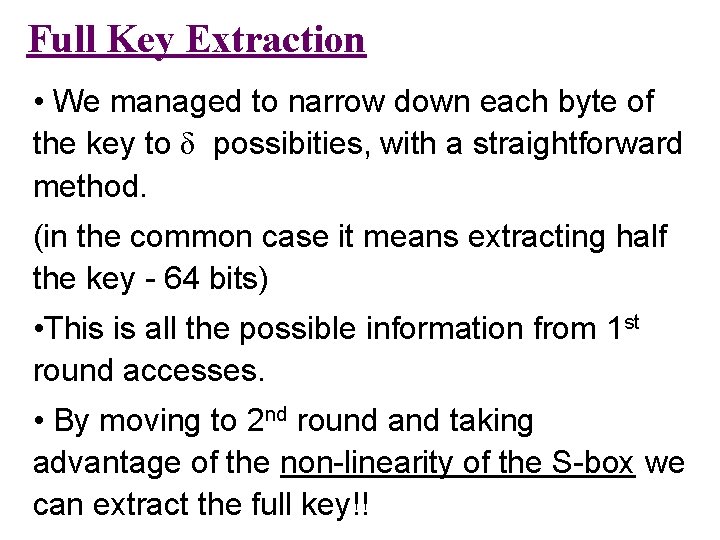
Full Key Extraction • We managed to narrow down each byte of the key to δ possibities, with a straightforward method. (in the common case it means extracting half the key - 64 bits) • This is all the possible information from 1 st round accesses. • By moving to 2 nd round and taking advantage of the non-linearity of the S-box we can extract the full key!!
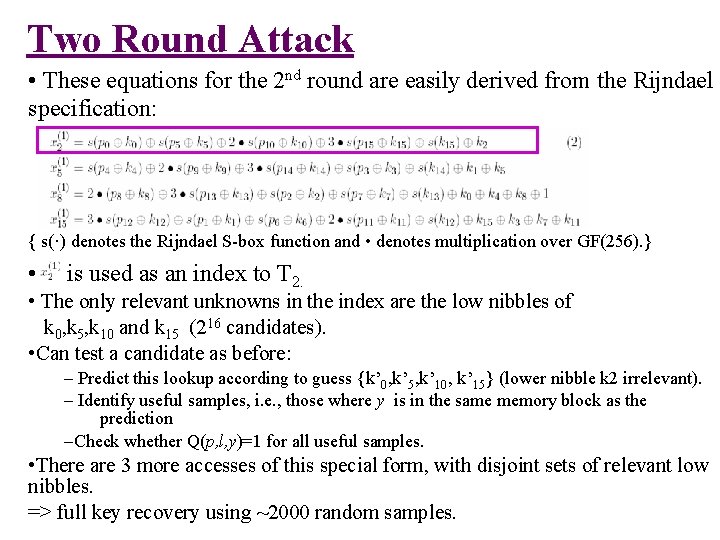
Two Round Attack • These equations for the 2 nd round are easily derived from the Rijndael specification: { s(·) denotes the Rijndael S-box function and • denotes multiplication over GF(256). } • is used as an index to T 2. • The only relevant unknowns in the index are the low nibbles of k 0, k 5, k 10 and k 15 (216 candidates). • Can test a candidate as before: – Predict this lookup according to guess {k’ 0, k’ 5, k’ 10, k’ 15} (lower nibble k 2 irrelevant). – Identify useful samples, i. e. , those where y is in the same memory block as the prediction –Check whether Q(p, l, y)=1 for all useful samples. • There are 3 more accesses of this special form, with disjoint sets of relevant low nibbles. => full key recovery using ~2000 random samples.
Measurement Methods • How do we obtain the measurements Mk(p, l, y) of predicate Qk(p, l, y) ? ? • Inter-process crosstalk can be exploited in two ways: – Effect of the cache on the encryption (timing). – Effect of the encryption on the cache.
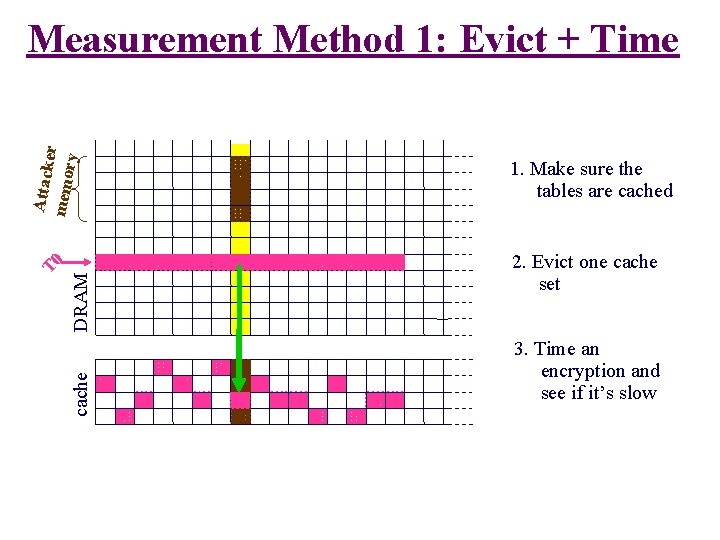
DRAM cache T 0 Attack er memor y Measurement Method 1: Evict + Time 1. Make sure the tables are cached 2. Evict one cache set 3. Time an encryption and see if it’s slow
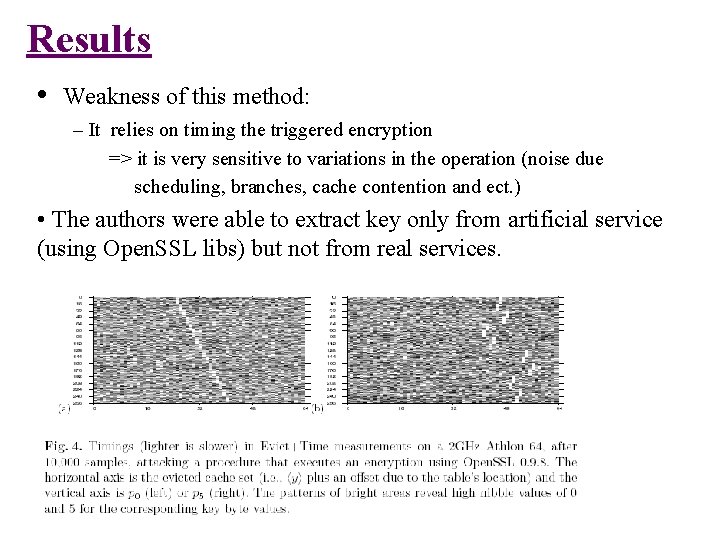
Results • Weakness of this method: – It relies on timing the triggered encryption => it is very sensitive to variations in the operation (noise due scheduling, branches, cache contention and ect. ) • The authors were able to extract key only from artificial service (using Open. SSL libs) but not from real services.
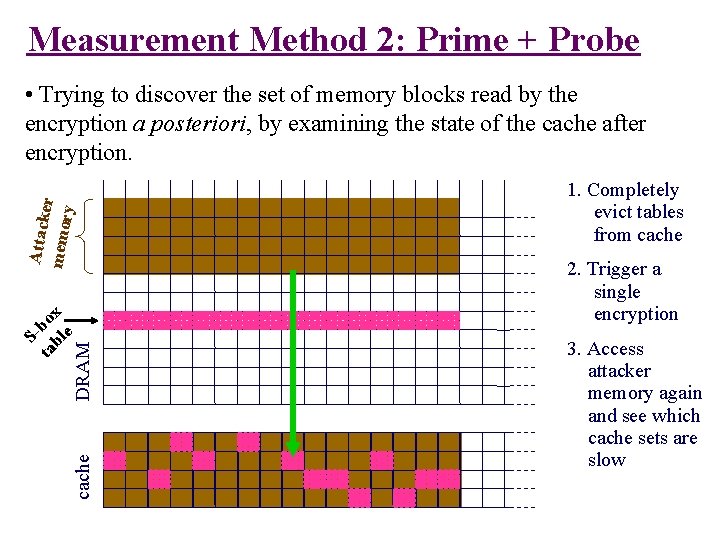
Measurement Method 2: Prime + Probe cache DRAM Sta box bl e Attack er memor y • Trying to discover the set of memory blocks read by the encryption a posteriori, by examining the state of the cache after encryption. 1. Completely evict tables from cache 2. Trigger a single encryption 3. Access attacker memory again and see which cache sets are slow
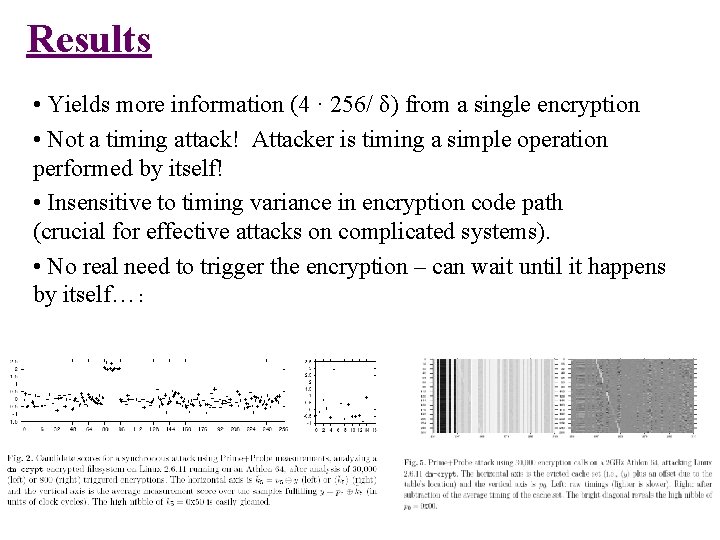
Results • Yields more information (4 · 256/ δ) from a single encryption • Not a timing attack! Attacker is timing a simple operation performed by itself! • Insensitive to timing variance in encryption code path (crucial for effective attacks on complicated systems). • No real need to trigger the encryption – can wait until it happens by itself… :
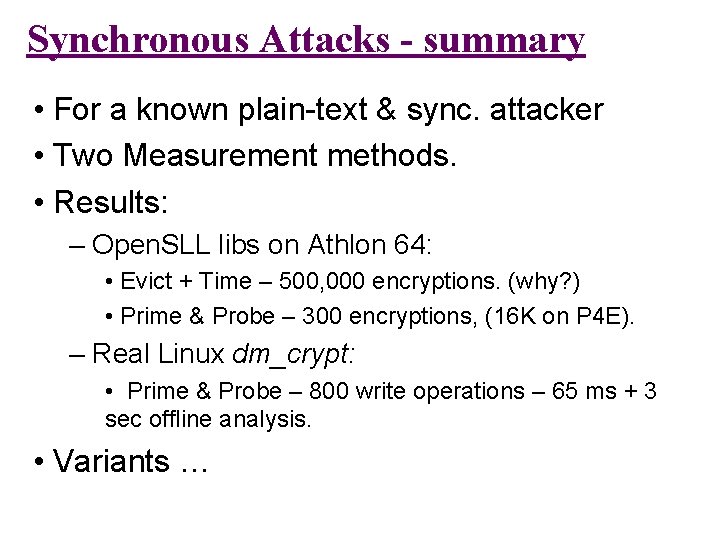
Synchronous Attacks - summary • For a known plain-text & sync. attacker • Two Measurement methods. • Results: – Open. SLL libs on Athlon 64: • Evict + Time – 500, 000 encryptions. (why? ) • Prime & Probe – 300 encryptions, (16 K on P 4 E). – Real Linux dm_crypt: • Prime & Probe – 800 write operations – 65 ms + 3 sec offline analysis. • Variants …
Asynchronous Attack • Someone runs encryptions computations using a secret key. • Attacker process runs on the same CPU at (roughly) the same time. • Assume the plaintext/ciphertext has a non-uniform (conditional) distribution: –English –Formatted data –Headers –Ciphertext gleaned from wire • Examples: just about any use of crypto on a multi-user system Finding the key • Compare two distributions: – Measured memory accesses statistics. – Predicted memory accesses statistics, under the given plaintext distribution and the key hypothesis. • Find key that yields best correlation
Countermeasures • The authors consider numerous countermeasures e. g. : – Avoiding Memory Accesses – Alternative Lookup Tables – Data-Oblivious Memory Access Pattern – Cache State Normalization and Process Blocking – Disabling Cache Sharing – Static or Disabled Cache – Dynamic Table Storage – Hiding the Timing • None of them solves the problem completely. Some architecture/application dependant or require changes in the system. • None are both secure, efficient (or cheap) and generic. => Case specific solutions – probably a combination of the methods.
Thank you! Questions?
Homework 1. What is the difference between Evict+Time and Prime+Probe measurement methods. 2. In the case of known cipher-text, how would the attack change? (hint: can be more efficient – see paper) 3. Why does a first round synchronous attack able to extract only half the key bits? (on a δ=16 platform) 4. Does the addition of random delay to the encryption algorithm improve the immunity against synchronous attacks? Why?