Memory Performance Attacks Denial of Memory Service in
- Slides: 72
Memory Performance Attacks: Denial of Memory Service in Multi-Core Systems Anlin Yan ETH Zurich Fall 2019 28 November 2019 Computer Architecture Seminar Anlin Yan | 28. 11. 2019 | 1
Proceedings of the 16 th USENIX Security Symposium (USENIX SECURITY), pages 257 -274, Boston, MA, August 2007 Computer Architecture Seminar Anlin Yan | 28. 11. 2019 | 2
Summary § Problem: § DRAM memory scheduler designed for single-core system § In multi-core system: unfair when threads with certain access pattern are present § Goal: fair memory scheduler § Key Ideas: § Approximate unfairness by computing thread slowdown § Prioritize unfairly slowed-down threads § Result: Fair. Mem removes denial of service threat Computer Architecture Seminar Anlin Yan | 28. 11. 2019 | 3
Structure § Background § Denial of Service § DRAM § Memory Performance Attacks: Denial of Memory Service in Multi-Core System § § § § Vulnerabilities of current memory scheduling algorithm DRAM fairness Fair memory scheduling model Hardware implementation Results Sensitivity analysis Summary Analysis § § § Strengths Weaknesses Takeaways Further ideas Discussion Computer Architecture Seminar Anlin Yan | 28. 11. 2019 | 4
Structure § Background § Denial of Service § DRAM § Memory Performance Attacks: Denial of Memory Service in Multi-Core System § § § § Vulnerabilities of current memory scheduling algorithm DRAM fairness Fair memory scheduling model Hardware implementation Results Sensitivity analysis Summary Analysis § § § Strengths Weaknesses Takeaways Further ideas Discussion Computer Architecture Seminar Anlin Yan | 28. 11. 2019 | 5
Structure § Background § Denial of Service § DRAM § Memory Performance Attacks: Denial of Memory Service in Multi-Core System § § § § Vulnerabilities of current memory scheduling algorithm DRAM fairness Fair memory scheduling model Hardware implementation Results Sensitivity analysis Summary Analysis § § § Strengths Weaknesses Takeaways Further ideas Discussion Computer Architecture Seminar Anlin Yan | 28. 11. 2019 | 6
Denial of Service (Do. S) § Any type of attack where the attacker prevents legitimate users from accessing some resource Computer Architecture Seminar Anlin Yan | 28. 11. 2019 | 7
Structure § Background § Denial of Service § DRAM § Memory Performance Attacks: Denial of Memory Service in Multi-Core System § § § § Vulnerabilities of current memory scheduling algorithm DRAM fairness Fair memory scheduling model Hardware implementation Results Sensitivity analysis Summary Analysis § § § Strengths Weaknesses Takeaways Further ideas Discussion Computer Architecture Seminar Anlin Yan | 28. 11. 2019 | 8
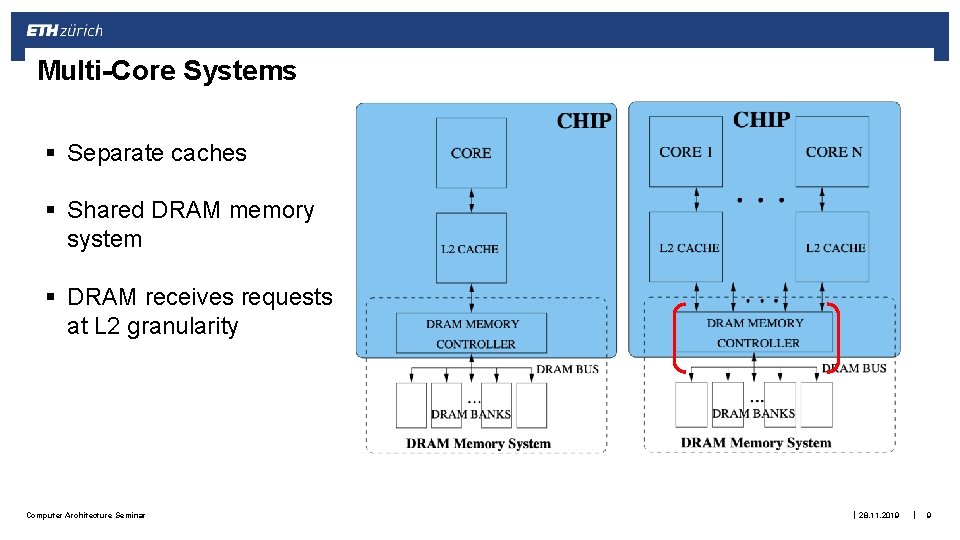
Multi-Core Systems § Separate caches § Shared DRAM memory system § DRAM receives requests at L 2 granularity Computer Architecture Seminar | 28. 11. 2019 | 9
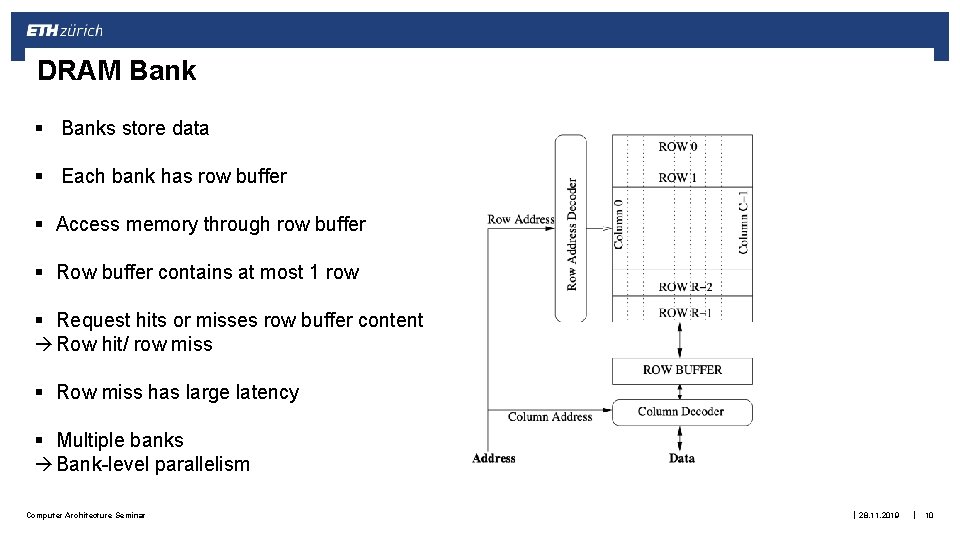
DRAM Bank § Banks store data § Each bank has row buffer § Access memory through row buffer § Row buffer contains at most 1 row § Request hits or misses row buffer content Row hit/ row miss § Row miss has large latency § Multiple banks Bank-level parallelism Computer Architecture Seminar | 28. 11. 2019 | 10
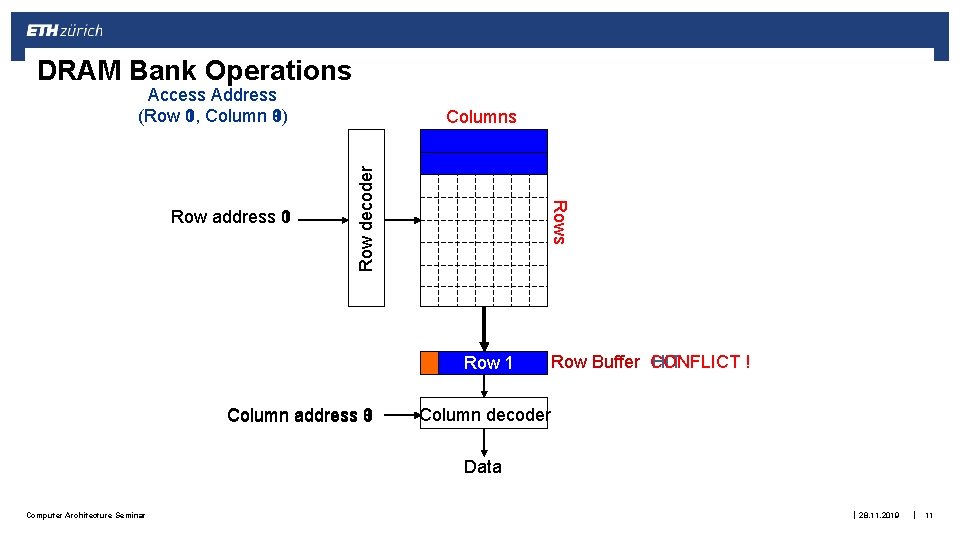
DRAM Bank Operations Access Address (Row 1, 0, Column 0) 1) 9) Row decoder Rows Row address 0 1 Columns Row 01 Row Empty 1 9 Column address 0 Row Buffer CONFLICT HIT ! Column decoder Data Computer Architecture Seminar | 28. 11. 2019 | 11
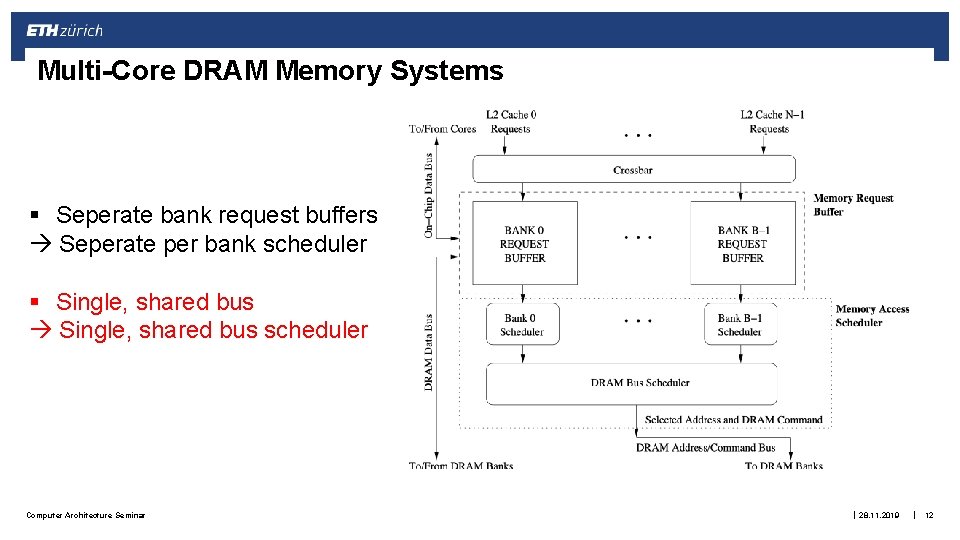
Multi-Core DRAM Memory Systems § Seperate bank request buffers Seperate per bank scheduler § Single, shared bus scheduler Computer Architecture Seminar | 28. 11. 2019 | 12
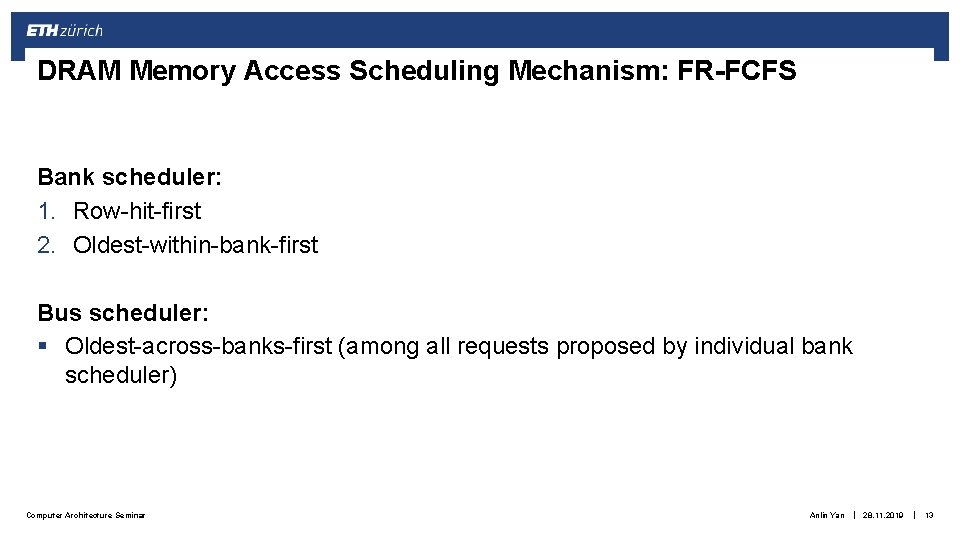
DRAM Memory Access Scheduling Mechanism: FR-FCFS Bank scheduler: 1. Row-hit-first 2. Oldest-within-bank-first Bus scheduler: § Oldest-across-banks-first (among all requests proposed by individual bank scheduler) Computer Architecture Seminar Anlin Yan | 28. 11. 2019 | 13
Structure § Background § Denial of Service § DRAM § Memory Performance Attacks: Denial of Memory Service in Multi-Core System § § § § Vulnerabilities of current memory scheduling algorithm DRAM fairness Fair memory scheduling model Hardware implementation Results Sensitivity analysis Summary Analysis § § § Strengths Weaknesses Takeaways Further ideas Discussion Computer Architecture Seminar Anlin Yan | 28. 11. 2019 | 14
Structure § Background § Denial of Service § DRAM § Memory Performance Attacks: Denial of Memory Service in Multi-Core System § § § § Vulnerabilities of current memory scheduling algorithm DRAM fairness Fair memory scheduling model Hardware implementation Results Sensitivity analysis Summary Analysis § § § Strengths Weaknesses Takeaways Further ideas Discussion Computer Architecture Seminar Anlin Yan | 28. 11. 2019 | 15
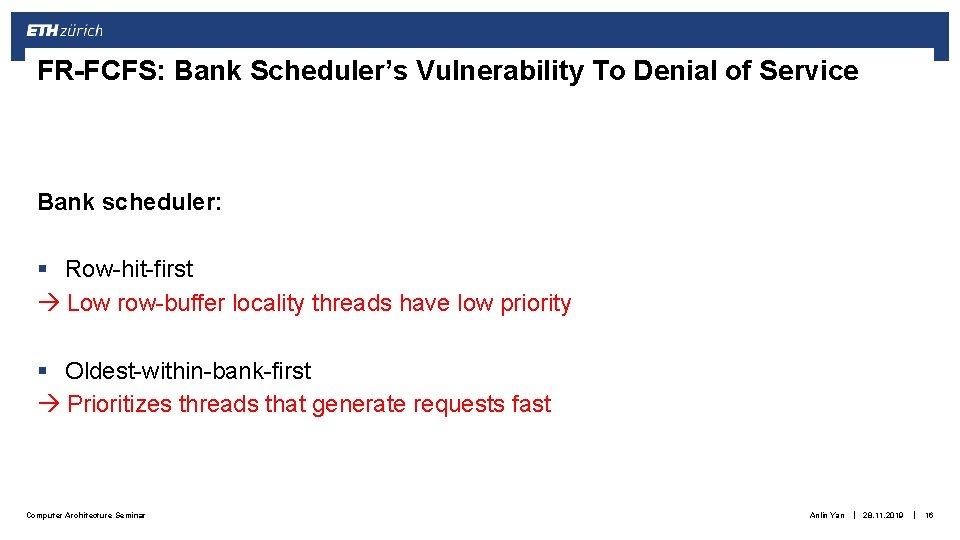
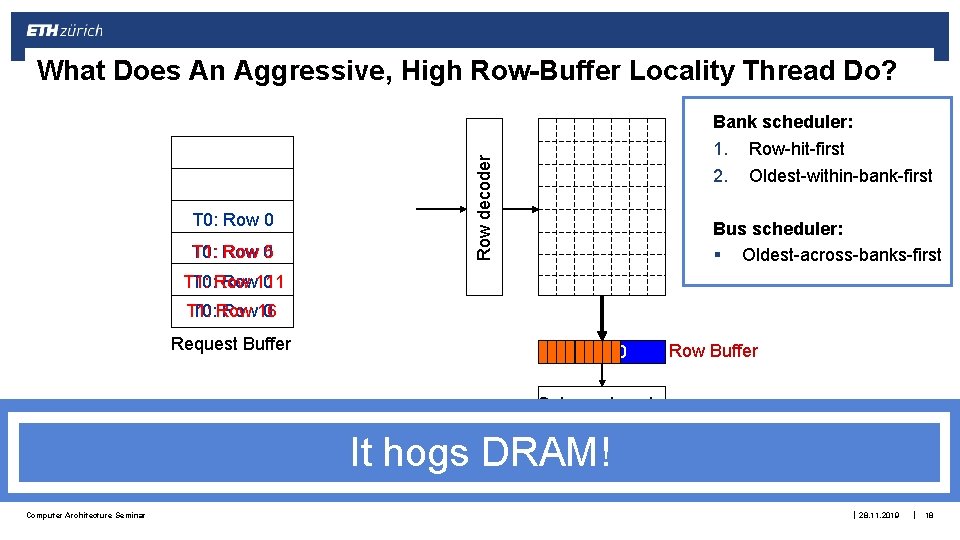
FR-FCFS: Bank Scheduler’s Vulnerability To Denial of Service Bank scheduler: § Row-hit-first Low row-buffer locality threads have low priority § Oldest-within-bank-first Prioritizes threads that generate requests fast Computer Architecture Seminar Anlin Yan | 28. 11. 2019 | 16
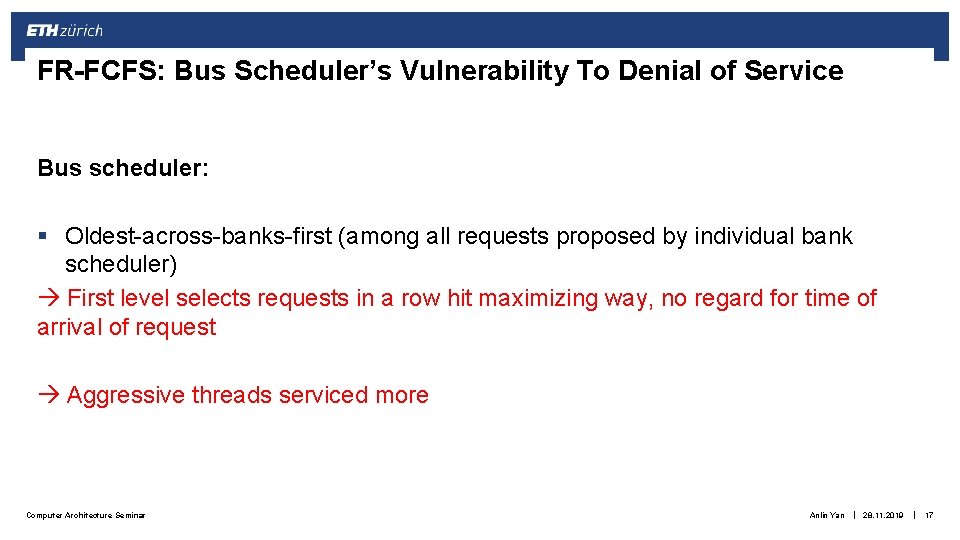
FR-FCFS: Bus Scheduler’s Vulnerability To Denial of Service Bus scheduler: § Oldest-across-banks-first (among all requests proposed by individual bank scheduler) First level selects requests in a row hit maximizing way, no regard for time of arrival of request Aggressive threads serviced more Computer Architecture Seminar Anlin Yan | 28. 11. 2019 | 17
What Does An Aggressive, High Row-Buffer Locality Thread Do? T 0: T 1: Row 05 Row decoder T 0: Row 0 Bank scheduler: 1. Row-hit-first 2. Oldest-within-bank-first Bus scheduler: § Oldest-across-banks-first T 1: T 0: Row 111 0 T 1: T 0: Row 16 0 Request Buffer Row 00 Row Buffer Column decoder Data It hogs DRAM! Computer Architecture Seminar | 28. 11. 2019 | 18
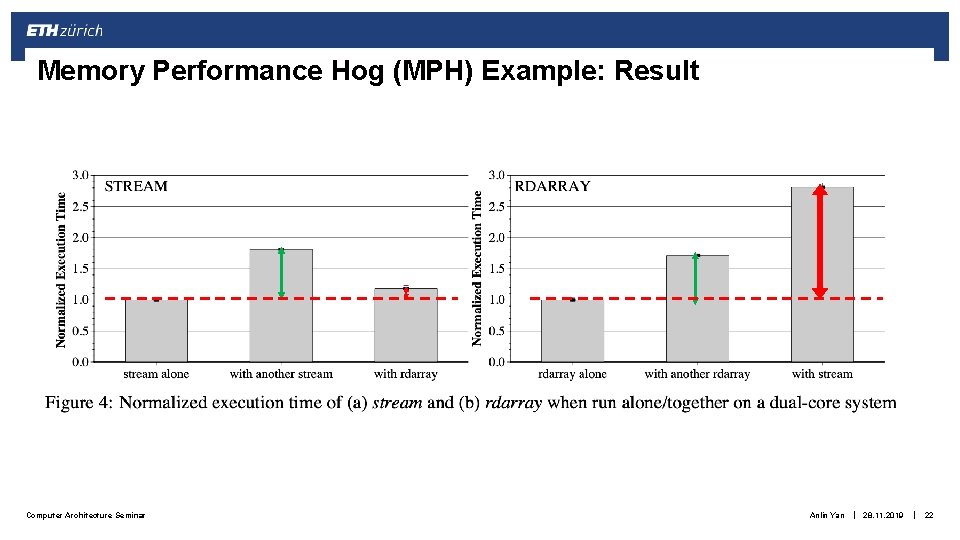
Do. S Threat: Memory Performance Hog (MPH) Is an aggressive, high row-buffer locality thread… § Hogs shared resources § Significantly reduces performance of other threads § No significant performance reduction itself “Any attack where the attacker prevents legitimate users from accessing some resource” Computer Architecture Seminar Anlin Yan | 28. 11. 2019 | 19
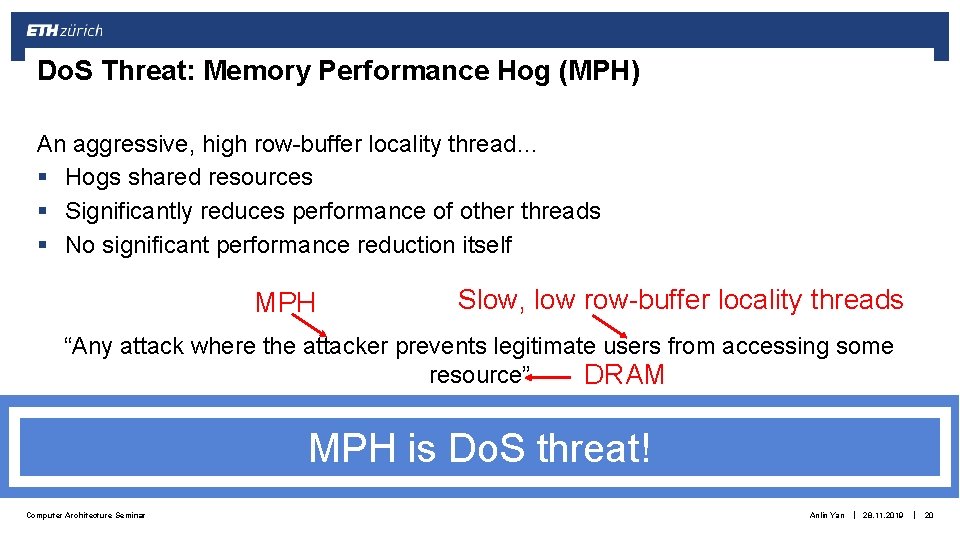
Do. S Threat: Memory Performance Hog (MPH) An aggressive, high row-buffer locality thread… § Hogs shared resources § Significantly reduces performance of other threads § No significant performance reduction itself MPH Slow, low row-buffer locality threads “Any attack where the attacker prevents legitimate users from accessing some resource” DRAM MPH is Do. S threat! Computer Architecture Seminar Anlin Yan | 28. 11. 2019 | 20
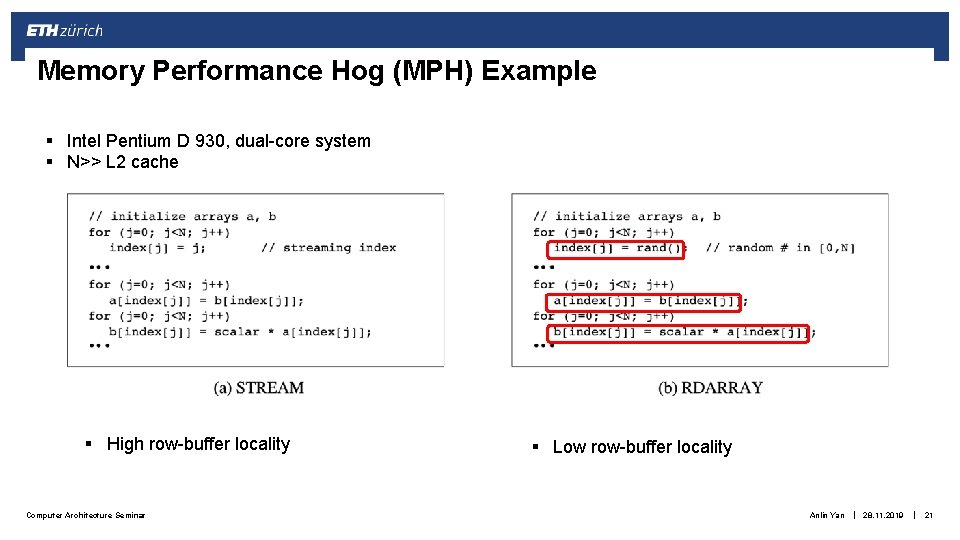
Memory Performance Hog (MPH) Example § Intel Pentium D 930, dual-core system § N>> L 2 cache § High row-buffer locality Computer Architecture Seminar § Low row-buffer locality Anlin Yan | 28. 11. 2019 | 21
Memory Performance Hog (MPH) Example: Result Computer Architecture Seminar Anlin Yan | 28. 11. 2019 | 22
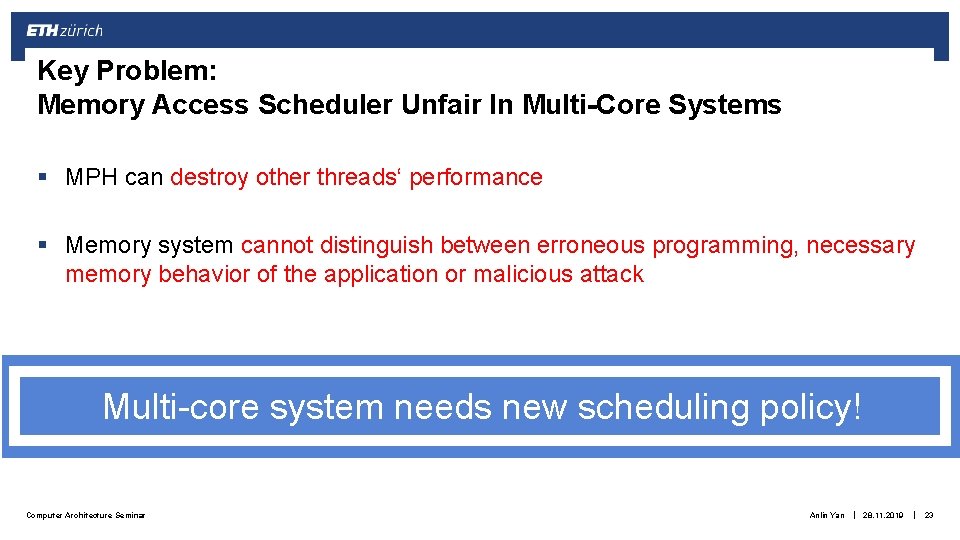
Key Problem: Memory Access Scheduler Unfair In Multi-Core Systems § MPH can destroy other threads‘ performance § Memory system cannot distinguish between erroneous programming, necessary memory behavior of the application or malicious attack Multi-core system needs new scheduling policy! Computer Architecture Seminar Anlin Yan | 28. 11. 2019 | 23
Structure § Background § Denial of Service § DRAM § Memory Performance Attacks: Denial of Memory Service in Multi-Core System § § § § Vulnerabilities of current memory scheduling algorithm DRAM fairness Fair memory scheduling model Hardware implementation Results Sensitivity analysis Summary Analysis § § § Strengths Weaknesses Takeaways Further ideas Discussion Computer Architecture Seminar Anlin Yan | 28. 11. 2019 | 24
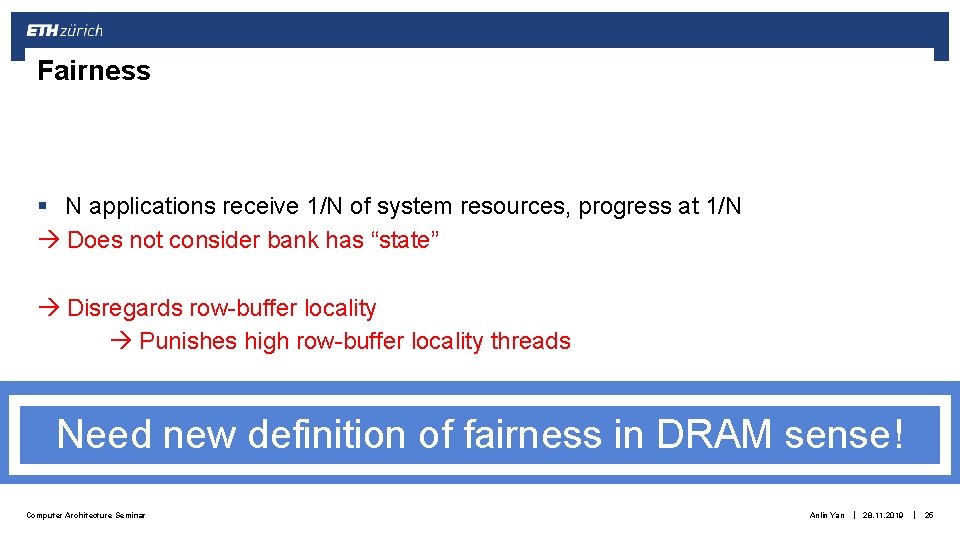
Fairness § N applications receive 1/N of system resources, progress at 1/N Does not consider bank has “state” Disregards row-buffer locality Punishes high row-buffer locality threads Need new definition of fairness in DRAM sense! Computer Architecture Seminar Anlin Yan | 28. 11. 2019 | 25
Fairness in DRAM Memory Sense § Latency § Thread inherent latency (depends on row-buffer locality) § Contention caused latency § Fairness § Thread inherent latency unchanged § Contention caused latency proportionally distributed across all threads Computer Architecture Seminar Anlin Yan | 28. 11. 2019 | 26
Structure § Background § Denial of Service § DRAM § Memory Performance Attacks: Denial of Memory Service in Multi-Core System § § § § Vulnerabilities of current memory scheduling algorithm DRAM fairness Fair memory scheduling model Hardware implementation Results Sensitivity analysis Summary Analysis § § § Strengths Weaknesses Takeaways Further ideas Discussion Computer Architecture Seminar Anlin Yan | 28. 11. 2019 | 27
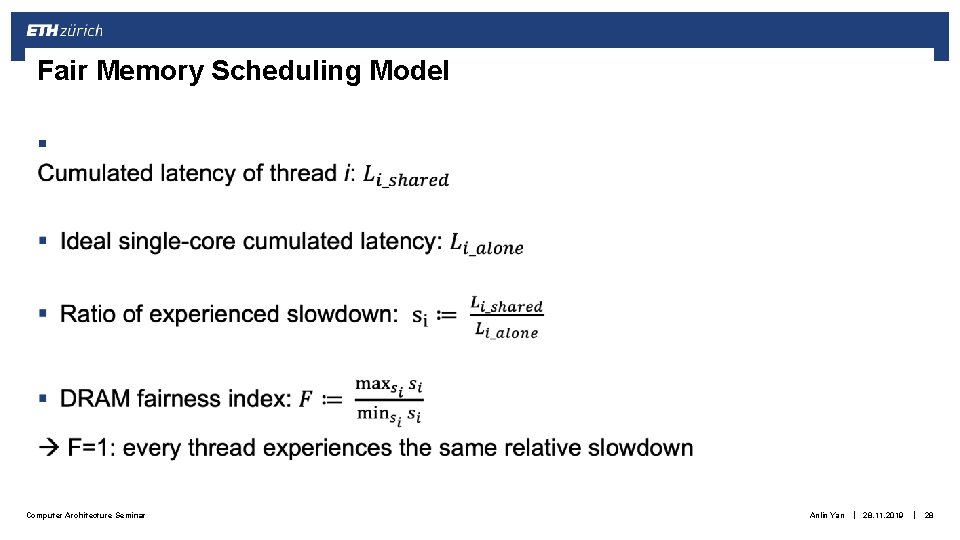
Fair Memory Scheduling Model § Computer Architecture Seminar Anlin Yan | 28. 11. 2019 | 28
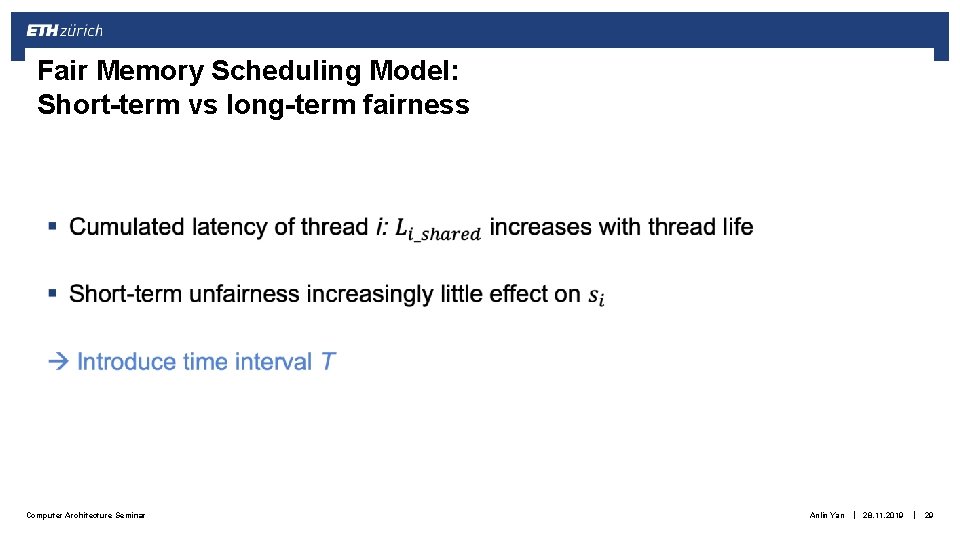
Fair Memory Scheduling Model: Short-term vs long-term fairness Computer Architecture Seminar Anlin Yan | 28. 11. 2019 | 29
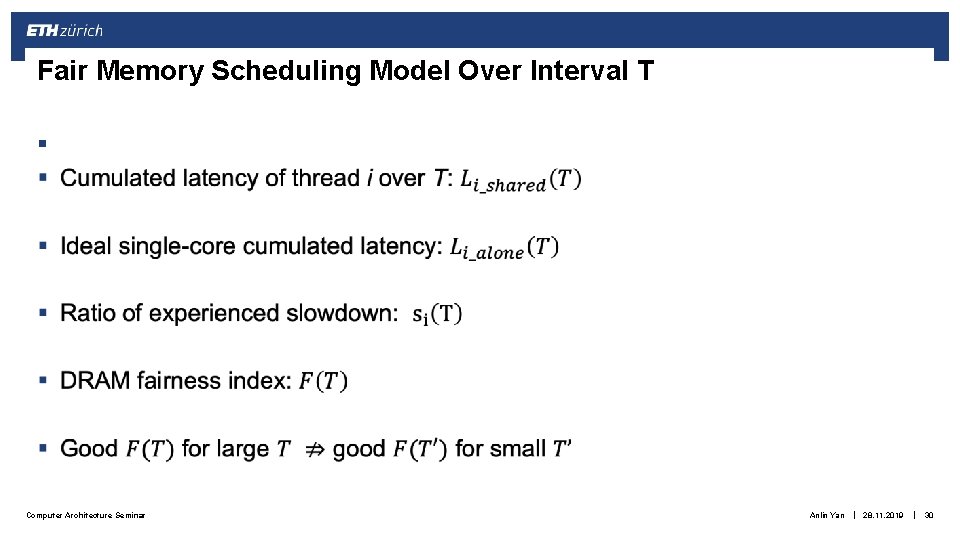
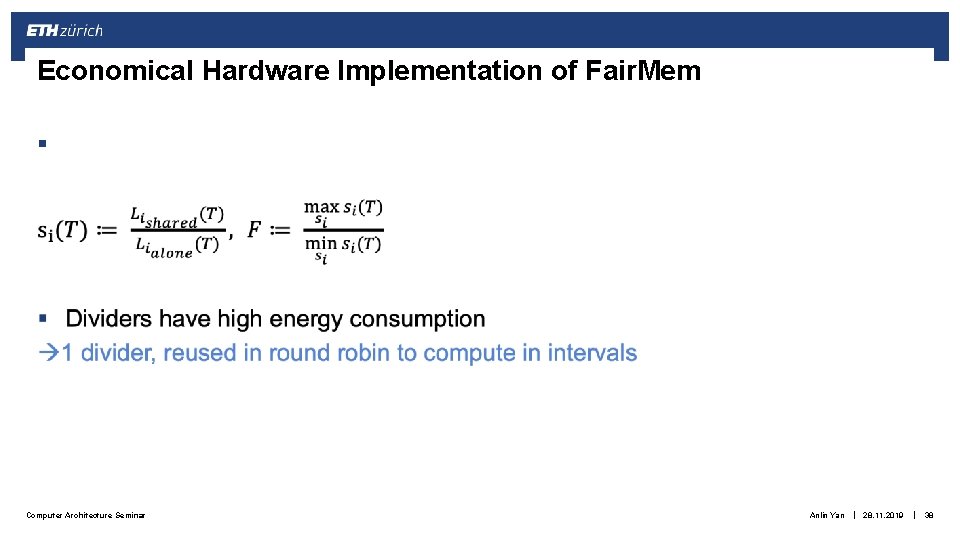
Fair Memory Scheduling Model Over Interval T § Computer Architecture Seminar Anlin Yan | 28. 11. 2019 | 30
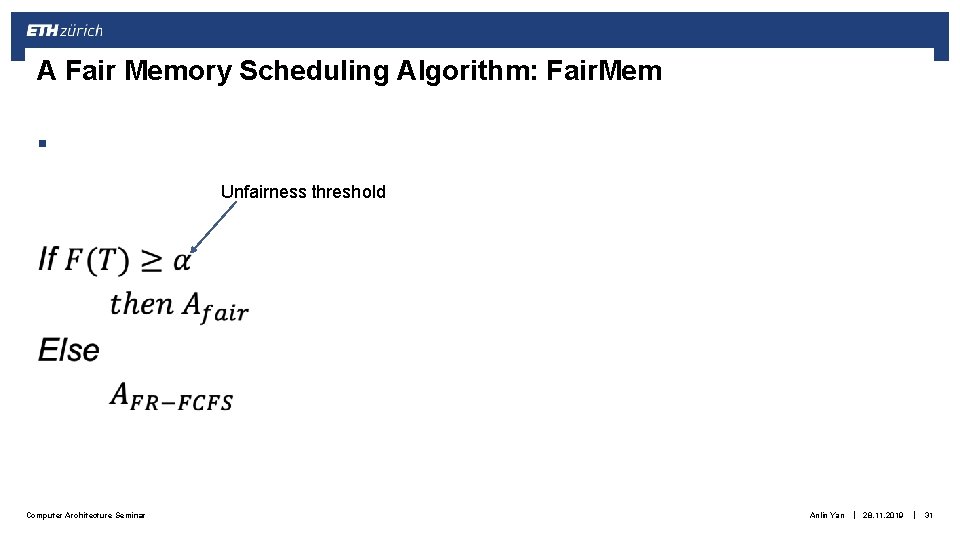
A Fair Memory Scheduling Algorithm: Fair. Mem § Unfairness threshold Computer Architecture Seminar Anlin Yan | 28. 11. 2019 | 31
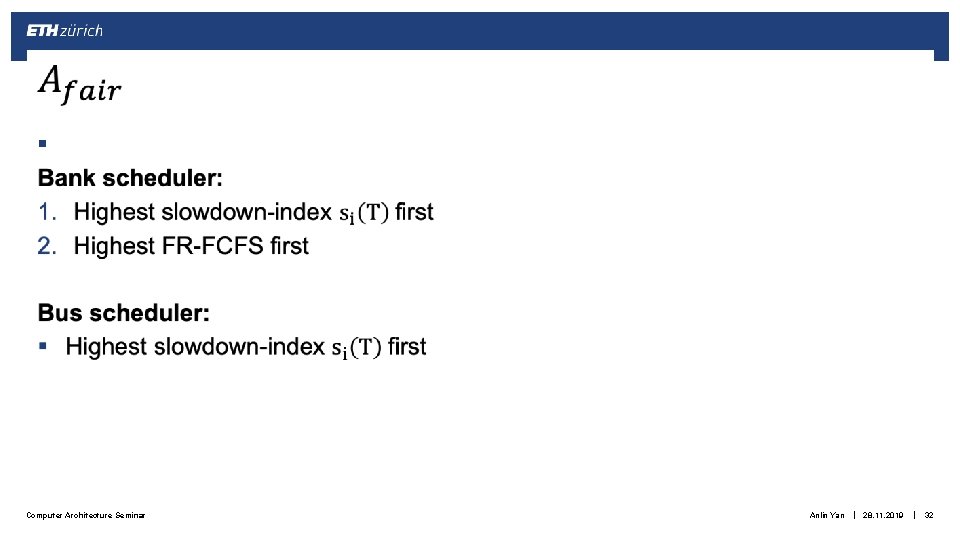
§ Computer Architecture Seminar Anlin Yan | 28. 11. 2019 | 32
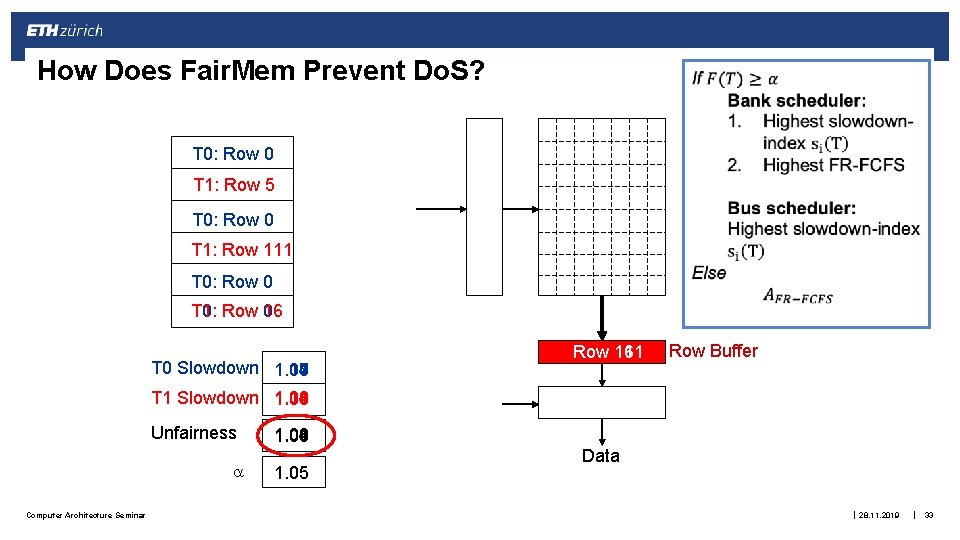
How Does Fair. Mem Prevent Do. S? T 0: Row 0 T 1: Row 5 T 0: Row 0 T 1: Row 111 T 0: Row 0 T 0: T 1: Row 0 16 T 0 Slowdown 1. 10 1. 04 1. 07 1. 03 Row 16 Row 00 Row 111 Row Buffer T 1 Slowdown 1. 14 1. 03 1. 06 1. 08 1. 11 1. 00 Unfairness Computer Architecture Seminar 1. 06 1. 04 1. 03 1. 00 1. 05 Data | 28. 11. 2019 | 33
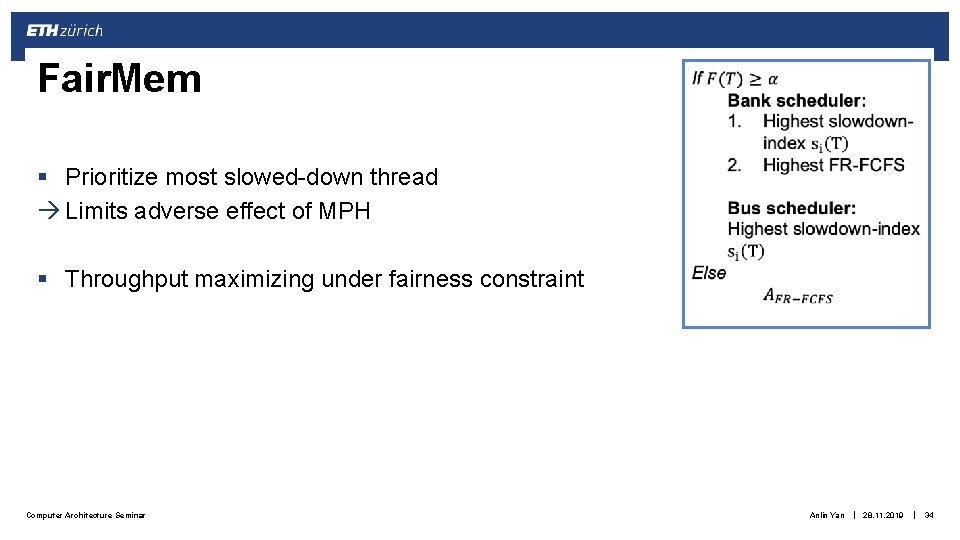
Fair. Mem § Prioritize most slowed-down thread Limits adverse effect of MPH § Throughput maximizing under fairness constraint Computer Architecture Seminar Anlin Yan | 28. 11. 2019 | 34
Structure § Background § Denial of Service § DRAM § Memory Performance Attacks: Denial of Memory Service in Multi-Core System § § § § Vulnerabilities of current memory scheduling algorithm DRAM fairness Fair memory scheduling model Hardware implementation Results Sensitivity analysis Summary Analysis § § § Strengths Weaknesses Takeaways Further ideas Discussion Computer Architecture Seminar Anlin Yan | 28. 11. 2019 | 35
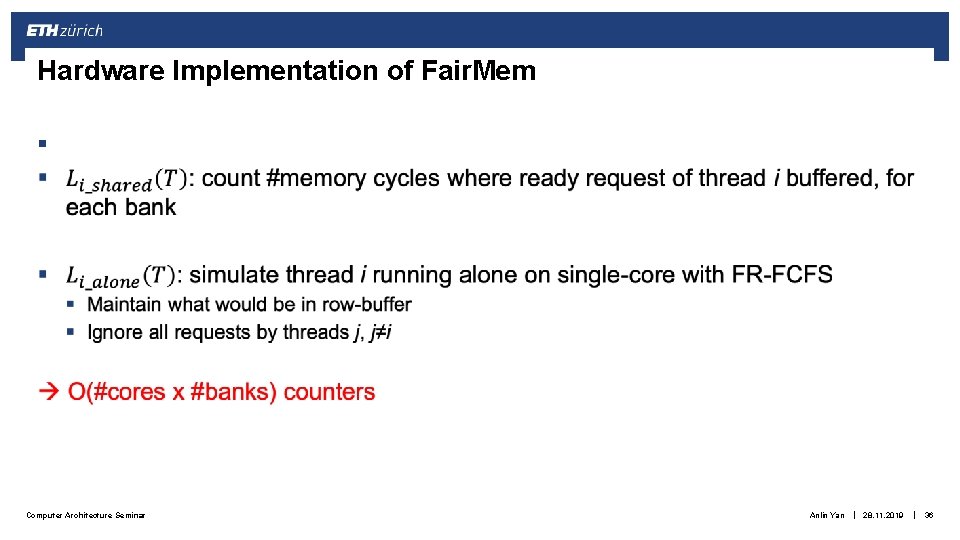
Hardware Implementation of Fair. Mem § Computer Architecture Seminar Anlin Yan | 28. 11. 2019 | 36
Economical Hardware Implementation of Fair. Mem: Reduce Counters by Sampling Random sample of subset of requests by thread i to some bank b Does i request the same row in its next request to b? Approximate row hit rate Approximate latency O(#cores) counters Computer Architecture Seminar Anlin Yan | 28. 11. 2019 | 37
Economical Hardware Implementation of Fair. Mem § Computer Architecture Seminar Anlin Yan | 28. 11. 2019 | 38
Structure § Background § Denial of Service § DRAM § Memory Performance Attacks: Denial of Memory Service in Multi-Core System § § § § Vulnerabilities of current memory scheduling algorithm DRAM fairness Fair memory scheduling model Hardware implementation Results Sensitivity analysis Summary Analysis § § § Strengths Weaknesses Takeaways Further ideas Discussion Computer Architecture Seminar Anlin Yan | 28. 11. 2019 | 39
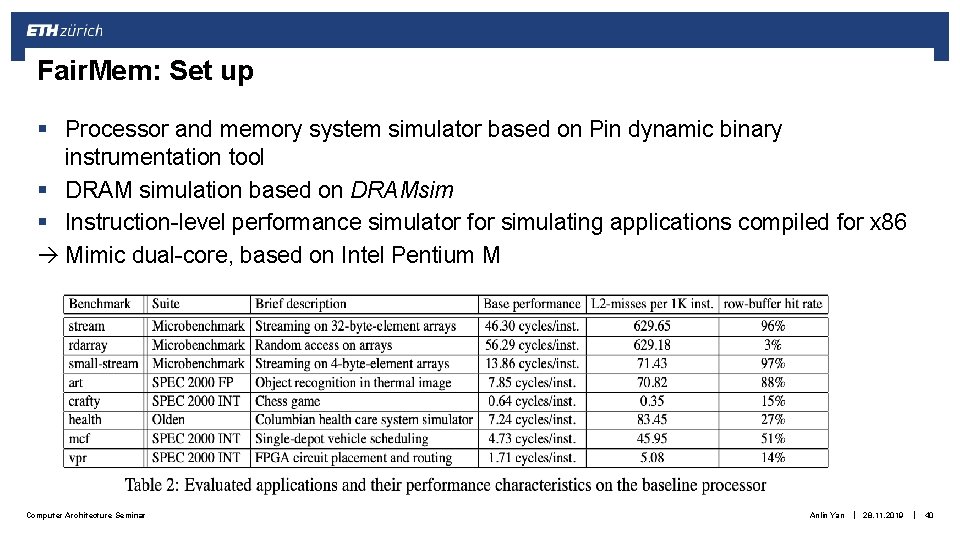
Fair. Mem: Set up § Processor and memory system simulator based on Pin dynamic binary instrumentation tool § DRAM simulation based on DRAMsim § Instruction-level performance simulator for simulating applications compiled for x 86 Mimic dual-core, based on Intel Pentium M Computer Architecture Seminar Anlin Yan | 28. 11. 2019 | 40
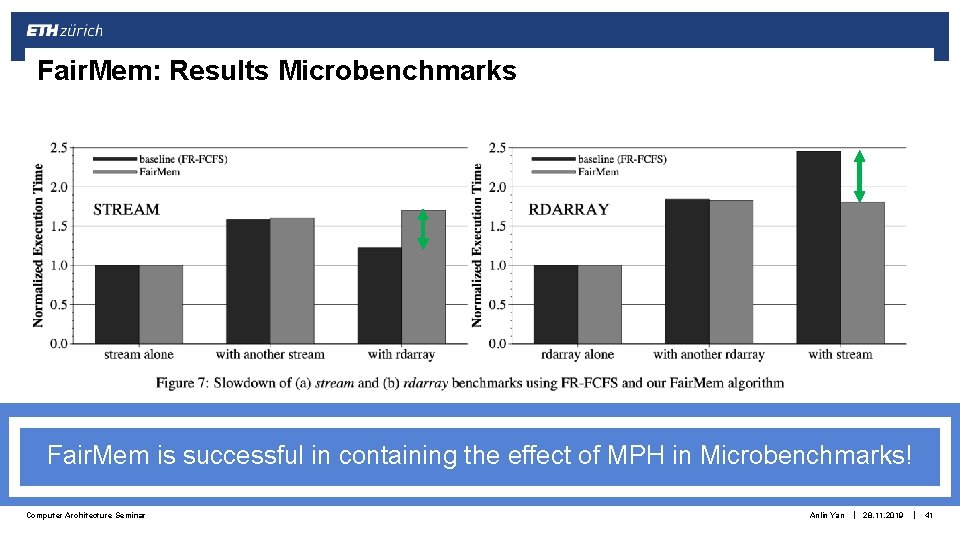
Fair. Mem: Results Microbenchmarks Fair. Mem is successful in containing the effect of MPH in Microbenchmarks! Computer Architecture Seminar Anlin Yan | 28. 11. 2019 | 41
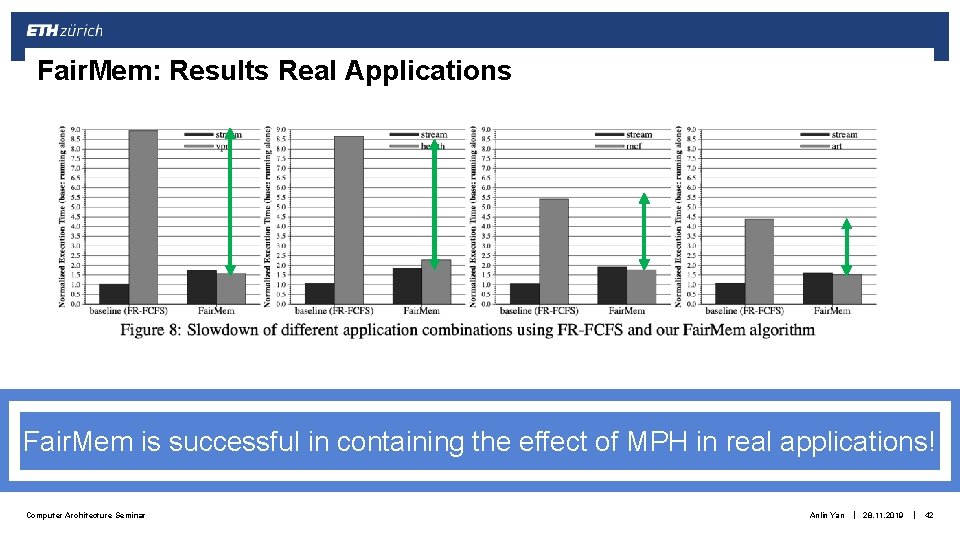
Fair. Mem: Results Real Applications Fair. Mem is successful in containing the effect of MPH in real applications! Computer Architecture Seminar Anlin Yan | 28. 11. 2019 | 42
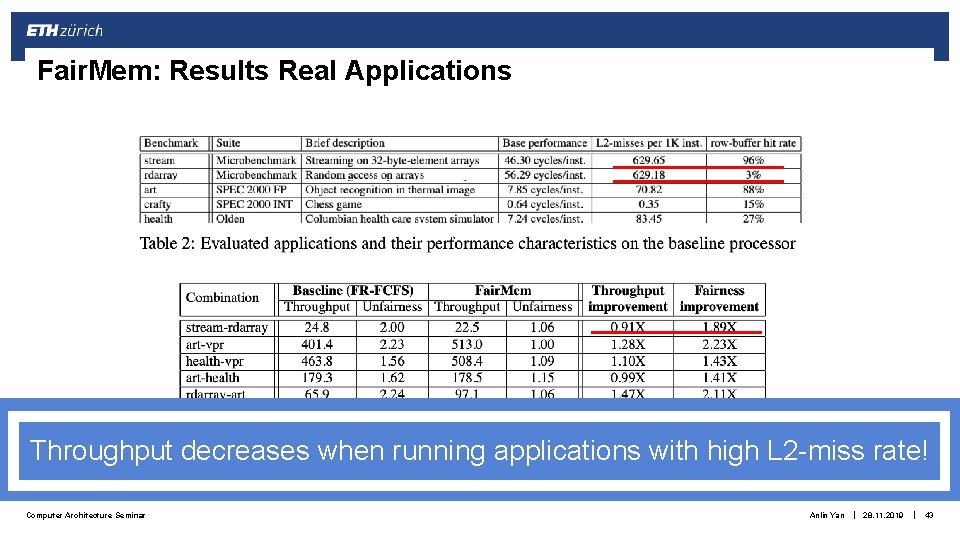
Fair. Mem: Results Real Applications Throughput decreases when running applications with high L 2 -miss rate! Computer Architecture Seminar Anlin Yan | 28. 11. 2019 | 43
Structure § Background § Denial of Service § DRAM § Memory Performance Attacks: Denial of Memory Service in Multi-Core System § § § § Vulnerabilities of current memory scheduling algorithm DRAM fairness Fair memory scheduling model Hardware implementation Results Sensitivity analysis Summary Analysis § § § Strengths Weaknesses Takeaways Further ideas Discussion Computer Architecture Seminar Anlin Yan | 28. 11. 2019 | 44
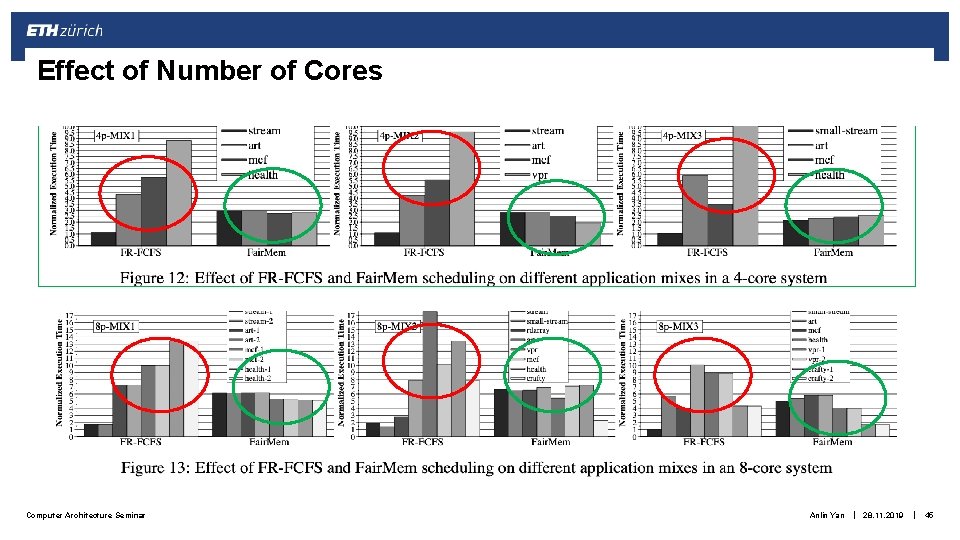
Effect of Number of Cores Computer Architecture Seminar Anlin Yan | 28. 11. 2019 | 45
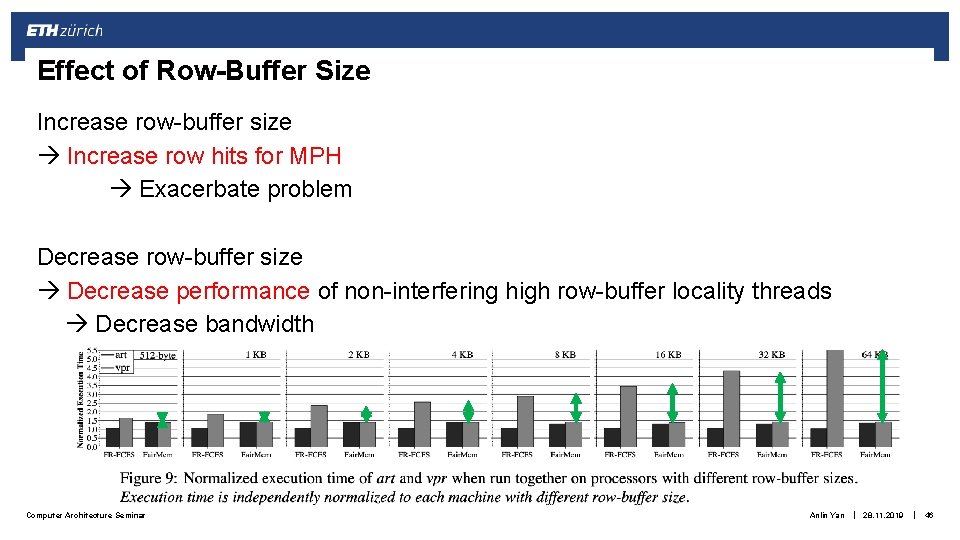
Effect of Row-Buffer Size Increase row-buffer size Increase row hits for MPH Exacerbate problem Decrease row-buffer size Decrease performance of non-interfering high row-buffer locality threads Decrease bandwidth Computer Architecture Seminar Anlin Yan | 28. 11. 2019 | 46
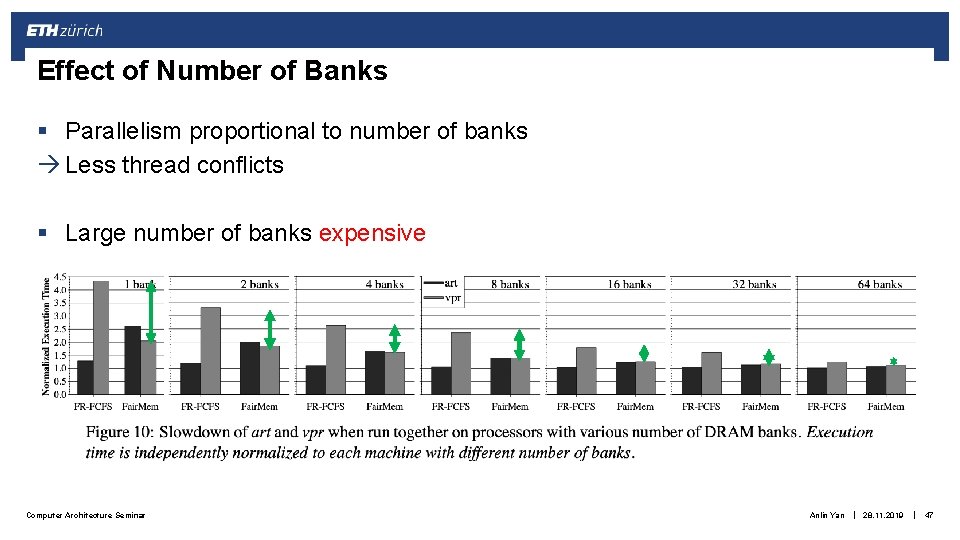
Effect of Number of Banks § Parallelism proportional to number of banks Less thread conflicts § Large number of banks expensive Computer Architecture Seminar Anlin Yan | 28. 11. 2019 | 47
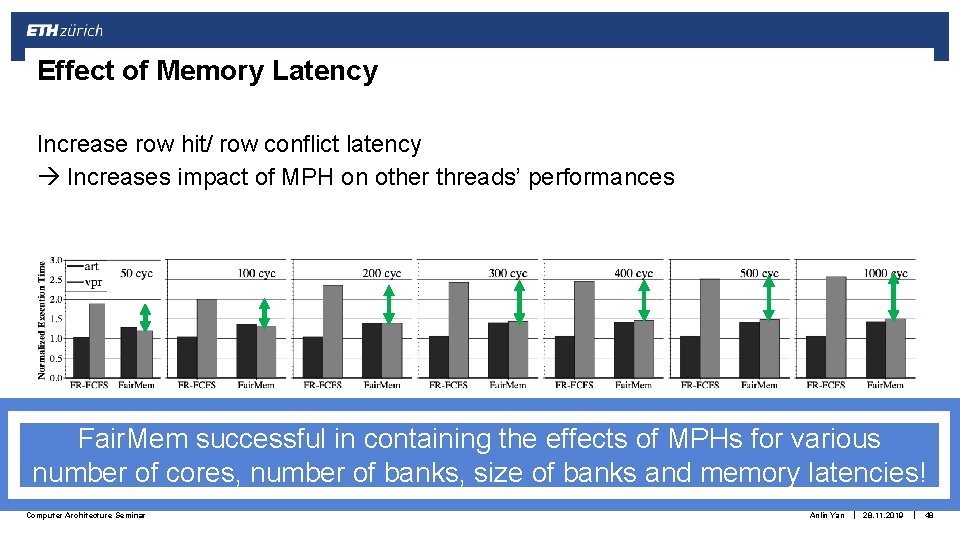
Effect of Memory Latency Increase row hit/ row conflict latency Increases impact of MPH on other threads’ performances Fair. Mem successful in containing the effects of MPHs for various number of cores, number of banks, size of banks and memory latencies! Computer Architecture Seminar Anlin Yan | 28. 11. 2019 | 48
Structure § Background § Denial of Service § DRAM § Memory Performance Attacks: Denial of Memory Service in Multi-Core System § § § § Vulnerabilities of current memory scheduling algorithm DRAM fairness Fair memory scheduling model Hardware implementation Results Sensitivity analysis Summary Analysis § § § Strengths Weaknesses Takeaways Further ideas Discussion Computer Architecture Seminar Anlin Yan | 28. 11. 2019 | 49
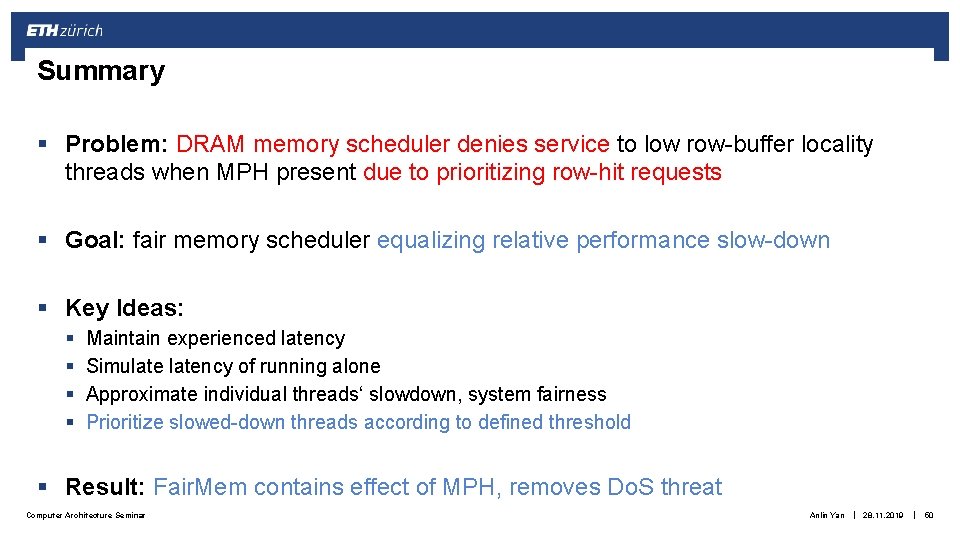
Summary § Problem: DRAM memory scheduler denies service to low row-buffer locality threads when MPH present due to prioritizing row-hit requests § Goal: fair memory scheduler equalizing relative performance slow-down § Key Ideas: § § Maintain experienced latency Simulatency of running alone Approximate individual threads‘ slowdown, system fairness Prioritize slowed-down threads according to defined threshold § Result: Fair. Mem contains effect of MPH, removes Do. S threat Computer Architecture Seminar Anlin Yan | 28. 11. 2019 | 50
Structure § Background § Denial of Service § DRAM § Memory Performance Attacks: Denial of Memory Service in Multi-Core System § § § § Vulnerabilities of current memory scheduling algorithm DRAM fairness Fair memory scheduling model Hardware implementation Results Sensitivity analysis Summary Analysis § § § Strengths Weaknesses Takeaways Further ideas Discussion Computer Architecture Seminar Anlin Yan | 28. 11. 2019 | 51
Structure § Background § Denial of Service § DRAM § Memory Performance Attacks: Denial of Memory Service in Multi-Core System § § § § Vulnerabilities of current memory scheduling algorithm DRAM fairness Fair memory scheduling model Hardware implementation Results Sensitivity analysis Summary Analysis § § § Strengths Weaknesses Takeaways Further ideas Discussion Computer Architecture Seminar Anlin Yan | 28. 11. 2019 | 52
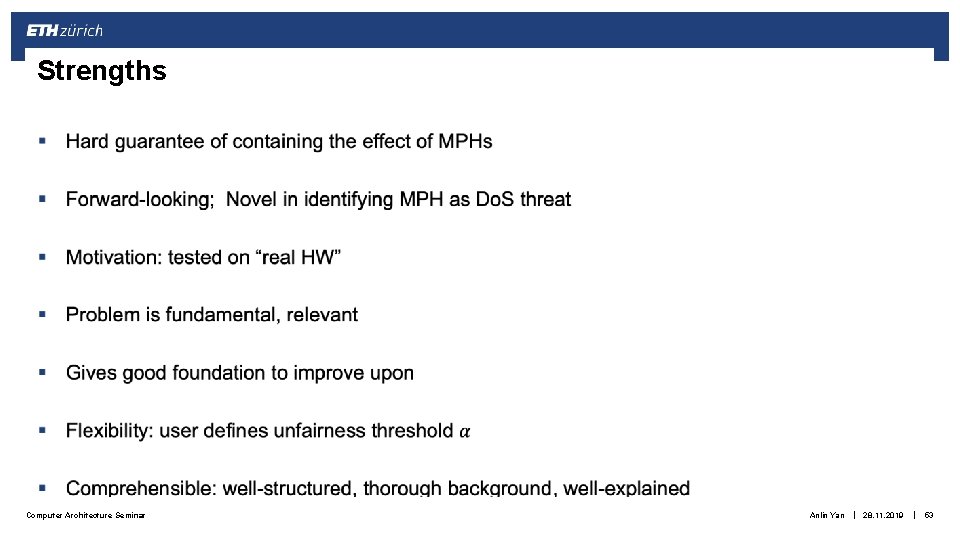
Strengths § Computer Architecture Seminar Anlin Yan | 28. 11. 2019 | 53
Structure § Background § Denial of Service § DRAM § Memory Performance Attacks: Denial of Memory Service in Multi-Core System § § § § Vulnerabilities of current memory scheduling algorithm DRAM fairness Fair memory scheduling model Hardware implementation Results Sensitivity analysis Summary Analysis § § § Strengths Weaknesses Takeaways Further ideas Discussion Computer Architecture Seminar Anlin Yan | 28. 11. 2019 | 54
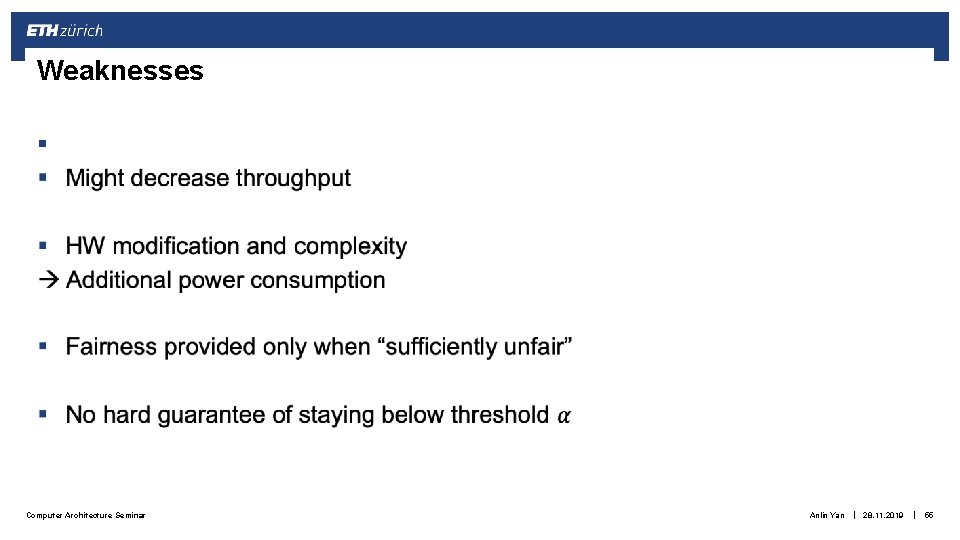
Weaknesses § Computer Architecture Seminar Anlin Yan | 28. 11. 2019 | 55
Structure § Background § Denial of Service § DRAM § Memory Performance Attacks: Denial of Memory Service in Multi-Core System § § § § Vulnerabilities of current memory scheduling algorithm DRAM fairness Fair memory scheduling model Hardware implementation Results Sensitivity analysis Summary Analysis § § § Strengths Weaknesses Takeaways Further ideas Discussion Computer Architecture Seminar Anlin Yan | 28. 11. 2019 | 56
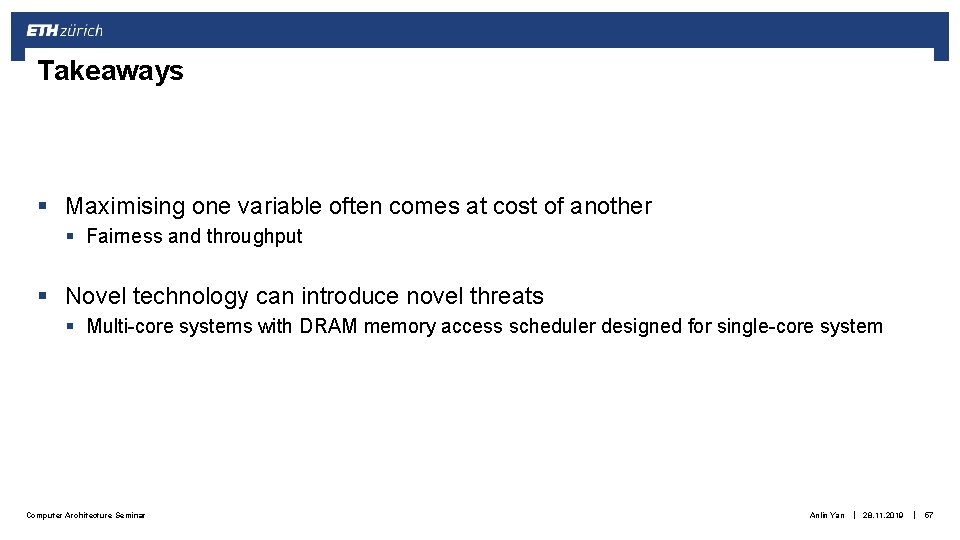
Takeaways § Maximising one variable often comes at cost of another § Fairness and throughput § Novel technology can introduce novel threats § Multi-core systems with DRAM memory access scheduler designed for single-core system Computer Architecture Seminar Anlin Yan | 28. 11. 2019 | 57
Structure § Background § Denial of Service § DRAM § Memory Performance Attacks: Denial of Memory Service in Multi-Core System § § § § Vulnerabilities of current memory scheduling algorithm DRAM fairness Fair memory scheduling model Hardware implementation Results Sensitivity analysis Summary Analysis § § § Strengths Weaknesses Takeaways Further ideas Discussion Computer Architecture Seminar Anlin Yan | 28. 11. 2019 | 58
Further Ideas § Computer Architecture Seminar Anlin Yan | 28. 11. 2019 | 59
Structure § Background § Denial of Service § DRAM § Memory Performance Attacks: Denial of Memory Service in Multi-Core System § § § § Vulnerabilities of current memory scheduling algorithm DRAM fairness Fair memory scheduling model Hardware implementation Results Sensitivity analysis Summary Analysis § § § Strengths Weaknesses Takeaways Further ideas Discussion Computer Architecture Seminar Anlin Yan | 28. 11. 2019 | 60
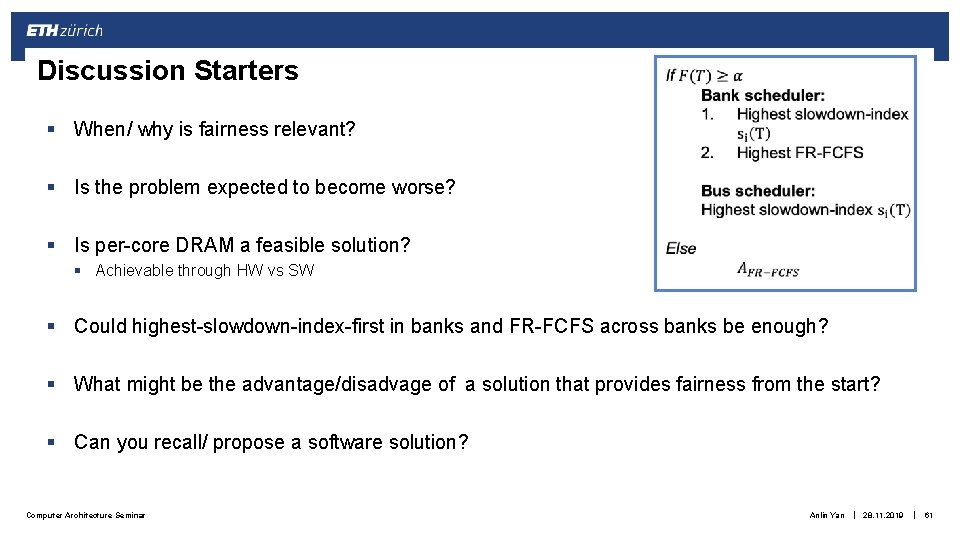
Discussion Starters § When/ why is fairness relevant? § Is the problem expected to become worse? § Is per-core DRAM a feasible solution? § Achievable through HW vs SW § Could highest-slowdown-index-first in banks and FR-FCFS across banks be enough? § What might be the advantage/disadvage of a solution that provides fairness from the start? § Can you recall/ propose a software solution? Computer Architecture Seminar Anlin Yan | 28. 11. 2019 | 61
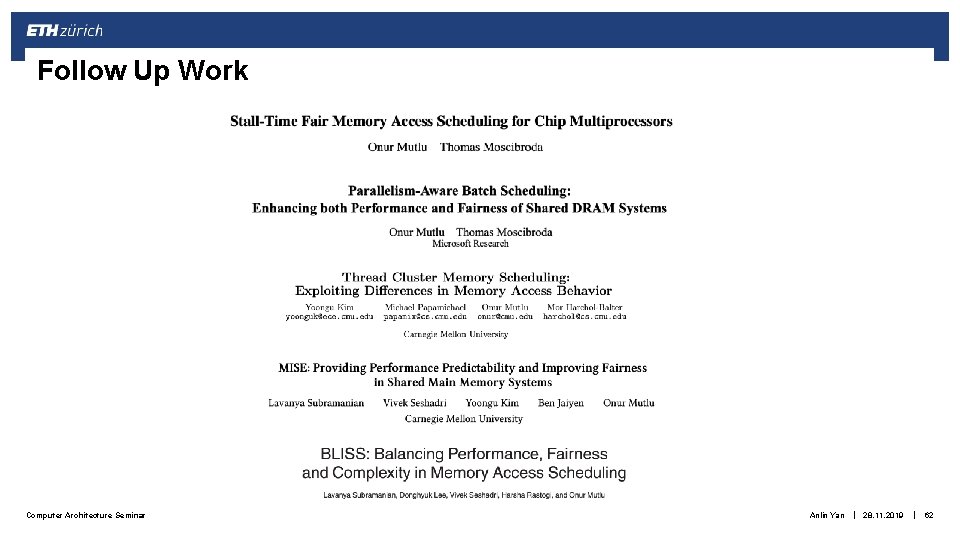
Follow Up Work Computer Architecture Seminar Anlin Yan | 28. 11. 2019 | 62
Memory Performance Attacks: Denial of Memory Service in Multi-Core Systems Anlin Yan ETH Zurich Fall 2019 28 November 2019 Computer Architecture Seminar Anlin Yan | 28. 11. 2019 | 63
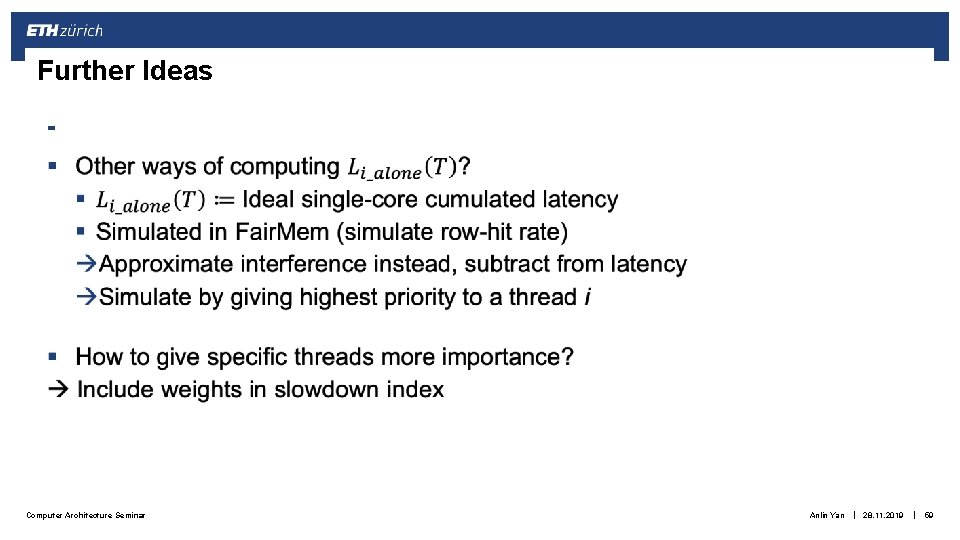
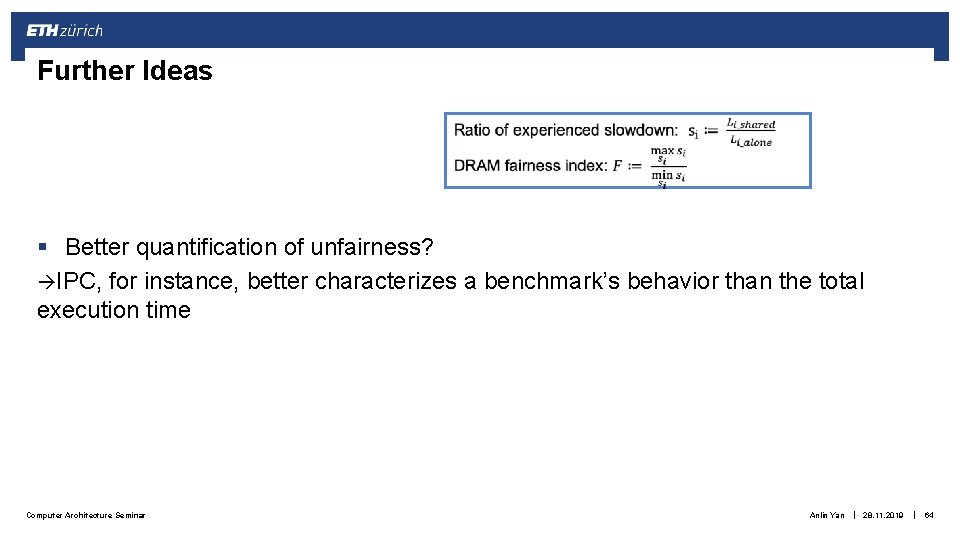
Further Ideas § Better quantification of unfairness? IPC, for instance, better characterizes a benchmark’s behavior than the total execution time Computer Architecture Seminar Anlin Yan | 28. 11. 2019 | 64
Further Ideas § TCM(Thread cluster memory): classify thread into memory-intensive and non-intensive groups § deprioritized high-memory-intensity applications might be slowed down § Per group individual scheduling policy low-mem-intensity: ranking based on intensity high: shuffle ranks to provide fairness Computer Architecture Seminar Anlin Yan | 28. 11. 2019 | 65
Further Ideas § ATLAS: observation: low memory service receiving applications experience interference from high memory service receiving applications -> adaptive per-thread least-attained-service memory scheduling, multiple memory schedulers controlling different channels of main memory, schedule: in each time period controllers coordinate to determine a consistent ranking of threads, least serviced in past have highest ranking -> preserve bank-level parallelism thread’s requests all serviced from start to finish without other threads’ request being serviced? (gives bank-level parallelism and starvation freedom) Computer Architecture Seminar Anlin Yan | 28. 11. 2019 | 66
Further Ideas: Bank Partitioning § Combine with software bank partitioning (ameliorate low row-buffer hit ratio and delay of reordering due to tasks being mapped to same bank and thus interfering each other): dedicate specific physical pages and thus also specific DRAM bank to each core #DRAM banks grows much slower than #cores -> across bank, ie bus level contention (Bounding Memory Interference Delay in COTS-based Multi-core Systems, Kim) Independent channels -> separate data buses and independent memory controllers (MC) Computer Architecture Seminar Anlin Yan | 28. 11. 2019 | 67
Further Ideas § STFM (very similar to proposed Fair. Mem) § Maintain T_alone by estimating T_interference: T_alone = T_shared – T_interference (heuristics based! Compute T_alone by computing how much it is interefered) § T_interference § DRAM bus interference (otherwise scheduled command (any ready command in request buffer)stalled for t_bus cycles) § DRAM bank interference: row-buffer locality interference and waiting for another thread to be serviced (cannot however simply sum up bank interferences, since these are serviced in parallel) Computer Architecture Seminar Anlin Yan | 28. 11. 2019 | 68
Further Ideas § PAR-BS(inter-thread interference destroys bank-level access parallelism, overlapped latencies become serialized): form a batch of outstanding requests and prioritize all requests within batch, form ranking within batch based on estimated stall time (finish time), avoid reordering in batch, highest ranking: lowest number of requests to any bank, lowest ranking: highest number of requests to any bank (not parallelisable) –> improve thoughput an bank-level-parallelism ->not scalable due to significant coordination between memory controllers Optimization problem of achieving high bank-level parallelism and high row hit rate is NP-complete, no efficient algorithmic solutions are expected to exist Computer Architecture Seminar Anlin Yan | 28. 11. 2019 | 69
Further Ideas § MISE: providing performance predicatability and improving fairness in shared main memory systems § Request-service-rate as proxy for performance in memory intensive applications § Alone-request-service-rate (memory controller gives each thread in round robin highest priority, ie very little interference from other threads) § MISE for instance much higher accuracy than STFM (when compared to measured worst-case) Computer Architecture Seminar Anlin Yan | 28. 11. 2019 | 70
Further Ideas § BLISS(Blacklisting Memory Scheduler): Balancing Performance, Fairness and Complexity in Memory Access Scheduling (L. Subramanian) § Shortcomings of so far Application-aware memory schedulers: have high H/W complexity (individual total order ranking), total order unfair to low-ranking applications § Group into vulnerable-to-interference and interference-causing, computed by counting #consecutive requests served from each application Computer Architecture Seminar Anlin Yan | 28. 11. 2019 | 71
Further Ideas § Fairness via souce throttling § Estimate application slowdown due to inter-application interference at cache and memory as ratio of uninterfered to interfered exectuiton itime § Thread weights to give different thread slowdowns more or less importance, their slowdown more or less tolerable Computer Architecture Seminar Anlin Yan | 28. 11. 2019 | 72