
Defenses Preventing hijacking attacks 1 Fix bugs Audit
Defenses

Preventing hijacking attacks 1. Fix bugs: – Audit software • Automated tools: Coverity, Prefast/Prefix. – Rewrite software in a type safe languange (Java, ML) • Difficult for existing (legacy) code … 2. Concede overflow, but prevent code execution 3. Add runtime code to detect overflows exploits – Halt process when overflow exploit detected – Stack. Guard, Lib. Safe, …
Marking memory as non-execute (W^X) • Prevent overflow code execution by marking stack and heap segments as non-executable – NX-bit on AMD Athlon 64, Prescott XD-bit on Intel P 4 • NX bit in every Page Table Entry (PTE) – Deployment: • Linux (via Pa. X project); Open. BSD • Windows since XP SP 2 (DEP) – • Boot. ini : /noexecute=Opt. In or Always. On Limitations: – Some apps need executable heap (e. g. JITs). – Does not defend against `return-to-libc’ exploit
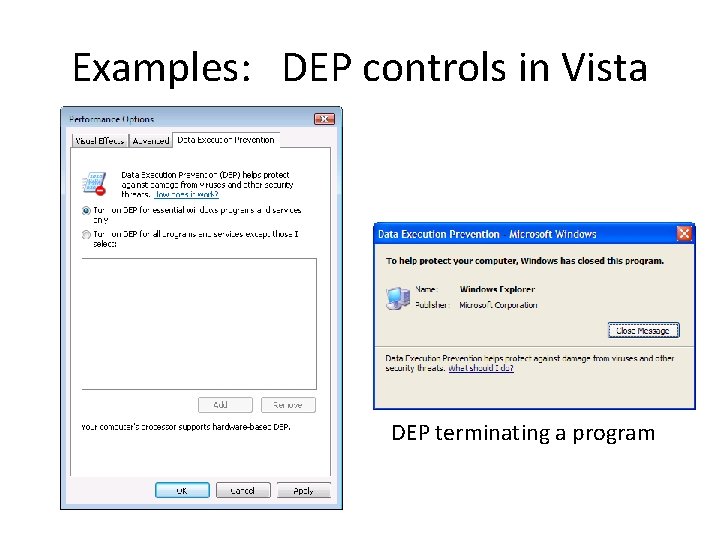
Examples: DEP controls in Vista DEP terminating a program
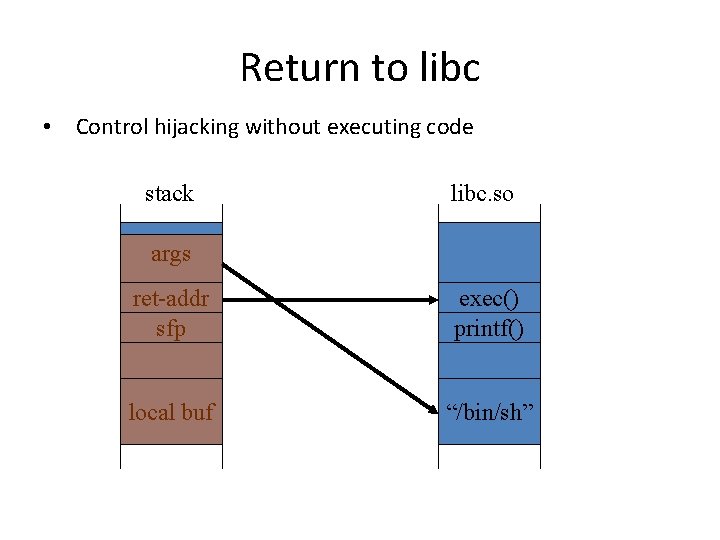
Return to libc • Control hijacking without executing code stack libc. so args ret-addr sfp exec() printf() local buf “/bin/sh”

Response: randomization • ASLR: (Address Space Layout Randomization) – Map shared libraries to rand location in process memory Attacker cannot jump directly to exec function – Deployment: • Windows Vista: 8 bits of randomness for DLLs – aligned to 64 K page in a 16 MB region 256 choices • Linux (via Pa. X): 16 bits of randomness for libraries – More effective on 64 -bit architectures • Other randomization methods: – Sys-call randomization: randomize sys-call id’s – Instruction Set Randomization (ISR)
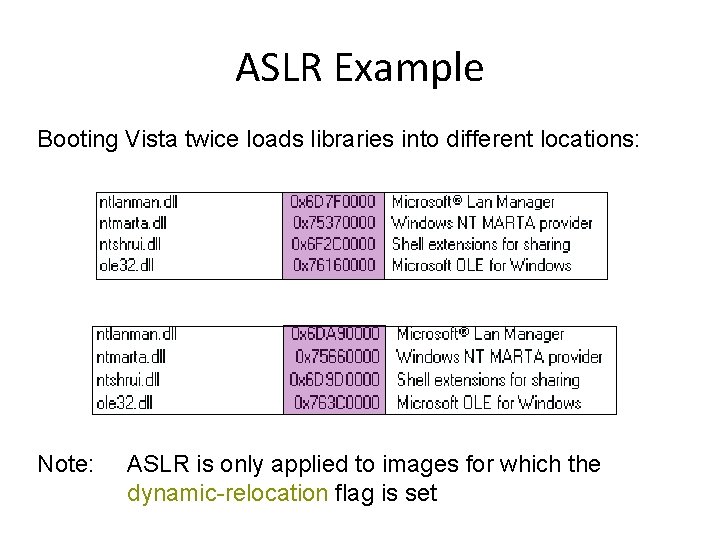
ASLR Example Booting Vista twice loads libraries into different locations: Note: ASLR is only applied to images for which the dynamic-relocation flag is set
Run time checking
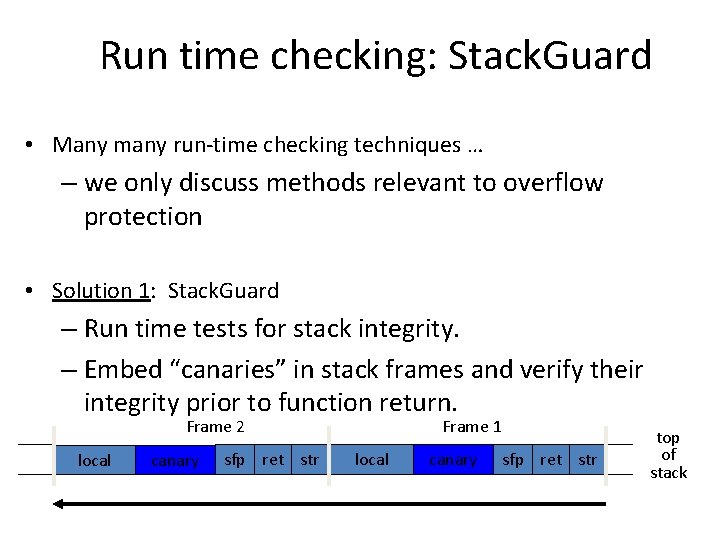
Run time checking: Stack. Guard • Many many run-time checking techniques … – we only discuss methods relevant to overflow protection • Solution 1: Stack. Guard – Run time tests for stack integrity. – Embed “canaries” in stack frames and verify their integrity prior to function return. Frame 2 local canary sfp ret str Frame 1 local canary sfp ret str top of stack
Canary Types • Random canary: – Choose random string at program startup. – Insert canary string into every stack frame. – Verify canary before returning from function. – To corrupt random canary, attacker must learn current random string. • Terminator canary: Canary = 0, newline, linefeed, EOF – String functions will not copy beyond terminator. – Attacker cannot use string functions to corrupt stack.
Stack. Guard (Cont. ) • Stack. Guard implemented as a GCC patch. – Program must be recompiled. • Minimal performance effects: 8% for Apache. • Note: Canaries don’t offer fullproof protection. – Some stack smashing attacks leave canaries unchanged • Heap protection: Point. Guard. – Protects function pointers and setjmp buffers by encrypting them: XOR with random cookie – More noticeable performance effects
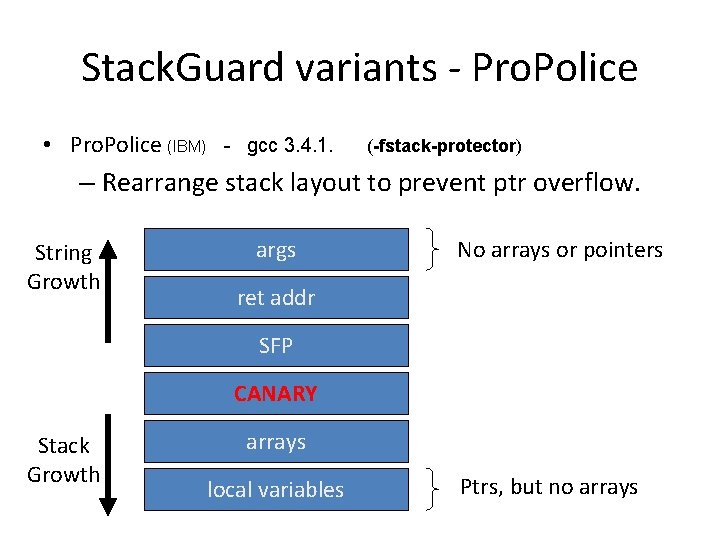
Stack. Guard variants - Pro. Police • Pro. Police (IBM) - gcc 3. 4. 1. (-fstack-protector) – Rearrange stack layout to prevent ptr overflow. String Growth args No arrays or pointers ret addr SFP CANARY Stack Growth arrays local variables Ptrs, but no arrays
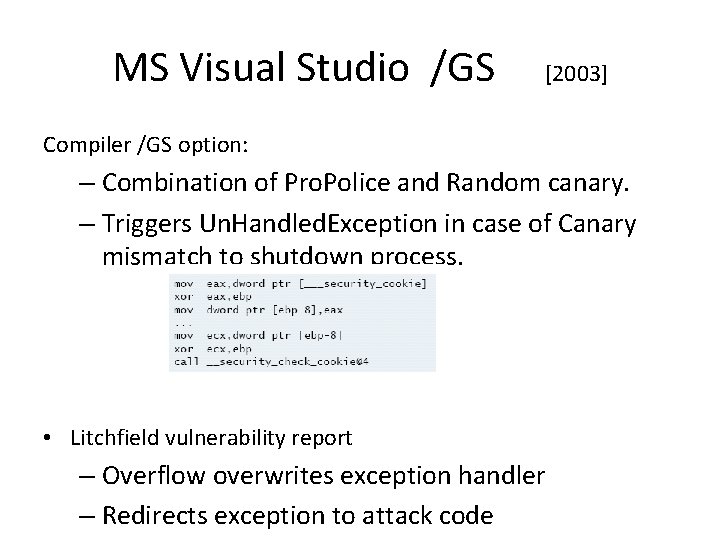
MS Visual Studio /GS [2003] Compiler /GS option: – Combination of Pro. Police and Random canary. – Triggers Un. Handled. Exception in case of Canary mismatch to shutdown process. • Litchfield vulnerability report – Overflow overwrites exception handler – Redirects exception to attack code
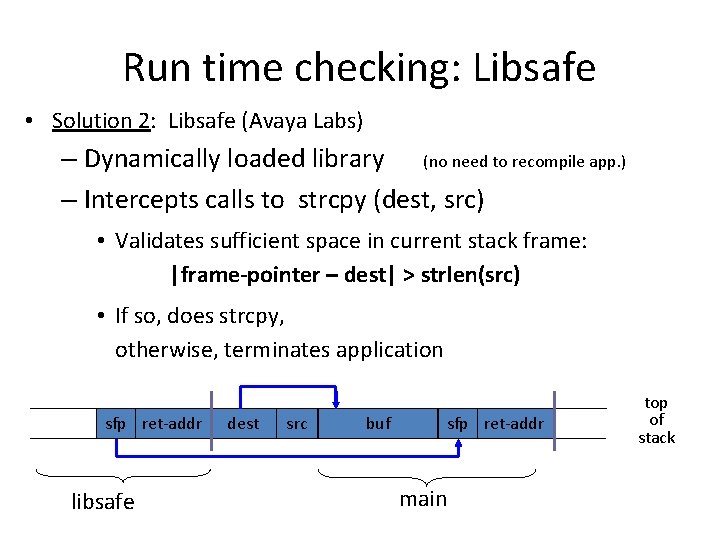
Run time checking: Libsafe • Solution 2: Libsafe (Avaya Labs) – Dynamically loaded library (no need to recompile app. ) – Intercepts calls to strcpy (dest, src) • Validates sufficient space in current stack frame: |frame-pointer – dest| > strlen(src) • If so, does strcpy, otherwise, terminates application sfp ret-addr libsafe dest src buf sfp ret-addr main top of stack
More methods … q Stack. Shield § At function prologue, copy return address RET and SFP to “safe” location (beginning of data segment) § Upon return, check that RET and SFP is equal to copy. § Implemented as assembler file processor (GCC) q Control Flow Integrity (CFI) § A combination of static and dynamic checking § Statically determine program control flow § Dynamically enforce control flow integrity
- Slides: 15