
Corresponding Responsibility Attacks From All Sides Jonathan Klein
Corresponding Responsibility – Attacks From All Sides Jonathan Klein, Esq. Managing Director Kelly, Hockel & Klein P. C. jaklein@khklaw. com (415) 951 -0535 Michael J. Simko, Esq. , R. Ph. Senior Attorney, Litigation & Regulatory Law Walgreen Co. michael. simko@walgreens. com (847) 315 -4344 Virginia Herold Executive Officer California Board of Pharmacy virginia. herold@dca. gov
Topics we’ll cover Ø Pharmacist’s Corresponding Responsibility v what it is and where it comes up Ø Ø Issues of balancing patient demands and pharmacist obligations Legal risks in filling prescriptions where “red flags” are present California Board of Pharmacy perspective on compliance Chain pharmacy “best practices” for training and compliance
Why are we talking about this now? � Increase in Board of Pharmacy enforcement actions; � Increase in Fines by DEA; � Desire to increase awareness of regulations and how to handle red flags; � Discussion of balancing competing duties to dispense/aid and legal obligations to prevent drug diversion

Doctor? Pharmacist? � I'm going with the pharmacist
What is Corresponding Responsibility? � The prescribing practitioner has the responsibility for prescribing and dispensing controlled substances for a legitimate medical purpose. � The pharmacist has a corresponding responsibility to ensure that the prescription is valid. � A pharmacist who knowingly fills a prescription that does not meet the definition of a legitimate medical purpose is subject to penalties.
Why do we have Corresponding Responsibility rules? Short Answer: Opioid Abuse � The Centers for Disease Control and Prevention (CDC) estimates that in 2010, the volume of prescribed opioids reached the level at which every American could be medicated around the clock for a month. � Addressing the epidemic of opioid overdoses is a priority of the Drug Enforcement Administration, the CDC, and BOPs.
Federal & State Regulations � The responsibility for the proper prescribing and dispensing of controlled substances is upon the prescribing practitioner, but a corresponding responsibility rests with the pharmacist who fills the prescription. � A person knowingly filling a prescription issued not in the usual course of professional treatment, as well as the person issuing it, shall be subject to penalties. � DEA Regulations - 21 C. F. R. § 1306. 04 � Most states have a variation of the same
DEA Red Flags Pharmacists must identify (and resolve) certain red flags before a prescription for controlled substances is dispensed “Pattern prescribing’’ – prescriptions for the same drugs and the same quantities coming from the same doctor Prescribing combinations or “cocktails” of frequently abused controlled substances Holy Trinity = opioid + benzodiazepine + carisoprodol Geographic anomalies Shared addresses by customers presenting on the same day
More Red Flags The prescribing of controlled substances in general Quantity and strength Paying cash Customers with the same diagnosis code from the same doctor Prescriptions written by doctors for illnesses or health conditions not consistent with their area of specialty Fraudulent prescriptions
California State Board of Pharmacy Perspective on Compliance � Serious about corresponding responsibility cases � Enforced CA’s corresponding responsibility laws since at least mid-1980 s. � Specialized inspectors on Drug Diversion and Fraud Teams investigate corresponding responsibility cases � 2014 Board created Prescription Drug Abuse Team to analyze available data and investigate cases � Requirements for corresponding responsibility have not changed. Discussed in board’s newsletter since 2000 in numerous issues
CA’s Corresponding Responsibility and Precedential Decision CA pharmacists should know and follow applicable law: � Health & Safety Code, § 11153, subdivision (a), � 16 CCR § 1761, and � In the Matter of the Accusation Against Pacifica Pharmacy; Thang Tran - Board of Pharmacy Case No. 3802; OAH No. 2011010644; Precedential Decision No. 2013 -01. )
California State Board of Pharmacy Perspective on Compliance As discussed in Pacifica: (1) A pharmacist must evaluate the four corners of a controlled substance prescription to make certain it is valid (i. e. , on security paper, complete and signed. ) If something is wrong with the face of the prescription, a pharmacist must verify that the prescriber issued the prescription; (2) Once the pharmacist concludes that the prescription is legitimate on its face, the pharmacist must evaluate the patient, the prescriber and medication therapy; (3) In meeting the corresponding responsibility obligation, a pharmacist is to be alert for “warning signs” or “red flags” that indicate that the prescription may not have been issued for a legitimate medical purpose;
California State Board of Pharmacy Perspective on Compliance (4) The pharmacist should refuse to fill a questionable prescription for a controlled substance; and (5) In disciplinary proceedings, the board is not required to establish that a prescription for a controlled substance was in fact written by a prescriber for an illegitimate purpose —just that circumstances were present that would cause a pharmacist to question whether a prescription for a controlled substance was issued for a legitimate medical purpose and that the pharmacist failed to make the required inquiry. There is no requirement that pharmacists must know a controlled substance prescription is false before denying the fill.
Methods for Conducting Reasonable Inquiries The Board of Pharmacy expects pharmacists to conduct inquiries using such methods as: � � � Telephone calls and interviews of patients and/or prescribers Review of PDMP/CURES Verification of prescribers’ licenses, board certifications on Medical Board website, and DEA Registration numbers of prescribers Evaluate the appropriateness of drug therapy for a given patient and patient’s condition Conducting other internet research
Corresponding Responsibility Applies to Wholesalers in California Wholesalers should know and follow applicable law (Health & Safety Code, § 11153. 5). The board will enforce federal law as well (i. e. , 21 CFR § 1301. 74). Red flags that should alert a wholesaler to a potential problem and invoke in it a duty of inquiry include: � � � Any discrepancies in the amount of controlled substances furnished The customer’s previous ordering patterns (including size and frequency of orders) The type and size of customer as compared to its ordering and dispensing patterns and where and to whom the customer distributes the product (i. e. , the dispensing practices of the customer).
Focus of CA State Board of Pharmacy Inspections Inspectors will conduct examinations to determine the licensees’ compliance with law by review of: � � � The prescribing of specific drugs and specific combinations of drugs in prescriber data and in pharmacy dispensing data contained in CURES reports Sales data from wholesalers to a pharmacy Review of acquisition and disposition records of controlled substances and pharmacists’ notes of their due diligence performed prior to filling
Focus of CA State Board of Pharmacy Inspections � Review of pharmacies’ policies and procedures on corresponding responsibility and pharmacists’ adherence to those policies and procedures � Review of pharmacies’ computer programs used to detect suspicious controlled substance prescriptions � Research of anomalies in red flags data. A list of examples of red flags can be found on the board’s website
California Board of Pharmacy Actions � � � � If a case is opened, an investigation will follow in which the data is confirmed at the source (pharmacy) level. Attempt to determine if the totality of circumstances surrounding a prescription cause that prescription to present red flags indicative of medical illegitimacy. Then, the inspectors attempt to determine what the pharmacy and its pharmacists did to verify the prescription was medically legitimate. Many times, documented verification with the prescriber aids in this determination; however, sometimes although a prescriber may confirm a controlled substance was written, the totality of red flags may prompt the average, prudent pharmacist to determine if the prescription is still illegitimate, e. g. prescription pill mill prescribers.
Recommendations � � � Establish a clear policy and procedure for the dispensing of controlled substances which includes an evaluation for red flags of illegitimacy Maintain detailed documentation of attempts toward verification of medical legitimacy. Whether the pharmacist decides to dispense or refuse to dispense the prescription, maintain documentation of the reason for the decision and the names of pharmacist(s) and prescriber(s) involved in the verification process Follow the law
Recommendations � Establish a risk-based inventory control procedure whereby you monitor controlled substances with a frequency and intensity determined by risk and/or volume of dispensing � Establish and maintain working relationships with prescribers � Establish and maintain rapport with patients to encourage help-seeking behavior
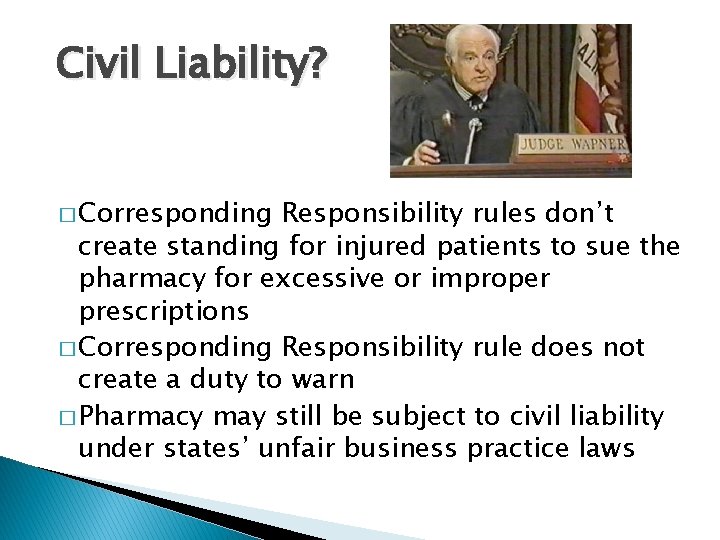
Civil Liability? � Corresponding Responsibility rules don’t create standing for injured patients to sue the pharmacy for excessive or improper prescriptions � Corresponding Responsibility rule does not create a duty to warn � Pharmacy may still be subject to civil liability under states’ unfair business practice laws
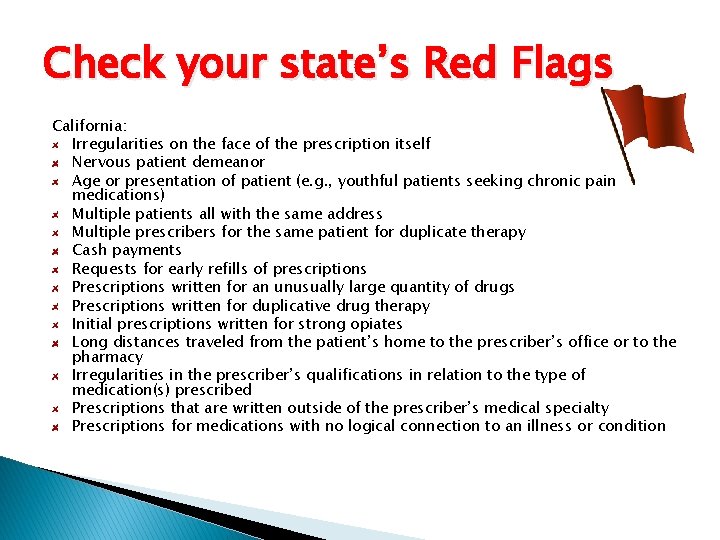
Check your state’s Red Flags California: Irregularities on the face of the prescription itself Nervous patient demeanor Age or presentation of patient (e. g. , youthful patients seeking chronic pain medications) Multiple patients all with the same address Multiple prescribers for the same patient for duplicate therapy Cash payments Requests for early refills of prescriptions Prescriptions written for an unusually large quantity of drugs Prescriptions written for duplicative drug therapy Initial prescriptions written for strong opiates Long distances traveled from the patient’s home to the prescriber’s office or to the pharmacy Irregularities in the prescriber’s qualifications in relation to the type of medication(s) prescribed Prescriptions that are written outside of the prescriber’s medical specialty Prescriptions for medications with no logical connection to an illness or condition
Not much guidance from DEA Important yet unanswered questions: � Does identifying red flags really mean pharmacist is exercising her corresponding responsibility as required by the regulations? � In the DEA’s eyes, are pharmacists only appropriately exercising their corresponding responsibility when they decide not to dispense controlled substances to a patient whose prescription sets off one or more red flags? � How many and/or what combination of red flags must be present for a pharmacist to decline dispensing a particular prescription?
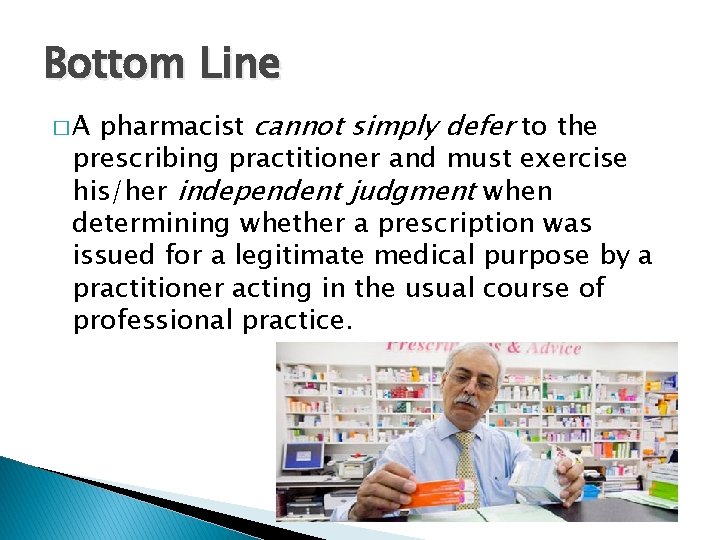
Bottom Line pharmacist cannot simply defer to the prescribing practitioner and must exercise his/her independent judgment when determining whether a prescription was issued for a legitimate medical purpose by a practitioner acting in the usual course of professional practice. �A
Impact on Pharmacists � DEA and states see pharmacists as “last line of defense” in preventing drug abuse and diversion � Imposing a “corresponding responsibility” on pharmacists to ensure controlled substances are prescribed for a “legitimate medical purpose’” requires them to make medical judgments beyond their education and training
Impact on Pharmacists � What if the DEA disagrees with a physician’s medical judgment and the medical necessity of a prescribed medication? ◦ Pharmacists who now share a “corresponding responsibility, ” along with the physician, “to assure that its prescription for controlled substances was issued for a legitimate medical purpose” will be subject to the same civil and criminal liability as the physician, despite authenticating the prescription with prescribing doctor, as required by state law.
Considering Patient Needs � In response to regulations, some pharmacies have implemented policies which restrict dispensing of controlled substances, such as a provision that no new prescriptions for controlled drugs could be filled within 72 hours of being received. ◦ Issues arise including elevated pain and withdrawal, which puts the patient at risk for a hypertensive crisis, possibly resulting in stoke and/or death.
Considering Patient Needs � Question of whether delay or denial of a chronic pain patient’s legitimate prescription is a violation of their civil rights under the Americans with Disability Act (ADA). � Denial of a chronic pain patient’s prescriptions could result in unprofessional conduct charges against the pharmacist involved with the appropriate state Board of Pharmacy. � Patients express frustration and embarrassment when pharmacies deny their prescriptions.
The challenges facing a pharmacist What exactly is professional judgement? � Does a “red flag” mean “don’t fill”? � Inconsistency between pharmacists �When one pharmacist says no and based on professional judgment another pharmacist fills the prescription. � How much documentation is enough? �Why is the medication being prescribed. �Why is the patient not filling prescription neare their home or nearer the physician’s office. � What is a legitimate reason
Red Flag Resolution �Document ◦ Regular pharmacy patient ◦ Prescriber reputation �Does the physician’s practice fit the use of the medication. ◦ Confirmed treatment with the prescriber. ◦ Monitor state PDMP �Pharmacy shopping ◦ Early fills of the same or similar medication. �Dosing changes �Caregiver availability
Difficulty Resolving Red Flags � Cannot reach physician. � Backlash from physicians why pharmacist is questioning the physician’s treatment plan. � Are some Red Flags more important than others? � Does each subsequent prescription need a separate resolution?
Pharmacists may avoid conflict “I am out of stock”. � Works – but may not be the best choice. �Physician - Patient may be legitimate �Diagnosis & treatment may be legitimate. � Does not identify problem physicians or persons using fraudulent means to obtain medication. � Pharmacists should not simply shirk their responsibility.
Case No. 1 � Pharmacy notes excessive number of hydrocodone and oxycodone being prescribed by one physician � Makes decision not to fill on case-by-case basis � Attorney for physician writes generic letter for his patients to present to their pharmacists, assuring the pharmacy that physician’s prescriptions are legitimate � Pharmacy blacklists physician for controlled substances � Physician sues pharmacy for breach of contract
Case No. 2 �A pharmacist was discharged from his employment after having worked for the pharmacy for 18 months, for being overly aggressive in questioning controlled substance prescriptions. � Pharmacist: Just doing my job, and you can’t fire me for following Corresponding Responsibility Rule. � Corresponding Responsibility Rule does not mandate or even authorize a pharmacist to question every prescription or to conduct an investigation to determine the validity of the prescription. � Can pharmacists take a “play it safe” position?
Case No. 3 �A prescription is presented at the pharmacy for fill by a caregiver. She states that this is the third pharmacy she has been to and has been refused the fill. Her sister is a cancer patient and the doctor had told her to increase the oxycodone. Upon looking at state’s PDMP, it shows “too soon. ” The caregiver is frantic because her sister is in pain. � What should the pharmacist do?
- Slides: 35