
Chapter 22 Internet Security Protocols and Standards MIME








- Slides: 33
Chapter 22 Internet Security Protocols and Standards
MIME and S/MIME • Extension to the old RFC 822 specification of an Internet mail format o RFC 822 defines a simple heading with To, From, Subject o Assumes ASCII text format • Provides a number of new header fields that define information about the body of the message S/MIME • Secure/Multipurpose Internet Mail Extension • Security enhancement to the MIME Internet e-mail format o Based on technology from RSA Data Security • Provides the ability to sign and/or encrypt email messages
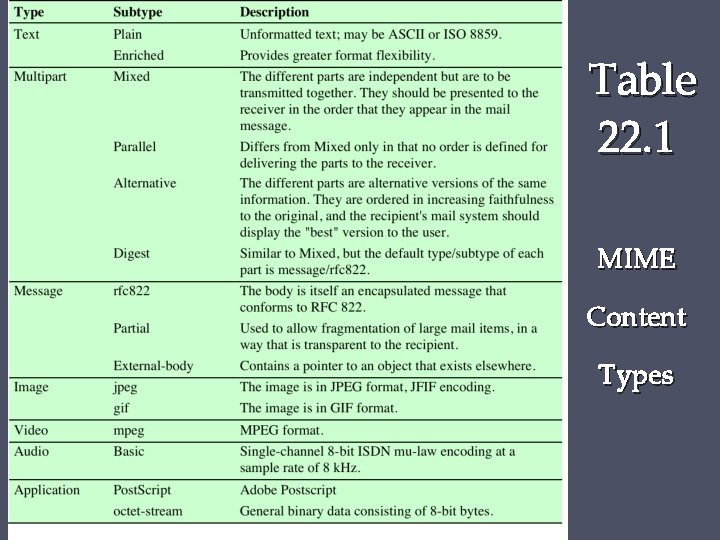
Table 22. 1 MIME Content Types
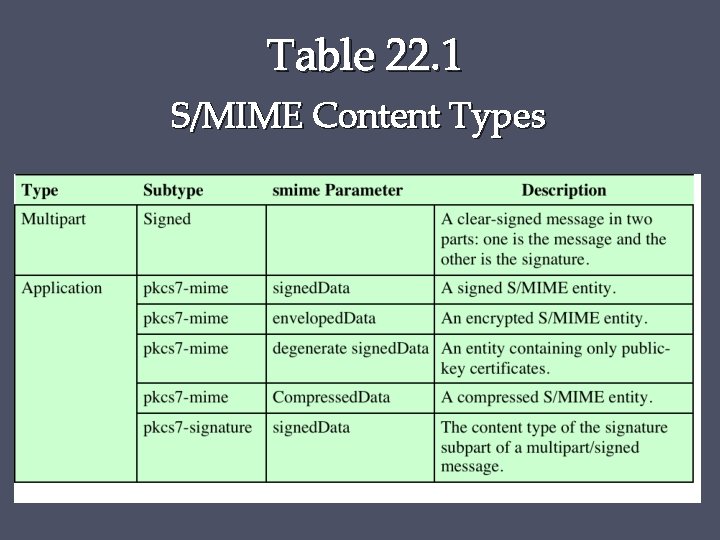
Table 22. 1 S/MIME Content Types
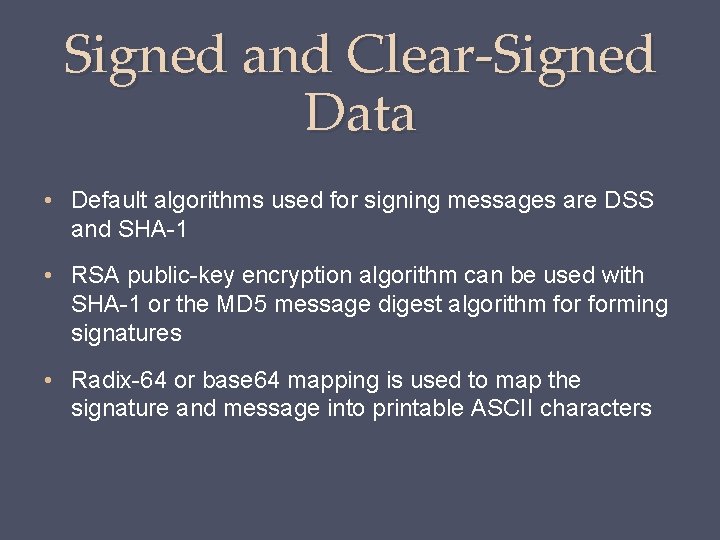
Signed and Clear-Signed Data • Default algorithms used for signing messages are DSS and SHA-1 • RSA public-key encryption algorithm can be used with SHA-1 or the MD 5 message digest algorithm forming signatures • Radix-64 or base 64 mapping is used to map the signature and message into printable ASCII characters
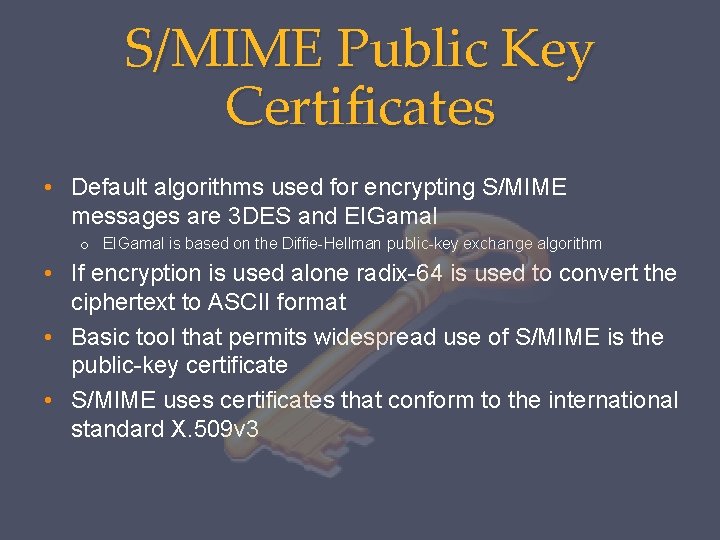
S/MIME Public Key Certificates • Default algorithms used for encrypting S/MIME messages are 3 DES and EIGamal o EIGamal is based on the Diffie-Hellman public-key exchange algorithm • If encryption is used alone radix-64 is used to convert the ciphertext to ASCII format • Basic tool that permits widespread use of S/MIME is the public-key certificate • S/MIME uses certificates that conform to the international standard X. 509 v 3
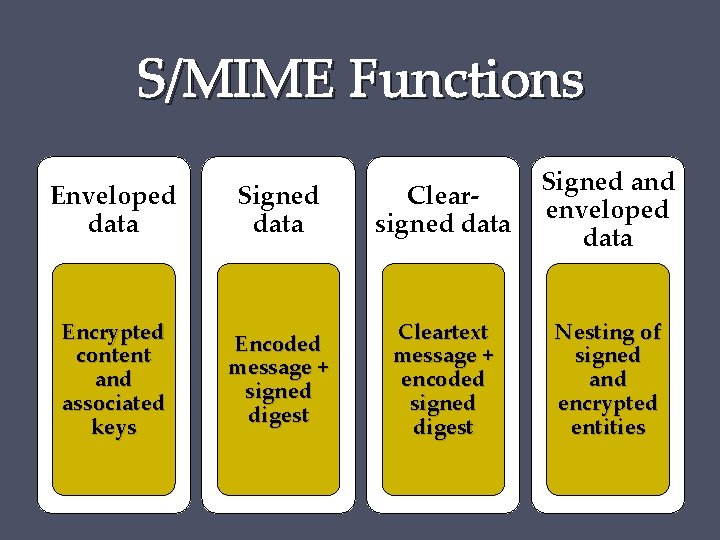
S/MIME Functions Enveloped data Signed data Clearsigned data Signed and enveloped data Encrypted content and associated keys Encoded message + signed digest Cleartext message + encoded signed digest Nesting of signed and encrypted entities
Domain. Keys Identified Mail (DKIM) • Specification of cryptographically signing e-mail messages permitting a signing domain to claim responsibility for a message in the mail stream • Proposed Internet Standard (RFC 4871: Domain. Keys Identified Mail (DKIM) Signatures) • Has been widely adopted by a range of e-mail providers
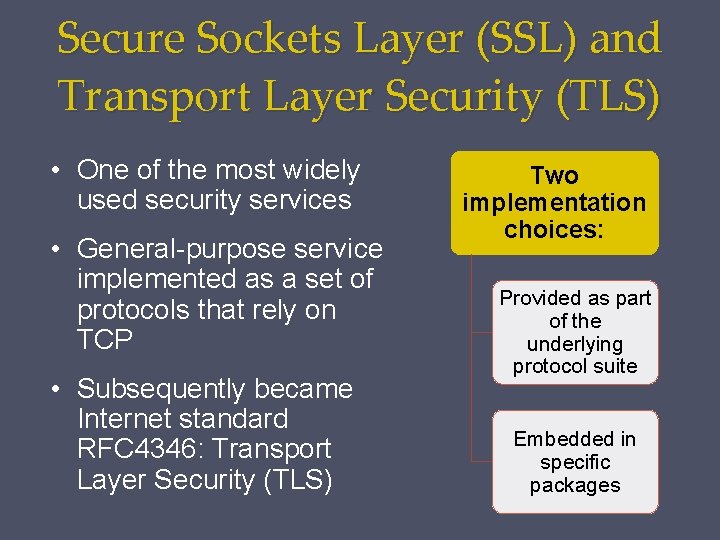
Secure Sockets Layer (SSL) and Transport Layer Security (TLS) • One of the most widely used security services • General-purpose service implemented as a set of protocols that rely on TCP • Subsequently became Internet standard RFC 4346: Transport Layer Security (TLS) Two implementation choices: Provided as part of the underlying protocol suite Embedded in specific packages
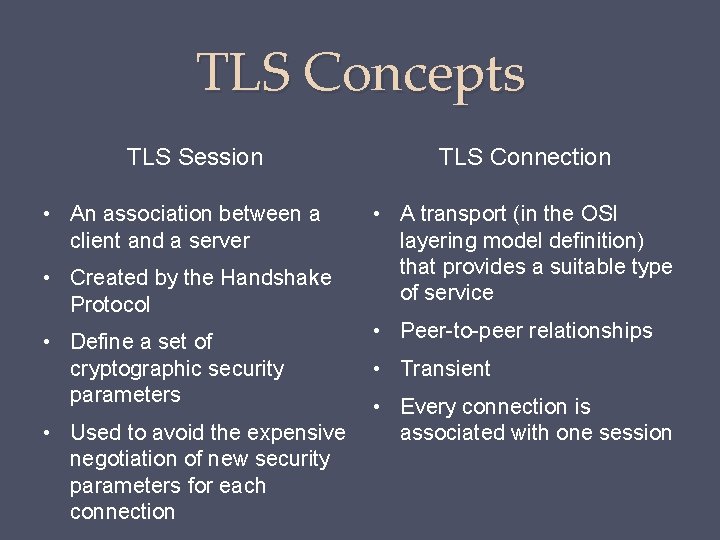
TLS Concepts TLS Session • An association between a client and a server • Created by the Handshake Protocol • Define a set of cryptographic security parameters • Used to avoid the expensive negotiation of new security parameters for each connection TLS Connection • A transport (in the OSI layering model definition) that provides a suitable type of service • Peer-to-peer relationships • Transient • Every connection is associated with one session
Change Cipher Spec Protocol • One of four TLS specific protocols that use the TLS Record Protocol • Is the simplest • Consists of a single message which consists of a single byte with the value 1 • Sole purpose of this message is to cause pending state to be copied into the current state • Hence updating the cipher suite in use
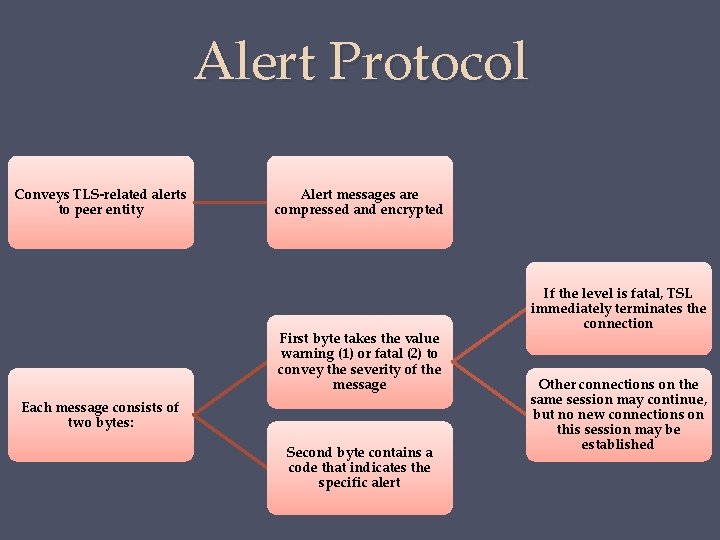
Alert Protocol Conveys TLS-related alerts to peer entity Alert messages are compressed and encrypted First byte takes the value warning (1) or fatal (2) to convey the severity of the message Each message consists of two bytes: Second byte contains a code that indicates the specific alert If the level is fatal, TSL immediately terminates the connection Other connections on the same session may continue, but no new connections on this session may be established
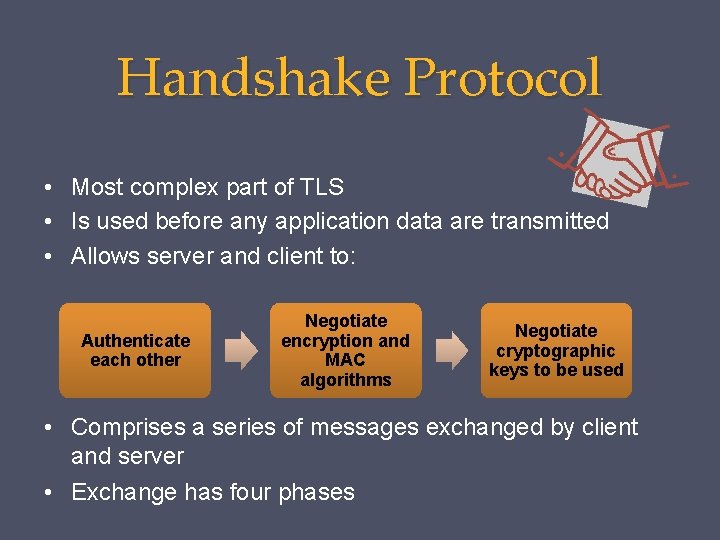
Handshake Protocol • Most complex part of TLS • Is used before any application data are transmitted • Allows server and client to: Authenticate each other Negotiate encryption and MAC algorithms Negotiate cryptographic keys to be used • Comprises a series of messages exchanged by client and server • Exchange has four phases
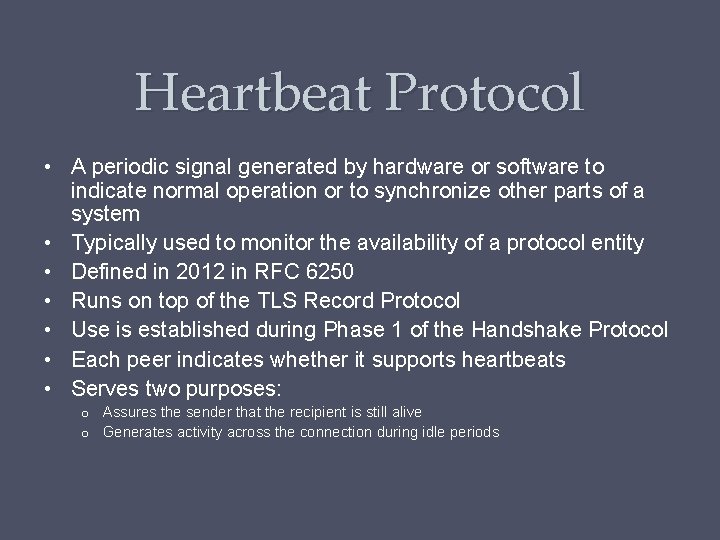
Heartbeat Protocol • A periodic signal generated by hardware or software to indicate normal operation or to synchronize other parts of a system • Typically used to monitor the availability of a protocol entity • Defined in 2012 in RFC 6250 • Runs on top of the TLS Record Protocol • Use is established during Phase 1 of the Handshake Protocol • Each peer indicates whether it supports heartbeats • Serves two purposes: o Assures the sender that the recipient is still alive o Generates activity across the connection during idle periods
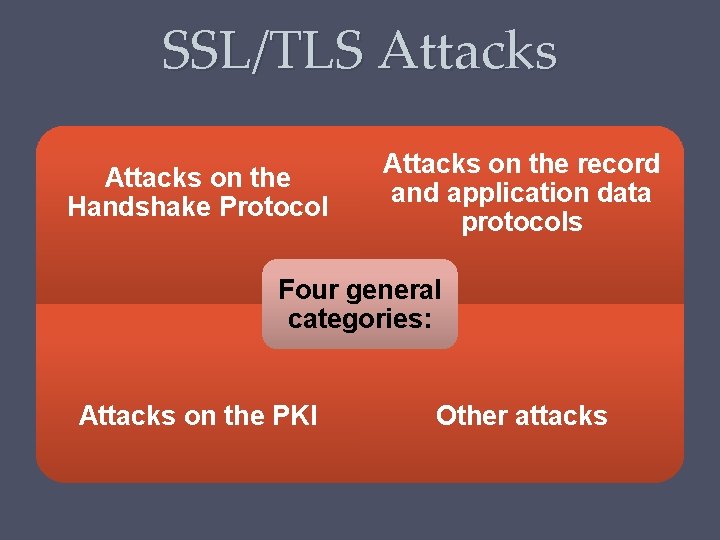
SSL/TLS Attacks on the Handshake Protocol Attacks on the record and application data protocols Four general categories: Attacks on the PKI Other attacks
HTTPS (HTTP over SSL) • • • Combination of HTTP and SSL to implement secure communication between a Web browser and a Web server Built into all modern Web browsers o Search engines do not support HTTPS o URL addresses begin with https: // Documented in RFC 2818, HTTP Over TLS Agent acting as the HTTP client also acts as the TLS client Closure of an HTTPS connection requires that TLS close the connection with the peer TLS entity on the remote side, which will involve closing the underlying TCP connection
IP Security (IPsec) • Various application security mechanisms o S/MIME, Kerberos, SSL/HTTPS • Security concerns cross protocol layers • Would like security implemented by the network for all applications • Authentication and encryption security features included in next-generation IPv 6 • Also usable in existing IPv 4
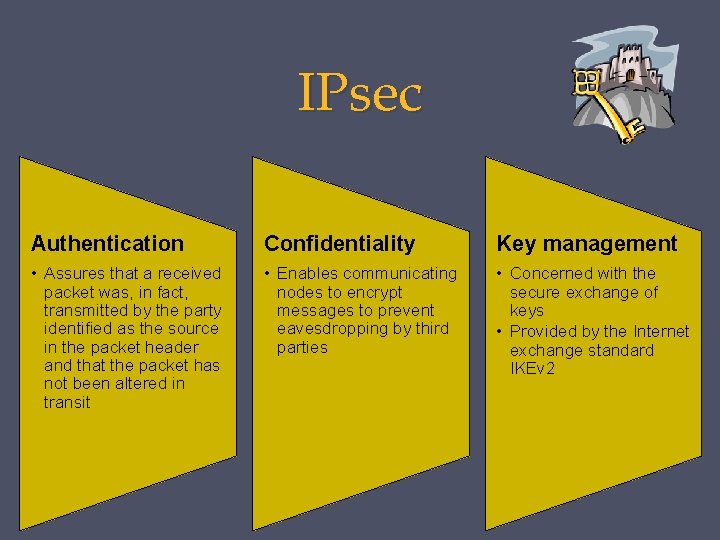
IPsec Authentication Confidentiality Key management • Assures that a received packet was, in fact, transmitted by the party identified as the source in the packet header and that the packet has not been altered in transit • Enables communicating nodes to encrypt messages to prevent eavesdropping by third parties • Concerned with the secure exchange of keys • Provided by the Internet exchange standard IKEv 2
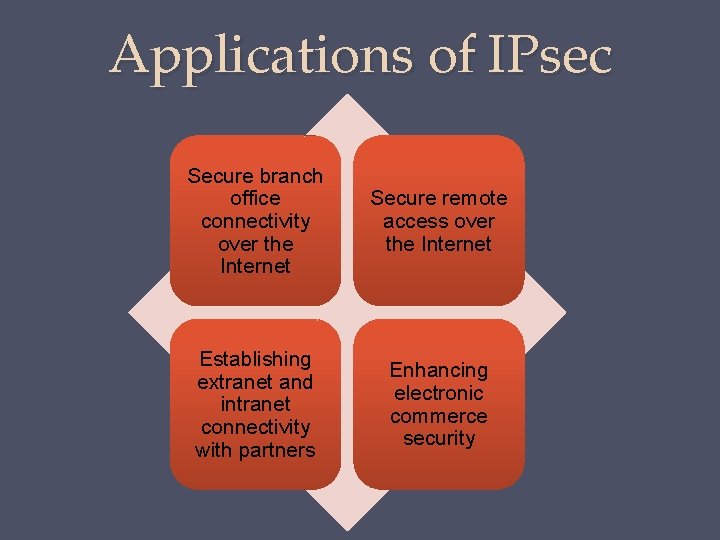
Applications of IPsec Secure branch office connectivity over the Internet Secure remote access over the Internet Establishing extranet and intranet connectivity with partners Enhancing electronic commerce security
Benefits of IPsec • When implemented in a firewall or router, it provides strong security to all traffic crossing the perimeter • In a firewall it is resistant to bypass • Below transport layer, hence transparent to applications • Can be transparent to end users • Can provide security for individual users • Secures routing architecture
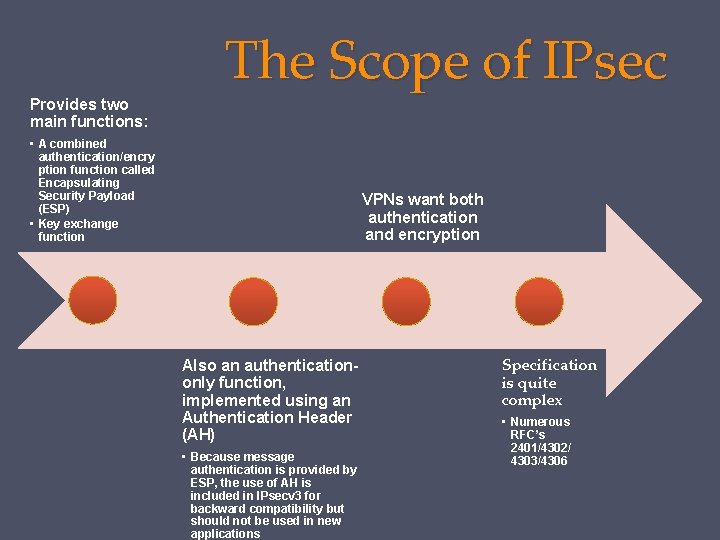
Provides two main functions: The Scope of IPsec • A combined authentication/encry ption function called Encapsulating Security Payload (ESP) • Key exchange function VPNs want both authentication and encryption Also an authenticationonly function, implemented using an Authentication Header (AH) • Because message authentication is provided by ESP, the use of AH is included in IPsecv 3 for backward compatibility but should not be used in new applications Specification is quite complex • Numerous RFC’s 2401/4302/ 4303/4306
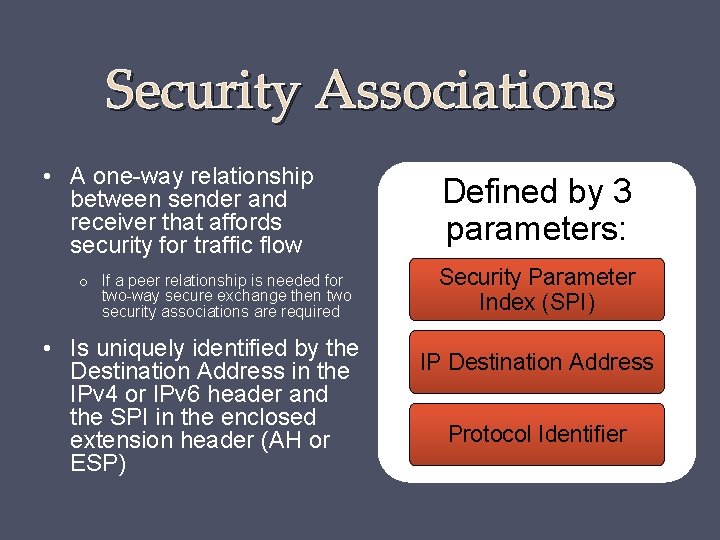
Security Associations • A one-way relationship between sender and receiver that affords security for traffic flow o If a peer relationship is needed for two-way secure exchange then two security associations are required • Is uniquely identified by the Destination Address in the IPv 4 or IPv 6 header and the SPI in the enclosed extension header (AH or ESP) Defined by 3 parameters: Security Parameter Index (SPI) IP Destination Address Protocol Identifier
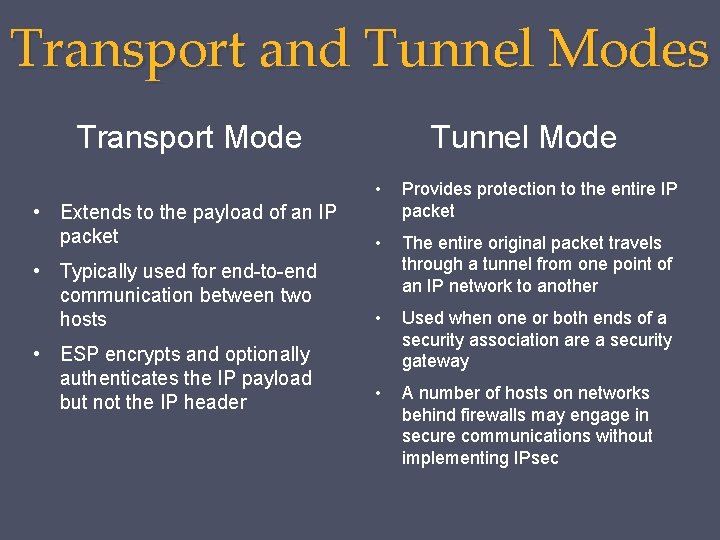
Transport and Tunnel Modes Transport Mode Tunnel Mode • • Extends to the payload of an IP packet Provides protection to the entire IP packet • • Typically used for end-to-end communication between two hosts The entire original packet travels through a tunnel from one point of an IP network to another • Used when one or both ends of a security association are a security gateway • A number of hosts on networks behind firewalls may engage in secure communications without implementing IPsec • ESP encrypts and optionally authenticates the IP payload but not the IP header
Summary • Secure E-mail and S/MIME o S/MIME • Domain. Keys identified mail o Internet mail architecture o DKIM strategy • SSL and TLS o o TLS architecture TLS protocols TLS attacks SSL/TLS attacks • HTTPS o Connection institution o Connection closure • IPv 4 and IPv 6 security o IP security overview o The scope of IPsec o Security associations o Encapsulating security payload o Transport and tunnel modes