How Cells Harvest Energy Chapter 9 Laws of
- Slides: 123
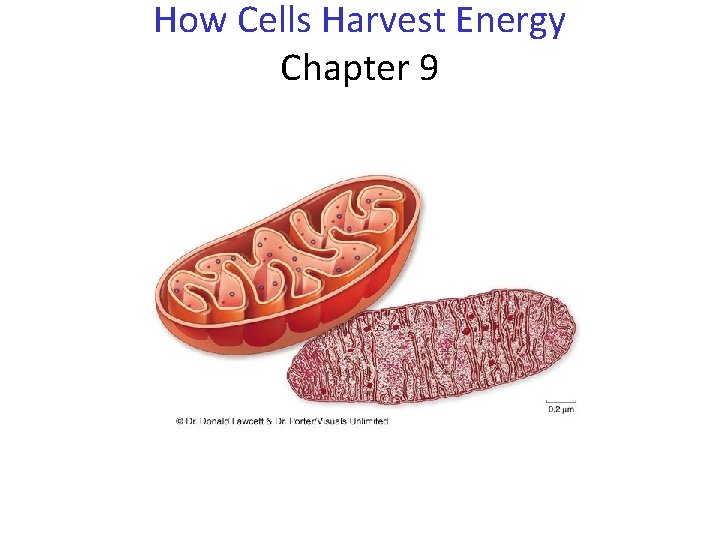
How Cells Harvest Energy Chapter 9
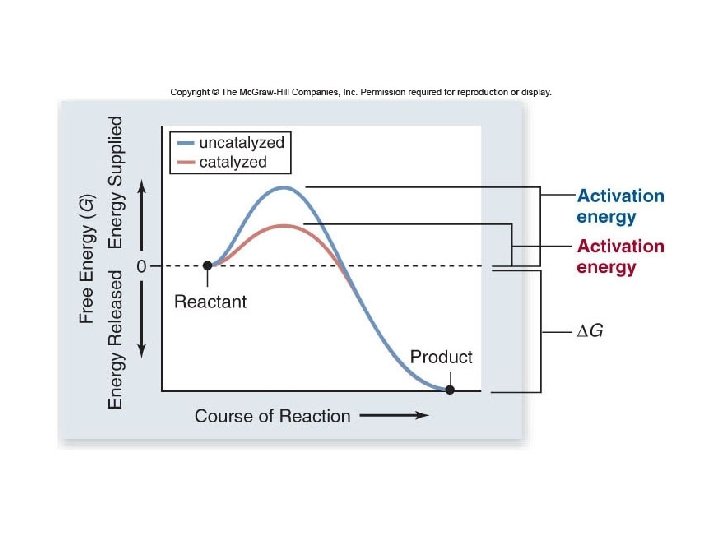
Laws of Thermodynamics Most reactions require some energy to get started. activation energy: extra energy needed to get a reaction started -destabilizes existing chemical bonds -required even for exergonic reactions catalysts: substances that lower the activation energy of a reaction
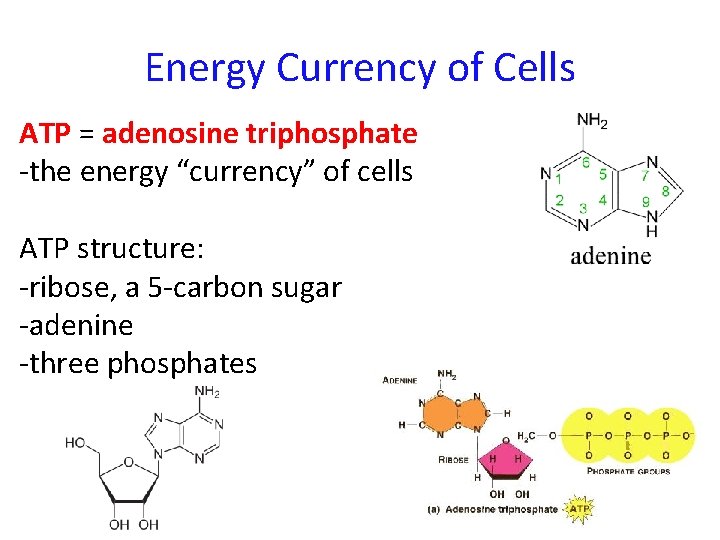
Energy Currency of Cells ATP = adenosine triphosphate -the energy “currency” of cells ATP structure: -ribose, a 5 -carbon sugar -adenine -three phosphates
Respiration Organisms can be classified based on how they obtain energy: autotrophs: are able to produce their own organic molecules through photosynthesis heterotrophs: live on organic compounds produced by other organisms All organisms use cellular respiration to extract energy from organic molecules.
Respiration Cellular respiration is a series of reactions that: -are oxidations – loss of electrons -are also dehydrogenations – lost electrons are accompanied by hydrogen Therefore, what is actually lost is a hydrogen atom (1 electron, 1 proton).
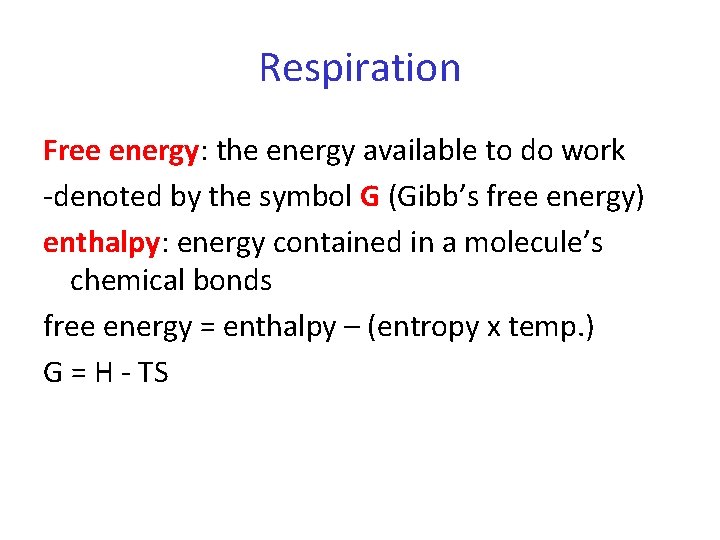
Respiration Free energy: the energy available to do work -denoted by the symbol G (Gibb’s free energy) enthalpy: energy contained in a molecule’s chemical bonds free energy = enthalpy – (entropy x temp. ) G = H - TS
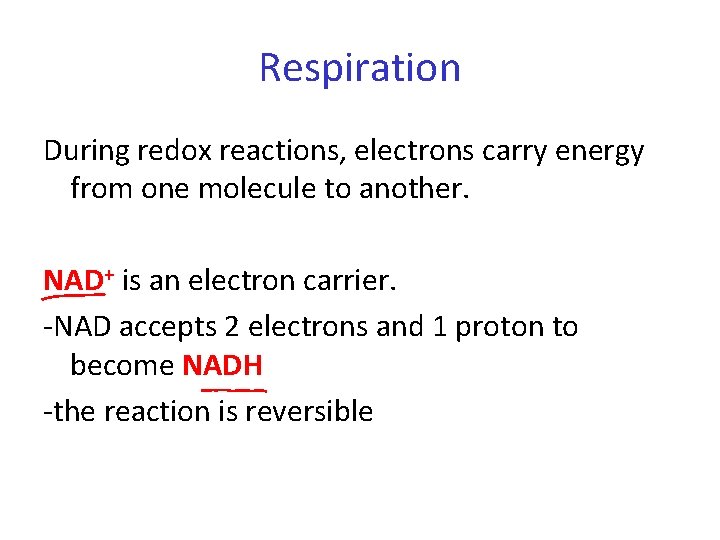
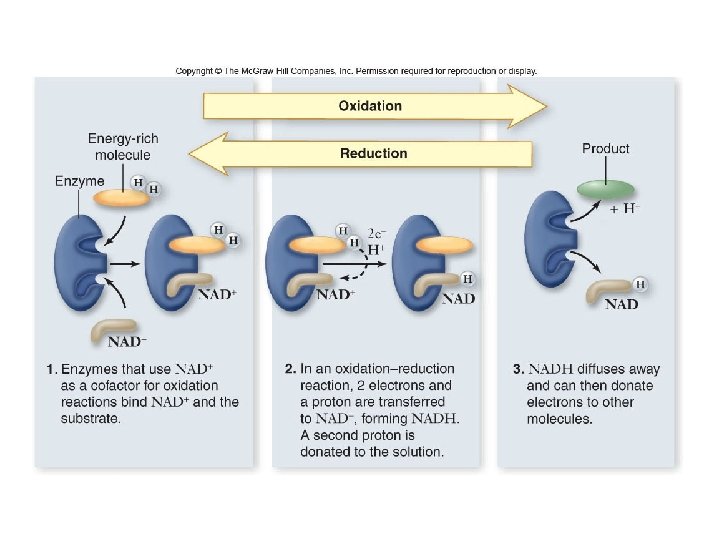
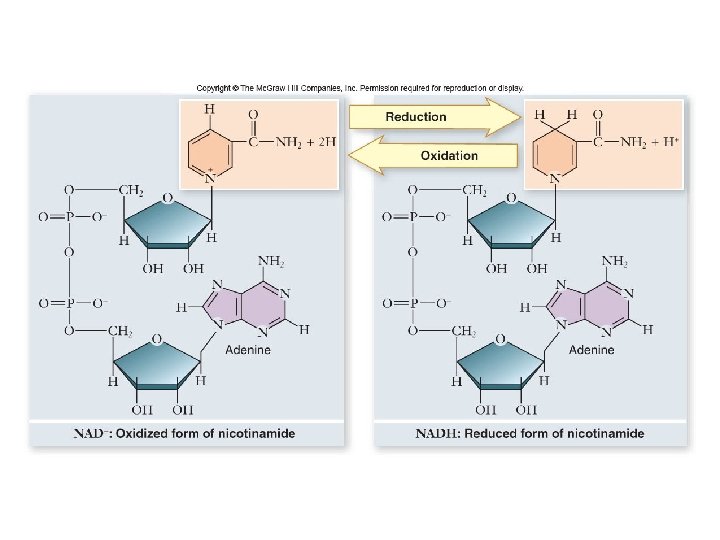
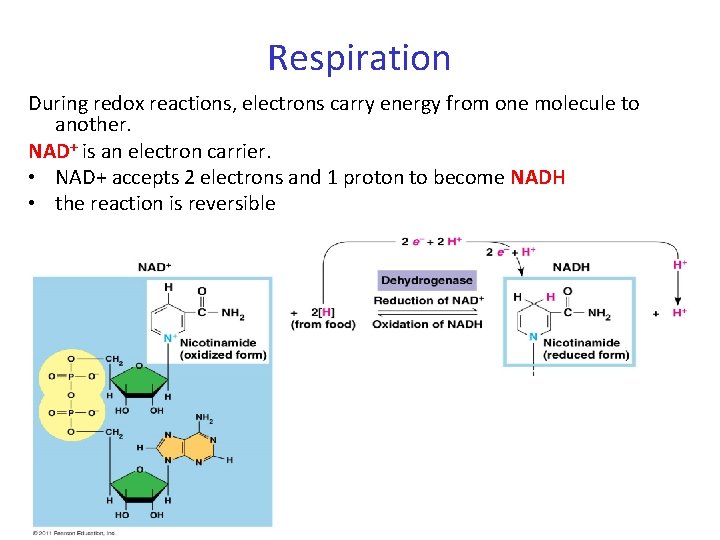
Respiration During redox reactions, electrons carry energy from one molecule to another. NAD+ is an electron carrier. -NAD accepts 2 electrons and 1 proton to become NADH -the reaction is reversible
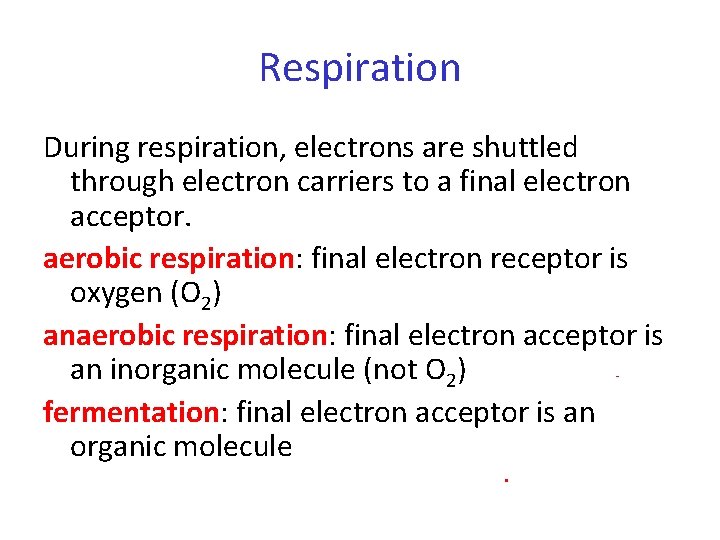
Respiration During respiration, electrons are shuttled through electron carriers to a final electron acceptor. aerobic respiration: final electron receptor is oxygen (O 2) anaerobic respiration: final electron acceptor is an inorganic molecule (not O 2) fermentation: final electron acceptor is an organic molecule
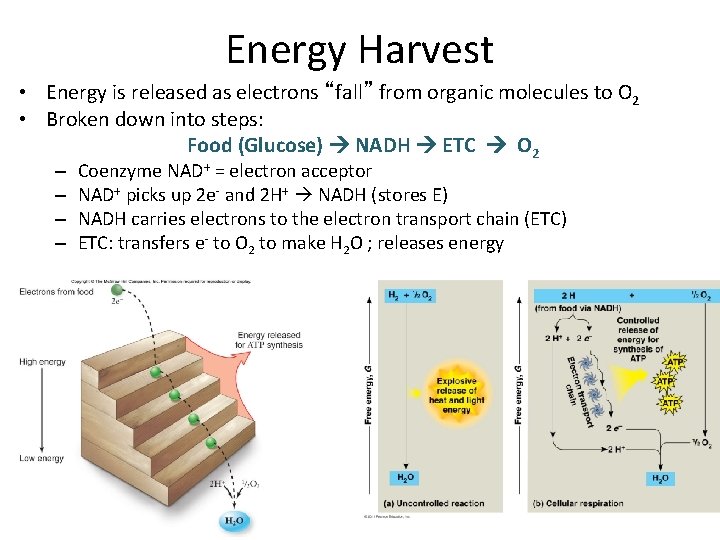
Energy Harvest • Energy is released as electrons “fall” from organic molecules to O 2 • Broken down into steps: Food (Glucose) NADH ETC O 2 – – Coenzyme NAD+ = electron acceptor NAD+ picks up 2 e- and 2 H+ NADH (stores E) NADH carries electrons to the electron transport chain (ETC) ETC: transfers e- to O 2 to make H 2 O ; releases energy
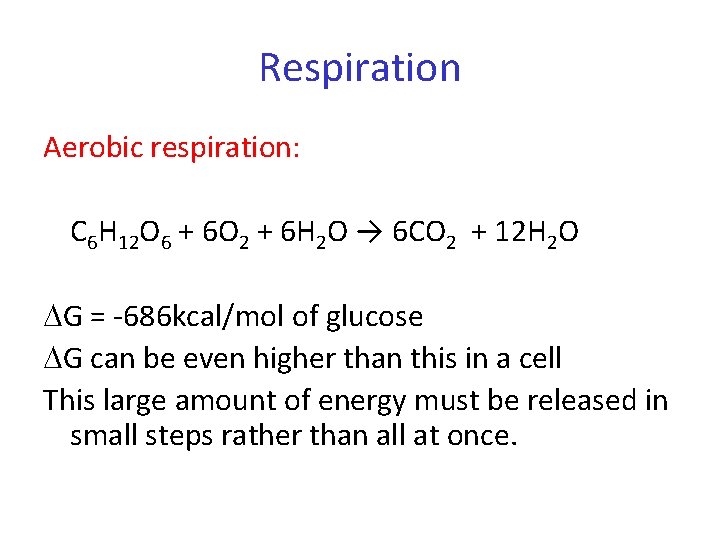
Respiration Aerobic respiration: C 6 H 12 O 6 + 6 O 2 + 6 H 2 O → 6 CO 2 + 12 H 2 O DG = -686 kcal/mol of glucose DG can be even higher than this in a cell This large amount of energy must be released in small steps rather than all at once.
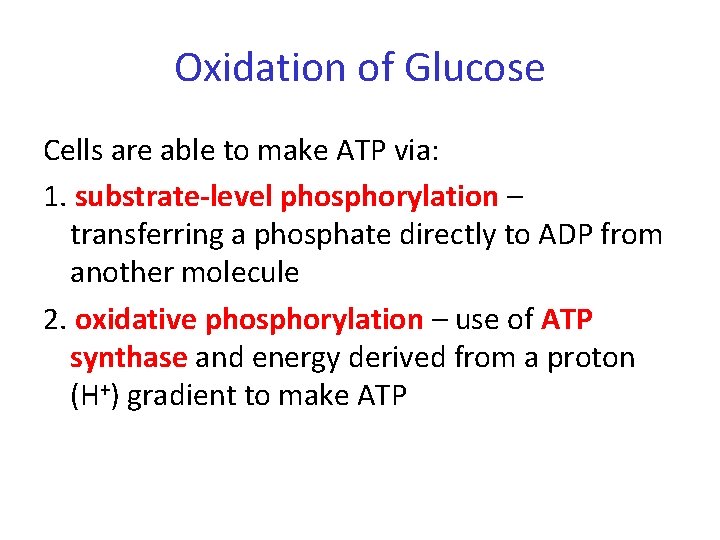
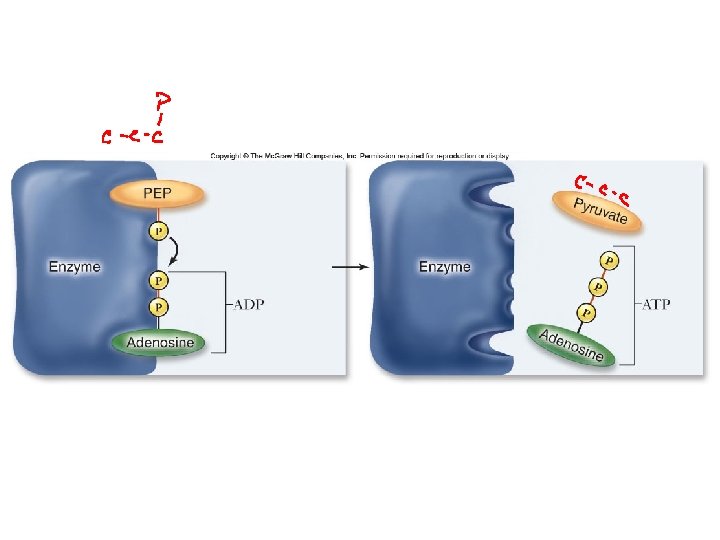
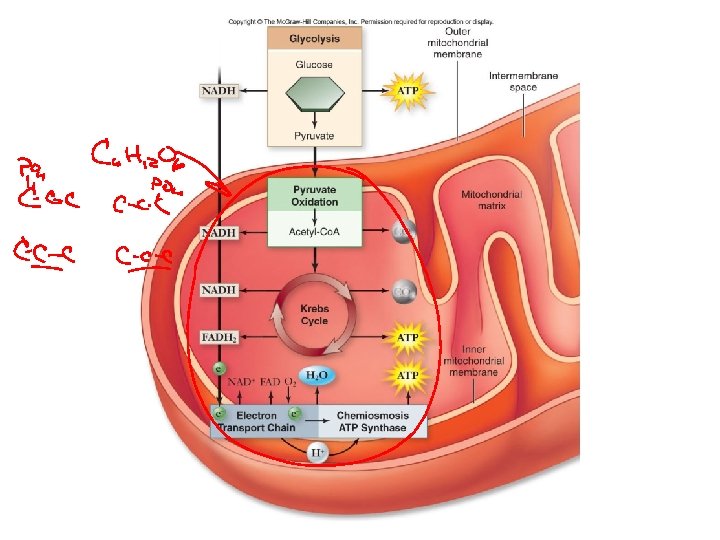
Oxidation of Glucose Cells are able to make ATP via: 1. substrate-level phosphorylation – transferring a phosphate directly to ADP from another molecule 2. oxidative phosphorylation – use of ATP synthase and energy derived from a proton (H+) gradient to make ATP
Respiration During redox reactions, electrons carry energy from one molecule to another. NAD+ is an electron carrier. • NAD+ accepts 2 electrons and 1 proton to become NADH • the reaction is reversible
Oxidation of Glucose The complete oxidation of glucose proceeds in stages: 1. glycoloysis 2. pyruvate oxidation 3. Krebs cycle 4. electron transport chain & chemiosmosis
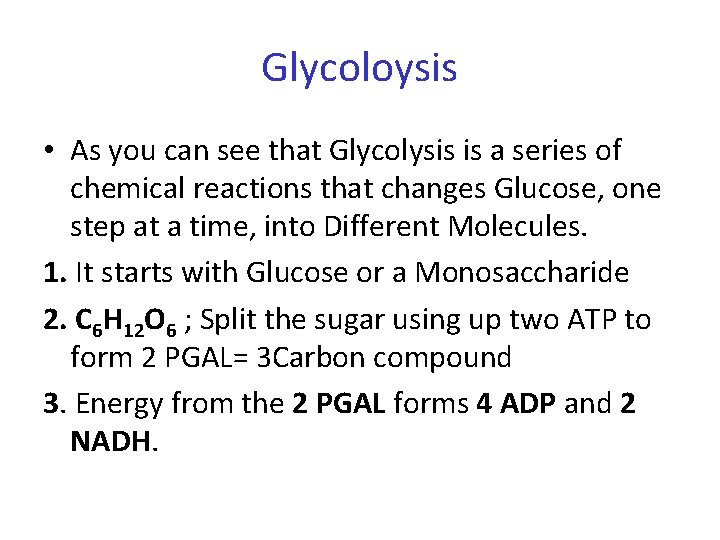
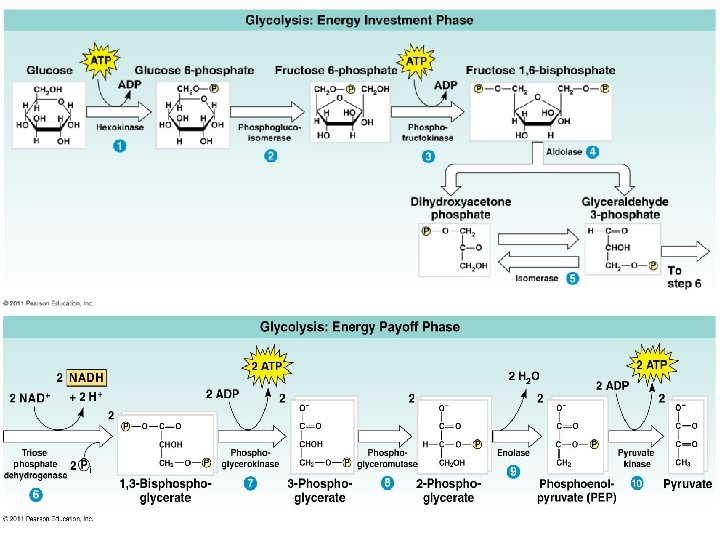
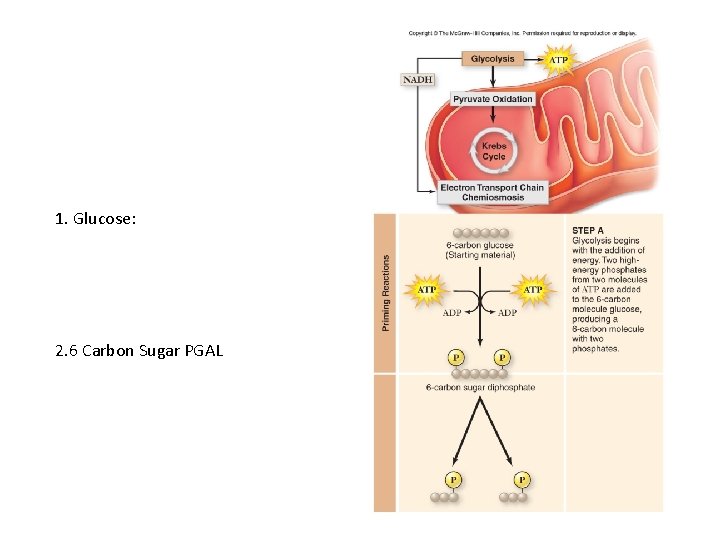
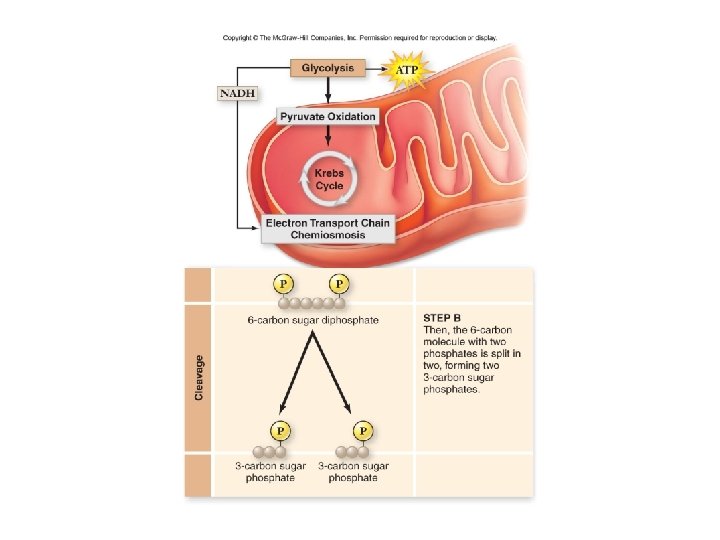
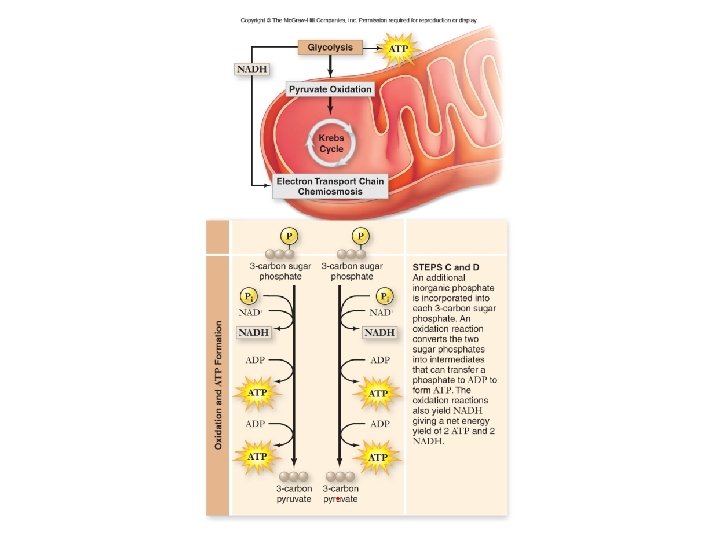
Glycoloysis • As you can see that Glycolysis is a series of chemical reactions that changes Glucose, one step at a time, into Different Molecules. 1. It starts with Glucose or a Monosaccharide 2. C 6 H 12 O 6 ; Split the sugar using up two ATP to form 2 PGAL= 3 Carbon compound 3. Energy from the 2 PGAL forms 4 ADP and 2 NADH.
Glycoloysis 4. 4 ADP forms into 4 ATP by phosphorylation. • This uses 2 ATP. 5. That is a Net gain of 2 ATP in Glycolysis And Pyruvic Acid. Glycolysis is an Anerobic Phase!! No O 2 requirement.
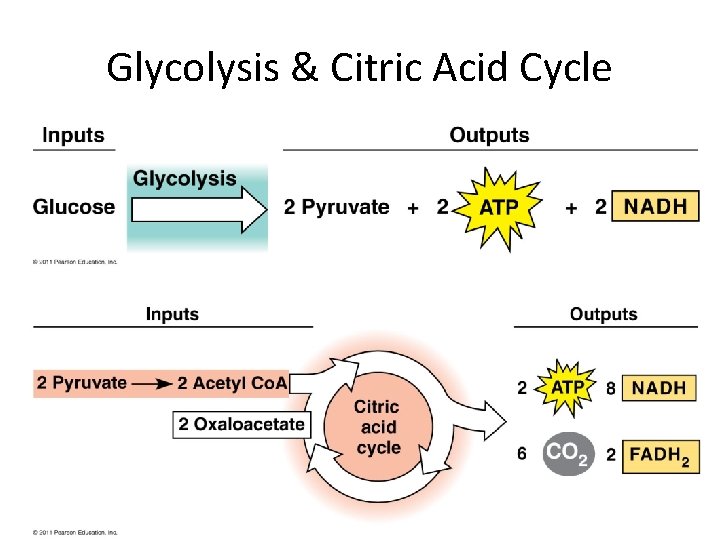
Glycoloysis converts glucose to pyruvate. -a 10 -step biochemical pathway -occurs in the cytoplasm -2 molecules of pyruvate are formed -net production of 2 ATP molecules by substrate -level phosphorylation -2 NADH produced by the reduction of NAD+
1. Glucose: 2. 6 Carbon Sugar PGAL
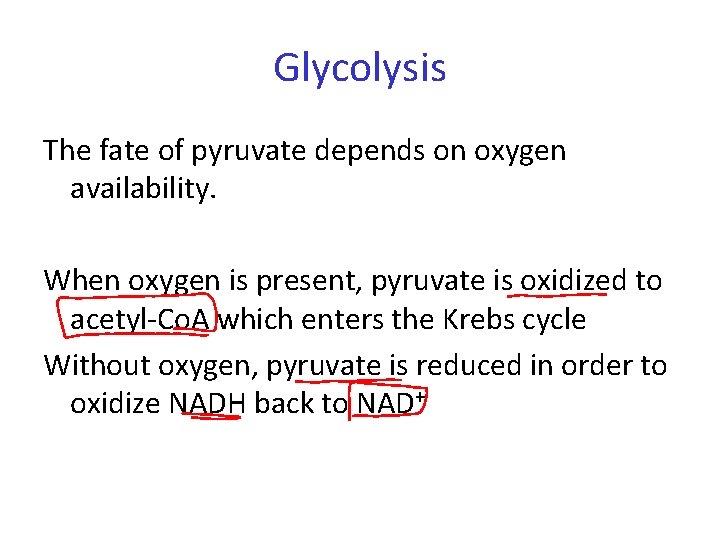
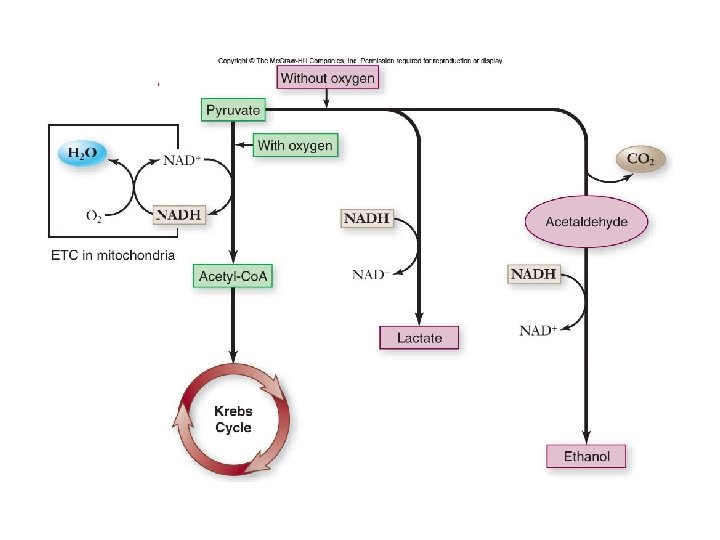
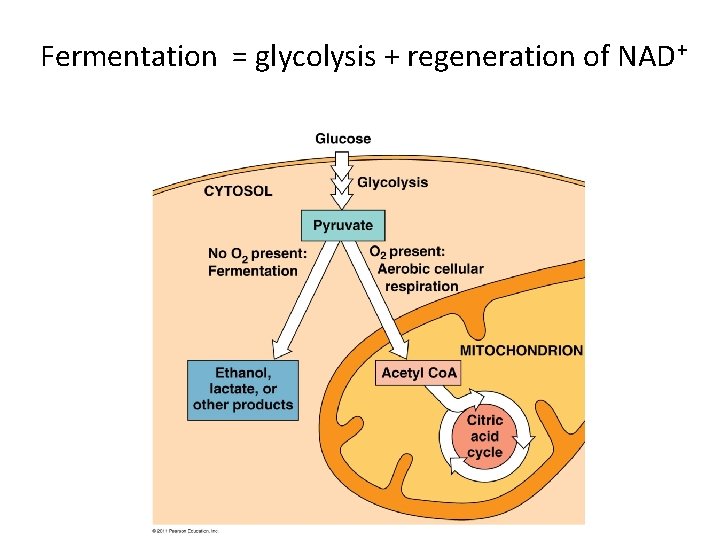
Glycolysis The fate of pyruvate depends on oxygen availability. When oxygen is present, pyruvate is oxidized to acetyl-Co. A which enters the Krebs cycle Without oxygen, pyruvate is reduced in order to oxidize NADH back to NAD+
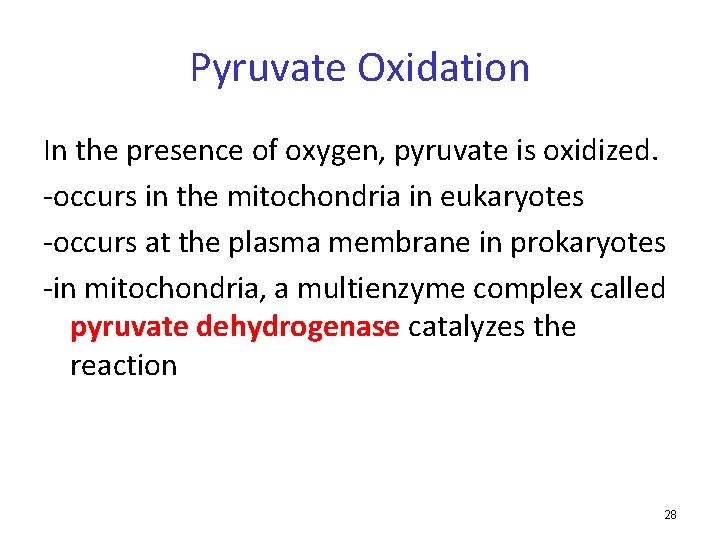
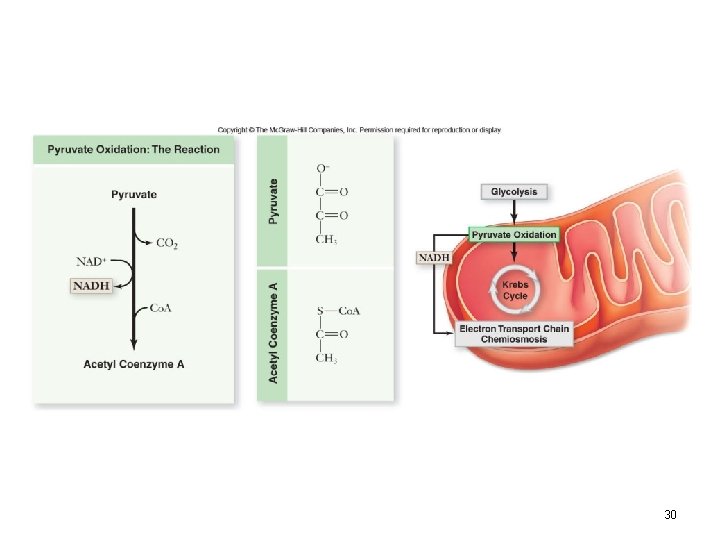
Pyruvate Oxidation In the presence of oxygen, pyruvate is oxidized. -occurs in the mitochondria in eukaryotes -occurs at the plasma membrane in prokaryotes -in mitochondria, a multienzyme complex called pyruvate dehydrogenase catalyzes the reaction 28
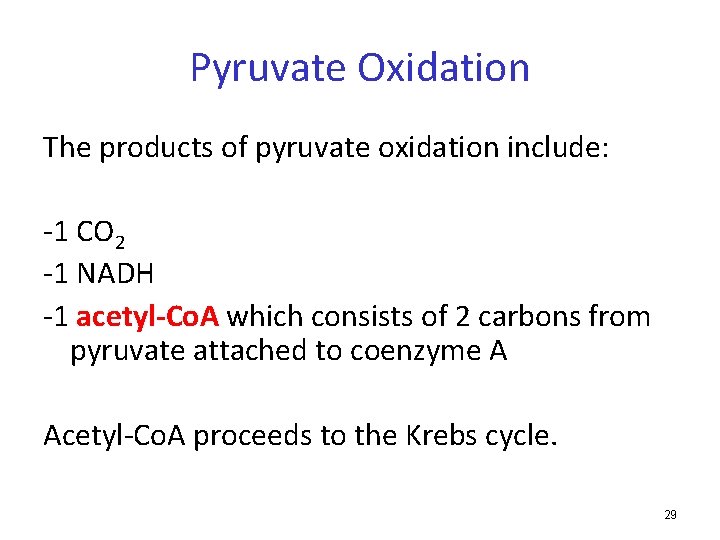
Pyruvate Oxidation The products of pyruvate oxidation include: -1 CO 2 -1 NADH -1 acetyl-Co. A which consists of 2 carbons from pyruvate attached to coenzyme A Acetyl-Co. A proceeds to the Krebs cycle. 29
30
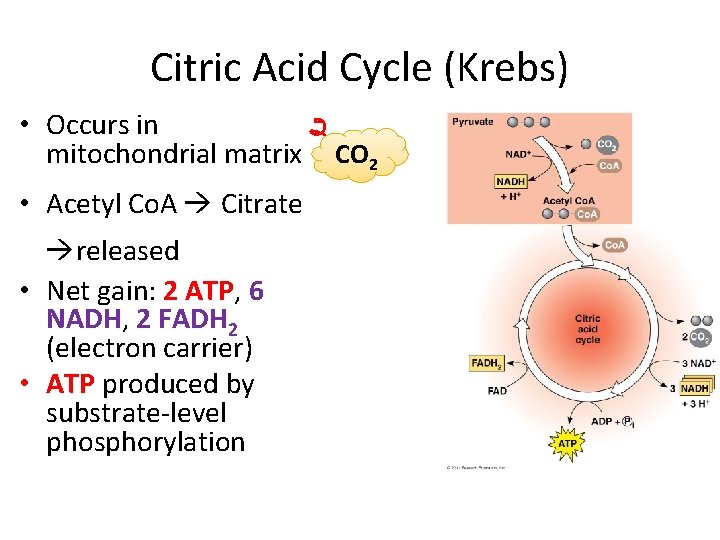
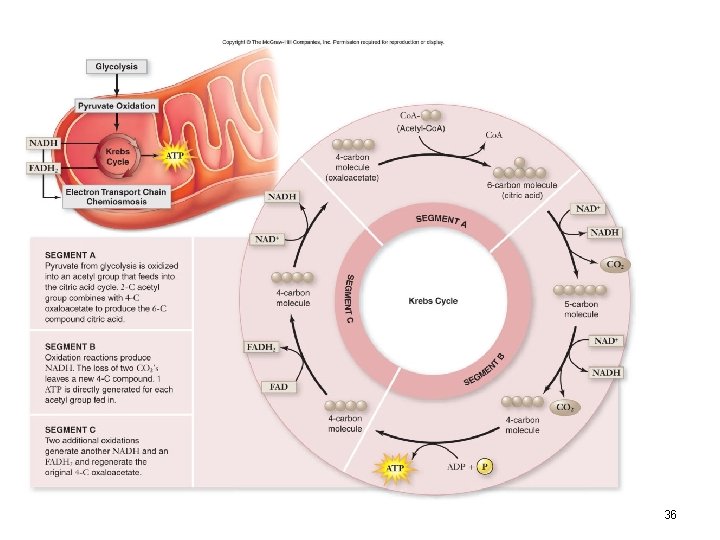
Citric Acid Cycle (Krebs) • Occurs in mitochondrial matrix • Acetyl Co. A Citrate released • Net gain: 2 ATP, 6 NADH, 2 FADH 2 (electron carrier) • ATP produced by substrate-level phosphorylation CO 2
Krebs Cycle The Krebs cycle oxidizes the acetyl group from pyruvate. -occurs in the matrix of the mitochondria -biochemical pathway of 9 steps -first step: acetyl group + oxaloacetate citrate (2 carbons) (4 carbons) (6 carbons) 32
Krebs Cycle The remaining steps of the Krebs cycle: -release 2 molecules of CO 2 -reduce 3 NAD+ to 3 NADH -reduce 1 FAD (electron carrier) to FADH 2 -produce 1 ATP -regenerate oxaloacetate 33
Krebs Cycle 1. Acetyl Coenzyme A Produced in Glycolysis is added to a 4 carbon compound to produce a 6 carbon compound. (Citric Acid. ) 2. Several Step Sequence of electron yielding reactions. NAD+ to NADH forming 2 CO 2 and a 4 Carbon Compound. 3. Phosphorylation of a GDP to GTP. This GTP can then transfer a Phosphate to ADP forming ATP.
Krebs Cycle After glycolysis, pyruvate oxidation, and the Krebs cycle, glucose has been oxidized to: - 6 CO 2 - 4 ATP - 10 NADH These electron carriers proceed - 2 FADH 2 to the electron transport chain. 35
36
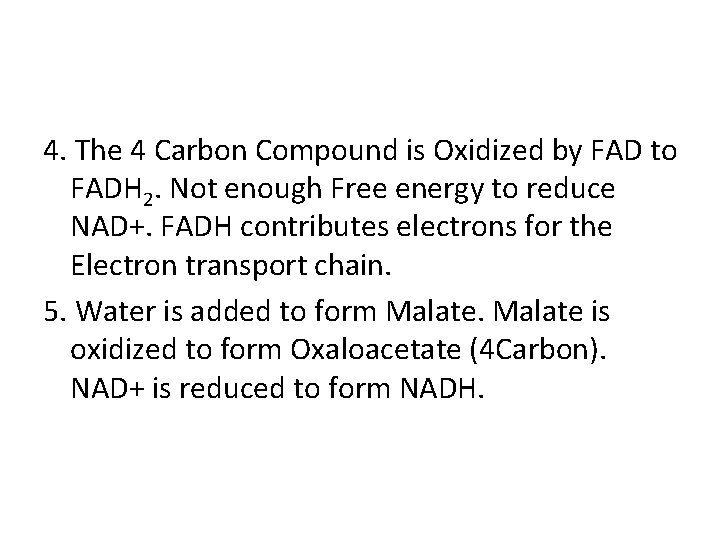
4. The 4 Carbon Compound is Oxidized by FAD to FADH 2. Not enough Free energy to reduce NAD+. FADH contributes electrons for the Electron transport chain. 5. Water is added to form Malate is oxidized to form Oxaloacetate (4 Carbon). NAD+ is reduced to form NADH.
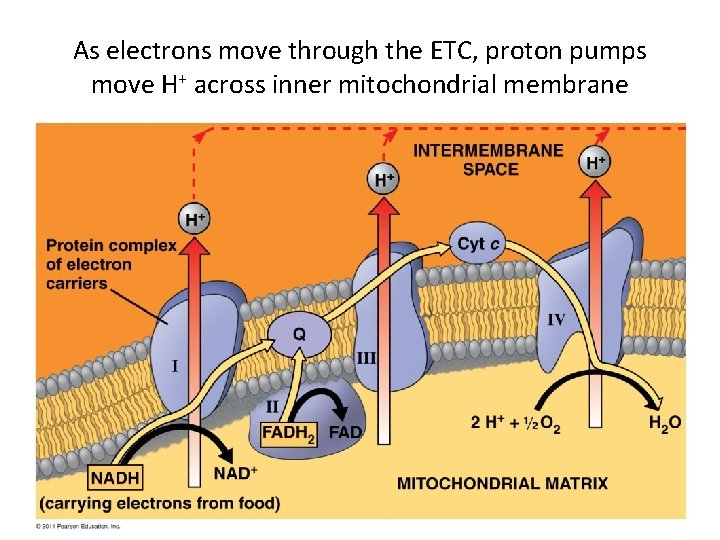
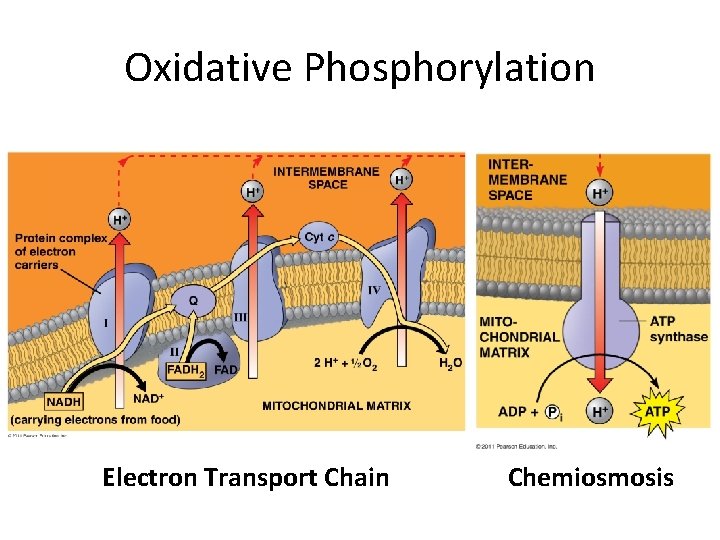
Electron Transport Chain The electron transport chain (ETC) is a series of membrane-bound electron carriers. -embedded in the mitochondrial inner membrane -electrons from NADH and FADH 2 are transferred to complexes of the ETC -each complex transfers the electrons to the next complex in the chain 38
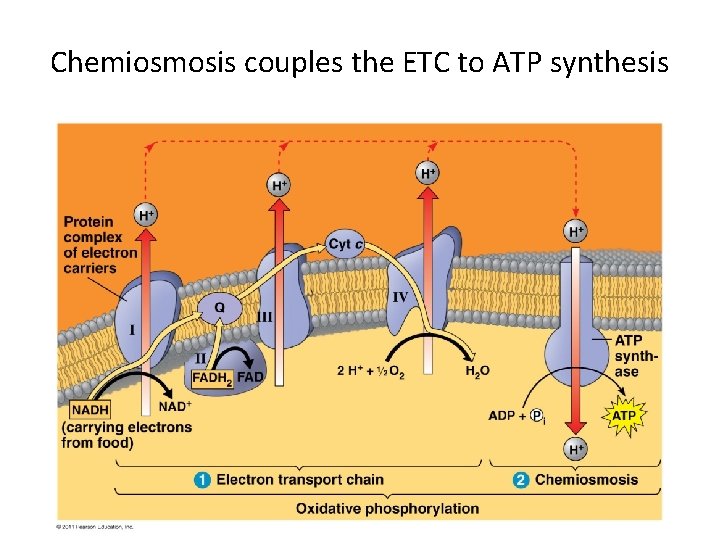
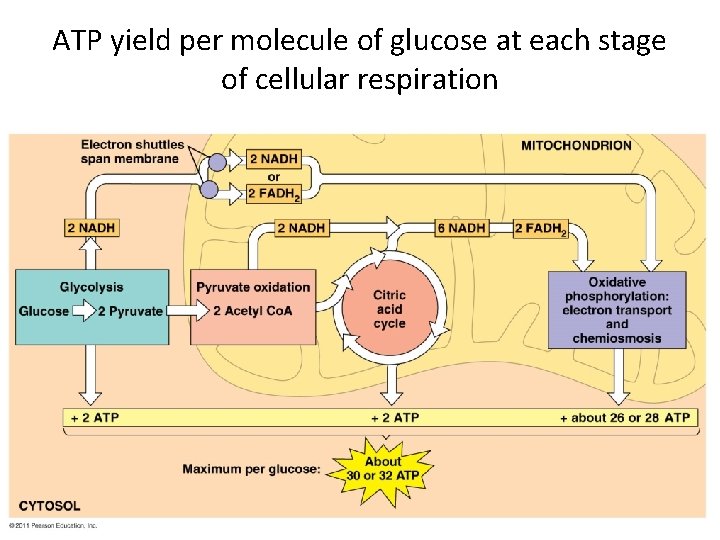
Stage 4: Oxidative Phosphorylation Electron Transport Chain • Occurs in inner membrane of mitochondria • Produces 26 -28 ATP by oxidative phosphorylation via chemiosmosis Chemiosmosis • H+ ions pumped across inner mitochondrial membrane • H+ diffuse through ATP synthase (ADP ATP)
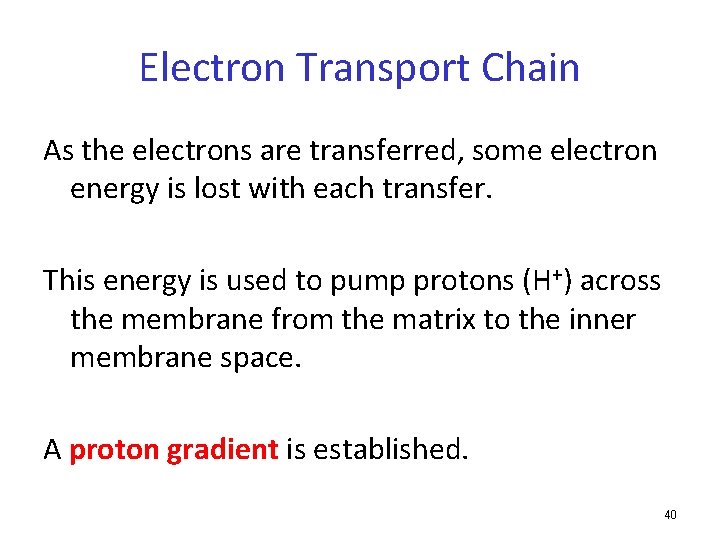
Electron Transport Chain As the electrons are transferred, some electron energy is lost with each transfer. This energy is used to pump protons (H+) across the membrane from the matrix to the inner membrane space. A proton gradient is established. 40
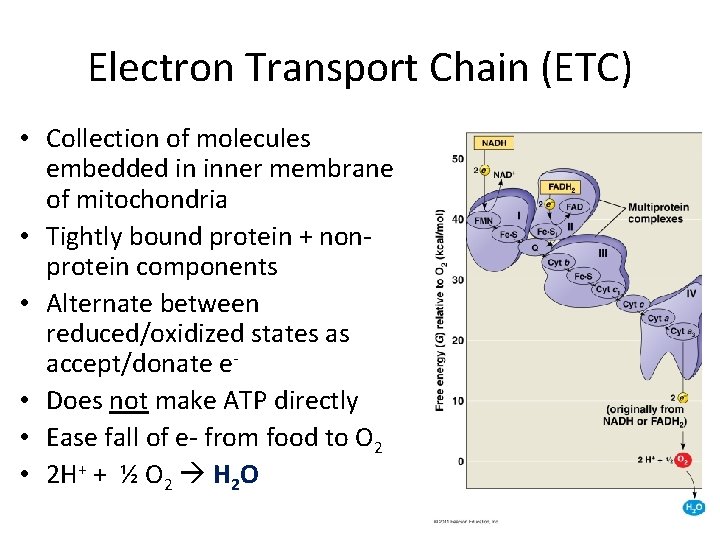
Electron Transport Chain (ETC) • Collection of molecules embedded in inner membrane of mitochondria • Tightly bound protein + nonprotein components • Alternate between reduced/oxidized states as accept/donate e • Does not make ATP directly • Ease fall of e- from food to O 2 • 2 H+ + ½ O 2 H 2 O
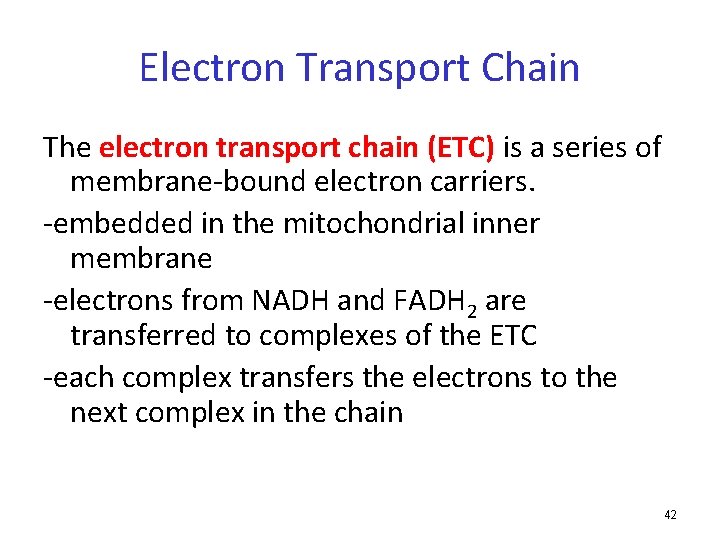
Electron Transport Chain The electron transport chain (ETC) is a series of membrane-bound electron carriers. -embedded in the mitochondrial inner membrane -electrons from NADH and FADH 2 are transferred to complexes of the ETC -each complex transfers the electrons to the next complex in the chain 42
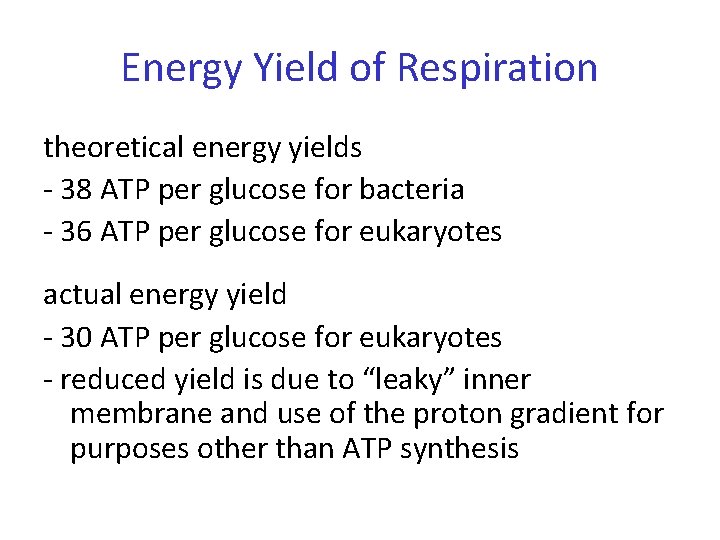
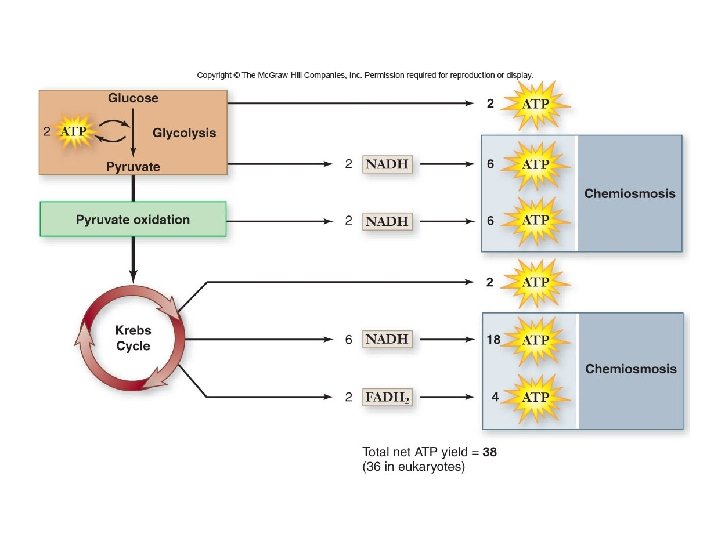
Energy Yield of Respiration theoretical energy yields - 38 ATP per glucose for bacteria - 36 ATP per glucose for eukaryotes actual energy yield - 30 ATP per glucose for eukaryotes - reduced yield is due to “leaky” inner membrane and use of the proton gradient for purposes other than ATP synthesis
As electrons move through the ETC, proton pumps move H+ across inner mitochondrial membrane
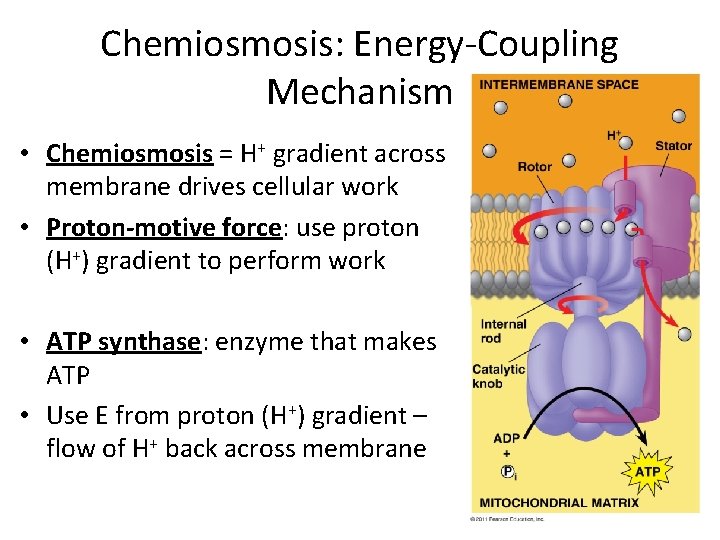
Chemiosmosis: Energy-Coupling Mechanism • Chemiosmosis = H+ gradient across membrane drives cellular work • Proton-motive force: use proton (H+) gradient to perform work • ATP synthase: enzyme that makes ATP • Use E from proton (H+) gradient – flow of H+ back across membrane
Chemiosmosis couples the ETC to ATP synthesis
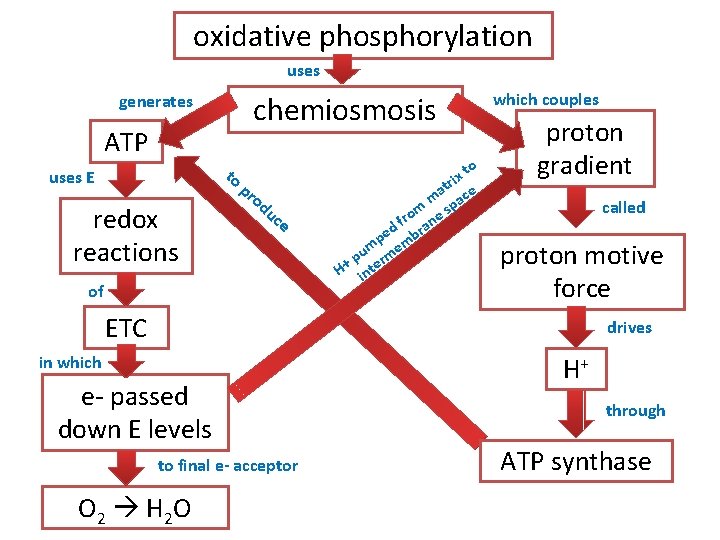
oxidative phosphorylation uses ATP to p uses E redox reactions which couples chemiosmosis generates ro du c e of to x ri at ce m a m e sp o fr ran d pe mb um rme p H+ inte proton gradient called proton motive force ETC drives in which e- passed down E levels to final e- acceptor O 2 H 2 O H+ through ATP synthase
ATP yield per molecule of glucose at each stage of cellular respiration
Respiration Overview • The Process that involves the breakdown of Food molecules such as Glucose to Release energy. • Pyruvate used in Glycolysis is Broken down and 34 ATP are formed. Oxygen is needed to release the energy and the chemical reactions occur in the Mitochondria of the cell.
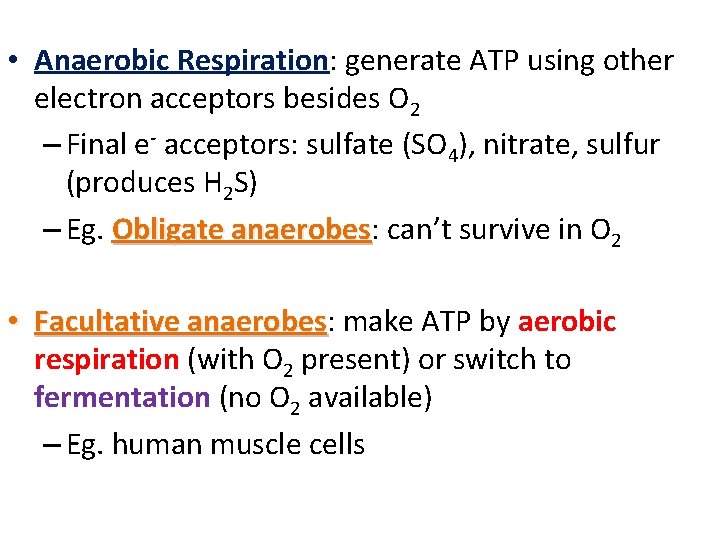
• Anaerobic Respiration: generate ATP using other electron acceptors besides O 2 – Final e- acceptors: sulfate (SO 4), nitrate, sulfur (produces H 2 S) – Eg. Obligate anaerobes: can’t survive in O Obligate anaerobes 2 • Facultative anaerobes: make ATP by aerobic Facultative anaerobes respiration (with O 2 present) or switch to fermentation (no O 2 available) – Eg. human muscle cells
Fermentation = glycolysis + regeneration of NAD+
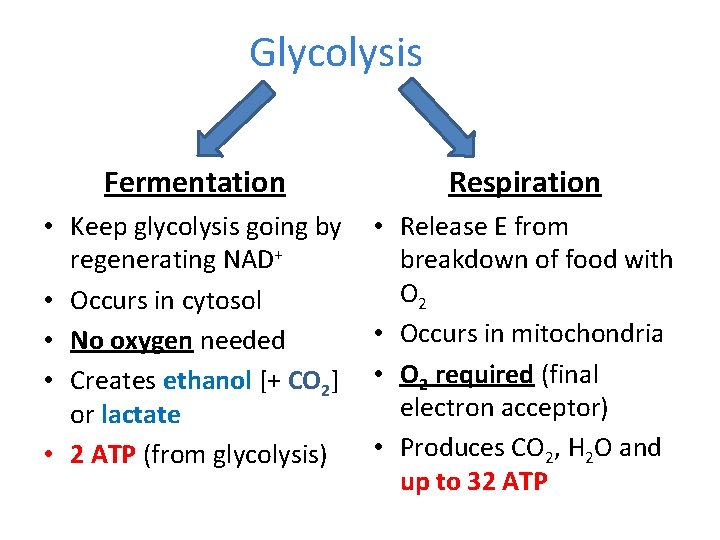
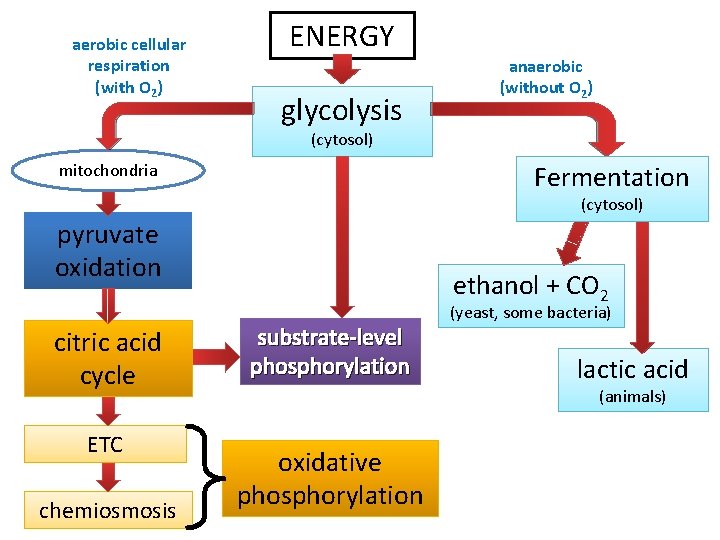
Without O 2 Glycolysis O 2 present Fermentation Respiration • Keep glycolysis going by regenerating NAD+ • Occurs in cytosol • No oxygen needed • Creates ethanol [+ CO 2] or lactate • 2 ATP (from glycolysis) • Release E from breakdown of food with O 2 • Occurs in mitochondria • O 2 required (final electron acceptor) • Produces CO 2, H 2 O and up to 32 ATP
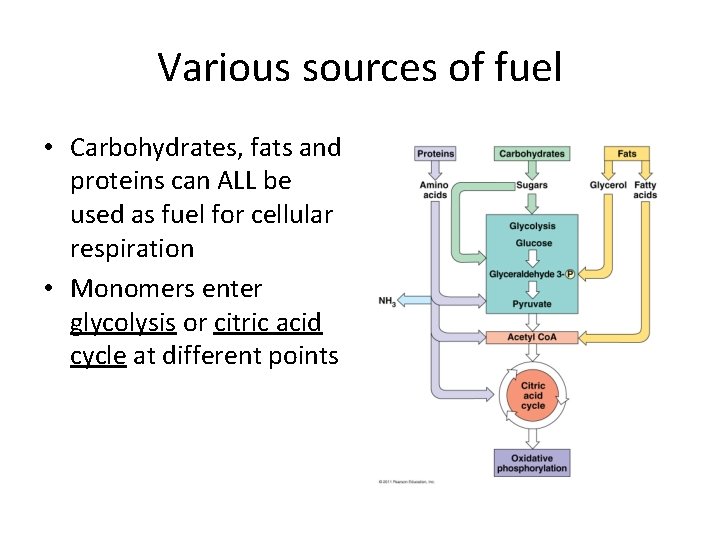
Various sources of fuel • Carbohydrates, fats and proteins can ALL be used as fuel for cellular respiration • Monomers enter glycolysis or citric acid cycle at different points
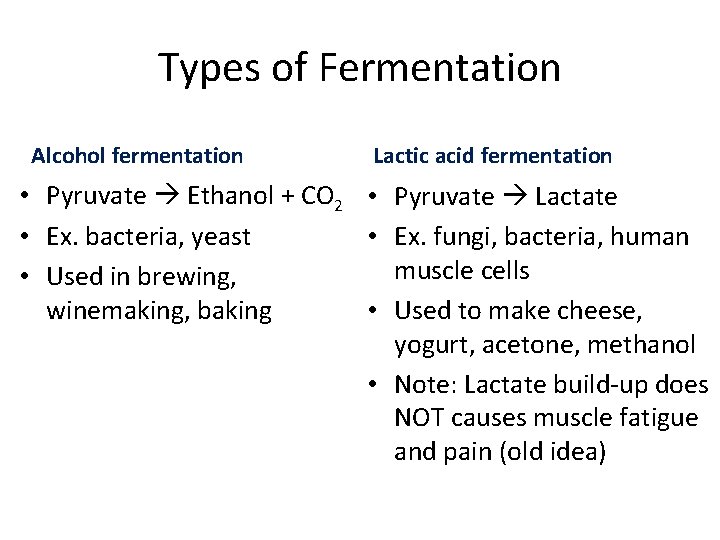
Types of Fermentation Alcohol fermentation Lactic acid fermentation • Pyruvate Ethanol + CO 2 • Pyruvate Lactate • Ex. bacteria, yeast • Ex. fungi, bacteria, human muscle cells • Used in brewing, winemaking, baking • Used to make cheese, yogurt, acetone, methanol • Note: Lactate build-up does NOT causes muscle fatigue and pain (old idea)
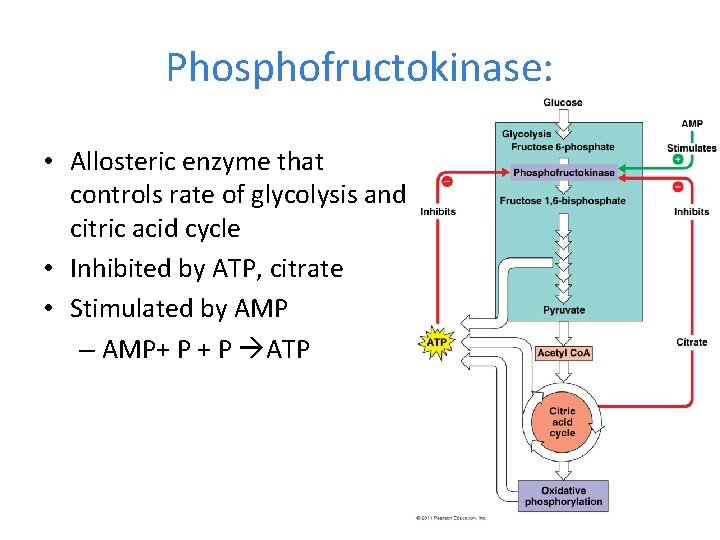
Phosphofructokinase: • Allosteric enzyme that controls rate of glycolysis and citric acid cycle • Inhibited by ATP, citrate • Stimulated by AMP – AMP+ P ATP
Energy production and Exercise • ATP and Creatine Phosphate produce enough energy for about 15 seconds of maximum muscle contraction. • After 15 second of exercise the muscle must go to glycolysis to find the energy.
Glycolysis: • This is the process of breaking down glucose into pyruvic acid ( Pyruvate) and 2 ATP. • Glucose passes easily to the muscle from the blood. • Glycolysis occurs in the sarcoplasm and is anaerobic. . • It provides enough energy for the muscles 30 to 40 seconds. • • After 40 sec. The muscle performs either lactic acid fermentation or aerobic cellular respiration if oxygen is present.
Aerobic Cellular Respiration • • 2 sources of oxygen used 1. ) from Blood 2. ) from Myoglobin Used in activities that last more than 10 min.
• If enough Oxygen is present Pyruvic acid enters the Mitochondria and is completely oxidized. This generates 36 ATP, carbon dioxide, water, and heat. • Lactic Acid Fermentation: If Oxygen levels are low the pyruvic acid that is made during glycolysis is converted to lactic acid
Respiration: Big Picture
aerobic cellular respiration (with O 2) ENERGY glycolysis anaerobic (without O 2) (cytosol) Fermentation mitochondria (cytosol) pyruvate oxidation citric acid cycle ETC chemiosmosis ethanol + CO 2 substrate-level phosphorylation (yeast, some bacteria) lactic acid (animals) oxidative phosphorylation
Glycolysis & Citric Acid Cycle
Oxidative Phosphorylation Electron Transport Chain Chemiosmosis
Photosynthesis Chapter 10
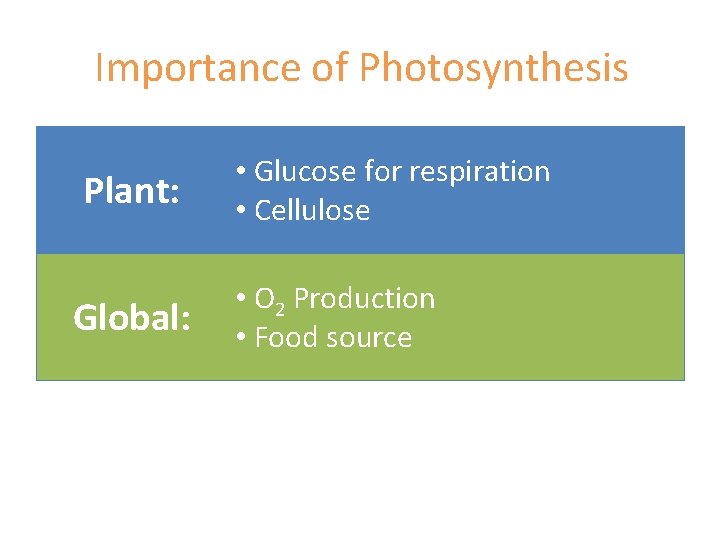
Importance of Photosynthesis Plant: Global: • Glucose for respiration • Cellulose • O 2 Production • Food source
What is Photosynthesis? • What type of organisms does this occur? • Where does it occur? • What are the reactants? • What are the Products?
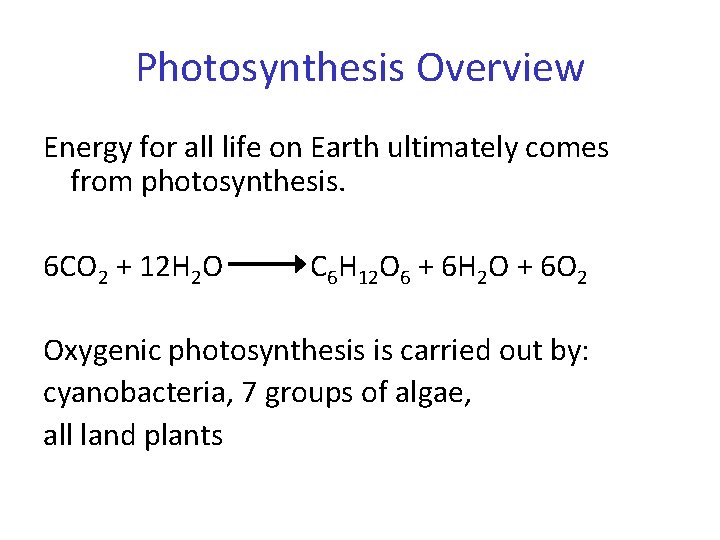
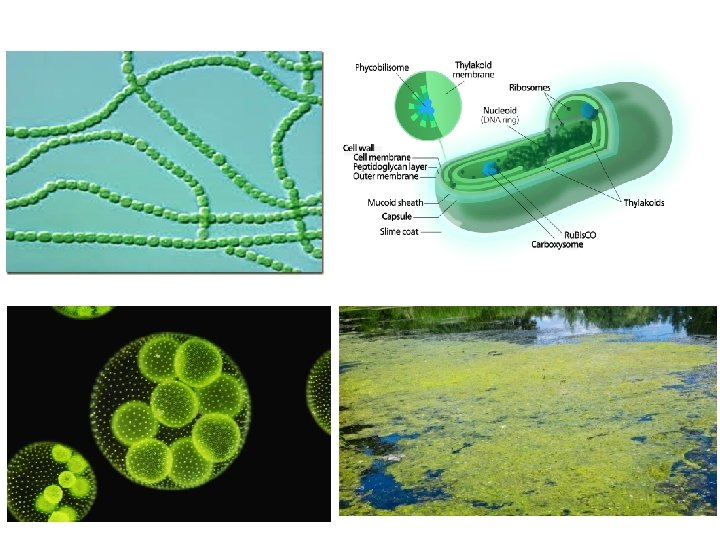
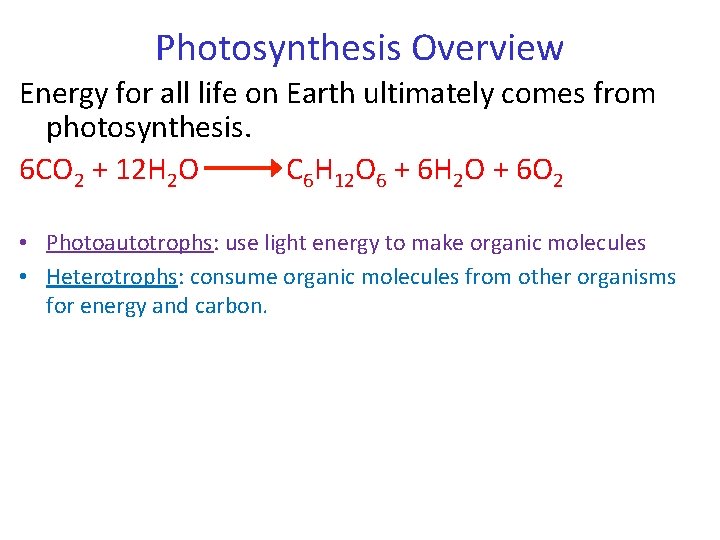
Photosynthesis Overview Energy for all life on Earth ultimately comes from photosynthesis. 6 CO 2 + 12 H 2 O C 6 H 12 O 6 + 6 H 2 O + 6 O 2 Oxygenic photosynthesis is carried out by: cyanobacteria, 7 groups of algae, all land plants
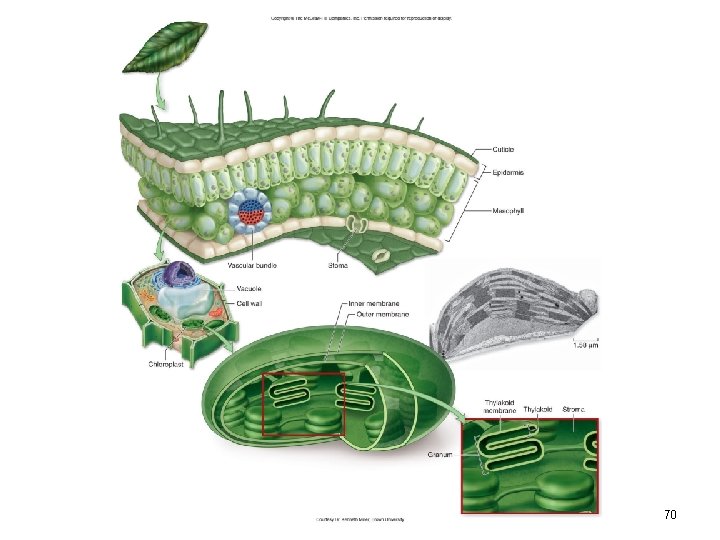
70
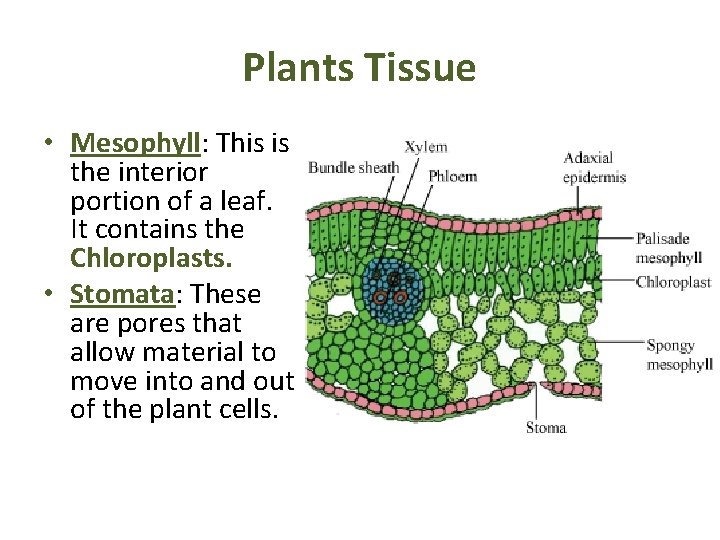
Plants Tissue • Mesophyll: This is the interior portion of a leaf. It contains the Chloroplasts. • Stomata: These are pores that allow material to move into and out of the plant cells.
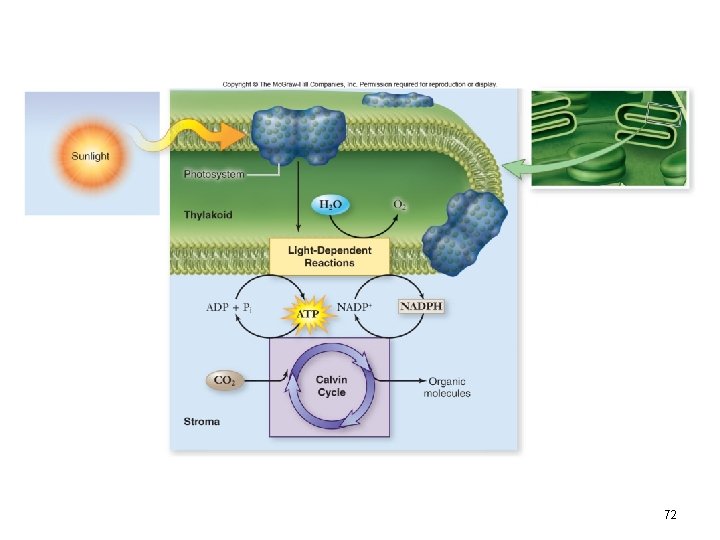
72
Photosynthesis Overview Energy for all life on Earth ultimately comes from photosynthesis. 6 CO 2 + 12 H 2 O C 6 H 12 O 6 + 6 H 2 O + 6 O 2 • Photoautotrophs: use light energy to make organic molecules • Heterotrophs: consume organic molecules from other organisms for energy and carbon.
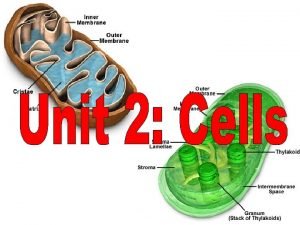
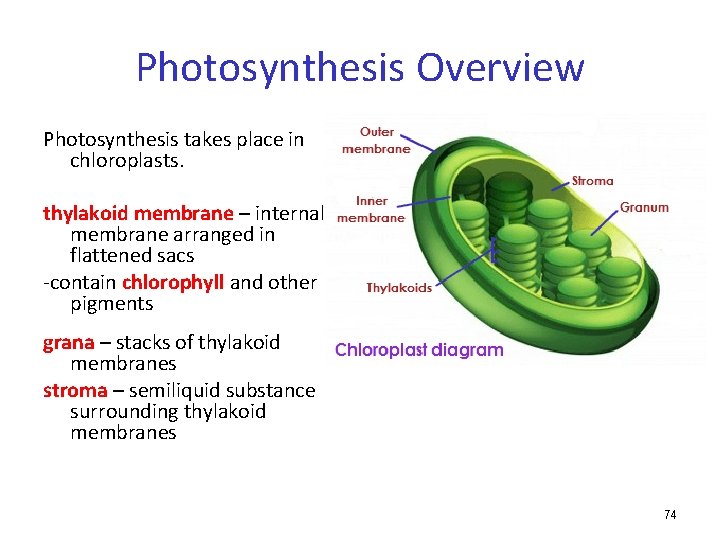
Photosynthesis Overview Photosynthesis takes place in chloroplasts. thylakoid membrane – internal membrane arranged in flattened sacs -contain chlorophyll and other pigments grana – stacks of thylakoid membranes stroma – semiliquid substance surrounding thylakoid membranes 74
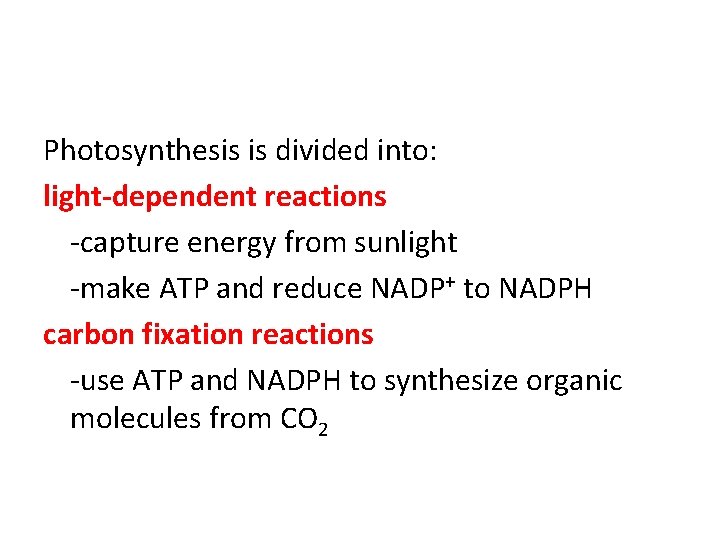
Photosynthesis is divided into: light-dependent reactions -capture energy from sunlight -make ATP and reduce NADP+ to NADPH carbon fixation reactions -use ATP and NADPH to synthesize organic molecules from CO 2
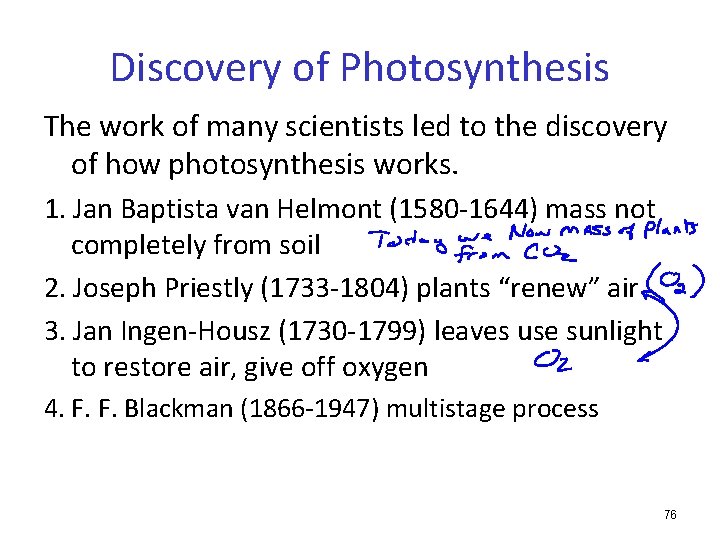
Discovery of Photosynthesis The work of many scientists led to the discovery of how photosynthesis works. 1. Jan Baptista van Helmont (1580 -1644) mass not completely from soil 2. Joseph Priestly (1733 -1804) plants “renew” air 3. Jan Ingen-Housz (1730 -1799) leaves use sunlight to restore air, give off oxygen 4. F. F. Blackman (1866 -1947) multistage process 76
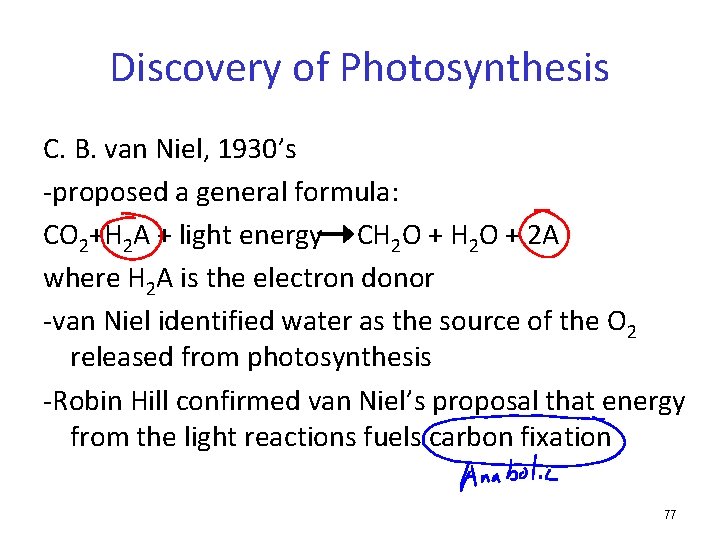
Discovery of Photosynthesis C. B. van Niel, 1930’s -proposed a general formula: CO 2+H 2 A + light energy CH 2 O + 2 A where H 2 A is the electron donor -van Niel identified water as the source of the O 2 released from photosynthesis -Robin Hill confirmed van Niel’s proposal that energy from the light reactions fuels carbon fixation 77
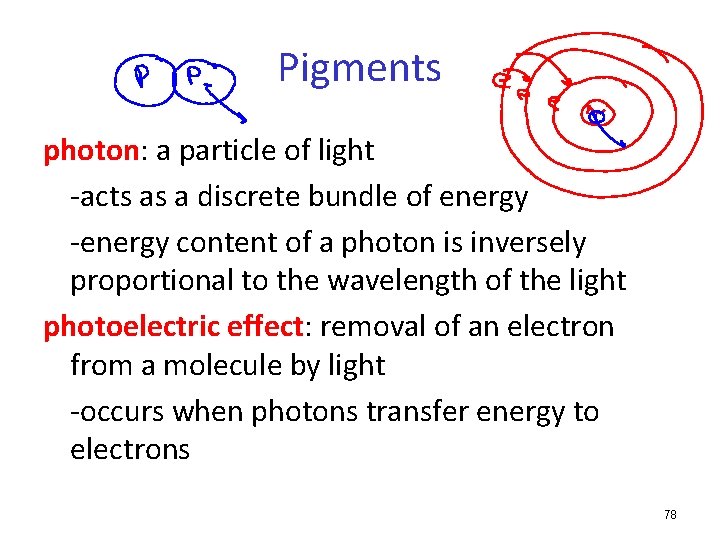
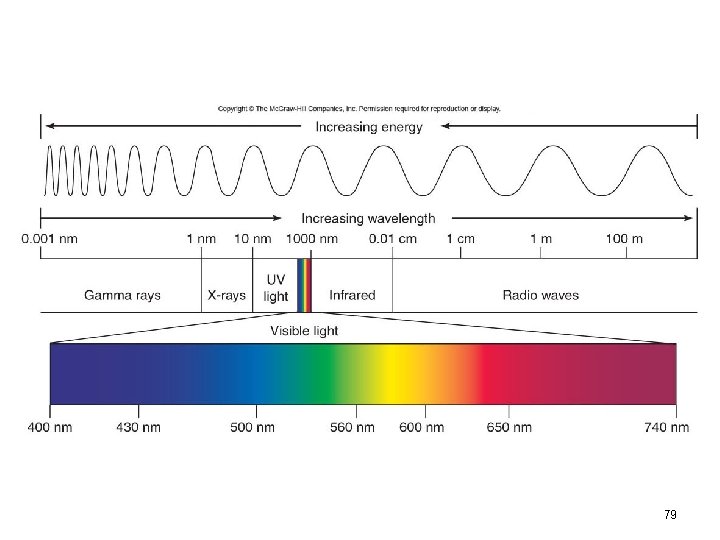
Pigments photon: a particle of light -acts as a discrete bundle of energy -energy content of a photon is inversely proportional to the wavelength of the light photoelectric effect: removal of an electron from a molecule by light -occurs when photons transfer energy to electrons 78
79
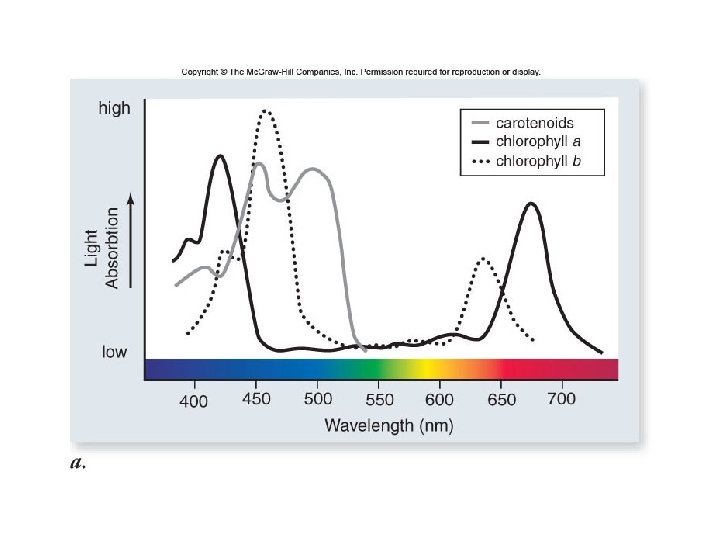
Pigments: molecules that absorb visible light Each pigment has a characteristic absorption spectrum, the range and efficiency of photons it is capable of absorbing. 80
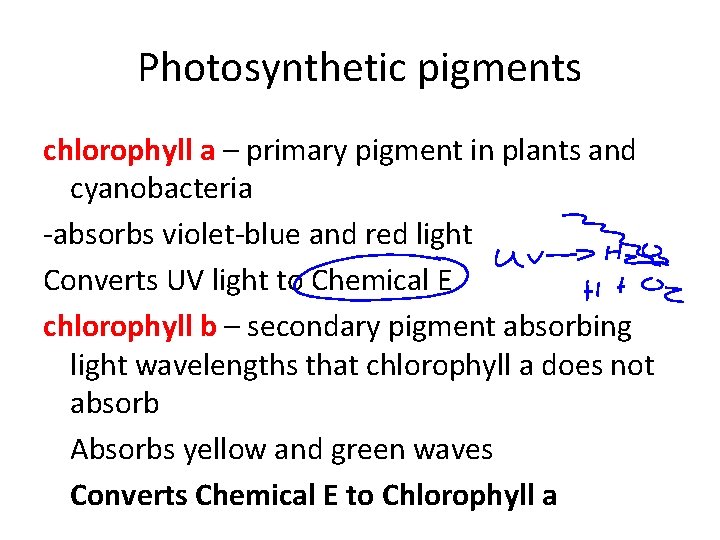
Photosynthetic pigments chlorophyll a – primary pigment in plants and cyanobacteria -absorbs violet-blue and red light Converts UV light to Chemical E chlorophyll b – secondary pigment absorbing light wavelengths that chlorophyll a does not absorb Absorbs yellow and green waves Converts Chemical E to Chlorophyll a
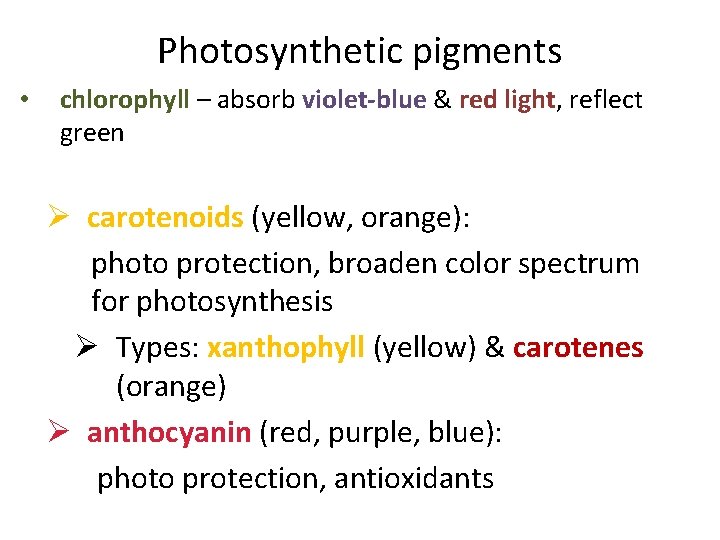
Photosynthetic pigments • chlorophyll – absorb violet-blue & red light, reflect green Ø carotenoids (yellow, orange): photo protection, broaden color spectrum for photosynthesis Ø Types: xanthophyll (yellow) & carotenes (orange) Ø anthocyanin (red, purple, blue): photo protection, antioxidants
accessory pigments: secondary pigments absorbing light wavelengths other than those absorbed by chlorophyll a -increase the range of light wavelengths that can be used in photosynthesis -include: chlorophyll b, carotenoids, phycobiloproteins -carotenoids also act as antioxidants
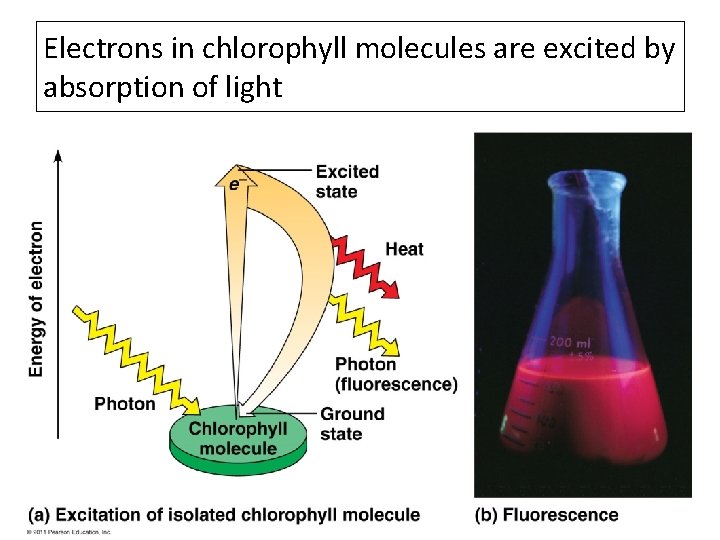
Electrons in chlorophyll molecules are excited by absorption of light
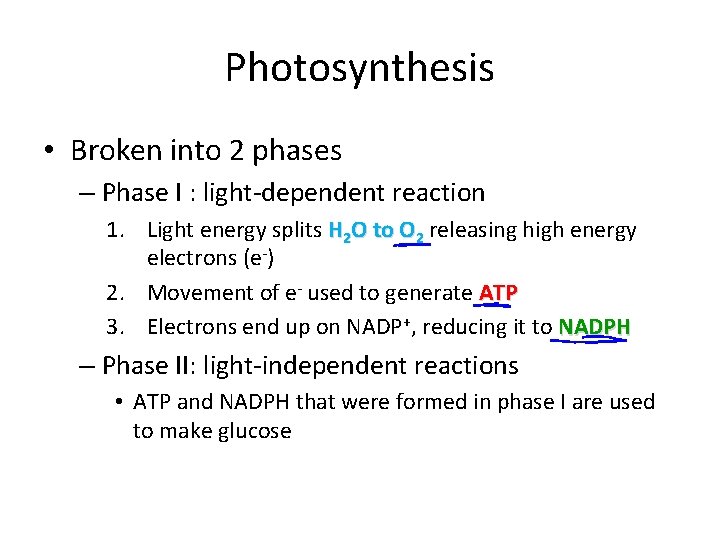
Photosynthesis • Broken into 2 phases – Phase I : light-dependent reaction 1. Light energy splits H 2 O to O 2 releasing high energy electrons (e-) 2. Movement of e- used to generate ATP 3. Electrons end up on NADP+, reducing it to NADPH – Phase II: light-independent reactions • ATP and NADPH that were formed in phase I are used to make glucose
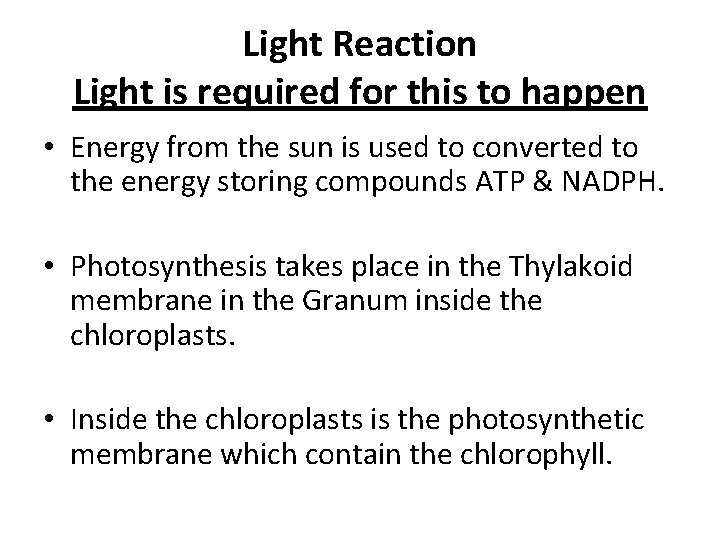
Light Reaction Light is required for this to happen • Energy from the sun is used to converted to the energy storing compounds ATP & NADPH. • Photosynthesis takes place in the Thylakoid membrane in the Granum inside the chloroplasts. • Inside the chloroplasts is the photosynthetic membrane which contain the chlorophyll.
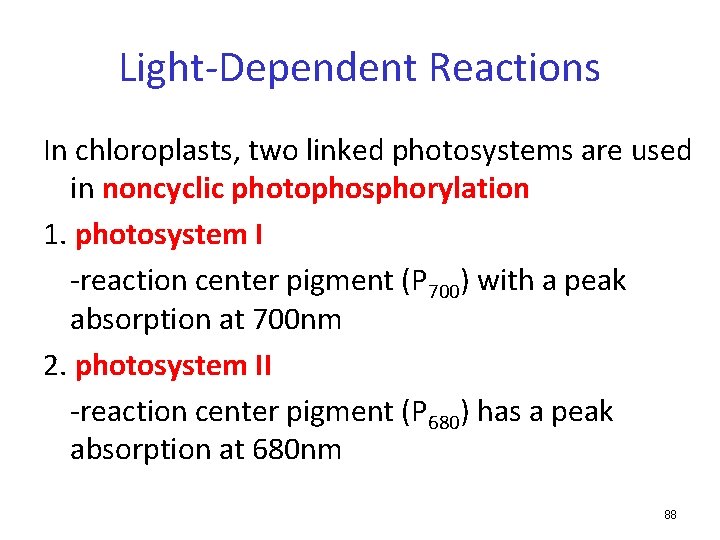
Light-Dependent Reactions In chloroplasts, two linked photosystems are used in noncyclic photophosphorylation 1. photosystem I -reaction center pigment (P 700) with a peak absorption at 700 nm 2. photosystem II -reaction center pigment (P 680) has a peak absorption at 680 nm 88
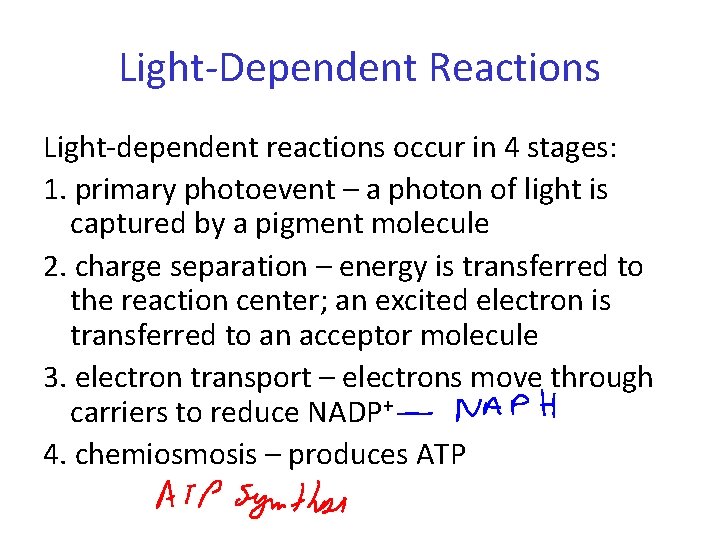
Light-Dependent Reactions Light-dependent reactions occur in 4 stages: 1. primary photoevent – a photon of light is captured by a pigment molecule 2. charge separation – energy is transferred to the reaction center; an excited electron is transferred to an acceptor molecule 3. electron transport – electrons move through carriers to reduce NADP+ 4. chemiosmosis – produces ATP
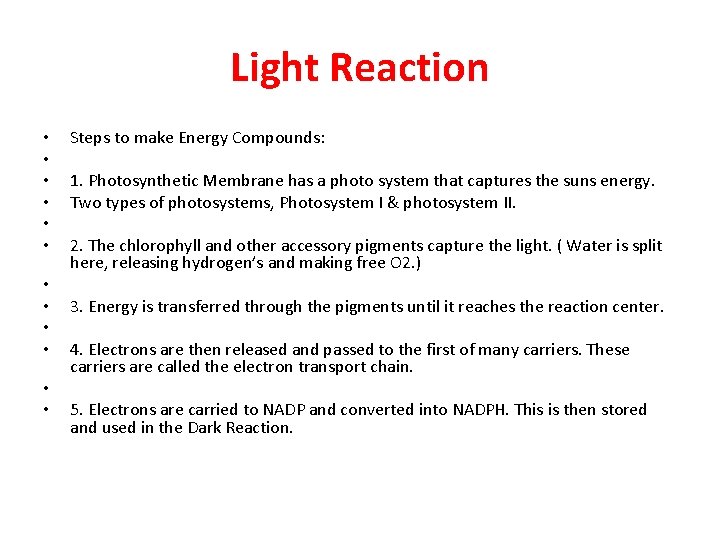
Photosynthetic Membrane has a photo system that captures the suns energy. • Two types of photosystems: Photosystem I & photosystem II. • The chlorophyll a, chlorophyll b and other accessory pigments capture the light. ( Water is split here, releasing hydrogen’s and making free O 2. ) • Steps to make Energy Compounds:
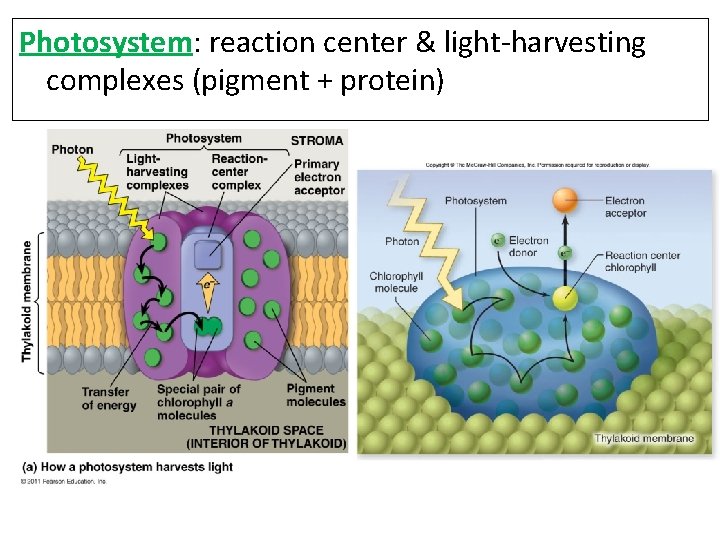
Photosystem: reaction center & light-harvesting complexes (pigment + protein)
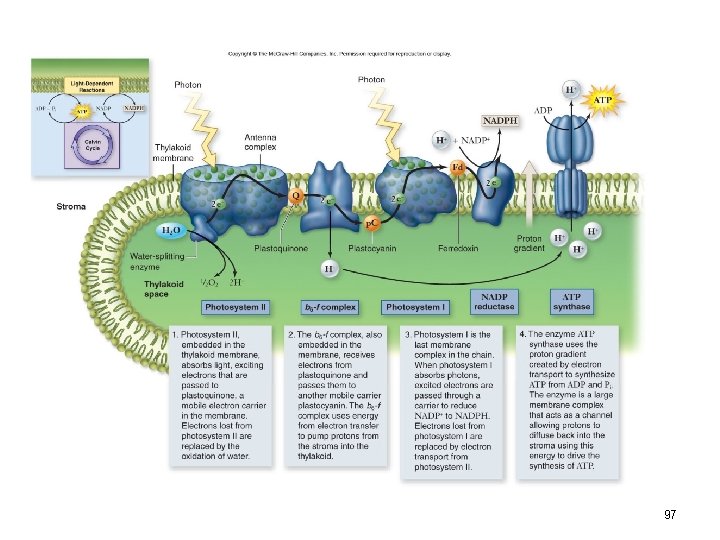
Light-Dependent Reactions Photosystem II acts first: -accessory pigments shuttle energy to the P 680 reaction center -excited electrons from P 680 are transferred to b 6 -f complex -electron lost from P 680 is replaced by an electron released from the splitting of water 92
Light-Dependent Reactions The b 6 -f complex is a series of electron carriers. -electron carrier molecules are embedded in the thylakoid membrane -protons are pumped into the thylakoid space to form a proton gradient 93
Light-Dependent Reactions ATP is produced via chemiosmosis. - ATP synthase is embedded in the thylakoid membrane -protons have accumulated in the thylakoid space -protons move into the stroma only through ATP synthase -ATP is produced from ADP + Pi 94
Light-Dependent Reactions Photosystem I -receives energy from an antenna complex -energy is shuttled to P 700 reaction center -excited electron is transferred to a membranebound electron carrier -electrons are used to reduce NADP+ to NADPH -electrons lost from P 700 are replaced from the b 6 -f complex 95
Light Reaction • • • Steps to make Energy Compounds: 1. Photosynthetic Membrane has a photo system that captures the suns energy. Two types of photosystems, Photosystem I & photosystem II. 2. The chlorophyll and other accessory pigments capture the light. ( Water is split here, releasing hydrogen’s and making free O 2. ) 3. Energy is transferred through the pigments until it reaches the reaction center. 4. Electrons are then released and passed to the first of many carriers. These carriers are called the electron transport chain. 5. Electrons are carried to NADP and converted into NADPH. This is then stored and used in the Dark Reaction.
97
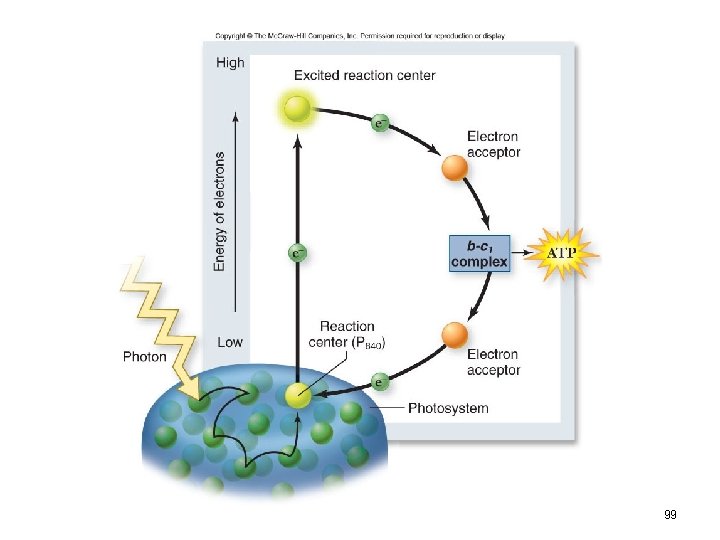
In sulfur bacteria, only one photosystem is used for cyclic photophosphorylation 1. an electron joins a proton to produce hydrogen 2. an electron is recycled to chlorophyll -this process drives the chemiosmotic synthesis of ATP
99
Carbon Fixation Reactions To build carbohydrates, cells need: 1. energy -ATP from light-dependent reactions 2. reduction potential -NADPH from photosystem I
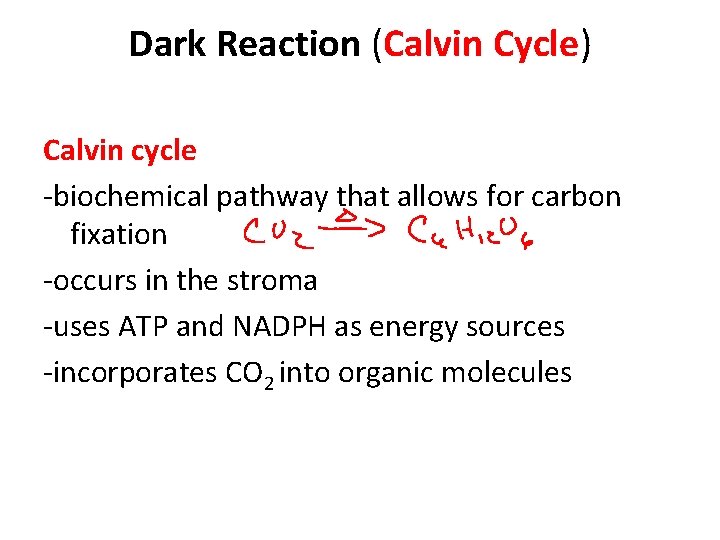
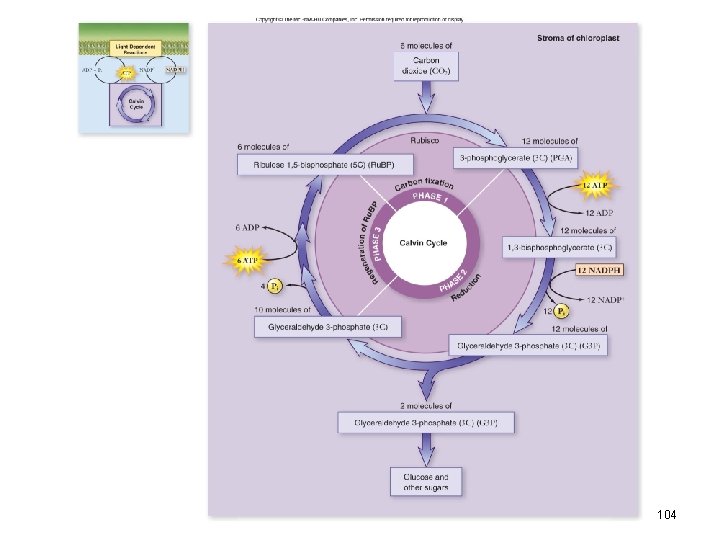
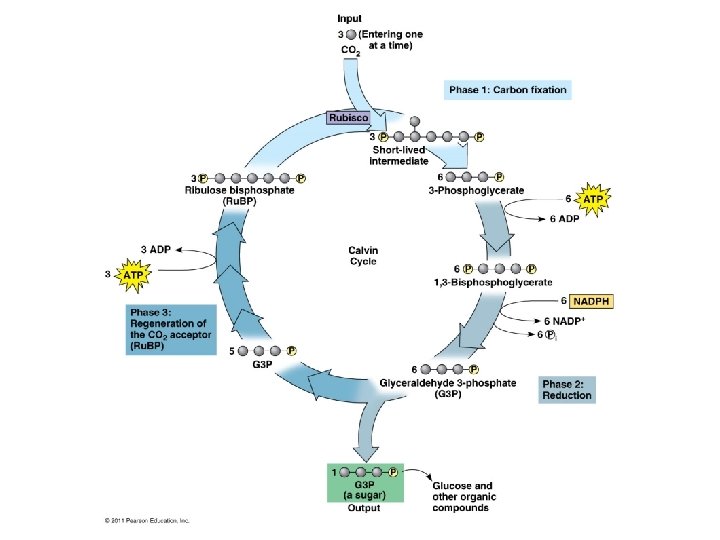
Dark Reaction (Calvin Cycle) Calvin cycle -biochemical pathway that allows for carbon fixation -occurs in the stroma -uses ATP and NADPH as energy sources -incorporates CO 2 into organic molecules
• • • Dark Reaction (Calvin Cycle) Does not need light but can occur in the light. Uses CO 2 and ATP & NADPH to form PGAL, to form Glucose (sugar). Calvin Cycle: CO 2 enters the cycle and combines with a 5 carbon compound. This forms a 3 carbon compound. Energy from 12 ATP and 12 NADPH change the 3 carbon compound to PGAL, and 12 ADP and 12 NADP. PGAL is then converted to make glucose. This cycle must go around 6 times to make glucose.
Dark Reaction (Calvin Cycle) • Does not need light but can occur in the light. • Uses CO 2 and ATP & NADPH to form PGAL, to form sugar. • Calvin Cycle: • CO 2 enters the cycle and combines with a 5 carbon compound. This forms a 3 carbon compound. • Energy from 12 ATP and 12 NADPH change the 3 carbon compound to PGAL, and 12 ADP and 12 NADP. • PGAL is then converted to make glucose. • This cycle must go around 6 times to make glucose.
104
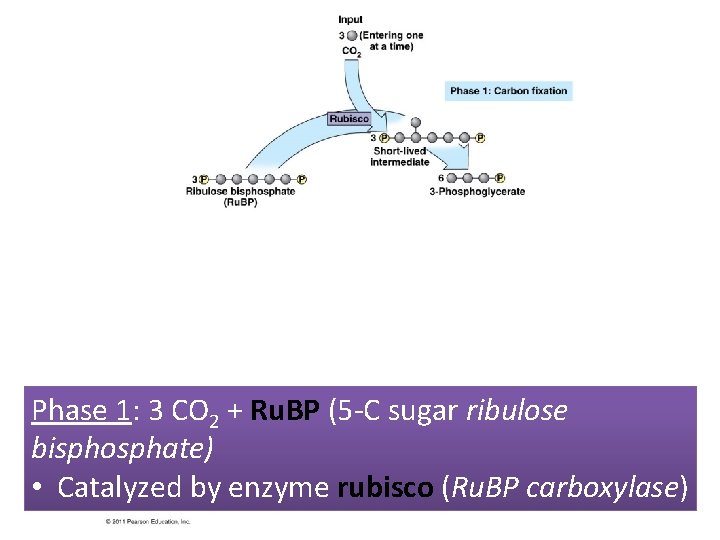
Phase 1: 3 CO 2 + Ru. BP (5 -C sugar ribulose bisphosphate) • Catalyzed by enzyme rubisco (Ru. BP carboxylase)
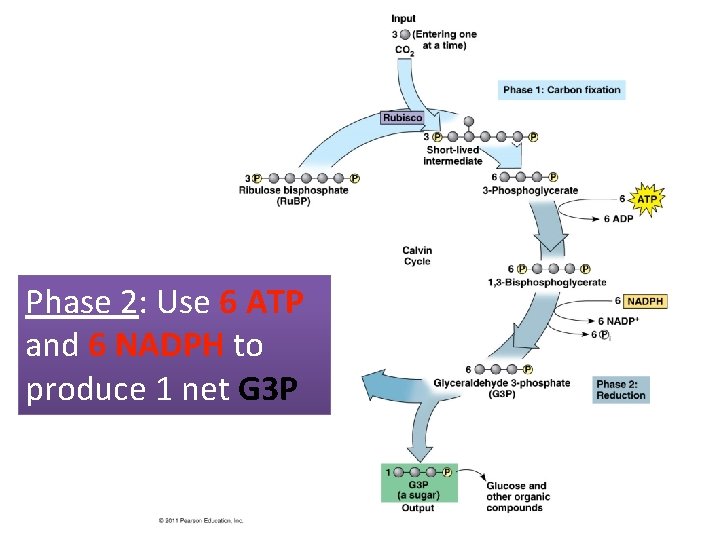
Phase 2: Use 6 ATP and 6 NADPH to produce 1 net G 3 P
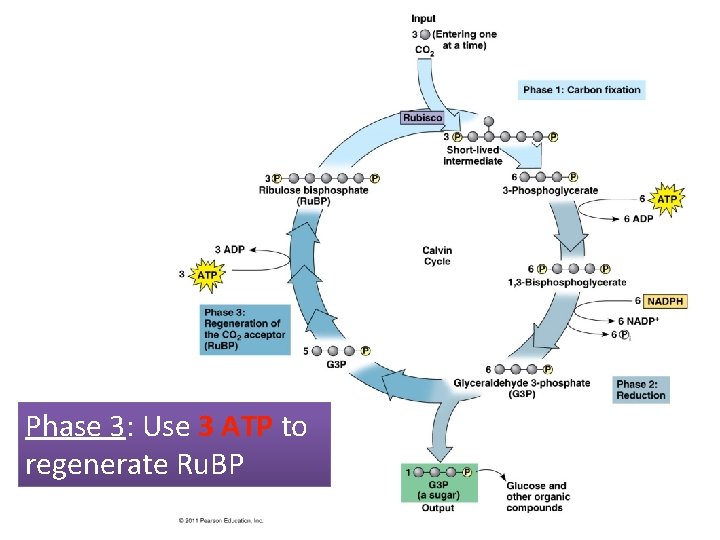
Phase 3: Use 3 ATP to regenerate Ru. BP
Glucose is not a direct product of the Calvin cycle. -2 molecules of G 3 P leave the cycle -each G 3 P contains 3 carbons -2 G 3 P are used to produce 1 glucose in reactions in the cytoplasm
During the Calvin cycle, energy is needed. The energy is supplied from: - 18 ATP molecules - 12 NADPH molecules
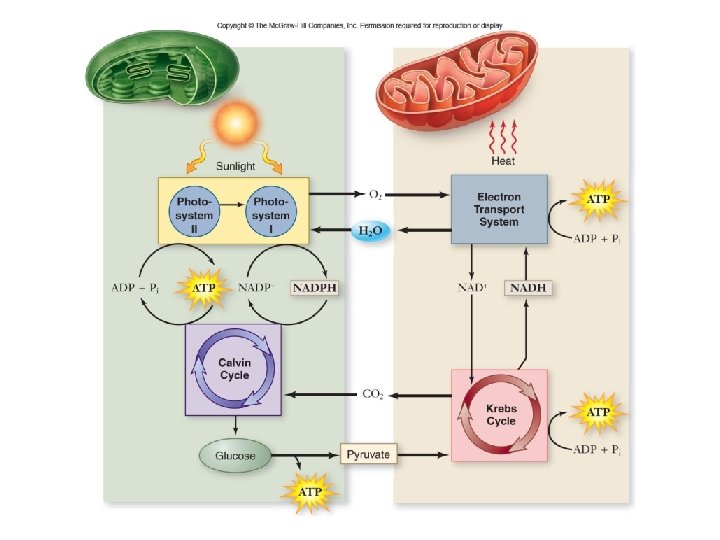
The energy cycle: -photosynthesis uses the products of respiration as starting substrates -respiration uses the products of photosynthesis as starting substrates
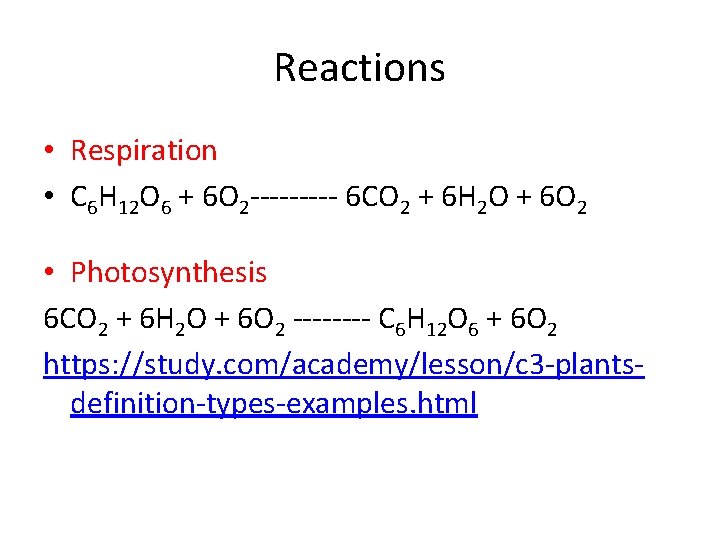
Reactions • Respiration • C 6 H 12 O 6 + 6 O 2 ----- 6 CO 2 + 6 H 2 O + 6 O 2 • Photosynthesis 6 CO 2 + 6 H 2 O + 6 O 2 ---- C 6 H 12 O 6 + 6 O 2 https: //study. com/academy/lesson/c 3 -plantsdefinition-types-examples. html
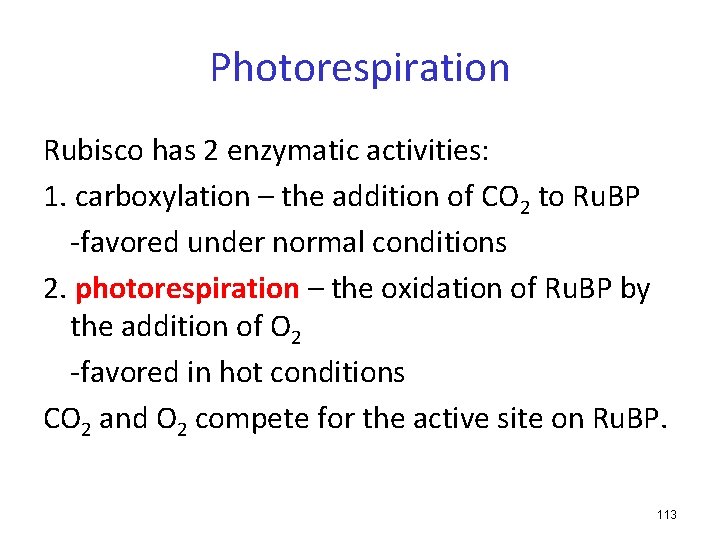
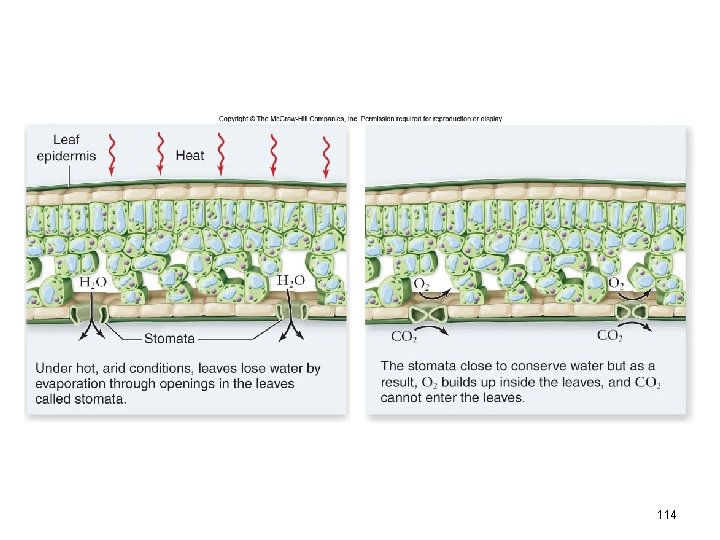
Photorespiration Rubisco has 2 enzymatic activities: 1. carboxylation – the addition of CO 2 to Ru. BP -favored under normal conditions 2. photorespiration – the oxidation of Ru. BP by the addition of O 2 -favored in hot conditions CO 2 and O 2 compete for the active site on Ru. BP. 113
114
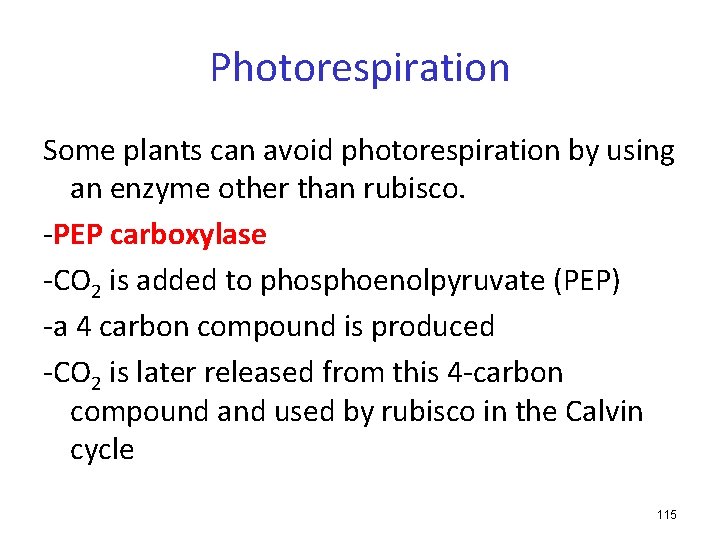
Photorespiration Some plants can avoid photorespiration by using an enzyme other than rubisco. -PEP carboxylase -CO 2 is added to phosphoenolpyruvate (PEP) -a 4 carbon compound is produced -CO 2 is later released from this 4 -carbon compound and used by rubisco in the Calvin cycle 115
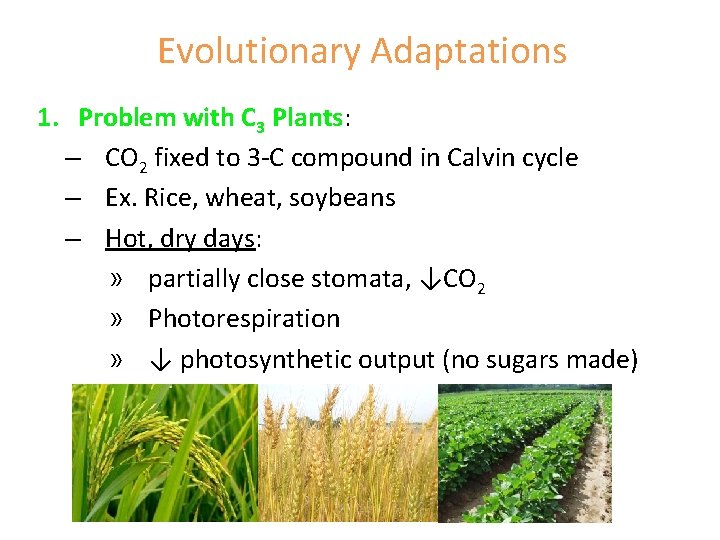
Evolutionary Adaptations 1. Problem with C 3 Plants: – CO 2 fixed to 3 -C compound in Calvin cycle – Ex. Rice, wheat, soybeans – Hot, dry days: » partially close stomata, ↓CO 2 » Photorespiration » ↓ photosynthetic output (no sugars made)
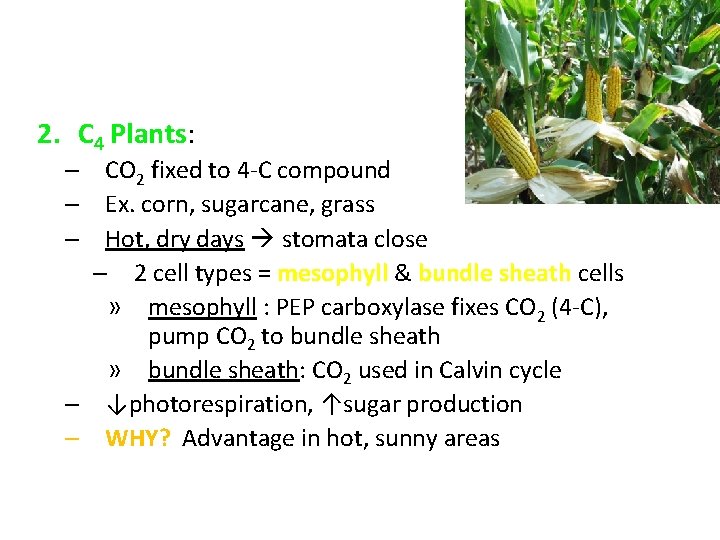
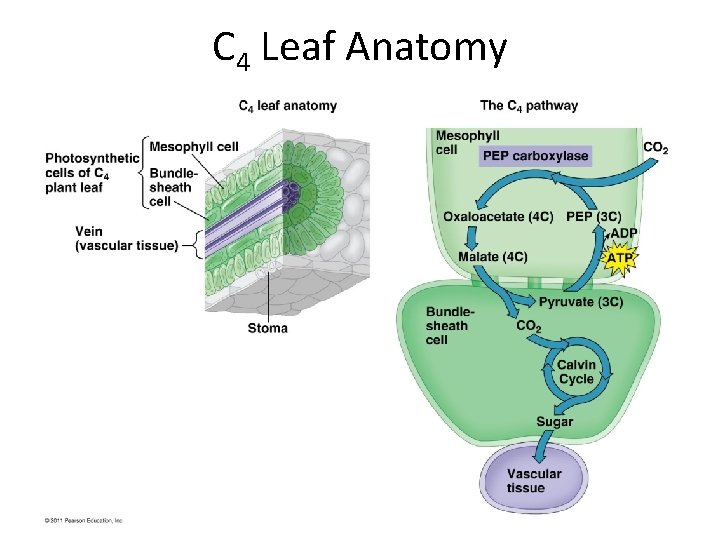
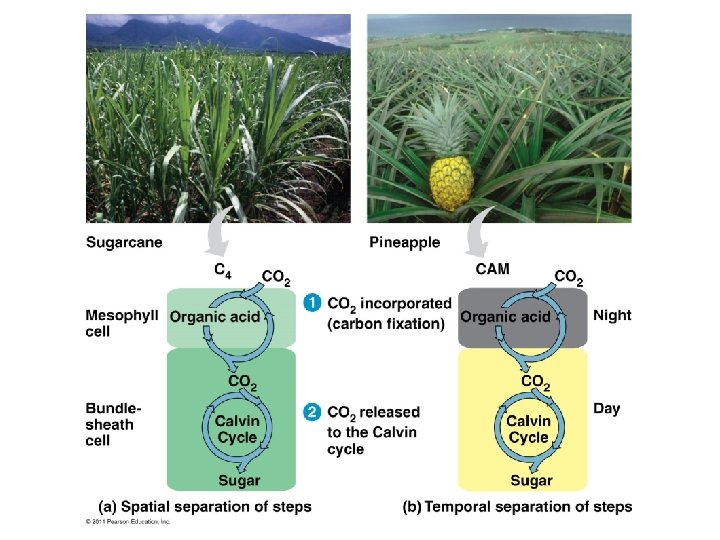
2. C 4 Plants: – CO 2 fixed to 4 -C compound – Ex. corn, sugarcane, grass – Hot, dry days stomata close – 2 cell types = mesophyll & bundle sheath cells » mesophyll : PEP carboxylase fixes CO 2 (4 -C), pump CO 2 to bundle sheath » bundle sheath: CO 2 used in Calvin cycle – ↓photorespiration, ↑sugar production – WHY? Advantage in hot, sunny areas
C 4 Leaf Anatomy
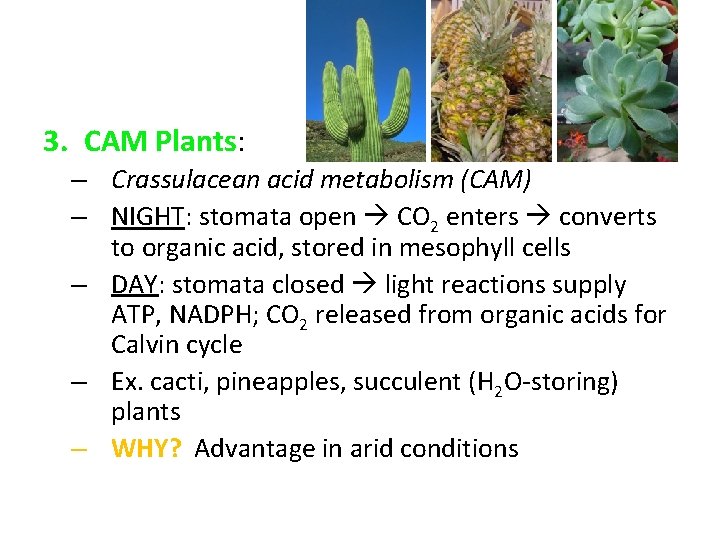
3. CAM Plants: – Crassulacean acid metabolism (CAM) – NIGHT: stomata open CO 2 enters converts to organic acid, stored in mesophyll cells – DAY: stomata closed light reactions supply ATP, NADPH; CO 2 released from organic acids for Calvin cycle – Ex. cacti, pineapples, succulent (H 2 O-storing) plants – WHY? Advantage in arid conditions
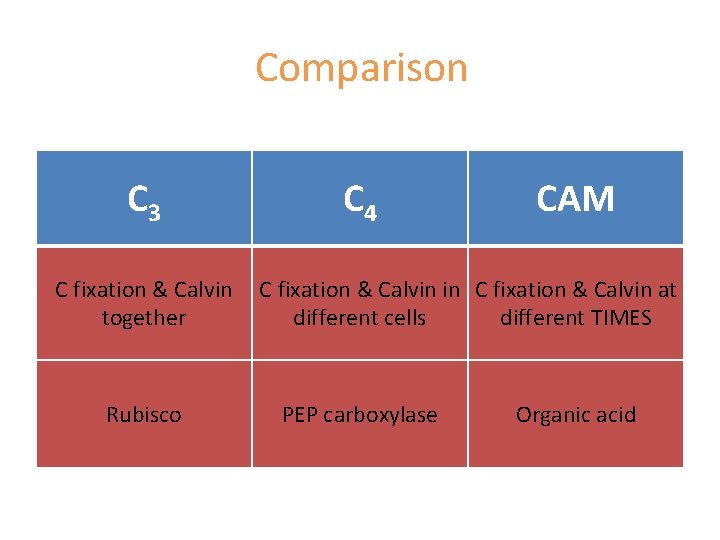
Comparison C 3 C 4 CAM C fixation & Calvin in C fixation & Calvin at together different cells different TIMES Rubisco PEP carboxylase Organic acid
C-3 plants • http: //www. cropsreview. com/c 3 -plants. html • http: //www. bozemanscience. com/photosynth esis • http: //www. bozemanscience. com/013 photosynthesis-and-respiration