
Cowpea Use Case IITA Melaku Gedil Genomics for
- Slides: 45
Cowpea Use Case IITA Melaku Gedil Genomics for Genebank Dec 5 -8, 2016 CIMMYT, Mexico 1
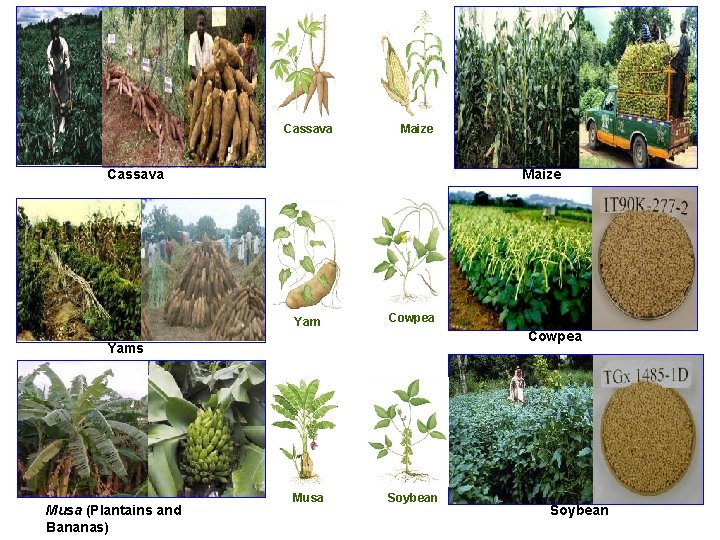
Cassava Maize Yam Cowpea Yams Musa (Plantains and Bananas) Musa Soybean
INTRODUCTION • Cowpea is an important grain legume adapted and grown in the tropics and subtropics • Cowpea’s importance lies in its high protein content (~25%), high soluble carbohydrates content (62%), micronutrients, low anti‐nutritional content, and vitamins • All parts of the plant (seed, stem and leaves) are used for food or as nutritious fodder for animals • It is also a means of Income generation • It has the ability to tolerate poor soils and drought.
Major Uses § Young leaves as spinach § Green immature pod in salad § Green mature seeds as pea § Dry grain eaten as boiled beans § Transformed as flour or paste for ‘kosai’ and ‘moi -moi’ § Couscous or spaghetti § Fodder for animals
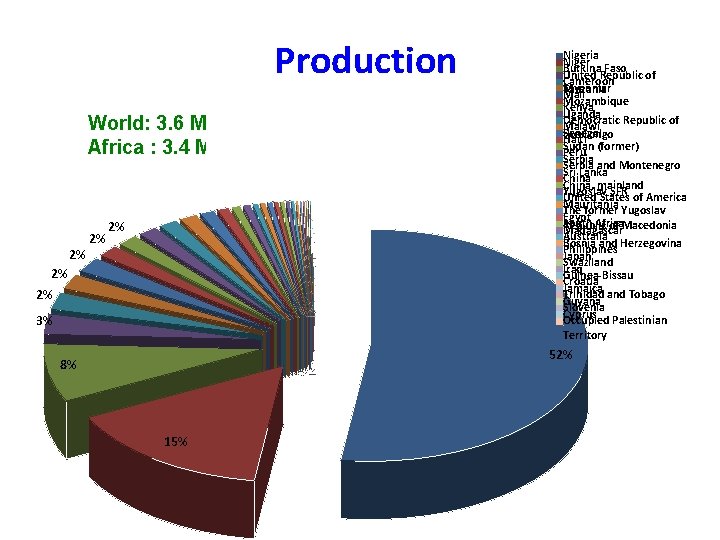
INTRODUCTION • Cowpea is grown on about 14. 5 M ha worldwide and the total production is estimated about 6. 5 M tons. • Africa contributes 83% of global cowpea production of which over 80% is from West Africa. • Nigeria accounts for 45% of world production; 55% of Africa production.
Production World: 3. 6 M tonnes Africa : 3. 4 M tonnes 2% 2% 2% 3% Nigeria Niger Burkina Faso United Republic of Cameroon Myanmar Tanzania Mali Mozambique Kenya Uganda Democratic Republic of Malawi Senegal the Haiti. Congo Sudan (former) Peru Serbia and Montenegro Sri Lanka China, mainland Yugoslav SFR United States of America Mauritania The former Yugoslav Egypt South Africa Republic of Macedonia Madagascar Australia Bosnia and Herzegovina Philippines Japan Swaziland Iraq Guinea-Bissau Croatia Jamaica Trinidad and Tobago Guyana Slovenia Cyprus Occupied Palestinian Territory 52% 8% 15%
COWPEA PRODUCTION CONSTRAINTS
Insect pests Insect Pests • • Aphid (Aphis craccivora) Flower bud thrips (Megalurothrips sjostedti) The legume pod borer (Maruca vitrata) A complex of pod sucking bugs (e. g. : Clavigralla tomentosicollis, Anoplocnemis curvipes and Riptortus dentipes) • Cowpea weevil (Callosobruchus maculatus) – Losses in yield due to infestation can be as high as 90% costing in excess of $100 M annually.
Insect pests Diseases • Bacterial disease: bacterial blight • Fungal diseases: Ascochyta blight, Brown blotch, Scab, smut, pythium, Rhizoctonia and Septoria • Viral diseases: Cowpea aphid borne mosaic virus (CABMV), bean common mosaic virus (BCMV-BIC), cucumber mosaic cucumovirus (CMV)
Parasitic weeds: • Striga • Alectra Abiotic stress • Drought • Low soil fertility • Heat Although cowpea is drought tolerant when compared with many other crops its productivity can be hampered by drought and heat.
Insufficient genomic resources • Cowpea yield is suppressed to the bare minimum as a result of a deluge of biotic and abiotic stresses. • The effort to tackle these stresses through genetic improvement has been hampered due to lack of sources of resistance. • Enriched genomic resources can provide more opportunity to accelerate genetic gain, stack traits, characterize existing diversity in cultivated cowpea and wild relatives, and pyramid favorable gene/alleles in farmer‐preferred varieties.
OBJECTIVE OF COWPEA BREEDING PROGRAM
• To develop improved lines with: – High stable yield potential – Resistance/tolerance to both biotic and abiotic stresses – Good adaptation to monocropping and intercropping systems – Grain characteristics preferred by consumers and processors • With at least 60 percent higher grain yield in the next five years (IITA Crop Imp. Strategy) > 650 kg/ha
Breeding and pre-breeding • Three wild subspecies of V. unguiculata, are recognized: – dekindtiana or spontanea, – Stenophylla – tenuis • Highly self-pollinated: as a result the genetic base of released varieties is narrow (confirmed by molecular markers) • Need for broadening the genetic base • Sources of desired alleles were identified by screening germplasm in different countries and germplasm at IITA genebank • More than 20 IITA breeding lines were released in about 10 countries from 2005 to 2015
Funding • • Tropical Legumes I, II Tropical Legumes III CRP Grain Legume? Ft. F Climate Resilient Cowpea Project USAID • IITA-Monsanto funded by BMGF • Global Crop Diversity Trust
Taxonomy and Genome Common name Cowpea, blackeye pea Genus Vigna Family Fabaceae Subfamily Faboideae Tribe Phaseoleae Chromosome no. 2 n=2 x=22 Genome size 620 mb Estimated heterozygosity 0. 1% to 0. 5%
Genomic Resources • Genomic resources required for deployment of molecular breeding in cowpea are inadequate and few institutions around the world are involved in development of tools for modern breeding of cowpea. • Boukar et al. 2016 (Review) – Physical map – EST database (Harv. EST cowpea) – Cowpea Genespace/Genomics Knowledge Base – Microarray – Validated SSR markers at GCP – Linkage map and software
Links to cowpea projects University of California Riverside (UCR) – Tim Close Harv. EST: Cowpea version 1. 42 • Consensus genetic map viewer based on 37, 372 mapped i. Select SNP loci from 5 bi‐parental RIL populations • Over 4000 BAC sequence assemblies from a library of IT 97 K‐ 499‐ 35 • 183, 118 cowpea ESTs in an EST assembly (from 17 libraries) • EST sequence alignment viewer, University of Virginia: Mike Timko Cowpea Genomics Knowledge. Base Timko Lab http: //cowpeagenomics. med. virginia. edu/CGKB/ • Searches: SSRs, metabolic pathways • Tools: blastall, download, msa, and contig building tools • Sequences: Gene space, retro elements, SSR, chloroplast and mitochondria
Genome Sequence • An initial whole genome shotgun (WGS) assembly of cowpea accession IT 97 K‐ 499‐ 35 • includes sequences for about 97% of all known cowpea genes. • 65× coverage (one 5‐kb library included) using Illumina paired‐end technology on GAII, and then assembled together with Sanger BAC‐end sequences and “gene‐ space” sequences using SOAPdenovo (Luo et al. , 2012). • Contains 323, 048, 341 bp of non‐N sequences, • N 50 of 6322 bp. • Accessible via harvest-blast. org and downloaded via harvest-web. org.
Genome Sequence • A 323 Mb WGS and 497 Mb of BAC sequence • A physical map was developed from BAC libraries of IT 97 K‐ 499‐ 35 is accessible from http: //phymap. ucdavis. edu/cowpea/ • Improvement of the genome assembly using sequenced BACs, long‐read shotgun sequencing and optical mapping is in progress • Will produce 11 pseudomolecules and an average scaffold length of 56 Mb
Funding and Approaches Marker Applications • Genetic characterization of germplasm • Discovery of gene/QTL • Linkage mapping • GWAS • Molecular breeding • MABC • MARS
Diversity analysis of minicore collection
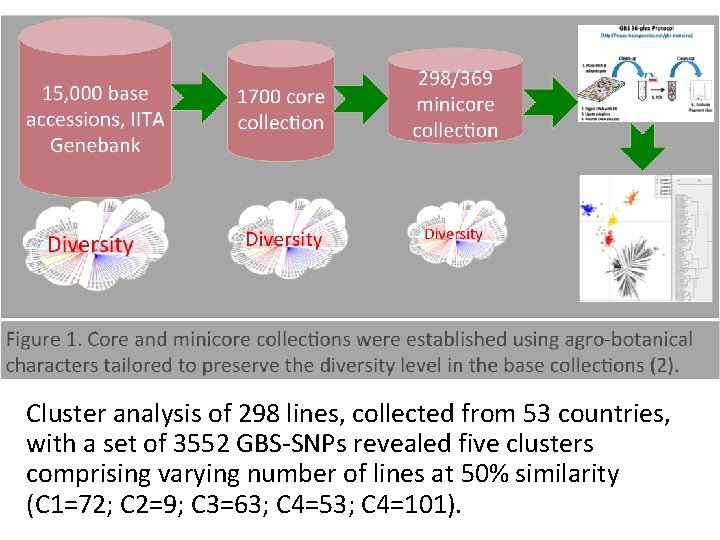
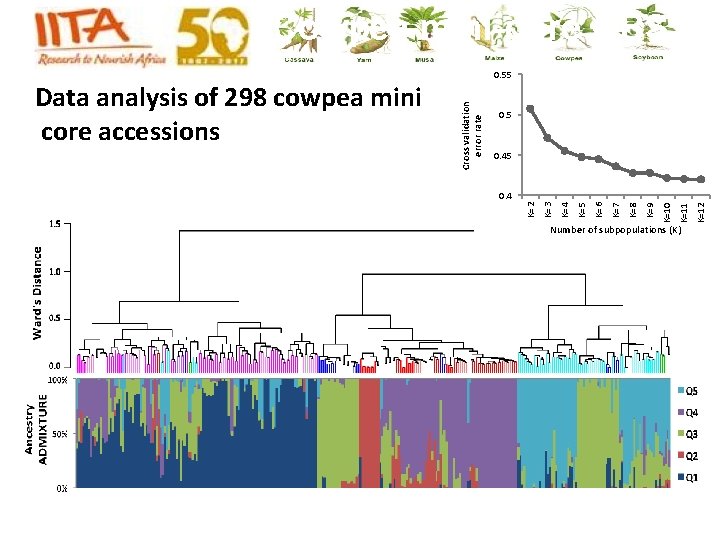
Cowpea mini-core GBS Cluster analysis of 298 lines, collected from 53 countries, with a set of 3552 GBS‐SNPs revealed five clusters comprising varying number of lines at 50% similarity (C 1=72; C 2=9; C 3=63; C 4=53; C 4=101).
Cowpea mini-core GBS 0. 5 0. 45 Number of subpopulations (K) K=12 K=11 K=10 K=9 K=8 K=7 K=6 K=5 K=4 K=3 0. 4 K=2 Cross validation error rate Data analysis of 298 cowpea mini core accessions 0. 55
Phenotyping of mini‐core Work‐in‐proress A better insight into population structure and accessions clustering can be obtained by combining information on origin, morphological and agronomic characterization with the current genotypic data Availability of cowpea reference genome will improve the SNP calling process for better quality and quantity of SNP markers The SNP fingerprinting data paves the way for association mapping studies of key cowpea traits including virus disease resistance, drought tolerance and nutritional qualities which in turn facilitate marker‐assisted selection.
Phenotyping of mini‐core Phenotyping for marker association • Drought tolerance • Off season: 2 locations • Cropping season: 1 location • Screen house • Heat tolerance • Off‐season: Gidan Ala and Mijibir for drought and heat • Insect pest resistance: • Aphids • Thrips
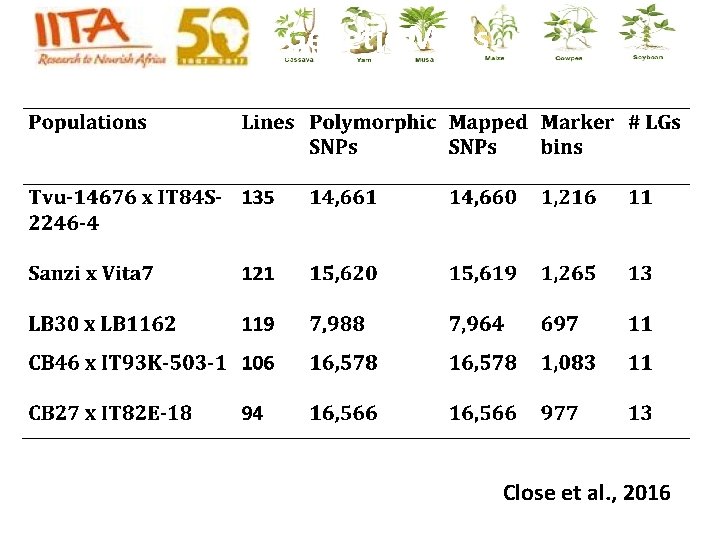
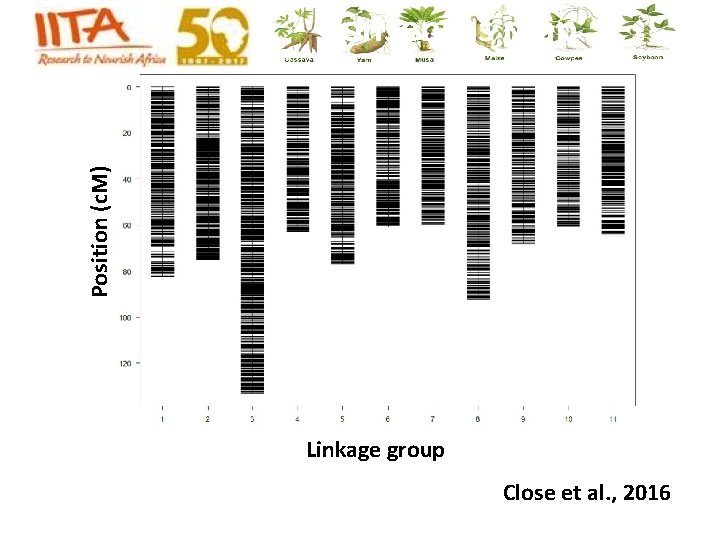
Genetic Maps Linkage mapping • First reported in 1993 and then 1997 based first gen markers (RFLP, RAPD, AFLP) • SNP‐based consensus map, using multiple populations, developed in 2009 and improved consensus published in 2011 • Efforts are underway to develop, high density high resolution map using multiple bi‐parental crosses
Genetic Maps Close et al. , 2016
Position (c. M) Consensus map Linkage group Close et al. , 2016
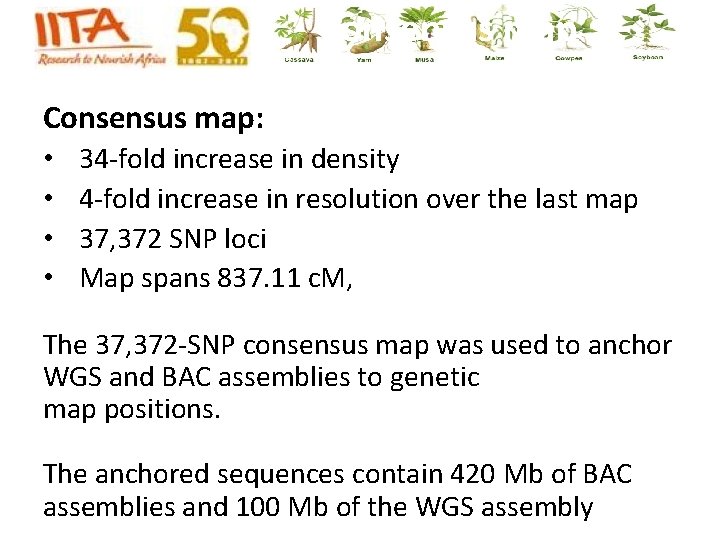
Consensus map: • • 34‐fold increase in density 4‐fold increase in resolution over the last map 37, 372 SNP loci Map spans 837. 11 c. M, The 37, 372‐SNP consensus map was used to anchor WGS and BAC assemblies to genetic map positions. The anchored sequences contain 420 Mb of BAC assemblies and 100 Mb of the WGS assembly
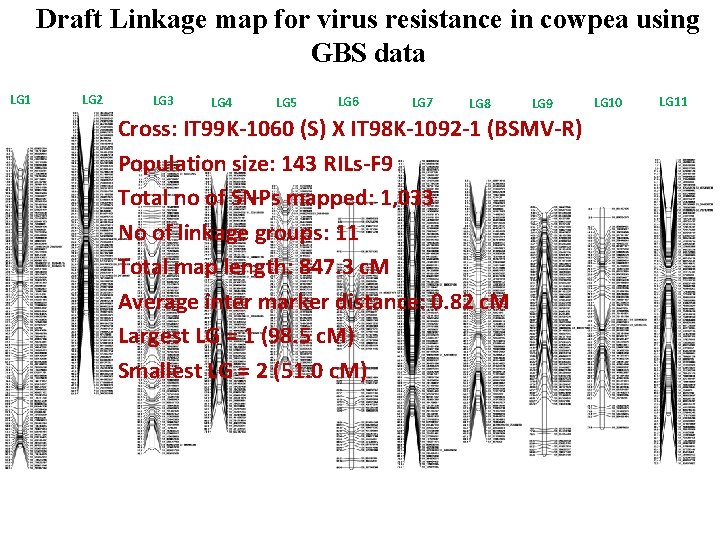
Draft Linkage map for virus resistance in cowpea using GBS data LG 1 LG 2 LG 3 LG 4 LG 5 LG 6 LG 7 LG 8 LG 9 Cross: IT 99 K-1060 (S) X IT 98 K-1092 -1 (BSMV-R) Population size: 143 RILs-F 9 Total no of SNPs mapped: 1, 033 No of linkage groups: 11 Total map length: 847. 3 c. M Average inter marker distance: 0. 82 c. M Largest LG = 1 (98. 5 c. M) Smallest LG = 2 (51. 0 c. M) LG 10 LG 11
SNP markers associated with QTLs • QTLs discovered for abiotic stress tolerance • • Drought tolerance & stay‐green Heat tolerance (reproductive stage) • QTLs discovered for biotic stress resistance: • • Bacterial blight resistance Aphid resistance Flower & foliar thrips tolerance Macrophomina; Fusarium resistance Nematode resistance Virus resistance Striga resistance
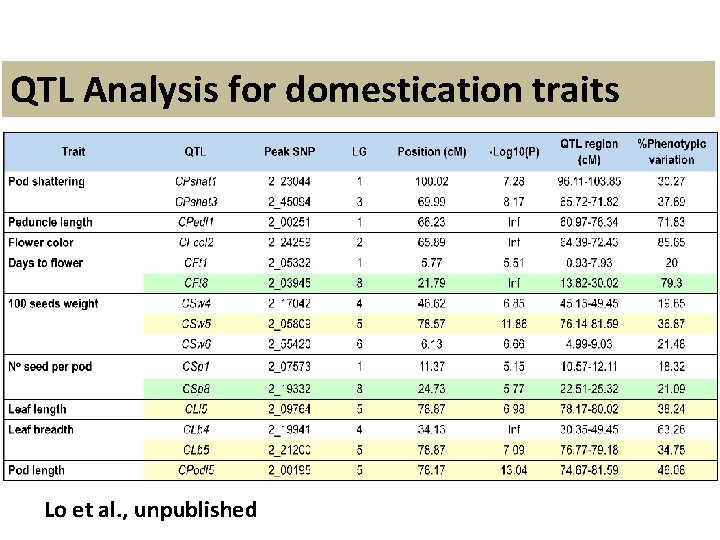
• QTLs discovered for agronomic traits: • • • Leaf shape Maturity time Grain weight (seed size) Seed coat color & patterns Pod shattering • Boukar et al. 2016 Review Table 3
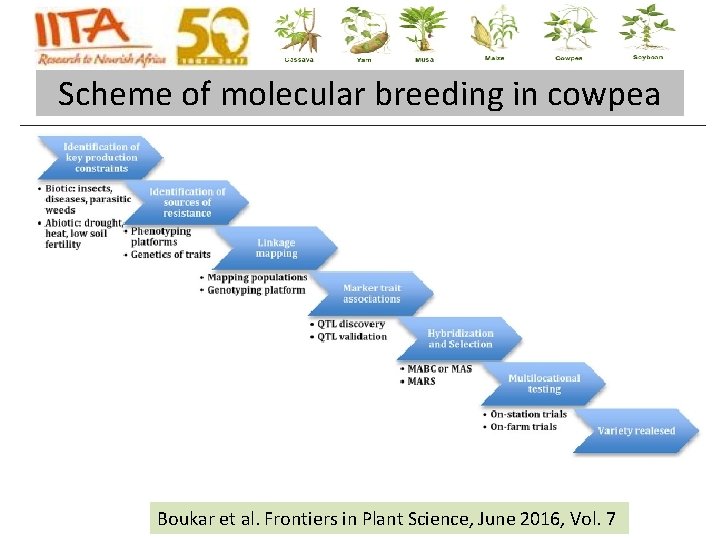
Scheme of molecular breeding in cowpea Boukar et al. Frontiers in Plant Science, June 2016, Vol. 7
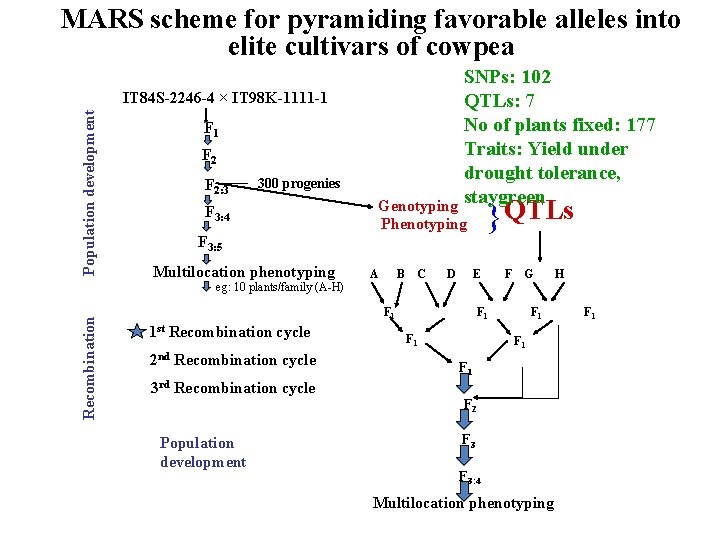
Molecular Breeding • Marker Assisted Backcross (MABC) for Striga resistance (donor) – IT 93 K‐ 452‐ 1/IT 97 K-499 -35//IT 93 K‐ 452‐ 1 – IT 89 KD‐ 288/IT 97 K-499 -35//IT 89 KD‐ 288 • Marker Assisted Recurrent Selection (MARS) for drought tolerance – IT 84 S‐ 2246‐ 4 x IT 98 K‐ 1111‐ 1 • Multi‐parent Advanced Generation Inter‐cross (MAGIC), population improvement
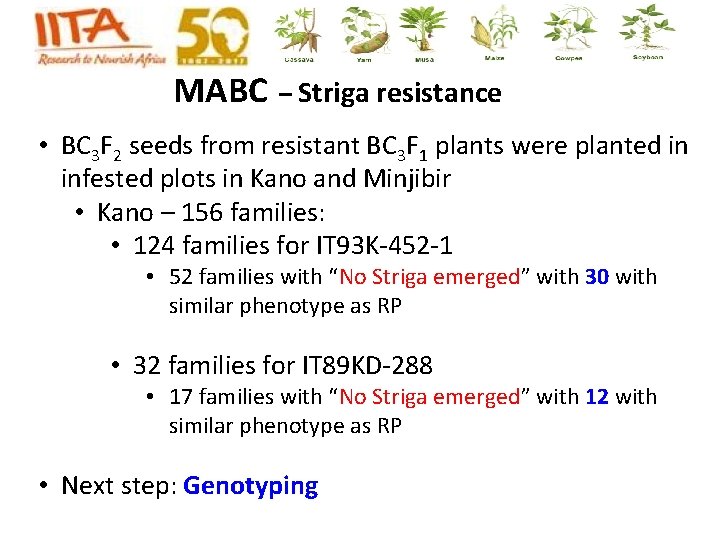
MABC – Striga resistance • BC 3 F 2 seeds from resistant BC 3 F 1 plants were planted in infested plots in Kano and Minjibir • Kano – 156 families: • 124 families for IT 93 K‐ 452‐ 1 • 52 families with “No Striga emerged” with 30 with similar phenotype as RP • 32 families for IT 89 KD‐ 288 • 17 families with “No Striga emerged” with 12 with similar phenotype as RP • Next step: Genotyping
MARS scheme for pyramiding favorable alleles into elite cultivars of cowpea Population development IT 84 S-2246 -4 × IT 98 K-1111 -1 F 2 F 2: 3 300 progenies F 3: 4 SNPs: 102 QTLs: 7 No of plants fixed: 177 Traits: Yield under drought tolerance, Genotyping staygreen }QTLs Phenotyping F 3: 5 Multilocation phenotyping A B C D E F G H Recombination eg: 10 plants/family (A-H) F 1 1 st Recombination cycle 2 nd Recombination cycle 3 rd Recombination cycle Population development F 1 F 1 F 1 F 2 F 3: 4 Multilocation phenotyping F 1
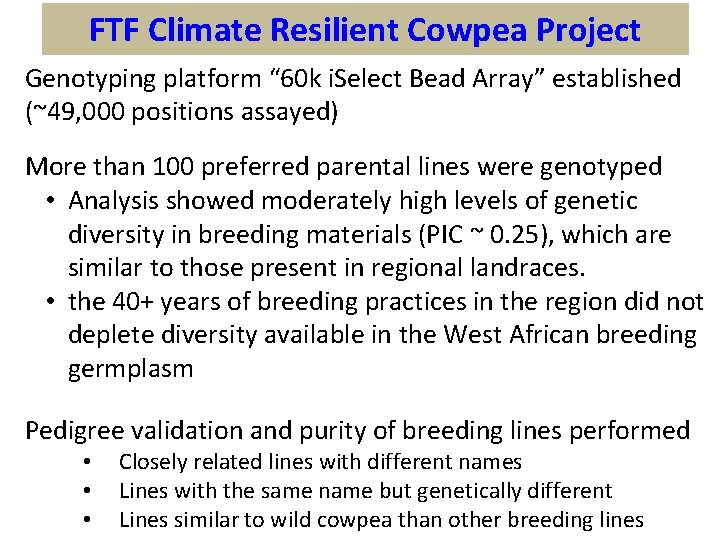
FTF Climate Resilient Cowpea Project Genotyping platform “ 60 k i. Select Bead Array” established (~49, 000 positions assayed) More than 100 preferred parental lines were genotyped • Analysis showed moderately high levels of genetic diversity in breeding materials (PIC ~ 0. 25), which are similar to those present in regional landraces. • the 40+ years of breeding practices in the region did not deplete diversity available in the West African breeding germplasm Pedigree validation and purity of breeding lines performed • • • Closely related lines with different names Lines with the same name but genetically different Lines similar to wild cowpea than other breeding lines
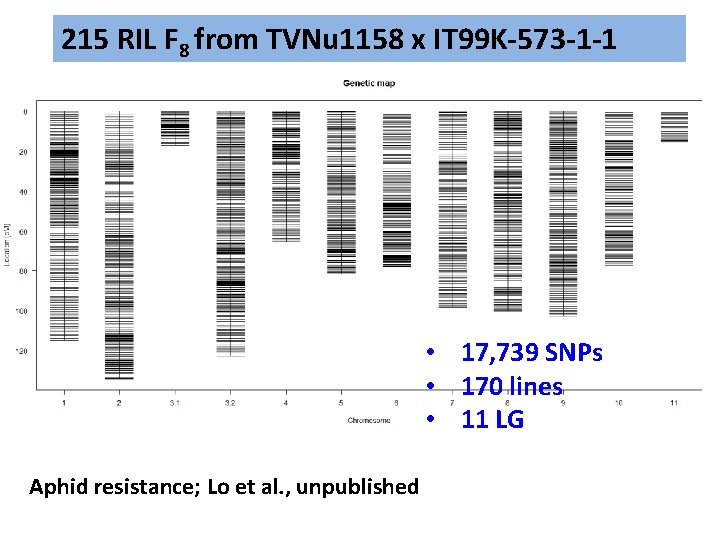
215 RIL F 8 from TVNu 1158 x IT 99 K-573 -1 -1 • 17, 739 SNPs • 170 lines • 11 LG Aphid resistance; Lo et al. , unpublished
QTL Analysis for domestication traits Lo et al. , unpublished
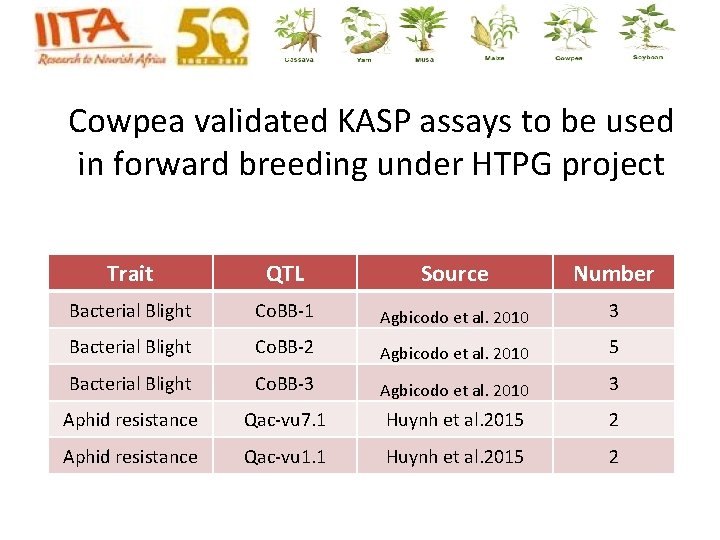
Cowpea validated KASP assays to be used in forward breeding under HTPG project Trait QTL Source Number Bacterial Blight Co. BB‐ 1 Agbicodo et al. 2010 3 Bacterial Blight Co. BB‐ 2 Agbicodo et al. 2010 5 Bacterial Blight Co. BB‐ 3 Agbicodo et al. 2010 3 Aphid resistance Qac‐vu 7. 1 Huynh et al. 2015 2 Aphid resistance Qac‐vu 1. 1 Huynh et al. 2015 2
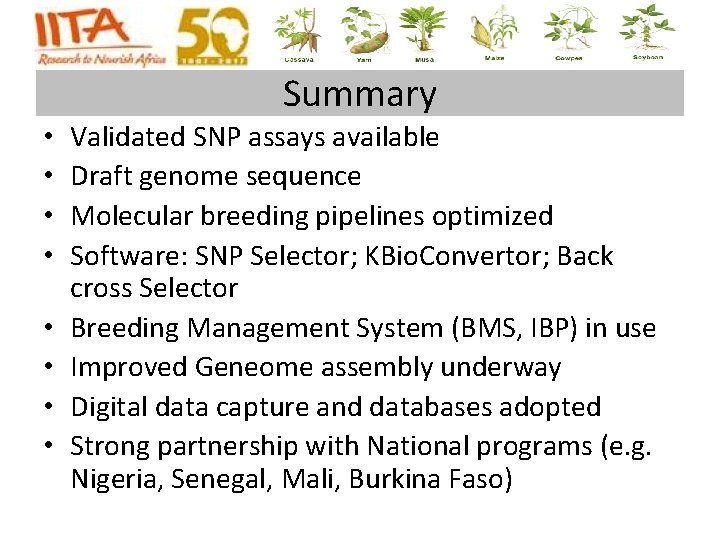
Summary • • Validated SNP assays available Draft genome sequence Molecular breeding pipelines optimized Software: SNP Selector; KBio. Convertor; Back cross Selector Breeding Management System (BMS, IBP) in use Improved Geneome assembly underway Digital data capture and databases adopted Strong partnership with National programs (e. g. Nigeria, Senegal, Mali, Burkina Faso)
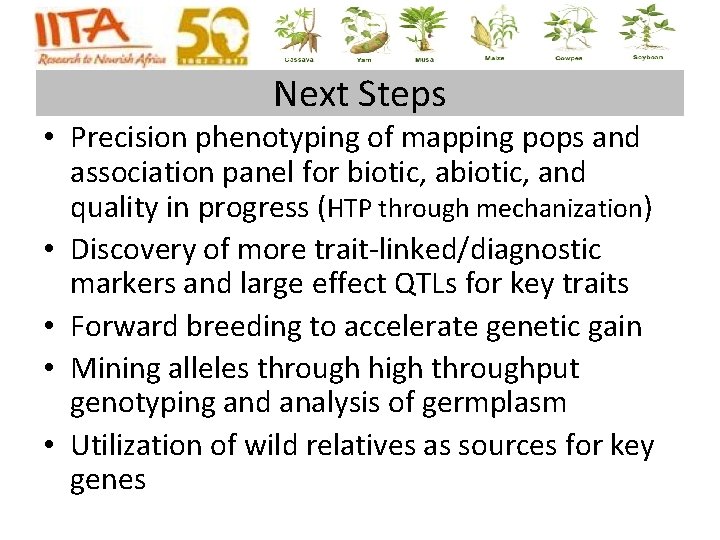
Next Steps • Precision phenotyping of mapping pops and association panel for biotic, and quality in progress (HTP through mechanization) • Discovery of more trait‐linked/diagnostic markers and large effect QTLs for key traits • Forward breeding to accelerate genetic gain • Mining alleles through high throughput genotyping and analysis of germplasm • Utilization of wild relatives as sources for key genes
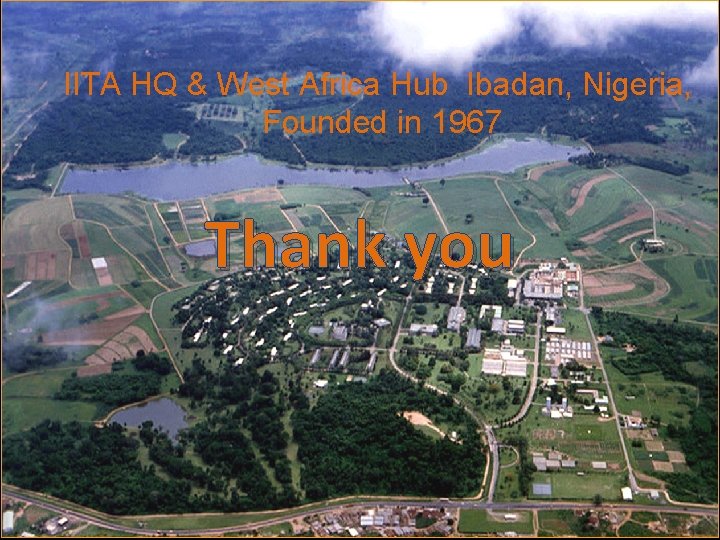
IITA HQ & West Africa Hub Ibadan, Nigeria, Founded in 1967 Thank you