GEOGG 141 GEOG 3051 Principles Practice of Remote
- Slides: 59
GEOGG 141/ GEOG 3051 Principles & Practice of Remote Sensing (PPRS) Introduction, EM Radiation (i) Dr. Mathias (Mat) Disney UCL Geography Office: 113, Pearson Building Tel: 7679 0592 Email: mdisney@ucl. geog. ac. uk http: //www 2. geog. ucl. ac. uk/~mdisney/teaching/GEOGG 141. html http: //www 2. geog. ucl. ac. uk/~mdisney/teaching/3051/GEOG 3051. html
Format • Component 1 (GEOGG 141 only) – Mapping principles (Dowman, Iliffe, Haklay, Backes, Smith, Cross) – Understanding the geometry of data acquisition – Orbits, geoids and principles of geodesy • Component 2 (GEOGG 141 & GEOG 3051) – – – Radiometric principles (Disney) Understanding the what we measure and how Radiative transfer (GEOGG 141 only – Reading Week) Resolution, sampling and practical tradeoffs Pre-processing and ground segment Active remote sensing (LIDAR, RADAR…) 2
Miscellaneous • Remote Sensing at UCL – NERC National Centre for Earth Observation (NCEO) http: //www. nceo. ac. uk/) – Involvement in several themes at UCL • Cryosphere @ Earth Sciences: http: //www. cpom. org/ (Wingham, Laxman et al. ) • Carbon Theme @ Geography (Lewis, Mat Disney et al. ) • Solid Earth: COMET @ GE http: //comet. nerc. ac. uk/ (Ziebart) – More generally • MSSL: http: //www. ucl. ac. uk/mssl e. g. imaging (Muller), planetary, astro, instruments • UK prof. body - Remote Sensing and Photogrammetry Society – http: //www. rspsoc. org/ 3
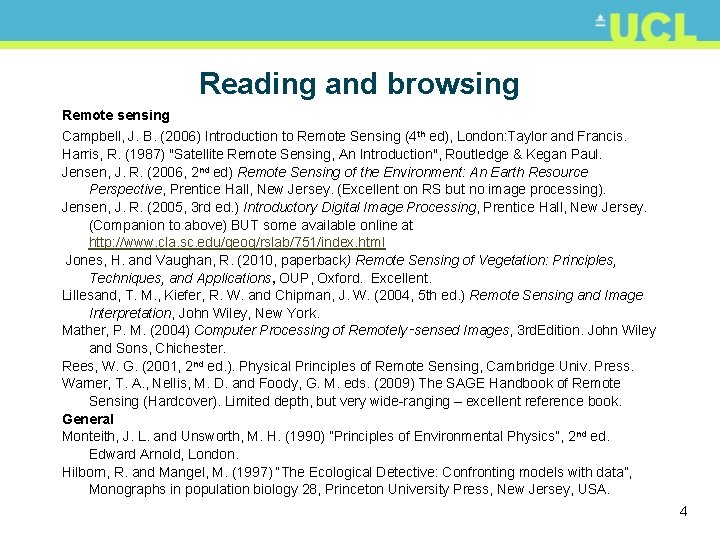
Reading and browsing Remote sensing Campbell, J. B. (2006) Introduction to Remote Sensing (4 th ed), London: Taylor and Francis. Harris, R. (1987) "Satellite Remote Sensing, An Introduction", Routledge & Kegan Paul. Jensen, J. R. (2006, 2 nd ed) Remote Sensing of the Environment: An Earth Resource Perspective, Prentice Hall, New Jersey. (Excellent on RS but no image processing). Jensen, J. R. (2005, 3 rd ed. ) Introductory Digital Image Processing, Prentice Hall, New Jersey. (Companion to above) BUT some available online at http: //www. cla. sc. edu/geog/rslab/751/index. html Jones, H. and Vaughan, R. (2010, paperback) Remote Sensing of Vegetation: Principles, Techniques, and Applications, OUP, Oxford. Excellent. Lillesand, T. M. , Kiefer, R. W. and Chipman, J. W. (2004, 5 th ed. ) Remote Sensing and Image Interpretation, John Wiley, New York. Mather, P. M. (2004) Computer Processing of Remotely‑sensed Images, 3 rd. Edition. John Wiley and Sons, Chichester. Rees, W. G. (2001, 2 nd ed. ). Physical Principles of Remote Sensing, Cambridge Univ. Press. Warner, T. A. , Nellis, M. D. and Foody, G. M. eds. (2009) The SAGE Handbook of Remote Sensing (Hardcover). Limited depth, but very wide-ranging – excellent reference book. General Monteith, J. L. and Unsworth, M. H. (1990) ”Principles of Environmental Physics”, 2 nd ed. Edward Arnold, London. Hilborn, R. and Mangel, M. (1997) “The Ecological Detective: Confronting models with data”, Monographs in population biology 28, Princeton University Press, New Jersey, USA. 4
Browsing • • Moodle & www. geog. ucl. ac. uk/~mdisney/pprs. html Web Tutorials http: //rst. gsfc. nasa. gov/ http: //earth. esa. int/applications/data_util/SARDOCS/spaceborne/Radar_Courses/ http: //www. crisp. nus. edu. sg/~research/tutorial/image. htm http: //ccrs. nrcan. gc. ca/resource/index_e. php#tutor http: //octopus. gma. org/surfing/satellites/index. html • Glossary : http: //ccrs. nrcan. gc. ca/glossary/index_e. php • • Other resources NASA www. nasa. gov NASAs Visible Earth (source of data): http: //visibleearth. nasa. gov/ European Space Agency earth. esa. int (eg Image of the week…. ) NOAA www. noaa. gov IKONOS: http: //www. spaceimaging. com/ Quick. Bird: http: //www. digitalglobe. com/ 5
Today • General introduction to remote sensing (RS), Earth Observation (EO). . . . – definitions of RS – Concepts and terms • remote sensing process, end-to-end • Radiation I – Concepts and terms • remote sensing process, end-to-end 6
What is remote sensing? The Experts say "Remote Sensing (RS) is. . . ” • “The science technology and art of obtaining information about objects or phenomena from a distance (i. e. without being in physical contact with them” http: //ccrs. nrcan. gc. ca/glossary/index_e. php? id=486 • But not the whole story: – Tend to use Earth Observation (EO). To distinguish from? – Domains (atmosphere, terrestrial, ocean, cryosphere, biosphere etc) – But also astronomy, planetary remote sensing etc. 7
What is remote sensing (II)? The not so experts say "Remote Sensing is. . . ” • Advanced colouring-in. • Seeing what can't be seen, then convincing someone that you're right. • Being as far away from your object of study as possible and getting the computer to handle the numbers. • Legitimised voyeurism (more of the same from http: //www. ccrs. nrcan. gc. ca/ccrs/eduref/misc) 8
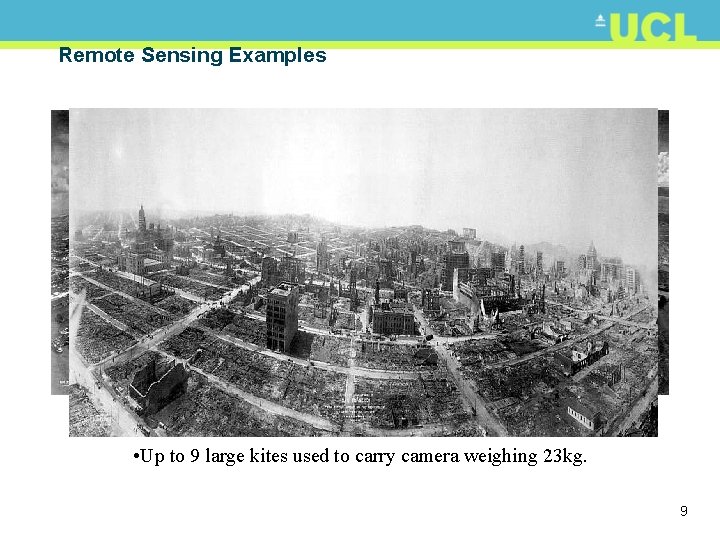
Remote Sensing Examples • Kites (still used!) Panorama of San Francisco, 1906. • Up to 9 large kites used to carry camera weighing 23 kg. 9
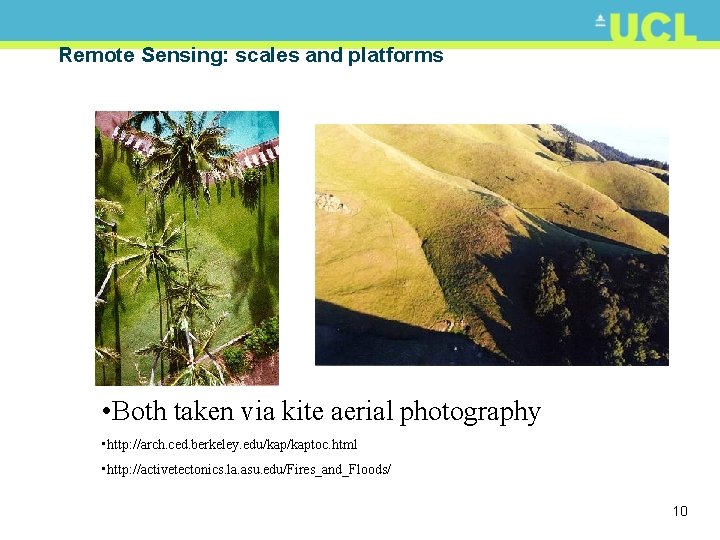
Remote Sensing: scales and platforms • Both taken via kite aerial photography • http: //arch. ced. berkeley. edu/kaptoc. html • http: //activetectonics. la. asu. edu/Fires_and_Floods/ 10
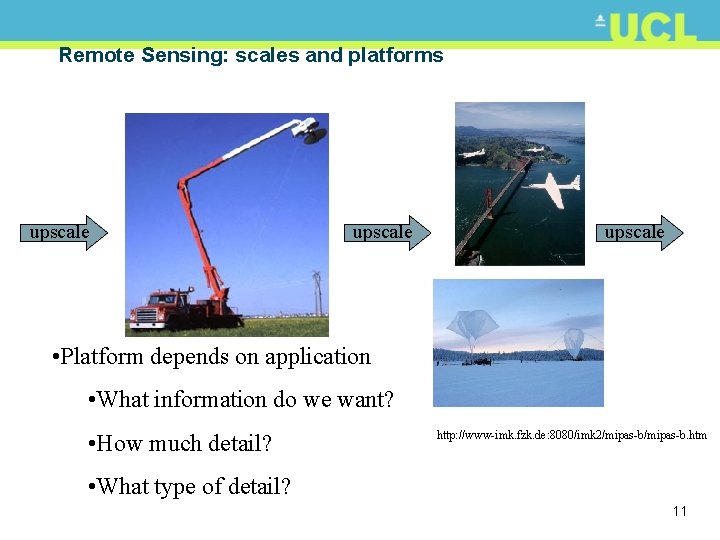
Remote Sensing: scales and platforms upscale • Platform depends on application • What information do we want? • How much detail? http: //www-imk. fzk. de: 8080/imk 2/mipas-b. htm • What type of detail? 11
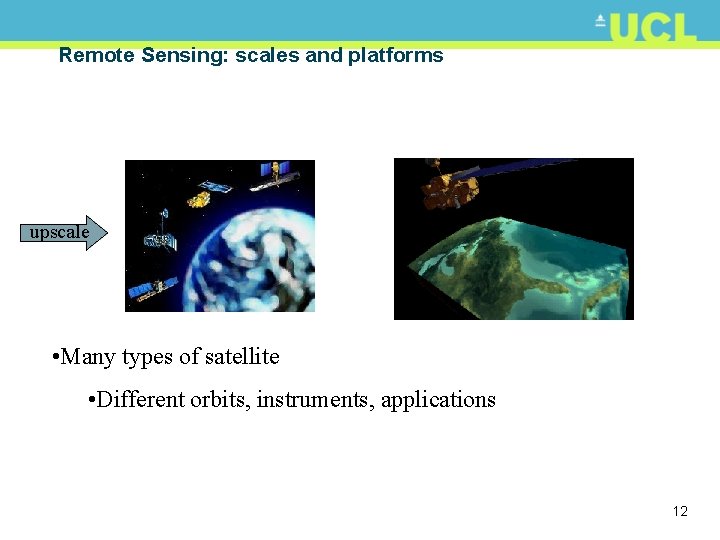
Remote Sensing: scales and platforms upscale • Many types of satellite • Different orbits, instruments, applications 12
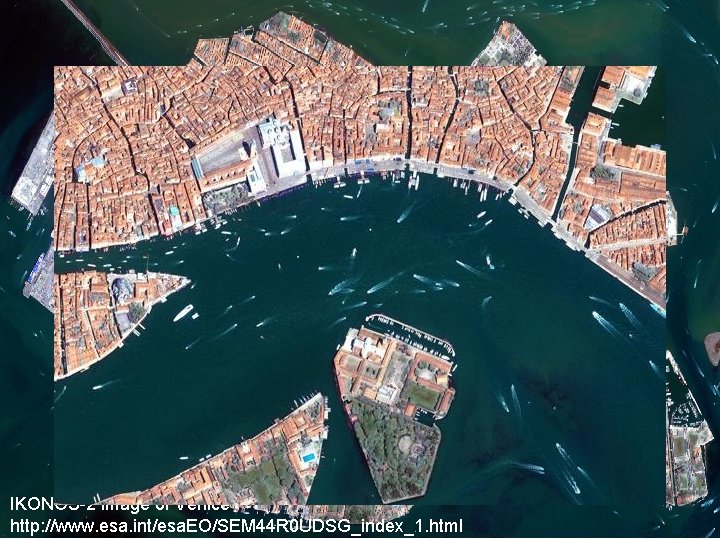
Remote Sensing Examples • Global maps of vegetation from MODIS instrument IKONOS-2 image of Venice http: //www. esa. int/esa. EO/SEM 44 R 0 UDSG_index_1. html 13
Why do we use remote sensing? • Many monitoring issues global or regional • Drawbacks of in situ measurement …. . • Remote sensing can provide (not always!) – Global coverage • Range of spatial resolutions – Temporal coverage (repeat viewing) – Spectral information (wavelength) – Angular information (different view angles) 14
Why do we study/use remote sensing? • source of spatial and temporal information (land surface, oceans, atmosphere, ice) • monitor and develop understanding of environment (measurement and modelling) • information can be accurate, timely, consistent • remote access • some historical data (1960 s/70 s+) • move to quantitative RS e. g. data for climate – some commercial applications (growing? ) e. g. weather – typically (geo)'physical' information but information widely used (surrogate - tsetse fly mapping) – derive data (raster) for input to GIS (land cover, temperature etc. ) 15
EO process in summary. . . • Collection of data – Some type of remotely measured signal – Electromagnetic radiation of some form • Transformation of signal into something useful – Information extraction – Use of information to answer confirm/contradict a hypothesis a question or 16
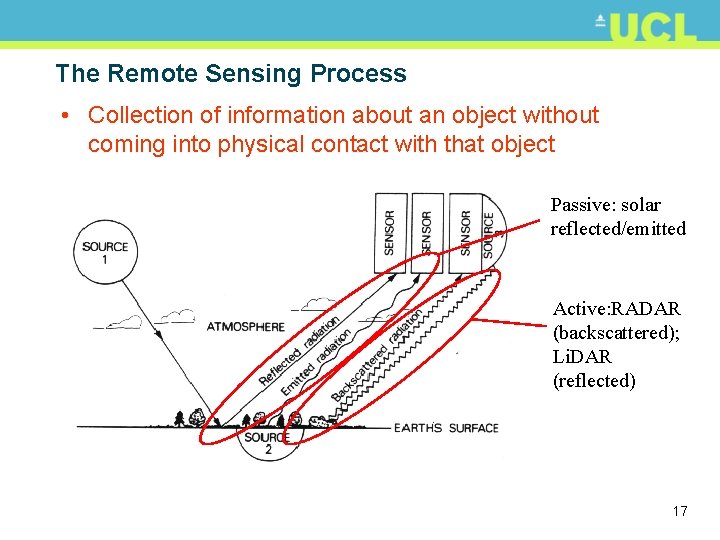
The Remote Sensing Process • Collection of information about an object without coming into physical contact with that object Passive: solar reflected/emitted Active: RADAR (backscattered); Li. DAR (reflected) 17
The Remote Sensing Process • What are we collecting? – Electromagnetic radiation (EMR) • What is the source? – Solar radiation • passive – reflected (vis/NIR), emitted (thermal) – OR artificial source • active - RADAR, Li. DAR even sonar • Note various paths – Source to sensor direct? – Source to surface to sensor – Sensor can also be source 18
Energy transport • Conduction – transfer of molecular kinetic (motion) energy due to contact – heat energy moves from T 1 to T 2 where T 1 > T 2 • Convection – movement of hot material from one place to another – e. g. Hot air rises • Radiation – results whenever an electrical charge is accelerated – propagates via EM waves, through vacuum & over long distances hence of interest for remote sensing 19
Electromagnetic radiation: wave model • James Clerk Maxwell (1831 -1879) • Wave model of EM energy • Unified theories of electricity and magnetism (via Newton, Faraday, Kelvin, Ampère etc. ) • Oscillating electric charge produces magnetic field (and vice versa) • Can be described by 4 simple (ish) differential equations • Calculated speed of EM wave in a vacuum 20
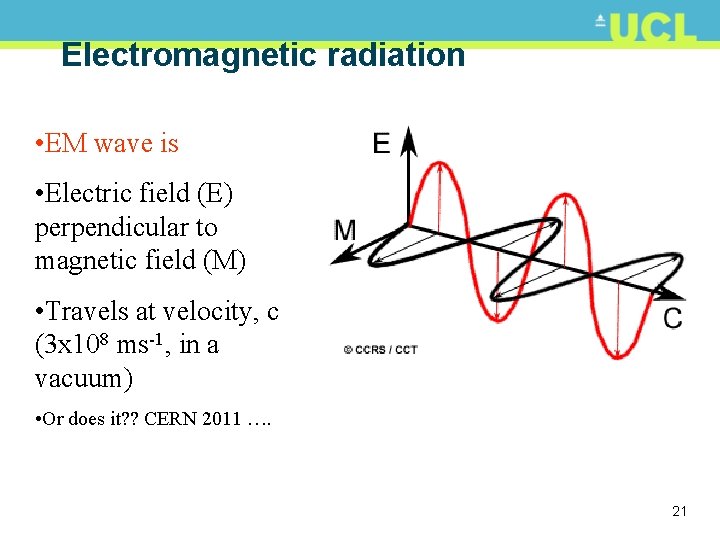
Electromagnetic radiation • EM wave is • Electric field (E) perpendicular to magnetic field (M) • Travels at velocity, c (3 x 10⁸ ms-1, in a vacuum) • Or does it? ? CERN 2011 …. 21
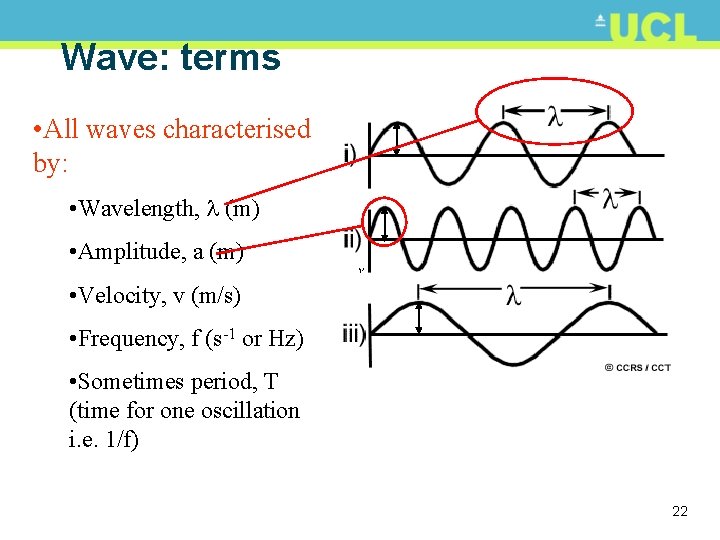
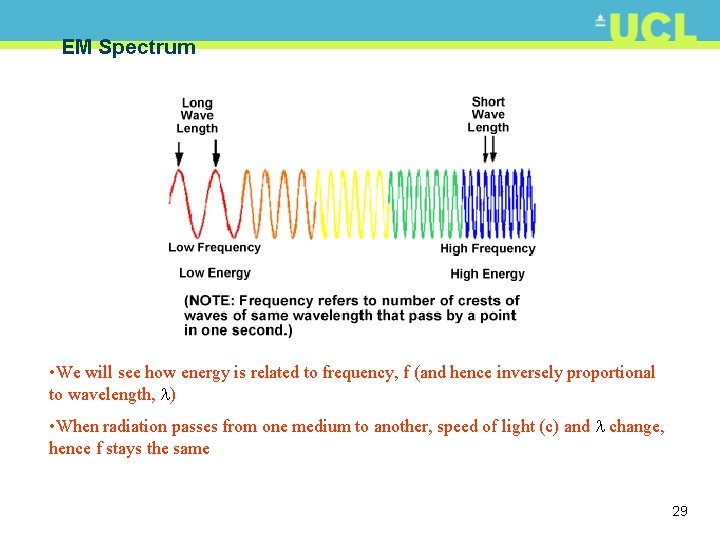
Wave: terms • All waves characterised by: • Wavelength, (m) • Amplitude, a (m) • Velocity, v (m/s) • Frequency, f (s-1 or Hz) • Sometimes period, T (time for one oscillation i. e. 1/f) 22
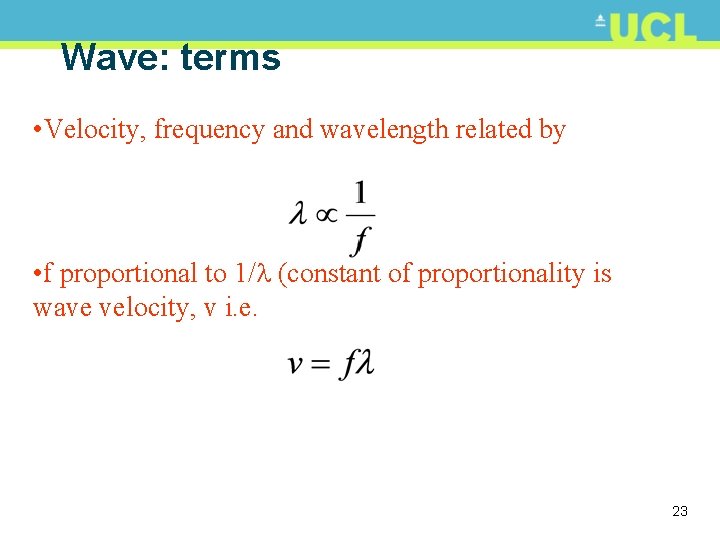
Wave: terms • Velocity, frequency and wavelength related by • f proportional to 1/ (constant of proportionality is wave velocity, v i. e. 23
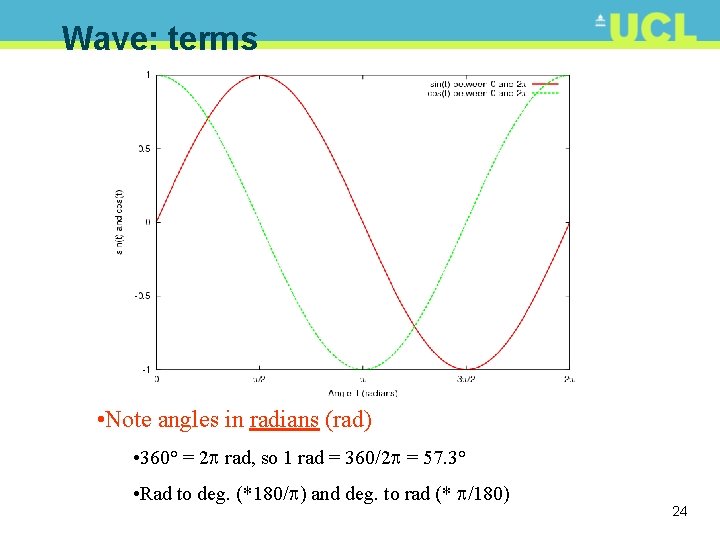
Wave: terms • Note angles in radians (rad) • 360° = 2 rad, so 1 rad = 360/2 = 57. 3° • Rad to deg. (*180/ ) and deg. to rad (* /180) 24
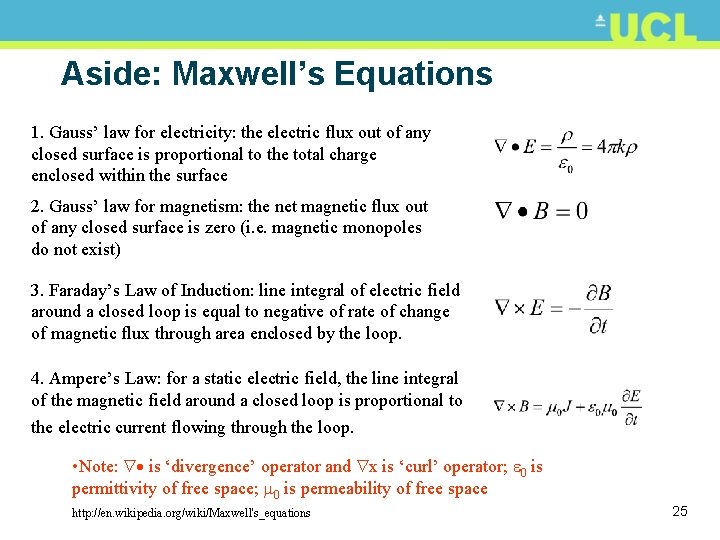
Aside: Maxwell’s Equations 1. Gauss’ law for electricity: the electric flux out of any closed surface is proportional to the total charge enclosed within the surface 2. Gauss’ law for magnetism: the net magnetic flux out of any closed surface is zero (i. e. magnetic monopoles do not exist) 3. Faraday’s Law of Induction: line integral of electric field around a closed loop is equal to negative of rate of change of magnetic flux through area enclosed by the loop. 4. Ampere’s Law: for a static electric field, the line integral of the magnetic field around a closed loop is proportional to the electric current flowing through the loop. • Note: is ‘divergence’ operator and x is ‘curl’ operator; 0 is permittivity of free space; 0 is permeability of free space http: //en. wikipedia. org/wiki/Maxwell's_equations 25
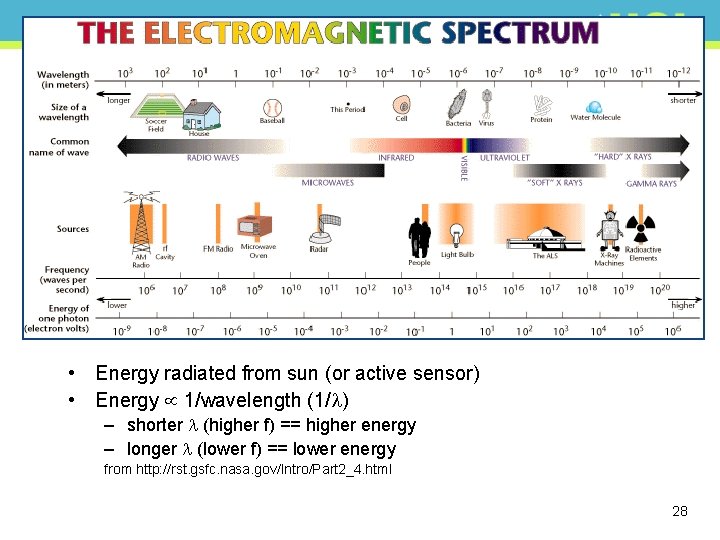
EM Spectrum • Continuous range of EM radiation • From very short wavelengths (<300 x 10 -9 m) • high energy • To very long wavelengths (cm, m, km) • low energy • Energy is related to wavelength (and hence frequency) 26
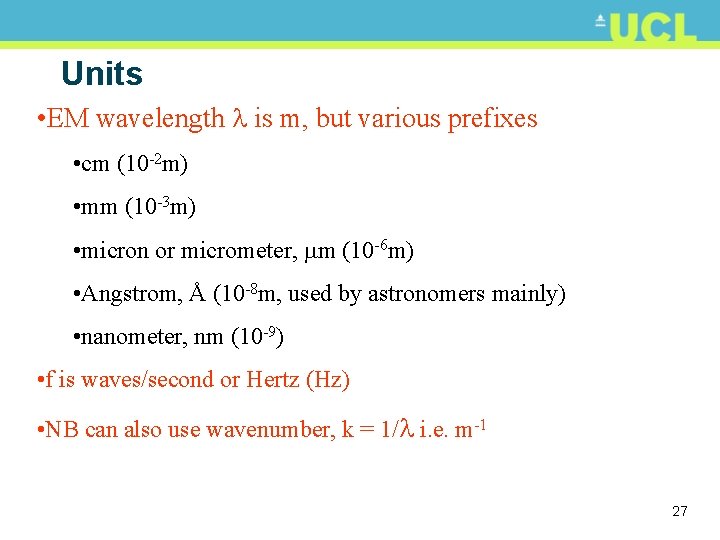
Units • EM wavelength is m, but various prefixes • cm (10 -2 m) • mm (10 -3 m) • micron or micrometer, m (10 -6 m) • Angstrom, Å (10 -8 m, used by astronomers mainly) • nanometer, nm (10 -9) • f is waves/second or Hertz (Hz) • NB can also use wavenumber, k = 1/ i. e. m-1 27
• Energy radiated from sun (or active sensor) • Energy 1/wavelength (1/ ) – shorter (higher f) == higher energy – longer (lower f) == lower energy from http: //rst. gsfc. nasa. gov/Intro/Part 2_4. html 28
EM Spectrum • We will see how energy is related to frequency, f (and hence inversely proportional to wavelength, ) • When radiation passes from one medium to another, speed of light (c) and change, hence f stays the same 29
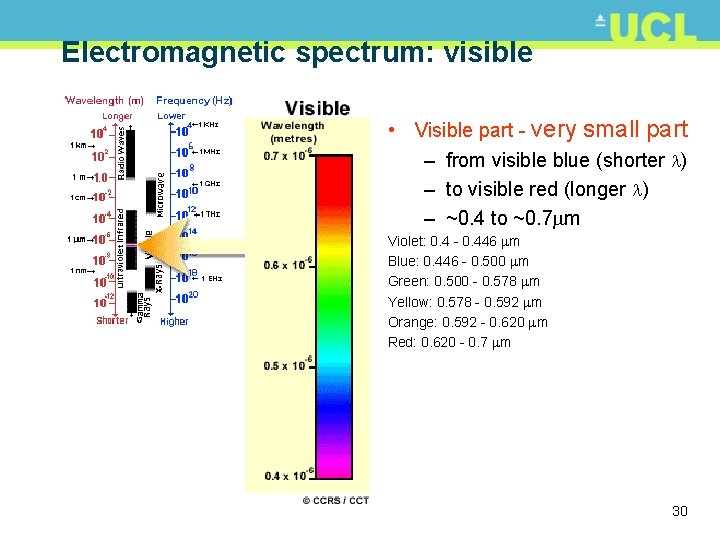
Electromagnetic spectrum: visible • Visible part - very small part – from visible blue (shorter ) – to visible red (longer ) – ~0. 4 to ~0. 7 m Violet: 0. 4 - 0. 446 m Blue: 0. 446 - 0. 500 m Green: 0. 500 - 0. 578 m Yellow: 0. 578 - 0. 592 m Orange: 0. 592 - 0. 620 m Red: 0. 620 - 0. 7 m 30
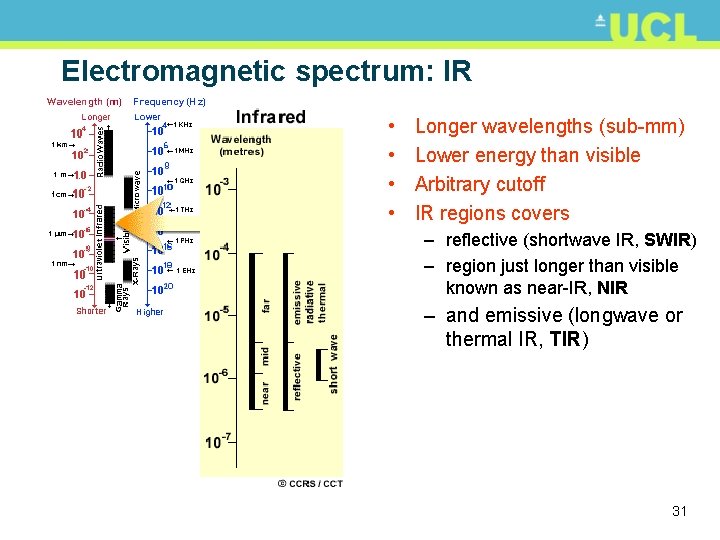
Electromagnetic spectrum: IR • • Longer wavelengths (sub-mm) Lower energy than visible Arbitrary cutoff IR regions covers – reflective (shortwave IR, SWIR) – region just longer than visible known as near-IR, NIR – and emissive (longwave or thermal IR, TIR) 31
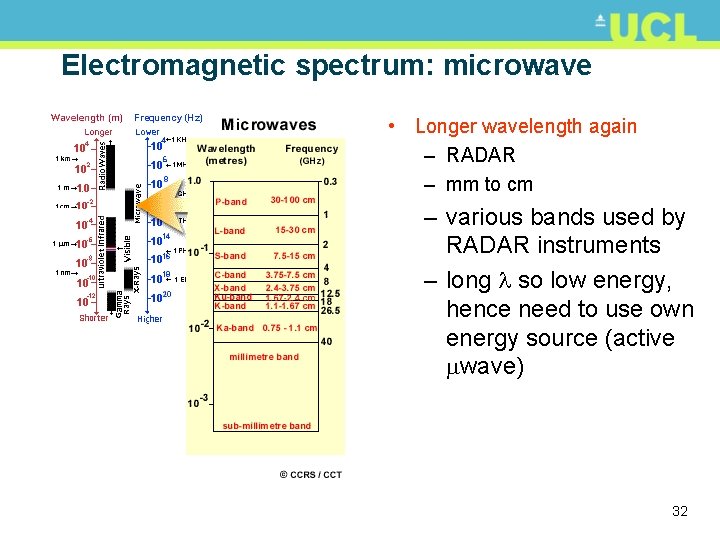
Electromagnetic spectrum: microwave • Longer wavelength again – RADAR – mm to cm – various bands used by RADAR instruments – long so low energy, hence need to use own energy source (active wave) 32
Blackbody • All objects above absolute zero (0 K or -273° C) radiate EM energy (due to vibration of atoms) • We can use concept of a perfect blackbody • Absorbs and re-radiates all radiation incident upon it at maximum possible rate per unit area (Wm-2), at each wavelength, , for a given temperature T (in K) • Energy from a blackbody? 33
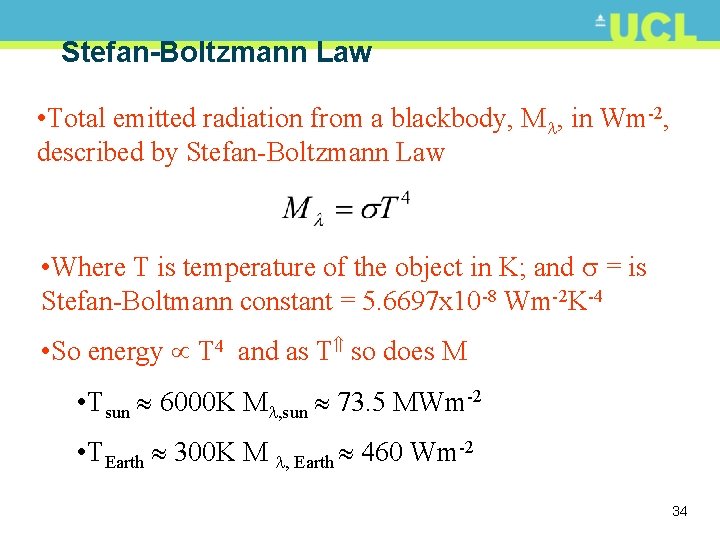
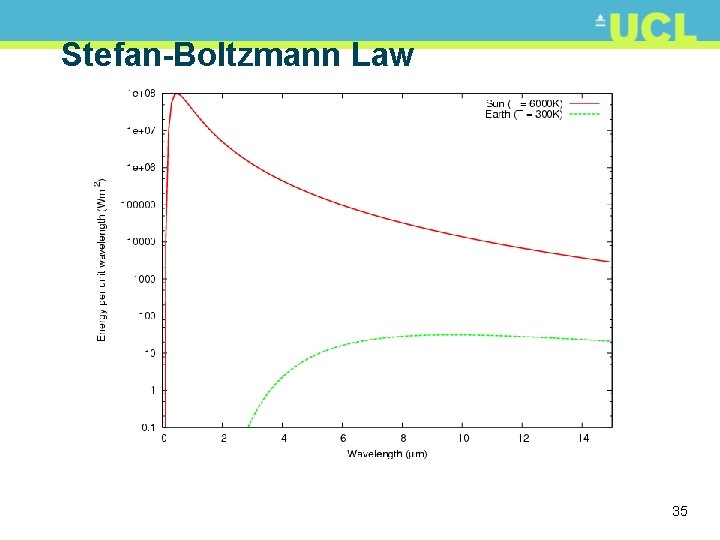
Stefan-Boltzmann Law • Total emitted radiation from a blackbody, M , in Wm-2, described by Stefan-Boltzmann Law • Where T is temperature of the object in K; and = is Stefan-Boltmann constant = 5. 6697 x 10 -8 Wm-2 K-4 • So energy T 4 and as T so does M • Tsun 6000 K M , sun 73. 5 MWm-2 • TEarth 300 K M , Earth 460 Wm-2 34
Stefan-Boltzmann Law 35
Stefan-Boltzmann Law • Note that peak of sun’s energy around 0. 5 m • negligible after 4 -6 m • Peak of Earth’s radiant energy around 10 m • negligible before ~ 4 m • Total energy emitted in each case is area under curve 36
Stefan-Boltzmann Law • Generalisation of Stefan-Boltzmann Law • radiation emitted from unit area of any plane surface with emissivity of (<1) can be written as: = Tn where n is a numerical index • For ‘grey’ surface where is nearly independent of , n =4 • When radiation emitted predominantly at < m , n > 4 • When radiation emitted predominantly at > m , n < 4 37
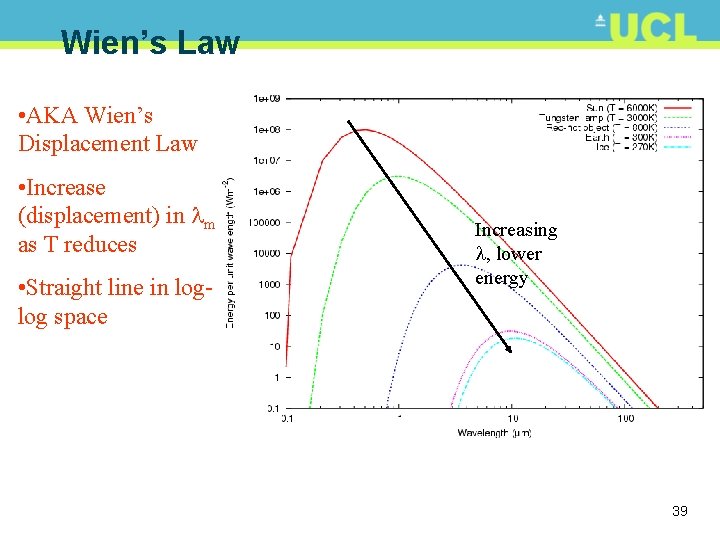
Peak of emitted radiation: Wien’s Law • Wien deduced from thermodynamic principles that energy per unit wavelength E( ) is function of T and • At what m is maximum radiant energy emitted? • Comparing blackbodies at different T, note m. T is constant, k = 2897 m. K i. e. m = k/T • m, sun = 0. 48 m • m, Earth = 9. 66 m 38
Wien’s Law • AKA Wien’s Displacement Law • Increase (displacement) in m as T reduces • Straight line in loglog space Increasing , lower energy 39
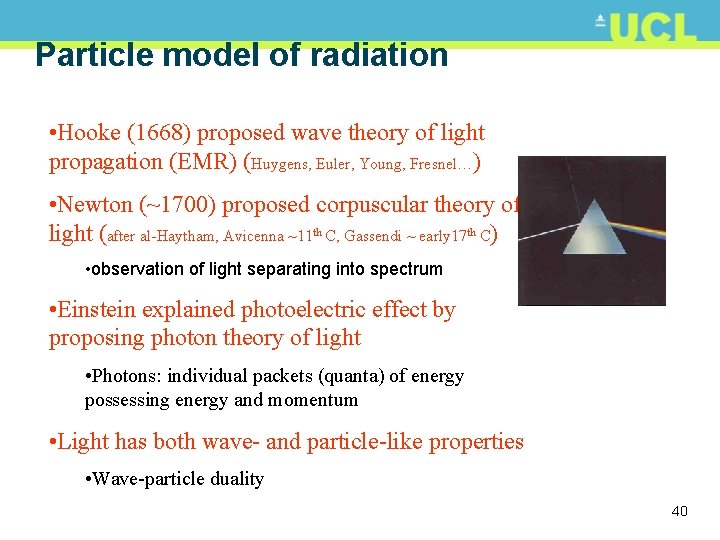
Particle model of radiation • Hooke (1668) proposed wave theory of light propagation (EMR) (Huygens, Euler, Young, Fresnel…) • Newton (~1700) proposed corpuscular theory of light (after al-Haytham, Avicenna ~11 th C, Gassendi ~ early 17 th C) • observation of light separating into spectrum • Einstein explained photoelectric effect by proposing photon theory of light • Photons: individual packets (quanta) of energy possessing energy and momentum • Light has both wave- and particle-like properties • Wave-particle duality 40
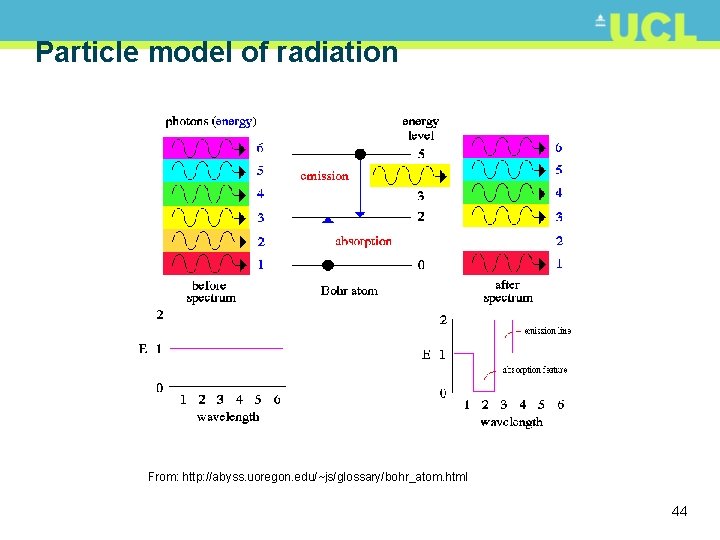
Particle model of radiation • EMR intimately related to atomic structure and energy • Atom: +ve charged nucleus (protons +neutrons) & -ve charged electrons bound in orbits • Electron orbits are fixed at certain levels, each level corresponding to a particular electron energy • Change of orbit either requires energy (work done), or releases energy • Minimum energy required to move electron up a full energy level (can’t have shift of 1/2 an energy level) • Once shifted to higher energy state, atom is excited, and possesses potential energy • Released as electron falls back to lower energy level 41
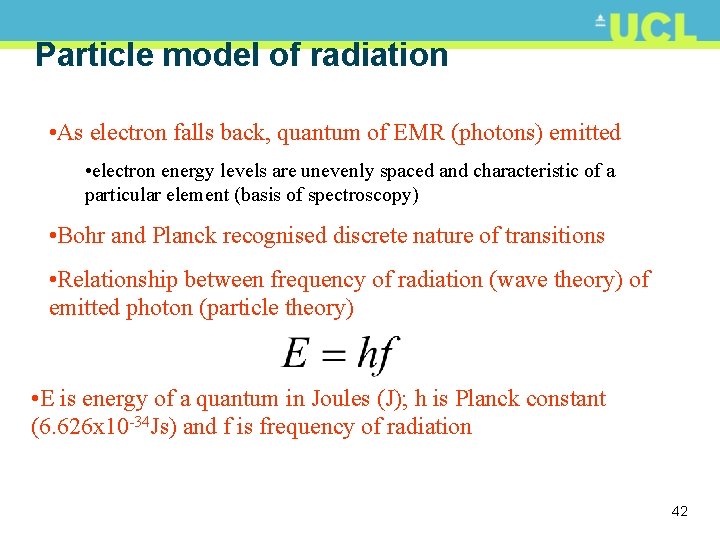
Particle model of radiation • As electron falls back, quantum of EMR (photons) emitted • electron energy levels are unevenly spaced and characteristic of a particular element (basis of spectroscopy) • Bohr and Planck recognised discrete nature of transitions • Relationship between frequency of radiation (wave theory) of emitted photon (particle theory) • E is energy of a quantum in Joules (J); h is Planck constant (6. 626 x 10 -34 Js) and f is frequency of radiation 42
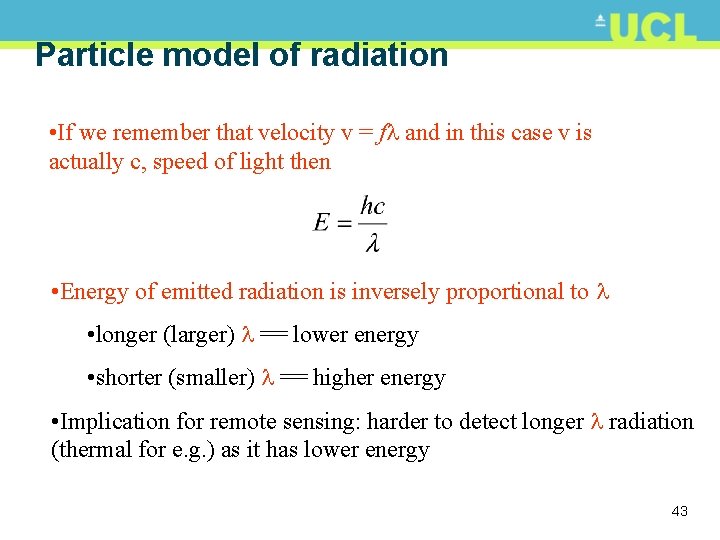
Particle model of radiation • If we remember that velocity v = f and in this case v is actually c, speed of light then • Energy of emitted radiation is inversely proportional to • longer (larger) == lower energy • shorter (smaller) == higher energy • Implication for remote sensing: harder to detect longer radiation (thermal for e. g. ) as it has lower energy 43
Particle model of radiation From: http: //abyss. uoregon. edu/~js/glossary/bohr_atom. html 44
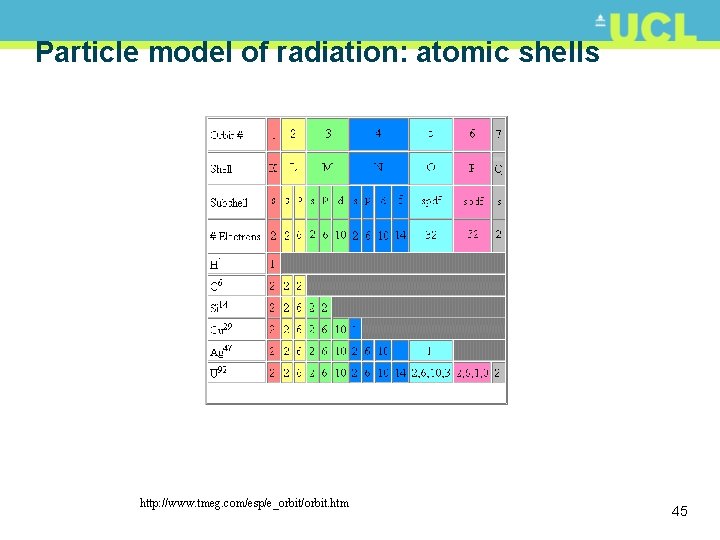
Particle model of radiation: atomic shells http: //www. tmeg. com/esp/e_orbit/orbit. htm 45
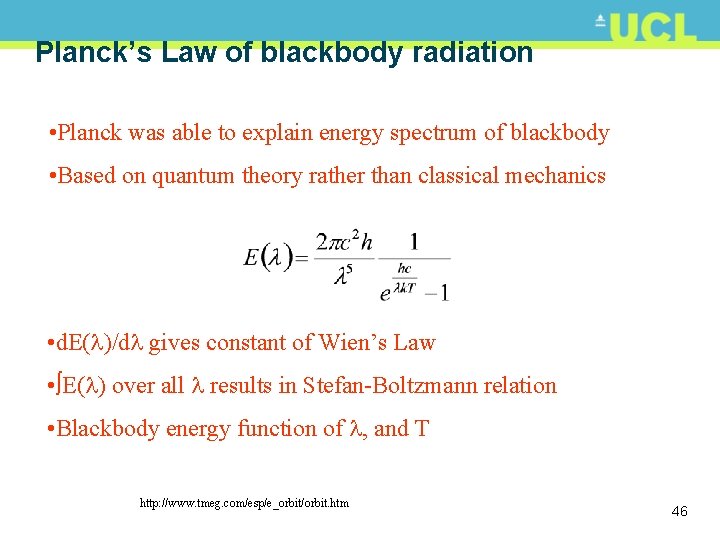
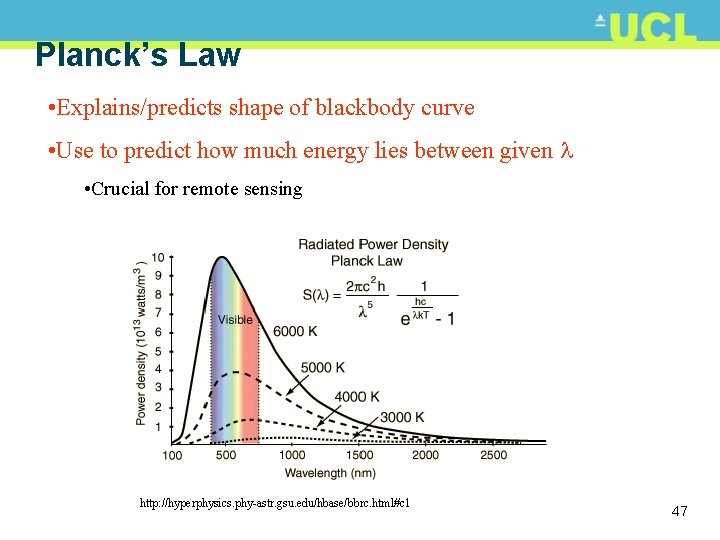
Planck’s Law of blackbody radiation • Planck was able to explain energy spectrum of blackbody • Based on quantum theory rather than classical mechanics • d. E( )/d gives constant of Wien’s Law • E( ) over all results in Stefan-Boltzmann relation • Blackbody energy function of , and T http: //www. tmeg. com/esp/e_orbit/orbit. htm 46
Planck’s Law • Explains/predicts shape of blackbody curve • Use to predict how much energy lies between given • Crucial for remote sensing http: //hyperphysics. phy-astr. gsu. edu/hbase/bbrc. html#c 1 47
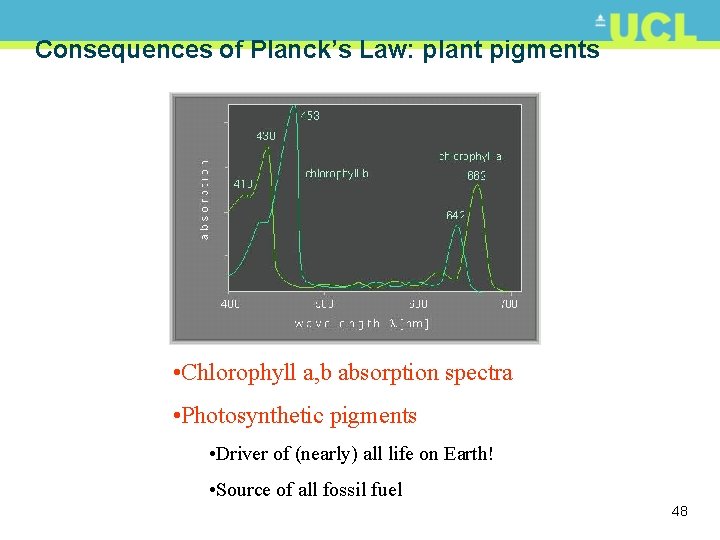
Consequences of Planck’s Law: plant pigments • Chlorophyll a, b absorption spectra • Photosynthetic pigments • Driver of (nearly) all life on Earth! • Source of all fossil fuel 48
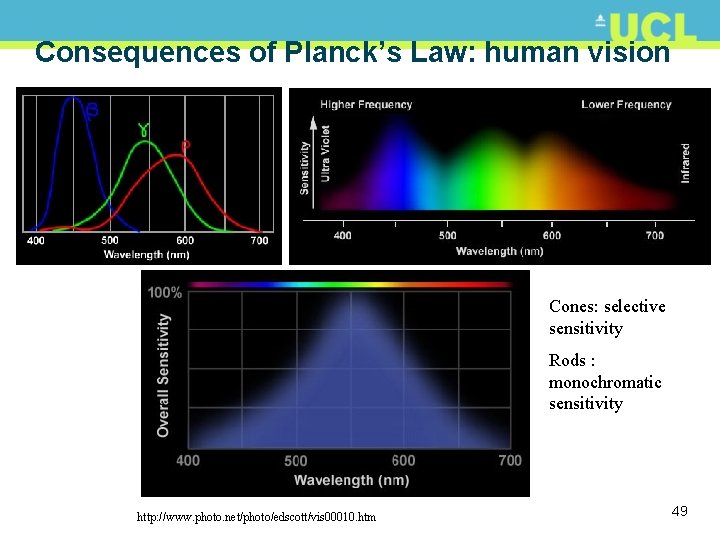
Consequences of Planck’s Law: human vision Cones: selective sensitivity Rods : monochromatic sensitivity http: //www. photo. net/photo/edscott/vis 00010. htm 49
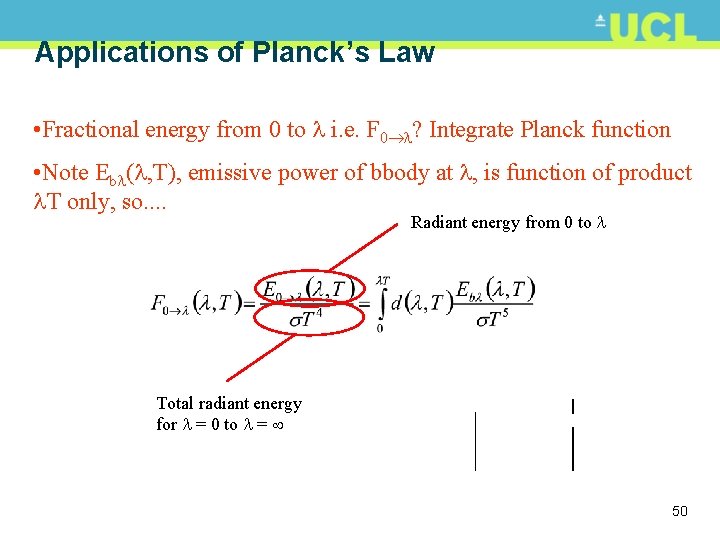
Applications of Planck’s Law • Fractional energy from 0 to i. e. F 0 ? Integrate Planck function • Note Eb ( , T), emissive power of bbody at , is function of product T only, so. . Radiant energy from 0 to Total radiant energy for = 0 to = 50
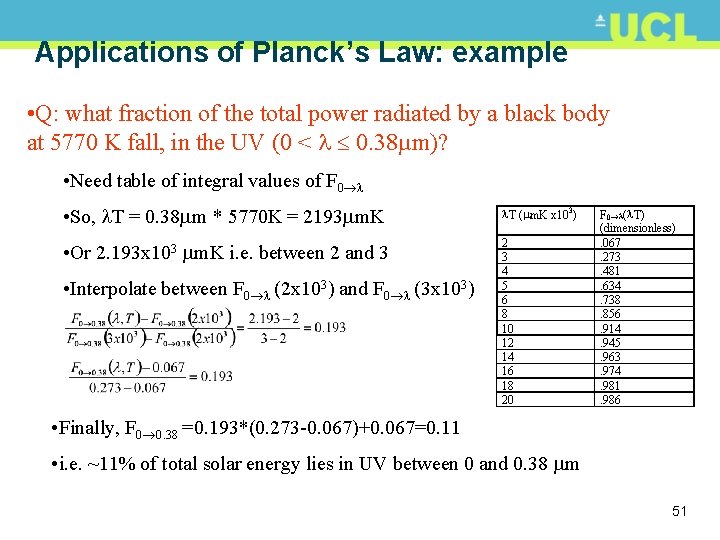
Applications of Planck’s Law: example • Q: what fraction of the total power radiated by a black body at 5770 K fall, in the UV (0 < 0. 38µm)? • Need table of integral values of F 0 • So, T = 0. 38 m * 5770 K = 2193 m. K T ( m. K x 103) • Or 2. 193 x 103 m. K i. e. between 2 and 3 2 3 4 5 6 8 10 12 14 16 18 20 • Interpolate between F 0 (2 x 10³) and F 0 (3 x 10³) F 0 ( T) (dimensionless). 067. 273. 481. 634. 738. 856. 914. 945. 963. 974. 981. 986 • Finally, F 0 0. 38 =0. 193*(0. 273 -0. 067)+0. 067=0. 11 • i. e. ~11% of total solar energy lies in UV between 0 and 0. 38 m 51
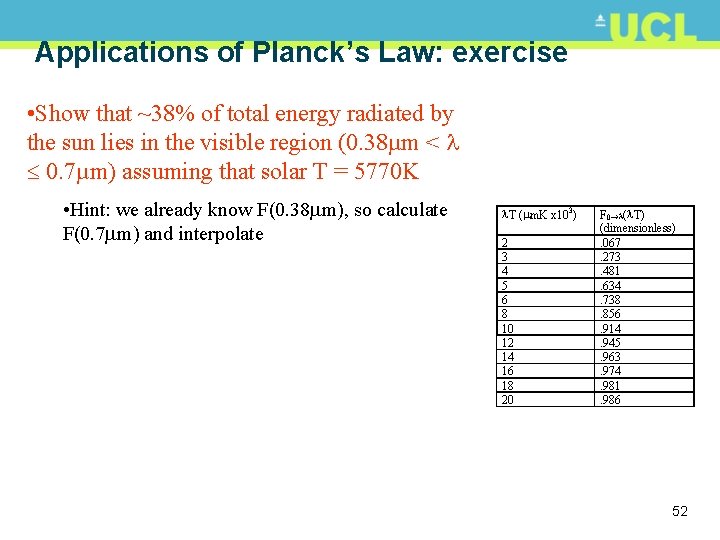
Applications of Planck’s Law: exercise • Show that ~38% of total energy radiated by the sun lies in the visible region (0. 38µm < 0. 7µm) assuming that solar T = 5770 K • Hint: we already know F(0. 38 m), so calculate F(0. 7 m) and interpolate T ( m. K x 103) 2 3 4 5 6 8 10 12 14 16 18 20 F 0 ( T) (dimensionless). 067. 273. 481. 634. 738. 856. 914. 945. 963. 974. 981. 986 52
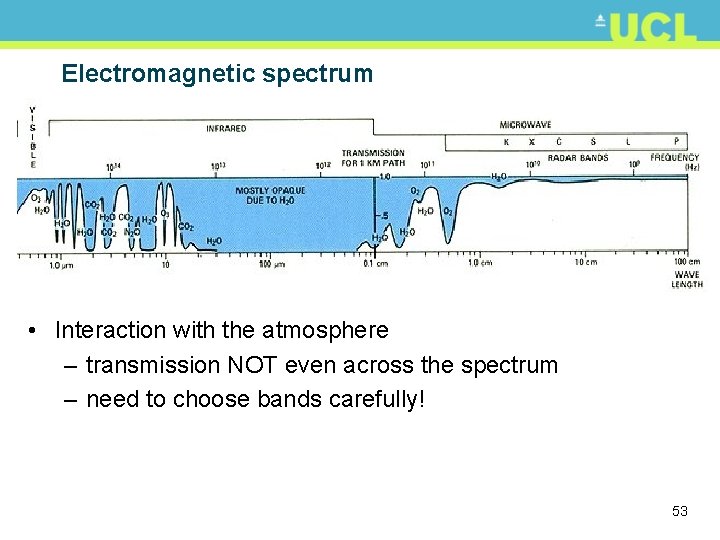
Electromagnetic spectrum • Interaction with the atmosphere – transmission NOT even across the spectrum – need to choose bands carefully! 53
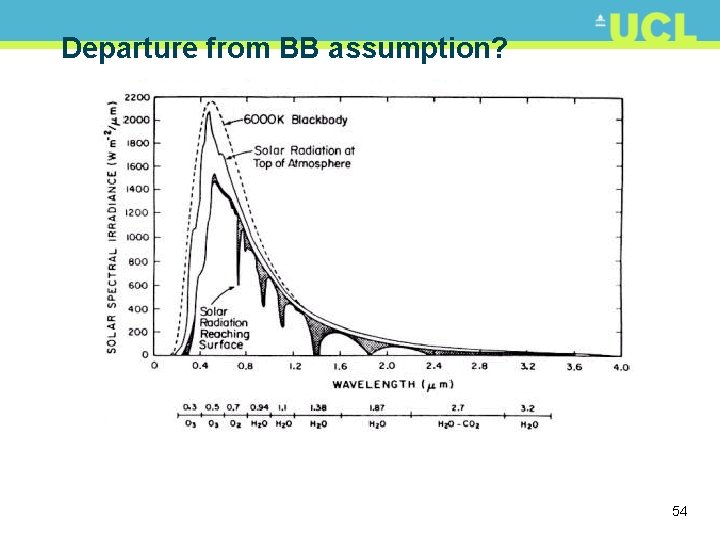
Departure from BB assumption? 54
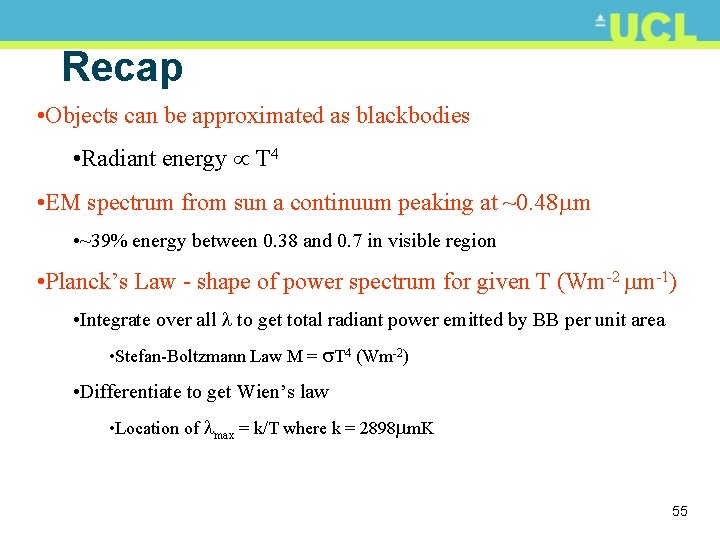
Recap • Objects can be approximated as blackbodies • Radiant energy T 4 • EM spectrum from sun a continuum peaking at ~0. 48 m • ~39% energy between 0. 38 and 0. 7 in visible region • Planck’s Law - shape of power spectrum for given T (Wm-2 m-1) • Integrate over all to get total radiant power emitted by BB per unit area • Stefan-Boltzmann Law M = T 4 (Wm-2) • Differentiate to get Wien’s law • Location of max = k/T where k = 2898 m. K 55
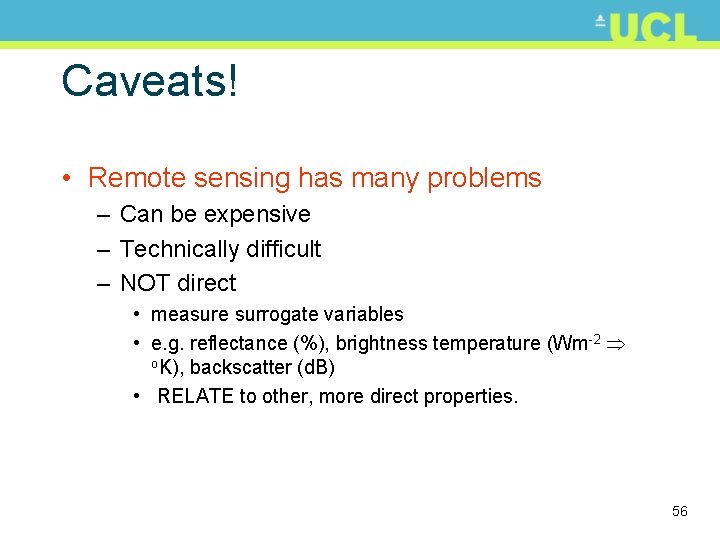
Caveats! • Remote sensing has many problems – Can be expensive – Technically difficult – NOT direct • measure surrogate variables • e. g. reflectance (%), brightness temperature (Wm-2 o. K), backscatter (d. B) • RELATE to other, more direct properties. 56
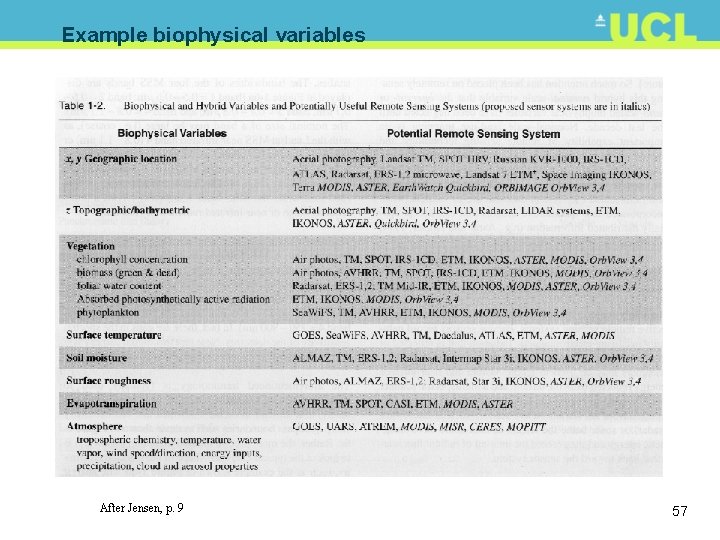
Example biophysical variables After Jensen, p. 9 57
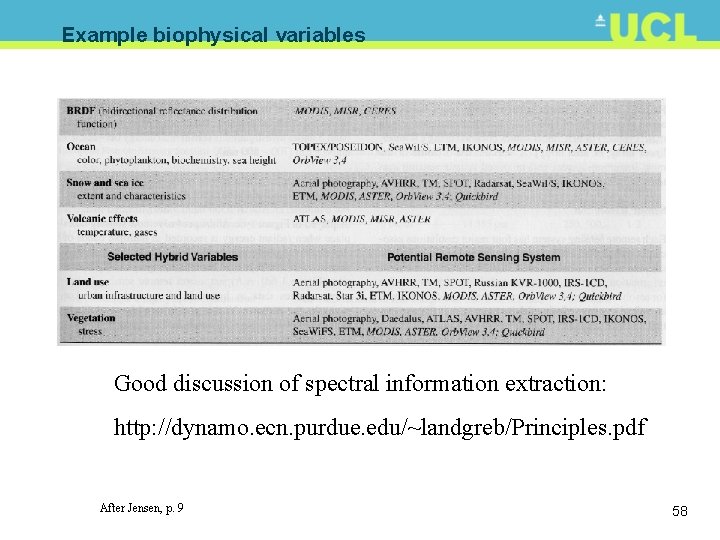
Example biophysical variables Good discussion of spectral information extraction: http: //dynamo. ecn. purdue. edu/~landgreb/Principles. pdf After Jensen, p. 9 58
Interesting stuff…. . • IKONOS image gallery index: http: //www. spaceimaging. com/Corp. Site/gallery/allimages. aspx • Quickbird, Worldview 1 & 2 image gallery: http: //www. digitalglobe. com/index. php/27/Sample+Imagery+Gallery • Eg Japan earthquake and tsunami: http: //www. digitalglobe. com/index. php/27/Sample+Imagery+Gallery? ITEM=452 59