
Measuring Performance Part I 11802 CSE 141 Performance
- Slides: 19
Measuring Performance Part I 1/18/02 CSE 141 - Performance I
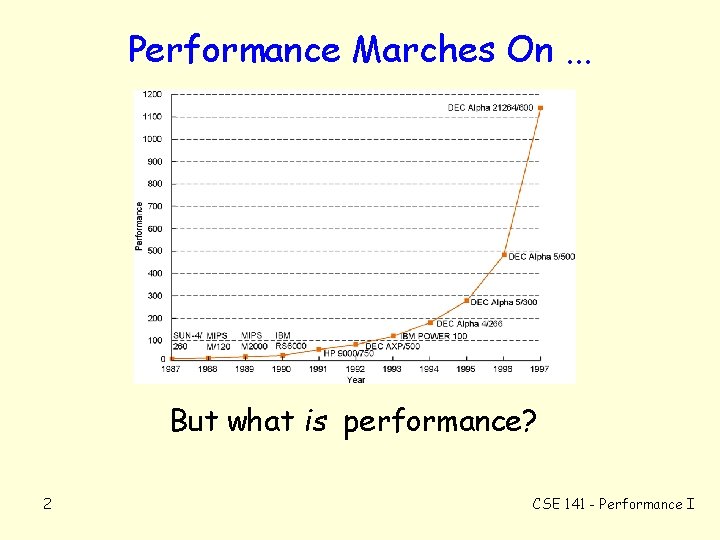
Performance Marches On. . . But what is performance? 2 CSE 141 - Performance I
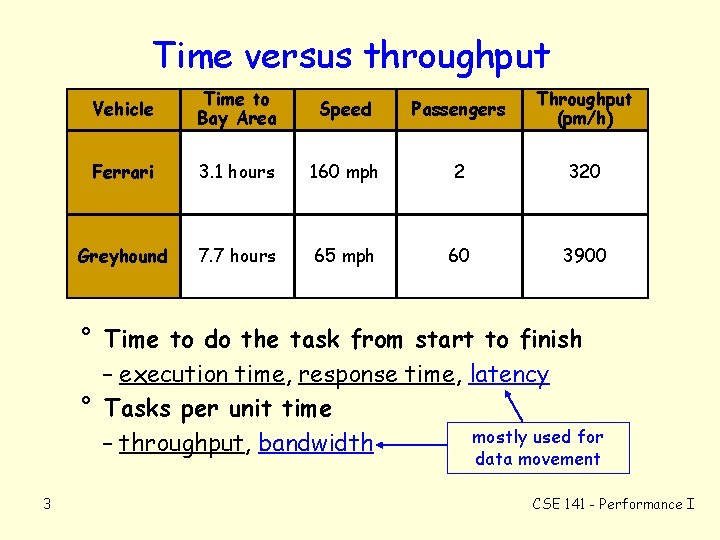
Time versus throughput Vehicle Time to Bay Area Speed Passengers Throughput (pm/h) Ferrari 3. 1 hours 160 mph 2 320 Greyhound 7. 7 hours 65 mph 60 3900 ° Time to do the task from start to finish – execution time, response time, latency ° Tasks per unit time mostly used for – throughput, bandwidth data movement 3 CSE 141 - Performance I
Time versus throughput • Time is measured in time units/job. • Throughput is measured in jobs/time unit. • But “time = 1/throughput” may be false. – It takes 4 months to grow a tomato. Can you only grow 3 tomatoes a year ? ? – If you run only one job at a time, time = 1/throughput 4 CSE 141 - Performance I
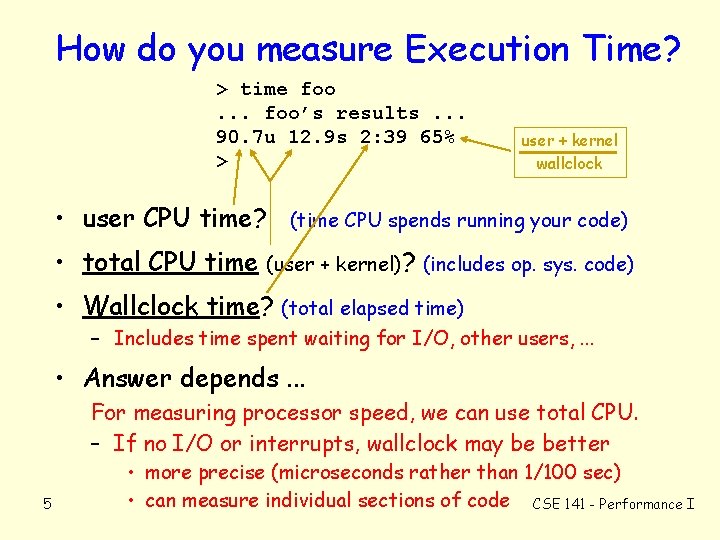
How do you measure Execution Time? > time foo. . . foo’s results. . . 90. 7 u 12. 9 s 2: 39 65% > • user CPU time? • total CPU time user + kernel wallclock (time CPU spends running your code) (user + kernel)? (includes op. sys. code) • Wallclock time? (total elapsed time) – Includes time spent waiting for I/O, other users, . . . • Answer depends. . . For measuring processor speed, we can use total CPU. – If no I/O or interrupts, wallclock may be better 5 • more precise (microseconds rather than 1/100 sec) • can measure individual sections of code CSE 141 - Performance I
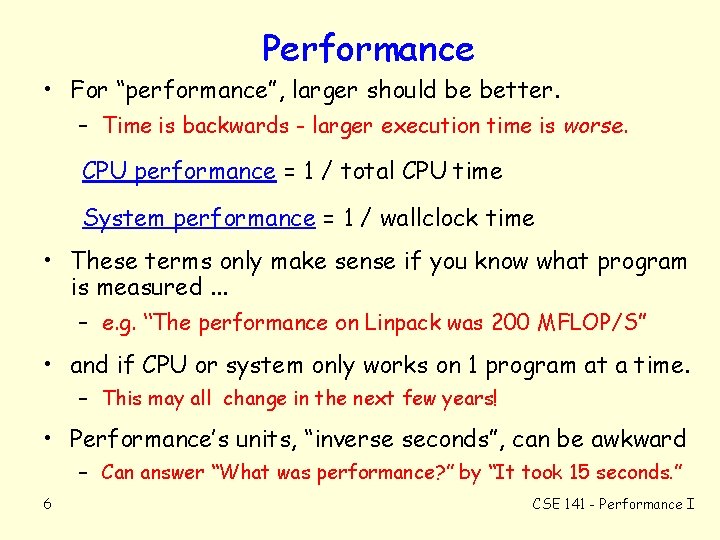
Performance • For “performance”, larger should be better. – Time is backwards - larger execution time is worse. CPU performance = 1 / total CPU time System performance = 1 / wallclock time • These terms only make sense if you know what program is measured. . . – e. g. “The performance on Linpack was 200 MFLOP/S” • and if CPU or system only works on 1 program at a time. – This may all change in the next few years! • Performance’s units, “inverse seconds”, can be awkward – Can answer “What was performance? ” by “It took 15 seconds. ” 6 CSE 141 - Performance I
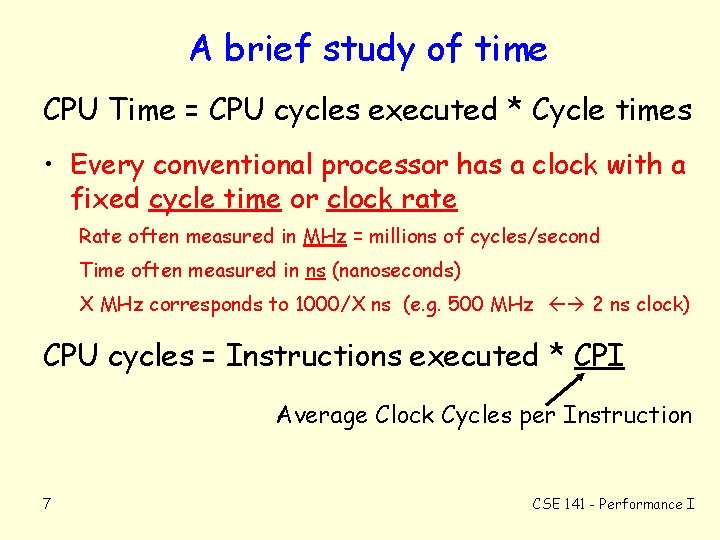
A brief study of time CPU Time = CPU cycles executed * Cycle times • Every conventional processor has a clock with a fixed cycle time or clock rate Rate often measured in MHz = millions of cycles/second Time often measured in ns (nanoseconds) X MHz corresponds to 1000/X ns (e. g. 500 MHz 2 ns clock) CPU cycles = Instructions executed * CPI Average Clock Cycles per Instruction 7 CSE 141 - Performance I
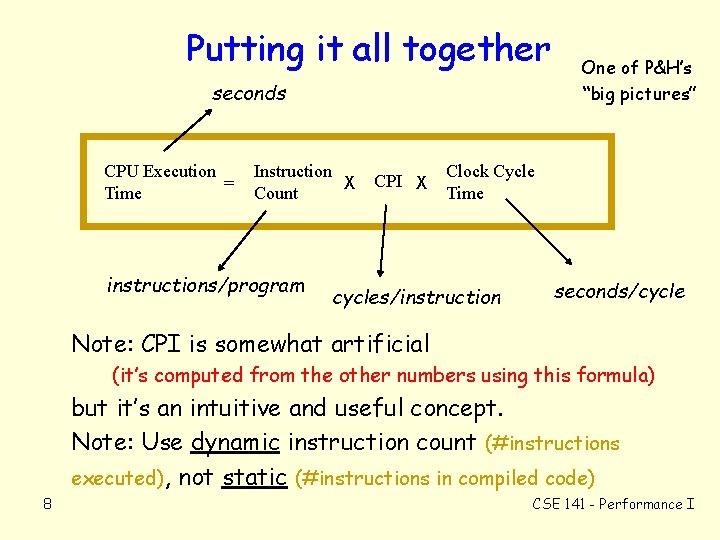
Putting it all together seconds CPU Execution = Time Instruction X Count instructions/program CPI X One of P&H’s “big pictures” Clock Cycle Time cycles/instruction seconds/cycle Note: CPI is somewhat artificial (it’s computed from the other numbers using this formula) but it’s an intuitive and useful concept. Note: Use dynamic instruction count (#instructions executed), not static (#instructions in compiled code) 8 CSE 141 - Performance I
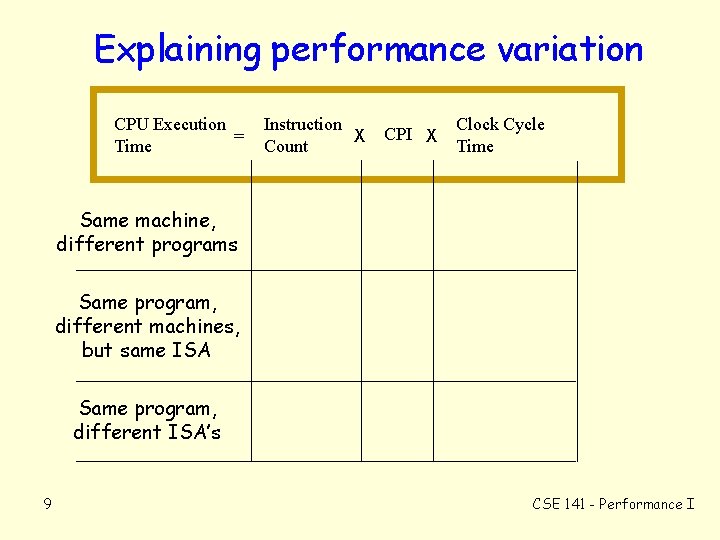
Explaining performance variation CPU Execution = Time Instruction X Count CPI X Clock Cycle Time Same machine, different programs Same program, different machines, but same ISA Same program, different ISA’s 9 CSE 141 - Performance I
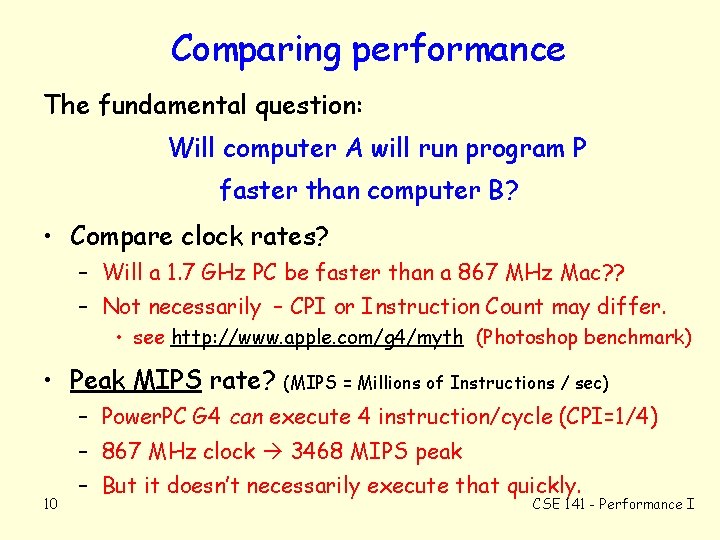
Comparing performance The fundamental question: Will computer A will run program P faster than computer B? • Compare clock rates? – Will a 1. 7 GHz PC be faster than a 867 MHz Mac? ? – Not necessarily – CPI or Instruction Count may differ. • see http: //www. apple. com/g 4/myth (Photoshop benchmark) • Peak MIPS rate? (MIPS = Millions of Instructions / sec) – Power. PC G 4 can execute 4 instruction/cycle (CPI=1/4) – 867 MHz clock 3468 MIPS peak 10 – But it doesn’t necessarily execute that quickly. CSE 141 - Performance I
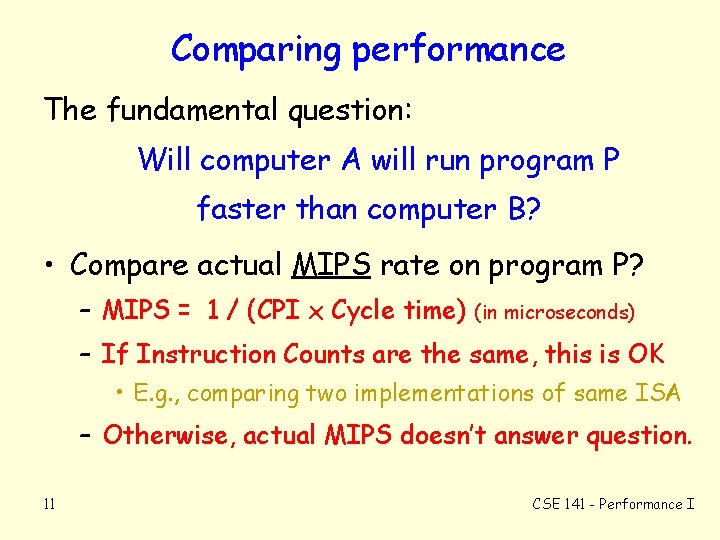
Comparing performance The fundamental question: Will computer A will run program P faster than computer B? • Compare actual MIPS rate on program P? – MIPS = 1 / (CPI x Cycle time) (in microseconds) – If Instruction Counts are the same, this is OK • E. g. , comparing two implementations of same ISA – Otherwise, actual MIPS doesn’t answer question. 11 CSE 141 - Performance I
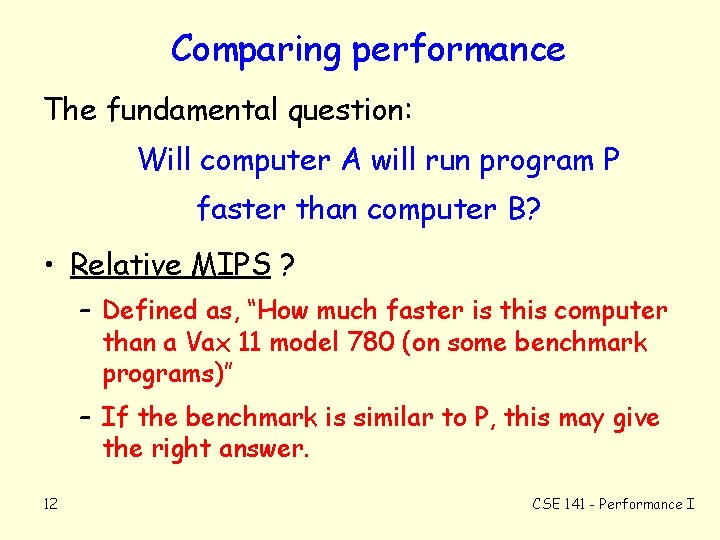
Comparing performance The fundamental question: Will computer A will run program P faster than computer B? • Relative MIPS ? – Defined as, “How much faster is this computer than a Vax 11 model 780 (on some benchmark programs)” – If the benchmark is similar to P, this may give the right answer. 12 CSE 141 - Performance I
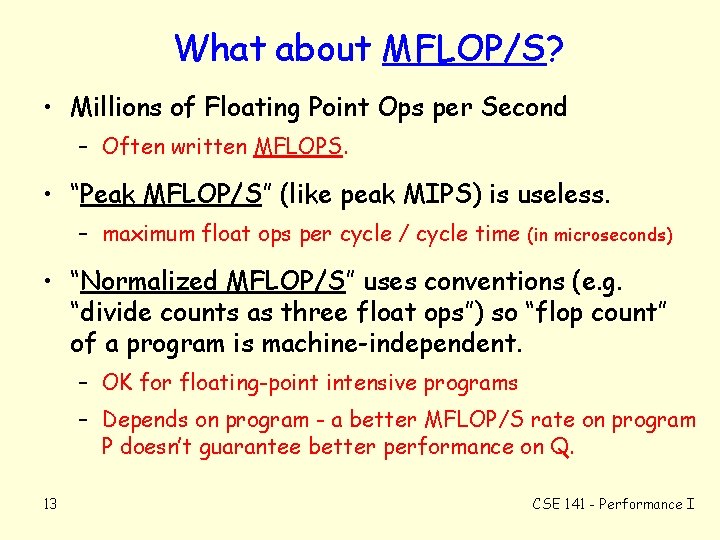
What about MFLOP/S? • Millions of Floating Point Ops per Second – Often written MFLOPS. • “Peak MFLOP/S” (like peak MIPS) is useless. – maximum float ops per cycle / cycle time (in microseconds) • “Normalized MFLOP/S” uses conventions (e. g. “divide counts as three float ops”) so “flop count” of a program is machine-independent. – OK for floating-point intensive programs – Depends on program - a better MFLOP/S rate on program P doesn’t guarantee better performance on Q. 13 CSE 141 - Performance I
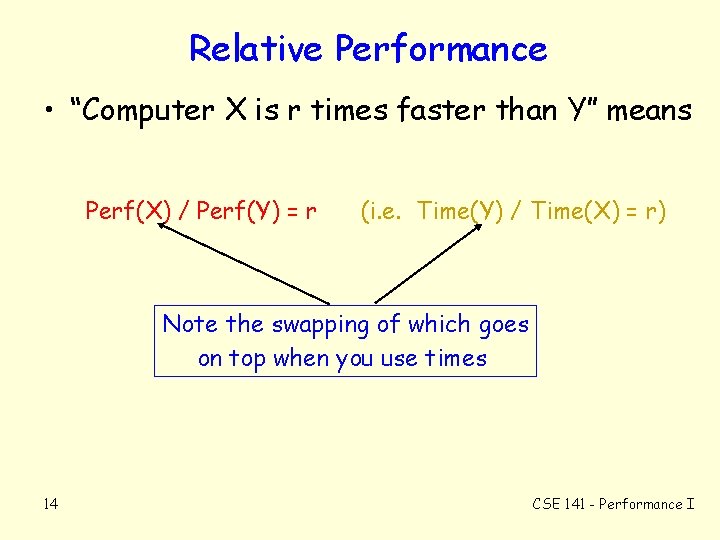
Relative Performance • “Computer X is r times faster than Y” means Perf(X) / Perf(Y) = r (i. e. Time(Y) / Time(X) = r) Note the swapping of which goes on top when you use times 14 CSE 141 - Performance I
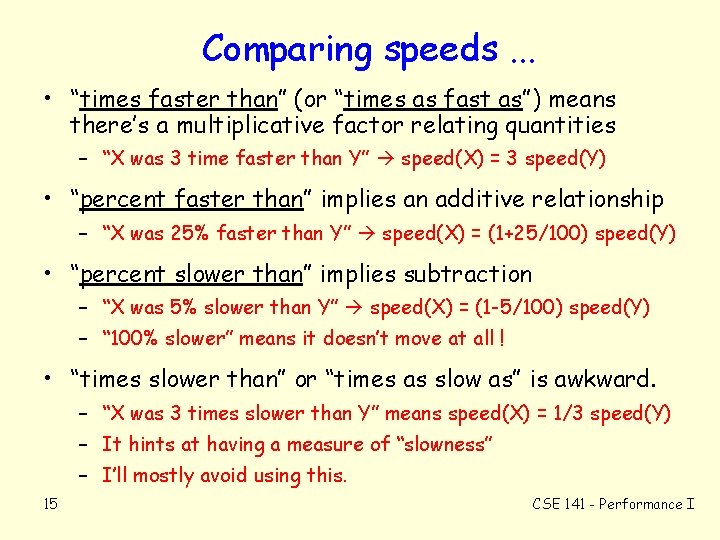
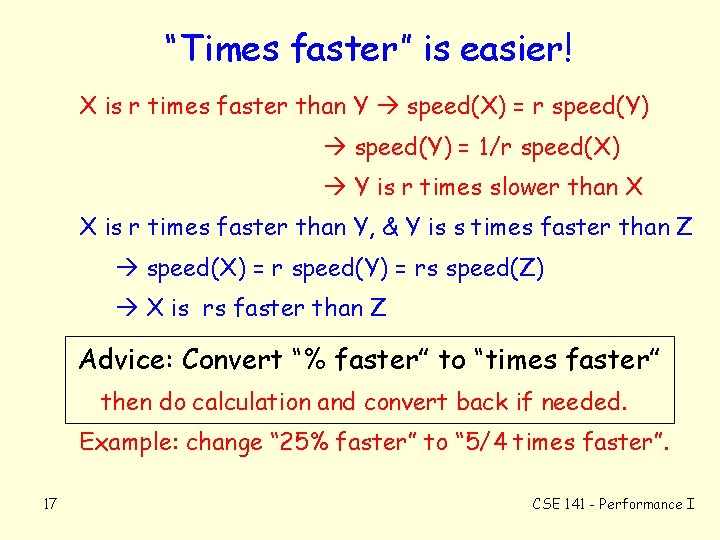
Comparing speeds. . . • “times faster than” (or “times as fast as”) means there’s a multiplicative factor relating quantities – “X was 3 time faster than Y” speed(X) = 3 speed(Y) • “percent faster than” implies an additive relationship – “X was 25% faster than Y” speed(X) = (1+25/100) speed(Y) • “percent slower than” implies subtraction – “X was 5% slower than Y” speed(X) = (1 -5/100) speed(Y) – “ 100% slower” means it doesn’t move at all ! • “times slower than” or “times as slow as” is awkward. – “X was 3 times slower than Y” means speed(X) = 1/3 speed(Y) – It hints at having a measure of “slowness” – I’ll mostly avoid using this. 15 CSE 141 - Performance I
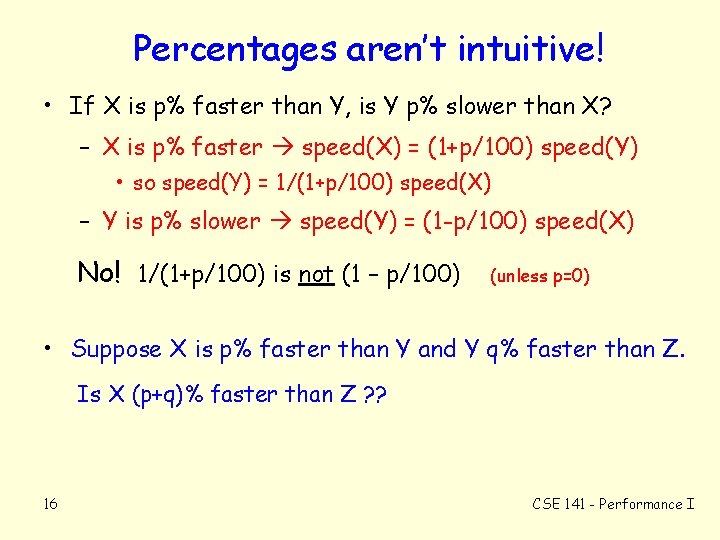
Percentages aren’t intuitive! • If X is p% faster than Y, is Y p% slower than X? – X is p% faster speed(X) = (1+p/100) speed(Y) • so speed(Y) = 1/(1+p/100) speed(X) – Y is p% slower speed(Y) = (1 -p/100) speed(X) No! 1/(1+p/100) is not (1 – p/100) (unless p=0) • Suppose X is p% faster than Y and Y q% faster than Z. Is X (p+q)% faster than Z ? ? 16 CSE 141 - Performance I
“Times faster” is easier! X is r times faster than Y speed(X) = r speed(Y) = 1/r speed(X) Y is r times slower than X X is r times faster than Y, & Y is s times faster than Z speed(X) = r speed(Y) = rs speed(Z) X is rs faster than Z Advice: Convert “% faster” to “times faster” then do calculation and convert back if needed. Example: change “ 25% faster” to “ 5/4 times faster”. 17 CSE 141 - Performance I
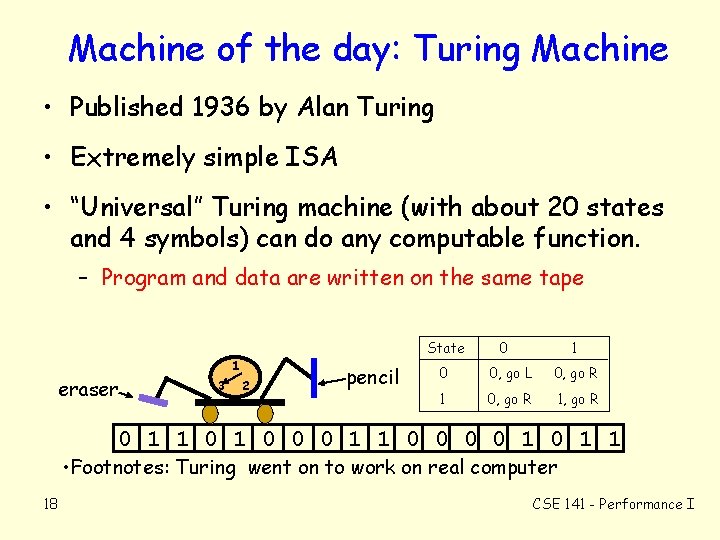
Machine of the day: Turing Machine • Published 1936 by Alan Turing • Extremely simple ISA • “Universal” Turing machine (with about 20 states and 4 symbols) can do any computable function. – Program and data are written on the same tape State 1 eraser 3 2 pencil 0 1 0 0, go L 0, go R 1, go R 0 1 1 0 0 1 0 1 1 • Footnotes: Turing went on to work on real computer 18 CSE 141 - Performance I
Machine of the day: Turing Machine • Used to prove some functions are uncomputable • Turing machine only of theoretical interest – still remarkable – had elements of real computer • Turing worked on “Bombe” computer during WW II – cracked German codes; greatly helped Allied victory • After war, designed a general purpose computer (not built), proposed ideas of programming languages, neural nets, and the “Turing test”. • Turing persecuted as homosexual; committed suicide 19 CSE 141 - Performance I