US Government Principles in Practice Chapter 3 Next


- Slides: 37
US Government: Principles in Practice Chapter 3 Next Copyright © by Houghton Mifflin Harcourt Publishing Company
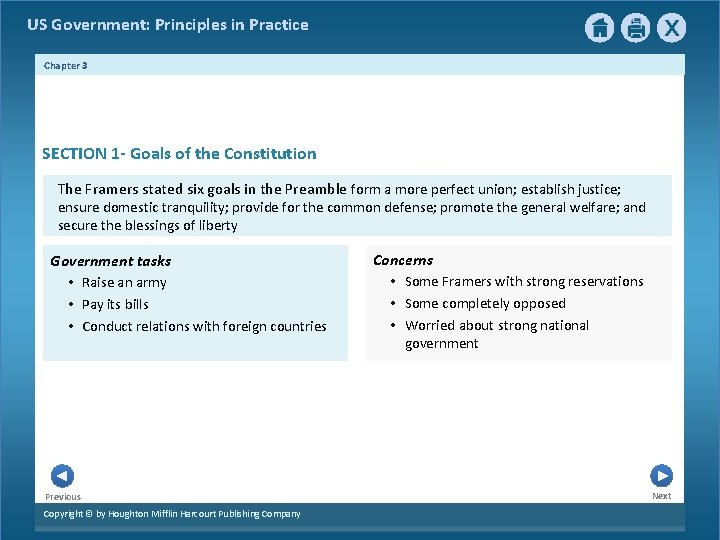
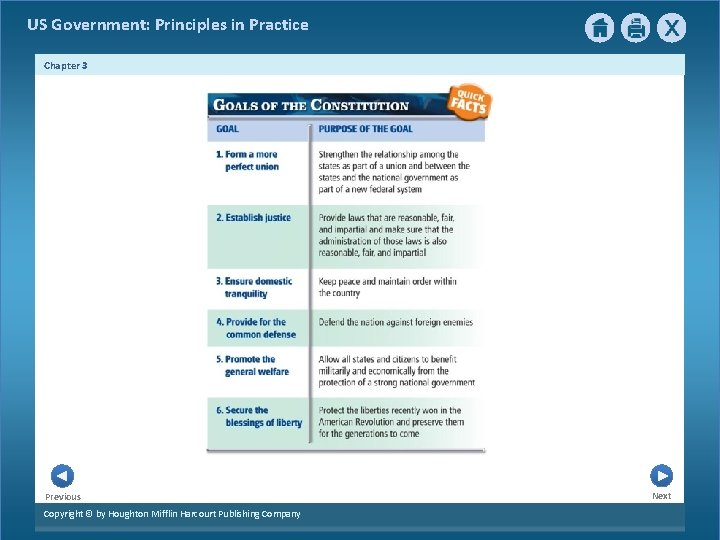
US Government: Principles in Practice Chapter 3 SECTION 1 - Goals of the Constitution The Framers stated six goals in the Preamble form a more perfect union; establish justice; ensure domestic tranquility; provide for the common defense; promote the general welfare; and secure the blessings of liberty Government tasks • Raise an army • Pay its bills • Conduct relations with foreign countries Previous Copyright © by Houghton Mifflin Harcourt Publishing Company Concerns • Some Framers with strong reservations • Some completely opposed • Worried about strong national government Next
US Government: Principles in Practice Chapter 3 Previous Copyright © by Houghton Mifflin Harcourt Publishing Company Next
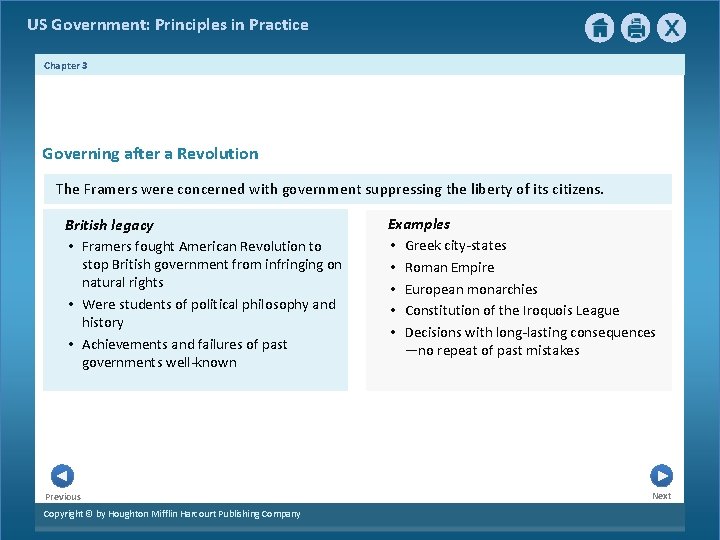
US Government: Principles in Practice Chapter 3 Governing after a Revolution The Framers were concerned with government suppressing the liberty of its citizens. British legacy • Framers fought American Revolution to stop British government from infringing on natural rights • Were students of political philosophy and history • Achievements and failures of past governments well-known Previous Copyright © by Houghton Mifflin Harcourt Publishing Company Examples • Greek city-states • Roman Empire • European monarchies • Constitution of the Iroquois League • Decisions with long-lasting consequences —no repeat of past mistakes Next
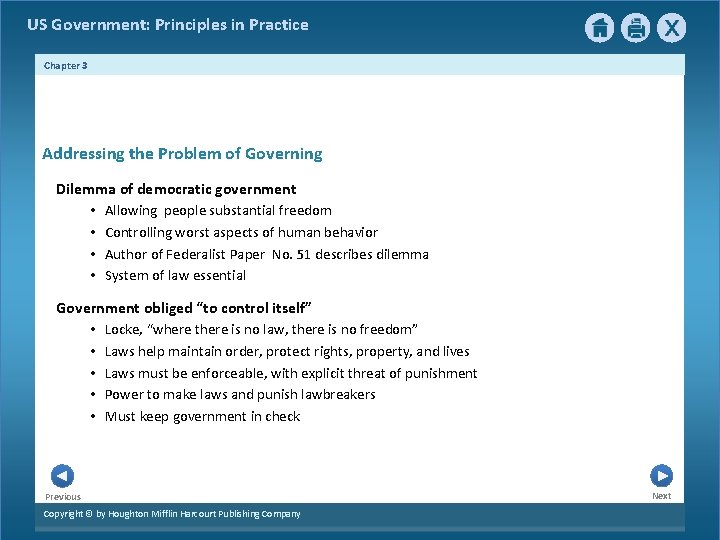
US Government: Principles in Practice Chapter 3 Addressing the Problem of Governing Dilemma of democratic government • Allowing people substantial freedom • Controlling worst aspects of human behavior • Author of Federalist Paper No. 51 describes dilemma • System of law essential Government obliged “to control itself” • Locke, “where there is no law, there is no freedom” • Laws help maintain order, protect rights, property, and lives • Laws must be enforceable, with explicit threat of punishment • Power to make laws and punish lawbreakers • Must keep government in check Previous Copyright © by Houghton Mifflin Harcourt Publishing Company Next
US Government: Principles in Practice Chapter 3 Principles of Government in the Constitution Framers’ solution • Create governing document • Divide, distribute, and balance Uses of power • Government power subject to will of the Bill of Rights • Final check on power • Inclusion of Bill of Rights in 1791 Restraints • Placed specific restraints on power of governmental power Previous Copyright © by Houghton Mifflin Harcourt Publishing Company people • Power as voters government • Cannot violate basic rights of citizens Next
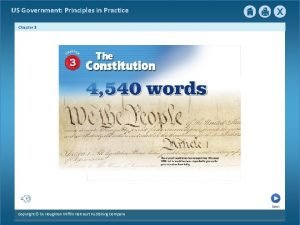
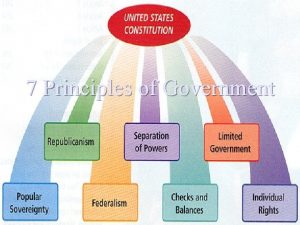
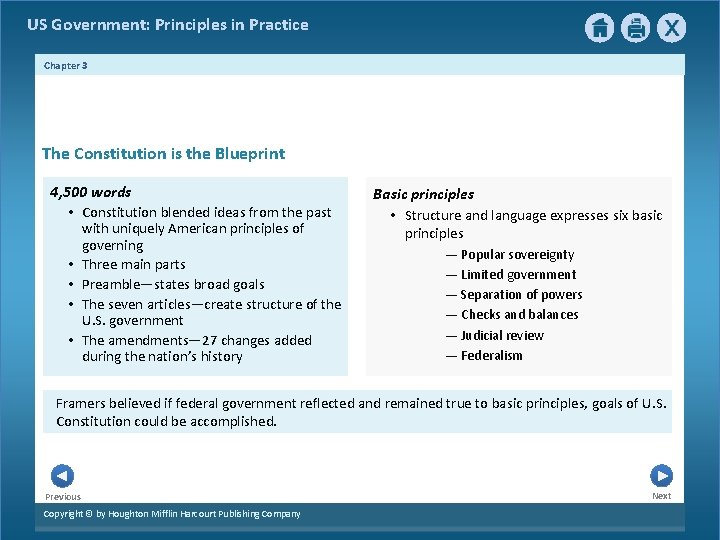
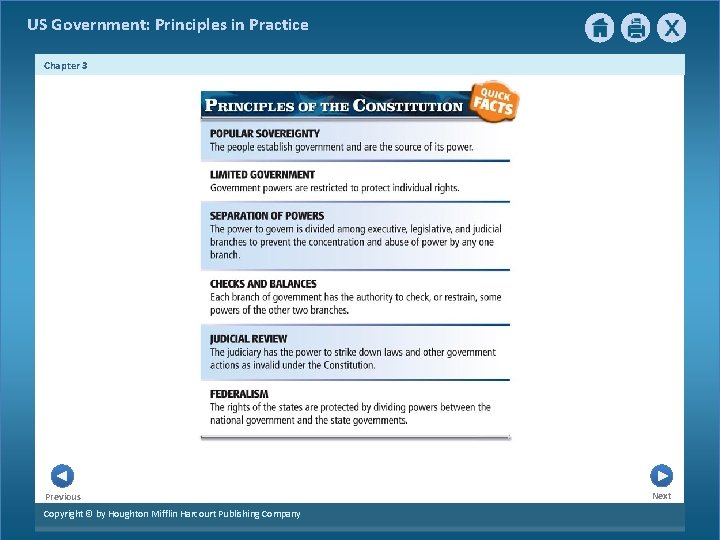
US Government: Principles in Practice Chapter 3 The Constitution is the Blueprint 4, 500 words • Constitution blended ideas from the past • • with uniquely American principles of governing Three main parts Preamble—states broad goals The seven articles—create structure of the U. S. government The amendments— 27 changes added during the nation’s history Basic principles • Structure and language expresses six basic principles — Popular sovereignty — Limited government — Separation of powers — Checks and balances — Judicial review — Federalism Framers believed if federal government reflected and remained true to basic principles, goals of U. S. Constitution could be accomplished. Previous Copyright © by Houghton Mifflin Harcourt Publishing Company Next
US Government: Principles in Practice Chapter 3 Previous Copyright © by Houghton Mifflin Harcourt Publishing Company Next
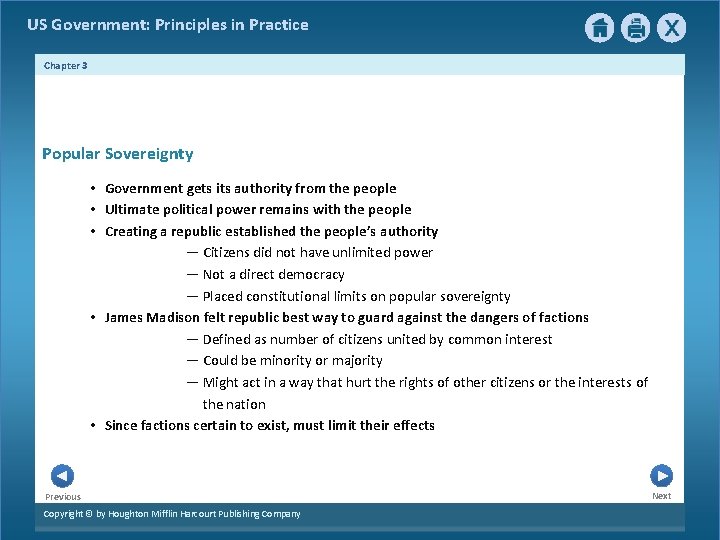
US Government: Principles in Practice Chapter 3 Popular Sovereignty • Government gets its authority from the people • Ultimate political power remains with the people • Creating a republic established the people’s authority — Citizens did not have unlimited power — Not a direct democracy — Placed constitutional limits on popular sovereignty • James Madison felt republic best way to guard against the dangers of factions — Defined as number of citizens united by common interest — Could be minority or majority — Might act in a way that hurt the rights of other citizens or the interests of the nation • Since factions certain to exist, must limit their effects Previous Copyright © by Houghton Mifflin Harcourt Publishing Company Next
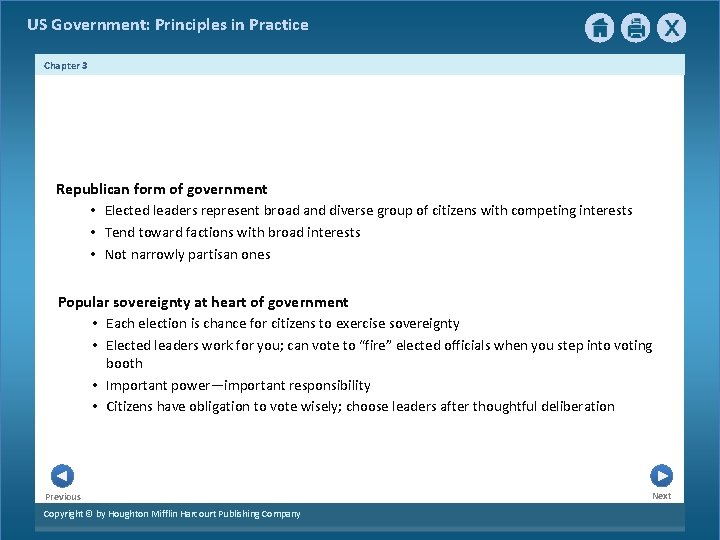
US Government: Principles in Practice Chapter 3 Republican form of government • Elected leaders represent broad and diverse group of citizens with competing interests • Tend toward factions with broad interests • Not narrowly partisan ones Popular sovereignty at heart of government • Each election is chance for citizens to exercise sovereignty • Elected leaders work for you; can vote to “fire” elected officials when you step into voting booth • Important power—important responsibility • Citizens have obligation to vote wisely; choose leaders after thoughtful deliberation Previous Copyright © by Houghton Mifflin Harcourt Publishing Company Next
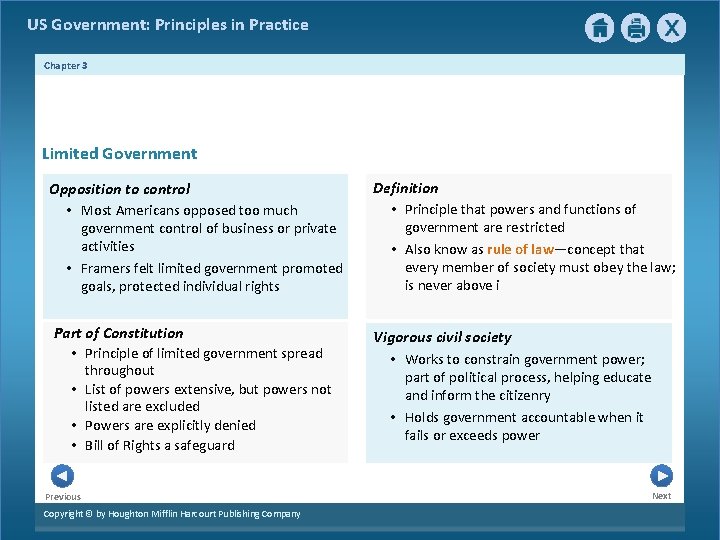
US Government: Principles in Practice Chapter 3 Limited Government Opposition to control • Most Americans opposed too much Definition • Principle that powers and functions of Part of Constitution • Principle of limited government spread Vigorous civil society • Works to constrain government power; government control of business or private activities • Framers felt limited government promoted goals, protected individual rights throughout • List of powers extensive, but powers not listed are excluded • Powers are explicitly denied • Bill of Rights a safeguard Previous Copyright © by Houghton Mifflin Harcourt Publishing Company government are restricted • Also know as rule of law—concept that every member of society must obey the law; is never above i part of political process, helping educate and inform the citizenry • Holds government accountable when it fails or exceeds power Next
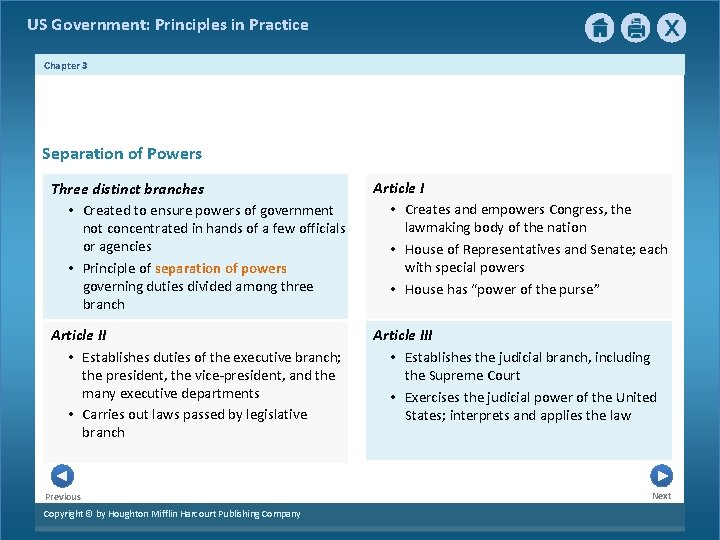
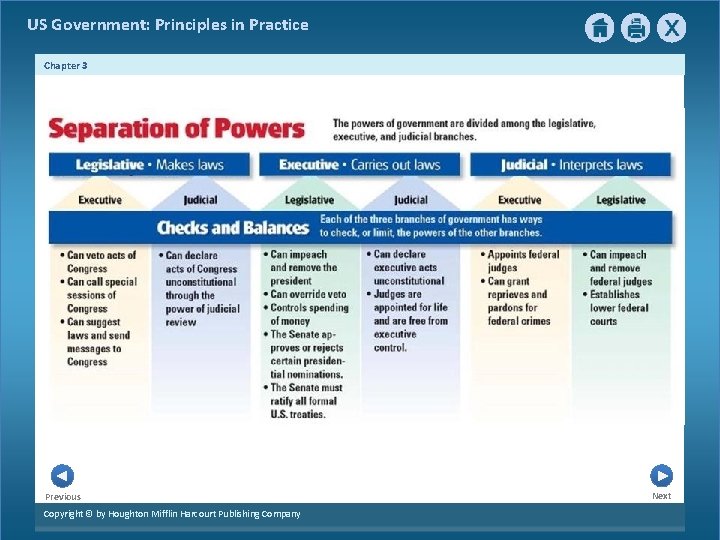
US Government: Principles in Practice Chapter 3 Separation of Powers Three distinct branches • Created to ensure powers of government Article I • Creates and empowers Congress, the Article II • Establishes duties of the executive branch; Article III • Establishes the judicial branch, including not concentrated in hands of a few officials or agencies • Principle of separation of powers governing duties divided among three branch the president, the vice-president, and the many executive departments • Carries out laws passed by legislative branch Previous Copyright © by Houghton Mifflin Harcourt Publishing Company lawmaking body of the nation • House of Representatives and Senate; each with special powers • House has “power of the purse” the Supreme Court • Exercises the judicial power of the United States; interprets and applies the law Next
US Government: Principles in Practice Chapter 3 Previous Copyright © by Houghton Mifflin Harcourt Publishing Company Next
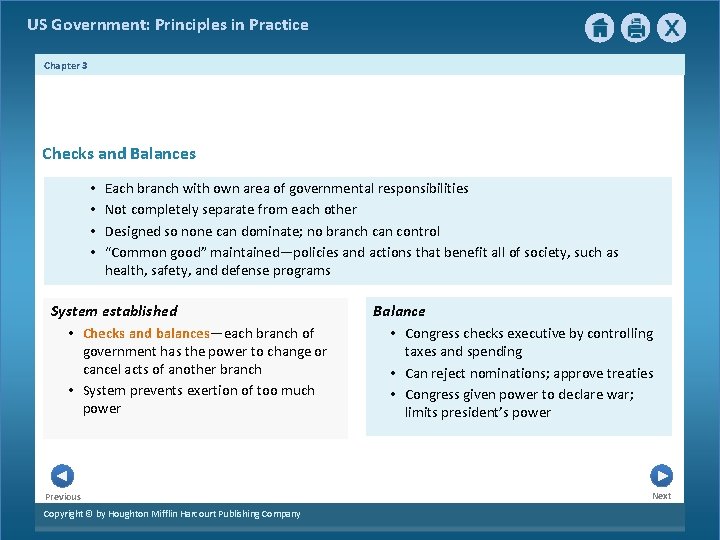
US Government: Principles in Practice Chapter 3 Checks and Balances • • Each branch with own area of governmental responsibilities Not completely separate from each other Designed so none can dominate; no branch can control “Common good” maintained—policies and actions that benefit all of society, such as health, safety, and defense programs System established • Checks and balances—each branch of government has the power to change or cancel acts of another branch • System prevents exertion of too much power Previous Copyright © by Houghton Mifflin Harcourt Publishing Company Balance • Congress checks executive by controlling taxes and spending • Can reject nominations; approve treaties • Congress given power to declare war; limits president’s power Next
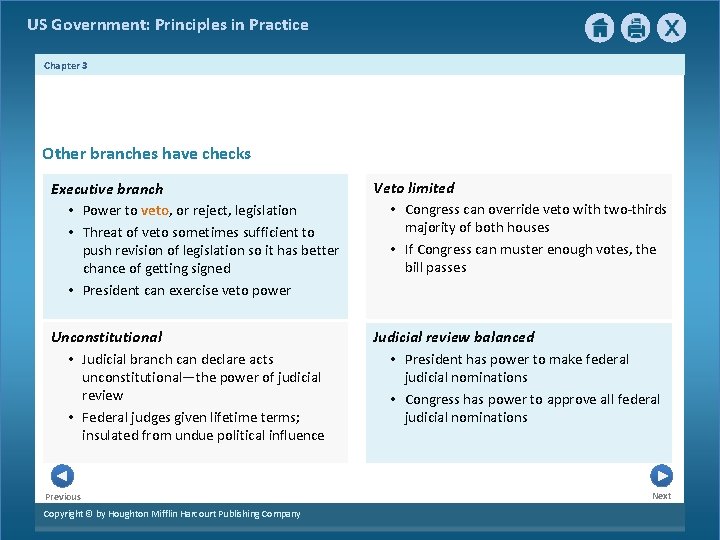
US Government: Principles in Practice Chapter 3 Other branches have checks Executive branch • Power to veto, or reject, legislation • Threat of veto sometimes sufficient to Veto limited • Congress can override veto with two-thirds Unconstitutional • Judicial branch can declare acts Judicial review balanced • President has power to make federal push revision of legislation so it has better chance of getting signed • President can exercise veto power unconstitutional—the power of judicial review • Federal judges given lifetime terms; insulated from undue political influence Previous Copyright © by Houghton Mifflin Harcourt Publishing Company majority of both houses • If Congress can muster enough votes, the bill passes judicial nominations • Congress has power to approve all federal judicial nominations Next
US Government: Principles in Practice Chapter 3 Presidential frustrations • Famous example of annoyance at Supreme Court in 1930 s — President Franklin Roosevelt convinced Congress to pass measures to combat the Great Depression — Court declared some measures to be unconstitutional • Roosevelt responded by introducing legislation to reorganize the federal judiciary — Wanted to increase the size of the Court by adding new justic — Result would be larger Supreme Court with favorable majority • Critics claimed Roosevelt trying to change balance of power with “court-packing” plan; Senate passed a watered-down plan — Plan never implemented — In second term, Roosevelt able to replace five of the Supreme Court justices; gained a sympathetic majority which upheld New Deal programs, including Social Security Previous Copyright © by Houghton Mifflin Harcourt Publishing Company Next
US Government: Principles in Practice Chapter 3 Judicial Review Deciding constitutionality • Courts exercise judicial review—power to determine whether actions of legislative and judicial branch are constitutional • Any law or government action (federal or state) found to violate a part of the Constitution is said to be unconstitutional; act deemed illegal and cannot be enforced or carried out by the government Judicial review not mentioned in Constitution • Writers of Federalist Papers made it clear courts were to have such power; an independent judiciary would serve as precaution against one branch becoming predominant over the others • In 1803 the Supreme Court established the principle of judicial review with the landmark case Marbury v. Madison Previous Copyright © by Houghton Mifflin Harcourt Publishing Company Next
US Government: Principles in Practice Chapter 3 Federalism • The powers of government are distributed between the national government and state governments—federalism • Framers struggled to find acceptable distribution of powers with the rights of states and sufficient national government strength • Two clauses spell this out, Article I, Section 8 and Article VI Supremacy clause • Advocates for states rights found clauses troubling—where was limit to federal power • Amendment X addresses issue • Powers not delegated are reserved to the states respectively, or to the people Previous Copyright © by Houghton Mifflin Harcourt Publishing Company Flexibility • Language allows for strong federal government but guarantees states retain powers and rights • Strong federal authority for national defense, disaster response, and highway construction accepted; disagreement with other issues Next
US Government: Principles in Practice Chapter 3 SECTION 2 - Jefferson and Madison on Amending the Constitution Jefferson’s views • Jefferson felt Constitution should not be changed on a whim but could be changed as society and circumstances changed • Believed in each generation as “a distinct nation, ” with the right to govern itself but not to bind succeeding generations • Jefferson made his arguments in exchange of letters with fellow Virginian James Madison Previous Copyright © by Houghton Mifflin Harcourt Publishing Company Madison’s views • Madison felt laws and constitutions grow in authority and acceptance the longer they go unchanged • Worried that changing Constitution too often could split the country into factions • Feared sectional rivalry would leave the nation prey to foreign powers and influence • Madison feared periods of chaos might occur between periods of revision Next
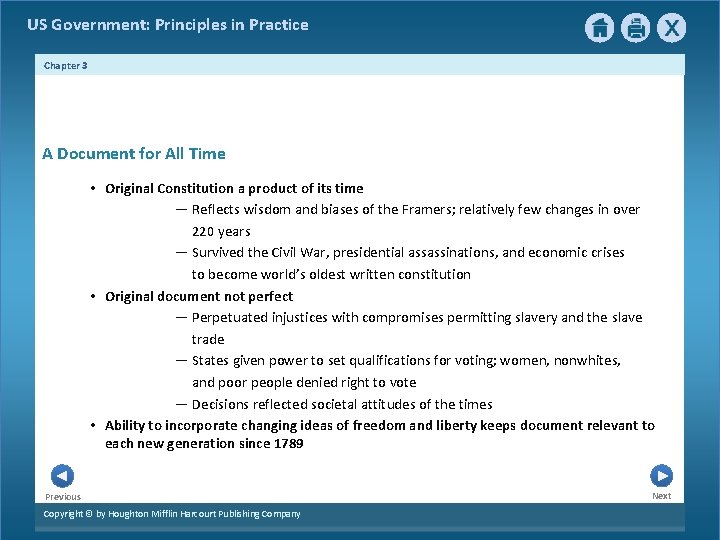
US Government: Principles in Practice Chapter 3 A Document for All Time • Original Constitution a product of its time — Reflects wisdom and biases of the Framers; relatively few changes in over 220 years — Survived the Civil War, presidential assassinations, and economic crises to become world’s oldest written constitution • Original document not perfect — Perpetuated injustices with compromises permitting slavery and the slave trade — States given power to set qualifications for voting; women, nonwhites, and poor people denied right to vote — Decisions reflected societal attitudes of the times • Ability to incorporate changing ideas of freedom and liberty keeps document relevant to each new generation since 1789 Previous Copyright © by Houghton Mifflin Harcourt Publishing Company Next
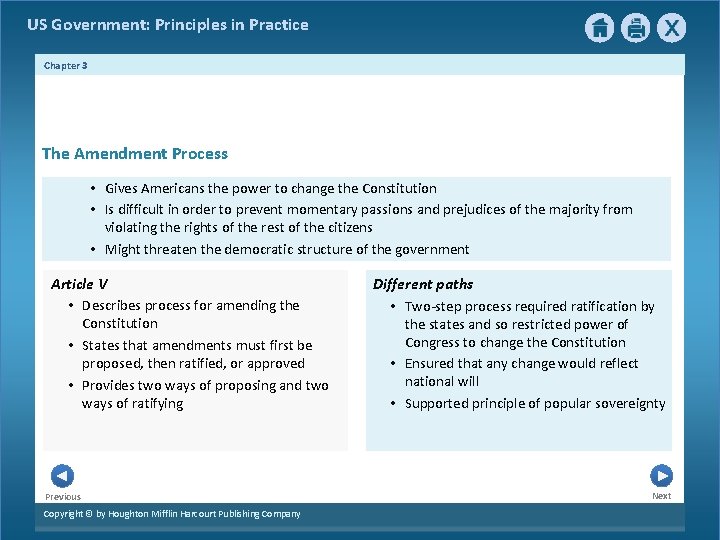
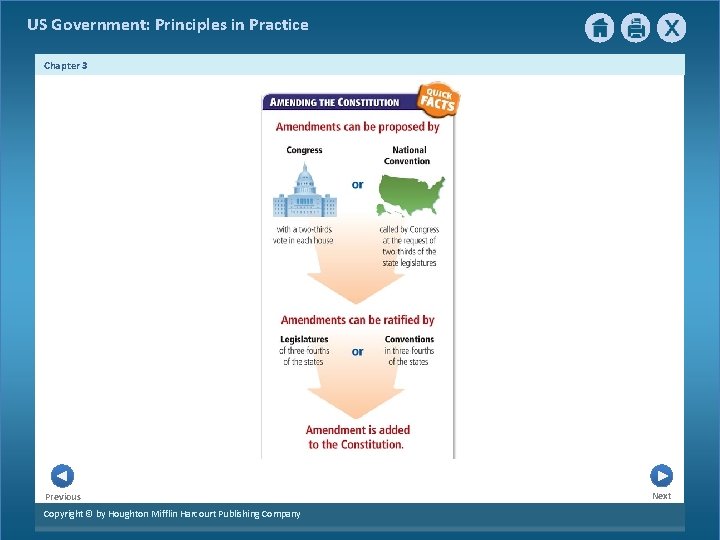
US Government: Principles in Practice Chapter 3 The Amendment Process • Gives Americans the power to change the Constitution • Is difficult in order to prevent momentary passions and prejudices of the majority from violating the rights of the rest of the citizens • Might threaten the democratic structure of the government Article V • Describes process for amending the Constitution • States that amendments must first be proposed, then ratified, or approved • Provides two ways of proposing and two ways of ratifying Previous Copyright © by Houghton Mifflin Harcourt Publishing Company Different paths • Two-step process required ratification by the states and so restricted power of Congress to change the Constitution • Ensured that any change would reflect national will • Supported principle of popular sovereignty Next
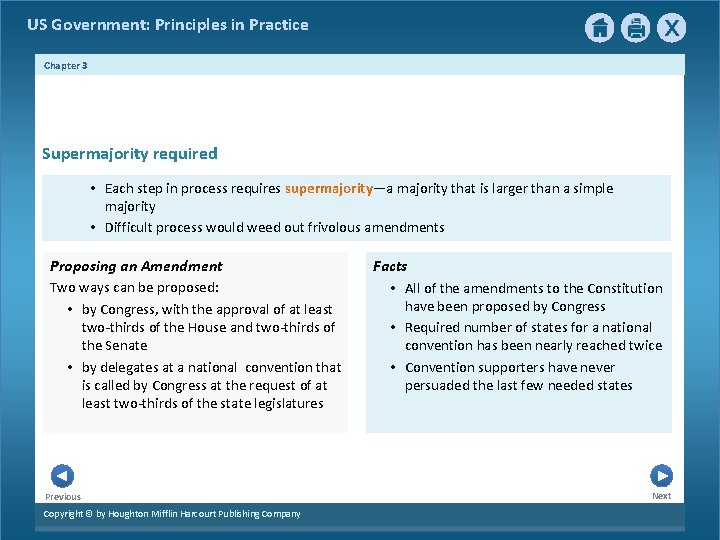
US Government: Principles in Practice Chapter 3 Supermajority required • Each step in process requires supermajority—a majority that is larger than a simple majority • Difficult process would weed out frivolous amendments Proposing an Amendment Two ways can be proposed: • by Congress, with the approval of at least two-thirds of the House and two-thirds of the Senate • by delegates at a national convention that is called by Congress at the request of at least two-thirds of the state legislatures Previous Copyright © by Houghton Mifflin Harcourt Publishing Company Facts • All of the amendments to the Constitution have been proposed by Congress • Required number of states for a national convention has been nearly reached twice • Convention supporters have never persuaded the last few needed states Next
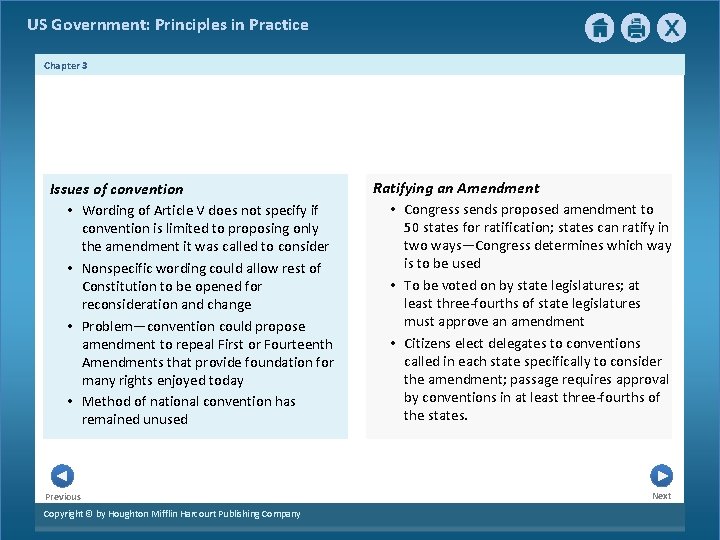
US Government: Principles in Practice Chapter 3 Issues of convention • Wording of Article V does not specify if convention is limited to proposing only the amendment it was called to consider • Nonspecific wording could allow rest of Constitution to be opened for reconsideration and change • Problem—convention could propose amendment to repeal First or Fourteenth Amendments that provide foundation for many rights enjoyed today • Method of national convention has remained unused Previous Copyright © by Houghton Mifflin Harcourt Publishing Company Ratifying an Amendment • Congress sends proposed amendment to 50 states for ratification; states can ratify in two ways—Congress determines which way is to be used • To be voted on by state legislatures; at least three-fourths of state legislatures must approve an amendment • Citizens elect delegates to conventions called in each state specifically to consider the amendment; passage requires approval by conventions in at least three-fourths of the states. Next
US Government: Principles in Practice Chapter 3 Previous Copyright © by Houghton Mifflin Harcourt Publishing Company Next
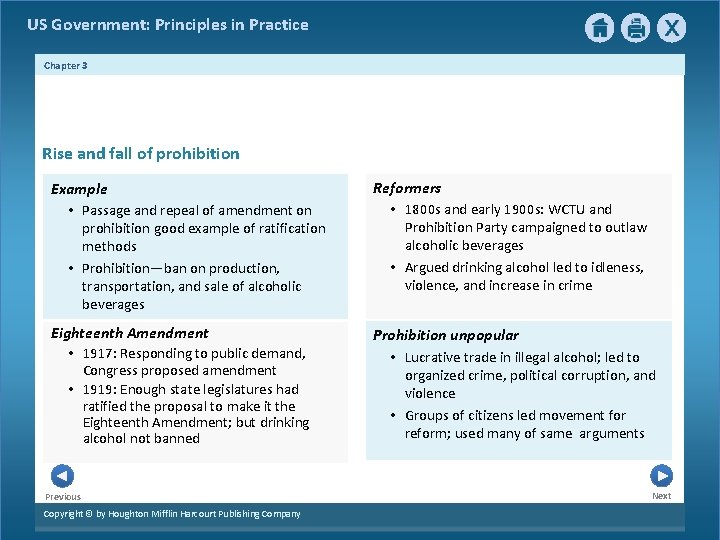
US Government: Principles in Practice Chapter 3 Rise and fall of prohibition Example • Passage and repeal of amendment on Reformers • 1800 s and early 1900 s: WCTU and Eighteenth Amendment • 1917: Responding to public demand, Prohibition unpopular • Lucrative trade in illegal alcohol; led to prohibition good example of ratification methods • Prohibition—ban on production, transportation, and sale of alcoholic beverages Congress proposed amendment • 1919: Enough state legislatures had ratified the proposal to make it the Eighteenth Amendment; but drinking alcohol not banned Previous Copyright © by Houghton Mifflin Harcourt Publishing Company Prohibition Party campaigned to outlaw alcoholic beverages • Argued drinking alcohol led to idleness, violence, and increase in crime organized crime, political corruption, and violence • Groups of citizens led movement for reform; used many of same arguments Next
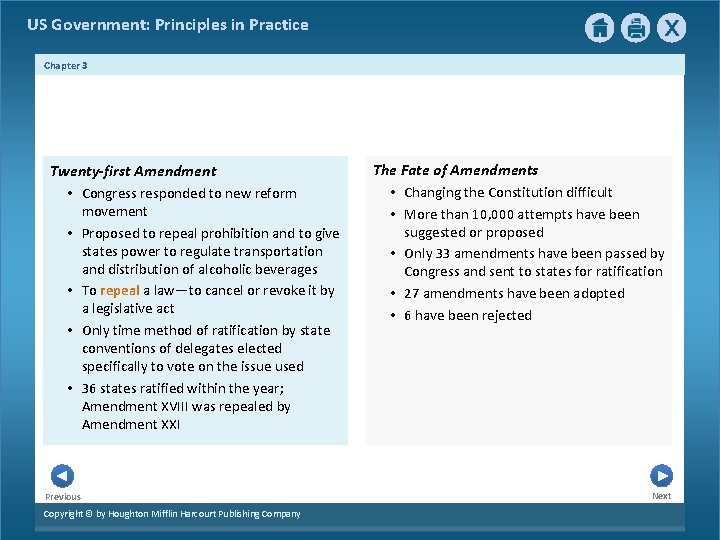
US Government: Principles in Practice Chapter 3 Twenty-first Amendment • Congress responded to new reform • • movement Proposed to repeal prohibition and to give states power to regulate transportation and distribution of alcoholic beverages To repeal a law—to cancel or revoke it by a legislative act Only time method of ratification by state conventions of delegates elected specifically to vote on the issue used 36 states ratified within the year; Amendment XVIII was repealed by Amendment XXI Previous Copyright © by Houghton Mifflin Harcourt Publishing Company The Fate of Amendments • Changing the Constitution difficult • More than 10, 000 attempts have been suggested or proposed • Only 33 amendments have been passed by Congress and sent to states for ratification • 27 amendments have been adopted • 6 have been rejected Next
US Government: Principles in Practice Chapter 3 Previous Copyright © by Houghton Mifflin Harcourt Publishing Company Next
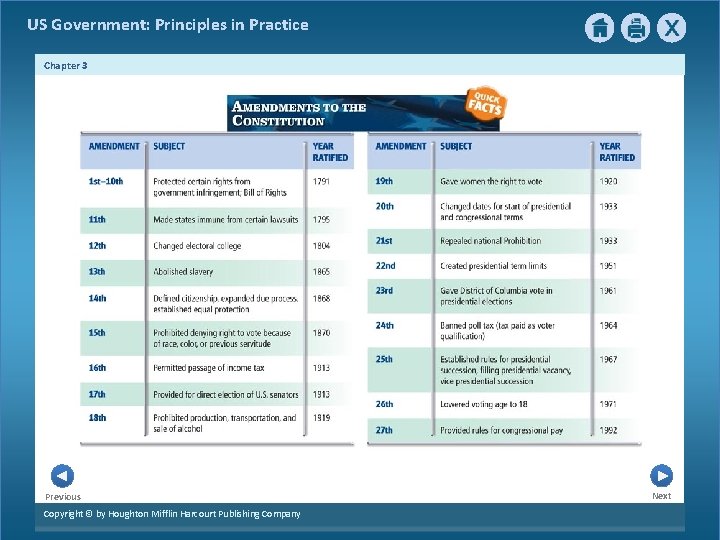
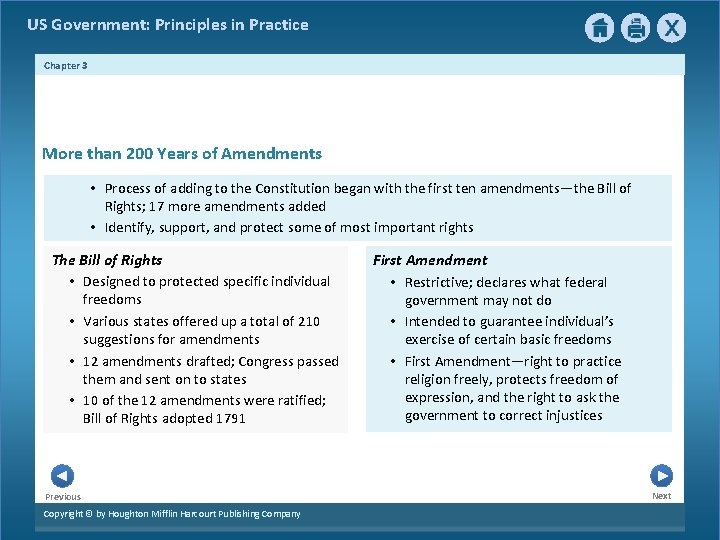
US Government: Principles in Practice Chapter 3 More than 200 Years of Amendments • Process of adding to the Constitution began with the first ten amendments—the Bill of Rights; 17 more amendments added • Identify, support, and protect some of most important rights The Bill of Rights • Designed to protected specific individual freedoms • Various states offered up a total of 210 suggestions for amendments • 12 amendments drafted; Congress passed them and sent on to states • 10 of the 12 amendments were ratified; Bill of Rights adopted 1791 Previous Copyright © by Houghton Mifflin Harcourt Publishing Company First Amendment • Restrictive; declares what federal government may not do • Intended to guarantee individual’s exercise of certain basic freedoms • First Amendment—right to practice religion freely, protects freedom of expression, and the right to ask the government to correct injustices Next
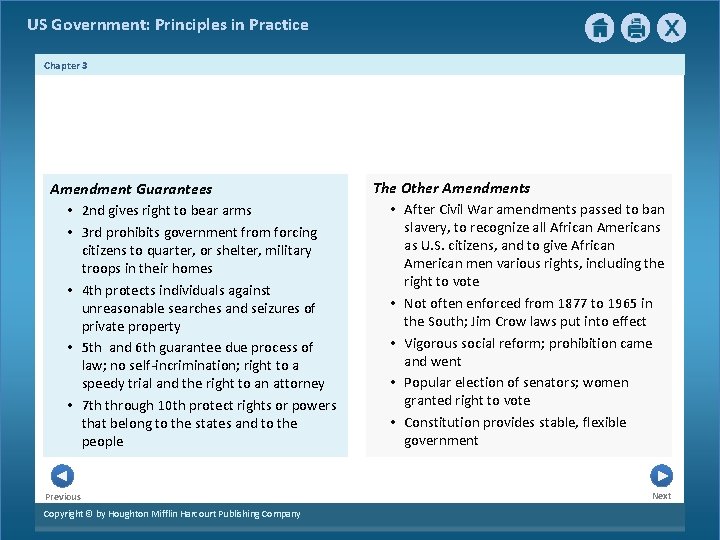
US Government: Principles in Practice Chapter 3 Amendment Guarantees • 2 nd gives right to bear arms • 3 rd prohibits government from forcing citizens to quarter, or shelter, military troops in their homes • 4 th protects individuals against unreasonable searches and seizures of private property • 5 th and 6 th guarantee due process of law; no self-incrimination; right to a speedy trial and the right to an attorney • 7 th through 10 th protect rights or powers that belong to the states and to the people Previous Copyright © by Houghton Mifflin Harcourt Publishing Company The Other Amendments • After Civil War amendments passed to ban • • slavery, to recognize all African Americans as U. S. citizens, and to give African American men various rights, including the right to vote Not often enforced from 1877 to 1965 in the South; Jim Crow laws put into effect Vigorous social reform; prohibition came and went Popular election of senators; women granted right to vote Constitution provides stable, flexible government Next
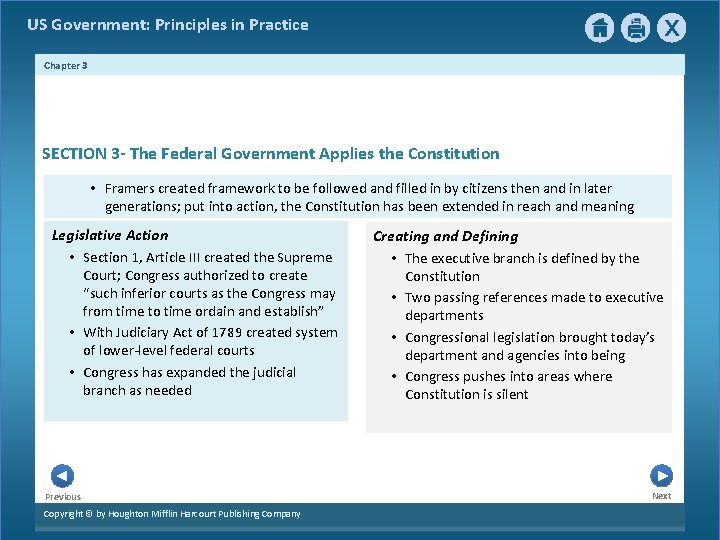
US Government: Principles in Practice Chapter 3 SECTION 3 - The Federal Government Applies the Constitution • Framers created framework to be followed and filled in by citizens then and in later generations; put into action, the Constitution has been extended in reach and meaning Legislative Action • Section 1, Article III created the Supreme Court; Congress authorized to create “such inferior courts as the Congress may from time to time ordain and establish” • With Judiciary Act of 1789 created system of lower-level federal courts • Congress has expanded the judicial branch as needed Previous Copyright © by Houghton Mifflin Harcourt Publishing Company Creating and Defining • The executive branch is defined by the Constitution • Two passing references made to executive departments • Congressional legislation brought today’s department and agencies into being • Congress pushes into areas where Constitution is silent Next
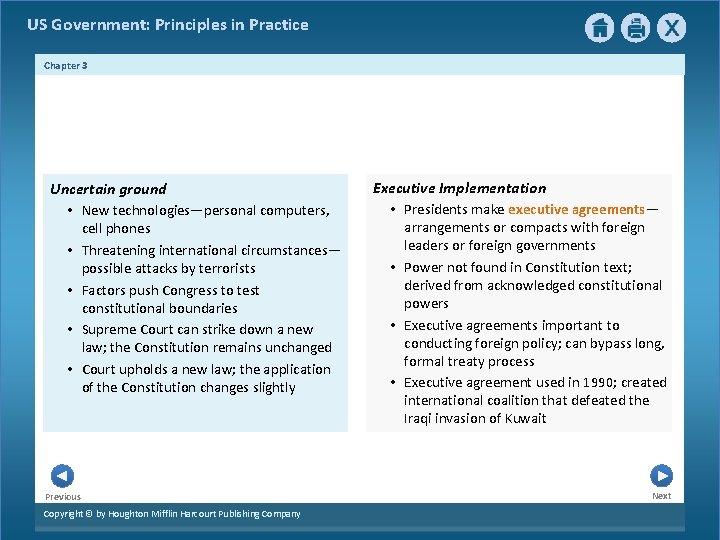
US Government: Principles in Practice Chapter 3 Uncertain ground • New technologies—personal computers, • • cell phones Threatening international circumstances— possible attacks by terrorists Factors push Congress to test constitutional boundaries Supreme Court can strike down a new law; the Constitution remains unchanged Court upholds a new law; the application of the Constitution changes slightly Previous Copyright © by Houghton Mifflin Harcourt Publishing Company Executive Implementation • Presidents make executive agreements— arrangements or compacts with foreign leaders or foreign governments • Power not found in Constitution text; derived from acknowledged constitutional powers • Executive agreements important to conducting foreign policy; can bypass long, formal treaty process • Executive agreement used in 1990; created international coalition that defeated the Iraqi invasion of Kuwait Next
US Government: Principles in Practice Chapter 3 • Executive agreement has the force of a treaty; does not require Senate ratification • Congress has authorized majority in advance or has approved them after signing; most require subsequent congressional action • Actions of the executive department and agencies change way the Constitution applied or interpreted • Agencies must define their operations; carry out programs Congress has assigned to them • Executive branch agencies usually have rule-making power; rules have force of law; examples are medicine we take and tap water • Code of Federal Regulations, collection of all of the rules made by executive agencies; about 135, 000 pages long Previous Copyright © by Houghton Mifflin Harcourt Publishing Company Next
US Government: Principles in Practice Chapter 3 Judicial Interpretation • Modern-day cases a challenge • “Unreasonable searches and seizures” in an era of airport screening devices, cell phones, and wireless Internet access • Courts must interpret the Fourth Amendment in light of changing conditions; judges to apply the Constitution’s prohibitions to new technologies. • Setting legal standards for lawenforcement to follow when intercepting private conversations, monitoring e-mail, and using other “searching” methods Previous Copyright © by Houghton Mifflin Harcourt Publishing Company How to Interpret • “Strict” versus “loose” construction of the Constitution • Strict interpretation of the Constitution means giving the words in the document only their literal meaning • Loose construction means following the words plus any reasonable inferences that can be drawn from them • In debates over national bank Thomas Jefferson was a strict constructionist; Alexander Hamilton was a loose constructionist Next
US Government: Principles in Practice Chapter 3 Political Parties, Customs, and Traditions • Political parties and entrenched customs and traditions affect how the Constitution is interpreted, applied, and carried out. Political Parties • Political party—an organized group that seeks to win elections in order to influence the activities of government • Parties help determine the choice of candidates, policies, and programs presented to the voters • Parties also help shape the judicial branch; deeply affect how government operates Previous Copyright © by Houghton Mifflin Harcourt Publishing Company Legacy of Political Movements • Populists supported bank regulation; government regulation of railroads; unlimited coinage of silver; direct election of senators • Progressives took same causes as Populists; helped the urban poor • Federal government regulated banks, food and drug safety, railroads, and business monopolies • Now have PACs, online political commentators, and bloggers Next
US Government: Principles in Practice Chapter 3 Customs and Traditions • Strongly influence how American government behaves • Constitution authorizes the president to “require the opinion, in writing, of the principal officer in each of the executive departments” • Washington relied on language in Article II to create a cabinet—a group of advisers consisting of the heads of the executive departments; in time tradition of cabinet and cabinet meetings born • Some traditions have become law; no president served more than two terms in office until Roosevelt broke with tradition with third and fourth terms as president in the 1940 s • Many Americans concerned; Congress passed the Twenty-second Amendment • Presidents limited to two terms, formalizing the custom that began with Washington Previous Copyright © by Houghton Mifflin Harcourt Publishing Company Next
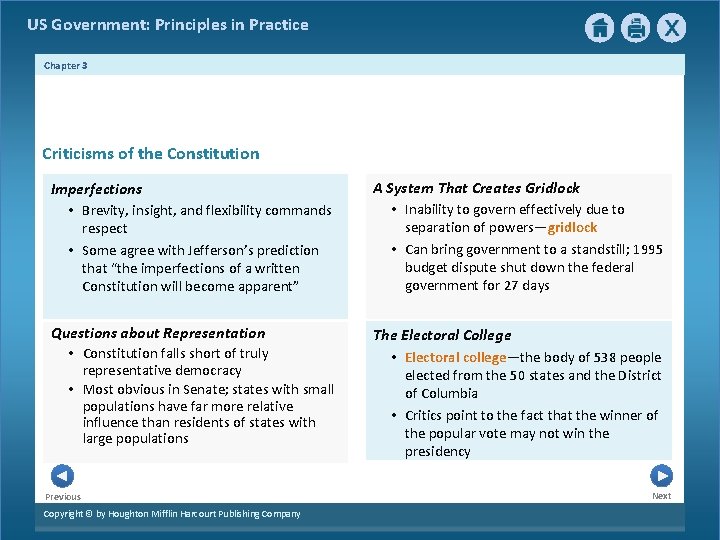
US Government: Principles in Practice Chapter 3 Criticisms of the Constitution Imperfections • Brevity, insight, and flexibility commands A System That Creates Gridlock • Inability to govern effectively due to Questions about Representation • Constitution falls short of truly The Electoral College • Electoral college—the body of 538 people respect • Some agree with Jefferson’s prediction that “the imperfections of a written Constitution will become apparent” representative democracy • Most obvious in Senate; states with small populations have far more relative influence than residents of states with large populations Previous Copyright © by Houghton Mifflin Harcourt Publishing Company separation of powers—gridlock • Can bring government to a standstill; 1995 budget dispute shut down the federal government for 27 days elected from the 50 states and the District of Columbia • Critics point to the fact that the winner of the popular vote may not win the presidency Next
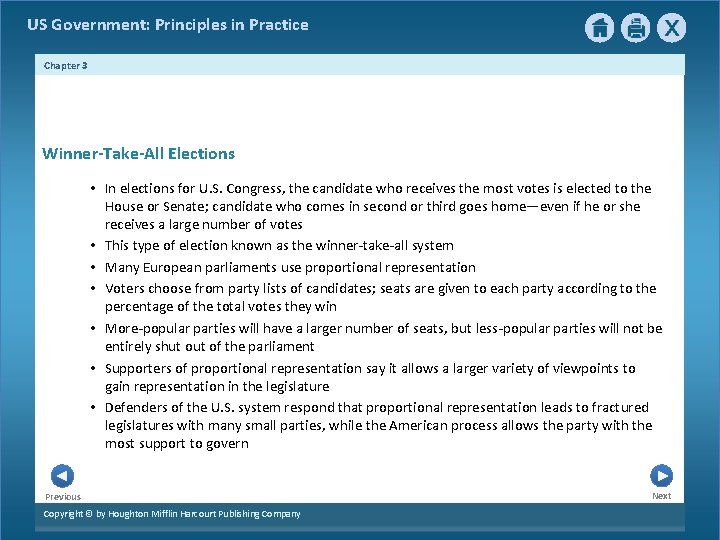
US Government: Principles in Practice Chapter 3 Winner-Take-All Elections • In elections for U. S. Congress, the candidate who receives the most votes is elected to the House or Senate; candidate who comes in second or third goes home—even if he or she receives a large number of votes • This type of election known as the winner-take-all system • Many European parliaments use proportional representation • Voters choose from party lists of candidates; seats are given to each party according to the percentage of the total votes they win • More-popular parties will have a larger number of seats, but less-popular parties will not be entirely shut of the parliament • Supporters of proportional representation say it allows a larger variety of viewpoints to gain representation in the legislature • Defenders of the U. S. system respond that proportional representation leads to fractured legislatures with many small parties, while the American process allows the party with the most support to govern Previous Copyright © by Houghton Mifflin Harcourt Publishing Company Next