PSYCHOLOGY PRINCIPLES IN PRACTICE Chapter 14 THEORIES OF



- Slides: 52
PSYCHOLOGY PRINCIPLES IN PRACTICE Chapter 14 THEORIES OF PERSONALITY Section 1: The Trait Approach 1 HOLT, RINEHART AND WINSTON
Chapter 14 Section 1: The Trait Approach PSYCHOLOGY PRINCIPLES IN PRACTICE Personality: The patterns of feelings, motives, and behavior that set people apart from one another. Five approaches to the study of personality: n Trait theory n Psychoanalytic theory n Learning theory n Humanistic theory n Sociocultural theory 2 HOLT, RINEHART AND WINSTON
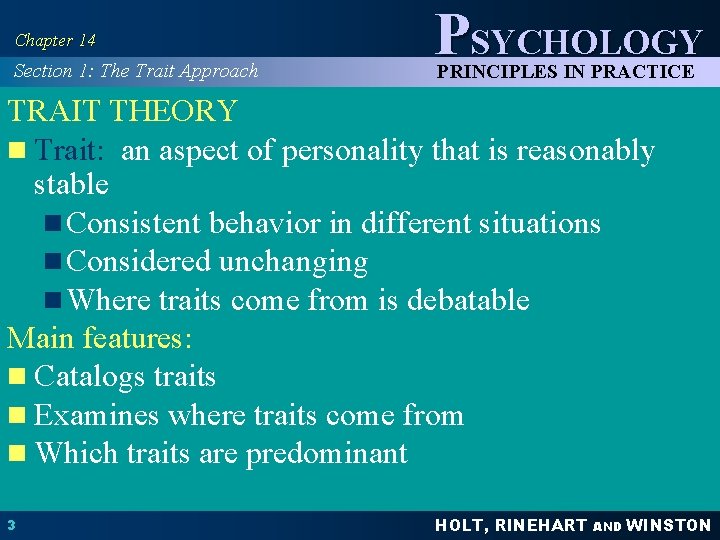
Chapter 14 Section 1: The Trait Approach PSYCHOLOGY PRINCIPLES IN PRACTICE TRAIT THEORY n Trait: an aspect of personality that is reasonably stable n Consistent behavior in different situations n Considered unchanging n Where traits come from is debatable Main features: n Catalogs traits n Examines where traits come from n Which traits are predominant 3 HOLT, RINEHART AND WINSTON
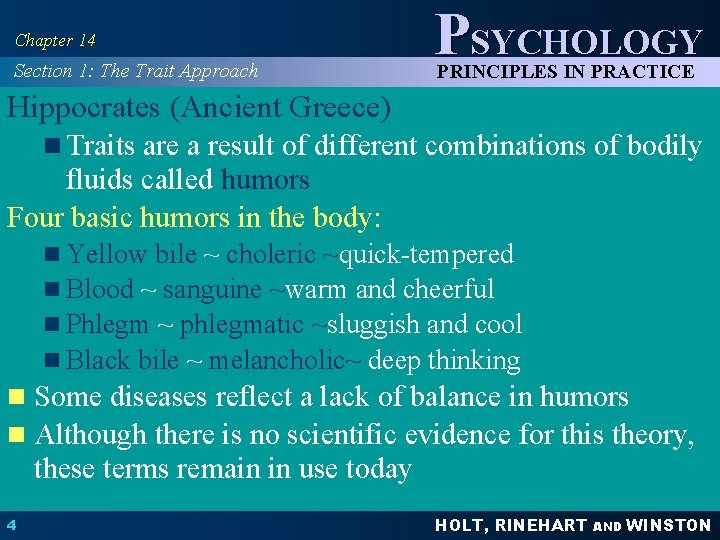
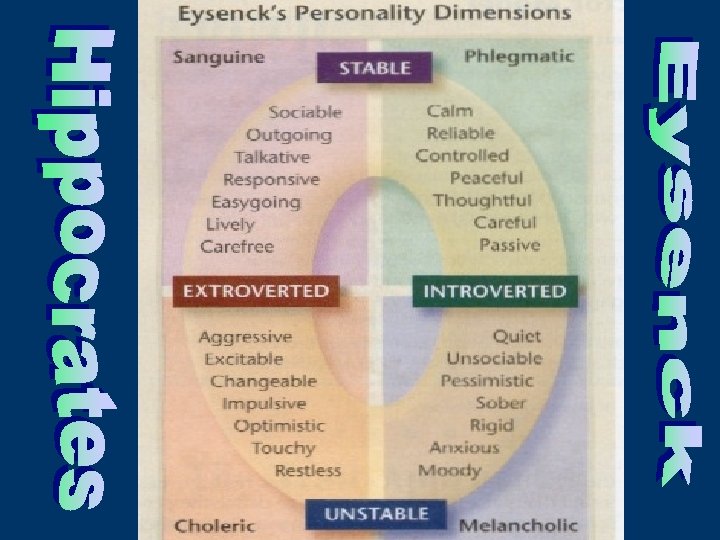
Chapter 14 Section 1: The Trait Approach PSYCHOLOGY PRINCIPLES IN PRACTICE Hippocrates (Ancient Greece) n Traits are a result of different combinations of bodily fluids called humors Four basic humors in the body: n Yellow bile ~ choleric ~quick-tempered n Blood ~ sanguine ~warm and cheerful n Phlegm ~ phlegmatic ~sluggish and cool n Black bile ~ melancholic~ deep thinking n Some diseases reflect a lack of balance in humors n Although there is no scientific evidence for this theory, these terms remain in use today 4 HOLT, RINEHART AND WINSTON
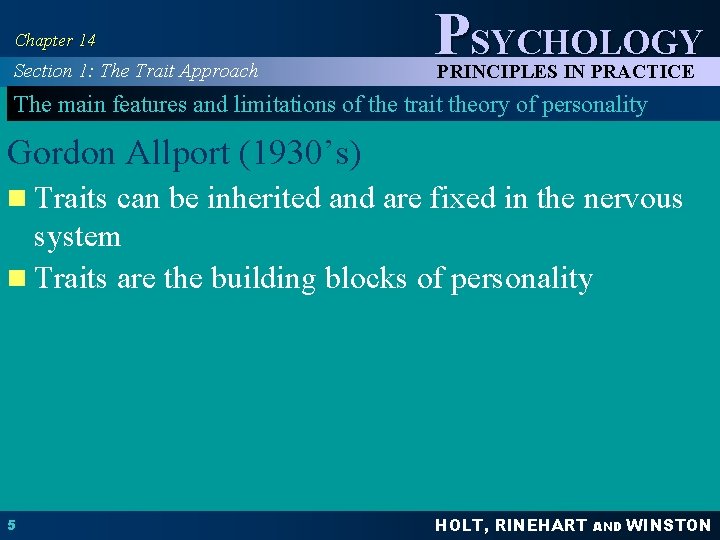
Chapter 14 Section 1: The Trait Approach PSYCHOLOGY PRINCIPLES IN PRACTICE The main features and limitations of the trait theory of personality Gordon Allport (1930’s) n Traits can be inherited and are fixed in the nervous system n Traits are the building blocks of personality 5 HOLT, RINEHART AND WINSTON
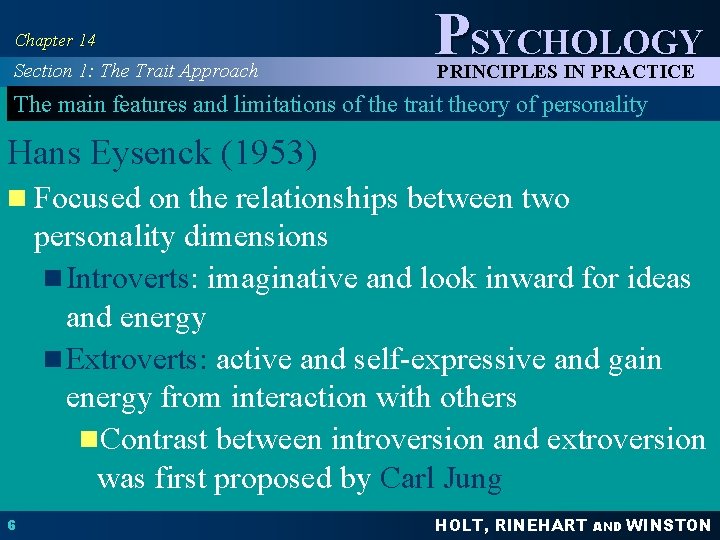
Chapter 14 Section 1: The Trait Approach PSYCHOLOGY PRINCIPLES IN PRACTICE The main features and limitations of the trait theory of personality Hans Eysenck (1953) n Focused on the relationships between two personality dimensions n Introverts: imaginative and look inward for ideas and energy n Extroverts: active and self-expressive and gain energy from interaction with others n. Contrast between introversion and extroversion was first proposed by Carl Jung 6 HOLT, RINEHART AND WINSTON
Chapter 14 Section 1: The Trait Approach PSYCHOLOGY PRINCIPLES IN PRACTICE n Eysenck added the dimensions of introversion- extroversion and emotional stability-instability n. Stable people are reliable, composed, and rational n. Unstable people can be agitated and unpredictable 7 HOLT, RINEHART AND WINSTON
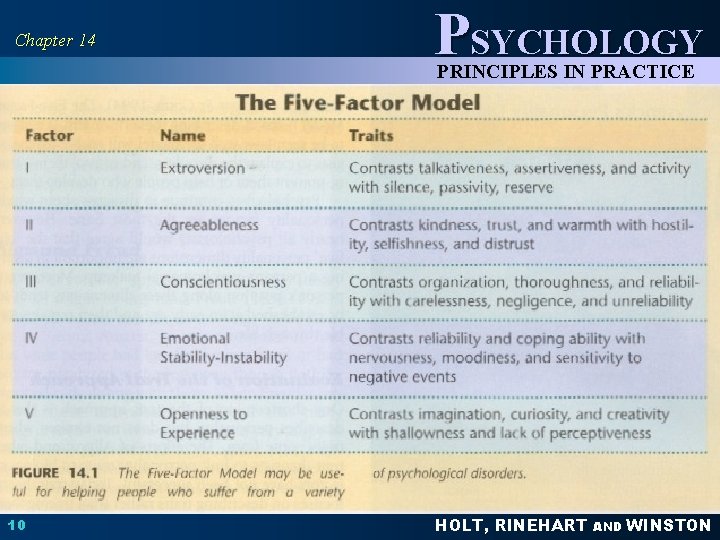
Chapter 14 Section 1: The Trait Approach PSYCHOLOGY PRINCIPLES IN PRACTICE The Five-Factor Model (2000) n Extroversion (Eysenck) n Emotional stability (Eysenck) n Conscientiousness n Agreeableness n Openness to experience n Related to basic temperaments which are largely inborn n Cross-cultural traits are the same, but expression differs n Personalities tend to mature rather than be shaped by environment 9 HOLT, RINEHART AND WINSTON
Chapter 14 PSYCHOLOGY PRINCIPLES IN PRACTICE 10 HOLT, RINEHART AND WINSTON
Chapter 14 Section 1: The Trait Approach PSYCHOLOGY PRINCIPLES IN PRACTICE Short comings of the trait approach: n Describes personality but does not explain where traits come from n Personality traits can’t be linked to biological factors n Describes traits rather than tracing their origins Practical Applications: n Since there are links between personality, ability, and interests, we can match people to educational programs and jobs. 11 HOLT, RINEHART AND WINSTON
PSYCHOLOGY PRINCIPLES IN PRACTICE Chapter 14 THEORIES OF PERSONALITY Section 2: The Psychoanalytic Approach 12 HOLT, RINEHART AND WINSTON
Chapter 14 Section 2: The Psychoanalytic Approach PSYCHOLOGY PRINCIPLES IN PRACTICE The Psychoanalytic Approach n People are born with biological drives such as aggression, sex, and the need for superiority n Could conflict with laws, social norms, and moral codes that have previously been internalized n Behavior, thoughts, and emotions represent the outcome of inner contests between the opposing forces of drives and rules 13 HOLT, RINEHART AND WINSTON
Chapter 14 Section 2: The Psychoanalytic Approach PSYCHOLOGY PRINCIPLES IN PRACTICE Sigmund Freud (1856 -1939) n “Inner Conflict” Approach n Physical symptoms with no medical reason n Anxious or angry but refuse to recognize it n Conscious ideas and feelings occupy only a small part of the mind n Many thoughts, fears, and urges remain in the unconscious n Used psychoanalysis to explore the unconscious n Called the “talking cure” 14 HOLT, RINEHART AND WINSTON
Chapter 14 Section 2: The Psychoanalytic Approach PSYCHOLOGY PRINCIPLES IN PRACTICE n Used dream analysis n People experience unconscious wishes in their dreams—often in disguised form n. Recorded dreams, then Freud helped explore the hidden meanings n Used hypnosis n Better access to unconscious thoughts n Later abandoned it because people denied the things they said 15 HOLT, RINEHART AND WINSTON
Chapter 14 Section 2: The Psychoanalytic Approach PSYCHOLOGY PRINCIPLES IN PRACTICE Id, Ego, and Superego n Three psychological structures: n Id—represents basic drives such as hunger n. Like the stereotypical two-year-old n. Demands pleasure through instant gratification n. Pays no attention to laws, social customs, or the needs of others n“I want what I want, and I want it now” n. Follows the pleasure principle—the urge for an immediate release of energy or emotion that will bring personal gratification, relief, or pleasure n. Present at birth 16 HOLT, RINEHART AND WINSTON
Chapter 14 Section 2: The Psychoanalytic Approach PSYCHOLOGY PRINCIPLES IN PRACTICE n Ego—develops because a child’s demands for instant gratification cannot be met or because meeting these demands may be harmful n“Stands for reason and good sense” n. Guided by the reality principle —the understanding that in the real world we cannot always get what we want 17 HOLT, RINEHART AND WINSTON
Chapter 14 Section 2: The Psychoanalytic Approach PSYCHOLOGY PRINCIPLES IN PRACTICE n. Seeks to satisfy the id in ways that are consistent with reality n. Example: to satisfy hunger you cook a hamburger instead of eating it raw n. Provides the conscious sense of self n. Some functions carried out unconsciously n. Example: acts as a censor that screens out the wild impulses of the id by trying to repress them 18 HOLT, RINEHART AND WINSTON
Chapter 14 Section 2: The Psychoanalytic Approach PSYCHOLOGY PRINCIPLES IN PRACTICE n Superego—develops throughout early childhood n Functions according to the moral principle —by incorporating the standards and values of parents and the community n Acts as the conscience and floods the ego with feelings of guilt and shame when we think or do something that society defines as wrong 19 HOLT, RINEHART AND WINSTON
Chapter 14 Section 2: The Psychoanalytic Approach PSYCHOLOGY PRINCIPLES IN PRACTICE n The ego gets caught between the conflicting messages of the id and the superego n. The id may urge, “Go out with your friends, study later. ” The superego warns “study or you won’t pass the test” n. People with healthy egos find ways to balance the id’s demands and the superego’s warnings 20 HOLT, RINEHART AND WINSTON
Chapter 14 PSYCHOLOGY PRINCIPLES IN PRACTICE Id, Ego, & Superego Explained http: //www. youtube. com/watch? v=Mkin 1 Fhoj. Co 21 HOLT, RINEHART AND WINSTON
Chapter 14 Section 2: The Psychoanalytic Approach PSYCHOLOGY PRINCIPLES IN PRACTICE Defense Mechanisms n Unconscious methods the ego uses to avoid recognizing ideas or emotions that may cause personal anxiety n Repression—removes anxiety-causing ideas from conscious awareness n. Can cause people to “explode” and develop other psychological problems n Rationalization—use of self-deception to justify unacceptable behaviors or ideas n Displacement—transfer of an idea or impulse from a threatening object to a less threatening object 22 HOLT, RINEHART AND WINSTON
Chapter 14 Section 2: The Psychoanalytic Approach PSYCHOLOGY PRINCIPLES IN PRACTICE n Regression—behavior from an earlier stage of development brought on by stress n Projection—seeing your own faults in other people n Reaction Formation—act contrary to genuine feelings in order to keep true feelings hidden n. Being attracted to someone and being mean to them n Denial—refuse to accept the reality of anything that is bad or upsetting n. Smokers; “It won’t happen to me” n Sublimation—channeling basic impulses into socially acceptable behavior n. Being angry and playing sports 23 HOLT, RINEHART AND WINSTON
Chapter 14 Section 2: The Psychoanalytic Approach PSYCHOLOGY PRINCIPLES IN PRACTICE Effects of Defense Mechanisms n When used in moderation, may be normal and even useful to protect from pain, anxiety, guilt, and shame n Becomes unhealthy when the underlying issues causing the feelings are ignored n A strong, healthy ego is able to balance the id and the superego without the use of defense mechanisms 24 HOLT, RINEHART AND WINSTON
Chapter 14 Section 2: The Psychoanalytic Approach PSYCHOLOGY PRINCIPLES IN PRACTICE Freud’s Five Stages of Development n These stages are aided by a psychological energy Freud labeled libido (Latin for desire) n Children encounter conflicts during each stage n Unresolved, they might become stuck at an early stage of development and carry that stage into adulthood 25 HOLT, RINEHART AND WINSTON
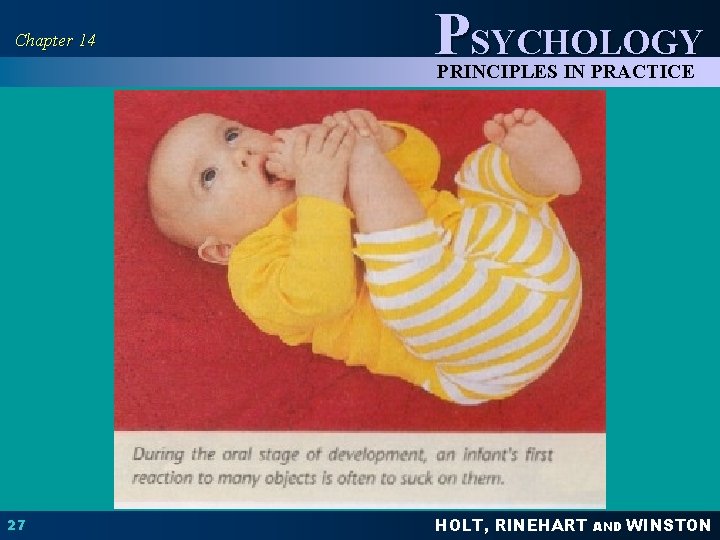
Chapter 14 Section 2: The Psychoanalytic Approach PSYCHOLOGY PRINCIPLES IN PRACTICE The Oral Stage n Begins the first year of life n Infants explore by putting things in their mouths n An infants survival is dependent on the attention of adults n A child whose needs are not met at this stage may become fixated here as adults n. Smoking, overeating, excessive talking, and nail biting n. Clinging, dependent interpersonal relationships 26 HOLT, RINEHART AND WINSTON
Chapter 14 PSYCHOLOGY PRINCIPLES IN PRACTICE 27 HOLT, RINEHART AND WINSTON
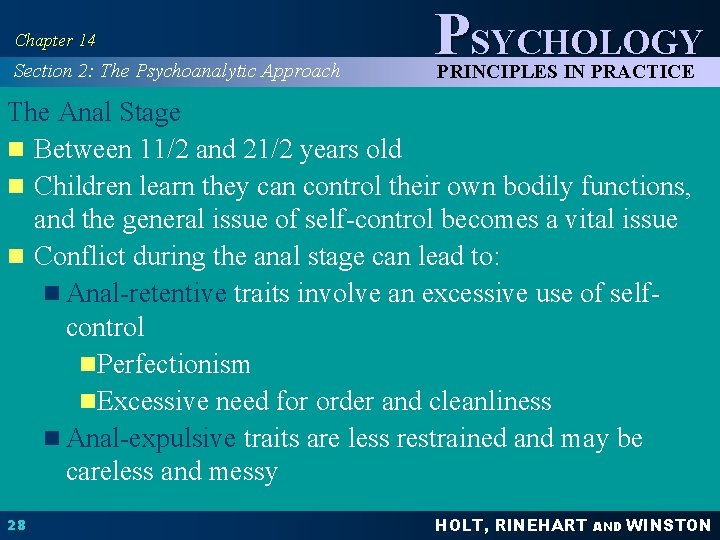
Chapter 14 Section 2: The Psychoanalytic Approach PSYCHOLOGY PRINCIPLES IN PRACTICE The Anal Stage n Between 11/2 and 21/2 years old n Children learn they can control their own bodily functions, and the general issue of self-control becomes a vital issue n Conflict during the anal stage can lead to: n Anal-retentive traits involve an excessive use of selfcontrol n. Perfectionism n. Excessive need for order and cleanliness n Anal-expulsive traits are less restrained and may be careless and messy 28 HOLT, RINEHART AND WINSTON
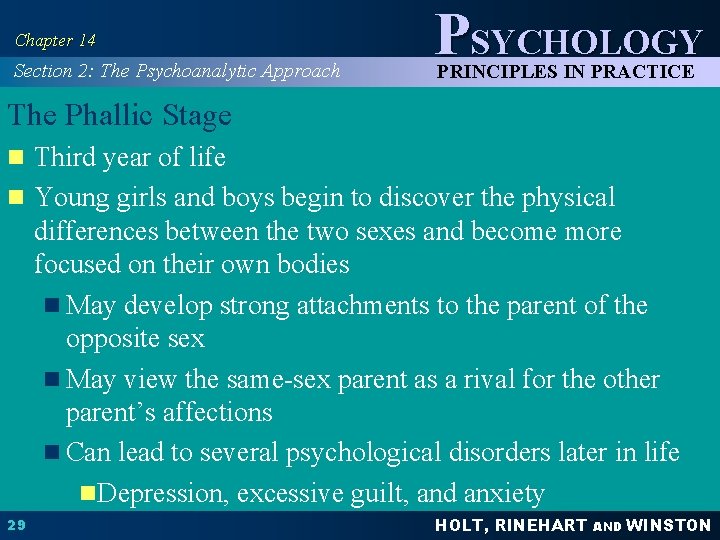
Chapter 14 Section 2: The Psychoanalytic Approach PSYCHOLOGY PRINCIPLES IN PRACTICE The Phallic Stage n Third year of life n Young girls and boys begin to discover the physical differences between the two sexes and become more focused on their own bodies n May develop strong attachments to the parent of the opposite sex n May view the same-sex parent as a rival for the other parent’s affections n Can lead to several psychological disorders later in life n. Depression, excessive guilt, and anxiety 29 HOLT, RINEHART AND WINSTON
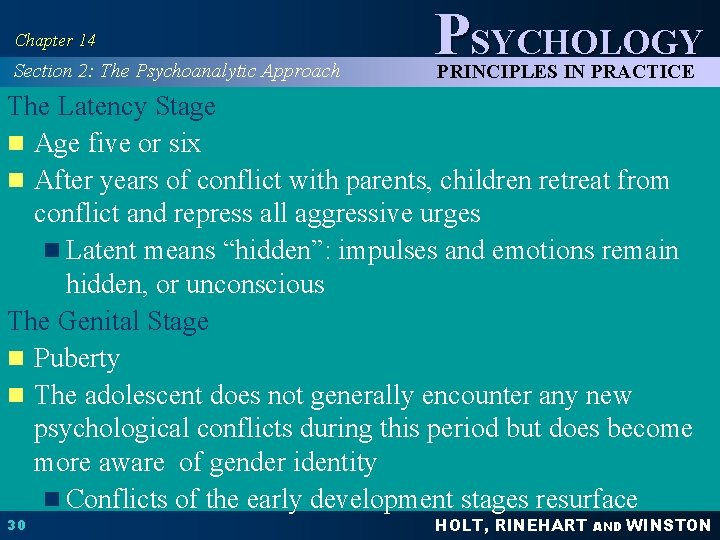
Chapter 14 Section 2: The Psychoanalytic Approach PSYCHOLOGY PRINCIPLES IN PRACTICE The Latency Stage n Age five or six n After years of conflict with parents, children retreat from conflict and repress all aggressive urges n Latent means “hidden”: impulses and emotions remain hidden, or unconscious The Genital Stage n Puberty n The adolescent does not generally encounter any new psychological conflicts during this period but does become more aware of gender identity n Conflicts of the early development stages resurface 30 HOLT, RINEHART AND WINSTON
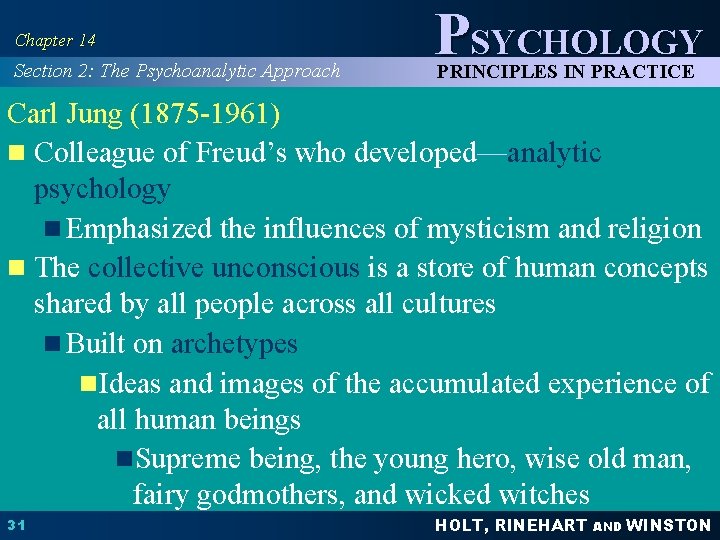
Chapter 14 Section 2: The Psychoanalytic Approach PSYCHOLOGY PRINCIPLES IN PRACTICE Carl Jung (1875 -1961) n Colleague of Freud’s who developed—analytic psychology n Emphasized the influences of mysticism and religion n The collective unconscious is a store of human concepts shared by all people across all cultures n Built on archetypes n. Ideas and images of the accumulated experience of all human beings n. Supreme being, the young hero, wise old man, fairy godmothers, and wicked witches 31 HOLT, RINEHART AND WINSTON
Chapter 14 Section 2: The Psychoanalytic Approach PSYCHOLOGY PRINCIPLES IN PRACTICE n These images appear in our dreams n Influence our thoughts and feelings and help form a foundation on which personality develops n The sense of self is a unifying force of personality that gives people direction and provides a sense of completeness n Characterized by four functions of the mind n. Thinking, feeling, intuition, and sensation n. We are identified by our primary form of expression n Most psychologists consider Jung’s theory unscientific 32 HOLT, RINEHART AND WINSTON
Chapter 14 Section 2: The Psychoanalytic Approach PSYCHOLOGY PRINCIPLES IN PRACTICE Alfred Alder (1870 -1937) n We are motivated by a need to overcome feelings of inferiority—inferiority complex n Based on the need to compensate for n. Physical problems or our small size as children n Drive for superiority n Causes sibling rivalry n Self awareness plays a major role in the formation of personality n Strives to overcome obstacles and develop the individual’s unique potential 33 HOLT, RINEHART AND WINSTON
Chapter 14 Section 2: The Psychoanalytic Approach PSYCHOLOGY PRINCIPLES IN PRACTICE Karen Horney (1885 -1952) n Childhood experiences play a major role in the development of adult personality n The greatest influence are social relationships n Parent-child relationships are the most important n. Children treated with indifference or harshness develop feelings of insecurity called basic anxiety n. Neglectful parents cause feelings of hostility n. Children repress feelings of hostility because they would fear driving their parents away n. Genuine, consistent love could temper the effects of even the most painful childhood 34 HOLT, RINEHART AND WINSTON
Chapter 14 Section 2: The Psychoanalytic Approach PSYCHOLOGY PRINCIPLES IN PRACTICE Erikson (1902 -1994) n Social relationships are the most important factors in personality development n Emphasis on the mother-infant relationship n More power to the ego than Freud allowed n People are entirely capable of making real and meaningful choices n Expands Freud’s five stages into adulthood— psychosocial theory n Named his stages after the traits people might develop during each of them 35 HOLT, RINEHART AND WINSTON
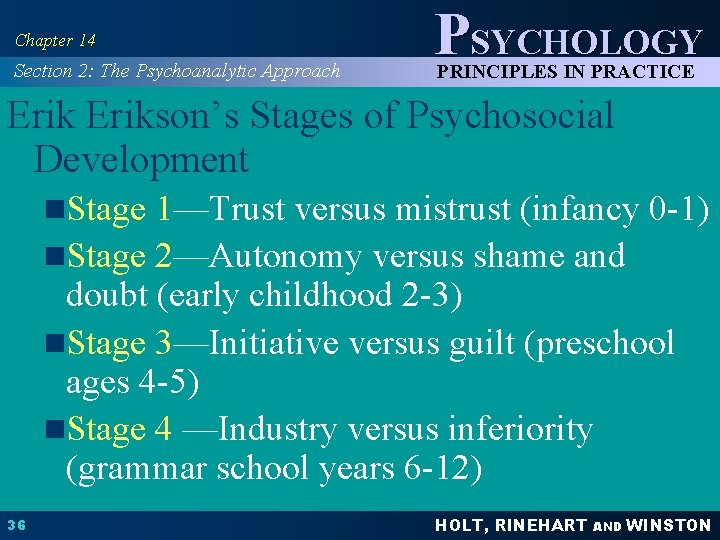
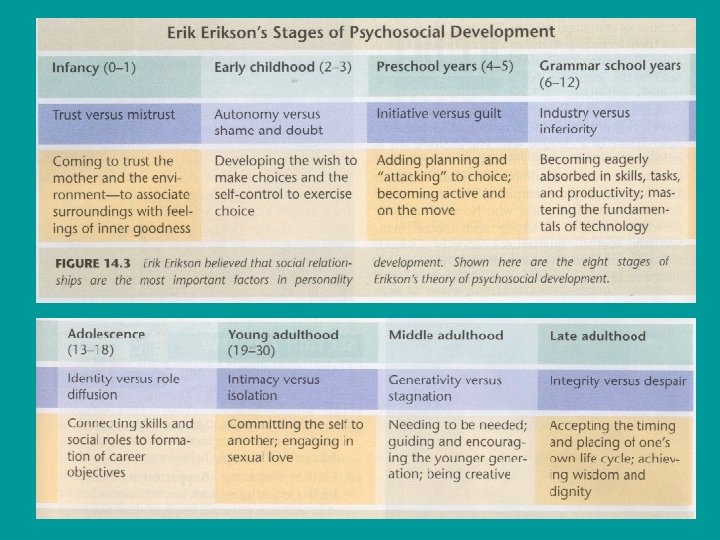
Chapter 14 Section 2: The Psychoanalytic Approach PSYCHOLOGY PRINCIPLES IN PRACTICE Erikson’s Stages of Psychosocial Development n. Stage 1—Trust versus mistrust (infancy 0 -1) n. Stage 2—Autonomy versus shame and doubt (early childhood 2 -3) n. Stage 3—Initiative versus guilt (preschool ages 4 -5) n. Stage 4 —Industry versus inferiority (grammar school years 6 -12) 36 HOLT, RINEHART AND WINSTON
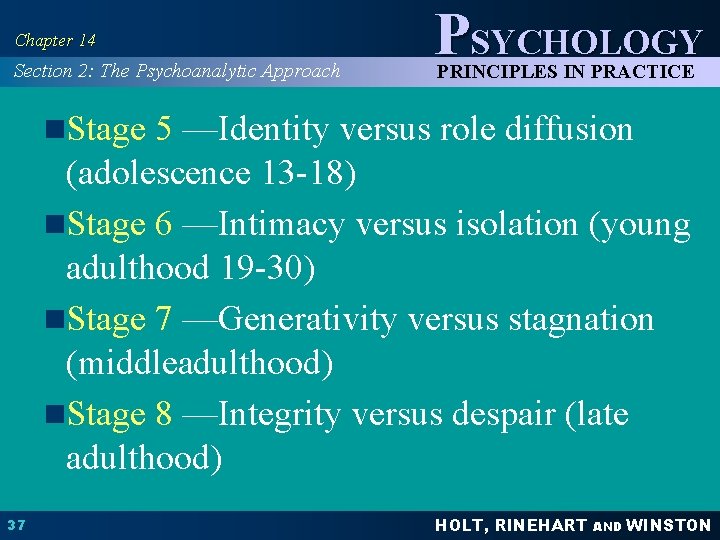
Chapter 14 Section 2: The Psychoanalytic Approach PSYCHOLOGY PRINCIPLES IN PRACTICE n. Stage 5 —Identity versus role diffusion (adolescence 13 -18) n. Stage 6 —Intimacy versus isolation (young adulthood 19 -30) n. Stage 7 —Generativity versus stagnation (middleadulthood) n. Stage 8 —Integrity versus despair (late adulthood) 37 HOLT, RINEHART AND WINSTON
PSYCHOLOGY PRINCIPLES IN PRACTICE Chapter 14 THEORIES OF PERSONALITY Section 3: The Learning Approach 39 HOLT, RINEHART AND WINSTON
Chapter 14 Section 3: The Learning Approach PSYCHOLOGY PRINCIPLES IN PRACTICE LEARNING THEORISTS Behaviorism n James B. Watson (1924) external forces shape behavior n B. F. Skinner (1938) study behavior rather than the mind n. Emphasized reinforcement n Disregarded personal freedom, choice, and selfdirection n. We are shaped into wanting what is good for society at an early age 40 HOLT, RINEHART AND WINSTON
Chapter 14 Section 3: The Learning Approach PSYCHOLOGY PRINCIPLES IN PRACTICE Social-Learning Theory § Focuses on learning by observation and cognitive processes § Extends to reading about others or watching them on t. v. § Internal variables influence how we act: §Skills, Values, Goals, Expectations, Selfefficacy expectations 41 HOLT, RINEHART AND WINSTON
Chapter 14 Section 3: The Learning Approach PSYCHOLOGY PRINCIPLES IN PRACTICE Strengths and Weaknesses n. Emphasizes environment n. Learn by reinforcement n Limited in explaining personality n Does not explain inner human experience n Does not deal with thoughts or feelings n Not enough attention given to genetics 42 HOLT, RINEHART AND WINSTON
PSYCHOLOGY PRINCIPLES IN PRACTICE Chapter 14 THEORIES OF PERSONALITY Section 4: The Humanistic Approach 43 HOLT, RINEHART AND WINSTON
Chapter 14 Section 4: The Humanistic Approach PSYCHOLOGY PRINCIPLES IN PRACTICE HUMANISTIC APPROACH Beliefs: n Self-awareness is the core of humanity n Focuses on self-fulfillment and ethical conduct n People have the freedom to create their own personalities n Focuses on conscious experience 44 HOLT, RINEHART AND WINSTON
Chapter 14 Section 4: The Humanistic Approach PSYCHOLOGY PRINCIPLES IN PRACTICE Abraham Maslow (1908 -1970) n Humans are separated from animals because they recognize their desire to achieve selfactualization to reach their full potential Carl Rogers (1902 -1987) n People shape their personalities by free choice and action n Self theory: revolves around people’s sense of self n Emphasis on the human ability to create a selfconcept 45 HOLT, RINEHART AND WINSTON
Chapter 14 Section 4: The Humanistic Approach PSYCHOLOGY PRINCIPLES IN PRACTICE Self-Concept and Congruence n Impressions of ourselves and our evaluations of our adequacy n Key to happiness and healthy adjustment is congruence, consistency between one’s selfconcept and one’s experience 46 HOLT, RINEHART AND WINSTON
Chapter 14 Section 4: The Humanistic Approach PSYCHOLOGY PRINCIPLES IN PRACTICE Self-Esteem and Positive Regard n We can’t live up to the wishes of others and also remain true to ourselves n Conditional positive regard may lead to n Children thinking they are worthwhile only if they behave in certain ways 47 HOLT, RINEHART AND WINSTON
Chapter 14 Section 4: The Humanistic Approach PSYCHOLOGY PRINCIPLES IN PRACTICE Evaluation of the Humanistic Approach n Popular because: n Emphasizes the conscious experience n Stresses human freedom n Weaknesses: n Conscious experience is private and subjective n Has little to say about the development of traits and personality types 48 HOLT, RINEHART AND WINSTON
PSYCHOLOGY PRINCIPLES IN PRACTICE Chapter 14 THEORIES OF PERSONALITY Section 5: The Sociocultural Approach 49 HOLT, RINEHART AND WINSTON
Chapter 14 Section 5: The Sociocultural Approach PSYCHOLOGY PRINCIPLES IN PRACTICE SOCIOCULTURAL APPROACH n. Focuses on ethnicity, gender, and culture n. Family and environment are the key influence n. Social and cultural influence affect selfconcept n. Depends on how a person acculturates — the process of adapting to a different culture 50 HOLT, RINEHART AND WINSTON
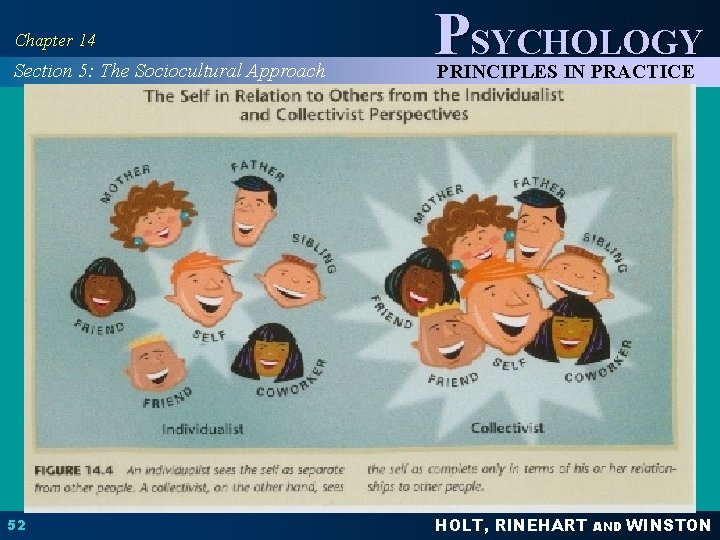
Chapter 14 Section 5: The Sociocultural Approach PSYCHOLOGY PRINCIPLES IN PRACTICE Individualism Versus Collectivism n Individualism: U. S. and European nations n. Define self by personal identity n. Gives priority to personal goals n. Collectivism: Africa, Asia, and Central and South America n. Defined by the group n. Priority to the goals of the group 51 HOLT, RINEHART AND WINSTON
Chapter 14 Section 5: The Sociocultural Approach 52 PSYCHOLOGY PRINCIPLES IN PRACTICE HOLT, RINEHART AND WINSTON