
Values Theory and Practice The Fundamentals of Positive


- Slides: 41
Values, Theory and Practice: The Fundamentals of Positive Behavioural Support North East and Cumbria Community of Practice: Positive Behavioural Support in Action Dr Nick Gore
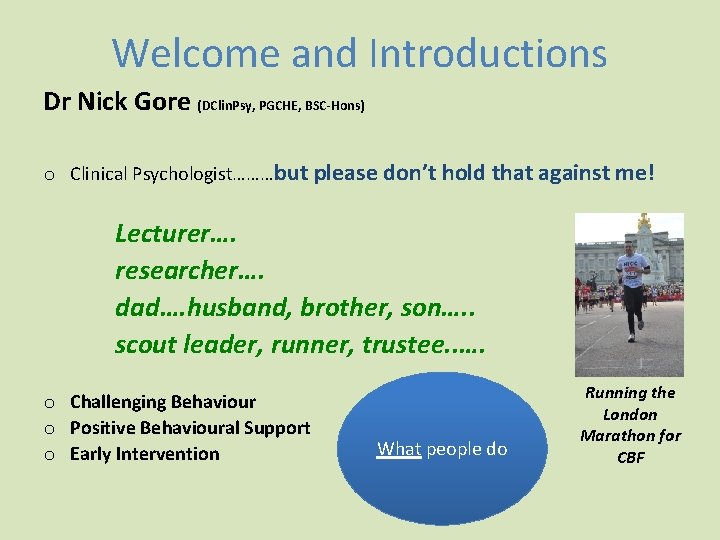
Welcome and Introductions Dr Nick Gore (DClin. Psy, PGCHE, BSC-Hons) o Clinical Psychologist………but please don’t hold that against me! Lecturer…. researcher…. dad…. husband, brother, son…. . scout leader, runner, trustee. . …. o Challenging Behaviour o Positive Behavioural Support o Early Intervention What people do Running the London Marathon for CBF
Tizard Centre – University of Kent One of the leading UK academic groups working in learning disability and community care. Members of the Centre are selected both for their academic record and for their practical experience in services. Teaching • Short courses as well as degree and diploma programmes • Ph. D students Consultancy • Training for services, commissioners • Clinical support for individuals, families, services Research • Applied research focused predominantly on improving support and quality of life for people with disabilities. Policy • Support for development of policy and best practice guidance
A Plan for Today • What is behaviour that challenges and what is the impact of this behaviour? The theory! • A functional approach to understanding behaviour or ‘why do people do what they do? ’ More theory!! • Introducing Positive Behavioural Support – the values and practice • Ultimately, the interaction of theory, values and practice in PBS • Questions, answers and planning next steps
Some Doubts and Concerns about PBS o o o o o It doesn’t work for everyone It is only for psychologists and behaviour analysts It’s a one size fits all Only suitable for people with severe/mild CB or LD It doesn’t consider medical factors or mental health It’s a treatment It’s a new fad There’s no proper evidence for it Its controlling Its too complicated for the real world……… or too simple for the complexities of the real world!
What is challenging behavior?
Behaviours that Challenge The sort of behaviours this includes varies across situation, time and place – what might it include in your experience? • • Aggression Self Injury Property Destruction Inappropriate sexual behaviour
Terms and definitions Behaviours that challenge / challenging behaviour • Problem behaviours • Difficult behaviours • Aberrant behaviours • Behaviours!
Terms and Definitions • ‘Challenging Behaviour’ (Association for People with Severe Handicaps) • There are limitations / difficulties with most of other terms (internal causation, universal, connotations of deliberate) • ‘Its your fault – you are doing it on purpose’
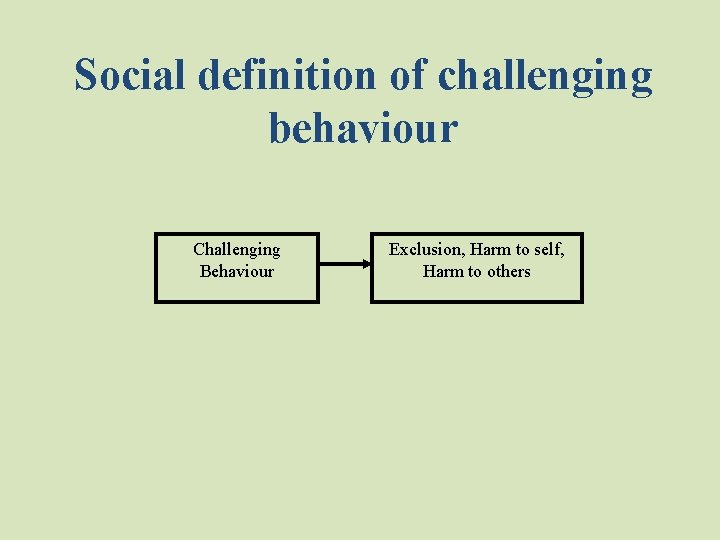
Behaviour can be described as challenging when it is of such intensity, frequency or duration as to threaten the quality of life and/or physical safety of the individual or others and is likely to lead to responses that are restrictive, aversive or result in exclusion (Unified Approach, 2007)
What is challenging in one context is not necessarily challenging in another…… Challenging behaviour is defined by the impact the behaviour has Not by what the behaviour looks like or by what causes/maintains it………
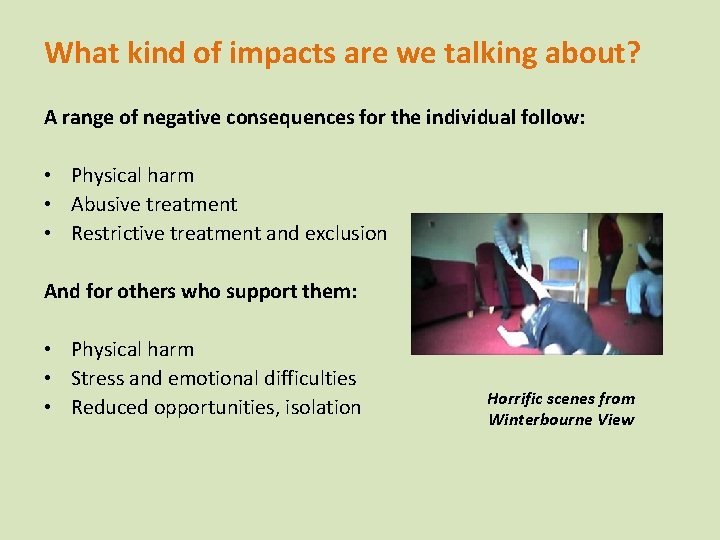
What kind of impacts are we talking about? A range of negative consequences for the individual follow: • Physical harm • Abusive treatment • Restrictive treatment and exclusion And for others who support them: • Physical harm • Stress and emotional difficulties • Reduced opportunities, isolation Horrific scenes from Winterbourne View
Who is being challenged? The individual: o Because of impact on the wellbeing o Because of limitations in their environment and support form others that influence the behaviour Other people: o Because of the effects/impact of the behaviour on them o Because of the need to respond in new ways and shape the environment differently • The person is not the challenge or problem • The ‘behaviour’ or challenge is not inside them
How does challenging behavior develop and how is it maintained?
Who displays behaviors that challenge? All of us! – given the right (or wrong) conditions More likely for: 1. Children (and adults) with intellectual disabilities and or Autism 2. Other developmental disabilities (ADHD) 3. Emotional and Mental Health difficulties o These groups often overlap (children with IDD are at increased risk of emotional/mental health difficulties) o There are often additional risk factors within these groups (severity of difficulty, physical health complications) o And additional risk factors associated with these groups (increased chance of living in poverty for those with IDD)
As complexity of need goes up Risk of CB goes up
A Functional Approach Why do some children display challenging behaviour? Chris is a child who has a rare syndrome. Chris frequently rocks from one foot to the other whilst standing up. Often Chris injures his own body, Chris will hit his head on the wall, bite and pick his skin. Sometimes, Chris spits on the table and smears it around. Occasionally, Chris is aggressive, Chris will shout and hit out at people who are close by, and throw things around.
What do you think are some of the reasons for some of Chris’ behaviours and what could be done to make things better? Take a few minutes to jot down some ideas. .
When we have no assessment information: o The best we can do is guess o These are rarely likely to relate to the real reasons for the behaviour o They focus mostly on what the behaviour looks like o The reasons we come up with tend to cite causation or blame within the individual o These ‘reasons’ do not lend themselves to clear, practical and positive solutions
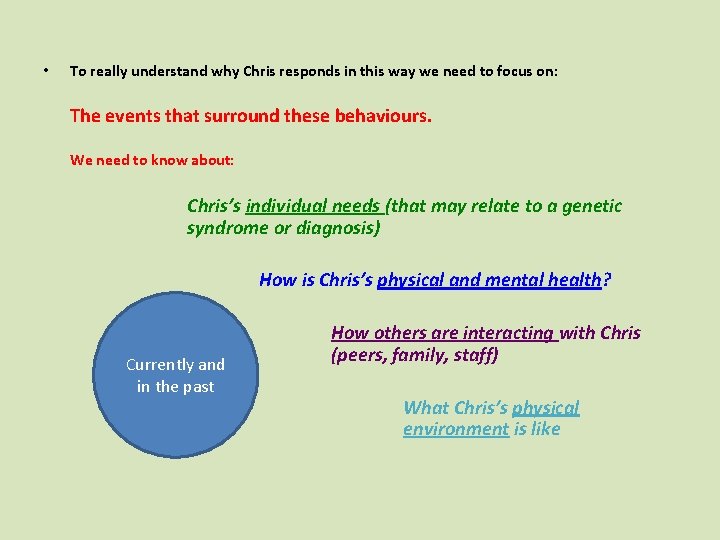
• To really understand why Chris responds in this way we need to focus on: The events that surround these behaviours. We need to know about: Chris’s individual needs (that may relate to a genetic syndrome or diagnosis) How is Chris’s physical and mental health? Currently and in the past How others are interacting with Chris (peers, family, staff) What Chris’s physical environment is like
To understand why the behavior is happening we need to get to know the whole person in their whole world we need to stand shoulder to shoulder with the person and those that know them……. ………. . endeavor to see the world from their perspective……… ………. . and understand, their abilities, needs and preferences
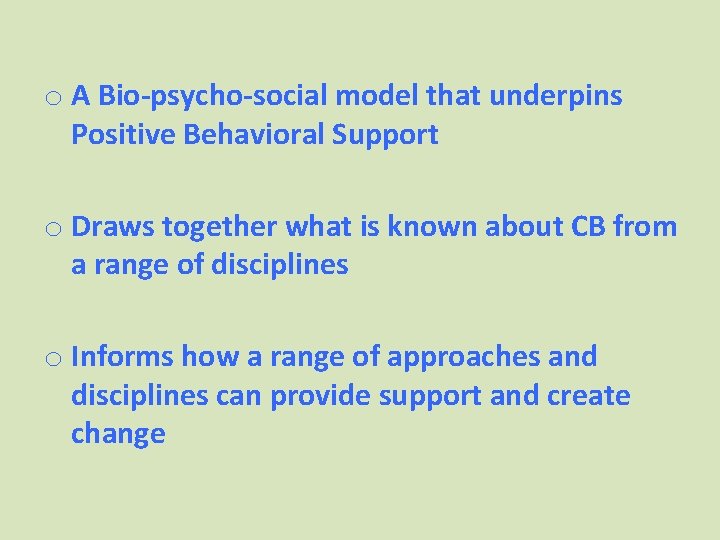
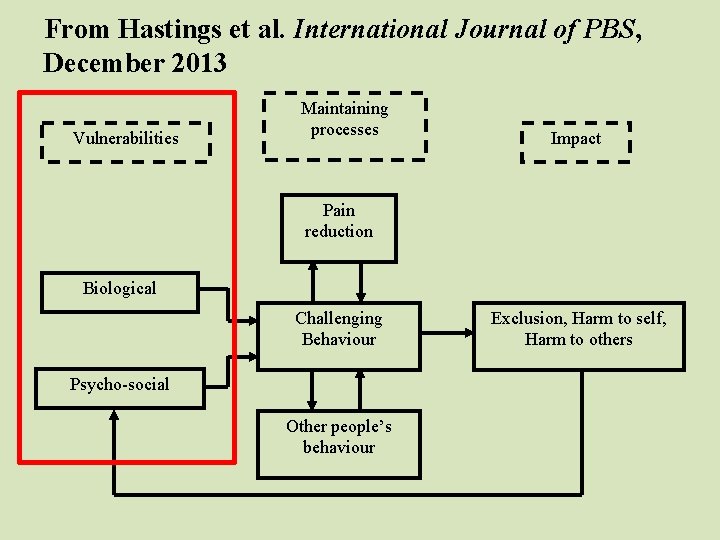
o A Bio-psycho-social model that underpins Positive Behavioral Support o Draws together what is known about CB from a range of disciplines o Informs how a range of approaches and disciplines can provide support and create change
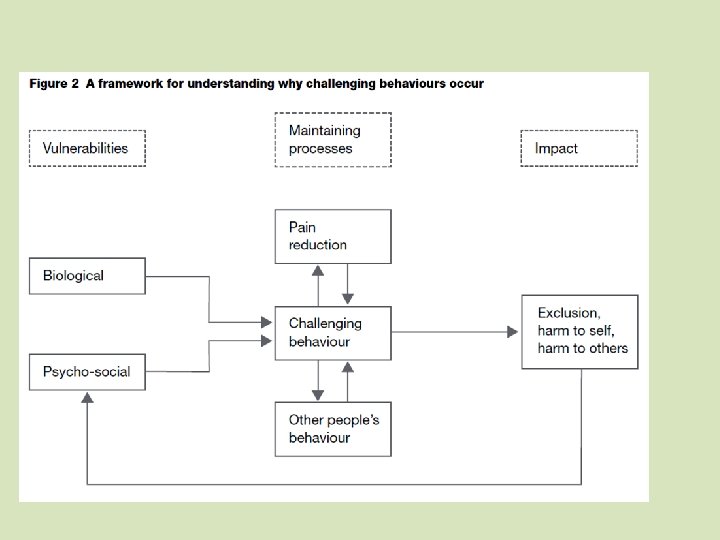
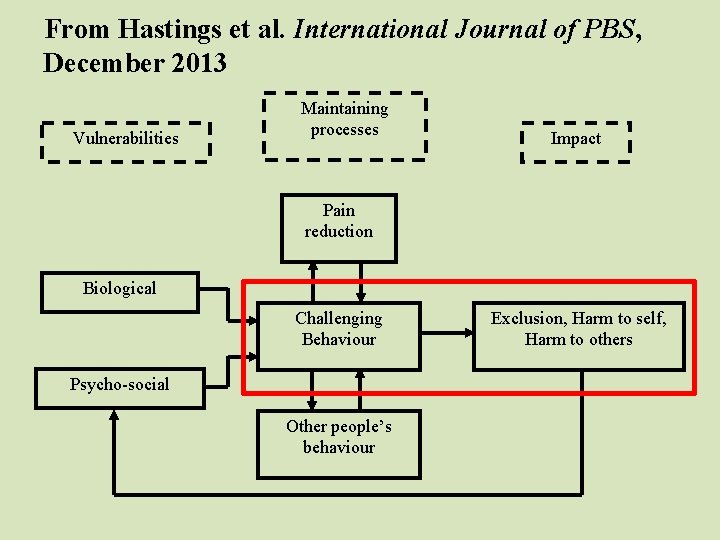
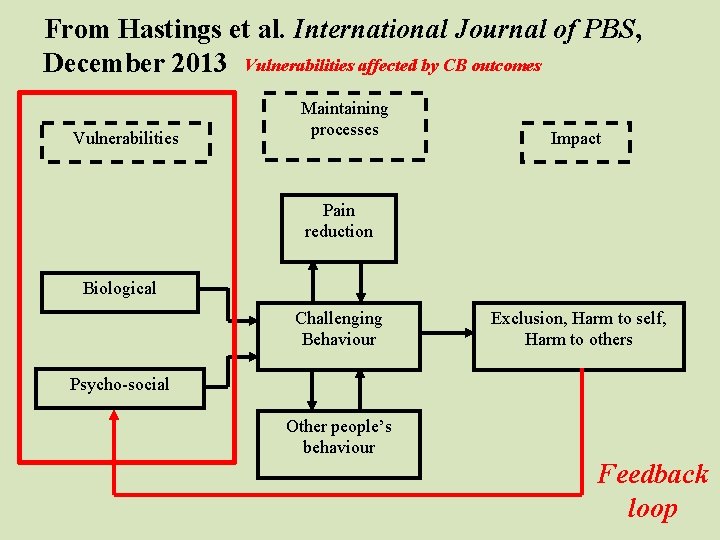
From Hastings et al. International Journal of PBS, December 2013 Vulnerabilities Maintaining processes Impact Pain reduction Biological Challenging Behaviour Psycho-social Other people’s behaviour Exclusion, Harm to self, Harm to others
Social definition of challenging behaviour Challenging Behaviour Exclusion, Harm to self, Harm to others
From Hastings et al. International Journal of PBS, December 2013 Vulnerabilities Maintaining processes Impact Pain reduction Biological Challenging Behaviour Psycho-social Other people’s behaviour Exclusion, Harm to self, Harm to others
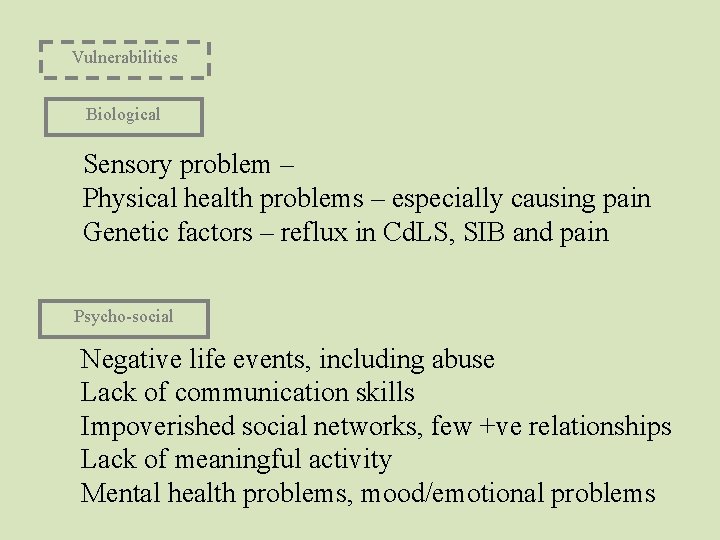
Vulnerabilities Biological Sensory problem – Physical health problems – especially causing pain Genetic factors – reflux in Cd. LS, SIB and pain Psycho-social Negative life events, including abuse Lack of communication skills Impoverished social networks, few +ve relationships Lack of meaningful activity Mental health problems, mood/emotional problems
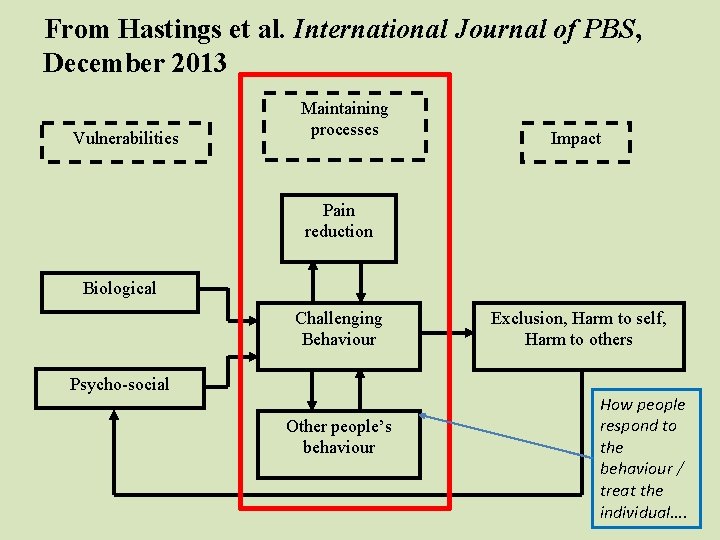
From Hastings et al. International Journal of PBS, December 2013 Vulnerabilities Maintaining processes Impact Pain reduction Biological Challenging Behaviour Psycho-social Other people’s behaviour Exclusion, Harm to self, Harm to others How people respond to the behaviour / treat the individual….
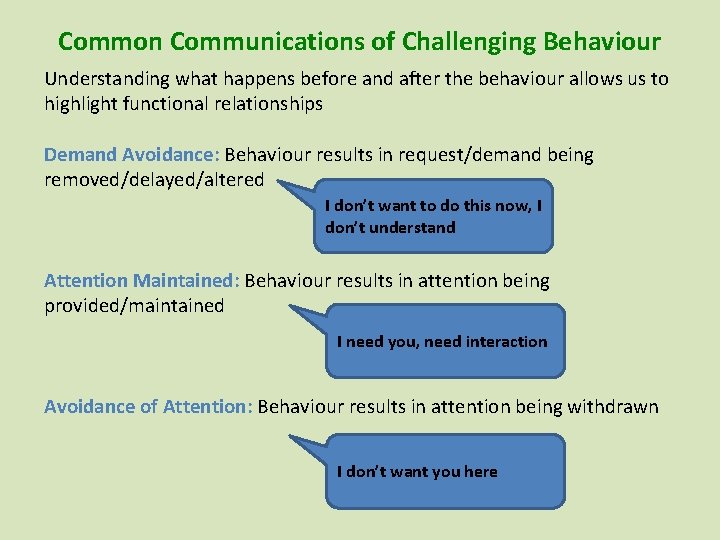
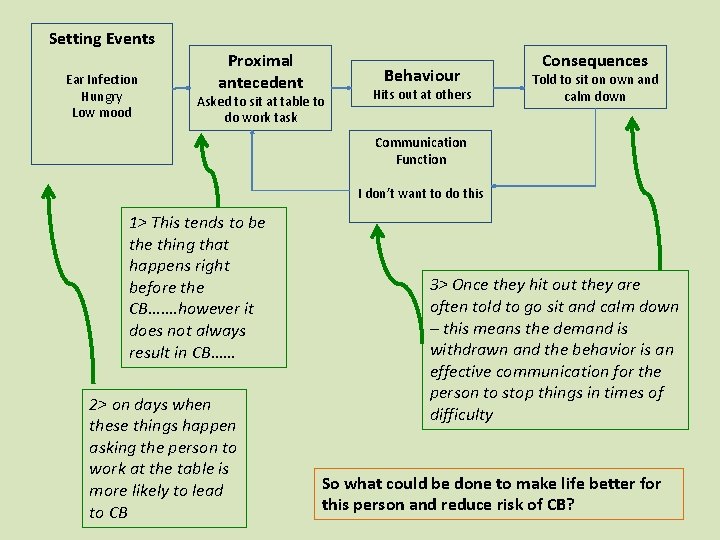
Common Communications of Challenging Behaviour Understanding what happens before and after the behaviour allows us to highlight functional relationships Demand Avoidance: Behaviour results in request/demand being removed/delayed/altered I don’t want to do this now, I don’t understand Attention Maintained: Behaviour results in attention being provided/maintained I need you, need interaction Avoidance of Attention: Behaviour results in attention being withdrawn I don’t want you here
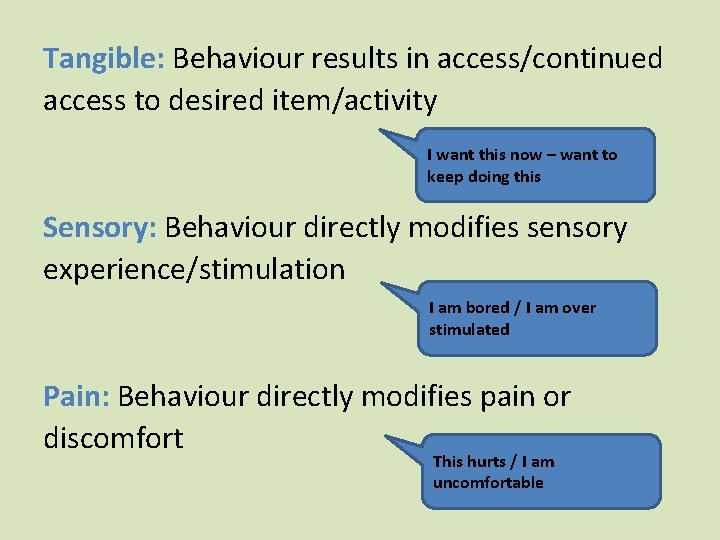
Tangible: Behaviour results in access/continued access to desired item/activity I want this now – want to keep doing this Sensory: Behaviour directly modifies sensory experience/stimulation I am bored / I am over stimulated Pain: Behaviour directly modifies pain or discomfort This hurts / I am uncomfortable
From Hastings et al. International Journal of PBS, December 2013 Vulnerabilities affected by CB outcomes Vulnerabilities Maintaining processes Impact Pain reduction Biological Challenging Behaviour Exclusion, Harm to self, Harm to others Psycho-social Other people’s behaviour Feedback loop
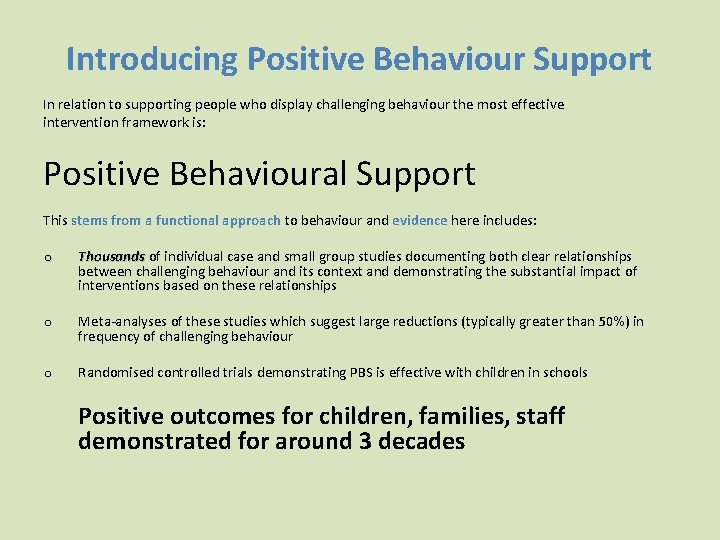
Introducing Positive Behaviour Support In relation to supporting people who display challenging behaviour the most effective intervention framework is: Positive Behavioural Support This stems from a functional approach to behaviour and evidence here includes: o Thousands of individual case and small group studies documenting both clear relationships between challenging behaviour and its context and demonstrating the substantial impact of interventions based on these relationships o Meta-analyses of these studies which suggest large reductions (typically greater than 50%) in frequency of challenging behaviour o Randomised controlled trials demonstrating PBS is effective with children in schools Positive outcomes for children, families, staff demonstrated for around 3 decades
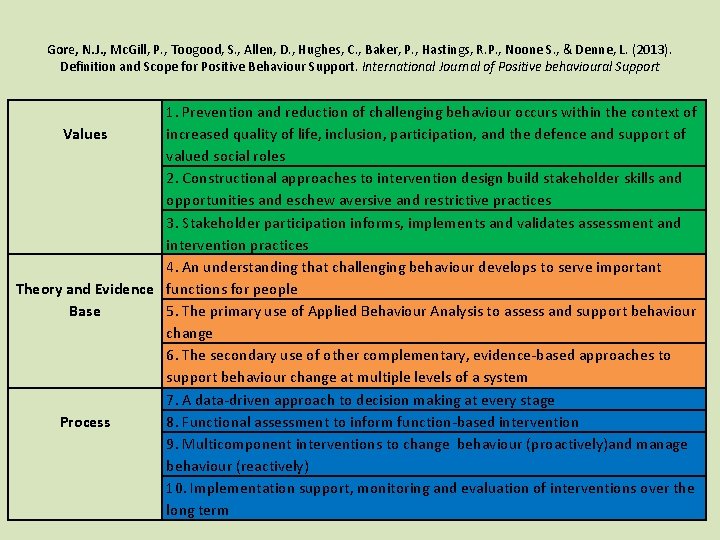
Gore, N. J. , Mc. Gill, P. , Toogood, S. , Allen, D. , Hughes, C. , Baker, P. , Hastings, R. P. , Noone S. , & Denne, L. (2013). Definition and Scope for Positive Behaviour Support. International Journal of Positive behavioural Support 1. Prevention and reduction of challenging behaviour occurs within the context of Values increased quality of life, inclusion, participation, and the defence and support of valued social roles 2. Constructional approaches to intervention design build stakeholder skills and opportunities and eschew aversive and restrictive practices 3. Stakeholder participation informs, implements and validates assessment and intervention practices 4. An understanding that challenging behaviour develops to serve important Theory and Evidence functions for people 5. The primary use of Applied Behaviour Analysis to assess and support behaviour Base change 6. The secondary use of other complementary, evidence-based approaches to support behaviour change at multiple levels of a system 7. A data-driven approach to decision making at every stage Process 8. Functional assessment to inform function-based intervention 9. Multicomponent interventions to change behaviour (proactively)and manage behaviour (reactively) 10. Implementation support, monitoring and evaluation of interventions over the long term
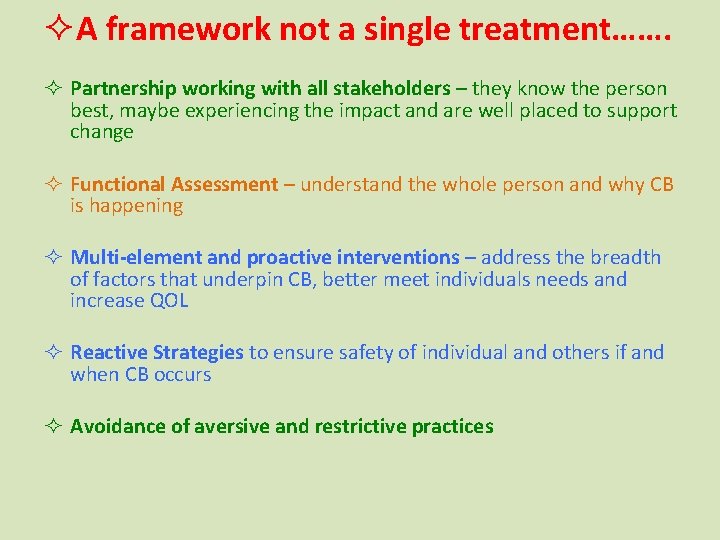
²A framework not a single treatment……. ² Partnership working with all stakeholders – they know the person best, maybe experiencing the impact and are well placed to support change ² Functional Assessment – understand the whole person and why CB is happening ² Multi-element and proactive interventions – address the breadth of factors that underpin CB, better meet individuals needs and increase QOL ² Reactive Strategies to ensure safety of individual and others if and when CB occurs ² Avoidance of aversive and restrictive practices
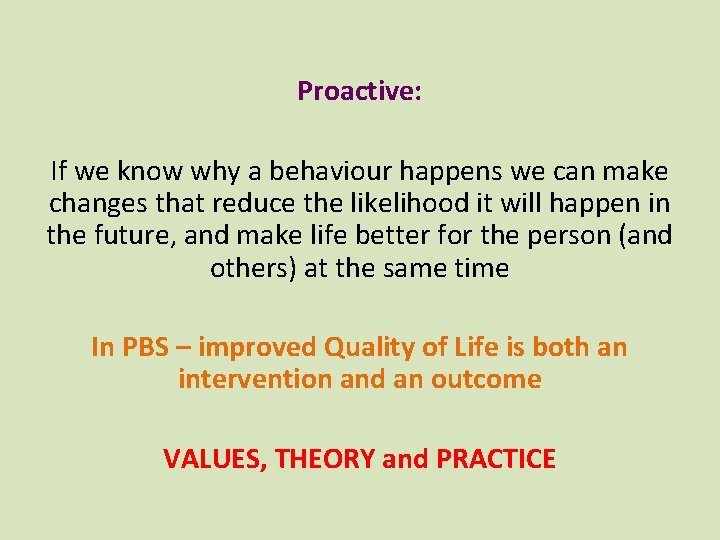
Proactive: If we know why a behaviour happens we can make changes that reduce the likelihood it will happen in the future, and make life better for the person (and others) at the same time In PBS – improved Quality of Life is both an intervention and an outcome VALUES, THEORY and PRACTICE
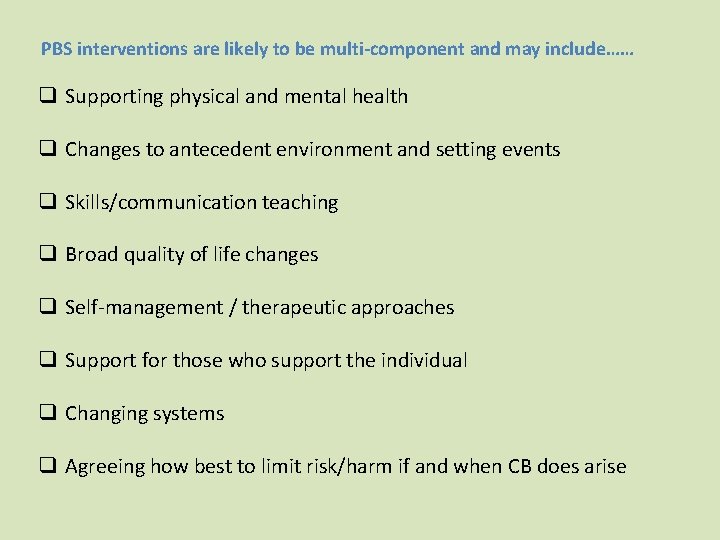
PBS interventions are likely to be multi-component and may include…… q Supporting physical and mental health q Changes to antecedent environment and setting events q Skills/communication teaching q Broad quality of life changes q Self-management / therapeutic approaches q Support for those who support the individual q Changing systems q Agreeing how best to limit risk/harm if and when CB does arise
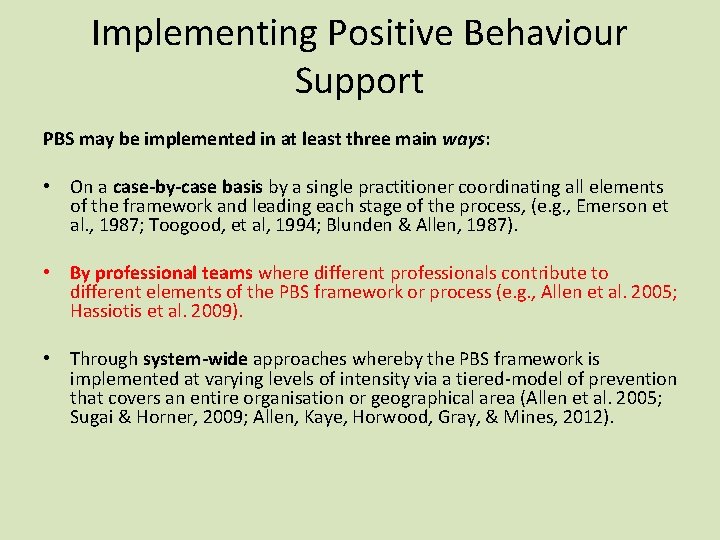
Implementing Positive Behaviour Support PBS may be implemented in at least three main ways: • On a case-by-case basis by a single practitioner coordinating all elements of the framework and leading each stage of the process, (e. g. , Emerson et al. , 1987; Toogood, et al, 1994; Blunden & Allen, 1987). • By professional teams where different professionals contribute to different elements of the PBS framework or process (e. g. , Allen et al. 2005; Hassiotis et al. 2009). • Through system-wide approaches whereby the PBS framework is implemented at varying levels of intensity via a tiered-model of prevention that covers an entire organisation or geographical area (Allen et al. 2005; Sugai & Horner, 2009; Allen, Kaye, Horwood, Gray, & Mines, 2012).
Setting Events Ear Infection Hungry Low mood Proximal antecedent Behaviour Asked to sit at table to do work task Hits out at others Consequences Told to sit on own and calm down Communication Function I don’t want to do this 1> This tends to be thing that happens right before the CB……. however it does not always result in CB…… 2> on days when these things happen asking the person to work at the table is more likely to lead to CB 3> Once they hit out they are often told to go sit and calm down – this means the demand is withdrawn and the behavior is an effective communication for the person to stop things in times of difficulty So what could be done to make life better for this person and reduce risk of CB?
Resources for people with learning disabilities, family carers, staff and commissioners: • Academy resource PBS is everybody’s business http: //pbsacademy. org. uk/wpcontent/uploads/2016/01/PBS-Academy-Service -Provder-checklist. pdf
N. J. Gore@Kent. ac. uk Questions and attempted answers!