PSYCHOLOGY PRINCIPLES IN PRACTICE Chapter 10 INFANCY AND
- Slides: 7
PSYCHOLOGY PRINCIPLES IN PRACTICE Chapter 10 INFANCY AND CHILDHOOD Section 1: The Study of Development Section 2: Physical Development Section 3: Social Development Section 4: Cognitive Development 1 HOLT, RINEHART AND WINSTON
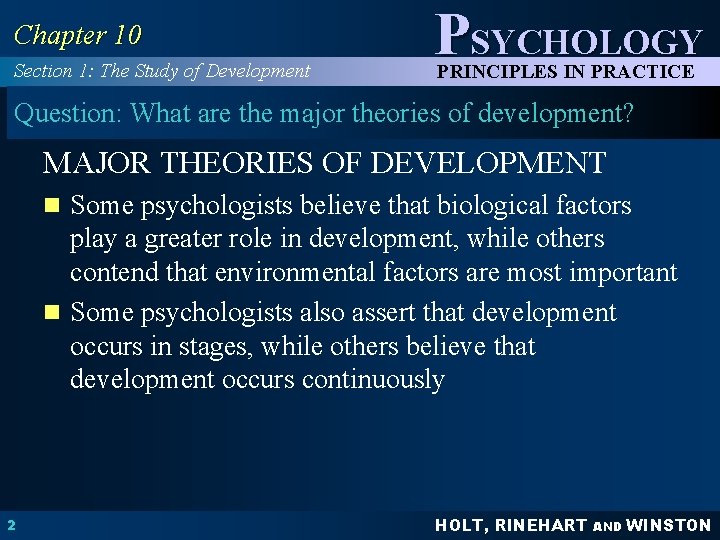
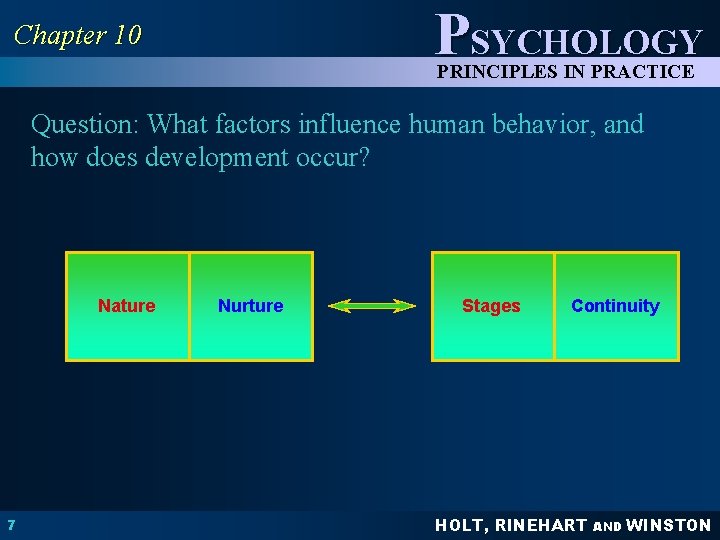
Chapter 10 Section 1: The Study of Development PSYCHOLOGY PRINCIPLES IN PRACTICE Question: What are the major theories of development? MAJOR THEORIES OF DEVELOPMENT n Some psychologists believe that biological factors play a greater role in development, while others contend that environmental factors are most important n Some psychologists also assert that development occurs in stages, while others believe that development occurs continuously 2 HOLT, RINEHART AND WINSTON
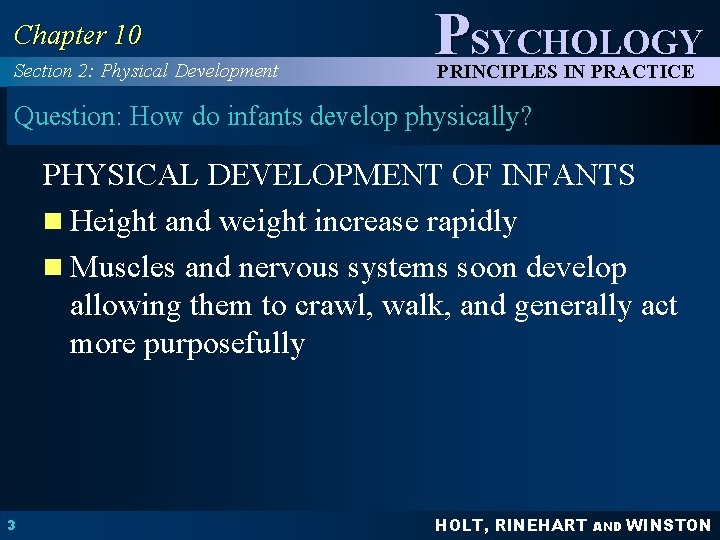
Chapter 10 Section 2: Physical Development PSYCHOLOGY PRINCIPLES IN PRACTICE Question: How do infants develop physically? PHYSICAL DEVELOPMENT OF INFANTS n Height and weight increase rapidly n Muscles and nervous systems soon develop allowing them to crawl, walk, and generally act more purposefully 3 HOLT, RINEHART AND WINSTON
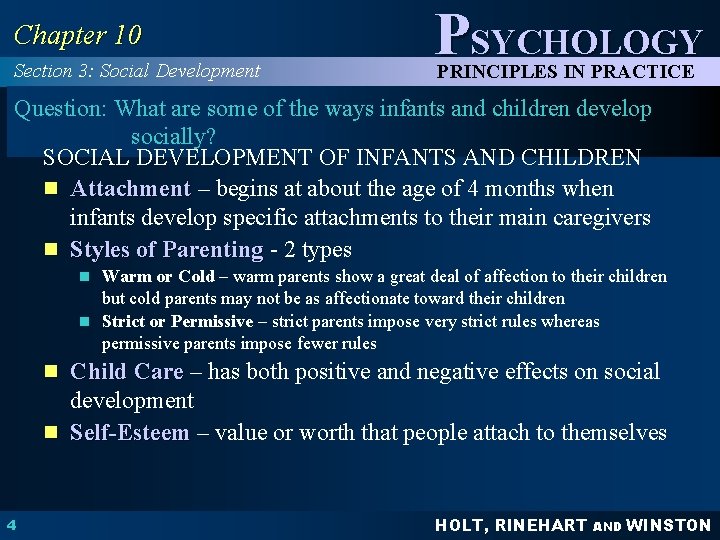
Chapter 10 Section 3: Social Development PSYCHOLOGY PRINCIPLES IN PRACTICE Question: What are some of the ways infants and children develop socially? SOCIAL DEVELOPMENT OF INFANTS AND CHILDREN n Attachment – begins at about the age of 4 months when infants develop specific attachments to their main caregivers n Styles of Parenting - 2 types n Warm or Cold – warm parents show a great deal of affection to their children but cold parents may not be as affectionate toward their children n Strict or Permissive – strict parents impose very strict rules whereas permissive parents impose fewer rules n Child Care – has both positive and negative effects on social development n Self-Esteem – value or worth that people attach to themselves 4 HOLT, RINEHART AND WINSTON
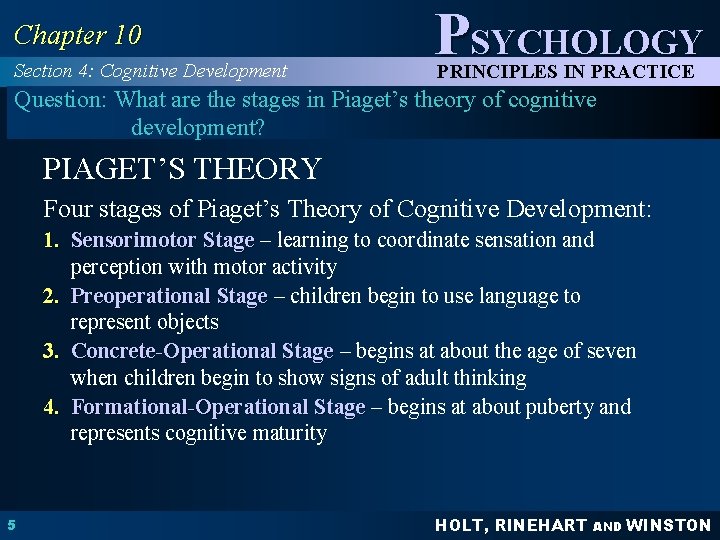
Chapter 10 Section 4: Cognitive Development PSYCHOLOGY PRINCIPLES IN PRACTICE Question: What are the stages in Piaget’s theory of cognitive development? PIAGET’S THEORY Four stages of Piaget’s Theory of Cognitive Development: 1. Sensorimotor Stage – learning to coordinate sensation and perception with motor activity 2. Preoperational Stage – children begin to use language to represent objects 3. Concrete-Operational Stage – begins at about the age of seven when children begin to show signs of adult thinking 4. Formational-Operational Stage – begins at about puberty and represents cognitive maturity 5 HOLT, RINEHART AND WINSTON
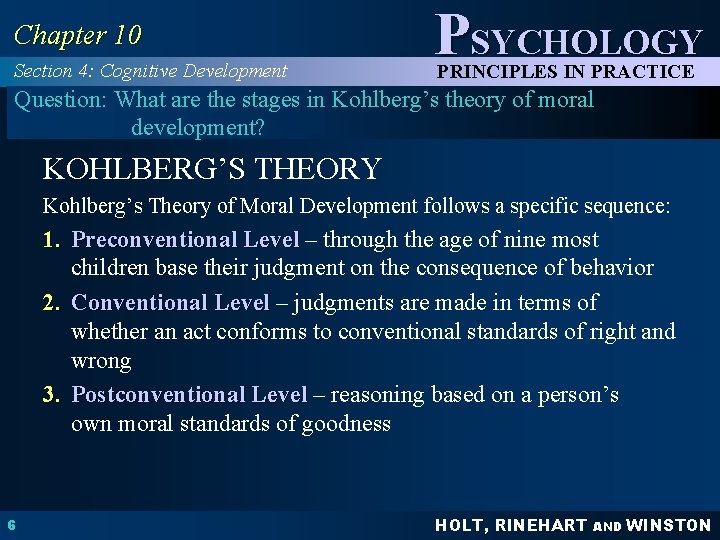
Chapter 10 Section 4: Cognitive Development PSYCHOLOGY PRINCIPLES IN PRACTICE Question: What are the stages in Kohlberg’s theory of moral development? KOHLBERG’S THEORY Kohlberg’s Theory of Moral Development follows a specific sequence: 1. Preconventional Level – through the age of nine most children base their judgment on the consequence of behavior 2. Conventional Level – judgments are made in terms of whether an act conforms to conventional standards of right and wrong 3. Postconventional Level – reasoning based on a person’s own moral standards of goodness 6 HOLT, RINEHART AND WINSTON
PSYCHOLOGY Chapter 10 PRINCIPLES IN PRACTICE Question: What factors influence human behavior, and how does development occur? Nature 7 Nurture Stages Continuity HOLT, RINEHART AND WINSTON