PSYCHOLOGY PRINCIPLES IN PRACTICE Chapter 8 THINKING AND
- Slides: 12
PSYCHOLOGY PRINCIPLES IN PRACTICE Chapter 8 THINKING AND LANGUAGE Section 1: What Is Thinking? Section 2: Problem Solving Section 3: Reasoning Section 4: Decision Making and Judgment Section 5: Language 1 HOLT, RINEHART AND WINSTON
Chapter 8 PSYCHOLOGY PRINCIPLES IN PRACTICE Thinking is…… n 1. thinking is the mental activity that is involved in the understanding, processing, and communicating of information. Made possible through the use of symbols, concepts, and prototypes. 2 HOLT, RINEHART AND WINSTON
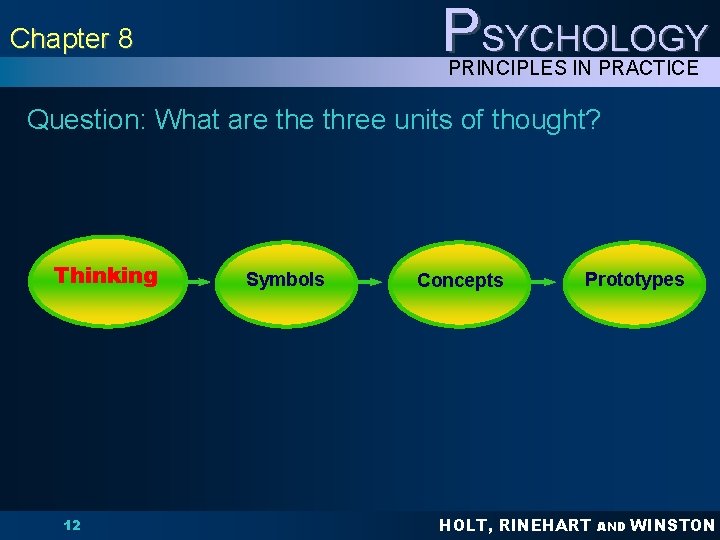
Chapter 8 Section 1: What Is Thinking? PSYCHOLOGY PRINCIPLES IN PRACTICE Question: What are three units of thought? THREE UNITS OF THOUGHT n SYMBOLS – objects or acts that stand for something else n CONCEPTS – mentally grouping together objects, events, or ideas that have similar characteristics such as dogs, horses, etc. n PROTOTYPES – examples of concepts that best exemplify that concept 3 HOLT, RINEHART AND WINSTON
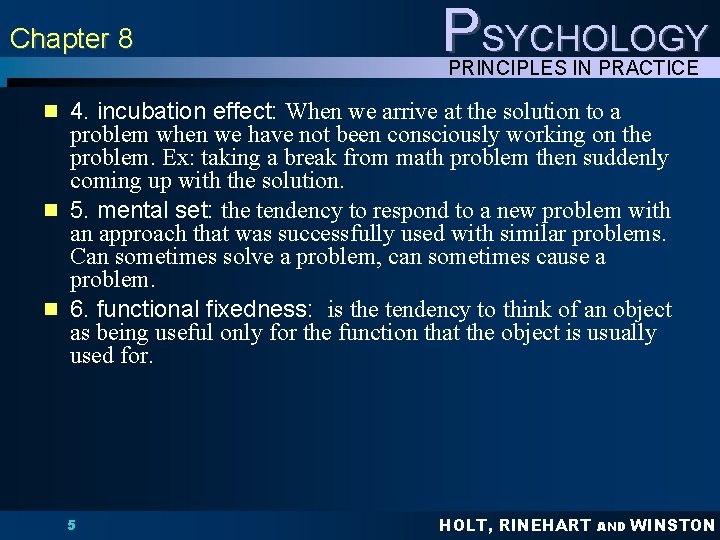
Chapter 8 PSYCHOLOGY PRINCIPLES IN PRACTICE How do we solve problems? n 2. algorithms: a specific procedure that, when used properly and in the right circumstances, will always lead to the solution of a problem. Ex: formulas. n 3. heuristics: rules of thumb that often, but not always, help us find the solution to a problem. They are shortcuts. Ex: C_ _ FF (cliff) 4 HOLT, RINEHART AND WINSTON
Chapter 8 PSYCHOLOGY PRINCIPLES IN PRACTICE n 4. incubation effect: When we arrive at the solution to a problem when we have not been consciously working on the problem. Ex: taking a break from math problem then suddenly coming up with the solution. n 5. mental set: the tendency to respond to a new problem with an approach that was successfully used with similar problems. Can sometimes solve a problem, can sometimes cause a problem. n 6. functional fixedness: is the tendency to think of an object as being useful only for the function that the object is usually used for. 5 HOLT, RINEHART AND WINSTON
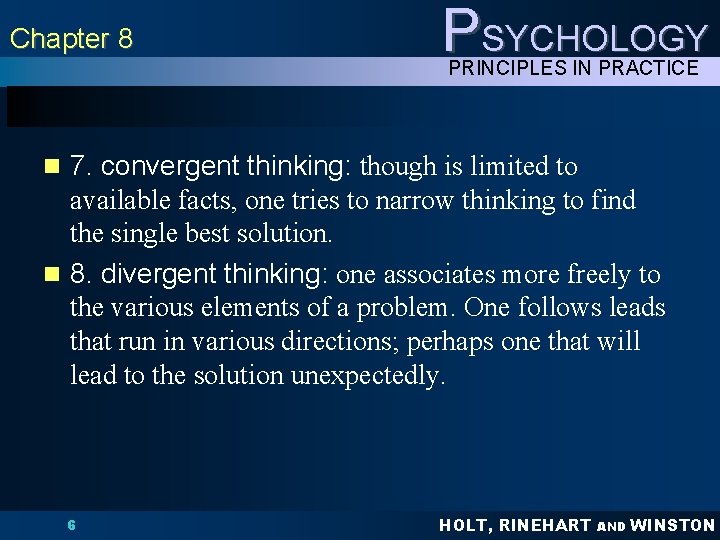
Chapter 8 PSYCHOLOGY PRINCIPLES IN PRACTICE n 7. convergent thinking: though is limited to available facts, one tries to narrow thinking to find the single best solution. n 8. divergent thinking: one associates more freely to the various elements of a problem. One follows leads that run in various directions; perhaps one that will lead to the solution unexpectedly. 6 HOLT, RINEHART AND WINSTON
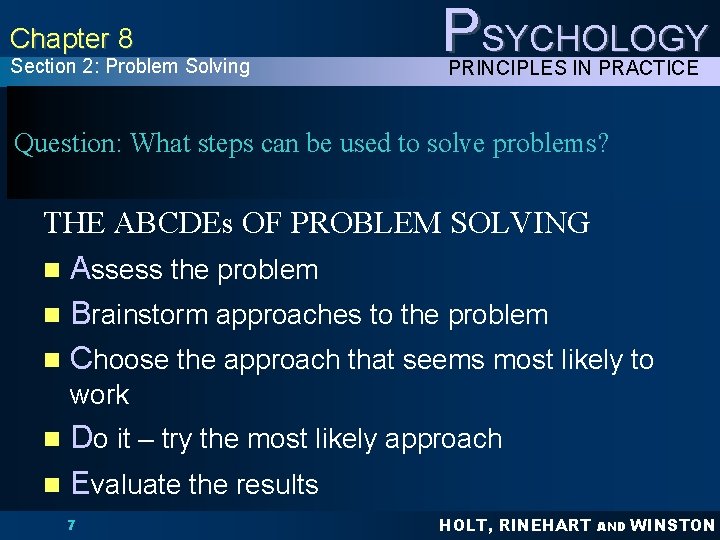
Chapter 8 Section 2: Problem Solving PSYCHOLOGY PRINCIPLES IN PRACTICE Question: What steps can be used to solve problems? THE ABCDEs OF PROBLEM SOLVING n Assess the problem n Brainstorm approaches to the problem n Choose the approach that seems most likely to work Do it – try the most likely approach n Evaluate the results n 7 HOLT, RINEHART AND WINSTON
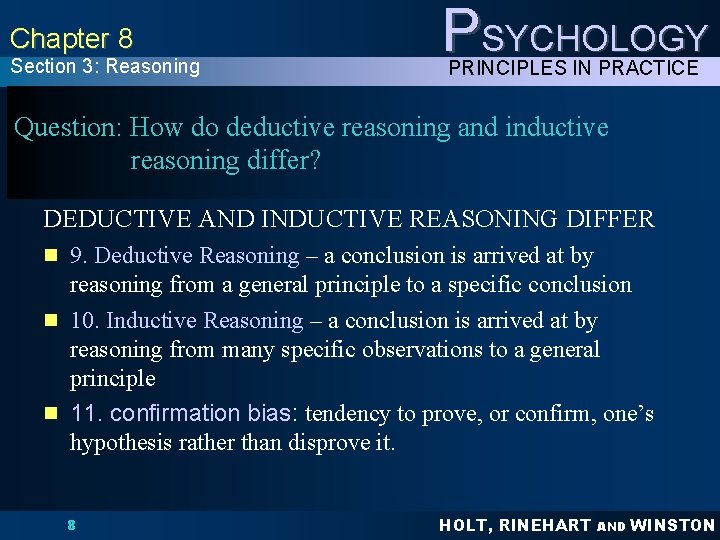
Chapter 8 Section 3: Reasoning PSYCHOLOGY PRINCIPLES IN PRACTICE Question: How do deductive reasoning and inductive reasoning differ? DEDUCTIVE AND INDUCTIVE REASONING DIFFER n 9. Deductive Reasoning – a conclusion is arrived at by reasoning from a general principle to a specific conclusion n 10. Inductive Reasoning – a conclusion is arrived at by reasoning from many specific observations to a general principle n 11. confirmation bias: tendency to prove, or confirm, one’s hypothesis rather than disprove it. 8 HOLT, RINEHART AND WINSTON
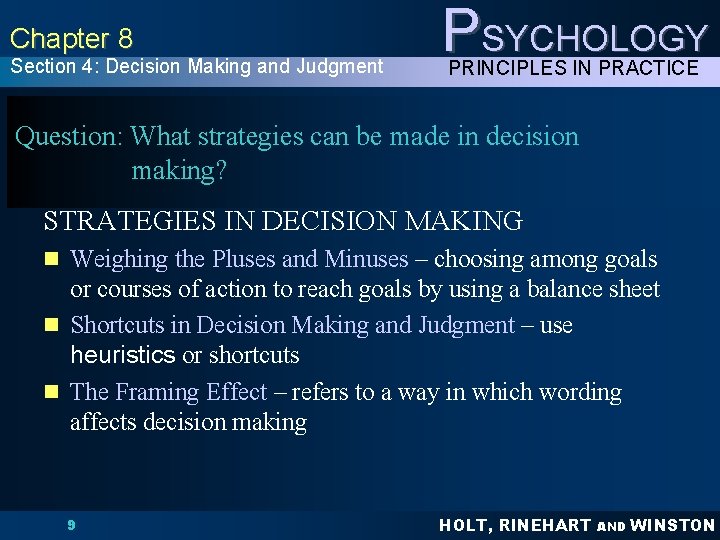
Chapter 8 Section 4: Decision Making and Judgment PSYCHOLOGY PRINCIPLES IN PRACTICE Question: What strategies can be made in decision making? STRATEGIES IN DECISION MAKING n Weighing the Pluses and Minuses – choosing among goals or courses of action to reach goals by using a balance sheet n Shortcuts in Decision Making and Judgment – use heuristics or shortcuts n The Framing Effect – refers to a way in which wording affects decision making 9 HOLT, RINEHART AND WINSTON
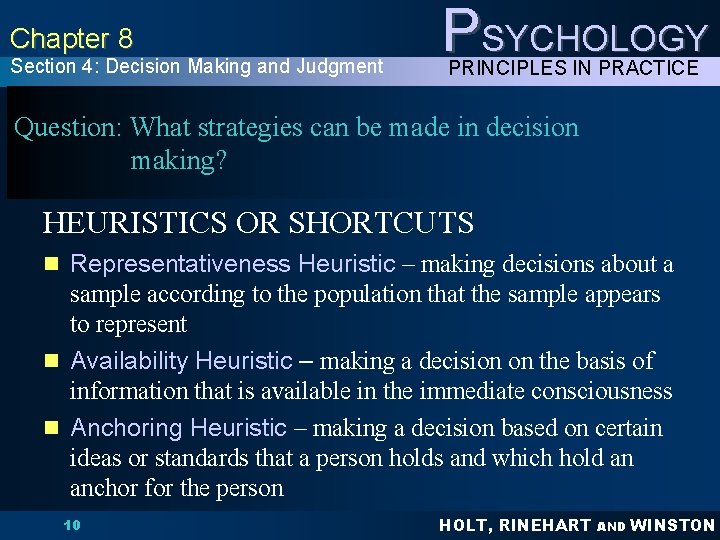
Chapter 8 Section 4: Decision Making and Judgment PSYCHOLOGY PRINCIPLES IN PRACTICE Question: What strategies can be made in decision making? HEURISTICS OR SHORTCUTS n Representativeness Heuristic – making decisions about a sample according to the population that the sample appears to represent n Availability Heuristic – making a decision on the basis of information that is available in the immediate consciousness n Anchoring Heuristic – making a decision based on certain ideas or standards that a person holds and which hold an anchor for the person 10 HOLT, RINEHART AND WINSTON
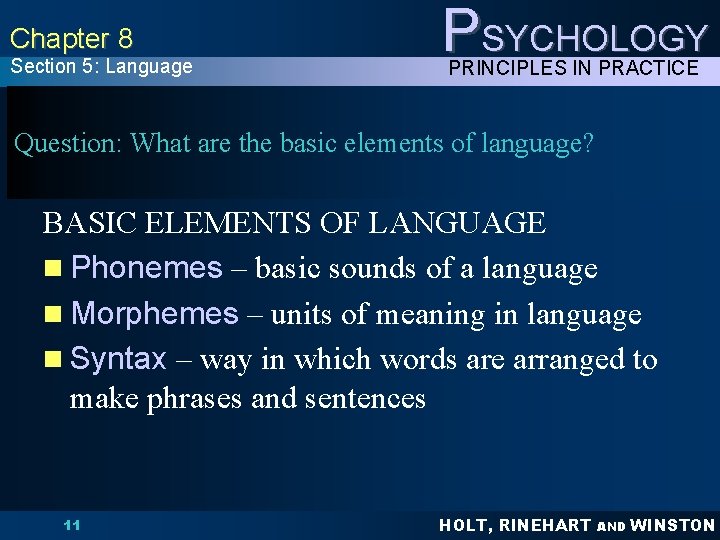
Chapter 8 Section 5: Language PSYCHOLOGY PRINCIPLES IN PRACTICE Question: What are the basic elements of language? BASIC ELEMENTS OF LANGUAGE n Phonemes – basic sounds of a language n Morphemes – units of meaning in language n Syntax – way in which words are arranged to make phrases and sentences 11 HOLT, RINEHART AND WINSTON
PSYCHOLOGY Chapter 8 PRINCIPLES IN PRACTICE Question: What are three units of thought? Thinking 12 Symbols Concepts Prototypes HOLT, RINEHART AND WINSTON