ESCAPE European Space Craft for the study of
- Slides: 40
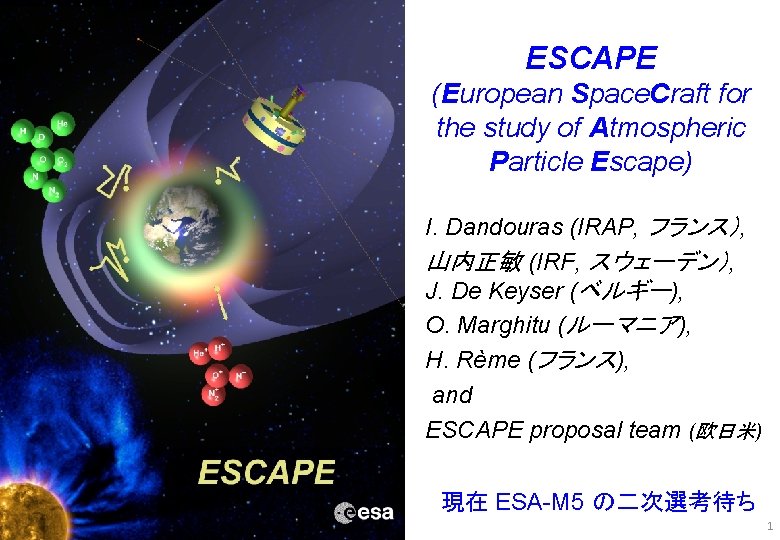
ESCAPE (European Space. Craft for the study of Atmospheric Particle Escape) I. Dandouras (IRAP, フランス), 山内正敏 (IRF, スウェーデン), J. De Keyser (ベルギー), O. Marghitu (ルーマニア), H. Rème (フランス), and ESCAPE proposal team (欧日米) 現在 ESA-M 5 の二次選考待ち 1
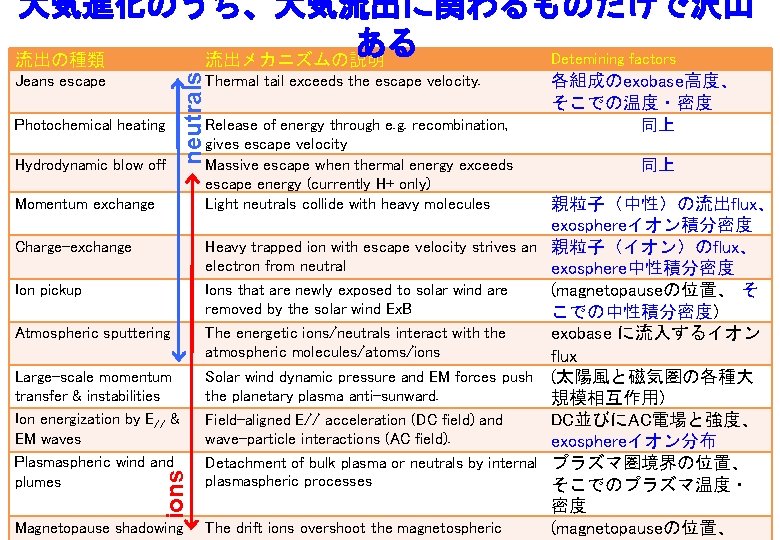
Jeans escape neutrals 大気進化のうち、大気流出に関わるものだけで沢山 ある Detemining factors 流出の種類 流出メカニズムの説明 Thermal tail exceeds the escape velocity. Photochemical heating Hydrodynamic blow off Momentum exchange Charge-exchange Ion pickup Atmospheric sputtering ions Large-scale momentum transfer & instabilities Ion energization by E// & EM waves Plasmaspheric wind and plumes Magnetopause shadowing Release of energy through e. g. recombination, gives escape velocity Massive escape when thermal energy exceeds escape energy (currently H+ only) Light neutrals collide with heavy molecules 各組成のexobase高度、 そこでの温度・密度 同上 同上 親粒子(中性)の流出flux、 exosphereイオン積分密度 Heavy trapped ion with escape velocity strives an 親粒子(イオン)のflux、 electron from neutral exosphere中性積分密度 Ions that are newly exposed to solar wind are (magnetopauseの位置、 そ removed by the solar wind Ex. B こでの中性積分密度) The energetic ions/neutrals interact with the exobase に流入するイオン atmospheric molecules/atoms/ions flux Solar wind dynamic pressure and EM forces push (太陽風と磁気圏の各種大 the planetary plasma anti-sunward. 規模相互作用) Field-aligned E// acceleration (DC field) and DC並びにAC電場と強度、 wave-particle interactions (AC field). exosphereイオン分布 Detachment of bulk plasma or neutrals by internal プラズマ圏境界の位置、 plasmaspheric processes そこでのプラズマ温度・ 密度 The drift ions overshoot the magnetospheric (magnetopauseの位置、 4
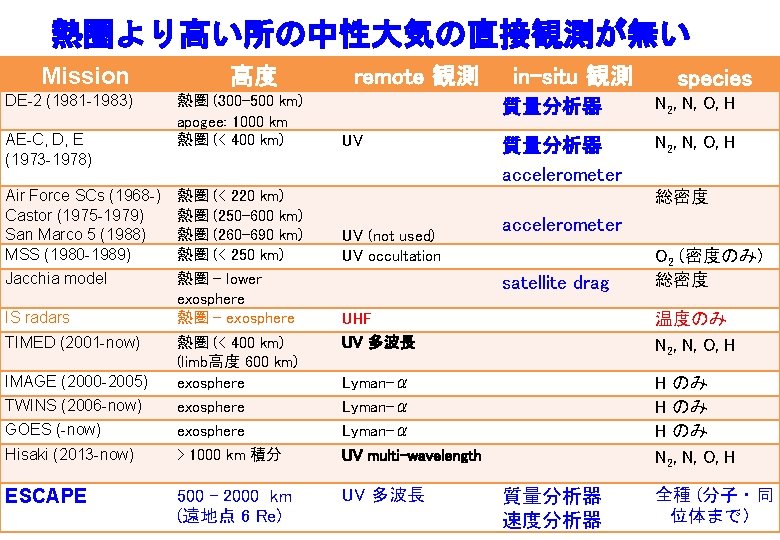
熱圏より高い所の中性大気の直接観測が無い Mission DE-2 (1981 -1983) 高度 remote 観測 in-situ 観測 species 熱圏 (300 -500 km) apogee: 1000 km 熱圏 (< 400 km) 質量分析器 N 2, N, O, H UV 質量分析器 accelerometer N 2, N, O, H Air Force SCs (1968 -) Castor (1975 -1979) San Marco 5 (1988) MSS (1980 -1989) 熱圏 熱圏 Jacchia model 熱圏 – lower exosphere 熱圏 - exosphere AE-C, D, E (1973 -1978) IS radars TIMED (2001 -now) (< 220 km) (250 -600 km) (260 -690 km) (< 250 km) UV (not used) UV occultation O 2 (密度のみ) 総密度 UHF UV 多波長 温度のみ N 2, N, O, H Lyman-α H のみ N 2, N, O, H 質量分析器 速度分析器 全種 (分子・同 位体まで) 7 IMAGE (2000 -2005) TWINS (2006 -now) exosphere Lyman-α GOES (-now) exosphere > 1000 km 積分 Lyman-α 500 - 2000 km (遠地点 6 Re) UV 多波長 ESCAPE accelerometer satellite drag 熱圏 (< 400 km) (limb高度 600 km) exosphere Hisaki (2013 -now) 総密度 UV multi-wavelength
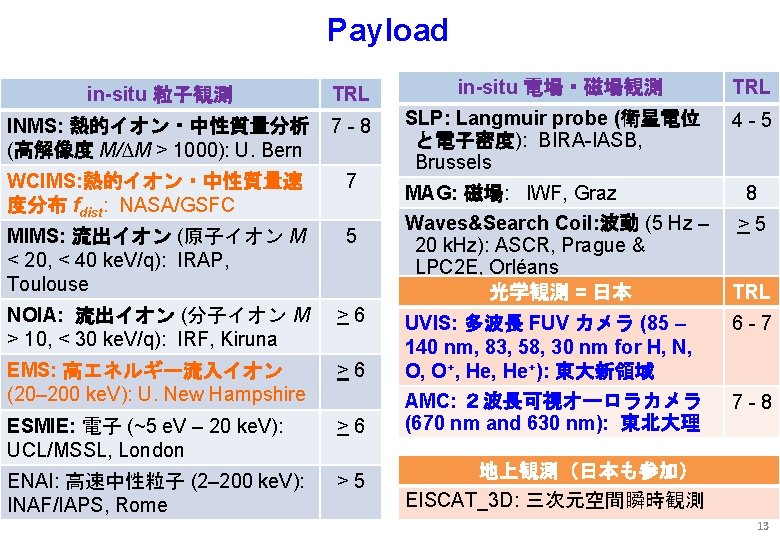
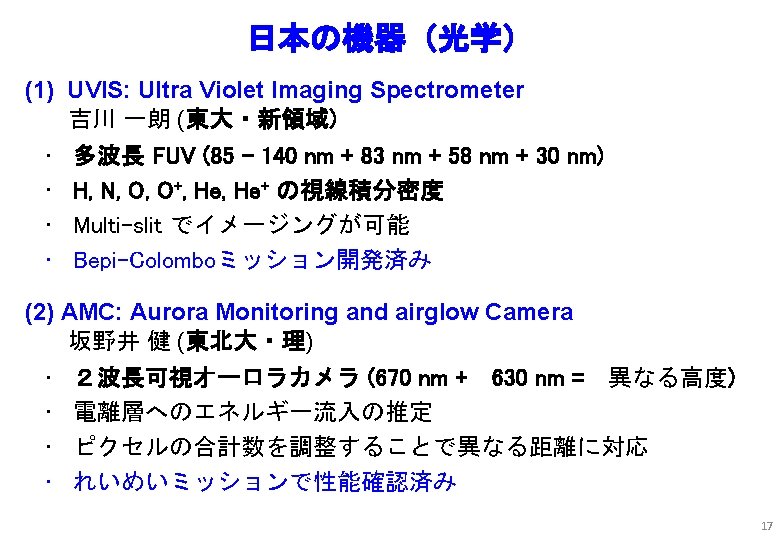
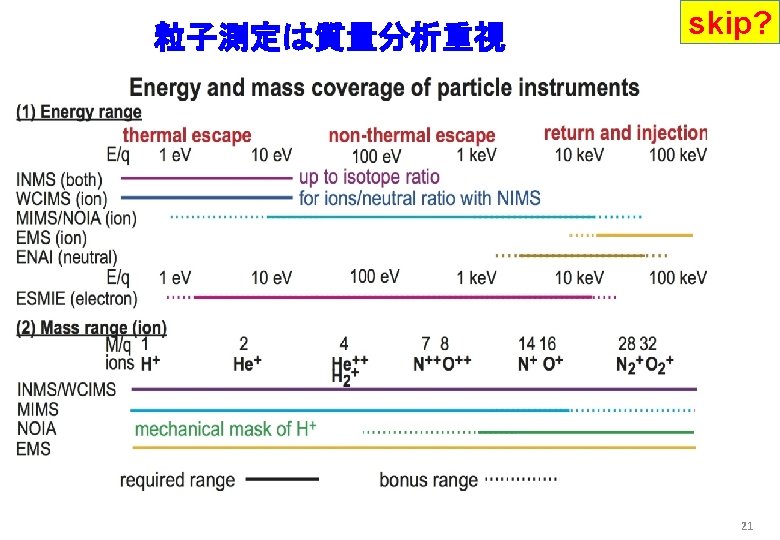
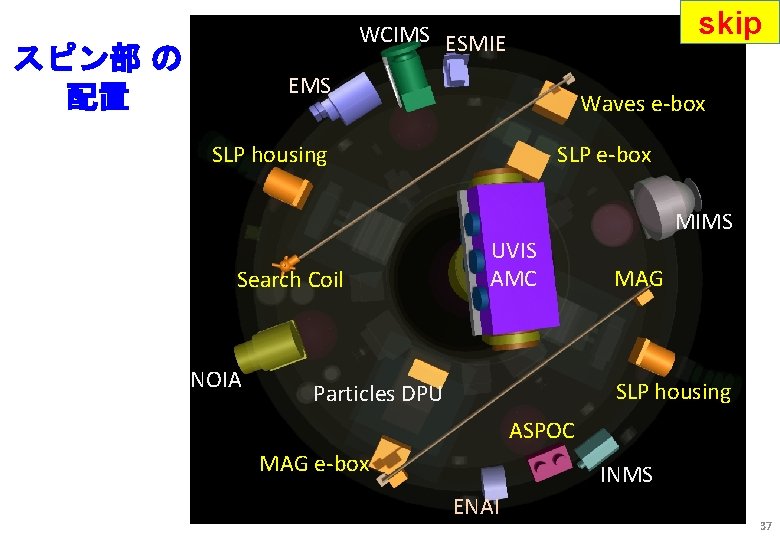
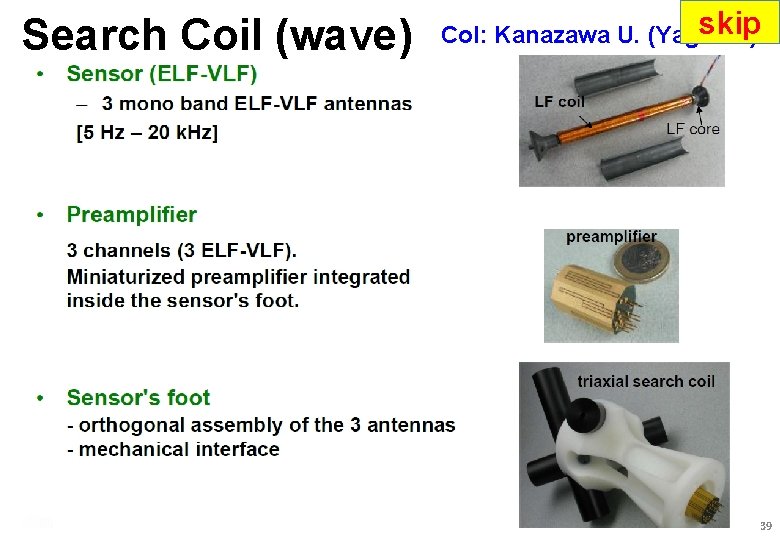
Payload in-situ 粒子観測 TRL INMS: 熱的イオン・中性質量分析 7 - 8 (高解像度 M/∆M > 1000): U. Bern WCIMS: 熱的イオン・中性質量速 度分布 fdist: NASA/GSFC 7 MIMS: 流出イオン (原子イオン M < 20, < 40 ke. V/q): IRAP, Toulouse 5 NOIA: 流出イオン (分子イオン M > 10, < 30 ke. V/q): IRF, Kiruna > 6 EMS: 高エネルギー流入イオン (20– 200 ke. V): U. New Hampshire > 6 ESMIE: 電子 (~5 e. V – 20 ke. V): UCL/MSSL, London > 6 ENAI: 高速中性粒子 (2– 200 ke. V): INAF/IAPS, Rome > 5 in-situ 電場・磁場観測 TRL SLP: Langmuir probe (衛星電位 と電子密度): BIRA-IASB, Brussels 4 - 5 MAG: 磁場: IWF, Graz Waves&Search Coil: 波動 (5 Hz – 20 k. Hz): ASCR, Prague & LPC 2 E, Orléans 光学観測 = 日本 8 UVIS: 多波長 FUV カメラ (85 – 140 nm, 83, 58, 30 nm for H, N, O, O+, He+): 東大新領域 AMC: 2波長可視オーロラカメラ (670 nm and 630 nm): 東北大理 > 5 TRL 6 - 7 7 - 8 地上観測(日本も参加) EISCAT_3 D: 三次元空間瞬時観測 13
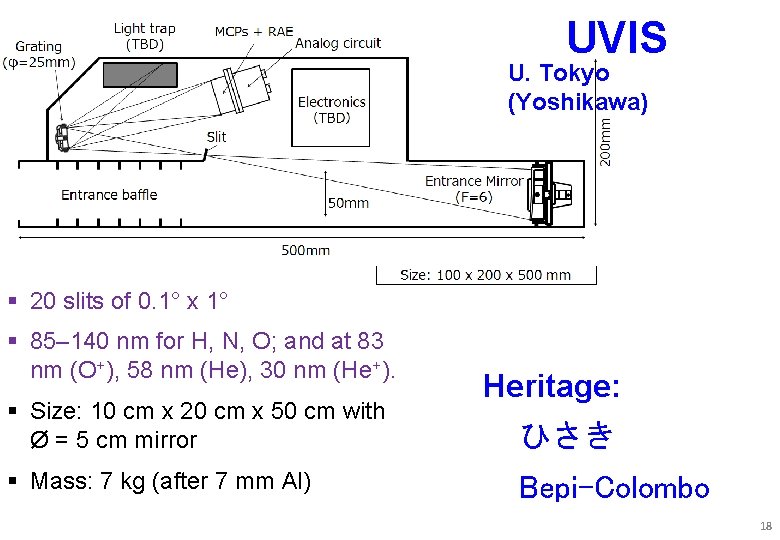
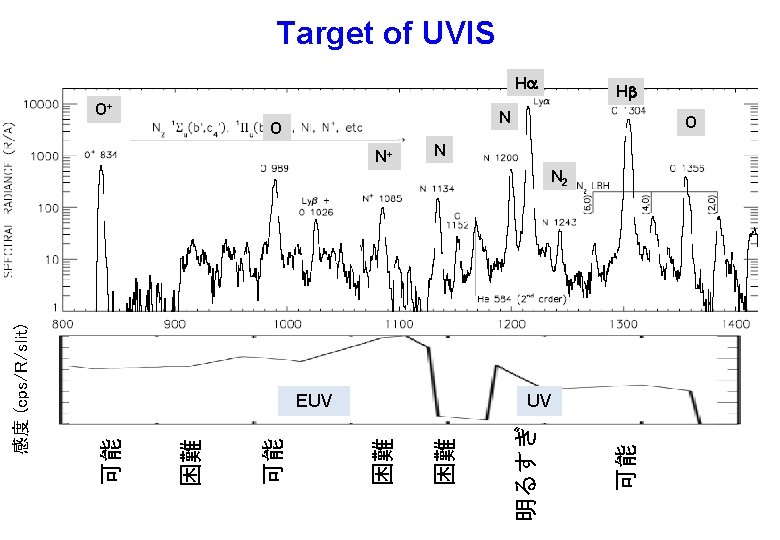
UVIS U. Tokyo (Yoshikawa) § 20 slits of 0. 1° x 1° § 85– 140 nm for H, N, O; and at 83 nm (O+), 58 nm (He), 30 nm (He+). § Size: 10 cm x 20 cm x 50 cm with Ø = 5 cm mirror § Mass: 7 kg (after 7 mm Al) Heritage: ひさき Bepi-Colombo 18
Target of UVIS Ha O+ Hb N O N+ O N N 2 可能 明るすぎ 困難 UV 困難 可能 困難 EUV 可能 感度 (cps/R/slit) 19
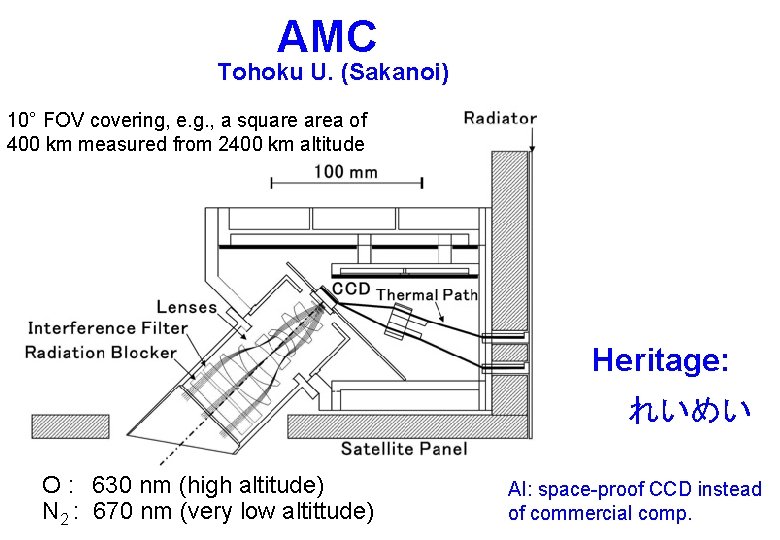
AMC Tohoku U. (Sakanoi) 10° FOV covering, e. g. , a square area of 400 km measured from 2400 km altitude Heritage: れいめい O : 630 nm (high altitude) N 2 : 670 nm (very low altittude) AI: space-proof CCD instead of commercial comp.
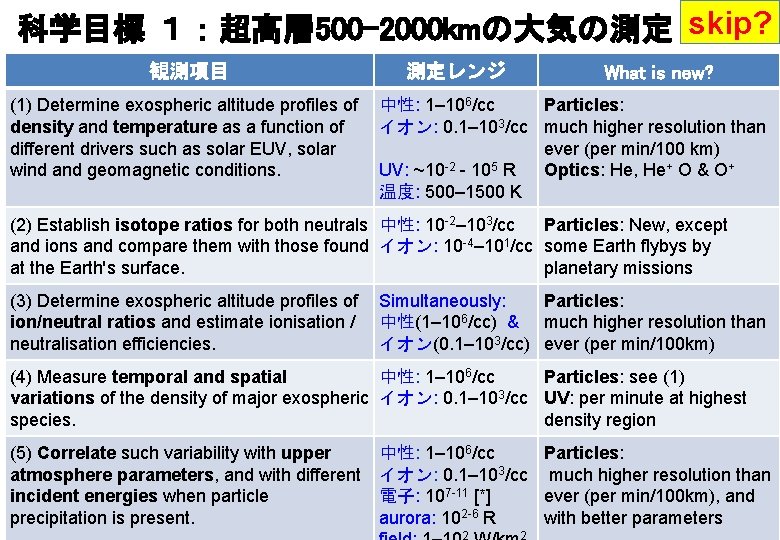
科学目標 1:超高層 500 -2000 kmの大気の測定 skip? 観測項目 測定レンジ What is new? (1) Determine exospheric altitude profiles of density and temperature as a function of different drivers such as solar EUV, solar wind and geomagnetic conditions. 中性: 1– 106/cc イオン: 0. 1– 103/cc UV: ~10 -2 - 105 R 温度: 500– 1500 K Particles: much higher resolution than ever (per min/100 km) Optics: He, He+ O & O+ (2) Establish isotope ratios for both neutrals 中性: 10 -2– 103/cc Particles: New, except and ions and compare them with those found イオン: 10 -4– 101/cc some Earth flybys by at the Earth's surface. planetary missions (3) Determine exospheric altitude profiles of Simultaneously: Particles: ion/neutral ratios and estimate ionisation / 中性(1– 106/cc) & much higher resolution than neutralisation efficiencies. イオン(0. 1– 103/cc) ever (per min/100 km) (4) Measure temporal and spatial 中性: 1– 106/cc Particles: see (1) variations of the density of major exospheric イオン: 0. 1– 103/cc UV: per minute at highest species. density region (5) Correlate such variability with upper atmosphere parameters, and with different incident energies when particle precipitation is present. 中性: 1– 106/cc イオン: 0. 1– 103/cc 電子: 107 -11 [*] aurora: 102 -6 R 2 2 Particles: much higher resolution than ever (per min/100 km), and with better parameters 23
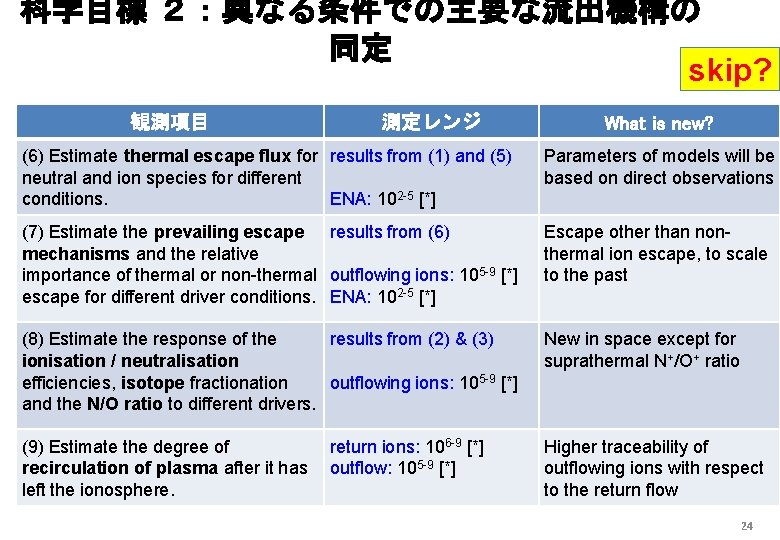
科学目標 2:異なる条件での主要な流出機構の 同定 skip? 観測項目 測定レンジ What is new? (6) Estimate thermal escape flux for results from (1) and (5) neutral and ion species for different conditions. ENA: 102 -5 [*] Parameters of models will be based on direct observations (7) Estimate the prevailing escape mechanisms and the relative importance of thermal or non-thermal escape for different driver conditions. Escape other than nonthermal ion escape, to scale to the past results from (6) outflowing ions: 105 -9 [*] ENA: 102 -5 [*] (8) Estimate the response of the results from (2) & (3) ionisation / neutralisation efficiencies, isotope fractionation outflowing ions: 105 -9 [*] and the N/O ratio to different drivers. New in space except for suprathermal N+/O+ ratio (9) Estimate the degree of return ions: 106 -9 [*] recirculation of plasma after it has outflow: 105 -9 [*] left the ionosphere. Higher traceability of outflowing ions with respect to the return flow 24
Thank you !
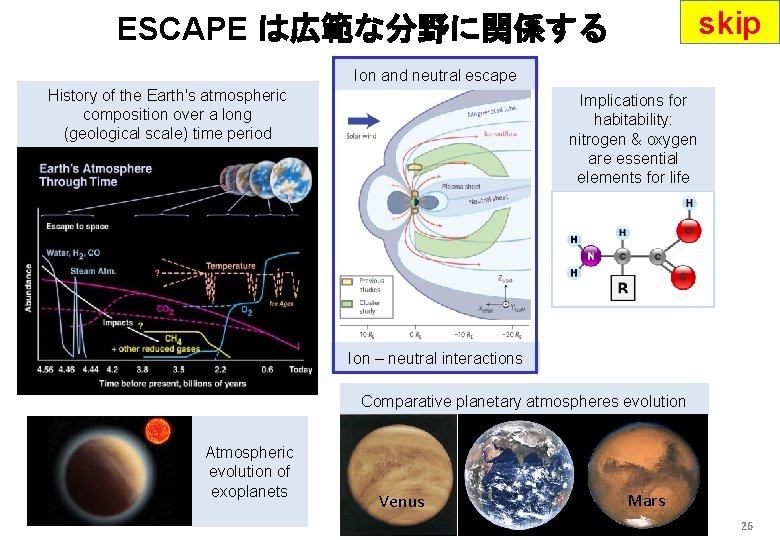
skip ESCAPE は広範な分野に関係する Ion and neutral escape History of the Earth's atmospheric composition over a long (geological scale) time period Implications for habitability: nitrogen & oxygen are essential elements for life Ion – neutral interactions Comparative planetary atmospheres evolution Atmospheric evolution of exoplanets Venus Mars 26
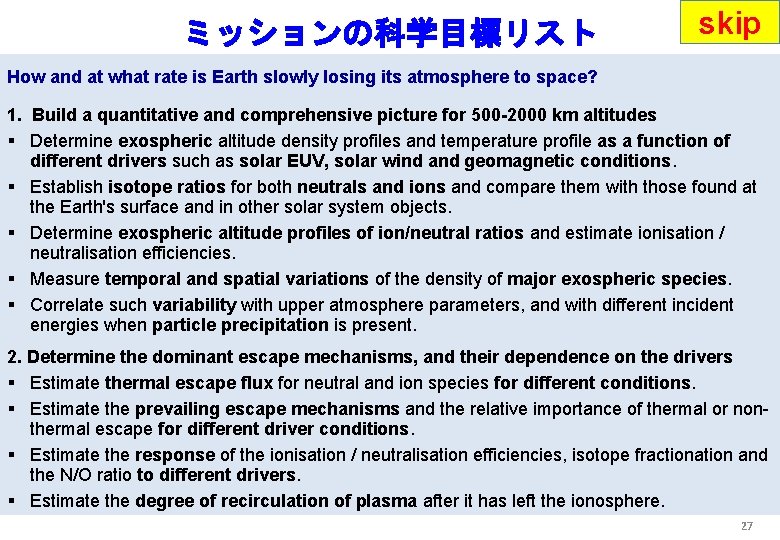
ミッションの科学目標リスト skip How and at what rate is Earth slowly losing its atmosphere to space? 1. Build a quantitative and comprehensive picture for 500 -2000 km altitudes § Determine exospheric altitude density profiles and temperature profile as a function of different drivers such as solar EUV, solar wind and geomagnetic conditions. § Establish isotope ratios for both neutrals and ions and compare them with those found at the Earth's surface and in other solar system objects. § Determine exospheric altitude profiles of ion/neutral ratios and estimate ionisation / neutralisation efficiencies. § Measure temporal and spatial variations of the density of major exospheric species. § Correlate such variability with upper atmosphere parameters, and with different incident energies when particle precipitation is present. 2. Determine the dominant escape mechanisms, and their dependence on the drivers § Estimate thermal escape flux for neutral and ion species for different conditions. § Estimate the prevailing escape mechanisms and the relative importance of thermal or nonthermal escape for different driver conditions. § Estimate the response of the ionisation / neutralisation efficiencies, isotope fractionation and the N/O ratio to different drivers. § Estimate the degree of recirculation of plasma after it has left the ionosphere. 27
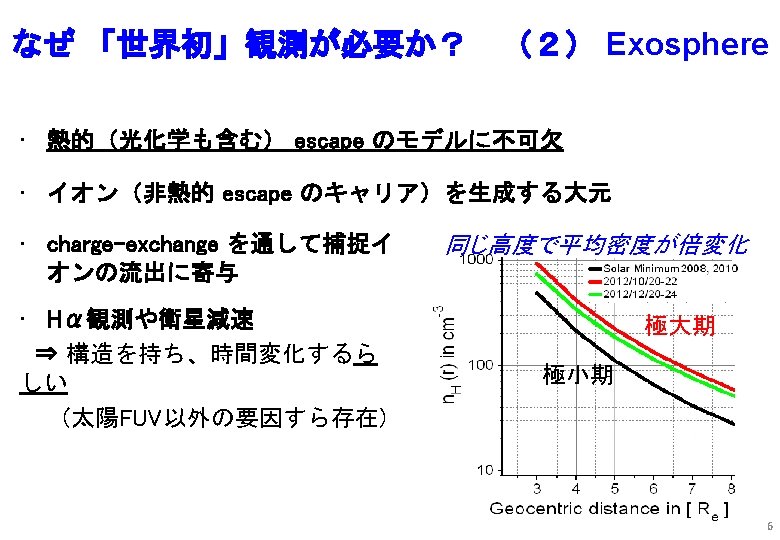
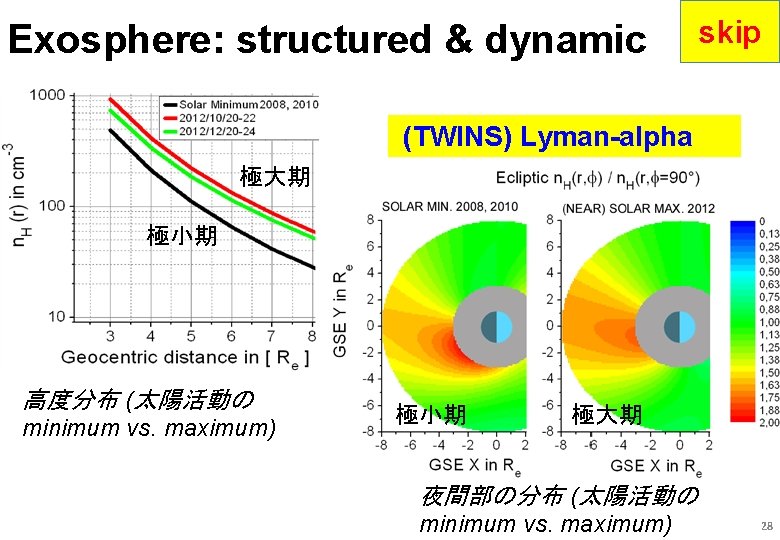
Exosphere: structured & dynamic skip (TWINS) Lyman-alpha 極大期 極小期 高度分布 (太陽活動の minimum vs. maximum) 極小期 極大期 夜間部の分布 (太陽活動の minimum vs. maximum) 28
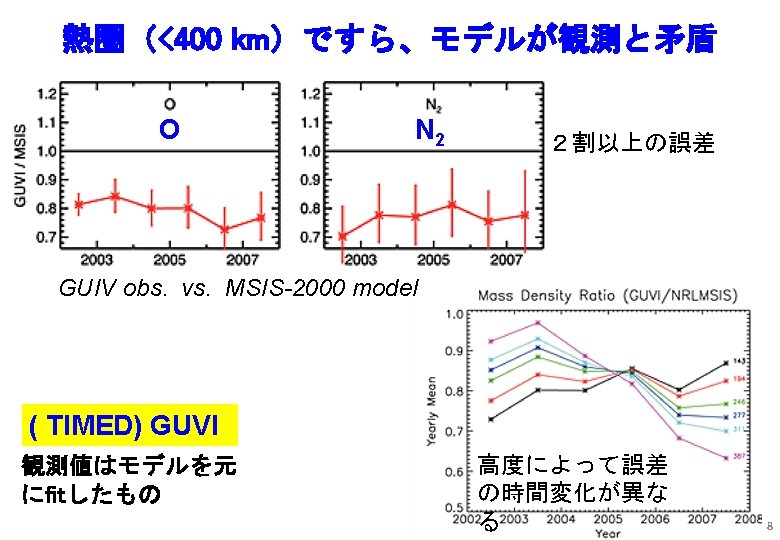
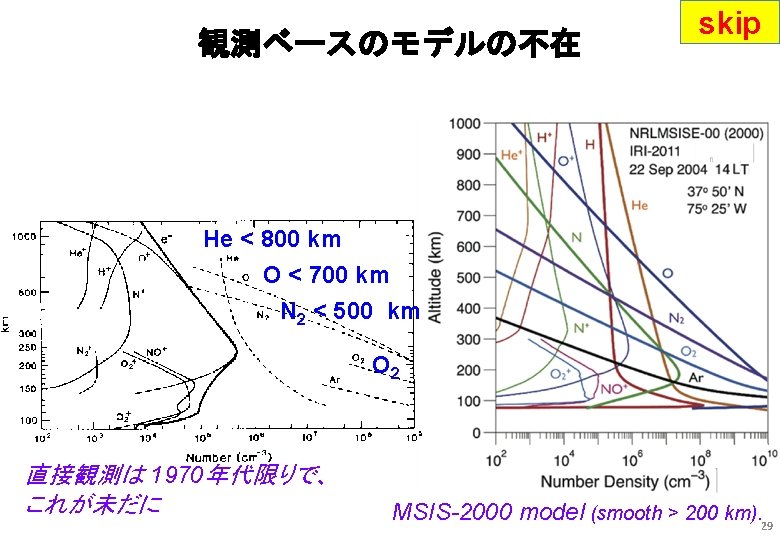
観測ベースのモデルの不在 skip He < 800 km O < 700 km N 2 < 500 km O 2 直接観測は 1970年代限りで、 これが未だに MSIS-2000 model (smooth > 200 km). 29
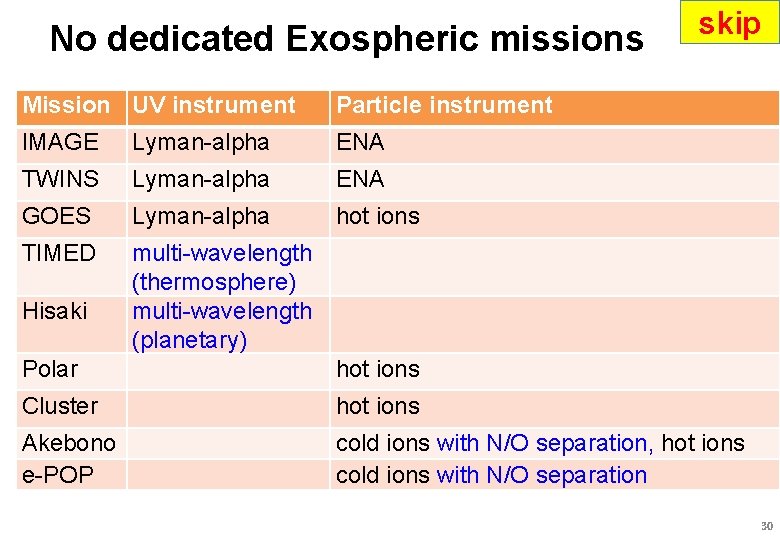
No dedicated Exospheric missions Mission UV instrument Particle instrument IMAGE Lyman-alpha ENA TWINS Lyman-alpha ENA GOES Lyman-alpha hot ions skip TIMED multi-wavelength (thermosphere) Hisaki multi-wavelength (planetary) Polar hot ions Cluster hot ions Akebono e-POP cold ions with N/O separation, hot ions cold ions with N/O separation 30
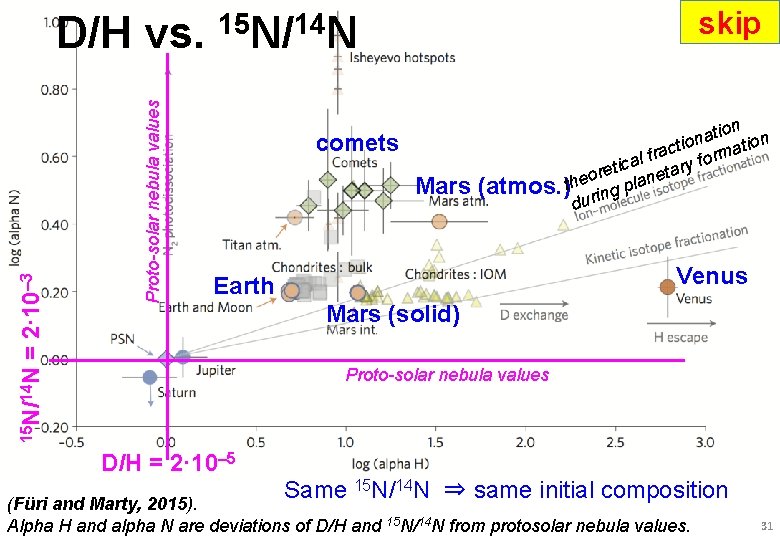
skip Proto-solar nebula values comets Mars tion n a n ctio rmatio a r f ical tary fo t e r (atmos. )theoring plane du Venus Earth Mars (solid) Proto-solar nebula values 15 N/14 N = 2· 10– 3 D/H vs. 15 N/14 N D/H = 2· 10– 5 Same 15 N/14 N ⇒ same initial composition (Füri and Marty, 2015). Alpha H and alpha N are deviations of D/H and 15 N/14 N from protosolar nebula values. 31
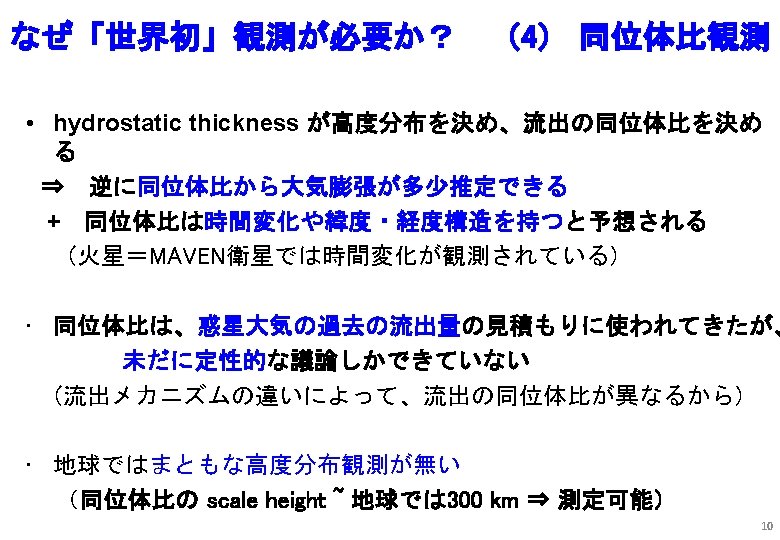
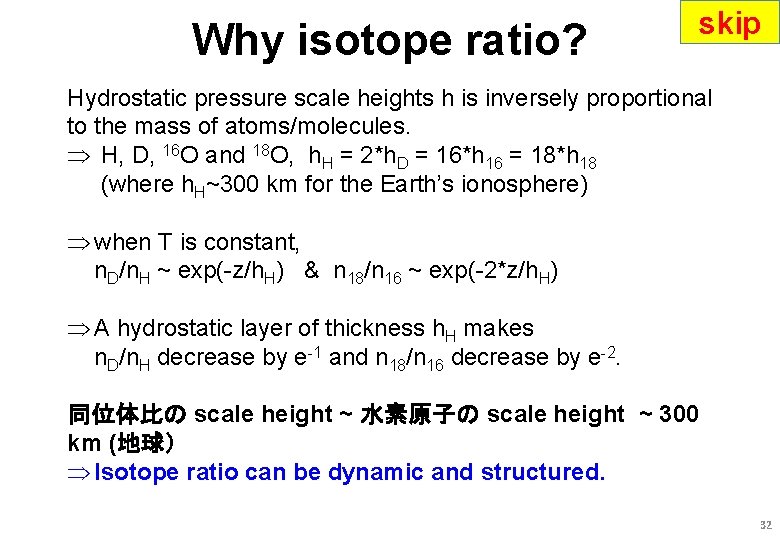
Why isotope ratio? skip Hydrostatic pressure scale heights h is inversely proportional to the mass of atoms/molecules. H, D, 16 O and 18 O, h. H = 2*h. D = 16*h 16 = 18*h 18 (where h. H~300 km for the Earth’s ionosphere) when T is constant, n. D/n. H ~ exp(-z/h. H) & n 18/n 16 ~ exp(-2*z/h. H) A hydrostatic layer of thickness h. H makes n. D/n. H decrease by e-1 and n 18/n 16 decrease by e-2. 同位体比の scale height ~ 水素原子の scale height ~ 300 km (地球) Isotope ratio can be dynamic and structured. 32
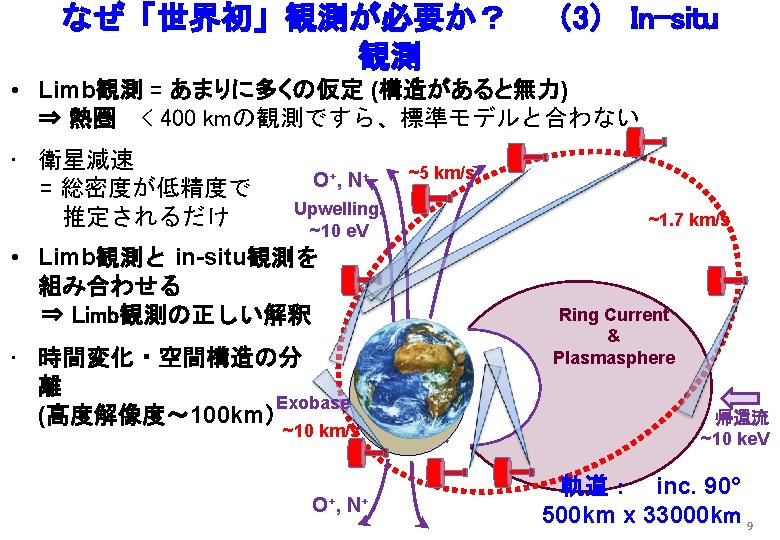
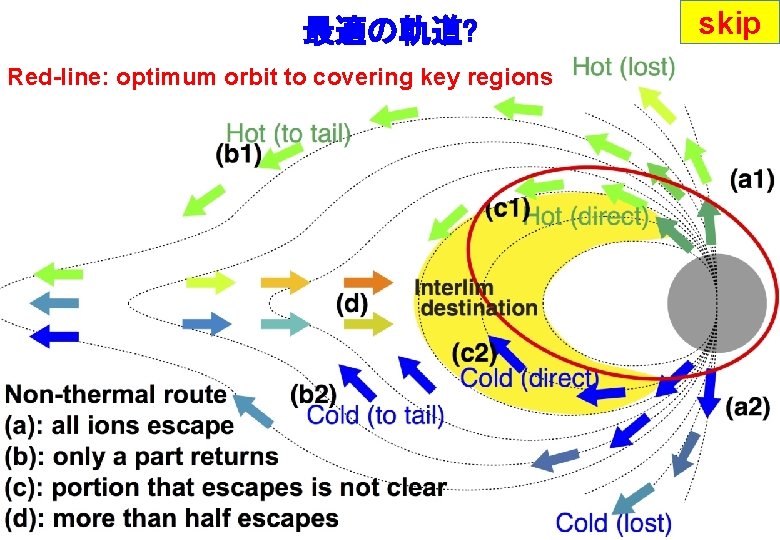
最適の軌道? skip Red-line: optimum orbit to covering key regions 33
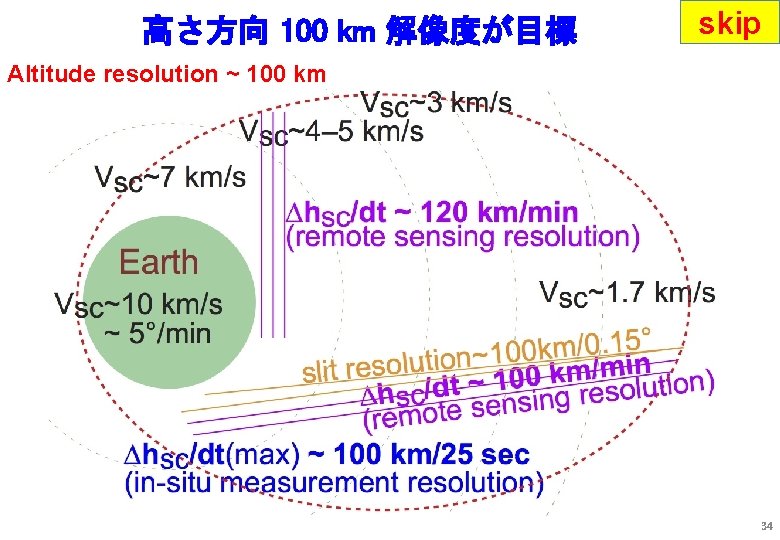
高さ方向 100 km 解像度が目標 skip Altitude resolution ~ 100 km 34
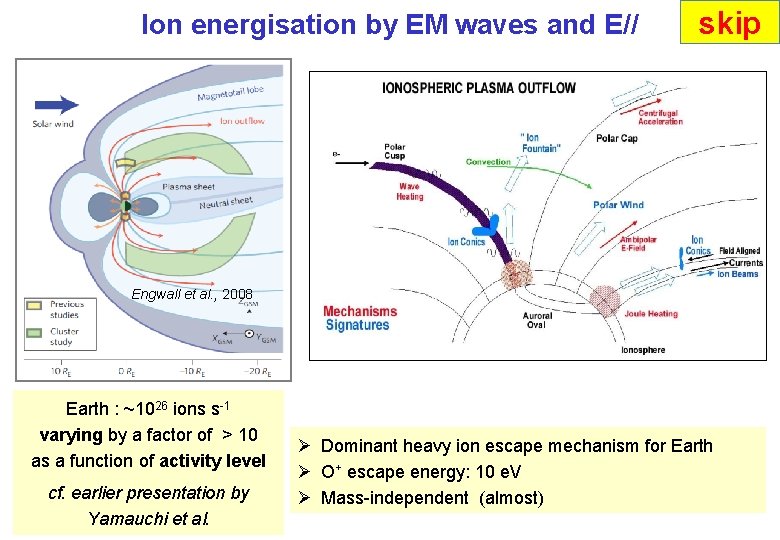
Ion energisation by EM waves and E// skip Engwall et al. , 2008 Earth : ~1026 ions s-1 varying by a factor of > 10 as a function of activity level cf. earlier presentation by Yamauchi et al. Ø Dominant heavy ion escape mechanism for Earth Ø O+ escape energy: 10 e. V Ø Mass-independent (almost)
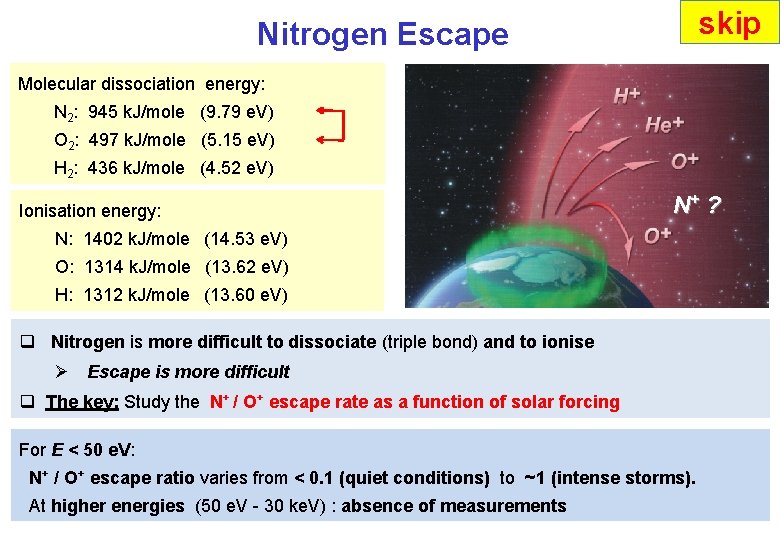
skip Nitrogen Escape Molecular dissociation energy: N 2: 945 k. J/mole (9. 79 e. V) O 2: 497 k. J/mole (5. 15 e. V) H 2: 436 k. J/mole (4. 52 e. V) Ionisation energy: N+ ? N: 1402 k. J/mole (14. 53 e. V) O: 1314 k. J/mole (13. 62 e. V) H: 1312 k. J/mole (13. 60 e. V) q Nitrogen is more difficult to dissociate (triple bond) and to ionise Ø Escape is more difficult q The key: Study the N+ / O+ escape rate as a function of solar forcing For E < 50 e. V: N+ / O+ escape ratio varies from < 0. 1 (quiet conditions) to ~1 (intense storms). At higher energies (50 e. V - 30 ke. V) : absence of measurements
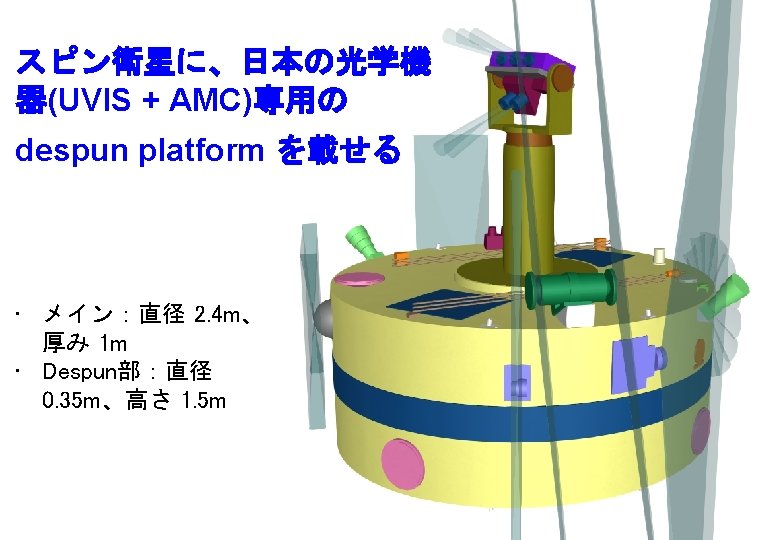
skip WCIMS ESMIE スピン部 の 配置 EMS Waves e-box SLP housing Search Coil NOIA SLP e-box UVIS AMC MIMS MAG SLP housing Particles DPU ASPOC MAG e-box INMS ENAI 37
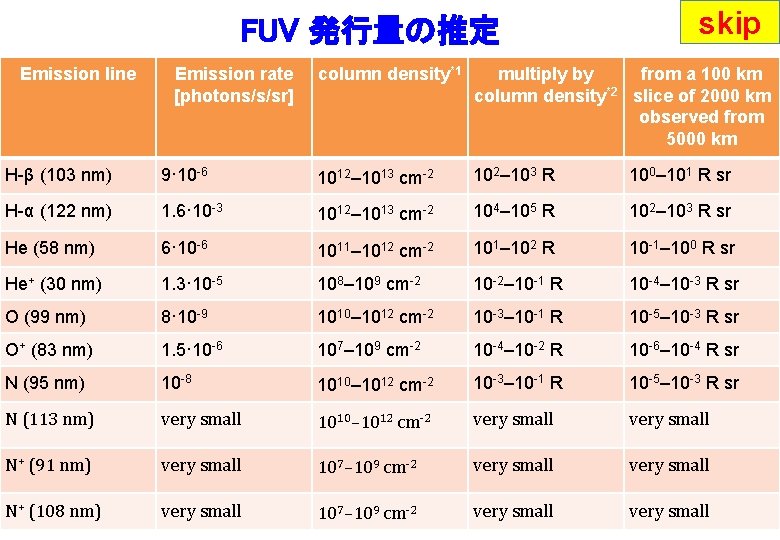
FUV 発行量の推定 Emission line Emission rate [photons/s/sr] skip column density*1 multiply by from a 100 km column density*2 slice of 2000 km observed from 5000 km H-β (103 nm) 9· 10 -6 1012– 1013 cm-2 102– 103 R 100– 101 R sr H-α (122 nm) 1. 6· 10 -3 1012– 1013 cm-2 104– 105 R 102– 103 R sr He (58 nm) 6· 10 -6 1011– 1012 cm-2 101– 102 R 10 -1– 100 R sr He+ (30 nm) 1. 3· 10 -5 108– 109 cm-2 10 -2– 10 -1 R 10 -4– 10 -3 R sr O (99 nm) 8· 10 -9 1010– 1012 cm-2 10 -3– 10 -1 R 10 -5– 10 -3 R sr O+ (83 nm) 1. 5· 10 -6 107– 109 cm-2 10 -4– 10 -2 R 10 -6– 10 -4 R sr N (95 nm) 10 -8 1010– 1012 cm-2 10 -3– 10 -1 R 10 -5– 10 -3 R sr N (113 nm) very small 1010– 1012 cm-2 very small N+ (91 nm) very small 107– 109 cm-2 very small N+ (108 nm) very small 107– 109 cm-2 very small 38
Search Coil (wave) skip Co. I: Kanazawa U. (Yagitani) 39