Educating Students with Autism Paul Livelli Ph D










- Slides: 74
Educating Students with Autism Paul Livelli, Ph. D. Mountain Creek Farms Universtiy of Maryland
Objectives n Understanding Autism n Setting up classrooms and schools n Behavioral Programming n Teaching Strategies/Instruction n Communication Programming n Vocational Programming n Questions and hopefully answers
Paul Livelli The Story of Roger
Who are you? Group exercise
What is Autism
Group Activity n Break into small groups n Label all the characteristics of students with autism on large sheet of paper n Group them into categories (hopefully 3 or 4) n Present to larger group
Autism characteristics n Social n Communication n Motor n Sensory
How Autism Looks n People different and remote n Incapable of understanding others thoughts/feeling (Theory of Mind) n Language and intelligence impaired n Repetitive behaviors n Sensory sensitivity
Children with Autism n Don’t follow typical patterns of development n 18 – 36 months of age changes occur n Rejection of others, strange behaviors, lose language, lose social skills
Typical Parent Fears n Lack of communication/connection n Feelings of being ignored n Embarrassment of public displays of behavior n Lack of hopes and dreams
Autism Statistics n Found in every country of the world n Found in all racial, ethnic, religious, and economic backgrounds n Affects 1 or 2 people for every thousand n Three to four times more likely in boys
What is Autism?
Communication Infant w/Autism Normal Avoid eye contact n Seem deaf n Start developing language, then abruptly stop talking n Study mother’s face n Easily stimulated by sounds n Keep adding to vocabulary and expanding grammatical usage n
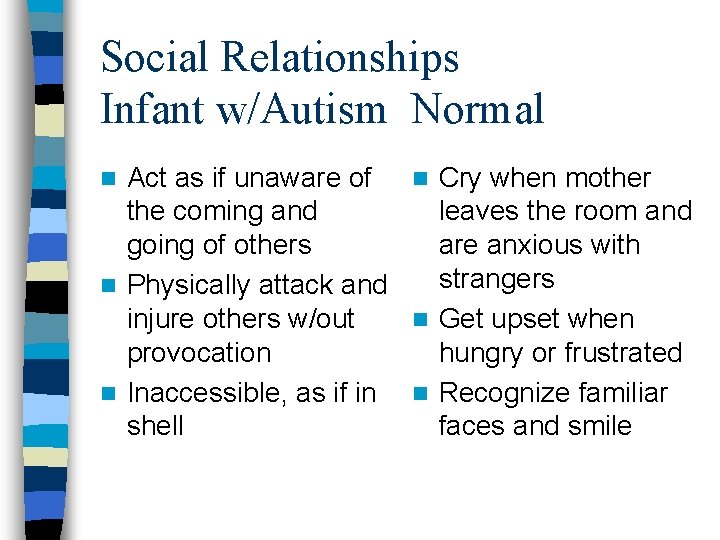
Social Relationships Infant w/Autism Normal Act as if unaware of n Cry when mother the coming and leaves the room and going of others are anxious with strangers n Physically attack and injure others w/out n Get upset when provocation hungry or frustrated n Inaccessible, as if in n Recognize familiar shell faces and smile n
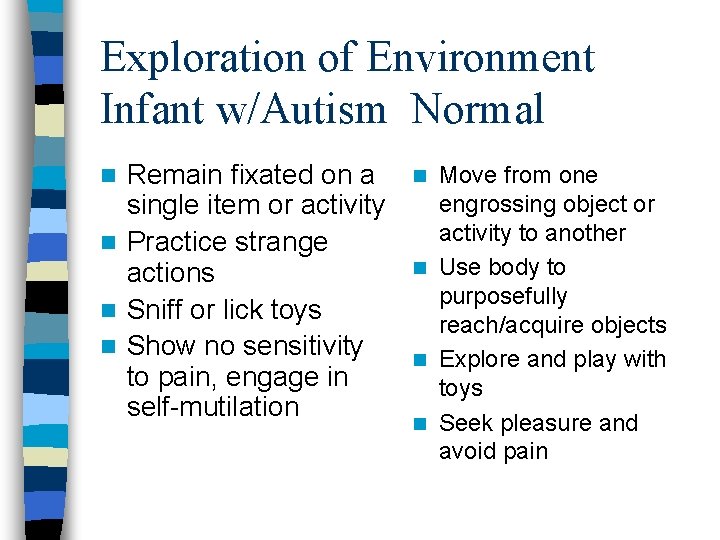
Exploration of Environment Infant w/Autism Normal Remain fixated on a single item or activity n Practice strange actions n Sniff or lick toys n Show no sensitivity to pain, engage in self-mutilation n Move from one engrossing object or activity to another n Use body to purposefully reach/acquire objects n Explore and play with toys n Seek pleasure and avoid pain n
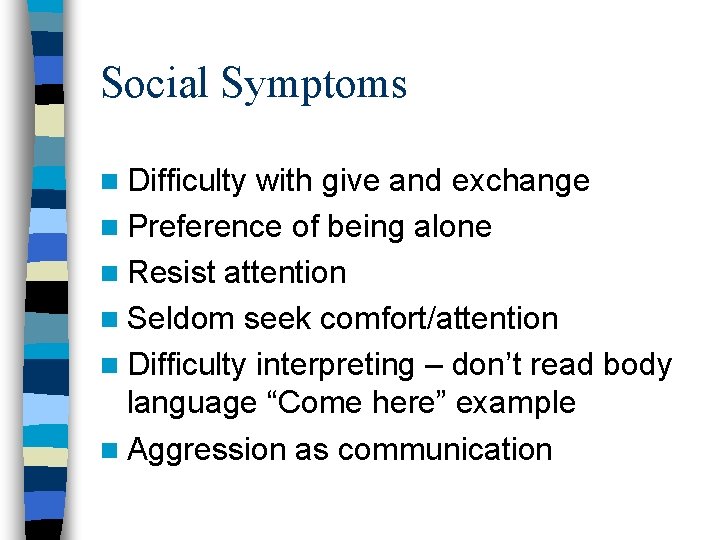
Social Symptoms n Difficulty with give and exchange n Preference of being alone n Resist attention n Seldom seek comfort/attention n Difficulty interpreting – don’t read body language “Come here” example n Aggression as communication
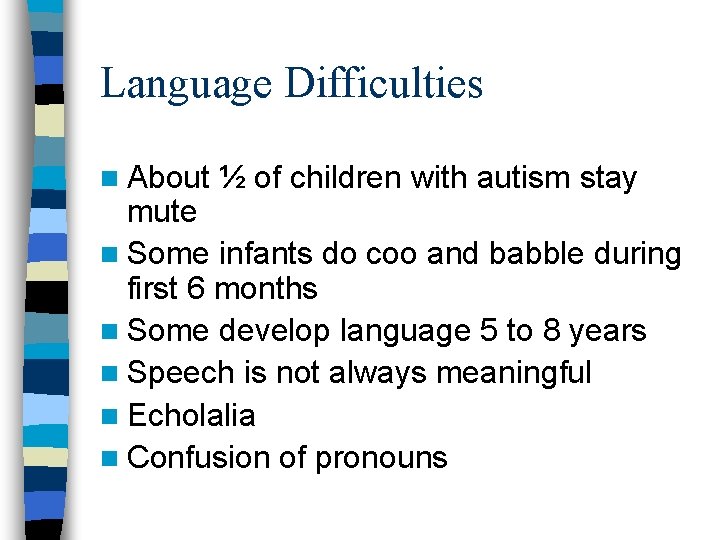
Language Difficulties n About ½ of children with autism stay mute n Some infants do coo and babble during first 6 months n Some develop language 5 to 8 years n Speech is not always meaningful n Echolalia n Confusion of pronouns
Story of Temple Grandin “Thinking in Pictures”
Repetitive behaviors and obsessions n Stereotypies/Self stimulation n Repetition of tasks – lining up pretzels n Fixations/obsessions n Demand consistency n Order and sameness may provide sensory stability n Imaginative play is limited
Sensory symptoms n Sensory integration – difficulty organizing n Painful sensitivities – sound, light, texture, smells n Oblivious to cold or pain n Senses sometimes scrambled – gag when touching a certain texture
Unusual Abilities n Artistic talent n Capacity for complicated mathematical concepts n Puzzles n Play instruments w/out lessons n Savant skills
Autism Diagnosis
How is Autism Diagnosed? n Parents first to notice n Changes in regular development n NO medical test/rule out other disorders n Psychiatrist/Psychologist with training can recognize disorder n Standardized scales n Rett’s/Aspergers
Diagnostic Criteria n Poor or limited social relationships n Underdeveloped communication skills n Repetitive behaviors, interests, and activities
What Causes Autism? n Abnormalities in brain structure/function n The Lymbic System n Amygdala – regulation of social and emotional behavior n Serotonin (neurotransmitter) – higher levels n Still not sure with the current research available
Factors Affecting Brain Development
Heredity n Studies of twins suggest higher likelihood of brain dysfunction n Identical more likely than fraternal to have autism n Parents with one child more likely to have another with autism n Autism does not appear to be due to one gene
Inheritance n Irregular segment of genetic code n Cluster of 3 to 6 unstable genes n Certain conditions unstable genes interact and interfere with brain development n In some families siblings have minor language difficulties but not full autism reinforcing the “conditions theory”
Pregnancy and Other Problems n Viral infections like rubella n Lack of oxygen n No clear links yet
Accompanying Disorders n Mental retardation – 15 -20% have IQ below 35, 75 -80% have MR, more than 10% have above average IQ n Seizures – about 1/3 of people with autism, most cases can be controlled with meds n Fragile X – 10% of those with autism, defective piece of X chromosone
Intervention/Aproac hes
Developmental n Environment building on skills and interests n Consistency and structure n Predictable schedules n Classroom activity areas n Activities to meet sensory needs n Adaptation of materials
Behavioral n Reward for appropriate behavior n Time intensive, highly structured, repetitive sequences n Opportunities for practice n Reinforcement, reinforcement, reinforcement
Medications n Treat anxiety and depression, serotonin levels (Prozac, Luvox, Zoloft, Anafranil) n OCD meds n Hyperactivity meds n Sensory research to block endorphins n Meds to treat psychiatric disorders – now unpopular in use
Practice Teaching
Instructional Design Making and managing the classroom
Classroom Activities n Group instruction n Discrete trail delivery n Social and play areas n Technology
Group Instruction n Delivered by the teacher n Support by aide(s) n Dynamic movement n Repetition and practice n Generalization of skills
Discrete-trial Delivery n Delivered by aide(s) n Supported by the teacher n Static instruction n Repetition and practice n Not for generalization except across instructors
Social and Play Areas n Space for movement n Table tops for games n Access to leisure materials n Design for comfort and relaxation n Outside play areas
Technology n Located in the classroom n Available both to staff and students n Proximate to group instruction areas n Designed for generalization of skills n Introduction to technological age
Small Group Project Design your classroom setup
The Instructional Day Maximizing learning while maintaining staff and student energy
The Instructional Day n Reading, writing, math, communication, social skills n Mix of high energy and low energy activities n Pyramid instructional design
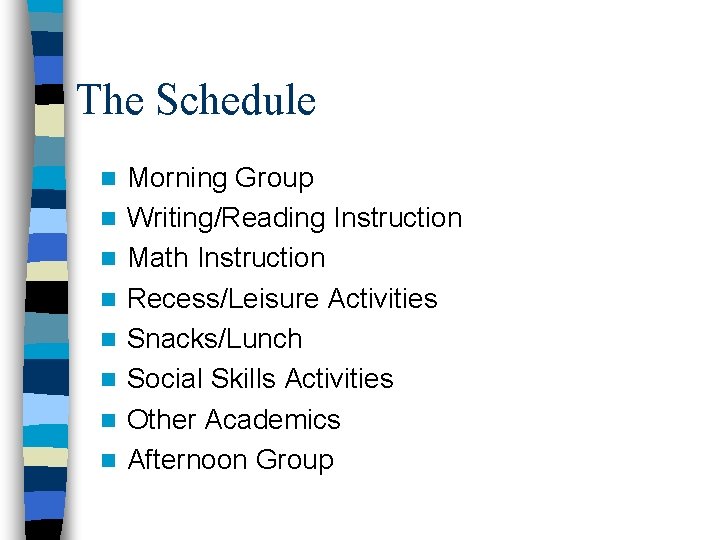
The Schedule n n n n Morning Group Writing/Reading Instruction Math Instruction Recess/Leisure Activities Snacks/Lunch Social Skills Activities Other Academics Afternoon Group
The Schedule as a Behavioral Tool n Posted in easily understood format n Redirect students after each activity n Provide adequate warning n Manipulate schedule as tasks are finished n Written word, PECs, Actual pictures (digital camera)
The Instructional Program n Instructional Area that relates to the overall plan n Specific instructions for implementation of the program n Materials needed for the program n Data collection to be used n Specification of how often to take data
Small Group Project Write an Instructional Program for identifying colors
Practice Teaching
Syndrome: Understanding and Increasing Behavior Paul Livelli, Ph. D Student Services Coordinator College Living Experience
Brainstorm Activity n What motivates people? » ? ? ? ?
A Powerful Motivator n/ / -
Sorry; this is it n/ - /
Sorry; this is the really powerful motivator n/ - n. Don’t you see it?
This is really it…
The really powerful motivator n. A n Does it apply to the students we serve?
The Nature of Motivation n Motivation is not dichotomous – Little utility in thinking a student “is” or “is not” motivated n Motivation is dynamic and continuous – It is a probability that an individual will engage in and maintain a certain activity. n Motivation is therefore subject to numerous factors – People (instructors/parents) have no affect on some factors but may have significant affects on other factors
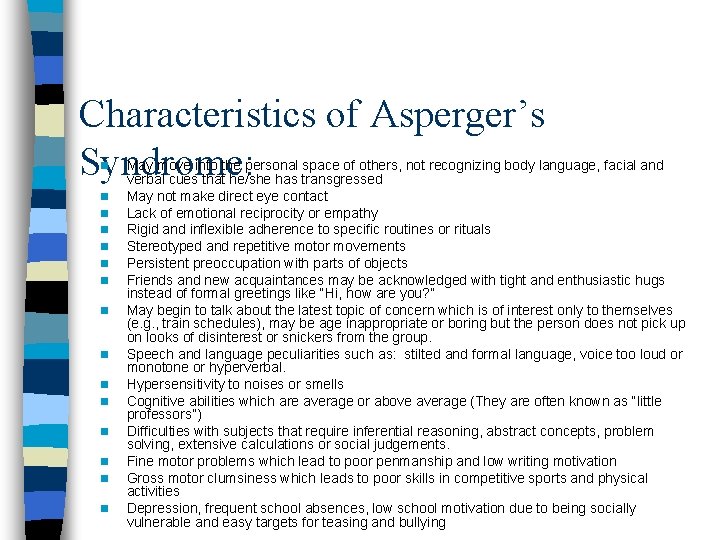
Characteristics of Asperger’s Syndrome: n n n n May move into the personal space of others, not recognizing body language, facial and verbal cues that he/she has transgressed May not make direct eye contact Lack of emotional reciprocity or empathy Rigid and inflexible adherence to specific routines or rituals Stereotyped and repetitive motor movements Persistent preoccupation with parts of objects Friends and new acquaintances may be acknowledged with tight and enthusiastic hugs instead of formal greetings like “Hi, how are you? ” May begin to talk about the latest topic of concern which is of interest only to themselves (e. g. , train schedules), may be age inappropriate or boring but the person does not pick up on looks of disinterest or snickers from the group. Speech and language peculiarities such as: stilted and formal language, voice too loud or monotone or hyperverbal. Hypersensitivity to noises or smells Cognitive abilities which are average or above average (They are often known as “little professors”) Difficulties with subjects that require inferential reasoning, abstract concepts, problem solving, extensive calculations or social judgements. Fine motor problems which lead to poor penmanship and low writing motivation Gross motor clumsiness which leads to poor skills in competitive sports and physical activities Depression, frequent school absences, low school motivation due to being socially vulnerable and easy targets for teasing and bullying
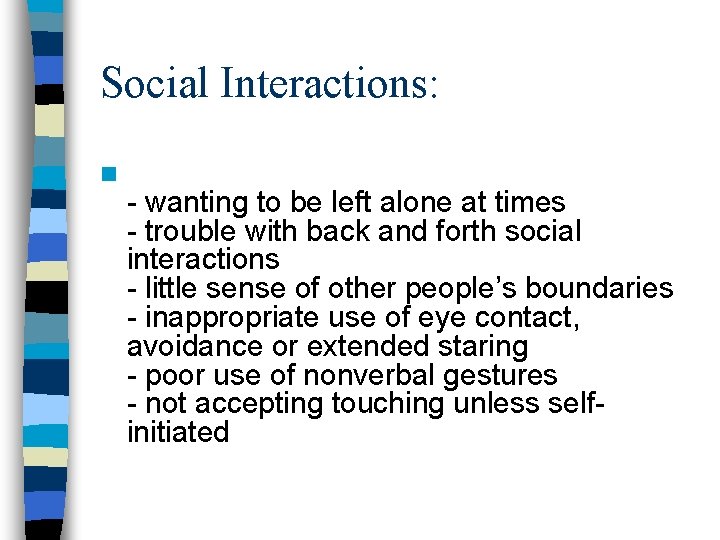
Social Interactions: n - wanting to be left alone at times - trouble with back and forth social interactions - little sense of other people’s boundaries - inappropriate use of eye contact, avoidance or extended staring - poor use of nonverbal gestures - not accepting touching unless selfinitiated
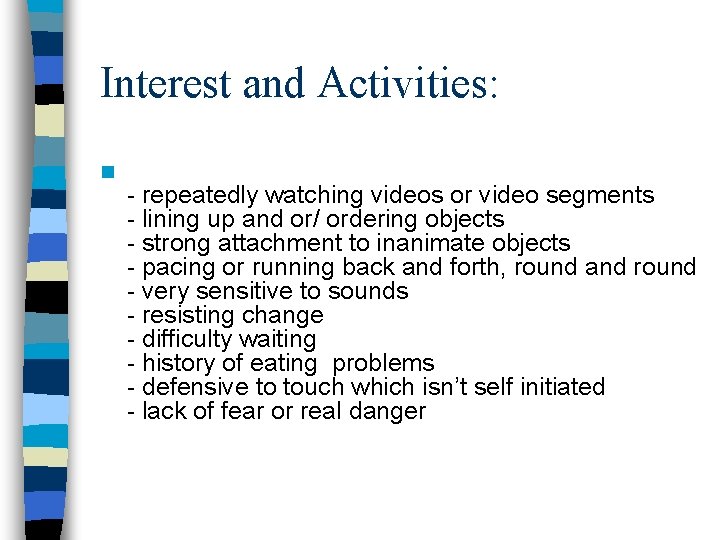
Interest and Activities: n - repeatedly watching videos or video segments - lining up and or/ ordering objects - strong attachment to inanimate objects - pacing or running back and forth, round and round - very sensitive to sounds - resisting change - difficulty waiting - history of eating problems - defensive to touch which isn’t self initiated - lack of fear or real danger
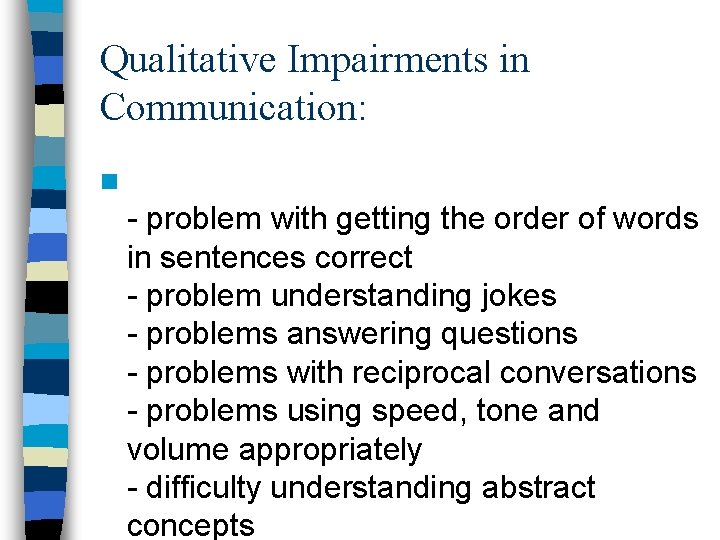
Qualitative Impairments in Communication: n - problem with getting the order of words in sentences correct - problem understanding jokes - problems answering questions - problems with reciprocal conversations - problems using speed, tone and volume appropriately - difficulty understanding abstract concepts
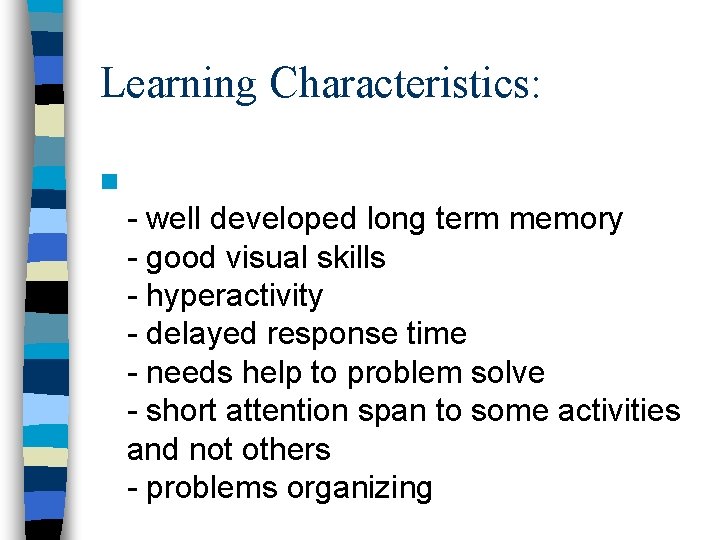
Learning Characteristics: n - well developed long term memory - good visual skills - hyperactivity - delayed response time - needs help to problem solve - short attention span to some activities and not others - problems organizing
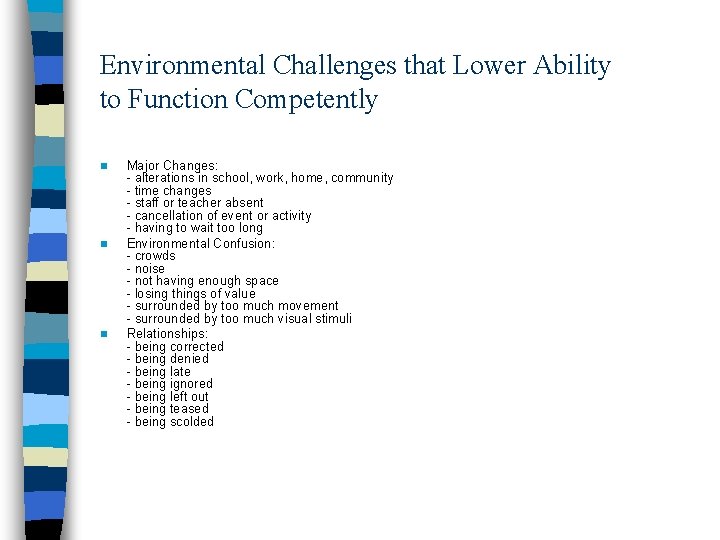
Environmental Challenges that Lower Ability to Function Competently n n n Major Changes: - alterations in school, work, home, community - time changes - staff or teacher absent - cancellation of event or activity - having to wait too long Environmental Confusion: - crowds - noise - not having enough space - losing things of value - surrounded by too much movement - surrounded by too much visual stimuli Relationships: - being corrected - being denied - being late - being ignored - being left out - being teased - being scolded
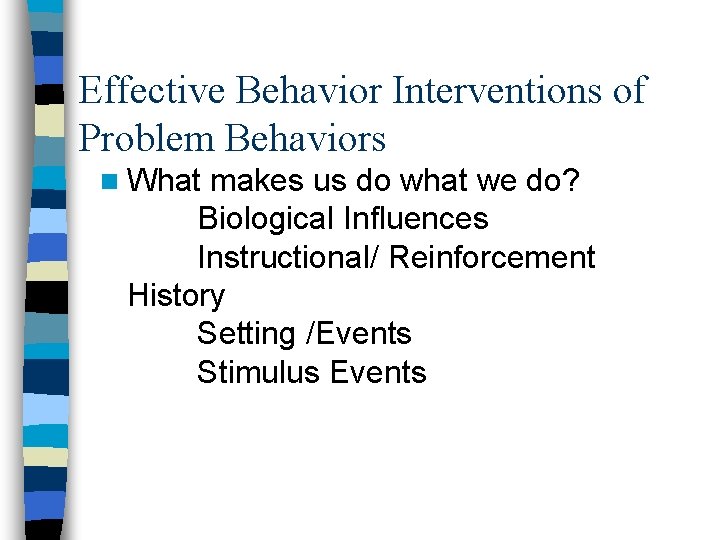
Effective Behavior Interventions of Problem Behaviors n What makes us do what we do? Biological Influences Instructional/ Reinforcement History Setting /Events Stimulus Events
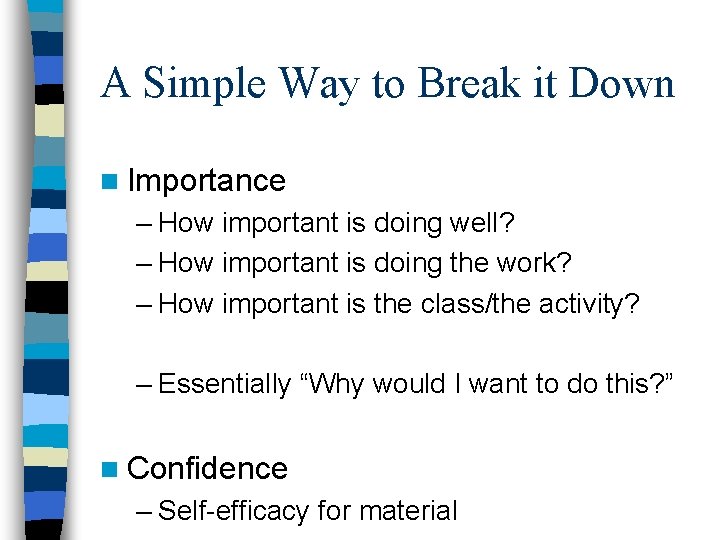
A Simple Way to Break it Down n Importance – How important is doing well? – How important is doing the work? – How important is the class/the activity? – Essentially “Why would I want to do this? ” n Confidence – Self-efficacy for material
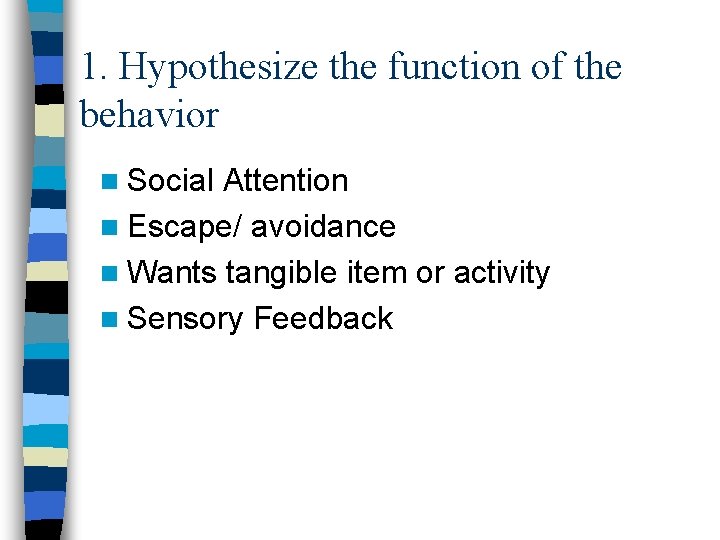
1. Hypothesize the function of the behavior n Social Attention n Escape/ avoidance n Wants tangible item or activity n Sensory Feedback
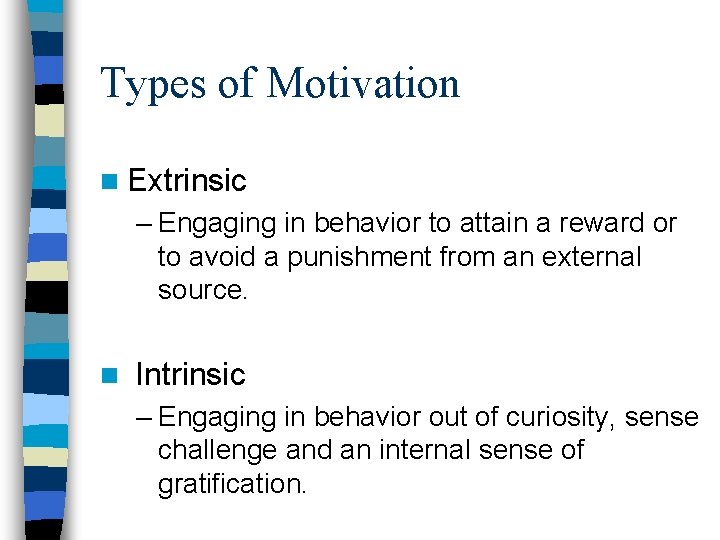
Types of Motivation n Extrinsic – Engaging in behavior to attain a reward or to avoid a punishment from an external source. n Intrinsic – Engaging in behavior out of curiosity, sense challenge and an internal sense of gratification.
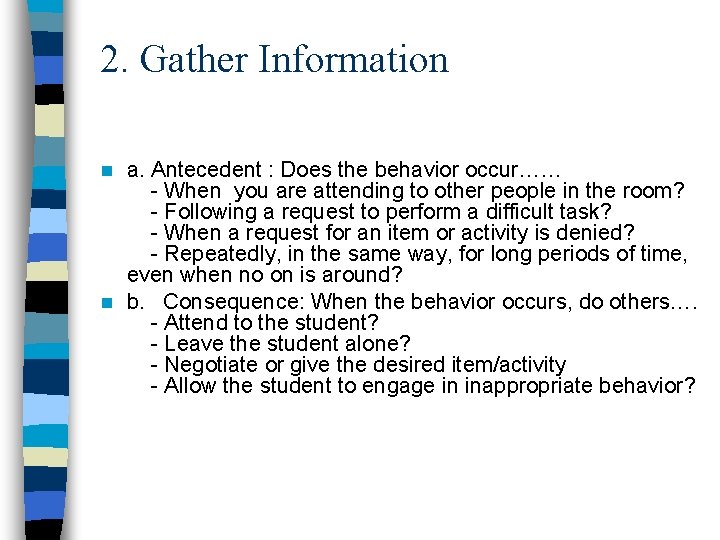
2. Gather Information a. Antecedent : Does the behavior occur…… - When you are attending to other people in the room? - Following a request to perform a difficult task? - When a request for an item or activity is denied? - Repeatedly, in the same way, for long periods of time, even when no on is around? n b. Consequence: When the behavior occurs, do others…. - Attend to the student? - Leave the student alone? - Negotiate or give the desired item/activity - Allow the student to engage in inappropriate behavior? n
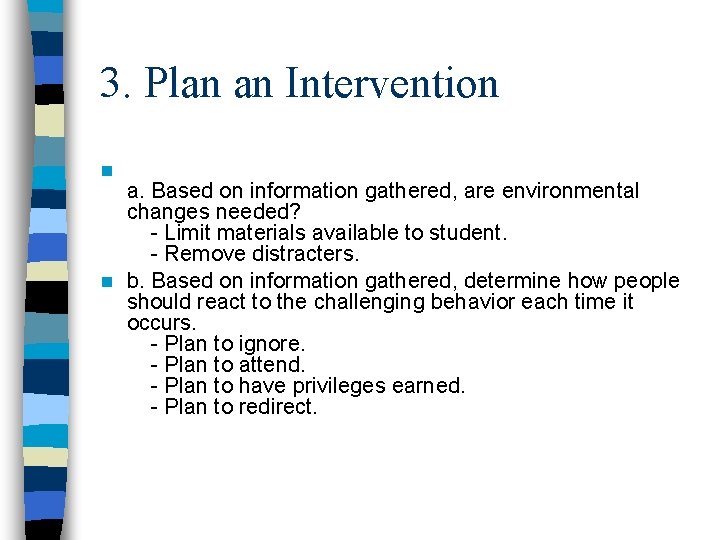
3. Plan an Intervention n a. Based on information gathered, are environmental changes needed? - Limit materials available to student. - Remove distracters. n b. Based on information gathered, determine how people should react to the challenging behavior each time it occurs. - Plan to ignore. - Plan to attend. - Plan to have privileges earned. - Plan to redirect.
4. Identify a Replacement Behavior n n a. What appropriate behavior is “functionally equivalent” to the challenging behavior? - Manipulating a stress ball or twist pen to replace inappropriate hand movements - Teaching the student to ask if he can use the computer later to replace tantrum behavior - Teaching student to raise his hand to replace attention-seeking behaviors - Teaching the student to communicate his wants appropriately to replace escape/ avoidance behaviors b. Complete replacement behavior planning guide with team -Which behavior is the team going to target for replacement? 1. What functionally equivalent behavior is the team going to train in place of the problem behavior? 2. In what situations will training occur? 3. Who will be responsible for conducting the training sessions? 4. What motivation system will be implemented during training? 5. Describe how the team will evaluate if and how the student uses the new response.
Some Points of Intervention n Style – the walking M n Content, context, and meaning n Extrinsic reward structure n When the individual comes to talk with you every interaction has the potential to reinforce behavior
Our Style n n n Create a context where you relate to them do not force them to relate to you Hold high but realistic expectations Use concrete language Tell students what they need to do in order to be successful Be enthusiastic Use humor
Extrinsic Rewards n Give students feedback as quickly as possible n Reward behaviors that you desire n Attention for desired behaviors
Take Home Message n Show and share your interest n Think in terms of importance and confidence n Use but do not over-use extrinsic rewards n Individualize as much as possible n Listen as much as possible n It’s your agenda through their eyes