CONFIDENTIAL Senior Management Workshop Telephone Organization of Thailand


- Slides: 134
CONFIDENTIAL Senior Management Workshop Telephone Organization of Thailand Discussion papers Bangkok, June 19, 1999 This report is solely for the use of client personnel. No part of it may be circulated, quoted, or reproduced for distribution outside the client organization without prior written approval from Mc. Kinsey & Company. This material was used by Mc. Kinsey & Company during an oral presentation; it is not a complete record of the discussion.
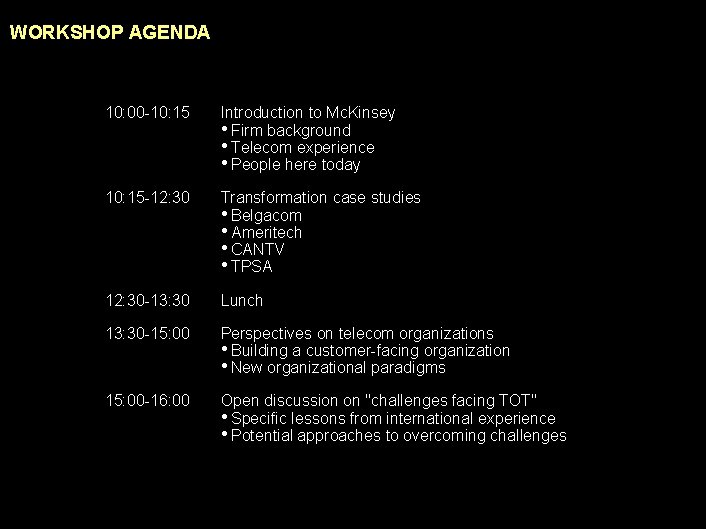
WORKSHOP AGENDA 10: 00 -10: 15 Introduction to Mc. Kinsey • Firm background • Telecom experience • People here today 10: 15 -12: 30 Transformation case studies • Belgacom • Ameritech • CANTV • TPSA 12: 30 -13: 30 Lunch 13: 30 -15: 00 Perspectives on telecom organizations • Building a customer-facing organization • New organizational paradigms 15: 00 -16: 00 Open discussion on "challenges facing TOT" • Specific lessons from international experience • Potential approaches to overcoming challenges 1
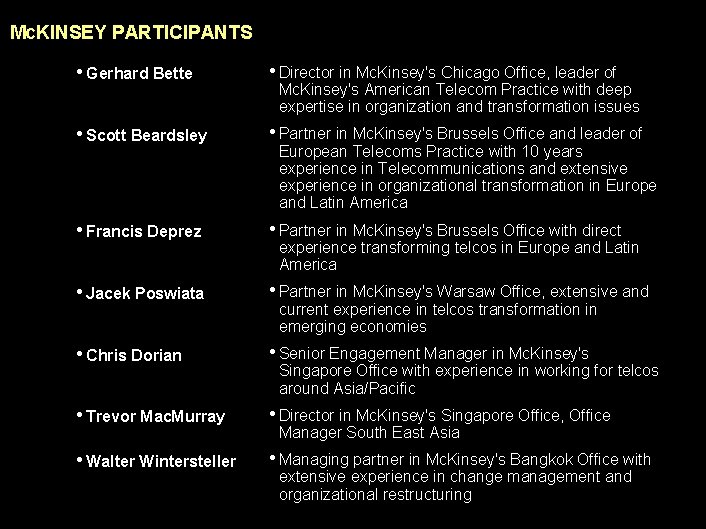
990617 BKZXW 380 WWGZ Mc. KINSEY PARTICIPANTS • Gerhard Bette • Director in Mc. Kinsey's Chicago Office, leader of • Scott Beardsley • Partner in Mc. Kinsey's Brussels Office and leader of • Francis Deprez • Partner in Mc. Kinsey's Brussels Office with direct • Jacek Poswiata • Partner in Mc. Kinsey's Warsaw Office, extensive and • Chris Dorian • Senior Engagement Manager in Mc. Kinsey's • Trevor Mac. Murray • Director in Mc. Kinsey's Singapore Office, Office • Walter Wintersteller • Managing partner in Mc. Kinsey's Bangkok Office with Source: Mc. Kinsey's American Telecom Practice with deep expertise in organization and transformation issues European Telecoms Practice with 10 years experience in Telecommunications and extensive experience in organizational transformation in Europe and Latin America experience transforming telcos in Europe and Latin America current experience in telcos transformation in emerging economies Singapore Office with experience in working for telcos around Asia/Pacific Manager South East Asia extensive experience in change management and organizational restructuring 2
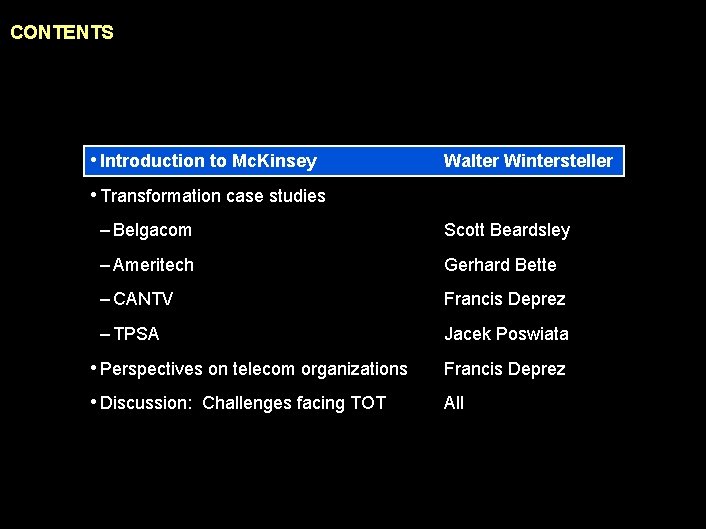
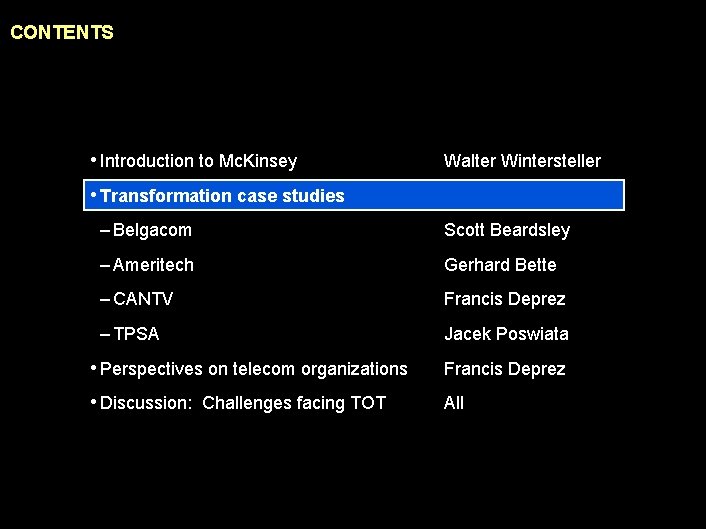
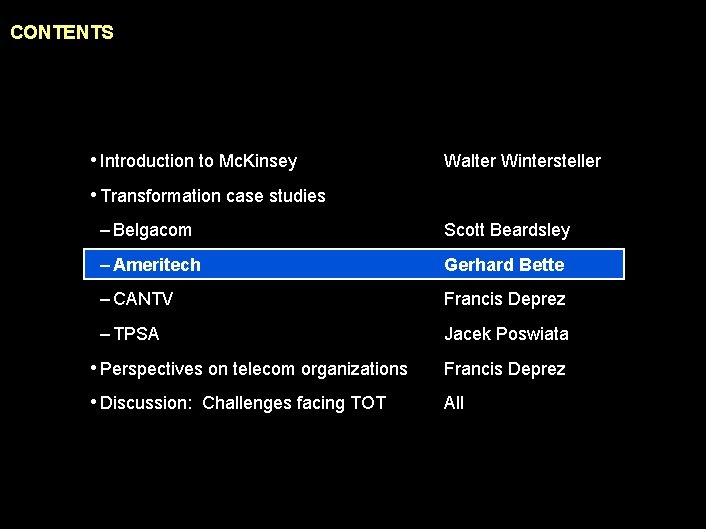
990617 BKZXW 380 WWGZ CONTENTS • Introduction to Mc. Kinsey Walter Wintersteller • Transformation case studies – Belgacom Scott Beardsley – Ameritech Gerhard Bette – CANTV Francis Deprez – TPSA Jacek Poswiata • Perspectives on telecom organizations Francis Deprez • Discussion: Challenges facing TOT All 3
CONFIDENTIAL Introduction to Mc. Kinsey Walter Wintersteller - Mc. Kinsey Bangkok Telephone Organization of Thailand Workshop with Senior management Bangkok, June 19, 1999 This report is solely for the use of client personnel. No part of it may be circulated, quoted, or reproduced for distribution outside the client organization without prior written approval from Mc. Kinsey & Company. This material was used by Mc. Kinsey & Company during an oral presentation; it is not a complete record of the discussion.
990617 BKZXW 380 WWGZ INTRODUCTION TO Mc. KINSEY • Who we are and how we work • Mc. Kinsey in Asia and Thailand • Mc. Kinsey's Telecom practice 5
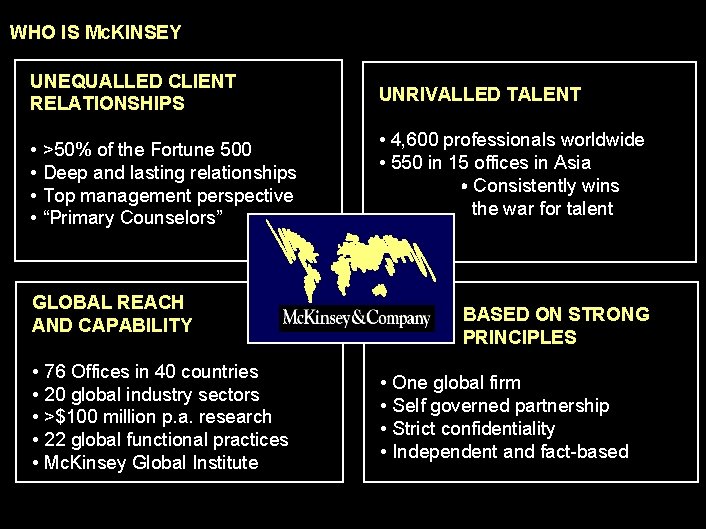
990617 BKZXW 380 WWGZ WHO IS Mc. KINSEY UNEQUALLED CLIENT RELATIONSHIPS • >50% of the Fortune 500 • Deep and lasting relationships • Top management perspective • “Primary Counselors” GLOBAL REACH AND CAPABILITY • 76 Offices in 40 countries • 20 global industry sectors • >$100 million p. a. research • 22 global functional practices • Mc. Kinsey Global Institute Source: Mc. Kinsey UNRIVALLED TALENT • 4, 600 professionals worldwide • 550 in 15 offices in Asia Consistently wins the war for talent BASED ON STRONG PRINCIPLES • One global firm • Self governed partnership • Strict confidentiality • Independent and fact-based 6
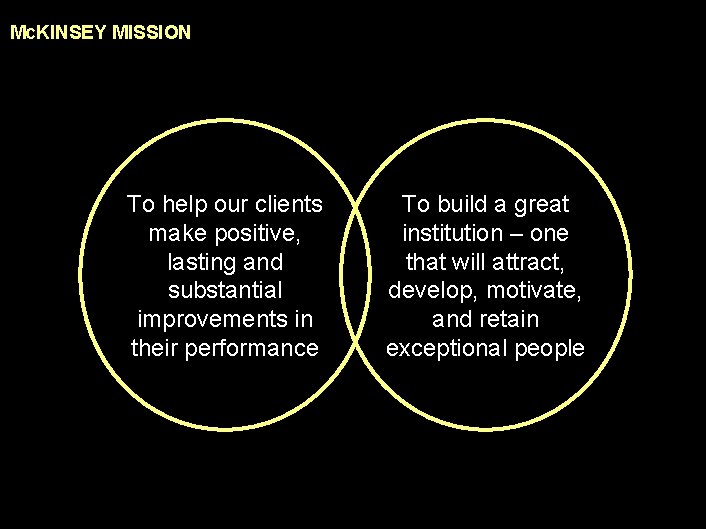
990617 BKZXW 380 WWGZ Mc. KINSEY MISSION To help our clients make positive, lasting and substantial improvements in their performance Source: Mc. Kinsey To build a great institution – one that will attract, develop, motivate, and retain exceptional people 7
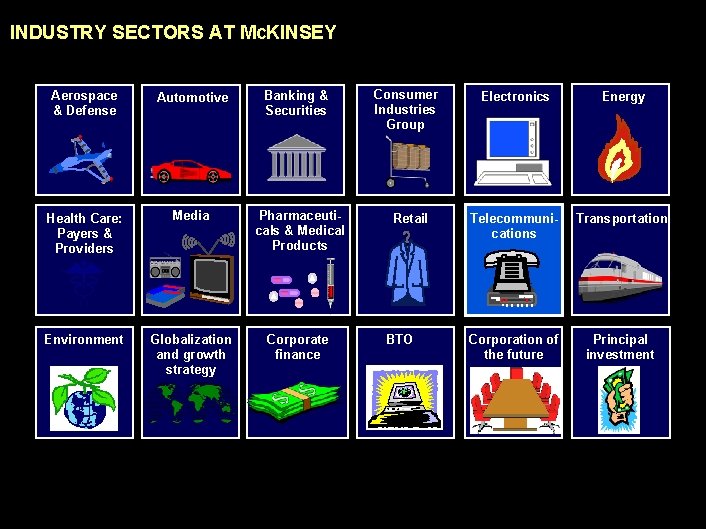
990617 BKZXW 380 WWGZ INDUSTRY SECTORS AT Mc. KINSEY Aerospace & Defense Automotive Health Care: Payers & Providers Media Pharmaceuticals & Medical Products Environment Globalization and growth strategy Corporate finance Source: Mc. Kinsey Banking & Securities Consumer Industries Group Retail BTO Electronics Energy Telecommunications Transportation Corporation of the future Principal investment 8
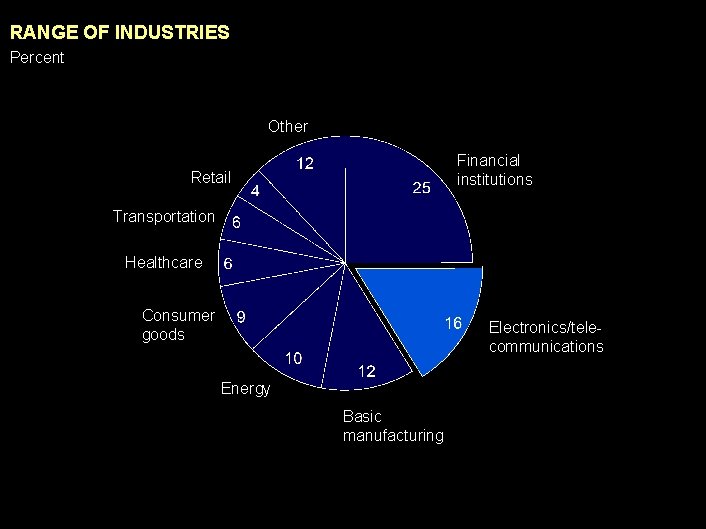
990617 BKZXW 380 WWGZ RANGE OF INDUSTRIES Percent Other Financial institutions Retail Transportation Healthcare Consumer goods Electronics/telecommunications Energy Basic manufacturing Source: Mc. Kinsey 9
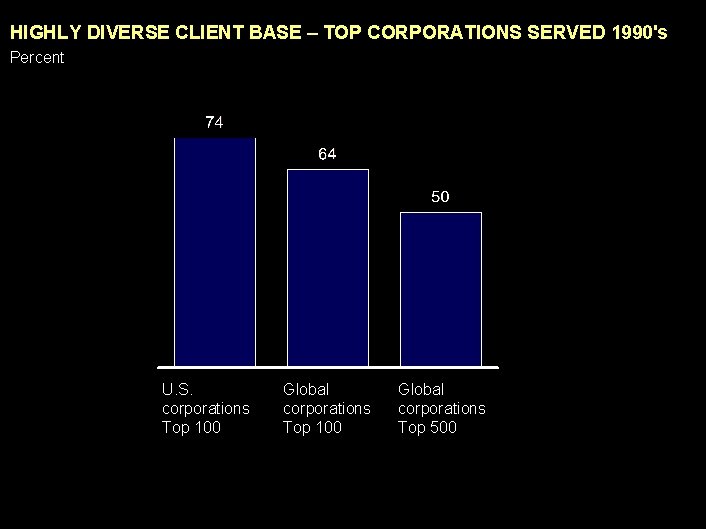
990617 BKZXW 380 WWGZ HIGHLY DIVERSE CLIENT BASE – TOP CORPORATIONS SERVED 1990's Percent U. S. corporations Top 100 Source: Mc. Kinsey Global corporations Top 100 Global corporations Top 500 10
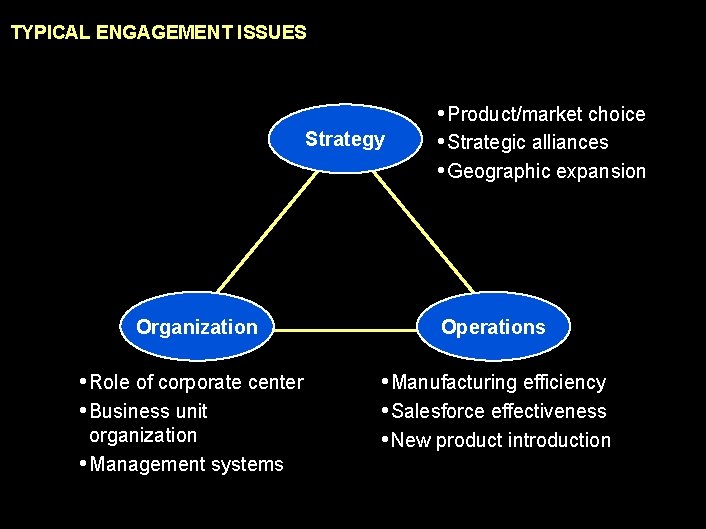
990617 BKZXW 380 WWGZ TYPICAL ENGAGEMENT ISSUES Strategy • Product/market choice • Strategic alliances • Geographic expansion Organization Operations • Role of corporate center • Business unit • Manufacturing efficiency • Salesforce effectiveness • New product introduction organization • Management systems Source: Mc. Kinsey 11
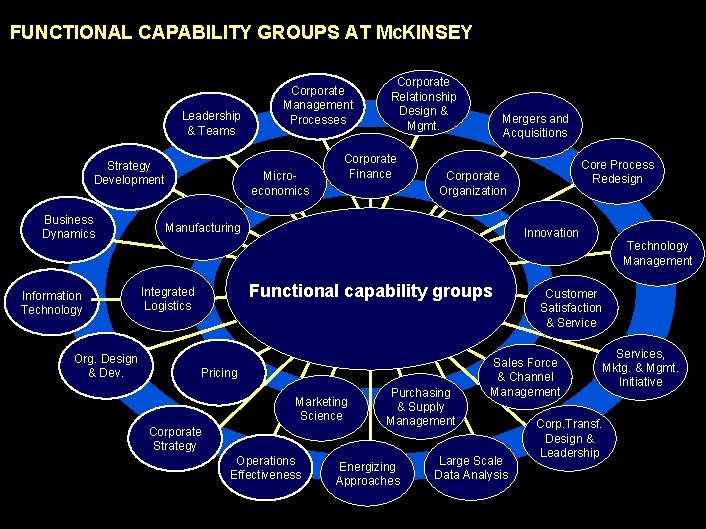
990617 BKZXW 380 WWGZ FUNCTIONAL CAPABILITY GROUPS AT Mc. KINSEY Leadership & Teams Strategy Development Business Dynamics Information Technology Org. Design & Dev. Corporate Management Processes Microeconomics Corporate Finance Mergers and Acquisitions Innovation Functional Capability Functional capability groups Groups Integrated Logistics Core Process Redesign Corporate Organization Manufacturing Pricing Marketing Science Corporate Strategy Operations Effectiveness Source: Mc. Kinsey Corporate Relationship Design & Mgmt. Purchasing & Supply Management Energizing Approaches Customer Satisfaction & Service Sales Force & Channel Management Large Scale Data Analysis Technology Management Services, Mktg. & Mgmt. Initiative Corp. Transf. Design & Leadership 12
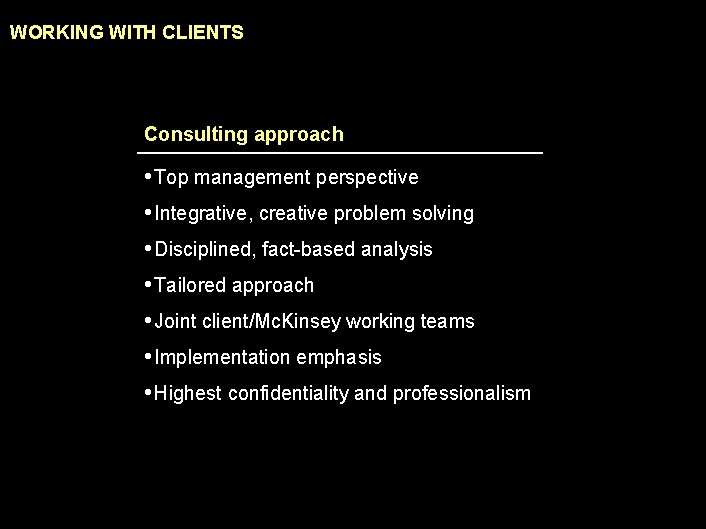
990617 BKZXW 380 WWGZ WORKING WITH CLIENTS Consulting approach • Top management perspective • Integrative, creative problem solving • Disciplined, fact-based analysis • Tailored approach • Joint client/Mc. Kinsey working teams • Implementation emphasis • Highest confidentiality and professionalism Source: Mc. Kinsey 13
990617 BKZXW 380 WWGZ INTRODUCTION TO Mc. KINSEY • Who we are and how we work • Mc. Kinsey in Asia and Thailand • Mc. Kinsey's Telecom practice 14
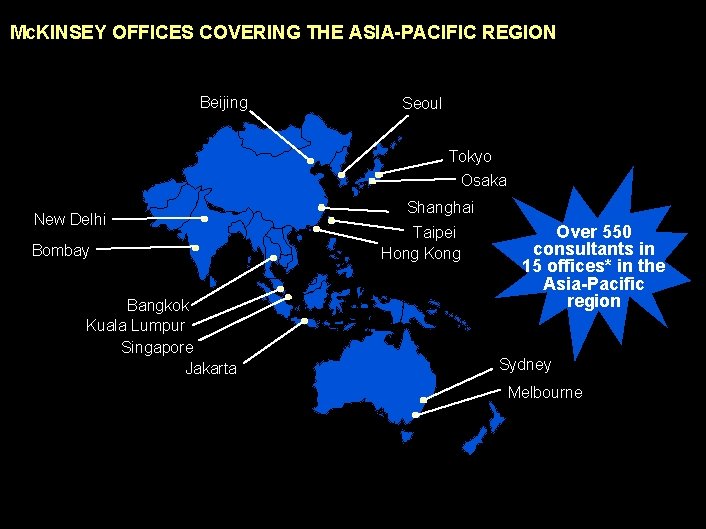
990617 BKZXW 380 WWGZ Mc. KINSEY OFFICES COVERING THE ASIA-PACIFIC REGION Beijing Seoul Tokyo Osaka New Delhi Bombay Shanghai Taipei Hong Kong Bangkok Kuala Lumpur Singapore Jakarta Over 550 consultants in 15 offices* in the Asia-Pacific region Sydney Melbourne *Additional offices will be opened in New Zealand The Philippines in 1999 Source: Mc. Kinsey 15
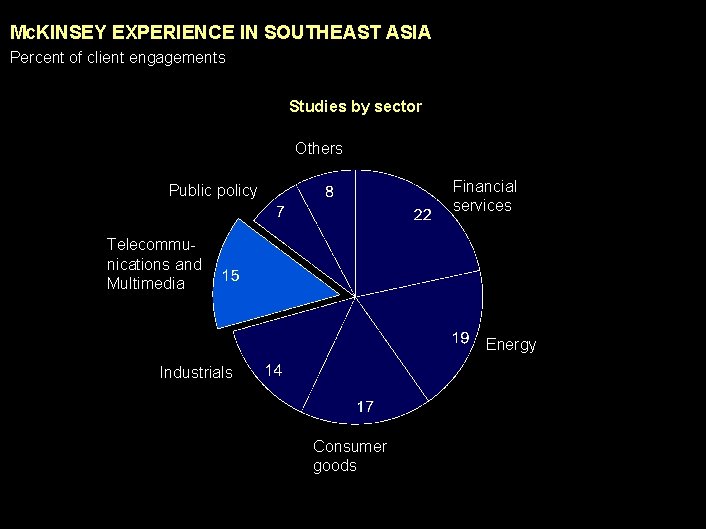
990617 BKZXW 380 WWGZ Mc. KINSEY EXPERIENCE IN SOUTHEAST ASIA Percent of client engagements Studies by sector Others Financial services Public policy Telecommunications and Multimedia Energy Industrials Consumer goods Source: Mc. Kinsey 16
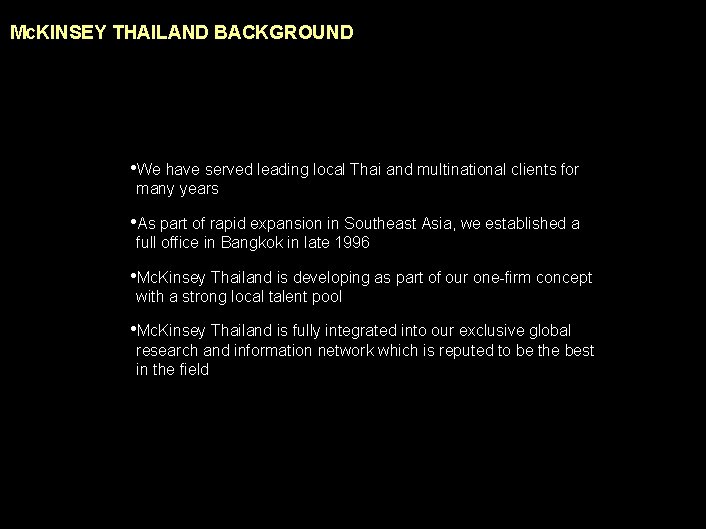
990617 BKZXW 380 WWGZ Mc. KINSEY THAILAND BACKGROUND • We have served leading local Thai and multinational clients for many years • As part of rapid expansion in Southeast Asia, we established a full office in Bangkok in late 1996 • Mc. Kinsey Thailand is developing as part of our one-firm concept with a strong local talent pool • Mc. Kinsey Thailand is fully integrated into our exclusive global research and information network which is reputed to be the best in the field Source: Mc. Kinsey 17
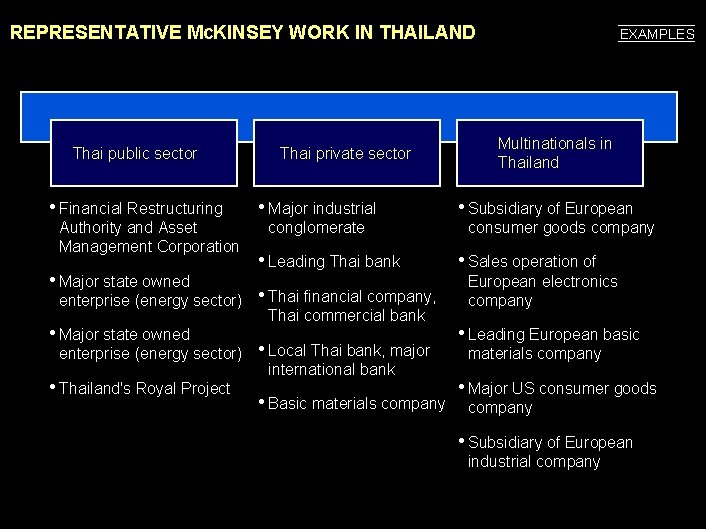
990617 BKZXW 380 WWGZ REPRESENTATIVE Mc. KINSEY WORK IN THAILAND Thai public sector • Financial Restructuring Authority and Asset Management Corporation • Major state owned enterprise (energy sector) • Major state owned Thai private sector • Major industrial conglomerate • Leading Thai bank • Thai financial company, Thai commercial bank enterprise (energy sector) • Local Thai bank, major • Thailand's Royal Project international bank • Basic materials company EXAMPLES Multinationals in Thailand • Subsidiary of European consumer goods company • Sales operation of European electronics company • Leading European basic materials company • Major US consumer goods company • Subsidiary of European industrial company Source: Mc. Kinsey 18
990617 BKZXW 380 WWGZ INTRODUCTION TO Mc. KINSEY • Who we are and how we work • Mc. Kinsey in Asia and Thailand • Mc. Kinsey's Telecom practice 19
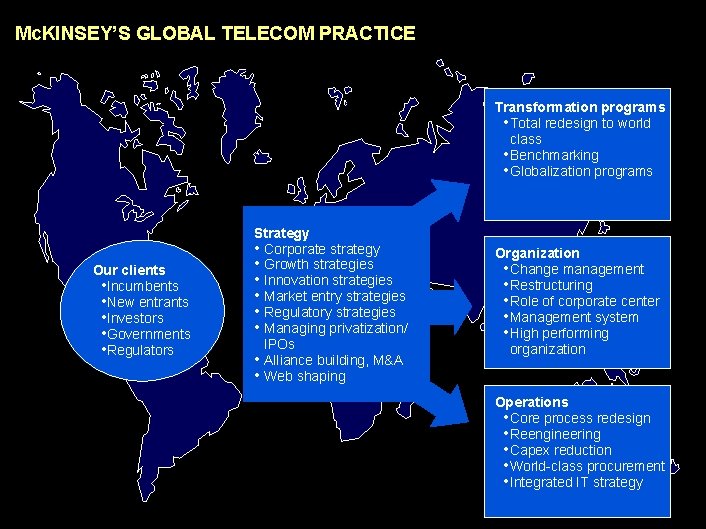
990617 BKZXW 380 WWGZ Mc. KINSEY’S GLOBAL TELECOM PRACTICE Transformation programs • Total redesign to world class • Benchmarking • Globalization programs Our clients • Incumbents • New entrants • Investors • Governments • Regulators Strategy • Corporate strategy • Growth strategies • Innovation strategies • Market entry strategies • Regulatory strategies • Managing privatization/ IPOs • Alliance building, M&A • Web shaping Organization • Change management • Restructuring • Role of corporate center • Management system • High performing organization Operations • Core process redesign • Reengineering • Capex reduction • World-class procurement • Integrated IT strategy 20
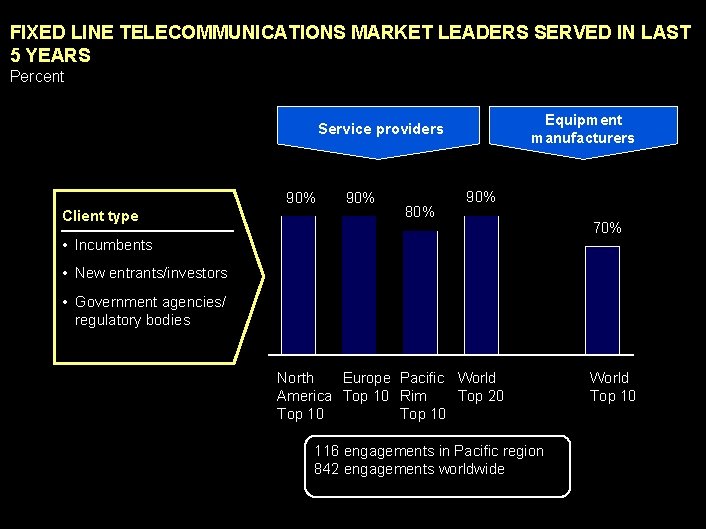
990617 BKZXW 380 WWGZ FIXED LINE TELECOMMUNICATIONS MARKET LEADERS SERVED IN LAST 5 YEARS Percent Equipment manufacturers Service providers 90% Client type 90% 80% 90% • Incumbents 70% • New entrants/investors • Government agencies/ regulatory bodies North Europe Pacific World America Top 10 Rim Top 20 Top 10 World Top 10 116 engagements in Pacific region 842 engagements worldwide 21
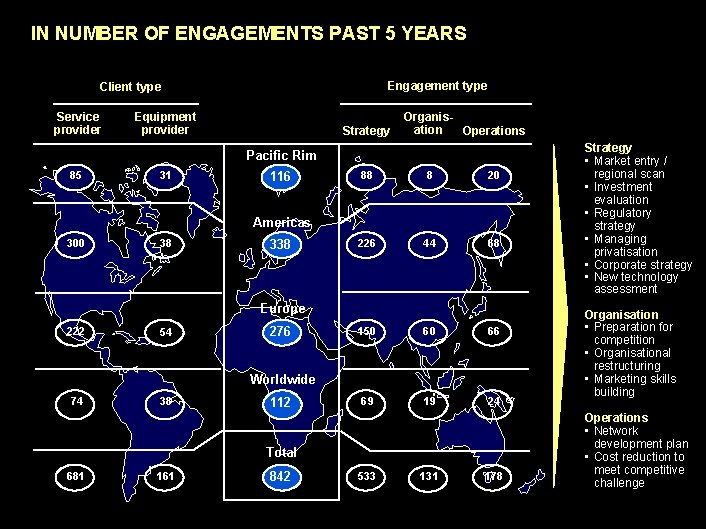
990617 BKZXW 380 WWGZ IN NUMBER OF ENGAGEMENTS PAST 5 YEARS Engagement type Client type Service provider Equipment provider Strategy Organisation Operations Pacific Rim 85 31 116 88 8 20 226 44 68 Americas 300 38 338 Europe 222 54 276 150 60 66 69 19 24 Worldwide 74 38 112 Total 681 161 842 533 131 178 Strategy • Market entry / regional scan • Investment evaluation • Regulatory strategy • Managing privatisation • Corporate strategy • New technology assessment Organisation • Preparation for competition • Organisational restructuring • Marketing skills building Operations • Network development plan • Cost reduction to meet competitive challenge 22
990617 BKZXW 380 WWGZ CONTENTS • Introduction to Mc. Kinsey Walter Wintersteller • Transformation case studies – Belgacom Scott Beardsley – Ameritech Gerhard Bette – CANTV Francis Deprez – TPSA Jacek Poswiata • Perspectives on telecom organizations Francis Deprez • Discussion: Challenges facing TOT All 23
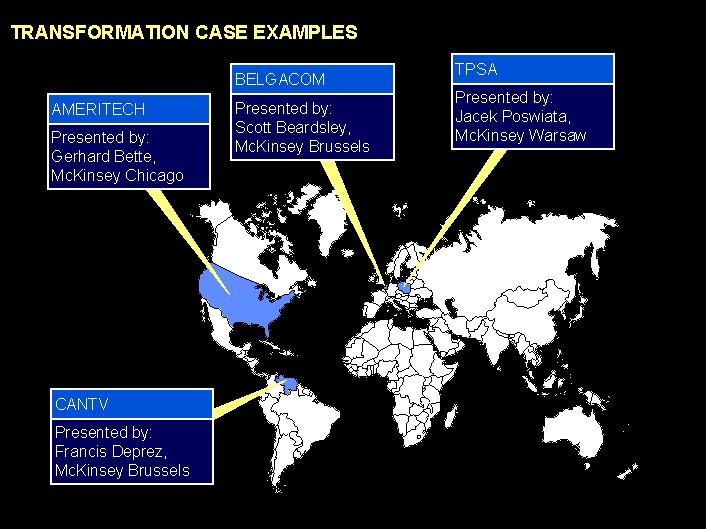
990617 BKZXW 380 WWGZ TRANSFORMATION CASE EXAMPLES BELGACOM AMERITECH Presented by: Gerhard Bette, Mc. Kinsey Chicago Presented by: Scott Beardsley, Mc. Kinsey Brussels TPSA Presented by: Jacek Poswiata, Mc. Kinsey Warsaw CANTV Presented by: Francis Deprez, Mc. Kinsey Brussels 24
990617 BKZXW 380 WWGZ CONTENTS • Introduction to Mc. Kinsey Walter Wintersteller • Transformation case studies – Belgacom Scott Beardsley – Ameritech Gerhard Bette – CANTV Francis Deprez – TPSA Jacek Poswiata • Perspectives on telecom organizations Francis Deprez • Discussion: Challenges facing TOT All 25
CONFIDENTIAL Transforming Belgacom Case Study Scott Beardsley - Mc. Kinsey Brussels Telephone Organization of Thailand Workshop with Senior management Bangkok, June 19, 1999 This report is solely for the use of client personnel. No part of it may be circulated, quoted, or reproduced for distribution outside the client organization without prior written approval from Mc. Kinsey & Company. This material was used by Mc. Kinsey & Company during an oral presentation; it is not a complete record of the discussion.
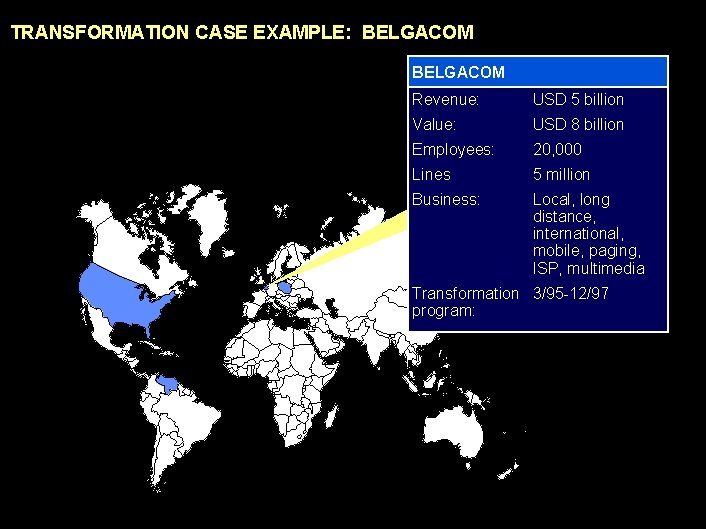
990617 BKZXW 380 WWGZ TRANSFORMATION CASE EXAMPLE: BELGACOM Revenue: USD 5 billion Value: USD 8 billion Employees: 20, 000 Lines 5 million Business: Local, long distance, international, mobile, paging, ISP, multimedia Transformation 3/95 -12/97 program: 27
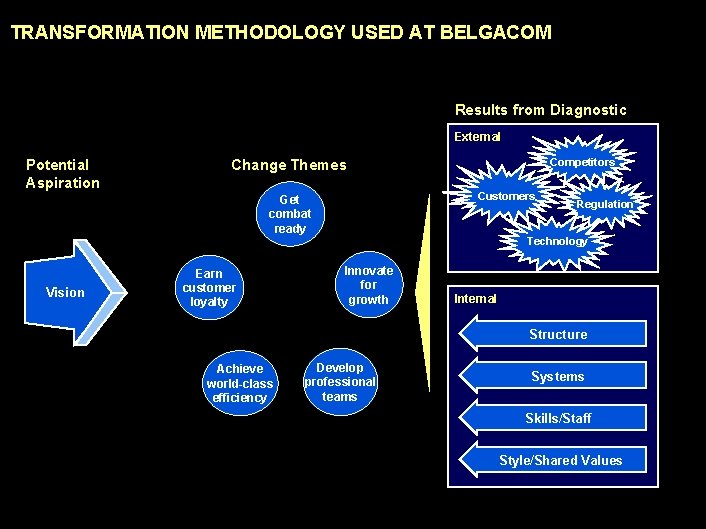
990617 BKZXW 380 WWGZ TRANSFORMATION METHODOLOGY USED AT BELGACOM Results from Diagnostic External Potential Aspiration Customers Get combat ready Vision Competitors Change Themes Earn customer loyalty Regulation Technology Innovate for growth Internal Structure Achieve world-class efficiency Develop professional teams Systems Skills/Staff Style/Shared Values Source: Mc. Kinsey 28
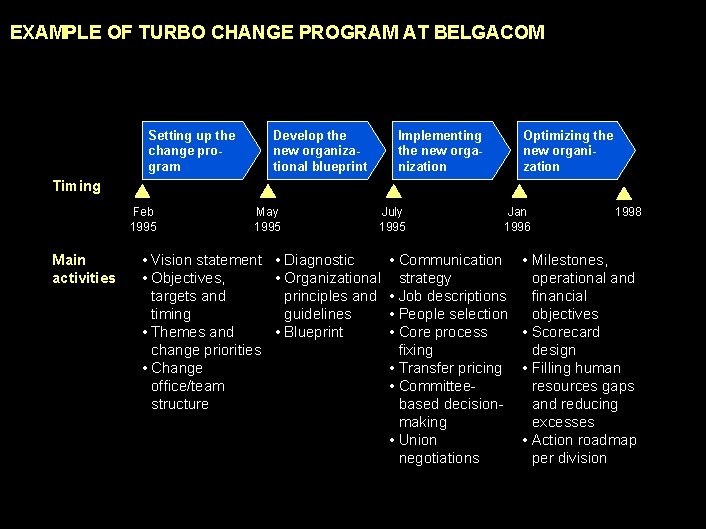
990617 BKZXW 380 WWGZ EXAMPLE OF TURBO CHANGE PROGRAM AT BELGACOM Setting up the change program Develop the new organizational blueprint Implementing the new organization Optimizing the new organization Timing Feb 1995 Main activities Source: Mc. Kinsey May 1995 July 1995 Jan 1996 • Vision statement • Diagnostic • Communication • Objectives, • Organizational strategy targets and principles and • Job descriptions timing guidelines • People selection • Themes and • Blueprint • Core process change priorities fixing • Change • Transfer pricing office/team • Committeestructure based decisionmaking • Union negotiations 1998 • Milestones, operational and financial objectives • Scorecard design • Filling human resources gaps and reducing excesses • Action roadmap per division 29
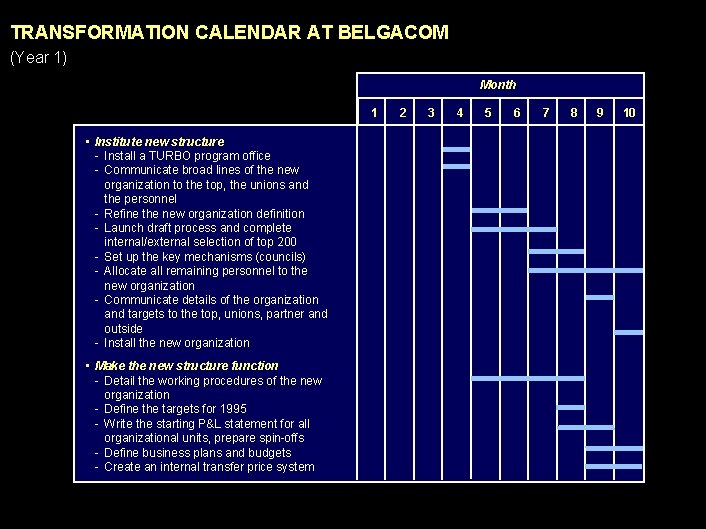
990617 BKZXW 380 WWGZ TRANSFORMATION CALENDAR AT BELGACOM (Year 1) Month 1 2 3 4 5 6 7 8 9 10 • Institute new structure - Install a TURBO program office - Communicate broad lines of the new organization to the top, the unions and the personnel - Refine the new organization definition - Launch draft process and complete internal/external selection of top 200 - Set up the key mechanisms (councils) - Allocate all remaining personnel to the new organization - Communicate details of the organization and targets to the top, unions, partner and outside - Install the new organization • Make the new structure function - Detail the working procedures of the new organization - Define the targets for 1995 - Write the starting P&L statement for all organizational units, prepare spin-offs - Define business plans and budgets - Create an internal transfer price system Source: Mc. Kinsey 30
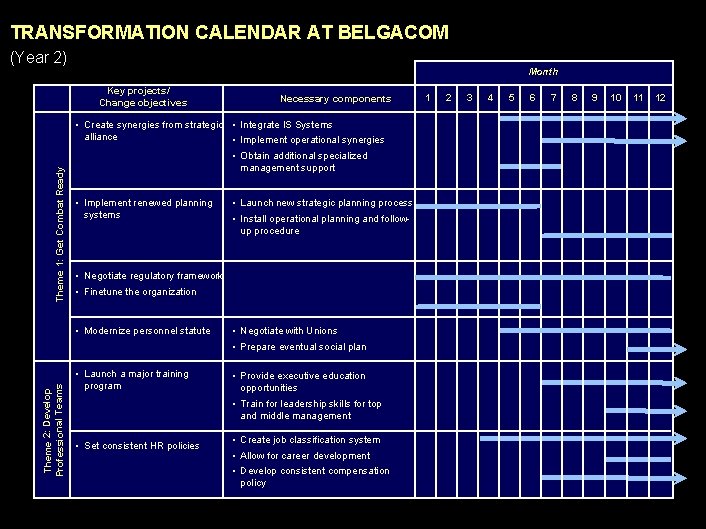
990617 BKZXW 380 WWGZ TRANSFORMATION CALENDAR AT BELGACOM (Year 2) Month Theme 2: Develop Professional Teams Theme 1: Get Combat Ready Key projects/ Change objectives Necessary components 1 2 3 4 5 6 7 8 9 10 11 12 • Create synergies from strategic • Integrate IS Systems alliance • Implement operational synergies • Obtain additional specialized management support • Implement renewed planning systems • Launch new strategic planning process • Install operational planning and followup procedure • Negotiate regulatory framework • Finetune the organization • Modernize personnel statute • Negotiate with Unions • Prepare eventual social plan • Launch a major training program • Provide executive education opportunities • Train for leadership skills for top and middle management • Set consistent HR policies Source: Mc. Kinsey • Create job classification system • Allow for career development • Develop consistent compensation policy 31
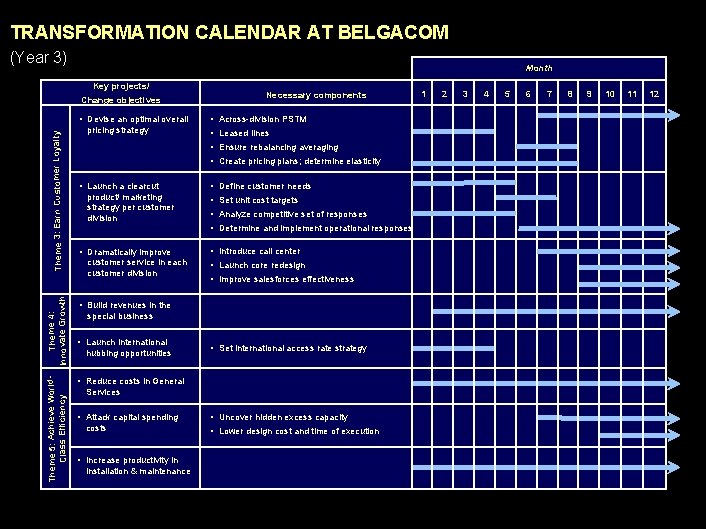
990617 BKZXW 380 WWGZ TRANSFORMATION CALENDAR AT BELGACOM (Year 3) Month Key projects/ Necessary components Change objectives Theme 4: Theme 5: Achieve World. Class Efficiency Innovate Growth Theme 3: Earn Customer Loyalty • Devise an optimal overall pricing strategy • Launch a clearcut product/ marketing strategy per customer division • Dramatically improve customer service in each customer division • • Across-division PSTM • • Define customer needs 1 2 3 4 5 6 7 8 9 10 11 12 Leased lines Ensure rebalancing averaging Create pricing plans; determine elasticity Set unit cost targets Analyze competitive set of responses Determine and implement operational responses • Introduce call center • Launch core redesign • Improve salesforces effectiveness • Build revenues in the special business • Launch international hubbing opportunities • Set international access rate strategy • Reduce costs in General Services • Attack capital spending costs • Uncover hidden excess capacity • Lower design cost and time of execution • Increase productivity in installation & maintenance Source: TURBO team 32
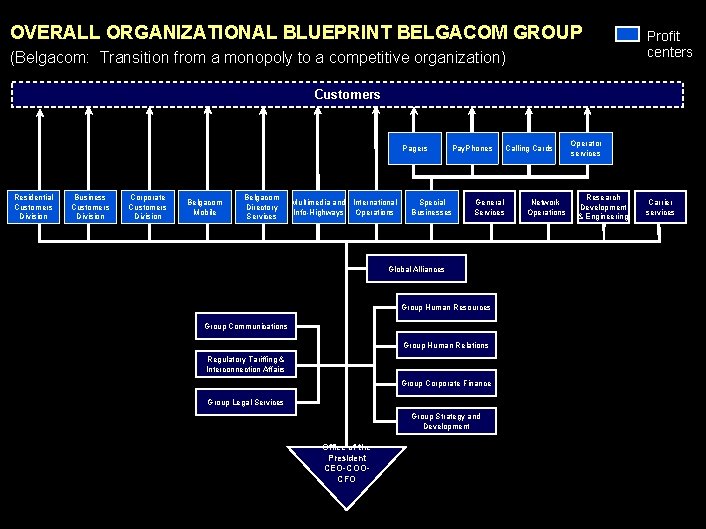
990617 BKZXW 380 WWGZ OVERALL ORGANIZATIONAL BLUEPRINT BELGACOM GROUP (Belgacom: Transition from a monopoly to a competitive organization) Profit centers Customers Pagers Residential Customers Division Business Customers Division Corporate Customers Division Belgacom Mobile Belgacom Directory Services Multimedia and International Info-Highways Operations Pay. Phones Special Businesses General Services Calling Cards Network Operations Operator services Research Development & Engineering Carrier services Global Alliances Group Human Resources Group Communications Group Human Relations Regulatory Tariffing & Interconnection Affairs Group Corporate Finance Group Legal Services Group Strategy and Development Office of the President CEO-COOCFO Source: Mc. Kinsey 33
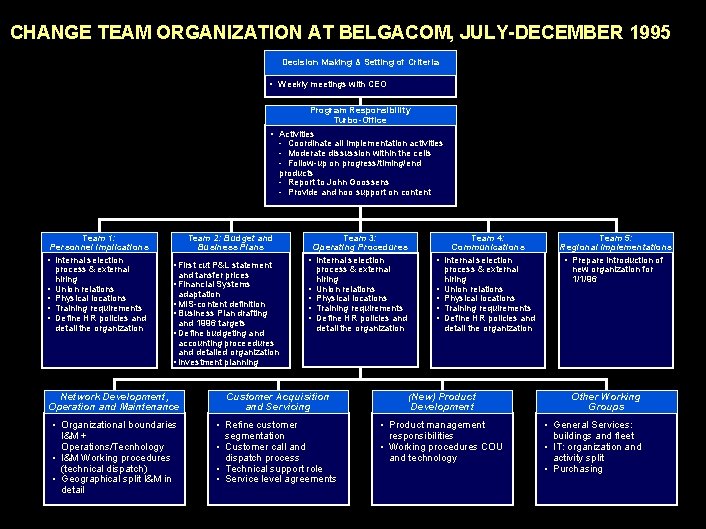
990617 BKZXW 380 WWGZ CHANGE TEAM ORGANIZATION AT BELGACOM, JULY-DECEMBER 1995 Decision Making & Setting of Criteria • Weekly meetings with CEO Program Responsibility Turbo-Office • Activities - Coordinate all implementation activities - Moderate dissussion within the cells - Follow-up on progress/timing/end products - Report to John Goossens - Provide and hoo support on content Team 1: Personnel implications • Internal selection process & external hiring • Union relations • Physical locations • Training requirements • Define HR policies and detail the organization Team 2: Budget and Business Plans • First cut P&L statement and tansfer prices • Financial Systems adaptation • MIS-content definition • Business Plan drafting and 1996 targets • Define budgeting and accounting proceedures and detailed organization • Investment planning Team 3: Operating Procedures • Internal selection process & external hiring • Union relations • Physical locations • Training requirements • Define HR policies and detail the organization • • • Team 4: Communications Internal selection process & external hiring Union relations Physical locations Training requirements Define HR policies and detail the organization Network Development, Operation and Maintenance Customer Acquisition and Servicing (New) Product Development • Organizational boundaries I&M + Operations/Tecnhology • I&M Working procedures (technical dispatch) • Geographical split I&M in detail • Refine customer segmentation • Customer call and dispatch process • Technical support role • Service level agreements • Product management responsibilities • Working procedures COU and technology Source: Mc. Kinsey Team 5: Regional implementations • Prepare introduction of new organization for 1/1/96 Other Working Groups • General Services: buildings and fleet • IT: organization and activity split • Purchasing 34
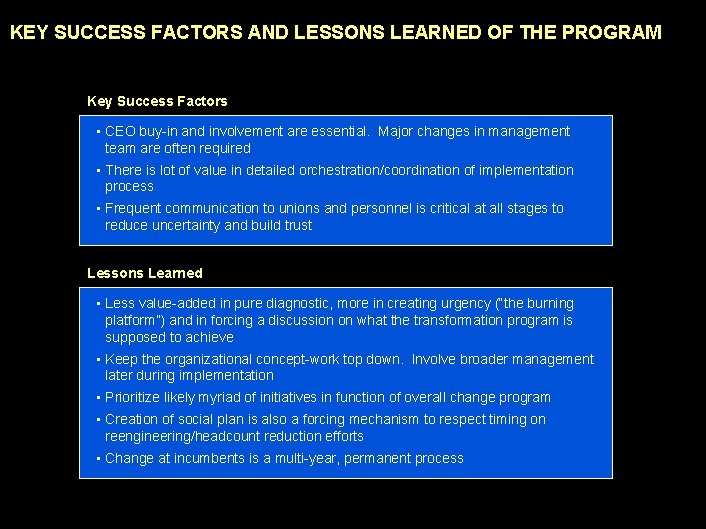
990617 BKZXW 380 WWGZ KEY SUCCESS FACTORS AND LESSONS LEARNED OF THE PROGRAM Key Success Factors • CEO buy-in and involvement are essential. Major changes in management team are often required • There is lot of value in detailed orchestration/coordination of implementation process • Frequent communication to unions and personnel is critical at all stages to reduce uncertainty and build trust Lessons Learned • Less value-added in pure diagnostic, more in creating urgency (“the burning platform”) and in forcing a discussion on what the transformation program is supposed to achieve • Keep the organizational concept-work top down. Involve broader management later during implementation • Prioritize likely myriad of initiatives in function of overall change program • Creation of social plan is also a forcing mechanism to respect timing on reengineering/headcount reduction efforts • Change at incumbents is a multi-year, permanent process Source: Mc. Kinsey 35
990617 BKZXW 380 WWGZ CONTENTS • Introduction to Mc. Kinsey Walter Wintersteller • Transformation case studies – Belgacom Scott Beardsley – Ameritech Gerhard Bette – CANTV Francis Deprez – TPSA Jacek Poswiata • Perspectives on telecom organizations Francis Deprez • Discussion: Challenges facing TOT All 36
CONFIDENTIAL Transforming Ameritech Case study Gerhard Bette – Mc. Kinsey Chicago Telephone Organization of Thailand Workshop with Senior management Bangkok, June 19, 1999 This report is solely for the use of client personnel. No part of it may be circulated, quoted, or reproduced for distribution outside the client organization without prior written approval from Mc. Kinsey & Company. This material was used by Mc. Kinsey & Company during an oral presentation; it is not a complete record of the discussion.
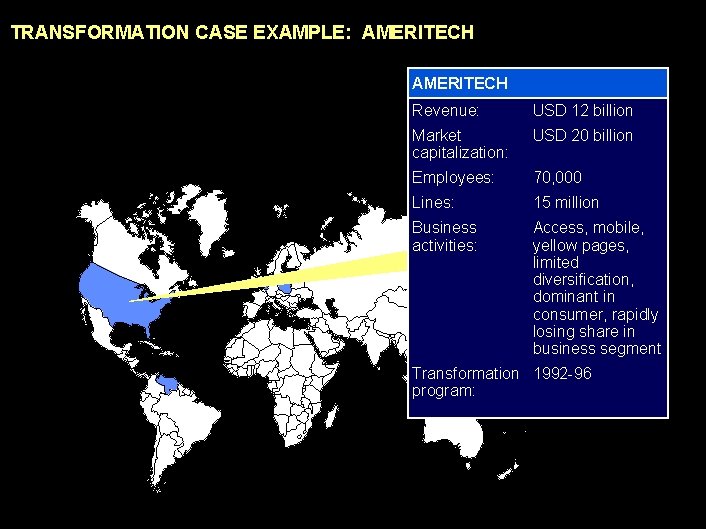
990617 BKZXW 380 WWGZ TRANSFORMATION CASE EXAMPLE: AMERITECH Revenue: USD 12 billion Market capitalization: USD 20 billion Employees: 70, 000 Lines: 15 million Business activities: Access, mobile, yellow pages, limited diversification, dominant in consumer, rapidly losing share in business segment Transformation 1992 -96 program: 38
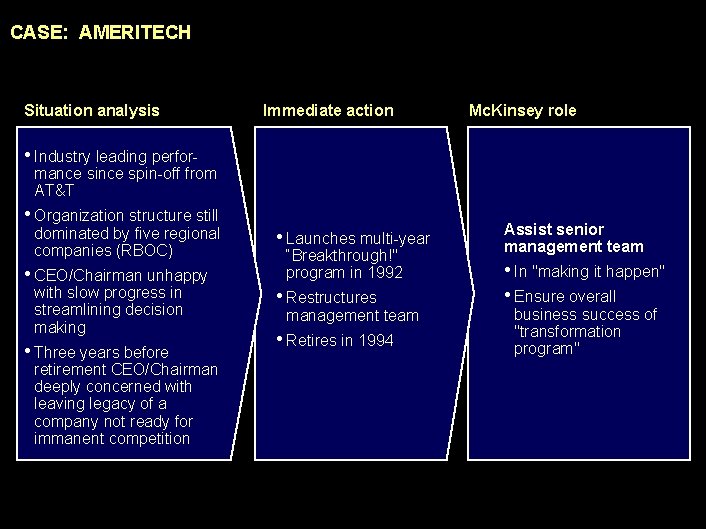
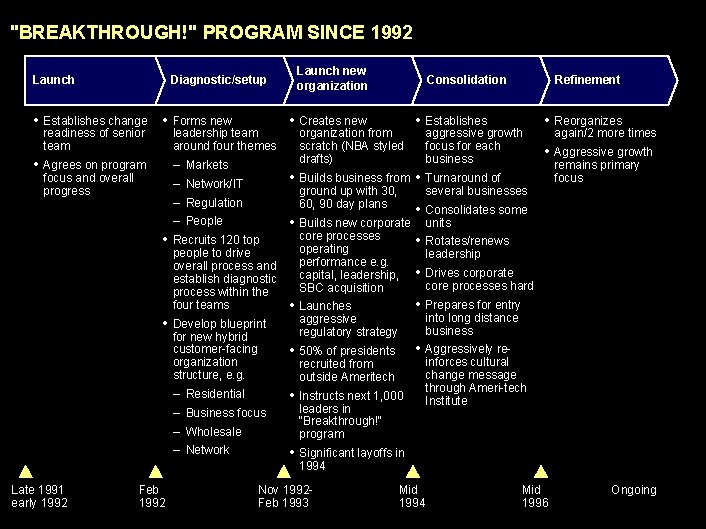
990617 BKZXW 380 WWGZ CASE: AMERITECH Situation analysis Immediate action Mc. Kinsey role • Industry leading perfor- mance since spin-off from AT&T • Organization structure still dominated by five regional companies (RBOC) • CEO/Chairman unhappy with slow progress in streamlining decision making • Three years before • Launches multi-year Assist senior management team • Restructures • In "making it happen" • Ensure overall “Breakthrough!" program in 1992 management team • Retires in 1994 business success of "transformation program" retirement CEO/Chairman deeply concerned with leaving legacy of a company not ready for immanent competition 39
990617 BKZXW 380 WWGZ "BREAKTHROUGH!" PROGRAM SINCE 1992 Diagnostic/setup Launch • Establishes change • Forms new • Agrees on program – Markets – Network/IT – Regulation – People • Recruits 120 top people to drive overall process and establish diagnostic process within the four teams • Develop blueprint for new hybrid customer-facing organization structure, e. g. – Residential – Business focus – Wholesale – Network readiness of senior team focus and overall progress leadership team around four themes Launch new organization Consolidation • Creates new organization from scratch (NBA styled drafts) Refinement • Establishes aggressive growth focus for each business • Reorganizes again/2 more times • Aggressive growth • Builds business from • Turnaround of ground up with 30, 60, 90 day plans several businesses remains primary focus • Consolidates some • Builds new corporate units core processes • Rotates/renews operating performance e. g. capital, leadership, SBC acquisition leadership • Drives corporate core processes hard • Launches • Prepares for entry • 50% of presidents • Aggressively re- into long distance business aggressive regulatory strategy recruited from outside Ameritech • Instructs next 1, 000 leaders in "Breakthrough!" program inforces cultural change message through Ameri-tech Institute • Significant layoffs in 1994 Late 1991 early 1992 Feb 1992 Nov 1992 Feb 1993 Mid 1994 Mid 1996 Ongoing 40
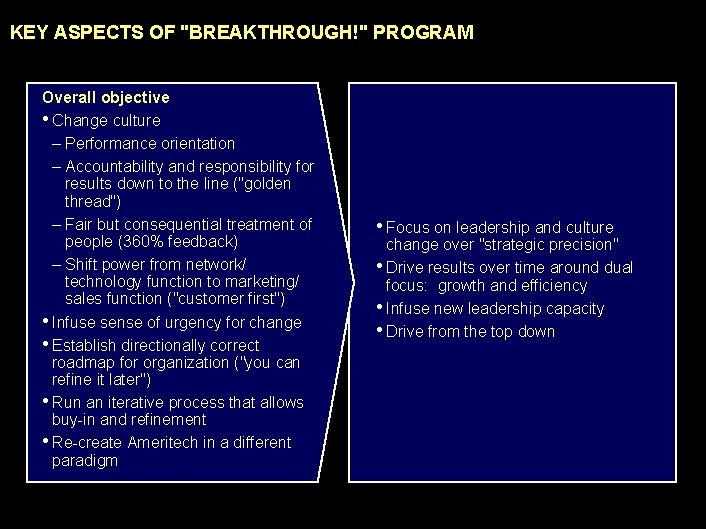
990617 BKZXW 380 WWGZ KEY ASPECTS OF "BREAKTHROUGH!" PROGRAM Overall objective • Change culture – Performance orientation – Accountability and responsibility for results down to the line ("golden thread") – Fair but consequential treatment of people (360% feedback) – Shift power from network/ technology function to marketing/ sales function ("customer first") • Infuse sense of urgency for change • Establish directionally correct roadmap for organization ("you can refine it later") • Run an iterative process that allows buy-in and refinement • Re-create Ameritech in a different paradigm • Focus on leadership and culture change over "strategic precision" • Drive results over time around dual focus: growth and efficiency • Infuse new leadership capacity • Drive from the top down 41
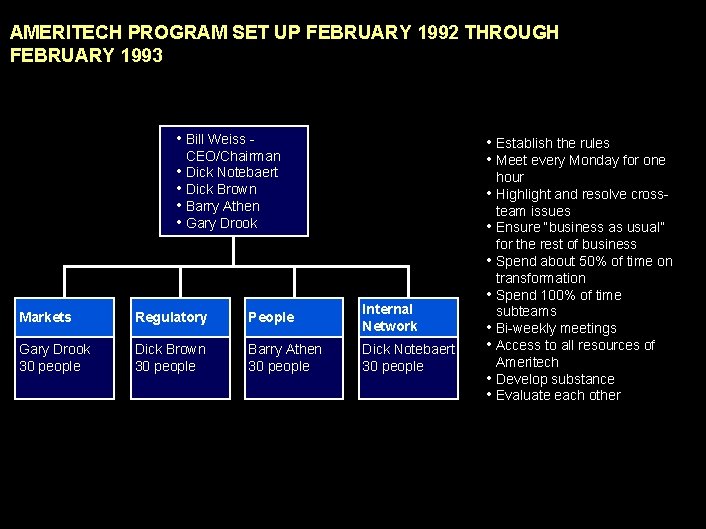
990617 BKZXW 380 WWGZ AMERITECH PROGRAM SET UP FEBRUARY 1992 THROUGH FEBRUARY 1993 • Bill Weiss - • Establish the rules • Meet every Monday for one CEO/Chairman • Dick Notebaert • Dick Brown • Barry Athen • Gary Drook Markets Regulatory People Internal Network Gary Drook 30 people Dick Brown 30 people Barry Athen 30 people Dick Notebaert 30 people hour • Highlight and resolve crossteam issues • Ensure “business as usual” for the rest of business • Spend about 50% of time on transformation • Spend 100% of time subteams • Bi-weekly meetings • Access to all resources of Ameritech • Develop substance • Evaluate each other 42
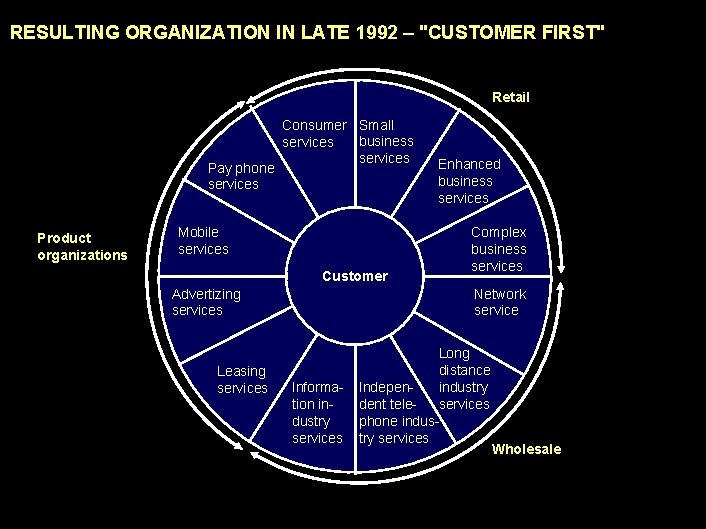
990617 BKZXW 380 WWGZ RESULTING ORGANIZATION IN LATE 1992 – "CUSTOMER FIRST" Retail Pay phone services Product organizations Consumer Small business services Mobile services Customer Advertizing services Leasing services Enhanced business services Complex business services Network service Information industry services Long distance industry Indepenservices dent telephone industry services Wholesale 43
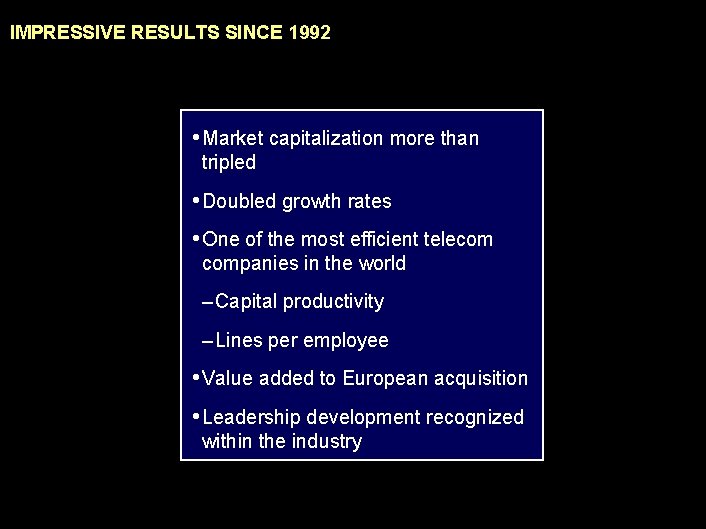
990617 BKZXW 380 WWGZ IMPRESSIVE RESULTS SINCE 1992 • Market capitalization more than tripled • Doubled growth rates • One of the most efficient telecom companies in the world – Capital productivity – Lines per employee • Value added to European acquisition • Leadership development recognized within the industry 44
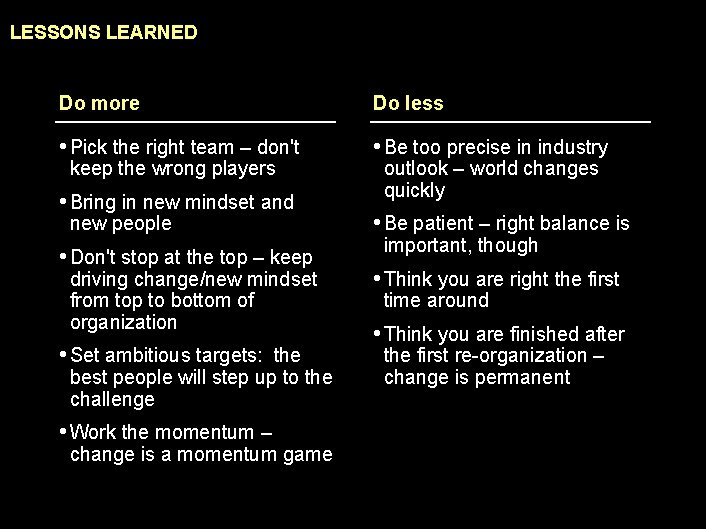
990617 BKZXW 380 WWGZ LESSONS LEARNED Do more Do less • Pick the right team – don't • Be too precise in industry keep the wrong players • Bring in new mindset and new people • Don't stop at the top – keep driving change/new mindset from top to bottom of organization • Set ambitious targets: the best people will step up to the challenge outlook – world changes quickly • Be patient – right balance is important, though • Think you are right the first time around • Think you are finished after the first re-organization – change is permanent • Work the momentum – change is a momentum game 45
990617 BKZXW 380 WWGZ CONTENTS • Introduction to Mc. Kinsey Walter Wintersteller • Transformation case studies – Belgacom Scott Beardsley – Ameritech Gerhard Bette – CANTV Francis Deprez – TPSA Jacek Poswiata • Perspectives on telecom organizations Francis Deprez • Discussion: Challenges facing TOT All 46
CONFIDENTIAL Transforming CANTV Case Study Francis Deprez – Mc. Kinsey Brussels Telephone Organization of Thailand Workshop with Senior management Bangkok, June 19, 1999 This report is solely for the use of client personnel. No part of it may be circulated, quoted, or reproduced for distribution outside the client organization without prior written approval from Mc. Kinsey & Company. This material was used by Mc. Kinsey & Company during an oral presentation; it is not a complete record of the discussion.
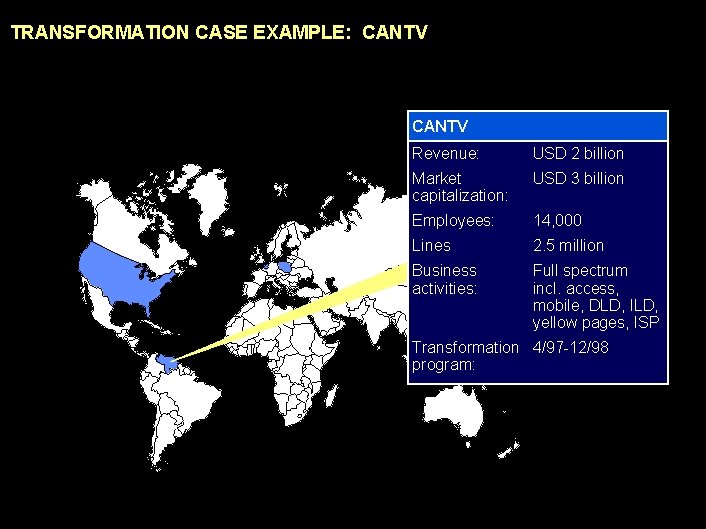
990617 BKZXW 380 WWGZ TRANSFORMATION CASE EXAMPLE: CANTV Revenue: USD 2 billion Market capitalization: USD 3 billion Employees: 14, 000 Lines 2. 5 million Business activities: Full spectrum incl. access, mobile, DLD, ILD, yellow pages, ISP Transformation 4/97 -12/98 program: 48
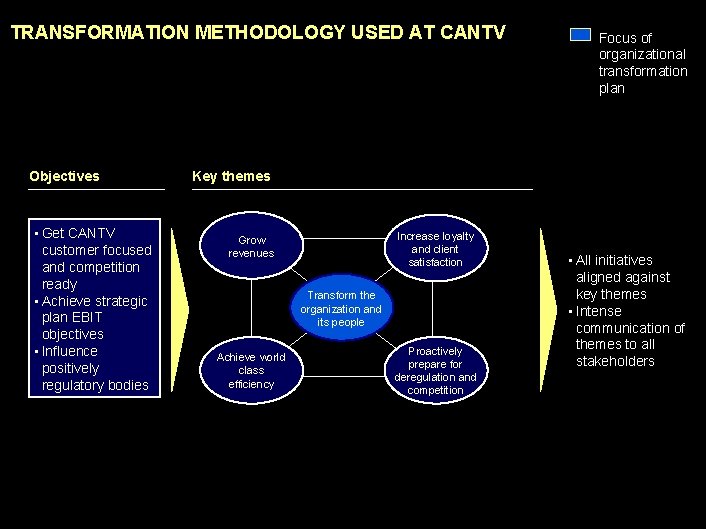
TRANSFORMATION METHODOLOGY USED AT CANTV Objectives • Get CANTV customer focused and competition ready • Achieve strategic plan EBIT objectives • Influence positively regulatory bodies Focus of organizational transformation plan Key themes Increase loyalty and client satisfaction Grow revenues Transform the organization and its people Achieve world class efficiency Proactively prepare for deregulation and competition • All initiatives aligned against key themes • Intense communication of themes to all stakeholders 49
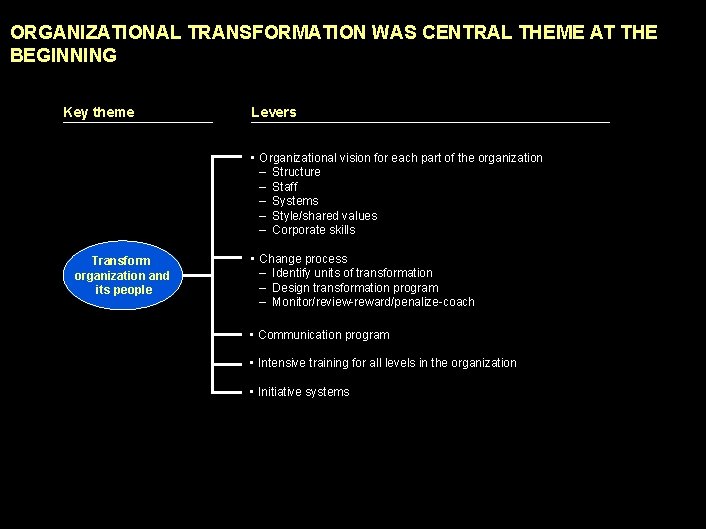
ORGANIZATIONAL TRANSFORMATION WAS CENTRAL THEME AT THE BEGINNING Key theme Levers • Organizational vision for each part of the organization – Structure – Staff – Systems – Style/shared values – Corporate skills Transform organization and its people • Change process – Identify units of transformation – Design transformation program – Monitor/review-reward/penalize-coach • Communication program • Intensive training for all levels in the organization • Initiative systems 50
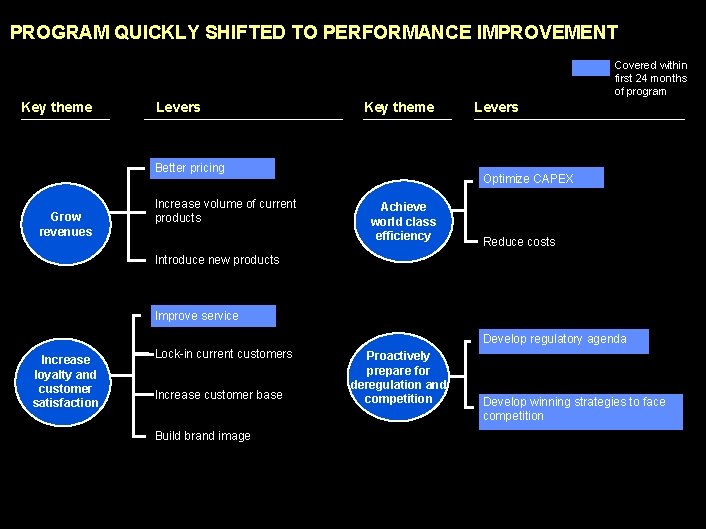
PROGRAM QUICKLY SHIFTED TO PERFORMANCE IMPROVEMENT Covered within first 24 months of program Key theme Levers Key theme Better pricing Grow revenues Increase volume of current products Levers Optimize CAPEX Achieve world class efficiency Reduce costs Introduce new products Improve service Develop regulatory agenda Increase loyalty and customer satisfaction Lock-in current customers Increase customer base Proactively prepare for deregulation and competition Develop winning strategies to face competition Build brand image 51
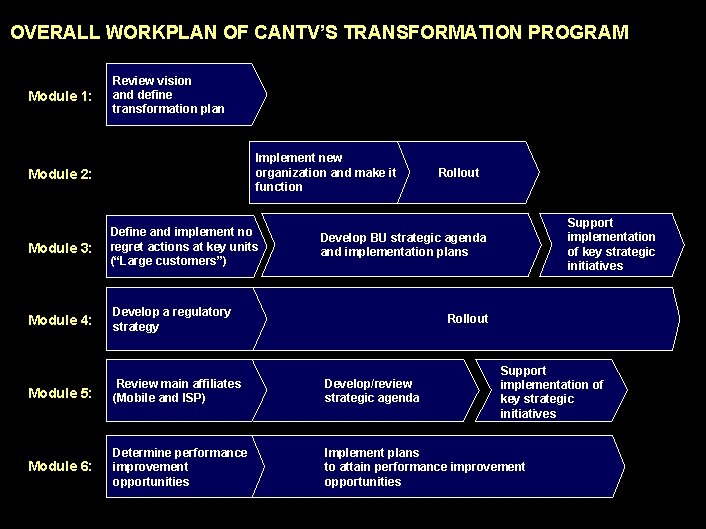
OVERALL WORKPLAN OF CANTV’S TRANSFORMATION PROGRAM Module 1: Review vision and define transformation plan Implement new organization and make it function Module 2: Rollout Support implementation of key strategic initiatives Module 3: Define and implement no regret actions at key units (“Large customers”) Module 4: Develop a regulatory strategy Module 5: Review main affiliates (Mobile and ISP) Develop/review strategic agenda Module 6: Determine performance improvement opportunities Implement plans to attain performance improvement opportunities Develop BU strategic agenda and implementation plans Rollout Support implementation of key strategic initiatives 52
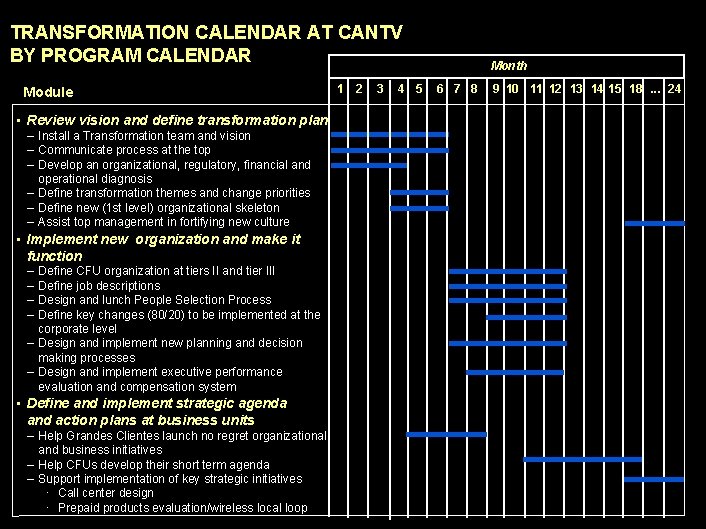
TRANSFORMATION CALENDAR AT CANTV BY PROGRAM CALENDAR Module • Review vision and define transformation plan – Install a Transformation team and vision – Communicate process at the top – Develop an organizational, regulatory, financial and operational diagnosis – Define transformation themes and change priorities – Define new (1 st level) organizational skeleton – Assist top management in fortifying new culture • Implement new organization and make it function – – Define CFU organization at tiers II and tier III Define job descriptions Design and lunch People Selection Process Define key changes (80/20) to be implemented at the corporate level – Design and implement new planning and decision making processes – Design and implement executive performance evaluation and compensation system • Define and implement strategic agenda and action plans at business units – Help Grandes Clientes launch no regret organizational and business initiatives – Help CFUs develop their short term agenda – Support implementation of key strategic initiatives · Call center design · Prepaid products evaluation/wireless local loop 1 2 3 4 5 Month 6 7 8 9 10 11 12 13 14 15 18. . . 24
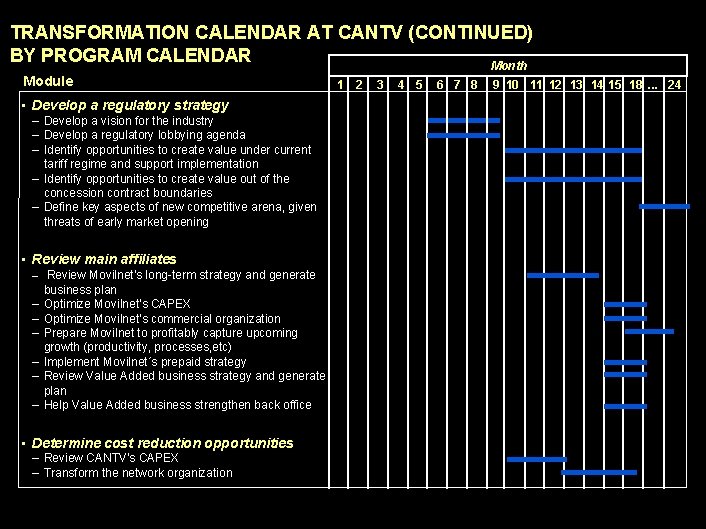
TRANSFORMATION CALENDAR AT CANTV (CONTINUED) BY PROGRAM CALENDAR Month Module • Develop a regulatory strategy – Develop a vision for the industry – Develop a regulatory lobbying agenda – Identify opportunities to create value under current tariff regime and support implementation – Identify opportunities to create value out of the concession contract boundaries – Define key aspects of new competitive arena, given threats of early market opening • Review main affiliates – Review Movilnet’s long-term strategy and generate – – – business plan Optimize Movilnet’s CAPEX Optimize Movilnet’s commercial organization Prepare Movilnet to profitably capture upcoming growth (productivity, processes, etc) Implement Movilnet´s prepaid strategy Review Value Added business strategy and generate plan Help Value Added business strengthen back office • Determine cost reduction opportunities – Review CANTV’s CAPEX – Transform the network organization 1 2 3 4 5 6 7 8 9 10 11 12 13 14 15 18. . . 24
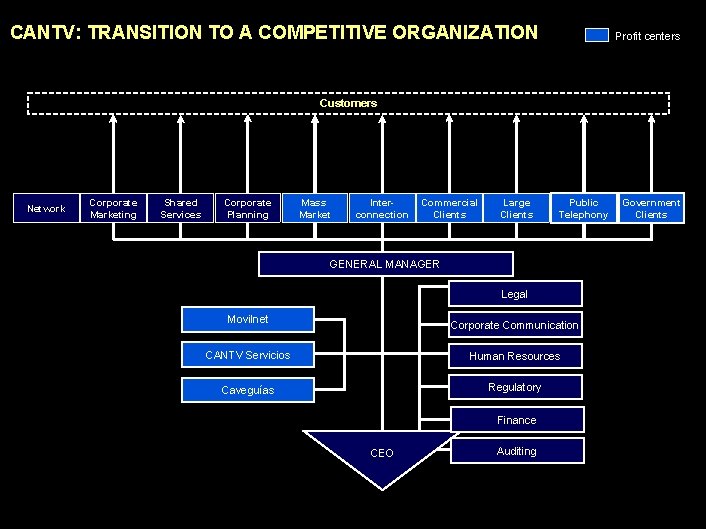
CANTV: TRANSITION TO A COMPETITIVE ORGANIZATION Profit centers Customers Network Corporate Marketing Shared Services Corporate Planning Mass Market Interconnection Commercial Clients Large Clients Public Telephony Government Clients GENERAL MANAGER Legal Movilnet Corporate Communication CANTV Servicios Human Resources Caveguías Regulatory Finance CEO Auditing 55
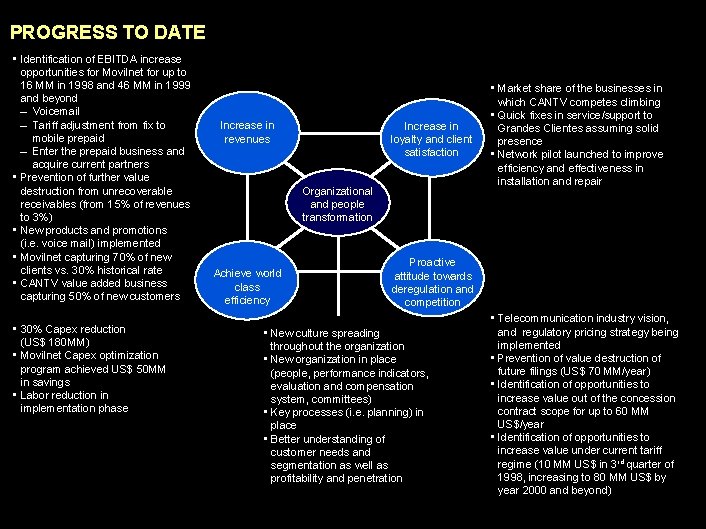
PROGRESS TO DATE • Identification of EBITDA increase opportunities for Movilnet for up to 16 MM in 1998 and 46 MM in 1999 and beyond – Voicemail – Tariff adjustment from fix to mobile prepaid – Enter the prepaid business and acquire current partners • Prevention of further value destruction from unrecoverable receivables (from 15% of revenues to 3%) • New products and promotions (i. e. voice mail) implemented • Movilnet capturing 70% of new clients vs. 30% historical rate • CANTV value added business capturing 50% of new customers • 30% Capex reduction (US$ 180 MM) • Movilnet Capex optimization program achieved US$ 50 MM in savings • Labor reduction in implementation phase Increase in revenues Increase in loyalty and client satisfaction Organizational and people transformation Achieve world class efficiency • Market share of the businesses in which CANTV competes climbing • Quick fixes in service/support to Grandes Clientes assuming solid presence • Network pilot launched to improve efficiency and effectiveness in installation and repair Proactive attitude towards deregulation and competition • New culture spreading throughout the organization • New organization in place (people, performance indicators, evaluation and compensation system, committees) • Key processes (i. e. planning) in place • Better understanding of customer needs and segmentation as well as profitability and penetration • Telecommunication industry vision, and regulatory pricing strategy being implemented • Prevention of value destruction of future filings (US$ 70 MM/year) • Identification of opportunities to increase value out of the concession contract scope for up to 60 MM US$/year • Identification of opportunities to increase value under current tariff regime (10 MM US$ in 3 rd quarter of 1998, increasing to 80 MM US$ by year 2000 and beyond) 56
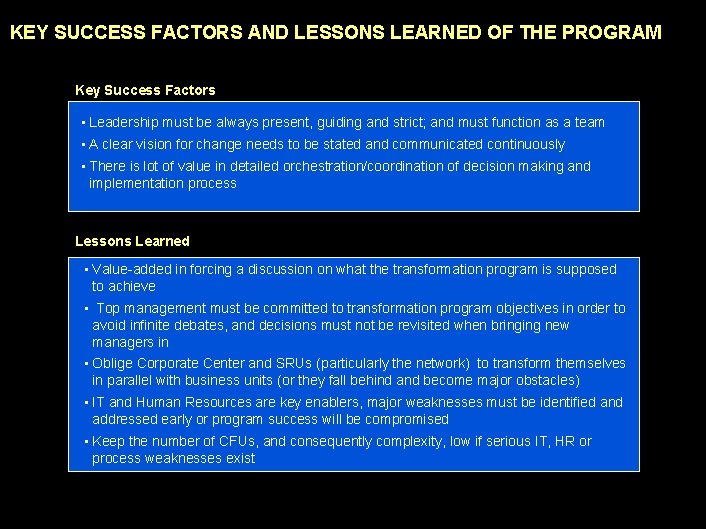
KEY SUCCESS FACTORS AND LESSONS LEARNED OF THE PROGRAM Key Success Factors • Leadership must be always present, guiding and strict; and must function as a team • A clear vision for change needs to be stated and communicated continuously • There is lot of value in detailed orchestration/coordination of decision making and implementation process Lessons Learned • Value-added in forcing a discussion on what the transformation program is supposed to achieve • Top management must be committed to transformation program objectives in order to avoid infinite debates, and decisions must not be revisited when bringing new managers in • Oblige Corporate Center and SRUs (particularly the network) to transform themselves in parallel with business units (or they fall behind and become major obstacles) • IT and Human Resources are key enablers, major weaknesses must be identified and addressed early or program success will be compromised • Keep the number of CFUs, and consequently complexity, low if serious IT, HR or process weaknesses exist 57
990617 BKZXW 380 WWGZ CONTENTS • Introduction to Mc. Kinsey Walter Wintersteller • Transformation case studies – Belgacom Scott Beardsley – Ameritech Gerhard Bette – CANTV Francis Deprez – TPSA Jacek Poswiata • Perspectives on telecom organizations Francis Deprez • Discussion: Challenges facing TOT All 58
CONFIDENTIAL Transforming TPSA Case Study Jacek Poswiata – Mc. Kinsey Warsaw Telephone Organization of Thailand Workshop with Senior management Bangkok, June 19, 1999 This report is solely for the use of client personnel. No part of it may be circulated, quoted, or reproduced for distribution outside the client organization without prior written approval from Mc. Kinsey & Company. This material was used by Mc. Kinsey & Company during an oral presentation; it is not a complete record of the discussion.
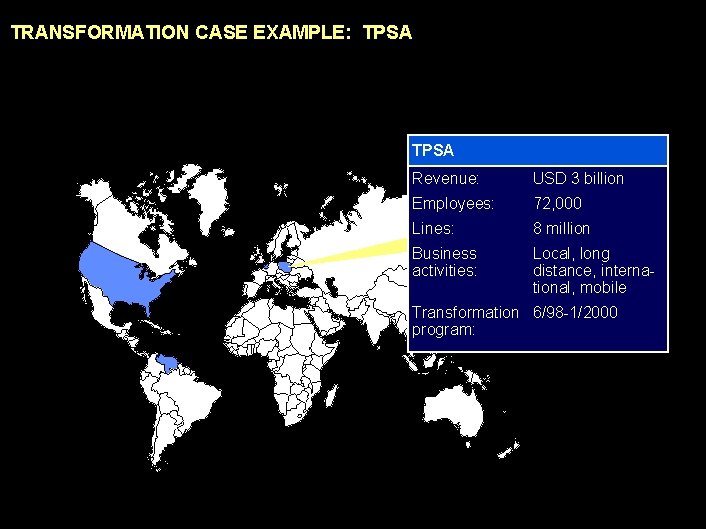
990617 BKZXW 380 WWGZ TRANSFORMATION CASE EXAMPLE: TPSA Revenue: USD 3 billion Employees: 72, 000 Lines: 8 million Business activities: Local, long distance, international, mobile Transformation 6/98 -1/2000 program: 60
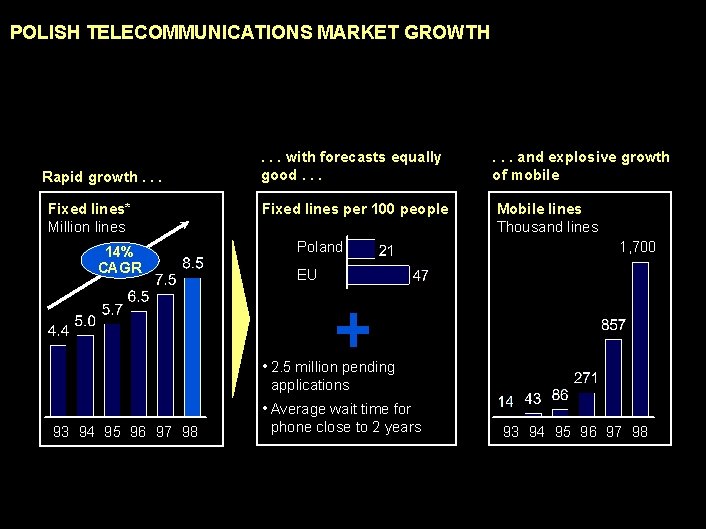
POLISH TELECOMMUNICATIONS MARKET GROWTH Rapid growth. . . Fixed lines* Million lines 14% CAGR . . . with forecasts equally good. . . and explosive growth of mobile Fixed lines per 100 people Mobile lines Thousand lines Poland 1, 700 EU • 2. 5 million pending applications • Average wait time for 93 94 95 96 97 98 *Year end, TP S. A. only phone close to 2 years 93 94 95 96 97 98 61
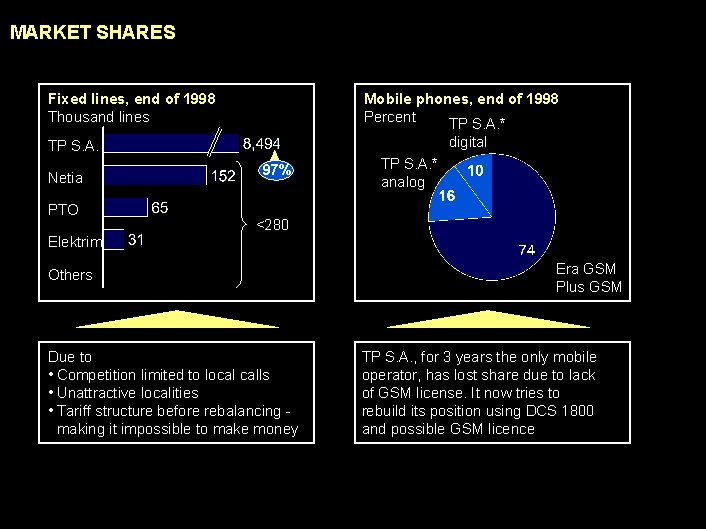
MARKET SHARES Fixed lines, end of 1998 Thousand lines Mobile phones, end of 1998 Percent TP S. A. * digital TP S. A. Netia PTO 97% TP S. A. * analog <280 Elektrim Others Due to • Competition limited to local calls • Unattractive localities • Tariff structure before rebalancing making it impossible to make money *JV with French Telecom Era GSM Plus GSM TP S. A. , for 3 years the only mobile operator, has lost share due to lack of GSM license. It now tries to rebuild its position using DCS 1800 and possible GSM licence 62
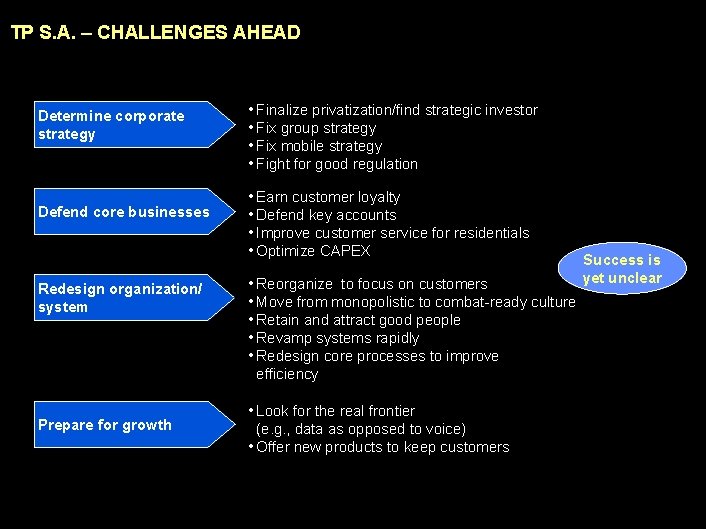
990617 BKZXW 380 WWGZ TP S. A. – CHALLENGES AHEAD Determine corporate strategy Defend core businesses Redesign organization/ system • Finalize privatization/find strategic investor • Fix group strategy • Fix mobile strategy • Fight for good regulation • Earn customer loyalty • Defend key accounts • Improve customer service for residentials • Optimize CAPEX • Reorganize to focus on customers • Move from monopolistic to combat-ready culture • Retain and attract good people • Revamp systems rapidly • Redesign core processes to improve Success is yet unclear efficiency Prepare for growth • Look for the real frontier (e. g. , data as opposed to voice) • Offer new products to keep customers 63
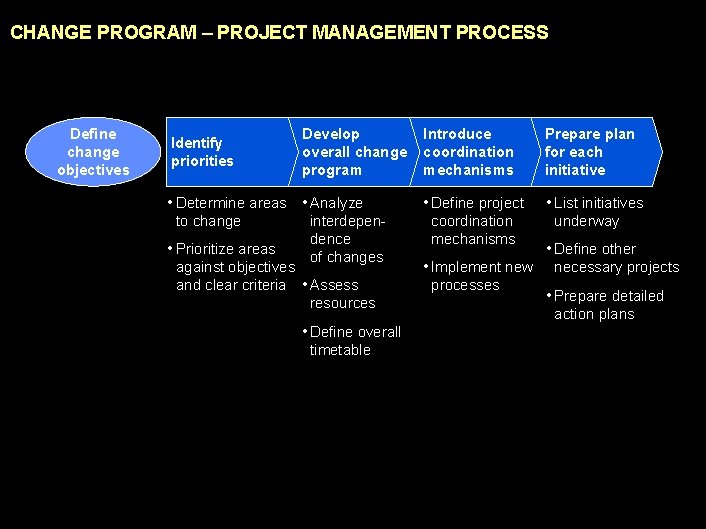
990617 BKZXW 380 WWGZ CHANGE PROGRAM – PROJECT MANAGEMENT PROCESS Define change objectives Identify priorities Develop overall change program • Determine areas • Analyze to change • Prioritize areas against objectives and clear criteria interdependence of changes • Assess resources • Define overall Introduce coordination mechanisms Prepare plan for each initiative • Define project • List initiatives coordination mechanisms • Implement new processes underway • Define other necessary projects • Prepare detailed action plans timetable 64
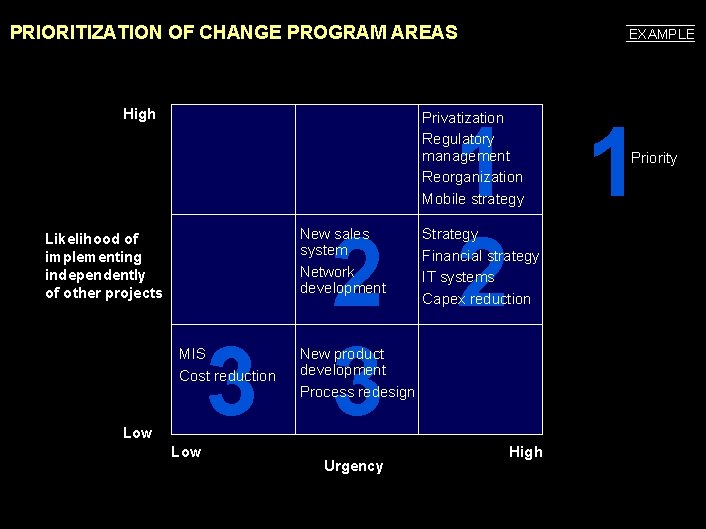
990617 BKZXW 380 WWGZ PRIORITIZATION OF CHANGE PROGRAM AREAS High EXAMPLE Privatization Regulatory management Reorganization Mobile strategy 1 1 2 2 3 3 New sales system Network development Likelihood of implementing independently of other projects MIS Cost reduction Low Priority Strategy Financial strategy IT systems Capex reduction New product development Process redesign Urgency High 65
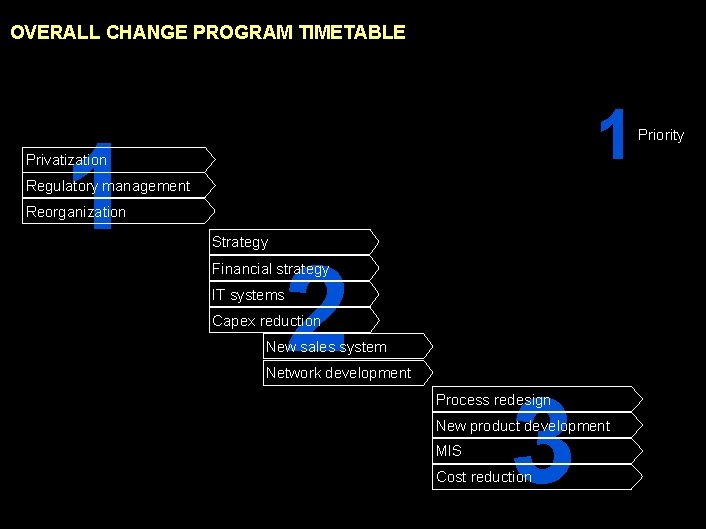
990617 BKZXW 380 WWGZ OVERALL CHANGE PROGRAM TIMETABLE 1 1 Privatization Priority Regulatory management Reorganization Strategy 2 Financial strategy IT systems Capex reduction New sales system Network development 3 Process redesign New product development MIS Cost reduction 66
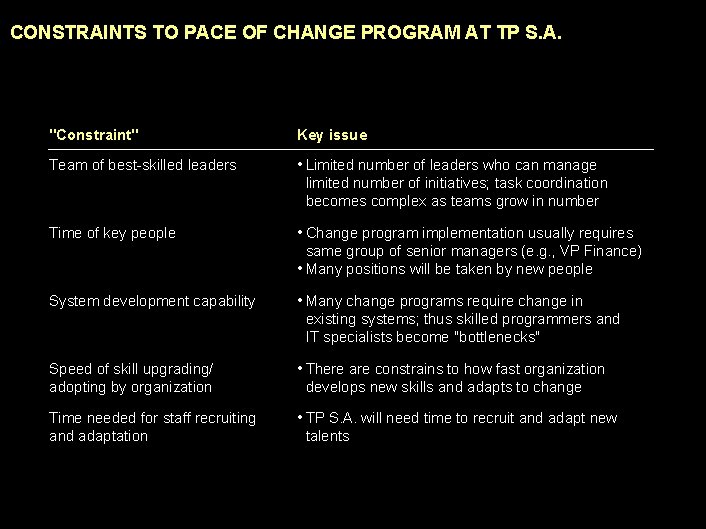
990617 BKZXW 380 WWGZ CONSTRAINTS TO PACE OF CHANGE PROGRAM AT TP S. A. "Constraint" Key issue Team of best-skilled leaders • Limited number of leaders who can manage limited number of initiatives; task coordination becomes complex as teams grow in number Time of key people • Change program implementation usually requires same group of senior managers (e. g. , VP Finance) • Many positions will be taken by new people System development capability • Many change programs require change in existing systems; thus skilled programmers and IT specialists become "bottlenecks" Speed of skill upgrading/ adopting by organization • There are constrains to how fast organization Time needed for staff recruiting and adaptation • TP S. A. will need time to recruit and adapt new develops new skills and adapts to change talents 67
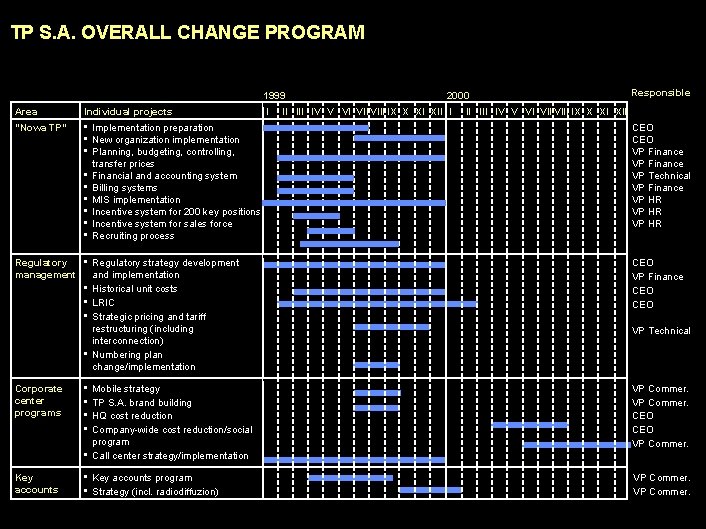
990617 BKZXW 380 WWGZ TP S. A. OVERALL CHANGE PROGRAM 1999 Area Individual projects "Nowa TP" • • • Regulatory strategy development and implementation Historical unit costs LRIC Strategic pricing and tariff restructuring (including interconnection) Numbering plan change/implementation CEO VP Finance CEO • Mobile strategy TP S. A. brand building HQ cost reduction Company-wide cost reduction/social program Call center strategy/implementation VP Commer. CEO VP Commer. • • Key accounts program Strategy (incl. radiodiffuzion) VP Commer. • • Key accounts II IV V VI VIII IX X XI XII CEO VP Finance VP Technical VP Finance VP HR • • • Corporate center programs II IV V VI VIII IX X XI XII I Responsible Implementation preparation New organization implementation Planning, budgeting, controlling, transfer prices Financial and accounting system Billing systems MIS implementation Incentive system for 200 key positions Incentive system for sales force Recruiting process • • • Regulatory management I 2000 • • VP Technical 68
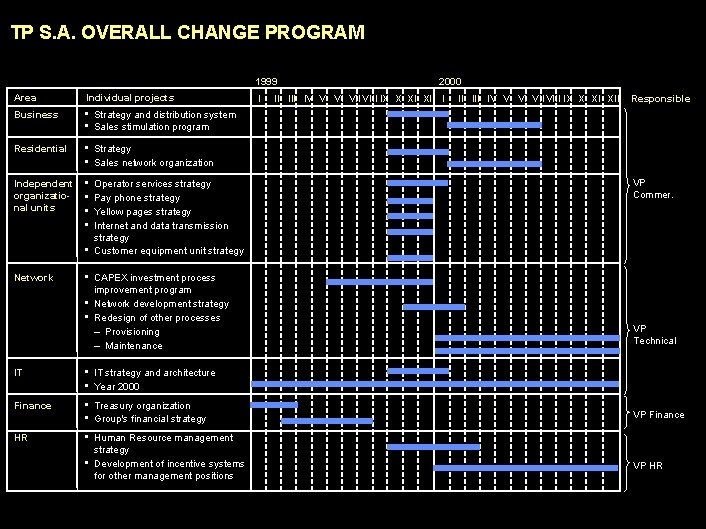
990617 BKZXW 380 WWGZ TP S. A. OVERALL CHANGE PROGRAM 1999 Area Individual projects Business • • Strategy and distribution system Sales stimulation program Residential • • Strategy Sales network organization Independent organizational units • • Operator services strategy Pay phone strategy Yellow pages strategy Internet and data transmission strategy Customer equipment unit strategy • Network • • • CAPEX investment process improvement program Network development strategy Redesign of other processes – Provisioning – Maintenance IT • • IT strategy and architecture Year 2000 Finance • • Treasury organization Group's financial strategy HR • Human Resource management strategy Development of incentive systems for other management positions • I 2000 II IV V VI VIII IX X XI XII IV V VI VIII IX X XI XII Responsible VP Commer. VP Technical VP Finance VP HR 69
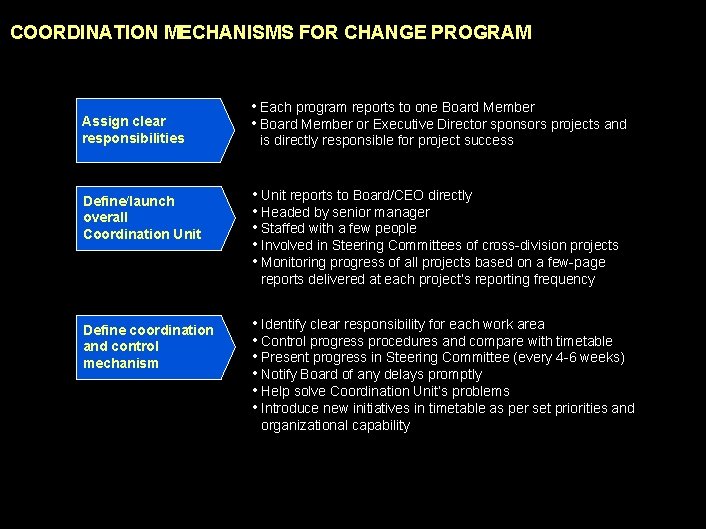
990617 BKZXW 380 WWGZ COORDINATION MECHANISMS FOR CHANGE PROGRAM Assign clear responsibilities Define/launch overall Coordination Unit • Each program reports to one Board Member • Board Member or Executive Director sponsors projects and is directly responsible for project success • Unit reports to Board/CEO directly • Headed by senior manager • Staffed with a few people • Involved in Steering Committees of cross-division projects • Monitoring progress of all projects based on a few-page reports delivered at each project’s reporting frequency Define coordination and control mechanism • Identify clear responsibility for each work area • Control progress procedures and compare with timetable • Present progress in Steering Committee (every 4 -6 weeks) • Notify Board of any delays promptly • Help solve Coordination Unit’s problems • Introduce new initiatives in timetable as per set priorities and organizational capability 70
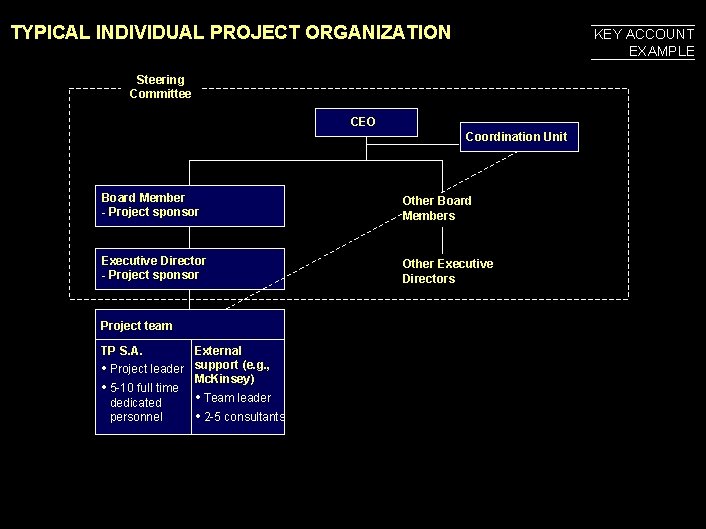
990617 BKZXW 380 WWGZ TYPICAL INDIVIDUAL PROJECT ORGANIZATION KEY ACCOUNT EXAMPLE Steering Committee CEO Coordination Unit Board Member - Project sponsor Other Board Members Executive Director - Project sponsor Other Executive Directors Project team TP S. A. External • Project leader support (e. g. , Mc. Kinsey) • 5 -10 full time • Team leader dedicated personnel • 2 -5 consultants 71
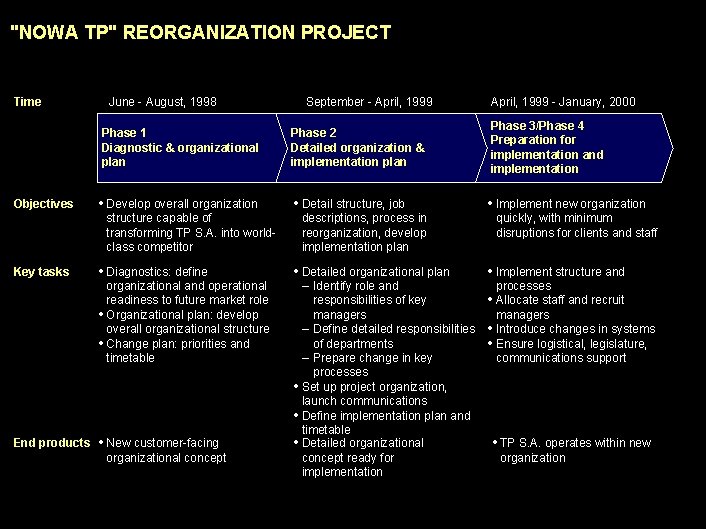
990617 BKZXW 380 WWGZ "NOWA TP" REORGANIZATION PROJECT Time June - August, 1998 Phase 1 Diagnostic & organizational plan Objectives • Develop overall organization structure capable of transforming TP S. A. into worldclass competitor Key tasks • Diagnostics: define organizational and operational readiness to future market role • Organizational plan: develop overall organizational structure • Change plan: priorities and timetable End products • New customer-facing organizational concept September - April, 1999 Phase 2 Detailed organization & implementation plan • Detail structure, job descriptions, process in reorganization, develop implementation plan • Detailed organizational plan April, 1999 - January, 2000 Phase 3/Phase 4 Preparation for implementation and implementation • Implement new organization quickly, with minimum disruptions for clients and staff • Implement structure and – Identify role and processes responsibilities of key • Allocate staff and recruit managers – Define detailed responsibilities • Introduce changes in systems of departments • Ensure logistical, legislature, – Prepare change in key communications support processes • Set up project organization, launch communications • Define implementation plan and timetable • Detailed organizational • TP S. A. operates within new concept ready for organization implementation 72
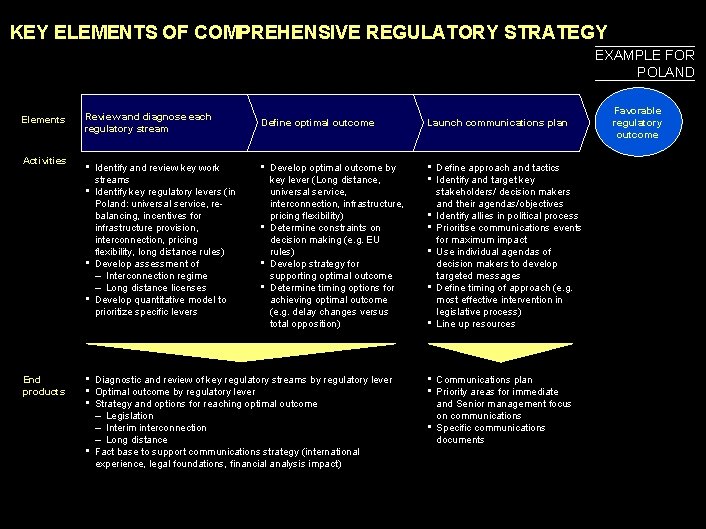
990617 BKZXW 380 WWGZ KEY ELEMENTS OF COMPREHENSIVE REGULATORY STRATEGY EXAMPLE FOR POLAND Elements Review and diagnose each regulatory stream Define optimal outcome Launch communications plan Activities • • End products • • Identify and review key work streams Identify key regulatory levers (in Poland: universal service, rebalancing, incentives for infrastructure provision, interconnection, pricing flexibility, long distance rules) Develop assessment of – Interconnection regime – Long distance licenses Develop quantitative model to prioritize specific levers • • • Develop optimal outcome by key lever (Long distance, universal service, interconnection, infrastructure, pricing flexibility) Determine constraints on decision making (e. g. EU rules) Develop strategy for supporting optimal outcome Determine timing options for achieving optimal outcome (e. g. delay changes versus total opposition) Diagnostic and review of key regulatory streams by regulatory lever Optimal outcome by regulatory lever Strategy and options for reaching optimal outcome – Legislation – Interim interconnection – Long distance Fact base to support communications strategy (international experience, legal foundations, financial analysis impact) • • Favorable regulatory outcome Define approach and tactics Identify and target key stakeholders/ decision makers and their agendas/objectives Identify allies in political process Prioritise communications events for maximum impact Use individual agendas of decision makers to develop targeted messages Define timing of approach (e. g. most effective intervention in legislative process) Line up resources Communications plan Priority areas for immediate and Senior management focus on communications Specific communications documents 73
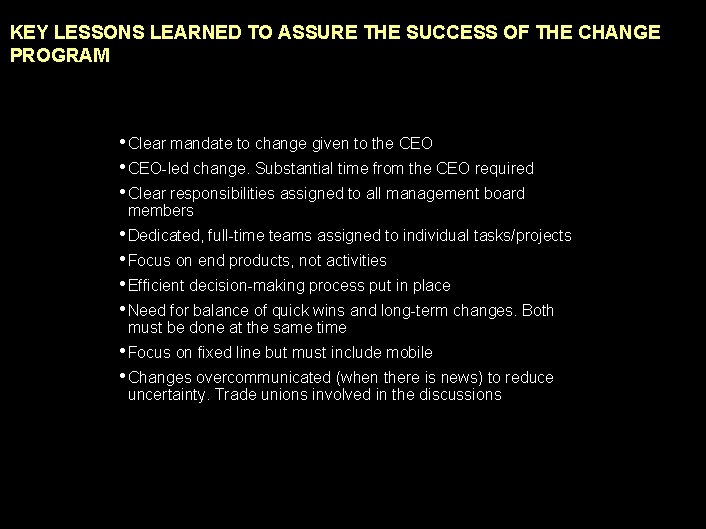
990617 BKZXW 380 WWGZ KEY LESSONS LEARNED TO ASSURE THE SUCCESS OF THE CHANGE PROGRAM • Clear mandate to change given to the CEO • CEO-led change. Substantial time from the CEO required • Clear responsibilities assigned to all management board members • Dedicated, full-time teams assigned to individual tasks/projects • Focus on end products, not activities • Efficient decision-making process put in place • Need for balance of quick wins and long-term changes. Both must be done at the same time • Focus on fixed line but must include mobile • Changes overcommunicated (when there is news) to reduce uncertainty. Trade unions involved in the discussions 74
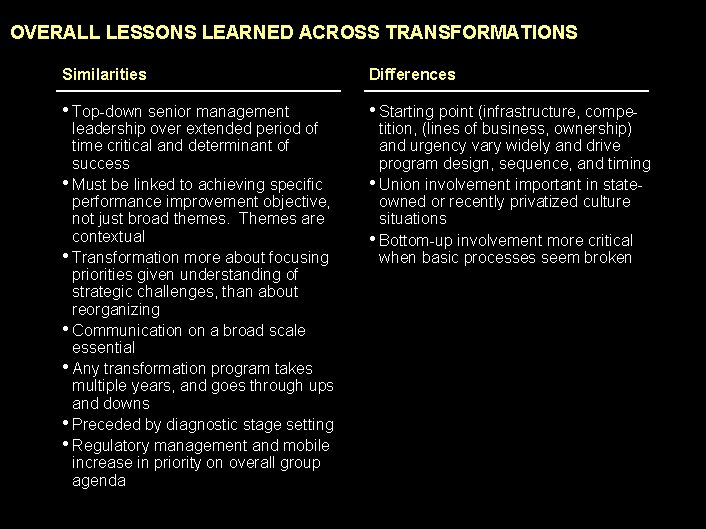
990617 BKZXW 380 WWGZ OVERALL LESSONS LEARNED ACROSS TRANSFORMATIONS Similarities Differences • Top-down senior management • Starting point (infrastructure, compe- leadership over extended period of time critical and determinant of success • Must be linked to achieving specific performance improvement objective, not just broad themes. Themes are contextual • Transformation more about focusing priorities given understanding of strategic challenges, than about reorganizing • Communication on a broad scale essential • Any transformation program takes multiple years, and goes through ups and downs • Preceded by diagnostic stage setting • Regulatory management and mobile increase in priority on overall group agenda tition, (lines of business, ownership) and urgency vary widely and drive program design, sequence, and timing • Union involvement important in stateowned or recently privatized culture situations • Bottom-up involvement more critical when basic processes seem broken 75
990617 BKZXW 380 WWGZ Back-up 76
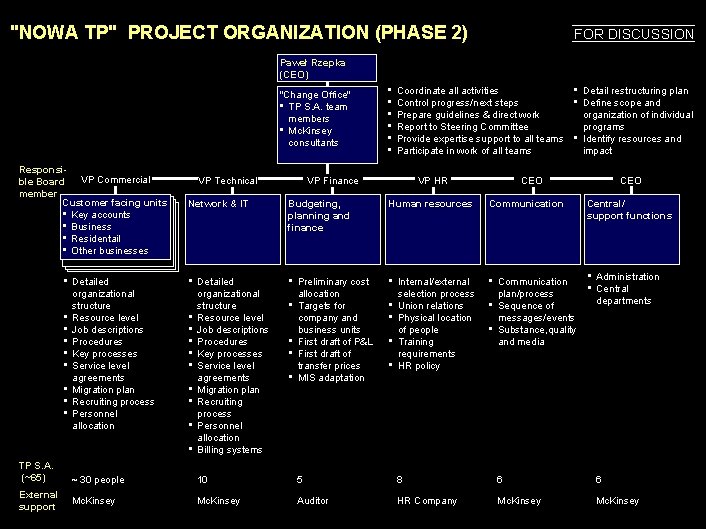
990617 BKZXW 380 WWGZ "NOWA TP" PROJECT ORGANIZATION (PHASE 2) FOR DISCUSSION Paweł Rzepka (CEO) "Change Office" • TP S. A. team members • Mc. Kinsey consultants Responsi. VP Commercial ble Board member Customer facing units • Key accounts • Business • Residentail • Other businesses • • • Detailed organizational structure Resource level Job descriptions Procedures Key processes Service level agreements Migration plan Recruiting process Personnel allocation VP Technical External support Coordinate all activities Control progress/next steps Prepare guidelines & direct work Report to Steering Committee Provide expertise support to all teams Participate in work of all teams VP Finance VP HR Budgeting, planning and finance Human resources Communication • • • Detailed organizational structure Resource level Job descriptions Procedures Key processes Service level agreements Migration plan Recruiting process Personnel allocation Billing systems • • Preliminary cost allocation Targets for company and business units First draft of P&L First draft of transfer prices MIS adaptation • • Internal/external selection process Union relations Physical location of people Training requirements HR policy • • • Detail restructuring plan Define scope and organization of individual programs Identify resources and impact CEO Network & IT • TP S. A. (~65) • • Communication plan/process Sequence of messages/events Substance, quality and media CEO Central/ support functions • • Administration Central departments ~ 30 people 10 5 8 6 6 Mc. Kinsey Auditor HR Company Mc. Kinsey 77
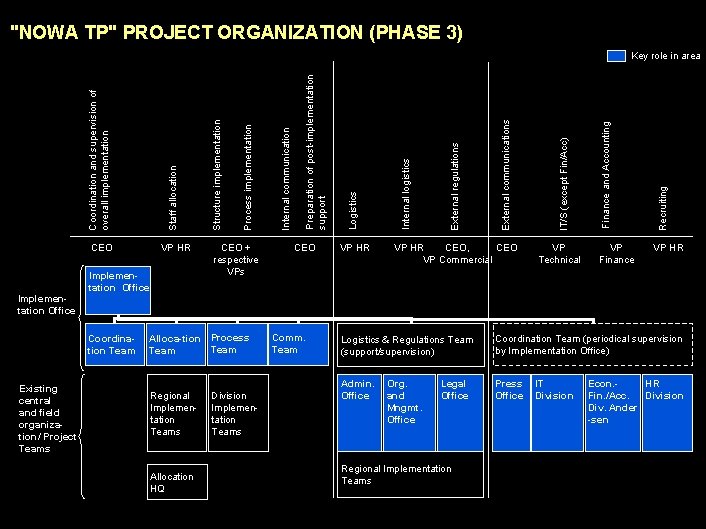
990617 BKZXW 380 WWGZ "NOWA TP" PROJECT ORGANIZATION (PHASE 3) CEO Implementation Office Coordination Team Existing central and field organization/ Project Teams VP HR CEO + respective VPs Alloca-tion Process Team Regional Implementation Teams Allocation HQ Division Implementation Teams CEO Comm. Team VP HR CEO, CEO VP Commercial VP Technical VP Finance Recruiting Finance and Accounting IT/S (except Fin/Acc) External communications External regulations Internal logistics Logistics Preparation of post-implementation support Internal communication Process implementation Structure implementation Staff allocation Coordination and supervision of overall implementation Key role in area VP HR Logistics & Regulations Team (support/supervision) Coordination Team (periodical supervision by Implementation Office) Admin. Office Press Office Org. and Mngmt. Office Legal Office IT Division Econ. HR Fin. /Acc. Division Div. Ander -sen Regional Implementation Teams 78
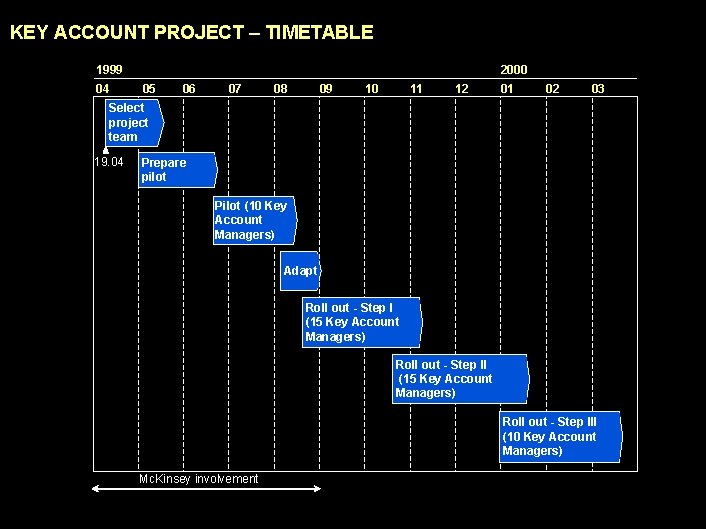
990617 BKZXW 380 WWGZ KEY ACCOUNT PROJECT – TIMETABLE 1999 04 2000 05 06 07 08 09 10 11 12 01 02 03 Select project team 19. 04 Prepare pilot Pilot (10 Key Account Managers) Adapt Roll out - Step I (15 Key Account Managers) Roll out - Step III (10 Key Account Managers) Mc. Kinsey involvement 79
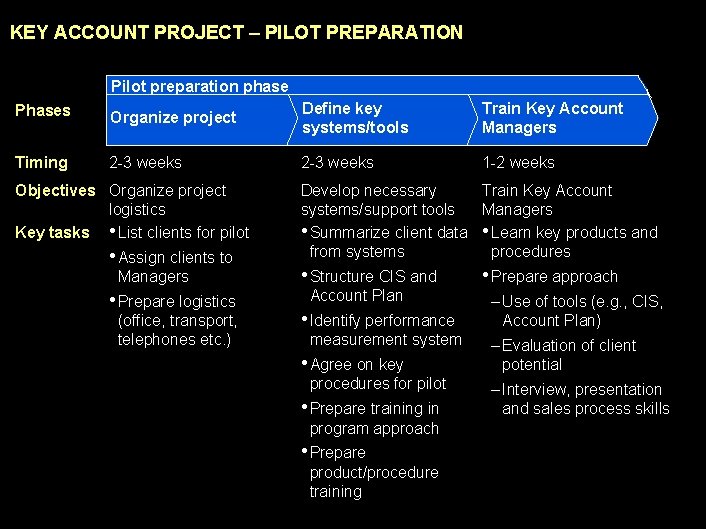
990617 BKZXW 380 WWGZ KEY ACCOUNT PROJECT – PILOT PREPARATION Pilot preparation phase Phases Organize project Define key systems/tools Train Key Account Managers Timing 2 -3 weeks 1 -2 weeks Objectives Organize project logistics Key tasks • List clients for pilot • Assign clients to Managers • Prepare logistics (office, transport, telephones etc. ) Develop necessary Train Key Account systems/support tools Managers • Summarize client data • Learn key products and from systems procedures • Structure CIS and Account Plan • Identify performance measurement system • Agree on key procedures for pilot • Prepare training in • Prepare approach – Use of tools (e. g. , CIS, Account Plan) – Evaluation of client potential – Interview, presentation and sales process skills program approach • Prepare product/procedure training 80
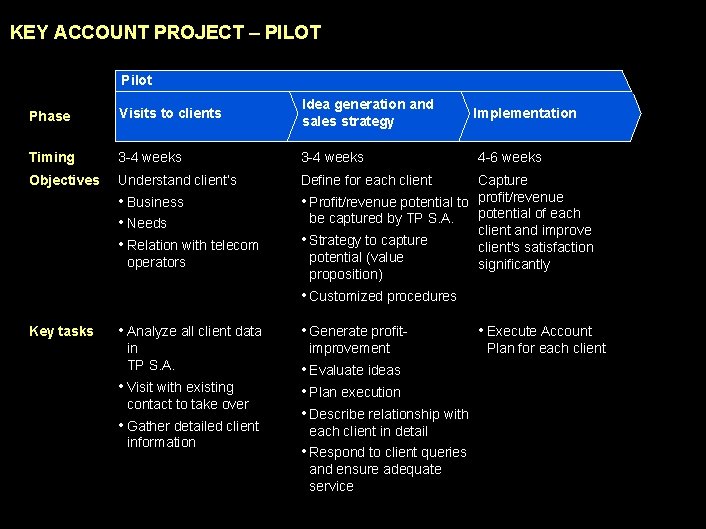
990617 BKZXW 380 WWGZ KEY ACCOUNT PROJECT – PILOT Pilot Phase Visits to clients Idea generation and sales strategy Timing 3 -4 weeks Objectives Understand client’s Define for each client • Business • Needs • Relation with telecom operators Implementation 4 -6 weeks Capture • Profit/revenue potential to profit/revenue potential of each be captured by TP S. A. client and improve • Strategy to capture client's satisfaction potential (value significantly proposition) • Customized procedures Key tasks • Analyze all client data in TP S. A. • Visit with existing contact to take over • Gather detailed client information • Generate profitimprovement • Execute Account Plan for each client • Evaluate ideas • Plan execution • Describe relationship with each client in detail • Respond to client queries and ensure adequate service 81
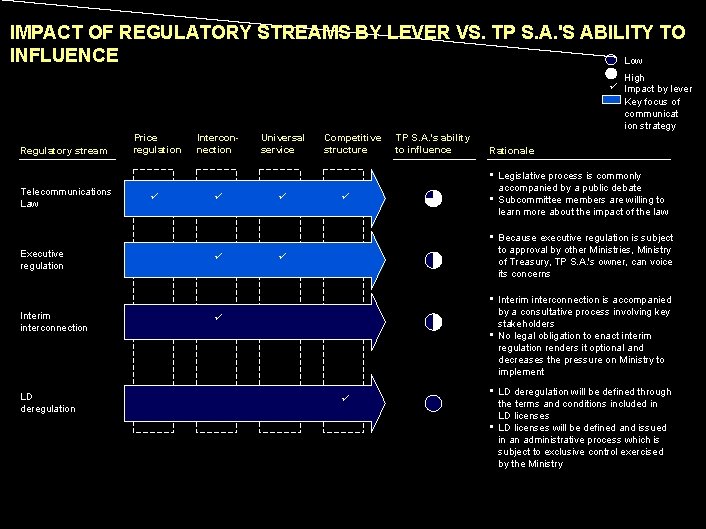
990617 BKZXW 380 WWGZ IMPACT OF REGULATORY STREAMS BY LEVER VS. TP S. A. 'S ABILITY TO INFLUENCE Low High ü Impact by lever Key focus of communicat ion strategy Regulatory stream Price regulation Interconnection Universal service Competitive structure TP S. A. 's ability to influence Rationale • Telecommunications Law Executive regulation Interim interconnection LD deregulation ü ü ü • • Because executive regulation is subject to approval by other Ministries, Ministry of Treasury, TP S. A. 's owner, can voice its concerns • Interim interconnection is accompanied by a consultative process involving key stakeholders No legal obligation to enact interim regulation renders it optional and decreases the pressure on Ministry to implement ü ü • ü Legislative process is commonly accompanied by a public debate Subcommittee members are willing to learn more about the impact of the law • • LD deregulation will be defined through the terms and conditions included in LD licenses will be defined and issued in an administrative process which is subject to exclusive control exercised by the Ministry 82
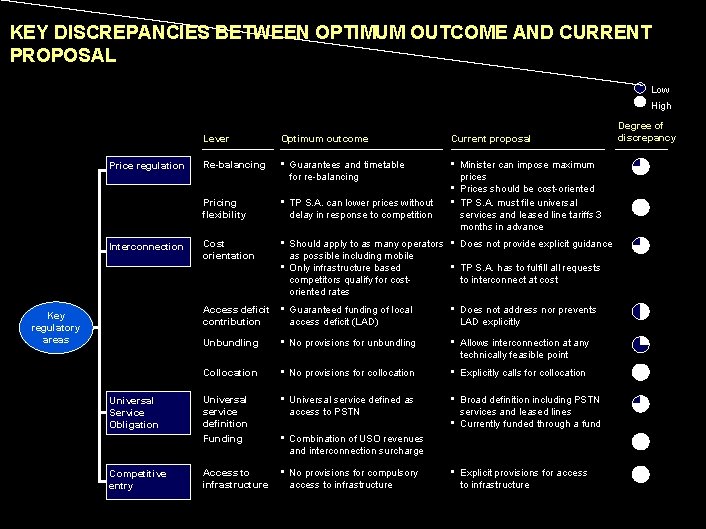
990617 BKZXW 380 WWGZ KEY DISCREPANCIES BETWEEN OPTIMUM OUTCOME AND CURRENT PROPOSAL Low High Price regulation Interconnection Key regulatory areas Universal Service Obligation Competitive entry Lever Optimum outcome Current proposal Re-balancing • Guarantees and timetable for re-balancing • Pricing flexibility • TP S. A. can lower prices without delay in response to competition Cost orientation • • Minister can impose maximum prices Prices should be cost-oriented TP S. A. must file universal services and leased line tariffs 3 months in advance Should apply to as many operators as possible including mobile Only infrastructure based competitors qualify for costoriented rates • Does not provide explicit guidance • TP S. A. has to fulfill all requests to interconnect at cost Access deficit contribution • Guaranteed funding of local access deficit (LAD) • Does not address nor prevents LAD explicitly Unbundling • No provisions for unbundling • Allows interconnection at any technically feasible point Collocation • No provisions for collocation • Explicitly calls for collocation Universal service definition Funding • Universal service defined as access to PSTN • Broad definition including PSTN services and leased lines Currently funded through a fund • Combination of USO revenues and interconnection surcharge Access to infrastructure • No provisions for compulsory access to infrastructure • • Degree of discrepancy Explicit provisions for access to infrastructure 83
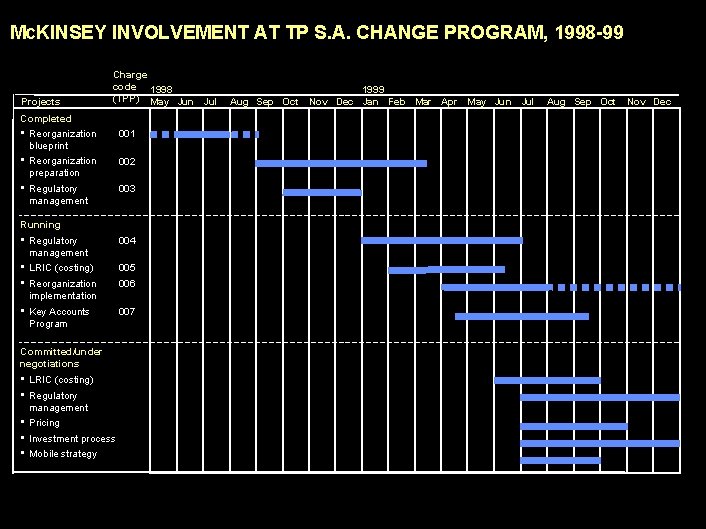
990617 BKZXW 380 WWGZ Mc. KINSEY INVOLVEMENT AT TP S. A. CHANGE PROGRAM, 1998 -99 Projects Charge code 1998 (TPP) May Jun Jul Completed • Reorganization blueprint 001 • Reorganization preparation 002 • Regulatory management 003 1999 Aug Sep Oct Nov Dec Jan Feb Mar Apr May Jun Jul Aug Sep Oct Nov Dec Running • Regulatory management 004 • • LRIC (costing) 005 Reorganization implementation 006 • Key Accounts Program 007 Committed/under negotiations • • LRIC (costing) • • • Pricing Regulatory management Investment process Mobile strategy 84
990617 BKZXW 380 WWGZ CONTENTS • Introduction to Mc. Kinsey Walter Wintersteller • Transformation case studies – Belgacom Scott Beardsley – Ameritech Gerhard Bette – CANTV Francis Deprez – TPSA Jacek Poswiata • Perspectives on telecom organizations Francis Deprez • Discussion: Challenges facing TOT All 85
CONFIDENTIAL Perspective on Telecom Organizations Case study Francis Deprez – Mc. Kinsey Brussels Telephone Organization of Thailand Workshop with Senior management Bangkok, June 19, 1999 This report is solely for the use of client personnel. No part of it may be circulated, quoted, or reproduced for distribution outside the client organization without prior written approval from Mc. Kinsey & Company. This material was used by Mc. Kinsey & Company during an oral presentation; it is not a complete record of the discussion.
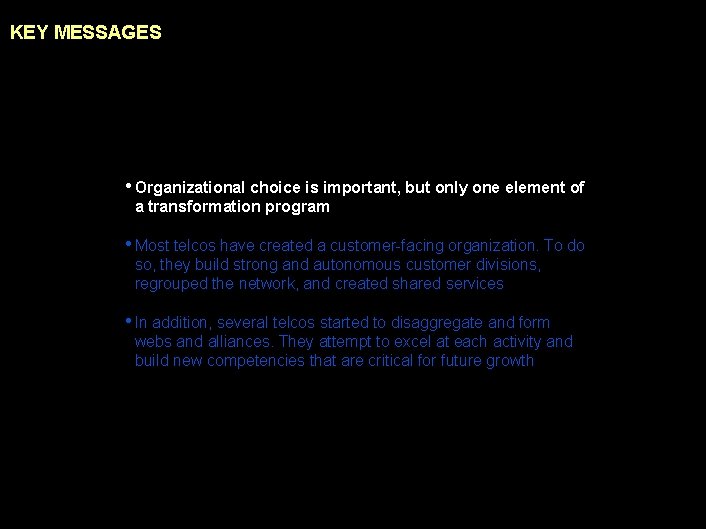
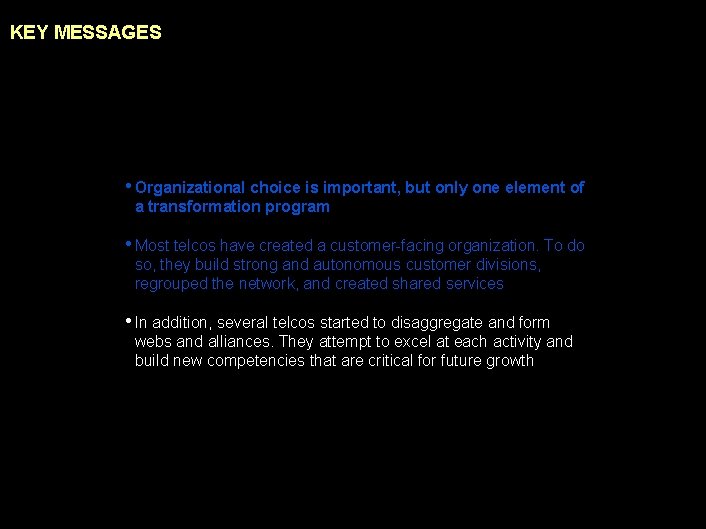
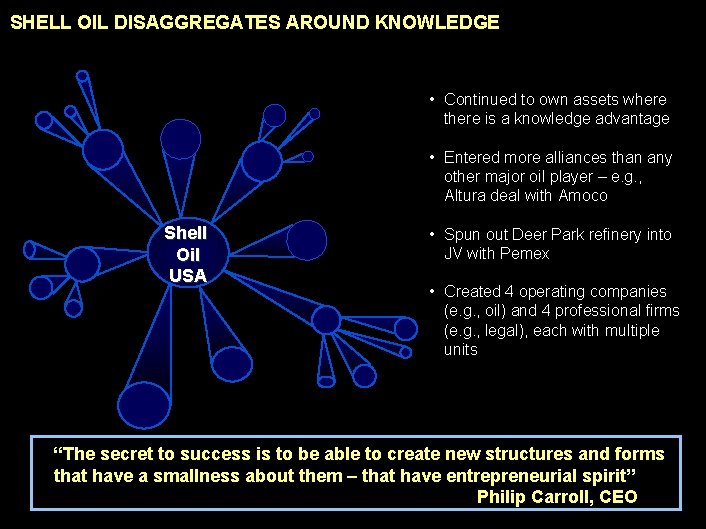
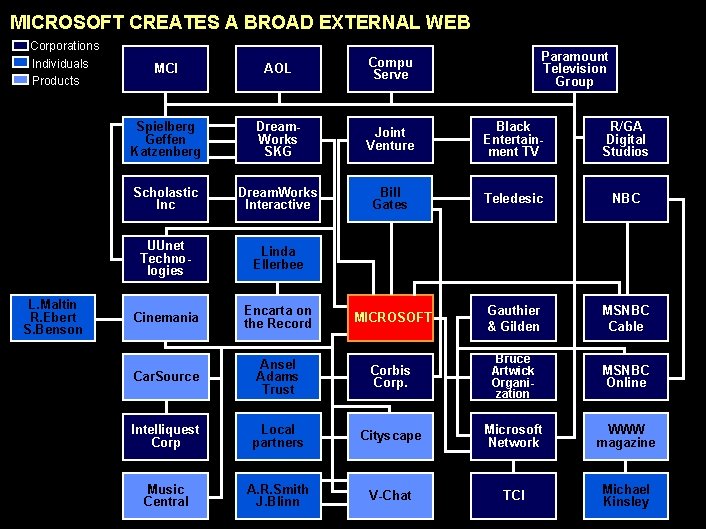
990617 BKZXW 380 WWGZ KEY MESSAGES • Organizational choice is important, but only one element of a transformation program • Most telcos have created a customer-facing organization. To do so, they build strong and autonomous customer divisions, regrouped the network, and created shared services • In addition, several telcos started to disaggregate and form webs and alliances. They attempt to excel at each activity and build new competencies that are critical for future growth 87
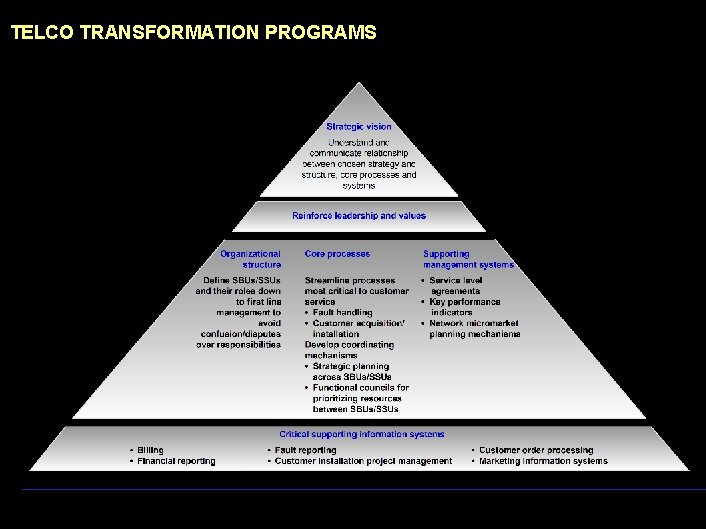
990617 BKZXW 380 WWGZ TELCO TRANSFORMATION PROGRAMS 88
990617 BKZXW 380 WWGZ EXAMPLES OF DIFFERENT TRANSFORMATION APPROACHES 89
990617 BKZXW 380 WWGZ EXAMPLES OF DIFFERENT TRANSFORMATION APPROACHES 90
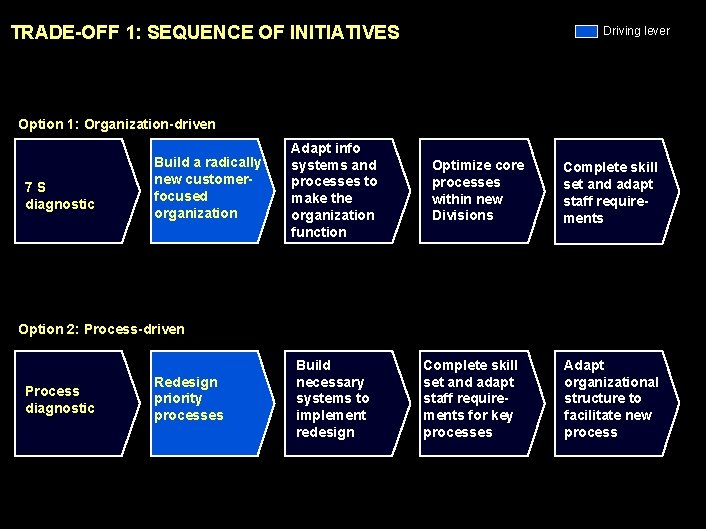
990617 BKZXW 380 WWGZ TRADE-OFF 1: SEQUENCE OF INITIATIVES Driving lever Option 1: Organization-driven 7 S diagnostic Build a radically new customerfocused organization Adapt info systems and processes to make the organization function Optimize core processes within new Divisions Complete skill set and adapt staff requirements Option 2: Process-driven Process diagnostic Redesign priority processes Build necessary systems to implement redesign Complete skill set and adapt staff requirements for key processes Adapt organizational structure to facilitate new process 91
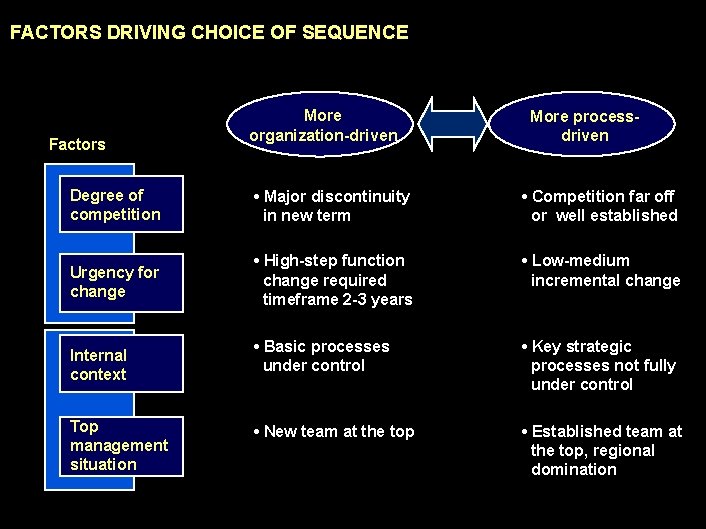
990617 BKZXW 380 WWGZ FACTORS DRIVING CHOICE OF SEQUENCE Factors More organization-driven More processdriven Degree of competition • Major discontinuity in new term • Competition far off or well established Urgency for change • High-step function change required timeframe 2 -3 years • Low-medium incremental change • Basic processes under control • Key strategic processes not fully under control • New team at the top • Established team at the top, regional domination Internal context Top management situation 92
990617 BKZXW 380 WWGZ KEY MESSAGES • Organizational choice is important, but only one element of a transformation program • Most telcos have created a customer-facing organization. To do so, they build strong and autonomous customer divisions, regrouped the network, and created shared services • In addition, several telcos started to disaggregate and form webs and alliances. They attempt to excel at each activity and build new competencies that are critical for future growth 93
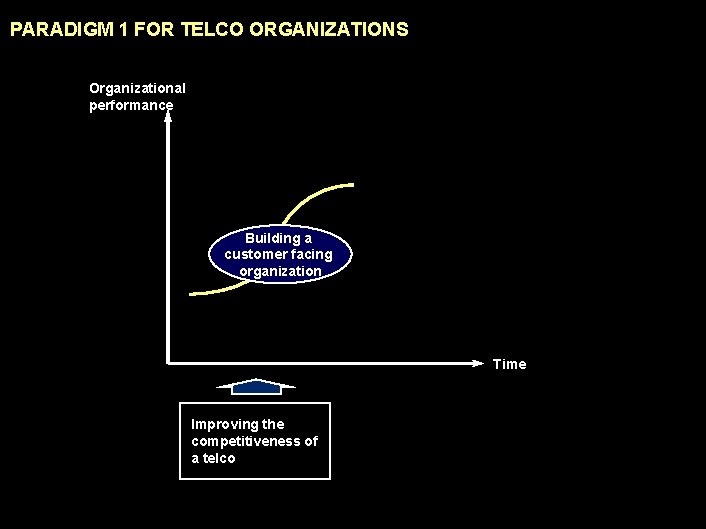
990617 BKZXW 380 WWGZ PARADIGM 1 FOR TELCO ORGANIZATIONS Organizational performance Building a customer facing organization Time Improving the competitiveness of a telco 94
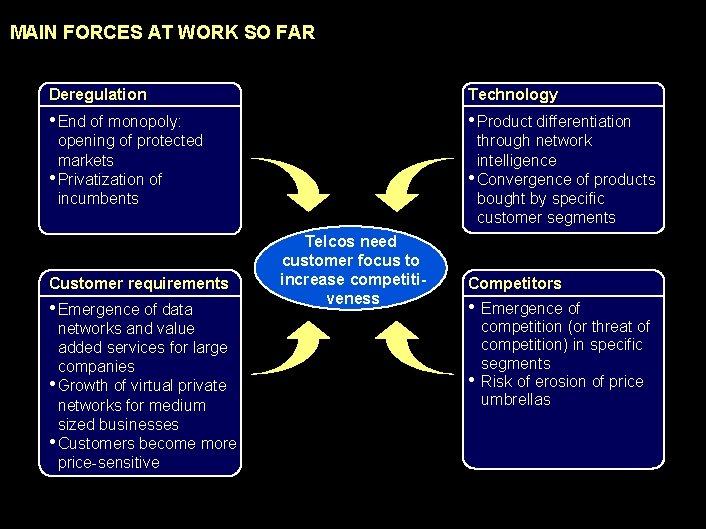
990617 BKZXW 380 WWGZ MAIN FORCES AT WORK SO FAR Deregulation Technology • End of monopoly: • Product differentiation opening of protected markets • Privatization of incumbents through network intelligence • Convergence of products bought by specific customer segments Customer requirements • Emergence of data networks and value added services for large companies • Growth of virtual private networks for medium sized businesses • Customers become more price-sensitive Telcos need customer focus to increase competitiveness Competitors • Emergence of • competition (or threat of competition) in specific segments Risk of erosion of price umbrellas 95
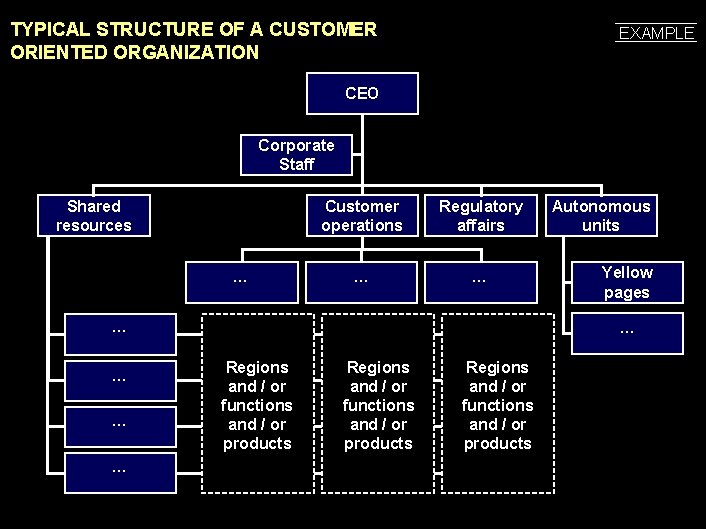
990617 BKZXW 380 WWGZ TYPICAL STRUCTURE OF A CUSTOMER ORIENTED ORGANIZATION EXAMPLE CEO Corporate Staff Shared resources … Customer operations Regulatory affairs … … … Autonomous units Yellow pages … Regions and / or functions and / or products … 96
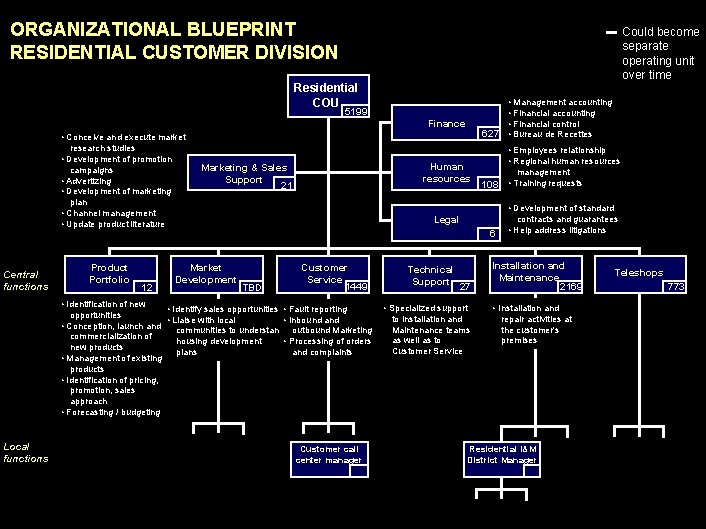
990617 BKZXW 380 WWGZ ORGANIZATIONAL BLUEPRINT RESIDENTIAL CUSTOMER DIVISION Could become separate operating unit over time Residential COU • Management accounting • Financial control 627 • Bureau de Recettes 5199 Finance • Conceive and execute market research studies • Development of promotion campaigns • Advertizing • Development of marketing plan • Channel management • Update product literature Central functions Product Portfolio 12 Human resources Marketing & Sales Support 21 Market Development 6 • Development of standard contracts and guarantees • Help address litigations Legal TBD Customer Service 1449 • Identification of new • Identify sales opportunities • Fault reporting opportunities • Liaise with local • Inbound and • Conception, launch and communities to understand outbound Marketing commercialization of housing development • Processing of orders new products plans and complaints • Management of existing products • Identification of pricing, promotion, sales approach • Forecasting / budgeting Local functions 108 • Employees relationship • Regional human resources management • Training requests Customer call center manager Technical Support 27 • Specialized support to Installation and Maintenance teams as well as to Customer Service Installation and Maintenance 2169 Teleshops 773 • Installation and repair activities at the customer's premises Residential I&M District Manager 97
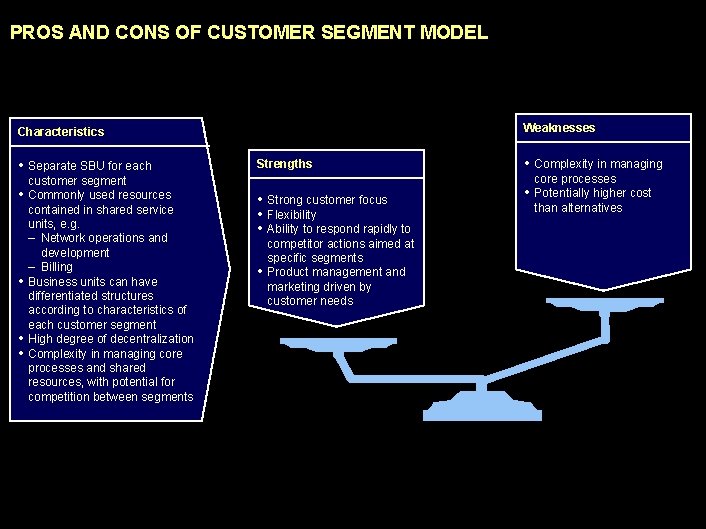
990617 BKZXW 380 WWGZ PROS AND CONS OF CUSTOMER SEGMENT MODEL Weaknesses Characteristics • Separate SBU for each • • customer segment Commonly used resources contained in shared service units, e. g. – Network operations and development – Billing Business units can have differentiated structures according to characteristics of each customer segment High degree of decentralization Complexity in managing core processes and shared resources, with potential for competition between segments Strengths • Strong customer focus • Flexibility • Ability to respond rapidly to • • Complexity in managing • core processes Potentially higher cost than alternatives competitor actions aimed at specific segments Product management and marketing driven by customer needs 98
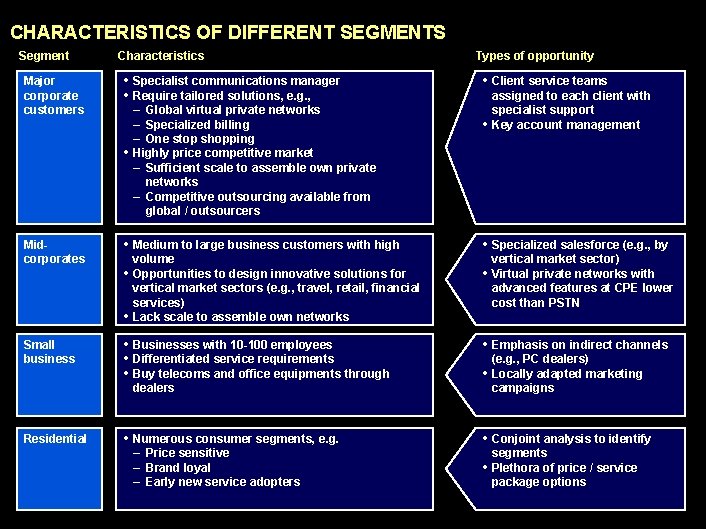
990617 BKZXW 380 WWGZ CHARACTERISTICS OF DIFFERENT SEGMENTS Segment Characteristics Major corporate customers • Specialist communications manager • Require tailored solutions, e. g. , Midcorporates • Medium to large business customers with high – Global virtual private networks – Specialized billing – One stop shopping • Highly price competitive market – Sufficient scale to assemble own private networks – Competitive outsourcing available from global / outsourcers • • Small business volume Opportunities to design innovative solutions for vertical market sectors (e. g. , travel, retail, financial services) Lack scale to assemble own networks • Businesses with 10 -100 employees • Differentiated service requirements • Buy telecoms and office equipments through dealers Residential • Numerous consumer segments, e. g. – Price sensitive – Brand loyal – Early new service adopters Types of opportunity • Client service teams • assigned to each client with specialist support Key account management • Specialized salesforce (e. g. , by • vertical market sector) Virtual private networks with advanced features at CPE lower cost than PSTN • Emphasis on indirect channels • (e. g. , PC dealers) Locally adapted marketing campaigns • Conjoint analysis to identify segments • Plethora of price / service package options 99
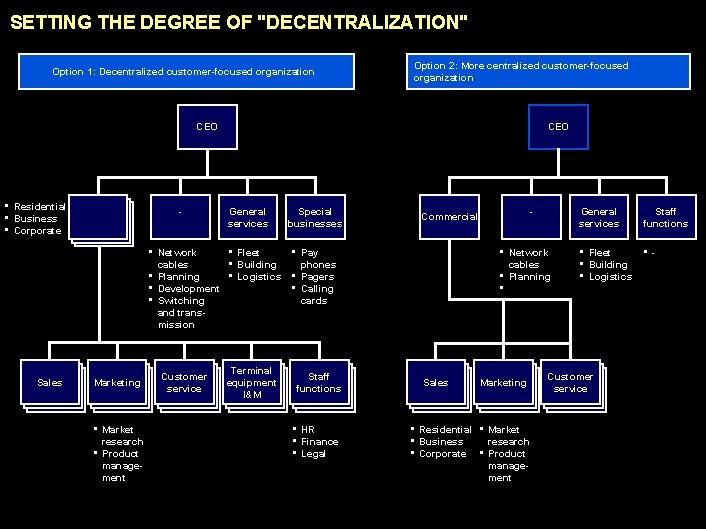
990617 BKZXW 380 WWGZ SETTING THE DEGREE OF "DECENTRALIZATION" Option 1: Decentralized customer-focused organization Option 2: More centralized customer-focused organization CEO • • • Residential Business Corporate - • • Sales Marketing • • Market research Product management Network cables Planning Development Switching and transmission Customer service CEO General services • • • Fleet Building Logistics Terminal equipment I&M Special businesses • - Commercial • Pay phones Pagers Calling cards • • Staff functions • • • HR Finance Legal Sales • • • Residential Business Corporate Network cables Planning Marketing • • General services Staff functions • • Fleet Building Logistics - Customer service Market research Product management 100
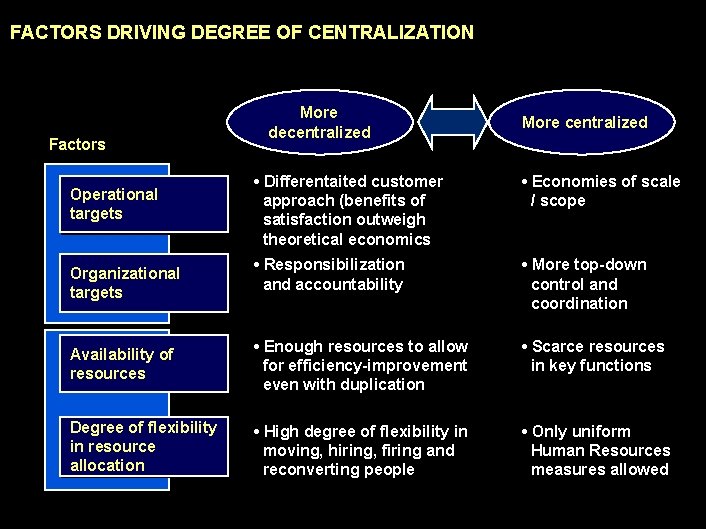
990617 BKZXW 380 WWGZ FACTORS DRIVING DEGREE OF CENTRALIZATION Factors More decentralized More centralized • Differentaited customer approach (benefits of satisfaction outweigh theoretical economics • Economies of scale / scope • Responsibilization and accountability • More top-down control and coordination Availability of resources • Enough resources to allow for efficiency-improvement even with duplication • Scarce resources in key functions Degree of flexibility in resource allocation • High degree of flexibility in moving, hiring, firing and reconverting people • Only uniform Human Resources measures allowed Operational targets Organizational targets 101
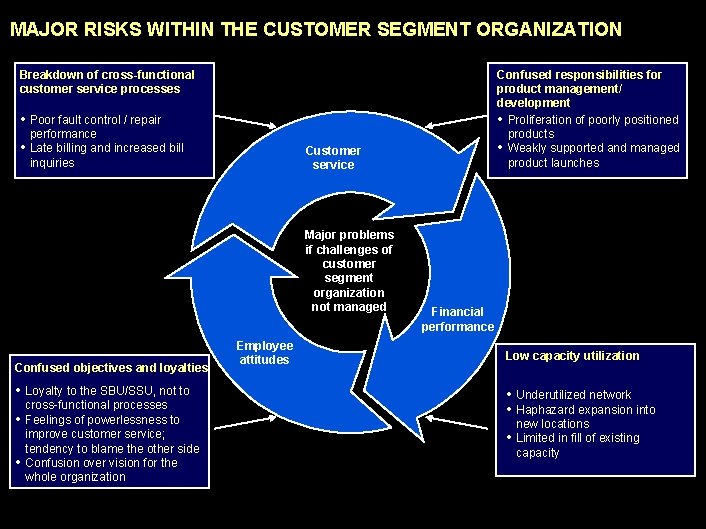
990617 BKZXW 380 WWGZ MAJOR RISKS WITHIN THE CUSTOMER SEGMENT ORGANIZATION Breakdown of cross-functional customer service processes Confused responsibilities for product management/ development • Proliferation of poorly positioned products • Weakly supported and managed product launches • Poor fault control / repair • performance Late billing and increased bill inquiries Customer service Major problems if challenges of customer segment organization not managed Confused objectives and loyalties • Loyalty to the SBU/SSU, not to • • cross-functional processes Feelings of powerlessness to improve customer service; tendency to blame the other side Confusion over vision for the whole organization Employee attitudes Financial performance Low capacity utilization • Underutilized network • Haphazard expansion into new locations • Limited in fill of existing capacity 102
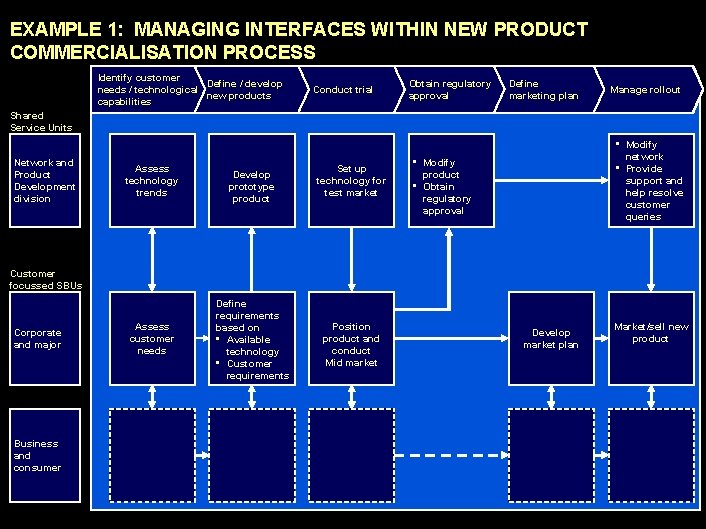
990617 BKZXW 380 WWGZ EXAMPLE 1: MANAGING INTERFACES WITHIN NEW PRODUCT COMMERCIALISATION PROCESS Identify customer Define / develop needs / technological new products capabilities Conduct trial Obtain regulatory approval Define marketing plan Manage rollout Shared Service Units • Network and Product Development division Assess technology trends Develop prototype product Set up technology for test market • • Modify product Obtain regulatory approval • Modify network Provide support and help resolve customer queries Customer focussed SBUs Corporate and major Assess customer needs Define requirements based on • Available technology • Customer requirements Position product and conduct Mid market Develop market plan Market/sell new product Business and consumer 103
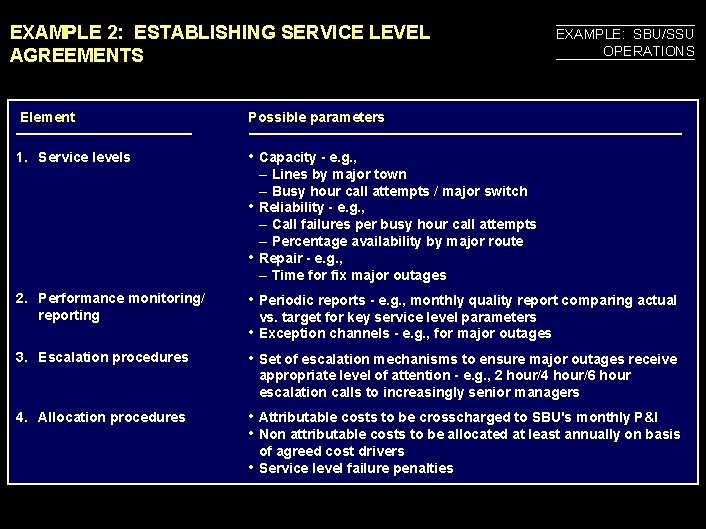
990617 BKZXW 380 WWGZ EXAMPLE 2: ESTABLISHING SERVICE LEVEL AGREEMENTS Element Possible parameters 1. Service levels • Capacity - e. g. , EXAMPLE: SBU/SSU OPERATIONS – Lines by major town – Busy hour call attempts / major switch • Reliability - e. g. , – Call failures per busy hour call attempts – Percentage availability by major route • Repair - e. g. , – Time for fix major outages 2. Performance monitoring/ reporting • Periodic reports - e. g. , monthly quality report comparing actual 3. Escalation procedures • Set of escalation mechanisms to ensure major outages receive vs. target for key service level parameters • Exception channels - e. g. , for major outages appropriate level of attention - e. g. , 2 hour/4 hour/6 hour escalation calls to increasingly senior managers 4. Allocation procedures • Attributable costs to be crosscharged to SBU's monthly P&l • Non attributable costs to be allocated at least annually on basis of agreed cost drivers • Service level failure penalties 104
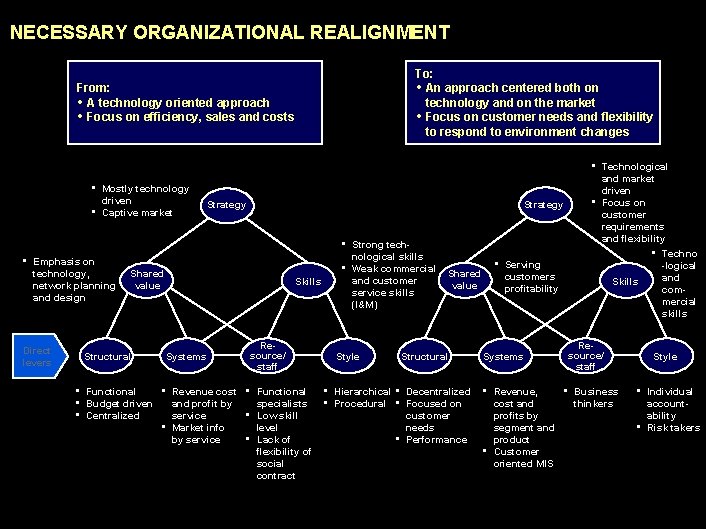
990617 BKZXW 380 WWGZ NECESSARY ORGANIZATIONAL REALIGNMENT To: • An approach centered both on technology and on the market • Focus on customer needs and flexibility to respond to environment changes From: • A technology oriented approach • Focus on efficiency, sales and costs • • • Mostly technology driven Captive market Strategy • • Emphasis on technology, network planning and design Direct levers • • Shared value Structural Functional Budget driven Centralized Skills Systems • • Revenue cost and profit by service Market info by service • Strategy Resource/ staff • • • Functional specialists Low skill level Lack of flexibility of social contract Strong technological skills Weak commercial and customer service skills (I&M) Style • • Hierarchical Procedural Shared value Structural • • Decentralized Focused on customer needs Performance • • Serving customers profitability Systems • Technological and market driven Focus on customer requirements and flexibility Revenue, cost and profits by segment and product Customer oriented MIS Skills Resource/ staff • Business thinkers Techno -logical and commercial skills Style • • Individual accountability Risk takers 105
990617 BKZXW 380 WWGZ KEY MESSAGES • Organizational choice is important, but only one element of a transformation program • Most telcos have created a customer-facing organization. To do so, they build strong and autonomous customer divisions, regrouped the network, and created shared services • In addition, several telcos started to disaggregate and form webs and alliances. They attempt to excel at each activity and build new competencies that are critical for future growth 106
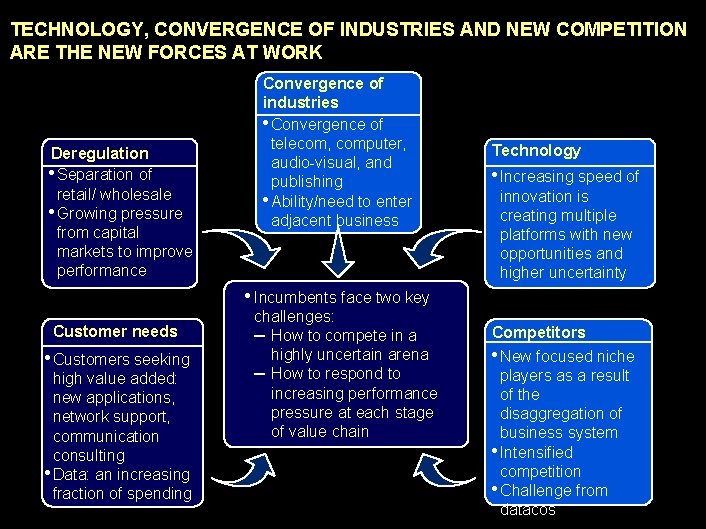
990617 BKZXW 380 WWGZ TECHNOLOGY, CONVERGENCE OF INDUSTRIES AND NEW COMPETITION ARE THE NEW FORCES AT WORK Deregulation • Separation of retail/ wholesale • Growing pressure from capital markets to improve performance Convergence of industries • Convergence of telecom, computer, audio-visual, and publishing • Ability/need to enter adjacent business Technology • Increasing speed of innovation is creating multiple platforms with new opportunities and higher uncertainty • Incumbents face two key Customer needs • Customers seeking high value added: new applications, network support, communication consulting • Data: an increasing fraction of spending challenges: – How to compete in a highly uncertain arena – How to respond to increasing performance pressure at each stage of value chain Competitors • New focused niche players as a result of the disaggregation of business system • Intensified competition • Challenge from datacos 107
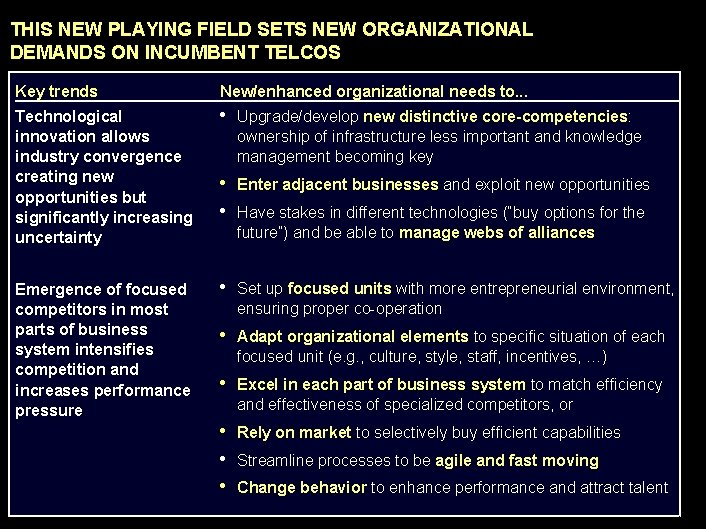
990617 BKZXW 380 WWGZ THIS NEW PLAYING FIELD SETS NEW ORGANIZATIONAL DEMANDS ON INCUMBENT TELCOS Key trends New/enhanced organizational needs to. . . Technological innovation allows industry convergence creating new opportunities but significantly increasing uncertainty • Upgrade/develop new distinctive core-competencies: Emergence of focused competitors in most parts of business system intensifies competition and increases performance pressure • Set up focused units with more entrepreneurial environment, ownership of infrastructure less important and knowledge management becoming key • Enter adjacent businesses and exploit new opportunities • Have stakes in different technologies (“buy options for the future”) and be able to manage webs of alliances ensuring proper co-operation • Adapt organizational elements to specific situation of each focused unit (e. g. , culture, style, staff, incentives, …) • Excel in each part of business system to match efficiency and effectiveness of specialized competitors, or • Rely on market to selectively buy efficient capabilities • Streamline processes to be agile and fast moving • Change behavior to enhance performance and attract talent 108
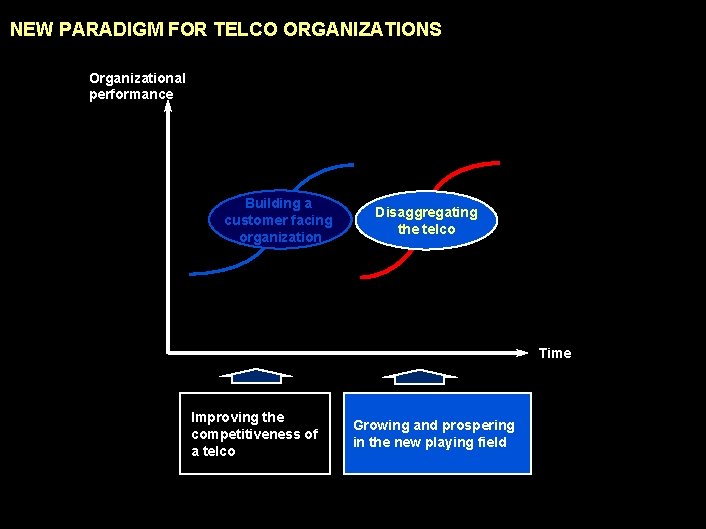
990617 BKZXW 380 WWGZ NEW PARADIGM FOR TELCO ORGANIZATIONS Organizational performance Building a customer facing organization Disaggregating the telco Time Improving the competitiveness of a telco Growing and prospering in the new playing field 109
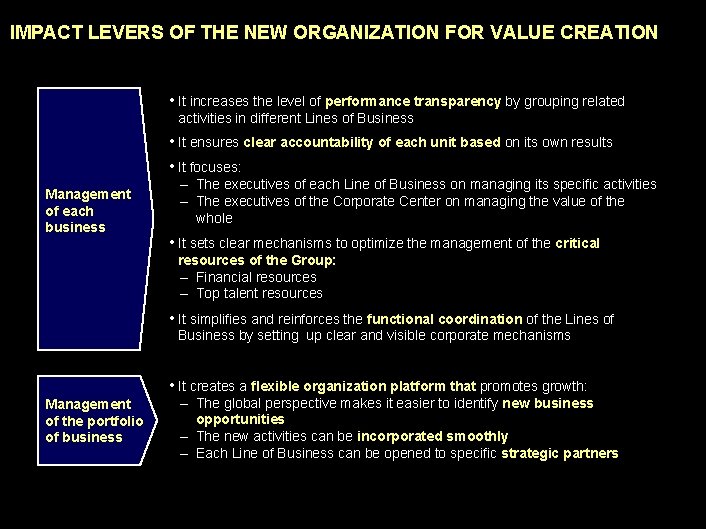
990617 BKZXW 380 WWGZ IMPACT LEVERS OF THE NEW ORGANIZATION FOR VALUE CREATION • It increases the level of performance transparency by grouping related activities in different Lines of Business • It ensures clear accountability of each unit based on its own results • It focuses: Management of each business – The executives of each Line of Business on managing its specific activities – The executives of the Corporate Center on managing the value of the whole • It sets clear mechanisms to optimize the management of the critical resources of the Group: – Financial resources – Top talent resources • It simplifies and reinforces the functional coordination of the Lines of Business by setting up clear and visible corporate mechanisms • It creates a flexible organization platform that promotes growth: Management of the portfolio of business – The global perspective makes it easier to identify new business opportunities – The new activities can be incorporated smoothly – Each Line of Business can be opened to specific strategic partners 110
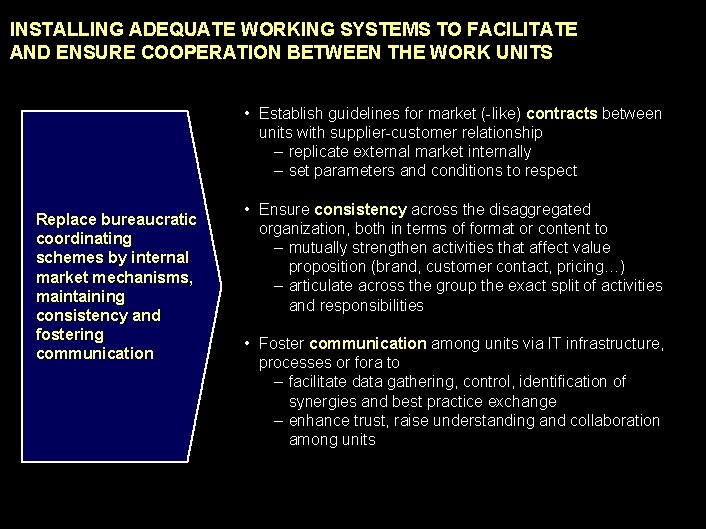
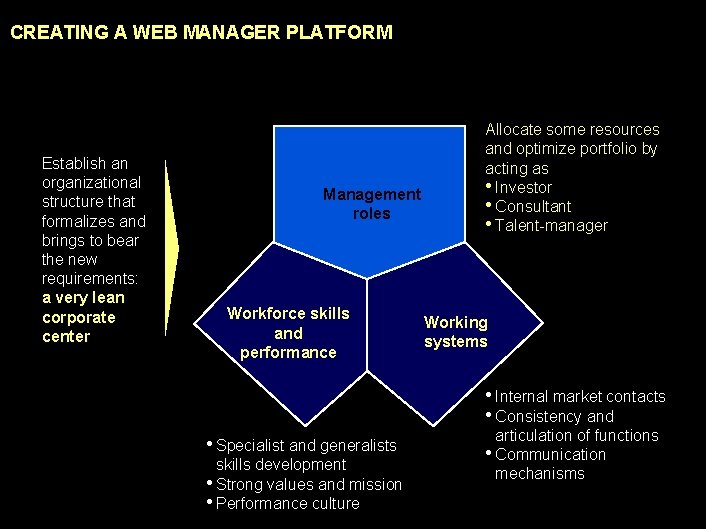
990617 BKZXW 380 WWGZ INSTALLING ADEQUATE WORKING SYSTEMS TO FACILITATE AND ENSURE COOPERATION BETWEEN THE WORK UNITS • Establish guidelines for market (-like) contracts between units with supplier-customer relationship – replicate external market internally – set parameters and conditions to respect Replace bureaucratic coordinating schemes by internal market mechanisms, maintaining consistency and fostering communication *Nota Fuente: Fuente • Ensure consistency across the disaggregated organization, both in terms of format or content to – mutually strengthen activities that affect value proposition (brand, customer contact, pricing…) – articulate across the group the exact split of activities and responsibilities • Foster communication among units via IT infrastructure, processes or fora to – facilitate data gathering, control, identification of synergies and best practice exchange – enhance trust, raise understanding and collaboration among units 111
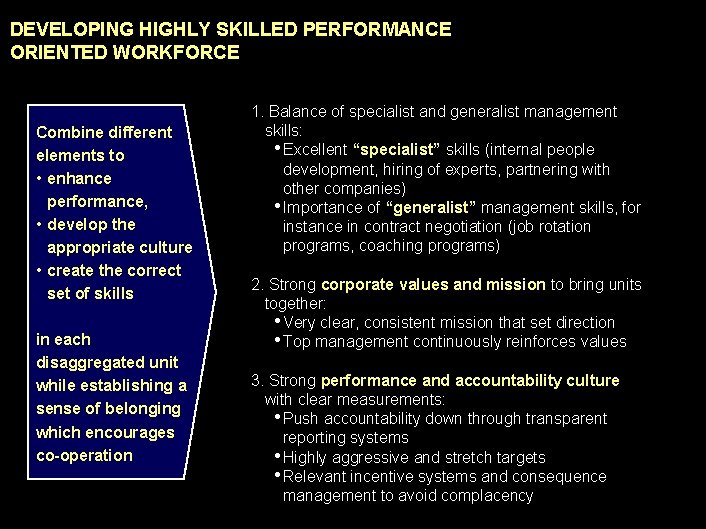
990617 BKZXW 380 WWGZ DEVELOPING HIGHLY SKILLED PERFORMANCE ORIENTED WORKFORCE Combine different elements to • enhance performance, • develop the appropriate culture • create the correct set of skills in each disaggregated unit while establishing a sense of belonging which encourages co-operation 1. Balance of specialist and generalist management skills: • Excellent “specialist” skills (internal people development, hiring of experts, partnering with other companies) • Importance of “generalist” management skills, for instance in contract negotiation (job rotation programs, coaching programs) 2. Strong corporate values and mission to bring units together: • Very clear, consistent mission that set direction • Top management continuously reinforces values 3. Strong performance and accountability culture with clear measurements: • Push accountability down through transparent reporting systems • Highly aggressive and stretch targets • Relevant incentive systems and consequence management to avoid complacency 112
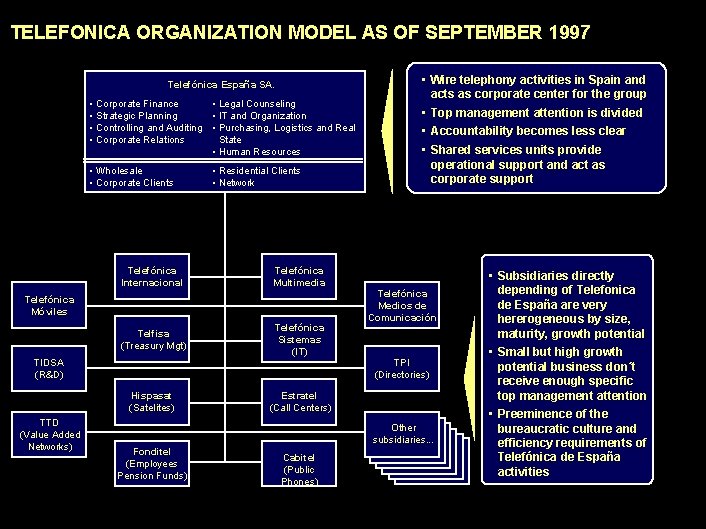
990617 BKZXW 380 WWGZ TELEFONICA ORGANIZATION MODEL AS OF SEPTEMBER 1997 Telefónica España SA. • • Corporate Finance • Legal Counseling Strategic Planning • IT and Organization Controlling and Auditing • Purchasing, Logistics and Real Corporate Relations State • Human Resources • Wholesale • Corporate Clients • Residential Clients • Network Telefónica Internacional Telefónica Multimedia Telfisa (Treasury Mgt) Telefónica Sistemas (IT) Telefónica Móviles TIDSA (R&D) Telefónica Medios de Comunicación TPI (Directories) Hispasat (Satelites) TTD (Value Added Networks) • Wire telephony activities in Spain and acts as corporate center for the group • Top management attention is divided • Accountability becomes less clear • Shared services units provide operational support and act as corporate support Estratel (Call Centers) Other subsidiaries. . . Fonditel (Employees Pension Funds) Cabitel (Public Phones) • Subsidiaries directly depending of Telefonica de España are very hererogeneous by size, maturity, growth potential • Small but high growth potential business don´t receive enough specific top management attention • Preeminence of the bureaucratic culture and efficiency requirements of Telefónica de España activities 113
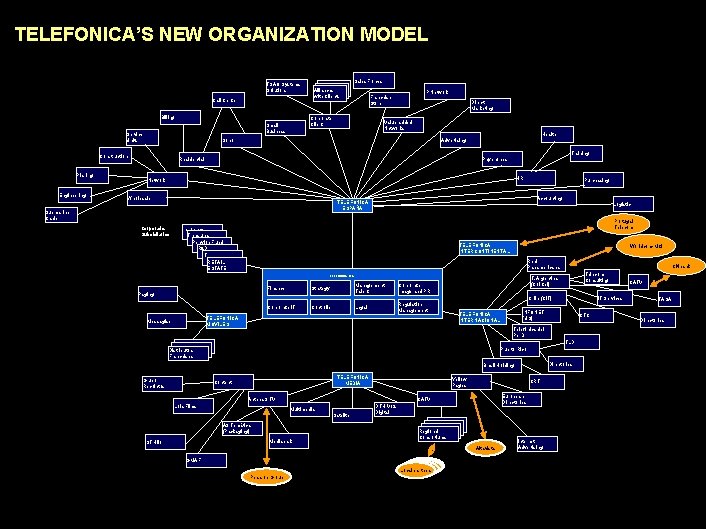
990617 BKZXW 380 WWGZ TELEFONICA’S NEW ORGANIZATION MODEL TSAO Systems Solutions Call Center Billing Engineering Direct Marketing Value added Networks Health Advertising Soho Construction Planing IP Network Franchise Store Corporate Client Small Business Service Units Sales Forces Alliances with Clients Training Payphones Residential HR Network Wholesale Accounting TELEFONICA ESPAÑA Submarine Cable Corporate Subsidiaries Purchasing Logistic Portugal Telecom Insurance Treasures Penvion Fund R&D IT RETAIL ESTATE TELEFONICA INTERCONTINENTAL Worldcom-MCI Red Panamericana TELEFONICA, S. A. Finance Strategy Management Talent Corporate Image and PR Corporate IT Controller Legal Regulation Management Paging Citibank Telecom Consulting T. Argentina (Cointel) Chile (CIT) TELEFONICA MOVILES Messagise IT Services INFONET (US) TELEFONICA INTERNACIONAL CTC CATV TASA Directories Telefónica del Perú TLD Puerto Rico Distributors Franchises Directories Brasil Holding Grupo Recoletos TELEFONICA MEDIA Content Yellow Pages Antena 3 TV Lola Films European Directories CATV Multimedia Satelite A 3 Temática (Packaging) Mediapark ST Hilo CRT DTH V 12 Digital Regional Consortiums Altavista Internet Advertising GMAF Local partners Pearson Group 114
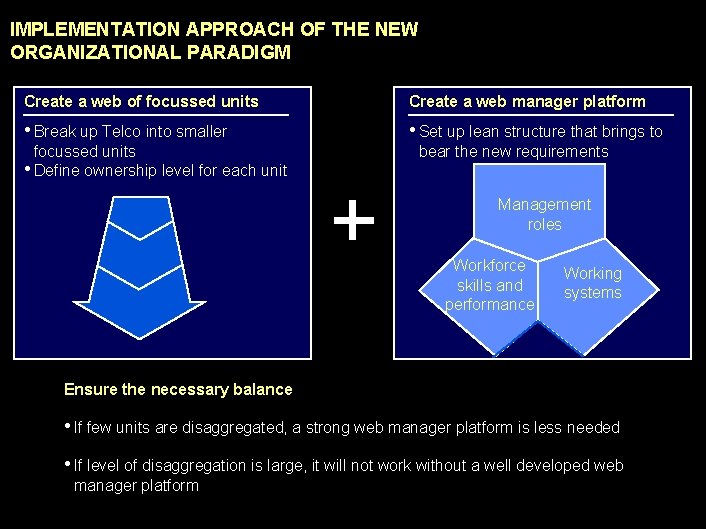
990617 BKZXW 380 WWGZ IMPLEMENTATION APPROACH OF THE NEW ORGANIZATIONAL PARADIGM Create a web of focussed units Create a web manager platform • Break up Telco into smaller • Set up lean structure that brings to focussed units • Define ownership level for each unit bear the new requirements Management roles Workforce skills and performance Working systems Ensure the necessary balance • If few units are disaggregated, a strong web manager platform is less needed • If level of disaggregation is large, it will not work without a well developed web manager platform 115
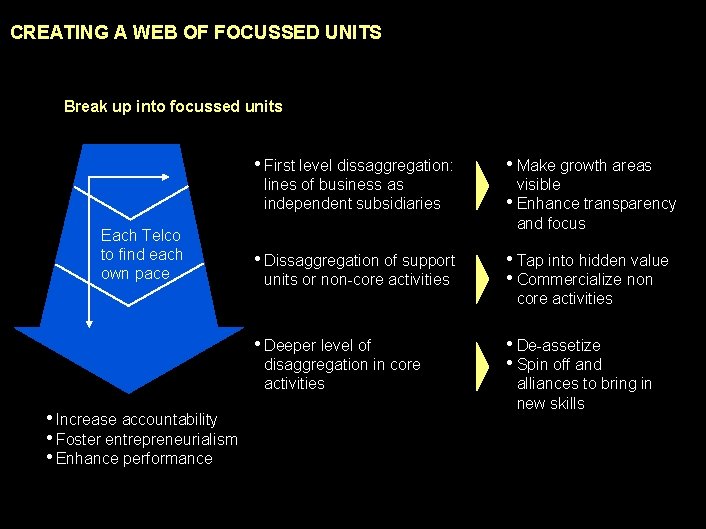
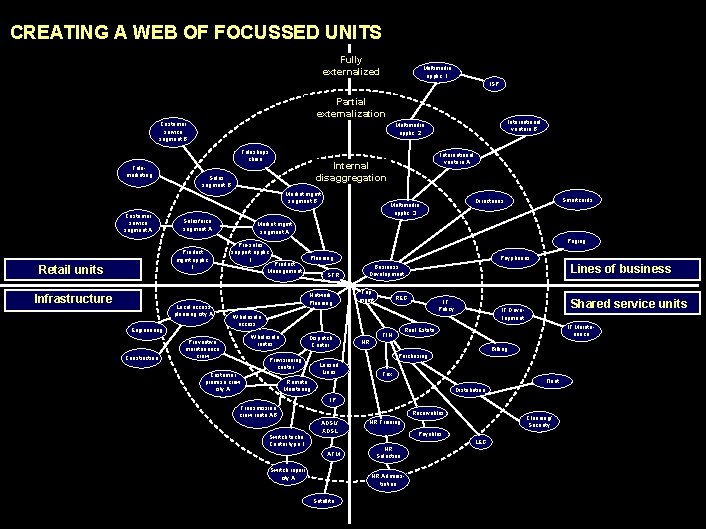
990617 BKZXW 380 WWGZ CREATING A WEB OF FOCUSSED UNITS Break up into focussed units • First level dissaggregation: Each Telco to find each own pace • Make growth areas lines of business as independent subsidiaries visible • Enhance transparency and focus • Dissaggregation of support • Tap into hidden value • Commercialize non units or non-core activities • Deeper level of disaggregation in core activities • Increase accountability • Foster entrepreneurialism • Enhance performance • De-assetize • Spin off and alliances to bring in new skills 116
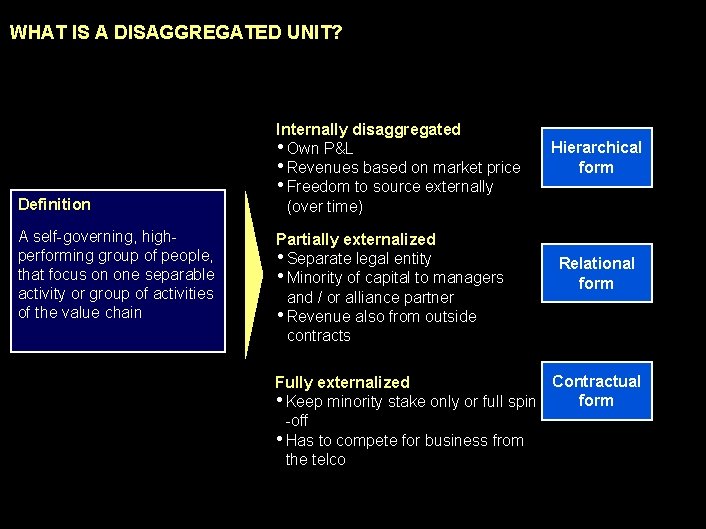
990617 BKZXW 380 WWGZ WHAT IS A DISAGGREGATED UNIT? Definition A self-governing, highperforming group of people, that focus on one separable activity or group of activities of the value chain Internally disaggregated • Own P&L • Revenues based on market price • Freedom to source externally (over time) Partially externalized • Separate legal entity • Minority of capital to managers and / or alliance partner • Revenue also from outside contracts Hierarchical form Relational form Contractual Fully externalized form • Keep minority stake only or full spin -off • Has to compete for business from the telco 117
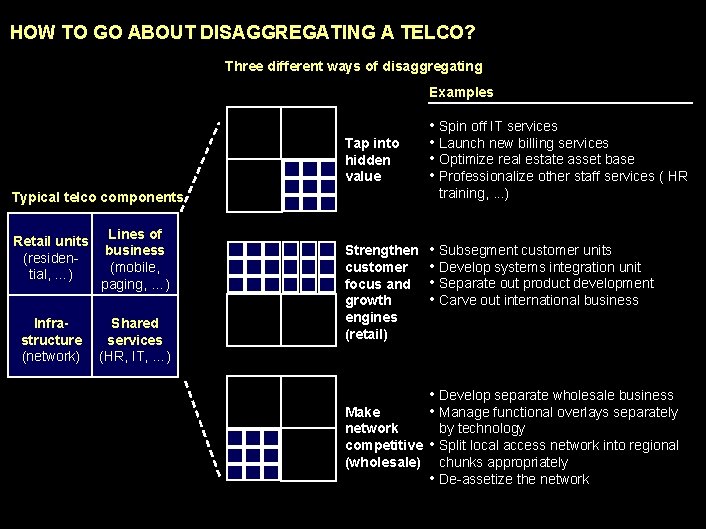
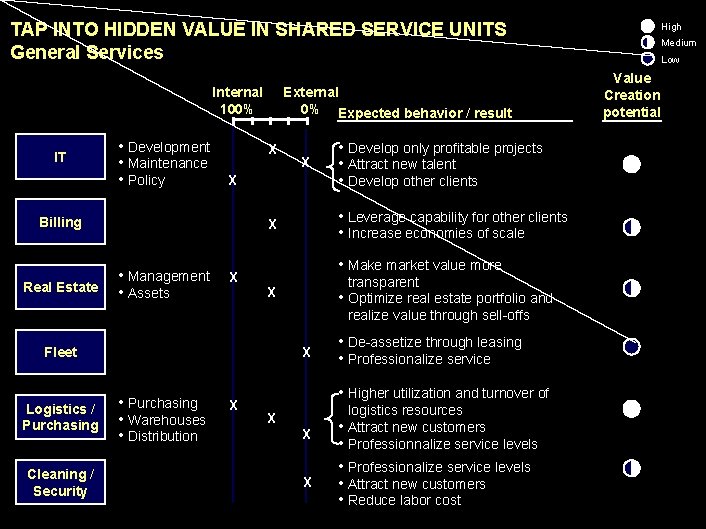
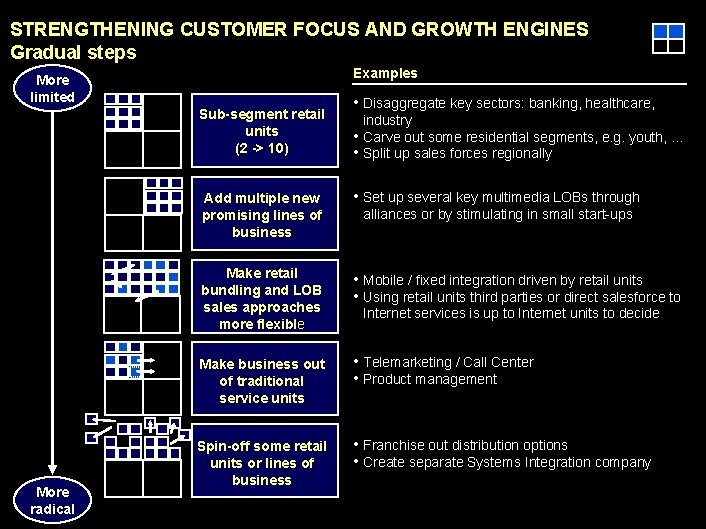
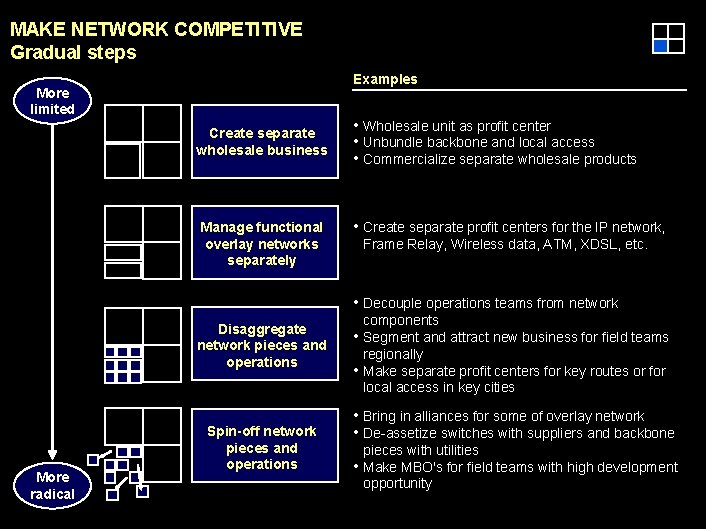
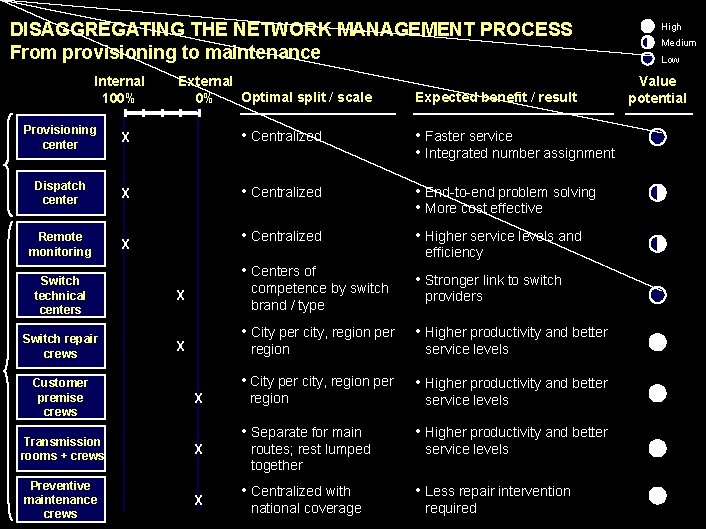
990617 BKZXW 380 WWGZ HOW TO GO ABOUT DISAGGREGATING A TELCO? Three different ways of disaggregating Examples Tap into hidden value training, . . . ) Typical telco components Retail units (residential, …) Lines of business (mobile, paging, …) Infrastructure (network) Shared services (HR, IT, …) • Spin off IT services • Launch new billing services • Optimize real estate asset base • Professionalize other staff services ( HR Strengthen customer focus and growth engines (retail) Make network competitive (wholesale) • Subsegment customer units • Develop systems integration unit • Separate out product development • Carve out international business • Develop separate wholesale business • Manage functional overlays separately by technology • Split local access network into regional chunks appropriately • De-assetize the network 118
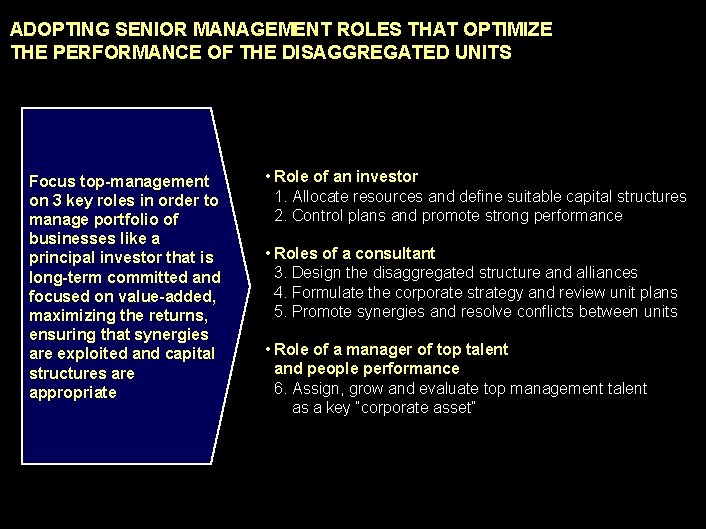
990617 BKZXW 380 WWGZ CREATING A WEB MANAGER PLATFORM Establish an organizational structure that formalizes and brings to bear the new requirements: a very lean corporate center Management roles Workforce skills and performance Allocate some resources and optimize portfolio by acting as • Investor • Consultant • Talent-manager Working systems • Internal market contacts • Consistency and • Specialist and generalists skills development • Strong values and mission • Performance culture articulation of functions • Communication mechanisms 119
990617 BKZXW 380 WWGZ Back-up 120
BREAKING UP INTO SMALLER FOCUSSED UNITS British Airways disaggregated organization chart Criteria for categorization Network Manager (“thinkers”) • Activities key to • Capitalize on British Airways Plc. British Airways (planes, crew, customer service agents) Capacity Providers ("doers") British Airways World Cargo Alliances international carriers Alliance equity in 2 nd. airlines • Qantas • TAT • Canada • Air. Liberté • AA • Deutsche Service Providers (“supporters”) Gate Gourmet (Swissair) Handling division* GE (engine maintenance) IT division* *To be checked Value drivers Franchises • Sun-Air • Cityflyer • Conair competitive intangible advantage assets and • Essential for client identifying franchise network • Develop opportunities or relationship avoiding skills destructive • Provide best competition service at • Customer facing competitive and delivering direct costs the brand • Break labor promise agreements • Not key to • Achieve competitive advantage • Can be sold or outsourced economies of scale or subcontract • Manage activity specific cost drivers 121
SHELL OIL DISAGGREGATES AROUND KNOWLEDGE 990617 BKZXW 380 WWGZ • Continued to own assets where there is a knowledge advantage • Entered more alliances than any other major oil player – e. g. , Altura deal with Amoco Shell Oil USA • Spun out Deer Park refinery into JV with Pemex • Created 4 operating companies (e. g. , oil) and 4 professional firms (e. g. , legal), each with multiple units “The secret to success is to be able to create new structures and forms that have a smallness about them – that have entrepreneurial spirit” Philip Carroll, CEO 122
990617 BKZXW 380 WWGZ MICROSOFT CREATES A BROAD EXTERNAL WEB Corporations Individuals Products L. Maltin R. Ebert S. Benson Paramount Television Group MCI AOL Compu Serve Spielberg Geffen Katzenberg Dream. Works SKG Joint Venture Black Entertainment TV R/GA Digital Studios Scholastic Inc Dream. Works Interactive Bill Gates Teledesic NBC UUnet Technologies Linda Ellerbee Cinemania Encarta on the Record MICROSOFT Gauthier & Gilden MSNBC Cable Car. Source Ansel Adams Trust Corbis Corp. Bruce Artwick Organization MSNBC Online Intelliquest Corp Local partners Cityscape Microsoft Network WWW magazine Music Central A. R. Smith J. Blinn V-Chat TCI Michael Kinsley 123
990617 BKZXW 380 WWGZ PARTIAL CARVE OUT PERFORMANCE 3 -year compounded annual shareholder return after IPO % 36. 7 31. 1 20. 3 10. 7 Russell 200 Index All carve outs Repeated carve-out parent companies Carve-out companies from repeated carveout parents 124
990617 BKZXW 380 WWGZ CREATING A WEB OF FOCUSSED UNITS Fully externalized Multimedia applic. 1 ISP Partial externalization Customer service segment B Teleshops chain Telemarketing Sales segment B Salesforce segment A Product mgmt applic. 1 Retail units Infrastructure Local access planning city A Engineering Construction International venture A Internal disaggregation Market mgmt segment B Customer service segment A International venture B Multimedia applic. 2 Smartcards Directories Multimedia applic. 3 Market mgmt segment A Paging Pre-sales support applic. 1 Product Management Planning STR Network Planning Payphones Top mgmt REG Wholesale access Wholesale routes Preventive maintenance crew Dispatch Center Provisioning center Customer premise crew city A Lines of business Business Development IT Policy IT Maintenance Real Estate FIN HR Billing Purchasing Leased Lines Shared service units IT Development Tax Fleet Remote Monitoring Distribution IP Transmission crew route AB Switch techn. Center type 1 Receivables ADSL/ XDSL Cleaning/ Security HR Training Payables LEG ATM Switch repair city A HR Selection HR Administration Satellite 125
990617 BKZXW 380 WWGZ TAP INTO HIDDEN VALUE IN SHARED SERVICE UNITS General Services Internal 100% IT • Development • Maintenance • Policy X • Management • Assets X Cleaning / Security X Low Value Creation potential • Develop only profitable projects • Attract new talent • Develop other clients • Make market value more transparent • Optimize real estate portfolio and realize value through sell-offs X X • Purchasing • Warehouses • Distribution Medium • Leverage capability for other clients • Increase economies of scale X Fleet Logistics / Purchasing X X Billing Real Estate External 0% Expected behavior / result High • De-assetize through leasing • Professionalize service • Higher utilization and turnover of X X X logistics resources • Attract new customers • Professionnalize service levels • Professionalize service levels • Attract new customers • Reduce labor cost 126
990617 BKZXW 380 WWGZ STRENGTHENING CUSTOMER FOCUS AND GROWTH ENGINES Gradual steps Examples More limited Sub-segment retail units (2 -> 10) More radical • Disaggregate key sectors: banking, healthcare, industry • Carve out some residential segments, e. g. youth, … • Split up sales forces regionally Add multiple new promising lines of business • Set up several key multimedia LOBs through Make retail bundling and LOB sales approaches more flexible • Mobile / fixed integration driven by retail units • Using retail units third parties or direct salesforce to Make business out of traditional service units • Telemarketing / Call Center • Product management Spin-off some retail units or lines of business • Franchise out distribution options • Create separate Systems Integration company alliances or by stimulating in small start-ups Internet services is up to Internet units to decide 127
990617 BKZXW 380 WWGZ MAKE NETWORK COMPETITIVE Gradual steps Examples More limited Create separate wholesale business Manage functional overlay networks separately • Wholesale unit as profit center • Unbundle backbone and local access • Commercialize separate wholesale products • Create separate profit centers for the IP network, Frame Relay, Wireless data, ATM, XDSL, etc. • Decouple operations teams from network Disaggregate network pieces and operations More radical Spin-off network pieces and operations components • Segment and attract new business for field teams regionally • Make separate profit centers for key routes or for local access in key cities • Bring in alliances for some of overlay network • De-assetize switches with suppliers and backbone pieces with utilities • Make MBO's for field teams with high development opportunity 128
990617 BKZXW 380 WWGZ DISAGGREGATING THE NETWORK MANAGEMENT PROCESS From provisioning to maintenance Internal 100% External Optimal split / scale 0% Expected benefit / result Provisioning center X • Centralized • Faster service • Integrated number assignment Dispatch center X • Centralized • End-to-end problem solving • More cost effective Remote monitoring X • Centralized • Higher service levels and Medium Low Value potential efficiency • Centers of Switch technical centers X Switch repair crews X Customer premise crews High competence by switch brand / type • City per city, region per region • City per city, region per X region • Separate for main Transmission rooms + crews X Preventive maintenance crews X routes; rest lumped together • Centralized with national coverage • Stronger link to switch providers • Higher productivity and better service levels • Less repair intervention required 129
990617 BKZXW 380 WWGZ ADOPTING SENIOR MANAGEMENT ROLES THAT OPTIMIZE THE PERFORMANCE OF THE DISAGGREGATED UNITS Focus top-management on 3 key roles in order to manage portfolio of businesses like a principal investor that is long-term committed and focused on value-added, maximizing the returns, ensuring that synergies are exploited and capital structures are appropriate *Nota Fuente: Fuente • Role of an investor 1. Allocate resources and define suitable capital structures 2. Control plans and promote strong performance • Roles of a consultant 3. Design the disaggregated structure and alliances 4. Formulate the corporate strategy and review unit plans 5. Promote synergies and resolve conflicts between units • Role of a manager of top talent and people performance 6. Assign, grow and evaluate top management talent as a key “corporate asset” 130
990617 BKZXW 380 WWGZ CONTENTS • Introduction to Mc. Kinsey Walter Wintersteller • Transformation case studies – Belgacom Scott Beardsley – Ameritech Gerhard Bette – CANTV Francis Deprez – TPSA Jacek Poswiata • Perspectives on telecom organizations Francis Deprez • Discussion: Challenges facing TOT All 131
990617 BKZXW 380 WWGZ TOT’S TRANSFORMATION PROGRAM Customer excellence project Demand analysis to define segment-specific strategies Customer-focused restructuring of sales & marketing Process redesign to improve service level Training to build customer-oriented skills Customer service information system Performance management system Strong financial performance project Elements of transformation program Accounting system Improved finance and accounting processes Best practice company change project Management quality and empowerment Rules, procedures and processes Organizational structure, job evaluation, staff redeployment Employee communications IT system, MIS, EIS Procurement and material management process redesign Culture and competence learning program Private sector culture & competence change project HR planning and processes HR IT systems *Including HR management, investment appraisal, scenario planning, treasury management, risk management, cash management, transfer pricing, activity based costing, etc. Source: Mc. Kinsey 132
ORGANIZATION CHART PROPOSED BY THE RE-ORGANIZATION Corporate core PROJECT WORKING GROUP • Office of the President • Corporate Core • • • President Support Access Provider Policy & Planning (Finance/Accounting/ Marketing/Human Resource Management) Legal Internal Audit Business Development/JV International business Public Relations & Coordination Service Provider Info Technology Provider HR Support • Fin. & Acct. • Personnel • Procurement Marketing & Customer Service Real Estate Support • Fin. & Acct. • Personnel • Procurement Marketing & Customer Service Access Provider Main network Support • Fin. /Acct. • HR • Procurement Prod. /Serv. development Mkt. & Cust. Service Maintenance Customer consulting R&D Support • Fin. & Acct. • Personnel • Procurement Marketing & Customer Service Construc-tion & installation Support • Fin. & Acct. • Personnel • Procurement Marketing & Customer Service Support • Fin. /Acct. • HR • Procurement Prod. /Serv. development Mkt. & Cust. Service Maintenance Fixed line (area 1 -n) area Support • Fin. /Acct. • HR • Procurement Prod. /Serv. development Mkt. & Cust. Service Maintenance Mobile Fixed line (area 1 -n) area Support • Fin. /Acct. • HR • Procurement Prod. /Serv. development Mkt. & Cust. Service Maintenance Leased line/ circuit ISDN Support • Fin. /Acct. • HR • Procurement Prod. /Serv. development Mkt. & Cust. Service Maintenance Support • Fin. & Acct. • Personnel • Procurement Marketing & Customer Service Information Technology Provider Service Provider Special network Telecommunications Engineering Value added Support • Fin. /Acct. • HR • Procurement Prod. /Serv. development Mkt. & Cust. Service Maintenance Other services Support • Fin. /Acct. • HR • Procurement Prod. /Serv. development Mkt. & Cust. Service Maintenance Computer application Support • Fin. /Acct. • HR • Procurement Prod. /Serv. development Mkt. & Cust. Service Maintenance Multimedia Support • Fin. /Acct. • HR • Procurement Prod. /Serv. development Mkt. & Cust. Service Maintenance Internet Support • Fin. /Acct. • HR • Procurement Prod. /Serv. development Mkt. & Cust. Service Maintenance Marketing & customer service Support • Fin. /Acct. • HR • Procurement Prod. /Serv. development Mkt. & Cust. Service Maintenance 133