
Agriculture in Thailand Agriculture Sector contributes 8 6

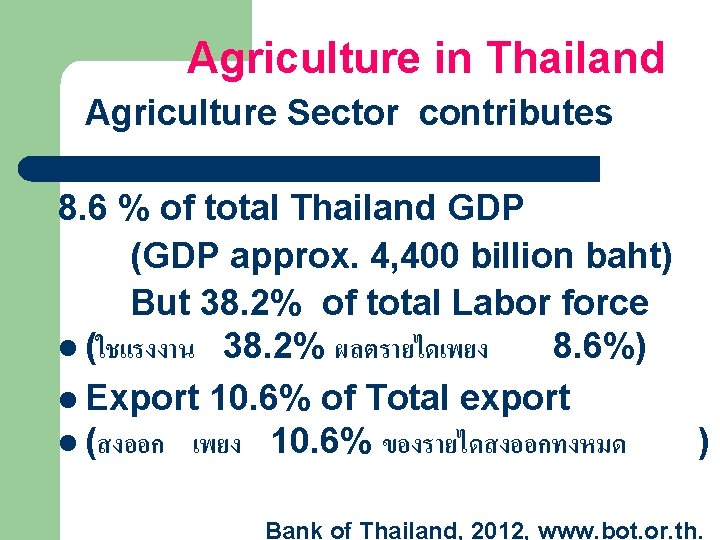
Agriculture in Thailand Agriculture Sector contributes 8. 6 % of total Thailand GDP (GDP approx. 4, 400 billion baht) But 38. 2% of total Labor force l (ใชแรงงาน 38. 2% ผลตรายไดเพยง 8. 6%) l Export 10. 6% of Total export l (สงออก เพยง 10. 6% ของรายไดสงออกทงหมด ) Bank of Thailand, 2012, www. bot. or. th.
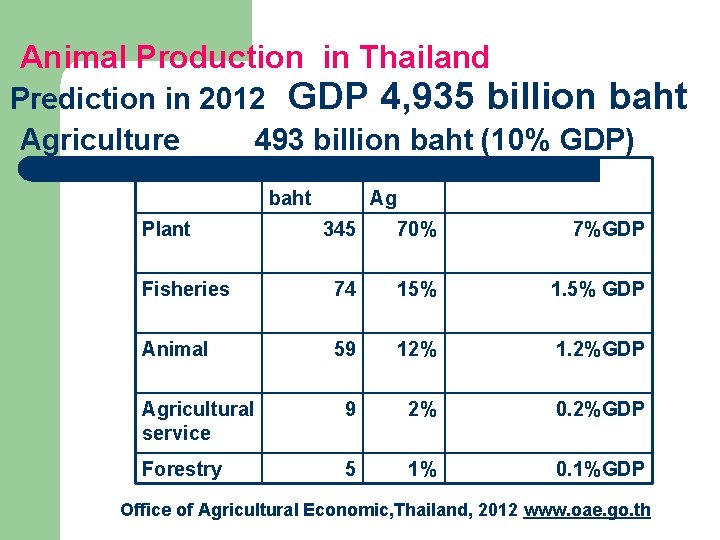
Animal Production in Thailand Prediction in 2012 GDP 4, 935 billion baht Agriculture 493 billion baht (10% GDP) Billion baht Plant % of Ag % of GDP 345 70% 7%GDP Fisheries 74 15% 1. 5% GDP Animal 59 12% 1. 2%GDP Agricultural service 9 2% 0. 2%GDP Forestry 5 1% 0. 1%GDP Office of Agricultural Economic, Thailand, 2012 www. oae. go. th
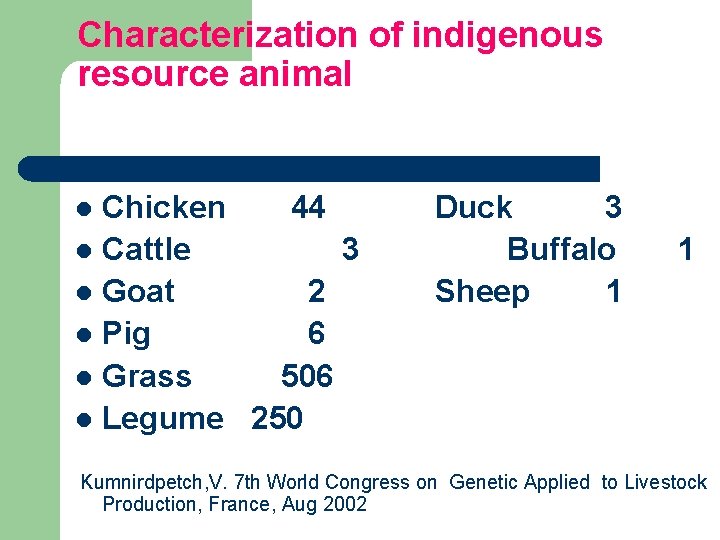
Characterization of indigenous resource animal Chicken 44 l Cattle 3 l Goat 2 l Pig 6 l Grass 506 l Legume 250 l Duck 3 Buffalo Sheep 1 1 Kumnirdpetch, V. 7 th World Congress on Genetic Applied to Livestock Production, France, Aug 2002
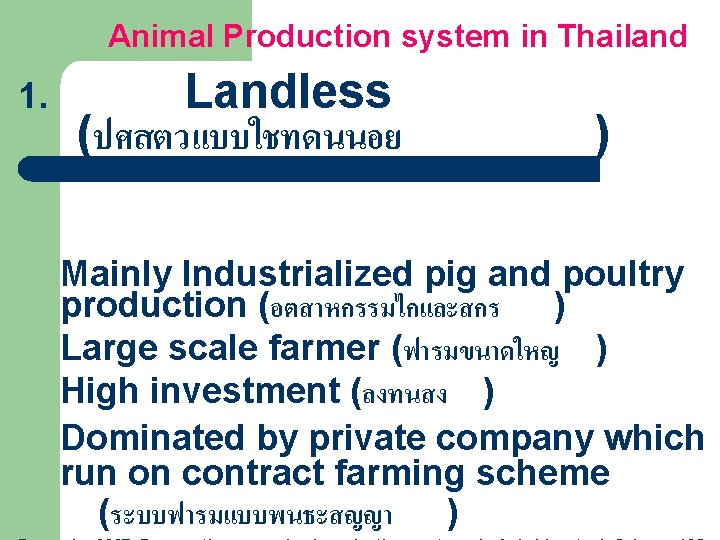
Animal Production system in Thailand 1. Landless (ปศสตวแบบใชทดนนอย ) Mainly Industrialized pig and poultry production (อตสาหกรรมไกและสกร ) Large scale farmer (ฟารมขนาดใหญ ) High investment (ลงทนสง ) Dominated by private company which run on contract farming scheme (ระบบฟารมแบบพนธะสญญา )
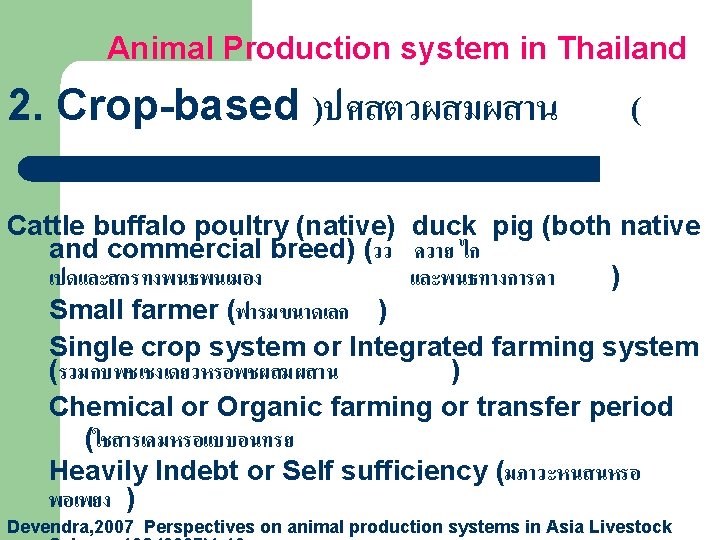
Animal Production system in Thailand 2. Crop-based )ปศสตวผสมผสาน ( Cattle buffalo poultry (native) duck pig (both native and commercial breed) (วว ควาย ไก เปดและสกรทงพนธพนเมอง และพนธทางการคา ) Small farmer (ฟารมขนาดเลก ) Single crop system or Integrated farming system (รวมกบพชเชงเดยวหรอพชผสมผสาน ) Chemical or Organic farming or transfer period (ใชสารเคมหรอแบบอนทรย Heavily Indebt or Self sufficiency (มภาวะหนสนหรอ พอเพยง ) Devendra, 2007 Perspectives on animal production systems in Asia Livestock
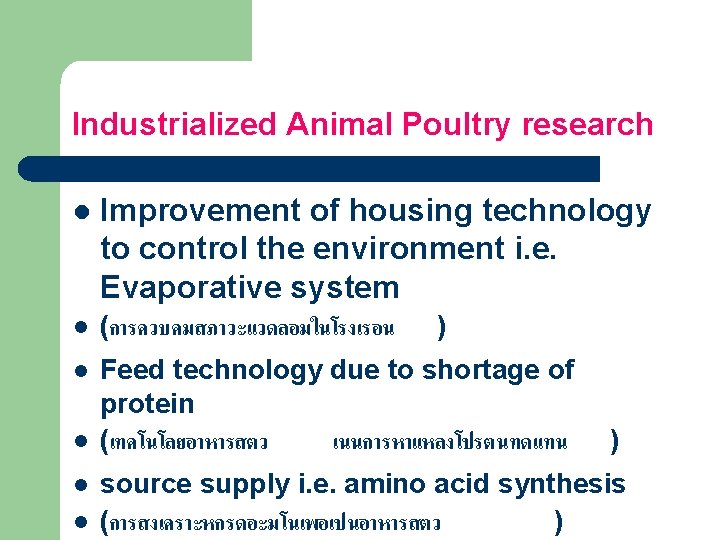
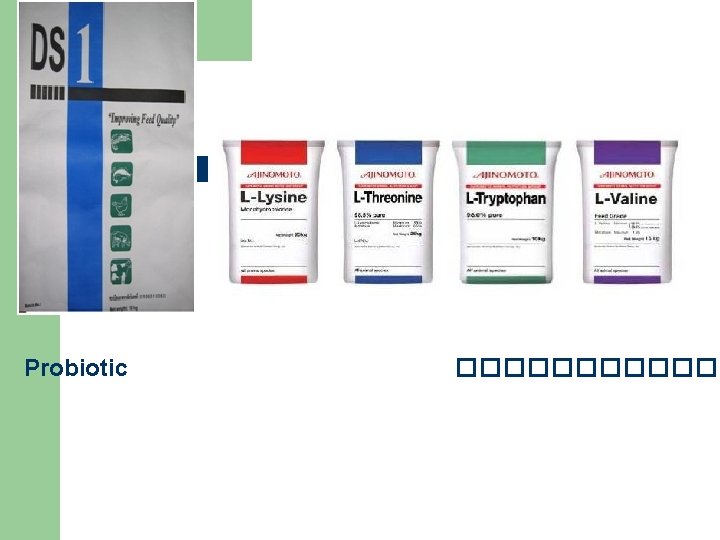
Industrialized Animal Poultry research l Improvement of housing technology to control the environment i. e. Evaporative system l (การควบคมสภาวะแวดลอมในโรงเรอน l Feed technology due to shortage of protein (เทคโนโลยอาหารสตว เนนการหาแหลงโปรตนทดแทน l l l ) ) source supply i. e. amino acid synthesis (การสงเคราะหกรดอะมโนเพอเปนอาหารสตว )
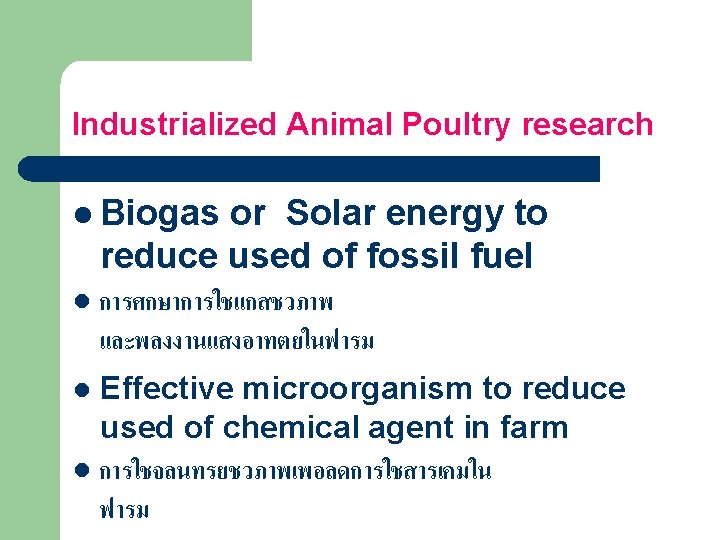
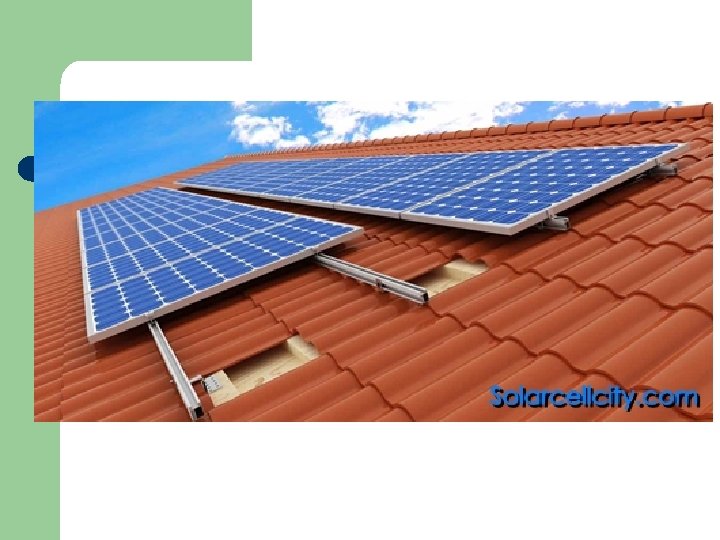
Industrialized Animal Poultry research l Biogas or Solar energy to reduce used of fossil fuel l การศกษาการใชแกสชวภาพ และพลงงานแสงอาทตยในฟารม Effective microorganism to reduce used of chemical agent in farm l การใชจลนทรยชวภาพเพอลดการใชสารเคมใน ฟารม l
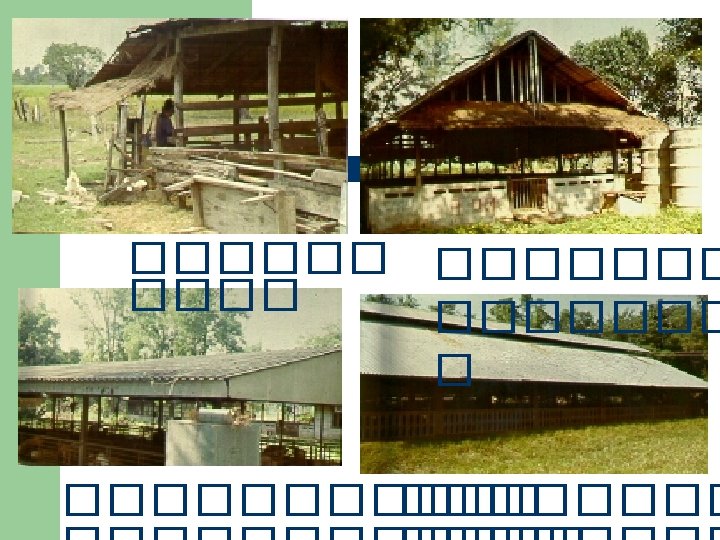
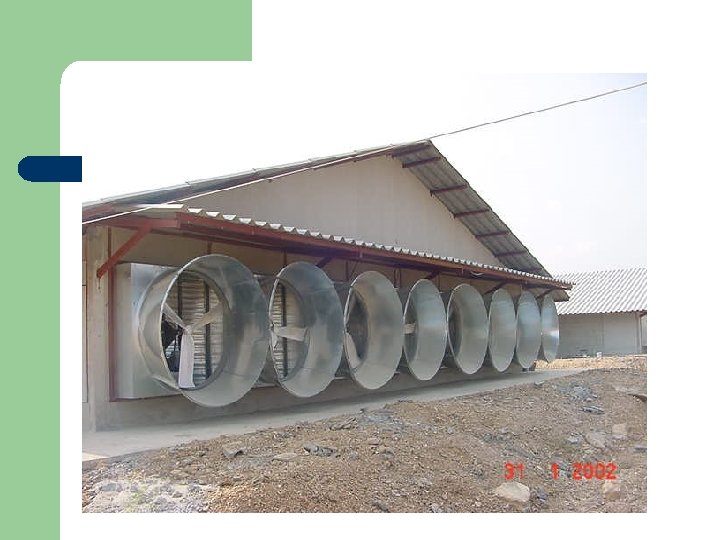
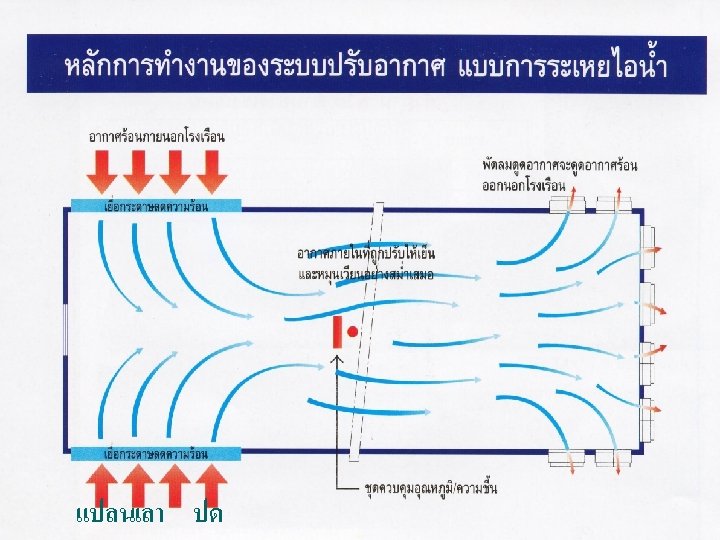
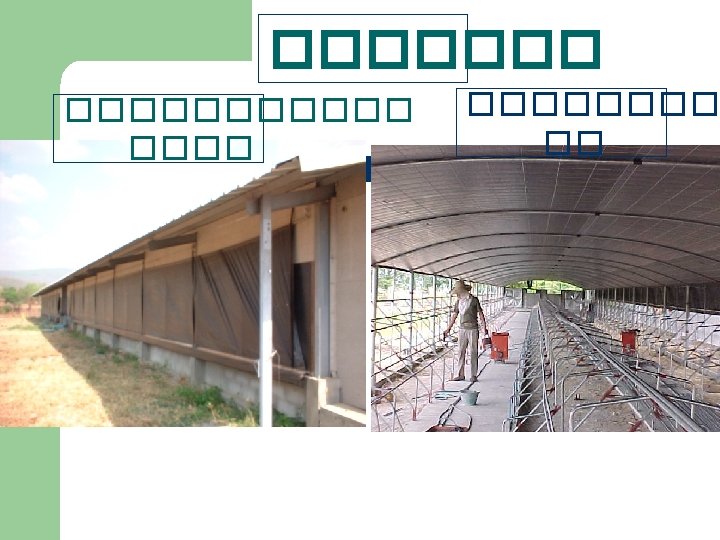
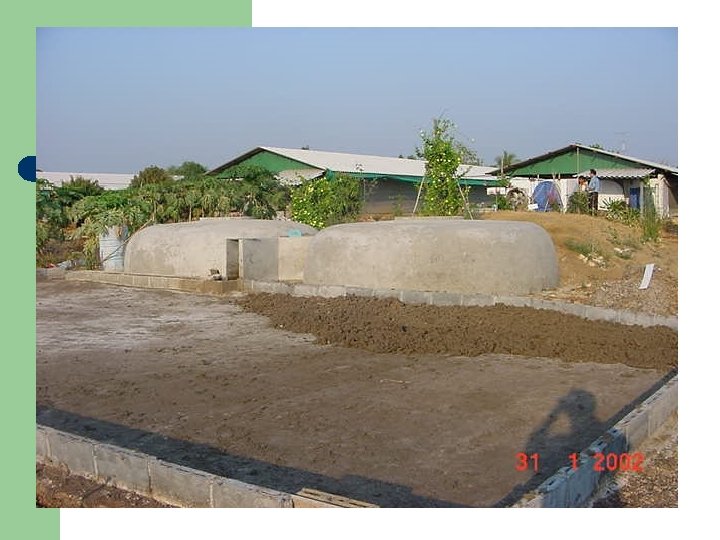
Research of animal production for small farmer l Straw based feeding for cattle ฟางหมกยเรยสำหรบวว l Crop residue for cattle, buffalo การใชพชอาหารสตว เศษเหลอเปนอาหารสตว
Research of animal production for small farmer l Zero Waste Discharge system for pig การเลยงหมหลม พนคอกเกบกกมล l Cross bred indigenous chicken การปรบปรงพนธไกพนเมอง
l. Some Animal Studies for Sustainable Development in Thailand
1. Study to reduce economic risk 1. 1. Integrated activity ฟารมผสมผสาน Integrated farming system showed self reliance and reduce economic risk l Crop Rice + Tree +Vegetable l Animal Ruminant: Buffalo and/or Cattle Non ruminant: Chicken duck and/or pig l Fish and frog l Community Forest Hutanuwat, N. , 2010
Sustainable agriculture farmer 96 % self support in rice consumption l 88% increase their rice production l 60% have enough fish vegetable for consumption and 78% reduce cost of food purchasing l 96% reduce consumption in meat (still need to buy from outside) l Hutanuwat, N. , 2010
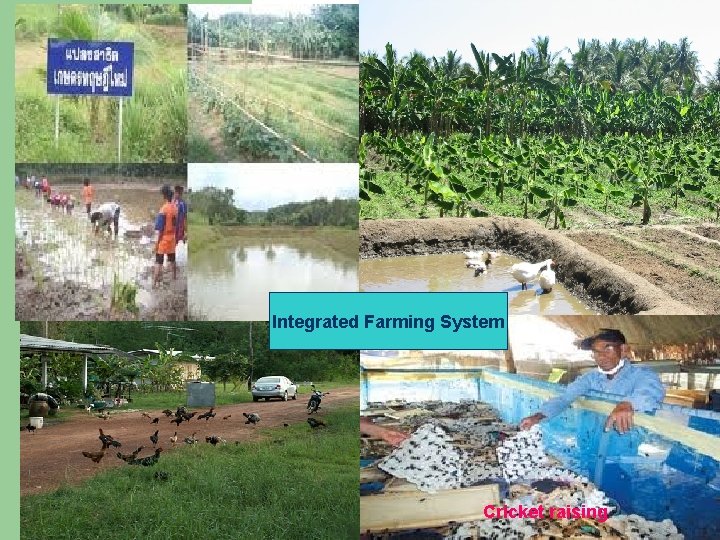
Integrated Farming System Integrated farming system Cricket raising
1. 2. Study of using Crop residue for animal feed l Rice Straw Utilization and treatments for Ruminant feeding ฟางหมกยเรย – – – Major crop residue in Thailand 1: 1 ratio of rice Yield 5% urea treat improve performance especially dry season with lack of pasture 2%urea + 2% calcium hydroxide (reduce cost of urea) Wanapat et al 1985 -2012
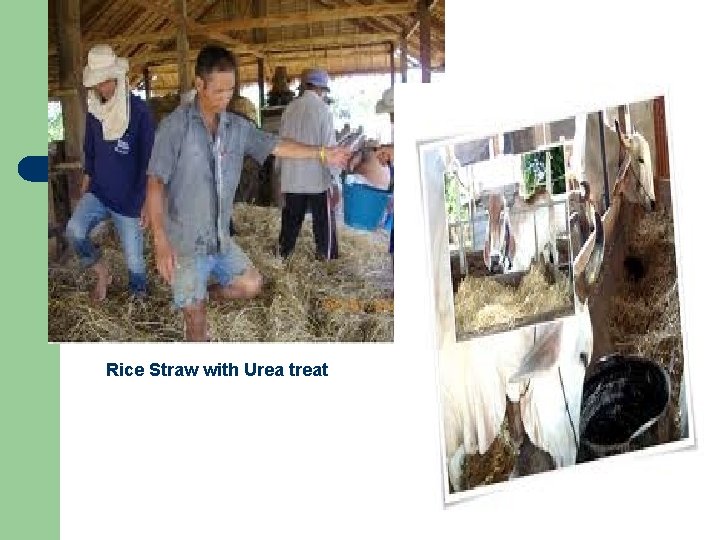
Rice Straw with Urea treat
2. Study to reduce pollution problem 2. 1. Biogas for industrialized farm (40, 000 pig) บอแกสชวภาพ less pollution and good for investment 1. B/C ratio (benefit/cost) 1. 48 (>1. 0) for non subsidized by the government 2. B/C ratio 2. 49 (>1. 0) for 45 % subsidized by the government Singthongchai, M.
2. 2. Biogas for small and medium pig farm Biogas for cooking Energy and Reducing Pollution – – Eight cubic meter cover with Polyvinyl Chloride (CMU-PVC) Replace 15 -30 kg of LPG which cost 600 B /month Before- 80% of the neighbor complain After- Their physical and mental conditions were remarkably improved Tangtaweewipat, S. , Songsri, O. , and Cheva-Isarakul, B. (2012).
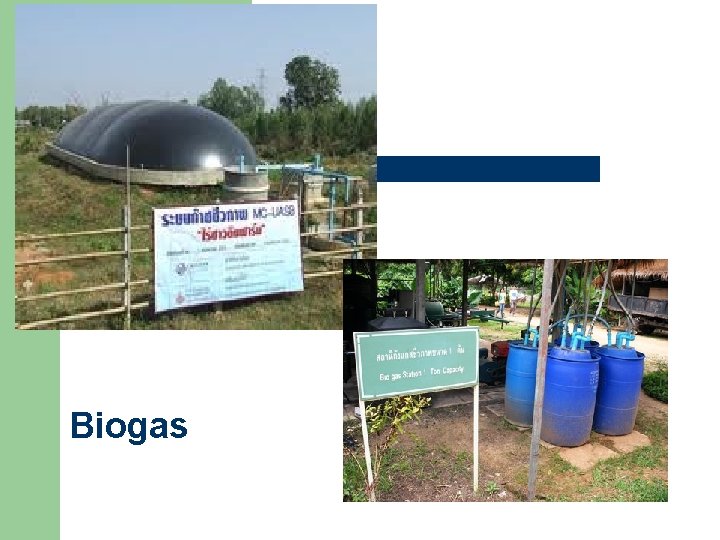
Biogas
2. 3. Zero wasted discharge for small pig farm Deep Pit Litter System/ Deep bedding system Deep Straw Hull and dry crop residue bedding (1 m. ) - Similar performance v. s. Conventional system Extra organic fertilizer (1 -1. 5 ton from 5 pigs) Less Smell, reduce conflict among community Suitable for both native and commercial breed Kanyamoon, R, 2011. ; Tatakul, W and Sanunnam, A. , 2010; NSTDA, 2012
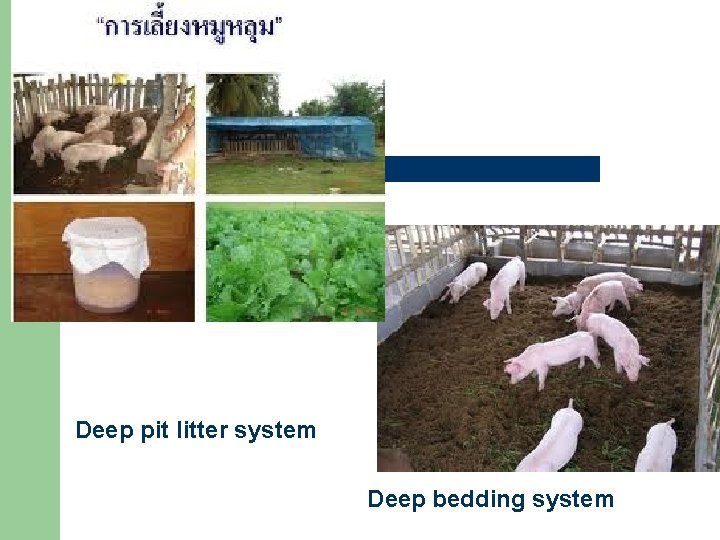
Deep pit litter system Deep bedding system
3. Study to reduce using of Chemical agent Organic product Effective microorganism (EM) for organic compost and reduce smell l Pesticides (Herb or Plant extract ) Wood Vinegar or pyroligneous acidนำสมควนไม Citronella Grass (oil). ตะไครหอม Neem plant สะเดา l
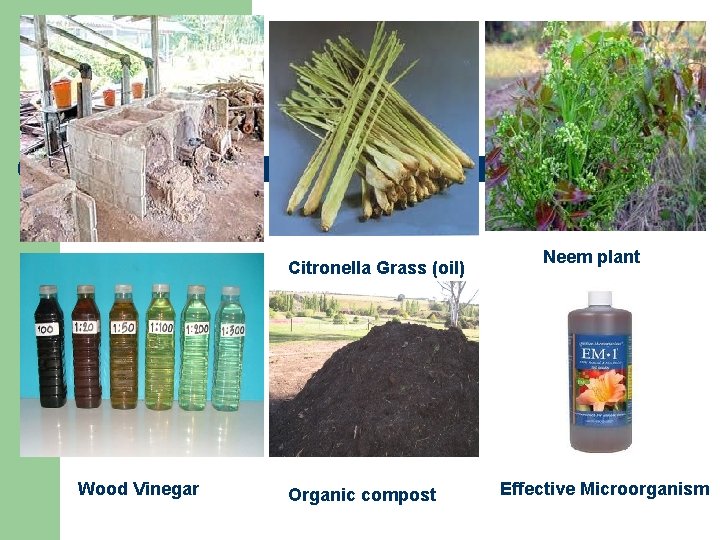
Citronella Grass (oil) Wood Vinegar Organic compost Neem plant Effective Microorganism
Finally, Sustainable development the concept should be first imprinted in people's mind The Philosophy of Sufficiency Economy suggested by His Majesty the King of Thailand 1. Moderate (���� ) 2. Reasonableness (������ ) 3. Self-immunity (������� ) With Two conditions 1. The use of Knowledge and Information (��������� ) 2. Moral Integrity esp. Decrease greed and selfishness
His Majesty the King of Thailand Thank you

- Slides: 47