
Agricultural Policy and Planning Division Office of Agricultural

- Slides: 16
Agricultural Policy and Planning Division Office of Agricultural Economics (OAE) Bangkok Thailand Room AEOC 2 at 1 pm. 16 Jan 2017 1
1. Agriculture in Thailand: an overview 2. Agricultural Trade between Thailand Swaziland 3. Agricultural Policies 4. Policy implementation: collective farm 5. Marketing Channels for selective Agricultural Commodities 6. Farmer market 2
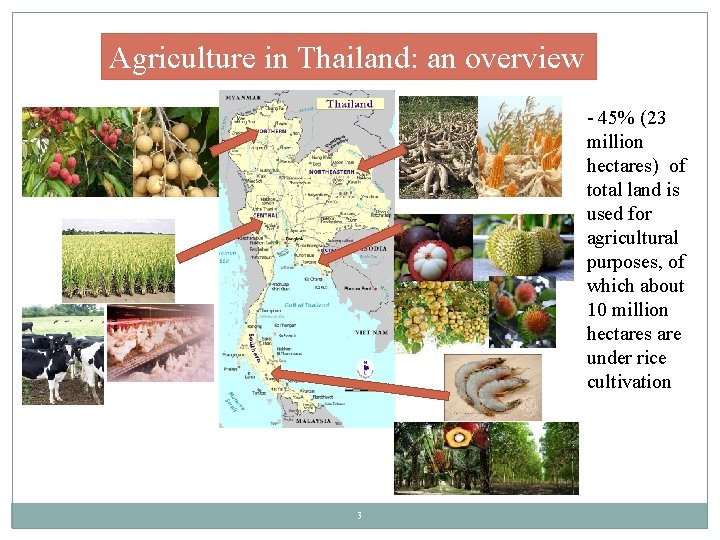
Agriculture in Thailand: an overview - 45% (23 million hectares) of total land is used for agricultural purposes, of which about 10 million hectares are under rice cultivation 3
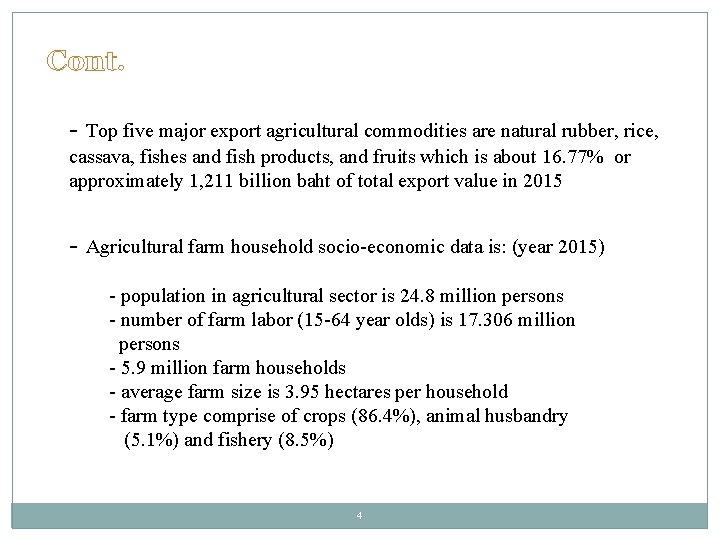
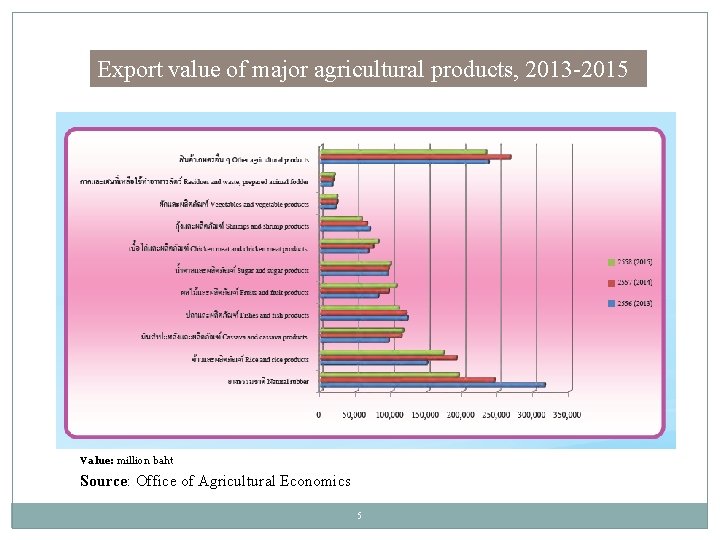
Cont. - Top five major export agricultural commodities are natural rubber, rice, cassava, fishes and fish products, and fruits which is about 16. 77% or approximately 1, 211 billion baht of total export value in 2015 - Agricultural farm household socio-economic data is: (year 2015) - population in agricultural sector is 24. 8 million persons - number of farm labor (15 -64 year olds) is 17. 306 million persons - 5. 9 million farm households - average farm size is 3. 95 hectares per household - farm type comprise of crops (86. 4%), animal husbandry (5. 1%) and fishery (8. 5%) 4
Export value of major agricultural products, 2013 -2015 Value: million baht Source: Office of Agricultural Economics 5
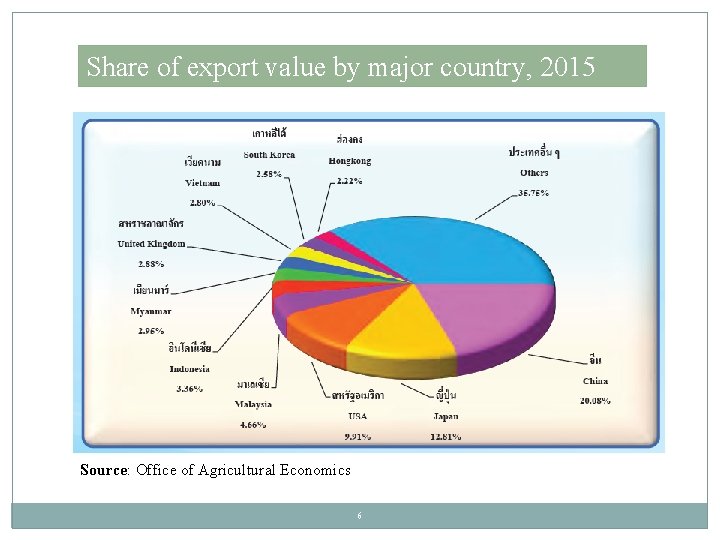
Share of export value by major country, 2015 Source: Office of Agricultural Economics 6
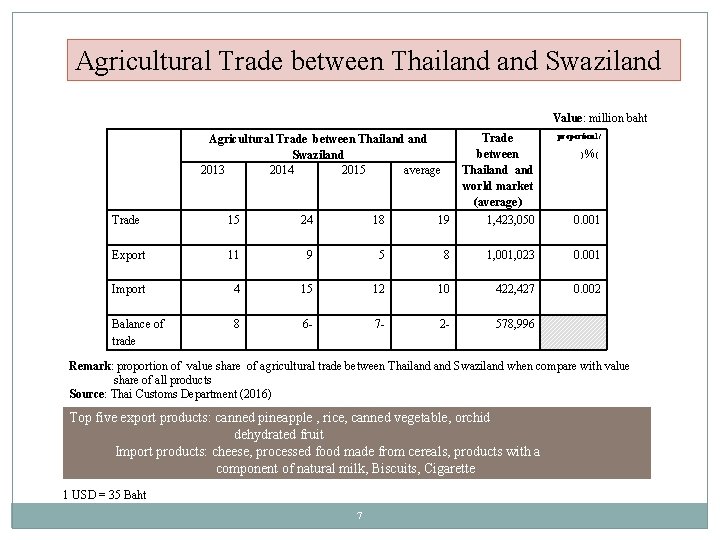
Agricultural Trade between Thailand Swaziland Value: million baht Trade between Thailand world market (average) 19 1, 423, 050 Agricultural Trade between Thailand Swaziland 2013 2014 2015 average proportion 1/ )%( Trade 15 24 18 0. 001 Export 11 9 5 8 1, 001, 023 0. 001 Import 4 15 12 10 422, 427 0. 002 Balance of trade 8 6 - 7 - 2 - 578, 996 Remark: proportion of value share of agricultural trade between Thailand Swaziland when compare with value share of all products Source: Thai Customs Department (2016) Top five export products: canned pineapple , rice, canned vegetable, orchid dehydrated fruit Import products: cheese, processed food made from cereals, products with a component of natural milk, Biscuits, Cigarette 1 USD = 35 Baht 7
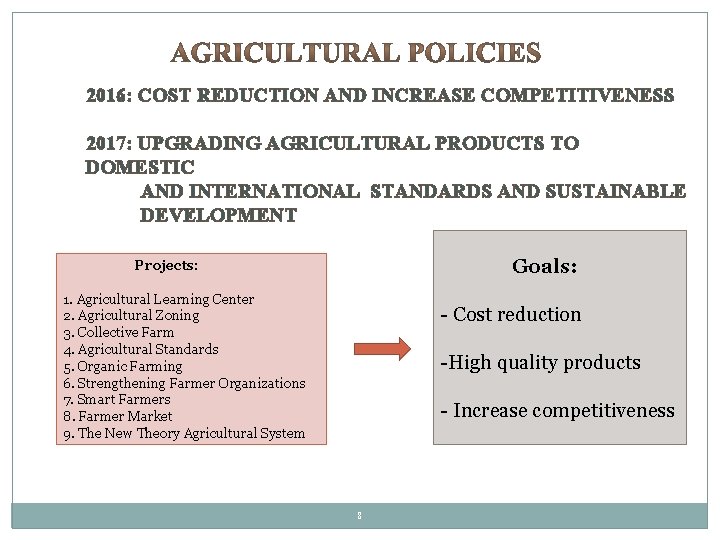
2016: COST REDUCTION AND INCREASE COMPETITIVENESS 2017: UPGRADING AGRICULTURAL PRODUCTS TO DOMESTIC AND INTERNATIONAL STANDARDS AND SUSTAINABLE DEVELOPMENT Goals: Projects: 1. Agricultural Learning Center 2. Agricultural Zoning 3. Collective Farm 4. Agricultural Standards 5. Organic Farming 6. Strengthening Farmer Organizations 7. Smart Farmers 8. Farmer Market 9. The New Theory Agricultural System - Cost reduction -High quality products - Increase competitiveness 8
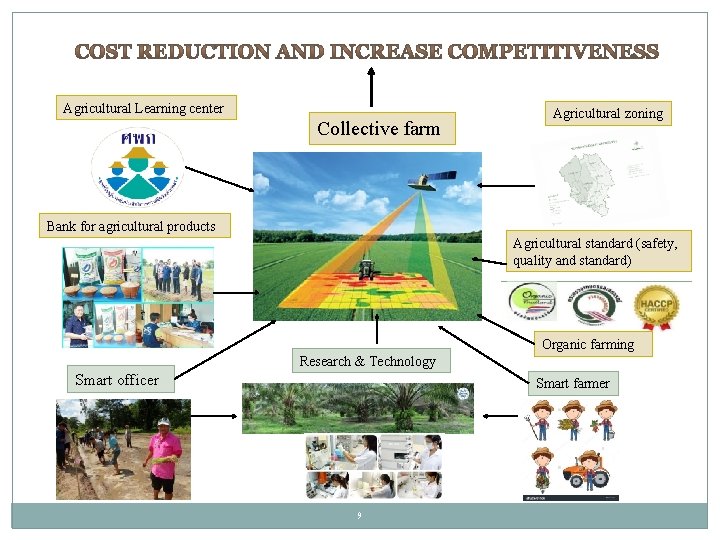
Agricultural Learning center Collective farm Agricultural zoning Bank for agricultural products Agricultural standard (safety, quality and standard) Organic farming Research & Technology Smart officer Smart farmer 9
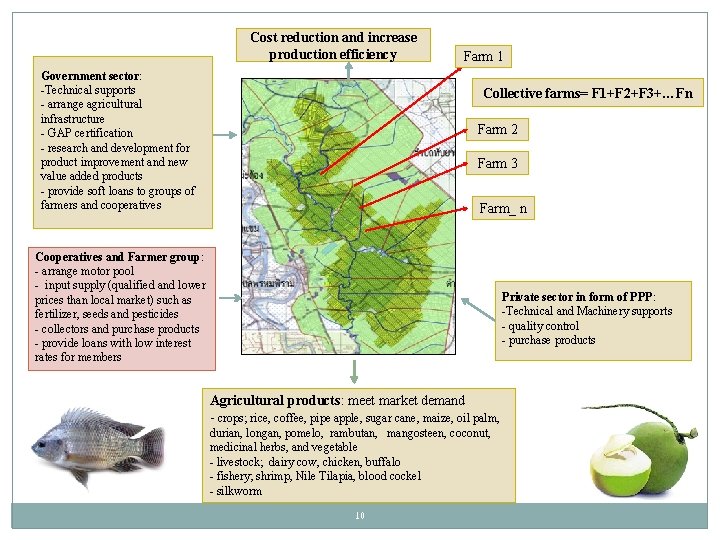
Cost reduction and increase production efficiency Government sector: -Technical supports - arrange agricultural infrastructure - GAP certification - research and development for product improvement and new value added products - provide soft loans to groups of farmers and cooperatives Farm 1 Collective farms= F 1+F 2+F 3+…Fn Farm 2 Farm 3 Farm_ n Cooperatives and Farmer group: - arrange motor pool - input supply (qualified and lower prices than local market) such as fertilizer, seeds and pesticides - collectors and purchase products - provide loans with low interest rates for members Private sector in form of PPP: -Technical and Machinery supports - quality control - purchase products Agricultural products: meet market demand - crops; rice, coffee, pipe apple, sugar cane, maize, oil palm, durian, longan, pomelo, rambutan, mangosteen, coconut, medicinal herbs, and vegetable - livestock; dairy cow, chicken, buffalo - fishery; shrimp, Nile Tilapia, blood cockel - silkworm 10
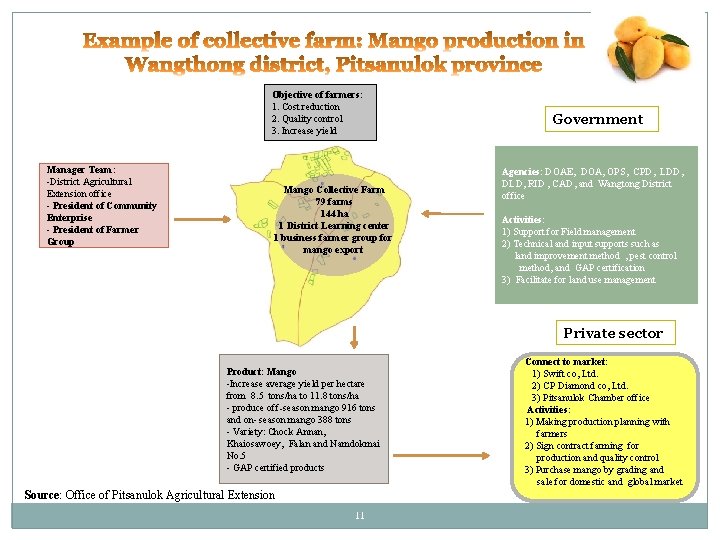
Objective of farmers: 1. Cost reduction 2. Quality control 3. Increase yield Manager Team: -District Agricultural Extension office - President of Community Enterprise - President of Farmer Group Mango Collective Farm 79 farms 144 ha 1 District Learning center 1 business farmer group for mango export Government Agencies: DOAE, DOA, OPS, CPD, LDD, DLD, RID , CAD, and Wangtong District office Activities: 1) Support for Field management 2) Technical and input supports such as land improvement method , pest control method, and GAP certification 3) Facilitate for land use management Private sector Product: Mango -Increase average yield per hectare from 8. 5 tons/ha to 11. 8 tons/ha - produce off-season mango 916 tons and on- season mango 388 tons - Variety: Chock Annan, Khaiosawoey, Falan and Namdokmai No. 5 - GAP certified products Source: Office of Pitsanulok Agricultural Extension 11 Connect to market: 1) Swift co, Ltd. 2) CP Diamond co, Ltd. 3) Pitsanulok Chamber office Activities: 1) Making production planning with farmers 2) Sign contract farming for production and quality control 3) Purchase mango by grading and sale for domestic and global market
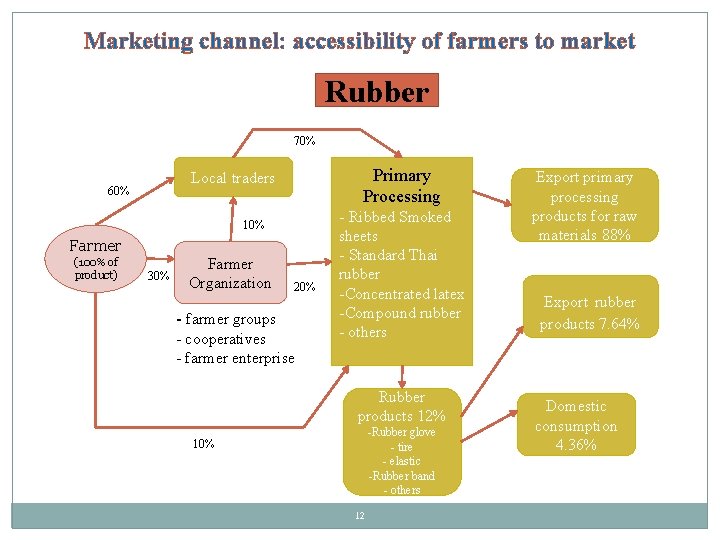
Marketing channel: accessibility of farmers to market Rubber 70% Primary Processing Local traders 60% 10% Farmer (100% of product) 30% Farmer Organization 20% - farmer groups - cooperatives - farmer enterprise - Ribbed Smoked sheets - Standard Thai rubber -Concentrated latex -Compound rubber - others Rubber products 12% -Rubber glove - tire - elastic -Rubber band - others 10% 12 Export primary processing products for raw materials 88% Export rubber products 7. 64% Domestic consumption 4. 36%
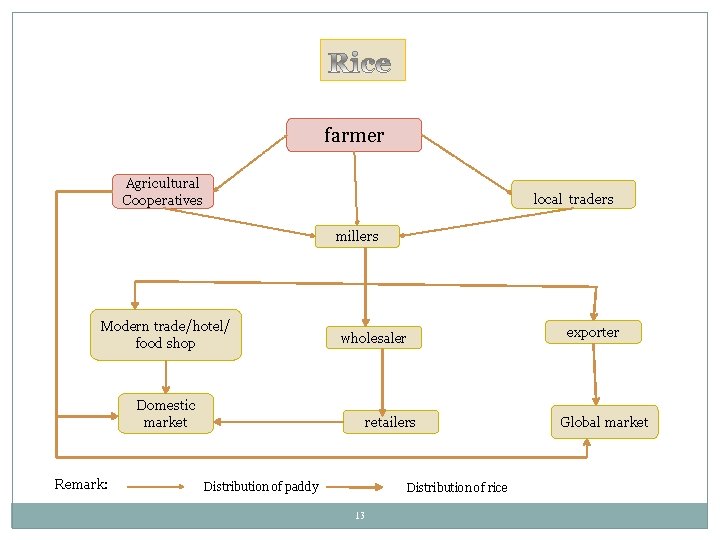
farmer Agricultural Cooperatives local traders millers Modern trade/hotel/ food shop wholesaler Domestic market Remark: retailers Distribution of paddy Distribution of rice 13 exporter Global market
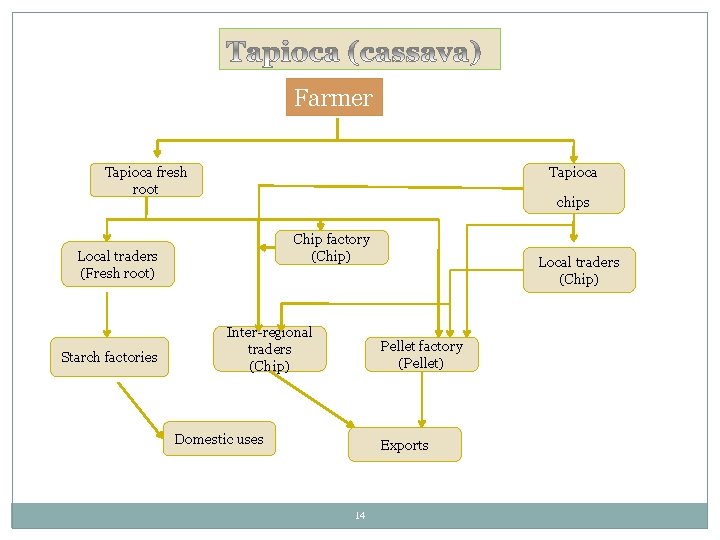
Farmer Tapioca fresh root Tapioca chips Chip factory (Chip) Local traders (Fresh root) Starch factories Inter-regional traders (Chip) Local traders (Chip) Pellet factory (Pellet) Domestic uses Exports 14
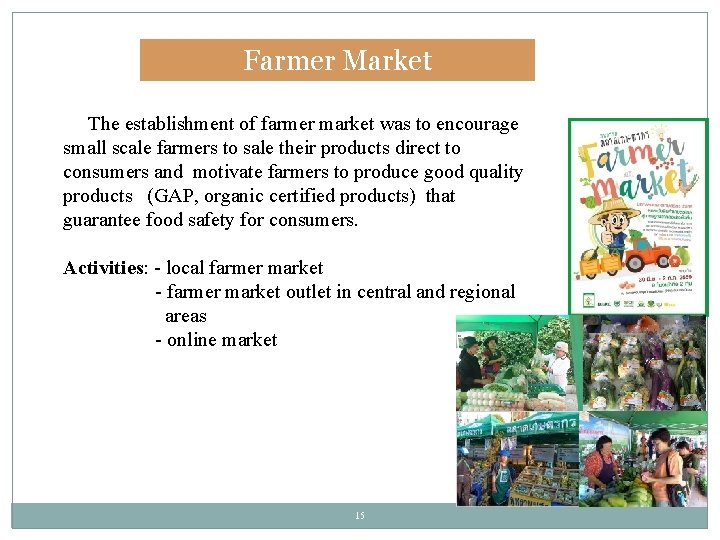
Farmer Market The establishment of farmer market was to encourage small scale farmers to sale their products direct to consumers and motivate farmers to produce good quality products (GAP, organic certified products) that guarantee food safety for consumers. Activities: - local farmer market - farmer market outlet in central and regional areas - online market 15
OIC RCMO application Thank you 16