Thailand at a Glance Introduction Thailand is a
- Slides: 54
Thailand at a Glance
Introduction � Thailand is a well known country in Southeast Asia � Thailand is a land of smile � It is the third largest country after Indonesia and Myanmar. � Thailand is only one country in this region of world which is never colonized by any European countries.
Introduction � Thailand is ruled by the king who is respected by all Thai people. � It has its own culture and tradition for a long time. � Thai language is the native language since Sukhothai period.
Geography of Thailand � There an area of 513, 115 square kilometers (198, 114 square miles). � The country lies on the north and west shores of the Gulf of Thailand. � It is bordered by Myanmar on the west and northwest, Cambodia on the east, Laos on northeast, Gulf of Thailand on the southeast, the Andaman Sea on the southwest and a long southern on Malay.
Geography of Thailand � The north of Thailand is mountain. � The highest point is Doi Inthanon at 2, 565 meters � The northeast consists of the Khorat Plateau which is bordered to the east by the Mekong River. � The central of Thailand is dominated by Chao Phraya River which runs into Gulf of Thailand.
Geography of Thailand � The southern region consists of the narrow Kra Isthmus which widens into the Malay Peninsula. � Chao Phraya and Mae Klong rivers are important to Thailand.
Climate � Thailand is near equator. � Thailand is warm and humid tropical country. � There are rainy, warm and cloudy. � It has the southwest monsoon during mid May to September.
Climate � It is dry and cool when the northeast monsoon appears during November to mid March. � The southern is always hot and humid. � The temperature is the highest in March to April and the lowest in December to January.
Capital City and Provinces � Bangkok has been the important center of Thailand since the late 18 th century. � It is the capital and the largest city of Thailand. � Bangkok is called Krung Thep Maha Nakorn or Krung Thep.
Capital City and Provinces � The full name in Krung Thep Mahanakhon Amon Rattankosin Mahinthara Yuthaya Mahadilok Phop Noppharat Ratchathani Burirom Udomratchaniwet Mahasathan Amon Phiman Awatan Sathit Sakkathattiya Witsanukam Prasit.
Capital City and Provinces � It is included traditional values, metropolitan atmosphere and Thai culture with historical heritages. � These can see around Bangkok which consists of beautiful temples and unique architectural.
Capital City and Provinces � Bangkok, Pattaya in Chonburi, Chiangmai, Hat Yai in Songkla and Nakhon Ratchasima are important metropolitan areas of Thailand. � Thailand is divided into five regions: Central, Eastern, Northeastern and Southern.
Capital City and Provinces � The Northern region has 17 provinces. � The Northeastern region has 19 provinces. � The Southern region has 14 provinces. � The Central region has 18 provinces. � The Eastern region has 7 provinces.
Thai Language � King Ramkhamhaeng who was the great king of Thailand invented Thai alphabets during 1279 -1298 in Sukhothai period more than 700 years ago. � It is called Thai language or Phasa Thai. � It is the national and official language. � It is the mother tongue of Thai people.
Thai Language � Many words in Thai language are borrowed Pali, Sanskrit, Khmer, Chinese, Malay and some European language. � The standard Thai is known as Central Thai which is the official language of Thailand.
Thai Language � The dialects are spoken languages in different regions which come form various ethnic groups in Thailand. � All of them are used in schools and universities throughout the country.
Thai Language � Southern Thai is spoken in the southern provinces. � The northern Thai is spoken in northern provinces which were formally parts of the independent kingdom of Lannathai. � The northeastern Thai is the Laotian dialect of Isan spoken in the northeastern provinces.
Thai Language � The phonology of the Thai language consists of consonants, tones and vowels. � There are forty-four consonants, thirty-two vowels and four characters with five phonemic tones.
Population � There approximately 64 million people in Thailand. � Thai people are about 75% of the population. � Chinese is approximately 14% and the other ethnic groups are 11% including Mons, Khmers, Malaysians, various hill tribes and others.
History of Thailand � The country of Thailand was begun with the migration of Tai-lao people from their ancestral home in the southern China into the present mainland. � The Southeast Asia during the 10 th century was occupied by the Mon, Khmer and Malay ethnic group.
History of Thailand � Sukhothai is the first Thai historical kingdom. � Thai people had the colony in Sukhothai kingdom. � Sukhothai period was during 13 th to 15 th centuries. � Sukhothai traded with China.
History of Thailand � King Ramkhamheang was a great king and a famous ruler. � Sukhothai period was so prosperous that King Ramkhamheang ’s inscription stone mentioned. � There are fishes in the water and rice in the fields. � It was called the golden age of Thai civilization.
History of Thailand � Ayutthaya was during 1350 to 1767 for 417 years. � There were five dynasties during Aytthaya period. � U-thong Dynasty consisted of 3 kings. � Suphanabhumi Dynasty consisted of 13 kings.
History of Thailand � Sukhothai Dynasty consisted of 7 kings. � Prasart Thong Dynasty consisted of 4 kings. � Bann Plu Huang Dynasty consisted of 6 kings.
History of Thailand � Ayutthaya period was prosperous for international trade and Ayutthaya became an international marketplace where goods from the Far East could be bought and exchanged with many merchandises from Malay to Indonesia, India and others.
History of Thailand � During Ayutthaya period, Burma was an important enemy to fight with. � Thai people faced many wars with other neighboring countries. � King Narasuan the Great declared Ayutthaya’ s independence at Nongsarai, Supahanburi after he killed the Burmese Crown Prince in the combat on elephant back one time.
History of Thailand � Dhonburi period was during 1767 to 1782 for 15 years. � Phraya Taksin, who was a governor in Tak, fought with Burmese invaders and established himself as the king of Siam. � He restored the independence of the country and chose Dhonburi his capital.
History of Thailand � Dhonburi was located by the mouth of the Chao Phraya River and it also was the seaport. � His offical name is King Borom Racha IV, but he generally known as King Tak Sin the Great
History of Thailand � Rattanakosin period was developed by the Chakri Dynasty in 1782 by King Rama I the Great for more than 225 years. � The country was know as Siam even since in 1939 and was changed to Thailand until the present time. � It means the Land of Free.
History of Thailand � Thailand has been much developed by the Chakri Dynasty since King Rama I to King Rama IX. � King Rama I restored most of the social and political systems of Ayutthaya period. � He built the Grand Palace in the capital, Bangkok.
History of Thailand � King Rama II renovated Wat Arun which is known as the Temple of Dawn, and many other temples and monasteries. � King Rama III reopened with Western nations which was suspended after the reign of King Narai in Ayutthaya period and developed trade with. China.
History of Thailand � King Rama IV avoided colonization and established modern Siam. � King Rama IV before becoming the king spent 27 years as a monk and studied western sciences. � He made many social and economic reforms during his reign.
History of Thailand � He had important role in introducing and understanding the western culture to Thai people. � King Rama IV has been still honored as the Father of Modern Science and Technology of Thailand.
History of Thailand � King Rama V continued his father’s reforms by improving the public welfare and administrative system. � He dramatically developed the railway network, military and government systems and slavish abolishment.
History of Thailand � King Rama VI introduced the compulsory education and other educational reforms in the country. � Both King Rama VI and VII were education in England. � King Rama VII became the last absolute monarch.
History of Thailand � On July 24, 1932, a revolution broke out, ushering in a new era of constituently government and overthrowing the absolute monarchy which had prevailed in Thailand since Sukhothai period. � In the reign of King Rama VIII the name of country was changed from Siam to Thailand in 1939.
History of Thailand � The present King, King Rama IX, ascended to the throne on the 5 th of May in 1946. � He is the longest current head of the country. � He has created more than 3, 000 useful developing projects to improve the welfare of his people.
Thai National Anthem � Thailand has the national anthem. � It was composed by Professor Phra Jenduriyang in 1932. � The national anthem is concerned with the Thai nation, Thai people, the freedom and safety of the nation.
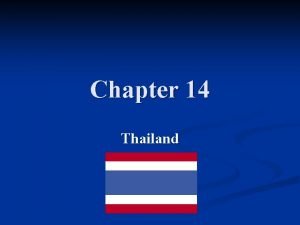
Thai Flag � In the past, there was a white elephant in the middle of a red background of the Thai flag. � The Thai flag with three colors was used in the reign of King Vajiravudh in 1917. � It was called Thong Trai Rong. � The Thai flag is rectangular and consists of five horizontal strips.
Thai Flag � There are red, white, dark blue, white, and red (the blue strip twice the width of the others. ( � The colors of the Thai flag are meaningful because it is concerned with the monarchy, the religion and the nation. � It was first used on September 28, 1917 during World War I.
Religions in Thailand � People in Thailand have different faiths and religions fro example, Buddhism, Muslim, Christian, Hinduism and Sikhism. � Nearly 95% of the populations are Theravada Buddhists.
Thai Society and Thai Culture � Thailand has warm society and culture. � Thai people respect hierarchical relationships. � Social relationships are defined as one person being superior to the other.
Thai Society and Thai Culture � Most Thai culture is also significant in behavior, customs, traditions and beliefs of the people today, � Most Thai people have good manners both gestures and etiquettes including eating.
Etiquette of Eating � Thai food is a part of Thai culture. � Thai manner for eating on the table is having a central spoon in each dish to take the food. � Thai food is blended with five fundamental tastes: sweet, spicy, sour, bitter and salty.
Wai and Smiles � The wai is the traditional from greeting, given by the person of lower status to the person of higher status. � The wai is both a sign of respect as well as a greeting. � Smiles are used instead of answering, greeting, and sympathy.
Thai Agriculture � Thailand is an agricultural country in which Thai rice, fruits, vegetables, various herbs and spices are produced. � Rice is consumed in almost every meal of Thai people. � The rice is well known throughout the world.
Thai Agriculture � Thailand has various kinds of fruits, vegetables, herbs and spices. � Fruits and vegetables become important products and increase income to Thai economy. � Thai people use various herbs and spices for cooking Thai foods and doing Thai massage.
Thai Currency � The unit of Thai currency is The Baht. � The sign is ฿ and the code is THB. � The subunit is the Satang. � One baht is 100 Satang.
Thai Performance Arts � Thai performance have become the identities of Thailand. � They vary from region to region because they are influenced by typical region and racial origin of the people. � They are divided into two types: Thai folk dances and Thai classical dances.
Thai Government and Politics � The politics of Thailand was changed on June 24 th in 1932. � After the democratic revolution in this year, Thailand became under a constitutional democratic monarchy. � The first written constitution was issued on December 10, 1932.
Thai Government and Politics � Thailand is a monarchical country and the King is the head of the country. � The Thai government and politics are ruled under the framework of democracy. � The Prime Minister is the head of the government and the chief executive.
Conclusion � Thailand is a well known country in Southeastern Asia. � It is a democratic country which is presently ruled by King Bhumibol Aduyadej who is a great and beloved king. � It is named the Land of the Free which means the freedom from being a colony.
Conclusion � Thailand has its own native language both spoken and written languages. � The central dialect is the official language to communicated within the country � The weather is characterized by tropical monsoons. � The country is divided into five regions
Conclusion � Every region plays very important influences to Thai culture and tradition. � Moreover, Thai agriculture is fertile with fruits, vegetables, herbs and spices including various agricultural exports to other countries.