Coding for Wound Care in 2017 Updates and

- Slides: 52
Coding for Wound Care in 2017: Updates and Changes Lawrence A. Santi, DPM, FASPS Member, APMA Coding Committee
Ulcer & Wound Grading • Wagner – 6 Grades • UTSA – Lesion Depth with both Ischemia & Infection (Stage A-D, Grade 0 -III) • Pressure – 4 +2 • Doesn’t matter which system you use as long as you describe the ulcer adequately
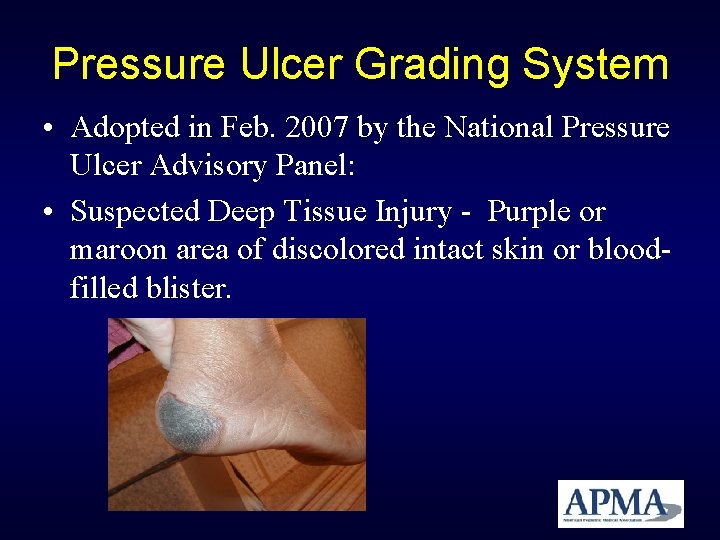
Pressure Ulcer Grading System • Adopted in Feb. 2007 by the National Pressure Ulcer Advisory Panel: • Suspected Deep Tissue Injury - Purple or maroon area of discolored intact skin or bloodfilled blister.
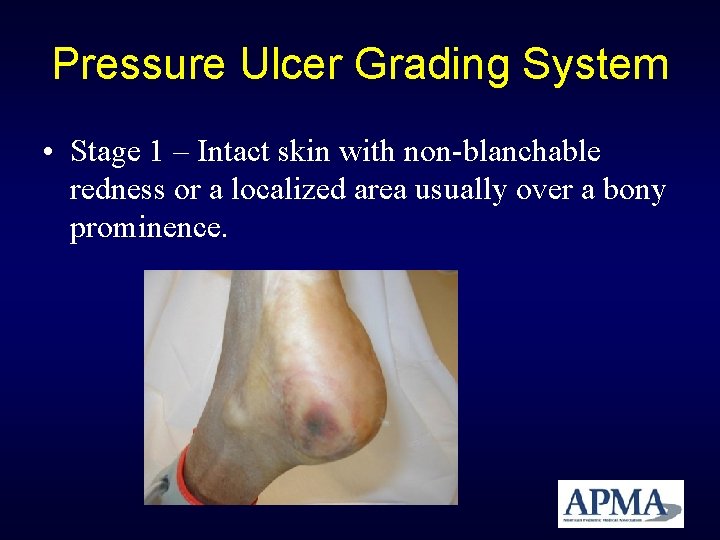
Pressure Ulcer Grading System • Stage 1 – Intact skin with non-blanchable redness or a localized area usually over a bony prominence.
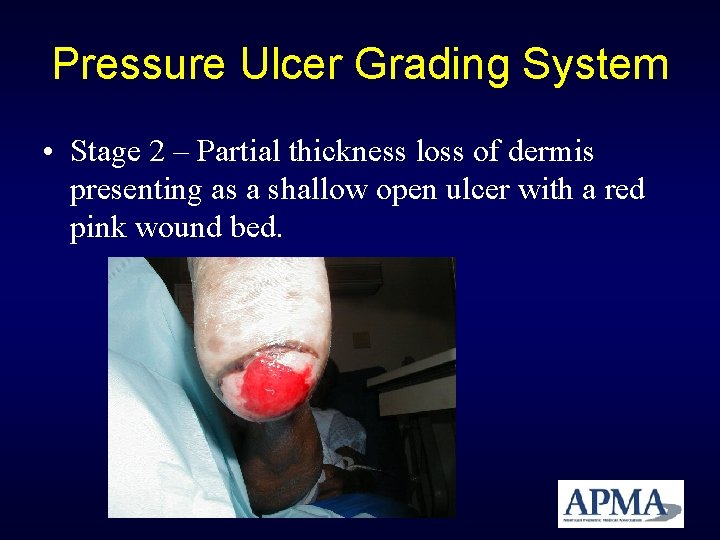
Pressure Ulcer Grading System • Stage 2 – Partial thickness loss of dermis presenting as a shallow open ulcer with a red pink wound bed.
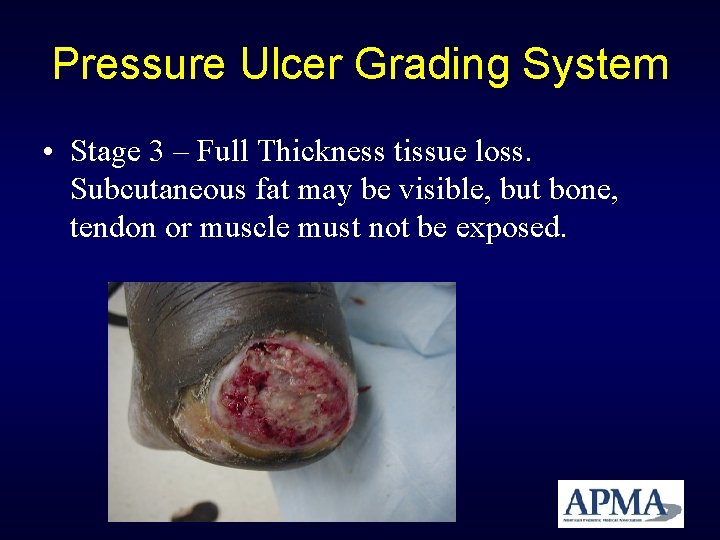
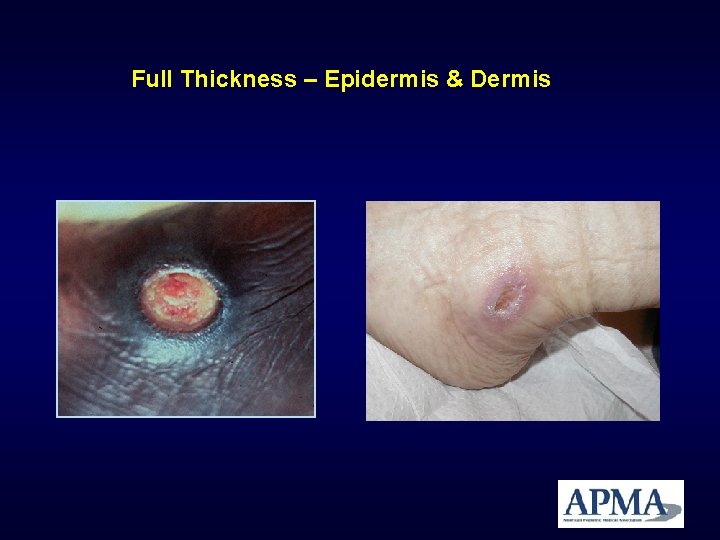
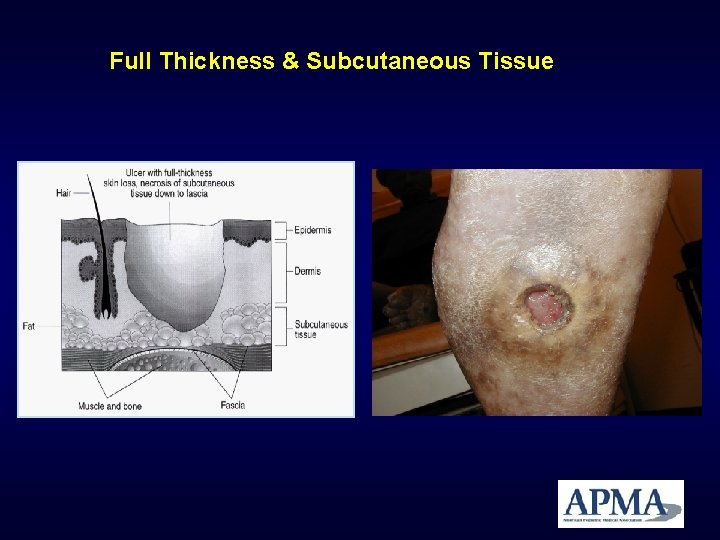
Pressure Ulcer Grading System • Stage 3 – Full Thickness tissue loss. Subcutaneous fat may be visible, but bone, tendon or muscle must not be exposed.
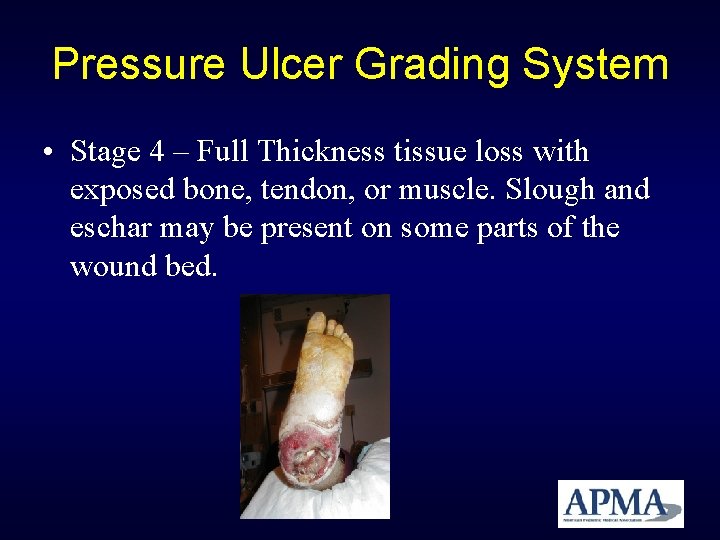
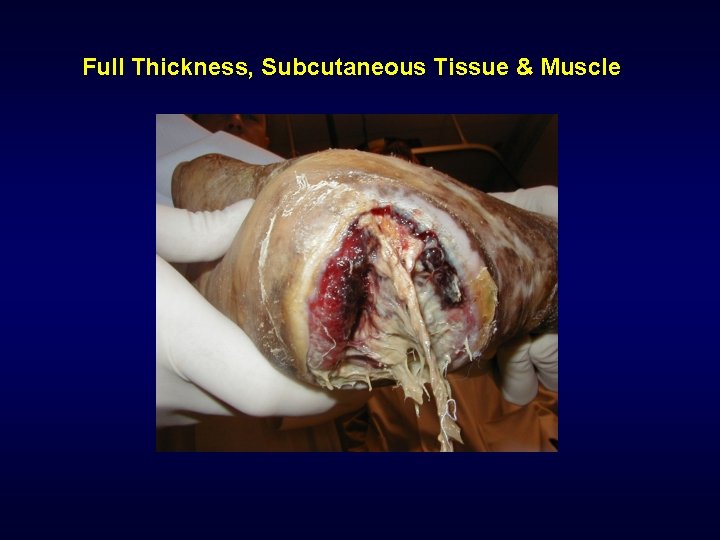
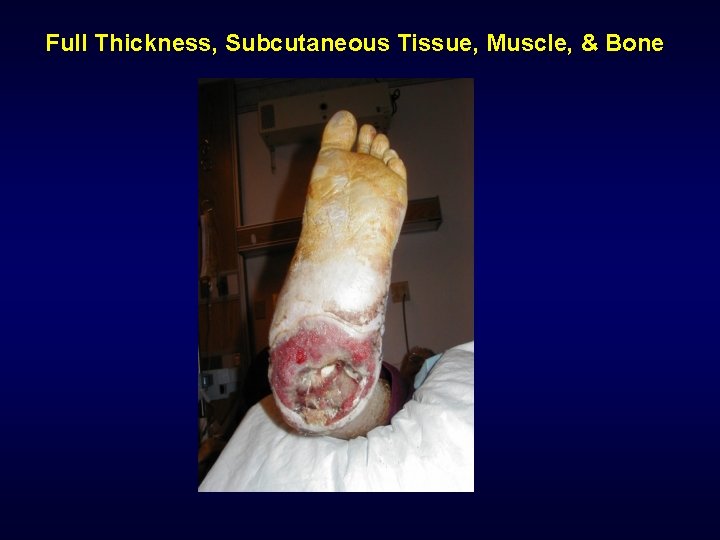
Pressure Ulcer Grading System • Stage 4 – Full Thickness tissue loss with exposed bone, tendon, or muscle. Slough and eschar may be present on some parts of the wound bed.
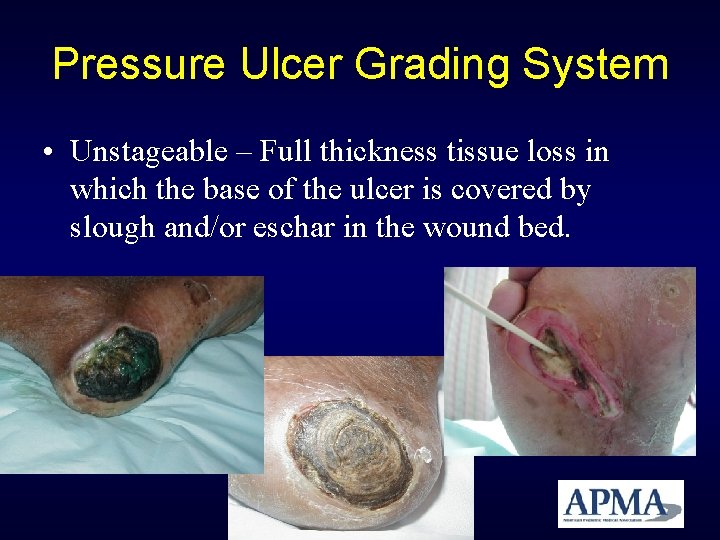
Pressure Ulcer Grading System • Unstageable – Full thickness tissue loss in which the base of the ulcer is covered by slough and/or eschar in the wound bed.
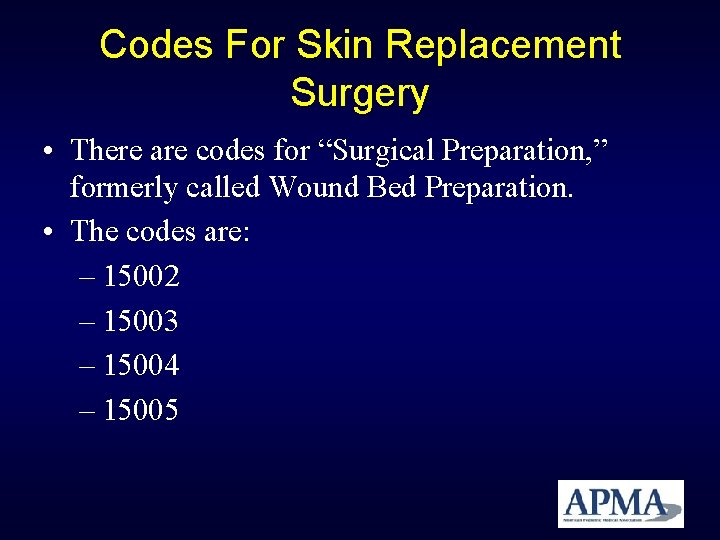
Codes For Skin Replacement Surgery • There are codes for “Surgical Preparation, ” formerly called Wound Bed Preparation. • The codes are: – 15002 – 15003 – 15004 – 15005
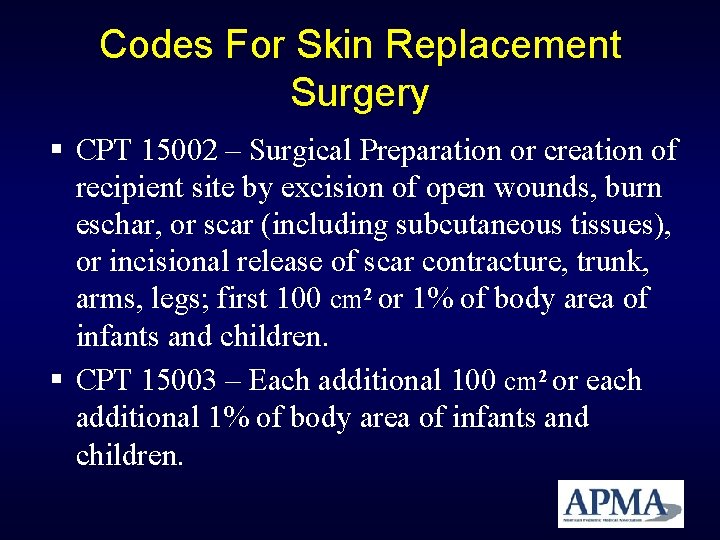
Codes For Skin Replacement Surgery CPT 15002 – Surgical Preparation or creation of recipient site by excision of open wounds, burn eschar, or scar (including subcutaneous tissues), or incisional release of scar contracture, trunk, arms, legs; first 100 cm 2 or 1% of body area of infants and children. CPT 15003 – Each additional 100 cm 2 or each additional 1% of body area of infants and children.
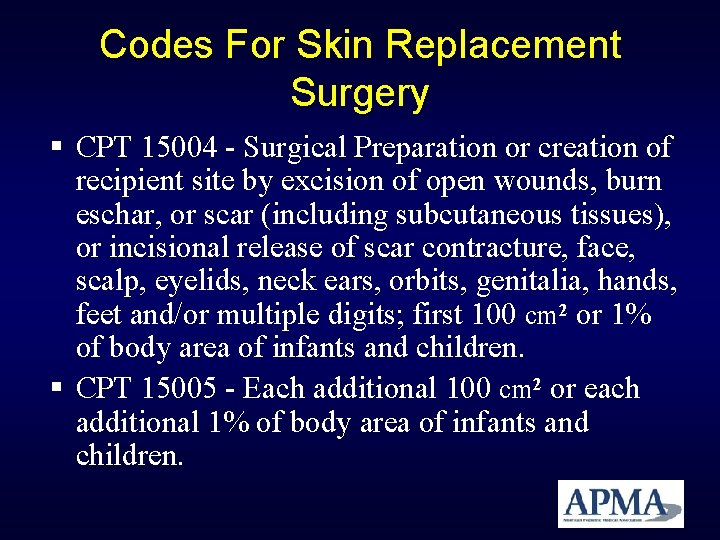
Codes For Skin Replacement Surgery CPT 15004 - Surgical Preparation or creation of recipient site by excision of open wounds, burn eschar, or scar (including subcutaneous tissues), or incisional release of scar contracture, face, scalp, eyelids, neck ears, orbits, genitalia, hands, feet and/or multiple digits; first 100 cm 2 or 1% of body area of infants and children. CPT 15005 - Each additional 100 cm 2 or each additional 1% of body area of infants and children.
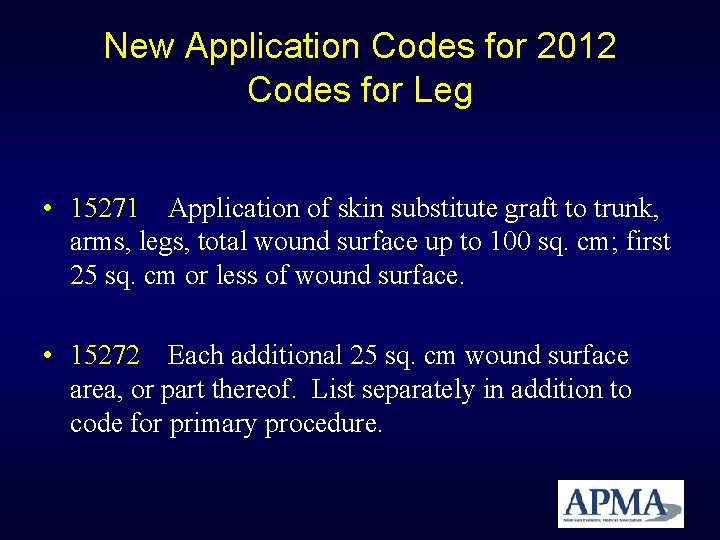
New Application Codes for 2012 Codes for Leg • 15271 Application of skin substitute graft to trunk, arms, legs, total wound surface up to 100 sq. cm; first 25 sq. cm or less of wound surface. • 15272 Each additional 25 sq. cm wound surface area, or part thereof. List separately in addition to code for primary procedure.
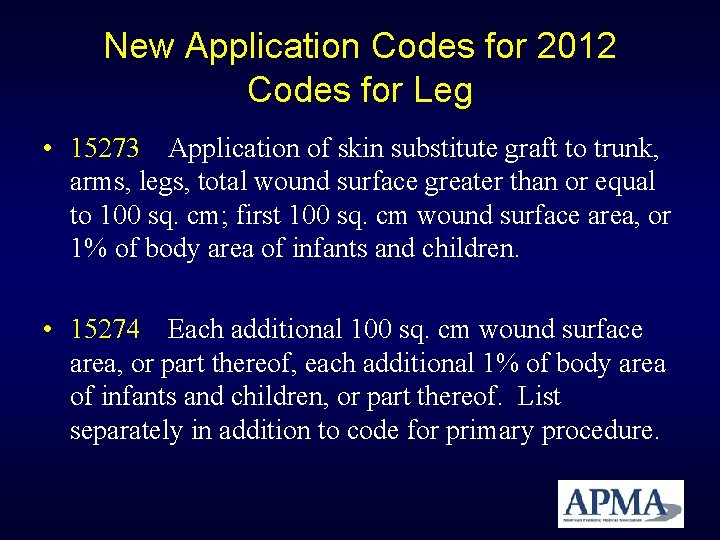
New Application Codes for 2012 Codes for Leg • 15273 Application of skin substitute graft to trunk, arms, legs, total wound surface greater than or equal to 100 sq. cm; first 100 sq. cm wound surface area, or 1% of body area of infants and children. • 15274 Each additional 100 sq. cm wound surface area, or part thereof, each additional 1% of body area of infants and children, or part thereof. List separately in addition to code for primary procedure.
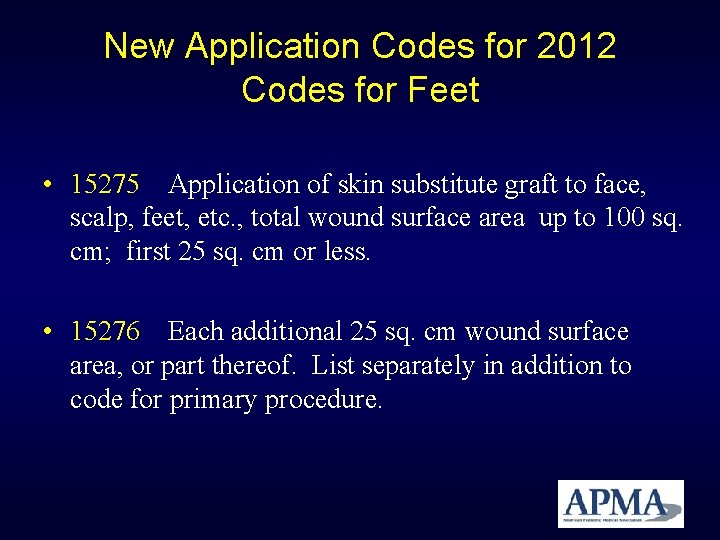
New Application Codes for 2012 Codes for Feet • 15275 Application of skin substitute graft to face, scalp, feet, etc. , total wound surface area up to 100 sq. cm; first 25 sq. cm or less. • 15276 Each additional 25 sq. cm wound surface area, or part thereof. List separately in addition to code for primary procedure.
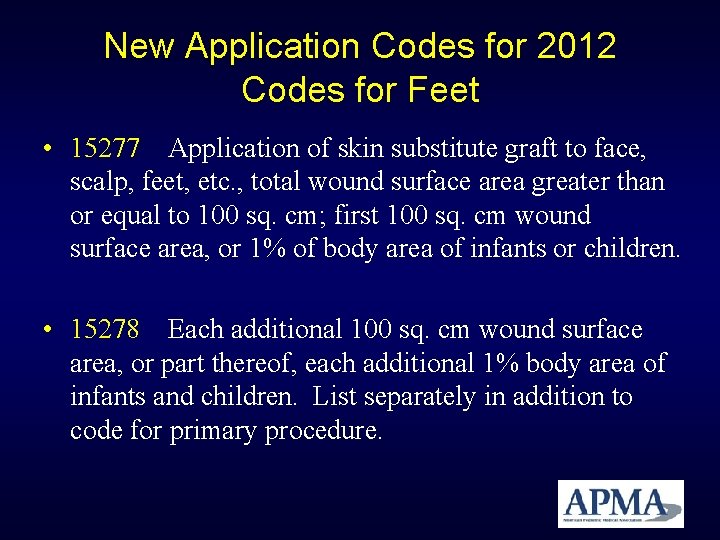
New Application Codes for 2012 Codes for Feet • 15277 Application of skin substitute graft to face, scalp, feet, etc. , total wound surface area greater than or equal to 100 sq. cm; first 100 sq. cm wound surface area, or 1% of body area of infants or children. • 15278 Each additional 100 sq. cm wound surface area, or part thereof, each additional 1% body area of infants and children. List separately in addition to code for primary procedure.
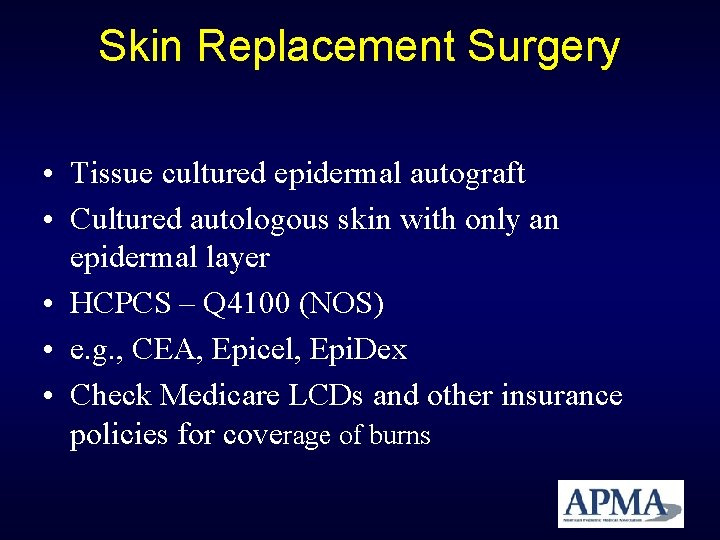
Skin Replacement Surgery • Tissue cultured epidermal autograft • Cultured autologous skin with only an epidermal layer • HCPCS – Q 4100 (NOS) • e. g. , CEA, Epicel, Epi. Dex • Check Medicare LCDs and other insurance policies for coverage of burns
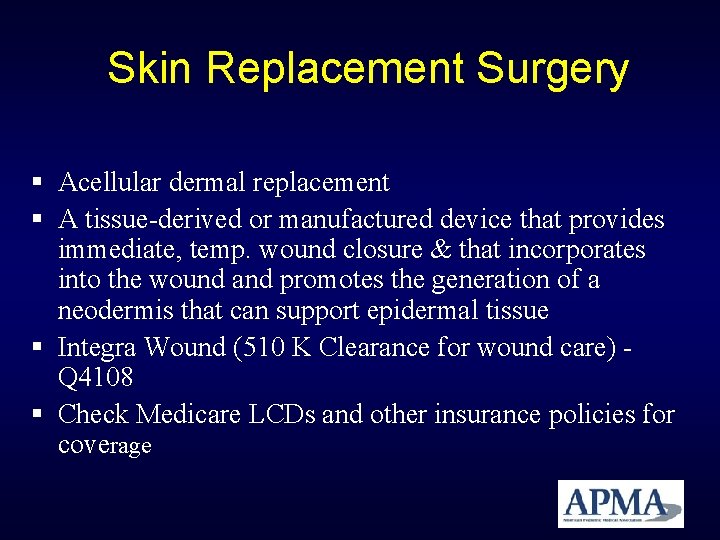
Skin Replacement Surgery Acellular dermal replacement A tissue-derived or manufactured device that provides immediate, temp. wound closure & that incorporates into the wound and promotes the generation of a neodermis that can support epidermal tissue Integra Wound (510 K Clearance for wound care) - Q 4108 Check Medicare LCDs and other insurance policies for coverage
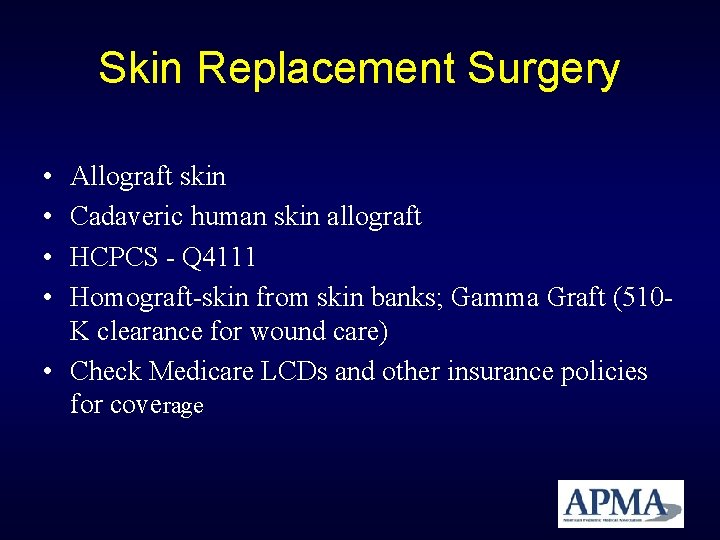
Skin Replacement Surgery • • Allograft skin Cadaveric human skin allograft HCPCS - Q 4111 Homograft-skin from skin banks; Gamma Graft (510 - K clearance for wound care) • Check Medicare LCDs and other insurance policies for coverage
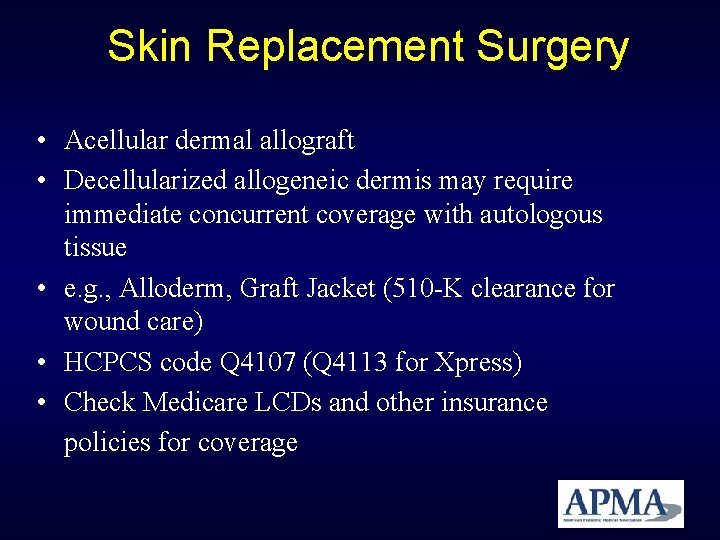
Skin Replacement Surgery • Acellular dermal allograft • Decellularized allogeneic dermis may require immediate concurrent coverage with autologous tissue • e. g. , Alloderm, Graft Jacket (510 -K clearance for wound care) • HCPCS code Q 4107 (Q 4113 for Xpress) • Check Medicare LCDs and other insurance policies for coverage
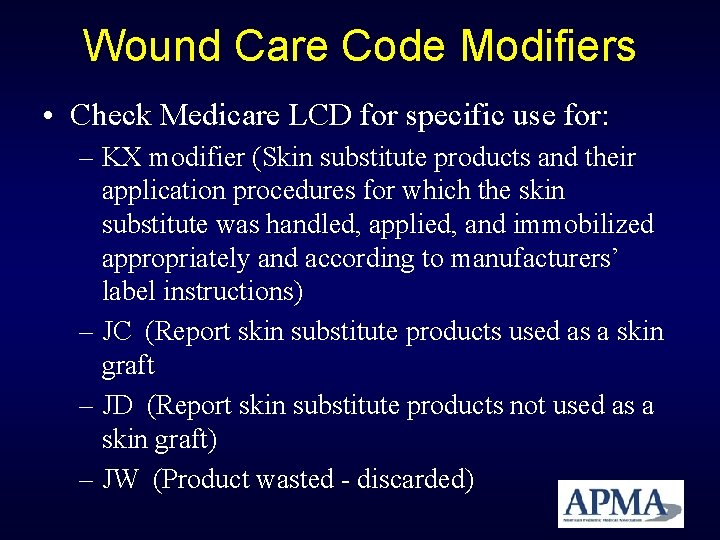
Wound Care Code Modifiers • Check Medicare LCD for specific use for: – KX modifier (Skin substitute products and their application procedures for which the skin substitute was handled, applied, and immobilized appropriately and according to manufacturers’ label instructions) – JC (Report skin substitute products used as a skin graft – JD (Report skin substitute products not used as a skin graft) – JW (Product wasted - discarded)
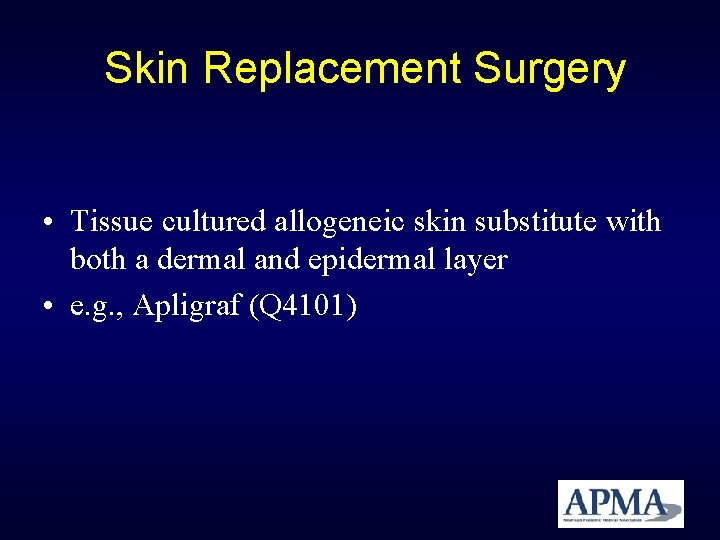
Skin Replacement Surgery • Tissue cultured allogeneic skin substitute with both a dermal and epidermal layer • e. g. , Apligraf (Q 4101)
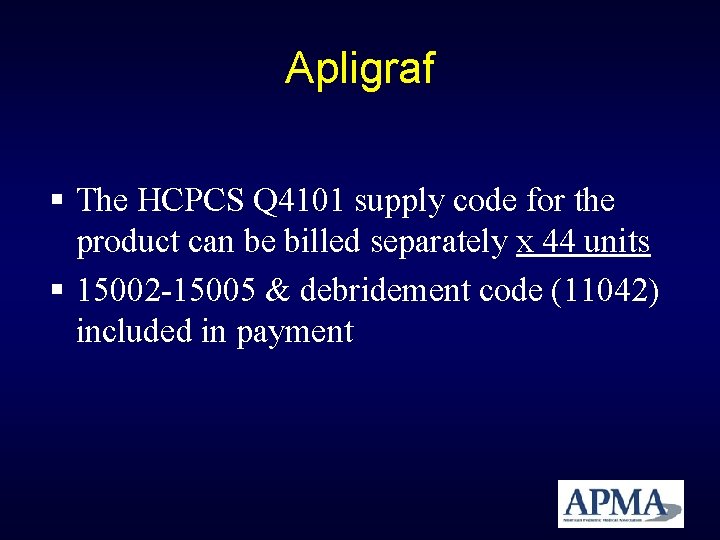
Apligraf The HCPCS Q 4101 supply code for the product can be billed separately x 44 units 15002 -15005 & debridement code (11042) included in payment
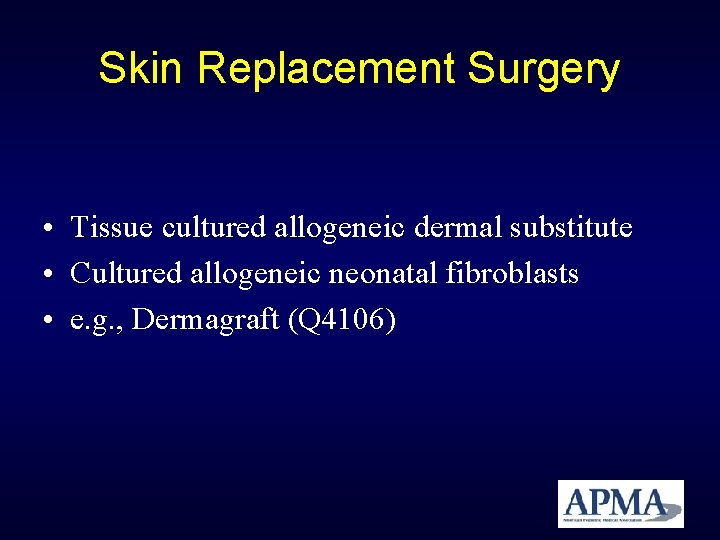
Skin Replacement Surgery • Tissue cultured allogeneic dermal substitute • Cultured allogeneic neonatal fibroblasts • e. g. , Dermagraft (Q 4106)
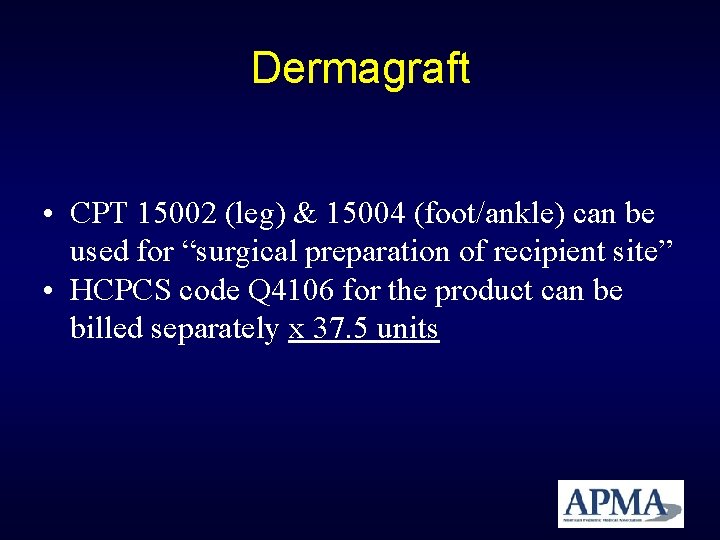
Dermagraft • CPT 15002 (leg) & 15004 (foot/ankle) can be used for “surgical preparation of recipient site” • HCPCS code Q 4106 for the product can be billed separately x 37. 5 units
Skin Replacement Surgery • Xenogeneic dermis - nonhuman dermis for temporary wound closure • e. g. , EZ Derm, Mediskin (510 -K approval for wound care) Q 4100 (not otherwise specified code) • Check Medicare LCDs and other insurance policies for coverage
Skin Replacement Surgery • Acellular xenogeneic implant – de-cellularized nonhuman connective tissue • Oasis, Surgisis, Pri. Matrix, Matri. Stem (510 K approval for wound care) • Check Medicare LCDs and other insurance policies for coverage
Oasis, Pri. Matrix, Surgisis, and Matri. Stem DO NOT USE MODIFIER – 58 HCPCS code for Oasis is Q 4102 HCPCS code for Pri. Matrix is Q 4110 HCPCS code for Surgisis & Matri. Stem is Q 4100 (not otherwise specified code) CPT 1500 x & Debridement codes (11042) included
Codes For Skin Replacement Surgery “These codes are not intended to be reported for simple graft application alone or application stabilized with dressings (e. g. , by simple gauze wrap). ” “The Skin substitute/graft is anchored using the surgeon’s choice of fixation. When services are performed in the office, the supply of the skin substitute/graft should be reported separately. Routine dressing supplies are not reported separately. ”
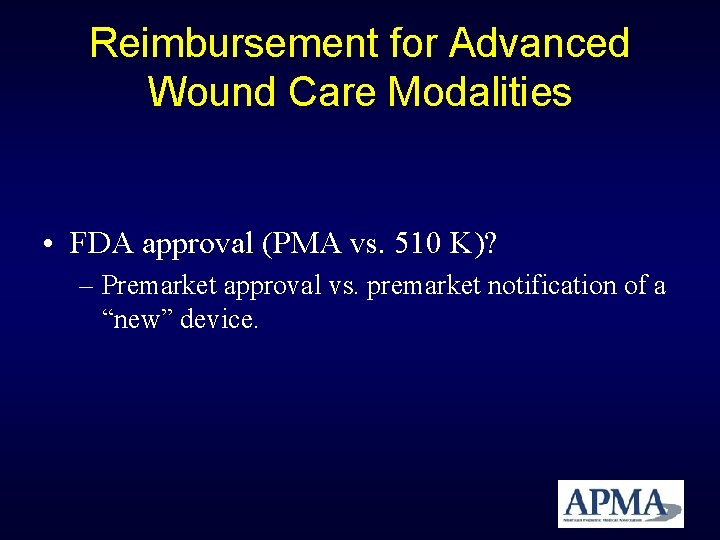
Reimbursement for Advanced Wound Care Modalities • FDA approval (PMA vs. 510 K)? – Premarket approval vs. premarket notification of a “new” device.
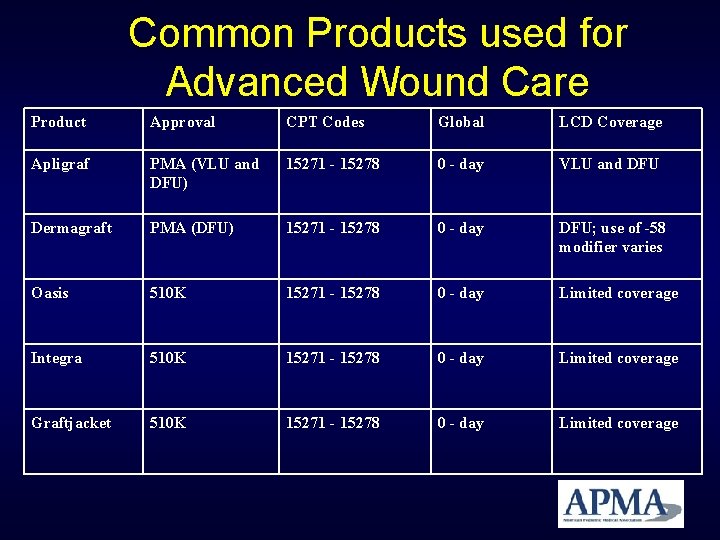
Common Products used for Advanced Wound Care Product Approval CPT Codes Global LCD Coverage Apligraf PMA (VLU and DFU) 15271 - 15278 0 - day VLU and DFU Dermagraft PMA (DFU) 15271 - 15278 0 - day DFU; use of -58 modifier varies Oasis 510 K 15271 - 15278 0 - day Limited coverage Integra 510 K 15271 - 15278 0 - day Limited coverage Graftjacket 510 K 15271 - 15278 0 - day Limited coverage
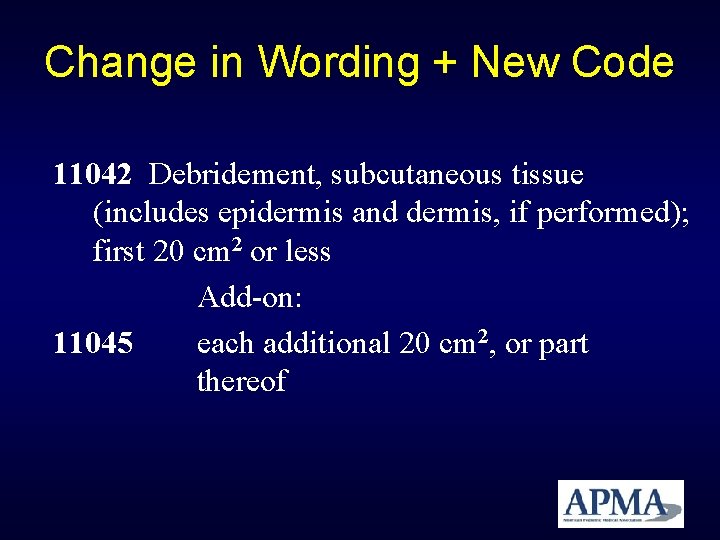
Change in Wording + New Code 11042 Debridement, subcutaneous tissue (includes epidermis and dermis, if performed); first 20 cm 2 or less Add-on: 11045 each additional 20 cm 2, or part thereof
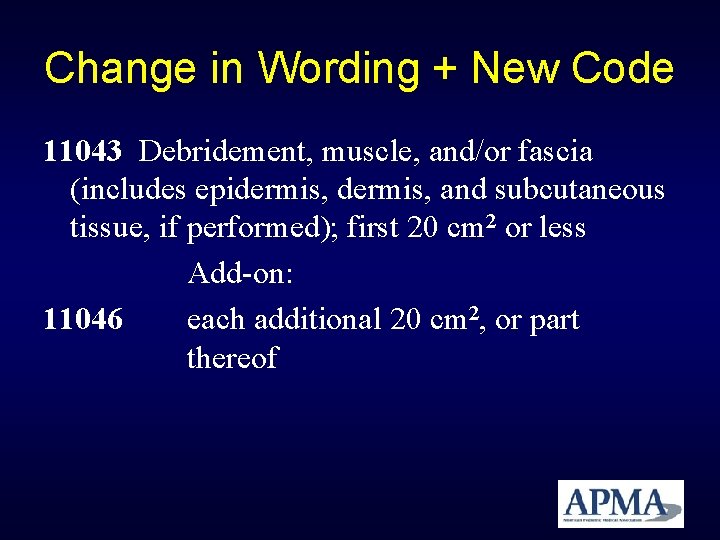
Change in Wording + New Code 11043 Debridement, muscle, and/or fascia (includes epidermis, and subcutaneous tissue, if performed); first 20 cm 2 or less Add-on: 11046 each additional 20 cm 2, or part thereof
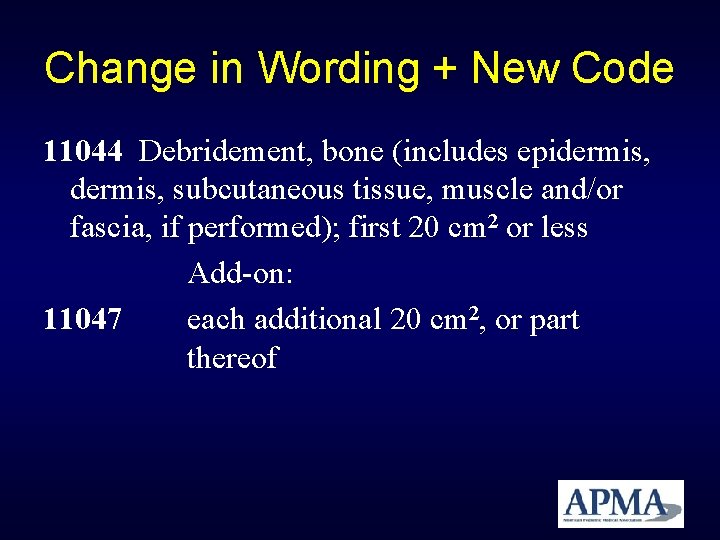
Change in Wording + New Code 11044 Debridement, bone (includes epidermis, subcutaneous tissue, muscle and/or fascia, if performed); first 20 cm 2 or less Add-on: 11047 each additional 20 cm 2, or part thereof
CMS & Debridement • Many CMS medical directors have expressed in their LCDs that there should be a limited frequency of use for CPT 11043 & 11044. • Place of Service has also come into question by these CMS medical directors. • Read your LCD.
97597 - 97598 Provider is required to have direct (one-on-one) patient contact. 97597 Removal of devitalized tissue from wound(s), selective debridement, without anesthesia (eg, high pressure waterjet with/without suction, sharp selective debridement with scissors, scalpel and forceps), with or without topical application(s), wound assessment, and instruction(s) for ongoing care, may include use of a whirlpool, per session; total wound(s) surface area; first 20 cm 2. 97598 each additional 20 cm 2.
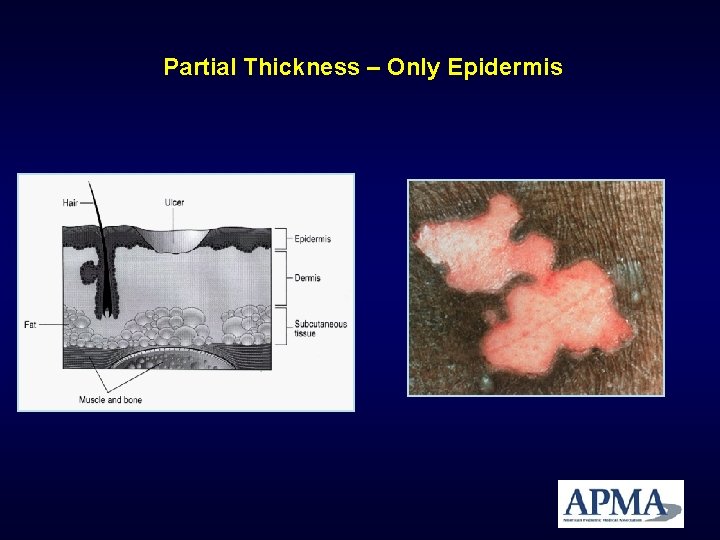
Partial Thickness – Only Epidermis
Full Thickness – Epidermis & Dermis
Full Thickness & Subcutaneous Tissue
Full Thickness, Subcutaneous Tissue & Muscle
Full Thickness, Subcutaneous Tissue, Muscle, & Bone
Role of Debridement must remove all necrotic soft tissue. This removes senescent cells from the wound. Debridement may aid by removing tissue with the highest bacterial counts, thereby bringing the wound into bacterial balance. Debridement can activate platelets to release the contents of their alpha granules. The released growth factors stimulate the inflammatory response that is believed to play an important role in wound healing. Formation of new granulation tissue following debridement may also help to perpetuate the wound healing cascade. An additional advantage of debridement is that it allows for a more thorough investigation of the degree of penetration and can detect inadequately treated infection. Pockets may be unroofed or saucerized to allow pus to drain freely. After debridement, the ulcer will usually be larger than it was at presentation
Other Codes for Wound Care 11000 – Debridement of extensive eczematous or infected skin; up to 10% of body surface This code was deleted in 2011 Typically a code used primarily for dermatological purposes Should be used sparingly in diabetic, venous stasis, and pressure ulcers 0 -day global Not typically a “podiatric” code
Other Codes for Wound Care 20000 – has been deleted in 2011 20005 – Incision and drainage of soft tissue abscess, subfascial, (ie, involves the soft tissue below the deep fascia) (verbiage changed) These codes may be used in conjunction with a diagnosis of osteomyelitis 10 -day global
Other Codes for Wound Care 27603 – Incision & drainage, leg or ankle; deep abscess or hematoma 27607 – Incision (e. g. , osteomyelitis or bone abscess), leg or ankle 27640 – Partial excision (craterization, saucerization, or diaphysectomy) bone (osteomyelitis or exostosis); tibia 27641 – fibula These codes have a 90 -day global
Other Codes for Wound Care 28120 – Partial excision (craterization, saucerization, or diaphysectomy) bone (osteomyelitis or bossing); talus or calcaneus 28122 – tarsal or metatarsal bone, except talus or calcaneus 28124 – phalanx of toe These codes have a 90 -day global
Other Codes for Wound Care 28002 – Incision and drainage below fascia, with or without tendon sheath involvement, foot; single bursal space 10 -day global 28003 – multiple areas 90 -day global 28005 – Incision, bone cortex (e. g. , osteomyelitis or bone abscess), foot 90 -day global
Negative Pressure Wound Therapy Codes 97605 – NPWT (vacuum assisted drainage collection), including topical application(s), wound assessment, and instruction for ongoing care, per session; total wound(s) surface area less than or equal to 50 cm 2 97606 – total wound surface greater than 50 cm 2 Selective debridement and dressings are INCLUDED in these codes FDA warning about bleeding complications – Document that you have explained this to your patient
Unna Boot Code 29580 – Unna Boot This is “officially” listed in the “casting and strapping” section of CPT and, therefore, it is not considered a bandage and is separately billable
Multi-Layer Compression System – NEW CPT CODE for 2010 • For multi-layer compression dressing, also known as a “high compression bandage system” (Profore, Dyna. Flex), the NEW CPT code is 29581.
Reimbursement for Advanced Wound Care Modalities • Always check your LCD for coverage and payment variations – There are many inconsistencies for products and procedures from payer to payer • Products and procedures with consistent coverage are typically safe, effective, and provide multiple patient and physician benefits
Platelet Rich Plasma • Category III (tracking) code - 0232 T • Effective as of 1/01/2010 • 0232 T – Injection(s), platelet rich plasma, any tissue, including guidance, harvesting and preparation when performed • A high-quality study just published in JAMA showed that platelet rich plasma was not effective in treating Achilles tendinitis
Questions