Chapter 29 The Making of Industrial Society 1


- Slides: 38
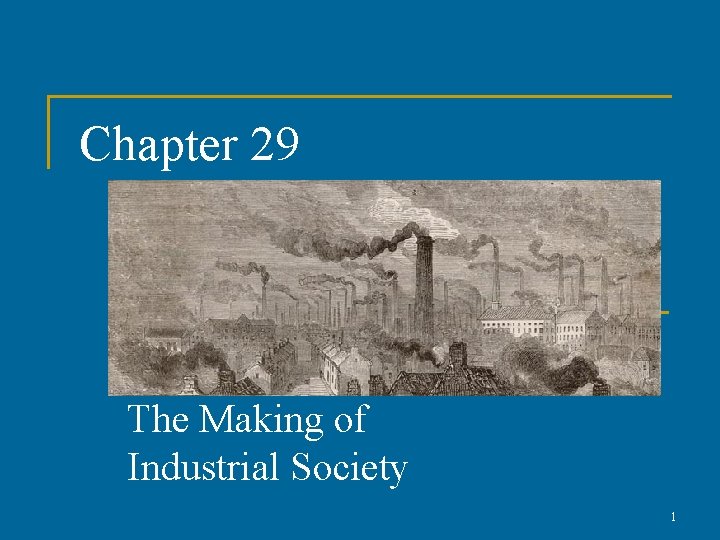
Chapter 29 The Making of Industrial Society 1
Overview: The Industrial Revolution n n Energy: Coal and steam replace wind, water, and human and animal labor Organization: Factories over cottage industries Urbanization: Rural agriculture declines, urban manufacturing increases Transportation: Steam-powered trains and ships replace animals and wind-driven vessels 2
Overview: Creation of New Classes n n Emerging Middle Class: “White-collar” clerks and managers in new industrial enterprises Urban proletariat: Laborers increasingly unskilled by mechanization of production Shift in political power: From aristocratic landholders to new industrial capitalists Industrialization and the Social Imagination: Sparks ideas for new political systems, especially socialist/Marxist ones 3
Overview: Unexpected Costs of the Industrial Revolution n Genesis of an environmental catastrophe q q n Intellectual Underpinnings: Faith in human domination over natural resources Unforeseen Consequences: Toxic waste, pollution, and occupational hazards created by industrial processes Social ills q q q Landless proletariat leads to creation of urban slums Urban workers lead lives of instability Increase in crime 4
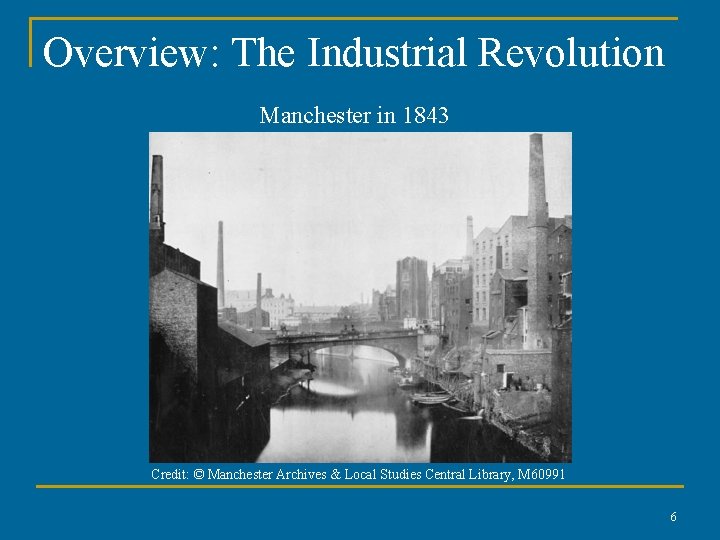
Overview: The Industrial Revolution From Charles Dickens’s Hard Times (1854) describing Coketown, a fictionalized Northern English mill-town: It was a town of red brick, or of brick that would have been red if the smoke and ashes had allowed it; but as matters stood, it was a town of unnatural red and black like the painted face of a savage. It was a town of machinery and tall chimneys, out of which interminable serpents of smoke trailed themselves for ever and ever, and never got uncoiled. It had a black canal in it, and a river that ran purple with illsmelling dye, and vast piles of building full of windows where there was a rattling and a trembling all day long, and where the piston of the steam-engine worked monotonously up and down, like the head of an elephant in a state of melancholy madness. It contained several large streets all very like one another, and many small streets still more like one another, inhabited by people equally like one another, who all went in and out at the same hours, with the same sound upon the same pavements, to do the same work, and to whom every day was the same as yesterday and to-morrow, and every year the counterpart of the last and the next. 5
Overview: The Industrial Revolution Manchester in 1843 Credit: © Manchester Archives & Local Studies Central Library, M 60991 6
Genesis of the Industrial Revolution n n Great Britain in the 1780 s: the birthplace of industrial production Followed an agricultural revolution q q q Food surplus Increase in disposable income Population increase n n Market for manufactured goods increases Labor supply increases, making it cheaper 7
British Advantages n Natural resources q n Ease of transportation q q n Plentiful coal and iron ore deposits Small and compact country Goods easily transported via river and canal systems Colonies q q q Raw goods imported from colonies Colonies provide market for manufactured goods, especially machine-made textiles Slave-produced sugar in the New World creates flows of trade and capital that create incentives for industrialization 8
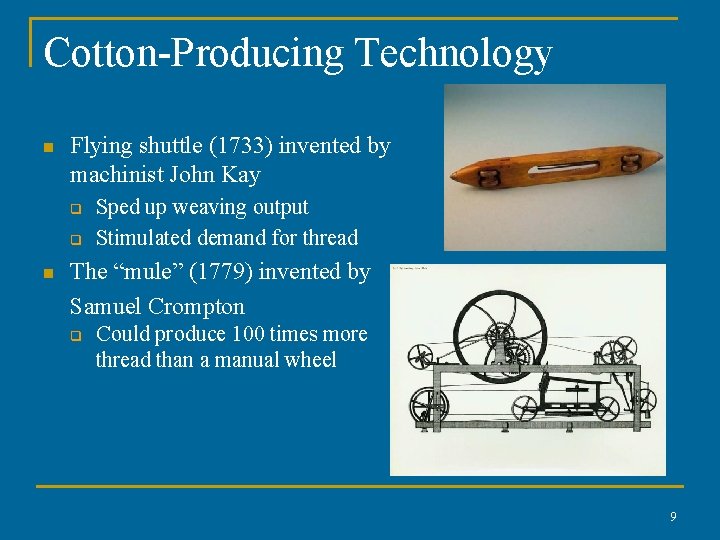
Cotton-Producing Technology n Flying shuttle (1733) invented by machinist John Kay q q n Sped up weaving output Stimulated demand for thread The “mule” (1779) invented by Samuel Crompton q Could produce 100 times more thread than a manual wheel 9
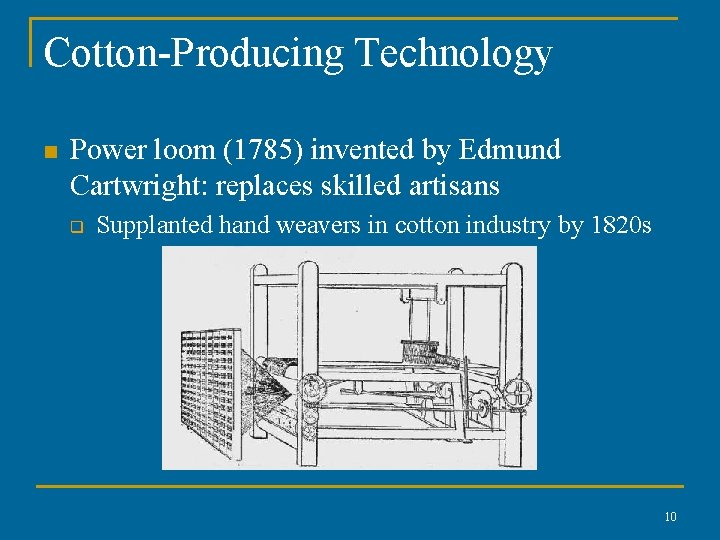
Cotton-Producing Technology n Power loom (1785) invented by Edmund Cartwright: replaces skilled artisans q Supplanted hand weavers in cotton industry by 1820 s 10
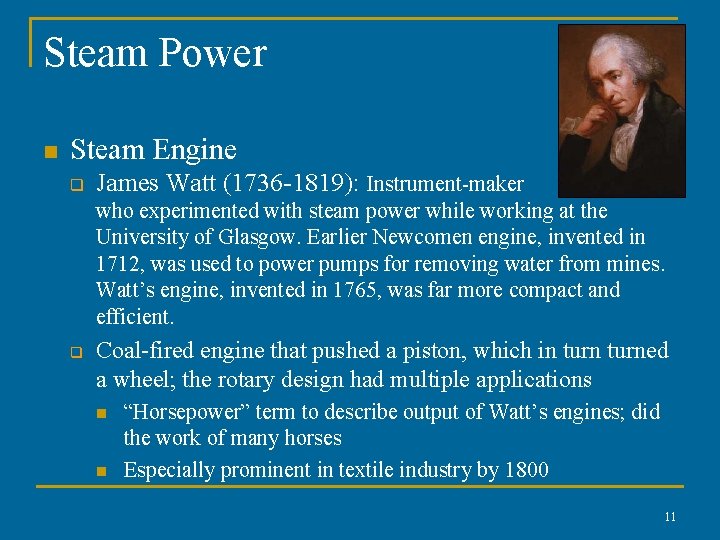
Steam Power n Steam Engine q James Watt (1736 -1819): Instrument-maker who experimented with steam power while working at the University of Glasgow. Earlier Newcomen engine, invented in 1712, was used to power pumps for removing water from mines. Watt’s engine, invented in 1765, was far more compact and efficient. q Coal-fired engine that pushed a piston, which in turned a wheel; the rotary design had multiple applications n n “Horsepower” term to describe output of Watt’s engines; did the work of many horses Especially prominent in textile industry by 1800 11
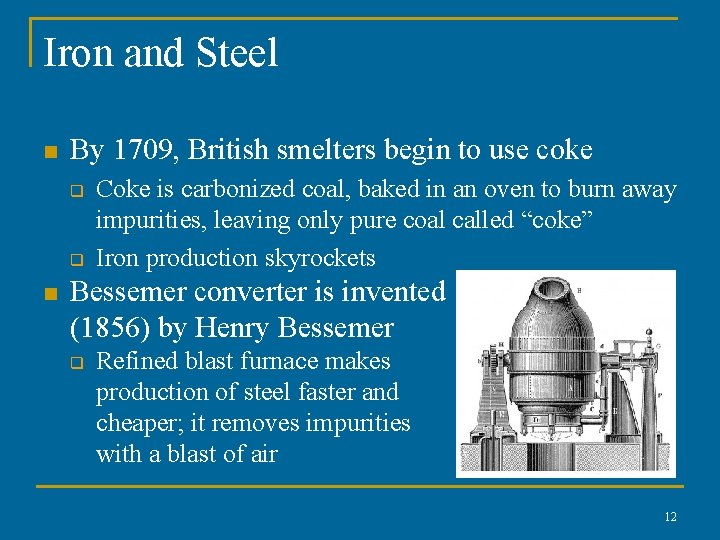
Iron and Steel n By 1709, British smelters begin to use coke q q n Coke is carbonized coal, baked in an oven to burn away impurities, leaving only pure coal called “coke” Iron production skyrockets Bessemer converter is invented (1856) by Henry Bessemer q Refined blast furnace makes production of steel faster and cheaper; it removes impurities with a blast of air 12
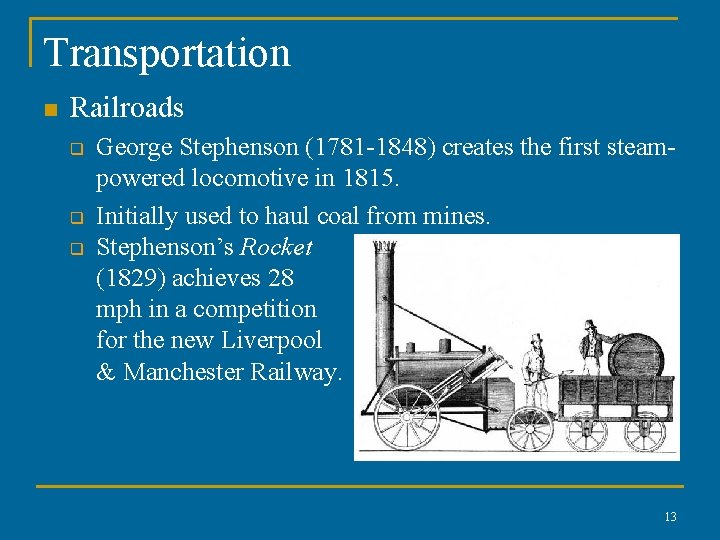
Transportation n Railroads q q q George Stephenson (1781 -1848) creates the first steampowered locomotive in 1815. Initially used to haul coal from mines. Stephenson’s Rocket (1829) achieves 28 mph in a competition for the new Liverpool & Manchester Railway. 13
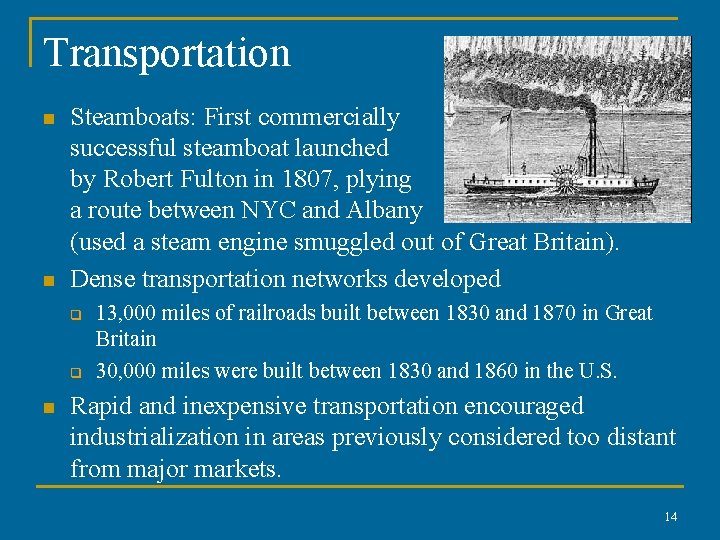
Transportation n n Steamboats: First commercially successful steamboat launched by Robert Fulton in 1807, plying a route between NYC and Albany (used a steam engine smuggled out of Great Britain). Dense transportation networks developed q q n 13, 000 miles of railroads built between 1830 and 1870 in Great Britain 30, 000 miles were built between 1830 and 1860 in the U. S. Rapid and inexpensive transportation encouraged industrialization in areas previously considered too distant from major markets. 14
The Factory System n “Putting-out” system used in early modern era: used in production of clothing, shoemaking, small firearms, etc. q q n Comes into widespread use in the 17 th and 18 th centuries in England Western Europe Subcontracted individuals work at home so that employers can avoid wage restrictions of guilds Rising prices cause factories to replace both guilds and putting-out system q q q Machines too large and expensive for home use Large buildings could house specialized laborers Urbanization guarantees supply of cheap unskilled labor 15
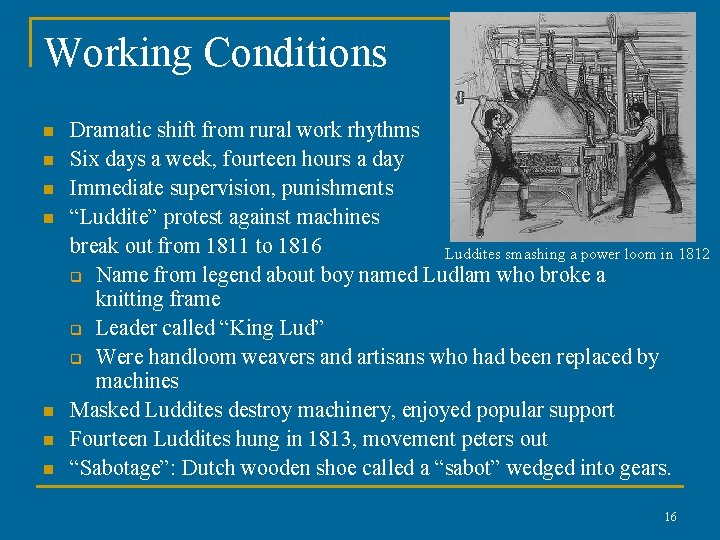
Working Conditions n n n n Dramatic shift from rural work rhythms Six days a week, fourteen hours a day Immediate supervision, punishments “Luddite” protest against machines break out from 1811 to 1816 Luddites smashing a power loom in 1812 q Name from legend about boy named Ludlam who broke a knitting frame q Leader called “King Lud” q Were handloom weavers and artisans who had been replaced by machines Masked Luddites destroy machinery, enjoyed popular support Fourteen Luddites hung in 1813, movement peters out “Sabotage”: Dutch wooden shoe called a “sabot” wedged into gears. 16
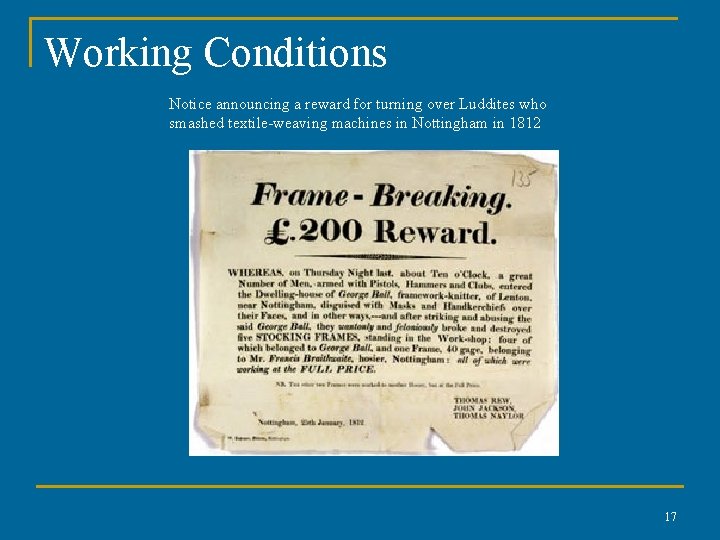
Working Conditions Notice announcing a reward for turning over Luddites who smashed textile-weaving machines in Nottingham in 1812 17
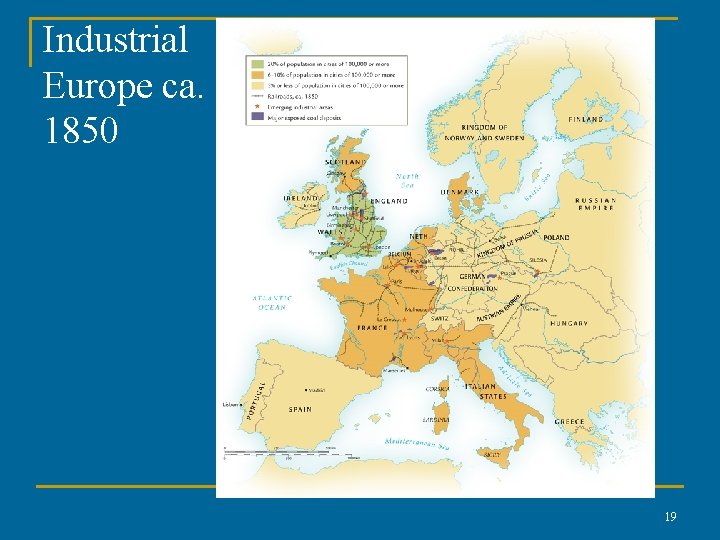
Spread of Industrialization n Western Europe q q Spread to Germany, Belgium, France by mid-1800 s French revolution and Napoleonic wars delay industrialization on the Continent, but also set stage for industrialization n n q Abolishes internal trade barriers Dismantles guilds After 1871, Bismarck pushes for state sponsorship of rapid industrialization in Germany, and the nation accomplished this quickly 18
Industrial Europe ca. 1850 19
Industrialization in North America n n n First New England water-powered textile mill established in 1793 in Rhode Island by Samuel Slater Industry develops on a wider scale in New England in the 1820 s with cotton mills Crude oil in Pennsylvania begins to be distilled for kerosene for lighting in the 1850 s (replaces whale oil); distilled for gasoline after internal combustion engine is invented in 1880 s By the 1870 s, heavy iron and steel industries emerges in Pennsylvania and Alabama. By 1900, the U. S. an economic powerhouse, with industrialization spilling over into Canada. Massive railroad construction stimulates industry: steel for rails and bridges, telegraph lines for communication, etc. 20
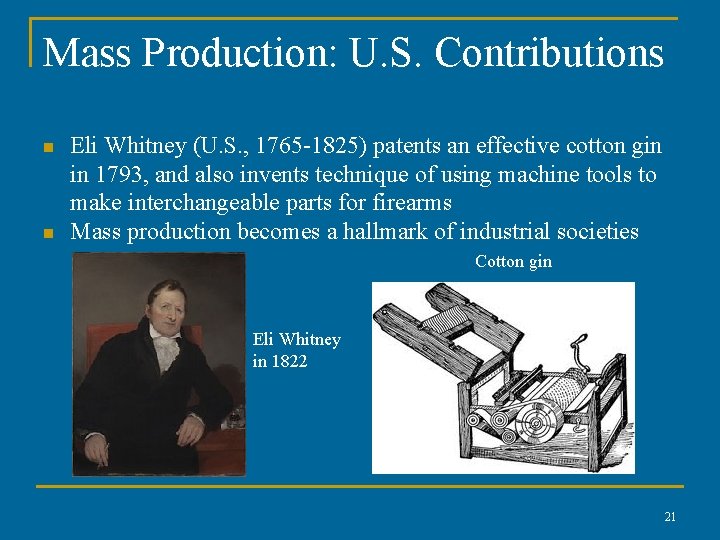
Mass Production: U. S. Contributions n n Eli Whitney (U. S. , 1765 -1825) patents an effective cotton gin in 1793, and also invents technique of using machine tools to make interchangeable parts for firearms Mass production becomes a hallmark of industrial societies Cotton gin Eli Whitney in 1822 21
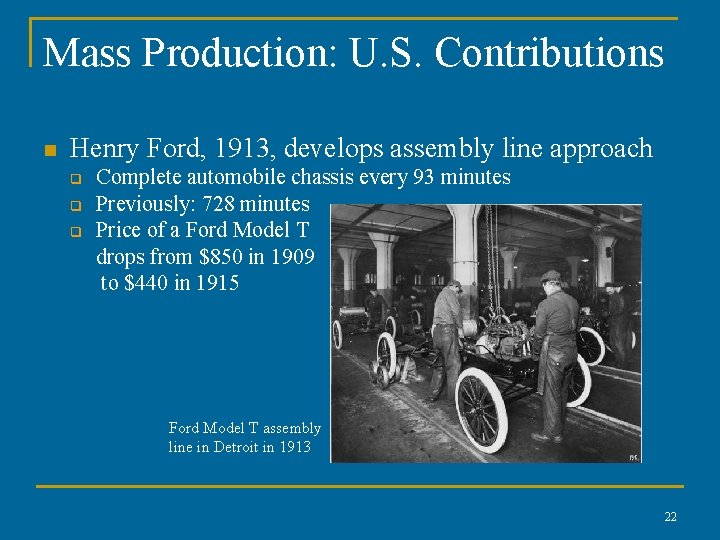
Mass Production: U. S. Contributions n Henry Ford, 1913, develops assembly line approach q q q Complete automobile chassis every 93 minutes Previously: 728 minutes Price of a Ford Model T drops from $850 in 1909 to $440 in 1915 Ford Model T assembly line in Detroit in 1913 22
Industrial Capitalism n n n Large factories require a huge amount of start-up capital; beyond the means of small entrepreneurs Corporations formed to share risk and maximize profits Britain and France laid the legal foundations for modern corporation in 1850 -1860 s; the British Limited Liability Act of 1855 was particularly important 23
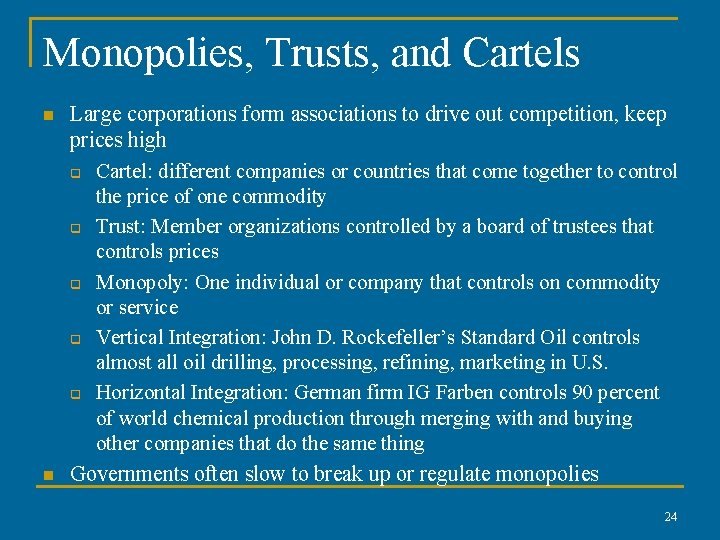
Monopolies, Trusts, and Cartels n n Large corporations form associations to drive out competition, keep prices high q Cartel: different companies or countries that come together to control the price of one commodity q Trust: Member organizations controlled by a board of trustees that controls prices q Monopoly: One individual or company that controls on commodity or service q Vertical Integration: John D. Rockefeller’s Standard Oil controls almost all oil drilling, processing, refining, marketing in U. S. q Horizontal Integration: German firm IG Farben controls 90 percent of world chemical production through merging with and buying other companies that do the same thing Governments often slow to break up or regulate monopolies 24
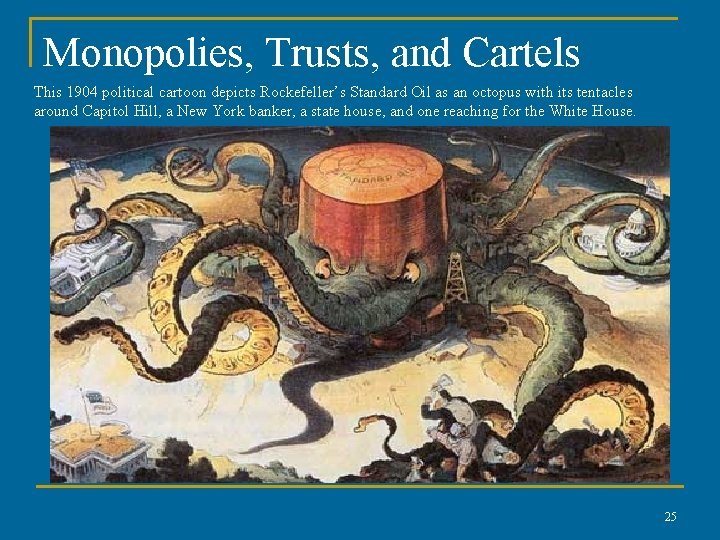
Monopolies, Trusts, and Cartels This 1904 political cartoon depicts Rockefeller’s Standard Oil as an octopus with its tentacles around Capitol Hill, a New York banker, a state house, and one reaching for the White House. 25
Industrial Demographics n Technological Innovation q q n “American System”: standardized parts for everything from revolvers to sewing machines Cheaper Food: Improved agricultural tools and better transportation lowers prices Cheap Manufactured Goods q q Textiles: Cheap and washable cotton clothes affordable for all but the desperately poor. Housewares: Furniture, porcelain, cabinets, and decorative objects far cheaper than in the past. 26
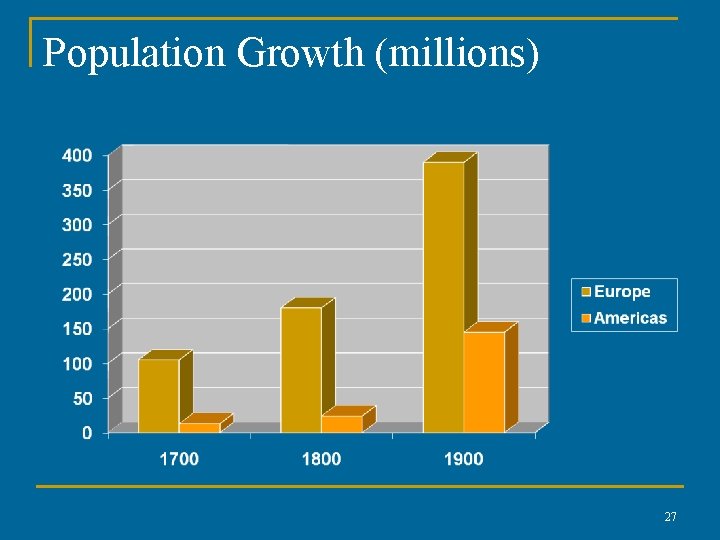
Population Growth (millions) 27
The Demographic Transition n Industrialization results in marked decline of both fertility and mortality q q Better diets Improved disease control n q English scientists Edmund Jenner (1749 -1823) develops the smallpox vaccine (1797); cowpox not deadly, but provides immunity to smallpox Declining fertility n Less need to have bigger families in industrial societies: less workers needed and more children survive 28
Contraception n Ancient and medieval methods: depositories or potions to induce miscarriage pose health risks Thomas Malthus (1766 -1834) predicts overpopulation crisis, advocates “moral restraint” Condom first efficient means of contraception without negative side effects q Made from animal intestines in seventeenth century, latex in nineteenth century 29
The Urban Environment n Urbanization proceeds dramatically q q n n 1800: only 20 percent of Britons live in towns with population over 10, 000 1900: 75 percent of Britons live in such places Intensified industrial pollution: fossil fuels like coal befoul air and water with particulates, makes breathing difficult City centers become overcrowded, unsanitary: outbreaks of cholera, typhus, tuberculosis, and dysentery. 30
Transcontinental Migrations n Nineteenth to early twentieth century, rapid population growth drives Europeans to Americas q q q 50 million cross Atlantic Britons to avoid urban slums, Irish to avoid potato famines of 1840 s, Jews to escape pogroms in the 1880 s in Russia United States is favored destination, but some go elsewhere: Argentina, Canada, Australia, etc. 31
New Social Classes n n n Economic factors result in decline of slavery Capitalist wealth brings new status to non-aristocratic families New urban classes of professionals Blue-collar factory workers Urban environment also creates new types of diversions q q Sporting events: European soccer and American baseball Leisure activities: bars and pubs, gambling, cockfighting and dogfighting 32
Women at Home and Work n n Agricultural and cottage industry work involved women: within the domestic sphere Role of men as prime breadwinners: Middle-class women supposed to remain in private/domestic sphere. Poor women become cheap labor: could be paid less than men. Double burden: Poorer women expected to maintain home as well as work since men’s wage can’t support family q n Women often work in domestic service Child labor: Women would often take children to work and have them work due to lack of daycare facilities 33
Child Labor n n Why Child Workers? Easily exploited, abused, and controlled Child Labor Laws in Britain • • • n n Cotton Factories Act in 1819: Made 9 years the minimum age to work, and limit of 12 hour workday for kids. Regulation Act in 1833: Funds inspectors to enforce laws Ten Hours Bill of 1847: Limits workday for women and children Moral concerns gradually remove children from labor pool Need for educated workforce: Education of children from 5 to 10 years old becomes mandatory in England in 1881. 34
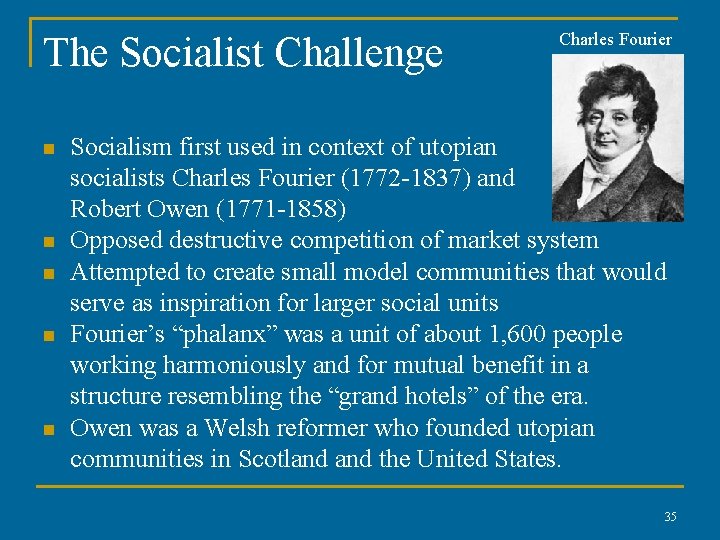
The Socialist Challenge n n n Charles Fourier Socialism first used in context of utopian socialists Charles Fourier (1772 -1837) and Robert Owen (1771 -1858) Opposed destructive competition of market system Attempted to create small model communities that would serve as inspiration for larger social units Fourier’s “phalanx” was a unit of about 1, 600 people working harmoniously and for mutual benefit in a structure resembling the “grand hotels” of the era. Owen was a Welsh reformer who founded utopian communities in Scotland the United States. 35
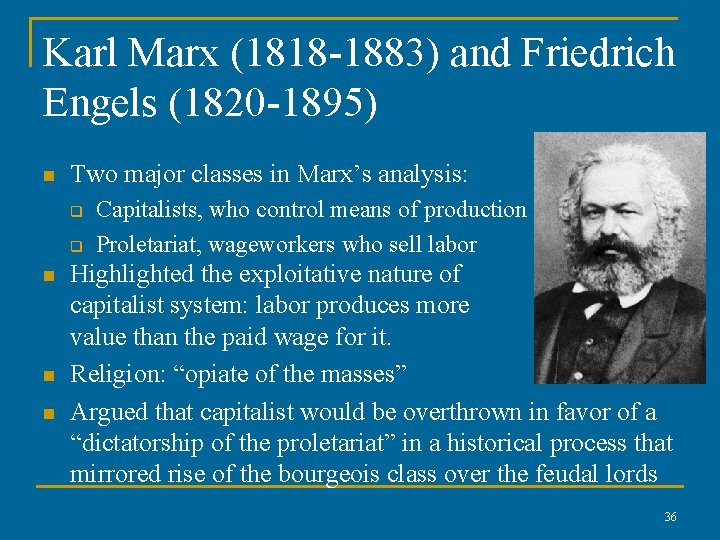
Karl Marx (1818 -1883) and Friedrich Engels (1820 -1895) n Two major classes in Marx’s analysis: q q n n n Capitalists, who control means of production Proletariat, wageworkers who sell labor Highlighted the exploitative nature of capitalist system: labor produces more value than the paid wage for it. Religion: “opiate of the masses” Argued that capitalist would be overthrown in favor of a “dictatorship of the proletariat” in a historical process that mirrored rise of the bourgeois class over the feudal lords 36
Social Reform and Trade Unions n Socialism had major impact on nineteenth-century reformers q n Addressed issues of medical insurance, unemployment compensation, retirement benefits Trade unions form for collective bargaining q q Strikes to address workers’ concerns Trade unions had major political influence in conservative imperial Germany: merger of two workers’ parties creates the Socialist Workers' Party of Germany in 1875. Though outlawed, it gained strength. 37
Global Effects n Global division of labor q q n n Rural societies that produce raw materials Urban societies that produce manufactured goods Uneven economic development Export dependency in Latin America, sub-Saharan Africa, south and southeast Asia q q Low wages and small domestic markets for manufactured goods Economies reliant on one or two export commodities 38