A Clinical Update on Intrauterine Contraception Nikole D






- Slides: 101
A Clinical Update on Intrauterine Contraception Nikole D. Gettings, CNM, MSN Presented by Memphis Center for Reproductive Health thanks to generous grant from MAC AIDS Association of Reproductive Health Professionals www. arhp. org
Expert Medical Advisory Committee • David A. Grimes, MD • Kirtly Parker Jones, MD • Chris Knutson, MN, ANP • Patricia Murphy, CNM, Dr. PH • Carolyn Westhoff, MD • Susan Wysocki, RN-C, NP
Learning Objectives • Name the two forms of intrauterine contraception available in the United States • Rank efficacy associated with intrauterine contraceptives compared with other contraceptive methods • List three selection criteria for appropriate candidates for intrauterine contraception more…
Learning Objectives (continued) • Identify two possible side effects of each type of intrauterine contraceptive • Develop skills required for proper insertion techniques for the two methods of intrauterine contraception • Discuss strategies for follow-up of intrauterine contraceptive users
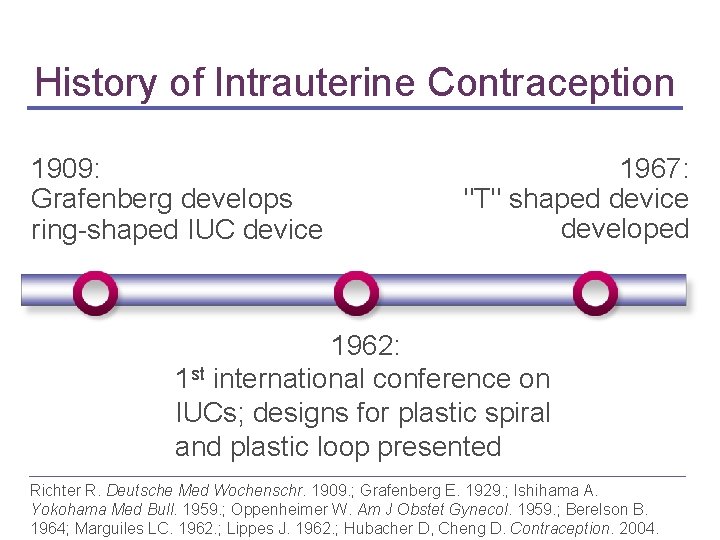
History of Intrauterine Contraception 1909: Grafenberg develops ring-shaped IUC device 1967: "T" shaped device developed 1962: 1 st international conference on IUCs; designs for plastic spiral and plastic loop presented Richter R. Deutsche Med Wochenschr. 1909. ; Grafenberg E. 1929. ; Ishihama A. Yokohama Med Bull. 1959. ; Oppenheimer W. Am J Obstet Gynecol. 1959. ; Berelson B. 1964; Marguiles LC. 1962. ; Lippes J. 1962. ; Hubacher D, Cheng D. Contraception. 2004.
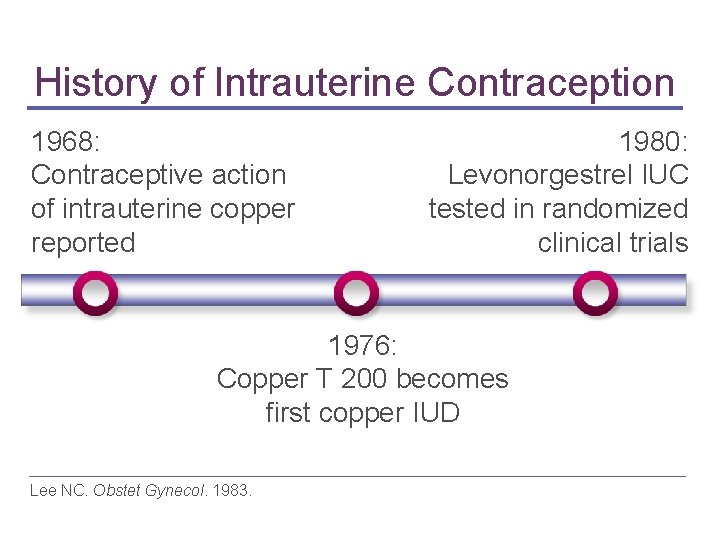
History of Intrauterine Contraception 1968: Contraceptive action of intrauterine copper reported 1980: Levonorgestrel IUC tested in randomized clinical trials 1976: Copper T 200 becomes first copper IUD Lee NC. Obstet Gynecol. 1983.
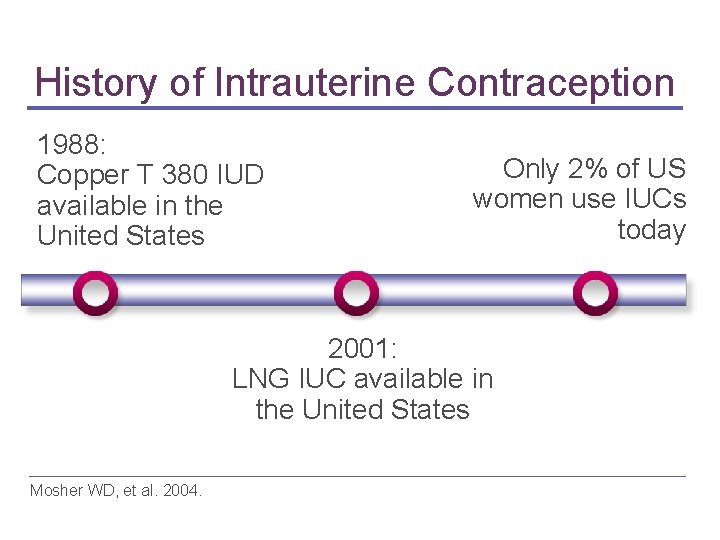
History of Intrauterine Contraception 1988: Copper T 380 IUD available in the United States Only 2% of US women use IUCs today 2001: LNG IUC available in the United States Mosher WD, et al. 2004.
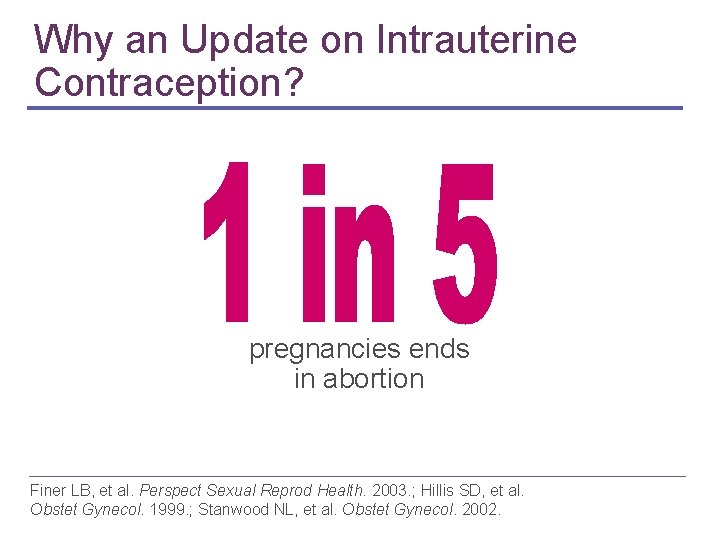
Why an Update on Intrauterine Contraception? pregnancies ends in abortion Finer LB, et al. Perspect Sexual Reprod Health. 2003. ; Hillis SD, et al. Obstet Gynecol. 1999. ; Stanwood NL, et al. Obstet Gynecol. 2002.
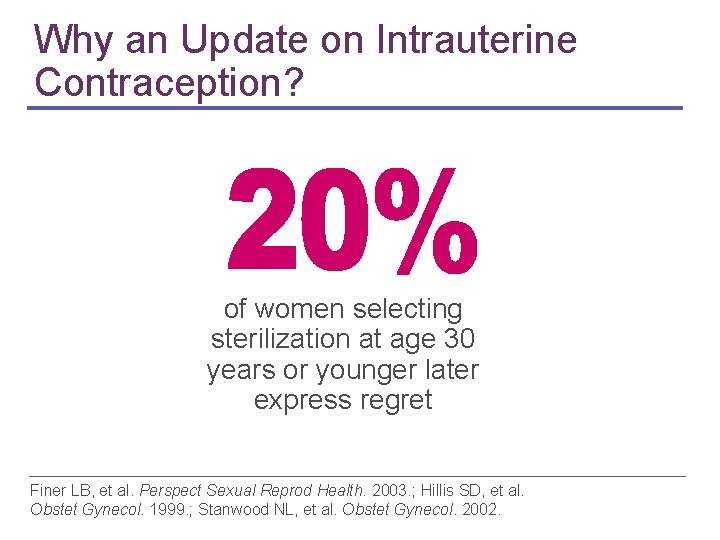
Why an Update on Intrauterine Contraception? of women selecting sterilization at age 30 years or younger later express regret Finer LB, et al. Perspect Sexual Reprod Health. 2003. ; Hillis SD, et al. Obstet Gynecol. 1999. ; Stanwood NL, et al. Obstet Gynecol. 2002.
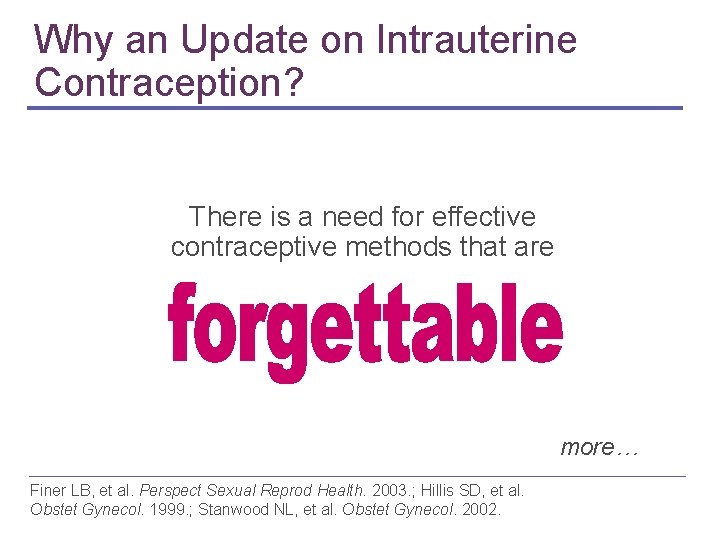
Why an Update on Intrauterine Contraception? There is a need for effective contraceptive methods that are more… Finer LB, et al. Perspect Sexual Reprod Health. 2003. ; Hillis SD, et al. Obstet Gynecol. 1999. ; Stanwood NL, et al. Obstet Gynecol. 2002.
Why an Update on Intrauterine Contraception? (Continued) • Myths exist about intrauterine contraception • Selection of candidates is unduly restrictive • Misinformation about intrauterine contraception among providers and patients is common Stanwood NL, et al. Obstet Gynecol. 2002. Weiss E, et al. Contraception. 2003.
Presentation Outline • Contraceptive Use • Overview of Intrauterine Contraception • Patient Screening and Counseling for IUCs • IUC Insertion and Management
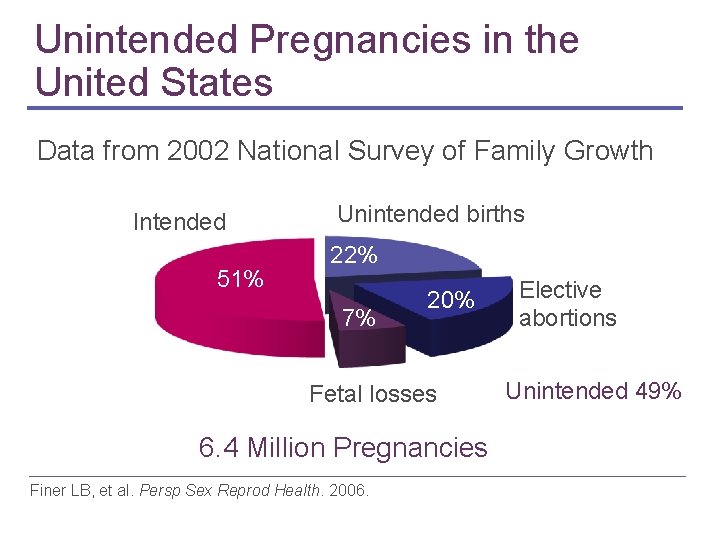
Unintended Pregnancies in the United States Data from 2002 National Survey of Family Growth Intended 51% Unintended births 22% 7% 20% Fetal losses 6. 4 Million Pregnancies Finer LB, et al. Persp Sex Reprod Health. 2006. Elective abortions Unintended 49%
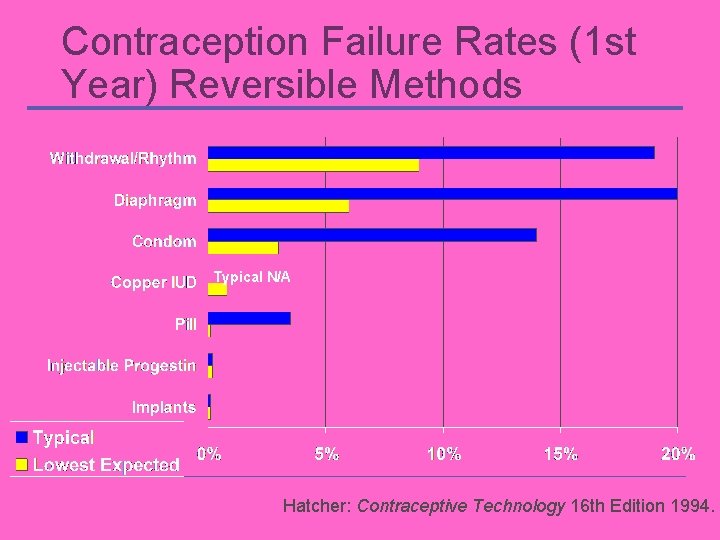
Contraception Failure Rates (1 st Year) Reversible Methods Typical N/A Hatcher: Contraceptive Technology 16 th Edition 1994.
Question Why are there so many unintended pregnancies in the United States?
Case Study • 31 yo, G 2 P 2, postpartum 12 weeks • Breastfeeding • Doesn’t want more children • Considering sterilization— not sure • Makes appointment for IUC • Doesn’t return for insertion • Why not?
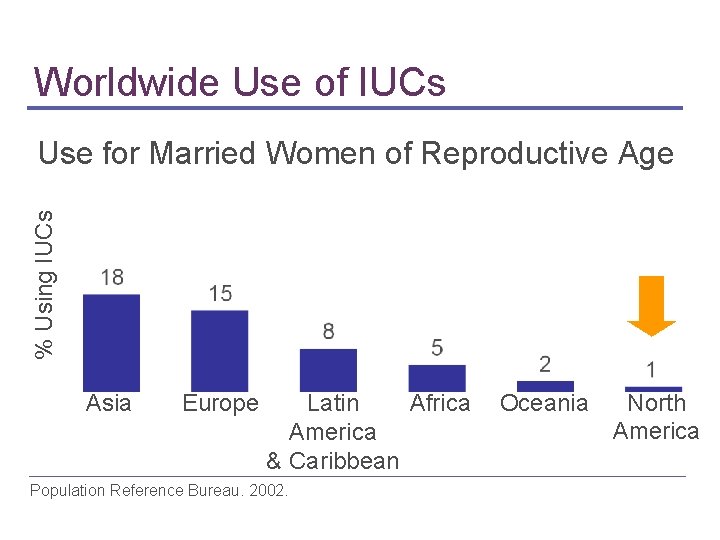
Worldwide Use of IUCs % Using IUCs Use for Married Women of Reproductive Age Asia Europe Latin Africa America & Caribbean Population Reference Bureau. 2002. Oceania North America
Question Why is contraceptive use different in other parts of the world?
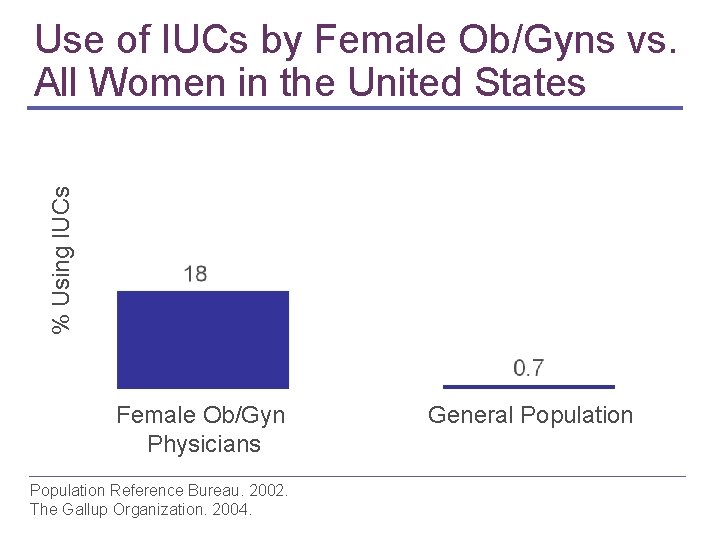
% Using IUCs Use of IUCs by Female Ob/Gyns vs. All Women in the United States Female Ob/Gyn Physicians Population Reference Bureau. 2002. The Gallup Organization. 2004. General Population
Question What do female ob/gyns know about intrauterine contraception that the average American woman doesn’t?
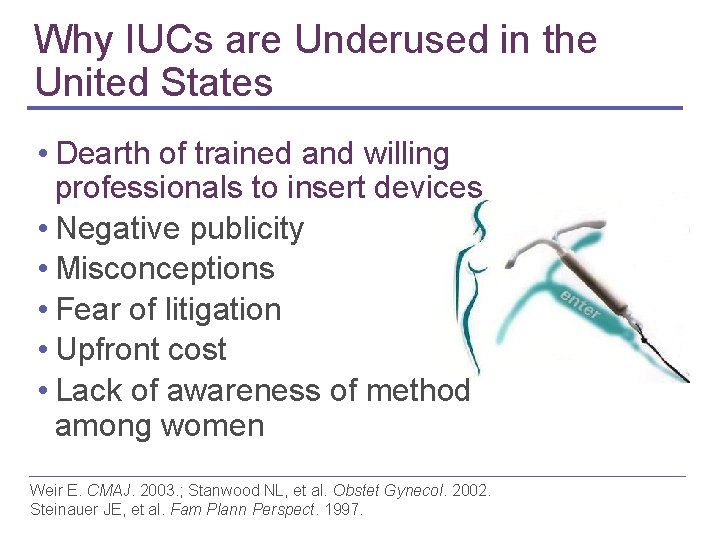
Why IUCs are Underused in the United States • Dearth of trained and willing professionals to insert devices • Negative publicity • Misconceptions • Fear of litigation • Upfront cost • Lack of awareness of method among women Weir E. CMAJ. 2003. ; Stanwood NL, et al. Obstet Gynecol. 2002. Steinauer JE, et al. Fam Plann Perspect. 1997.
What Do Women Find Unacceptable About IUCs? • Lack of objective information • Reported side effects • Anxiety about IUC insertion • Infection risk • Lack of personal control of IUC after insertion Asker C, et al. J Fam Plann Reprod Health Care. 2006.
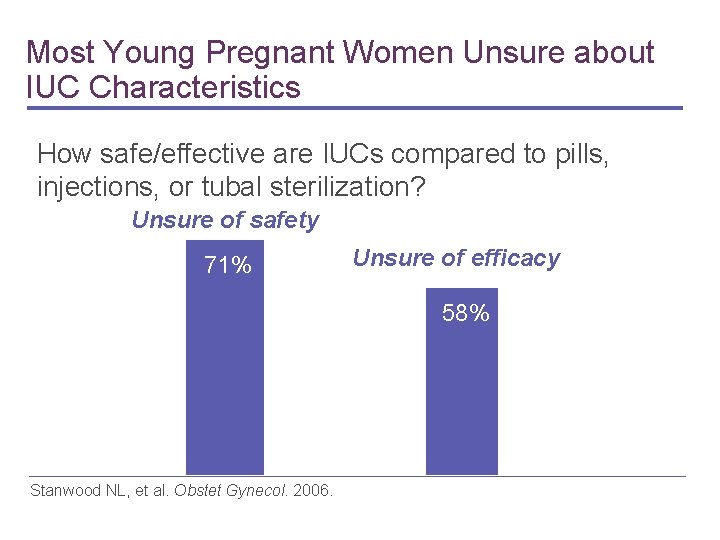
Most Young Pregnant Women Unsure about IUC Characteristics How safe/effective are IUCs compared to pills, injections, or tubal sterilization? Unsure of safety 71% Unsure of efficacy 58% Stanwood NL, et al. Obstet Gynecol. 2006.
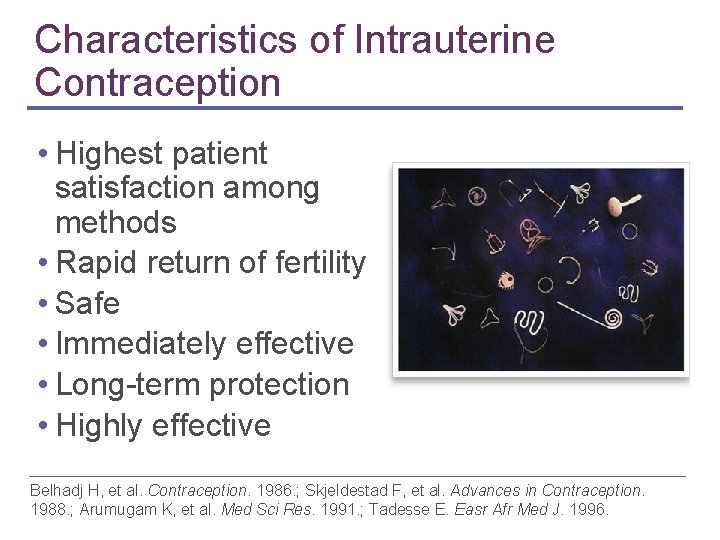
Characteristics of Intrauterine Contraception • Highest patient satisfaction among methods • Rapid return of fertility • Safe • Immediately effective • Long-term protection • Highly effective Belhadj H, et al. Contraception. 1986. ; Skjeldestad F, et al. Advances in Contraception. 1988. ; Arumugam K, et al. Med Sci Res. 1991. ; Tadesse E. Easr Afr Med J. 1996.
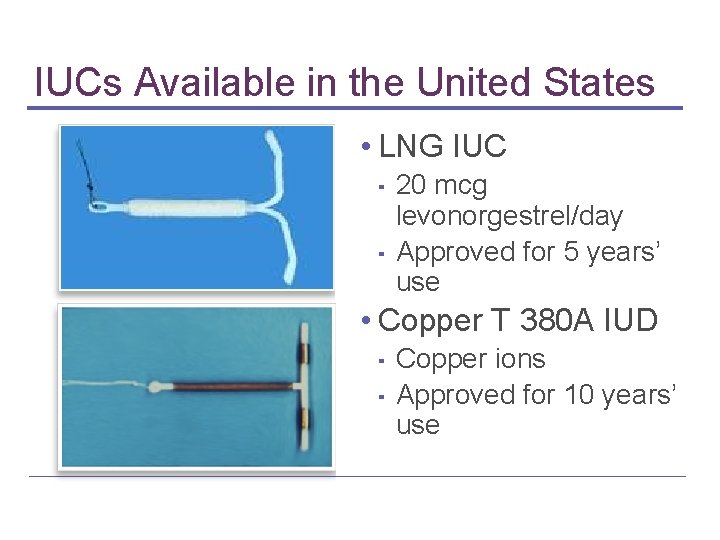
IUCs Available in the United States • LNG IUC ▪ ▪ 20 mcg levonorgestrel/day Approved for 5 years’ use • Copper T 380 A IUD ▪ ▪ Copper ions Approved for 10 years’ use
Dispelling Common Myths About IUCs In fact, IUCs: • Are not abortifacients • Do not cause ectopic pregnancies • Do not cause pelvic infection • Do not decrease the likelihood of future pregnancies • Are not large in size more… Hubacher D, et al. N Engl J Med. 2001. ; Stanwood NL, et al. Obstet Gynecol. 2002. Forrest JD. Obstet Gynecol Surv. 1996. ; Lippes J. Am J Obstet Gynecol. 1999.
Dispelling Common Myths About IUCs (continued) In fact, IUCs: • Can be used by nulliparous women • Can be used by women who have had an ectopic pregnancy • Do not need to be removed for PID treatment • Do not have to be removed if actinomyceslike organisms (ALO) are noted on a Pap test Duenas JL. Contraception. 1996. ; Stanwood NL. Obstet Gynecol. 2002. Forrest JD. Obstet Gynecol Surv. 1996; Lippes J. Am J Obstet Gynecol. 1999. Otero-Flores JB. Contraception. 2003. ; WHO. 2004. ; Penney G. J Fam Plann Reprod Health Care. 2004.
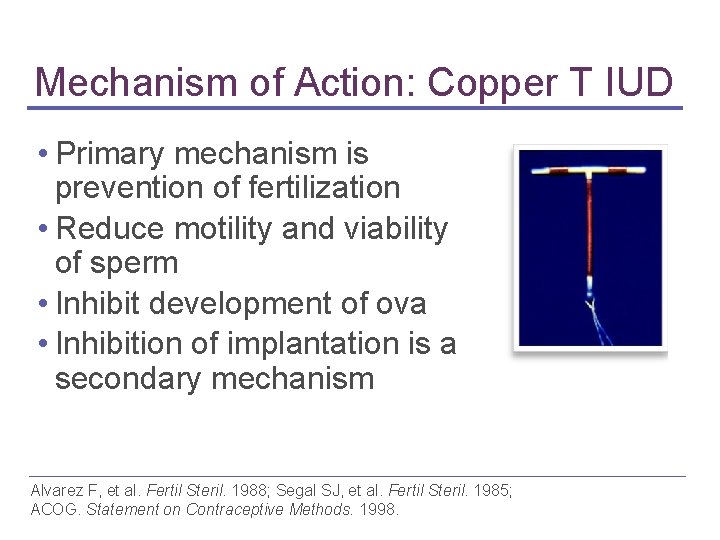
Mechanism of Action: Copper T IUD • Primary mechanism is prevention of fertilization • Reduce motility and viability of sperm • Inhibit development of ova • Inhibition of implantation is a secondary mechanism Alvarez F, et al. Fertil Steril. 1988; Segal SJ, et al. Fertil Steril. 1985; ACOG. Statement on Contraceptive Methods. 1998.
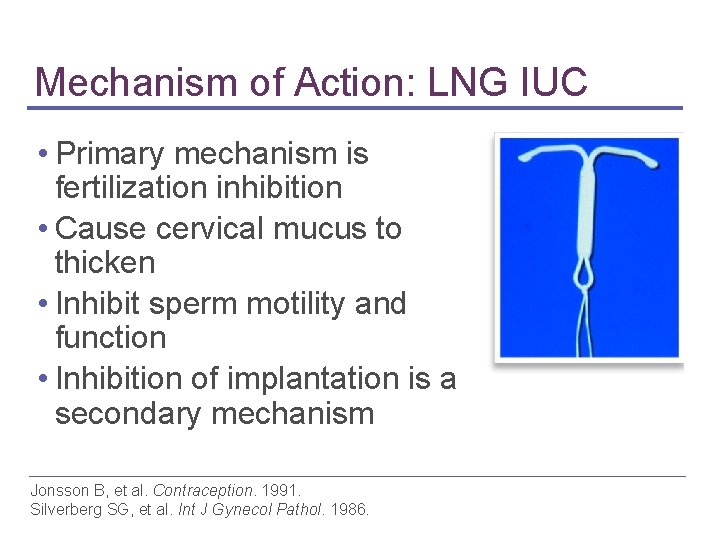
Mechanism of Action: LNG IUC • Primary mechanism is fertilization inhibition • Cause cervical mucus to thicken • Inhibit sperm motility and function • Inhibition of implantation is a secondary mechanism Jonsson B, et al. Contraception. 1991. Silverberg SG, et al. Int J Gynecol Pathol. 1986.
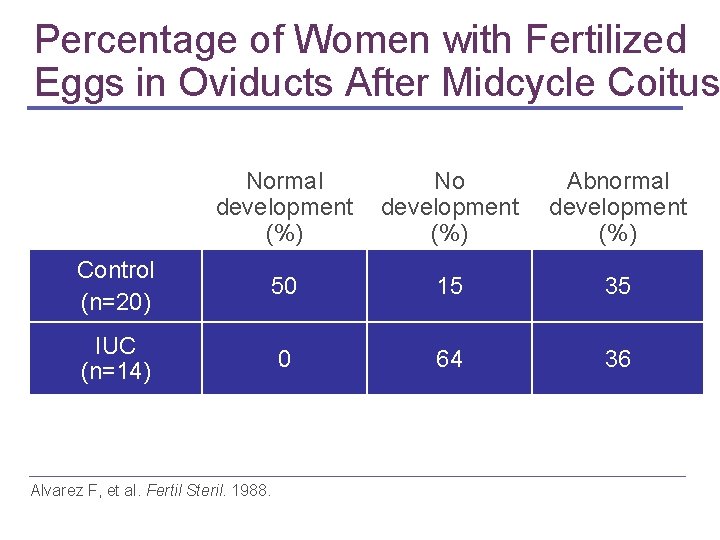
Percentage of Women with Fertilized Eggs in Oviducts After Midcycle Coitus Normal development (%) No development (%) Abnormal development (%) Control (n=20) 50 15 35 IUC (n=14) 0 64 36 Alvarez F, et al. Fertil Steril. 1988.
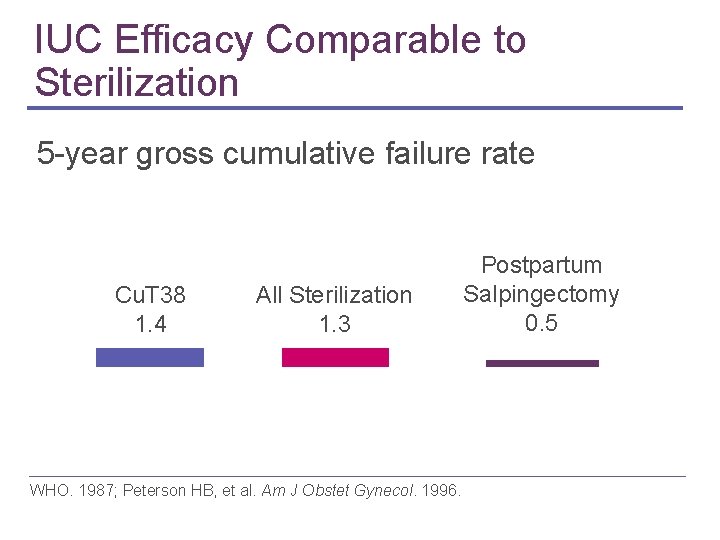
IUC Efficacy Comparable to Sterilization 5 -year gross cumulative failure rate Cu. T 38 1. 4 All Sterilization 1. 3 WHO. 1987; Peterson HB, et al. Am J Obstet Gynecol. 1996. Postpartum Salpingectomy 0. 5
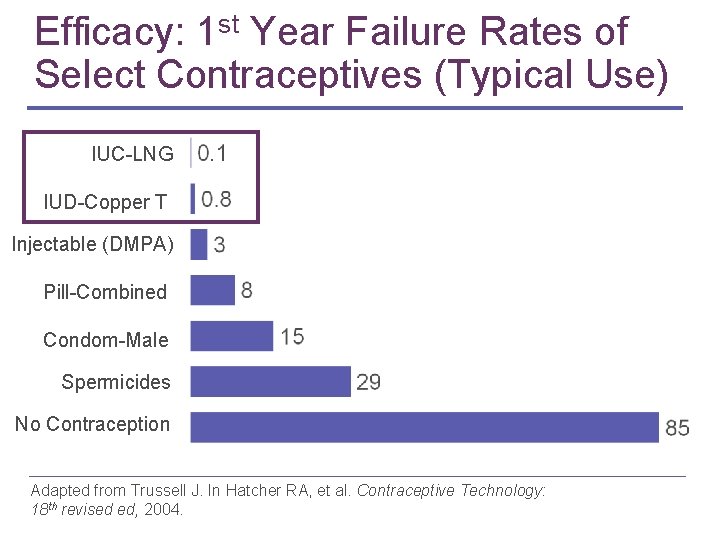
Efficacy: 1 st Year Failure Rates of Select Contraceptives (Typical Use) IUC-LNG IUD-Copper T Injectable (DMPA) Pill-Combined Condom-Male Spermicides No Contraception Adapted from Trussell J. In Hatcher RA, et al. Contraceptive Technology: 18 th revised ed, 2004.
Safety: Overview Recent data continue to demonstrate the safety of the current IUCs Hubacher D, et al. NEJM. 2001; Nelson AL. Obstet Gynecol N Am. 2000; Meirik O, et al. Obstet Gynecol. 2001.
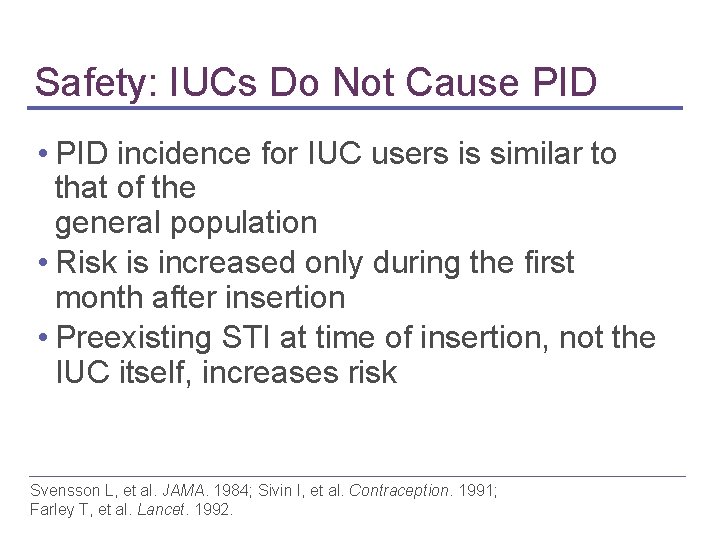
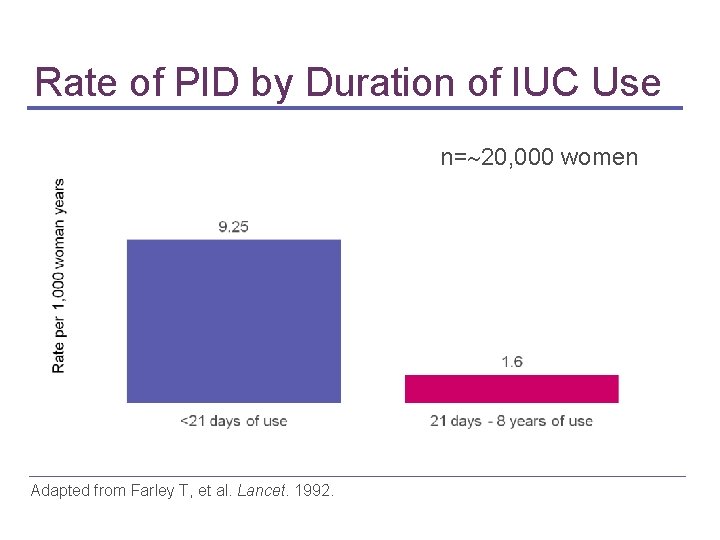
Safety: IUCs Do Not Cause PID • PID incidence for IUC users is similar to that of the general population • Risk is increased only during the first month after insertion • Preexisting STI at time of insertion, not the IUC itself, increases risk Svensson L, et al. JAMA. 1984; Sivin I, et al. Contraception. 1991; Farley T, et al. Lancet. 1992.
Rate of PID by Duration of IUC Use n= 20, 000 women Adapted from Farley T, et al. Lancet. 1992.
Risk of Fetal Abnormality • IUC is extra-amniotic • No increase in birth defects for copper IUD Atrash HK, et al. In: Proceedings from the Fourth International Conference on IUDs. 1994; Layde PM, et al. Fertil Steril. 1979; Simpson JL. Res Front Fertil Regul. 1985.
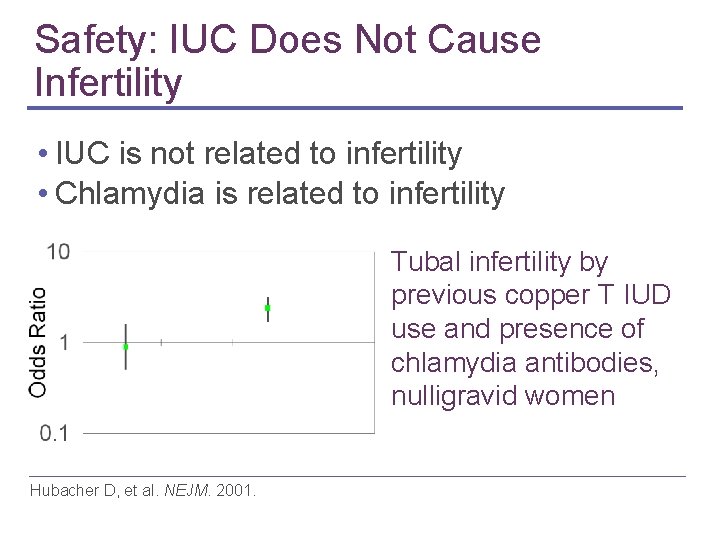
Safety: IUC Does Not Cause Infertility • IUC is not related to infertility • Chlamydia is related to infertility Tubal infertility by previous copper T IUD use and presence of chlamydia antibodies, nulligravid women Hubacher D, et al. NEJM. 2001.
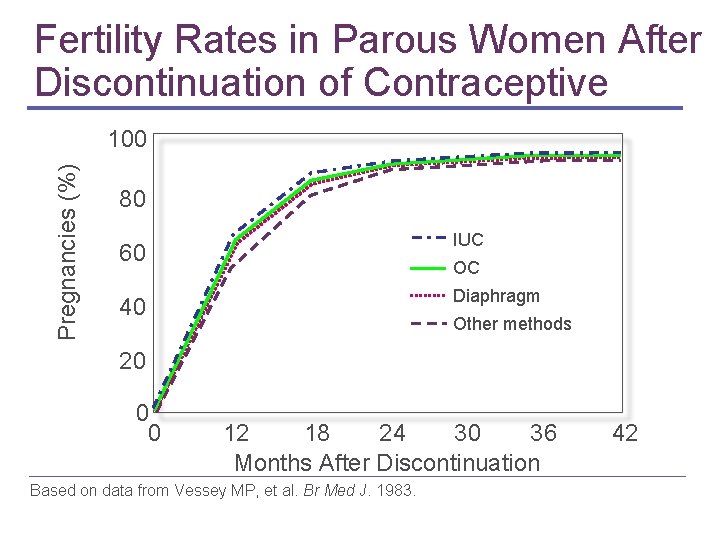
Fertility Rates in Parous Women After Discontinuation of Contraceptive Pregnancies (%) 100 80 IUC 60 OC Diaphragm 40 Other methods 20 0 0 12 18 24 30 36 Months After Discontinuation Based on data from Vessey MP, et al. Br Med J. 1983. 42
Safety: IUCs May Be Used by HIVPositive Women • No increased risk of complications compared with HIV-negative women • No increased cervical viral shedding • WHO Category 2 rating WHO. Medical Eligibility Criteria for Contraceptive Use. 2004; Morrison CS, et al. Brit J Obstet Gynaecol. 2001; Richardson B, et al. AIDS. 1999.
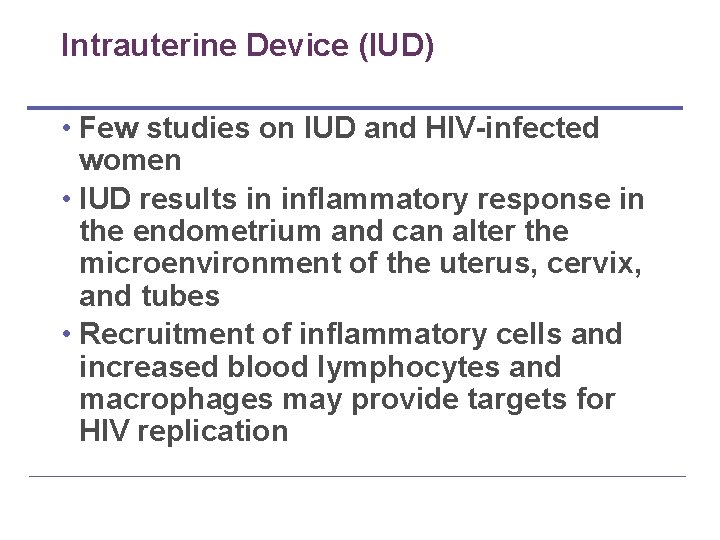
Intrauterine Device (IUD) • Few studies on IUD and HIV-infected women • IUD results in inflammatory response in the endometrium and can alter the microenvironment of the uterus, cervix, and tubes • Recruitment of inflammatory cells and increased blood lymphocytes and macrophages may provide targets for HIV replication
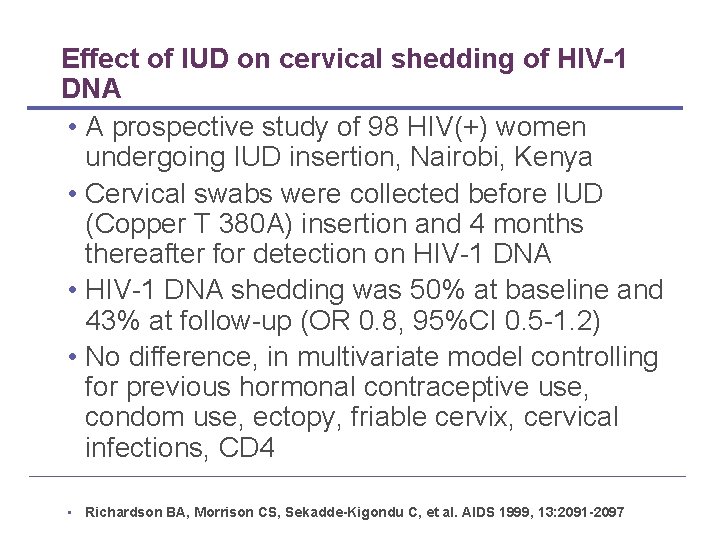
Effect of IUD on cervical shedding of HIV-1 DNA • A prospective study of 98 HIV(+) women undergoing IUD insertion, Nairobi, Kenya • Cervical swabs were collected before IUD (Copper T 380 A) insertion and 4 months thereafter for detection on HIV-1 DNA • HIV-1 DNA shedding was 50% at baseline and 43% at follow-up (OR 0. 8, 95%CI 0. 5 -1. 2) • No difference, in multivariate model controlling for previous hormonal contraceptive use, condom use, ectopy, friable cervix, cervical infections, CD 4 • Richardson BA, Morrison CS, Sekadde-Kigondu C, et al. AIDS 1999, 13: 2091 -2097
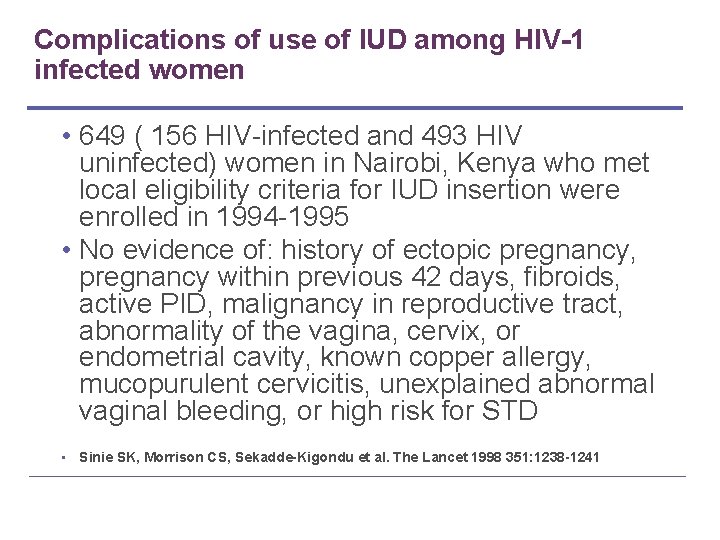
Complications of use of IUD among HIV-1 infected women • 649 ( 156 HIV-infected and 493 HIV uninfected) women in Nairobi, Kenya who met local eligibility criteria for IUD insertion were enrolled in 1994 -1995 • No evidence of: history of ectopic pregnancy, pregnancy within previous 42 days, fibroids, active PID, malignancy in reproductive tract, abnormality of the vagina, cervix, or endometrial cavity, known copper allergy, mucopurulent cervicitis, unexplained abnormal vaginal bleeding, or high risk for STD • Sinie SK, Morrison CS, Sekadde-Kigondu et al. The Lancet 1998 351: 1238 -1241
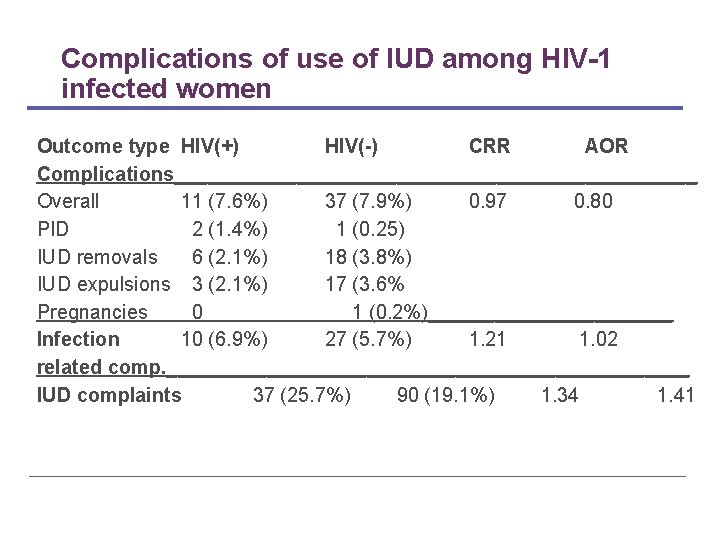
Complications of use of IUD among HIV-1 infected women Outcome type HIV(+) HIV(-) CRR AOR Complications________________________ Overall 11 (7. 6%) 37 (7. 9%) 0. 97 0. 80 PID 2 (1. 4%) 1 (0. 25) IUD removals 6 (2. 1%) 18 (3. 8%) IUD expulsions 3 (2. 1%) 17 (3. 6% Pregnancies 0 1 (0. 2%)___________ Infection 10 (6. 9%) 27 (5. 7%) 1. 21 1. 02 related comp. ________________________ IUD complaints 37 (25. 7%) 90 (19. 1%) 1. 34 1. 41
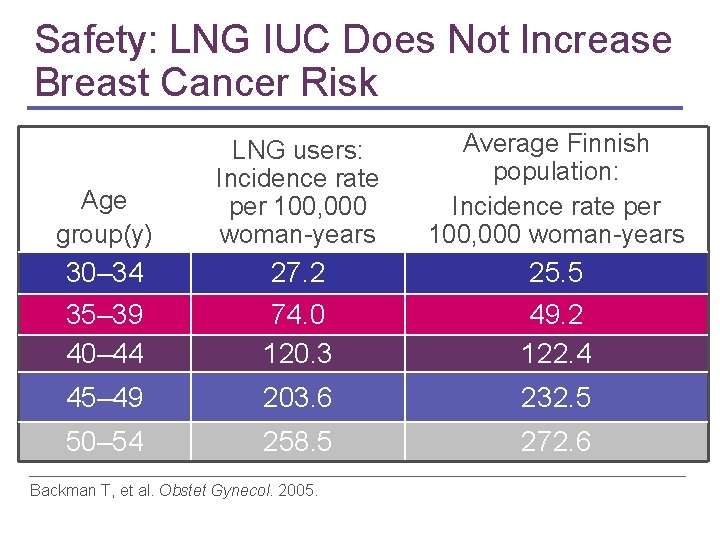
Safety: LNG IUC Does Not Increase Breast Cancer Risk Age group(y) LNG users: Incidence rate per 100, 000 woman-years Average Finnish population: Incidence rate per 100, 000 woman-years 30– 34 35– 39 40– 44 27. 2 74. 0 120. 3 25. 5 49. 2 122. 4 45– 49 203. 6 232. 5 50– 54 258. 5 272. 6 Backman T, et al. Obstet Gynecol. 2005.
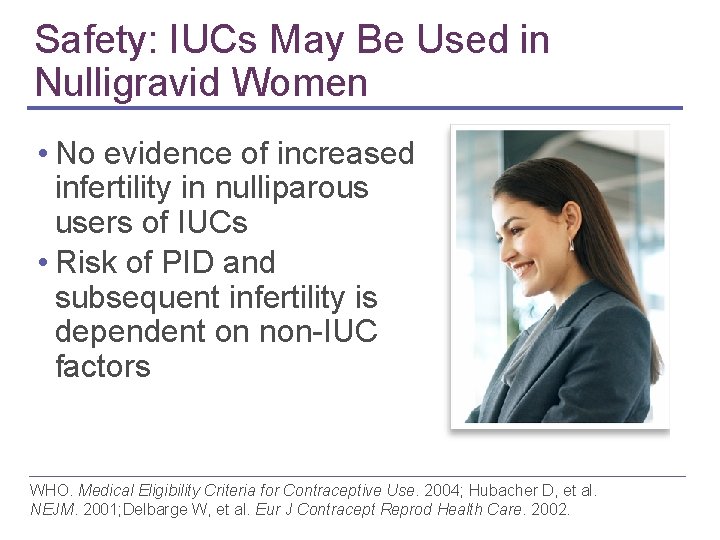
Safety: IUCs May Be Used in Nulligravid Women • No evidence of increased infertility in nulliparous users of IUCs • Risk of PID and subsequent infertility is dependent on non-IUC factors WHO. Medical Eligibility Criteria for Contraceptive Use. 2004; Hubacher D, et al. NEJM. 2001; Delbarge W, et al. Eur J Contracept Reprod Health Care. 2002.
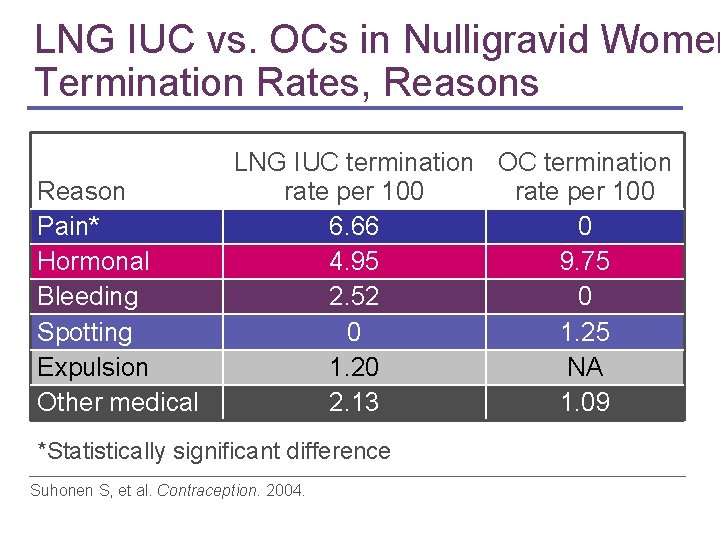
LNG IUC vs. OCs in Nulligravid Women Termination Rates, Reasons Reason Pain* Hormonal Bleeding Spotting Expulsion Other medical LNG IUC termination OC termination rate per 100 6. 66 0 4. 95 9. 75 2. 52 0 0 1. 25 1. 20 NA 2. 13 1. 09 *Statistically significant difference Suhonen S, et al. Contraception. 2004.
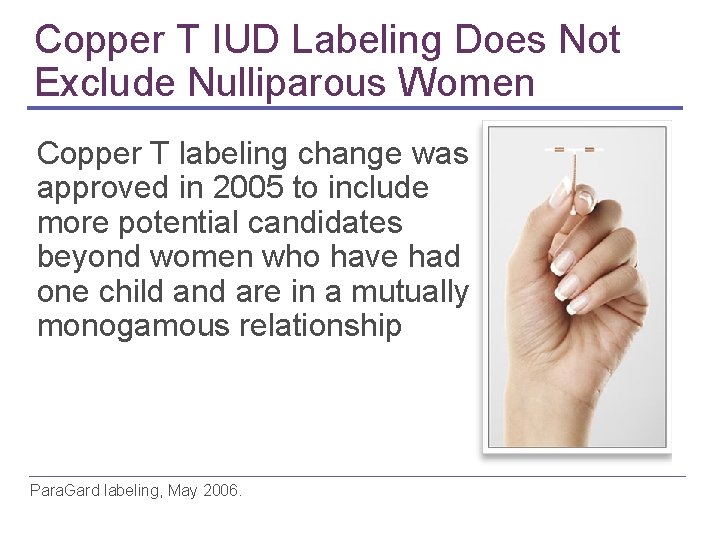
Copper T IUD Labeling Does Not Exclude Nulliparous Women Copper T labeling change was approved in 2005 to include more potential candidates beyond women who have had one child and are in a mutually monogamous relationship Para. Gard labeling, May 2006.
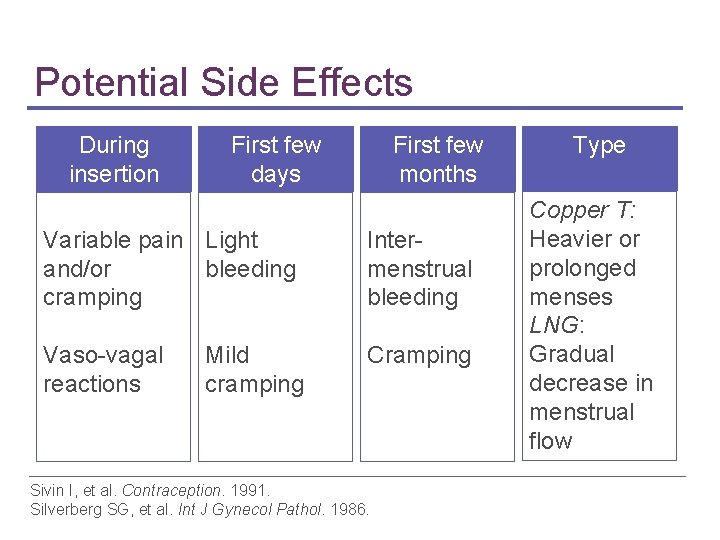
Potential Side Effects During insertion First few days First few months Variable pain Light and/or bleeding cramping Intermenstrual bleeding Vaso-vagal reactions Cramping Mild cramping Sivin I, et al. Contraception. 1991. Silverberg SG, et al. Int J Gynecol Pathol. 1986. Type Copper T: Heavier or prolonged menses LNG: Gradual decrease in menstrual flow
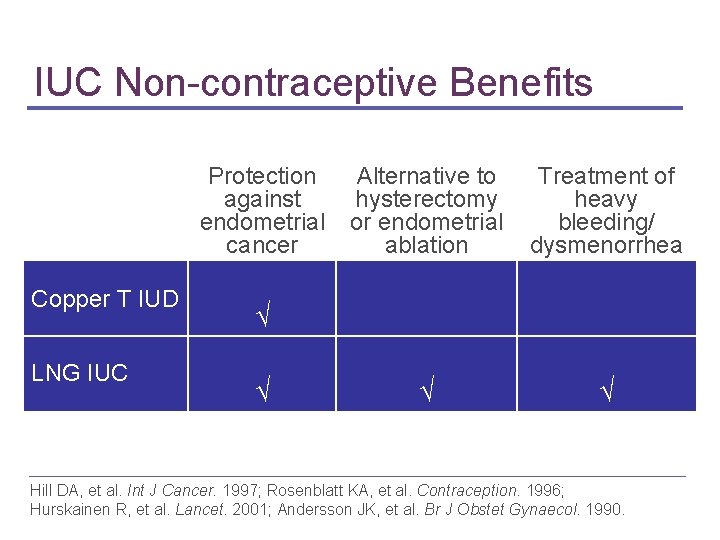
IUC Non-contraceptive Benefits Protection against endometrial cancer Copper T IUD LNG IUC Alternative to hysterectomy or endometrial ablation Treatment of heavy bleeding/ dysmenorrhea √ √ Hill DA, et al. Int J Cancer. 1997; Rosenblatt KA, et al. Contraception. 1996; Hurskainen R, et al. Lancet. 2001; Andersson JK, et al. Br J Obstet Gynaecol. 1990.
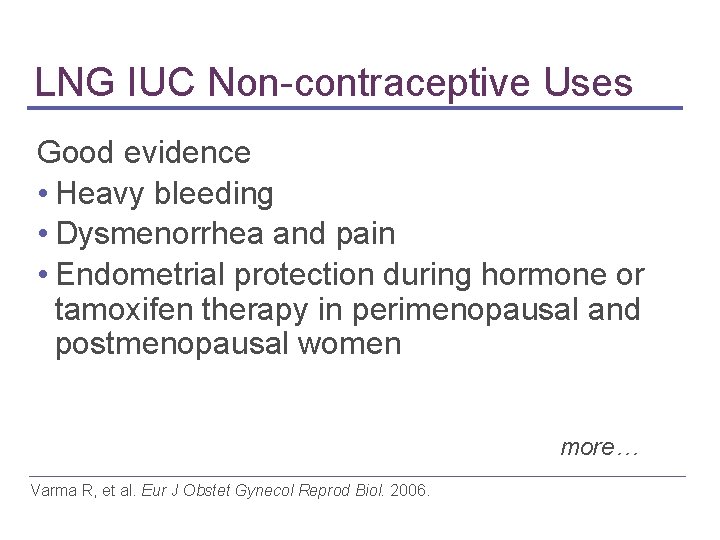
LNG IUC Non-contraceptive Uses Good evidence • Heavy bleeding • Dysmenorrhea and pain • Endometrial protection during hormone or tamoxifen therapy in perimenopausal and postmenopausal women more… Varma R, et al. Eur J Obstet Gynecol Reprod Biol. 2006.
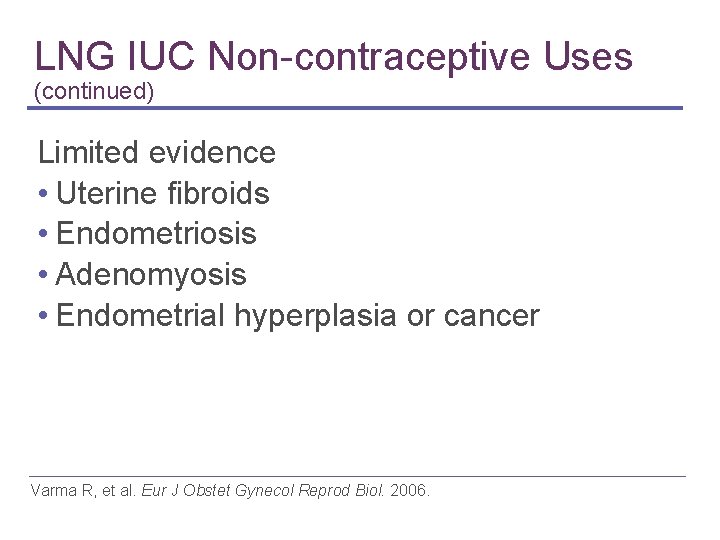
LNG IUC Non-contraceptive Uses (continued) Limited evidence • Uterine fibroids • Endometriosis • Adenomyosis • Endometrial hyperplasia or cancer Varma R, et al. Eur J Obstet Gynecol Reprod Biol. 2006.
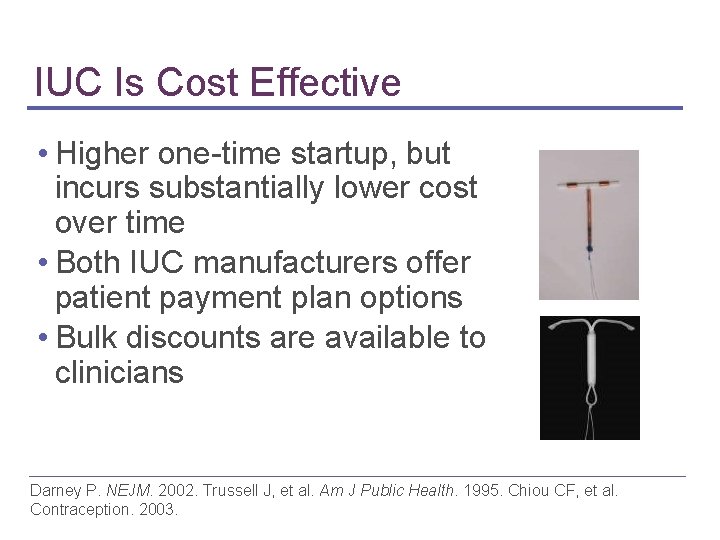
IUC Is Cost Effective • Higher one-time startup, but incurs substantially lower cost over time • Both IUC manufacturers offer patient payment plan options • Bulk discounts are available to clinicians Darney P. NEJM. 2002. Trussell J, et al. Am J Public Health. 1995. Chiou CF, et al. Contraception. 2003.
Costs for Patients • Patient costs are a factor in choosing contraceptive method • Up-front costs concern some women • Costs of side effects associated with some contraceptives are high compared with those for an IUC • Public clinics and pharmaceutical company patient assistance programs can be explored for low-income or uninsured patients
Screening & Counseling Goals for Providers Review contraceptive options with patients Allow patients to hold contraceptive devices Promote successful use of chosen method more…
Screening & Counseling Goals for Providers (Continued) Allow time for questions Provide written materials in the appropriate language and literacy level
Considerations in Choice of Contraceptive Methods • Effectiveness • Side effects • Convenience • Duration of action and childbearing plans • Patient choice • Reversibility • Non-contraceptive benefits • Cost • Privacy
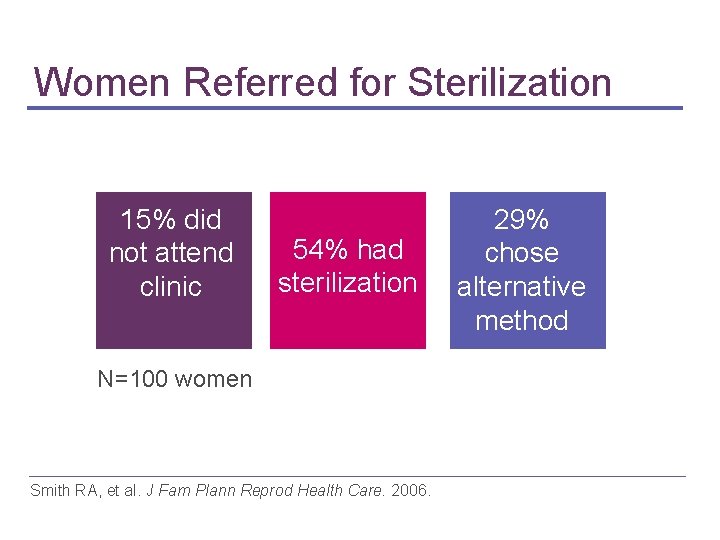
Women Referred for Sterilization 15% did not attend clinic 54% had sterilization N=100 women Smith RA, et al. J Fam Plann Reprod Health Care. 2006. 29% chose alternative method
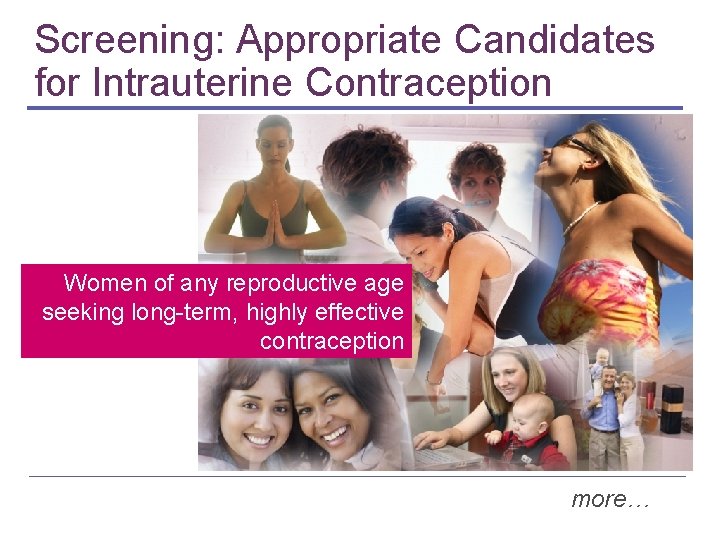
Screening: Appropriate Candidates for Intrauterine Contraception Women of any reproductive age seeking long-term, highly effective contraception more…
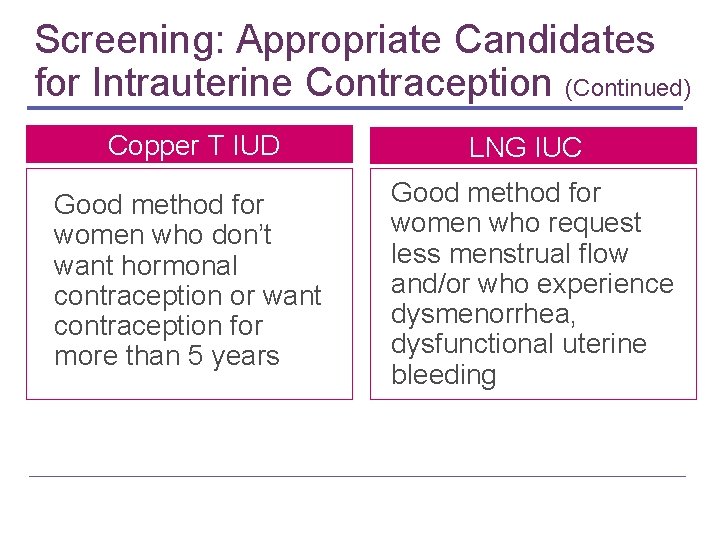
Screening: Appropriate Candidates for Intrauterine Contraception (Continued) Copper T IUD LNG IUC Good method for women who don’t want hormonal contraception or want contraception for more than 5 years Good method for women who request less menstrual flow and/or who experience dysmenorrhea, dysfunctional uterine bleeding
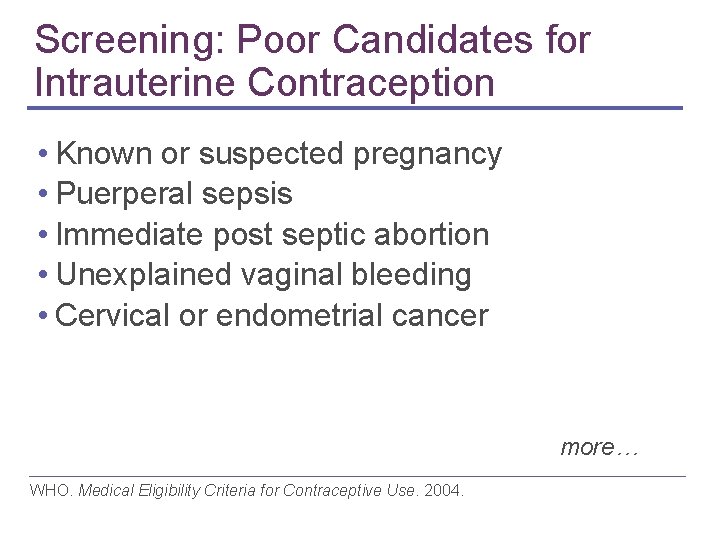
Screening: Poor Candidates for Intrauterine Contraception • Known or suspected pregnancy • Puerperal sepsis • Immediate post septic abortion • Unexplained vaginal bleeding • Cervical or endometrial cancer more… WHO. Medical Eligibility Criteria for Contraceptive Use. 2004.
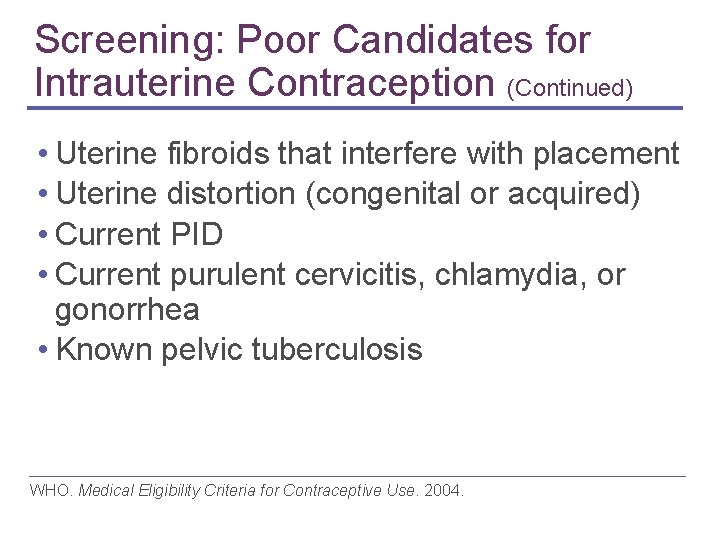
Screening: Poor Candidates for Intrauterine Contraception (Continued) • Uterine fibroids that interfere with placement • Uterine distortion (congenital or acquired) • Current PID • Current purulent cervicitis, chlamydia, or gonorrhea • Known pelvic tuberculosis WHO. Medical Eligibility Criteria for Contraceptive Use. 2004.
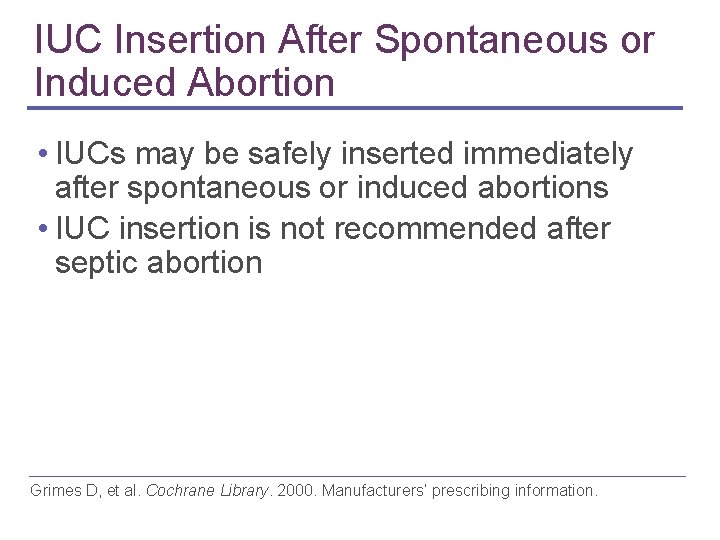
IUC Insertion After Spontaneous or Induced Abortion • IUCs may be safely inserted immediately after spontaneous or induced abortions • IUC insertion is not recommended after septic abortion Grimes D, et al. Cochrane Library. 2000. Manufacturers’ prescribing information.
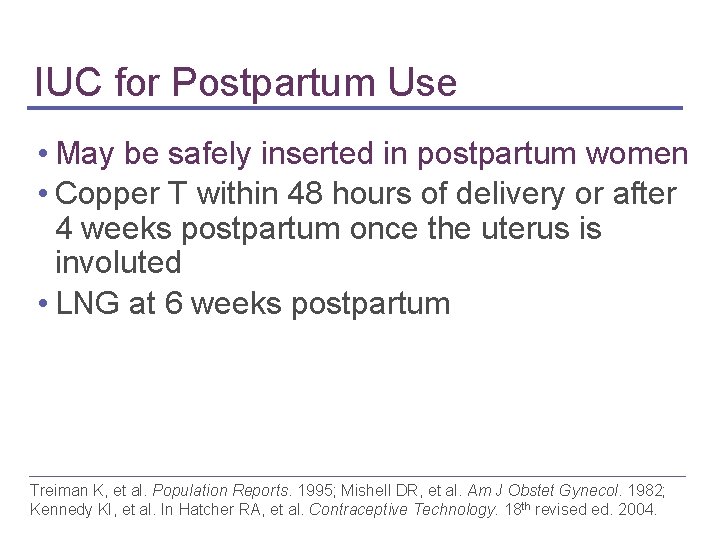
IUC for Postpartum Use • May be safely inserted in postpartum women • Copper T within 48 hours of delivery or after 4 weeks postpartum once the uterus is involuted • LNG at 6 weeks postpartum Treiman K, et al. Population Reports. 1995; Mishell DR, et al. Am J Obstet Gynecol. 1982; Kennedy KI, et al. In Hatcher RA, et al. Contraceptive Technology. 18 th revised ed. 2004.
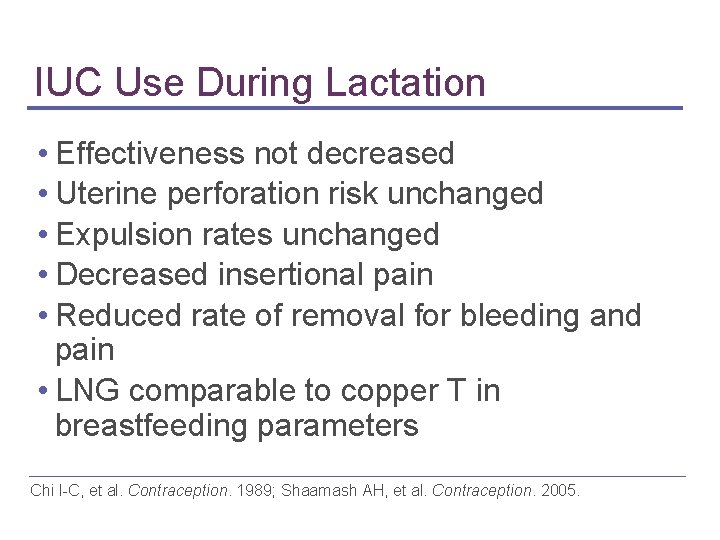
IUC Use During Lactation • Effectiveness not decreased • Uterine perforation risk unchanged • Expulsion rates unchanged • Decreased insertional pain • Reduced rate of removal for bleeding and pain • LNG comparable to copper T in breastfeeding parameters Chi I-C, et al. Contraception. 1989; Shaamash AH, et al. Contraception. 2005.
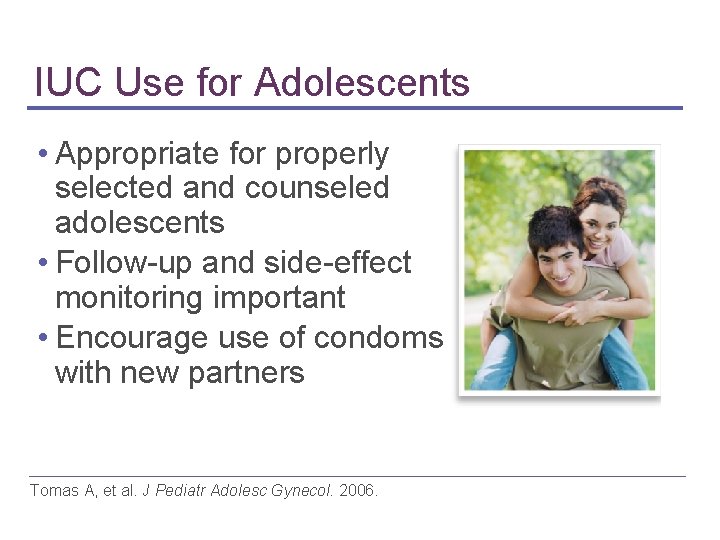
IUC Use for Adolescents • Appropriate for properly selected and counseled adolescents • Follow-up and side-effect monitoring important • Encourage use of condoms with new partners Tomas A, et al. J Pediatr Adolesc Gynecol. 2006.
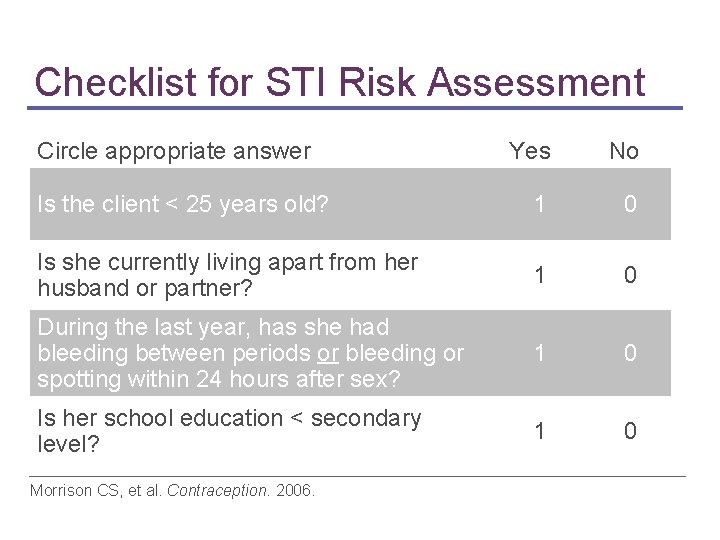
Checklist for STI Risk Assessment Circle appropriate answer Yes No Is the client < 25 years old? 1 0 Is she currently living apart from her husband or partner? 1 0 During the last year, has she had bleeding between periods or bleeding or spotting within 24 hours after sex? 1 0 Is her school education < secondary level? 1 0 Morrison CS, et al. Contraception. 2006.
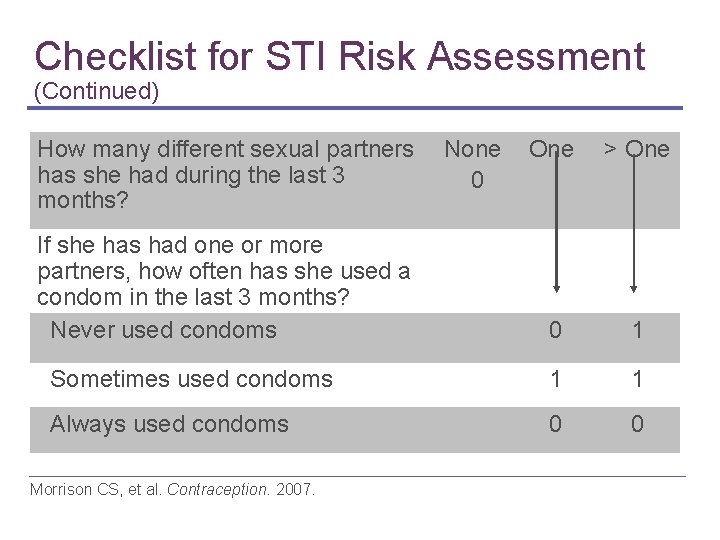
Checklist for STI Risk Assessment (Continued) How many different sexual partners has she had during the last 3 months? One > One 0 1 Sometimes used condoms 1 1 Always used condoms 0 0 If she has had one or more partners, how often has she used a condom in the last 3 months? Never used condoms Morrison CS, et al. Contraception. 2007. None 0
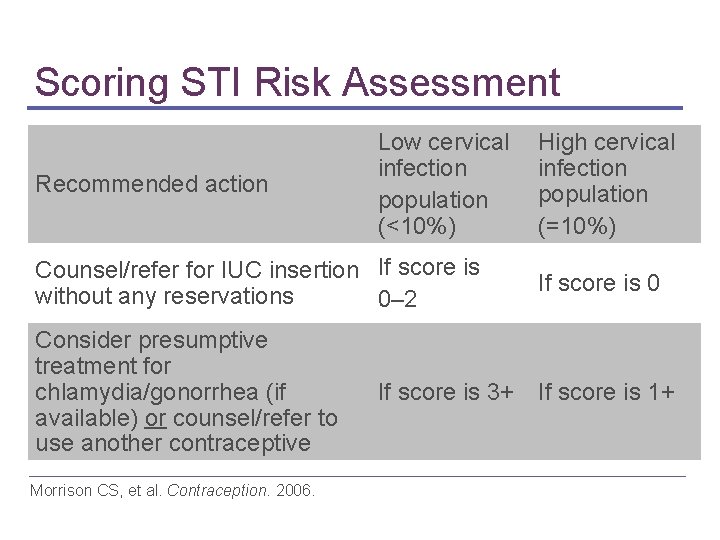
Scoring STI Risk Assessment Recommended action Low cervical infection population (<10%) Counsel/refer for IUC insertion If score is without any reservations 0– 2 Consider presumptive treatment for chlamydia/gonorrhea (if available) or counsel/refer to use another contraceptive Morrison CS, et al. Contraception. 2006. High cervical infection population (=10%) If score is 0 If score is 3+ If score is 1+
IUC Use for Older Women • LNG IUC can be an appropriate choice for perimenopausal women, especially those with dysfunctional uterine bleeding • LNG IUC can be used offlabel as an adjunct to estrogen therapy for postmenopausal women Penney G, et al. J Fam Plann Reprod Health Care. 2004.
IUC Counseling Topics • Effectiveness • Mechanism of action • Characteristics of method, including changes to menstrual flow • Insertion and removal procedures more…
IUC Counseling Topics (Continued) • Side effects and possible complications • Instructions on follow-up • Non-contraceptive benefits • Use of condoms with new partners
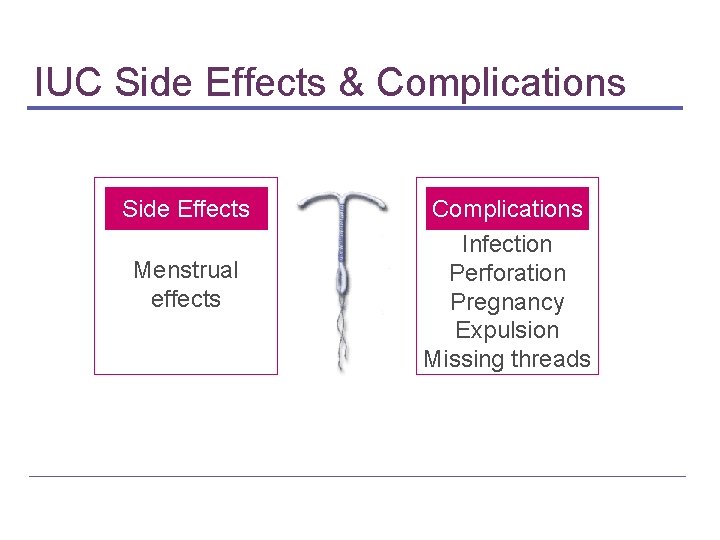
IUC Side Effects & Complications Side Effects Menstrual effects Complications Infection Perforation Pregnancy Expulsion Missing threads
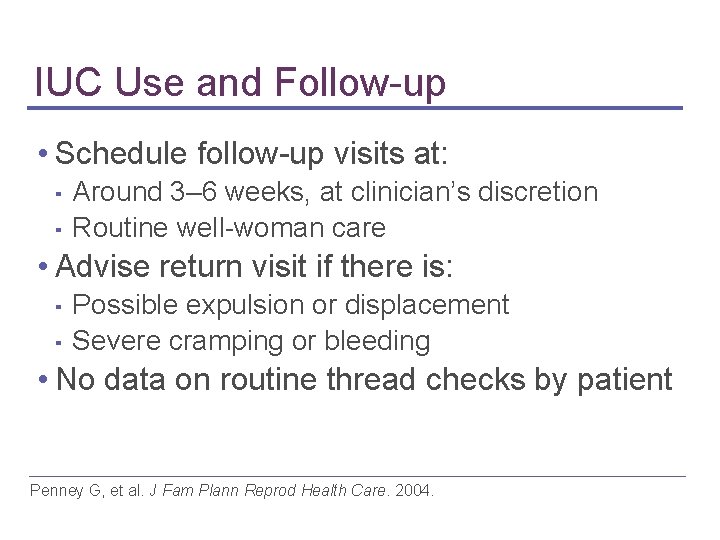
IUC Use and Follow-up • Schedule follow-up visits at: ▪ ▪ Around 3– 6 weeks, at clinician’s discretion Routine well-woman care • Advise return visit if there is: ▪ ▪ Possible expulsion or displacement Severe cramping or bleeding • No data on routine thread checks by patient Penney G, et al. J Fam Plann Reprod Health Care. 2004.
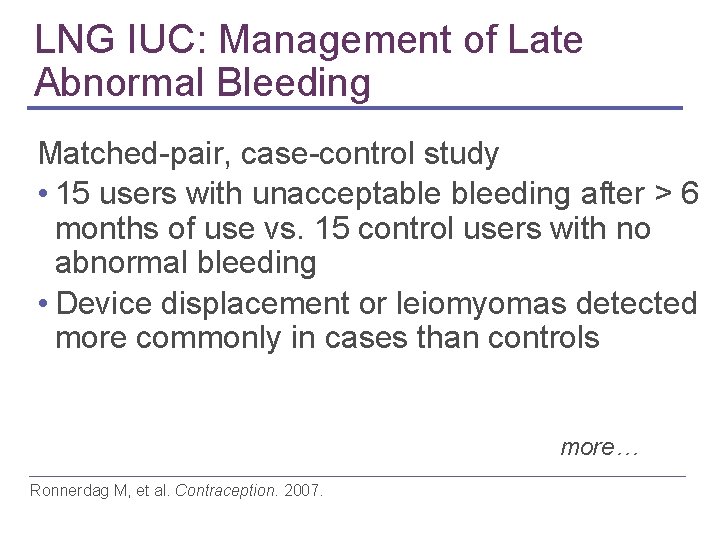
LNG IUC: Management of Late Abnormal Bleeding Matched-pair, case-control study • 15 users with unacceptable bleeding after > 6 months of use vs. 15 control users with no abnormal bleeding • Device displacement or leiomyomas detected more commonly in cases than controls more… Ronnerdag M, et al. Contraception. 2007.
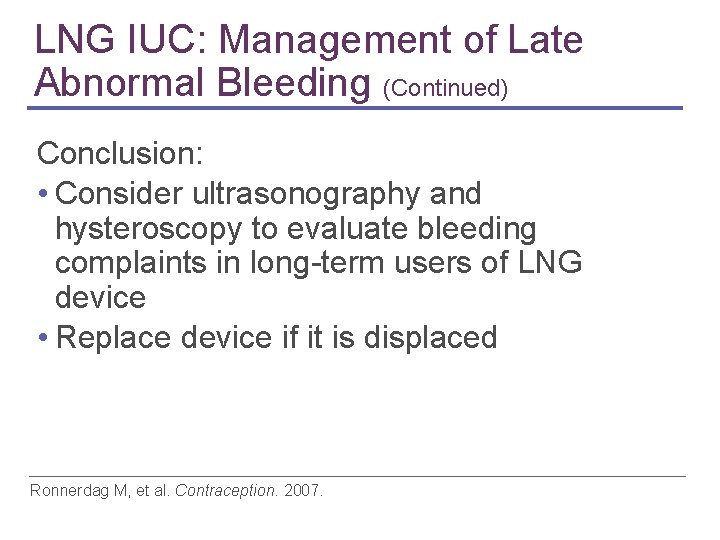
LNG IUC: Management of Late Abnormal Bleeding (Continued) Conclusion: • Consider ultrasonography and hysteroscopy to evaluate bleeding complaints in long-term users of LNG device • Replace device if it is displaced Ronnerdag M, et al. Contraception. 2007.
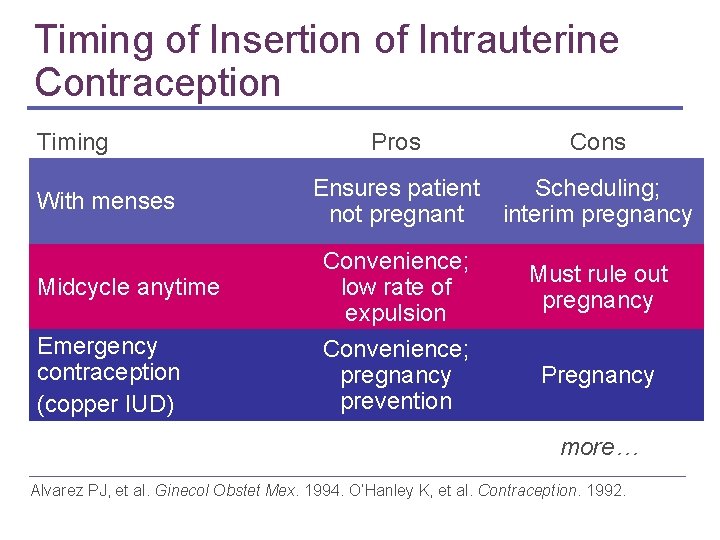
Timing of Insertion of Intrauterine Contraception Timing With menses Pros Cons Ensures patient Scheduling; not pregnant interim pregnancy Midcycle anytime Convenience; low rate of expulsion Must rule out pregnancy Emergency contraception (copper IUD) Convenience; pregnancy prevention Pregnancy more… Alvarez PJ, et al. Ginecol Obstet Mex. 1994. O’Hanley K, et al. Contraception. 1992.
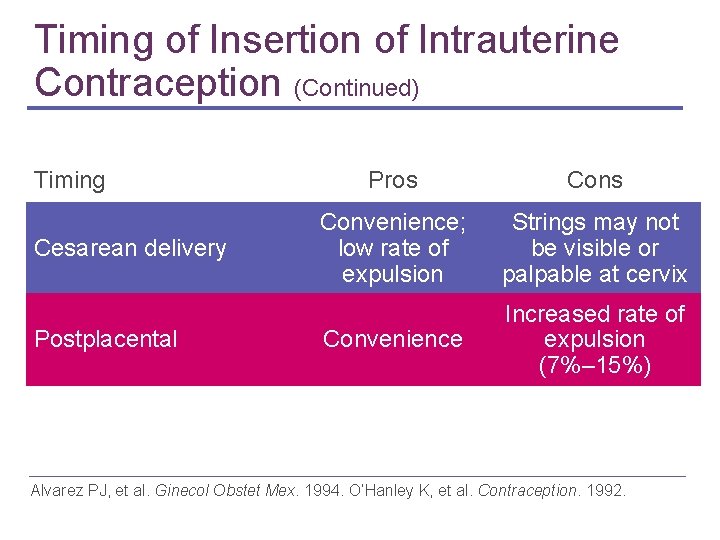
Timing of Insertion of Intrauterine Contraception (Continued) Timing Cesarean delivery Postplacental Pros Convenience; low rate of expulsion Strings may not be visible or palpable at cervix Convenience Increased rate of expulsion (7%– 15%) Alvarez PJ, et al. Ginecol Obstet Mex. 1994. O’Hanley K, et al. Contraception. 1992.
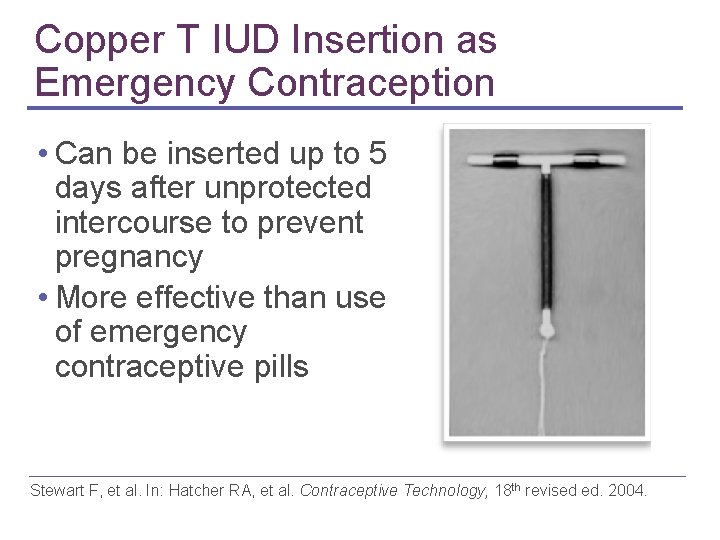
Copper T IUD Insertion as Emergency Contraception • Can be inserted up to 5 days after unprotected intercourse to prevent pregnancy • More effective than use of emergency contraceptive pills Stewart F, et al. In: Hatcher RA, et al. Contraceptive Technology, 18 th revised ed. 2004.
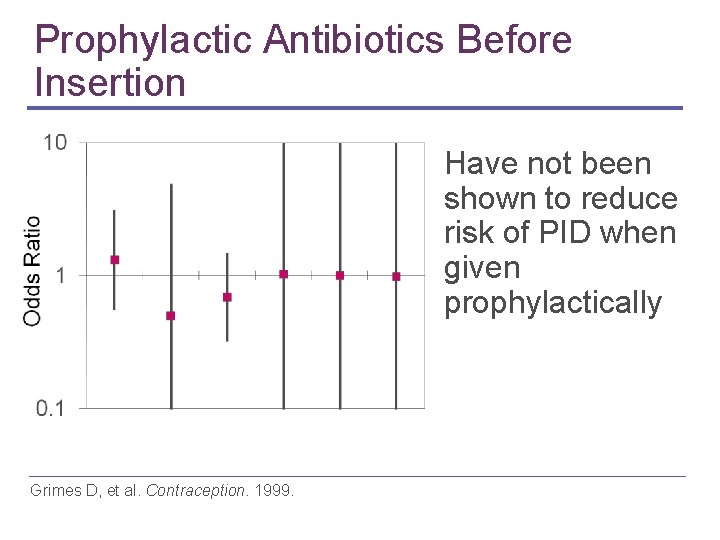
Prophylactic Antibiotics Before Insertion Have not been shown to reduce risk of PID when given prophylactically Grimes D, et al. Contraception. 1999.
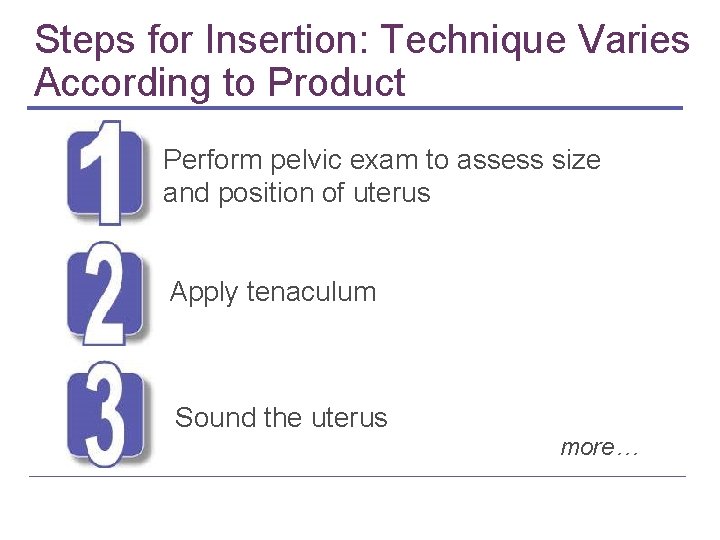
Steps for Insertion: Technique Varies According to Product Perform pelvic exam to assess size and position of uterus Apply tenaculum Sound the uterus more…
Steps for Insertion: Technique Varies According to Product (Continued) Load the device Place the device Cut the threads
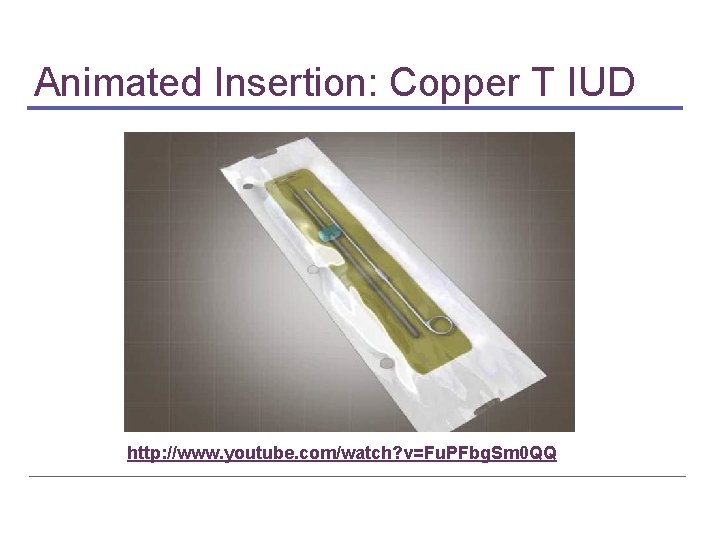
Animated Insertion: Copper T IUD http: //www. youtube. com/watch? v=Fu. PFbg. Sm 0 QQ
Animated Insertion: LNG IUS http: //www. youtube. com/watch? v=hlf. V 8 t. Kgw 6 E
IUC Insertion Tricks of the Trade • For women with narrow cervical canal ▪ Prime cervix with misoprostol 400 mcg a few hours before insertion • For pain management ▪ ▪ ▪ Oral NSAID 400 mg PO and/or Instill lidocaine in uterine cavity with an endometrial sampler The sampler can be used instead of sound to measure depth of uterus more…
IUC Insertion Tricks of the Trade (Continued) To visualize cervix • Use large speculum • If vaginal walls obscure cervix, cut off end of condom and slip over metal speculum • Get better light
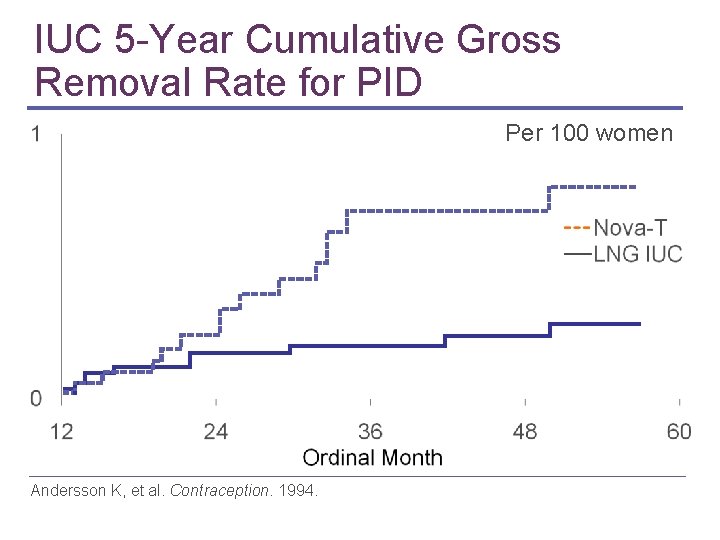
IUC 5 -Year Cumulative Gross Removal Rate for PID Per 100 women Andersson K, et al. Contraception. 1994.
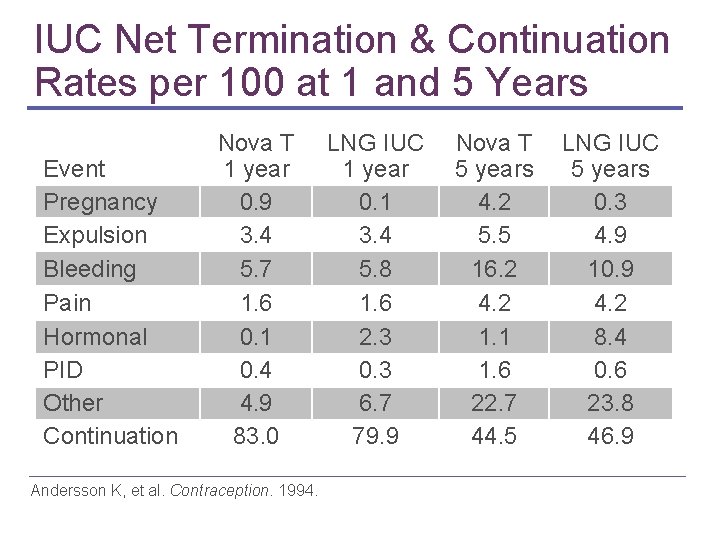
IUC Net Termination & Continuation Rates per 100 at 1 and 5 Years Event Pregnancy Expulsion Bleeding Pain Hormonal PID Other Continuation Nova T 1 year 0. 9 3. 4 5. 7 1. 6 0. 1 0. 4 4. 9 83. 0 Andersson K, et al. Contraception. 1994. LNG IUC 1 year 0. 1 3. 4 5. 8 1. 6 2. 3 0. 3 6. 7 79. 9 Nova T 5 years 4. 2 5. 5 16. 2 4. 2 1. 1 1. 6 22. 7 44. 5 LNG IUC 5 years 0. 3 4. 9 10. 9 4. 2 8. 4 0. 6 23. 8 46. 9
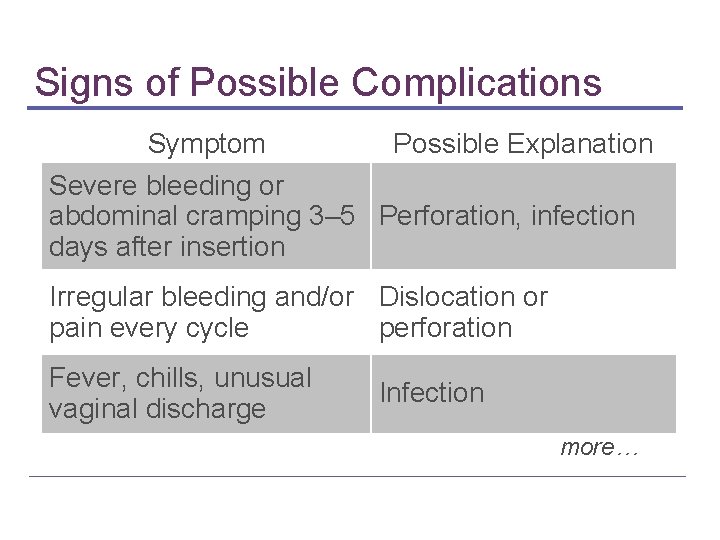
Signs of Possible Complications Symptom Possible Explanation Severe bleeding or abdominal cramping 3– 5 Perforation, infection days after insertion Irregular bleeding and/or Dislocation or pain every cycle perforation Fever, chills, unusual vaginal discharge Infection more…
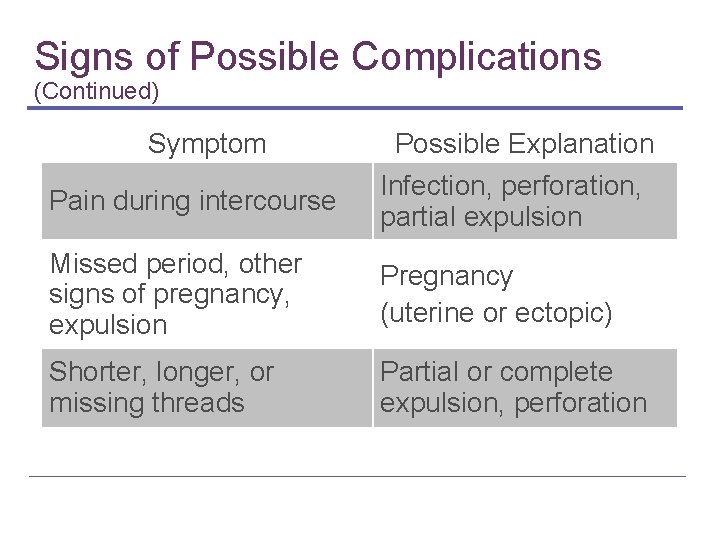
Signs of Possible Complications (Continued) Symptom Possible Explanation Pain during intercourse Infection, perforation, partial expulsion Missed period, other signs of pregnancy, expulsion Pregnancy (uterine or ectopic) Shorter, longer, or missing threads Partial or complete expulsion, perforation
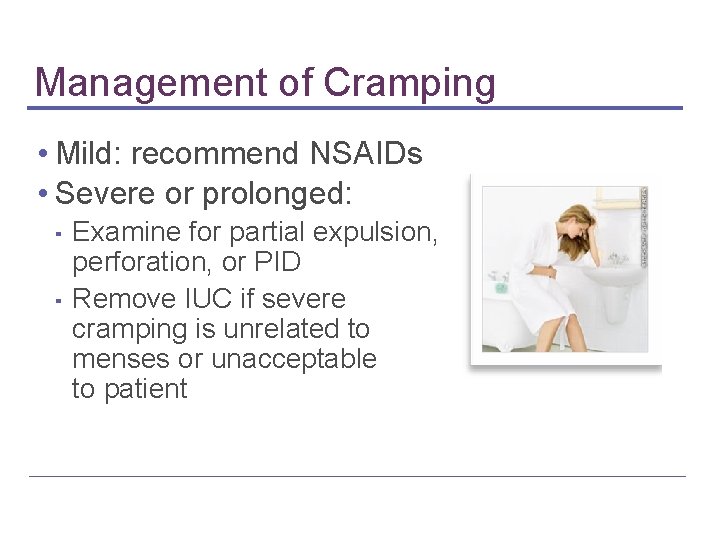
Management of Cramping • Mild: recommend NSAIDs • Severe or prolonged: ▪ ▪ Examine for partial expulsion, perforation, or PID Remove IUC if severe cramping is unrelated to menses or unacceptable to patient
Expulsions • Partial or unnoticed expulsion may present as irregular bleeding and/or pregnancy • Risk of expulsion related to: ▪ ▪ Provider’s skill at fundal placement Age and parity of woman Time since insertion Timing of insertion
Copper T: Management of Heavy Bleeding Lasting > 3 Months Examine for infection or fibroids Check for signs of anemia and treat, if needed Prescribe NSAIDs Remove device if medically indicated or unacceptable to patient
Management of Missing Threads • Rule out pregnancy • Probe for threads in cervical canal • Prescribe back-up contraceptive method • Obtain ultrasound or x-ray, as needed • Remove a copper T IUD in abdomen promptly
Management of STIs If STI diagnosed: • IUC removal not necessary if symptoms improve within 72 hours of treatment • Treat infection • Counsel patient about prevention of STI transmission Penney G, et al. J Fam Plann Reprod Health Care. 2004. WHO. Selected Practice Recommendations for Contraceptive Use. 2002.
Management of PID If PID diagnosed: • IUC removal may not be necessary • Treat infection • Recommendations to remove IUC are not evidence-based Grimes D. Lancet. 2000.
Risk of Uterine Perforation • Rare: 1 per 1, 000 insertions • Perforation linked to: ▪ ▪ ▪ Uterine position and consistency Skill and experience of provider with technique required Time of insertion after childbirth ▫ Risk doubled within first 12 weeks postpartum • Perforations reduced through directed training and observation Caliskan E, et al. Eur J Contracept Reprod Health Care. 2003; Van Houdenhoven K, et al. Contraception. 2006; Prema K, et al. Contracept Deliv Syst. 1981; Markovitch O, et al. Contraception. 2002; Harrison-Woolrych M, et al. Contraception. 2003.
Management of Perforation at Insertion If perforation occurs at insertion: • Remove device • Provide alternative contraception • Monitor for excessive bleeding • Follow up as appropriate • Can insert another device after next menses
Pregnancy with IUC In Situ • Determine site of pregnancy ▪ Intrauterine or ectopic • Remove IUD if threads available • Removal decreases risk of: ▪ ▪ Spontaneous abortion Premature delivery UK Family Planning Research Network. Br J Fam Plann. 1989. ; Foreman H, et al. Obstet Gynecol. 1981.
IUC Summary • Two options available in United States • Efficacy equivalent to sterilization • Broader options for insertion timing • Can be inserted in nulligravid women • Can be inserted after abortion or delivery • Cost effective
Expert Medical Advisory Committee Insert Photo Here David A. Grimes, MD Vice President Biomedical Affairs Family Health International Research Triangle Park, NC Insert Photo Here Kirtly Parker Jones, MD Professor, Department of Obstetrics and Gynecology University of Utah Health Sciences Center Salt Lake City, UT Chris Knutson, MN, ANP Public Health Nurse Consultant Washington Department of Health Olympia, WA more…
Expert Medical Advisory Committee (Continued) Insert Photo Here Patricia Murphy, CNM, Dr. PH Associate Professor, University of Utah School of Nursing Annette Poulson Cumming Endowed Chair in Women’s and Reproductive Health Salt Lake City, UT Insert Photo Here Carolyn Westhoff, MD Professor, Obstetrics and Gynecology and Public Health (Epidemiology) College of Physicians and Surgeons at Columbia University New York, NY Susan Wysocki, RN-C, NP President and CEO National Association of Nurse Practitioners in Women’s Health Washington, DC