
Voluntary Surgical Contraception for Women Tubal Occlusion 1
Voluntary Surgical Contraception for Women Tubal Occlusion 1
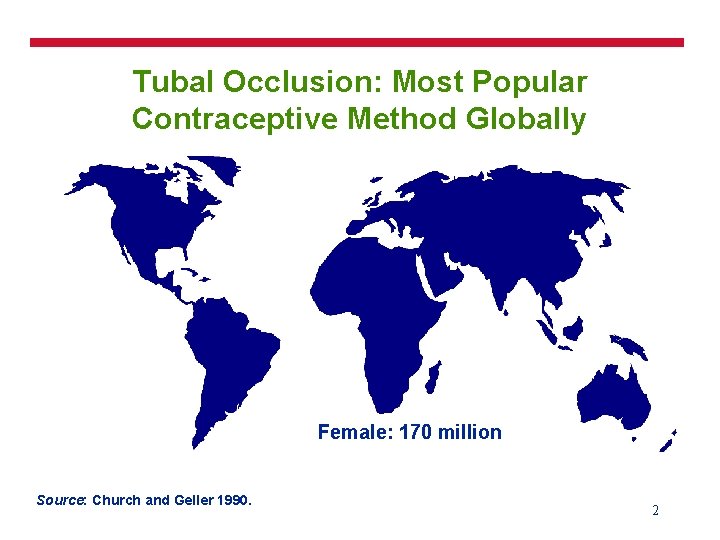
Tubal Occlusion: Most Popular Contraceptive Method Globally Female: 170 million Source: Church and Geller 1990. 2
Types of Tubal Occlusion ! Postpartum $ Minilaparotomy (Infraumbilical) ! Interval $ Minilaparotomy $ Laparoscopy 3
Tubal Occlusion: Client Issues ! The client should make the decision for sterilization voluntarily. ! The client has the right to change her mind anytime prior to the procedure. ! The client should understand that voluntary sterilization (VS) is a permanent (not easily reversible) method. ! No incentives should be given to clients to accept VS. ! A standard consent form must be signed by the client before the VS procedure. ! Spousal consent is not required. 4
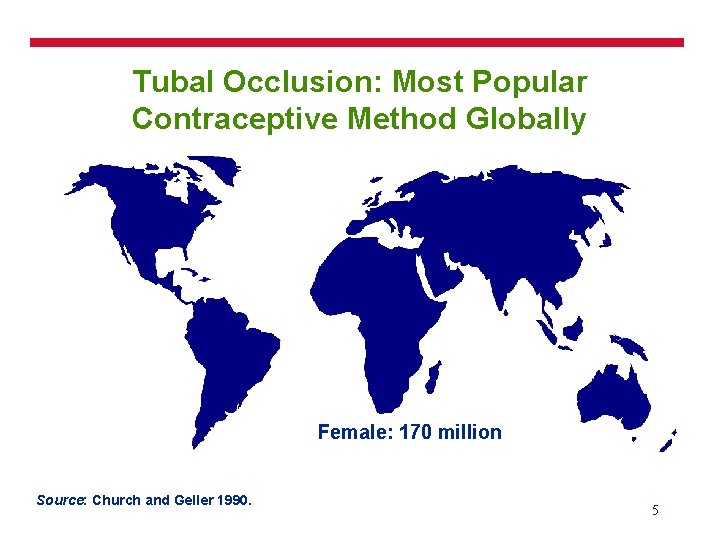
Tubal Occlusion: Most Popular Contraceptive Method Globally Female: 170 million Source: Church and Geller 1990. 5
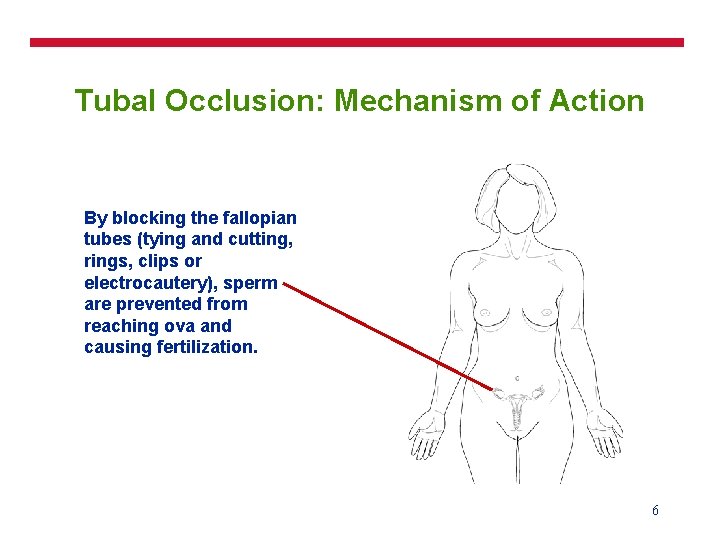
Tubal Occlusion: Mechanism of Action By blocking the fallopian tubes (tying and cutting, rings, clips or electrocautery), sperm are prevented from reaching ova and causing fertilization. 6
Tubal Occlusion: Contraceptive Benefits 1 ! Highly effective (0. 51 pregnancies per 100 women during first year of use) ! Effective immediately ! Permanent ! Does not interfere with intercourse ! Good for client if pregnancy would pose a serious health risk ! Simple surgery, usually done under local anesthesia ! No long-term side effects ! No change in sexual function (no effect on hormone production by ovaries) Trussell et al 1998. 7
Tubal Occlusion: Noncontraceptive Benefits ! Does not interfere with breastfeeding ! Decreased risk of ovarian cancer 8
Tubal Occlusion: Decreased Risk of Ovarian Cancer ! 39% decrease in risk compared to clients without tubal occlusion ! Decrease in risk does not depend upon method of sterilization ! Risk remains low 25 years after surgery Source: Green et al 1997. 9
Tubal Occlusion: Limitations ! Must be considered permanent (success of reversal cannot be guaranteed) ! Client may regret later (age < 35) ! Small risk of complications ! Short-term discomfort and pain following procedure ! Requires trained physician (gynecologist or surgeon for laparoscopy) ! Slightly decreased long-term effectiveness ! Increased risk of ectopic pregnancy ! Does not protect against STDs (e. g. , HBV, HIV/AIDS) 10
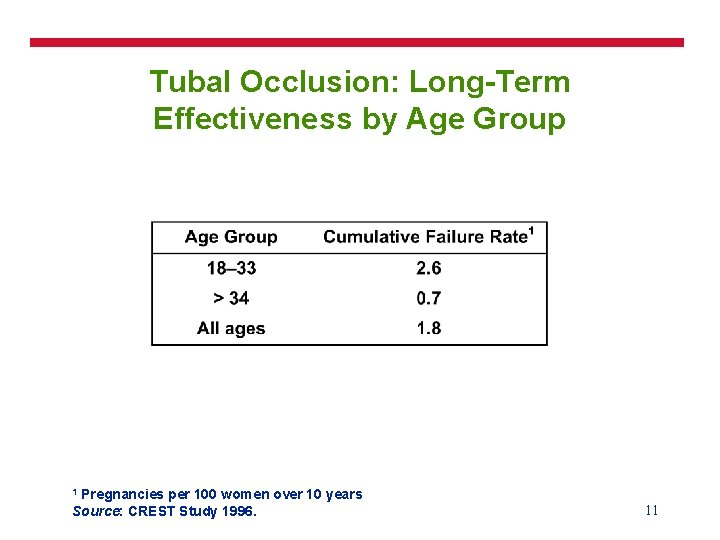
Tubal Occlusion: Long-Term Effectiveness by Age Group Pregnancies per 100 women over 10 years Source: CREST Study 1996. 1 11
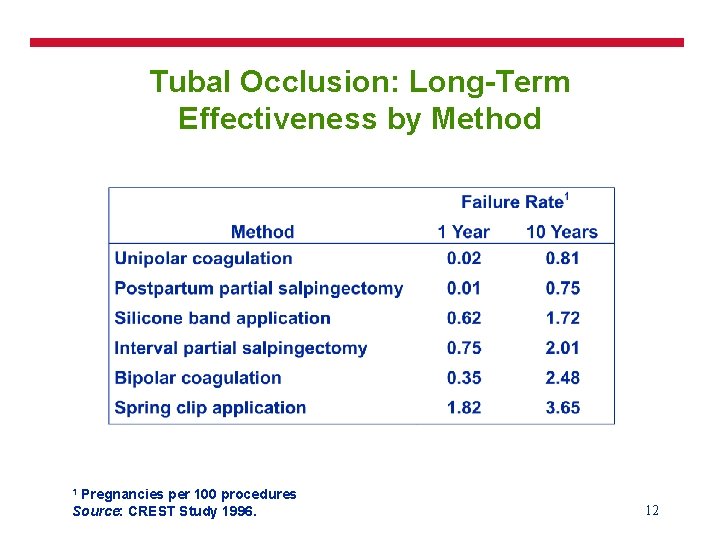
Tubal Occlusion: Long-Term Effectiveness by Method Pregnancies per 100 procedures Source: CREST Study 1996. 1 12
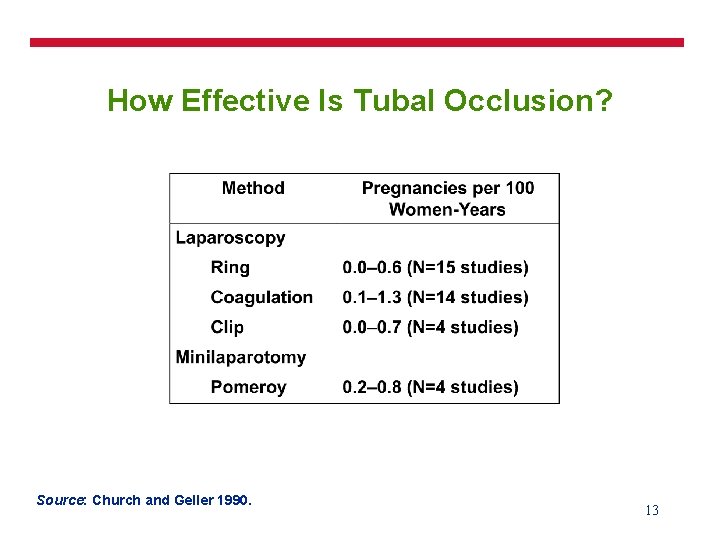
How Effective Is Tubal Occlusion? Source: Church and Geller 1990. 13
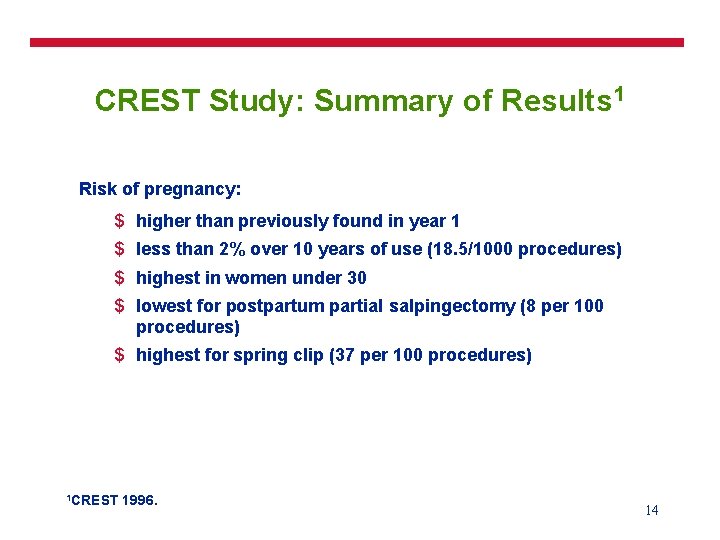
CREST Study: Summary of Results 1 Risk of pregnancy: $ higher than previously found in year 1 $ less than 2% over 10 years of use (18. 5/1000 procedures) $ highest in women under 30 $ lowest for postpartum partial salpingectomy (8 per 100 procedures) $ highest for spring clip (37 per 100 procedures) 1 CREST 1996. 14
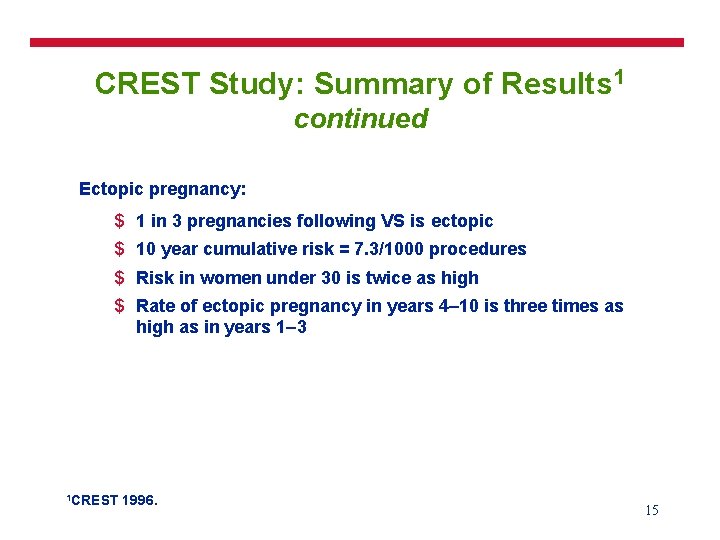
CREST Study: Summary of Results 1 continued Ectopic pregnancy: $ 1 in 3 pregnancies following VS is ectopic $ 10 year cumulative risk = 7. 3/1000 procedures $ Risk in women under 30 is twice as high $ Rate of ectopic pregnancy in years 4– 10 is three times as high as in years 1– 3 1 CREST 1996. 15
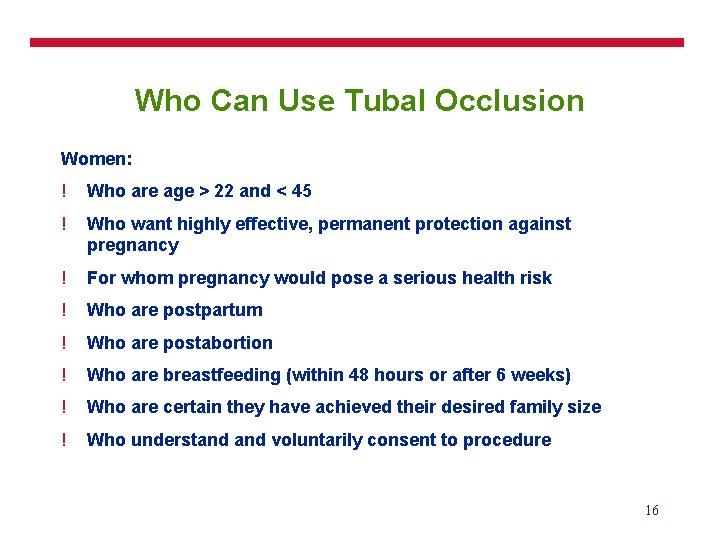
Who Can Use Tubal Occlusion Women: ! Who are age > 22 and < 45 ! Who want highly effective, permanent protection against pregnancy ! For whom pregnancy would pose a serious health risk ! Who are postpartum ! Who are postabortion ! Who are breastfeeding (within 48 hours or after 6 weeks) ! Who are certain they have achieved their desired family size ! Who understand voluntarily consent to procedure 16
Tubal Occlusion: Who May Require Additional Counseling Women: ! Who cannot withstand surgery ! Who are uncertain of their desire for future fertility ! Who do not give voluntary, informed consent 17
Tubal Occlusion: Conditions Requiring Precautions (WHO Class 3) ! Unexplained vaginal bleeding (until evaluated) ! Acute pelvic infection ! Acute systemic infection (e. g. , cold, flu, gastroenteritis, viral hepatitis) ! Anemia (Hb < 7 g/dl) ! Abdominal skin infection ! Cancer of the genital tract ! Deep venous thrombosis Appropriate precautions include delay of procedure until condition improves or resolves. Source: WHO 1996. 18
Tubal Occlusion: Conditions Requiring an Experienced Clinician with Full Backup ! Diabetes ! Symptomatic heart disease ! High blood pressure (> 160/100 or with vascular disease) ! Coagulation (clotting) disorders ! Overweight (> 80 kg/176 lb if H/W ratio not normal) ! Abdominal or umbilical hernia ! Multiple lower abdominal incisions/scars 19
Complications of Laparoscopic Sterilization Short-term ! Occur in less than 1% of all procedures ! Directly related to surgical expertise Long-term ! Decreased long-term effectiveness 20
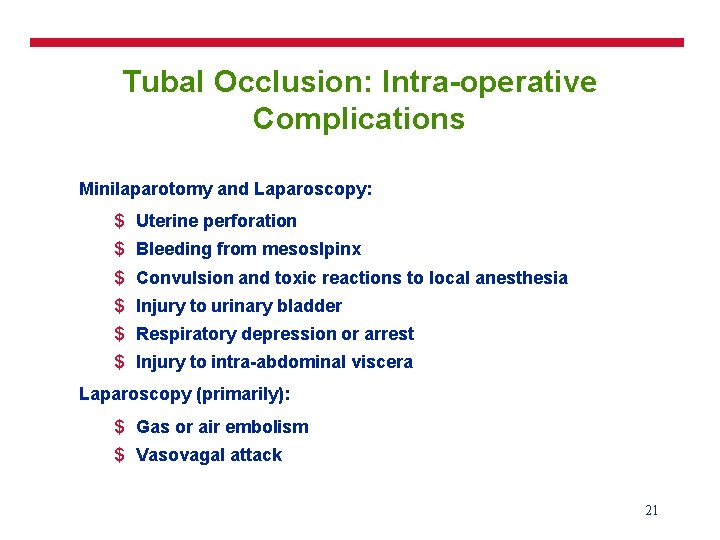
Tubal Occlusion: Intra-operative Complications Minilaparotomy and Laparoscopy: $ Uterine perforation $ Bleeding from mesoslpinx $ Convulsion and toxic reactions to local anesthesia $ Injury to urinary bladder $ Respiratory depression or arrest $ Injury to intra-abdominal viscera Laparoscopy (primarily): $ Gas or air embolism $ Vasovagal attack 21
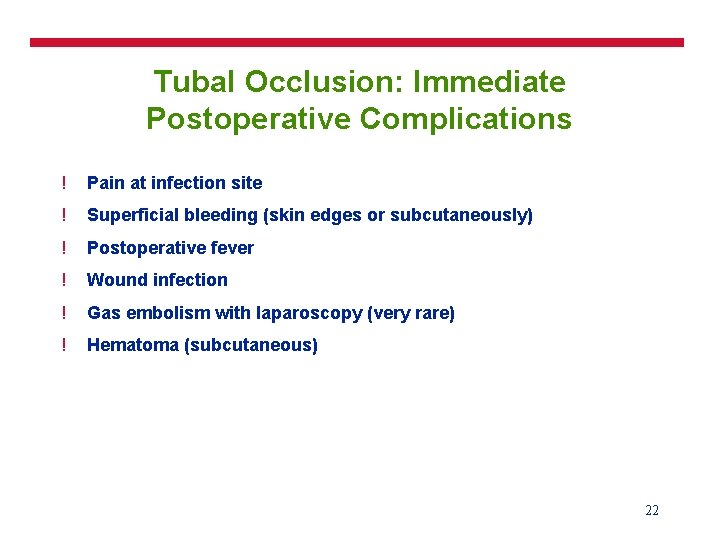
Tubal Occlusion: Immediate Postoperative Complications ! Pain at infection site ! Superficial bleeding (skin edges or subcutaneously) ! Postoperative fever ! Wound infection ! Gas embolism with laparoscopy (very rare) ! Hematoma (subcutaneous) 22
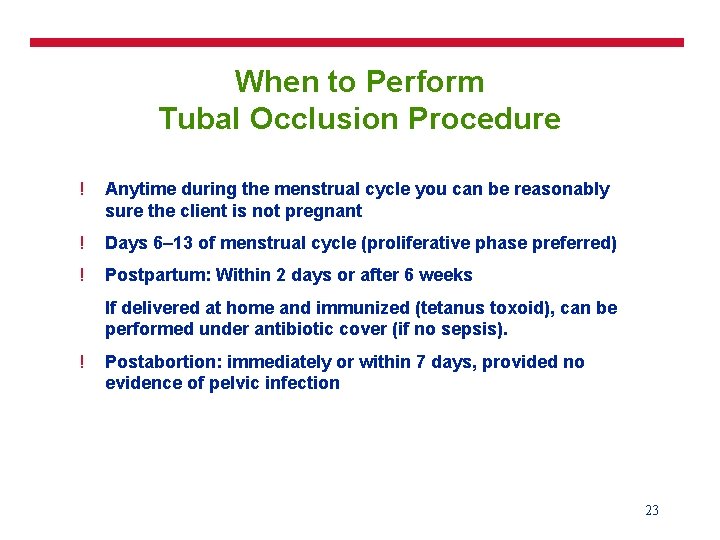
When to Perform Tubal Occlusion Procedure ! Anytime during the menstrual cycle you can be reasonably sure the client is not pregnant ! Days 6– 13 of menstrual cycle (proliferative phase preferred) ! Postpartum: Within 2 days or after 6 weeks If delivered at home and immunized (tetanus toxoid), can be performed under antibiotic cover (if no sepsis). ! Postabortion: immediately or within 7 days, provided no evidence of pelvic infection 23
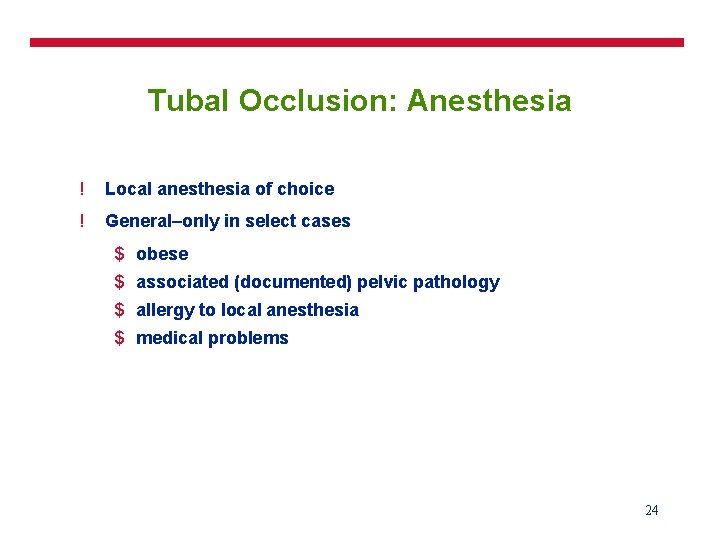
Tubal Occlusion: Anesthesia ! Local anesthesia of choice ! General–only in select cases $ obese $ associated (documented) pelvic pathology $ allergy to local anesthesia $ medical problems 24
Tubal Occlusion: Client Instructions ! Keep operative site dry for 2 days. Resume normal activities gradually. ! Avoid sexual intercourse for 1 week or until comfortable. ! Avoid heavy lifting and hard work for 1 week. ! For pain take 1 or 2 analgesic tablets every 4 to 6 hours. ! Schedule a routine followup visit between 7– 14 days. ! Return after 1 week if nonabsorbable stitches used. 25
Tubal Occlusion: General Information ! Shoulder pain during 12– 24 hours after laparoscopy is common due to gas (CO 2 or air) under diaphragm. ! Tubal occlusion is effective from time operation is complete. ! Menstrual periods will resume as usual. ! Use a condom if at risk for STDs (e. g. , HBV, HIV/AIDS). 26
Warning Signs for Tubal Occlusion Clients Return to clinic if following problems occur: ! Fever (greater than 38°C or 100. 4°F) ! Dizziness with fainting ! Persistent or increased abdominal pain ! Bleeding or fluid coming from the incision ! Signs or symptoms of pregnancy 27
Tubal Occlusion: Mobile Programs (Camps) ! Counseling and followup should be the same as at fixed sites. ! All recommended infection prevention practices should be followed. ! Followup for short-term and long-term complications must be available. 28
Tubal Occlusion: Common Medical Barriers ! Age restrictions (young and old) ! Provider bias ! Who can provide: $ Specialists only $ Physicians only 29
- Slides: 29