10 th World Studies 3 20 17 Turn
- Slides: 104
10 th World Studies 3. 20. 17 Turn in: Ø Nothing Take out : Ø Planner Ø Notes Ø Note-taking devices Today’s Learning Objectives: Ø I can make a determination as to what direction government leadership (can) should take. Today’s Agenda: Ø A Disaster… Ø An election… Ø A Revolution HW: Ø Cast your vote!
Is this type of attack the “beginning? ” • Paris Orly airport shooting: Attacker was 'radicalised Muslim' man known to French intelligence services • Man shot dead after attack at Paris Orly airport • Paris Orly Airport: Assailant shouted 'I'm here to die in the name of Allah' • Paris Orly Airport: Father of gunman says son 'not a terrorist'
Disaster strikes! Scenario: It is the year 2032. The United States has lost World War III, which ended 10 years ago in 2022. After the defeat of the United States, the American government had to agree to a “peace treaty” which was forced upon them by the victors. As a result of the treaty, the following things have happened.
Election time… Scenario: 1. The United States had to accept complete responsibility for starting the war and for all the damage and deaths that resulted from it. At the start of the war, the United States actually tried to restrain its allies and prevent war through compromise, but these efforts failed. The United States was considered the main target by the enemy. 2. The United States had to pay $500 billion, partly in money and partly in goods, to the victors in reparation for all the damage caused by the war. 3. California, Arizona, New Mexico, and Texas have been returned to Mexico.
Election time… 5. Most of Oregon and Washington (except for King County) have been given to Canada. 6. The army has been cut to 100, 000 officers and men. Its job is to “keep order in case of emergency. ” There is almost no navy; no air force; no marine corps. All the US missile bases have been dismantled, and all submarines turned over to the victors. This has been ordered by the victors of the war who believe that the US is an aggressive country and will make war again if given the opportunity. To make sure that the US doesn’t try to rearm in secret, an international team makes periodic inspections throughout the country. 6. An international military force occupies the Great Lakes industrial area, including the cities of Chicago and Detroit, determined to stay until 2035 or until the terms of the treaty have been fulfilled. 7. The US had to guarantee favored nation treatment in her commerce with the victorious nations. The victors do not have to reciprocate.
Election time… As if the terms of the treaty were not catastrophe enough, other disasters followed. 1. The country has been hit by wholesale inflation. A postage stamp which could once be bought for 37 cents, now costs $20, 000. The US Mint printed million and billion-dollar bills which are widely circulated. Beef prices have risen to $1 million a pound -- if you buy it at the slaughterhouse; the price is double at the supermarket. Now the worst of the inflation is over, but public faith in the monetary system has been severely shaken.
Election time… 2. Twenty-five percent (25%) of the nation’s work force is unemployed. In some cities the unemployment rate is closer to 40%. Unemployment is highest among workers 45 years old and younger. There is widespread hunger. People who forage in the garbage dumps are disappointed. Every scrap of food is precious, and nothing is “garbage. ” The number of people on welfare has doubled in the last year, placing one more strain on the nation’s finances. As each worker is laid off and as each shopkeeper, declaring bankruptcy, closes his doors, they look with resentment at those who are still able to earn their livings. Business and industry are increasingly controlled by a wealthy few. Far from uniting the people in a common catastrophe, the economic conditions have splintered the population into classconscious groups.
Election time… 3. Former soldiers from the now-dismembered army, furious with the terms of the treaty and frustrated by the apparent powerlessness of the US to solve its internal problems, have formed a number of self appointed, independent armies which are totally outside the authority and control of the government. These men parade and demonstrate for various political issues and for different political candidates, and are constantly brawling in the streets. One political spokesman observed that these riots spilled blood on American streets every Sunday. The Attorney General has banned outdoor meetings and parades, some say in violation of the First Amendment to the Constitution. The fighting continues anyway. Strike and riots are paralyzing the country.
Election time… WHO WILL YOU VOTE FOR IN THE ELECTION OF 2032? • In making your decision, consider what has happened to the US as a result of the war. Which candidate do you think offers the best chance of raising the country out of its troubles? Why? MICHAEL HINMAN Incumbent President trying for a third term. A living reminder of past glories, he is one of the few national heroes left. Hinman says that no one shall accuse him of abandoning his post while the country faces such a crisis. 84 years old. A man of honor, he is in an impossible situation: He hates the peace treaty which has humiliated the US, but says the country, having signed it, is honor-bound to follow its terms. He recognizes the problems of the country, but says that things will work themselves out if people will only have faith and support the government. He is the only candidate who does not favor revising the Constitution of the United States. To meet the nation’s economic crisis, he has instituted an unpopular program of wage and price controls. Hinman’s government favors wealthy manufacturers and has done little to help the average working man. He has spent considerable time writing his memoirs, in which he says that the US could not have lost the war unless there were traitors inside the country working for the enemy.
Election time… WHO WILL YOU VOTE FOR IN THE ELECTION OF 2032? • In making your decision, consider what has happened to the US as a result of the war. Which candidate do you think offers the best chance of raising the country out of its troubles? Why? THEODORE DUSTON Former army officer, now president of the Veterans Association. 57 years old. Together with Richard Johnson (below), he headed a committee sponsoring an initiative called “A Law Against the Enslavement of the American People” at a time when reparation payment were being renegotiated. The proposed law would have denounced the war-guilt clause of the peace treaty, forbidden the government from agreeing to any further reparation commitments, and subjected to trial for reasons of treason any government official who accepted new obligations to the victors. Congressmen were afraid that this so-called “Freedom Law” would bring down the wrath of the victors, and the bill was defeated. Duston believes the government should be run by those who held power before the war -- the army, the captains of industry, and the upper class. These people are accustomed to power and know better than the average citizen what should be done. He says the US should defy the peace treaty and start rebuilding its military strength immediately.
Election time… WHO WILL YOU VOTE FOR IN THE ELECTION OF 2032? • In making your decision, consider what has happened to the US as a result of the war. Which candidate do you think offers the best chance of raising the country out of its troubles? Why? ERNEST TAYLOR Former transportation worker with long experience in party politics. 46 years old. Taylor says that President Hinman has “betrayed the workers” by suppressing strikes and riots and by instituting wage and price controls, while not doing anything to improve working conditions and salaries. Unemployment has quadrupled in the last four years, and many workers are not covered by unemployment benefits or welfare. Taylor says that the government should be taken out of the hands of the rich and the privileged and run by elected councils of workers. Industry and agriculture should be owned by the government, but controlled by the workers. Taylor says that there should be no effort at all to rebuild the army and navy.
Election time… WHO WILL YOU VOTE FOR IN THE ELECTION OF 2032? • In making your decision, consider what has happened to the US as a result of the war. Which candidate do you think offers the best chance of raising the country out of its troubles? Why? RICHARD JOHNSON Son of a blacksmith and a Catholic school teacher. Involved in politics from an early age, also showed great signs of intelligence as seen in his role as editor of a political newspaper at age of 20. 39 years old. Johnson points to his activity in politics as well as the military (where he was wounded and discharged) as the basis of understanding what the country needs at the moment. His ideas are for natives first, and as such, he has plans for extensive public works programs to combat the high unemployment rates as well as rebuilding the nation’s much needed infrastructure—as seen in one of his many campaign quips, “Cities need their trains to run on time!”. Johnson has some similar ideologies as Duston, and each have mentioned their admiration of the work to preserve the nation—in particular restricting immigration. Johnson claims Americans need to focus on Americans (and then perhaps expand…).
As an individual: Decide for whom you will be voting (on my website): 1. 2. 3. 4. MICHAEL HINMAN THEODORE DUSTON ERNEST TAYLOR RICHARD JOHNSON Provide an explanation as to why you selected this candidate to lead our nation following this great destruction…
Who is each individual? 1. 2. 3. 4. MICHAEL HINMAN THEODORE DUSTON ERNEST TAYLOR RICHARD JOHNSON Who’s who in the zoo? What was the scenario described?
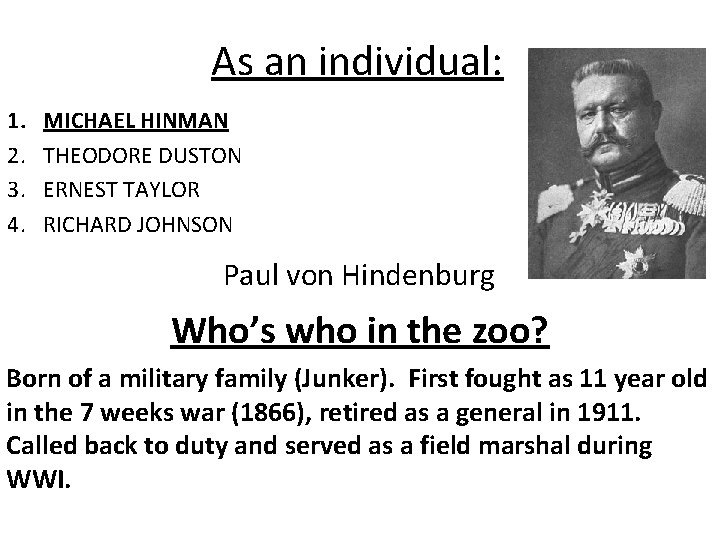
As an individual: 1. 2. 3. 4. MICHAEL HINMAN THEODORE DUSTON ERNEST TAYLOR RICHARD JOHNSON Paul von Hindenburg Who’s who in the zoo? Born of a military family (Junker). First fought as 11 year old in the 7 weeks war (1866), retired as a general in 1911. Called back to duty and served as a field marshal during WWI.
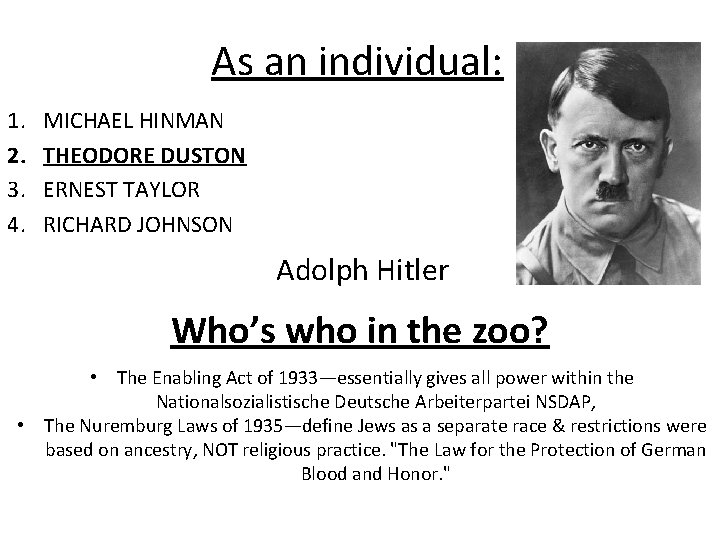
As an individual: 1. 2. 3. 4. MICHAEL HINMAN THEODORE DUSTON ERNEST TAYLOR RICHARD JOHNSON Adolph Hitler Who’s who in the zoo? • The Enabling Act of 1933—essentially gives all power within the Nationalsozialistische Deutsche Arbeiterpartei NSDAP, • The Nuremburg Laws of 1935—define Jews as a separate race & restrictions were based on ancestry, NOT religious practice. "The Law for the Protection of German Blood and Honor. "
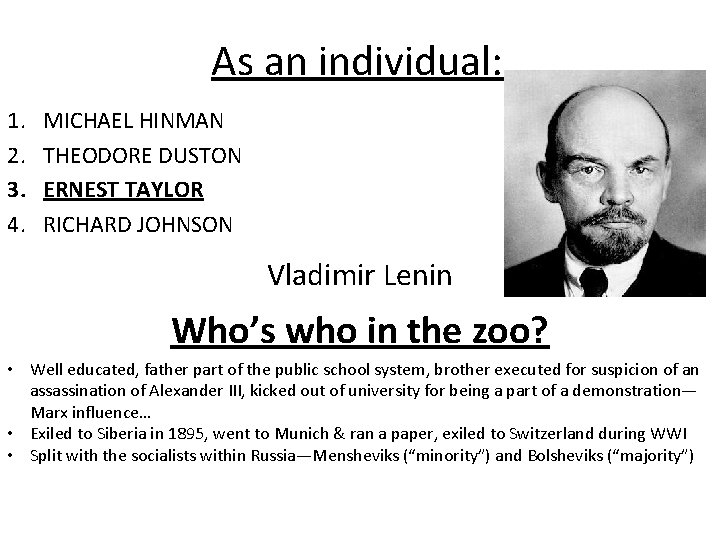
As an individual: 1. 2. 3. 4. MICHAEL HINMAN THEODORE DUSTON ERNEST TAYLOR RICHARD JOHNSON Vladimir Lenin Who’s who in the zoo? • Well educated, father part of the public school system, brother executed for suspicion of an assassination of Alexander III, kicked out of university for being a part of a demonstration— Marx influence… • Exiled to Siberia in 1895, went to Munich & ran a paper, exiled to Switzerland during WWI • Split with the socialists within Russia—Mensheviks (“minority”) and Bolsheviks (“majority”)
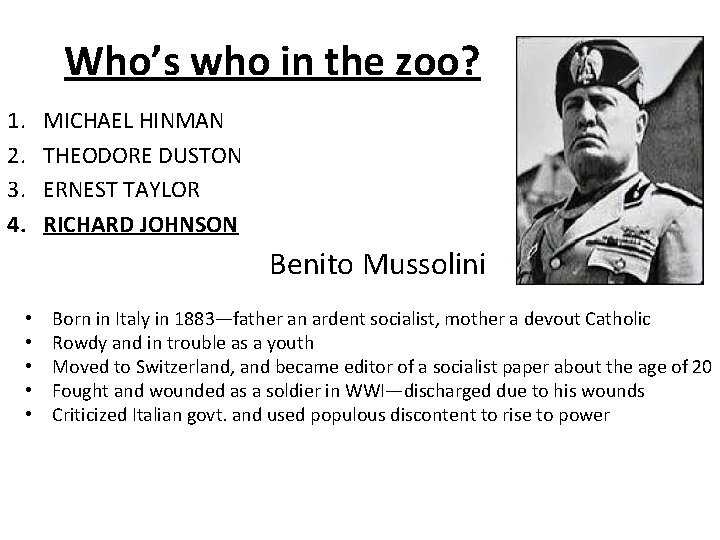
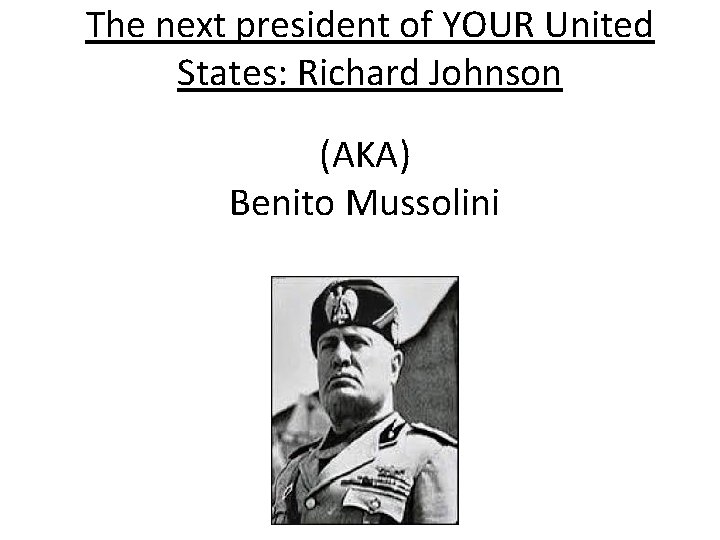
Who’s who in the zoo? 1. 2. 3. 4. MICHAEL HINMAN THEODORE DUSTON ERNEST TAYLOR RICHARD JOHNSON Benito Mussolini • • • Born in Italy in 1883—father an ardent socialist, mother a devout Catholic Rowdy and in trouble as a youth Moved to Switzerland, and became editor of a socialist paper about the age of 20 Fought and wounded as a soldier in WWI—discharged due to his wounds Criticized Italian govt. and used populous discontent to rise to power
So, what in the world is going on in Europe after WWI? ? ? 1. Russia leaves the war… 2. Russian Revolution 3. 1918 Influenza Pandemic 4. Brest-Litosvk Treaty 5. Naval Blockade of Germany 6. The Treaty of Versailles—Germany signs 7. Inflation in UK— 1926 General Strike 8. “War Economy” in France 9. Italy gets next to nothing… 10. China was “Allied” but doesn’t get what they want… 11. Japan also “Allied” got Germany’s part of China 12. The Lost Generation
The next president of YOUR United States: Richard Johnson (AKA) Benito Mussolini
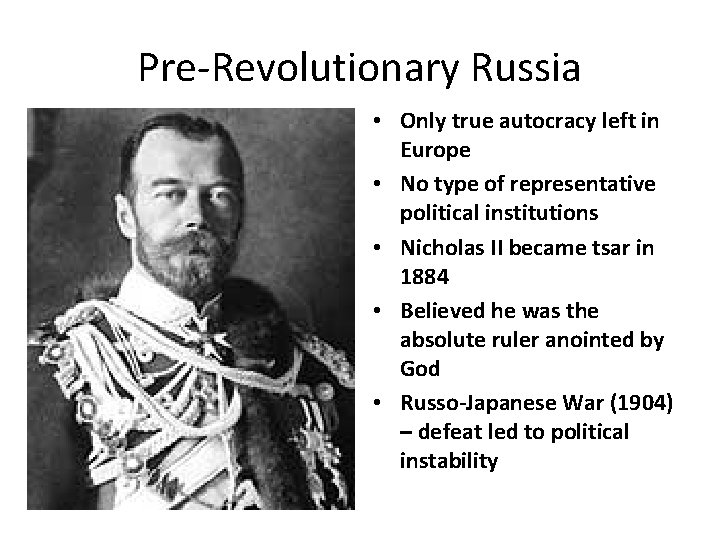
Pre-Revolutionary Russia • Only true autocracy left in Europe • No type of representative political institutions • Nicholas II became tsar in 1884 • Believed he was the absolute ruler anointed by God • Russo-Japanese War (1904) – defeat led to political instability
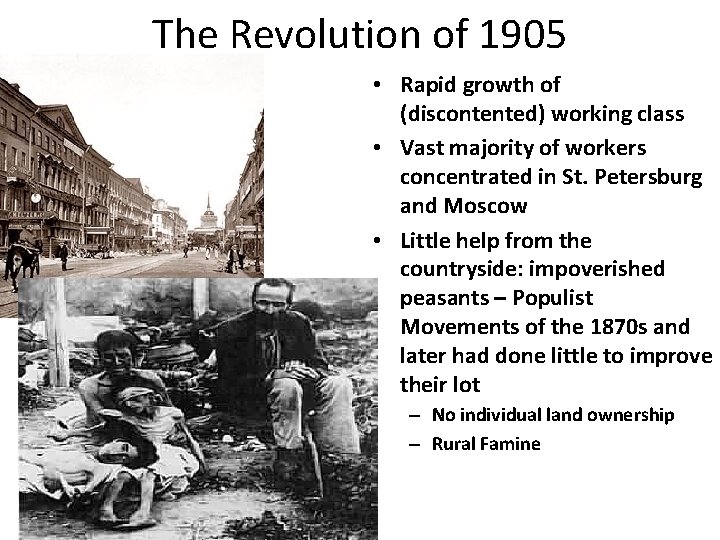
The Revolution of 1905 • Rapid growth of (discontented) working class • Vast majority of workers concentrated in St. Petersburg and Moscow • Little help from the countryside: impoverished peasants – Populist Movements of the 1870 s and later had done little to improve their lot – No individual land ownership – Rural Famine
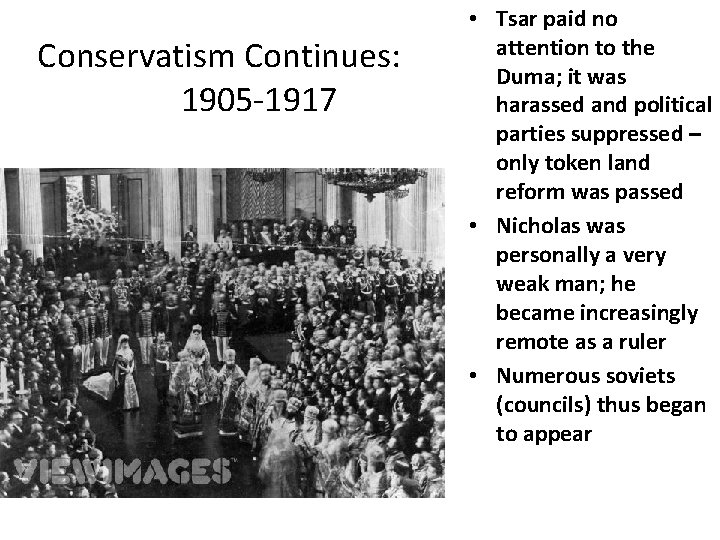
Conservatism Continues: 1905 -1917 • Tsar paid no attention to the Duma; it was harassed and political parties suppressed – only token land reform was passed • Nicholas was personally a very weak man; he became increasingly remote as a ruler • Numerous soviets (councils) thus began to appear
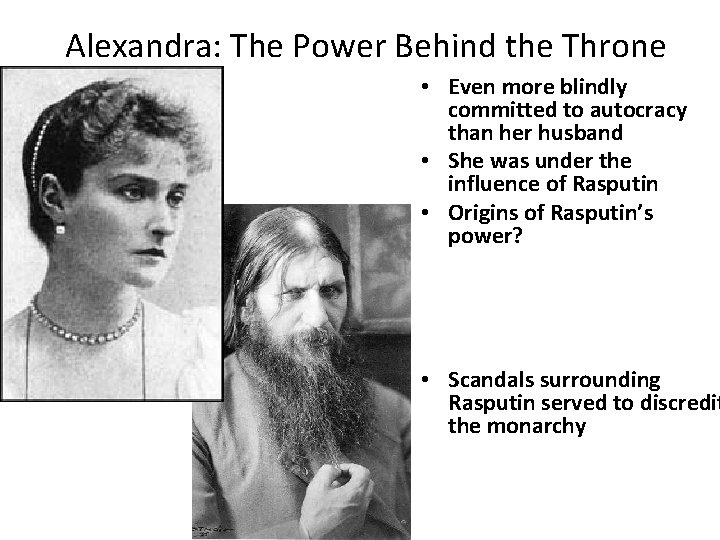
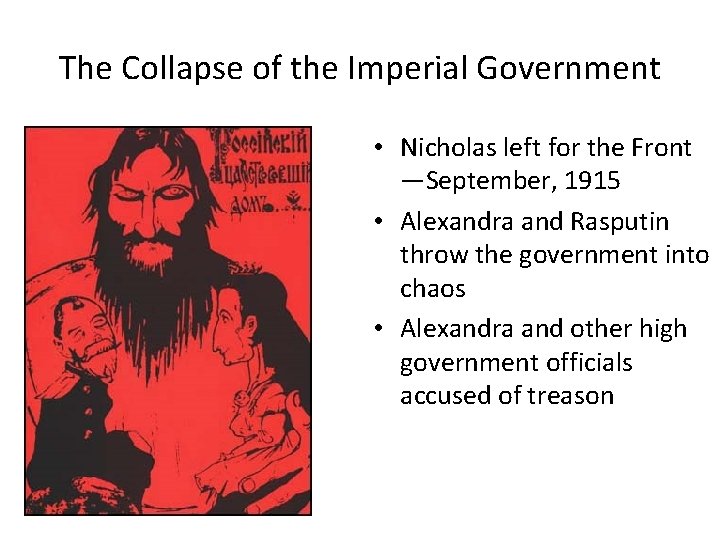
Alexandra: The Power Behind the Throne • Even more blindly committed to autocracy than her husband • She was under the influence of Rasputin • Origins of Rasputin’s power? • Scandals surrounding Rasputin served to discredit the monarchy
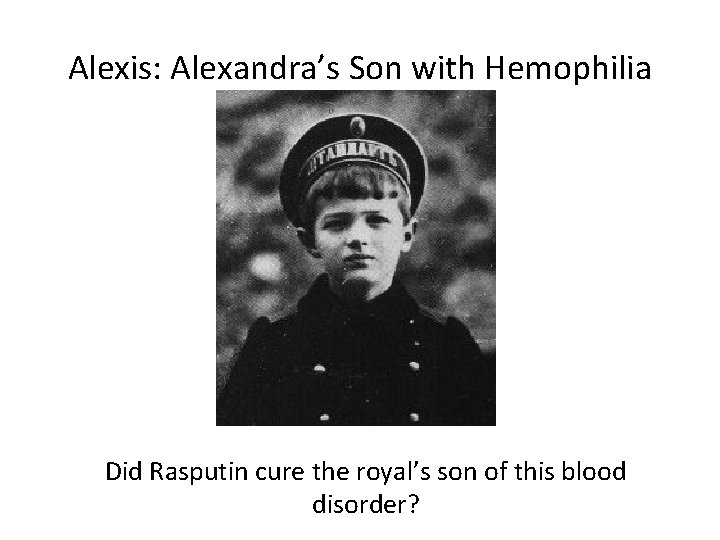
Alexis: Alexandra’s Son with Hemophilia Did Rasputin cure the royal’s son of this blood disorder?
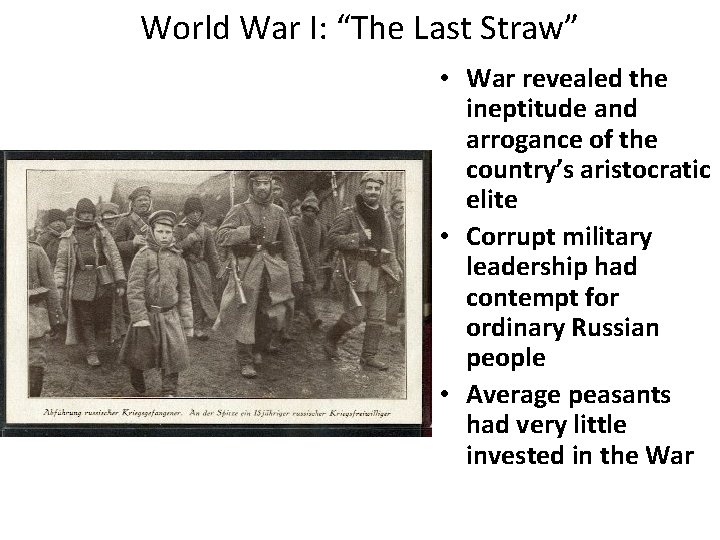
World War I: “The Last Straw” • War revealed the ineptitude and arrogance of the country’s aristocratic elite • Corrupt military leadership had contempt for ordinary Russian people • Average peasants had very little invested in the War
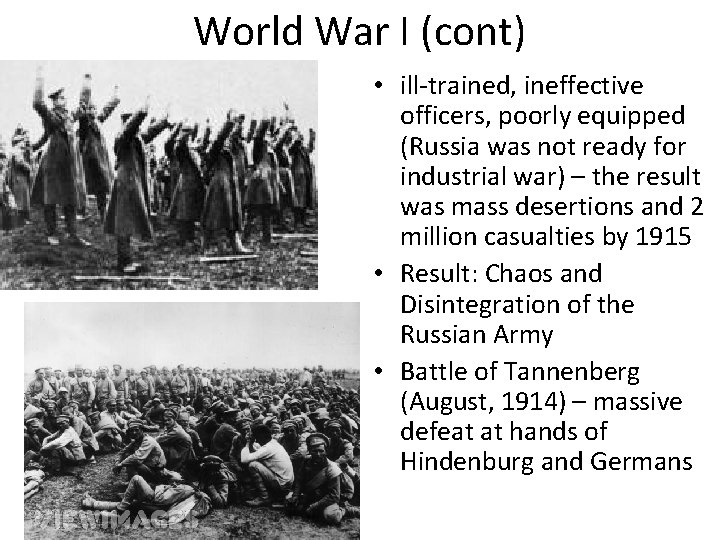
World War I (cont) • ill-trained, ineffective officers, poorly equipped (Russia was not ready for industrial war) – the result was mass desertions and 2 million casualties by 1915 • Result: Chaos and Disintegration of the Russian Army • Battle of Tannenberg (August, 1914) – massive defeat at hands of Hindenburg and Germans
The Collapse of the Imperial Government • Nicholas left for the Front —September, 1915 • Alexandra and Rasputin throw the government into chaos • Alexandra and other high government officials accused of treason
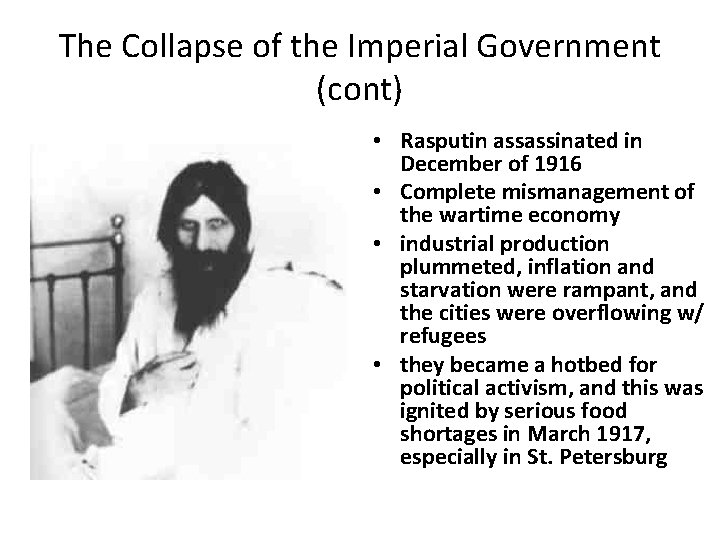
The Collapse of the Imperial Government (cont) • Rasputin assassinated in December of 1916 • Complete mismanagement of the wartime economy • industrial production plummeted, inflation and starvation were rampant, and the cities were overflowing w/ refugees • they became a hotbed for political activism, and this was ignited by serious food shortages in March 1917, especially in St. Petersburg
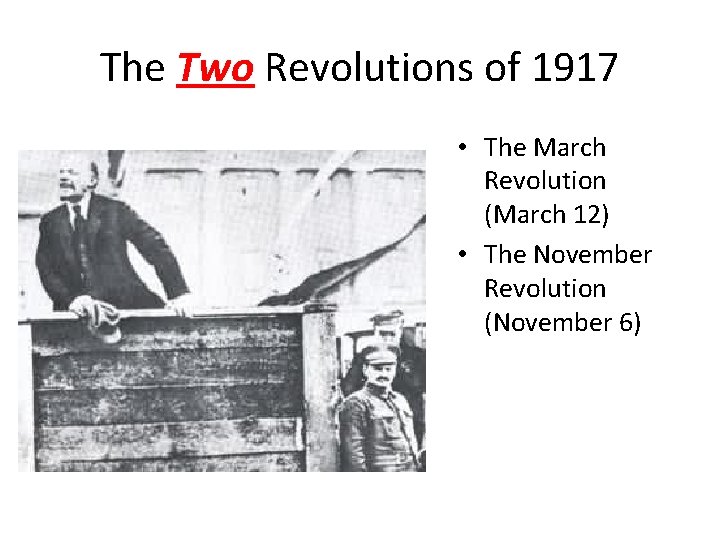
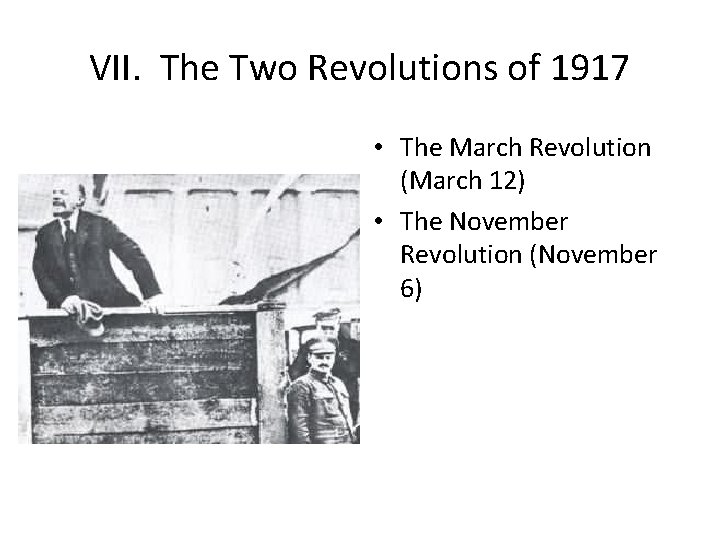
The Two Revolutions of 1917 • The March Revolution (March 12) • The November Revolution (November 6)
VII. The Two Revolutions of 1917 • The March Revolution (March 12) • The November Revolution (November 6)
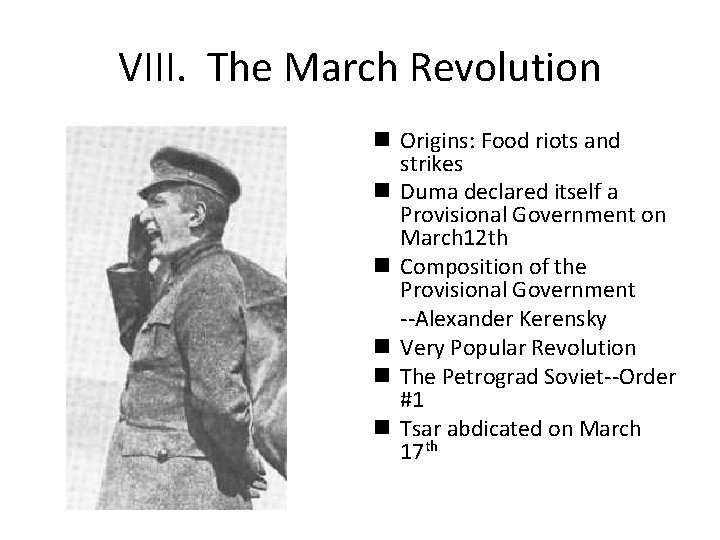
VIII. The March Revolution n Origins: Food riots and strikes n Duma declared itself a Provisional Government on March 12 th n Composition of the Provisional Government --Alexander Kerensky n Very Popular Revolution n The Petrograd Soviet--Order #1 n Tsar abdicated on March 17 th
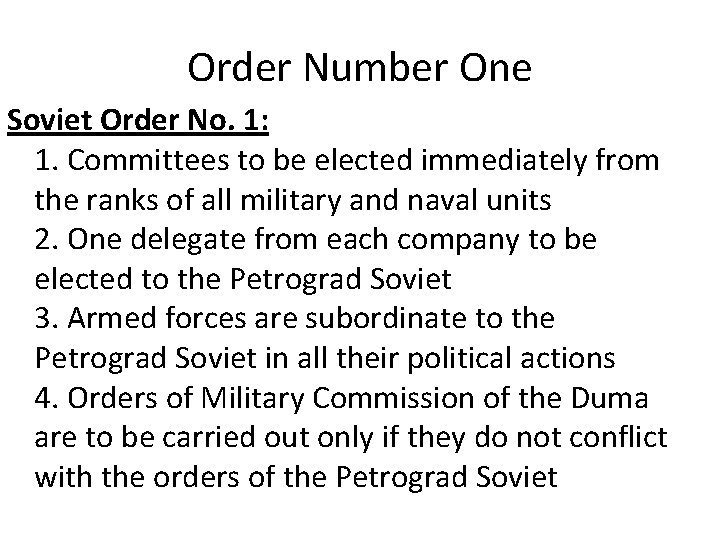
Order Number One Soviet Order No. 1: 1. Committees to be elected immediately from the ranks of all military and naval units 2. One delegate from each company to be elected to the Petrograd Soviet 3. Armed forces are subordinate to the Petrograd Soviet in all their political actions 4. Orders of Military Commission of the Duma are to be carried out only if they do not conflict with the orders of the Petrograd Soviet
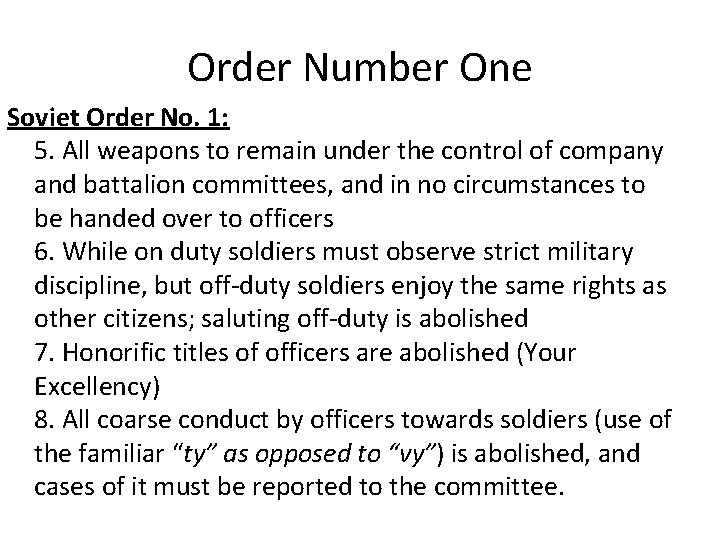
Order Number One Soviet Order No. 1: 5. All weapons to remain under the control of company and battalion committees, and in no circumstances to be handed over to officers 6. While on duty soldiers must observe strict military discipline, but off-duty soldiers enjoy the same rights as other citizens; saluting off-duty is abolished 7. Honorific titles of officers are abolished (Your Excellency) 8. All coarse conduct by officers towards soldiers (use of the familiar “ty” as opposed to “vy”) is abolished, and cases of it must be reported to the committee.
Order Number One • This is the first order of this new government? !? “Psst…hey, “politicians, ” we’re starving over here!!!” Why would this be that important? • This order was constructed and delivered by the common soldier. Lack of trust with politicians Lack of trust with their officers • Who controls the military? ? ? At it’s base level, it’s the soldier. But, levels of government are in place as well. • Does “might” make “right? ”
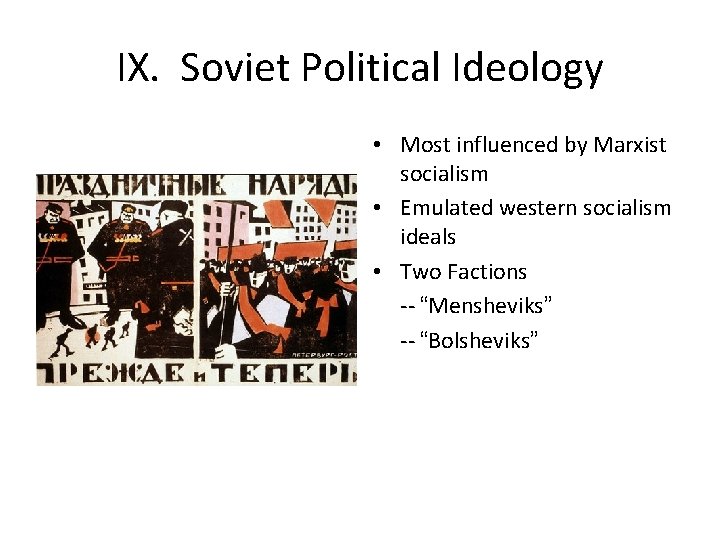
IX. Soviet Political Ideology • Most influenced by Marxist socialism • Emulated western socialism ideals • Two Factions -- “Mensheviks” -- “Bolsheviks”
A “Joke” about Capitalism • A young reporter asked a leading capitalist how he made his fortune.
A “Joke” about Capitalism • A young reporter asked a leading capitalist how he made his fortune. "It was really quite simple", the capitalist answered. I bought an apple for 5 cents, spent the evening polishing it, and sold it the next day for 10 cents. With this I bought two apples, spent the evening polishing them, and sold them for 20 cents. And so it went until I amassed 80 cents. It was at this point that my wife's father died and left us a million dollars. ”
Capitalism Individuals Hire workers Decide on production Realize a Profit Own their labor Competition Supply and Demand determines prices Risk/failure Think about it with respect to China—Silk Road, burning the boats, the Opium Trade/Wars How will China react? Will they embrace or rebel? Should they allow for “free” trade?
Marxist theory and the “Joke” about Capitalism • 1. Marxism is a theory of politics, economics and history developed by Karl Marx in the mid-1800 s. – Industrial Revolution and its impact…think 3 Estates, the bourgeoisie, and who controls what… • 2. It argues that society progresses through phases, which are determined by ownership of capital. – Primitive communism (hunter/gatherer), slavery, feudalism, capitalism, and finally industrialized communism… • 3. Those who control capital essentially control society, while exploiting the workers to increase profit.
Capitalism Individuals Hire workers Decide on production Realize a Profit Own their labor Competition Supply and Demand determines prices Risk/failure Think about it with respect to China—Silk Road, burning the boats, the Opium Trade/Wars How will China react? Will they embrace or rebel? Should they allow for “free” trade?
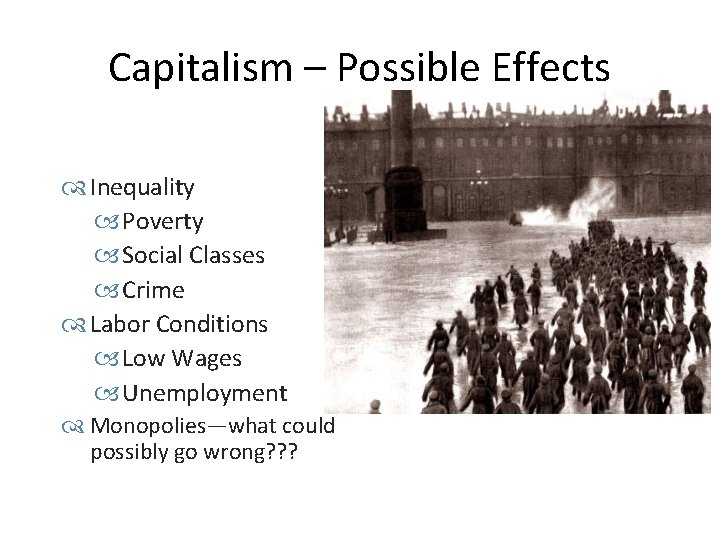
Capitalism – Possible Effects Inequality Poverty Social Classes Crime Labor Conditions Low Wages Unemployment Monopolies—what could possibly go wrong? ? ?
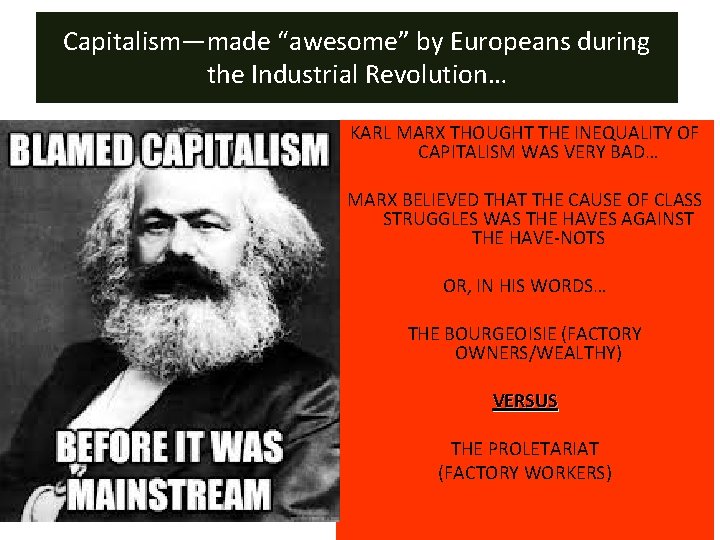
Capitalism—made “awesome” by Europeans during the Industrial Revolution… KARL MARX THOUGHT THE INEQUALITY OF CAPITALISM WAS VERY BAD… MARX BELIEVED THAT THE CAUSE OF CLASS STRUGGLES WAS THE HAVES AGAINST THE HAVE-NOTS OR, IN HIS WORDS… THE BOURGEOISIE (FACTORY OWNERS/WEALTHY) VERSUS THE PROLETARIAT (FACTORY WORKERS)
Highest Stage of Socialism = Communism
MARX WAS A SOCIALIST… Three Goals of Socialism: 1. To distribute wealth and economic opportunities equally among people 2. Government controls all major decisions about production (What and how many) 3. Public ownership of land, factories, etc. --Gov’t makes decisions for the “good of the people”
Capitalism v. Socialism • Captalism • Aka…Laissez-Faire – “Hands off” – No Government interference – Free Markets – Competition – Individual profit – Survival of fittest • Socialism • Aka…Government – “Hands in” – Government intervention – Controlled Markets – Equality – Shared profits – Help the weak
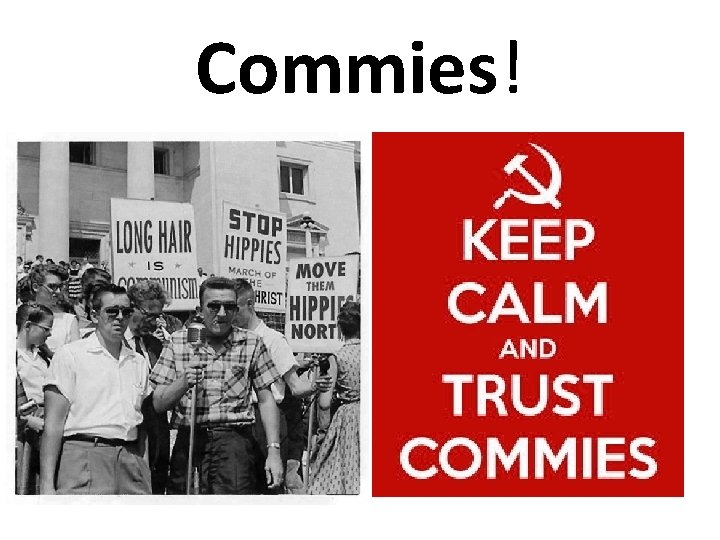
COMMIES! • “Arise ye pris’ners of starvation Arise ye wretched of the earth For justice thunders condemnation A better world’s in birth! No more tradition’s chains shall bind us Arise, ye slaves, no more in thrall; The earth shall rise on new foundations We have been naught we shall be all. ” • --Internationale Communist anthem
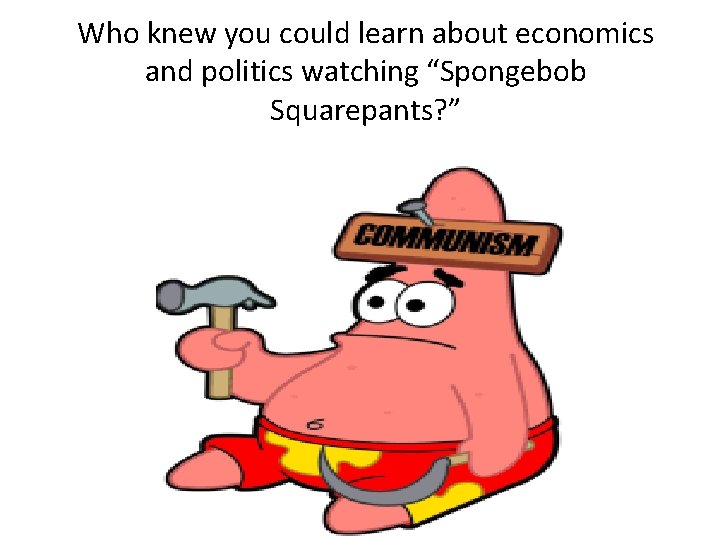
Who knew you could learn about economics and politics watching “Spongebob Squarepants? ”
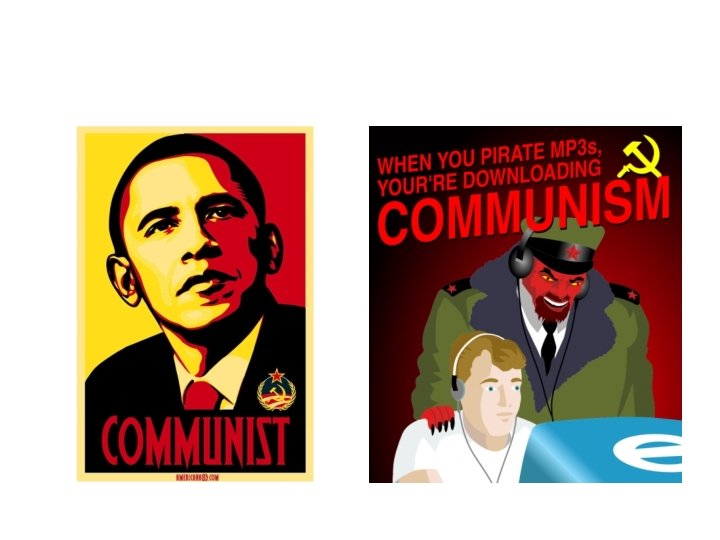
Commies!
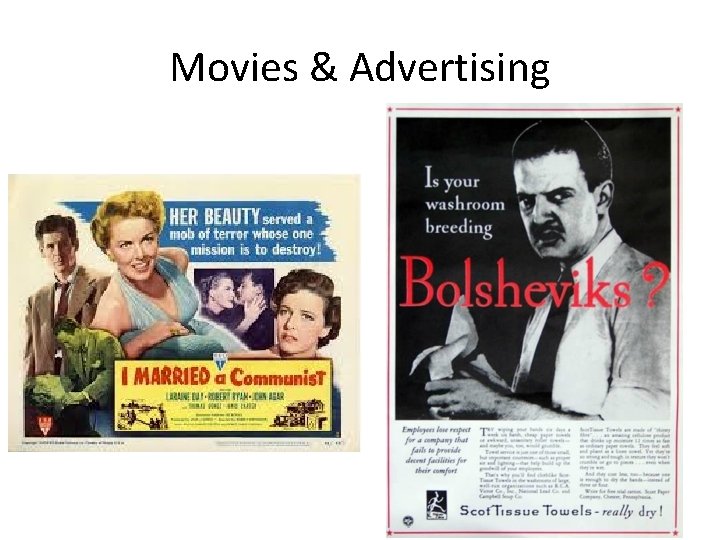
Movies & Advertising
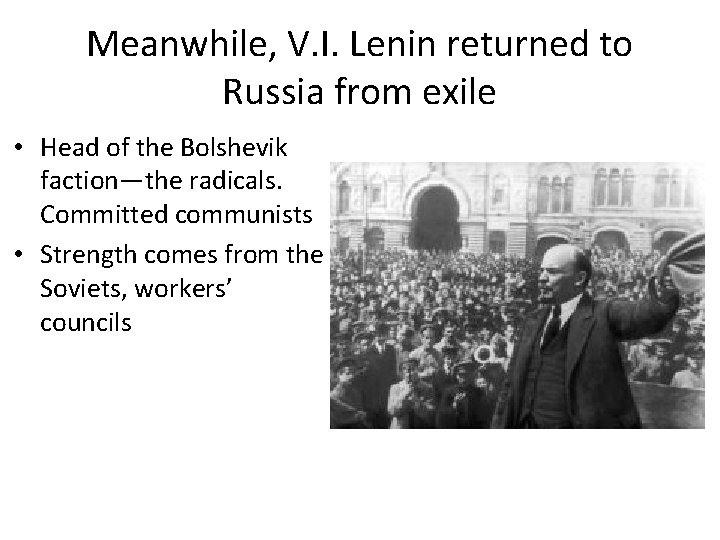
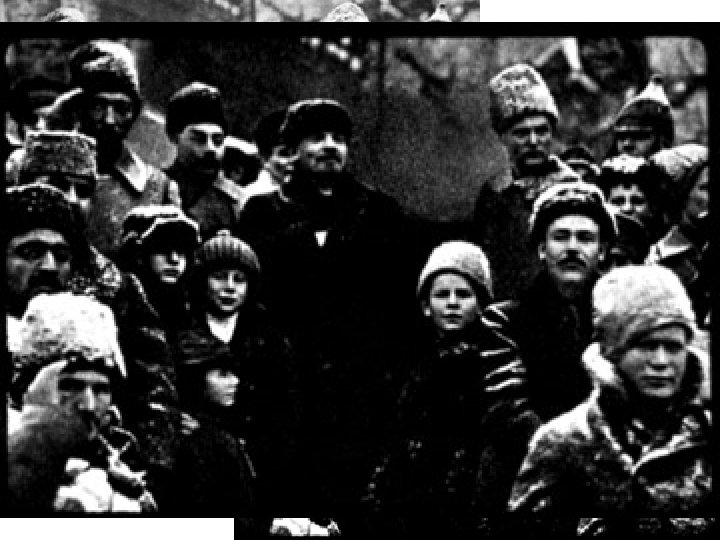
Meanwhile, V. I. Lenin returned to Russia from exile • Head of the Bolshevik faction—the radicals. Committed communists • Strength comes from the Soviets, workers’ councils
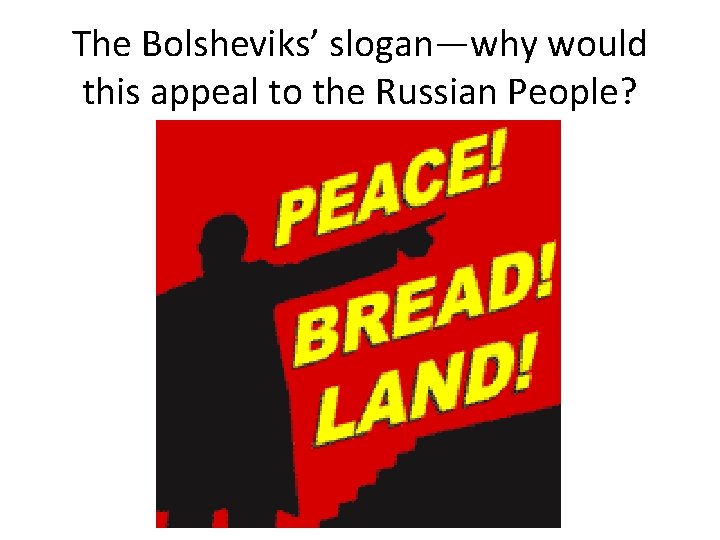
The Bolsheviks’ slogan—why would this appeal to the Russian People?
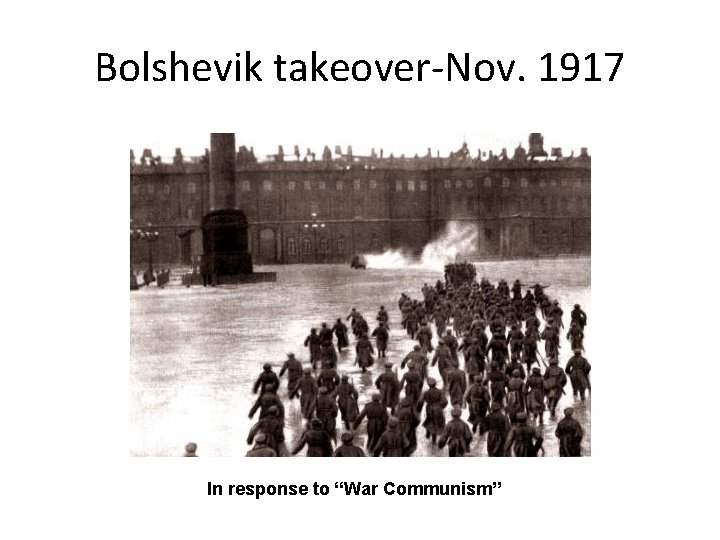
Bolshevik takeover-Nov. 1917 In response to “War Communism”
After the November Revolution • Elections for a constituent assembly didn’t give Bolsheviks a majority • In January, Bolsheviks disrupted the assembly with troops and dissolved opposition councils • Abolished private property, nationalized factories, redistributed land to the peasants.
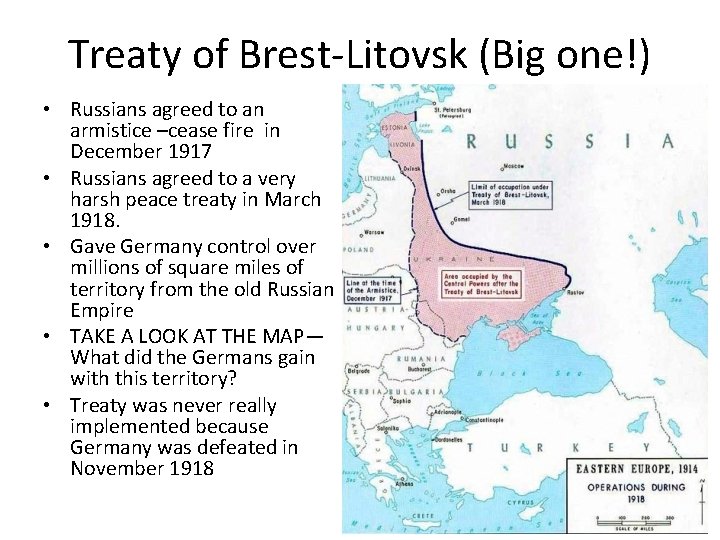
Treaty of Brest-Litovsk (Big one!) • Russians agreed to an armistice –cease fire in December 1917 • Russians agreed to a very harsh peace treaty in March 1918. • Gave Germany control over millions of square miles of territory from the old Russian Empire • TAKE A LOOK AT THE MAP— What did the Germans gain with this territory? • Treaty was never really implemented because Germany was defeated in November 1918
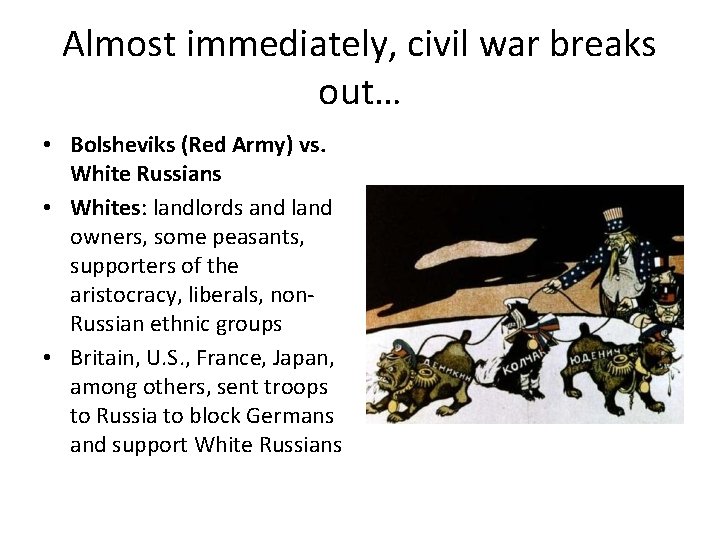
Almost immediately, civil war breaks out… • Bolsheviks (Red Army) vs. White Russians • Whites: landlords and land owners, some peasants, supporters of the aristocracy, liberals, non. Russian ethnic groups • Britain, U. S. , France, Japan, among others, sent troops to Russia to block Germans and support White Russians
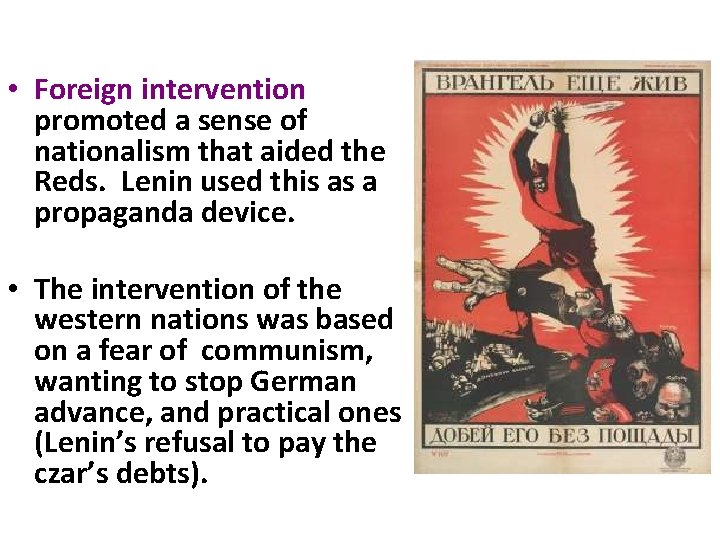
• Foreign intervention promoted a sense of nationalism that aided the Reds. Lenin used this as a propaganda device. • The intervention of the western nations was based on a fear of communism, wanting to stop German advance, and practical ones (Lenin’s refusal to pay the czar’s debts).
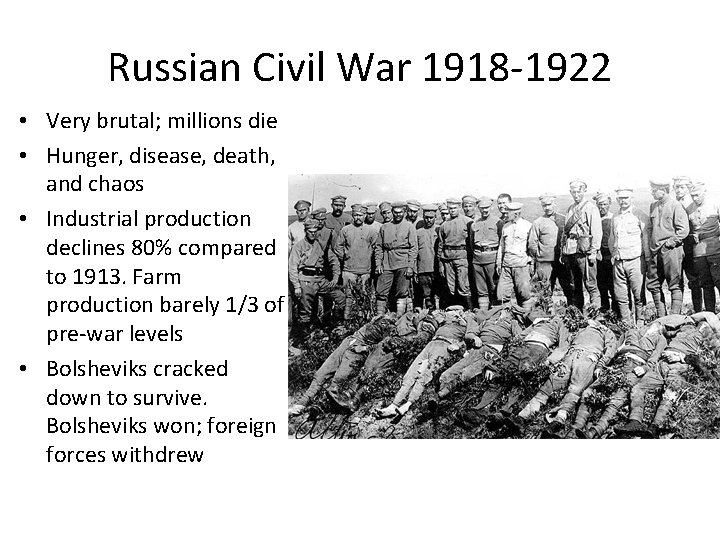
Russian Civil War 1918 -1922 • Very brutal; millions die • Hunger, disease, death, and chaos • Industrial production declines 80% compared to 1913. Farm production barely 1/3 of pre-war levels • Bolsheviks cracked down to survive. Bolsheviks won; foreign forces withdrew
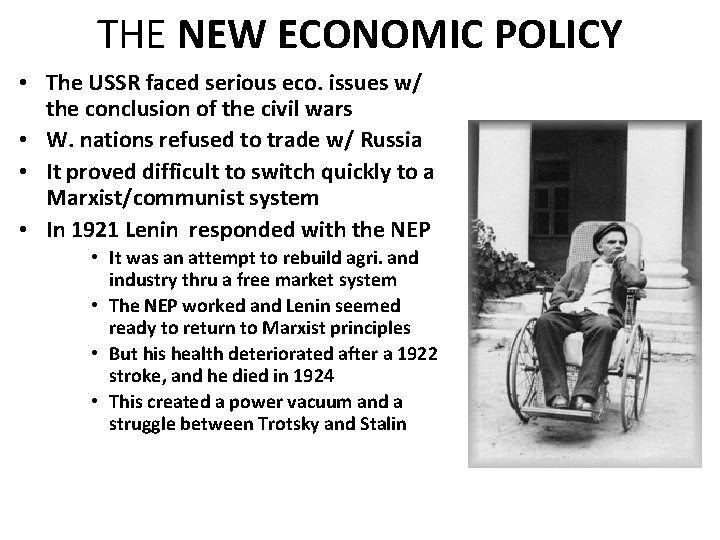
THE NEW ECONOMIC POLICY • The USSR faced serious eco. issues w/ the conclusion of the civil wars • W. nations refused to trade w/ Russia • It proved difficult to switch quickly to a Marxist/communist system • In 1921 Lenin responded with the NEP • It was an attempt to rebuild agri. and industry thru a free market system • The NEP worked and Lenin seemed ready to return to Marxist principles • But his health deteriorated after a 1922 stroke, and he died in 1924 • This created a power vacuum and a struggle between Trotsky and Stalin
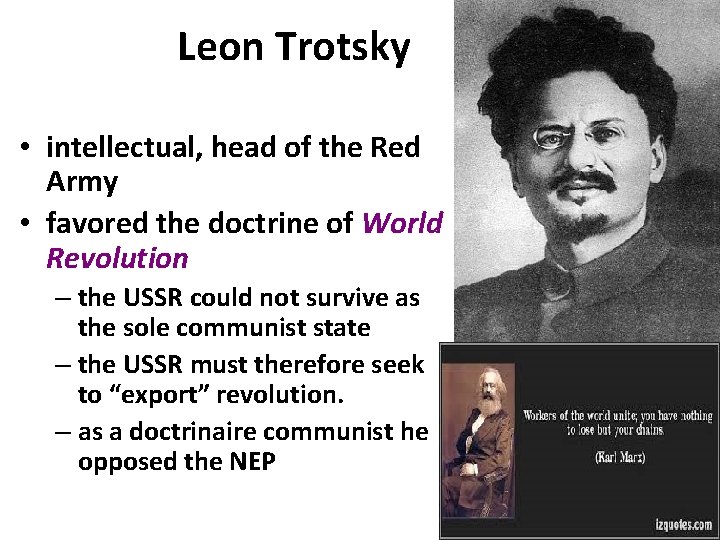
Leon Trotsky • intellectual, head of the Red Army • favored the doctrine of World Revolution – the USSR could not survive as the sole communist state – the USSR must therefore seek to “export” revolution. – as a doctrinaire communist he opposed the NEP
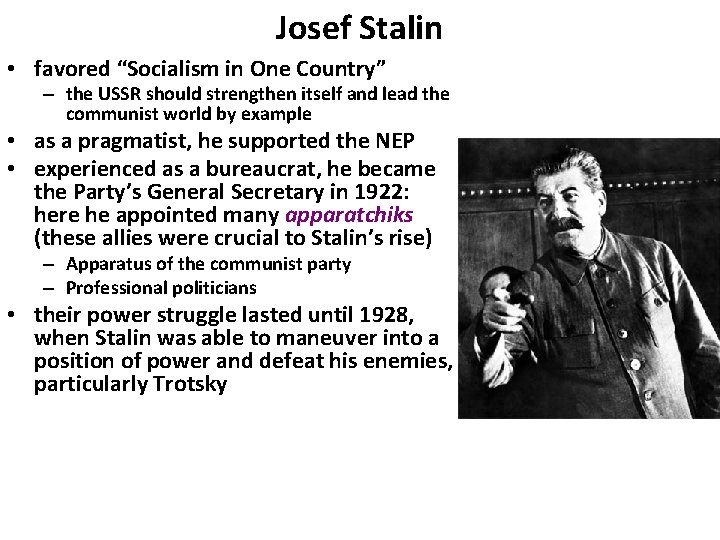
Josef Stalin • favored “Socialism in One Country” – the USSR should strengthen itself and lead the communist world by example • as a pragmatist, he supported the NEP • experienced as a bureaucrat, he became the Party’s General Secretary in 1922: here he appointed many apparatchiks (these allies were crucial to Stalin’s rise) – Apparatus of the communist party – Professional politicians • their power struggle lasted until 1928, when Stalin was able to maneuver into a position of power and defeat his enemies, particularly Trotsky
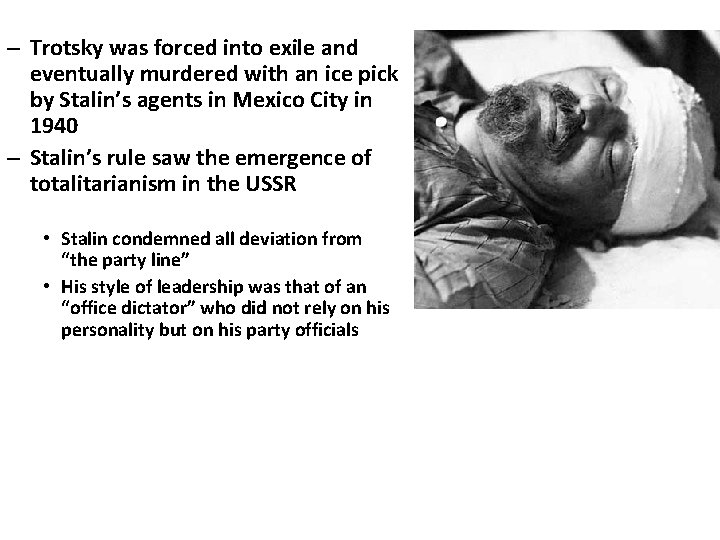
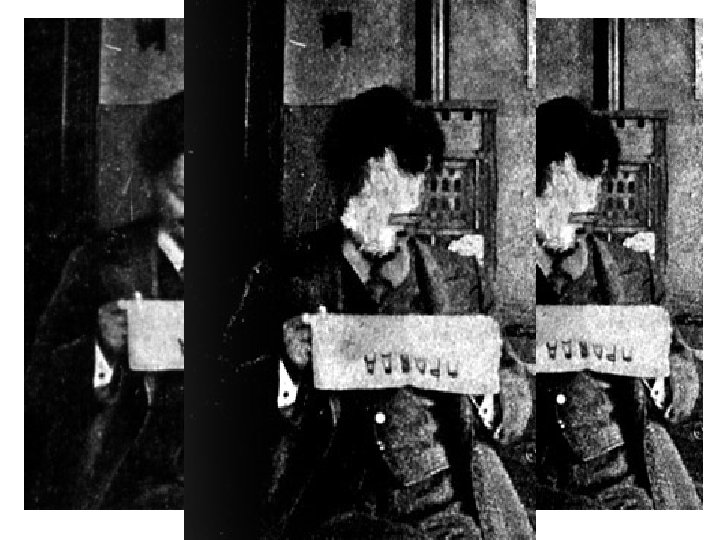
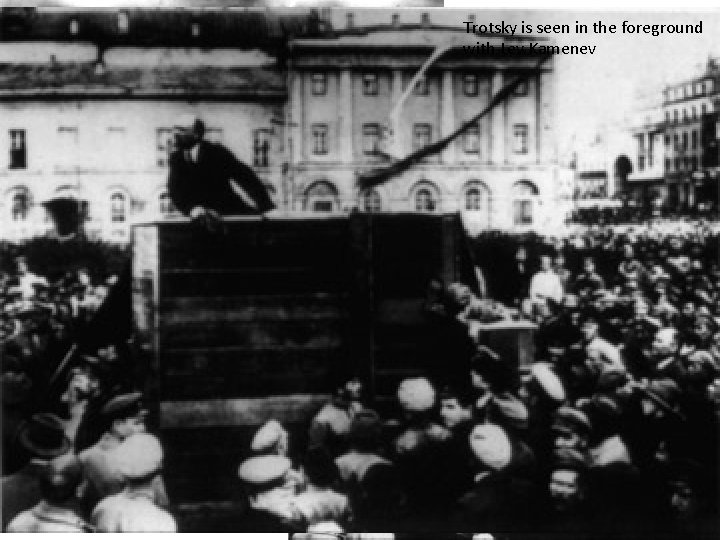
– Trotsky was forced into exile and eventually murdered with an ice pick by Stalin’s agents in Mexico City in 1940 – Stalin’s rule saw the emergence of totalitarianism in the USSR • Stalin condemned all deviation from “the party line” • His style of leadership was that of an “office dictator” who did not rely on his personality but on his party officials
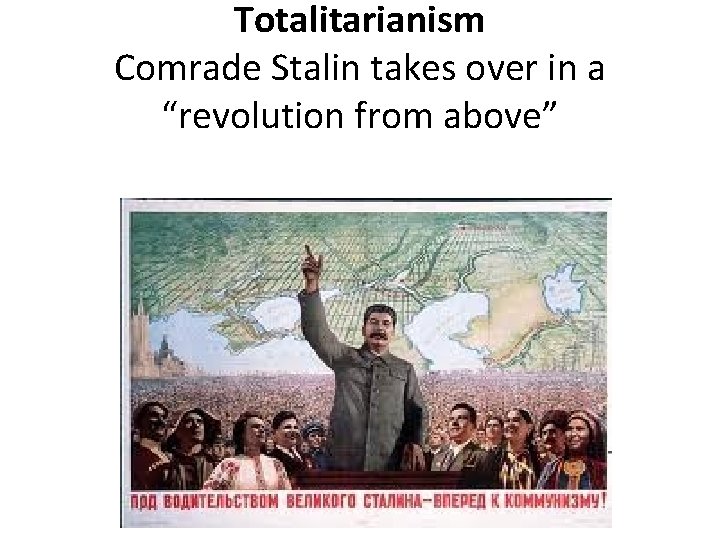
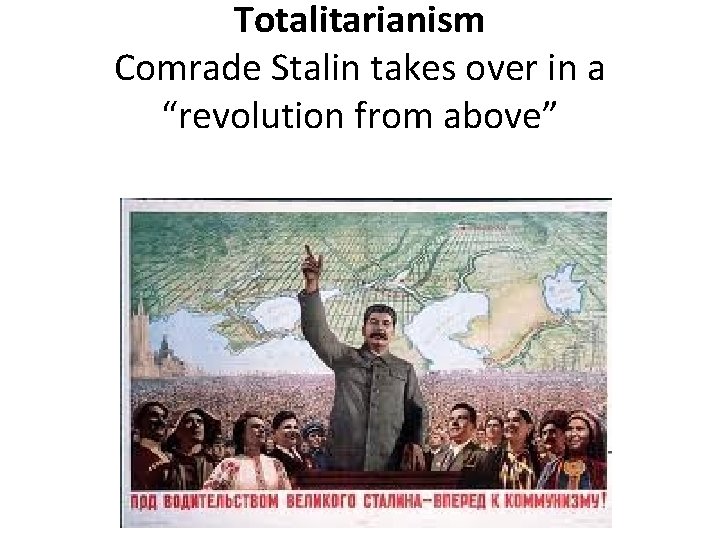
Totalitarianism Comrade Stalin takes over in a “revolution from above”
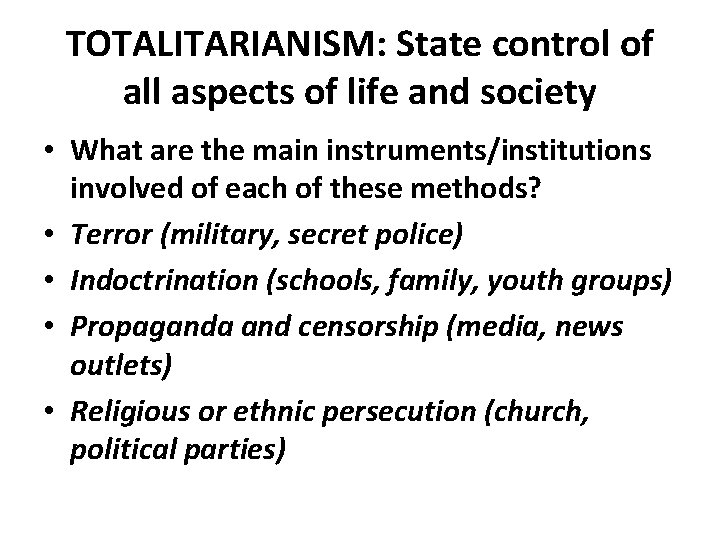
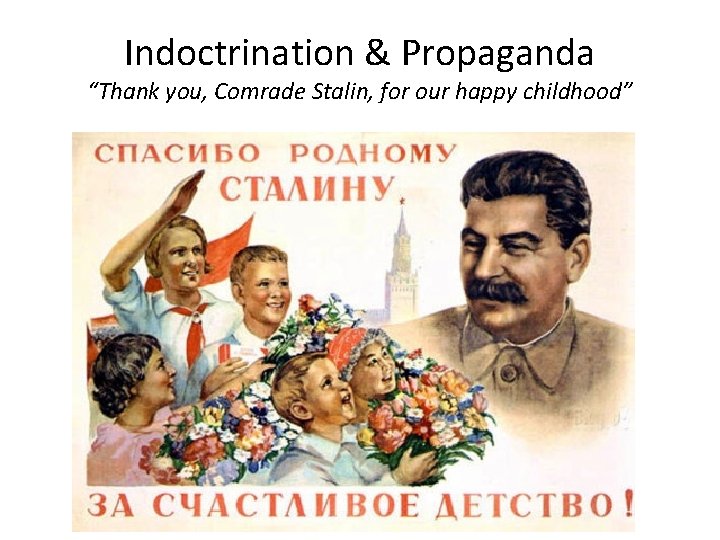
TOTALITARIANISM: State control of all aspects of life and society • What are the main instruments/institutions involved of each of these methods? • Terror (military, secret police) • Indoctrination (schools, family, youth groups) • Propaganda and censorship (media, news outlets) • Religious or ethnic persecution (church, political parties)
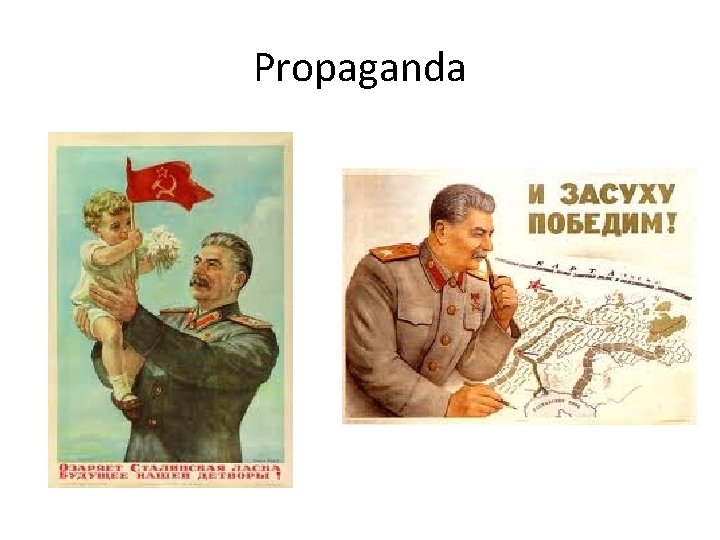
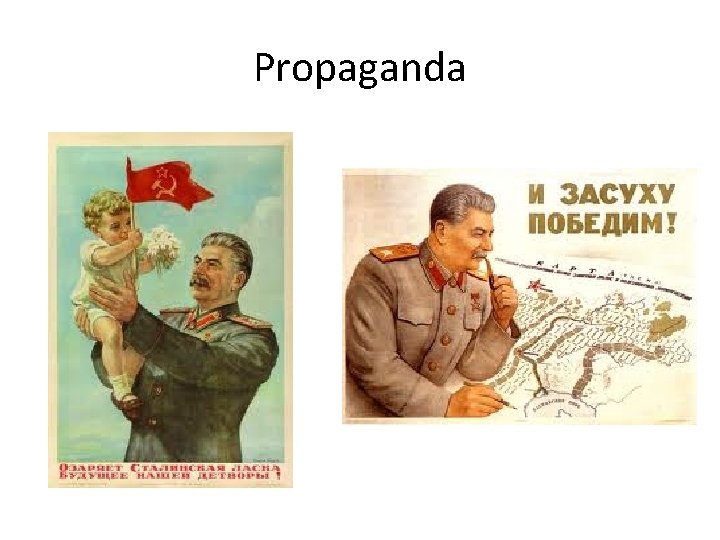
Propaganda
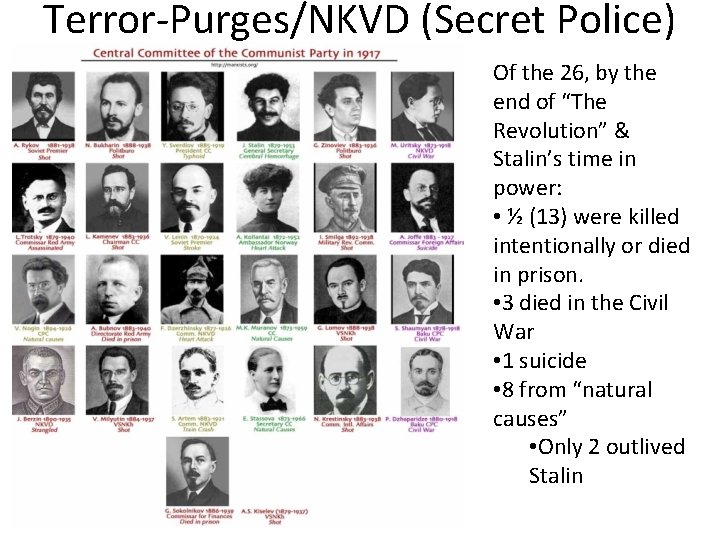
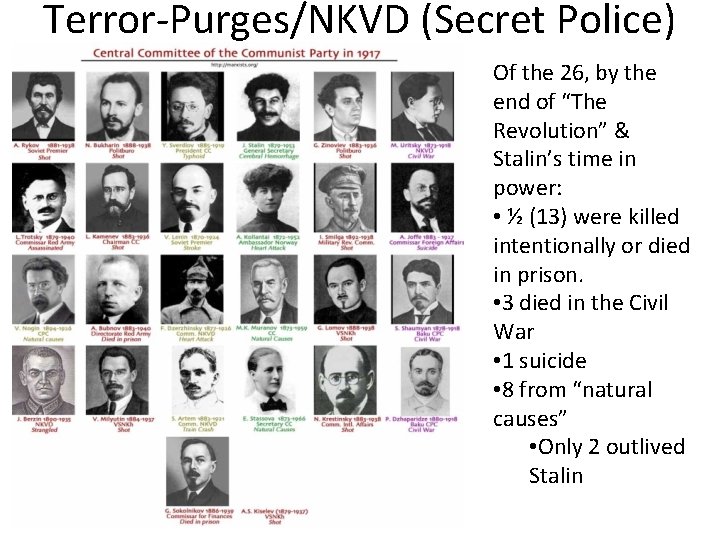
Terror-Purges/NKVD (Secret Police) Of the 26, by the end of “The Revolution” & Stalin’s time in power: • ½ (13) were killed intentionally or died in prison. • 3 died in the Civil War • 1 suicide • 8 from “natural causes” • Only 2 outlived Stalin
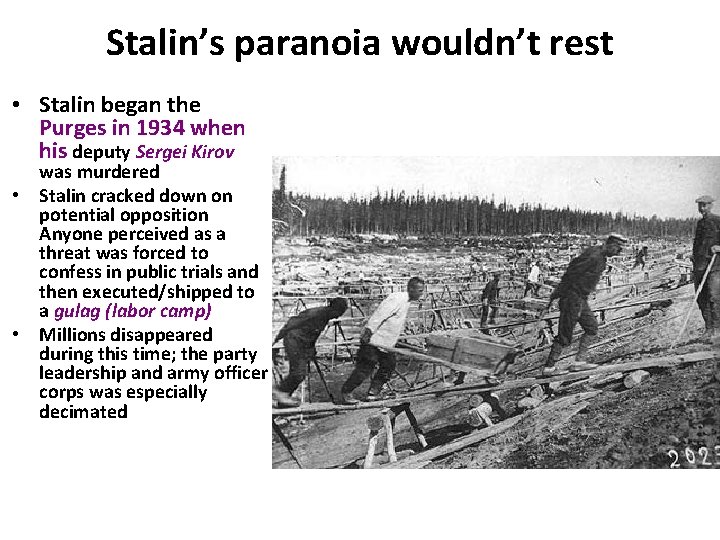
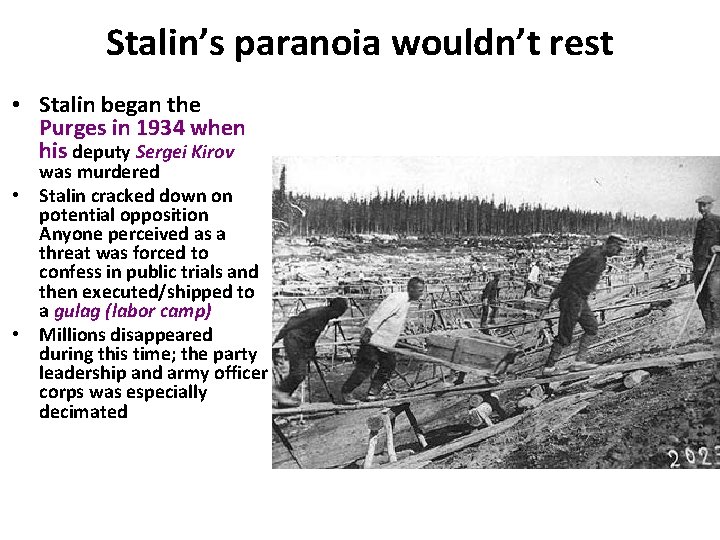
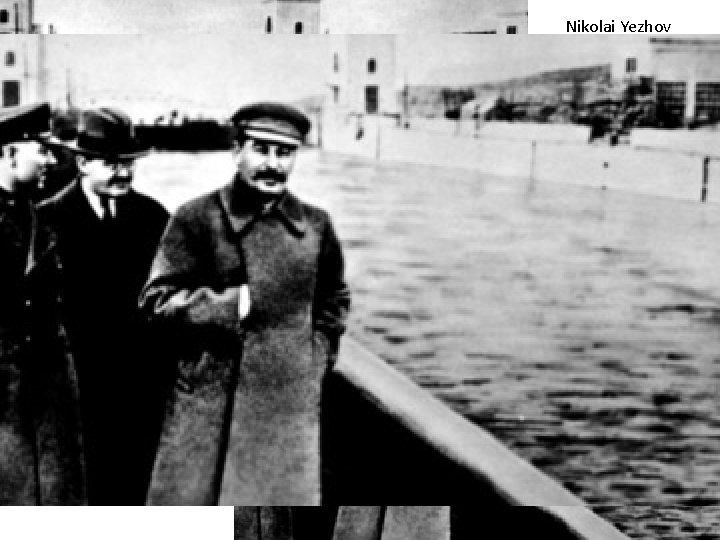
Stalin’s paranoia wouldn’t rest • Stalin began the Purges in 1934 when his deputy Sergei Kirov was murdered • Stalin cracked down on potential opposition Anyone perceived as a threat was forced to confess in public trials and then executed/shipped to a gulag (labor camp) • Millions disappeared during this time; the party leadership and army officer corps was especially decimated
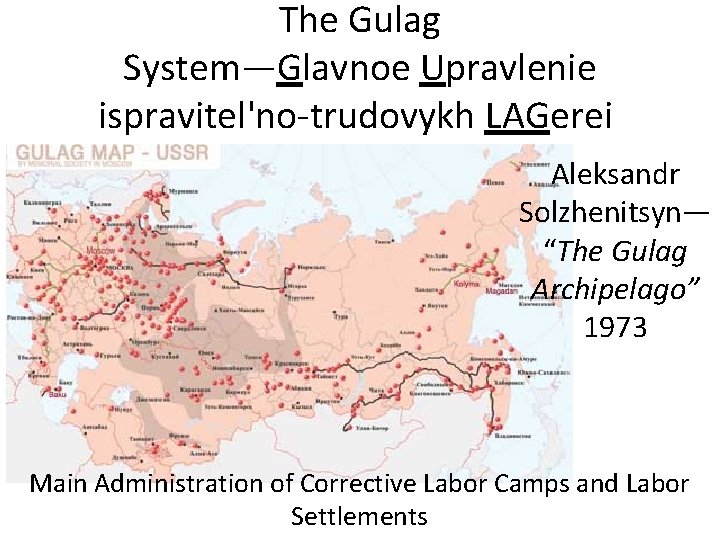
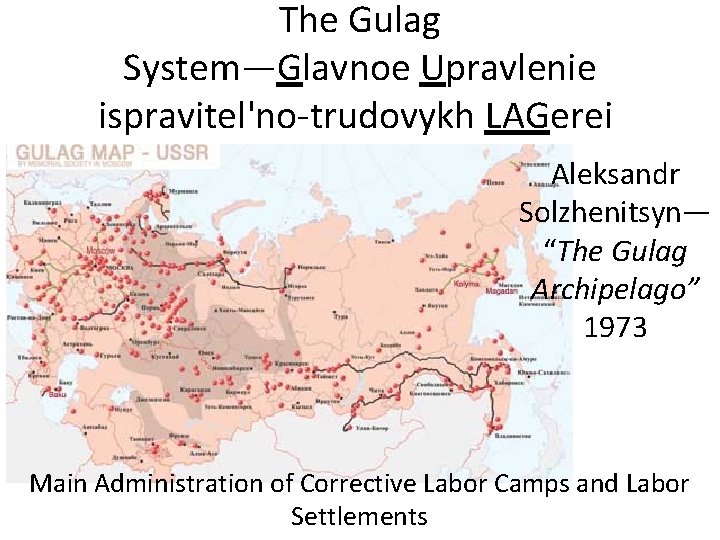
The Gulag System—Glavnoe Upravlenie ispravitel'no-trudovykh LAGerei Aleksandr Solzhenitsyn— “The Gulag Archipelago” 1973 Main Administration of Corrective Labor Camps and Labor Settlements
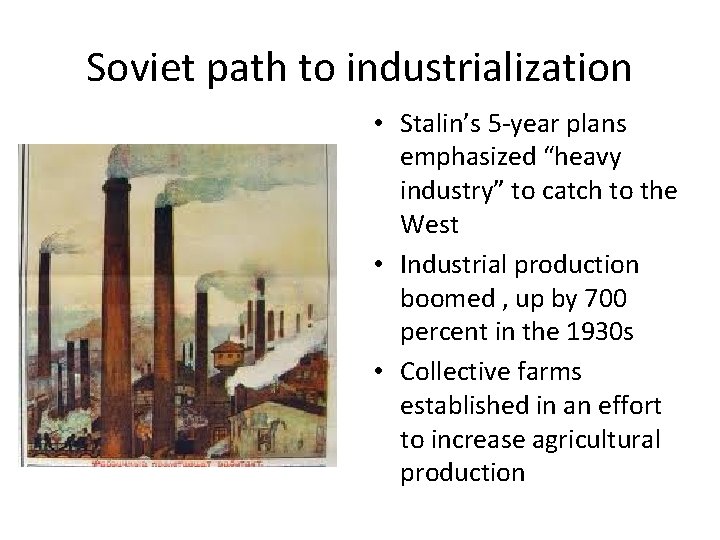
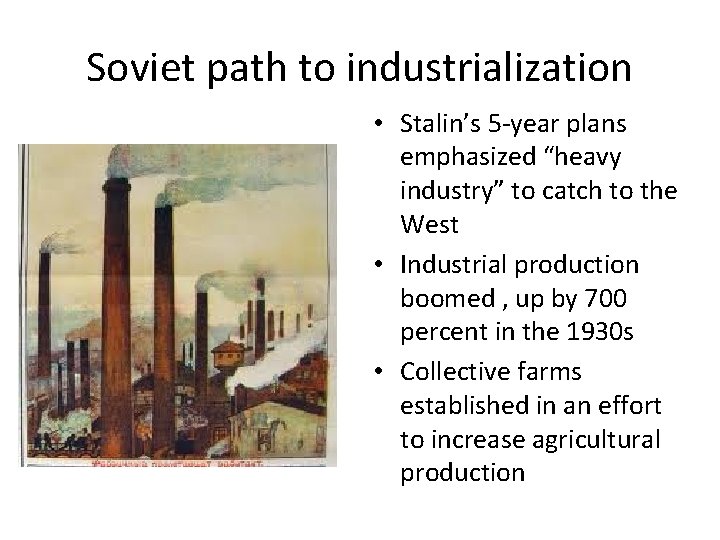
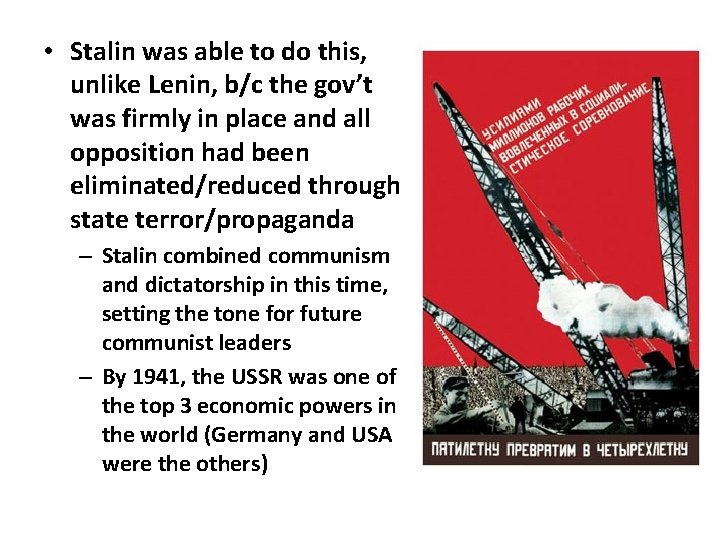
Soviet path to industrialization • Stalin’s 5 -year plans emphasized “heavy industry” to catch to the West • Industrial production boomed , up by 700 percent in the 1930 s • Collective farms established in an effort to increase agricultural production
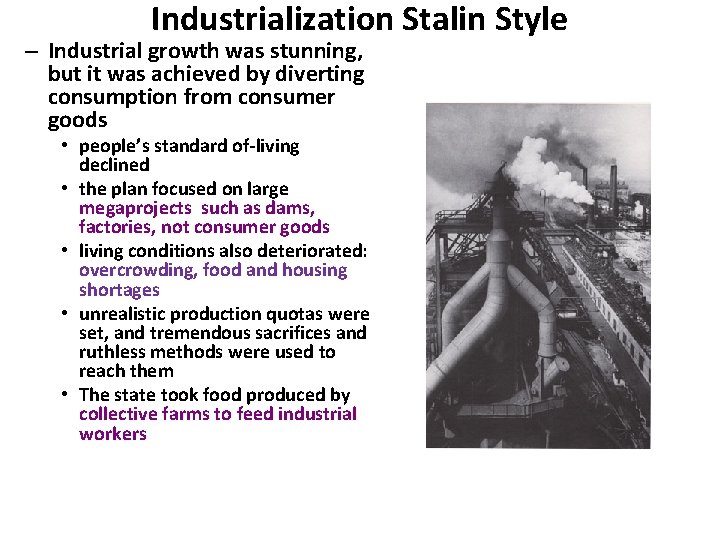
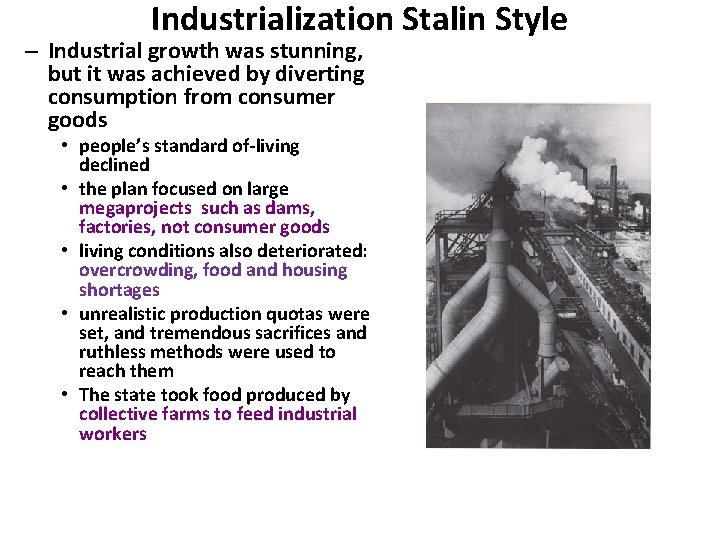
Industrialization Stalin Style – Industrial growth was stunning, but it was achieved by diverting consumption from consumer goods • people’s standard of-living declined • the plan focused on large megaprojects such as dams, factories, not consumer goods • living conditions also deteriorated: overcrowding, food and housing shortages • unrealistic production quotas were set, and tremendous sacrifices and ruthless methods were used to reach them • The state took food produced by collective farms to feed industrial workers
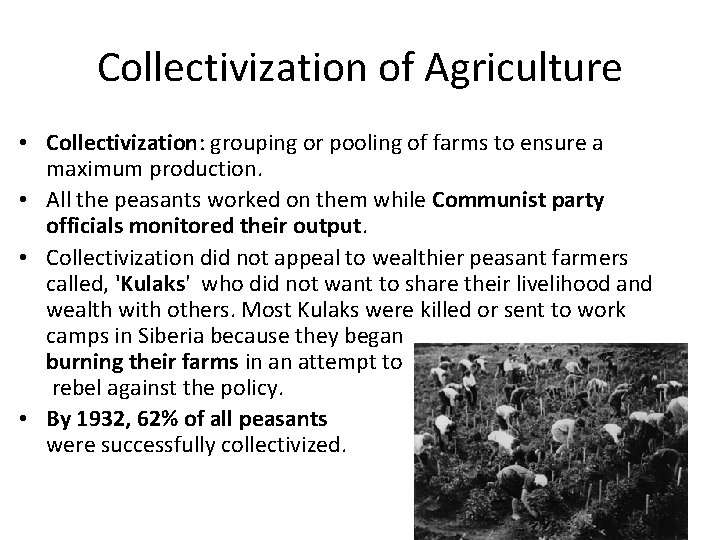
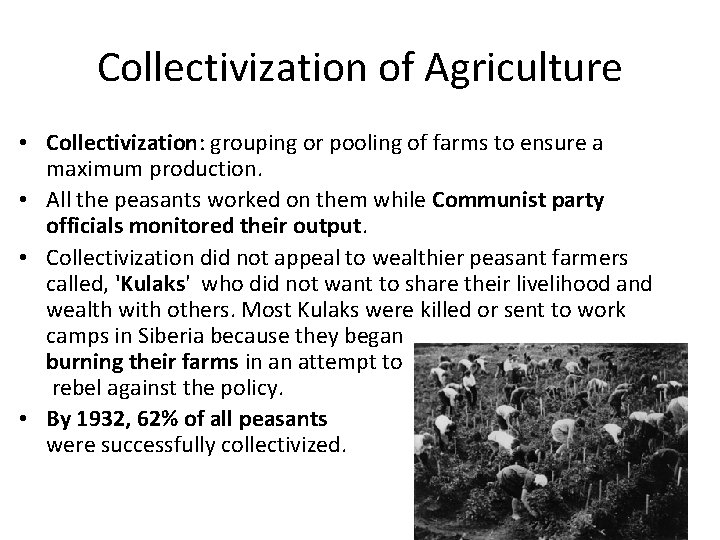
Collectivization of Agriculture • Collectivization: grouping or pooling of farms to ensure a maximum production. • All the peasants worked on them while Communist party officials monitored their output. • Collectivization did not appeal to wealthier peasant farmers called, 'Kulaks' who did not want to share their livelihood and wealth with others. Most Kulaks were killed or sent to work camps in Siberia because they began burning their farms in an attempt to rebel against the policy. • By 1932, 62% of all peasants were successfully collectivized.
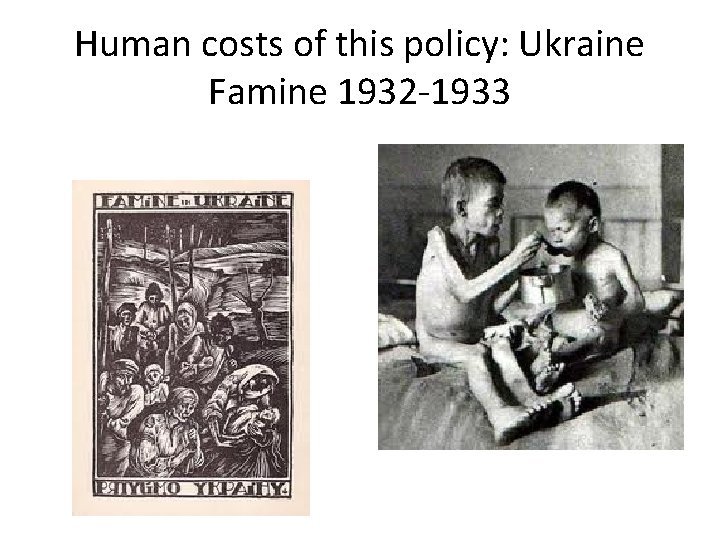
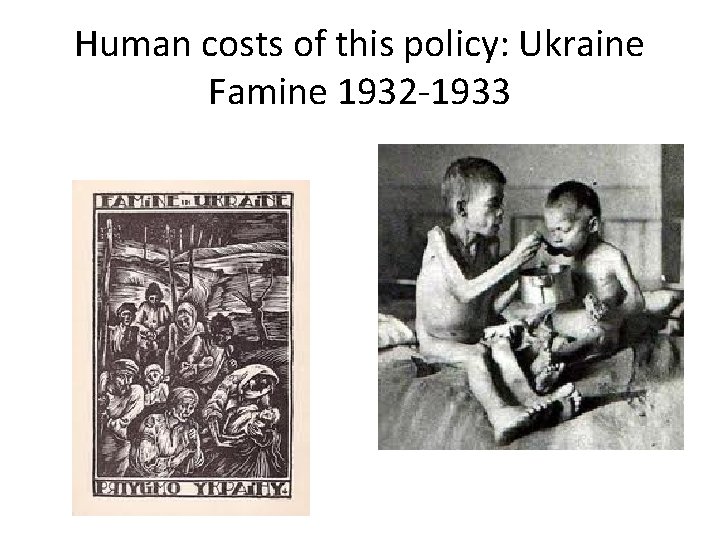
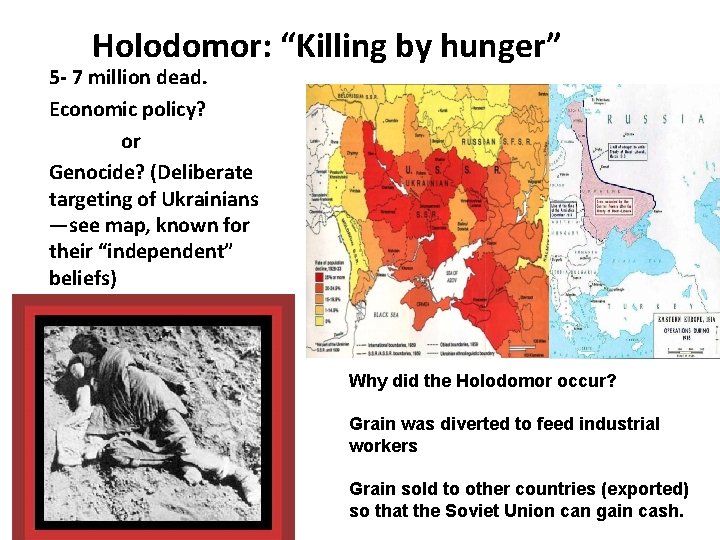
Human costs of this policy: Ukraine Famine 1932 -1933
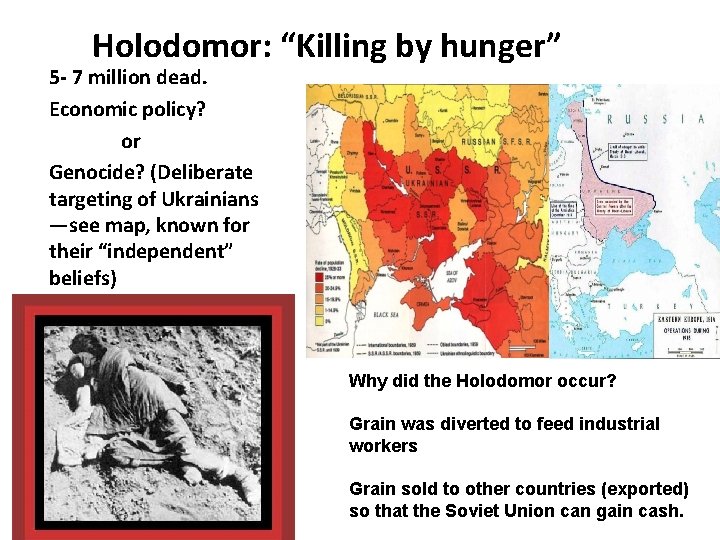
Holodomor: “Killing by hunger” 5 - 7 million dead. Economic policy? or Genocide? (Deliberate targeting of Ukrainians —see map, known for their “independent” beliefs) Why did the Holodomor occur? Grain was diverted to feed industrial workers Grain sold to other countries (exported) so that the Soviet Union can gain cash.
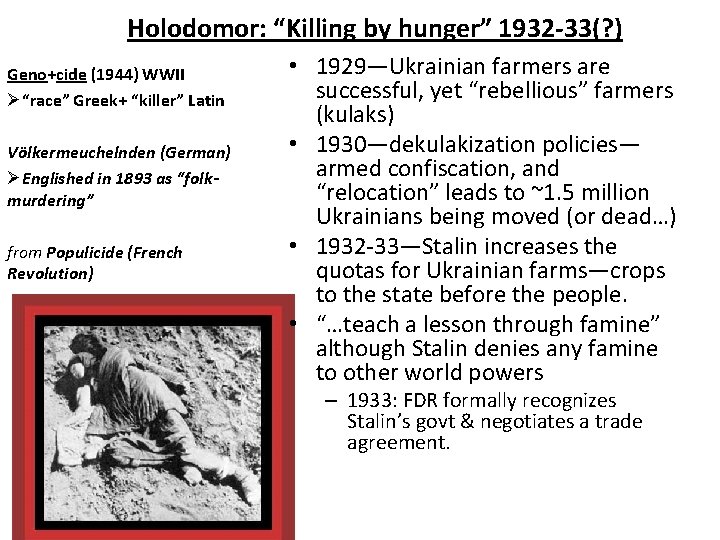
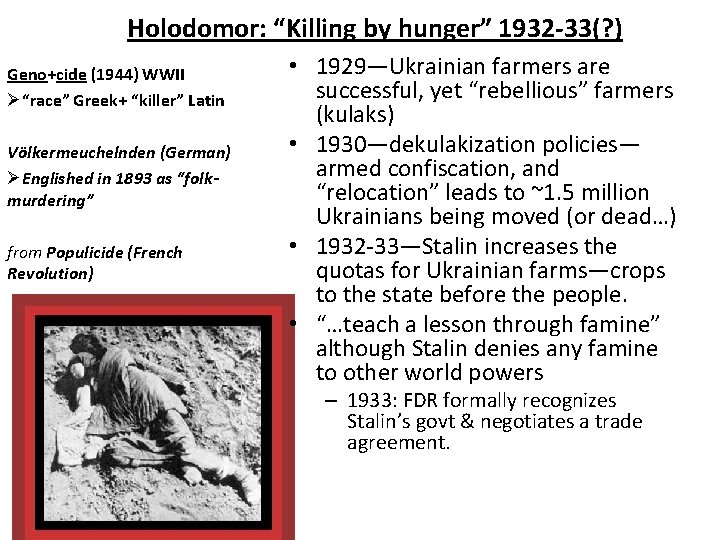
Holodomor: “Killing by hunger” 1932 -33(? ) Geno+cide (1944) WWII Ø“race” Greek+ “killer” Latin Völkermeuchelnden (German) ØEnglished in 1893 as “folkmurdering” from Populicide (French Revolution) • 1929—Ukrainian farmers are successful, yet “rebellious” farmers (kulaks) • 1930—dekulakization policies— armed confiscation, and “relocation” leads to ~1. 5 million Ukrainians being moved (or dead…) • 1932 -33—Stalin increases the quotas for Ukrainian farms—crops to the state before the people. • “…teach a lesson through famine” although Stalin denies any famine to other world powers – 1933: FDR formally recognizes Stalin’s govt & negotiates a trade agreement.
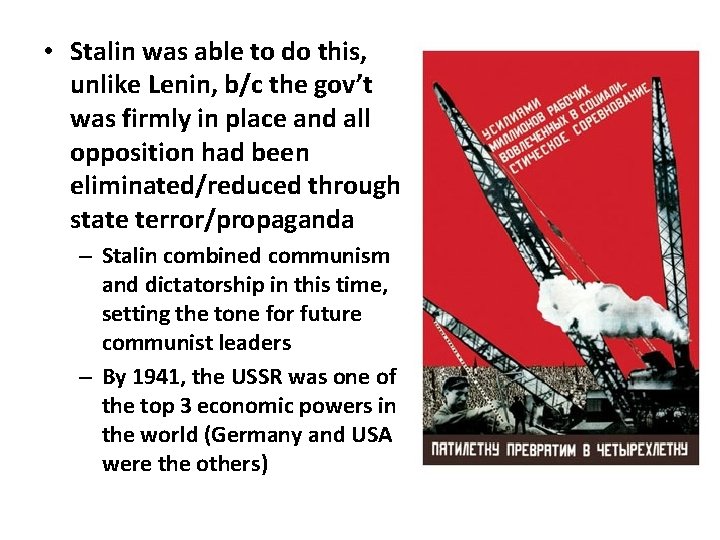
• Stalin was able to do this, unlike Lenin, b/c the gov’t was firmly in place and all opposition had been eliminated/reduced through state terror/propaganda – Stalin combined communism and dictatorship in this time, setting the tone for future communist leaders – By 1941, the USSR was one of the top 3 economic powers in the world (Germany and USA were the others)
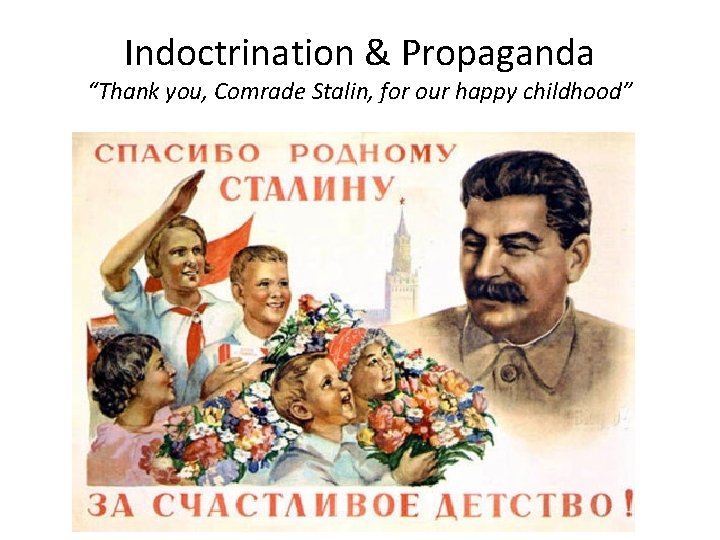
Indoctrination & Propaganda “Thank you, Comrade Stalin, for our happy childhood”
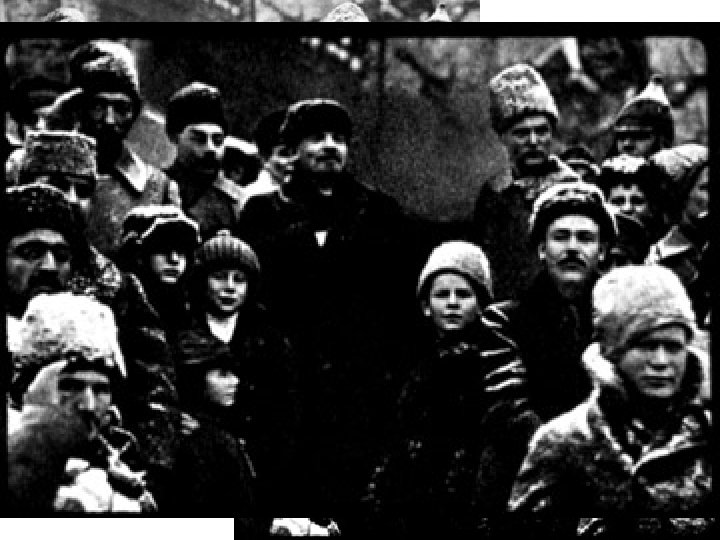
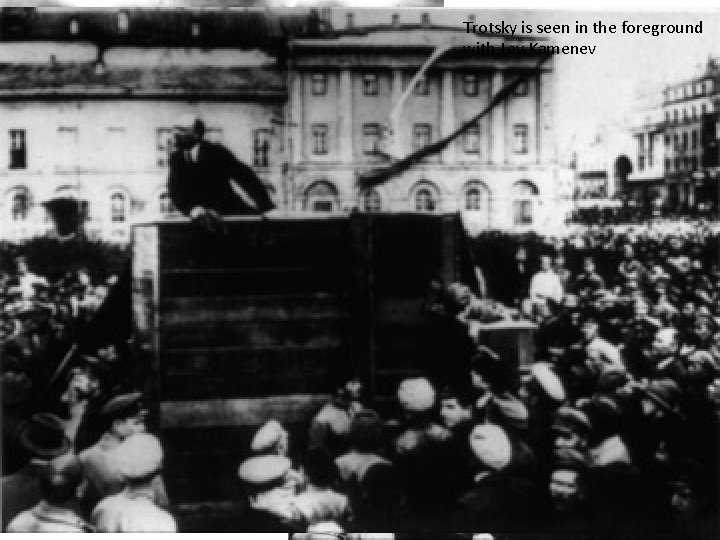
Trotsky is seen in the foreground with Lev Kamenev
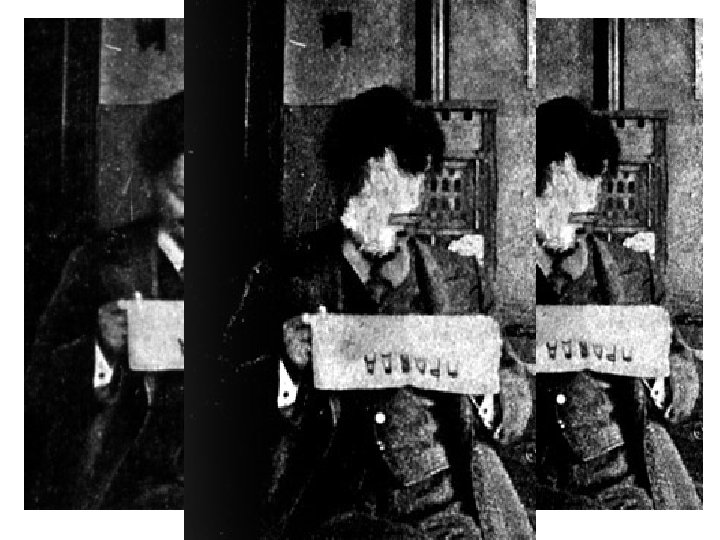
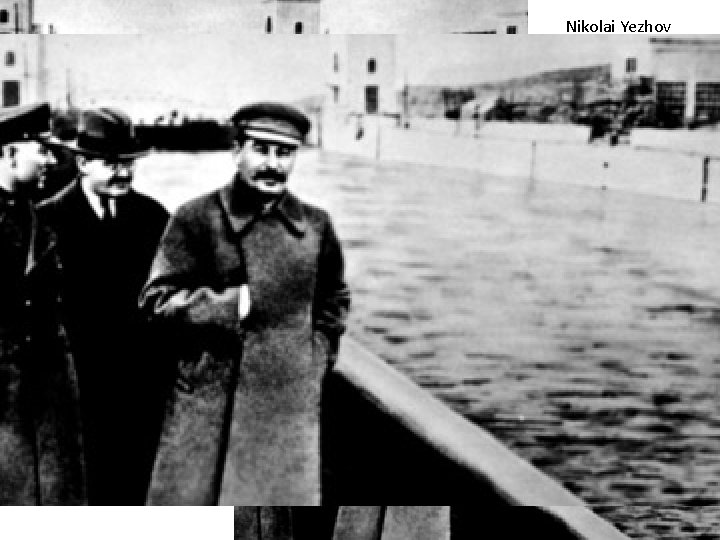
Nikolai Yezhov
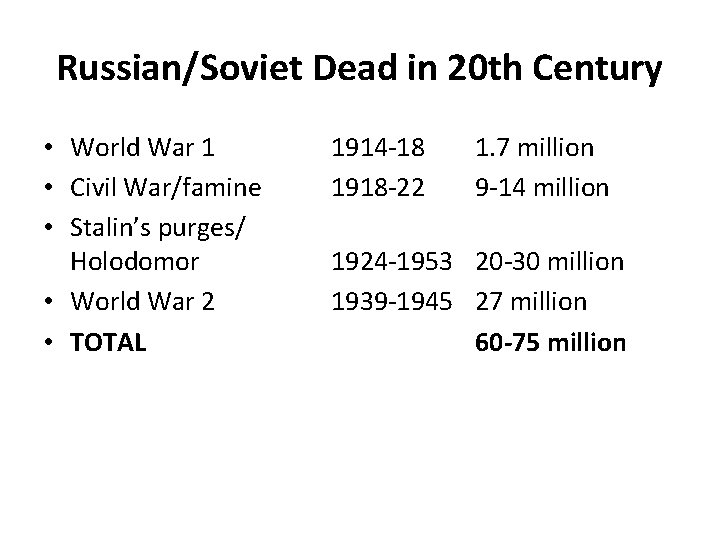
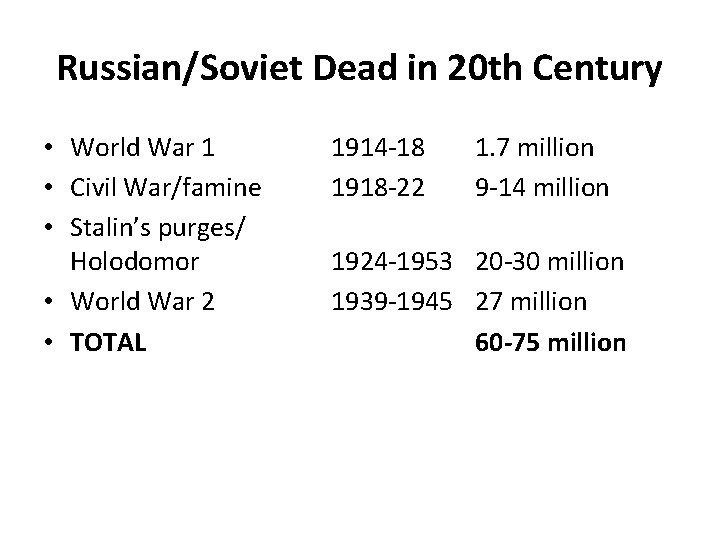
Russian/Soviet Dead in 20 th Century • World War 1 • Civil War/famine • Stalin’s purges/ Holodomor • World War 2 • TOTAL 1914 -18 1918 -22 1. 7 million 9 -14 million 1924 -1953 20 -30 million 1939 -1945 27 million 60 -75 million
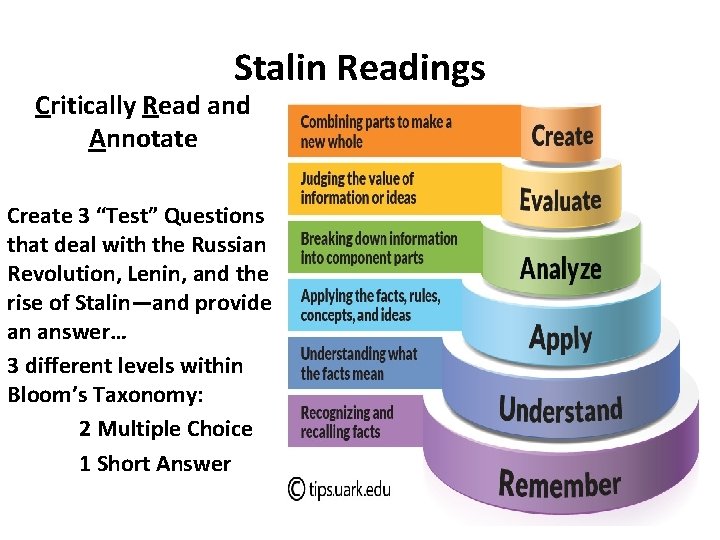
Stalin Readings Critically Read and Annotate Create 3 “Test” Questions that deal with the Russian Revolution, Lenin, and the rise of Stalin—and provide an answer… 3 different levels within Bloom’s Taxonomy: 2 Multiple Choice 1 Short Answer