
TURNBASED MULTIPLAYER MOBILE GAME SDK ON ANDROID By

TURN-BASED MULTIPLAYER MOBILE GAME SDK ON ANDROID By Harsh Sinha (SUID# 797790550) Advisor: Dr. Jim Fawcett
Motivation Building a full fledged multiplayer mobile game � Building Game Graphics � Writing game logic � Communication Platform � Social Media Integration Most solo mobile game developers are not professionals They know “WHAT” to build but “HOW” is a challenge
The What, Why and Who of it What are we building ? � An Android SDK which provides a framework to create turn -based mobile games with device to device multiplayer capability as well as Social Media Integration. Why are we building it? To abstract most of the game development tasks into a reusable and standardized codebase. � To allow game developers to concentrate more on game graphics/logic. � Who are we building it for? � Mostly Amateur Mobile Game Developers but even professionals can use it.
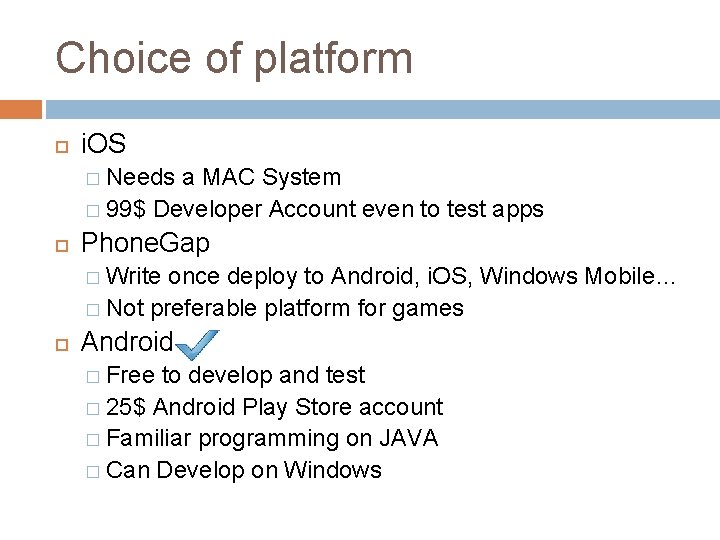
Choice of platform i. OS � Needs a MAC System � 99$ Developer Account even to test apps Phone. Gap � Write once deploy to Android, i. OS, Windows Mobile… � Not preferable platform for games Android � Free to develop and test � 25$ Android Play Store account � Familiar programming on JAVA � Can Develop on Windows
Main Project Targets Turn-Based Game Management Multiplayer Gaming Platform Social Media Integration
Turn-Based games (TBGs) Turn-Based Games are those where multiple players play together, but at a time only one player makes a move. Examples: Chess, Ludo, tic-tac-toe, Scrabble, Almost All Card Games & Board Games. . . Why an SDK for Turn-Based Games? � Most amateur game developers start with TBGs � Most of the game events are common across most TBGs � Simpler than Real-time Multiplayer games
Turn-Based games (TBGs) - Continued Common Features/Events in TBGs � Multiple players (2 -4 ideally) � One player making a move while others are blocked � Evaluating win condition � Updating Scores after each move � Saving/Resuming games
Main Project Targets Turn-Based Game Management Multiplayer Gaming Platform Social Media Integration
Multiplayer - Implementation Multiplayer option could be implemented as: � On Device (‘N’ players 1 device) � Using P 2 P (‘N’ players ‘N’ devices) $$$ � Using Game Servers (‘N’ players ‘N’ devices 1 hosted server) $$$ � Using Cloud Services(‘N’ players ‘N’ devices 1 Cloud Service ) We could start with P 2 P as its no cost, does not require internet connectivity and is faster.
Multiplayer - Activities Common activities that a device-to-device multiplayer SDK shall provide: � Hosting a game session � Joining a game session � Data Transfer Protocols: Wifi-direct, Bluetooth, HTTP, Cloud… Message Formats: XML, JSON… � Efficient Locking mechanism � Chat Service (optional)
Main Project Targets Turn-Based Game Management Multiplayer Gaming Platform Social Media Integration
Social Media Integration Social Media features are integral part of games on any platform let alone mobile. Social Media Features/benefits: � Sharing scores on FB, Twitter etc. � Sharing a major move � Finding FB, Twitter friends and joining them for a game � It helps advertising the game � Can build a game with social network data
Social Media Integration Contd. Social Media features that an SDK shall provide � One click share to various social networks like FB, twitter etc. � Finding friends on a social network and inviting them to play � Ability to promote the game on the player’s social network
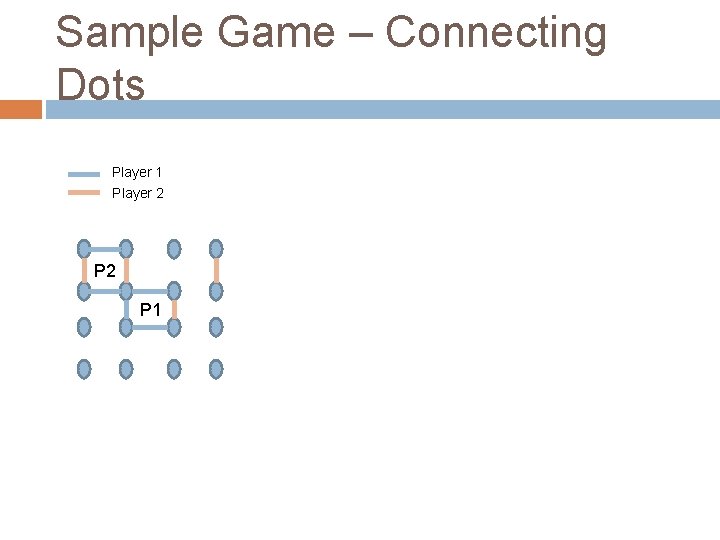
Sample Game – Connecting Dots Player 1 Player 2 P 1
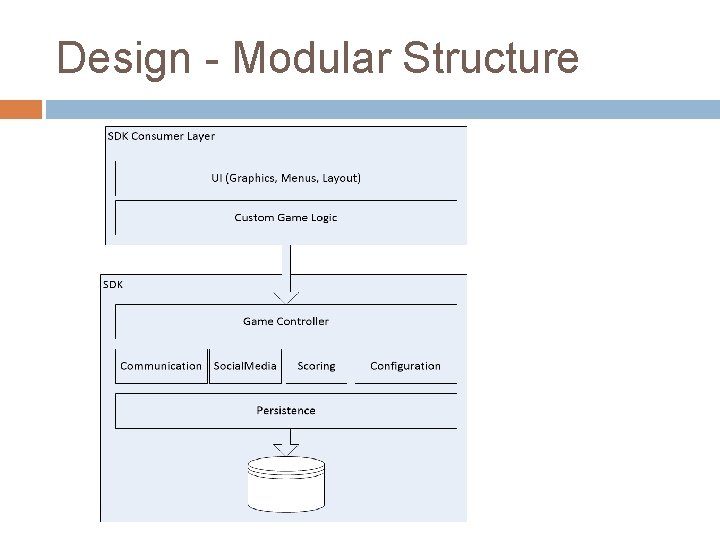
Design - Modular Structure

Design – Key Ideas/Decisions � Start with Wifi-Direct as the communication protocol � Choose JSON over XML for message format � A Singleton Game. Controller that controls the lifecycle of the game � Allow saving game session to database � Having a lock signal float between players � Periodic Ping All to detect players dropping out � Blocking Queue for message Routing

Sprint 2 Work Items Researching JSON Parsers Android Game Programming Hands On TBG Game Management Design
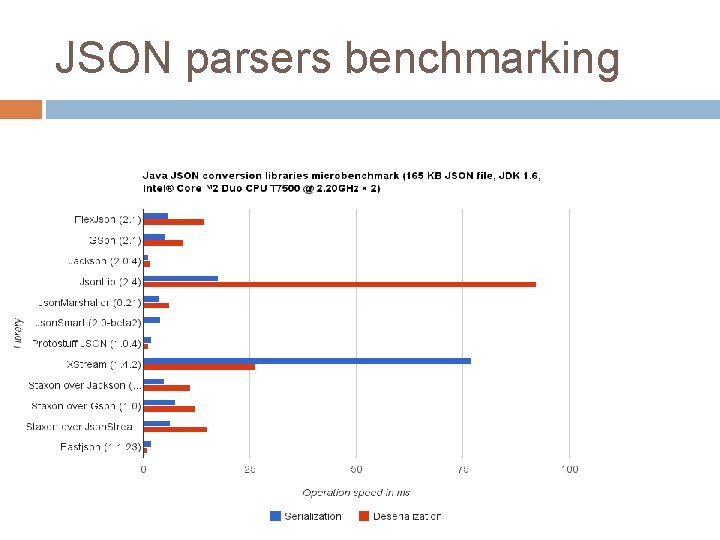
JSON parsers benchmarking
Jackson for JSON Offers three alternative methods for processing JSON � Streaming API - (aka "Incremental parsing/generation") reads and writes JSON content as discrete events � Tree. Model – Provides a mutable in-memory tree representation of a JSON document � Data Binding - converts JSON to and from POJOs based either on property accessor conventions or annotations. Simple data binding means converting to and from Java Maps, Lists, Strings, Numbers, Booleans and nulls

Game Programming Hands-On
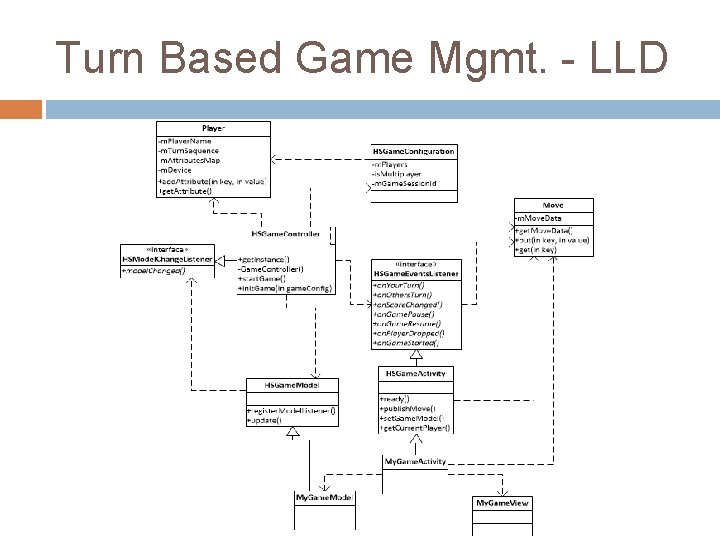
Turn Based Game Mgmt. - LLD
Sprint 3 Work Items SDK packages com. hs. sdk. gamemanagement Implementation Simplifying game data model Enhancing Game Graphics
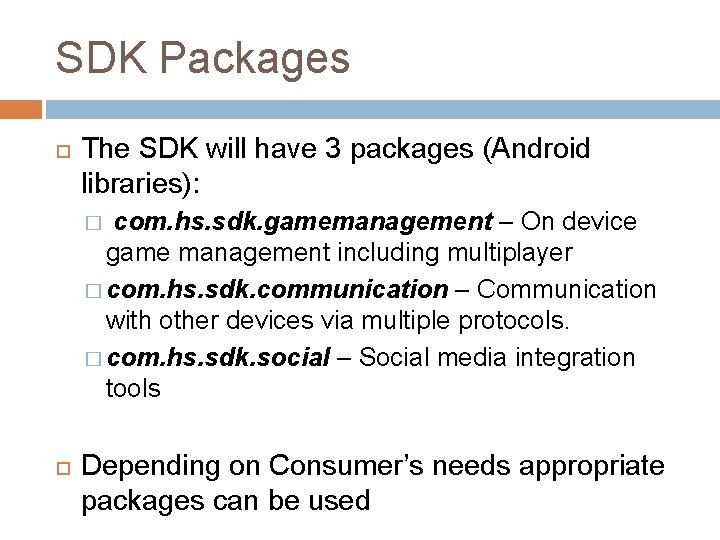
SDK Packages The SDK will have 3 packages (Android libraries): com. hs. sdk. gamemanagement – On device game management including multiplayer � com. hs. sdk. communication – Communication with other devices via multiple protocols. � com. hs. sdk. social – Social media integration tools � Depending on Consumer’s needs appropriate packages can be used
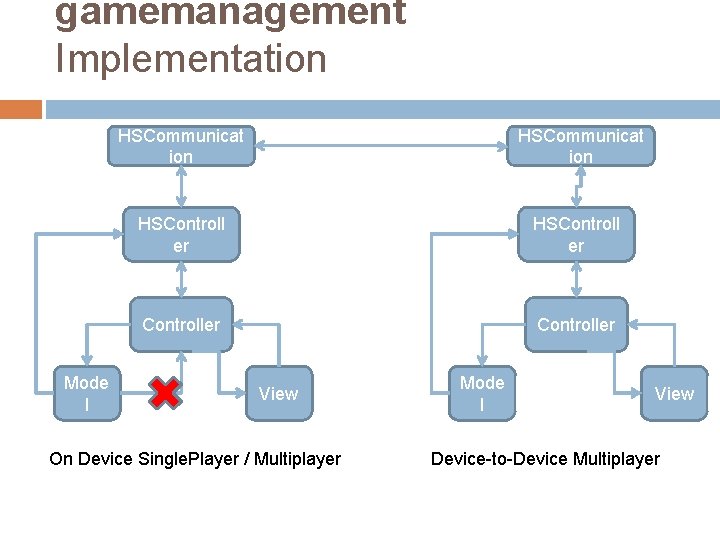
gamemanagement Implementation Mode l HSCommunicat ion HSControll er Controller View On Device Single. Player / Multiplayer Mode l View Device-to-Device Multiplayer
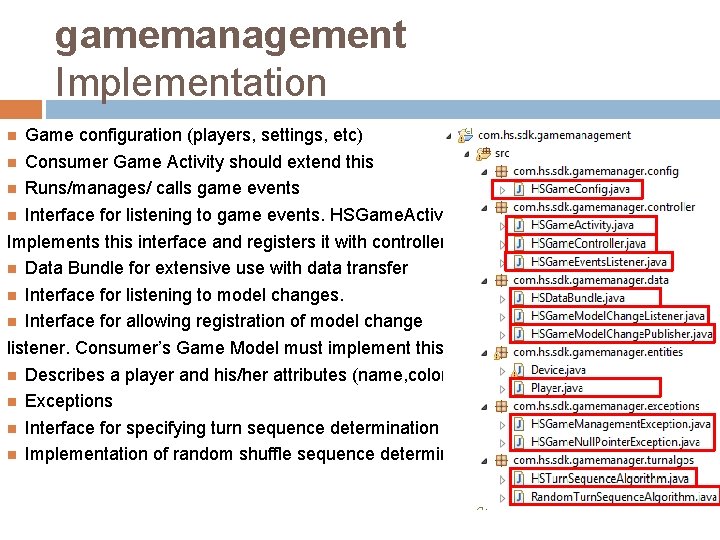
gamemanagement Implementation Game configuration (players, settings, etc) Consumer Game Activity should extend this Runs/manages/ calls game events Interface for listening to game events. HSGame. Activity Implements this interface and registers it with controller Data Bundle for extensive use with data transfer Interface for listening to model changes. Interface for allowing registration of model change listener. Consumer’s Game Model must implement this Describes a player and his/her attributes (name, color. . ) Exceptions Interface for specifying turn sequence determination algo Implementation of random shuffle sequence determination
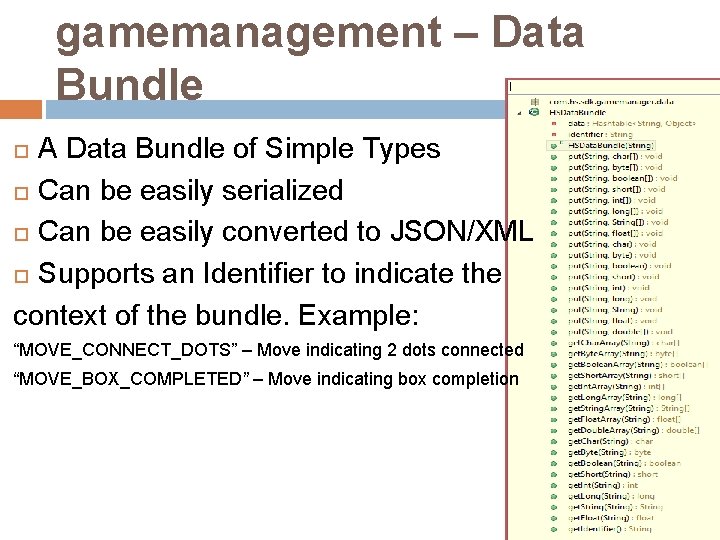
gamemanagement – Data Bundle A Data Bundle of Simple Types Can be easily serialized Can be easily converted to JSON/XML Supports an Identifier to indicate the context of the bundle. Example: “MOVE_CONNECT_DOTS” – Move indicating 2 dots connected “MOVE_BOX_COMPLETED” – Move indicating box completion
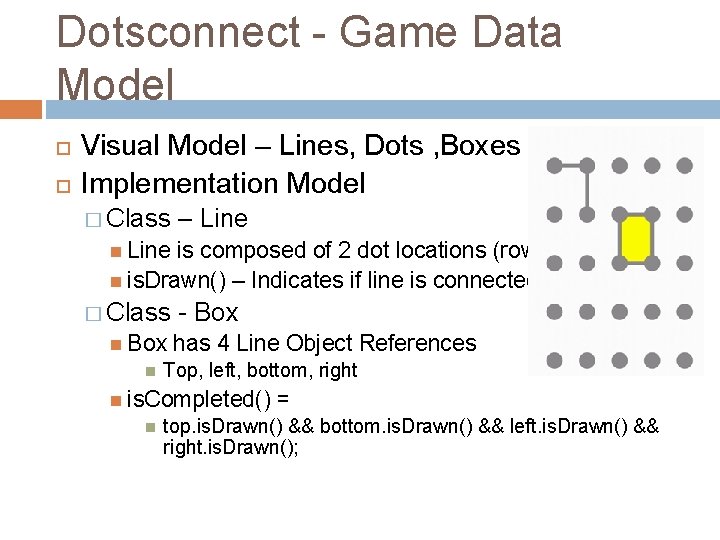
Dotsconnect - Game Data Model Visual Model – Lines, Dots , Boxes Implementation Model � Class – Line is composed of 2 dot locations (row, col) is. Drawn() – Indicates if line is connected � Class - Box has 4 Line Object References Top, left, bottom, right is. Completed() = top. is. Drawn() && bottom. is. Drawn() && left. is. Drawn() && right. is. Drawn();
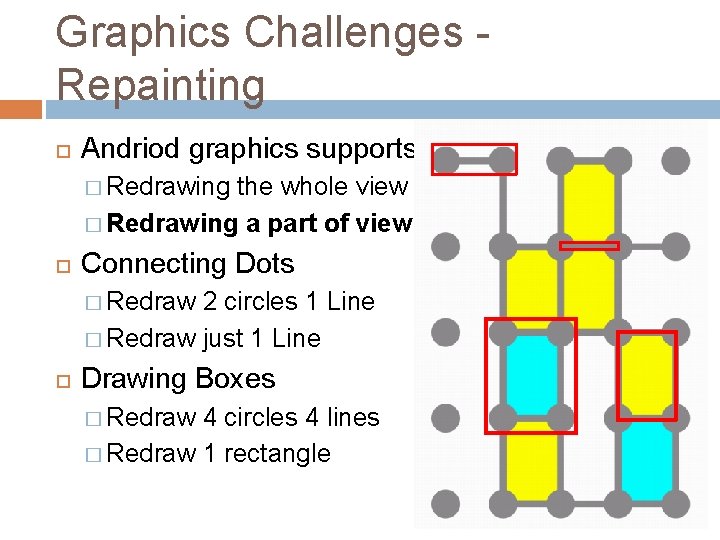
Graphics Challenges - Repainting Andriod graphics supports � Redrawing the whole view � Redrawing a part of view Connecting Dots � Redraw 2 circles 1 Line � Redraw just 1 Line Drawing Boxes � Redraw 4 circles 4 lines � Redraw 1 rectangle
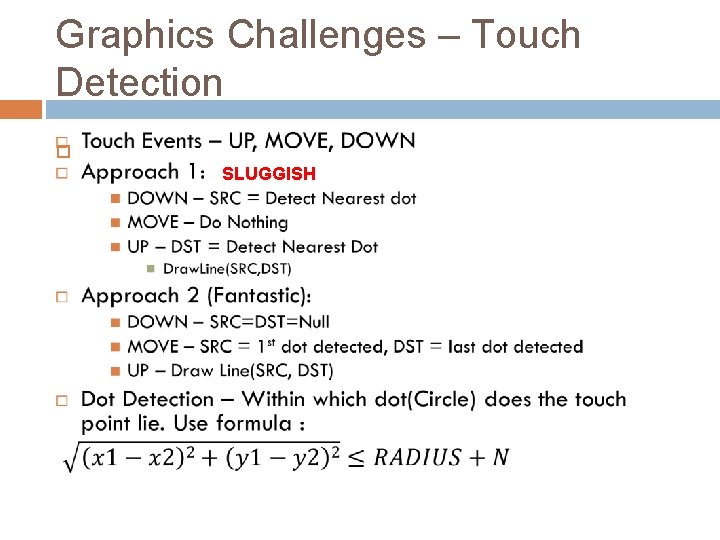
Graphics Challenges – Touch Detection SLUGGISH
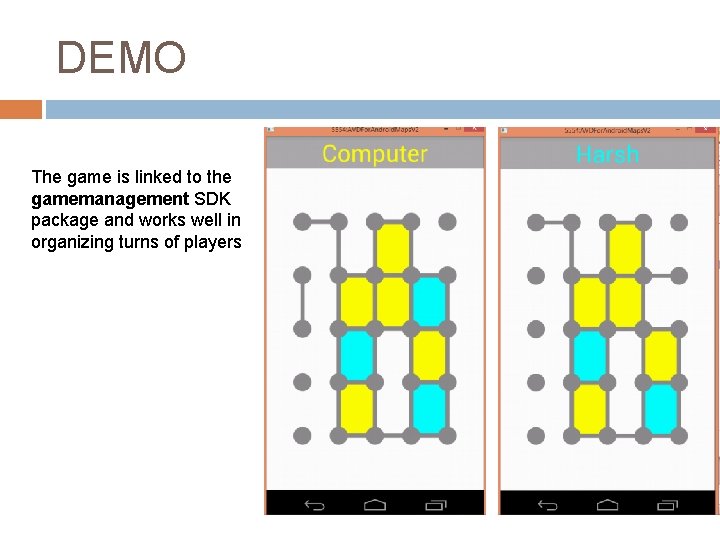
DEMO The game is linked to the gamemanagement SDK package and works well in organizing turns of players
- Slides: 30