Unit 6 Health and Illness Unit 6 Health
- Slides: 83
Unit 6 Health and Illness
Unit 6 Health and Illness
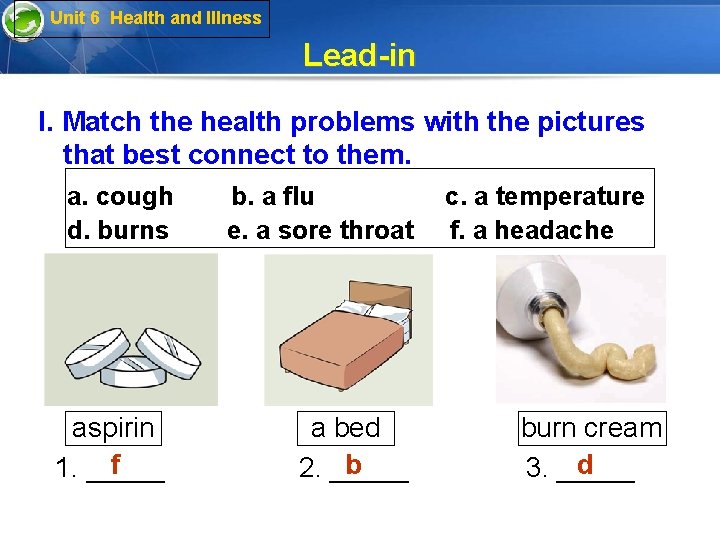
Unit 6 Health and Illness Lead-in I. Match the health problems with the pictures that best connect to them. a. cough b. a flu c. a temperature d. burns e. a sore throat f. a headache aspirin f 1. _____ a bed b 2. _____ burn cream d 3. _____
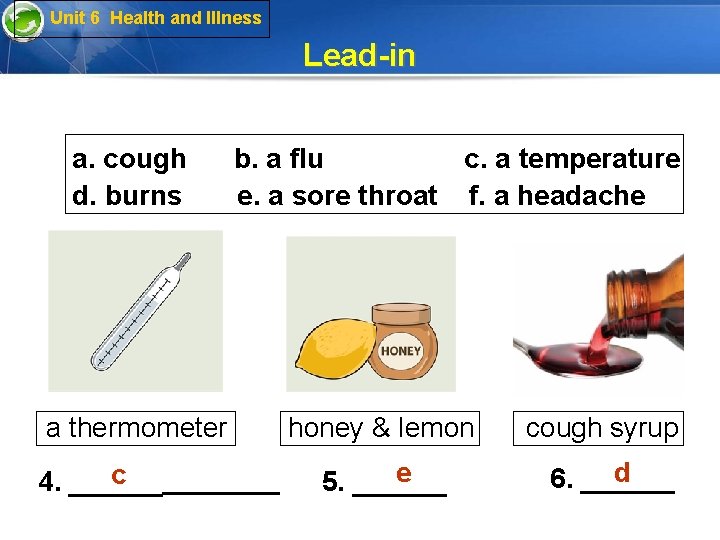
Unit 6 Health and Illness Lead-in a. cough b. a flu c. a temperature d. burns e. a sore throat f. a headache a thermometer c 4. ______ honey & lemon e 5. ______ cough syrup d 6. ______
Unit 6 Health and Illness Lead-in II. Work in pairs. Compare your answers with a partner’s. Give reasons for your choices. Example I think a flu best connects to a bed, because when I have a flu, I usually rest in bed. When we give reasons, we often use: . . . Because. . . The reason is. . .
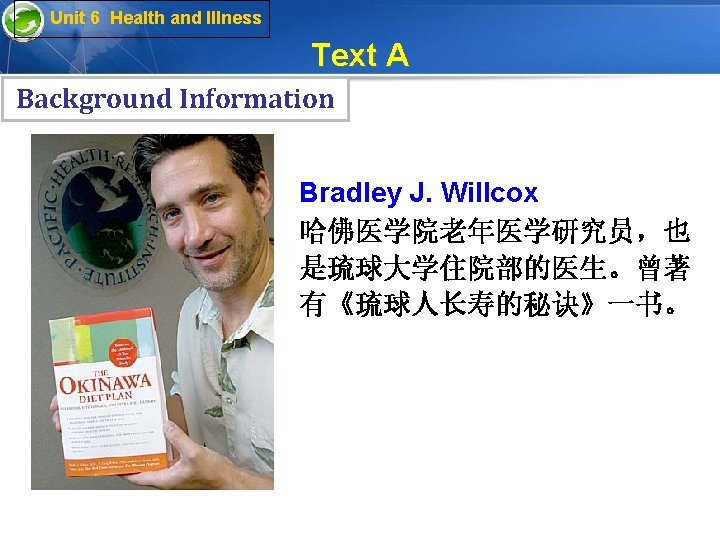
Unit 6 Health and Illness Text A Background Information TEXT A Bradley J. Willcox 哈佛医学院老年医学研究员,也 是琉球大学住院部的医生。曾著 有《琉球人长寿的秘诀》一书。
Unit 6 Health and Illness Text A Translation People in some places in the world live longer than others. What is the secret to their long life? TEXT A
Unit 6 Health and Illness Text A Translation The Time of Your Life 1 Thanks to advances in medical science, we are all living longer and healthier lives. But there are places in the world where people live longer than anywhere else. The remote Japanese island of Okinawa is one of these places. Okinawa has a population of about one million and 900 of them are over 100 years old – four times higher than the average in Britain or the USA. So what is their secret to long life?
Unit 6 Health and Illness Text A Translation 2 Scientific research shows that Okinawans age more slowly than other human beings. “The calendar may say they’re 70 but their body says they’re 50, ” says Bradley Willcox, a scientist researching the strange phenomenon. “The most impressive thing is that a lot of them are healthy until the very end. ”
Unit 6 Health and Illness Text A Translation 3 Researches have shown physical differences between Okinawans and the rest of the population. But their long life has also been linked to diet. They eat more tofu and soya products than any other people in the world and also enjoy a range of fruit and vegetables.
Unit 6 Health and Illness Text A Translation 4 But the most important thing isn’t what they eat, but how much. Okinawans have a cultural tradition known as “eat until you are only 80% full”. The typical daily calorie count in Okinawa is around 1200 — about 20% less than most people in the UK. No one knows exactly why it works, but scientists believe it sends a signal to the body that there is the danger of hunger. This in turn makes the body protect itself and so may lead to slower aging.
Unit 6 Health and Illness Text A Translation 5 It’s this ability to trick their bodies into hunger that keeps Okinawans so young. “It’s a sharp contrast with the cultural habits that drive food consumption in other parts of the world, ” says Mr. Willcox. If you look at high streets and supermarkets in most Western cities, you will see that he is right. Supermarkets are full of special offers encouraging people to buy more food than they need.
Unit 6 Health and Illness Text A New Words
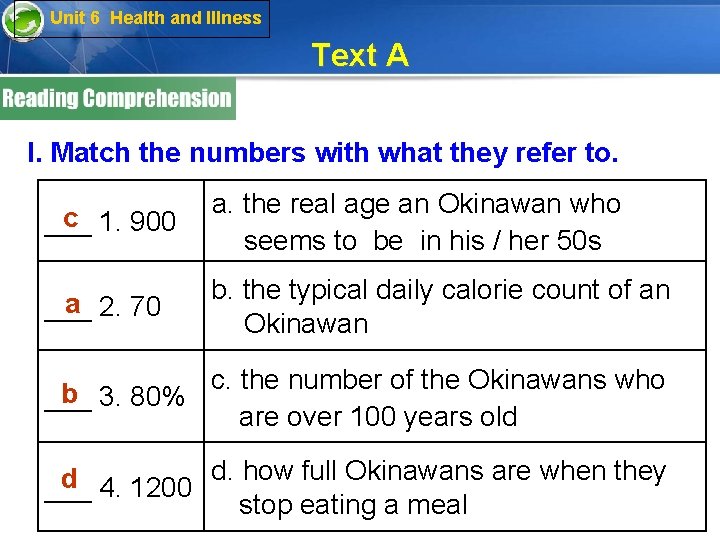
Unit 6 Health and Illness Text A I. Match the numbers with what they refer to. c ___ 1. 900 a. the real age an Okinawan who seems to be in his / her 50 s a ___ 2. 70 b. the typical daily calorie count of an Okinawan b ___ 3. 80% c. the number of the Okinawans who are over 100 years old d. how full Okinawans are when they d ___ 4. 1200 stop eating a meal
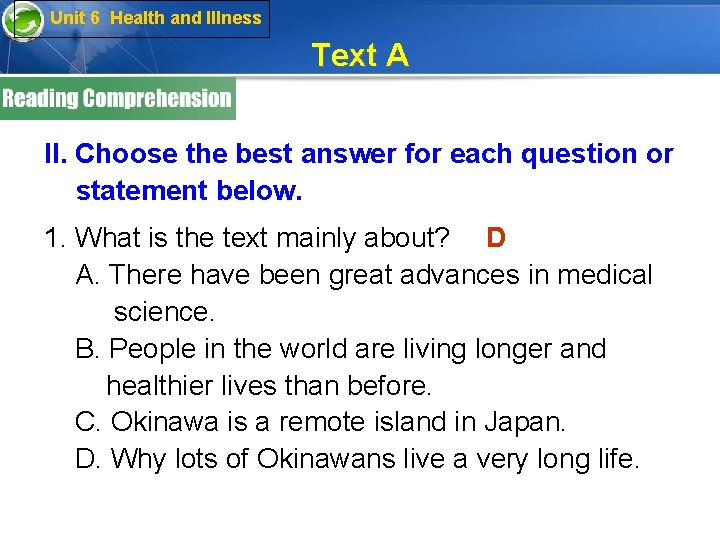
Unit 6 Health and Illness Text A II. Choose the best answer for each question or statement below. 1. What is the text mainly about? D A. There have been great advances in medical science. B. People in the world are living longer and healthier lives than before. C. Okinawa is a remote island in Japan. D. Why lots of Okinawans live a very long life.
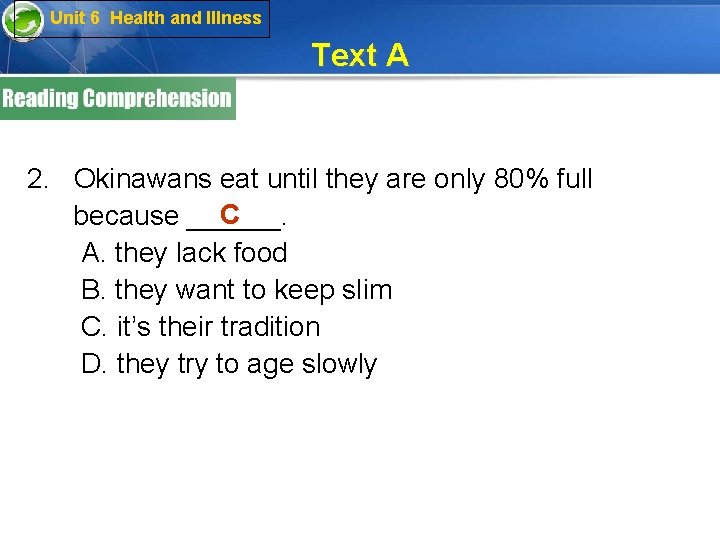
Unit 6 Health and Illness Text A 2. Okinawans eat until they are only 80% full C because ______. A. they lack food B. they want to keep slim C. it’s their tradition D. they try to age slowly
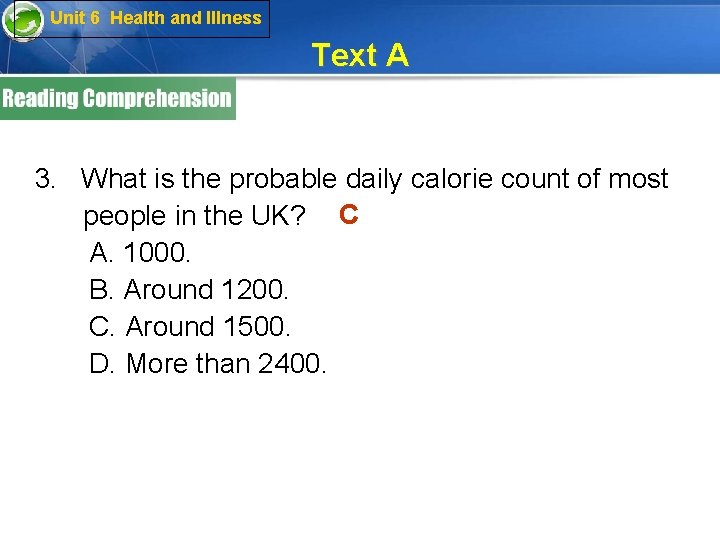
Unit 6 Health and Illness Text A 3. What is the probable daily calorie count of most people in the UK? C A. 1000. B. Around 1200. C. Around 1500. D. More than 2400.
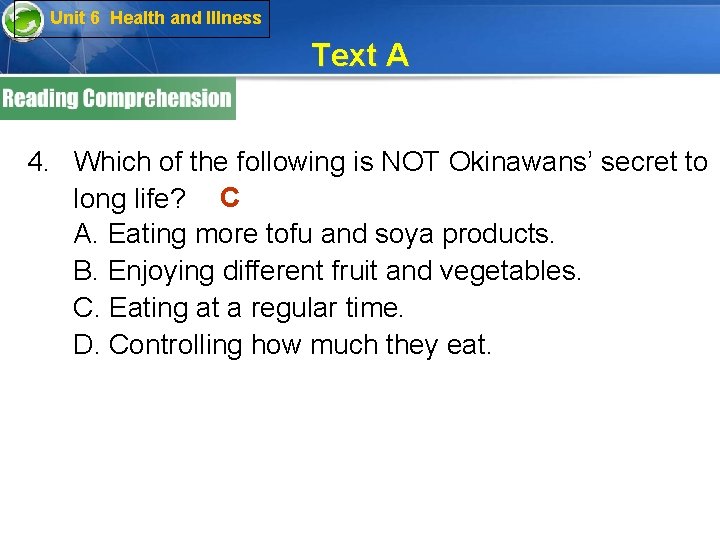
Unit 6 Health and Illness Text A 4. Which of the following is NOT Okinawans’ secret to long life? C A. Eating more tofu and soya products. B. Enjoying different fruit and vegetables. C. Eating at a regular time. D. Controlling how much they eat.
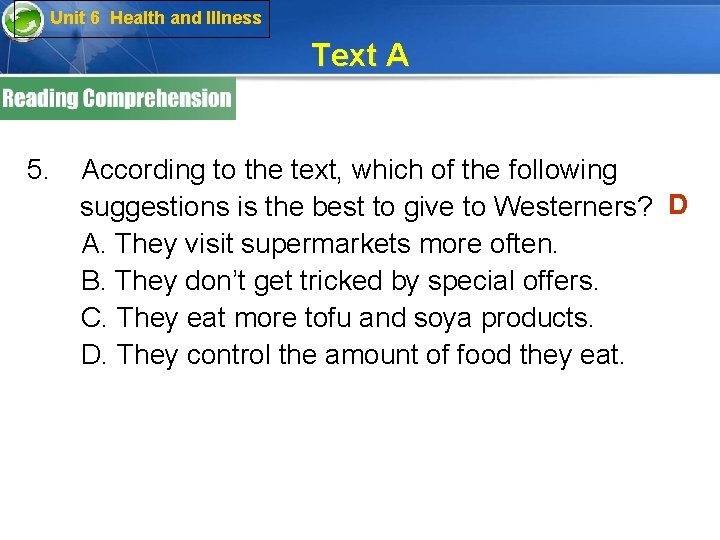
Unit 6 Health and Illness Text A 5. According to the text, which of the following suggestions is the best to give to Westerners? D A. They visit supermarkets more often. B. They don’t get tricked by special offers. C. They eat more tofu and soya products. D. They control the amount of food they eat.
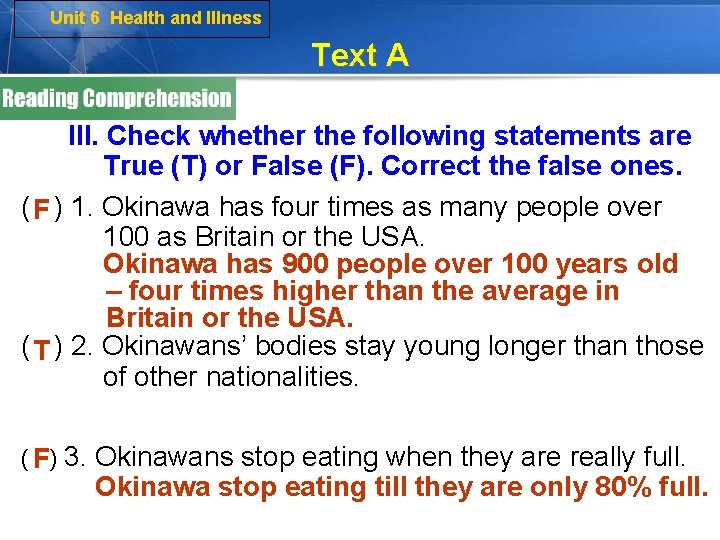
Unit 6 Health and Illness Text A III. Check whether the following statements are True (T) or False (F). Correct the false ones. ( ) 1. Okinawa has four times as many people over F 100 as Britain or the USA. Okinawa has 900 people over 100 years old – four times higher than the average in Britain or the USA. ( ) 2. Okinawans’ bodies stay young longer than those T of other nationalities. ( ) F 3. Okinawans stop eating when they are really full. Okinawa stop eating till they are only 80% full.
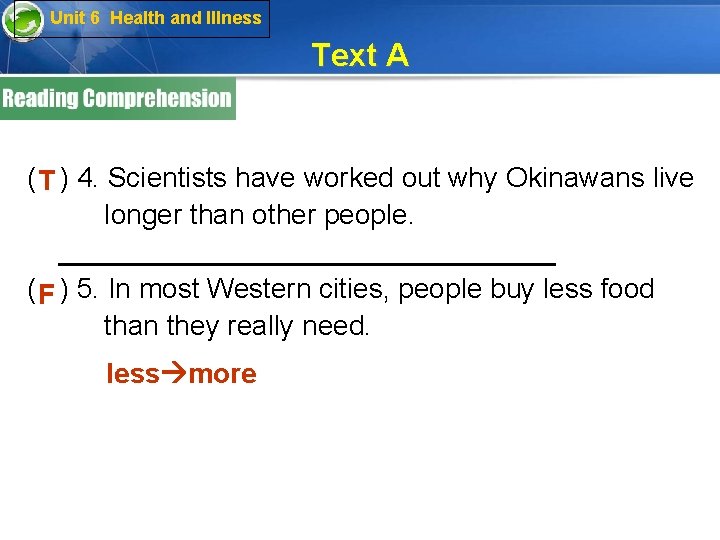
Unit 6 Health and Illness Text A ( ) 4. Scientists have worked out why Okinawans live T longer than other people. ( ) 5. In most Western cities, people buy less food F than they really need. less more
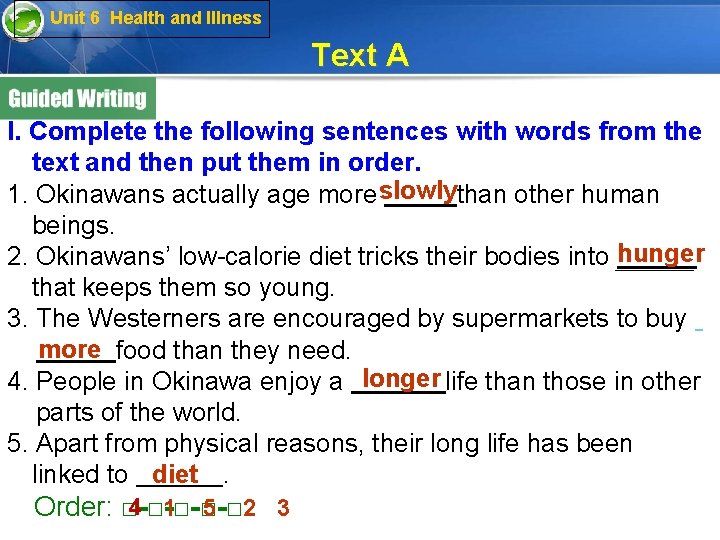
Unit 6 Health and Illness Text A I. Complete the following sentences with words from the text and then put them in order. slowly 1. Okinawans actually age more than other human beings. hunger 2. Okinawans’ low-calorie diet tricks their bodies into that keeps them so young. 3. The Westerners are encouraged by supermarkets to buy more food than they need. longer 4. People in Okinawa enjoy a life than those in other parts of the world. 5. Apart from physical reasons, their long life has been diet linked to . 4 1 5 2 3 Order: □-□-□
Unit 6 Health and Illness Text A II. Write a summary of the text, using the five sentences above. Make changes if necessary. Tip You may need to use in contrast to make your summary more fluent.
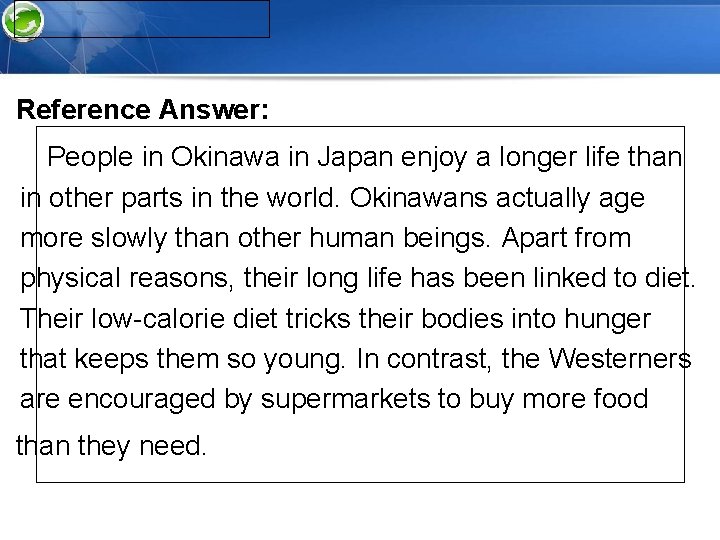
Reference Answer: People in Okinawa in Japan enjoy a longer life than in other parts in the world. Okinawans actually age more slowly than other human beings. Apart from physical reasons, their long life has been linked to diet. Their low-calorie diet tricks their bodies into hunger that keeps them so young. In contrast, the Westerners are encouraged by supermarkets to buy more food than they need.
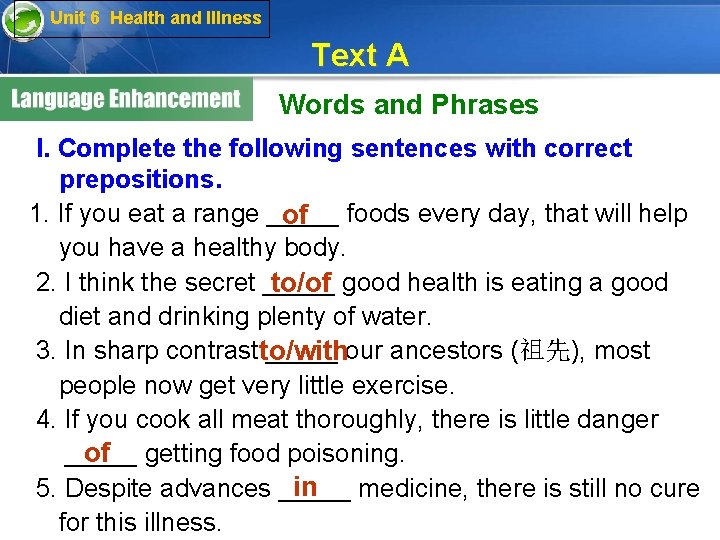
Unit 6 Health and Illness Text A Words and Phrases I. Complete the following sentences with correct prepositions. 1. If you eat a range _____ foods every day, that will help of you have a healthy body. 2. I think the secret _____ good health is eating a good to/of diet and drinking plenty of water. 3. In sharp contrast _____ our ancestors (祖先), most to/with people now get very little exercise. 4. If you cook all meat thoroughly, there is little danger of _____ getting food poisoning. in 5. Despite advances _____ medicine, there is still no cure for this illness.
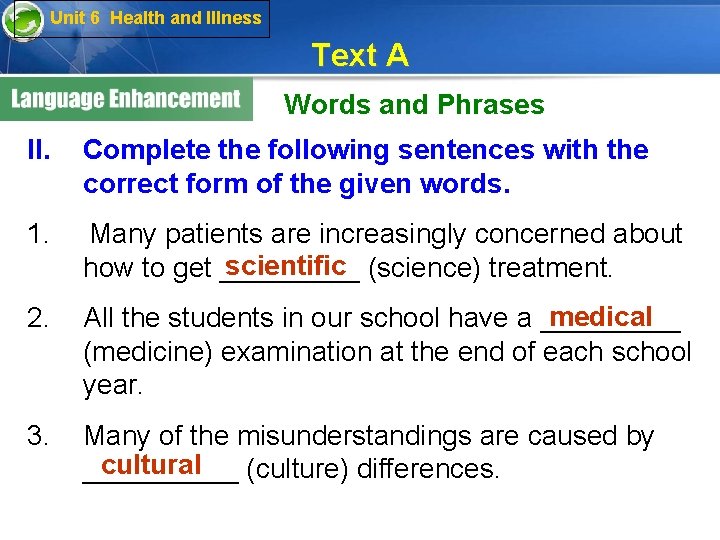
Unit 6 Health and Illness Text A Words and Phrases II. Complete the following sentences with the correct form of the given words. 1. Many patients are increasingly concerned about scientific how to get _____ (science) treatment. 2. medical All the students in our school have a _____ (medicine) examination at the end of each school year. 3. Many of the misunderstandings are caused by cultural _____ (culture) differences.
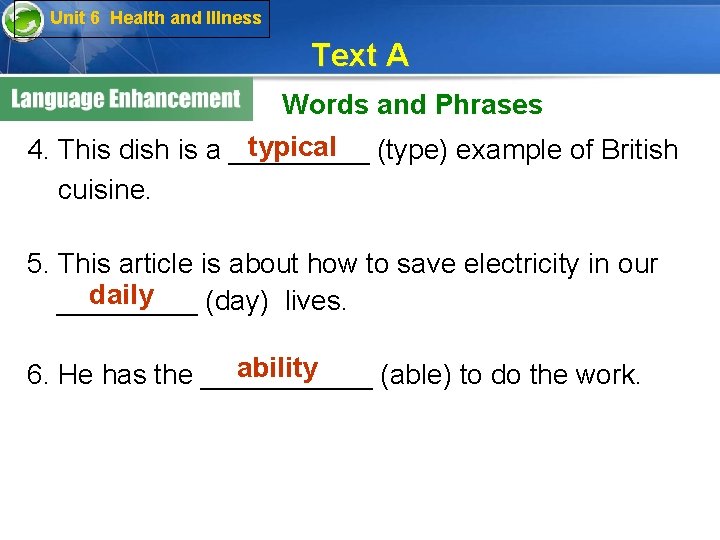
Unit 6 Health and Illness Text A Words and Phrases typical 4. This dish is a _____ (type) example of British cuisine. 5. This article is about how to save electricity in our daily _____ (day) lives. ability 6. He has the ______ (able) to do the work.
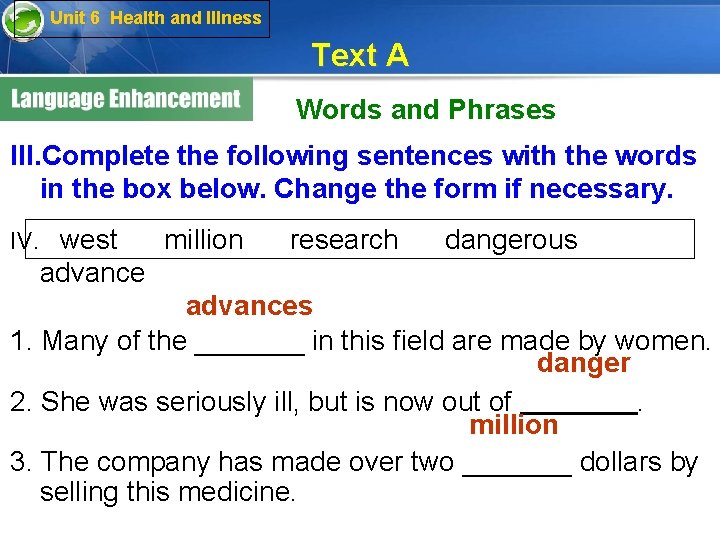
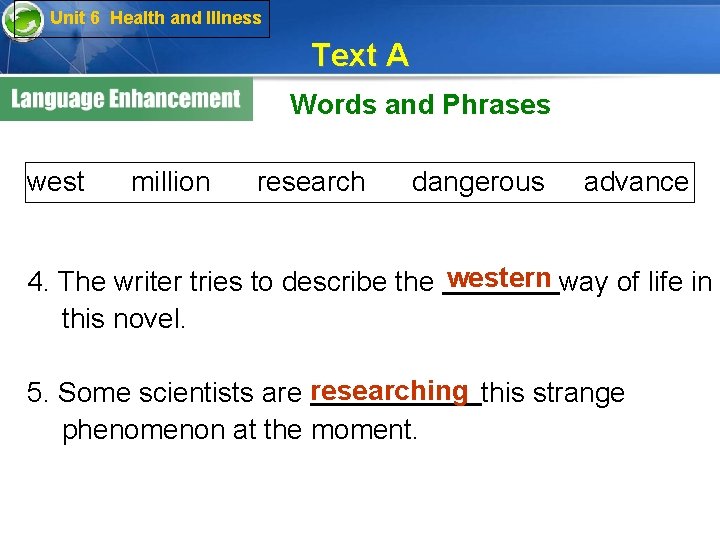
Unit 6 Health and Illness Text A Words and Phrases III. Complete the following sentences with the words in the box below. Change the form if necessary. IV. west million research dangerous advances 1. Many of the _______ in this field are made by women. danger 2. She was seriously ill, but is now out of . million 3. The company has made over two _______ dollars by selling this medicine.
Unit 6 Health and Illness Text A Words and Phrases west million research dangerous advance western 4. The writer tries to describe the way of life in this novel. researching 5. Some scientists are this strange phenomenon at the moment.
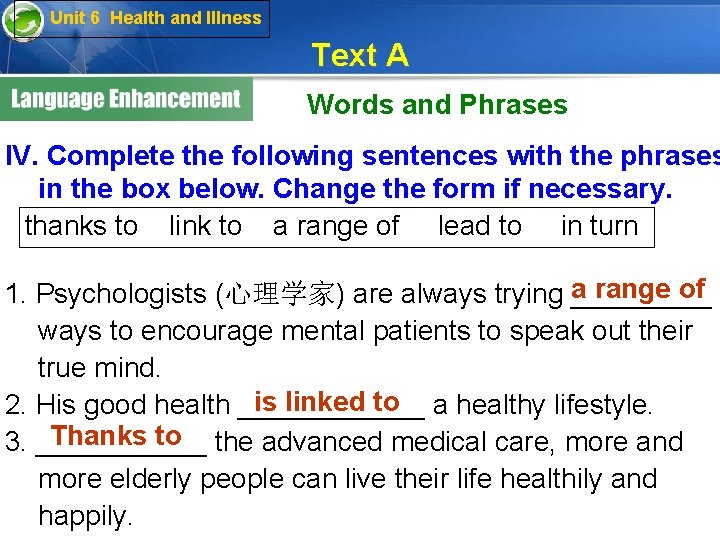
Unit 6 Health and Illness Text A Words and Phrases IV. Complete the following sentences with the phrases in the box below. Change the form if necessary. thanks to link to a range of lead to in turn a range of 1. Psychologists (心理学家) are always trying _____ ways to encourage mental patients to speak out their true mind. is linked to 2. His good health ______ a healthy lifestyle. Thanks to 3. ______ the advanced medical care, more and more elderly people can live their life healthily and happily.
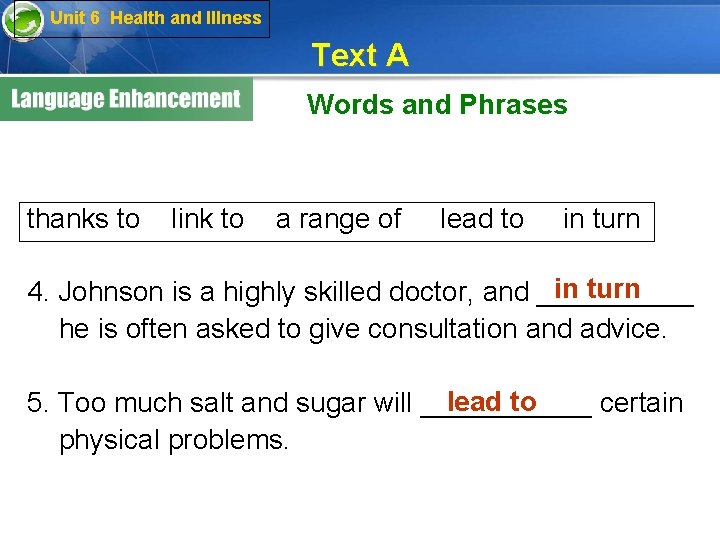
Unit 6 Health and Illness Text A Words and Phrases thanks to link to a range of lead to in turn 4. Johnson is a highly skilled doctor, and _____ he is often asked to give consultation and advice. lead to 5. Too much salt and sugar will ______ certain physical problems.
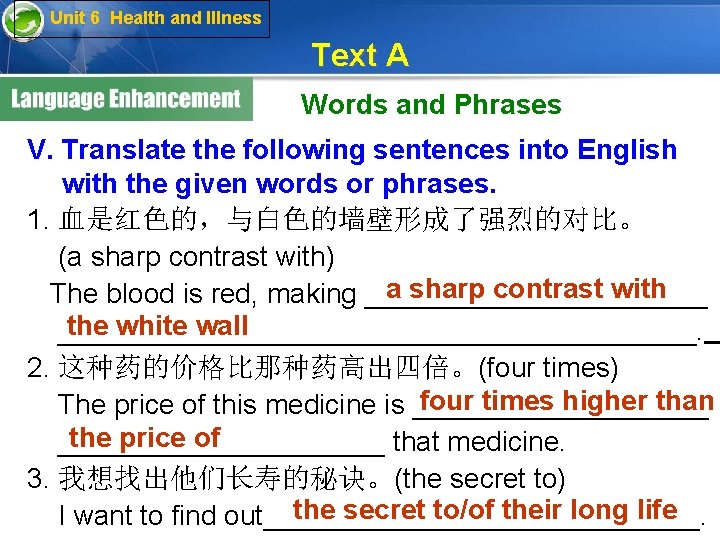
Unit 6 Health and Illness Text A Words and Phrases V. Translate the following sentences into English with the given words or phrases. 1. 血是红色的,与白色的墙壁形成了强烈的对比。 (a sharp contrast with) a sharp contrast with The blood is red, making ___________ the white wall _____________________. 2. 这种药的价格比那种药高出四倍。(four times) four times higher than The price of this medicine is __________ the price of ___________ that medicine. 3. 我想找出他们长寿的秘诀。(the secret to) the secret to/of their long life I want to find out______________.
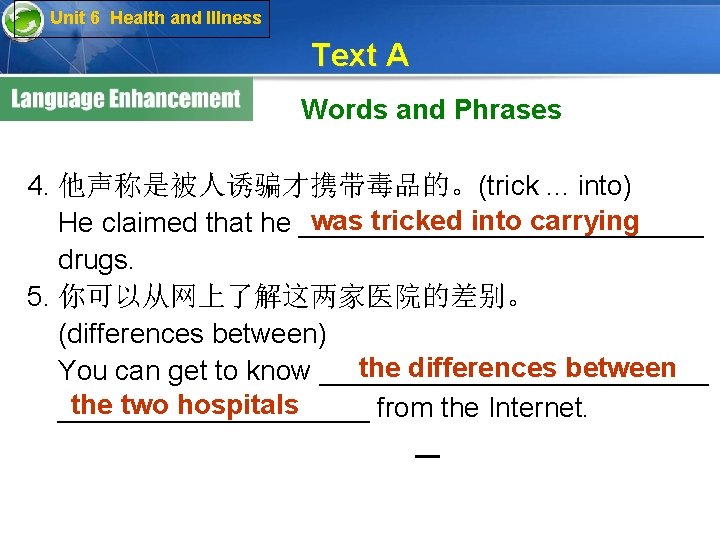
Unit 6 Health and Illness Text A Words and Phrases 4. 他声称是被人诱骗才携带毒品的。(trick. . . into) was tricked into carrying He claimed that he _____________ drugs. 5. 你可以从网上了解这两家医院的差别。 (differences between) the differences between You can get to know _____________ the two hospitals __________ from the Internet.
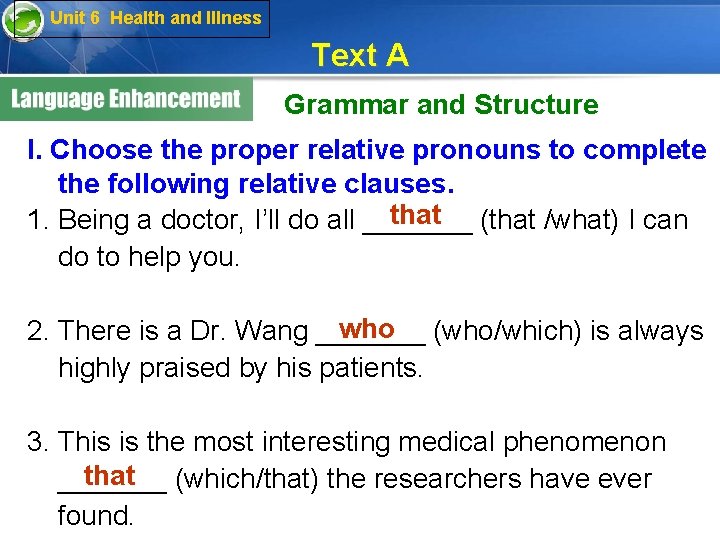
Unit 6 Health and Illness Text A Grammar and Structure I. Choose the proper relative pronouns to complete the following relative clauses. that 1. Being a doctor, I’ll do all _______ (that /what) I can do to help you. who 2. There is a Dr. Wang _______ (who/which) is always highly praised by his patients. 3. This is the most interesting medical phenomenon that _______ (which/that) the researchers have ever found.
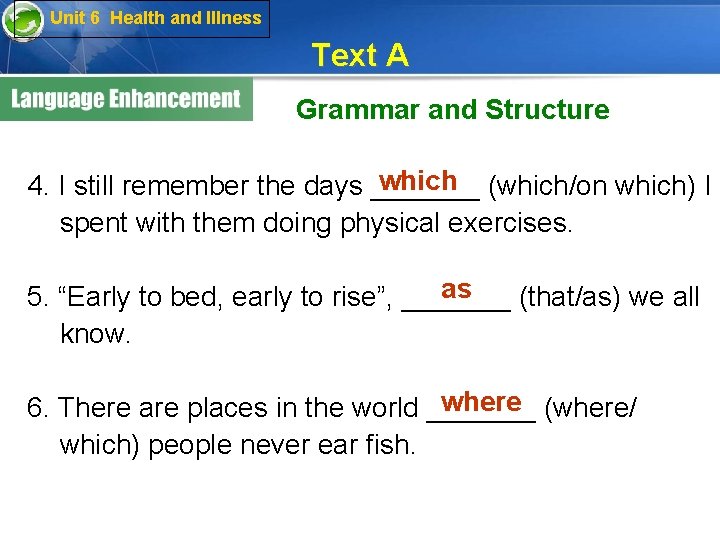
Unit 6 Health and Illness Text A Grammar and Structure which 4. I still remember the days _______ (which/on which) I spent with them doing physical exercises. as 5. “Early to bed, early to rise”, _______ (that/as) we all know. where 6. There are places in the world _______ (where/ which) people never ear fish.
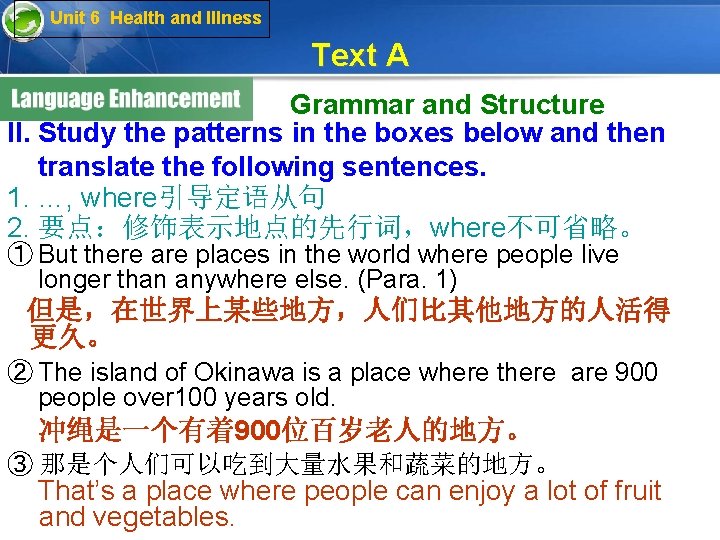
Unit 6 Health and Illness Text A Grammar and Structure II. Study the patterns in the boxes below and then translate the following sentences. 1. …, where引导定语从句 2. 要点:修饰表示地点的先行词,where不可省略。 ① But there are places in the world where people live longer than anywhere else. (Para. 1) 但是,在世界上某些地方,人们比其他地方的人活得 更久。 ② The island of Okinawa is a place where there are 900 people over 100 years old. 冲绳是一个有着900位百岁老人的地方。 ③ 那是个人们可以吃到大量水果和蔬菜的地方。 That’s a place where people can enjoy a lot of fruit and vegetables.
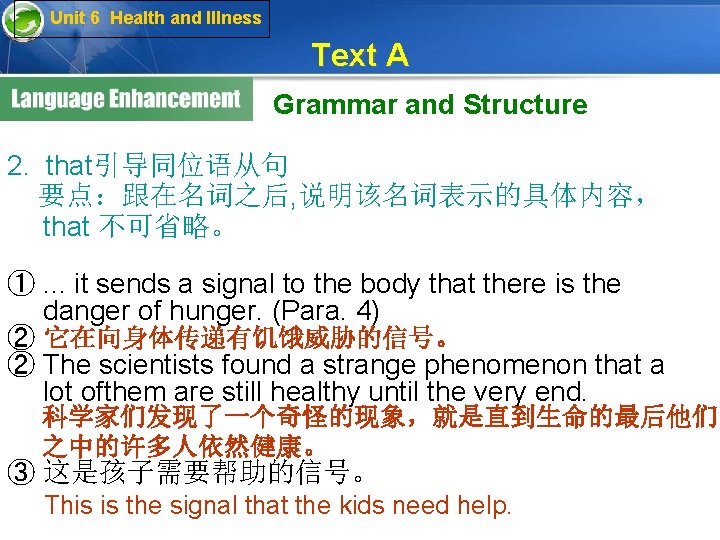
Unit 6 Health and Illness Text A Grammar and Structure 2. that引导同位语从句 要点:跟在名词之后, 说明该名词表示的具体内容, that 不可省略。 ①. . . it sends a signal to the body that there is the danger of hunger. (Para. 4) 它在向身体传递有饥饿威胁的信号。 ② ② The scientists found a strange phenomenon that a lot ofthem are still healthy until the very end. 科学家们发现了一个奇怪的现象,就是直到生命的最后他们 之中的许多人依然健康。 ③ 这是孩子需要帮助的信号。 This is the signal that the kids need help.
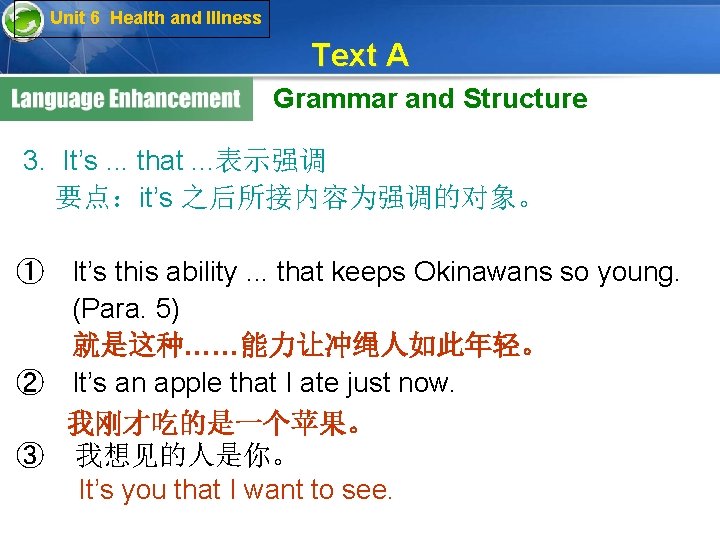
Unit 6 Health and Illness Text A Grammar and Structure 3. It’s. . . that. . . 表示强调 要点:it’s 之后所接内容为强调的对象。 ① It’s this ability. . . that keeps Okinawans so young. (Para. 5) 就是这种……能力让冲绳人如此年轻。 ② It’s an apple that I ate just now. 我刚才吃的是一个苹果。 ③ 我想见的人是你。 It’s you that I want to see.
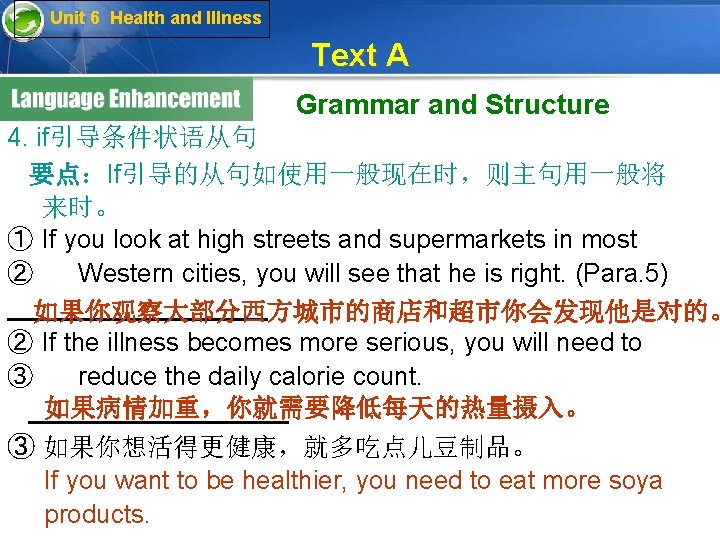
Unit 6 Health and Illness Text A Grammar and Structure 4. if引导条件状语从句 要点:If引导的从句如使用一般现在时,则主句用一般将 来时。 ① If you look at high streets and supermarkets in most ② Western cities, you will see that he is right. (Para. 5) 如果你观察大部分西方城市的商店和超市你会发现他是对的。 ② If the illness becomes more serious, you will need to ③ reduce the daily calorie count. 如果病情加重,你就需要降低每天的热量摄入。 ③ 如果你想活得更健康,就多吃点儿豆制品。 If you want to be healthier, you need to eat more soya products.
Unit 6 Health and Illness Text B Translation We often come across health advice, but not all of it is correct. Can you tell the facts from the myths? TEXT A
Unit 6 Health and Illness Text B Translation Fact or Myth? 1 People are always coming out with “facts” regarding health. Every now and then you hear someone say “Did you know you only use ten percent of your brain? ”, or “don’t eat that – it gives you cancer”. In spite of highly developed medical technology and scientific research, old wives’ tales continue to live on. Can you distinguish between the facts and the myths?
Unit 6 Health and Illness Text B Translation 2 The warmer, the better? It’s difficult to ignore your mother when she tells you to “wrap up warm” or “dry your hair or you’ll get a cold”. However, colds are not caused by the cold — they are caused by viruses! Walking around with wet hair or a T-shirt in winter may look silly, and will make you feel cold, but you will only get a cold or the flu if you stay with an infected person. The best way to avoid viruses like these is to wash your hands often when there’s a bug going around.
Unit 6 Health and Illness Text B Translation 3 The second problem youngsters often meet is acne. Acne is a hormonal condition which causes the skin to produce too much oil. Eating a lot of fatty foods may be bad for you in other ways, but research has failed to find any connection between diet and acne. By the way, washing too much can make the condition worse. It’s best just to wash twice a day and don't rub the skin too hard.
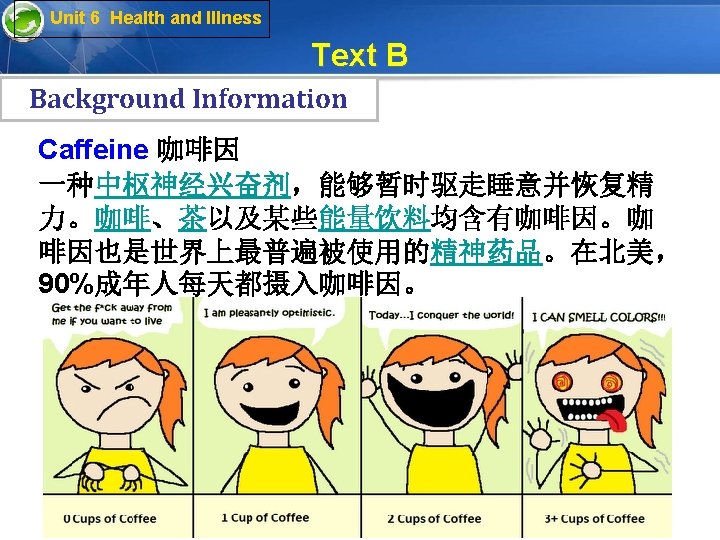
Unit 6 Health and Illness Text B Translation 4 The last one is about coffee. The caffeine in coffee makes your body speed up — your heart rate increases and it wakes you up. You may see these things as benefits, but caffeine also has a number of negative side effects. It’s addictive. After stopping drinking coffee, people may suffer symptoms such as headaches, irritability and restlessness. Caffeine has also been linked to other problems but coffee is fine if you don’t drink too much.
Unit 6 Health and Illness Text B Translation Remember this is for information only. If you have any worries about your health, you should always consult your doctor.
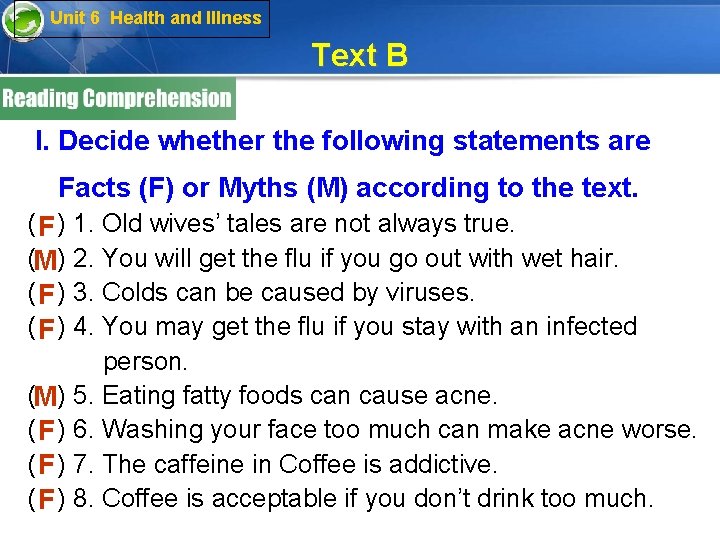
Unit 6 Health and Illness Text B I. Decide whether the following statements are Facts (F) or Myths (M) according to the text. ( ) 1. Old wives’ tales are not always true. F ( ) 2. You will get the flu if you go out with wet hair. M ( ) 3. Colds can be caused by viruses. F ( ) 4. You may get the flu if you stay with an infected F person. ( ) 5. Eating fatty foods can cause acne. M ( ) 6. Washing your face too much can make acne worse. F ( ) 7. The caffeine in Coffee is addictive. F ( ) 8. Coffee is acceptable if you don’t drink too much. F
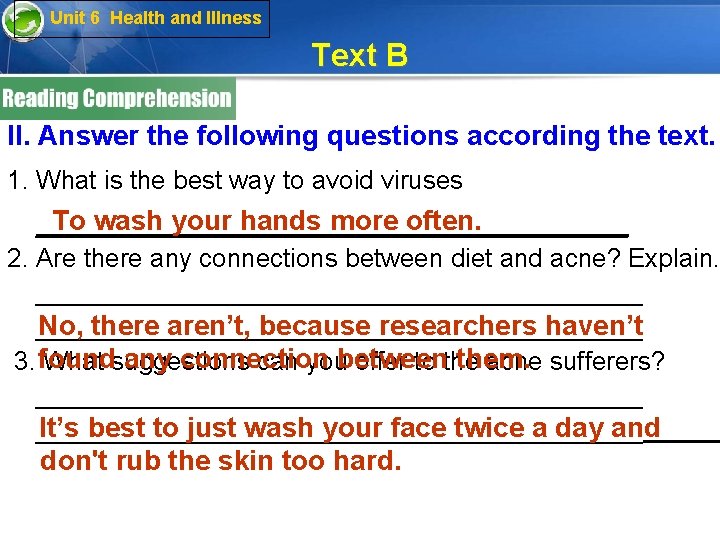
Unit 6 Health and Illness Text B II. Answer the following questions according the text. 1. What is the best way to avoid viruses To wash your hands more often. _____________________ 2. Are there any connections between diet and acne? Explain. _____________________ No, there aren’t, because researchers haven’t _____________________ found any connection between them. 3. What suggestions can you offer to the acne sufferers? _____________________ It’s best to just wash your face twice a day and _____________________ don't rub the skin too hard.
Unit 6 Health and Illness Text B 4. What are the positive effects that the caffeine in coffee will have? It makes your body speed up — your heart rate _____________________ increases and it wakes you up. _____________________ 5. What will happen when people give up drinking People may suffer symptoms such as headaches, coffee? irritability and restlessness. _________________________________________
Unit 6 Health and Illness Listening & Speaking 1. Health Problems Warming Up Decide whether the words in green are adjectives (a. ), verbs (v. ) or nouns (n. ). Then translate them into Chinese. n. 感冒 1. I think I’m getting a cold. ______ 我想我是得了感冒。 v. 听上去 2. That sounds horrible. ______ 听上去很恐怖。 v. 疼 3. My muscles ache a lot. ______ 我的肌肉疼得厉害。 v. 打喷嚏 4. Sorry, I can’t stop sneezing. ______ 对不起,喷嚏打个不停。 v. 流泪 5. In spring, my eyes water all the time. ______ 春天,我的眼睛总是流泪。
Unit 6 Health and Illness Listening & Speaking 1. Health Problems Listening I. Listen to a conversation. Choose the best answer for each question below. The conversation will be spoken twice. B 1. How does the man feel? A. Sad. B. Weak and tired. C. Cold. D. Excited. 2. How long has the man felt like this? C A. One day. B. Two days. C. A few days. Script D. Quite a long time.
Unit 6 Health and Illness Listening & Speaking Listening 3. What suggestion does the woman give to the man? B A. To exercise more. B. To go home and get some rest. C. Not to do his homework. D. To wear more clothes. 1. Health Problems 4. What will the man probably give to the woman? D A. A written request for leave. B. Some books. C. The teacher’s phone number. Script D. His homework.
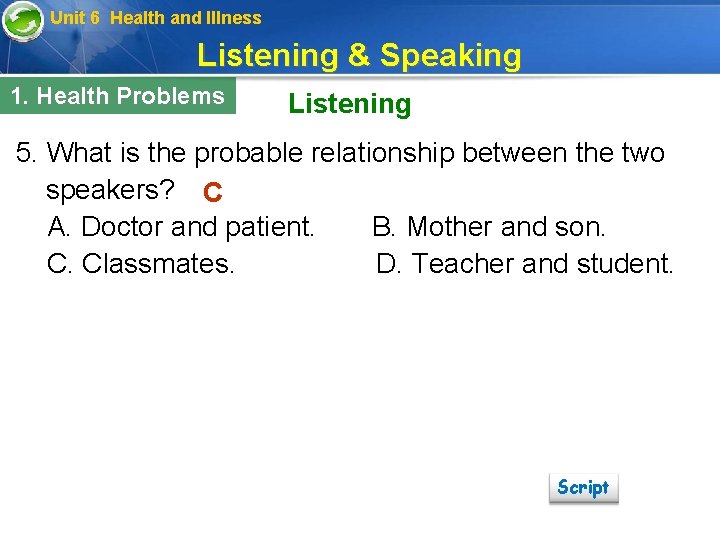
Unit 6 Health and Illness Listening & Speaking 1. Health Problems Listening 5. What is the probable relationship between the two speakers? C A. Doctor and patient. B. Mother and son. C. Classmates. D. Teacher and student. Script
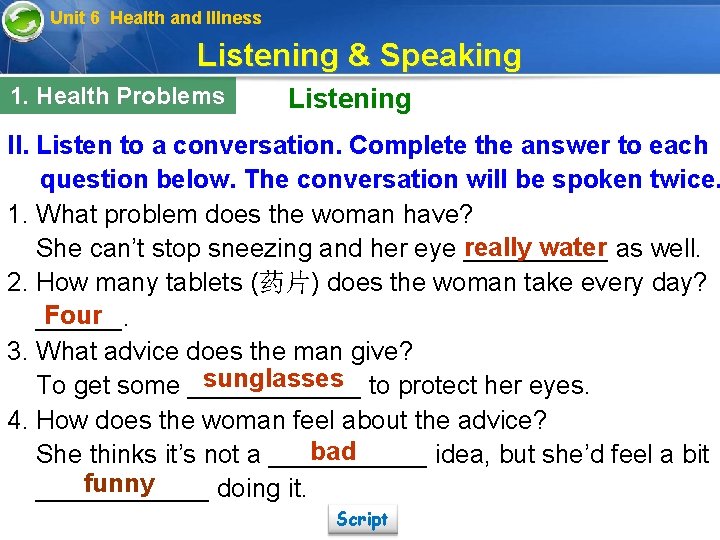
Unit 6 Health and Illness Listening & Speaking 1. Health Problems Listening II. Listen to a conversation. Complete the answer to each question below. The conversation will be spoken twice. 1. What problem does the woman have? really water She can’t stop sneezing and her eye _____ as well. 2. How many tablets (药片) does the woman take every day? Four ______. 3. What advice does the man give? sunglasses To get some ______ to protect her eyes. 4. How does the woman feel about the advice? bad She thinks it’s not a ______ idea, but she’d feel a bit funny ______ doing it. Script
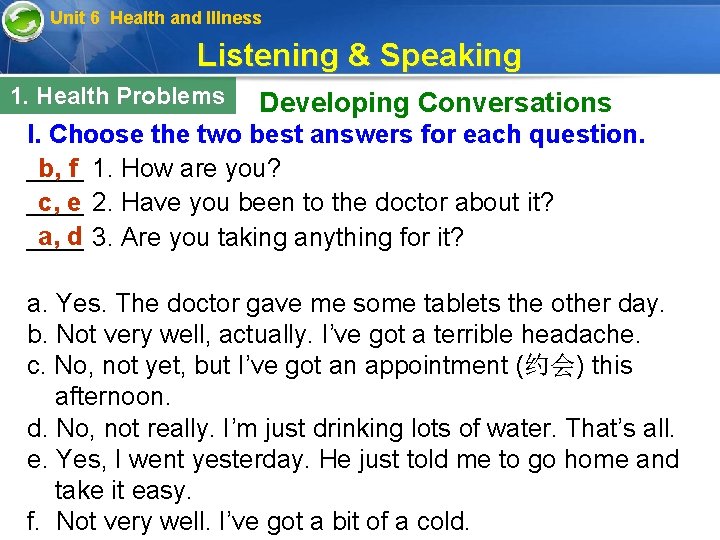
Unit 6 Health and Illness Listening & Speaking 1. Health Problems Developing Conversations I. Choose the two best answers for each question. b, f ____ 1. How are you? c, e ____ 2. Have you been to the doctor about it? a, d ____ 3. Are you taking anything for it? a. Yes. The doctor gave me some tablets the other day. b. Not very well, actually. I’ve got a terrible headache. c. No, not yet, but I’ve got an appointment (约会) this afternoon. d. No, not really. I’m just drinking lots of water. That’s all. e. Yes, I went yesterday. He just told me to go home and take it easy. f. Not very well. I’ve got a bit of a cold.
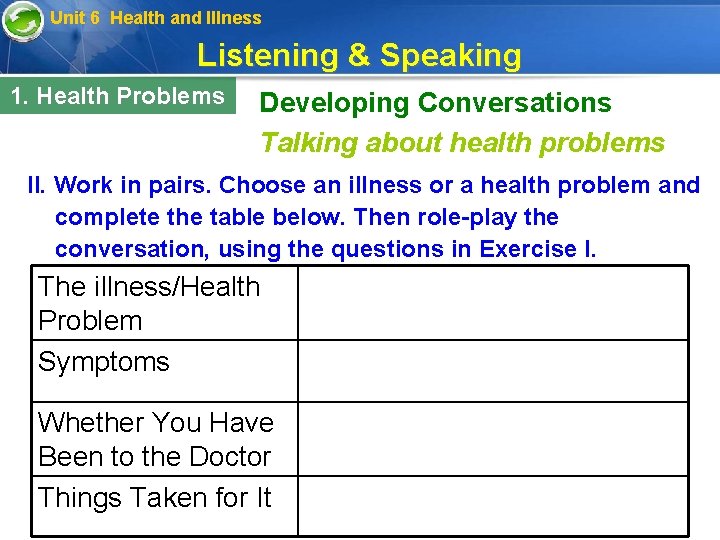
Unit 6 Health and Illness Listening & Speaking 1. Health Problems Developing Conversations Talking about health problems II. Work in pairs. Choose an illness or a health problem and complete the table below. Then role-play the conversation, using the questions in Exercise I. The illness/Health Problem Symptoms Whether You Have Been to the Doctor Things Taken for It
Unit 6 Health and Illness Listening & Speaking 1. Health Problems Developing Conversations Talking about health problems Sample Conversation A: How are you? B: Not very well, actually. I’ve got a terrible stomach ache. A: Have you been to the doctor about it? B: Yes, I went this morning. A: Are you taking anything for it? B: Yes, the doctor gave me some tablets.
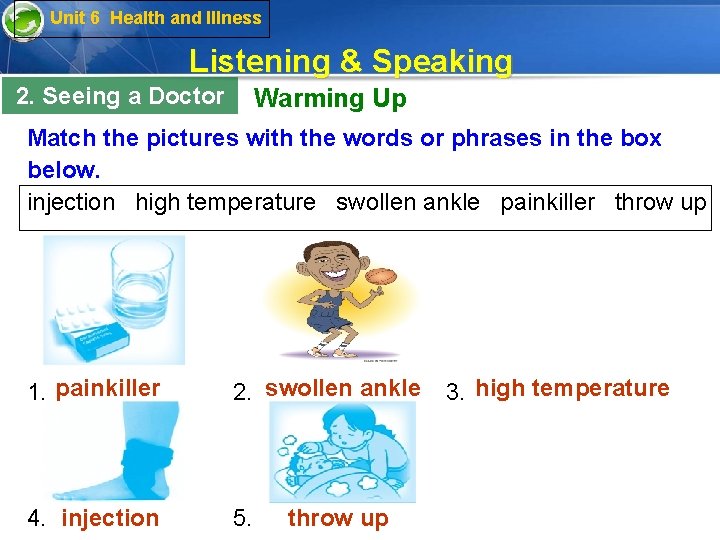
Unit 6 Health and Illness Listening & Speaking 2. Seeing a Doctor Warming Up Match the pictures with the words or phrases in the box below. injection high temperature swollen ankle painkiller throw up painkiller swollen ankle high temperature 1. 2. 3. injection 4. 5. throw up
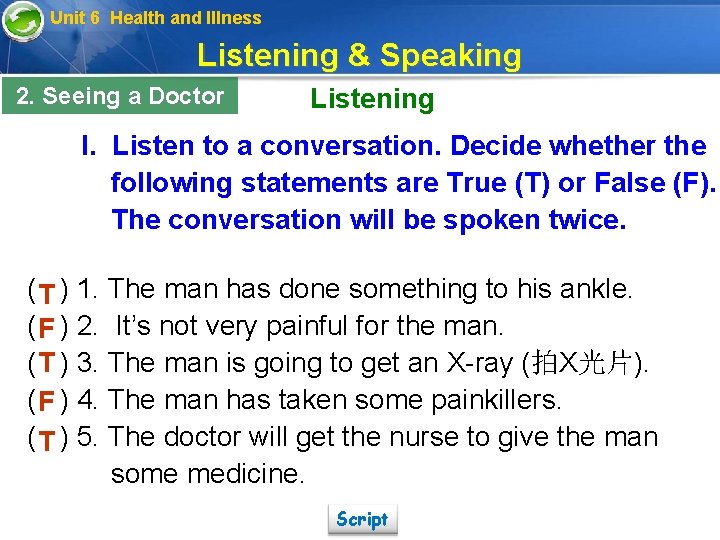
Unit 6 Health and Illness Listening & Speaking 2. Seeing a Doctor Listening I. Listen to a conversation. Decide whether the following statements are True (T) or False (F). The conversation will be spoken twice. ( ) 1. The man has done something to his ankle. T ( ) 2. It’s not very painful for the man. F ( ) 3. The man is going to get an X-ray (拍X光片). T ( ) 4. The man has taken some painkillers. F ( ) 5. The doctor will get the nurse to give the man T some medicine. Script
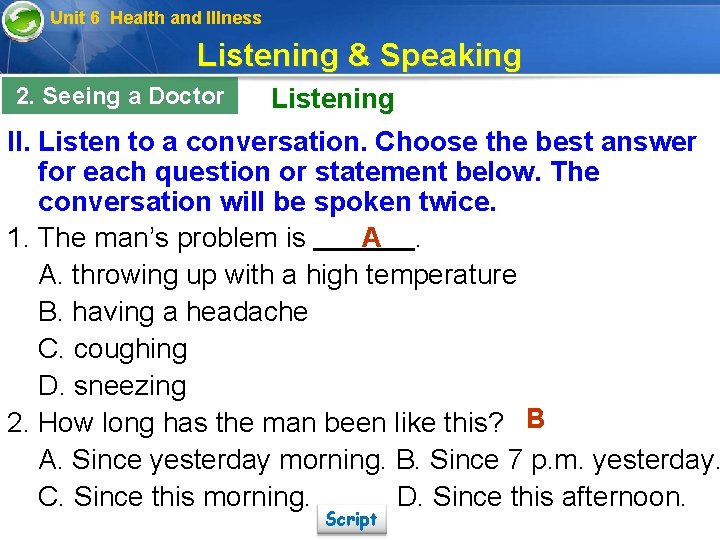
Unit 6 Health and Illness Listening & Speaking 2. Seeing a Doctor Listening II. Listen to a conversation. Choose the best answer for each question or statement below. The conversation will be spoken twice. 1. The man’s problem is . A A. throwing up with a high temperature B. having a headache C. coughing D. sneezing 2. How long has the man been like this? B A. Since yesterday morning. B. Since 7 p. m. yesterday. C. Since this morning. D. Since this afternoon. Script
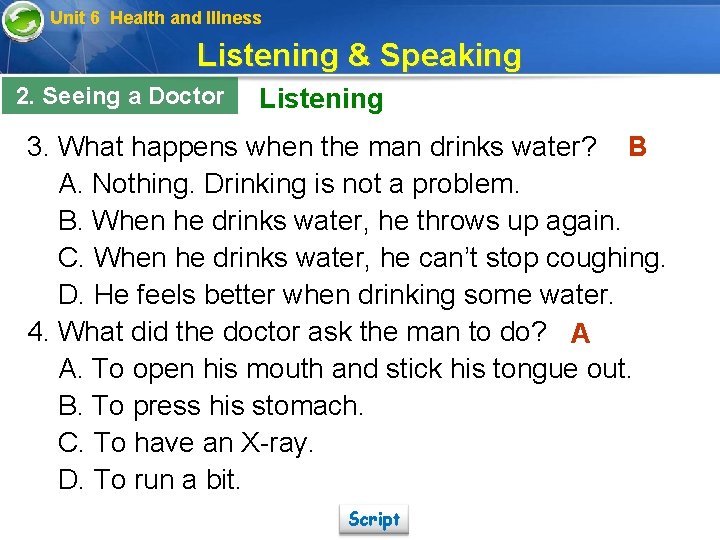
Unit 6 Health and Illness Listening & Speaking 2. Seeing a Doctor Listening 3. What happens when the man drinks water? B A. Nothing. Drinking is not a problem. B. When he drinks water, he throws up again. C. When he drinks water, he can’t stop coughing. D. He feels better when drinking some water. 4. What did the doctor ask the man to do? A A. To open his mouth and stick his tongue out. B. To press his stomach. C. To have an X-ray. D. To run a bit. Script
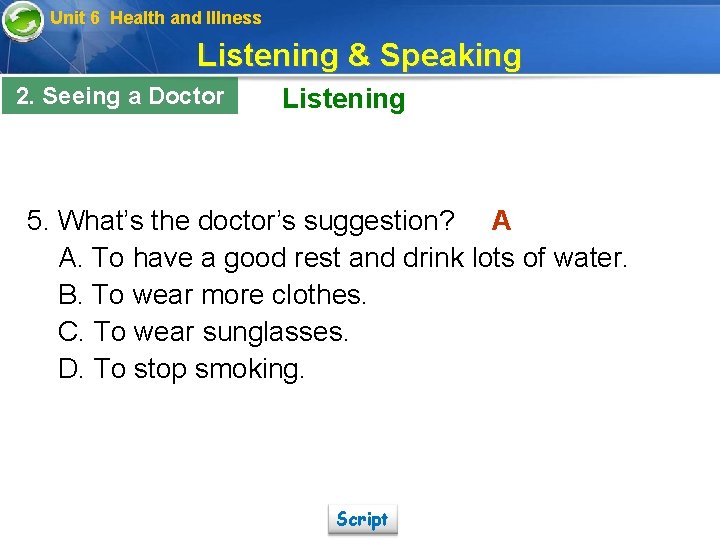
Unit 6 Health and Illness Listening & Speaking 2. Seeing a Doctor Listening 5. What’s the doctor’s suggestion? A A. To have a good rest and drink lots of water. B. To wear more clothes. C. To wear sunglasses. D. To stop smoking. Script
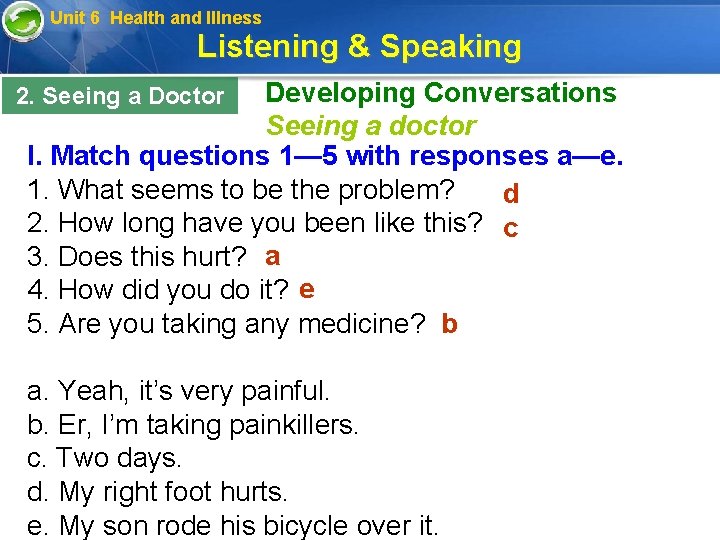
Unit 6 Health and Illness Listening & Speaking Developing Conversations Seeing a doctor I. Match questions 1— 5 with responses a—e. 1. What seems to be the problem? d 2. How long have you been like this? c 3. Does this hurt? a 4. How did you do it? e 5. Are you taking any medicine? b 2. Seeing a Doctor a. Yeah, it’s very painful. b. Er, I’m taking painkillers. c. Two days. d. My right foot hurts. e. My son rode his bicycle over it.
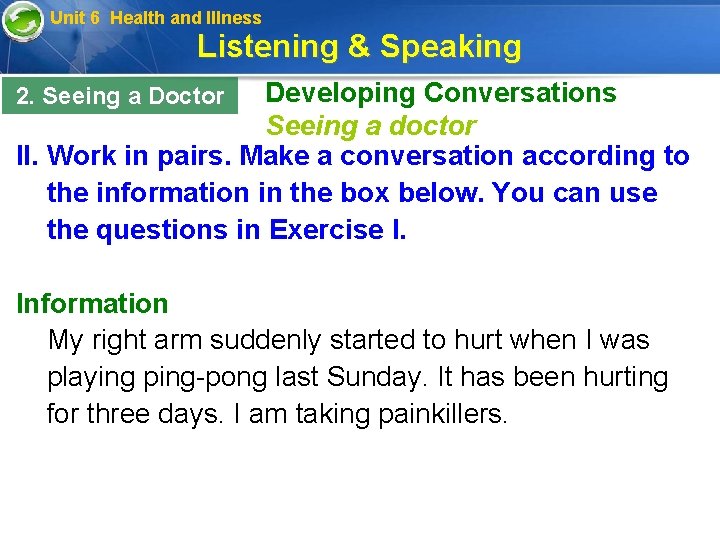
Unit 6 Health and Illness Listening & Speaking Developing Conversations Seeing a doctor II. Work in pairs. Make a conversation according to the information in the box below. You can use the questions in Exercise I. 2. Seeing a Doctor Information My right arm suddenly started to hurt when I was playing ping-pong last Sunday. It has been hurting for three days. I am taking painkillers.
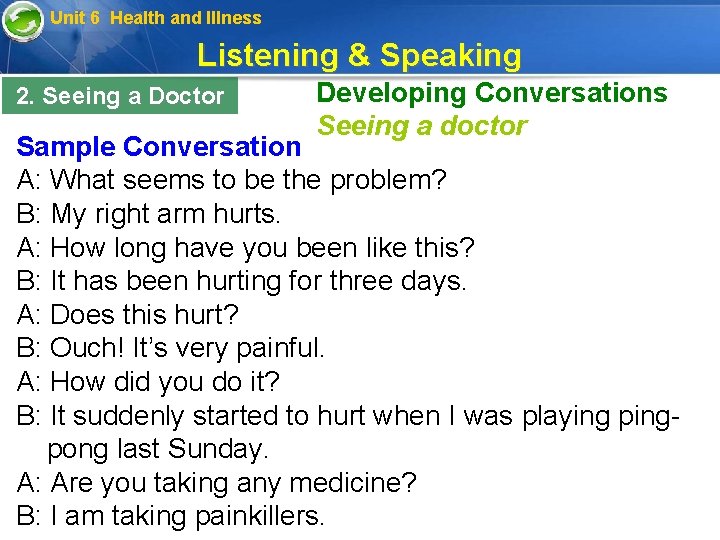
Unit 6 Health and Illness Listening & Speaking 2. Seeing a Doctor Developing Conversations Seeing a doctor Sample Conversation A: What seems to be the problem? B: My right arm hurts. A: How long have you been like this? B: It has been hurting for three days. A: Does this hurt? B: Ouch! It’s very painful. A: How did you do it? B: It suddenly started to hurt when I was playing pingpong last Sunday. A: Are you taking any medicine? B: I am taking painkillers.
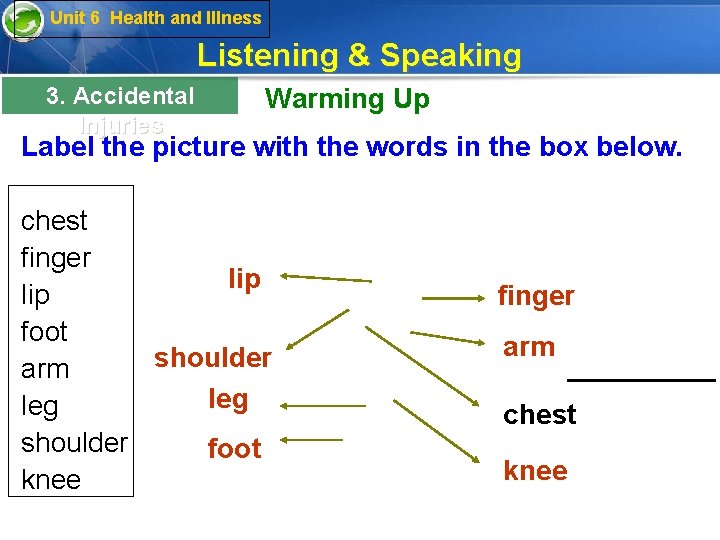
Unit 6 Health and Illness Listening & Speaking 3. Accidental Injuries Warming Up Label the picture with the words in the box below. chest finger lip finger foot arm shoulder arm leg chest shoulder foot knee
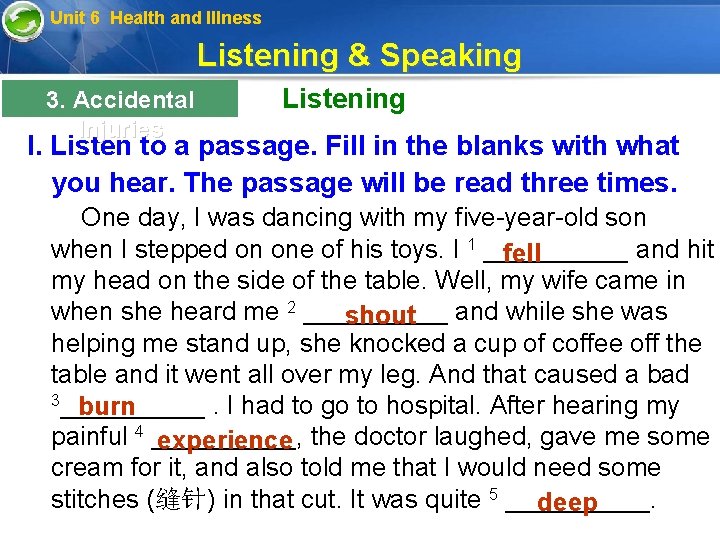
Unit 6 Health and Illness Listening & Speaking 3. Accidental Injuries Listening I. Listen to a passage. Fill in the blanks with what you hear. The passage will be read three times. One day, I was dancing with my five-year-old son when I stepped on one of his toys. I 1 _____ and hit fell my head on the side of the table. Well, my wife came in when she heard me 2 _____ and while she was shout helping me stand up, she knocked a cup of coffee off the table and it went all over my leg. And that caused a bad 3_____. I had to go to hospital. After hearing my burn painful 4 _____, the doctor laughed, gave me some experience cream for it, and also told me that I would need some stitches (缝针) in that cut. It was quite 5 _____. deep
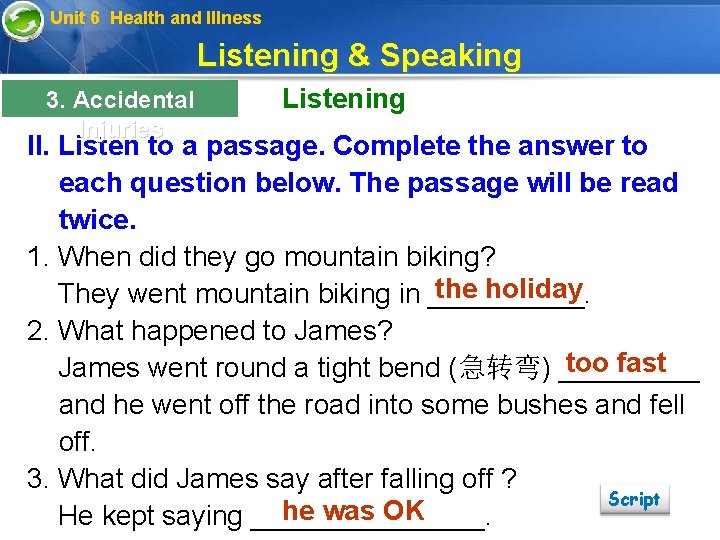
Unit 6 Health and Illness Listening & Speaking 3. Accidental Injuries Listening II. Listen to a passage. Complete the answer to each question below. The passage will be read twice. 1. When did they go mountain biking? the holiday They went mountain biking in _____. 2. What happened to James? too fast James went round a tight bend (急转弯) _____ and he went off the road into some bushes and fell off. 3. What did James say after falling off ? Script he was OK He kept saying ________.
Unit 6 Health and Illness Listening & Speaking 3. Accidental Injuries Listening 4. How were James’s injuries after he fell off? quite a few He had _______ cuts and bruises (青瘀) and was bleeding quite a bit. 5. What was the problem they were faced with? The problem was that they were still ______ miles from the next village. Script
Unit 6 Health and Illness Listening & Speaking 3. Accidental Injuries 6. 9 In the holiday, we went mountain biking in Australia. It was great, except for James’s accident. We’d been cycling in the mountains, and we were going back to the hotel down this road. James went round this tight bend too fast and he went off the road into some bushes and fell off. It was horrible. We all thought he was badly hurt. He kept saying he was OK, but you could see that his knee was really swollen. He also had quite a few cuts and bruises and was bleeding quite a bit. The problem was, though, we were still miles from Exercise II the next village.
Unit 6 Health and Illness Listening & Speaking 3. Accidental Injuries Discussion Work in groups. Discuss the following questions. 1. When was the last time you went to see a doctor? What was the problem with you? 2. Have you ever got injured accidentally? What happened?
Unit 6 Health and Illness Practical Reading Jack’s got a cold and he’s found a bottle of syrup at home. He is reading the drug facts carefully. Drug Facts Uses temporarily relieves common cold / flu symptoms: ■ cough ■ fever ■ sore throat Warnings Severe liver (肝脏) damage may occur if: ■ adult has 3 or more alcoholic drinks every day while using this product Stop use and ask a doctor if: ■ you get nervous, dizzy or sleepless ■ fever gets worse or lasts more than 3 days
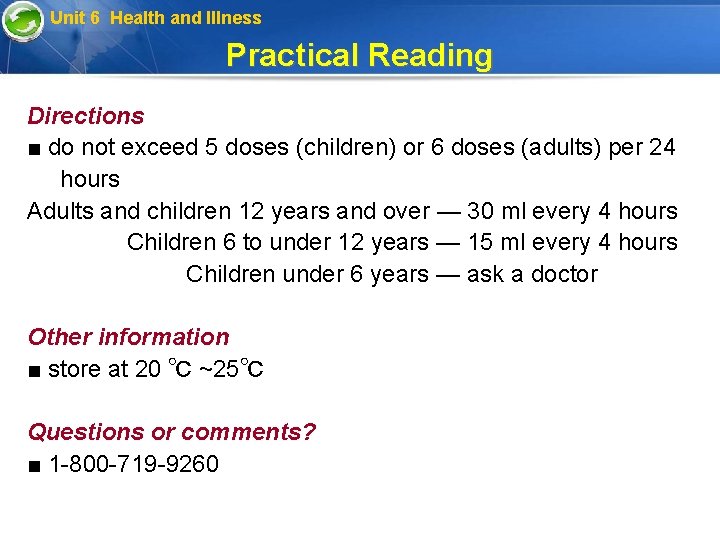
Unit 6 Health and Illness Practical Reading Directions ■ do not exceed 5 doses (children) or 6 doses (adults) per 24 hours Adults and children 12 years and over — 30 ml every 4 hours Children 6 to under 12 years — 15 ml every 4 hours Children under 6 years — ask a doctor Other information ■ store at 20 ℃ ~25℃ Questions or comments? ■ 1 -800 -719 -9260
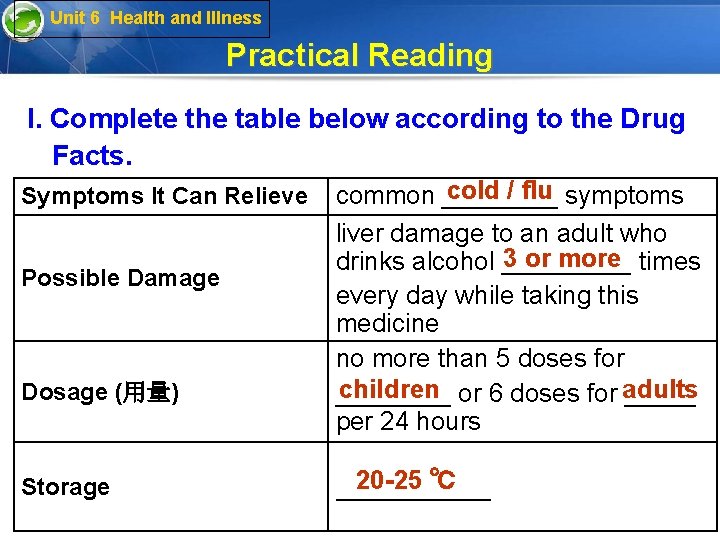
Unit 6 Health and Illness Practical Reading I. Complete the table below according to the Drug Facts. Symptoms It Can Relieve Possible Damage Dosage (用量) Storage cold / flu common ____ symptoms liver damage to an adult who 3 or more drinks alcohol _____ times every day while taking this medicine no more than 5 doses for children adults ____ or 6 doses for _____ per 24 hours 20 -25 ℃ ______
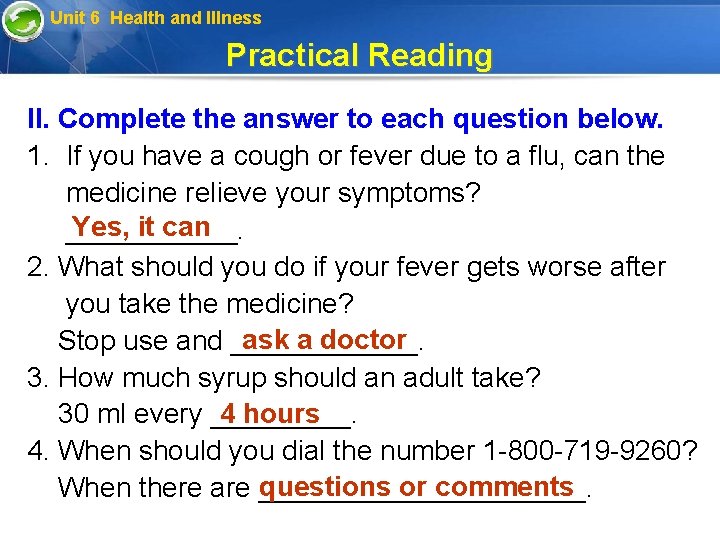
Unit 6 Health and Illness Practical Reading II. Complete the answer to each question below. 1. If you have a cough or fever due to a flu, can the medicine relieve your symptoms? Yes, it can ______. 2. What should you do if your fever gets worse after you take the medicine? ask a doctor Stop use and ______. 3. How much syrup should an adult take? 4 hours 30 ml every _____. 4. When should you dial the number 1 -800 -719 -9260? questions or comments When there are ___________.
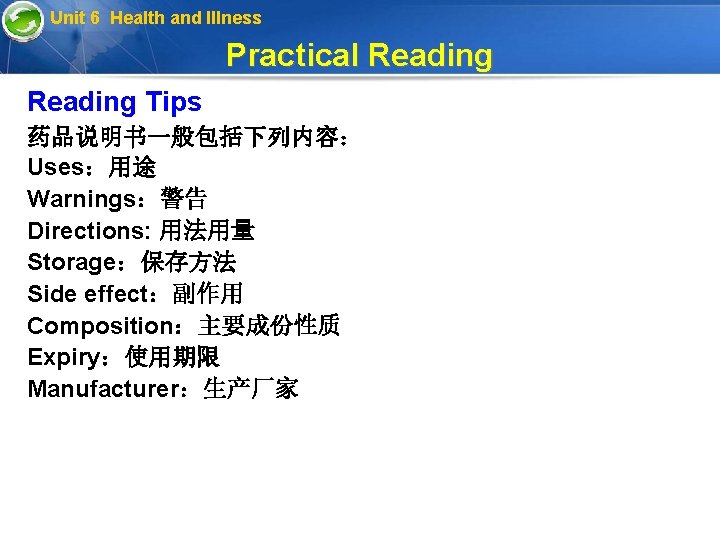
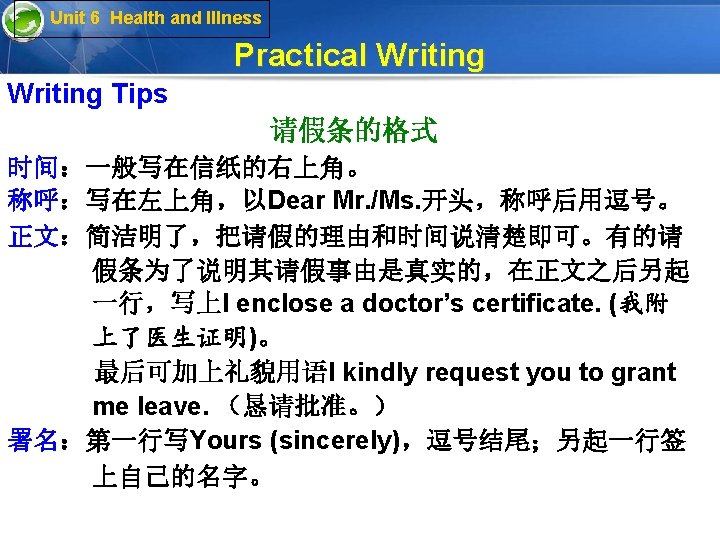
Unit 6 Health and Illness Practical Reading Tips 药品说明书一般包括下列内容: Uses:用途 Warnings:警告 Directions: 用法用量 Storage:保存方法 Side effect:副作用 Composition:主要成份性质 Expiry:使用期限 Manufacturer:生产厂家
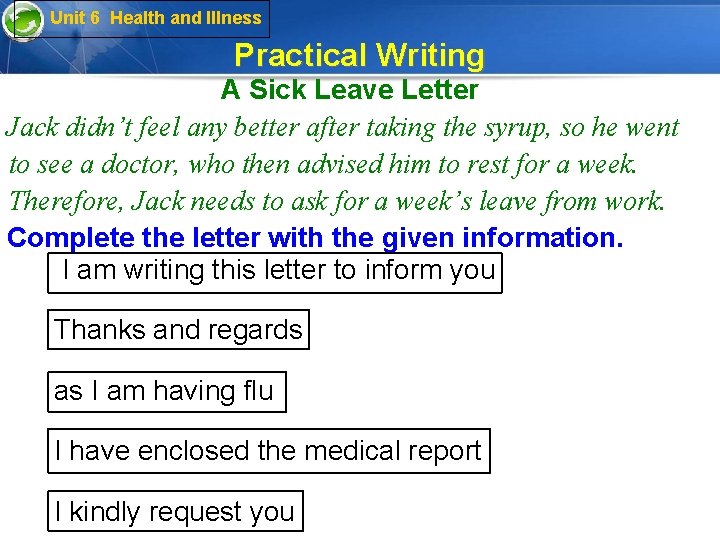
Unit 6 Health and Illness Practical Writing A Sick Leave Letter Jack didn’t feel any better after taking the syrup, so he went to see a doctor, who then advised him to rest for a week. Therefore, Jack needs to ask for a week’s leave from work. Complete the letter with the given information. I am writing this letter to inform you Thanks and regards as I am having flu I have enclosed the medical report I kindly request you
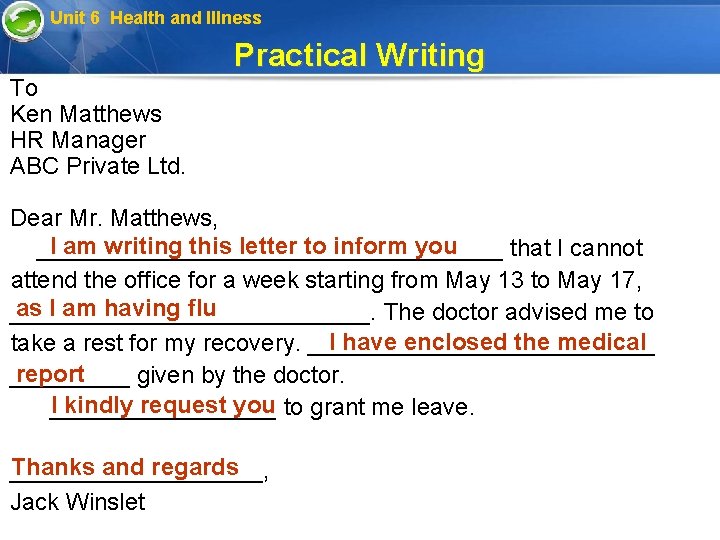
Unit 6 Health and Illness Practical Writing To Ken Matthews HR Manager ABC Private Ltd. Dear Mr. Matthews, I am writing this letter to inform you __________________ that I cannot attend the office for a week starting from May 13 to May 17, as I am having flu ______________. The doctor advised me to I have enclosed the medical take a rest for my recovery. _____________ report _____ given by the doctor. I kindly request you _________ to grant me leave. Thanks and regards __________, Jack Winslet
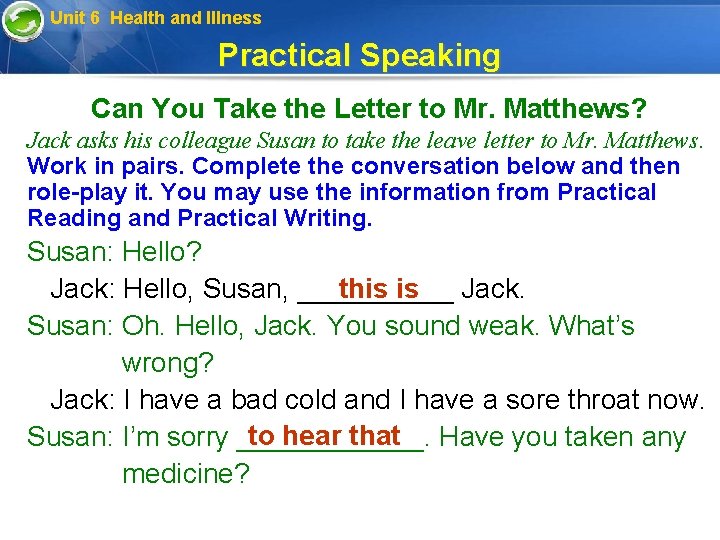
Unit 6 Health and Illness Practical Speaking Can You Take the Letter to Mr. Matthews? Jack asks his colleague Susan to take the leave letter to Mr. Matthews. Work in pairs. Complete the conversation below and then role-play it. You may use the information from Practical Reading and Practical Writing. Susan: Hello? this is Jack: Hello, Susan, _____ Jack. Susan: Oh. Hello, Jack. You sound weak. What’s wrong? Jack: I have a bad cold and I have a sore throat now. to hear that Susan: I’m sorry ______. Have you taken any medicine?
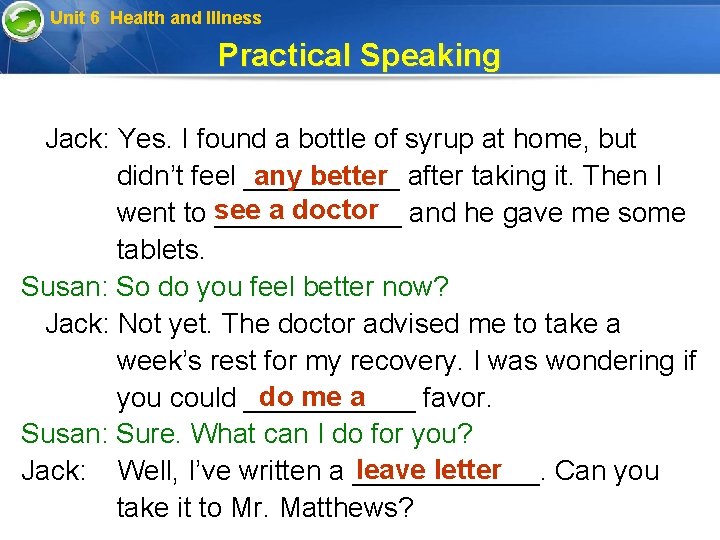
Unit 6 Health and Illness Practical Speaking Jack: Yes. I found a bottle of syrup at home, but any better didn’t feel _____ after taking it. Then I see a doctor went to ______ and he gave me some tablets. Susan: So do you feel better now? Jack: Not yet. The doctor advised me to take a week’s rest for my recovery. I was wondering if do me a you could ______ favor. Susan: Sure. What can I do for you? leave letter Jack: Well, I’ve written a ______. Can you take it to Mr. Matthews?
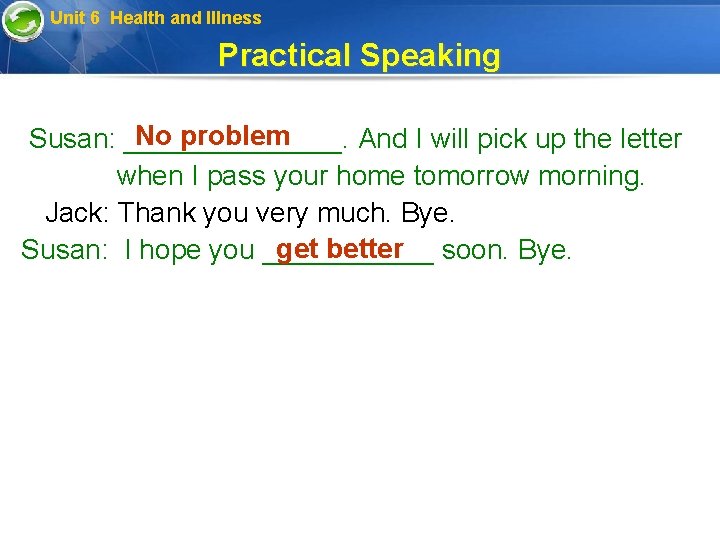
Unit 6 Health and Illness Practical Speaking No problem Susan: _______. And I will pick up the letter when I pass your home tomorrow morning. Jack: Thank you very much. Bye. get better Susan: I hope you ______ soon. Bye.