UNIT 6 Health and Fitness LESSON Parts of


- Slides: 88
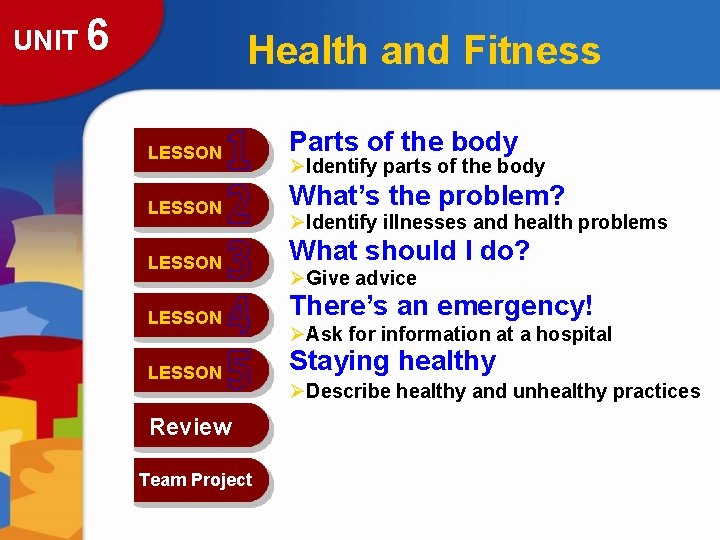
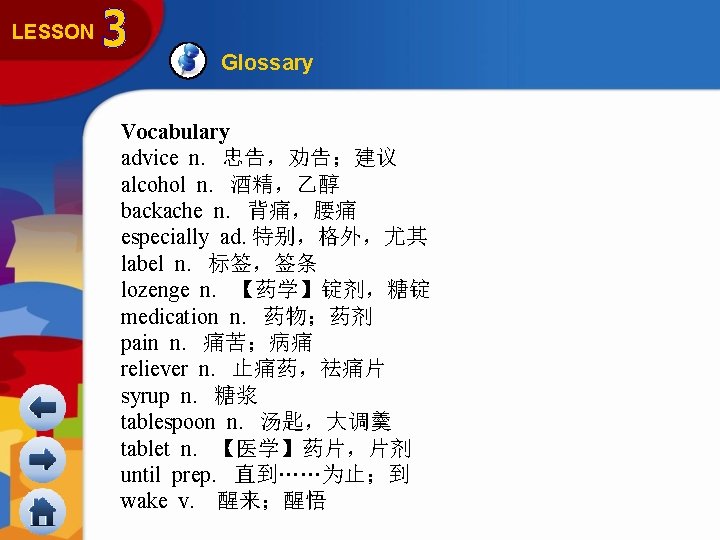
UNIT 6 Health and Fitness LESSON Parts of the body LESSON What’s the problem? LESSON What should I do? LESSON There’s an emergency! LESSON Staying healthy Review Team Project ØIdentify parts of the body ØIdentify illnesses and health problems ØGive advice ØAsk for information at a hospital ØDescribe healthy and unhealthy practices
LESSON Parts of the body GOAL Ø Identify parts of the body A C B F D H G E
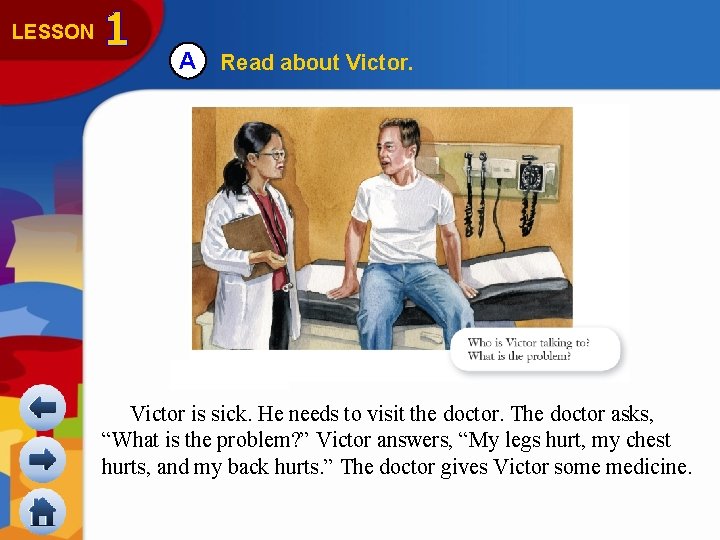
LESSON A Read about Victor is sick. He needs to visit the doctor. The doctor asks, “What is the problem? ” Victor answers, “My legs hurt, my chest hurts, and my back hurts. ” The doctor gives Victor some medicine.
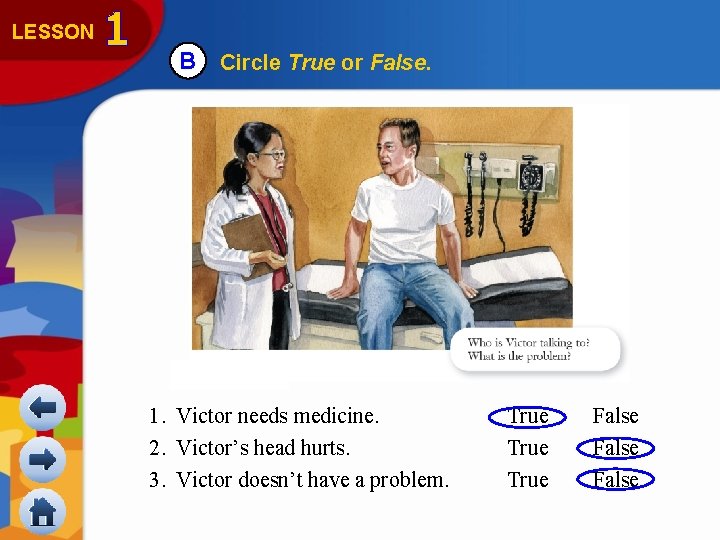
LESSON B Circle True or False. 1. Victor needs medicine. 2. Victor’s head hurts. 3. Victor doesn’t have a problem. True False
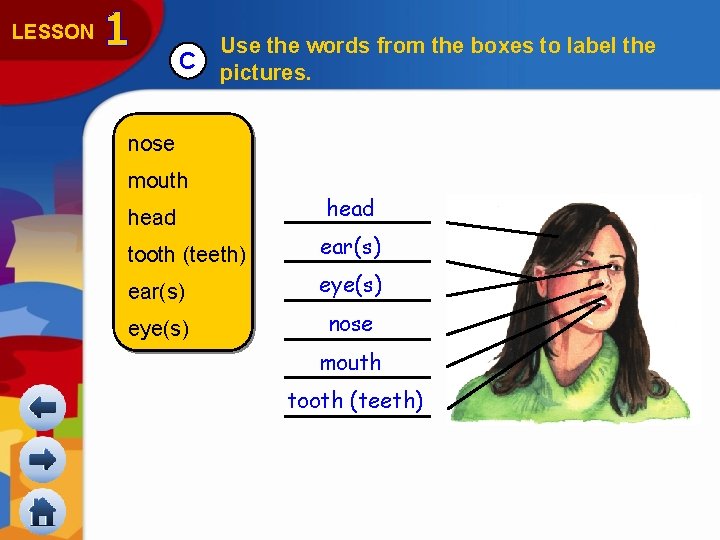
LESSON C Use the words from the boxes to label the pictures. nose mouth head tooth (teeth) ear(s) eye(s) nose mouth tooth (teeth)
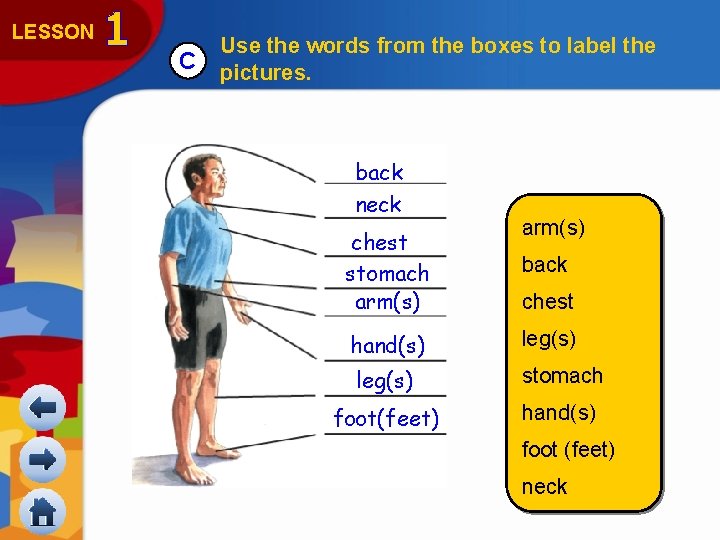
LESSON C Use the words from the boxes to label the pictures. back neck chest stomach arm(s) hand(s) leg(s) stomach foot(feet) hand(s) back chest foot (feet) neck
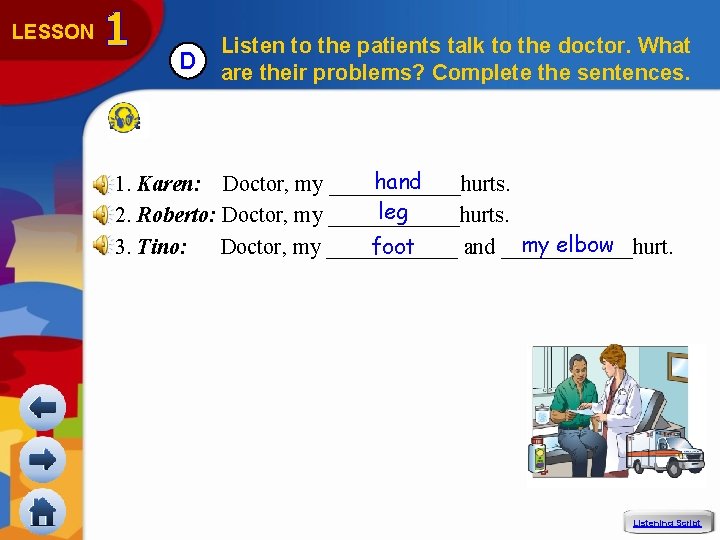
LESSON D Listen to the patients talk to the doctor. What are their problems? Complete the sentences. hand 1. Karen: Doctor, my ______hurts. leg 2. Roberto: Doctor, my ______hurts. my elbow 3. Tino: Doctor, my ______ and ______hurt. foot Listening Script
LESSON E Read the conversation. Practice new conversations using the words in Exercise C. Doctor: What is the problem today? Patient: My leg hurts. Doctor: Your leg? Patient: Yes, my leg.
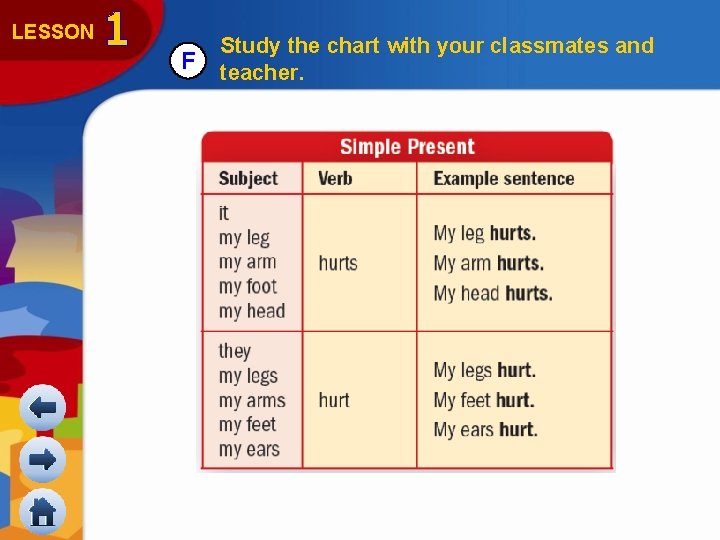
LESSON F Study the chart with your classmates and teacher.
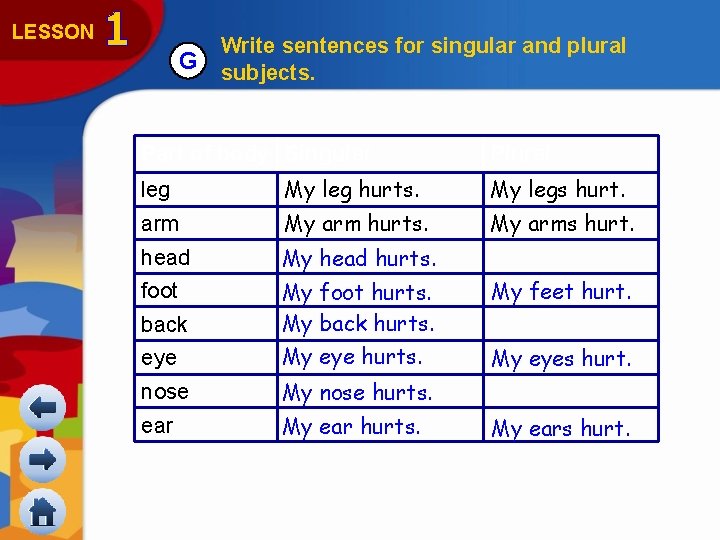
LESSON G Write sentences for singular and plural subjects. Part of body Singular Plural leg My leg hurts. My legs hurt. arm My arm hurts. My arms hurt. head My head hurts. foot My feet hurt. back My foot hurts. My back hurts. eye My eye hurts. My eyes hurt. nose My nose hurts. ear My ear hurts. My ears hurt.
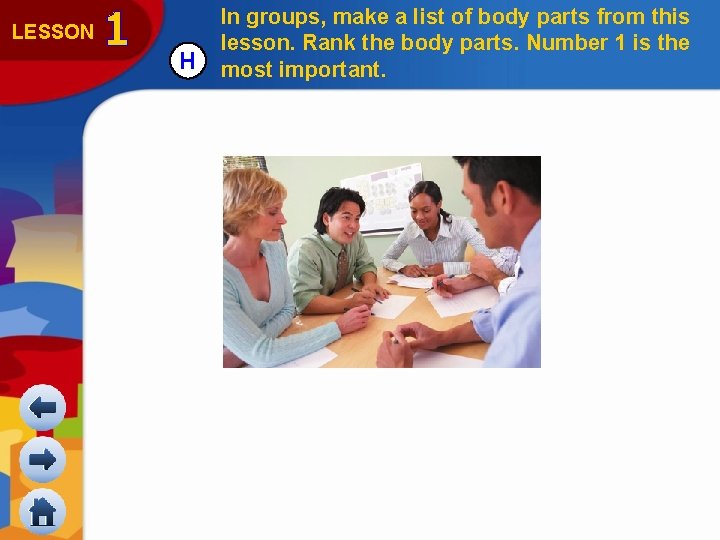
LESSON H In groups, make a list of body parts from this lesson. Rank the body parts. Number 1 is the most important.
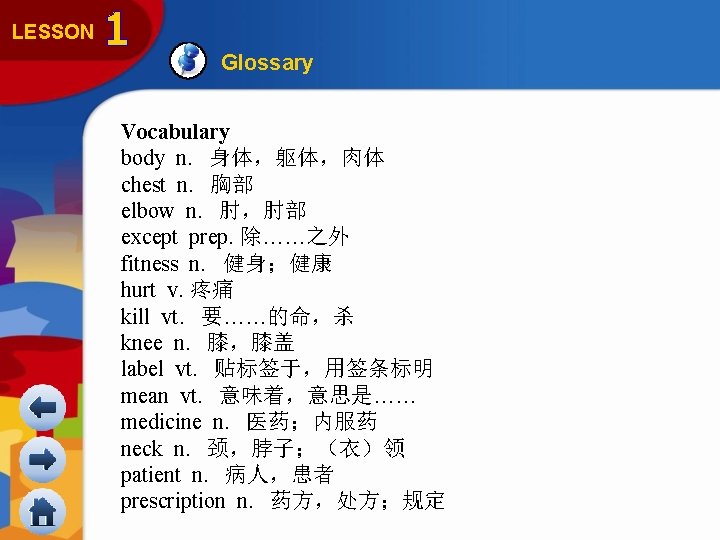
LESSON Glossary
LESSON Glossary
LESSON Listening Script 1. Karen: Doctor, thank you for seeing me on such short notice. Doctor: What seems to be the trouble? Karen: Well, I’m having trouble with my hand. Doctor: What do you mean, trouble? Karen: My hand is very stiff in the morning. I work at a computer, and it is getting very difficult to do my work. 2. Doctor: How are you today, Roberto? Roberto: I’m fine except my leg hurts all the time. Doctor: I see. Let’s check it out. Where does it hurt? Roberto: My leg hurts right here near the knee. Doctor: We probably should take some x-rays. Part D
LESSON Listening Script 3. Doctor: Well, Tino, it seems like you are here every week these days. Tino: I guess so doctor. My foot is killing me. Doctor: I know that you were here last week because of your elbow. Did the prescription help? Tino: Not at all. It seems to be getting worse. Part D
LESSON What’s the problem? GOAL A C B F D H G E
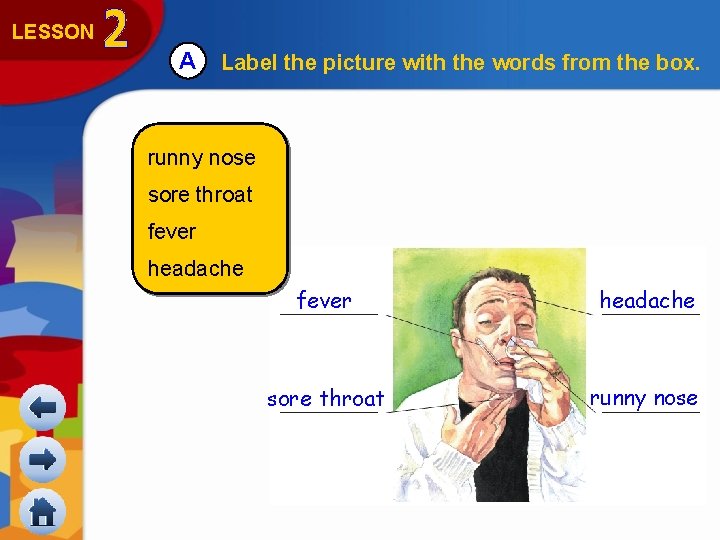
LESSON A Label the picture with the words from the box. runny nose sore throat fever headache sore throat runny nose
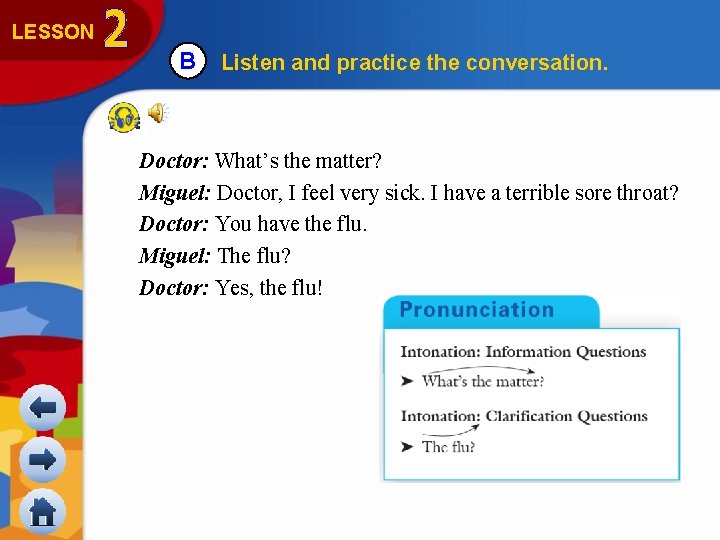
LESSON B Listen and practice the conversation. Doctor: What’s the matter? Miguel: Doctor, I feel very sick. I have a terrible sore throat? Doctor: You have the flu. Miguel: The flu? Doctor: Yes, the flu!
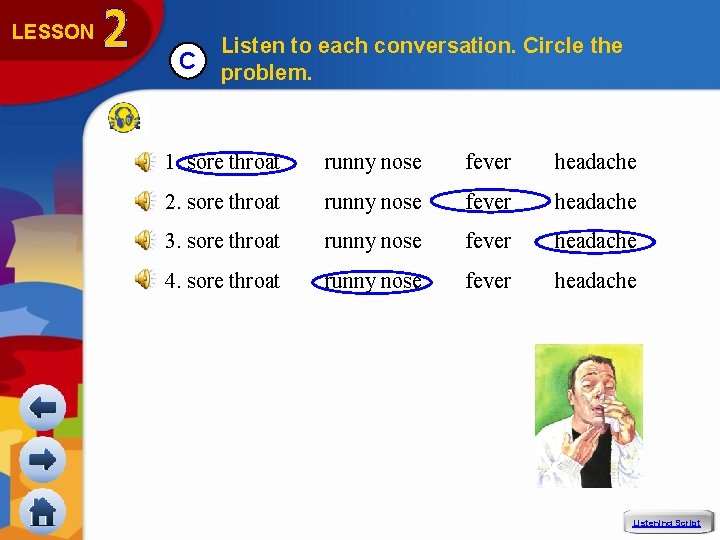
LESSON C Listen to each conversation. Circle the problem. 1. sore throat runny nose fever headache 2. sore throat runny nose fever headache 3. sore throat runny nose fever headache 4. sore throat runny nose fever headache Listening Script
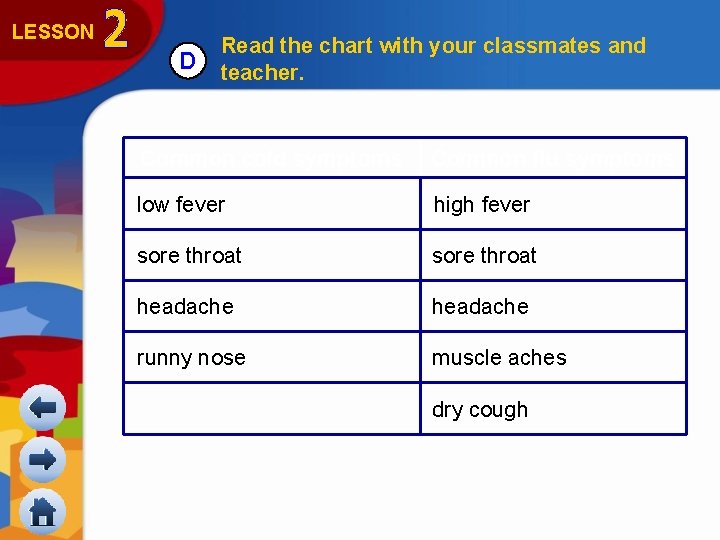
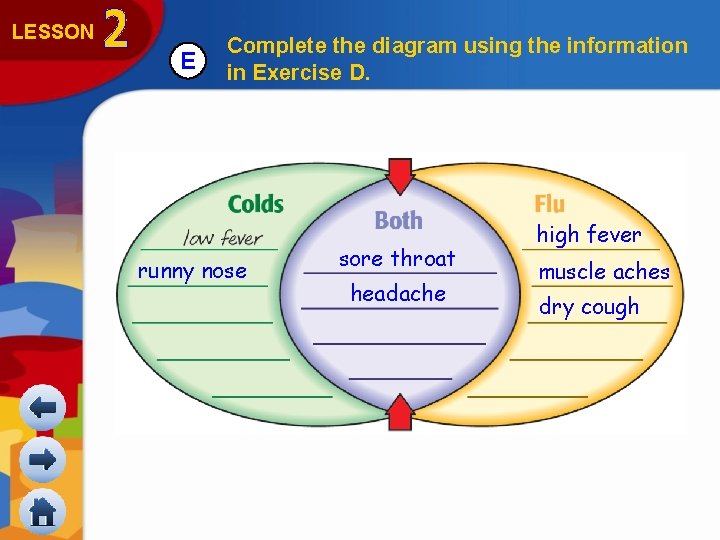
LESSON D Read the chart with your classmates and teacher. Common cold symptoms Common flu symptoms low fever high fever sore throat headache runny nose muscle aches dry cough
LESSON E Complete the diagram using the information in Exercise D. runny nose sore throat headache high fever muscle aches dry cough
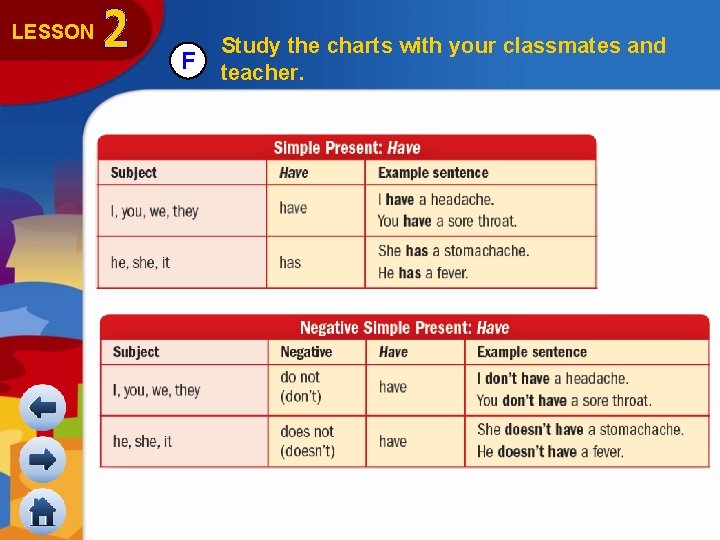
LESSON F Study the charts with your classmates and teacher.
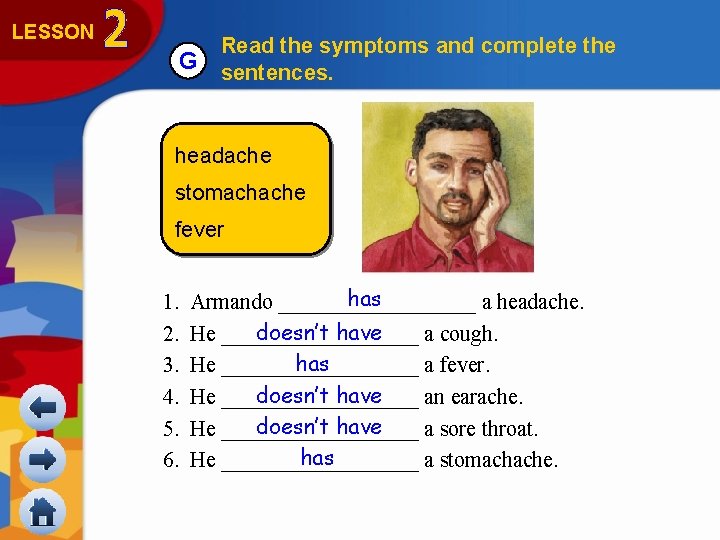
LESSON G Read the symptoms and complete the sentences. headache stomachache fever 1. 2. 3. 4. 5. 6. has Armando _________ a headache. doesn’t have He _________ a cough. has He _________ a fever. doesn’t have He _________ an earache. doesn’t have He _________ a sore throat. has He _________ a stomachache.
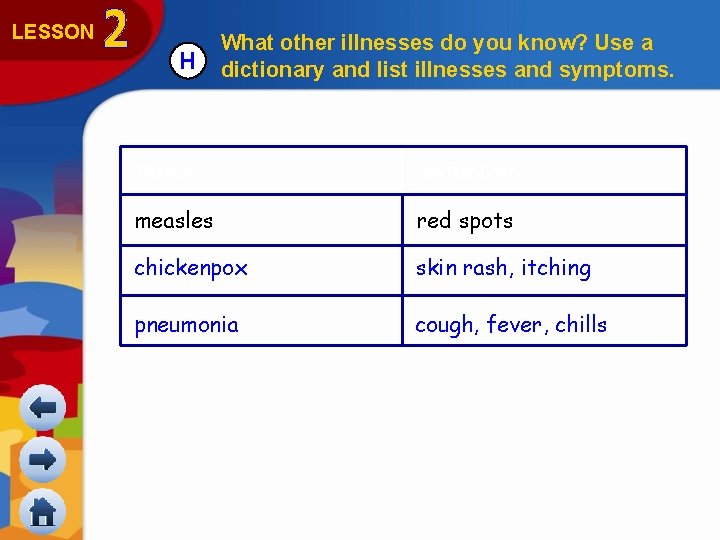
LESSON H What other illnesses do you know? Use a dictionary and list illnesses and symptoms. Illness Symptom measles red spots chickenpox skin rash, itching pneumonia cough, fever, chills
LESSON Glossary Vocabulary ache n. 疼痛 clarification n. 澄清 cold adj. 冷的;n. 感冒 cough n. /vi. 咳,咳嗽 earache n. 耳痛 examine vt. 检查,审查;考核 fever n. 发热,发烧 flu n. 流行性感冒 headache n. 头疼 illness n. 疾病;不健康 measles n. 麻疹 muscle n. 肌肉 negative a. 否定的;消极的 practice n. 做法;习惯
LESSON Glossary serious a. 严重的;严肃的;认真的 sore a. 痛的;疼痛发炎的 spot n. 斑点;污点;疵点 stomachache n. 胃痛;肚子痛 symptom n. 症状,症候 terrible a. 可怕的;很糟的 throat n. 嗓子,咽喉 Phrases & Useful Expressions dry cough 干咳 low / high fever 低/高烧 muscle ache 肌肉痛 open up 张开嘴 runny nose 流鼻涕
LESSON Glossary sore throat 喉咙疼 What’s the matter? 怎么了? Proper Names Armando 阿曼多
LESSON Listening Script 1. Doctor: What’s the matter? Miguel: Doctor, I feel very sick. I have a terrible sore throat. Doctor: You have the flu. Miguel: The flu? Doctor: Yes, the flu! 2. Doctor: What’s the matter? Patient: I don’t know. I am terribly tired. Doctor: Do you have any other symptoms? Patient: Yes, I have a fever. Doctor: Well, let’s examine you. Open up and say, “Aahh. ” Part C
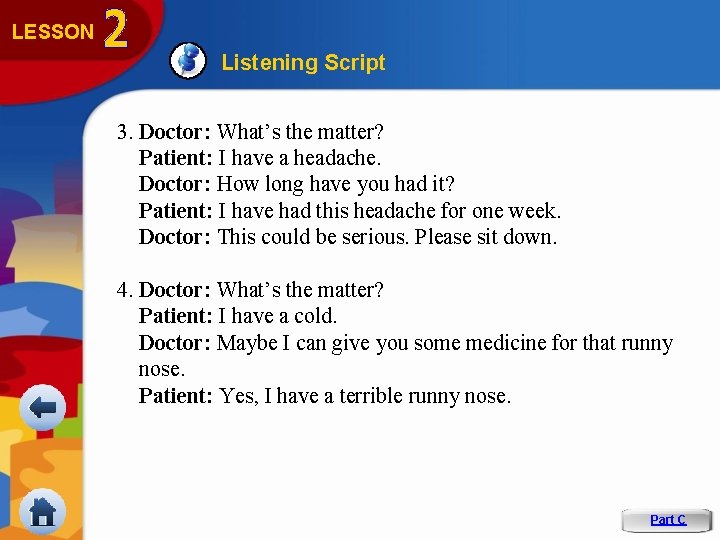
LESSON Listening Script 3. Doctor: What’s the matter? Patient: I have a headache. Doctor: How long have you had it? Patient: I have had this headache for one week. Doctor: This could be serious. Please sit down. 4. Doctor: What’s the matter? Patient: I have a cold. Doctor: Maybe I can give you some medicine for that runny nose. Patient: Yes, I have a terrible runny nose. Part C
LESSON What should I do? GOAL A C B F E D J H G I
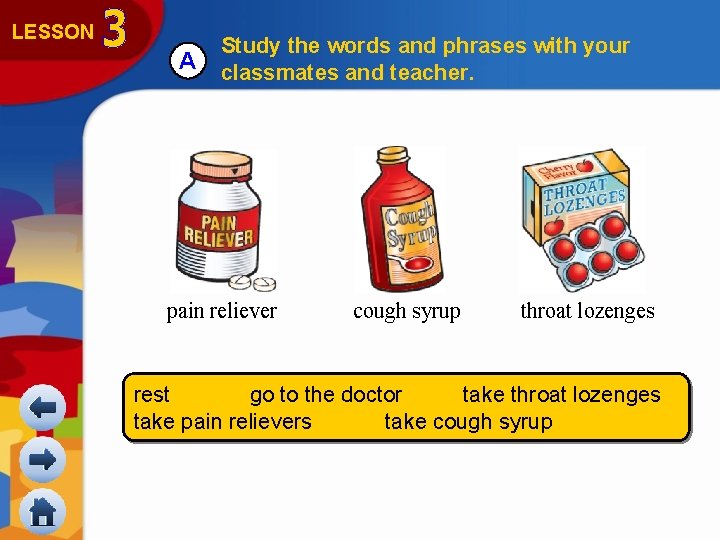
LESSON A Study the words and phrases with your classmates and teacher. pain reliever cough syrup throat lozenges rest go to the doctor take throat lozenges take pain relievers take cough syrup
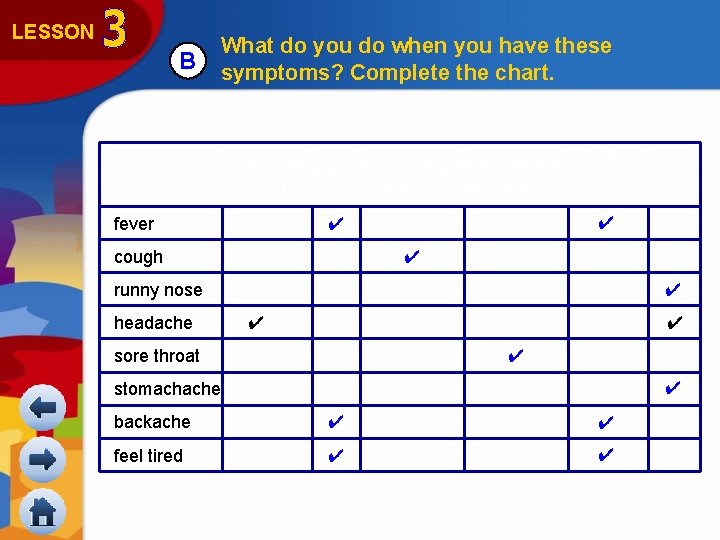
LESSON B What do you do when you have these symptoms? Complete the chart. Symptom fever Go to Take pain Take cough Take throat Rest. the relievers. syrup. lozenges. doctor. ✔ ✔ cough ✔ runny nose headache Other ✔ ✔ ✔ sore throat ✔ ✔ stomachache backache ✔ ✔ feel tired ✔ ✔
LESSON C Practice the conversation. Then, use information from Exercise B to make more conversations. Patient: I have a headache. Doctor: Take pain relievers. Patient: Thanks.
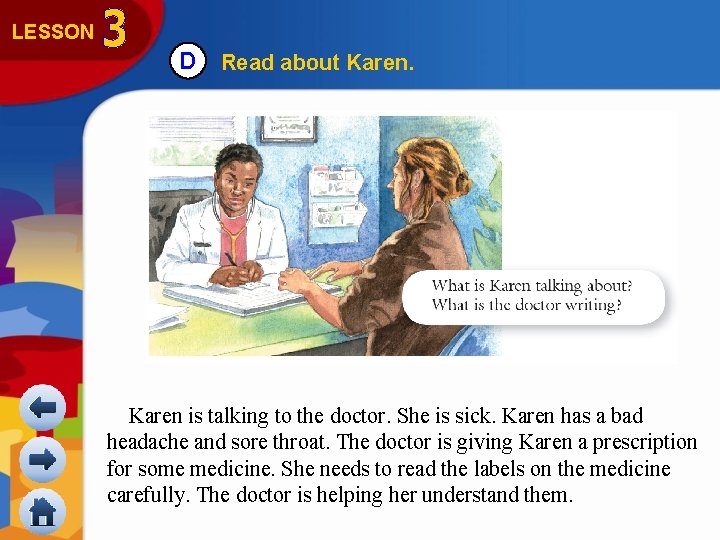
LESSON D Read about Karen is talking to the doctor. She is sick. Karen has a bad headache and sore throat. The doctor is giving Karen a prescription for some medicine. She needs to read the labels on the medicine carefully. The doctor is helping her understand them.
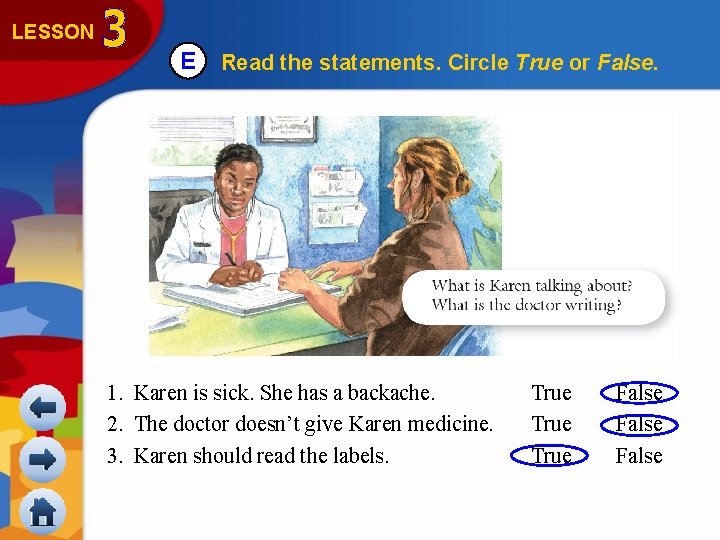
LESSON E Read the statements. Circle True or False. 1. Karen is sick. She has a backache. 2. The doctor doesn’t give Karen medicine. 3. Karen should read the labels. True False
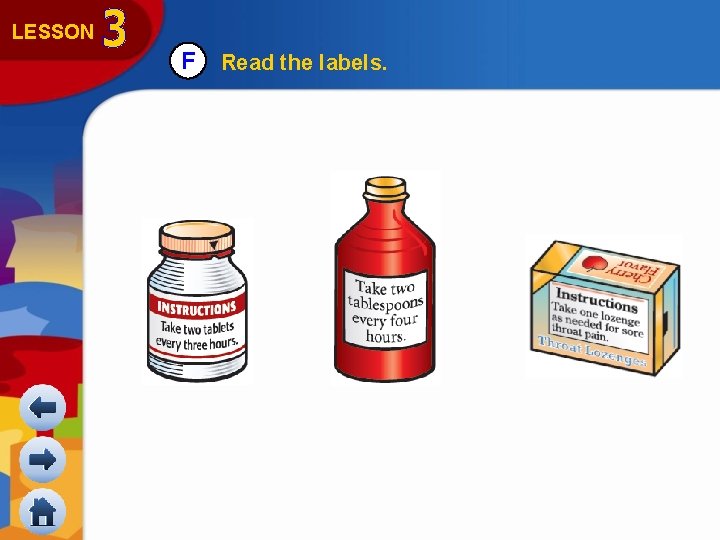
LESSON F Read the labels.
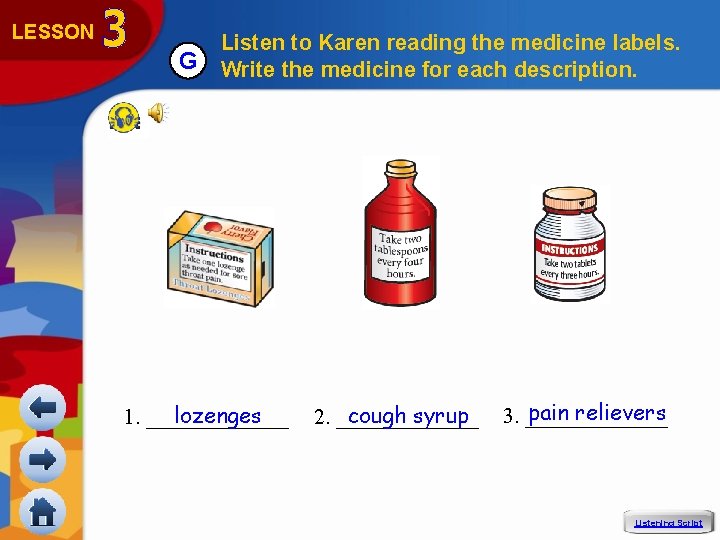
LESSON G Listen to Karen reading the medicine labels. Write the medicine for each description. lozenges 1. _______ cough syrup 2. _______ pain relievers 3. _______ Listening Script
LESSON H Study the charts with your classmates and teacher.
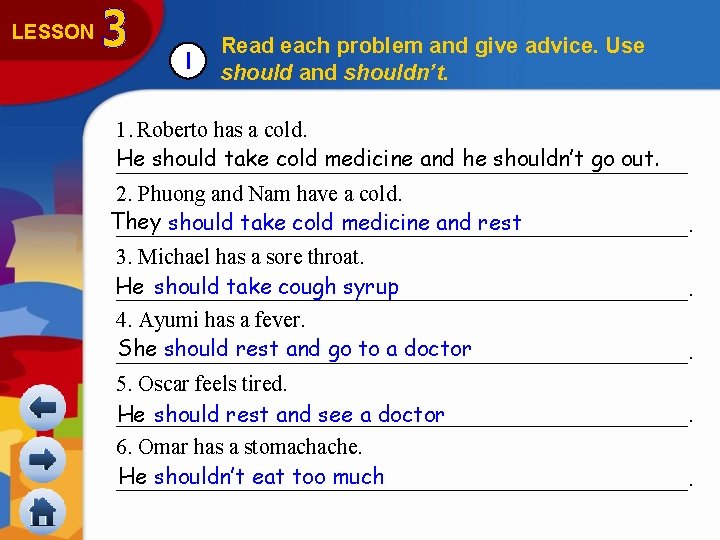
LESSON I Read each problem and give advice. Use should and shouldn’t. 1. Roberto has a cold. He should take cold medicine and he shouldn’t go out. __________________________ 2. Phuong and Nam have a cold. They should take cold medicine and rest __________________________. 3. Michael has a sore throat. He should take cough syrup __________________________. 4. Ayumi has a fever. She should rest and go to a doctor __________________________. 5. Oscar feels tired. He should rest and see a doctor __________________________. 6. Omar has a stomachache. He shouldn’t eat too much __________________________.
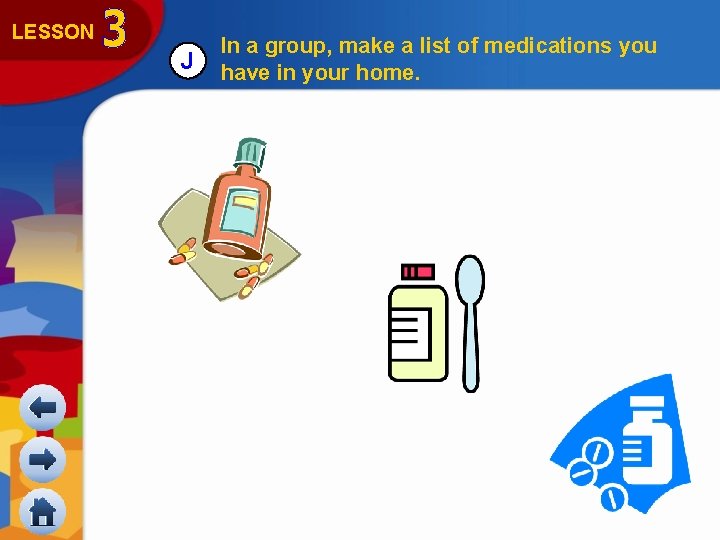
LESSON J In a group, make a list of medications you have in your home.
LESSON Glossary Phrases & Useful Expressions at work 在上班;在 作时 go away 消失 go to the doctor 看病,找大夫 take pain reliever 服用止疼药 throat lozenges 【药学】润喉片 wake up 醒来,吵醒 Proper Names Ayumi 宫崎步 Michael 迈克尔 Omar 奥玛尔 Oscar 奥斯卡 Phuong 凤,芳
LESSON Listening Script Well, let me see. The doctor says that I need to take this medicine for the next few days. Here it says, “Take one lozenge as needed for sore throat pain. ” I probably will need that. My throat really hurts. I will especially need it at work when I am talking to everyone. This one says to take two tablespoons every four hours. Let me see, that means I should take one when I wake up around 8: 00 and then at noon and again at 4: 00. I will take the last tablespoon at 8: 00. This last one reads, “Take two tablets every three hours. ” I will do that until my headache goes away. I hope that is soon. I really don’t like to be sick. Part G
LESSON There’s an emergency! GOAL Ø Ask for information at a hospital A C B F E D H G I
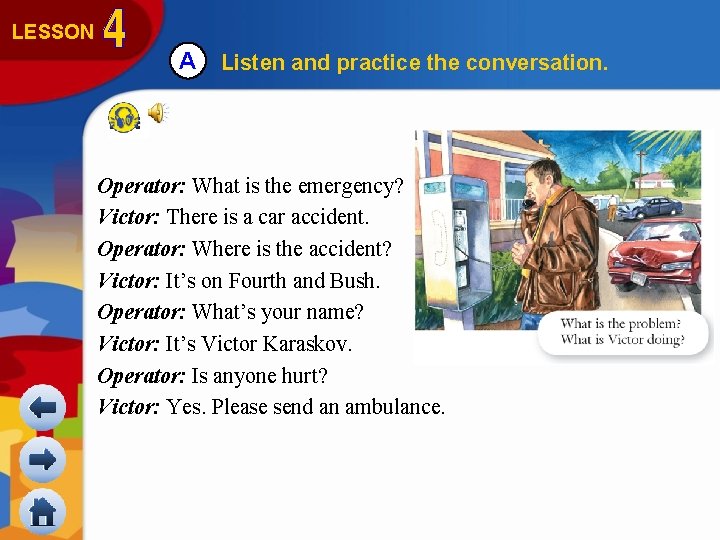
LESSON A Listen and practice the conversation. Operator: What is the emergency? Victor: There is a car accident. Operator: Where is the accident? Victor: It’s on Fourth and Bush. Operator: What’s your name? Victor: It’s Victor Karaskov. Operator: Is anyone hurt? Victor: Yes. Please send an ambulance.
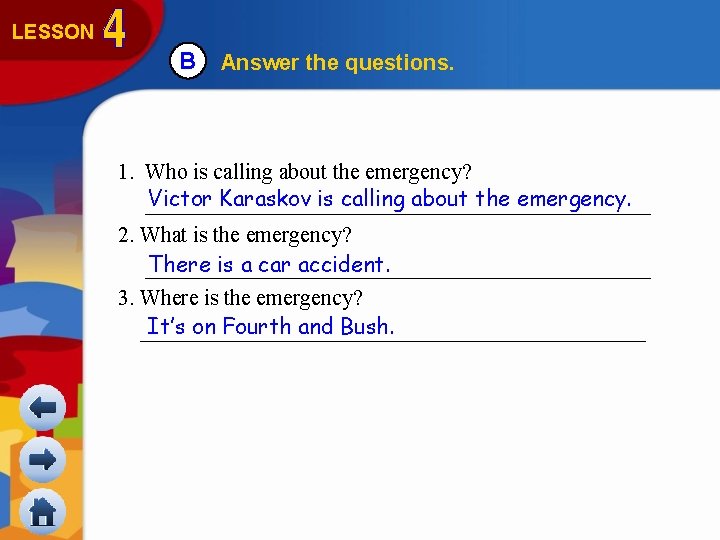
LESSON B Answer the questions. 1. Who is calling about the emergency? Victor Karaskov is calling about the emergency. _______________________ 2. What is the emergency? There is a car accident. _______________________ 3. Where is the emergency? It’s on Fourth and Bush. _______________________
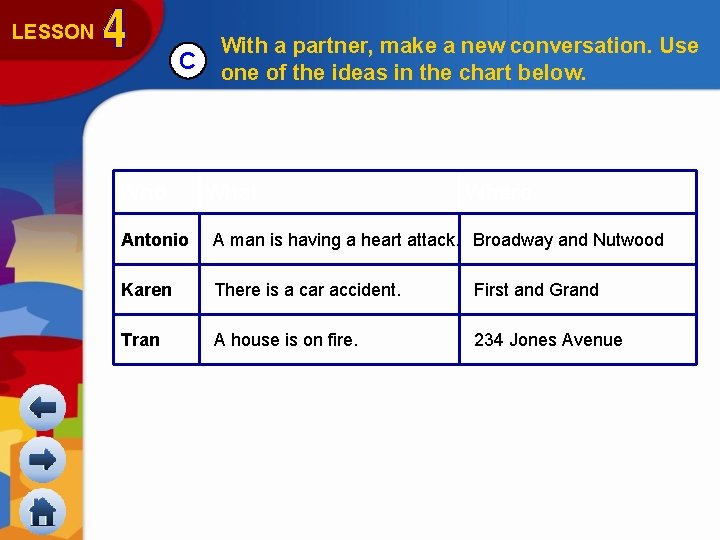
LESSON C Who With a partner, make a new conversation. Use one of the ideas in the chart below. What Where Antonio A man is having a heart attack. Broadway and Nutwood Karen There is a car accident. First and Grand Tran A house is on fire. 234 Jones Avenue
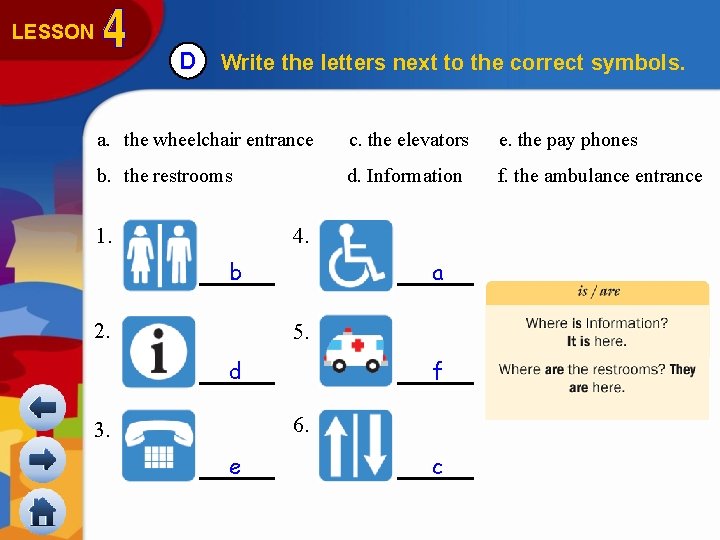
LESSON D Write the letters next to the correct symbols. a. the wheelchair entrance c. the elevators e. the pay phones b. the restrooms d. Information f. the ambulance entrance 1. 4. b 2. a 5. d f 6. 3. e c
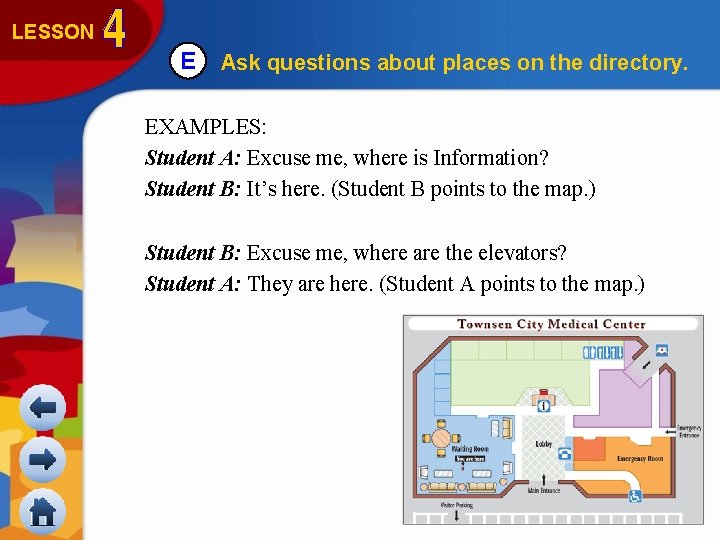
LESSON E Ask questions about places on the directory. EXAMPLES: Student A: Excuse me, where is Information? Student B: It’s here. (Student B points to the map. ) Student B: Excuse me, where are the elevators? Student A: They are here. (Student A points to the map. )
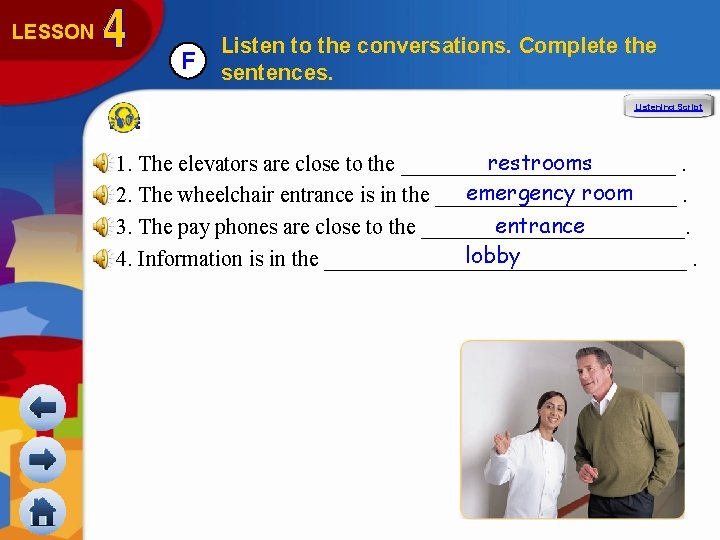
LESSON F Listen to the conversations. Complete the sentences. Listening Script restrooms 1. The elevators are close to the _____________. emergency room 2. The wheelchair entrance is in the ___________. entrance 3. The pay phones are close to the ____________. lobby 4. Information is in the _________________.
LESSON G Ask a partner for information. Ask about the elevators, the wheelchair entrance, the pay phones, and Information. EXAMPLE: Student A: Where are the restrooms? Student B: They are close to the elevators. H In groups of four, prepare a role-play. Student 1: You work in Information. Student 2: You are very sick. Student 3: You are a family member. Student 4: You are a nurse.
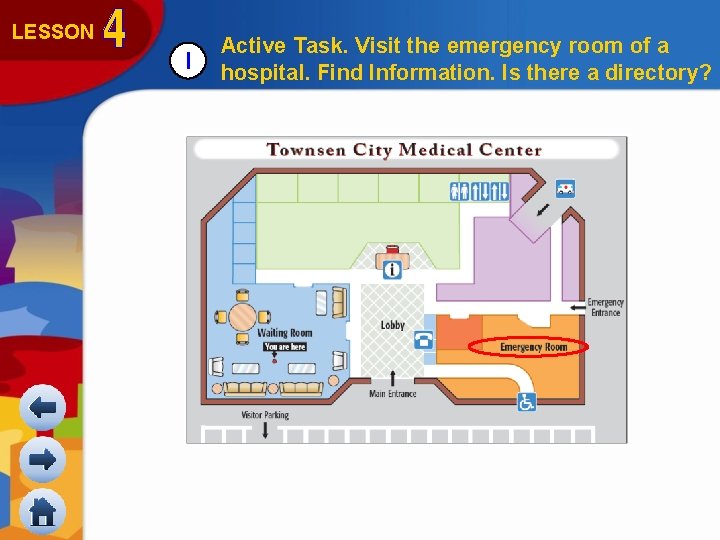
LESSON I Active Task. Visit the emergency room of a hospital. Find Information. Is there a directory?
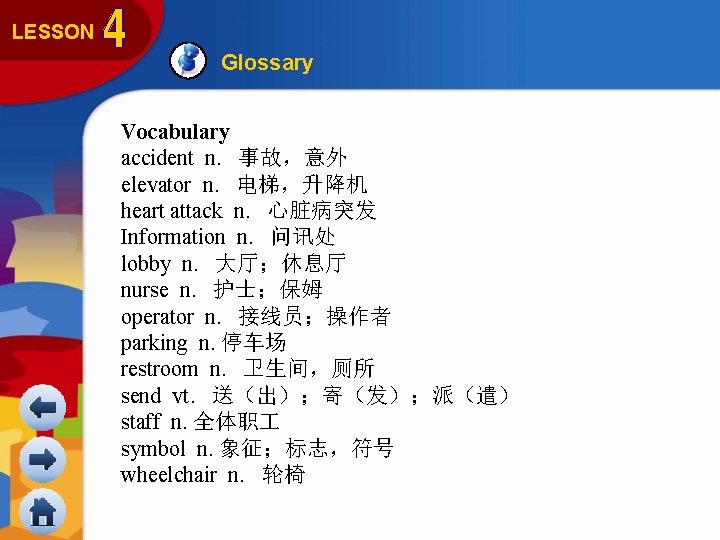
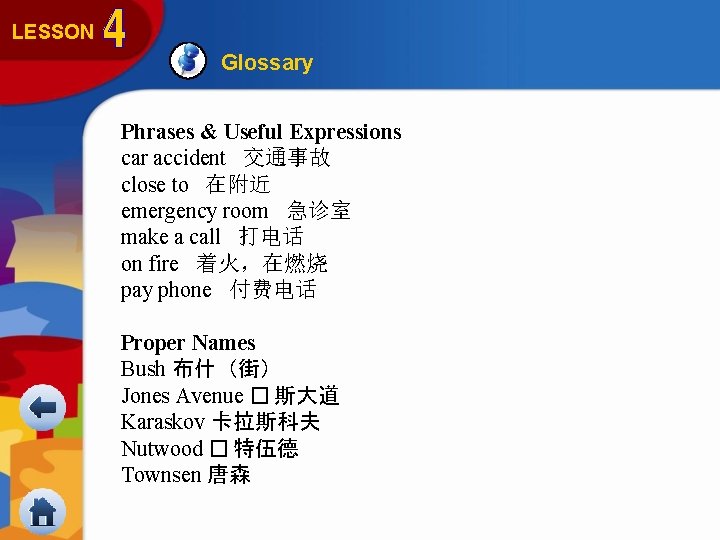
LESSON Glossary Phrases & Useful Expressions car accident 交通事故 close to 在附近 emergency room 急诊室 make a call 打电话 on fire 着火,在燃烧 pay phone 付费电话 Proper Names Bush 布什(街) Jones Avenue � 斯大道 Karaskov 卡拉斯科夫 Nutwood � 特伍德 Townsen 唐森
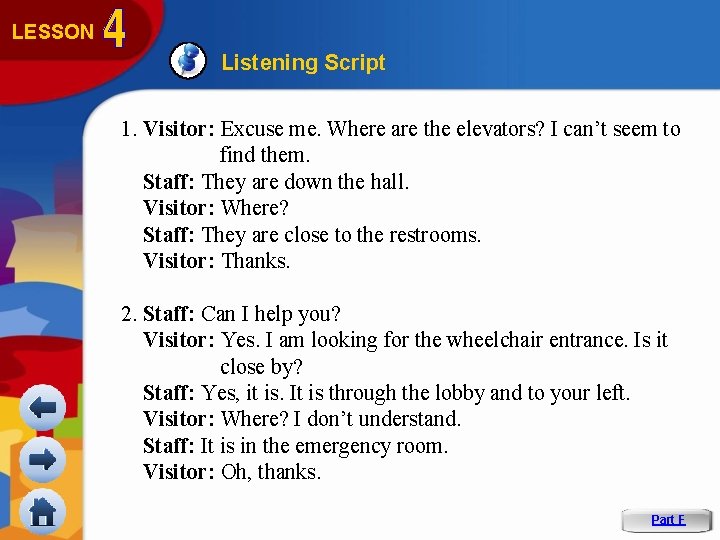
LESSON Listening Script 1. Visitor: Excuse me. Where are the elevators? I can’t seem to find them. Staff: They are down the hall. Visitor: Where? Staff: They are close to the restrooms. Visitor: Thanks. 2. Staff: Can I help you? Visitor: Yes. I am looking for the wheelchair entrance. Is it close by? Staff: Yes, it is. It is through the lobby and to your left. Visitor: Where? I don’t understand. Staff: It is in the emergency room. Visitor: Oh, thanks. Part F
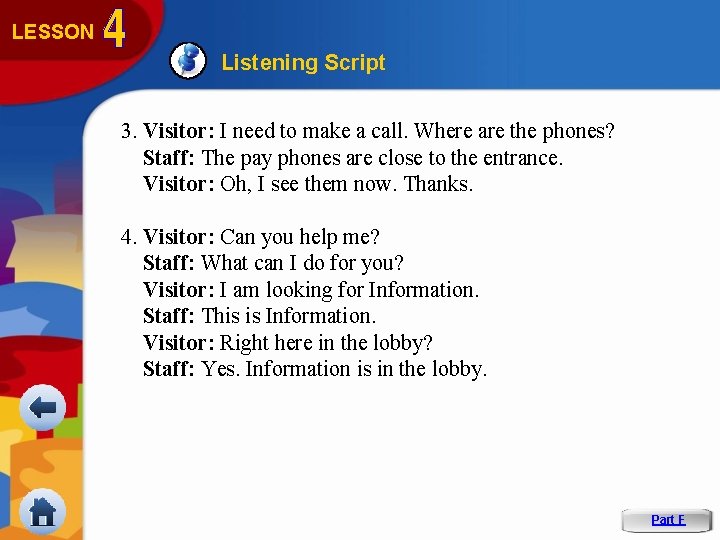
LESSON Listening Script 3. Visitor: I need to make a call. Where are the phones? Staff: The pay phones are close to the entrance. Visitor: Oh, I see them now. Thanks. 4. Visitor: Can you help me? Staff: What can I do for you? Visitor: I am looking for Information. Staff: This is Information. Visitor: Right here in the lobby? Staff: Yes. Information is in the lobby. Part F
LESSON Staying healthy GOAL Ø Describe healthy and unhealthy practices A C B F E D H G I
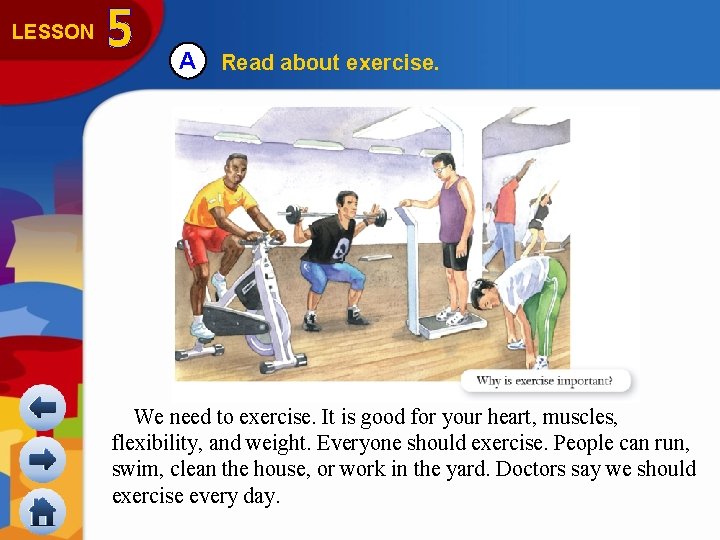
LESSON A Read about exercise. We need to exercise. It is good for your heart, muscles, flexibility, and weight. Everyone should exercise. People can run, swim, clean the house, or work in the yard. Doctors say we should exercise every day.
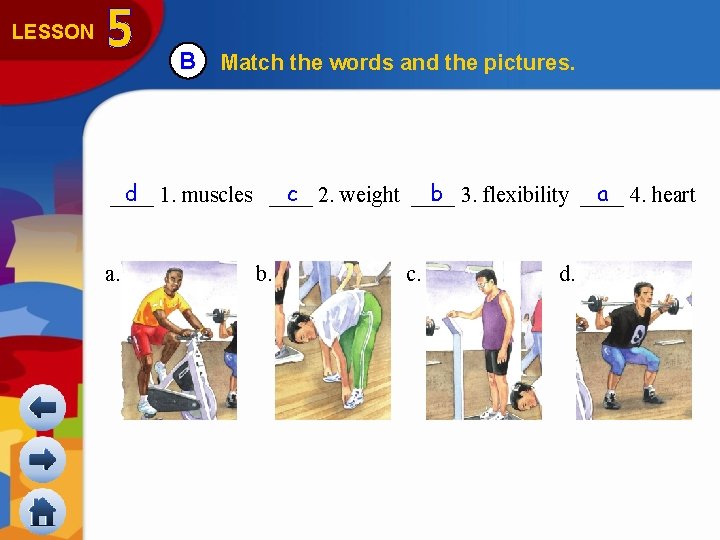
LESSON B Match the words and the pictures. d 1. muscles ____ c 2. weight ____ b 3. flexibility ____ a 4. heart ____ a. b. c. d.
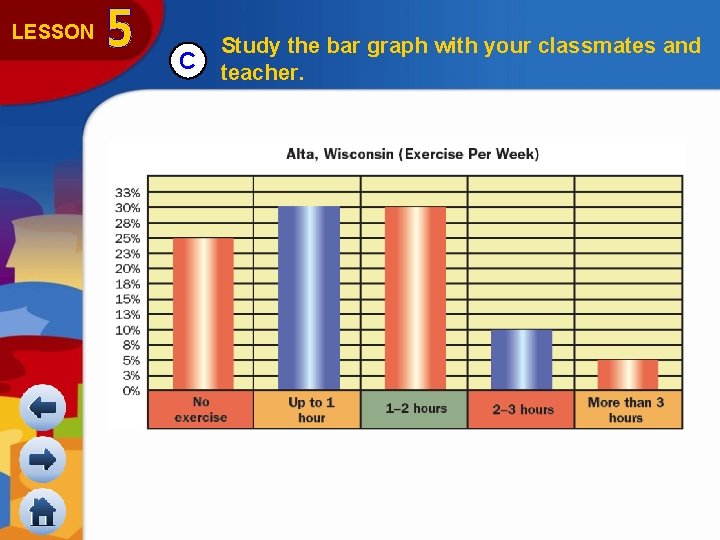
LESSON C Study the bar graph with your classmates and teacher.
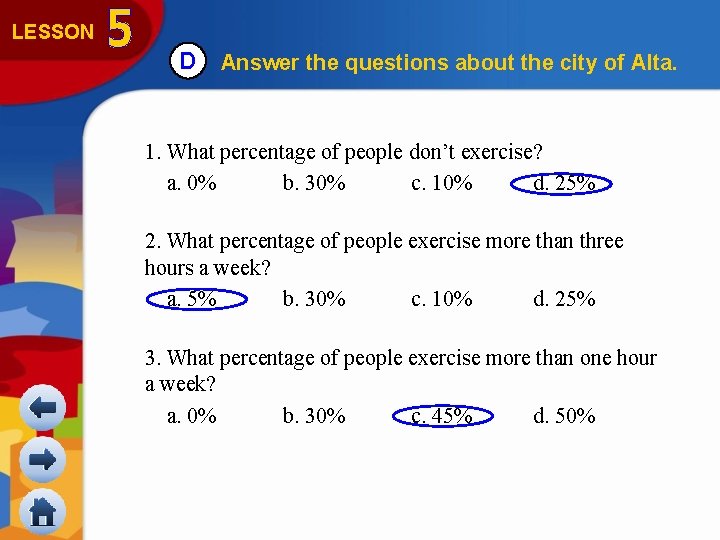
LESSON D Answer the questions about the city of Alta. 1. What percentage of people don’t exercise? a. 0% b. 30% c. 10% d. 25% 2. What percentage of people exercise more than three hours a week? a. 5% b. 30% c. 10% d. 25% 3. What percentage of people exercise more than one hour a week? a. 0% b. 30% c. 45% d. 50%
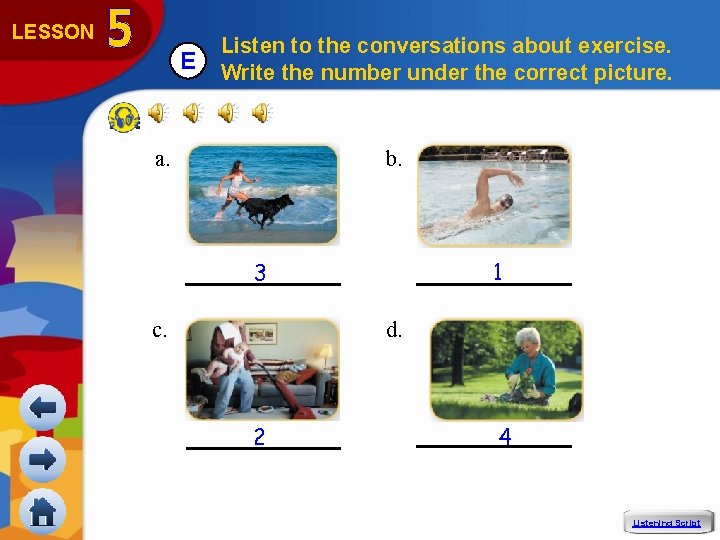
LESSON E Listen to the conversations about exercise. Write the number under the correct picture. b. a. 1 3 c. d. 2 4 Listening Script
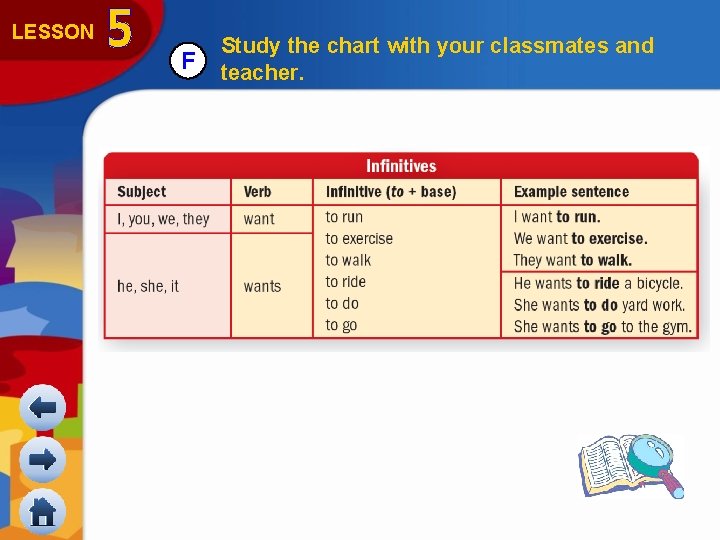
LESSON F Study the chart with your classmates and teacher.
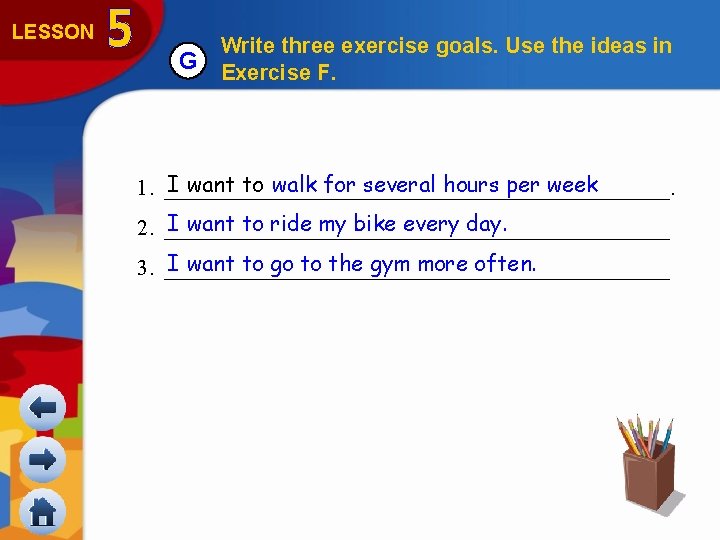
LESSON G Write three exercise goals. Use the ideas in Exercise F. I want to walk for several hours per week 1. _______________________. I want to ride my bike every day. 2. _______________________ I want to go to the gym more often. 3. _______________________
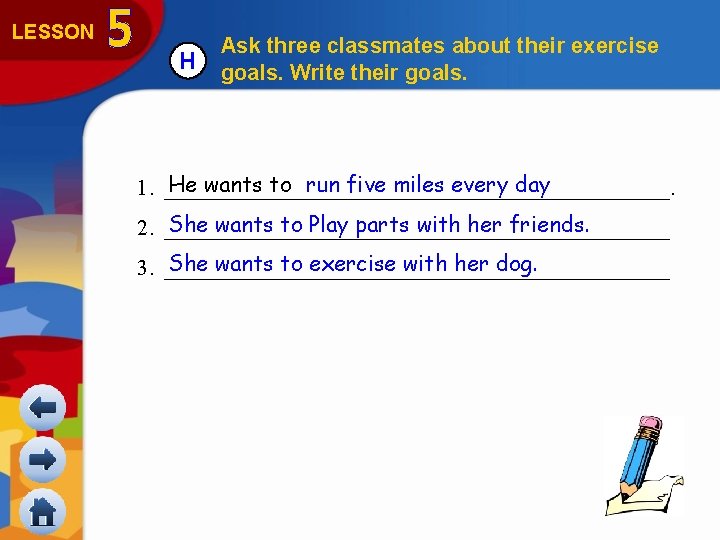
LESSON H Ask three classmates about their exercise goals. Write their goals. He wants to run five miles every day 1. _______________________. She wants to Play parts with her friends. 2. _______________________ She wants to exercise with her dog. 3. _______________________
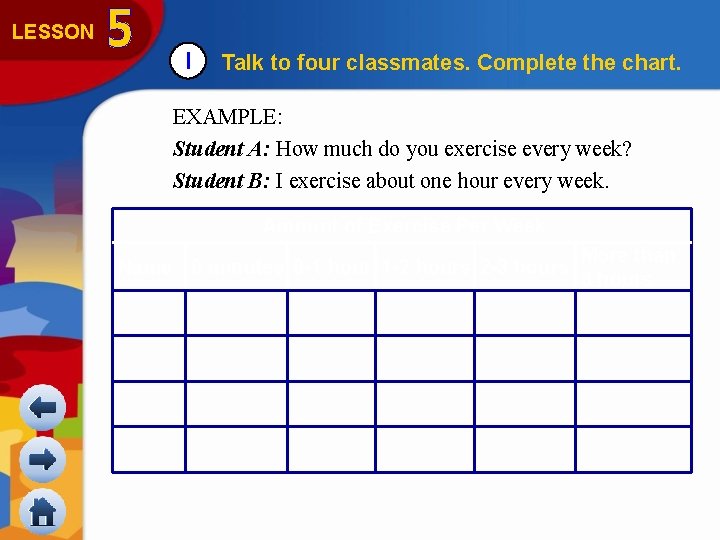
LESSON I Talk to four classmates. Complete the chart. EXAMPLE: Student A: How much do you exercise every week? Student B: I exercise about one hour every week. Amount of Exercise Per Week Name 0 minutes 0 -1 hour 1 -2 hours 2 -3 hours More than 3 hours
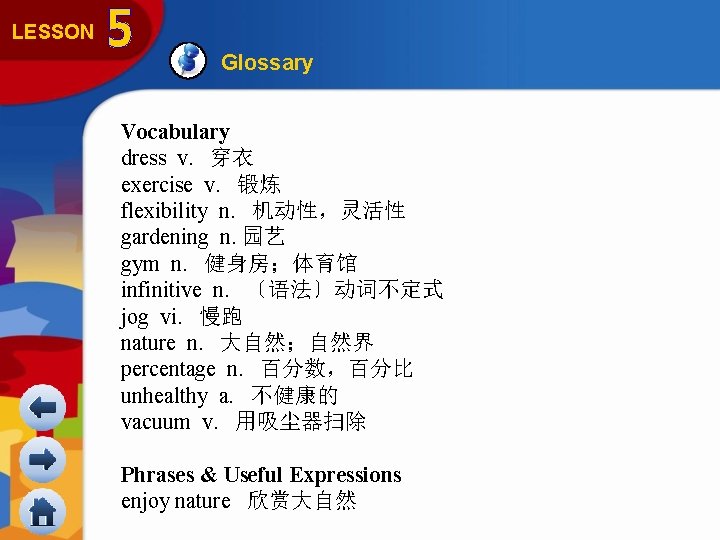
LESSON Glossary Vocabulary dress v. 穿衣 exercise v. 锻炼 flexibility n. 机动性,灵活性 gardening n. 园艺 gym n. 健身房;体育馆 infinitive n. 〔语法〕动词不定式 jog vi. 慢跑 nature n. 大自然;自然界 percentage n. 百分数,百分比 unhealthy a. 不健康的 vacuum v. 用吸尘器扫除 Phrases & Useful Expressions enjoy nature 欣赏大自然
LESSON Glossary most of 绝大多数 stay healthy 保持健康 Proper Names Alta 阿尔塔 Wisconsin 威斯康星(州)
LESSON Listening Script 1. A: I am so tired. B: Why? A: I think I need to exercise more. I don’t feel very healthy. B: I swim every day at the gym. It is great exercise. A: Maybe I’ll try that. 2. A: I don’t get any exercise. B: Yes you do. A: What do you mean? I never even leave the house. B: You vacuum every day. That is exercise. A: Oh, I never thought of that. Part E
LESSON Listening Script 3. A: What do you do for exercise? B: I jog. A: What is jogging? B: I run slowly and enjoy nature with my dog. A: That sounds great. 4. A: I exercise every day. B: Me, too. A: What do you do? B: I get most of my exercise outside in the yard. Gardening can be good exercise, too. A: Really? B: Sure, why not? Part E
Review A C B F E D H G I
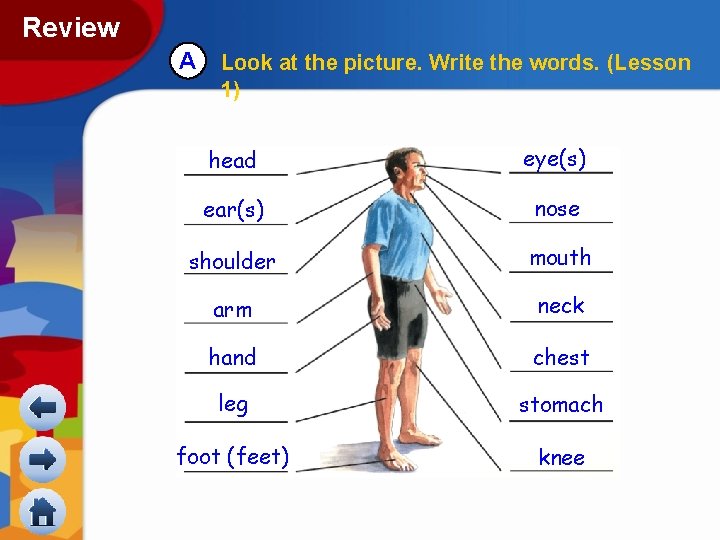
Review A Look at the picture. Write the words. (Lesson 1) head eye(s) ear(s) nose shoulder mouth arm neck hand chest leg stomach foot (feet) knee
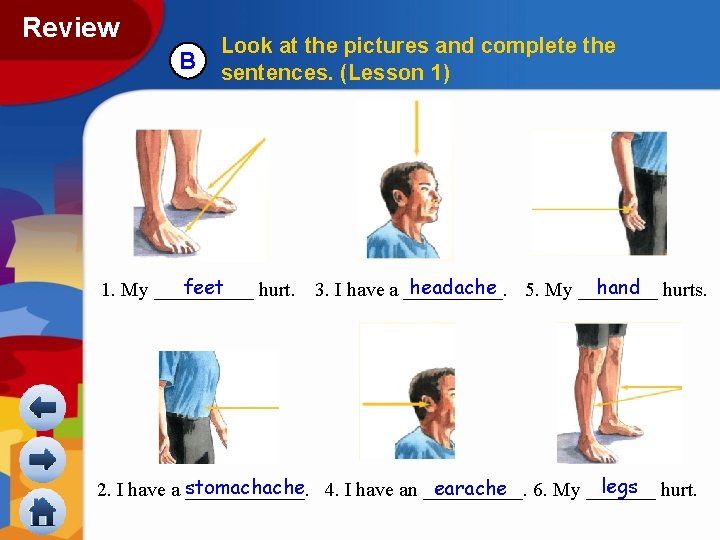
Review B Look at the pictures and complete the sentences. (Lesson 1) headache 5. My ____ hand hurts. feet 1. My _____ hurt. 3. I have a _____. legs hurt. earache 6. My _______ 2. I have a stomachache ______. 4. I have an _____.
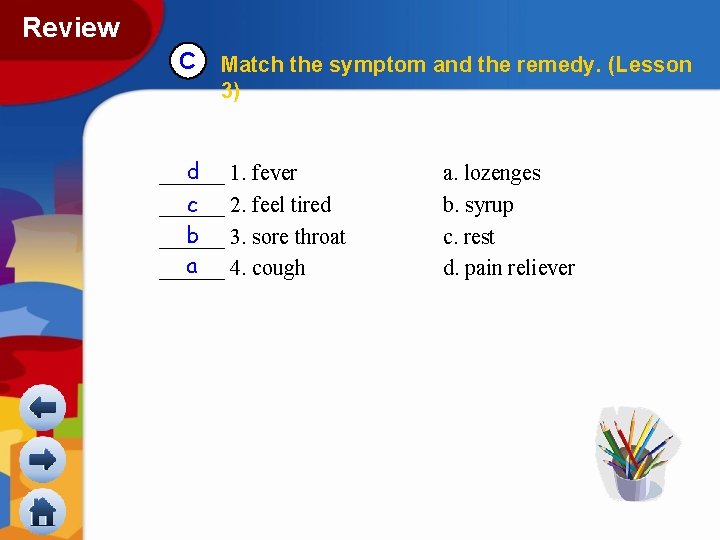
Review C Match the symptom and the remedy. (Lesson 3) d 1. fever ______ c 2. feel tired ______ b 3. sore throat ______ a ______ 4. cough a. lozenges b. syrup c. rest d. pain reliever
Review D Practice the conversation with a partner. Make similar conversations using the words in Exercise C. (Lessons 2 and 3) Student A: What’s the matter? Student B: I have a headache Student A: You should take a pain reliever Student B: Thanks. That’s a good idea.
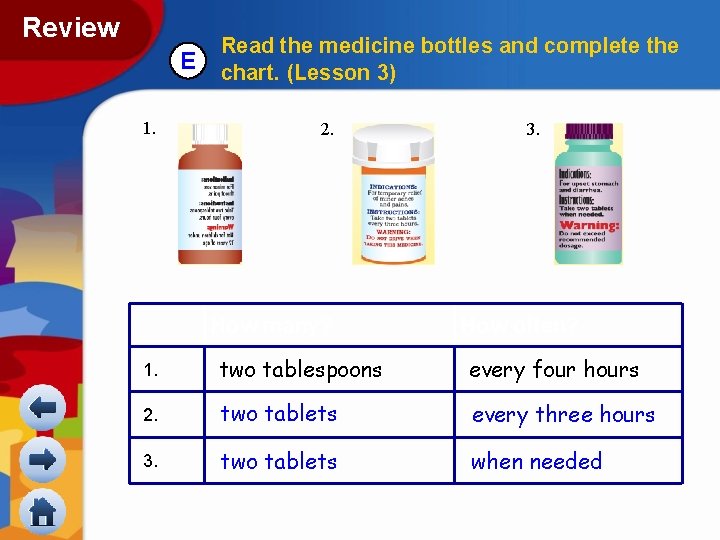
Review E 1. Read the medicine bottles and complete the chart. (Lesson 3) 2. How many? 3. How often? 1. two tablespoons every four hours 2. two tablets every three hours 3. two tablets when needed
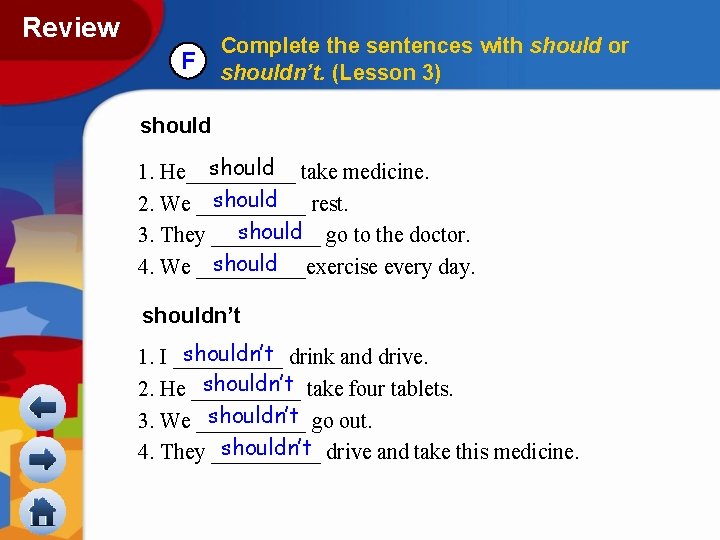
Review F Complete the sentences with should or shouldn’t. (Lesson 3) should take medicine. 1. He_____ should 2. We _____ rest. should go to the doctor. 3. They _____ should 4. We _____exercise every day. shouldn’t drink and drive. 1. I _____ shouldn’t take four tablets. 2. He _____ shouldn’t go out. 3. We _____ shouldn’t drive and take this medicine. 4. They _____
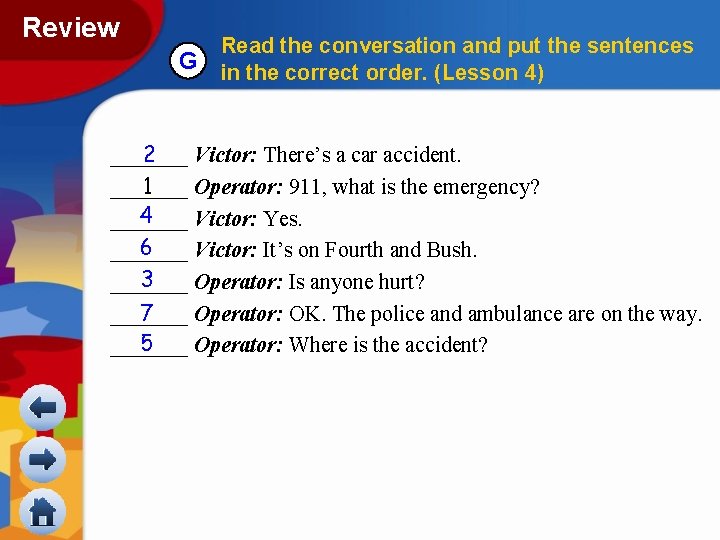
Review G Read the conversation and put the sentences in the correct order. (Lesson 4) 2 _______ Victor: There’s a car accident. _______ Operator: 911, what is the emergency? 1 4 _______ Victor: Yes. 6 _______ Victor: It’s on Fourth and Bush. 3 _______ Operator: Is anyone hurt? 7 _______ Operator: OK. The police and ambulance are on the way. 5 _______ Operator: Where is the accident?
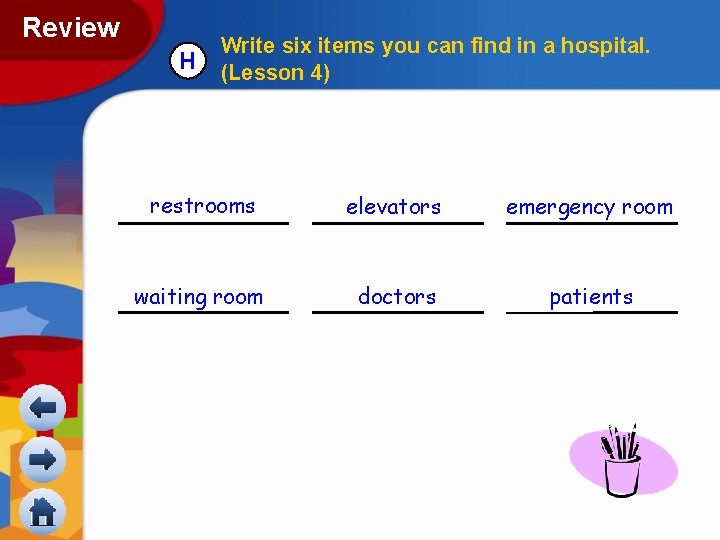
Review H Write six items you can find in a hospital. (Lesson 4) restrooms elevators emergency room waiting room doctors patients
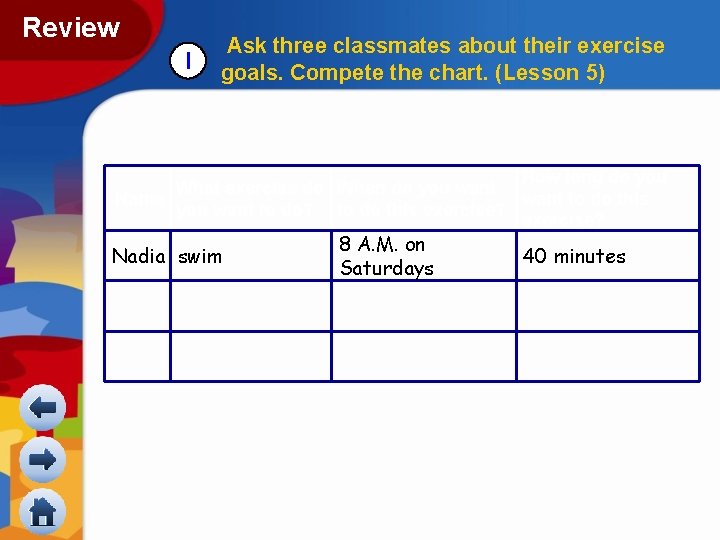
Review I Ask three classmates about their exercise goals. Compete the chart. (Lesson 5) How long do you What exercise do When do you want Name want to do this you want to do? to do this exercise? Nadia swim 8 A. M. on Saturdays 40 minutes
Review Glossary temporary a. 暂时的,临时的 upset a. (胸口、肚子等)不舒服的 warning n. 警告;警报 Phrases & Useful Expressions make sure 确保,确定 on the way 在路上 take on 承担(角色、任务等) write out 写出
UNIT 6
UNIT 6
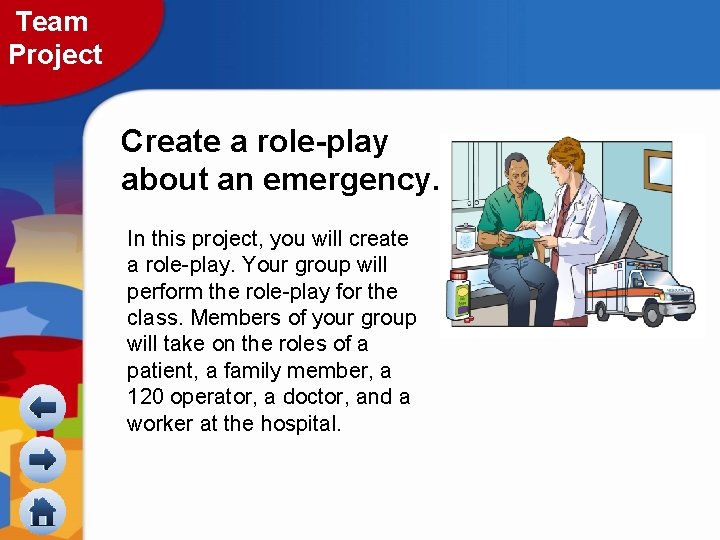
Team Project Create a role-play about an emergency. In this project, you will create a role-play. Your group will perform the role-play for the class. Members of your group will take on the roles of a patient, a family member, a 120 operator, a doctor, and a worker at the hospital.
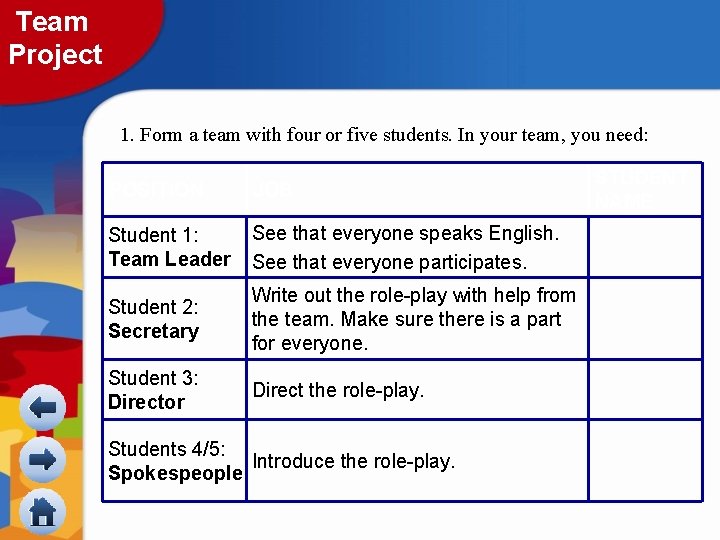
Team Project 1. Form a team with four or five students. In your team, you need: POSITION JOB Student 1: Team Leader See that everyone speaks English. See that everyone participates. Student 2: Secretary Write out the role-play with help from the team. Make sure there is a part for everyone. Student 3: Director Direct the role-play. Students 4/5: Introduce the role-play. Spokespeople STUDENT NAME
Team Project 2. Choose a name for your city. 3. Make a list of important places in your city and put them in alphabetical order. 4. Make a map of your city and mark where the important places are. 5. Make a brochure. On the brochure, write one paragraph about the city, write the names of your team’s members, and draw a picture that represents the city. 6. Prepare a presentation for the class.