
Unit 14 Exercise Health Lifestyle Factors Diet Lifestyle
- Slides: 12
Unit 14 – Exercise, Health & Lifestyle Factors Diet
Lifestyle Factors - Diet – your typical pattern of food consumption Balanced Diet – ‘a diet that provides the correct amount of nutrients required by your body without excess or deficiency’ Adams et al – Btec Level 3 Sport book 2
Your Diet Your diet should do 2 things 1 - provide enough energy & nutrients to maintain your normal physiological functions, including growth & repair of body tissues 2 – offer you protection from disease
Benefits of a healthy diet • • Increase in energy & vitality Increase in the function of the immune system Maintenance of a healthy body weight Decrease in the risk of chronic diseases There are direct links between good dietary habits & disease prevention
Negative effects of a poor diet A poor diet is one that; • Does not have enough of the essential components • Has too much of one or more components • Has imbalances
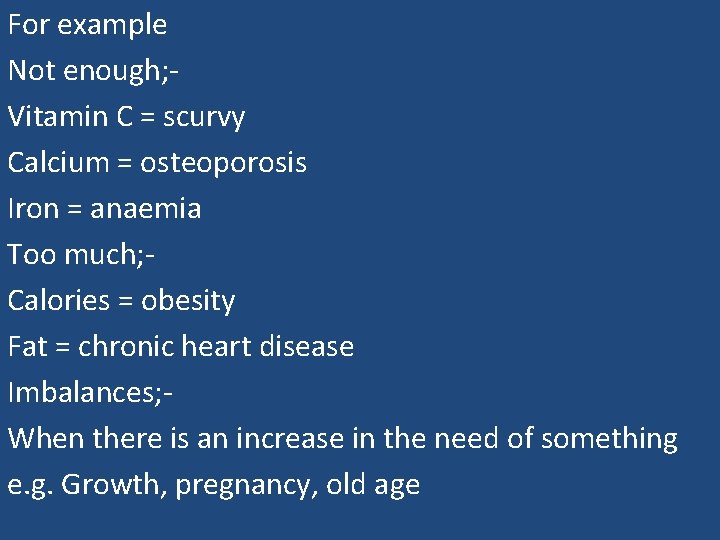
For example Not enough; Vitamin C = scurvy Calcium = osteoporosis Iron = anaemia Too much; Calories = obesity Fat = chronic heart disease Imbalances; When there is an increase in the need of something e. g. Growth, pregnancy, old age
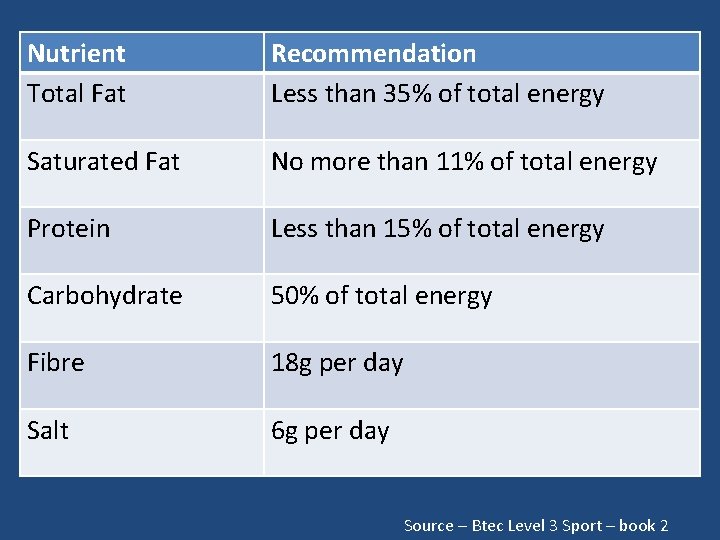
Nutrient Total Fat Recommendation Less than 35% of total energy Saturated Fat No more than 11% of total energy Protein Less than 15% of total energy Carbohydrate 50% of total energy Fibre 18 g per day Salt 6 g per day Source – Btec Level 3 Sport – book 2
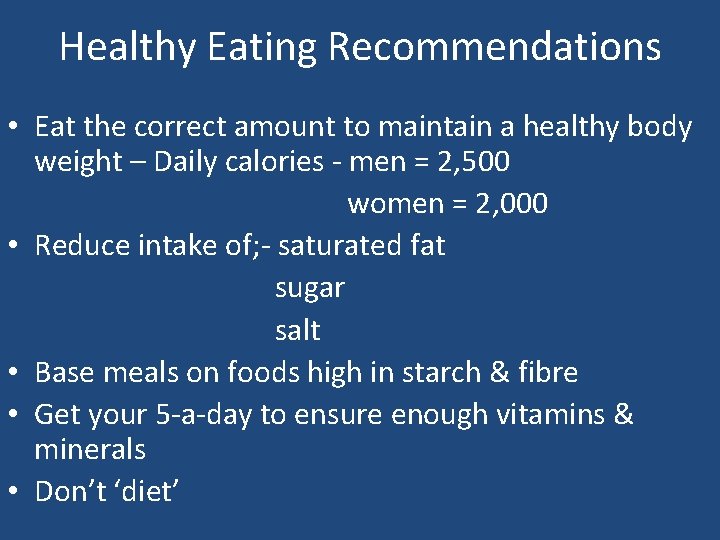
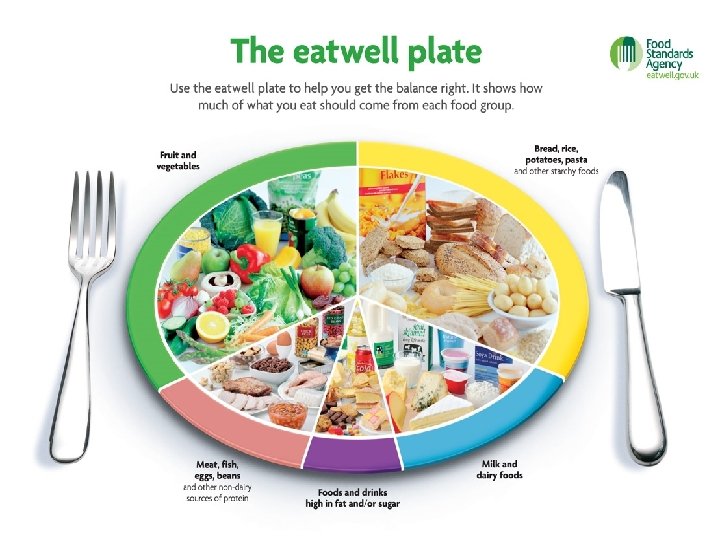
Healthy Eating Recommendations • Eat the correct amount to maintain a healthy body weight – Daily calories - men = 2, 500 women = 2, 000 • Reduce intake of; - saturated fat sugar salt • Base meals on foods high in starch & fibre • Get your 5 -a-day to ensure enough vitamins & minerals • Don’t ‘diet’
The Importance of Diet to Sports People • Fuel to train and perform at the elite level • Optimal gains from the training program • Enhanced recovery between workouts and between events • Achievement and maintenance of an ideal body weight and physique • Benefits from the many health-promoting components of food without the requirement for supplements • A reduced risk of injury, overtraining fatigue and illness • Confidence in being well-prepared to face competition • Consistency in achieving high-level competition performances • Enjoyment of food and social eating occasions at home and during travel
Increased Demand for Carbohydrates Targets for carbohydrate intake • Immediate recovery after exercise (0 -4 hours): 1 g per kg of the athlete’s body weight (BW) per hour • Daily recovery from a moderate duration/low intensity training program: 5 -7 g per kg BW per day • Recovery from moderate-heavy endurance training: 7 -12 g per kg BW per day • Daily recovery from extreme exercise program (more than 4 -6 h+ per day): 10 -12 g or more per kg BW per day
Increase in demand for Protein • Some sports scientists have suggested that endurance and resistance-training exercise may increase daily protein needs up to a maximum of 1. 2 -1. 6 g per kg body weight (BW), compared to the recommended intake of 0. 8 g/kg BW for a sedentary person