
Telephone Triage National Minor Illness Centre www minorillness




- Slides: 20
Telephone Triage National Minor Illness Centre www. minorillness. co. uk
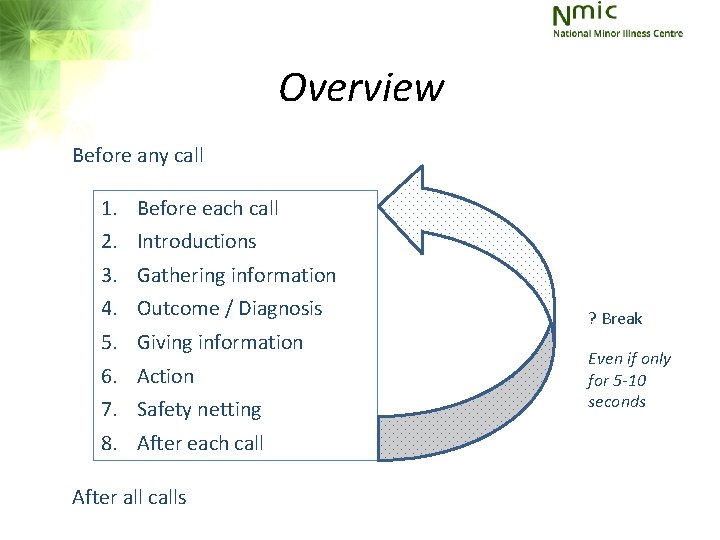
Overview Before any call 1. 2. 3. 4. 5. 6. 7. 8. Before each call Introductions Gathering information Outcome / Diagnosis Giving information Action Safety netting After each call After all calls ? Break Even if only for 5 -10 seconds
Before any call - Prepare • • Wipe down equipment Computer Chair Ambient noise (including keyboard & cats!) Headset or Earpiece/s Paper & pen Drink
Before each call • • • Gather all relevant information Read any background notes Aim to understand the reason for the call …usually from the patient’s perspective …sometimes from the clinician’s (e. g. lab result) Consider the potential outcomes
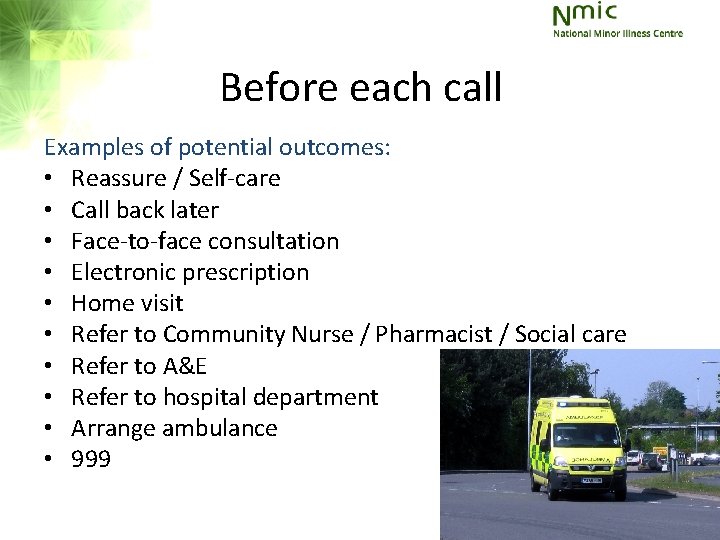
Before each call Examples of potential outcomes: • Reassure / Self-care • Call back later • Face-to-face consultation • Electronic prescription • Home visit • Refer to Community Nurse / Pharmacist / Social care • Refer to A&E • Refer to hospital department • Arrange ambulance • 999
Before each call – be calm Aim to sound calm, knowledgeable and caring. • Calm – like the floating duck, even if there’s a lot of paddling underneath! • Knowledgeable – it’s a real skill to be a generalist – value it! If you don’t know something needed, you may be able to access the information online • Caring – simply see things from the patient’s view Even if you don’t need to do anything else, this approach will help the patient
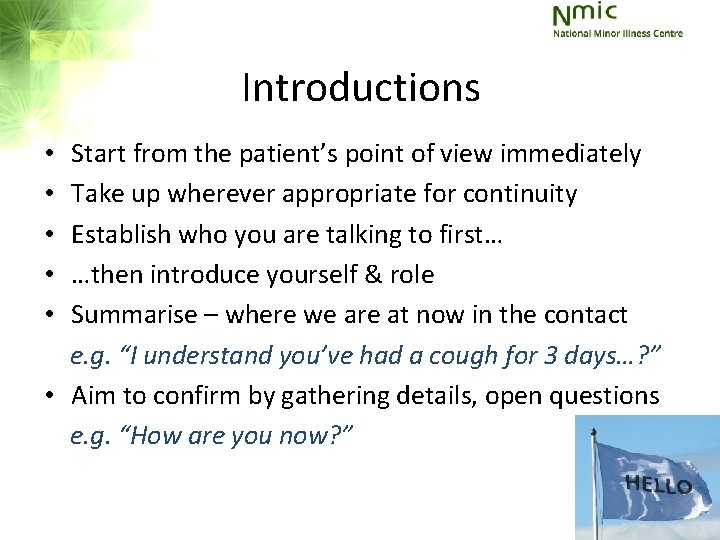
Introductions Start from the patient’s point of view immediately Take up wherever appropriate for continuity Establish who you are talking to first… …then introduce yourself & role Summarise – where we are at now in the contact e. g. “I understand you’ve had a cough for 3 days…? ” • Aim to confirm by gathering details, open questions e. g. “How are you now? ” • • •
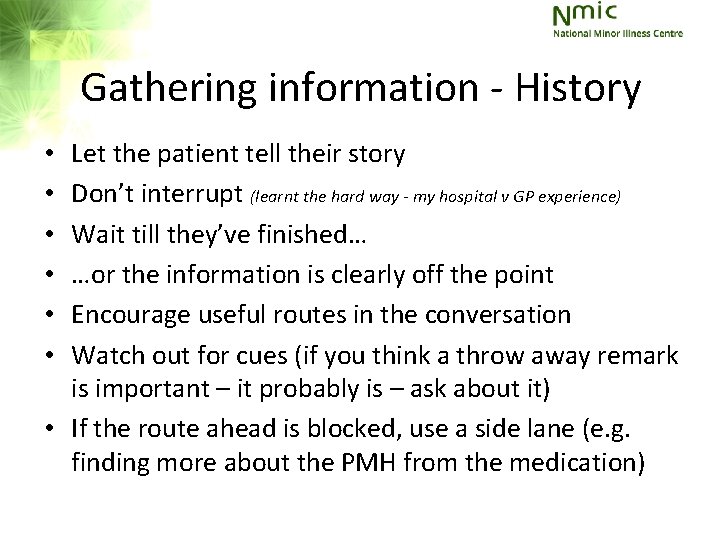
Gathering information - History Let the patient tell their story Don’t interrupt (learnt the hard way - my hospital v GP experience) Wait till they’ve finished… …or the information is clearly off the point Encourage useful routes in the conversation Watch out for cues (if you think a throw away remark is important – it probably is – ask about it) • If the route ahead is blocked, use a side lane (e. g. finding more about the PMH from the medication) • • •
Gathering information – Red Flags See our Little Book of Red Flags • Ask about any specific, relevant red flags • Ideally, still using open questions… • …or via the technique of Approximation (e. g. ‘So does this indigestion come when you’re sitting quietly? ’ – and see if the patient corrects this to ‘no, only when I do something like climb the stairs’ !) • …otherwise directly, but with lower diagnostic power
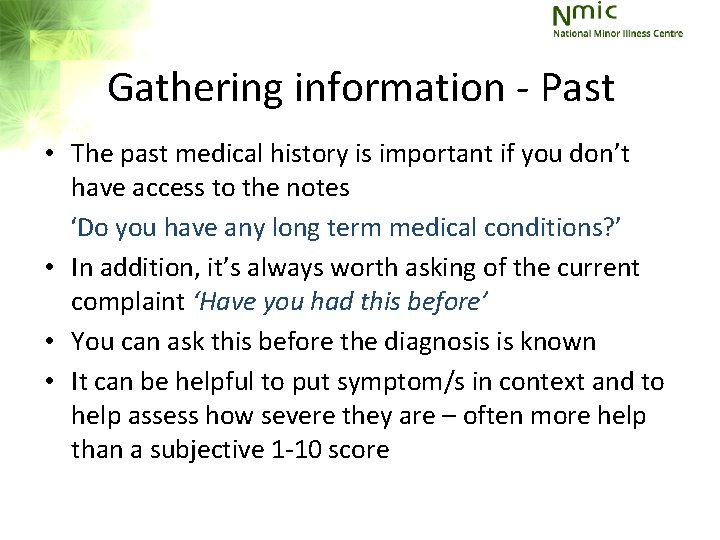
Gathering information - Past • The past medical history is important if you don’t have access to the notes ‘Do you have any long term medical conditions? ’ • In addition, it’s always worth asking of the current complaint ‘Have you had this before’ • You can ask this before the diagnosis is known • It can be helpful to put symptom/s in context and to help assess how severe they are – often more help than a subjective 1 -10 score
Gathering information – O/E • On examination - video • Establish the facts and the feelings, know which is which, e. g. ‘feverish, chills’ v ‘my temp is 38. 8’ • Check any measurement for accuracy of method
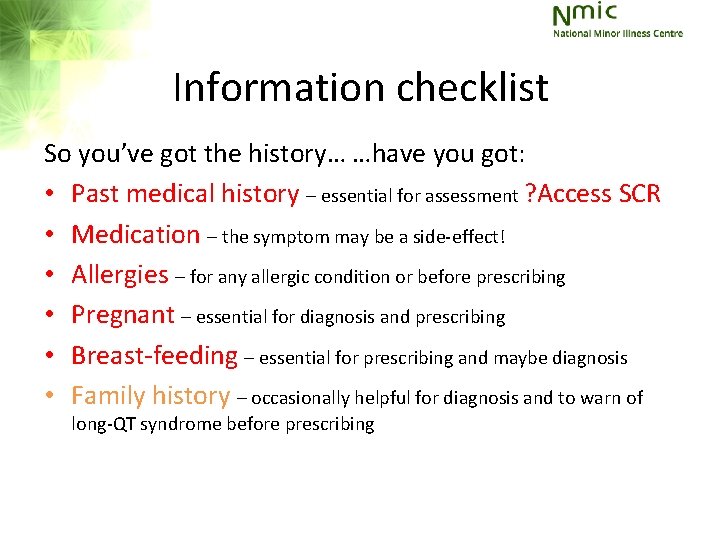
Information checklist So you’ve got the history… …have you got: • Past medical history – essential for assessment ? Access SCR • Medication – the symptom may be a side-effect! • Allergies – for any allergic condition or before prescribing • Pregnant – essential for diagnosis and prescribing • Breast-feeding – essential for prescribing and maybe diagnosis • Family history – occasionally helpful for diagnosis and to warn of long-QT syndrome before prescribing
Outcome / Diagnosis • Under time pressure (now with Covid-19 !) aim for the outcome first and foremost • The diagnosis may be helpful in this, but may not be necessary to establish the outcome e. g. 999 • Diagnosis is most useful when the outcome is reassurance or self-care
Giving Information • Positive aspects first if reassurance or self-care… • …because people listen and remember what you say in your initial summing up • Be straightforward if the outcome requires more intervention and there are risks that need explaining • Explain what the outcome / diagnosis means from the patient’s point of view… • …and later mention the name of the condition if helpful for the patient (e. g. support self-care)
Action • Make sure you know who’s doing what – you or the patient or a specific relative or friend (e. g. driving the patient to hospital) • Assess the risk posed by your proposed action – to the patient and anyone else involved • Make any arrangements you need to get the best possible outcome for the patient in their particular circumstances • Check patient or carer understands what’s happening
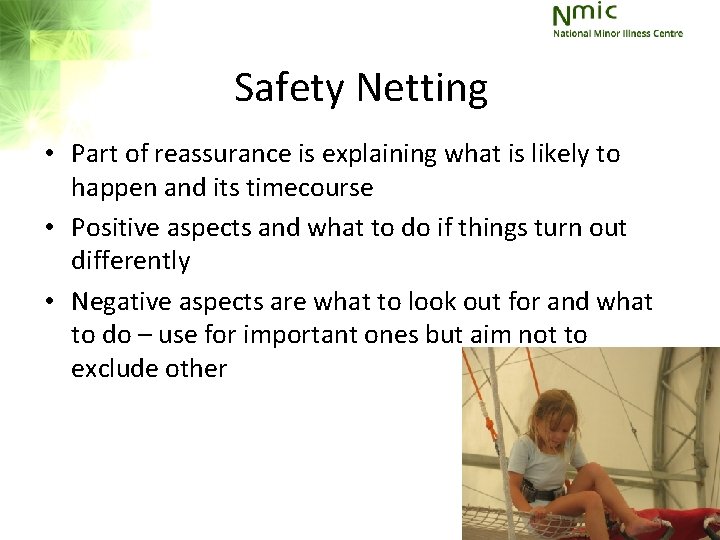
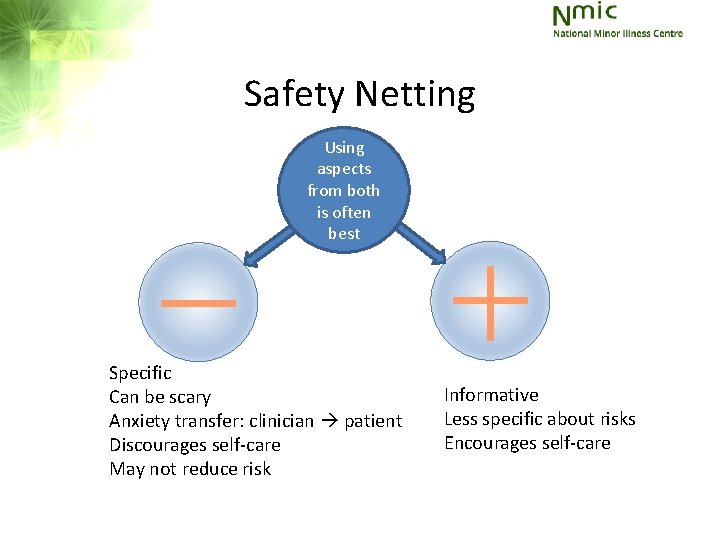
Safety Netting • Part of reassurance is explaining what is likely to happen and its timecourse • Positive aspects and what to do if things turn out differently • Negative aspects are what to look out for and what to do – use for important ones but aim not to exclude other
Safety Netting Using aspects from both is often best Specific Can be scary Anxiety transfer: clinician patient Discourages self-care May not reduce risk Informative Less specific about risks Encourages self-care
After each call • • • Check everything is documented that needs to be Check you have done everything you said Reflect – was it the right outcome? If not, perhaps you can phone back? Patients don’t mind at all – it shows you care Now look after yourself… …to avoid inter-consultation interference… …and fatigue
After all calls • Secure destruction of any paper notes used • Congratulate yourself… …telephone triage isn’t easy No-one’s perfect Do the best you can, and don’t expect to get everything right all the time. Judgement is needed and essential. Now where’s that wine. . ?
Thank you • All the materials on this course are copyright to NMIC, and must not be reproduced without our permission • We make every effort to ensure that the information we provide is accurate and correct, but it is of necessity of a brief and general nature, and this should not replace your own good clinical judgement, or be regarded as a substitute for taking professional advice in appropriate circumstances. In particular you should check drug doses, side effects and interactions with the British National Formulary. Save insofar as any such liability cannot be excluded at law, we do not accept any liability for loss of any type caused by reliance on the information which we provide.