Unit 10 Investor Relations Skills focus Reading recognizing





- Slides: 74
Unit 10 Investor Relations
Skills focus Reading • recognizing the writer’s stance and level of confidence or tentativeness • inferring implicit ideas Writing • writing essays • using direct quotations • compiling a bibliography/reference list Vocabulary focus • ‘neutral’ and ‘marked’ words • fixed phrases from legal English • fixed phrases from academic English
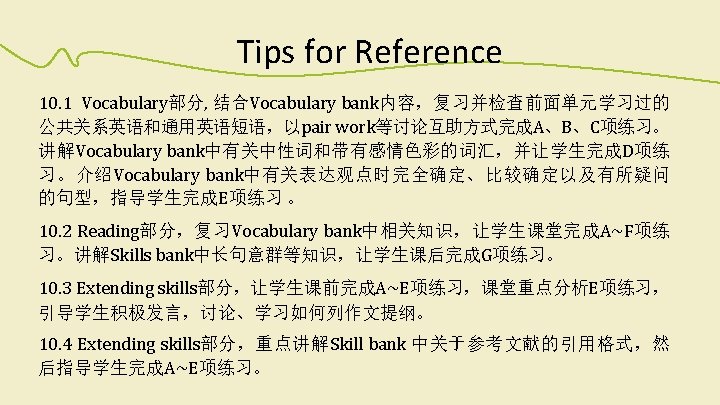
10. 1 Vocabulary 10. 2 Reading 10. 3 Extending skills 10. 4 Extending skills
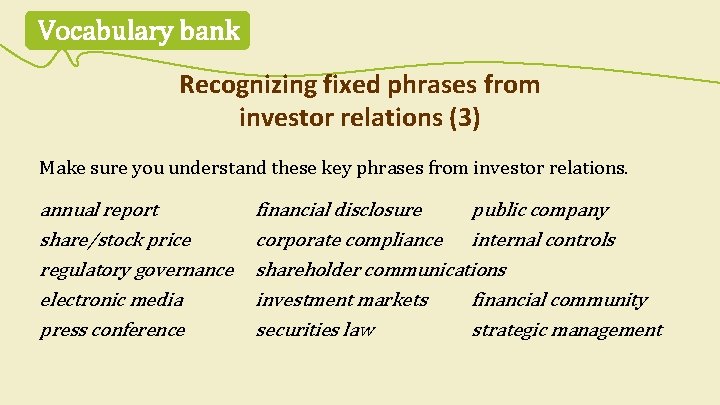
Vocabulary bank Recognizing fixed phrases from investor relations (3) Make sure you understand these key phrases from investor relations. annual report share/stock price regulatory governance electronic media press conference financial disclosure public company corporate compliance internal controls shareholder communications investment markets financial community securities law strategic management
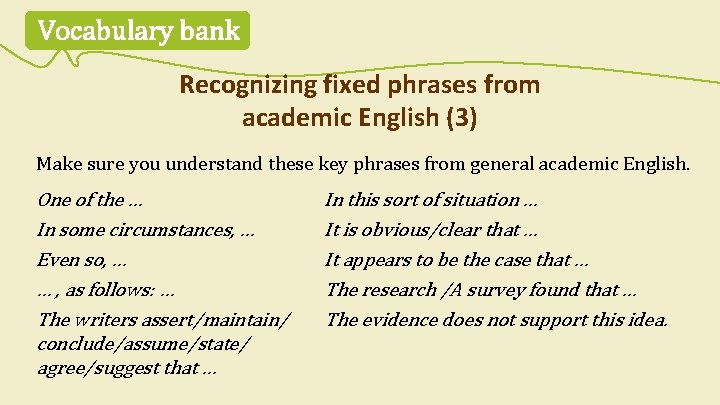
Vocabulary bank Recognizing fixed phrases from academic English (3) Make sure you understand these key phrases from general academic English. One of the … In some circumstances, … Even so, … … , as follows: … The writers assert/maintain/ conclude/assume/state/ agree/suggest that … In this sort of situation … It is obvious/clear that … It appears to be the case that … The research /A survey found that … The evidence does not support this idea.
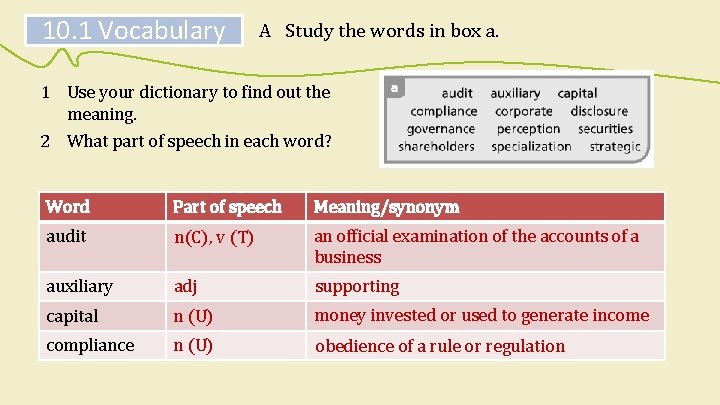
10. 1 Vocabulary A Study the words in box a. 1 Use your dictionary to find out the meaning. 2 What part of speech in each word? Word Part of speech Meaning/synonym audit n(C), v (T) an official examination of the accounts of a business auxiliary adj supporting capital n (U) money invested or used to generate income compliance n (U) obedience of a rule or regulation
10. 1 Vocabulary A Study the words in box a. Word Part of speech Meaning/synonym corporate adj relating to a large company disclosure n (C or U) making something known governance n (U) the process of governing, e. g. , corporate affairs perception n (C) opinion held by people securities pl n investment (e. g. , stocks, shares, bonds) in a company which produces an income for the investor shareholders n (C) people who own shares (stock) in a company specialization n (C or U) a particular area of knowledge strategic adj helping achieve a plan
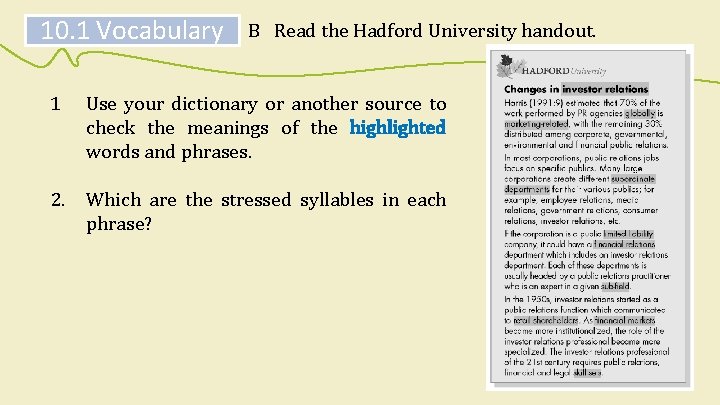
10. 1 Vocabulary 1 B Read the Hadford University handout. Use your dictionary or another source to check the meanings of the highlighted words and phrases. 2. Which are the stressed syllables in each phrase?
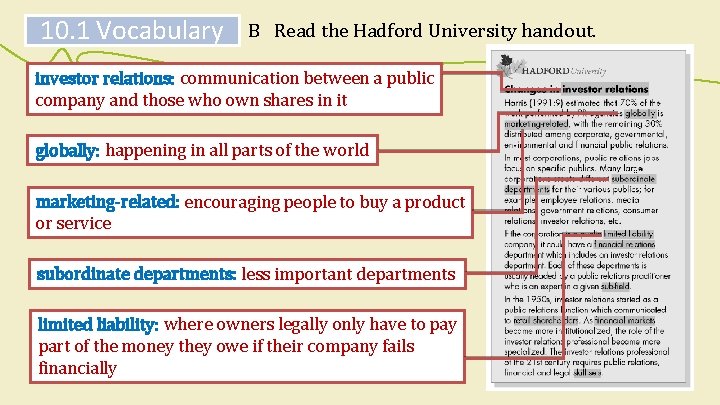
10. 1 Vocabulary B Read the Hadford University handout. investor relations: communication between a public company and those who own shares in it globally: happening in all parts of the world marketing-related: encouraging people to buy a product or service subordinate departments: less important departments limited liability: where owners legally only have to pay part of the money they owe if their company fails financially
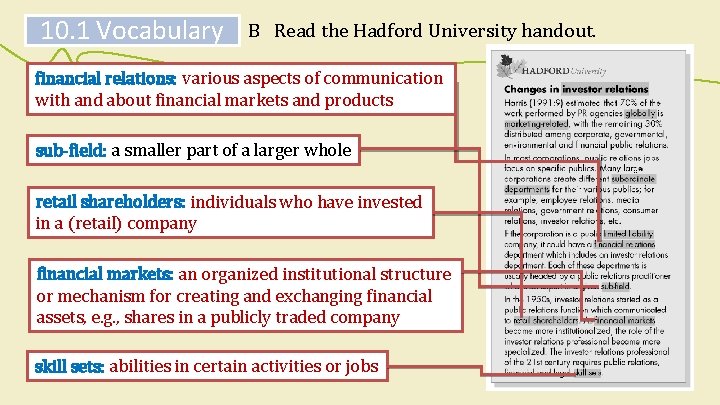
10. 1 Vocabulary B Read the Hadford University handout. financial relations: various aspects of communication with and about financial markets and products sub-field: a smaller part of a larger whole retail shareholders: individuals who have invested in a (retail) company financial markets: an organized institutional structure or mechanism for creating and exchanging financial assets, e. g. , shares in a publicly traded company skill sets: abilities in certain activities or jobs
10. 1 Vocabulary B Read the Hadford University handout. investor relations o. Oo globally Ooo marketing-related Ooo o. Oo subordinate departments o. Ooo o. Oo limited liability Ooo oo. Ooo financial relations o. Oo sub-field O-o retail shareholders Oo Ooo financial markets o. Oo Oo skill sets OO
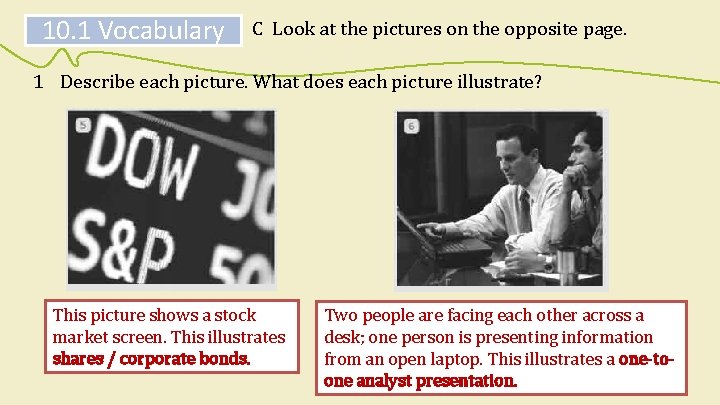
10. 1 Vocabulary C Look at the pictures on the opposite page. 1 Describe each picture. What does each picture illustrate?
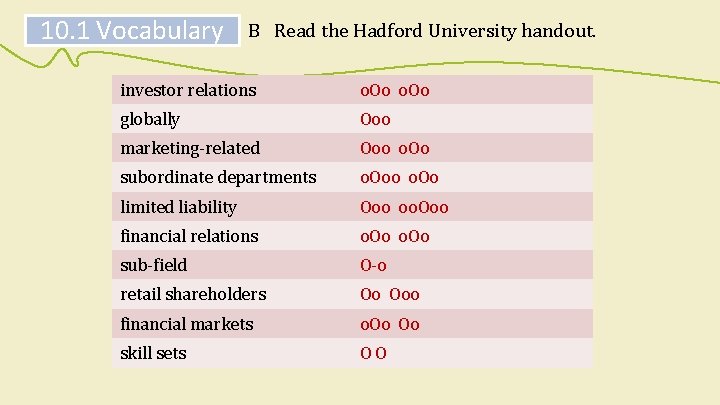
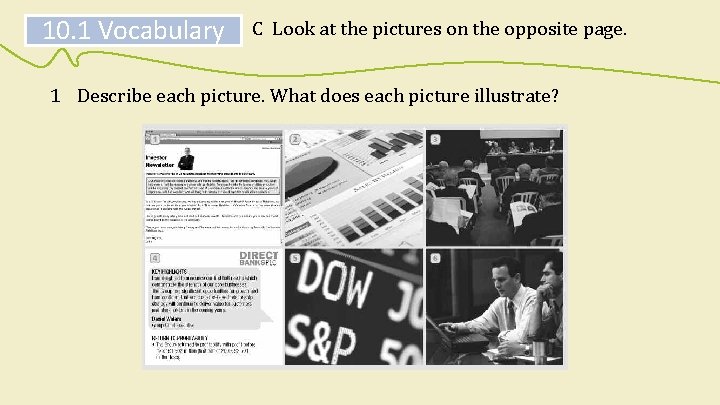
10. 1 Vocabulary C Look at the pictures on the opposite page. 1 Describe each picture. What does each picture illustrate? A page from a company newsletter to investors. This illustrates investor relations. A page from a company report with sales information and diagrams visible. This illustrates company quarterly reports.
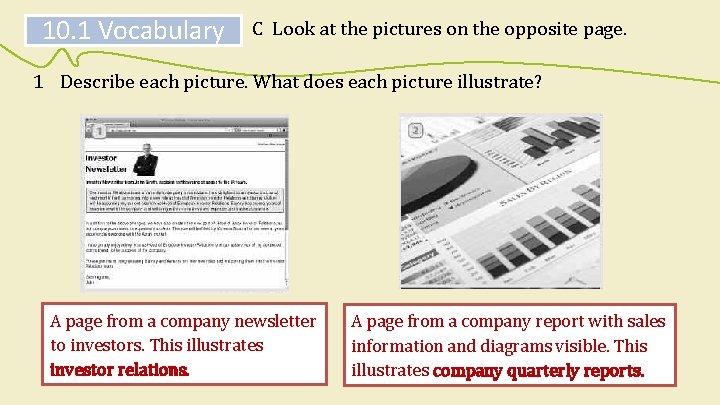
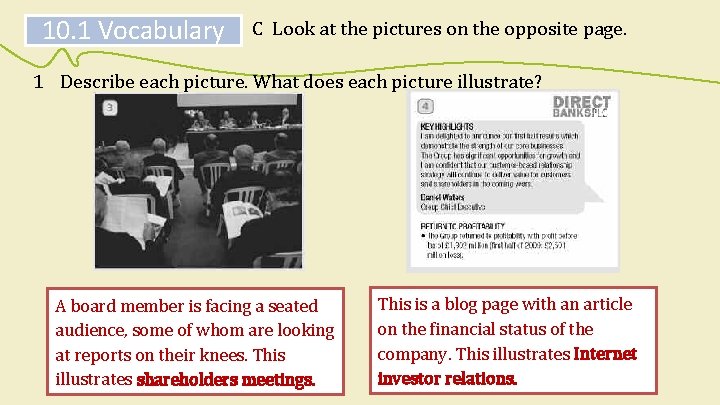
10. 1 Vocabulary C Look at the pictures on the opposite page. 1 Describe each picture. What does each picture illustrate? A board member is facing a seated audience, some of whom are looking at reports on their knees. This illustrates shareholders meetings. This is a blog page with an article on the financial status of the company. This illustrates Internet investor relations.
10. 1 Vocabulary C Look at the pictures on the opposite page. 1 Describe each picture. What does each picture illustrate? This picture shows a stock market screen. This illustrates shares / corporate bonds. Two people are facing each other across a desk; one person is presenting information from an open laptop. This illustrates a one-toone analyst presentation.
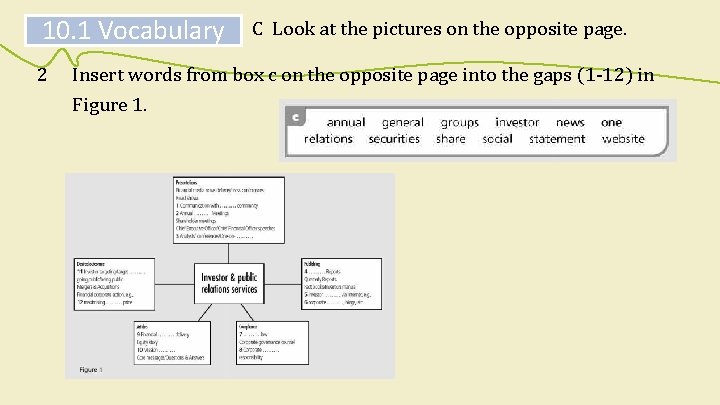
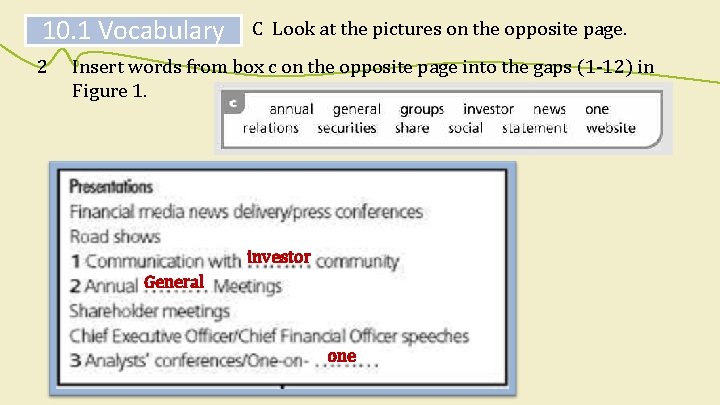
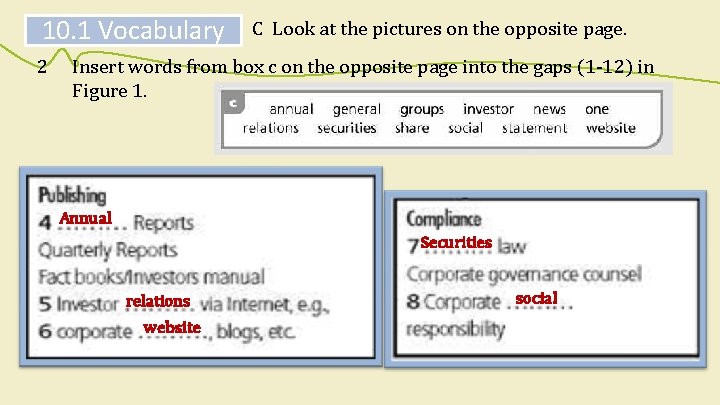
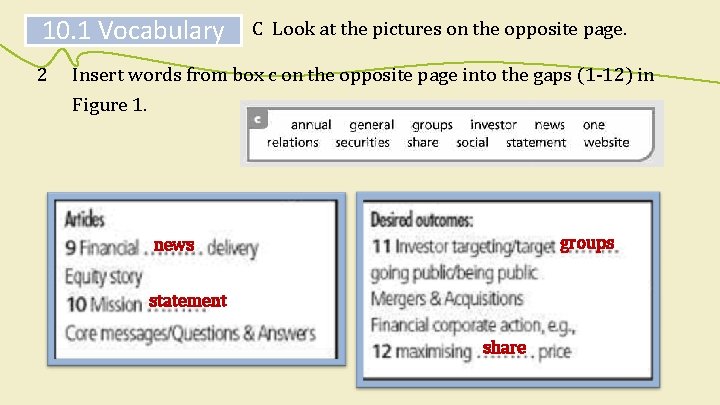
10. 1 Vocabulary 2 C Look at the pictures on the opposite page. Insert words from box c on the opposite page into the gaps (1 -12) in Figure 1.
10. 1 Vocabulary 2 C Look at the pictures on the opposite page. Insert words from box c on the opposite page into the gaps (1 -12) in Figure 1. investor General one
10. 1 Vocabulary 2 C Look at the pictures on the opposite page. Insert words from box c on the opposite page into the gaps (1 -12) in Figure 1. Annual Securities relations website social
10. 1 Vocabulary 2 C Look at the pictures on the opposite page. Insert words from box c on the opposite page into the gaps (1 -12) in Figure 1. groups news statement share
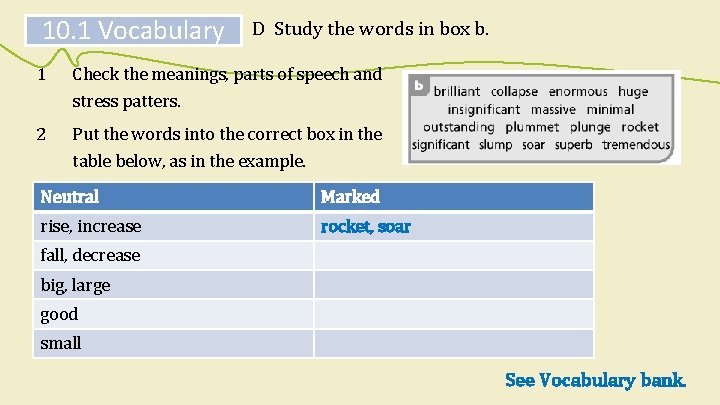
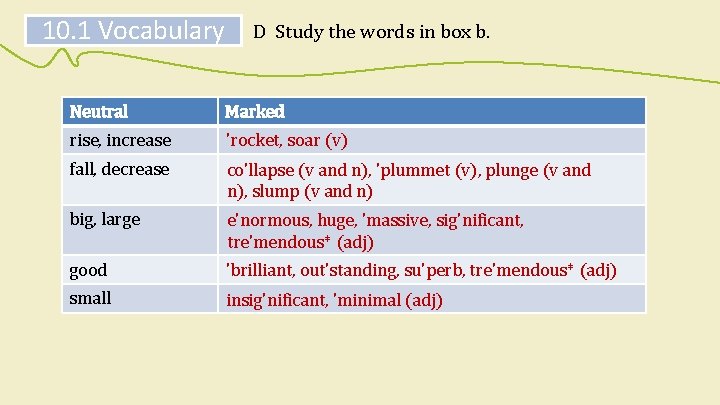
10. 1 Vocabulary D Study the words in box b. 1 Check the meanings, parts of speech and stress patters. 2 Put the words into the correct box in the table below, as in the example. Neutral Marked rise, increase rocket, soar fall, decrease big, large good small See Vocabulary bank.
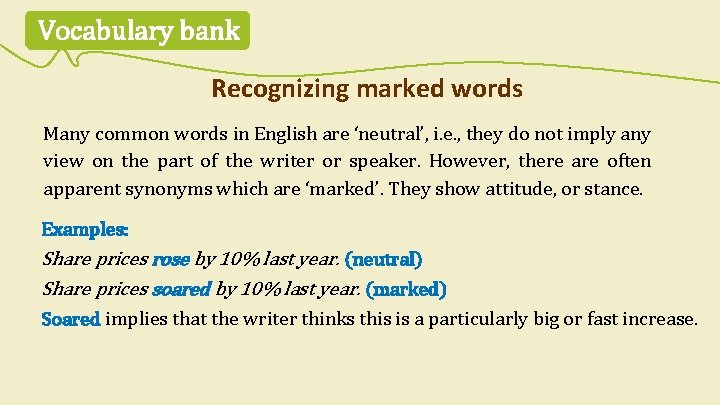
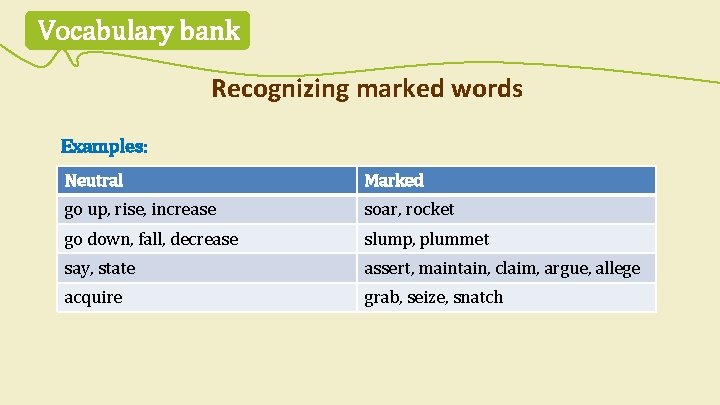
Vocabulary bank Recognizing marked words Many common words in English are ‘neutral’, i. e. , they do not imply any view on the part of the writer or speaker. However, there are often apparent synonyms which are ‘marked’. They show attitude, or stance. Examples: Share prices rose by 10% last year. (neutral) Share prices soared by 10% last year. (marked) Soared implies that the writer thinks this is a particularly big or fast increase.
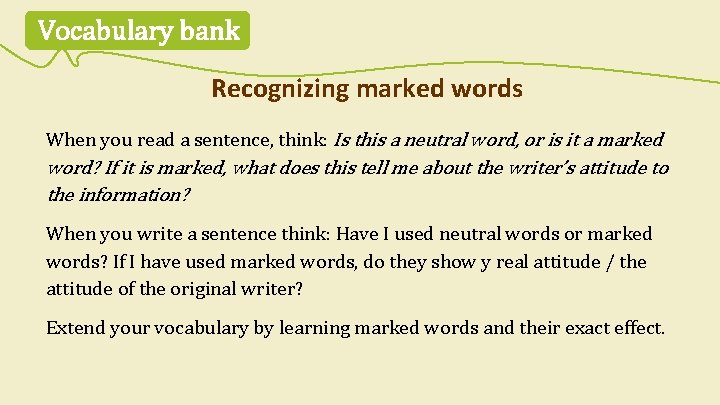
Vocabulary bank Recognizing marked words When you read a sentence, think: Is this a neutral word, or is it a marked word? If it is marked, what does this tell me about the writer’s attitude to the information? When you write a sentence think: Have I used neutral words or marked words? If I have used marked words, do they show y real attitude / the attitude of the original writer? Extend your vocabulary by learning marked words and their exact effect.
Vocabulary bank Recognizing marked words Examples: Neutral Marked go up, rise, increase soar, rocket go down, fall, decrease slump, plummet say, state assert, maintain, claim, argue, allege acquire grab, seize, snatch
10. 1 Vocabulary D Study the words in box b. Neutral Marked rise, increase 'rocket, soar (v) fall, decrease co'llapse (v and n), 'plummet (v), plunge (v and n), slump (v and n) big, large e'normous, huge, 'massive, sig'nificant, tre'mendous* (adj) good 'brilliant, out'standing, su'perb, tre'mendous* (adj) small insig'nificant, 'minimal (adj)
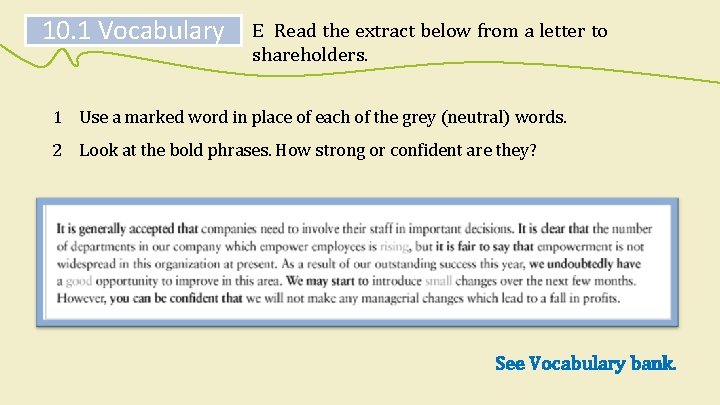
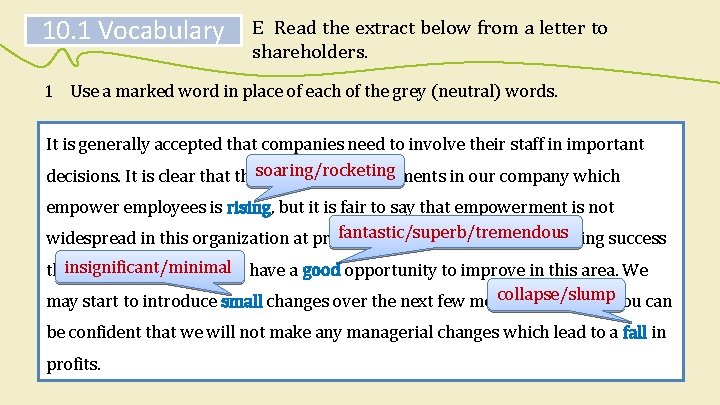
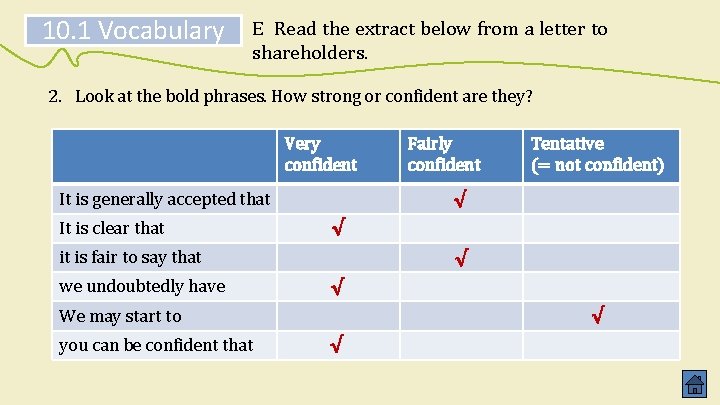
10. 1 Vocabulary E Read the extract below from a letter to shareholders. 1 Use a marked word in place of each of the grey (neutral) words. 2 Look at the bold phrases. How strong or confident are they? See Vocabulary bank.
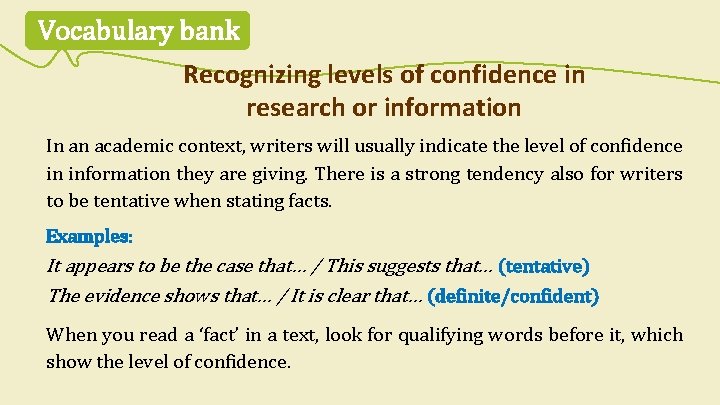
Vocabulary bank Recognizing levels of confidence in research or information In an academic context, writers will usually indicate the level of confidence in information they are giving. There is a strong tendency also for writers to be tentative when stating facts. Examples: It appears to be the case that… / This suggests that… (tentative) The evidence shows that… / It is clear that… (definite/confident) When you read a ‘fact’ in a text, look for qualifying words before it, which show the level of confidence.
10. 1 Vocabulary E Read the extract below from a letter to shareholders. 1 Use a marked word in place of each of the grey (neutral) words. It is generally accepted that companies need to involve their staff in important decisions. It is clear that thesoaring/rocketing number of departments in our company which empower employees is rising, but it is fair to say that empowerment is not fantastic/superb/tremendous widespread in this organization at present. As a result of our outstanding success insignificant/minimal this year, we undoubtedly have a good opportunity to improve in this area. We collapse/slump may start to introduce small changes over the next few months. However, you can be confident that we will not make any managerial changes which lead to a fall in profits.
10. 1 Vocabulary E Read the extract below from a letter to shareholders. 2. Look at the bold phrases. How strong or confident are they? Very confident It is generally accepted that It is clear that √ √ √ We may start to you can be confident that Tentative (= not confident) √ it is fair to say that we undoubtedly have Fairly confident √ √
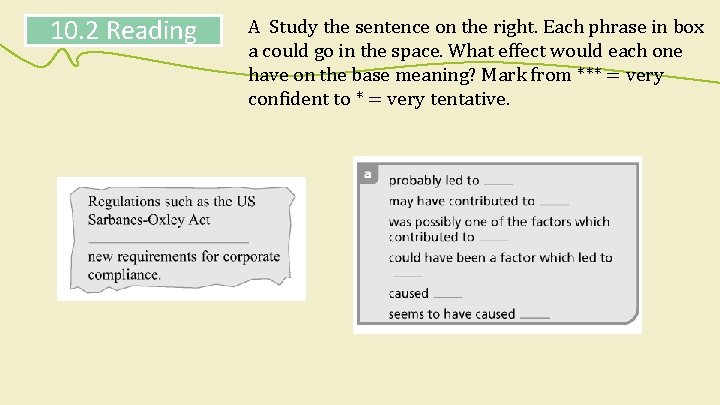
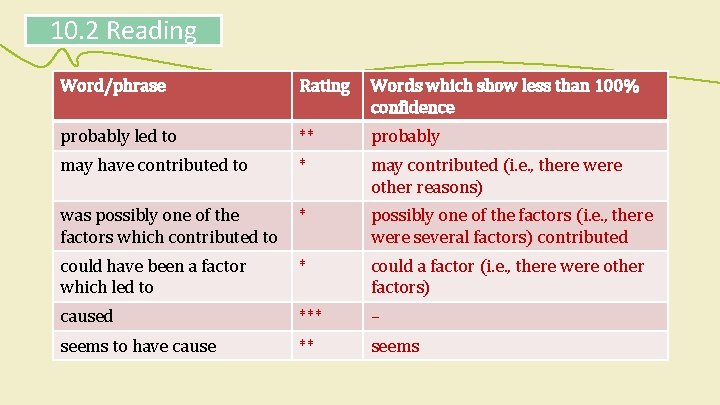
10. 2 Reading A Study the sentence on the right. Each phrase in box a could go in the space. What effect would each one have on the base meaning? Mark from *** = very confident to * = very tentative.
10. 2 Reading Word/phrase Rating Words which show less than 100% confidence probably led to ** probably may have contributed to * may contributed (i. e. , there were other reasons) was possibly one of the factors which contributed to * possibly one of the factors (i. e. , there were several factors) contributed could have been a factor which led to * could a factor (i. e. , there were other factors) caused *** – seems to have cause ** seems
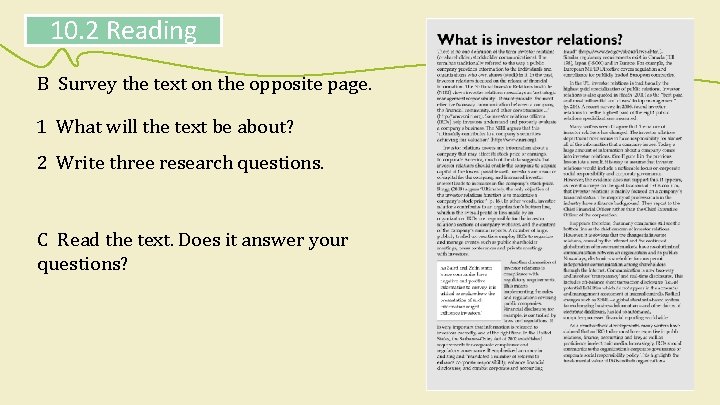
10. 2 Reading B Survey the text on the opposite page. 1 What will the text be about? 2 Write three research questions. C Read the text. Does it answer your questions?
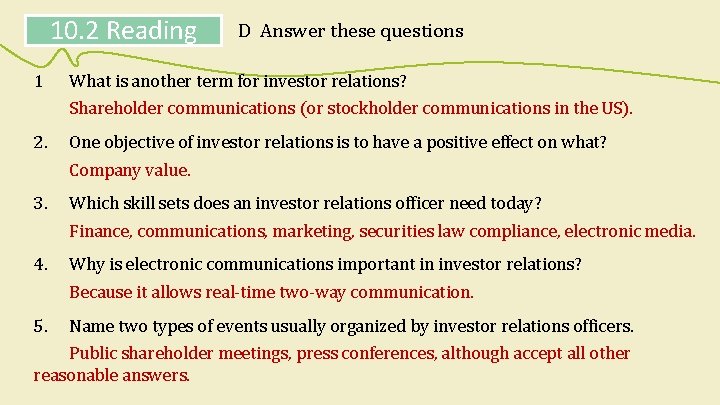
10. 2 Reading 1 D Answer these questions What is another term for investor relations? Shareholder communications (or stockholder communications in the US). 2. One objective of investor relations is to have a positive effect on what? Company value. 3. Which skill sets does an investor relations officer need today? Finance, communications, marketing, securities law compliance, electronic media. 4. Why is electronic communications important in investor relations? Because it allows real-time two-way communication. 5. Name two types of events usually organized by investor relations officers. Public shareholder meetings, press conferences, although accept all other reasonable answers.
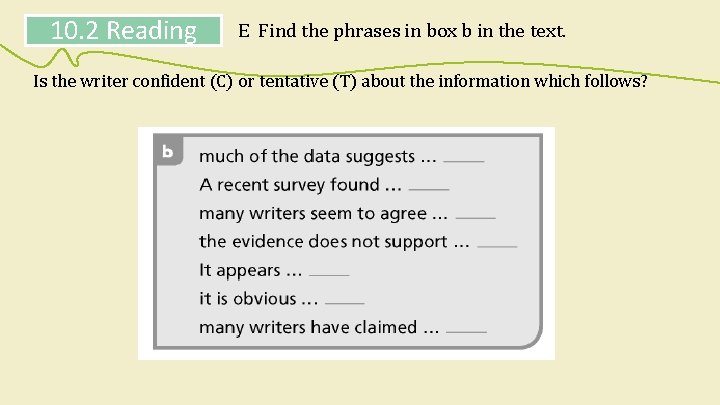
10. 2 Reading E Find the phrases in box b in the text. Is the writer confident (C) or tentative (T) about the information which follows?
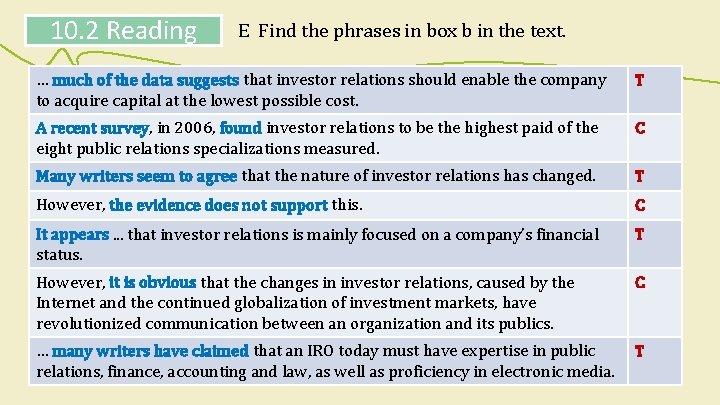
10. 2 Reading E Find the phrases in box b in the text. … much of the data suggests that investor relations should enable the company to acquire capital at the lowest possible cost. T A recent survey, in 2006, found investor relations to be the highest paid of the eight public relations specializations measured. C Many writers seem to agree that the nature of investor relations has changed. T However, the evidence does not support this. C It appears. . . that investor relations is mainly focused on a company’s financial status. T However, it is obvious that the changes in investor relations, caused by the Internet and the continued globalization of investment markets, have revolutionized communication between an organization and its publics. C … many writers have claimed that an IRO today must have expertise in public relations, finance, accounting and law, as well as proficiency in electronic media. T
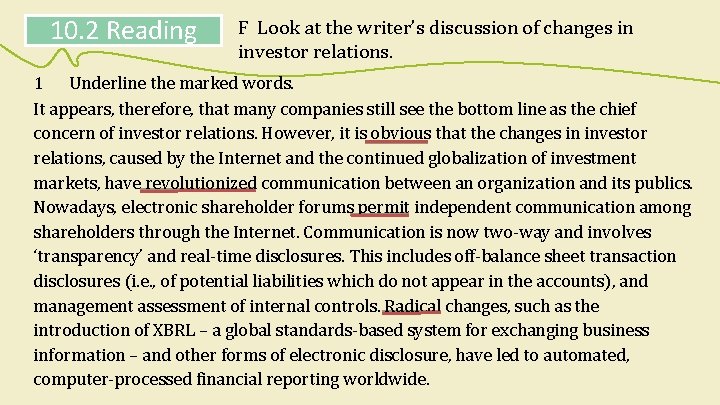
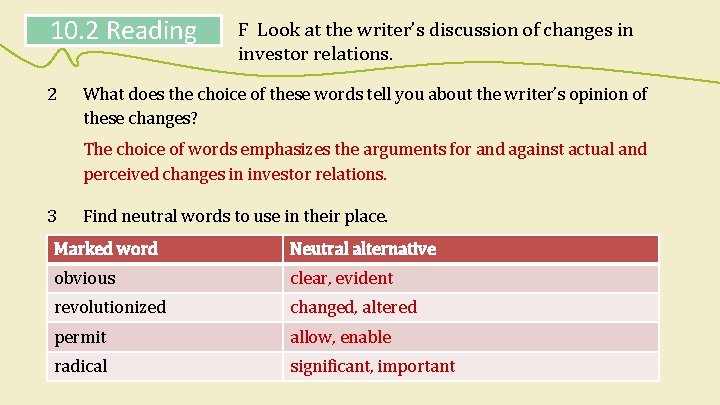
10. 2 Reading F Look at the writer’s discussion of changes in investor relations. 1 Underline the marked words. 2 What does the choice of these words tell you about the writer’s opinion of these changes? 3 Find neutral words to use in their place.
10. 2 Reading F Look at the writer’s discussion of changes in investor relations. 1 Underline the marked words. It appears, therefore, that many companies still see the bottom line as the chief concern of investor relations. However, it is obvious that the changes in investor relations, caused by the Internet and the continued globalization of investment markets, have revolutionized communication between an organization and its publics. Nowadays, electronic shareholder forums permit independent communication among shareholders through the Internet. Communication is now two-way and involves ‘transparency’ and real-time disclosures. This includes off-balance sheet transaction disclosures (i. e. , of potential liabilities which do not appear in the accounts), and management assessment of internal controls. Radical changes, such as the introduction of XBRL – a global standards-based system for exchanging business information – and other forms of electronic disclosure, have led to automated, computer-processed financial reporting worldwide.
10. 2 Reading 2 F Look at the writer’s discussion of changes in investor relations. What does the choice of these words tell you about the writer’s opinion of these changes? The choice of words emphasizes the arguments for and against actual and perceived changes in investor relations. 3 Find neutral words to use in their place. Marked word Neutral alternative obvious clear, evident revolutionized changed, altered permit allow, enable radical significant, important
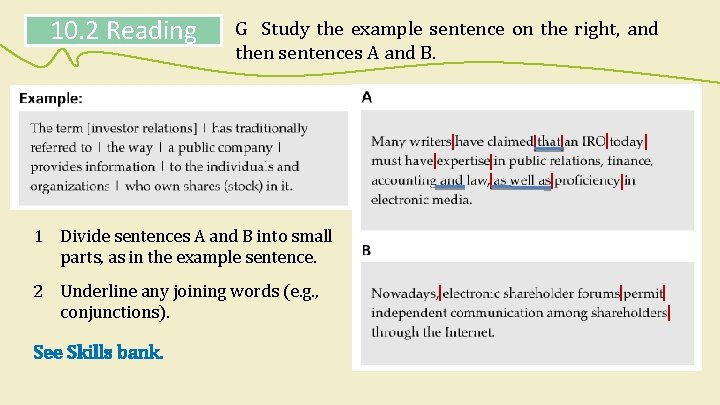
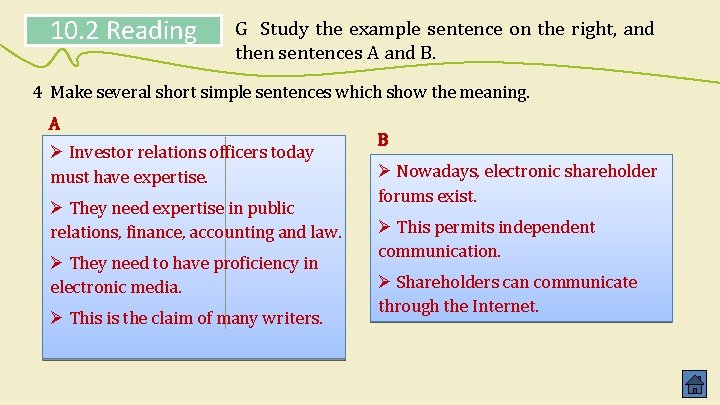
10. 2 Reading G Study the example sentence on the right, and then sentences A and B. | | | | | 1 Divide sentences A and B into small parts, as in the example sentence. 2 Underline any joining words (e. g. , conjunctions). See Skills bank. | |
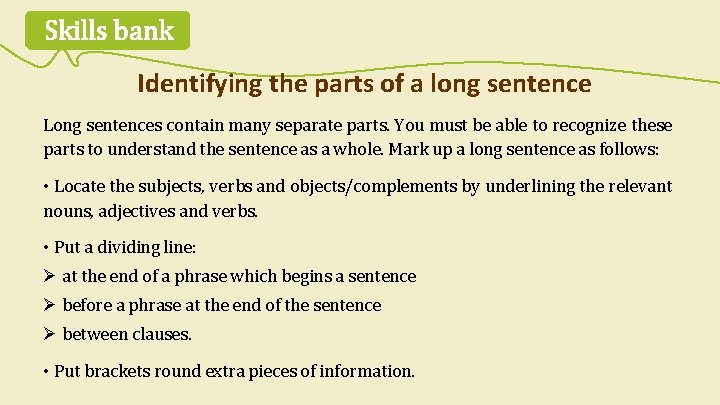
Skills bank Identifying the parts of a long sentence Long sentences contain many separate parts. You must be able to recognize these parts to understand the sentence as a whole. Mark up a long sentence as follows: • Locate the subjects, verbs and objects/complements by underlining the relevant nouns, adjectives and verbs. • Put a dividing line: Ø at the end of a phrase which begins a sentence Ø before a phrase at the end of the sentence Ø between clauses. • Put brackets round extra pieces of information.
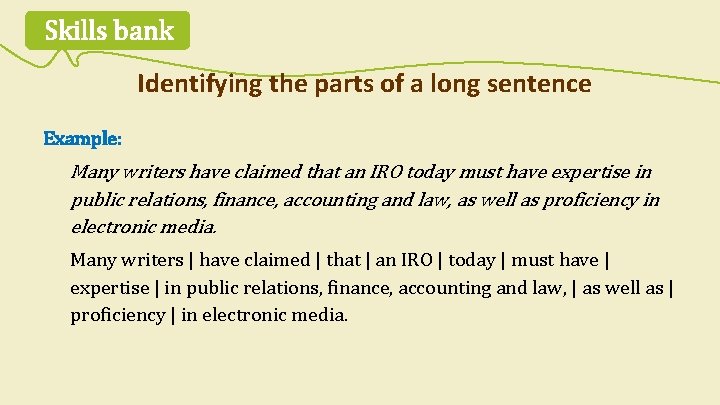
Skills bank Identifying the parts of a long sentence Example: Many writers have claimed that an IRO today must have expertise in public relations, finance, accounting and law, as well as proficiency in electronic media. Many writers | have claimed | that | an IRO | today | must have | expertise | in public relations, finance, accounting and law, | as well as | proficiency | in electronic media.
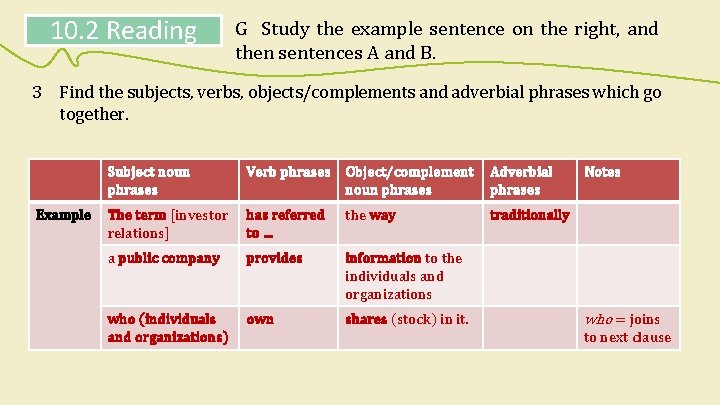
10. 2 Reading G Study the example sentence on the right, and then sentences A and B. 3 Find the subjects, verbs, objects/complements and adverbial phrases which go together. Example Subject noun phrases Verb phrases Object/complement noun phrases Adverbial phrases The term [investor relations] has referred to … the way traditionally a public company provides information to the individuals and organizations who (individuals and organizations) own shares (stock) in it. Notes who = joins to next clause
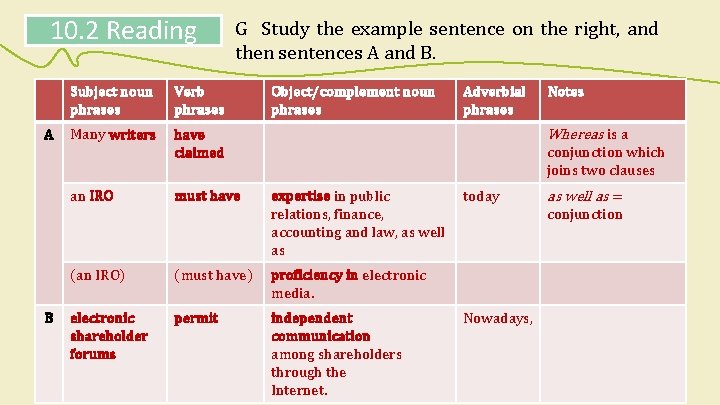
10. 2 Reading A Subject noun phrases Verb phrases Many writers have claimed an IRO B G Study the example sentence on the right, and then sentences A and B. must have Object/complement noun phrases Adverbial phrases Notes Whereas is a conjunction which joins two clauses expertise in public relations, finance, accounting and law, as well as (an IRO) (must have) proficiency in electronic media. electronic shareholder forums permit independent communication among shareholders through the Internet. today as well as = conjunction Nowadays,
10. 2 Reading G Study the example sentence on the right, and then sentences A and B. 4 Make several short simple sentences which show the meaning. A Ø Investor relations officers today must have expertise. Ø They need expertise in public relations, finance, accounting and law. Ø They need to have proficiency in electronic media. Ø This is the claim of many writers. B Ø Nowadays, electronic shareholder forums exist. Ø This permits independent communication. Ø Shareholders can communicate through the Internet.
10. 3 Extending skills A Read the four essay questions. What types of essay are they? 1 Comparison, plus some evaluation. 2 Analysis. 3 Descriptive. 4. Description, then analysis of situation and conclusion.
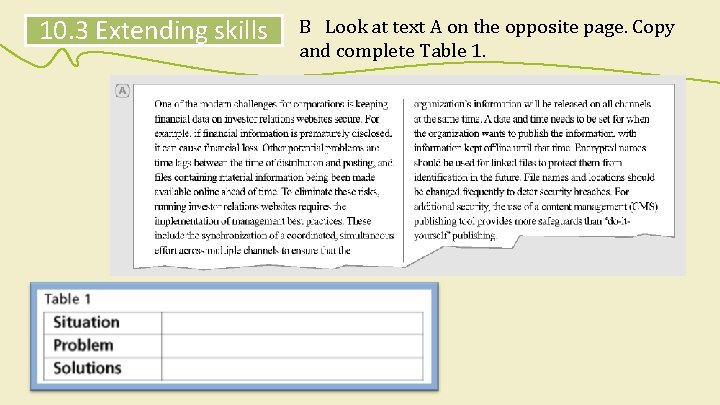
10. 3 Extending skills B Look at text A on the opposite page. Copy and complete Table 1.
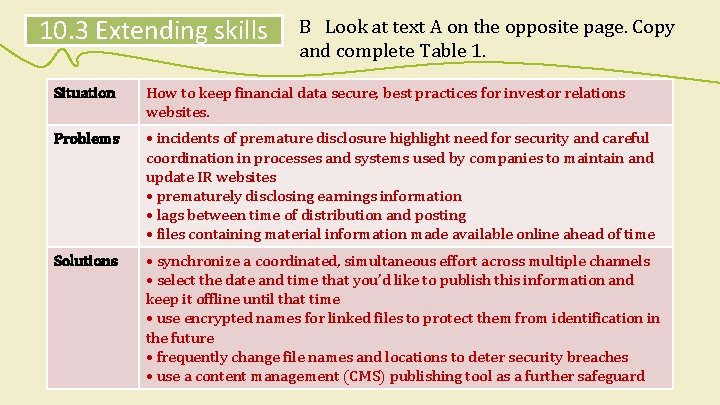
10. 3 Extending skills B Look at text A on the opposite page. Copy and complete Table 1. Situation How to keep financial data secure; best practices for investor relations websites. Problems • incidents of premature disclosure highlight need for security and careful coordination in processes and systems used by companies to maintain and update IR websites • prematurely disclosing earnings information • lags between time of distribution and posting • files containing material information made available online ahead of time Solutions • synchronize a coordinated, simultaneous effort across multiple channels • select the date and time that you’d like to publish this information and keep it offline until that time • use encrypted names for linked files to protect them from identification in the future • frequently change file names and locations to deter security breaches • use a content management (CMS) publishing tool as a further safeguard
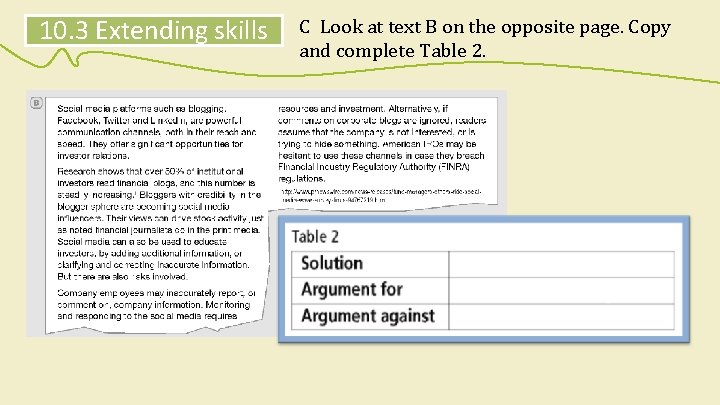
10. 3 Extending skills C Look at text B on the opposite page. Copy and complete Table 2.
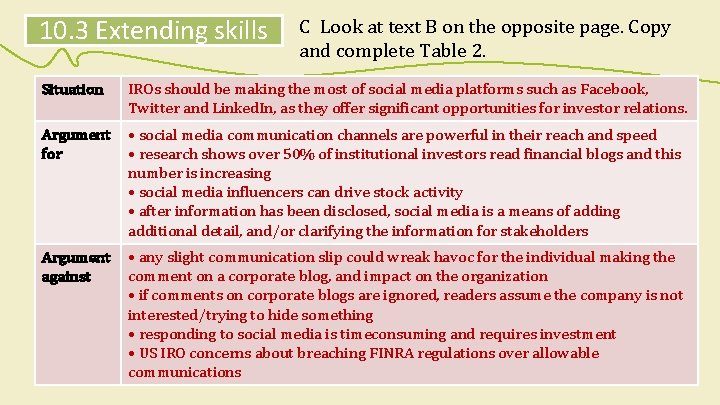
10. 3 Extending skills C Look at text B on the opposite page. Copy and complete Table 2. Situation IROs should be making the most of social media platforms such as Facebook, Twitter and Linked. In, as they offer significant opportunities for investor relations. Argument for • social media communication channels are powerful in their reach and speed • research shows over 50% of institutional investors read financial blogs and this number is increasing • social media influencers can drive stock activity • after information has been disclosed, social media is a means of adding additional detail, and/or clarifying the information for stakeholders Argument against • any slight communication slip could wreak havoc for the individual making the comment on a corporate blog, and impact on the organization • if comments on corporate blogs are ignored, readers assume the company is not interested/trying to hide something • responding to social media is timeconsuming and requires investment • US IRO concerns about breaching FINRA regulations over allowable communications
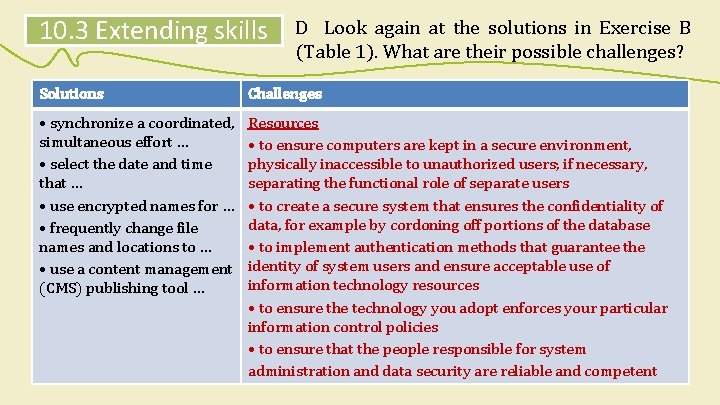
10. 3 Extending skills D Look again at the solutions in Exercise B (Table 1). What are their possible challenges? Solutions Challenges • synchronize a coordinated, simultaneous effort … • select the date and time that … • use encrypted names for … • frequently change file names and locations to … • use a content management (CMS) publishing tool … Resources • to ensure computers are kept in a secure environment, physically inaccessible to unauthorized users; if necessary, separating the functional role of separate users • to create a secure system that ensures the confidentiality of data, for example by cordoning off portions of the database • to implement authentication methods that guarantee the identity of system users and ensure acceptable use of information technology resources • to ensure the technology you adopt enforces your particular information control policies • to ensure that the people responsible for system administration and data security are reliable and competent
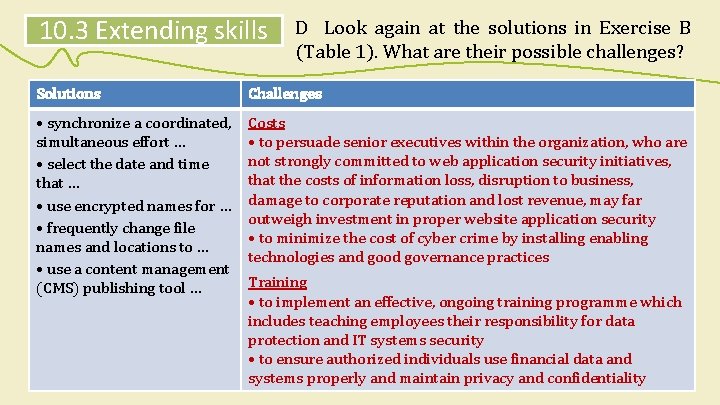
10. 3 Extending skills D Look again at the solutions in Exercise B (Table 1). What are their possible challenges? Solutions Challenges • synchronize a coordinated, simultaneous effort … • select the date and time that … • use encrypted names for … • frequently change file names and locations to … • use a content management (CMS) publishing tool … Costs • to persuade senior executives within the organization, who are not strongly committed to web application security initiatives, that the costs of information loss, disruption to business, damage to corporate reputation and lost revenue, may far outweigh investment in proper website application security • to minimize the cost of cyber crime by installing enabling technologies and good governance practices Training • to implement an effective, ongoing training programme which includes teaching employees their responsibility for data protection and IT systems security • to ensure authorized individuals use financial data and systems properly and maintain privacy and confidentiality
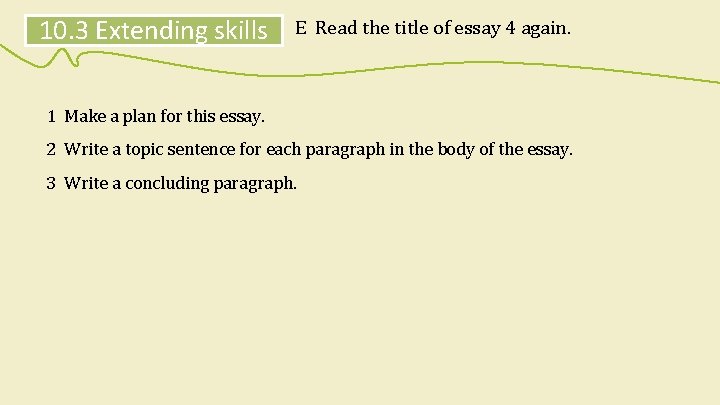
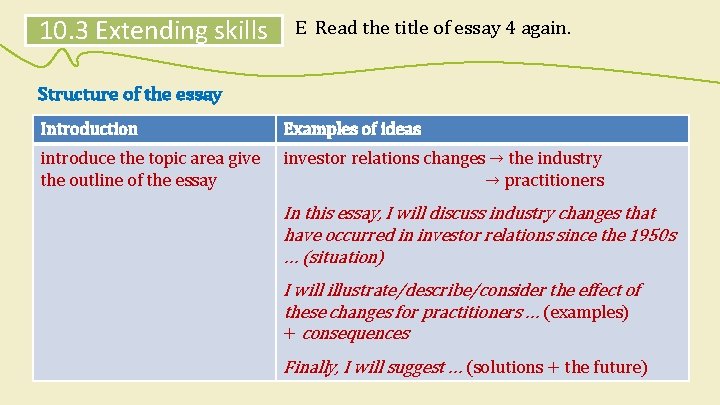
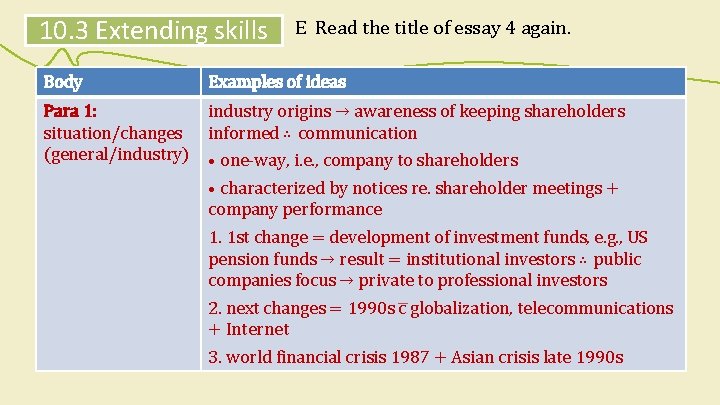
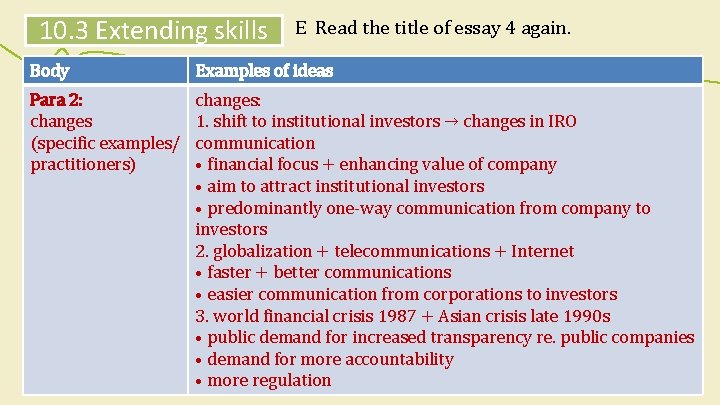
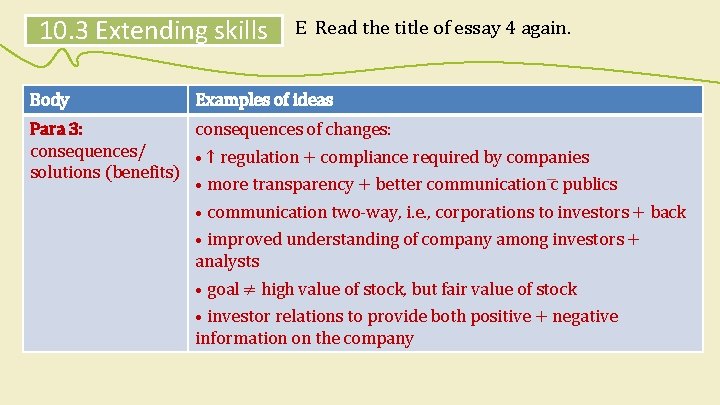
10. 3 Extending skills E Read the title of essay 4 again. 1 Make a plan for this essay. 2 Write a topic sentence for each paragraph in the body of the essay. 3 Write a concluding paragraph.
10. 3 Extending skills E Read the title of essay 4 again. Structure of the essay Introduction Examples of ideas introduce the topic area give the outline of the essay investor relations changes → the industry → practitioners In this essay, I will discuss industry changes that have occurred in investor relations since the 1950 s … (situation) I will illustrate/describe/consider the effect of these changes for practitioners … (examples) + consequences Finally, I will suggest … (solutions + the future)
10. 3 Extending skills E Read the title of essay 4 again. Body Examples of ideas Para 1: situation/changes (general/industry) industry origins → awareness of keeping shareholders informed ∴ communication • one-way, i. e. , company to shareholders • characterized by notices re. shareholder meetings + company performance 1. 1 st change = development of investment funds, e. g. , US pension funds → result = institutional investors ∴ public companies focus → private to professional investors 2. next changes = 1990 s c globalization, telecommunications + Internet 3. world financial crisis 1987 + Asian crisis late 1990 s
10. 3 Extending skills E Read the title of essay 4 again. Body Examples of ideas Para 2: changes (specific examples/ practitioners) changes: 1. shift to institutional investors → changes in IRO communication • financial focus + enhancing value of company • aim to attract institutional investors • predominantly one-way communication from company to investors 2. globalization + telecommunications + Internet • faster + better communications • easier communication from corporations to investors 3. world financial crisis 1987 + Asian crisis late 1990 s • public demand for increased transparency re. public companies • demand for more accountability • more regulation
10. 3 Extending skills Body E Read the title of essay 4 again. Examples of ideas Para 3: consequences of changes: consequences/ • ↑ regulation + compliance required by companies solutions (benefits) • more transparency + better communication c publics • communication two-way, i. e. , corporations to investors + back • improved understanding of company among investors + analysts • goal ≠ high value of stock, but fair value of stock • investor relations to provide both positive + negative information on the company
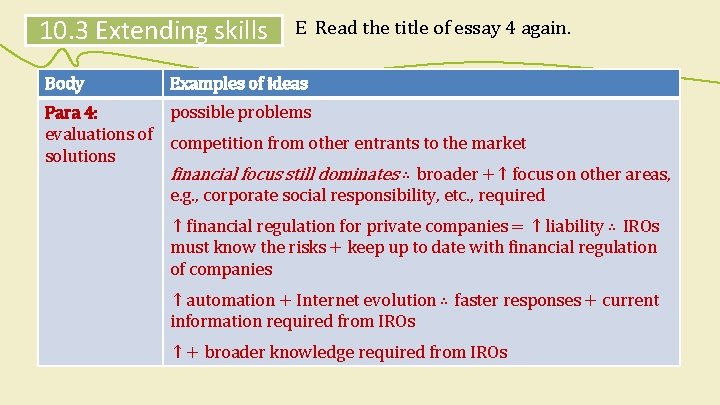
10. 3 Extending skills Body E Read the title of essay 4 again. Examples of ideas Para 4: possible problems evaluations of competition from other entrants to the market solutions financial focus still dominates ∴ broader + ↑ focus on other areas, e. g. , corporate social responsibility, etc. , required ↑ financial regulation for private companies = ↑ liability ∴ IROs must know the risks + keep up to date with financial regulation of companies ↑ automation + Internet evolution ∴ faster responses + current information required from IROs ↑ + broader knowledge required from IROs
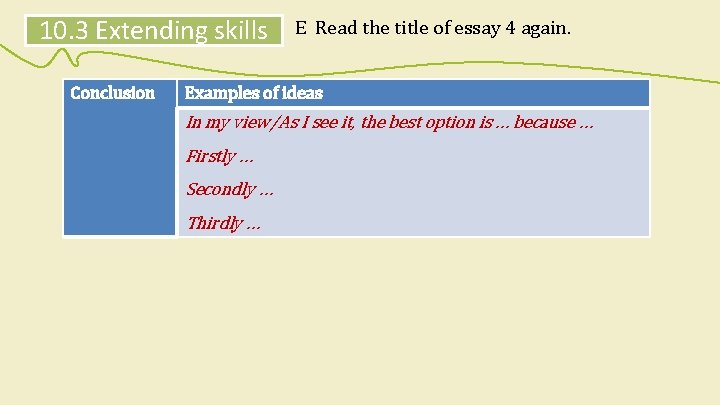
10. 3 Extending skills Conclusion E Read the title of essay 4 again. Examples of ideas In my view/As I see it, the best option is … because … Firstly … Secondly … Thirdly …
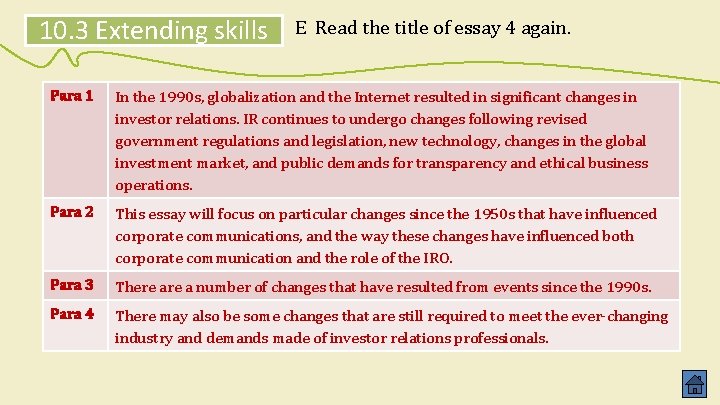
10. 3 Extending skills E Read the title of essay 4 again. Para 1 In the 1990 s, globalization and the Internet resulted in significant changes in investor relations. IR continues to undergo changes following revised government regulations and legislation, new technology, changes in the global investment market, and public demands for transparency and ethical business operations. Para 2 This essay will focus on particular changes since the 1950 s that have influenced corporate communications, and the way these changes have influenced both corporate communication and the role of the IRO. Para 3 There a number of changes that have resulted from events since the 1990 s. Para 4 There may also be some changes that are still required to meet the ever-changing industry and demands made of investor relations professionals.
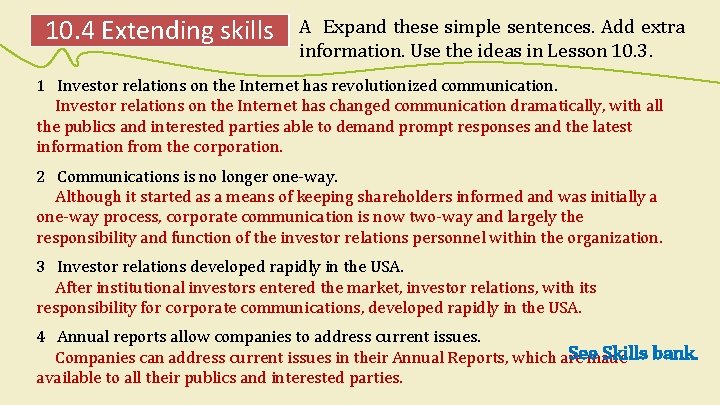
10. 4 Extending skills A Expand these simple sentences. Add extra information. Use the ideas in Lesson 10. 3. 1 Investor relations on the Internet has revolutionized communication. Investor relations on the Internet has changed communication dramatically, with all the publics and interested parties able to demand prompt responses and the latest information from the corporation. 2 Communications is no longer one-way. Although it started as a means of keeping shareholders informed and was initially a one-way process, corporate communication is now two-way and largely the responsibility and function of the investor relations personnel within the organization. 3 Investor relations developed rapidly in the USA. After institutional investors entered the market, investor relations, with its responsibility for corporate communications, developed rapidly in the USA. 4 Annual reports allow companies to address current issues. See Skills bank. Companies can address current issues in their Annual Reports, which are made available to all their publics and interested parties.
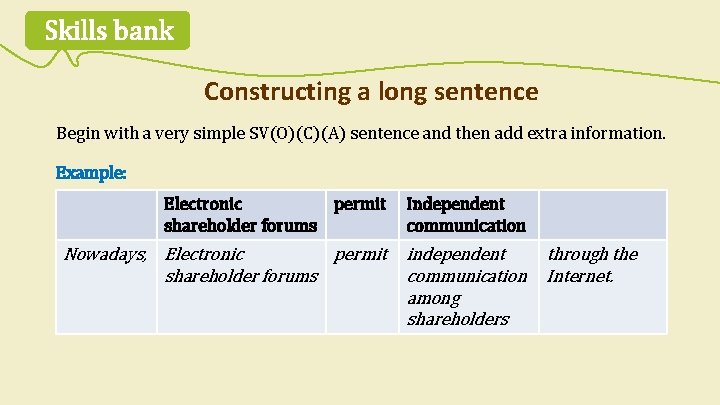
Skills bank Constructing a long sentence Begin with a very simple SV(O)(C)(A) sentence and then add extra information. Example: Electronic permit shareholder forums Independent communication Nowadays, Electronic permit shareholder forums independent communication among shareholders through the Internet.
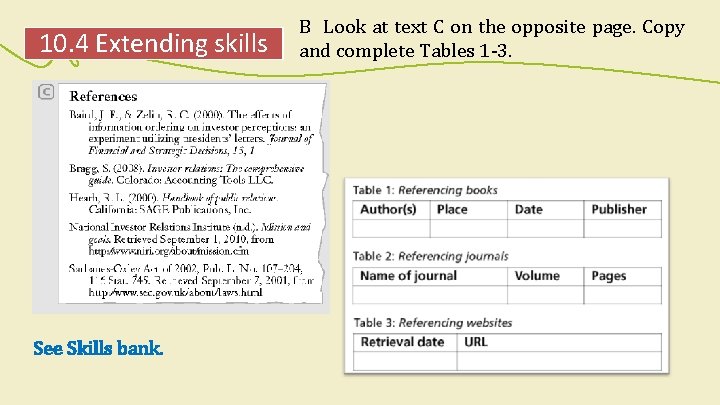
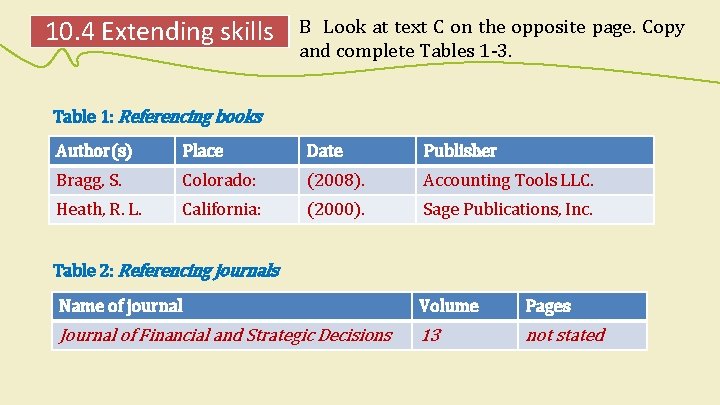
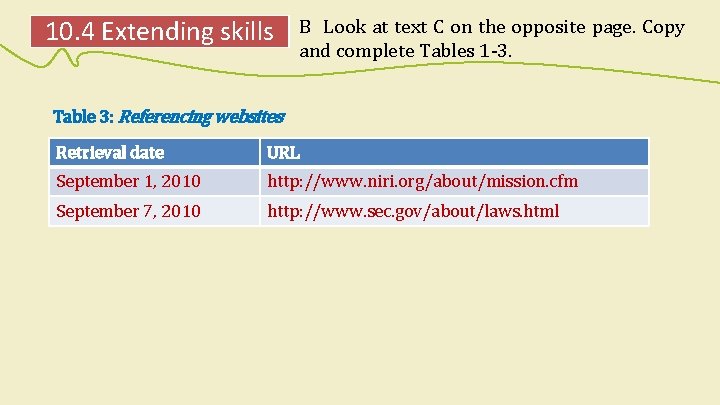
10. 4 Extending skills See Skills bank. B Look at text C on the opposite page. Copy and complete Tables 1 -3.
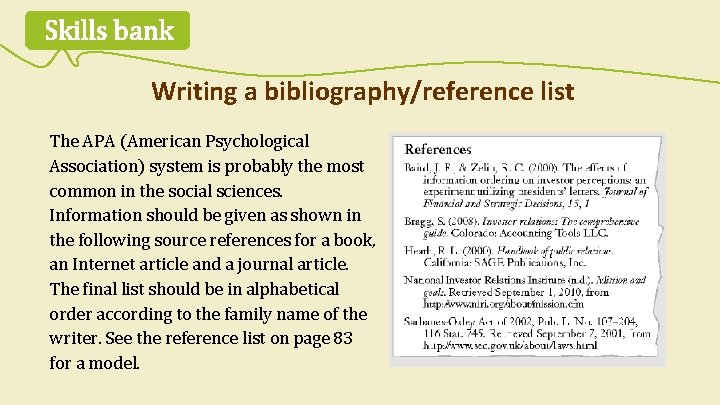
Skills bank Writing a bibliography/reference list The APA (American Psychological Association) system is probably the most common in the social sciences. Information should be given as shown in the following source references for a book, an Internet article and a journal article. The final list should be in alphabetical order according to the family name of the writer. See the reference list on page 83 for a model.
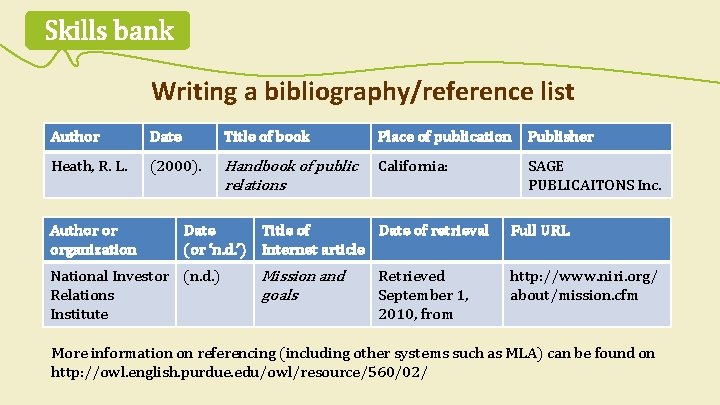
Skills bank Writing a bibliography/reference list Author Date Title of book Place of publication Publisher Heath, R. L. (2000). Handbook of public relations California: SAGE PUBLICAITONS Inc. Author or organization Date Title of Date of retrieval (or ‘n. d. ’) Internet article National Investor (n. d. ) Relations Institute Mission and goals Retrieved September 1, 2010, from Full URL http: //www. niri. org/ about/mission. cfm More information on referencing (including other systems such as MLA) can be found on http: //owl. english. purdue. edu/owl/resource/560/02/
10. 4 Extending skills B Look at text C on the opposite page. Copy and complete Tables 1 -3. Table 1: Referencing books Author(s) Place Date Publisher Bragg, S. Colorado: (2008). Accounting Tools LLC. Heath, R. L. California: (2000). Sage Publications, Inc. Table 2: Referencing journals Name of journal Volume Pages Journal of Financial and Strategic Decisions 13 not stated
10. 4 Extending skills B Look at text C on the opposite page. Copy and complete Tables 1 -3. Table 3: Referencing websites Retrieval date URL September 1, 2010 http: //www. niri. org/about/mission. cfm September 7, 2010 http: //www. sec. gov/about/laws. html
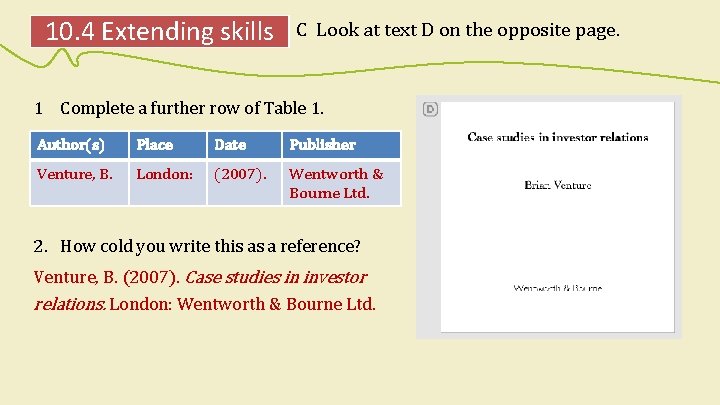
10. 4 Extending skills C Look at text D on the opposite page. 1 Complete a further row of Table 1. Author(s) Place Date Publisher Venture, B. London: (2007). Wentworth & Bourne Ltd. 2. How cold you write this as a reference? Venture, B. (2007). Case studies in investor relations. London: Wentworth & Bourne Ltd.
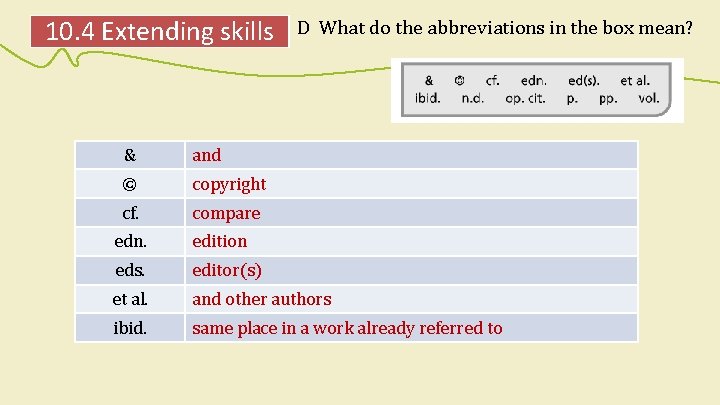
10. 4 Extending skills & and © copyright cf. compare D What do the abbreviations in the box mean? edn. edition eds. editor(s) et al. and other authors ibid. same place in a work already referred to
10. 4 Extending skills n. d. op. cit. D What do the abbreviations in the box mean? no date (used in a reference list if there is no date – as is often the case with web articles) the work already referred to p. page pp. pages volume
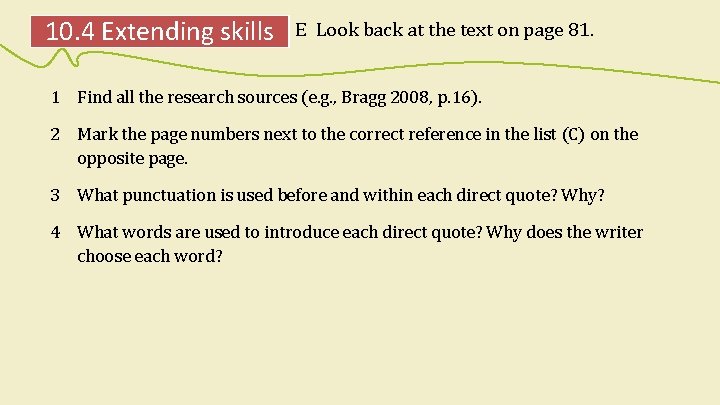
10. 4 Extending skills E Look back at the text on page 81. 1 Find all the research sources (e. g. , Bragg 2008, p. 16). 2 Mark the page numbers next to the correct reference in the list (C) on the opposite page. 3 What punctuation is used before and within each direct quote? Why? 4 What words are used to introduce each direct quote? Why does the writer choose each word?
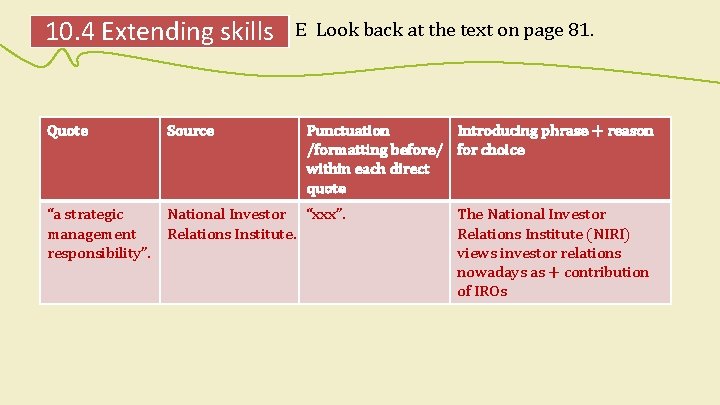
10. 4 Extending skills E Look back at the text on page 81. Quote Source Punctuation Introducing phrase + reason /formatting before/ for choice within each direct quote “a strategic management responsibility”. National Investor “xxx”. Relations Institute. The National Investor Relations Institute (NIRI) views investor relations nowadays as + contribution of IROs
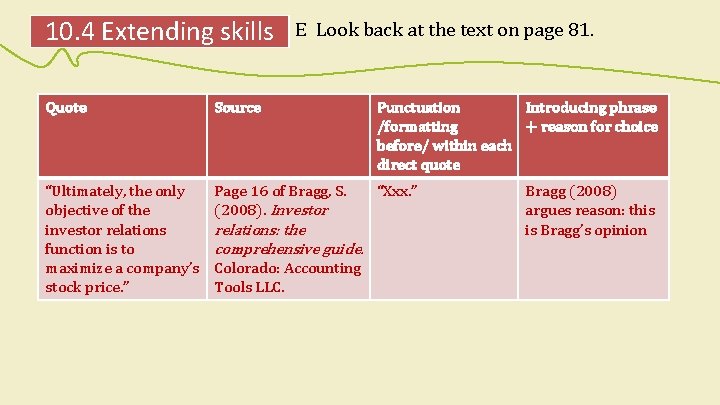
10. 4 Extending skills E Look back at the text on page 81. Quote Source Punctuation Introducing phrase /formatting + reason for choice before/ within each direct quote “Ultimately, the only objective of the investor relations function is to maximize a company’s stock price. ” Page 16 of Bragg, S. (2008). Investor “Xxx. ” relations: the comprehensive guide. Colorado: Accounting Tools LLC. Bragg (2008) argues reason: this is Bragg’s opinion
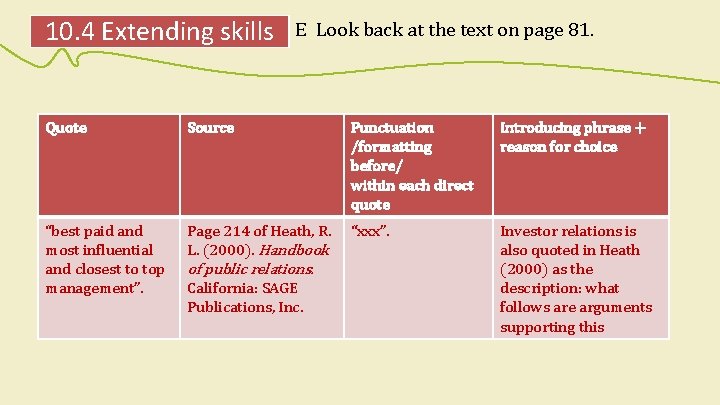
10. 4 Extending skills E Look back at the text on page 81. Quote Source Punctuation /formatting before/ within each direct quote Introducing phrase + reason for choice “best paid and most influential and closest to top management”. Page 214 of Heath, R. L. (2000). Handbook “xxx”. Investor relations is also quoted in Heath (2000) as the description: what follows are arguments supporting this of public relations. California: SAGE Publications, Inc.