
Puget Energy Puget Sound Energy EEI Company Update



- Slides: 32
Puget Energy Puget Sound Energy EEI Company Update November 2020
Cautionary Statement Information Current as of September 30, 2020 Except as expressly noted, the information in this presentation is current as of September 30, 2020– the date on which PUGET ENERGY, INC. (“PE”) filed its Quarterly Report on Form 10 -Q for the quarter ended September 30, 2020– and should not be relied upon as being current as of any subsequent date. PE undertakes no duty to update the presentation, except as may be required by law. Forward-Looking Statements in this presentation that relate to future plans, objectives, expectations, performance, events and the like may constitute “forwardlooking statements” with the meaning of the Private Securities Litigation Reform Act of 1995, Section 27 A of the Securities Act of 1933, as amended, and Section 21 E of the Securities Exchange Act of 1934, as amended. Forward-looking statements include statements regarding earnings guidance, statements regarding future load, hydro conditions and operating and maintenance costs; statements concerning implementation of PE’s 5 -year Plan and related future capital expenditures; statements regarding the outcome of any legal or regulatory proceeding; as well as other statements containing words such as “anticipates, ” “believes, ” “intends, ” “estimates, ” “promises, ” “expects, ” “should, ” and similar expressions. Investors are cautioned that any such forward-looking statements are subject to risks and uncertainties, including – but not limited to – the costs of compliance with regulatory and environmental laws, changes in capital market conditions, reduction in demand, low wholesale prices, operational risks, hydro and wind conditions, disruption in fuel supply, and unscheduled power outages, which may result in unanticipated operating, maintenance, and repair costs. As a result, actual results may differ materially from those projected in the forward-looking statements. All forward-looking statements included in this presentation are based on information available to PE on the date hereof and such statements speak only as of the date hereof. PE assumes no obligation to update any such forward-looking statement. Prospective investors should also review the risks and uncertainties listed in PE’s most recent Annual Report Form 10 -K and PE’s reports on Forms 8 -K and 10 -Q filed with the United States Securities and Exchange Commission. 2
Puget Energy Team Introduction Ø Dan Doyle Senior Vice President and Chief Financial Officer Dan. Doyle@pse. com (425) 462 -3193 Ø Patrick Mc. Connell Manager, Treasury Operations Patrick. Mc. Connell@pse. com (425) 462 -3345 Ø Cara Peterman Corporate Treasurer Cara. Peterman@pse. com (425) 462 -3092 Ø Tsung-Hsing Shen Debt Capital Markets Manager Tsung-Hsing. Shen@pse. com (425) 456 -2619 3
Agenda 1. Key Highlights & Business Strategy 2. Financial Update 3. Other Corporate Highlights & Matters of Interest 4
Mary E. Kipp was named president of PSE in August 2019 and CEO in January 2020 Mary joined PSE from El Paso Electric (EPE), where she served as chief executive officer since 2015 and president since 2014. Under her leadership, EPE—also a 100 -year-plus company with a deeply-rooted community history—evolved to serve a diverse customer base spread across a mountain west region and growing border communities. With EPE since 2007, Mary held a variety of leadership roles throughout the company, including General Counsel, regulatory and rates, risk management, human resources, external affairs, customer care, environmental and safety. Prior to EPE, Mary was a prosecuting attorney for FERC for four years, investigating and prosecuting violations of federal energy laws. Mary also worked as a lawyer at El Paso Natural Gas Company and at Greenberg Traurig, LLP. Mary is a member of the Board of Directors of ASE (Alliance to Save Energy) and is immediate past chair of SEPA (Smart Electric Power Alliance). She is also past deputy chair of the Federal Reserve Bank of Dallas; past chair of the Borderplex Alliance; and past executive committee member of the Texas Business Leadership Council. Mary received a Bachelor of Arts degree from Williams College, a Juris Doctor degree from The University of Texas School of Law, and is an alumnus of Exeter College, Oxford University. Mary lives in Seattle and has two children. 5
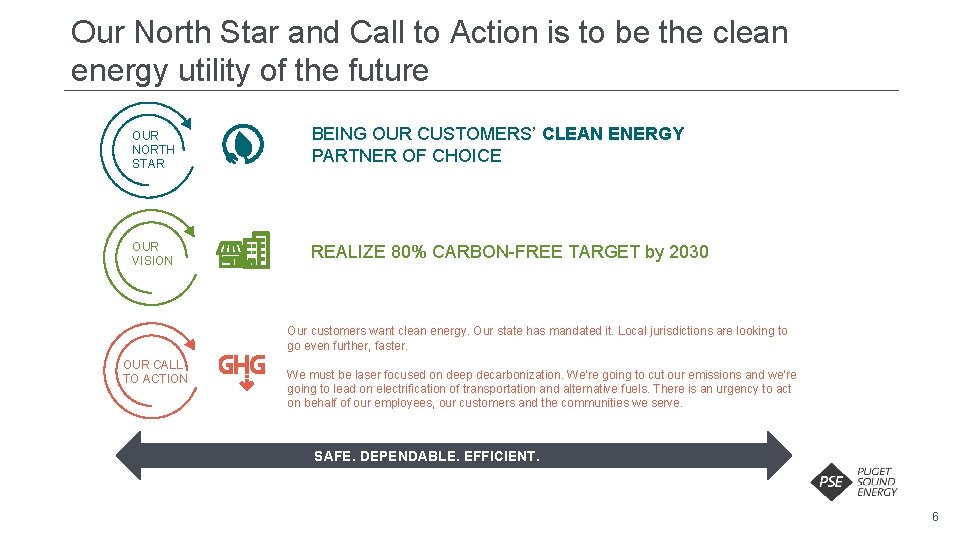
Our North Star and Call to Action is to be the clean energy utility of the future OUR NORTH STAR BEING OUR CUSTOMERS’ CLEAN ENERGY PARTNER OF CHOICE OUR VISION REALIZE 80% CARBON-FREE TARGET by 2030 Our customers want clean energy. Our state has mandated it. Local jurisdictions are looking to go even further, faster. OUR CALL TO ACTION We must be laser focused on deep decarbonization. We’re going to cut our emissions and we’re going to lead on electrification of transportation and alternative fuels. There is an urgency to act on behalf of our employees, our customers and the communities we serve. SAFE. DEPENDABLE. EFFICIENT. . 6
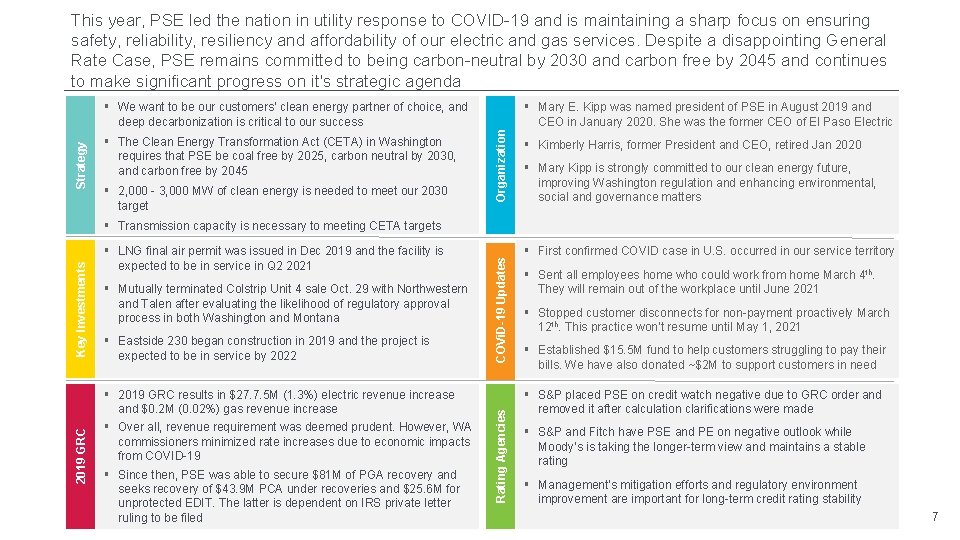
This year, PSE led the nation in utility response to COVID-19 and is maintaining a sharp focus on ensuring safety, reliability, resiliency and affordability of our electric and gas services. Despite a disappointing General Rate Case, PSE remains committed to being carbon-neutral by 2030 and carbon free by 2045 and continues to make significant progress on it's strategic agenda • Debt to capitalization ratio for PSE is maintained approximately § The Clean Energy Transformation Act at (CETA) in Washington 1, consistent with the 51. 5% requires that PSE be coal free by 2025, carbon neutral by 2030, and carbon free by 2045 approved equity of 48. 5% for regulatory purposes § 2, 000 - 3, 000 MW of clean energy is needed to meet our 2030 target § Mary E. Kipp was named president of PSE in August 2019 and CEO in January 2020. She was the former CEO of El Paso Electric Organization Strategy § We want to be our customers’ clean energy partner of choice, and deep decarbonization is critical to our success § Kimberly Harris, former President and CEO, retired Jan 2020 § Mary Kipp is strongly committed to our clean energy future, improving Washington regulation and enhancing environmental, social and governance matters § Mutually terminated Colstrip Unit 4 sale Oct. 29 with Northwestern and Talen after evaluating the likelihood of regulatory approval process in both Washington and Montana § Eastside 230 began construction in 2019 and the project is expected to be in service by 2022 § 2019 GRC results in $27. 7. 5 M (1. 3%) electric revenue increase and $0. 2 M (0. 02%) gas revenue increase § Over all, revenue requirement was deemed prudent. However, WA commissioners minimized rate increases due to economic impacts from COVID-19 § Since then, PSE was able to secure $81 M of PGA recovery and seeks recovery of $43. 9 M PCA under recoveries and $25. 6 M for unprotected EDIT. The latter is dependent on IRS private letter ruling to be filed COVi. D-19 Updates § LNG final air permit was issued in Dec 2019 and the facility is expected to be in service in Q 2 2021 Rating Agencies 2019 GRC Key Investments § Transmission capacity is necessary to meeting CETA targets § First confirmed COVID case in U. S. occurred in our service territory § Sent all employees home who could work from home March 4 th. They will remain out of the workplace until June 2021 § Stopped customer disconnects for non-payment proactively March 12 th. This practice won’t resume until May 1, 2021 § Established $15. 5 M fund to help customers struggling to pay their bills. We have also donated ~$2 M to support customers in need § S&P placed PSE on credit watch negative due to GRC order and removed it after calculation clarifications were made § S&P and Fitch have PSE and PE on negative outlook while Moody’s is taking the longer-term view and maintains a stable rating § Management’s mitigation efforts and regulatory environment improvement are important for long-term credit rating stability 7
FINANCIAL UPDATE 8
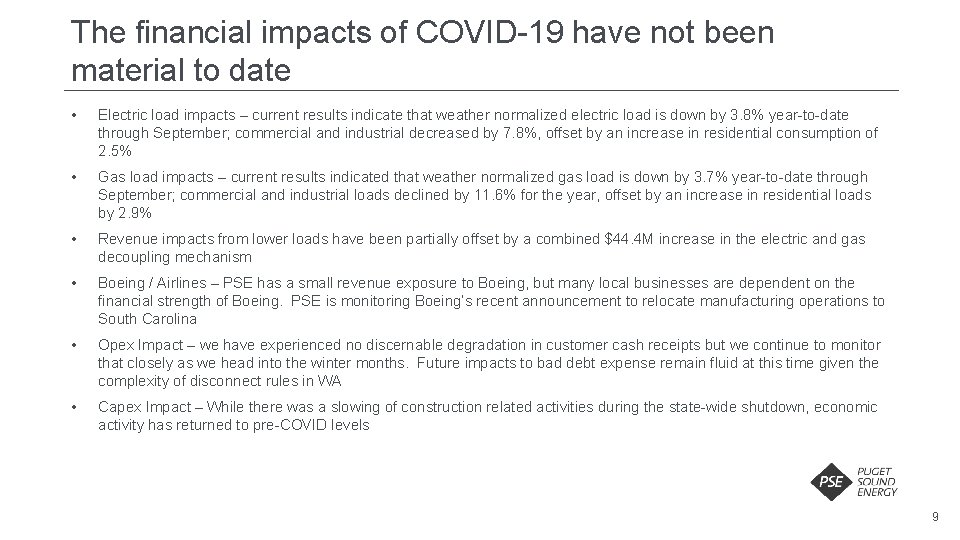
The financial impacts of COVID-19 have not been material to date • Electric load impacts – current results indicate that weather normalized electric load is down by 3. 8% year-to-date through September; commercial and industrial decreased by 7. 8%, offset by an increase in residential consumption of 2. 5% • Gas load impacts – current results indicated that weather normalized gas load is down by 3. 7% year-to-date through September; commercial and industrial loads declined by 11. 6% for the year, offset by an increase in residential loads by 2. 9% • Revenue impacts from lower loads have been partially offset by a combined $44. 4 M increase in the electric and gas decoupling mechanism • Boeing / Airlines – PSE has a small revenue exposure to Boeing, but many local businesses are dependent on the financial strength of Boeing. PSE is monitoring Boeing’s recent announcement to relocate manufacturing operations to South Carolina • Opex Impact – we have experienced no discernable degradation in customer cash receipts but we continue to monitor that closely as we head into the winter months. Future impacts to bad debt expense remain fluid at this time given the complexity of disconnect rules in WA • Capex Impact – While there was a slowing of construction related activities during the state-wide shutdown, economic activity has returned to pre-COVID levels 9
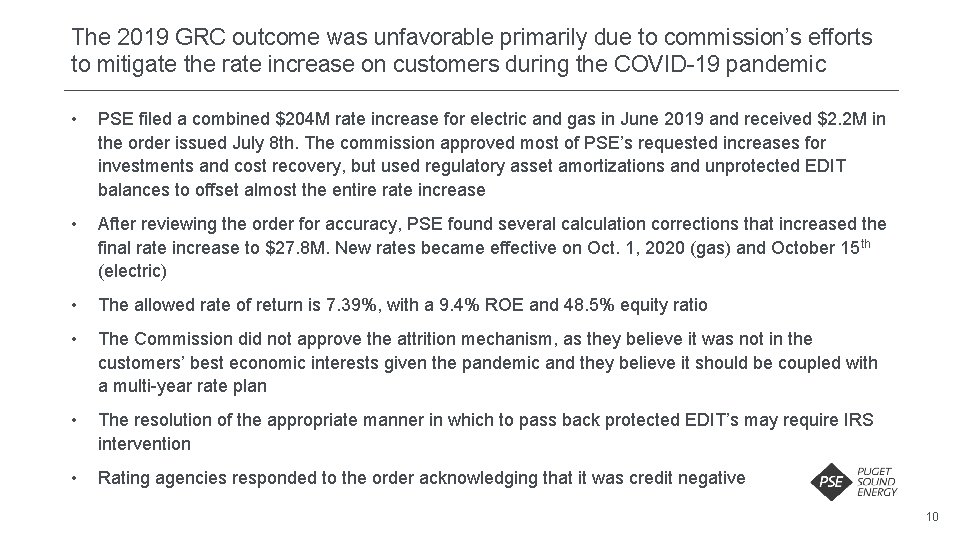
The 2019 GRC outcome was unfavorable primarily due to commission’s efforts to mitigate the rate increase on customers during the COVID-19 pandemic • PSE filed a combined $204 M rate increase for electric and gas in June 2019 and received $2. 2 M in the order issued July 8 th. The commission approved most of PSE’s requested increases for investments and cost recovery, but used regulatory asset amortizations and unprotected EDIT balances to offset almost the entire rate increase • After reviewing the order for accuracy, PSE found several calculation corrections that increased the final rate increase to $27. 8 M. New rates became effective on Oct. 1, 2020 (gas) and October 15 th (electric) • The allowed rate of return is 7. 39%, with a 9. 4% ROE and 48. 5% equity ratio • The Commission did not approve the attrition mechanism, as they believe it was not in the customers’ best economic interests given the pandemic and they believe it should be coupled with a multi-year rate plan • The resolution of the appropriate manner in which to pass back protected EDIT’s may require IRS intervention • Rating agencies responded to the order acknowledging that it was credit negative 10
A high level analysis illustrates how the UTC implemented holding rates flat during the pandemic 11
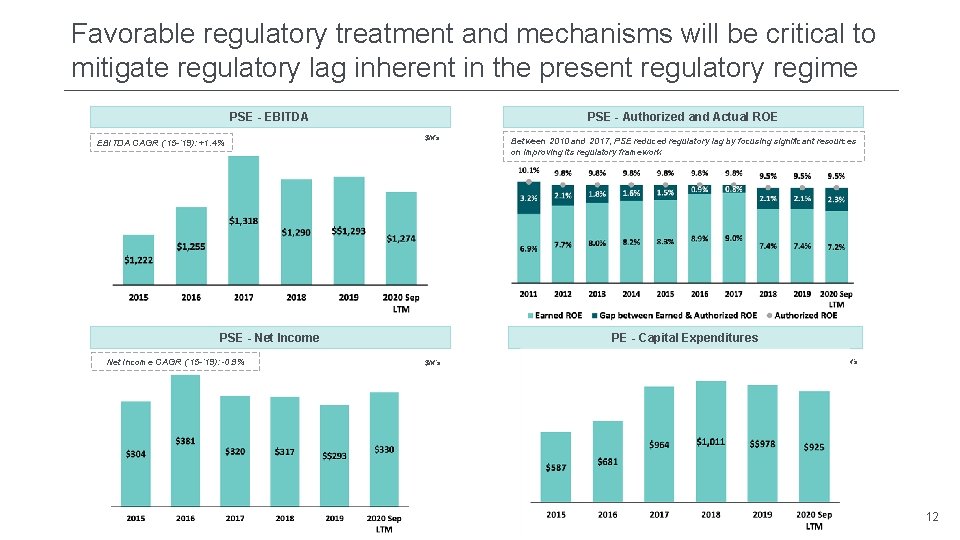
Favorable regulatory treatment and mechanisms will be critical to mitigate regulatory lag inherent in the present regulatory regime PSE - Authorized and Actual ROE PSE - EBITDA CAGR (‘ 15 -’ 19): +1. 4% $M’s PSE - Net Income CAGR (‘ 15 -’ 19): -0. 9% Between 2010 and 2017, PSE reduced regulatory lag by focusing significant resources on improving its regulatory framework PE - Capital Expenditures $M’s (1) Excluding Equity AFUDC 12
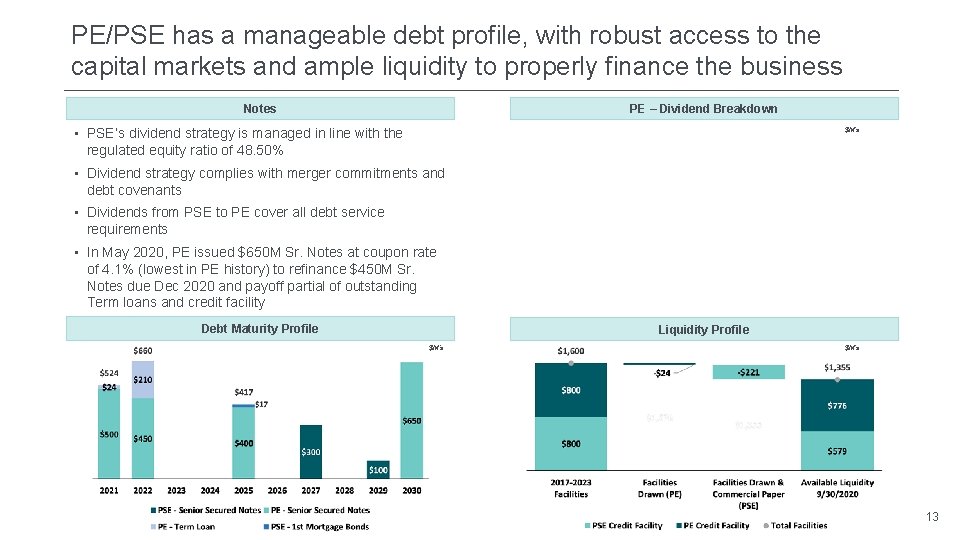
PE/PSE has a manageable debt profile, with robust access to the capital markets and ample liquidity to properly finance the business Notes PE – Dividend Breakdown • PSE’s dividend strategy is managed in line with the regulated equity ratio of 48. 50% $M’s • Dividend strategy complies with merger commitments and debt covenants • Dividends from PSE to PE cover all debt service requirements • In May 2020, PE issued $650 M Sr. Notes at coupon rate of 4. 1% (lowest in PE history) to refinance $450 M Sr. Notes due Dec 2020 and payoff partial of outstanding Term loans and credit facility Debt Maturity Profile Liquidity Profile $M’s 13
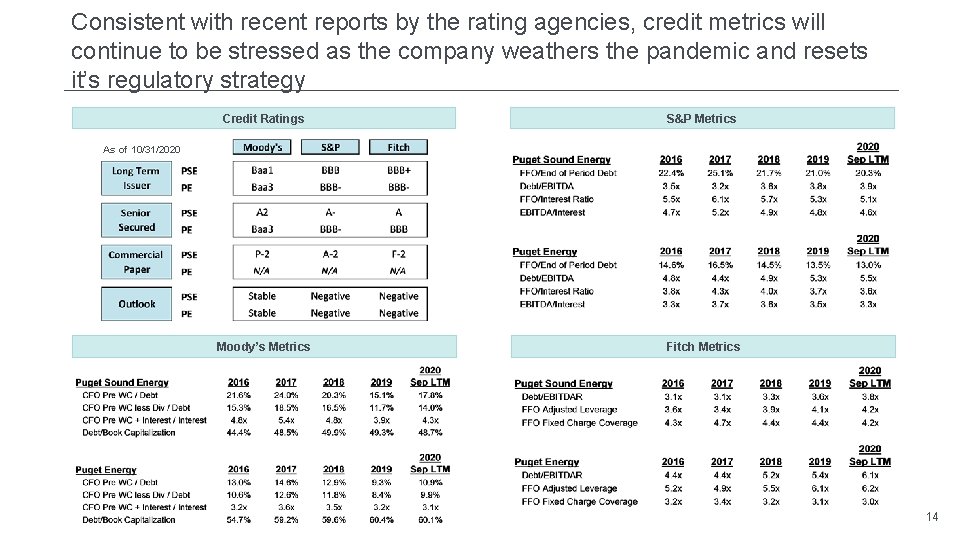
Consistent with recent reports by the rating agencies, credit metrics will continue to be stressed as the company weathers the pandemic and resets it’s regulatory strategy Credit Ratings S&P Metrics Moody’s Metrics Fitch Metrics As of 10/31/2020 14
PSE has already adjusted it’s regulatory strategy to strengthen cash flows and recover costs prudently incurred on behalf of customers • On September 3, 2020, the PSE filed an accounting petition with the WUTC requesting authorization to defer the costs and foregone revenue net of offsets associated with COVID-19. PSE anticipates receiving a ruling on the matter sometime in the fourth quarter of 2020 • On September 29 th, PSE filed to update its purchased gas adjustment (PGA) tariff and received approval October 29 th. Rates increased $81. 1 M on November 1 st • On October 30 th, PSE filed an update to its power cost adjustment (PCA) rate to collect $41. 7 M in power cost under-recoveries • PSE has a sharing mechanism on power costs whereby the company shares power cost volatility to customers • $43. 9 M request is the uncollected balance as of December 2019 • PSE voluntarily delayed the filing earlier this year due to the COVID-19 pandemic and anticipated sizeable rate increase from the GRC. • Other regulatory filings are under consideration but must be assessed in the context of the COVID 19 pandemic 15
OTHER CORPORATE HIGHLIGHTS AND MATTERS OF INTEREST 16
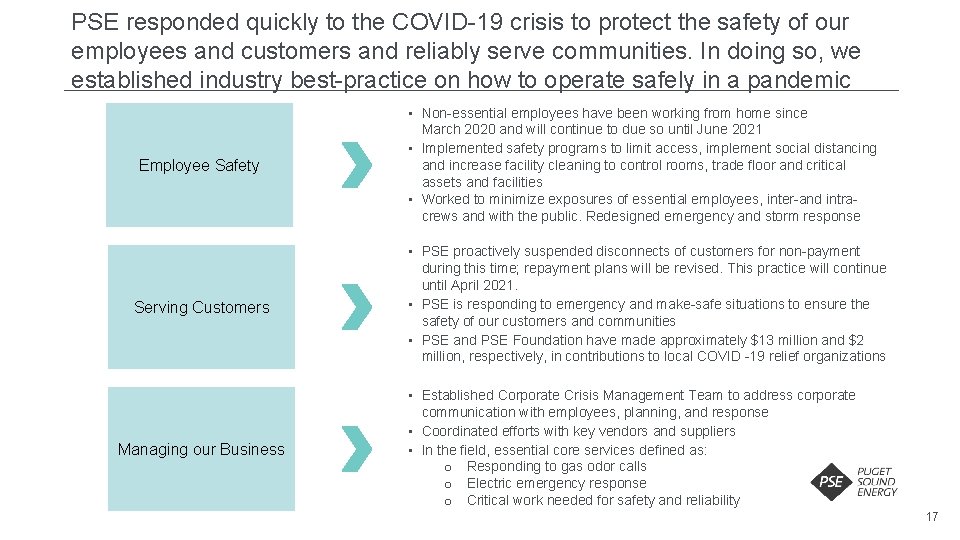
PSE responded quickly to the COVID-19 crisis to protect the safety of our employees and customers and reliably serve communities. In doing so, we established industry best-practice on how to operate safely in a pandemic Employee Safety Serving Customers Managing our Business • Non-essential employees have been working from home since March 2020 and will continue to due so until June 2021 • Implemented safety programs to limit access, implement social distancing and increase facility cleaning to control rooms, trade floor and critical assets and facilities • Worked to minimize exposures of essential employees, inter-and intracrews and with the public. Redesigned emergency and storm response • PSE proactively suspended disconnects of customers for non-payment during this time; repayment plans will be revised. This practice will continue until April 2021. • PSE is responding to emergency and make-safe situations to ensure the safety of our customers and communities • PSE and PSE Foundation have made approximately $13 million and $2 million, respectively, in contributions to local COVID -19 relief organizations • Established Corporate Crisis Management Team to address corporate communication with employees, planning, and response • Coordinated efforts with key vendors and suppliers • In the field, essential core services defined as: o Responding to gas odor calls o Electric emergency response o Critical work needed for safety and reliability 17
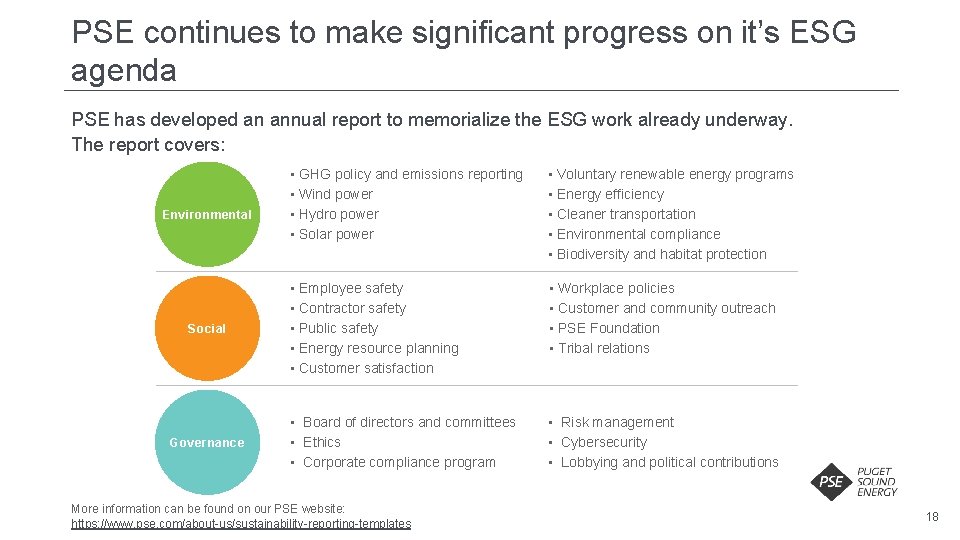
PSE continues to make significant progress on it’s ESG agenda PSE has developed an annual report to memorialize the ESG work already underway. The report covers: Environmental Social Governance • GHG policy and emissions reporting • Wind power • Hydro power • Solar power • Voluntary renewable energy programs • Energy efficiency • Cleaner transportation • Environmental compliance • Biodiversity and habitat protection • Employee safety • Contractor safety • Public safety • Energy resource planning • Customer satisfaction • Workplace policies • Customer and community outreach • PSE Foundation • Tribal relations • Board of directors and committees • Ethics • Corporate compliance program • Risk management • Cybersecurity • Lobbying and political contributions More information can be found on our PSE website: https: //www. pse. com/about-us/sustainability-reporting-templates 18
PSE’s path to exit coal is progressing and on track for completion by 2025 Colstrip • Colstrip Units 1&2 were retired effective December 31, 2019, and decreased capacity by approximately 307 MW per year. The decommissioning and remediation costs for Colstrip Units 1&2 are covered by 2017 GRC settlement and Washington’s Clean Energy Transformation Act of 2019 • PSE planned to sell Colstrip Unit 4 assets (PSE’s 25%) to North. Western Energy and Talen in December 2019. However, PSE mutually terminated the agreement on October 29, 2020 after evaluating the likelihood of regulatory approval in both Washington and Montana • Colstrip Units 3 & 4 will be fully depreciated by 2025. Centralia PPA • 380 MW PPA will ramp down to 300 MW in Jan 2025 and terminate in Dec 2025 19
To be carbon neutral by 2030, PSE will need to acquire additional clean energy generation • CETA requires Washington electric utilities to be: 1. Coal free by December 31, 2025 2. Carbon neutral by 2030 3. Carbon free by 2045 • PSE needs to acquire 2, 000 - 3, 000 MW + of nameplate renewable energy to meet 2030 target. (Amount varies based on capacity factor of the resources) • Much of PSE’s clean portfolio today consists of PSE-owned hydro and wind facilities, hydro contracts & purchases at the Mid-C market hub • There are significant renewable energy projects in the development pipeline in the PNW, but maturity varies • PSE’s current BPA transmission portfolio could be re-purposed and new transmission solutions will be required • Opportunities for distributed generation, customer programs, and storage will be required and their ultimate viability will be affected by available transmission solutions 20
Puget’s capital investment in strategic projects and reliability are the foundation of our transition to a carbon free future § Tacoma Liquefied Natural Gas Project ‒ 43% regulated at PSE; 57% unregulated at Puget LNG (50% TOTE, 50% open) ‒ LNG (regulated) business online by Q 2 2021 § Energize Eastside Strategic & ‒ Upgrade 18 miles of existing electric transmission lines to serve homes/business Risk Mitigation § AMI and Smart Grid ‒ Fully deploy AMI by 2024 ‒ Advanced Distribution Management System (ADMS) circuit enablement § Lower Baker Dam ‒ Grouting & crest improvement to reduce leakage rate & foundation erosion Distribution & § Electric Reliability Program ‒ Replace old cables & worst performing circuits Transmission ‒ Improve reliability & reduce outages § Energy Delivery & Power Generation – Other investments focus on safe, dependable, environmentally compliant operation to provide customers cost-effective supply of energy § Information Technology & Digital – investments directly support the ISP to improve system reliability, cyber security, and operational efficiency 21
In order to mitigate the financial pressure resulting from COVID-19 and unexpected GRC outcome, capital allocations are being prioritized to ensure safety, reliability, resiliency, and modernization objectives continue to move forward * 22
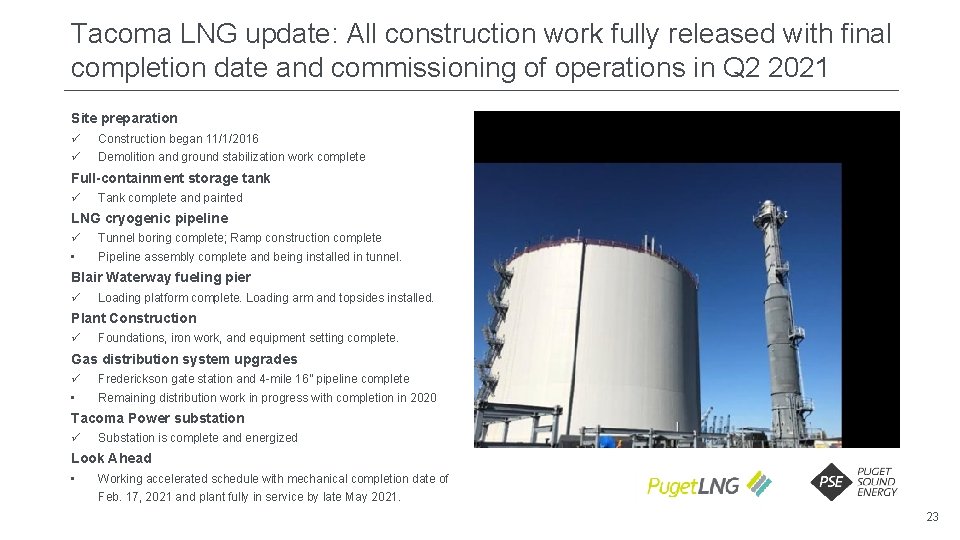
Tacoma LNG update: All construction work fully released with final completion date and commissioning of operations in Q 2 2021 Site preparation ü Construction began 11/1/2016 ü Demolition and ground stabilization work complete Full-containment storage tank ü Tank complete and painted LNG cryogenic pipeline ü Tunnel boring complete; Ramp construction complete • Pipeline assembly complete and being installed in tunnel. Blair Waterway fueling pier ü Loading platform complete. Loading arm and topsides installed. Plant Construction ü Foundations, iron work, and equipment setting complete. Gas distribution system upgrades ü Frederickson gate station and 4 -mile 16” pipeline complete • Remaining distribution work in progress with completion in 2020 Tacoma Power substation ü Substation is complete and energized Look Ahead • Working accelerated schedule with mechanical completion date of Feb. 17, 2021 and plant fully in service by late May 2021. 23
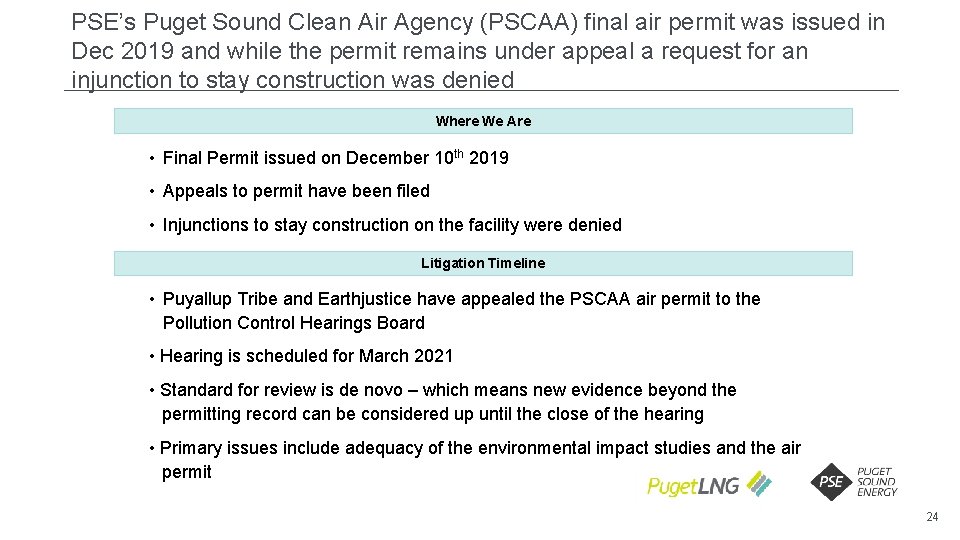
PSE’s Puget Sound Clean Air Agency (PSCAA) final air permit was issued in Dec 2019 and while the permit remains under appeal a request for an injunction to stay construction was denied Where We Are • Final Permit issued on December 10 th 2019 • Appeals to permit have been filed • Injunctions to stay construction on the facility were denied Litigation Timeline • Puyallup Tribe and Earthjustice have appealed the PSCAA air permit to the Pollution Control Hearings Board • Hearing is scheduled for March 2021 • Standard for review is de novo – which means new evidence beyond the permitting record can be considered up until the close of the hearing • Primary issues include adequacy of the environmental impact studies and the air permit 24
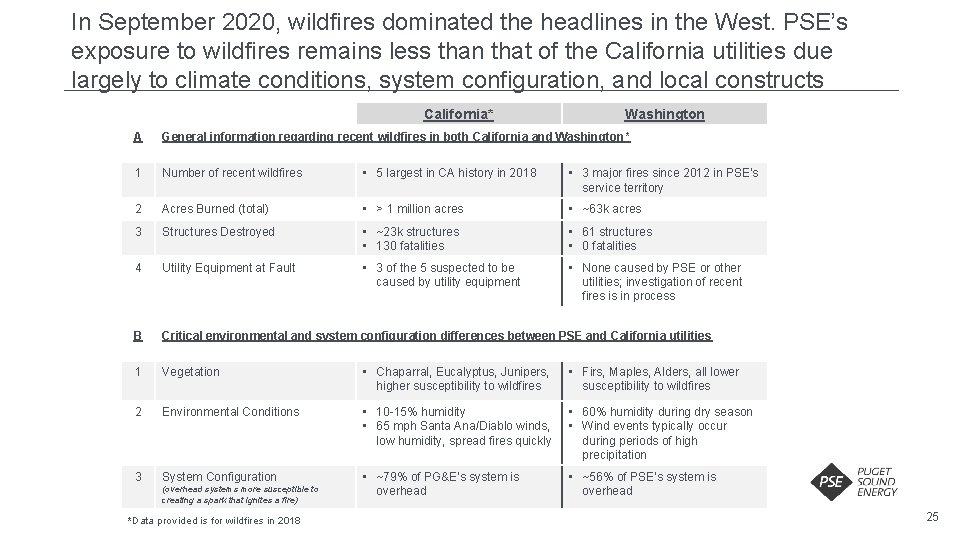
In September 2020, wildfires dominated the headlines in the West. PSE’s exposure to wildfires remains less than that of the California utilities due largely to climate conditions, system configuration, and local constructs California* Washington A General information regarding recent wildfires in both California and Washington* 1 Number of recent wildfires • 5 largest in CA history in 2018 • 3 major fires since 2012 in PSE’s service territory 2 Acres Burned (total) • > 1 million acres • ~63 k acres 3 Structures Destroyed • ~23 k structures • 130 fatalities • 61 structures • 0 fatalities 4 Utility Equipment at Fault • 3 of the 5 suspected to be caused by utility equipment • None caused by PSE or other utilities; investigation of recent fires is in process B Critical environmental and system configuration differences between PSE and California utilities 1 Vegetation • Chaparral, Eucalyptus, Junipers, higher susceptibility to wildfires • Firs, Maples, Alders, all lower susceptibility to wildfires 2 Environmental Conditions • 10 -15% humidity • 65 mph Santa Ana/Diablo winds, low humidity, spread fires quickly • 60% humidity during dry season • Wind events typically occur during periods of high precipitation 3 System Configuration • ~79% of PG&E’s system is overhead • ~56% of PSE’s system is overhead (overhead systems more susceptible to creating a spark that ignites a fire) *Data provided is for wildfires in 2018 25
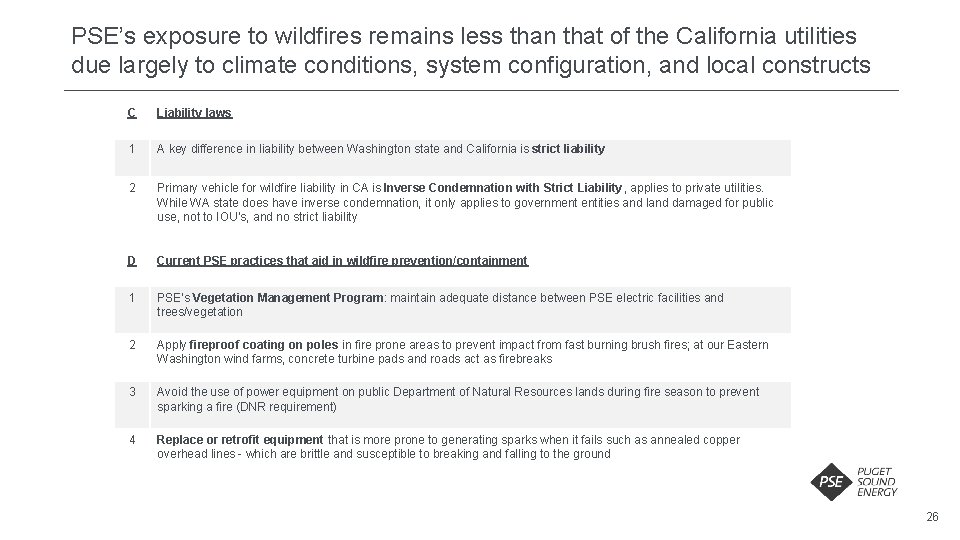
PSE’s exposure to wildfires remains less than that of the California utilities due largely to climate conditions, system configuration, and local constructs C Liability laws 1 A key difference in liability between Washington state and California is strict liability 2 Primary vehicle for wildfire liability in CA is Inverse Condemnation with Strict Liability, applies to private utilities. While WA state does have inverse condemnation, it only applies to government entities and land damaged for public use, not to IOU’s, and no strict liability D Current PSE practices that aid in wildfire prevention/containment 1 PSE’s Vegetation Management Program: maintain adequate distance between PSE electric facilities and trees/vegetation 2 Apply fireproof coating on poles in fire prone areas to prevent impact from fast burning brush fires; at our Eastern Washington wind farms, concrete turbine pads and roads act as firebreaks 3 Avoid the use of power equipment on public Department of Natural Resources lands during fire season to prevent sparking a fire (DNR requirement) 4 Replace or retrofit equipment that is more prone to generating sparks when it fails such as annealed copper overhead lines - which are brittle and susceptible to breaking and falling to the ground 26
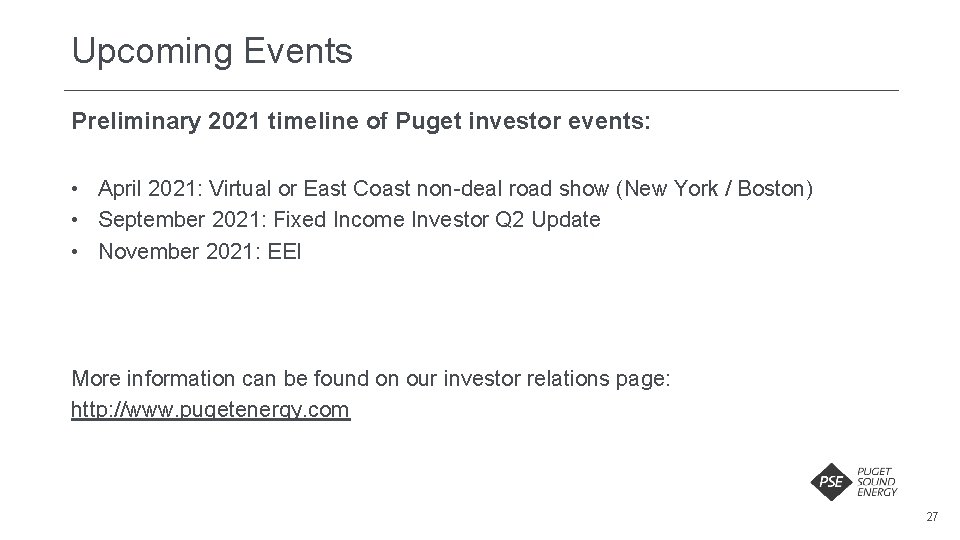
Upcoming Events Preliminary 2021 timeline of Puget investor events: • April 2021: Virtual or East Coast non-deal road show (New York / Boston) • September 2021: Fixed Income Investor Q 2 Update • November 2021: EEI More information can be found on our investor relations page: http: //www. pugetenergy. com 27
APPENDIX: OTHER COMPANY INFORMATION 28
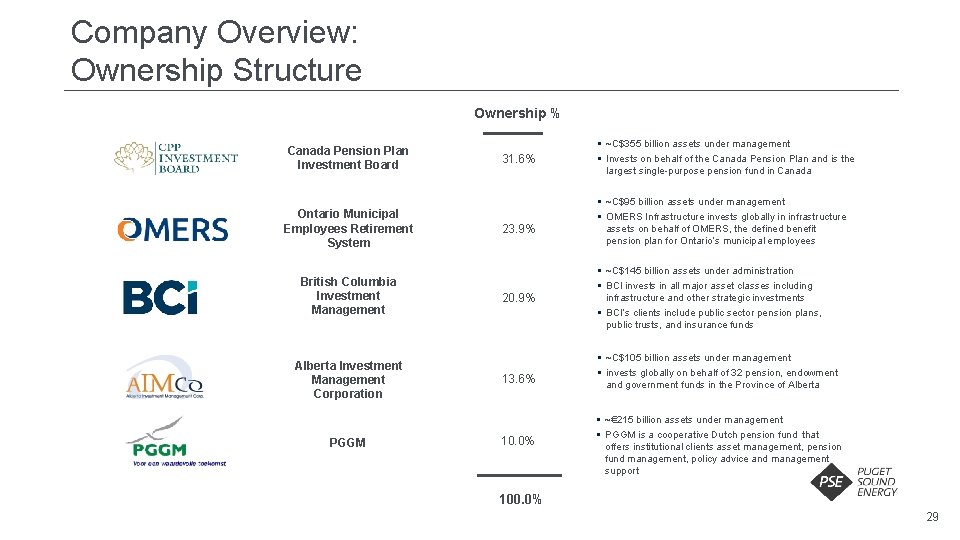
Company Overview: Ownership Structure Ownership % Canada Pension Plan Investment Board Ontario Municipal Employees Retirement System British Columbia Investment Management Alberta Investment Management Corporation PGGM 31. 6% 23. 9% 20. 9% 13. 6% 10. 0% § ~C$355 billion assets under management § Invests on behalf of the Canada Pension Plan and is the largest single-purpose pension fund in Canada § ~C$95 billion assets under management § OMERS Infrastructure invests globally in infrastructure assets on behalf of OMERS, the defined benefit pension plan for Ontario’s municipal employees § ~C$145 billion assets under administration § BCI invests in all major asset classes including infrastructure and other strategic investments § BCI’s clients include public sector pension plans, public trusts, and insurance funds § ~C$105 billion assets under management § invests globally on behalf of 32 pension, endowment and government funds in the Province of Alberta § ~€ 215 billion assets under management § PGGM is a cooperative Dutch pension fund that offers institutional clients asset management, pension fund management, policy advice and management support 100. 0% 29
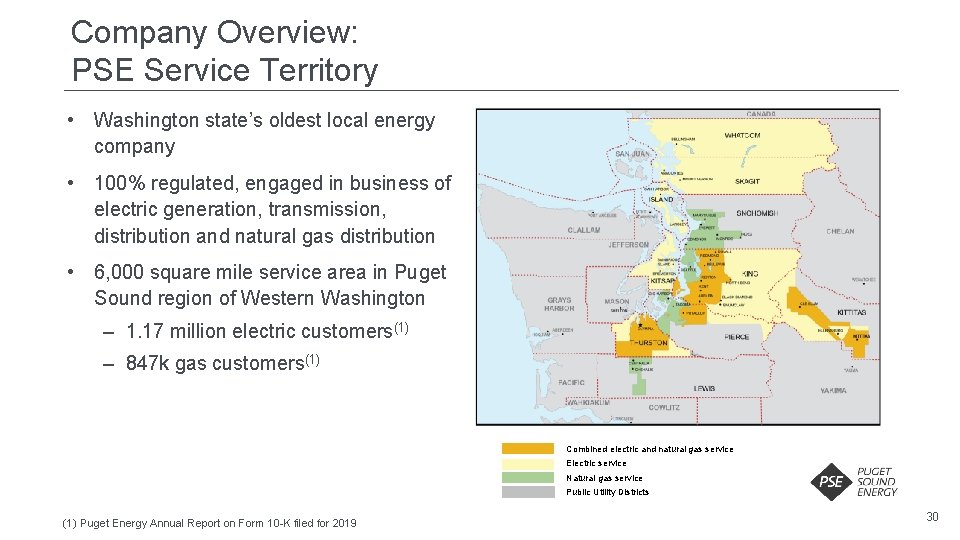
Company Overview: PSE Service Territory • Washington state’s oldest local energy company • 100% regulated, engaged in business of electric generation, transmission, distribution and natural gas distribution • 6, 000 square mile service area in Puget Sound region of Western Washington – 1. 17 million electric customers(1) – 847 k gas customers(1) Combined electric and natural gas service Electric service Natural gas service Public Utility Districts (1) Puget Energy Annual Report on Form 10 -K filed for 2019 30
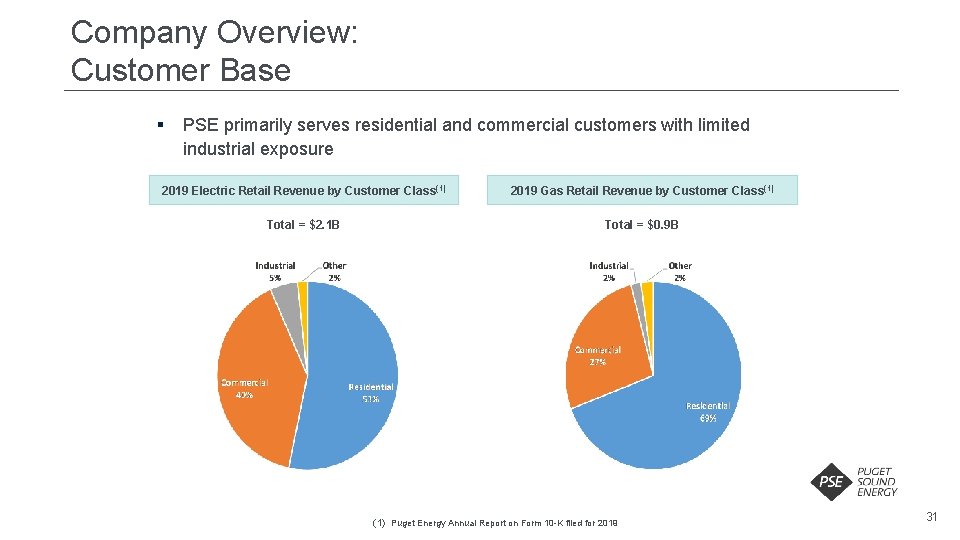
Company Overview: Customer Base § PSE primarily serves residential and commercial customers with limited industrial exposure 2019 Electric Retail Revenue by Customer Class(1) 2019 Gas Retail Revenue by Customer Class(1) Total = $2. 1 B Total = $0. 9 B (1) Puget Energy Annual Report on Form 10 -K filed for 2019 31
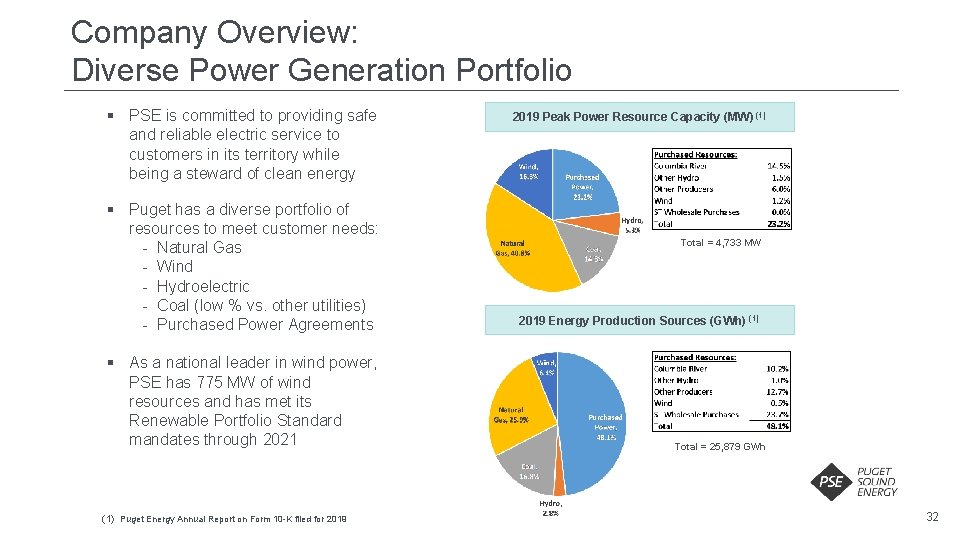
Company Overview: Diverse Power Generation Portfolio § PSE is committed to providing safe and reliable electric service to customers in its territory while being a steward of clean energy § Puget has a diverse portfolio of resources to meet customer needs: - Natural Gas - Wind - Hydroelectric - Coal (low % vs. other utilities) - Purchased Power Agreements § As a national leader in wind power, PSE has 775 MW of wind resources and has met its Renewable Portfolio Standard mandates through 2021 (1) Puget Energy Annual Report on Form 10 -K filed for 2019 Peak Power Resource Capacity (MW) (1) Total = 4, 733 MW 2019 Energy Production Sources (GWh) (1) Total = 25, 879 GWh 32