Treatment of serous endometrial cancer Frdric Amant MD
- Slides: 53
Treatment of serous endometrial cancer Frédéric Amant, MD Ph. D
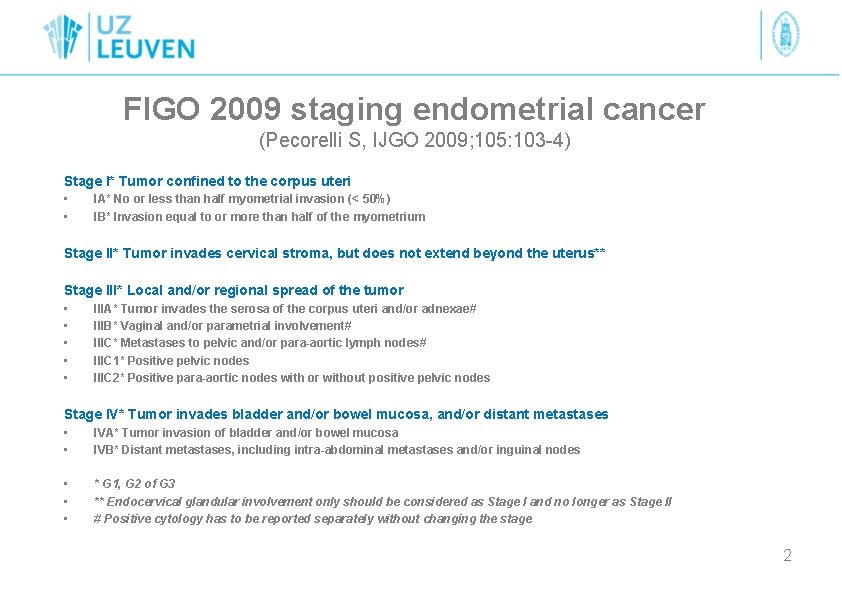
FIGO 2009 staging endometrial cancer (Pecorelli S, IJGO 2009; 105: 103 -4) Stage I* Tumor confined to the corpus uteri • • IA* No or less than half myometrial invasion (< 50%) IB* Invasion equal to or more than half of the myometrium Stage II* Tumor invades cervical stroma, but does not extend beyond the uterus** Stage III* Local and/or regional spread of the tumor • • • IIIA* Tumor invades the serosa of the corpus uteri and/or adnexae# IIIB* Vaginal and/or parametrial involvement# IIIC* Metastases to pelvic and/or para-aortic lymph nodes# IIIC 1* Positive pelvic nodes IIIC 2* Positive para-aortic nodes with or without positive pelvic nodes Stage IV* Tumor invades bladder and/or bowel mucosa, and/or distant metastases • • IVA* Tumor invasion of bladder and/or bowel mucosa IVB* Distant metastases, including intra-abdominal metastases and/or inguinal nodes • • • * G 1, G 2 of G 3 ** Endocervical glandular involvement only should be considered as Stage I and no longer as Stage II # Positive cytology has to be reported separately without changing the stage 2
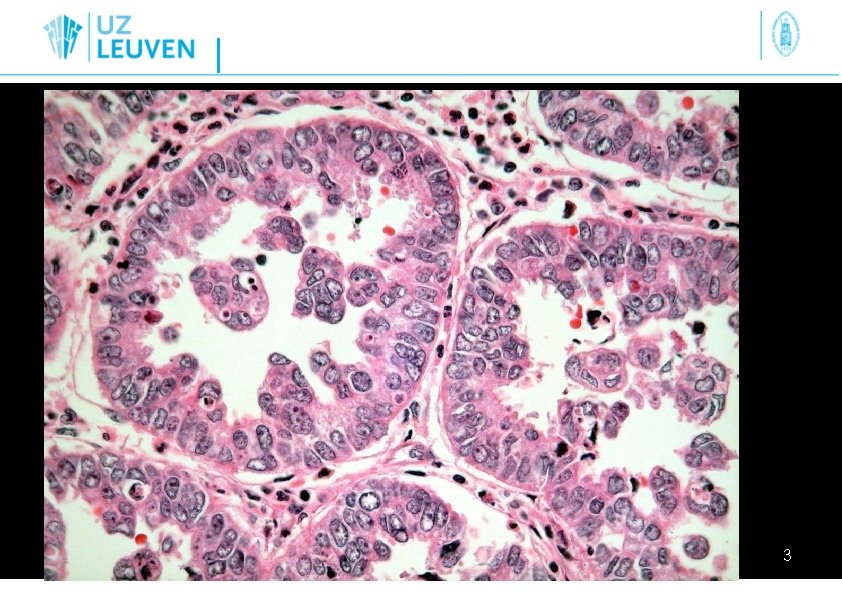
c 3
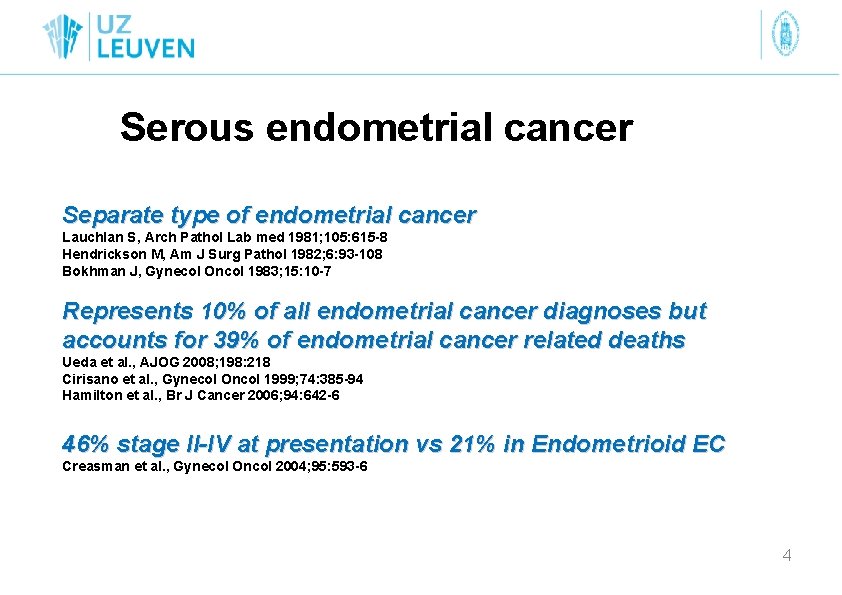
Serous endometrial cancer Separate type of endometrial cancer Lauchlan S, Arch Pathol Lab med 1981; 105: 615 -8 Hendrickson M, Am J Surg Pathol 1982; 6: 93 -108 Bokhman J, Gynecol Oncol 1983; 15: 10 -7 Represents 10% of all endometrial cancer diagnoses but accounts for 39% of endometrial cancer related deaths Ueda et al. , AJOG 2008; 198: 218 Cirisano et al. , Gynecol Oncol 1999; 74: 385 -94 Hamilton et al. , Br J Cancer 2006; 94: 642 -6 46% stage II-IV at presentation vs 21% in Endometrioid EC Creasman et al. , Gynecol Oncol 2004; 95: 593 -6 4
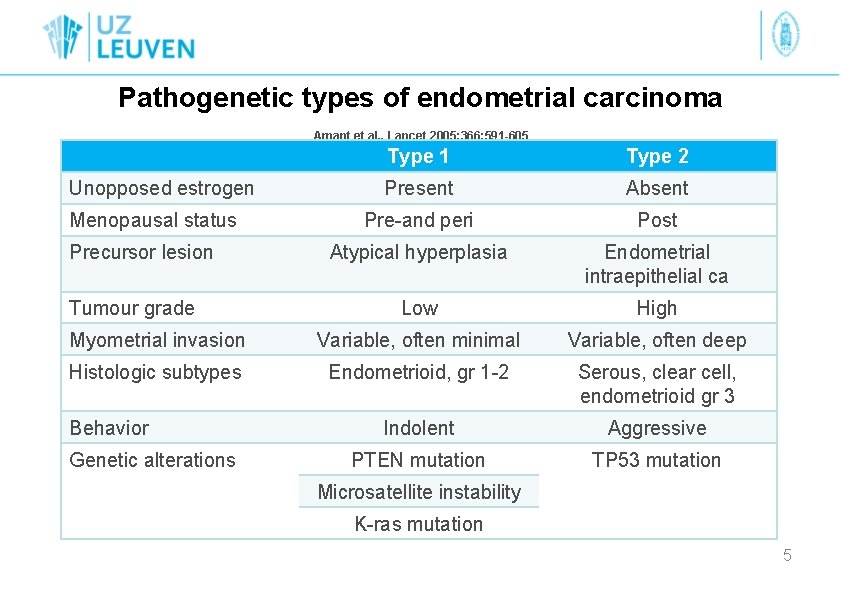
Pathogenetic types of endometrial carcinoma Amant et al. , Lancet 2005; 366: 591 -605 Type 1 Type 2 Present Absent Pre-and peri Post Atypical hyperplasia Endometrial intraepithelial ca Low High Myometrial invasion Variable, often minimal Variable, often deep Histologic subtypes Endometrioid, gr 1 -2 Serous, clear cell, endometrioid gr 3 Indolent Aggressive PTEN mutation TP 53 mutation Unopposed estrogen Menopausal status Precursor lesion Tumour grade Behavior Genetic alterations Microsatellite instability K-ras mutation 5
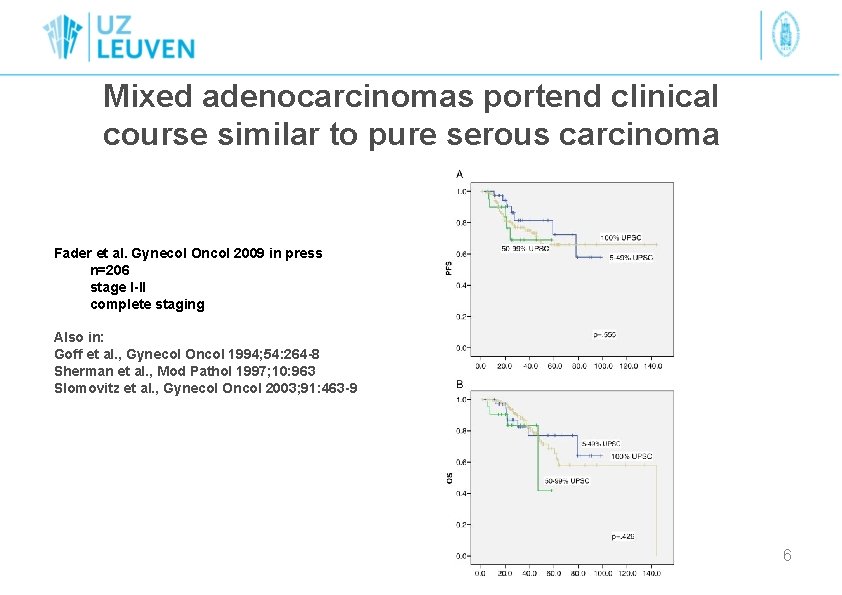
Mixed adenocarcinomas portend clinical course similar to pure serous carcinoma Fader et al. Gynecol Oncol 2009 in press n=206 stage I-II complete staging Also in: Goff et al. , Gynecol Oncol 1994; 54: 264 -8 Sherman et al. , Mod Pathol 1997; 10: 963 Slomovitz et al. , Gynecol Oncol 2003; 91: 463 -9 6
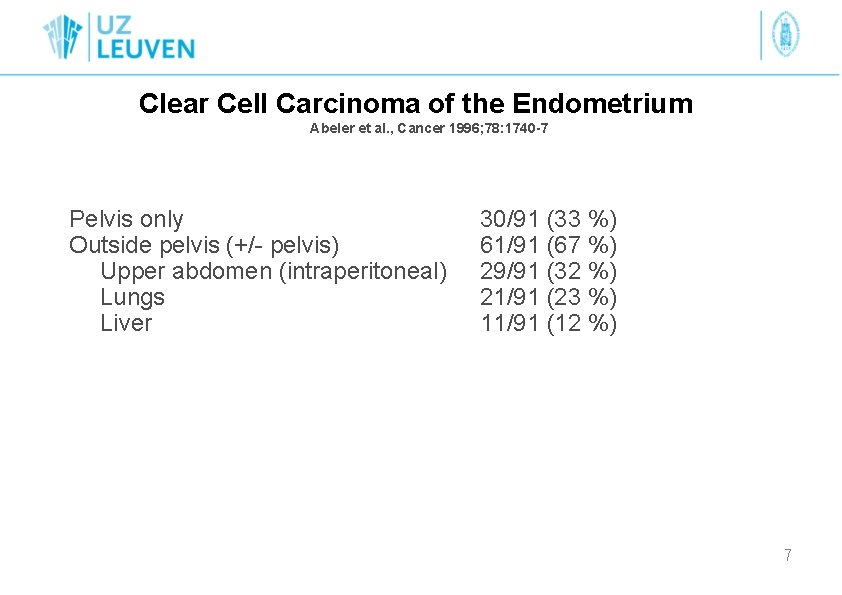
Clear Cell Carcinoma of the Endometrium Abeler et al. , Cancer 1996; 78: 1740 -7 Pelvis only Outside pelvis (+/- pelvis) Upper abdomen (intraperitoneal) Lungs Liver 30/91 (33 %) 61/91 (67 %) 29/91 (32 %) 21/91 (23 %) 11/91 (12 %) 7
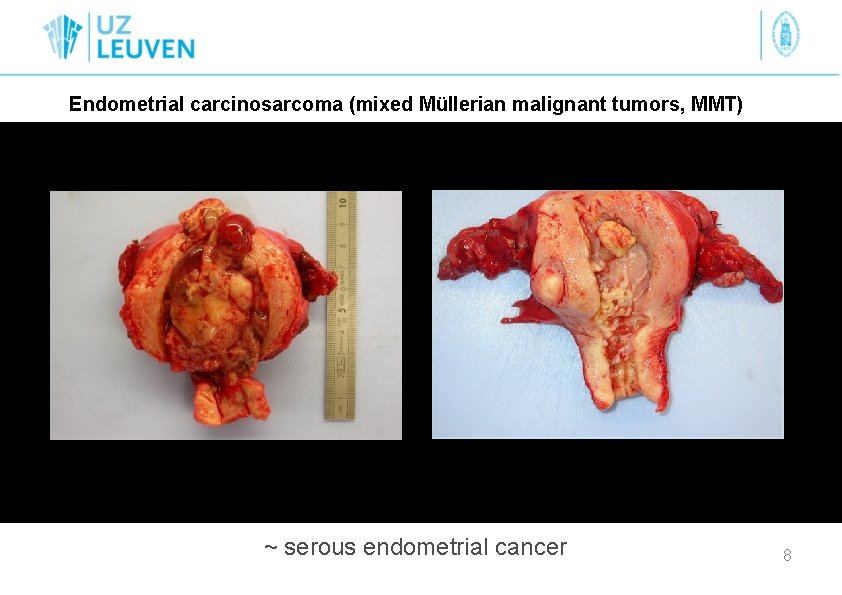
Endometrial carcinosarcoma (mixed Müllerian malignant tumors, MMT) ~ serous endometrial cancer 8
Serous endometrial cancer • • Surgical staging Role of adjuvant chemotherapy Stage IV disease Treatment proposal
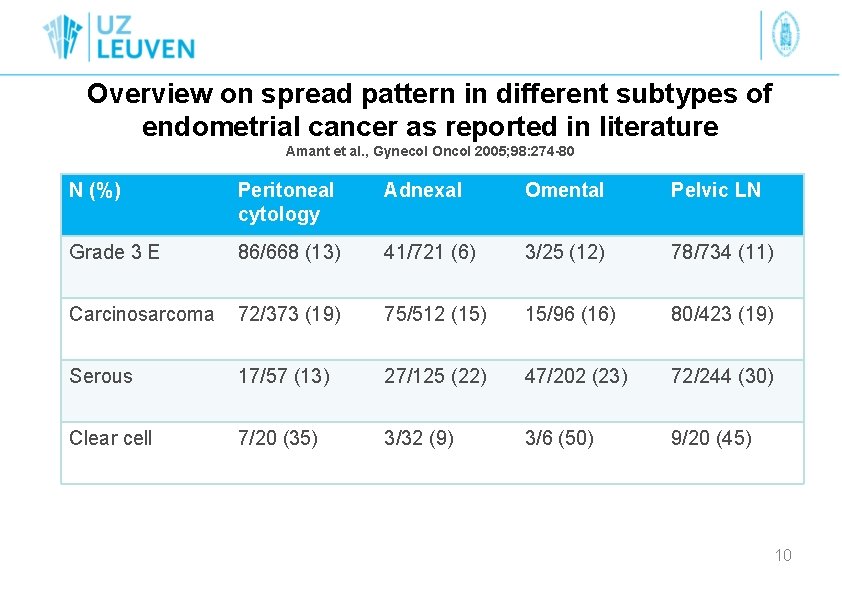
Overview on spread pattern in different subtypes of endometrial cancer as reported in literature Amant et al. , Gynecol Oncol 2005; 98: 274 -80 N (%) Peritoneal cytology Adnexal Omental Pelvic LN Grade 3 E 86/668 (13) 41/721 (6) 3/25 (12) 78/734 (11) Carcinosarcoma 72/373 (19) 75/512 (15) 15/96 (16) 80/423 (19) Serous 17/57 (13) 27/125 (22) 47/202 (23) 72/244 (30) Clear cell 7/20 (35) 3/32 (9) 3/6 (50) 9/20 (45) 10
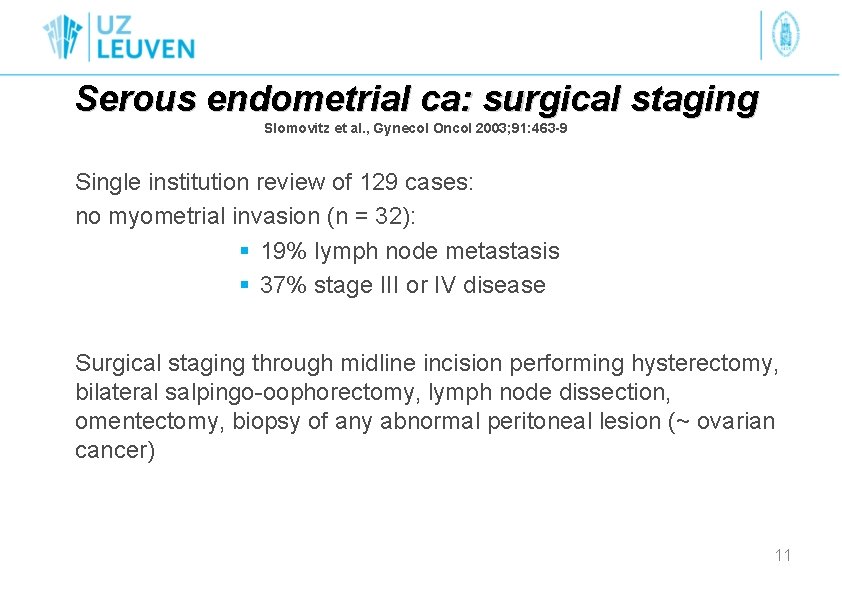
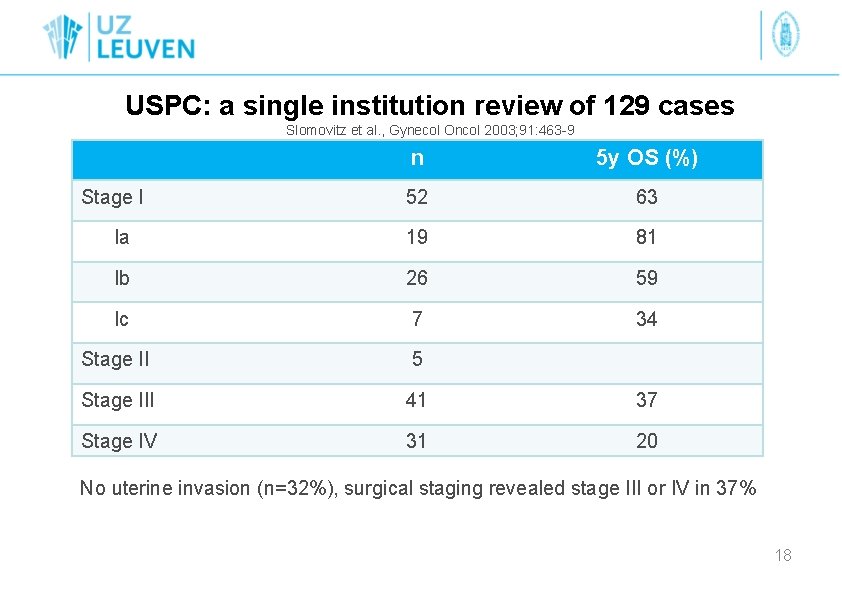
Serous endometrial ca: surgical staging Slomovitz et al. , Gynecol Oncol 2003; 91: 463 -9 Single institution review of 129 cases: no myometrial invasion (n = 32): § 19% lymph node metastasis § 37% stage III or IV disease Surgical staging through midline incision performing hysterectomy, bilateral salpingo-oophorectomy, lymph node dissection, omentectomy, biopsy of any abnormal peritoneal lesion (~ ovarian cancer) 11
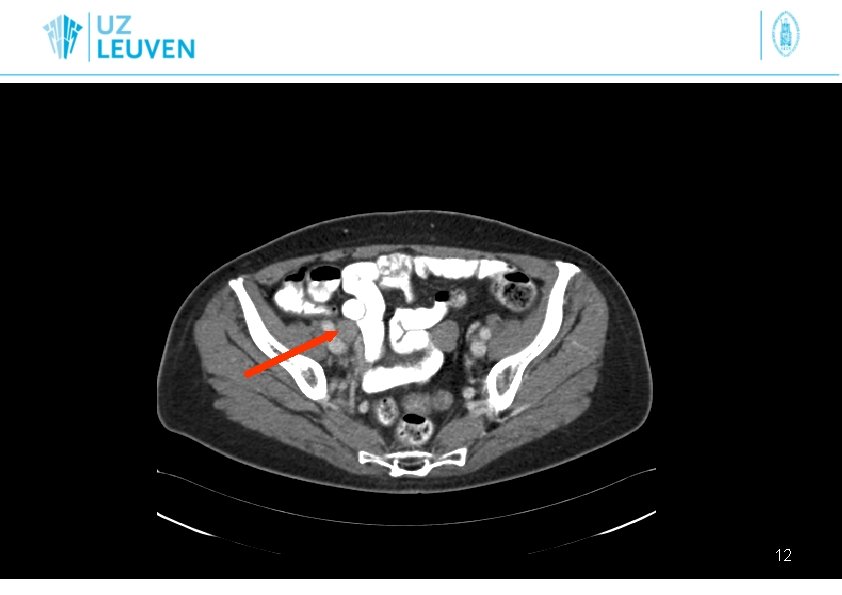
12
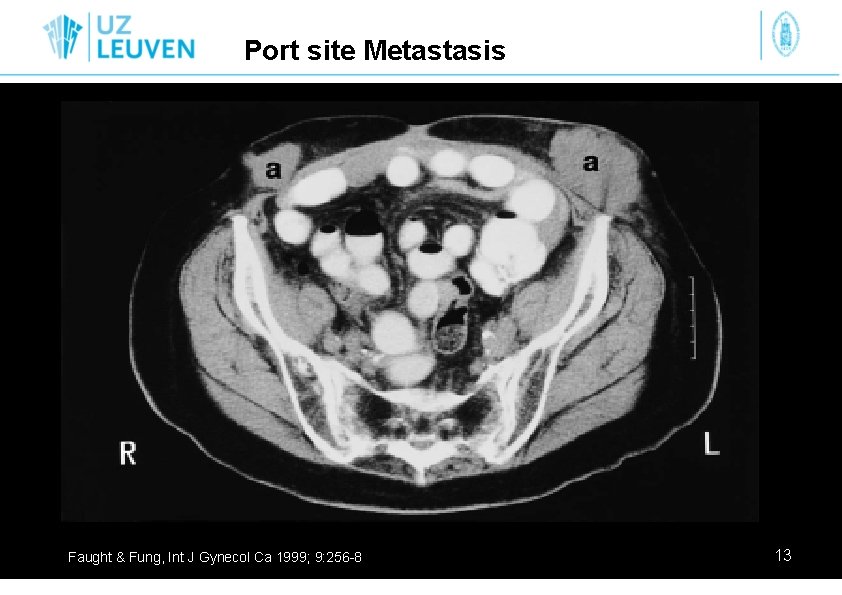
Port site Metastasis Faught & Fung, Int J Gynecol Ca 1999; 9: 256 -8 13
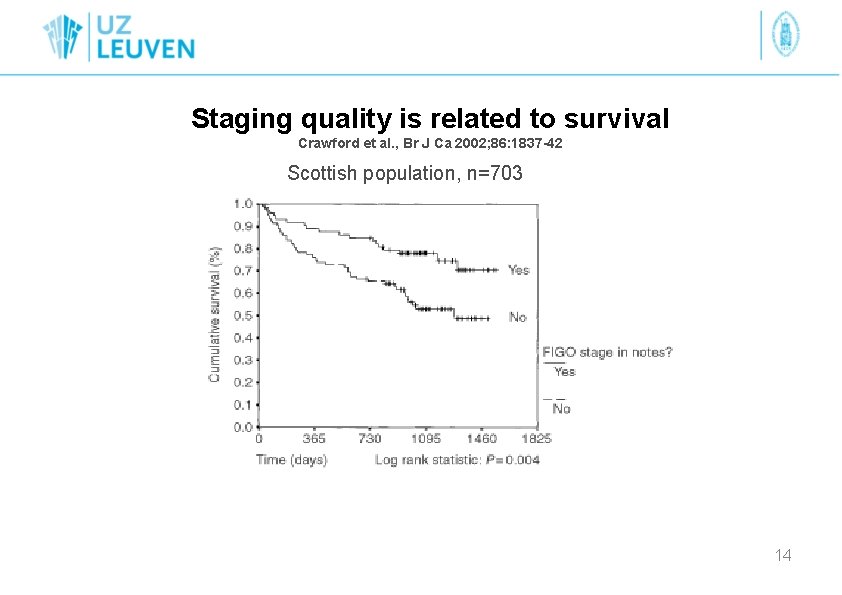
Staging quality is related to survival Crawford et al. , Br J Ca 2002; 86: 1837 -42 Scottish population, n=703 14
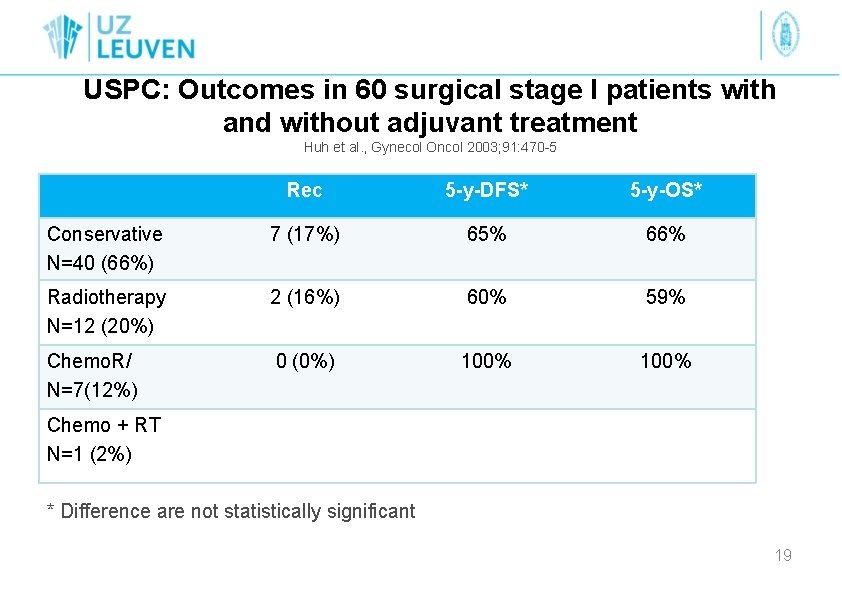
Role of radiotherapy? Huh et al. , Gynecol Oncol 2003; 91: 470 -5 Podratz & Mariani, Gynecol Oncol 2003; 91: 461 -2 40 node negative serous EC cases not receiving adjuvant therapy: § 7 failed § None to the pelvic side wall § 6 ultimately experienced distal failures In the absence of nodal metastasis following systematic lymphadenectomy adjuvant external beam pelvic radiation therapy is not indicated. 15
Serous endometrial cancer • • Surgical staging Role of adjuvant chemotherapy Stage IV disease Treatment proposal
Evidence pro adjuvant chemotherapy 17
USPC: a single institution review of 129 cases Slomovitz et al. , Gynecol Oncol 2003; 91: 463 -9 n 5 y OS (%) 52 63 Ia 19 81 Ib 26 59 Ic 7 34 Stage II 5 Stage III 41 37 Stage IV 31 20 No uterine invasion (n=32%), surgical staging revealed stage III or IV in 37% 18
USPC: Outcomes in 60 surgical stage I patients with and without adjuvant treatment Huh et al. , Gynecol Oncol 2003; 91: 470 -5 Rec 5 -y-DFS* 5 -y-OS* Conservative N=40 (66%) 7 (17%) 65% 66% Radiotherapy N=12 (20%) 2 (16%) 60% 59% Chemo. R/ N=7(12%) 0 (0%) 100% Chemo + RT N=1 (2%) * Difference are not statistically significant 19
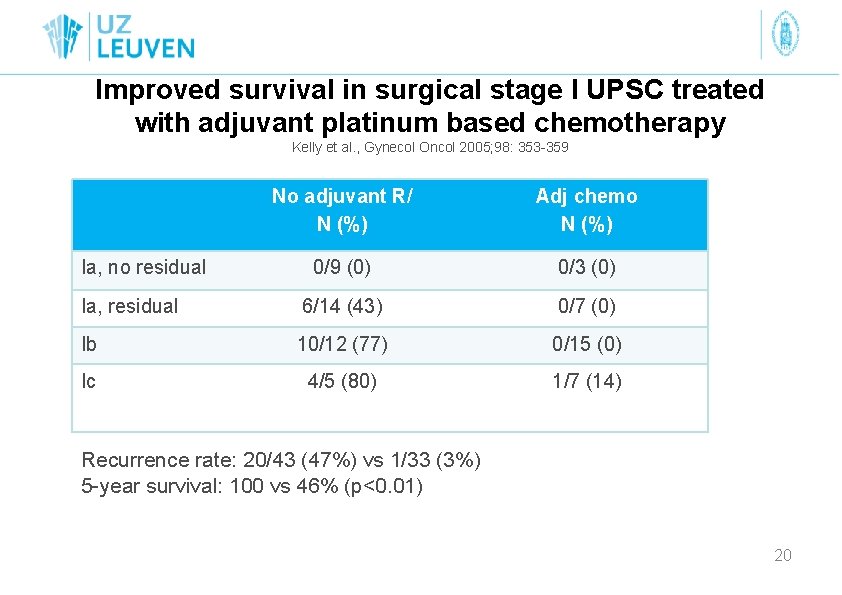
Improved survival in surgical stage I UPSC treated with adjuvant platinum based chemotherapy Kelly et al. , Gynecol Oncol 2005; 98: 353 -359 No adjuvant R/ N (%) Adj chemo N (%) 0/9 (0) 0/3 (0) Ia, residual 6/14 (43) 0/7 (0) Ib 10/12 (77) 0/15 (0) Ic 4/5 (80) 1/7 (14) Ia, no residual Recurrence rate: 20/43 (47%) vs 1/33 (3%) 5 -year survival: 100 vs 46% (p<0. 01) 20
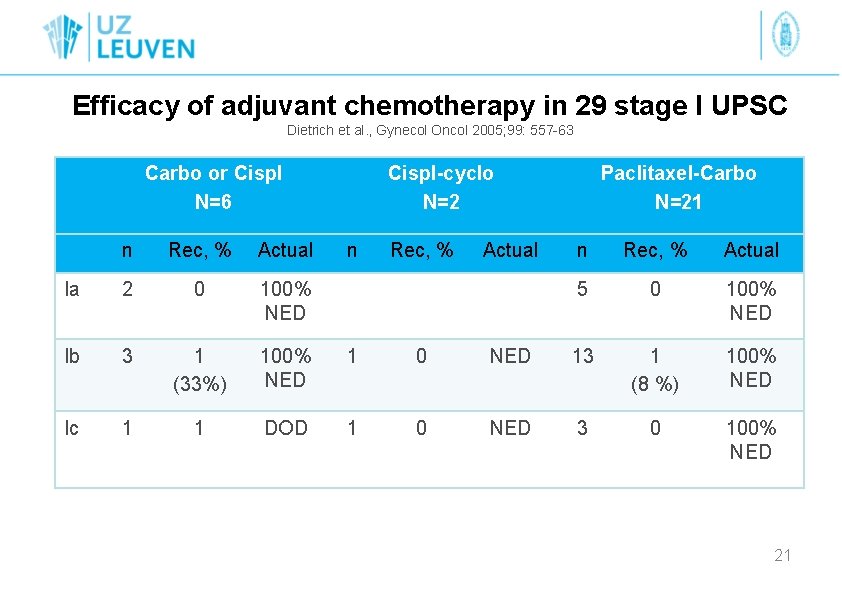
Efficacy of adjuvant chemotherapy in 29 stage I UPSC Dietrich et al. , Gynecol Oncol 2005; 99: 557 -63 Carbo or Cispl N=6 Cispl-cyclo N=2 n Rec, % Actual n Rec, % Ia 2 0 100% NED Ib 3 1 (33%) 100% NED 1 0 Ic 1 1 DOD 1 0 Actual Paclitaxel-Carbo N=21 n Rec, % Actual 5 0 100% NED 13 1 (8 %) 100% NED 3 0 100% NED 21
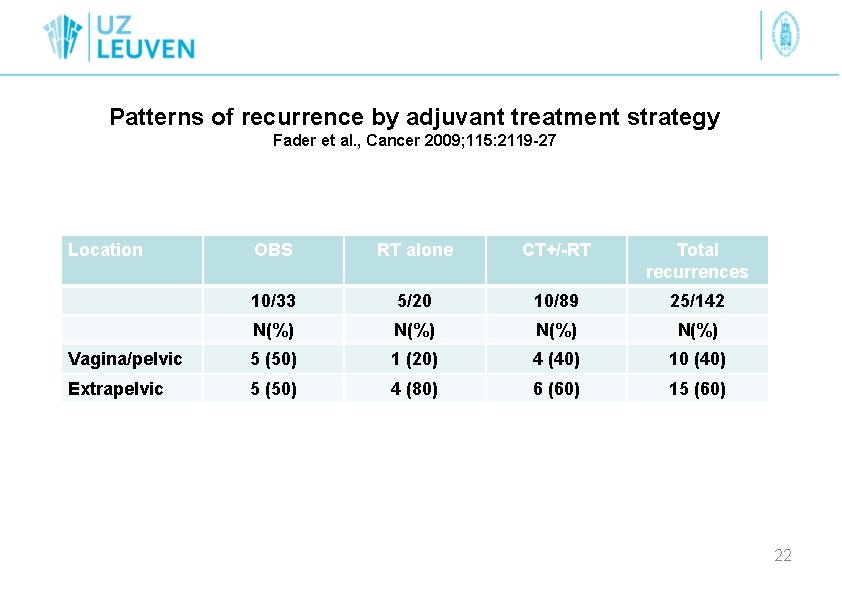
Patterns of recurrence by adjuvant treatment strategy Fader et al. , Cancer 2009; 115: 2119 -27 Location OBS RT alone CT+/-RT Total recurrences 10/33 5/20 10/89 25/142 N(%) Vagina/pelvic 5 (50) 1 (20) 4 (40) 10 (40) Extrapelvic 5 (50) 4 (80) 6 (60) 15 (60) 22
Evidence against adjuvant chemotherapy 23
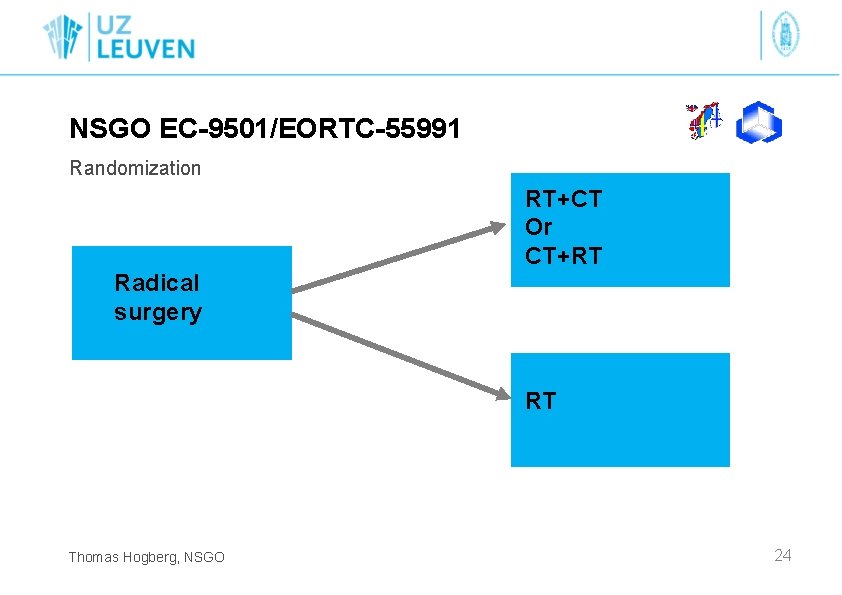
NSGO EC-9501/EORTC-55991 Randomization Radical surgery RT+CT Or CT+RT RT Thomas Hogberg, NSGO 24
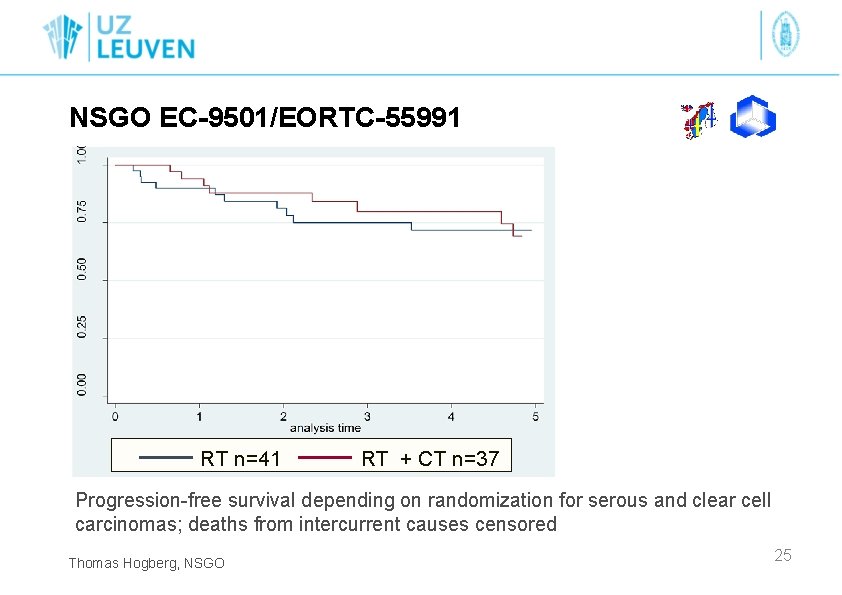
NSGO EC-9501/EORTC-55991 RT n=41 RT + CT n=37 Progression-free survival depending on randomization for serous and clear cell carcinomas; deaths from intercurrent causes censored Thomas Hogberg, NSGO 25
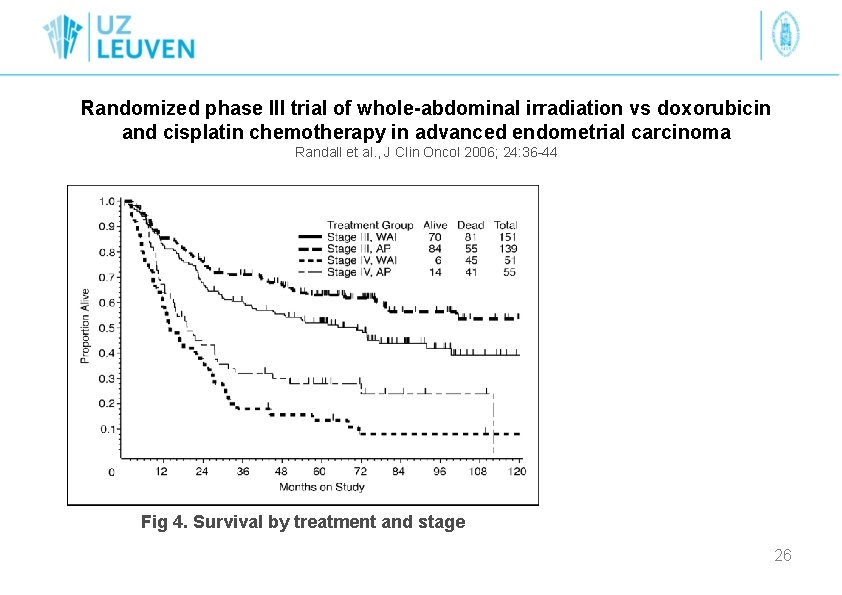
Randomized phase III trial of whole-abdominal irradiation vs doxorubicin and cisplatin chemotherapy in advanced endometrial carcinoma Randall et al. , J Clin Oncol 2006; 24: 36 -44 Fig 4. Survival by treatment and stage 26
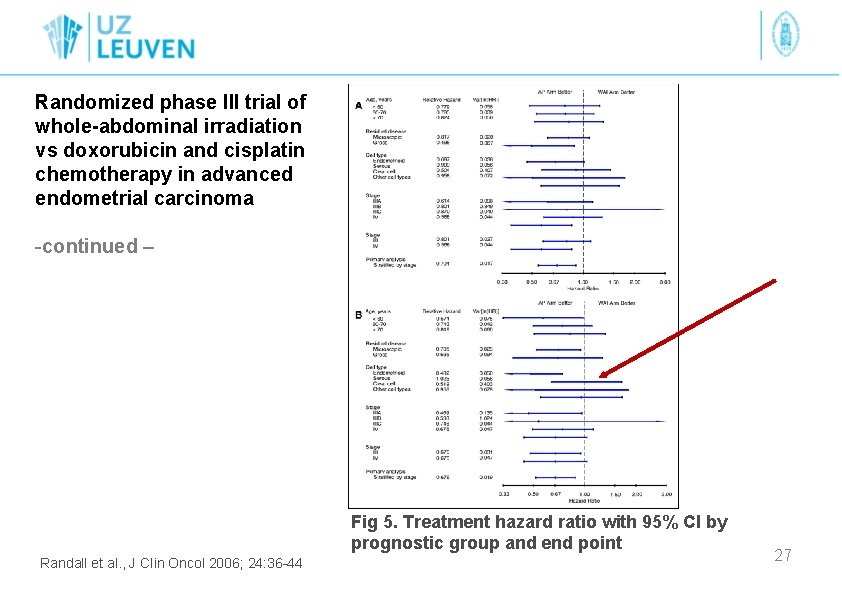
Randomized phase III trial of whole-abdominal irradiation vs doxorubicin and cisplatin chemotherapy in advanced endometrial carcinoma -continued – Fig 5. Treatment hazard ratio with 95% CI by prognostic group and end point Randall et al. , J Clin Oncol 2006; 24: 36 -44 27
Outcome without adjuvant chemotherapy? Kwon et al. , Int J Gynaecol Ca 2008; 18: 820 -4 § UPSC or CC § 22 evaluable patients (UPSC or CC) § Complete surgical staging including HT, BSO, washings, infracolic omentectomy, pelvic with or without para. AO lymphadenectomy § Stage Ia (n=9) and stage Ib (n=13) § FU is 25 mts § 1 recurrence (vag vault) -> 95% 2 -y DFS 28
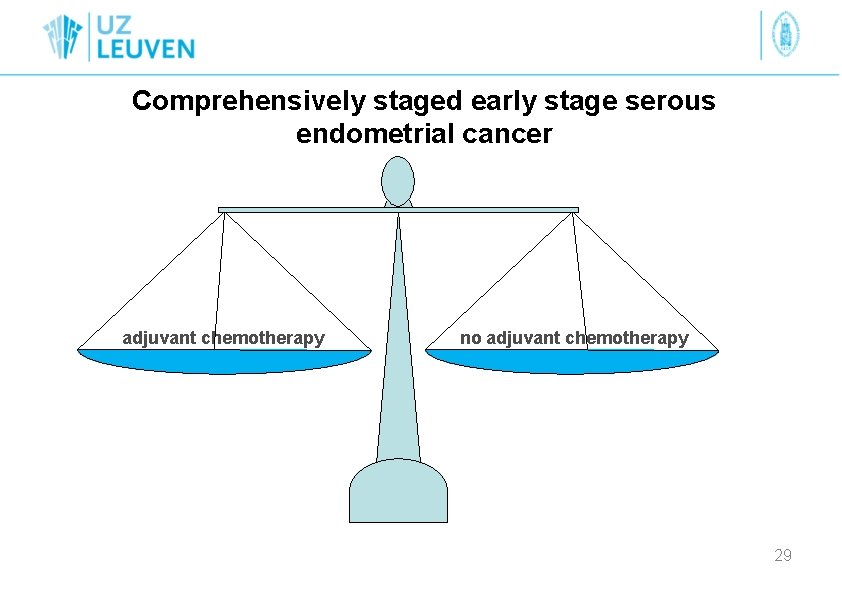
Comprehensively staged early stage serous endometrial cancer adjuvant chemotherapy no adjuvant chemotherapy 29
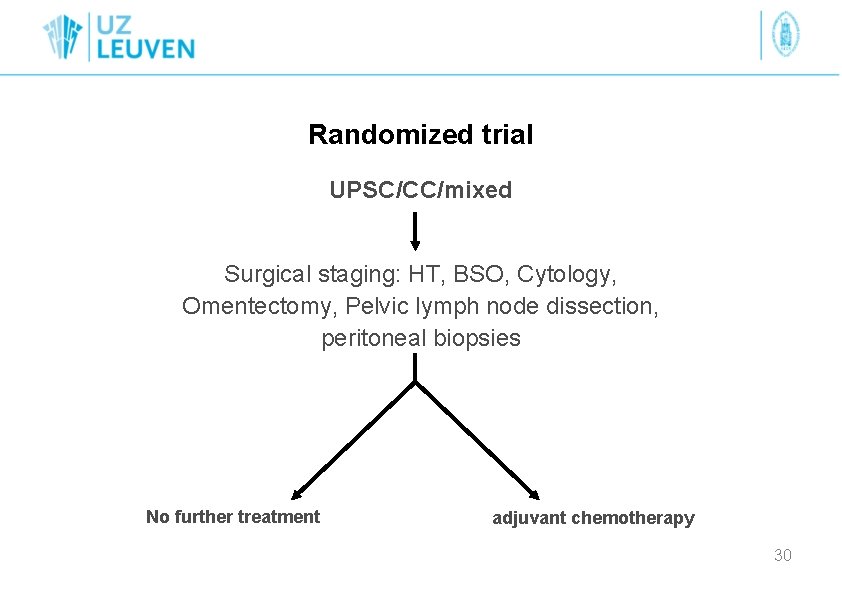
Randomized trial UPSC/CC/mixed Surgical staging: HT, BSO, Cytology, Omentectomy, Pelvic lymph node dissection, peritoneal biopsies No further treatment adjuvant chemotherapy 30
Current status § Approved by ethical committee in Leuven and 9 Flemish centers (01 -2008) § Flemish Group Gynecological Oncology § Trial is open for inclusion § Three patients included § Looking for collaboration 31
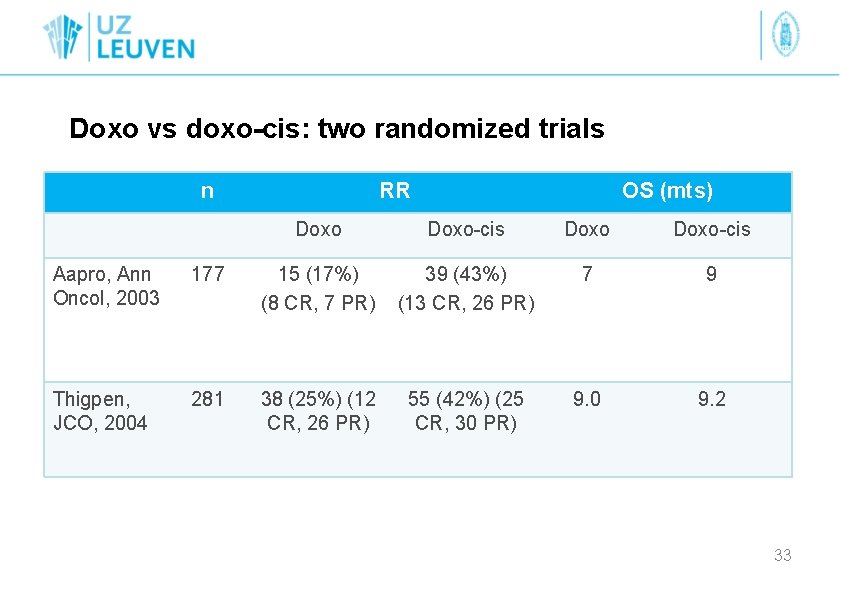
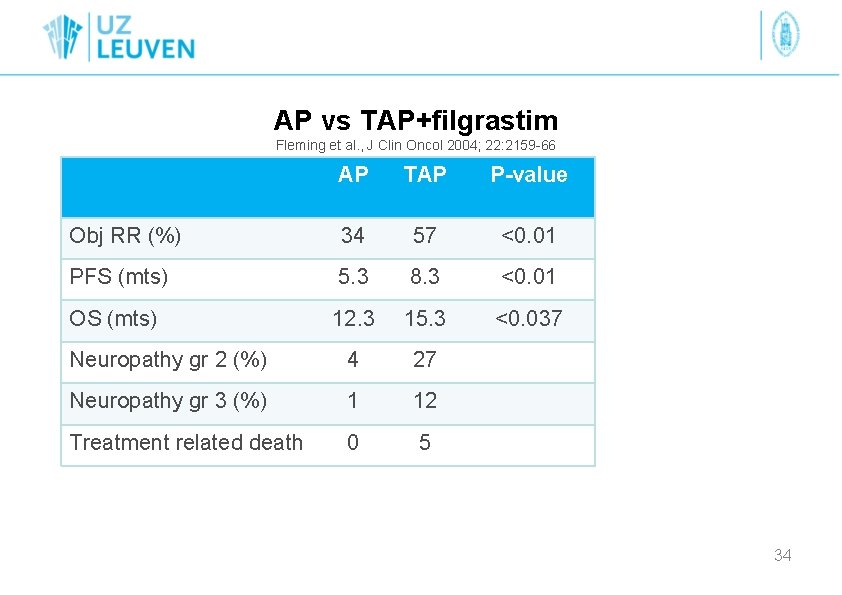
Which type of chemotherapy? 32
Doxo vs doxo-cis: two randomized trials n RR OS (mts) Doxo-cis Aapro, Ann Oncol, 2003 177 15 (17%) (8 CR, 7 PR) 39 (43%) (13 CR, 26 PR) 7 9 Thigpen, JCO, 2004 281 38 (25%) (12 CR, 26 PR) 55 (42%) (25 CR, 30 PR) 9. 0 9. 2 33
AP vs TAP+filgrastim Fleming et al. , J Clin Oncol 2004; 22: 2159 -66 AP TAP P-value Obj RR (%) 34 57 <0. 01 PFS (mts) 5. 3 8. 3 <0. 01 OS (mts) 12. 3 15. 3 <0. 037 Neuropathy gr 2 (%) 4 27 Neuropathy gr 3 (%) 1 12 Treatment related death 0 5 34
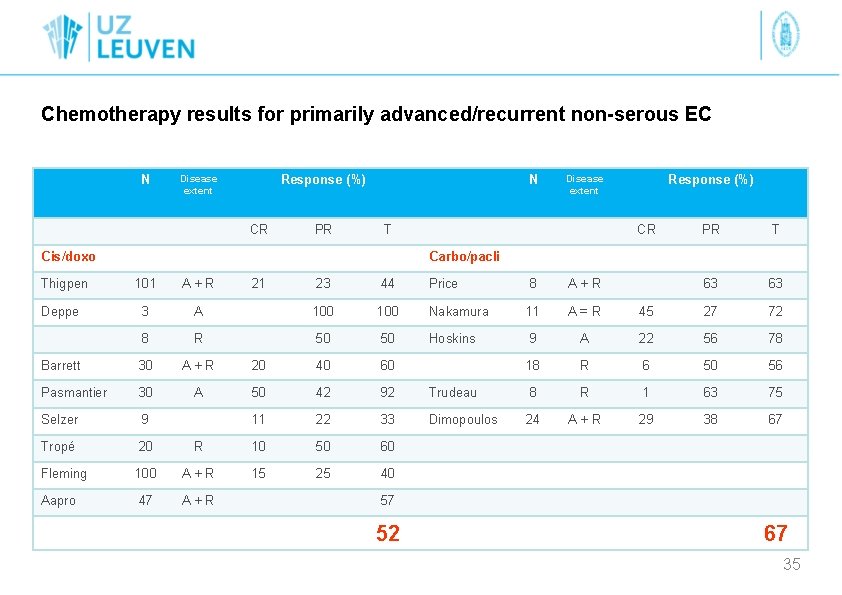
Chemotherapy results for primarily advanced/recurrent non-serous EC N Disease extent Response (%) CR PR N T Cis/doxo Thigpen Disease extent Response (%) CR PR T 63 63 Carbo/pacli 23 44 Price 8 A+R A 100 Nakamura 11 A=R 45 27 72 8 R 50 50 Hoskins 9 A 22 56 78 Barrett 30 A+R 20 40 60 18 R 6 50 56 Pasmantier 30 A 50 42 92 Trudeau 8 R 1 63 75 Selzer 9 11 22 33 Dimopoulos 24 A+R 29 38 67 Tropé 20 R 10 50 60 Fleming 100 A+R 15 25 40 Aapro 47 A+R Deppe 101 A+R 3 21 57 52 67 35
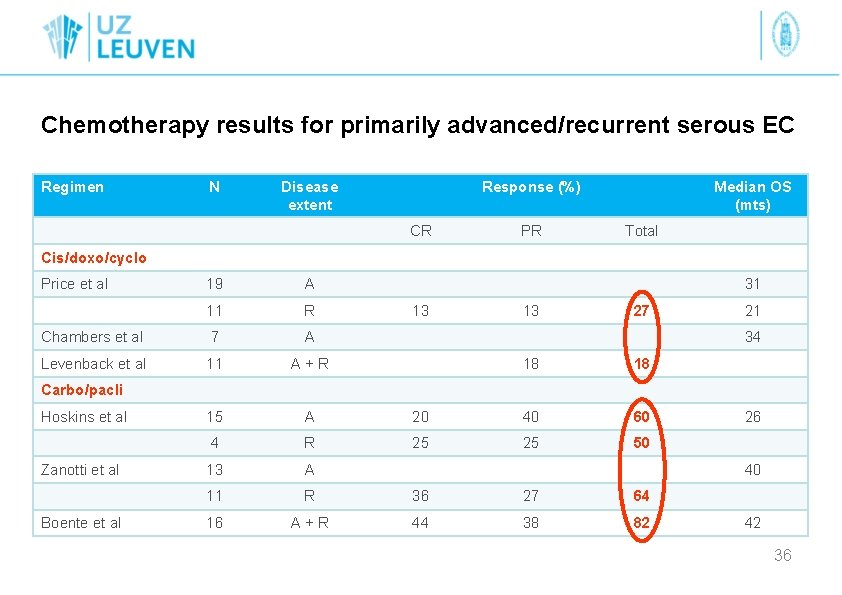
Chemotherapy results for primarily advanced/recurrent serous EC Regimen N Disease extent Response (%) CR PR Median OS (mts) Total Cis/doxo/cyclo Price et al 19 A 31 11 R Chambers et al 7 A Levenback et al 11 A+R 15 A 4 R 13 A 11 R 36 27 64 16 A+R 44 38 82 13 13 27 21 34 18 18 20 40 60 25 25 50 Carbo/pacli Hoskins et al Zanotti et al Boente et al 26 40 42 36
Serous endometrial cancer • • Surgical staging Role of adjuvant chemotherapy Stage IV disease Treatment proposal
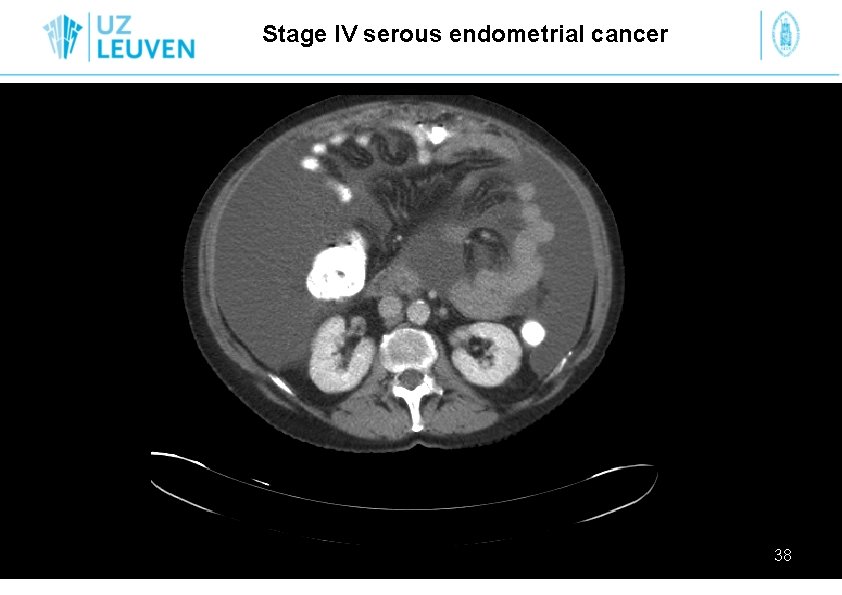
Stage IV serous endometrial cancer 38
Stage IV serous EC § 5 y OS: 0 -10% § Poor survival questioned benefit of cytoreductive surgery § Variety of management strategy: § Cytotoxic treatment only § Primary debulking surgery 39
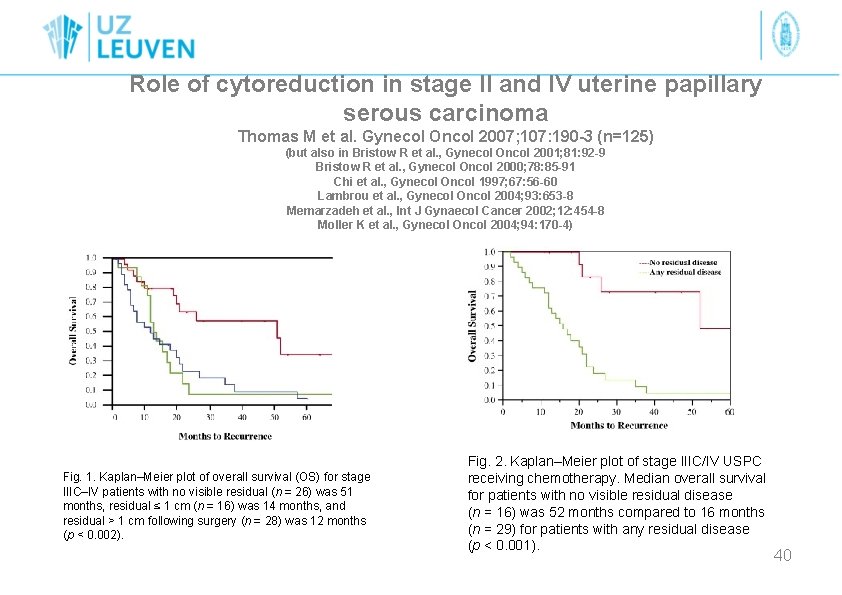
Role of cytoreduction in stage II and IV uterine papillary serous carcinoma Thomas M et al. Gynecol Oncol 2007; 107: 190 -3 (n=125) (but also in Bristow R et al. , Gynecol Oncol 2001; 81: 92 -9 Bristow R et al. , Gynecol Oncol 2000; 78: 85 -91 Chi et al. , Gynecol Oncol 1997; 67: 56 -60 Lambrou et al. , Gynecol Oncol 2004; 93: 653 -8 Memarzadeh et al. , Int J Gynaecol Cancer 2002; 12: 454 -8 Moller K et al. , Gynecol Oncol 2004; 94: 170 -4) Fig. 1. Kaplan–Meier plot of overall survival (OS) for stage IIIC–IV patients with no visible residual (n = 26) was 51 months, residual ≤ 1 cm (n = 16) was 14 months, and residual > 1 cm following surgery (n = 28) was 12 months (p < 0. 002). Fig. 2. Kaplan–Meier plot of stage IIIC/IV USPC receiving chemotherapy. Median overall survival for patients with no visible residual disease (n = 16) was 52 months compared to 16 months (n = 29) for patients with any residual disease (p < 0. 001). 40
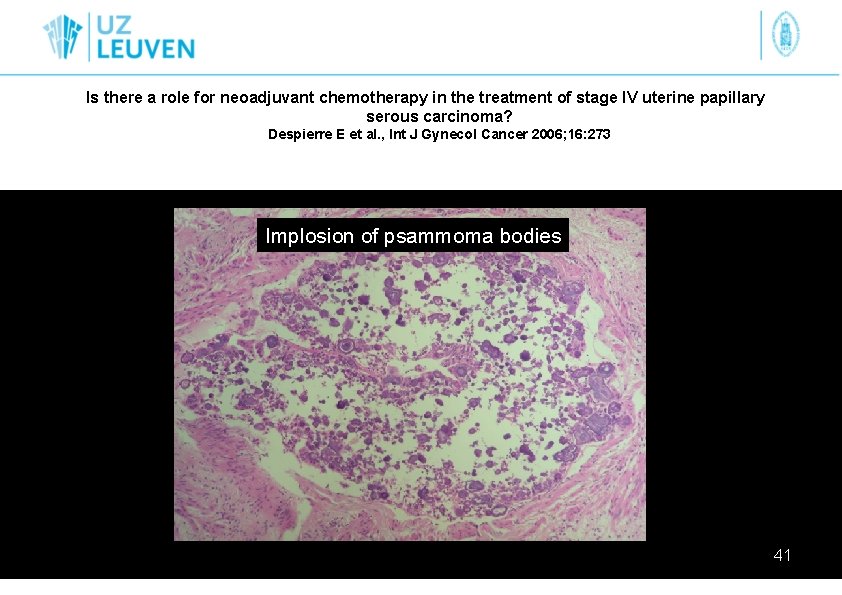
Is there a role for neoadjuvant chemotherapy in the treatment of stage IV uterine papillary serous carcinoma? Despierre E et al. , Int J Gynecol Cancer 2006; 16: 273 Implosion of psammoma bodies 41
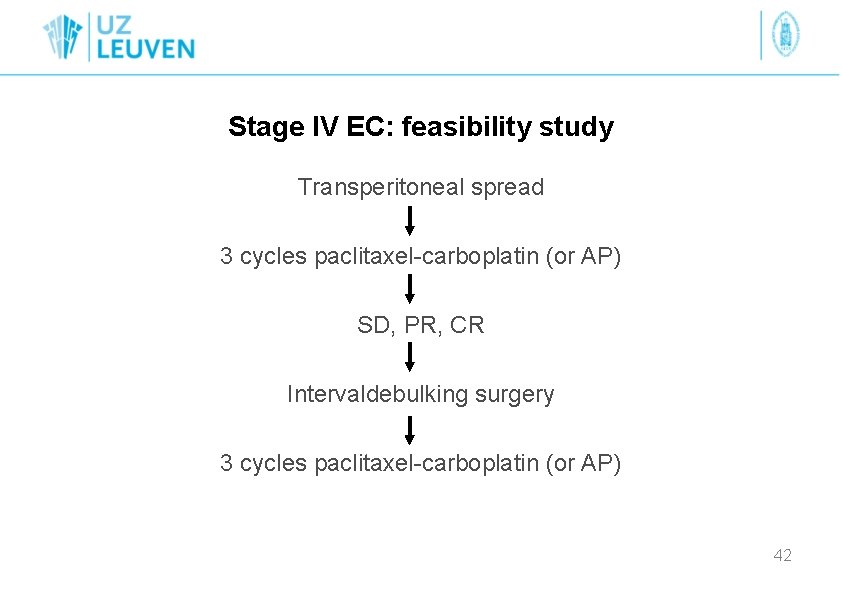
Stage IV EC: feasibility study Transperitoneal spread 3 cycles paclitaxel-carboplatin (or AP) SD, PR, CR Intervaldebulking surgery 3 cycles paclitaxel-carboplatin (or AP) 42
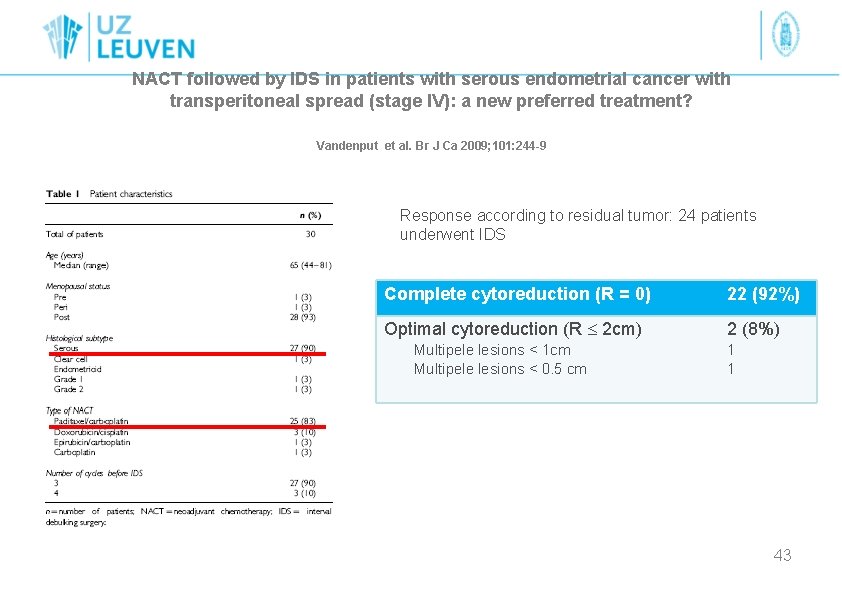
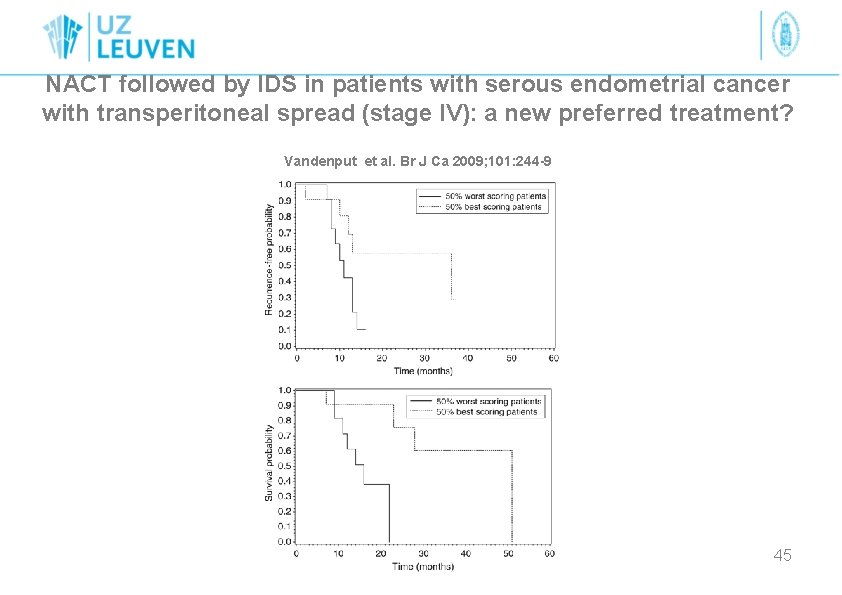
NACT followed by IDS in patients with serous endometrial cancer with transperitoneal spread (stage IV): a new preferred treatment? Vandenput et al. Br J Ca 2009; 101: 244 -9 Response according to residual tumor: 24 patients underwent IDS Complete cytoreduction (R = 0) 22 (92%) Optimal cytoreduction (R 2 cm) 2 (8%) Multipele lesions < 1 cm Multipele lesions < 0. 5 cm 1 1 43
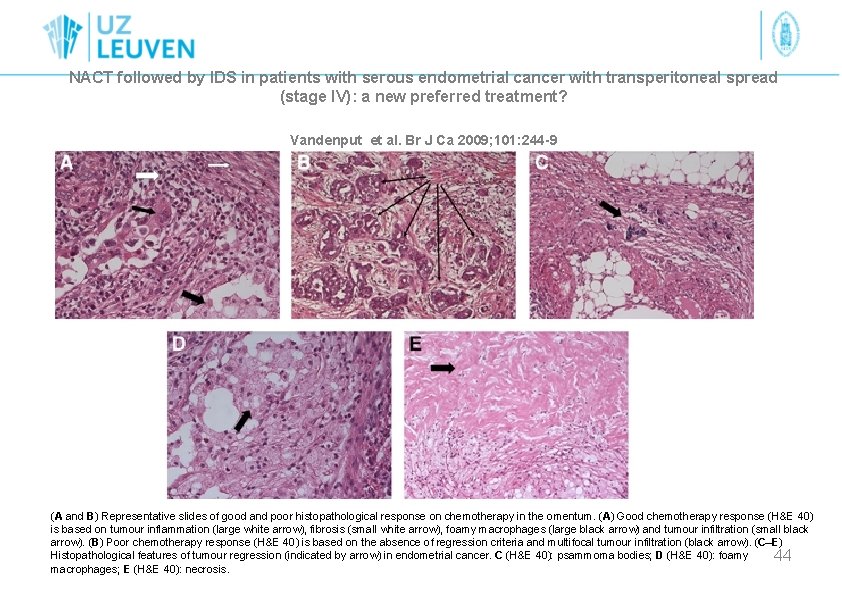
NACT followed by IDS in patients with serous endometrial cancer with transperitoneal spread (stage IV): a new preferred treatment? Vandenput et al. Br J Ca 2009; 101: 244 -9 (A and B) Representative slides of good and poor histopathological response on chemotherapy in the omentum. (A) Good chemotherapy response (H&E 40) is based on tumour inflammation (large white arrow), fibrosis (small white arrow), foamy macrophages (large black arrow) and tumour infiltration (small black arrow). (B) Poor chemotherapy response (H&E 40) is based on the absence of regression criteria and multifocal tumour infiltration (black arrow). (C–E) Histopathological features of tumour regression (indicated by arrow) in endometrial cancer. C (H&E 40): psammoma bodies; D (H&E 40): foamy 44 macrophages; E (H&E 40): necrosis.
NACT followed by IDS in patients with serous endometrial cancer with transperitoneal spread (stage IV): a new preferred treatment? Vandenput et al. Br J Ca 2009; 101: 244 -9 45
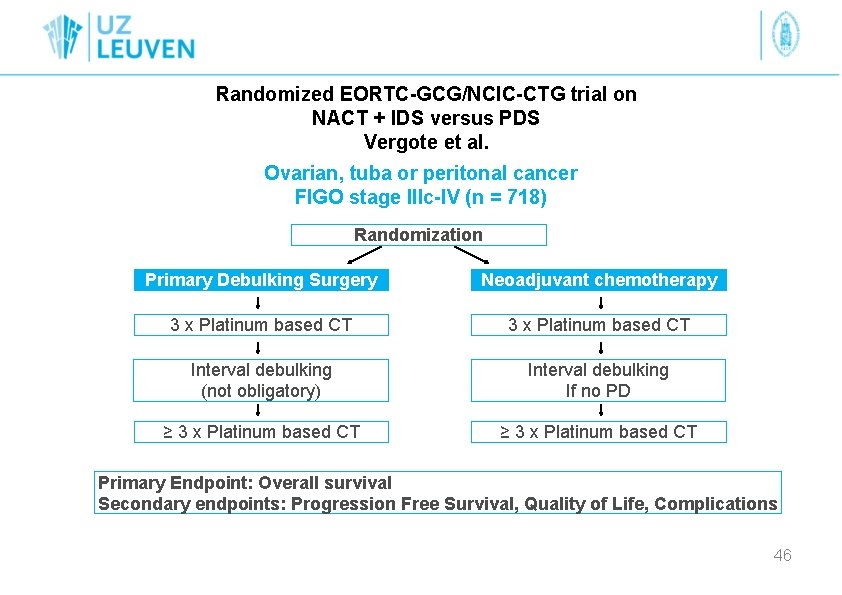
Randomized EORTC-GCG/NCIC-CTG trial on NACT + IDS versus PDS Vergote et al. Ovarian, tuba or peritonal cancer FIGO stage IIIc-IV (n = 718) Randomization Primary Debulking Surgery Neoadjuvant chemotherapy 3 x Platinum based CT Interval debulking (not obligatory) Interval debulking If no PD ≥ 3 x Platinum based CT Primary Endpoint: Overall survival Secondary endpoints: Progression Free Survival, Quality of Life, Complications 46
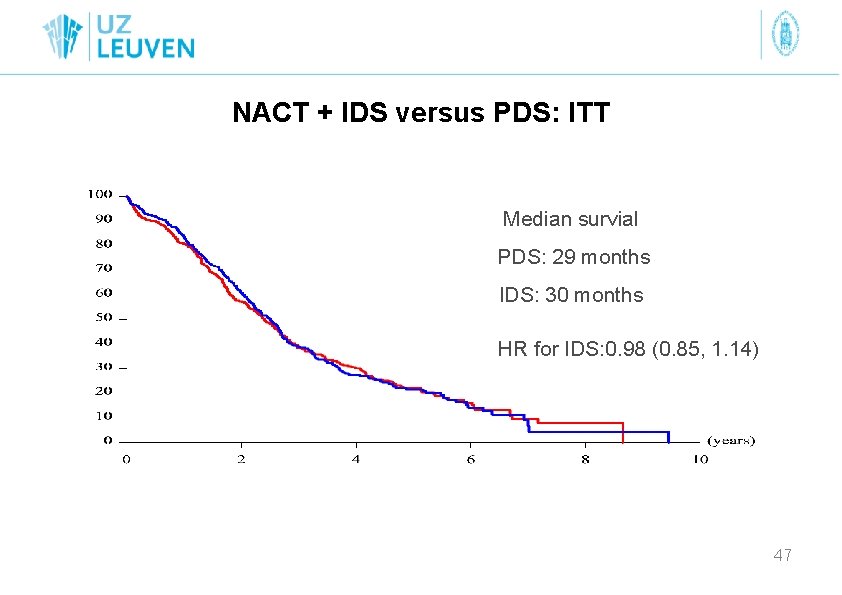
NACT + IDS versus PDS: ITT Median survial PDS: 29 months IDS: 30 months HR for IDS: 0. 98 (0. 85, 1. 14) 47
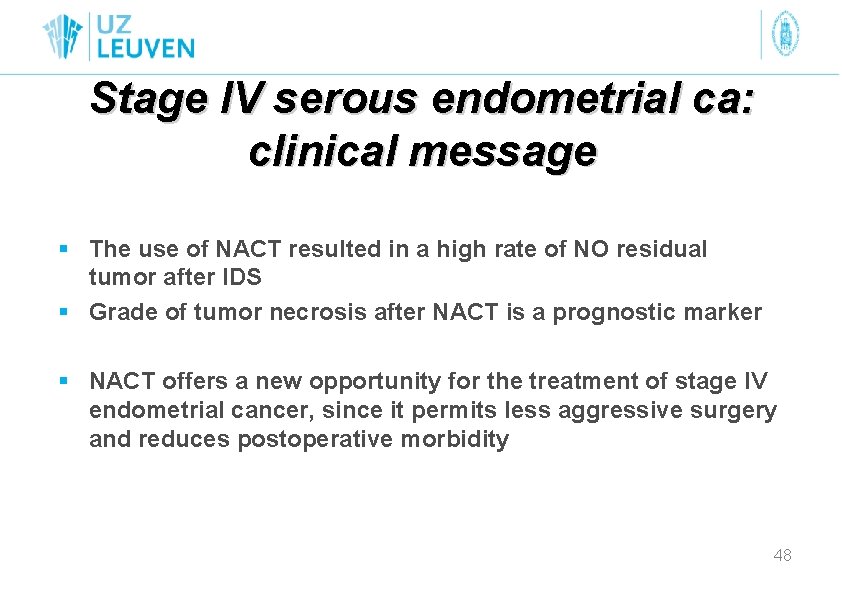
Stage IV serous endometrial ca: clinical message § The use of NACT resulted in a high rate of NO residual tumor after IDS § Grade of tumor necrosis after NACT is a prognostic marker § NACT offers a new opportunity for the treatment of stage IV endometrial cancer, since it permits less aggressive surgery and reduces postoperative morbidity 48
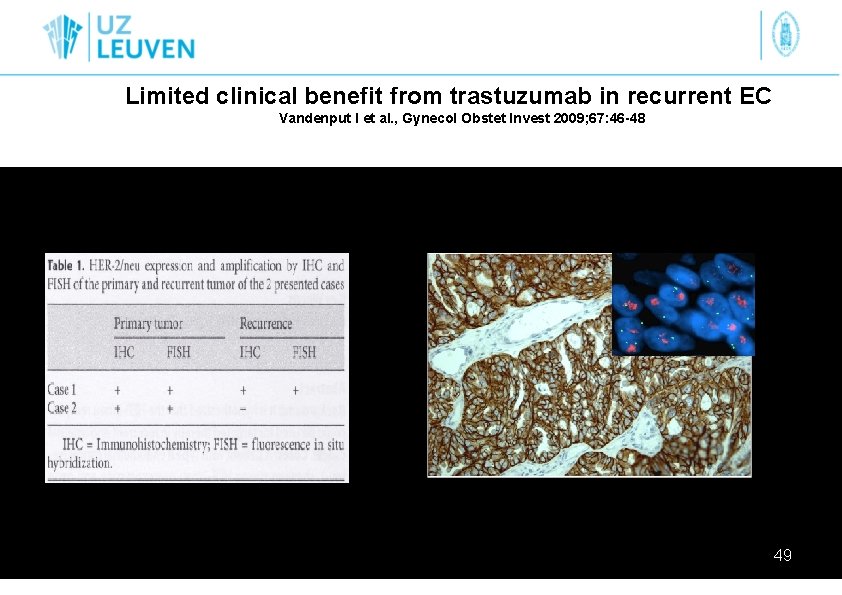
Limited clinical benefit from trastuzumab in recurrent EC Vandenput I et al. , Gynecol Obstet Invest 2009; 67: 46 -48 49
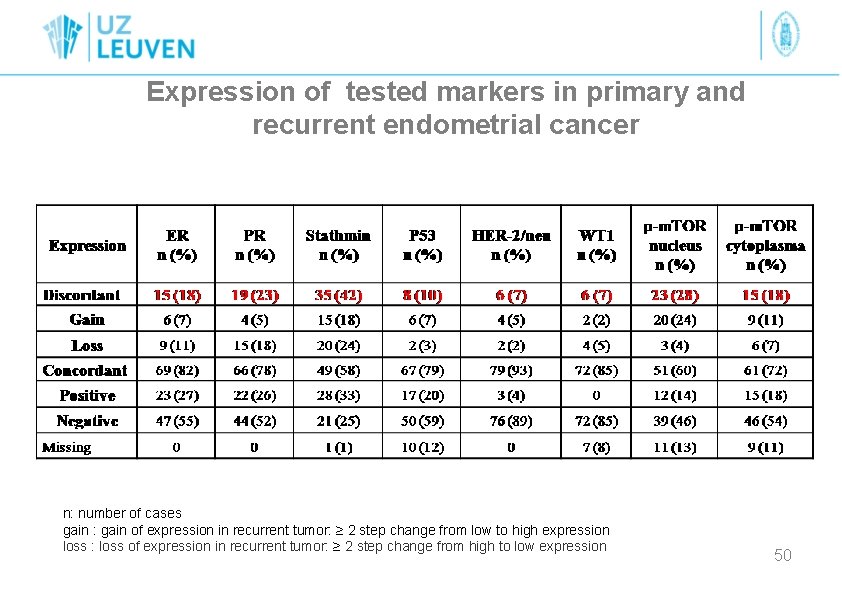
Expression of tested markers in primary and recurrent endometrial cancer n: number of cases gain : gain of expression in recurrent tumor: ≥ 2 step change from low to high expression loss : loss of expression in recurrent tumor: ≥ 2 step change from high to low expression 50
Serous endometrial cancer • • Surgical staging Role of adjuvant chemotherapy Stage IV disease Treatment proposal
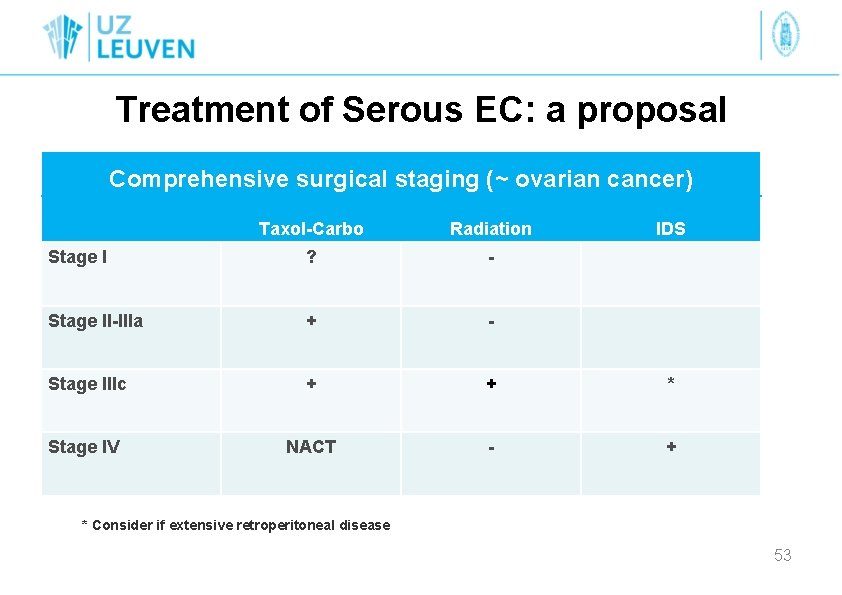
Treatment of Serous EC: a proposal Comprehensive surgical staging (~ ovarian cancer) Taxol-Carbo Radiation IDS Stage I ? - Stage II-IIIa + - Stage IIIc + + * Stage IV NACT - + * Consider if extensive retroperitoneal disease 53
Thank you! Verelst Baarmoederkanker fonds Leuven Endometrial cancer research group • Postdoc – Lieve Coenegrachts – Sandra Tuyaerts • Ph D students – An Coosemans – Diego Garcia – Helena Soenen – Ingrid Vandenput – Anke Vanderstraeten • Lab technician – Jessica Billen 54