
Anatomy And Physiology Of Salivary Glands Dr Supreet


- Slides: 55
Anatomy And Physiology Of Salivary Glands Dr. Supreet Singh Nayyar, AFMC For more topics, visit www. nayyar. ENT. com
Layout � Anatomy glands of Parotid, Submandibular, Sublingual � Physiology – structure of glands, secretion of primary fluid, neuronal control, neurotransmitters � Factors affecting salivary flow & composition www. nayyar. ENT. com 7/13/2012 2
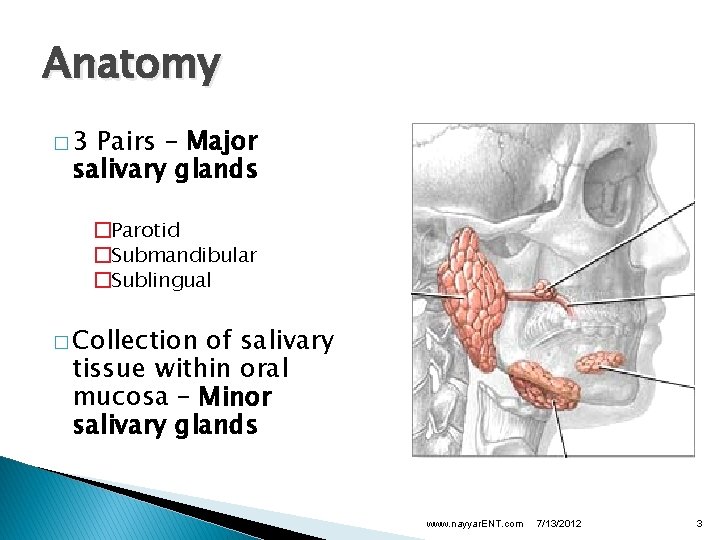
Anatomy � 3 Pairs – Major salivary glands �Parotid �Submandibular �Sublingual � Collection of salivary tissue within oral mucosa – Minor salivary glands www. nayyar. ENT. com 7/13/2012 3
Development Of Parotid Gland � Ectoderm � Solid of oral cavity bulb from oropharyngeal epithelium � 6 weeks - parotid gland � Dichotomous branching of solid bulb, development of lumen, condensation of mesenchyme � Formation of primitive ducts www. nayyar. ENT. com 7/13/2012 4
Contd… � Engulfment of facial nerve – 16 th- 21 st wk � Functional maturation after feeding is established www. nayyar. ENT. com 7/13/2012 5
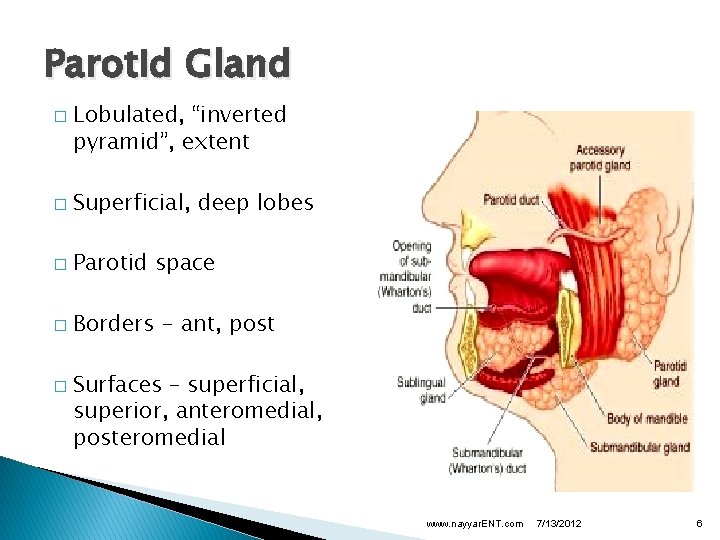
Parotid Gland � Lobulated, “inverted pyramid”, extent � Superficial, deep lobes � Parotid space � Borders - ant, post � Surfaces – superficial, superior, anteromedial, posteromedial www. nayyar. ENT. com 7/13/2012 6
Capsule � Condensed deep cervical fascia, tough, inelastic surface component, thin deep layer � Stylomandibular � Fibrous ligament septa arise from capsule � Contents of fascia – superficial lymph nodes, greater auricular nerve www. nayyar. ENT. com 7/13/2012 7
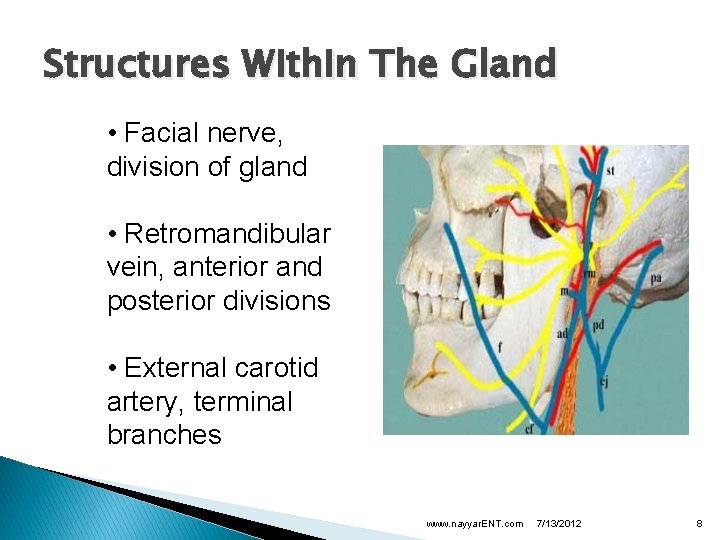
Structures Within The Gland • Facial nerve, division of gland • Retromandibular vein, anterior and posterior divisions • External carotid artery, terminal branches www. nayyar. ENT. com 7/13/2012 8
Lymphoid Tissue In The Gland � Capsule � Mostly � Part – Periparotid Nodes superficial to Facial Nerve of MALT, secrete Ig. A � Salivary gland tissue may be present within the lymph nodes www. nayyar. ENT. com 7/13/2012 9
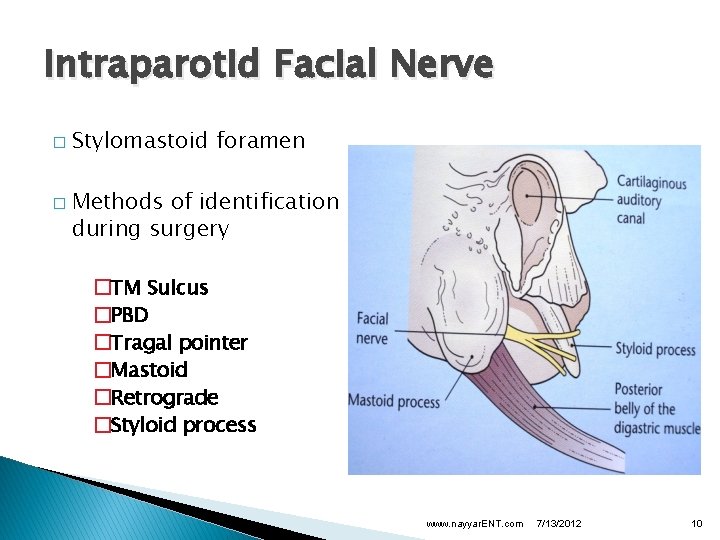
Intraparotid Facial Nerve � � Stylomastoid foramen Methods of identification during surgery �TM Sulcus �PBD �Tragal pointer �Mastoid �Retrograde �Styloid process www. nayyar. ENT. com 7/13/2012 10
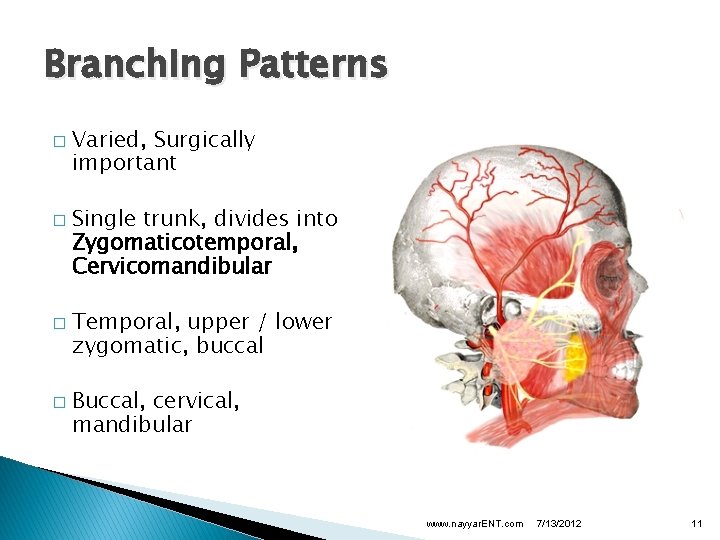
Branching Patterns � � Varied, Surgically important Single trunk, divides into Zygomaticotemporal, Cervicomandibular Temporal, upper / lower zygomatic, buccal Buccal, cervical, mandibular www. nayyar. ENT. com 7/13/2012 11
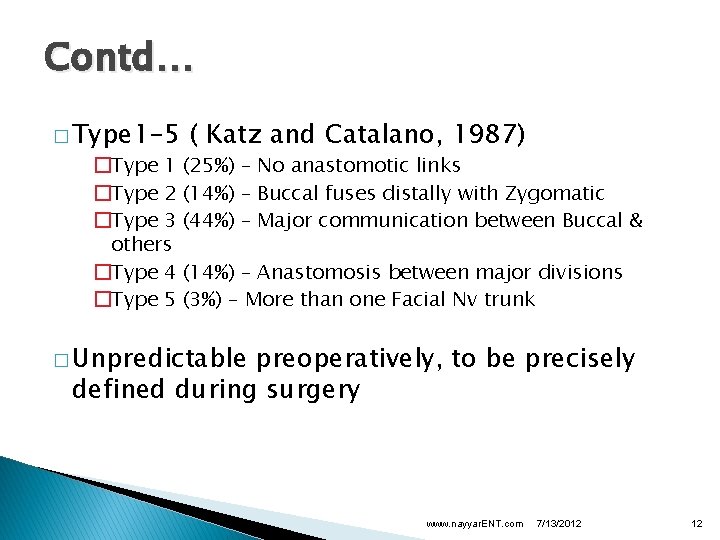
Contd… � Type 1 -5 �Type 1 �Type 2 �Type 3 others �Type 4 �Type 5 ( Katz and Catalano, 1987) (25%) – No anastomotic links (14%) – Buccal fuses distally with Zygomatic (44%) – Major communication between Buccal & (14%) – Anastomosis between major divisions (3%) – More than one Facial Nv trunk � Unpredictable preoperatively, to be precisely defined during surgery www. nayyar. ENT. com 7/13/2012 12
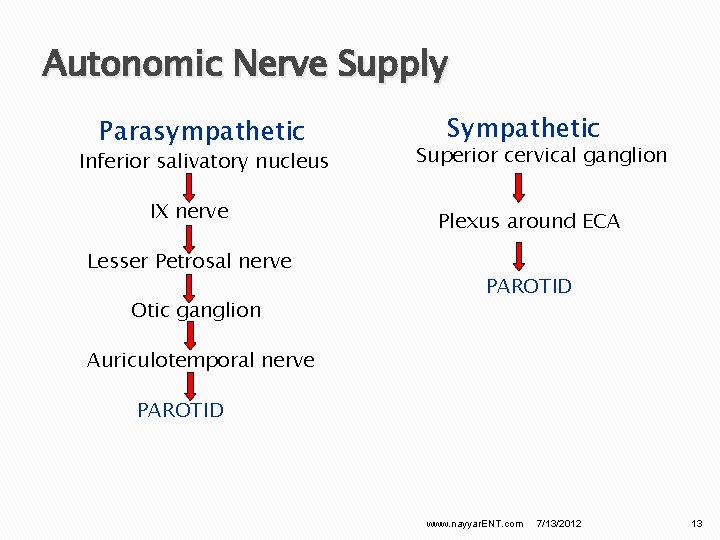
Autonomic Nerve Supply Parasympathetic Inferior salivatory nucleus IX nerve Lesser Petrosal nerve Otic ganglion Sympathetic Superior cervical ganglion Plexus around ECA PAROTID Auriculotemporal nerve PAROTID www. nayyar. ENT. com 7/13/2012 13
Parotid duct � � Formed near the anterior border Lies on superficial surface of Masseter Opens in the mouth at parotid papilla Accessory Parotid tissue www. nayyar. ENT. com 7/13/2012 14
Submandibular Salivary Gland � Development � 6 th IU wk �Ectoderm in floor of primitive oral cavity �Lateral to primitive tongue �Development of acini – 12 th wk � Large superficial, small deep lobe � Located in Submandibular triangle � Well defined capsule www. nayyar. ENT. com 7/13/2012 15
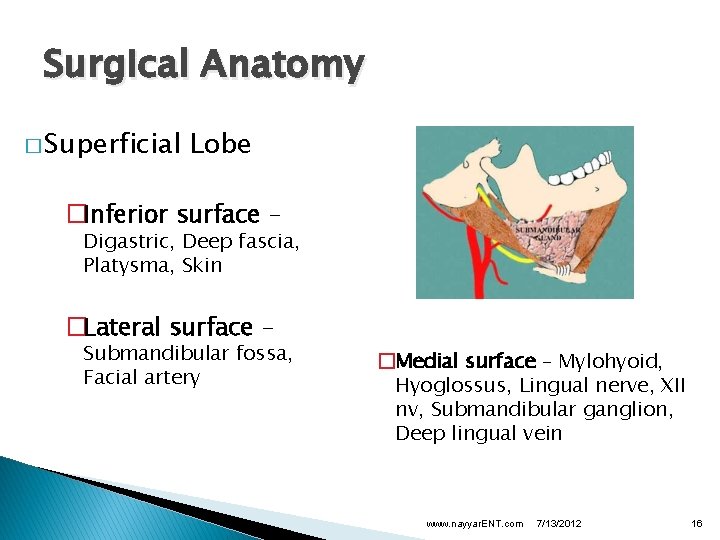
Surgical Anatomy � Superficial Lobe �Inferior surface – Digastric, Deep fascia, Platysma, Skin �Lateral surface – Submandibular fossa, Facial artery �Medial surface – Mylohyoid, Hyoglossus, Lingual nerve, XII nv, Submandibular ganglion, Deep lingual vein www. nayyar. ENT. com 7/13/2012 16
Deep Lobe � Extends for a variable distance between Mylohyoid & Hyoglossus � Relations �Superior – Lingual nerve �Inferior – XII Nv, Deep lingual vein, Submandibular duct www. nayyar. ENT. com 7/13/2012 17
Wharton’s duct � 5 cm in length �Middle of deep part �Crosses Sublingual space �Proximally – b/w Mylohyoid & Hyoglossus �Distally – b/w Genioglossus & Sublingual gland �Opening – on sides of frenulum of tongue �Relation to Lingual nerve www. nayyar. ENT. com 7/13/2012 18
Blood Supply & Lymphatic Drianage � Branches � Lymph of Facial & Lingual arteries nodes adjacent to the superficial part www. nayyar. ENT. com 7/13/2012 19
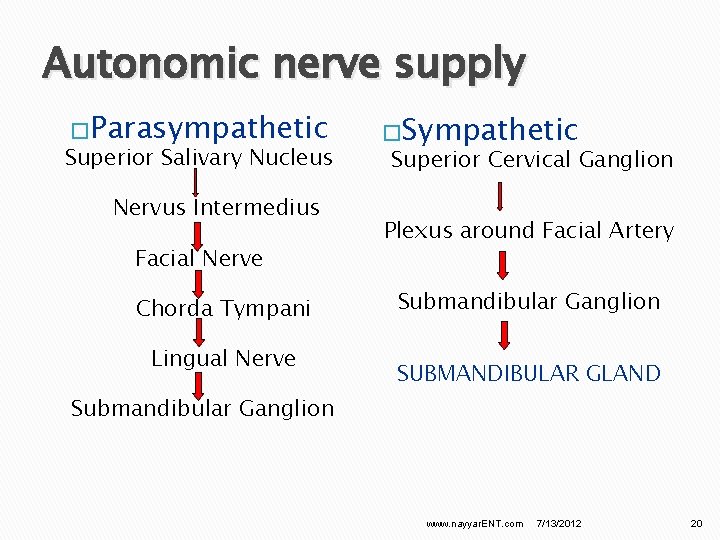
Autonomic nerve supply �Parasympathetic Superior Salivary Nucleus Nervus Intermedius Facial Nerve Chorda Tympani Lingual Nerve �Sympathetic Superior Cervical Ganglion Plexus around Facial Artery Submandibular Ganglion SUBMANDIBULAR GLAND Submandibular Ganglion www. nayyar. ENT. com 7/13/2012 20
Surgery Of Submandibular Gland � Skin incision – 4 cm below Mandible � Ligation of Facial vessels above & below � Dissected � Lymph away from Lingual Nerve nodes in substance of gland www. nayyar. ENT. com 7/13/2012 21
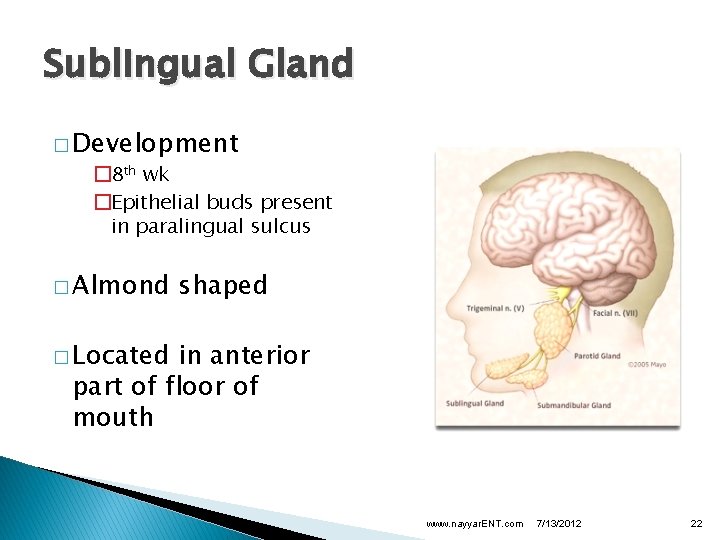
Sublingual Gland � Development � 8 th wk �Epithelial buds present in paralingual sulcus � Almond shaped � Located in anterior part of floor of mouth www. nayyar. ENT. com 7/13/2012 22
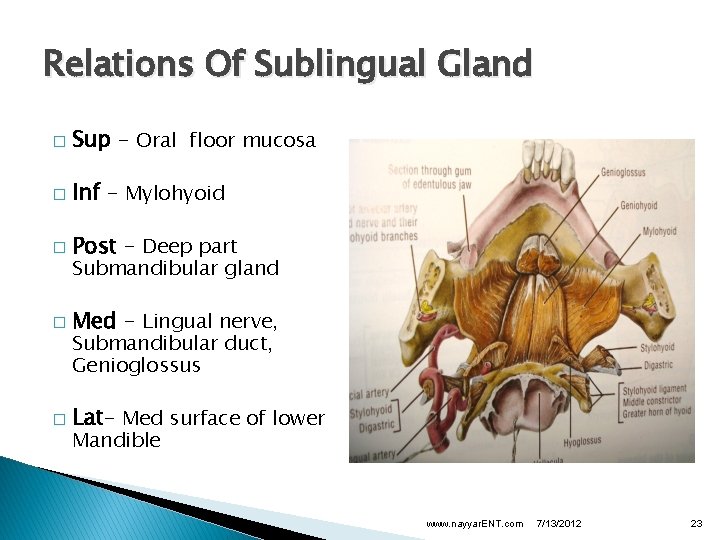
Relations Of Sublingual Gland � Sup – Oral floor mucosa � Inf – Mylohyoid � Post – Deep part � Med – Lingual nerve, � Lat– Med surface of lower Submandibular gland Submandibular duct, Genioglossus Mandible www. nayyar. ENT. com 7/13/2012 23
Contd… � Ducts �Multiple �Drain into oral cavity directly or into Submandibular duct � Blood supply � Nerve supply www. nayyar. ENT. com 7/13/2012 24
Physiology Of Salivary Glands www. nayyar. ENT. com
Function of Salivary Glands � Produce saliva – 1 L / day (1 ml/min/gm) � Contents �Mucin (glycoprotein) �Salivary amylase �Secretory Immunoglobulins �Other enzymes – DNase, RNase, lysozyme, lactoperoxidase, lingual lipase �Kallikerin �Inorganic compounds – Na+, K+, HCO 3 -, Ca 2+ www. nayyar. ENT. com 7/13/2012 26
Function Of Saliva � Lubrication � Buffering and protection and clearance � Maintenance of tooth integrity � Antibacterial activity � Taste and digestion www. nayyar. ENT. com 7/13/2012 27
Structure of Salivary Gland � Parotid �Largest, serous (Compound Tubuloacinar Gland) � Submandibular and Sublingual � Mixed (Compound Tubuloacinar Glands) www. nayyar. ENT. com 7/13/2012 28
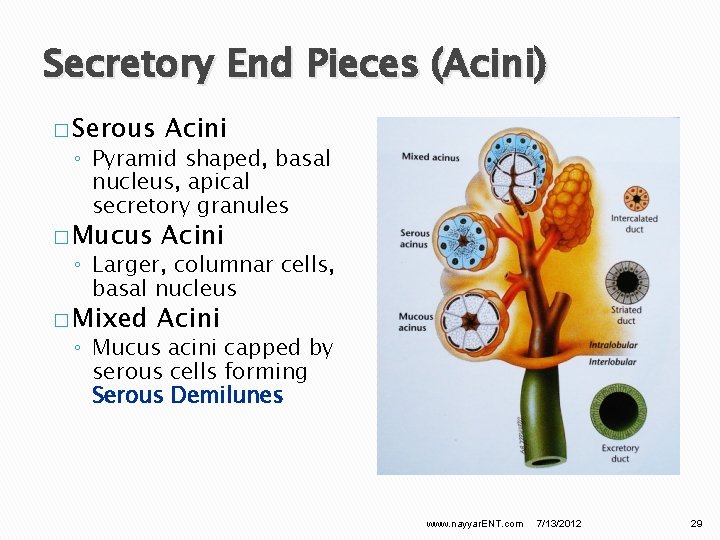
Secretory End Pieces (Acini) � Serous Acini � Mucus Acini � Mixed Acini ◦ Pyramid shaped, basal nucleus, apical secretory granules ◦ Larger, columnar cells, basal nucleus ◦ Mucus acini capped by serous cells forming Serous Demilunes www. nayyar. ENT. com 7/13/2012 29
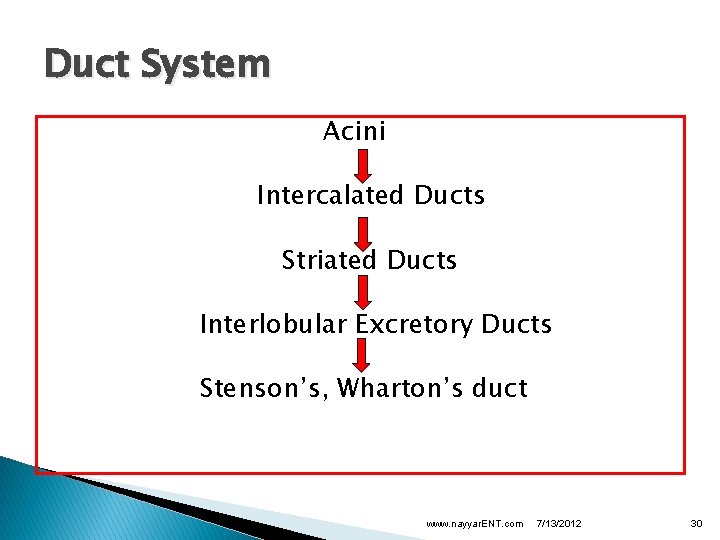
Duct System Acini Intercalated Ducts Striated Ducts Interlobular Excretory Ducts Stenson’s, Wharton’s duct www. nayyar. ENT. com 7/13/2012 30
Control of Blood Flow And Metabolism � High rates � Rate of saliva production – 1 ml/min/gm � Blood flow 10 times that of equal mass of skeletal muscle www. nayyar. ENT. com 7/13/2012 31
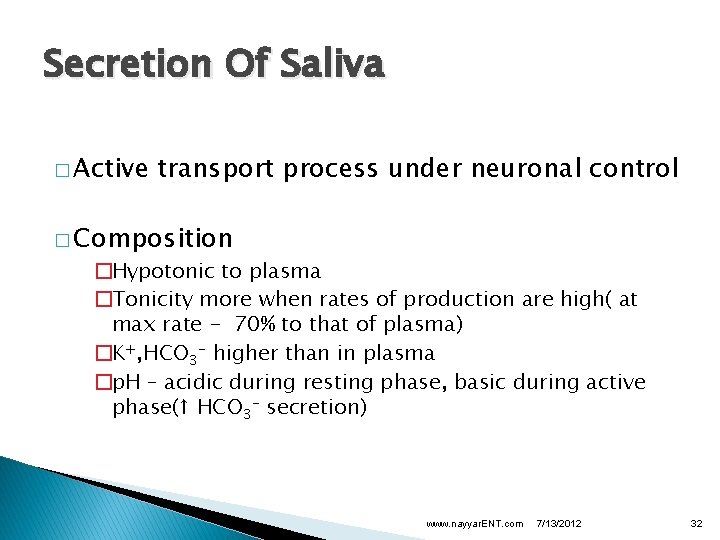
Secretion Of Saliva � Active transport process under neuronal control � Composition �Hypotonic to plasma �Tonicity more when rates of production are high( at max rate - 70% to that of plasma) �K+, HCO 3 - higher than in plasma �p. H – acidic during resting phase, basic during active phase(↑ HCO 3 - secretion) www. nayyar. ENT. com 7/13/2012 32
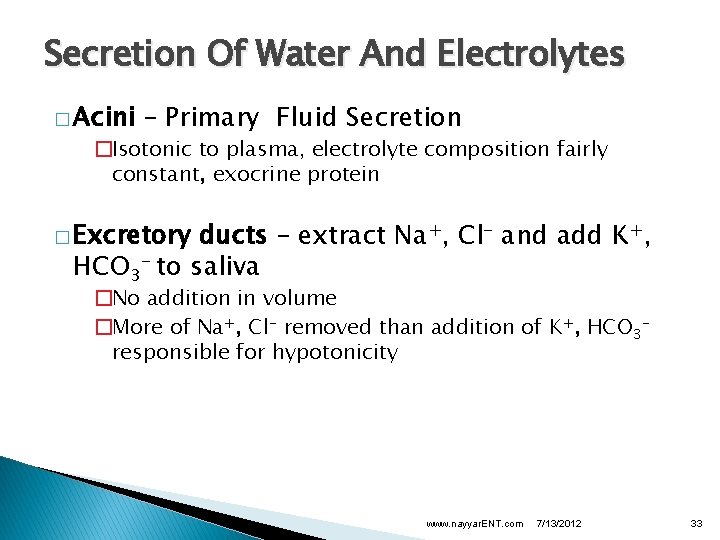
Secretion Of Water And Electrolytes � Acini – Primary Fluid Secretion �Isotonic to plasma, electrolyte composition fairly constant, exocrine protein � Excretory ducts – extract Na+, Cl- and add K+, HCO 3 - to saliva �No addition in volume �More of Na+, Cl- removed than addition of K+, HCO 3 responsible for hypotonicity www. nayyar. ENT. com 7/13/2012 33
Mechanisms Of Primary Fluid Secretion � Osmotic process �Transepithelial salt gradients �Four ion transport systems - luminal and basolateral membranes generate the gradient �Three mechanisms proposed – operate concurrently www. nayyar. ENT. com 7/13/2012 34
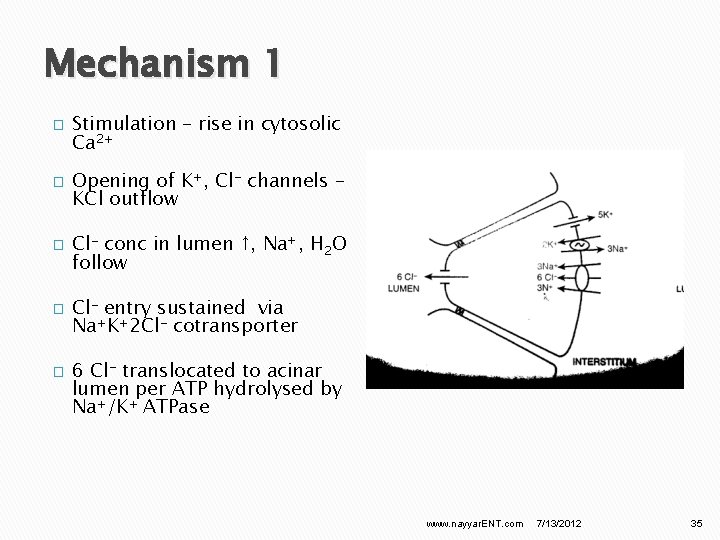
Mechanism 1 � � � Stimulation – rise in cytosolic Ca 2+ Opening of K+, Cl- channels – KCl outflow Cl- conc in lumen ↑, Na+, H 2 O follow Cl- entry sustained via Na+K+2 Cl- cotransporter 6 Cl- translocated to acinar lumen per ATP hydrolysed by Na+/K+ ATPase www. nayyar. ENT. com 7/13/2012 35
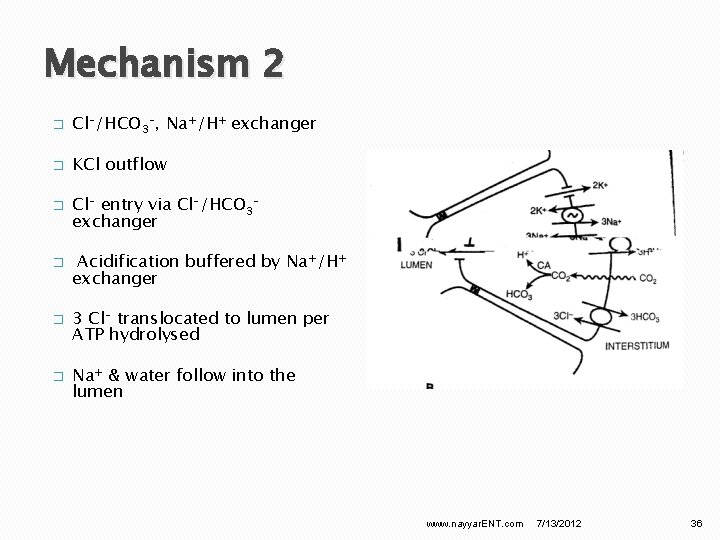
Mechanism 2 � Cl-/HCO 3 -, Na+/H+ exchanger � KCl outflow � � Cl- entry via Cl-/HCO 3 exchanger Acidification buffered by Na+/H+ exchanger 3 Cl- translocated to lumen per ATP hydrolysed Na+ & water follow into the lumen www. nayyar. ENT. com 7/13/2012 36
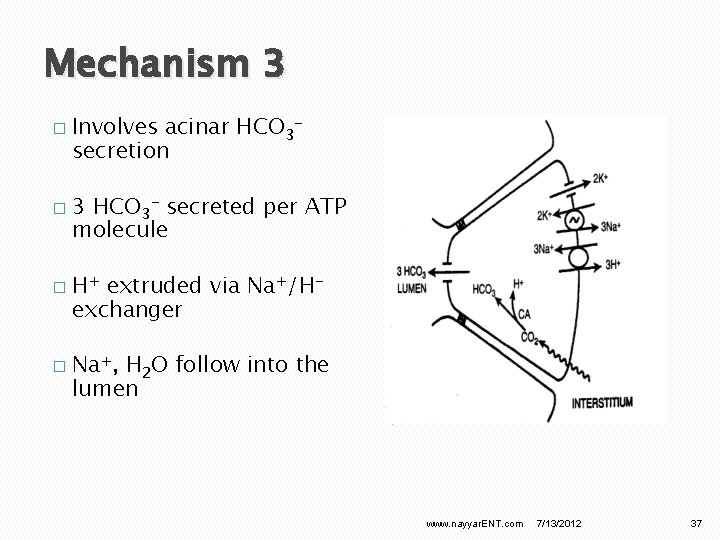
Mechanism 3 � � Involves acinar HCO 3 secretion 3 HCO 3 - secreted per ATP molecule H+ extruded via Na+/Hexchanger Na+, H 2 O follow into the lumen www. nayyar. ENT. com 7/13/2012 37
Mechanism Of Macromolecule Secretion � Contained in zymogen granules present in serous acinar cells, ductal cells � Upon stimulation release contents in lumen by exocytosis � Conc and rate varies with level and type of stimulation www. nayyar. ENT. com 7/13/2012 38
Mechanism Of Ductal Secretion � Inconstant, understood � Produce final hypotonic solution � Influence is slow underlying mechanisms partially of tubular cells more when flow rate www. nayyar. ENT. com 7/13/2012 39
Neural Control Of Gland Function � Predominant � Sympathetic � Probable control – PARASYMPATHETIC stimulation shorter and less strong synergistic action www. nayyar. ENT. com 7/13/2012 40
Parasympathetic Stimulation �Primary fluid secretion �Protein secretion �Vasodilatation �Increased metabolism and growth �Myoepithelial cell contraction LARGE VOLUME LOW PROTEIN OUTPUT www. nayyar. ENT. com 7/13/2012 41
Sympathetic Stimulation �High protein secretion �Vasoconstriction – decreased blood flow �Myoepithelial cell contraction LOW VOLUME HIGH PROTEIN OUTPUT www. nayyar. ENT. com 7/13/2012 42
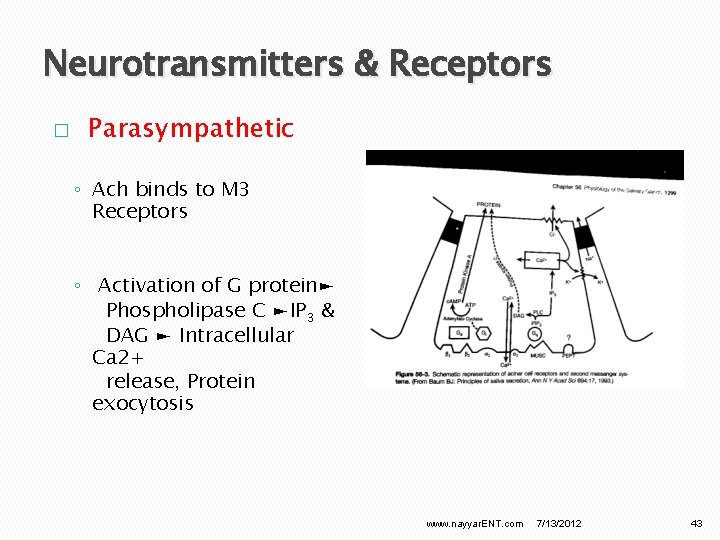
Neurotransmitters & Receptors � Parasympathetic ◦ Ach binds to M 3 Receptors ◦ Activation of G protein► Phospholipase C ►IP 3 & DAG ► Intracellular Ca 2+ release, Protein exocytosis www. nayyar. ENT. com 7/13/2012 43
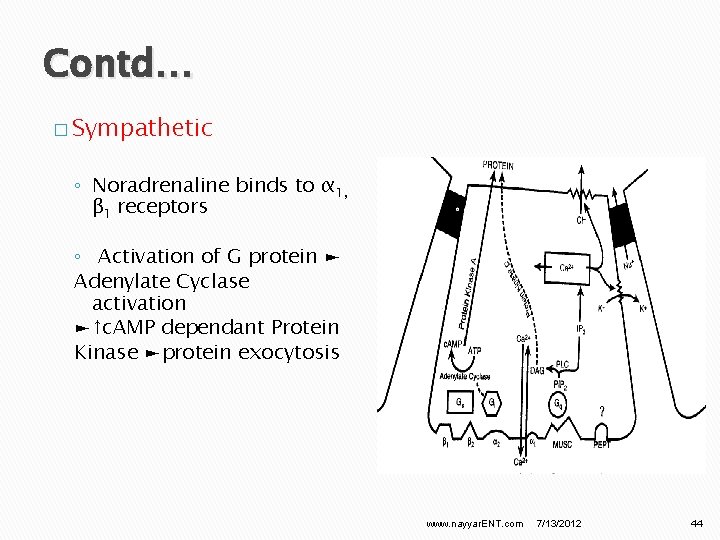
Contd… � Sympathetic ◦ Noradrenaline binds to α 1, β 1 receptors ◦ Activation of G protein ► Adenylate Cyclase activation ►↑c. AMP dependant Protein Kinase ►protein exocytosis www. nayyar. ENT. com 7/13/2012 44
Factors Affecting Salivary Flow � Unstimulated � Stimulated – Submandibular – Parotid 2/3 rd � Acidic tastes – Max stimulation � Sweet tastes – Least stimulation www. nayyar. ENT. com 7/13/2012 45
Contd… � Psychic factors � Circadian rhythm � Diurnal variation � Age � Drugs �Tricyclic antidepressants �Phenothiazines � Depression and anxiety states � Dehydration, hemorrhage, www. nayyar. ENT. com 7/13/2012 46
Contd… � Salivary Gland diseases �Radiation sialadenitis �Autoimmune sialadenitis �HIV infection �Iron overload �Sarcoidosis �Amyloidosis �Cystic fibrosis www. nayyar. ENT. com 7/13/2012 47
Factors Affecting Composition Of Saliva � Flow rate � Source of secretion � Type of stimulus � Diurnal variation � Diet � Drugs – flow dependant components � Hormones – mineralocorticoids, ovulation www. nayyar. ENT. com 7/13/2012 48
Contd… � Disease states �Sialadenitis �Radiation damage �Sjorgen’s syndrome �Cystic fibrosis �HTN �DM �Alcoholic cirrhosis �Aldosteronism �Chronic pancreatitis www. nayyar. ENT. com 7/13/2012 49
Salivary Assays In Diagnosis � Valid medium, painless, non-invasive � Hormone monitoring �Unconjugated steroids �Proportional to free unbound plasma levels �Useful in field studies �Estradiol, progesterone, testosterone www. nayyar. ENT. com 7/13/2012 50
Contd… � Drugs �Factors – lipid solubility, protein binding, molecular size, flow rates �Constant saliva / plasma ratio not established � Microbial antigens, antibodies �Hepatitis A, B, C �HIV �Immunisation status www. nayyar. ENT. com 7/13/2012 51
Radioisotope Salivary Function Tests � Tc 99 m pertechnitate � Scintigraphy – objective measure of its uptake, concenteration, excretion www. nayyar. ENT. com 7/13/2012 52
Sialolithiasis � Concentric shells of calcareous material alternating with organic material � Stasis of flow � Distribution �Submandibular gland – 92% �Parotid – 6% �Sublingual / minor salivary glands – 2% www. nayyar. ENT. com 7/13/2012 53
References � Scott-Brown’s Otolaryngology – 6 th ed, Vol 1, Vol 5 � Otolaryngology Head & Neck Surgery –Charles W Cummings, 4 th ed, Vol 2 � Skandalakis’ Surgical Anatomy � Last’s Anatomy – 9 th ed � Physiology – Berne & Levy, 5 th ed www. nayyar. ENT. com 7/13/2012 54