The Reign of Henry VII 1485 1509 1





- Slides: 66
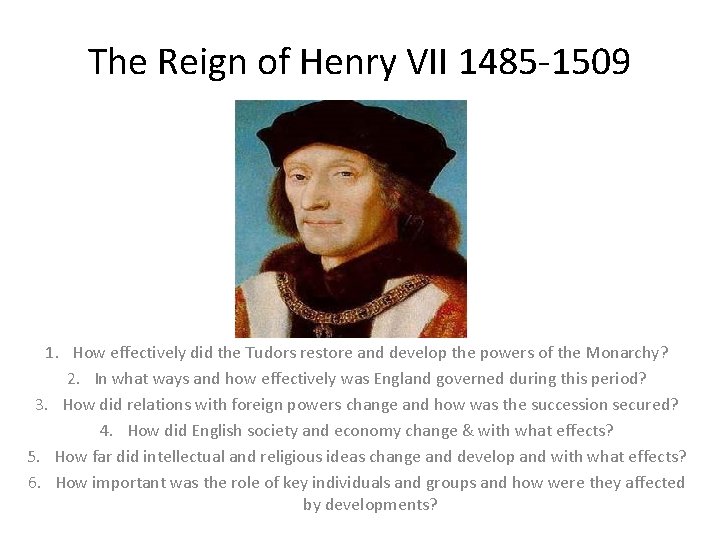
The Reign of Henry VII 1485 -1509 1. How effectively did the Tudors restore and develop the powers of the Monarchy? 2. In what ways and how effectively was England governed during this period? 3. How did relations with foreign powers change and how was the succession secured? 4. How did English society and economy change & with what effects? 5. How far did intellectual and religious ideas change and develop and with what effects? 6. How important was the role of key individuals and groups and how were they affected by developments?
Becoming King 1485 – 1509
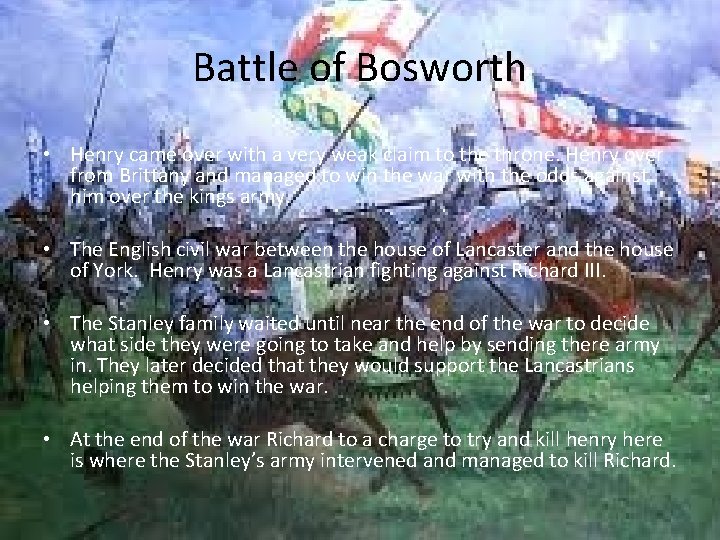
Battle of Bosworth • Henry came over with a very weak claim to the throne. Henry over from Brittany and managed to win the war with the odds against him over the kings army. • The English civil war between the house of Lancaster and the house of York. Henry was a Lancastrian fighting against Richard III. • The Stanley family waited until near the end of the war to decide what side they were going to take and help by sending there army in. They later decided that they would support the Lancastrians helping them to win the war. • At the end of the war Richard to a charge to try and kill henry here is where the Stanley’s army intervened and managed to kill Richard.
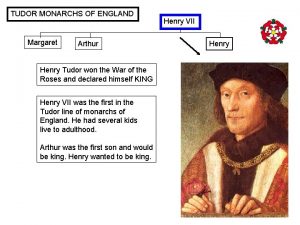
Character and aims • Henry wanted to make England great. He was able to get the country good in terms of finance and was also able to control the nobles. • Henry was the only king to be able to die without any debt and his son Henry VIII was even able to inherit money and jewels. • Henry had a very weak claim to the throne this meant he had to prove himself to the entire country and also the government. • He persevered through most as although he was able to win the battle of Bosworth the odds were not in his favour this shows how determined he was to become king. • Henry was a Lancastrian however he wanted to create peace between the houses so he later married Elizabeth of York in order to try and create peace. • Henry created many successful foreign policies showing how he believed more in peace than war although Henry saw money prospects more in this as war was very expensive.
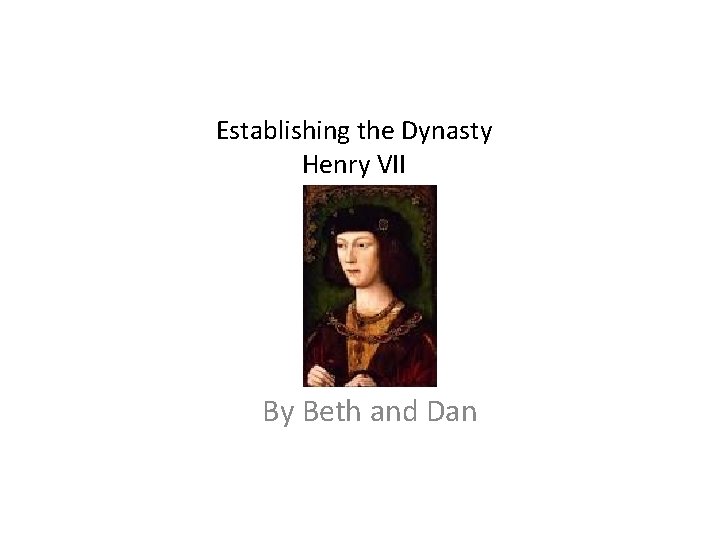
Establishing the Dynasty Henry VII By Beth and Dan
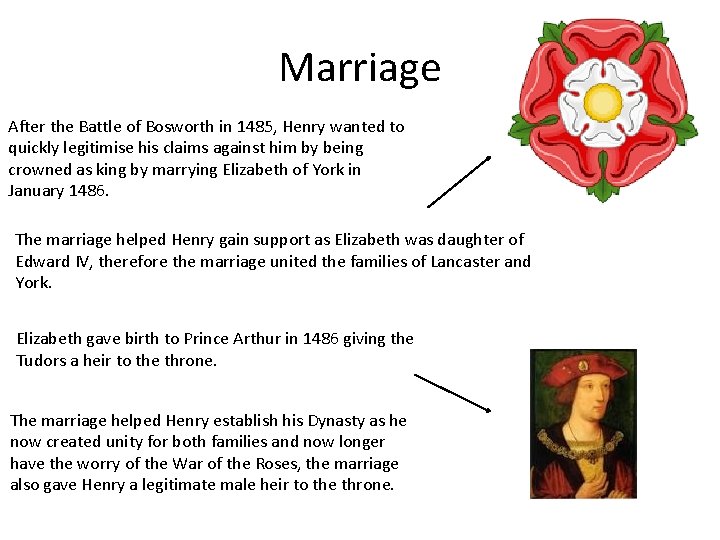
Marriage After the Battle of Bosworth in 1485, Henry wanted to quickly legitimise his claims against him by being crowned as king by marrying Elizabeth of York in January 1486. The marriage helped Henry gain support as Elizabeth was daughter of Edward IV, therefore the marriage united the families of Lancaster and York. Elizabeth gave birth to Prince Arthur in 1486 giving the Tudors a heir to the throne. The marriage helped Henry establish his Dynasty as he now created unity for both families and now longer have the worry of the War of the Roses, the marriage also gave Henry a legitimate male heir to the throne.
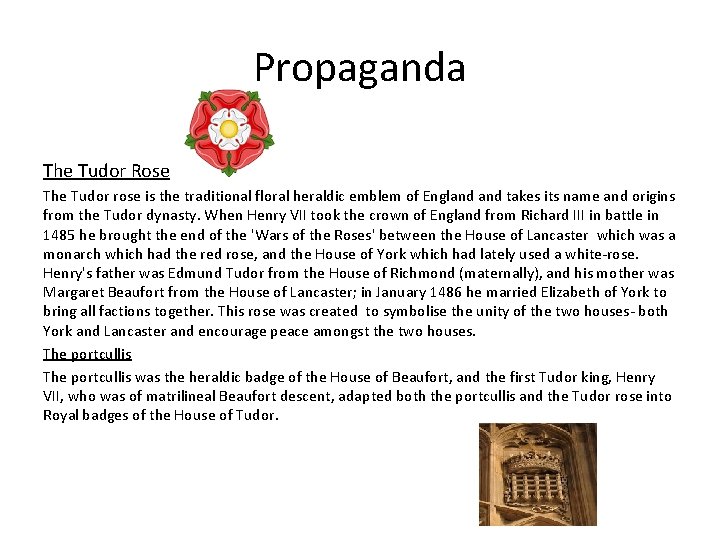
Propaganda The Tudor Rose The Tudor rose is the traditional floral heraldic emblem of England takes its name and origins from the Tudor dynasty. When Henry VII took the crown of England from Richard III in battle in 1485 he brought the end of the 'Wars of the Roses' between the House of Lancaster which was a monarch which had the red rose, and the House of York which had lately used a white-rose. Henry's father was Edmund Tudor from the House of Richmond (maternally), and his mother was Margaret Beaufort from the House of Lancaster; in January 1486 he married Elizabeth of York to bring all factions together. This rose was created to symbolise the unity of the two houses- both York and Lancaster and encourage peace amongst the two houses. The portcullis was the heraldic badge of the House of Beaufort, and the first Tudor king, Henry VII, who was of matrilineal Beaufort descent, adapted both the portcullis and the Tudor rose into Royal badges of the House of Tudor.
Use of Parliament Henry summoned parliament in November 1485 and went on a royal progress(tour of England)up north this allowed Henry to hear petitions and cases which allowed him to use his royal power. Parliament met only infrequently during his reign. Between 1485 and 1509, Parliament met only on seven occasions and five of these were between 1485 and 1495. When Henry felt more secure, he no longer felt the need to call Parliament. The failure of the Simnel and Warbeck rebellions strengthened Henry’s hold on government – hence his lack of any desire to call Parliament.
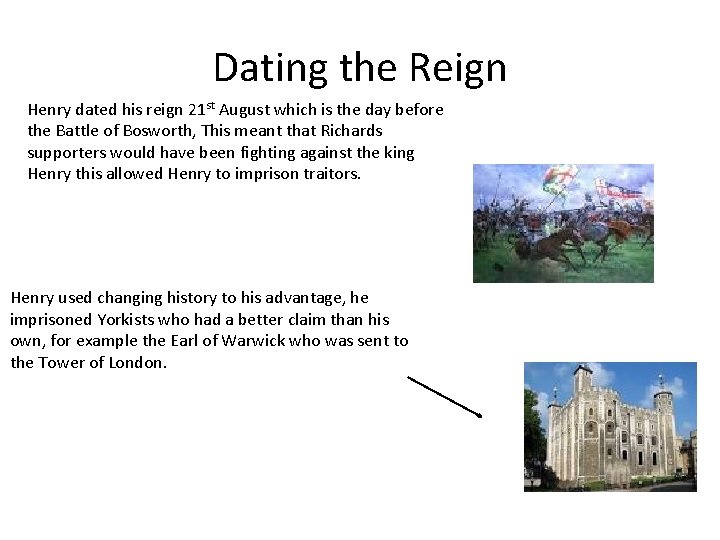
Dating the Reign Henry dated his reign 21 st August which is the day before the Battle of Bosworth, This meant that Richards supporters would have been fighting against the king Henry this allowed Henry to imprison traitors. Henry used changing history to his advantage, he imprisoned Yorkists who had a better claim than his own, for example the Earl of Warwick who was sent to the Tower of London.
Lovell Rebellion- 1486 What was it ? • A political rebellion, led by lord Lovell, who was a supporter and councillor of Richard III , with Yorkist brothers Humphrey and Thomas Strafford (pro-Yorkist), sought to overthrow Henry VII thrown after his victory within the battle of Bosworth. • Lovell, took sanctuary for a while then escaped the kings forces and gathered troops against henry VII, leading to potential danger • However, Henry’s troops captured the Strafford brother whilst Lovell escaped the country; Stafford was accused as a traitor and executed on 5 th July whilst his younger brother was pardoned. Was the rebellion dangerous? • Overall, the rebellion failed as the Strafford brother was executed whilst Lovell fled • The main reason to their lack of success was their lack of support from opponents of henry or Yorkist's. Why did it fail? • Their was mistrust between the leaders of the rebellion as Lovell, who was the leader fled to burgundy after loosing faith within their plan to overthrow henry. • Henry attained vast support unlike the Strafford brothers as they had no clear action plan or confidence within their attacks. Outcome • The rebellion highlighted Henrys success amongst dealing with political opponents against him • It indicated the support he had gained over a short period of time as many lacked involvement within the rebellion. • However, it shows how there are still dangerous Yorkist opponents that will remain a threat towards his throne
Simnel Rebellion – 1487 What was it? • Two years after Henry’s victory within the Battle of Bosworth, many Yorkist nobles and those who had a legitimate claim to the throne plotted to remove Henry and seize power; they believed England needed a Yorkist king. Many Yorkist's were enraged by their loss of land position , which resulted upon an increased support to Richard III. • Lambert Simmel, at the age of 10, was used to impersonate the earl of Warwick, who had a strong Yorkist claim to the throne, within a rebellion put together by John de la Pole • However, Henry soon presented the real Earl of Warwick out of the tower he was imprisoned in and paraded him around the streets of London , to reveal that the Yorkist plot was false In 1487, the rebels landed in England, however their army was crushed by Henry’s forces at the Battle of stock. • As a result, all Yorkist leaders were killed except for Simmel, who worked within Henry’s kitchen throughout his life. Why did the rebellion fail? • Simnel was only 10 years old – a child, he himself could not pose a vast threat • Simnel had lack of support from England therefore depended on foreign support such as Ireland • There was weak Yorkist leadership after the Battle of Bosworth • Henry treated the nobility harshly after the battle of Bosworth, whereby he confiscated their land enabled the Yorkist's to prove their loyalty to regain their property; this was effective as no one was desperate enough to rebel.
• • • How dangerous was the Simnel rebellion? Dangerous: Henry was brought to battle and had foreign opposition- despite his preparations for the battle, there were no guarantee of his victory as some trooped waited amongst the battlefield and only joined once a winner was clear. Margret of burgundy was involved-she had send 2000 armed forced to Dublin Henry pardoned some involved Yorkist’s which portrays him as a weak king Henry was new to the throne therefore people were not surprised if the he was defeated as the king of England constantly changed in the past. John de la pole, a Yorkist with a stronger claim, had supported this rebellion. Not dangerous: Henry easily defeated the armed forced and the rebellion ended shortly Simmel was only 10 years old and therefore treated with forgiveness People were reluctant to support war as the ‘war of the roses’ and damaged the country’s morale Henry was able to prove that the Earl of Warwick was alive
How far had Henry established the dynasty by 1487? Marriage: • • • Henry married Elizabeth of York in 1486, a year following his succession. Elizabeth was a Yorkist and the daughter of Edward IV so he established the dynasty through uniting the Houses of York and Lancaster, ending the Wars of the Roses and securing his position on the throne. Elizabeth soon gave birth to a son, Prince Arthur, in September 1486, helping to establish a future for the new Tudor dynasty. Use of Parliament: Henry summoned Parliament, a traditional act of a new king, establishing his dynasty as he could present his new royal power. • The king’s court assisted Henry on his royal progress. Specific detail and key words: Elizabeth of York – Henry’s wife Houses of York and Lancaster – the opposing families in the Wars of the Roses Prince Arthur – son of Henry and Elizabeth Summoning Parliament – authorising a gathering with Parliament Battle of Bosworth – a battle in the Wars of the Roses in which Richard III was defeated by Henry VII Treason – when someone is a traitor to the king Progress – a monarch’s journey in his ruling country • Backdating the reign: • Henry dated his reign from the 21 st August, the day before the Battle of Bosworth, so that he could trial those who supported Richard for treason. Propaganda: • • Henry went on a royal progress to the north in April 1486. The majority of Richard III’s supporters were in the north, so Henry could establish the new dynasty by demonstrating his royal presence to them. Henry used propaganda symbols including his mother’s portcullis to represent his legitimacy to the throne. He also used the Tudor Rose to show the uniting of the Houses of Lancaster and York, and the end of the Wars of the Roses (white and red) By 1487, Henry had established the dynasty significantly. This is because he used a lot of different methods including marriage, backdating his reign, propaganda and the use of Parliament. For example, marrying Elizabeth of York did not only unite York and Lancaster who had been at war, but allowed Henry to give birth to Prince Arthur who could be his male heir and continue the Tudor dynasty.
Perkin Warbeck (1491 -1497) • • In 1940, Warbeck first claimed the English throne at the Court of Burgundy. He pretended to be Richard of York and claimed that he had disappeared after his brother Edward V had been murdered and he had been spared his life by the killers due to this age and innocence. He was made to swear an oath not to reveal his true identity for “a certain number of years”. During the years 1483 – 1490 he had lived in Europe under the protection of leading Yorkists. However when his main guardian Sir Edward Brampton returned to England, he was left free, and declared his true identity. In 1491, Warbeck went to Ireland hoped to gain support for his claim to the throne in a similar way to how Simnel had done so four years prior to this. However, little support was found and he was forced to return to the European mainland. He was received by Charles VIII of France upon returning to Europe but was expelled under the terms of the Treaty of Etaples (as Charles had to agree not to harbour any rebels against Henry VII. Margret of York tutored Warbeck in the ways of the Yorkist court, and she publicly recognised him as Richard of York. On July 3 rd 1495 Warbeck landed at Deal in Kent with a small army, in the hope for support. His small army was routed and 150 of his troops were killed without Warbeck even disembarking. He was forced to retreat, this time to Ireland. He was the forced to flee to Scotland. He was then well received by James IV of Scotland married his cousin Lady Catherine Gordon as well as receiving a payment of 1200 from him. In September of 1496, James IV prepared to invade England with Warbeck. Eventually, James IV wished to be rid of Warbeck and ordered a ship and crew to return Warbeck to Waterford in July in 1497. James IV then made peace with England by signing the Treaty of Ayton. Eventually, Warbeck ended up fleeing to Ireland again.
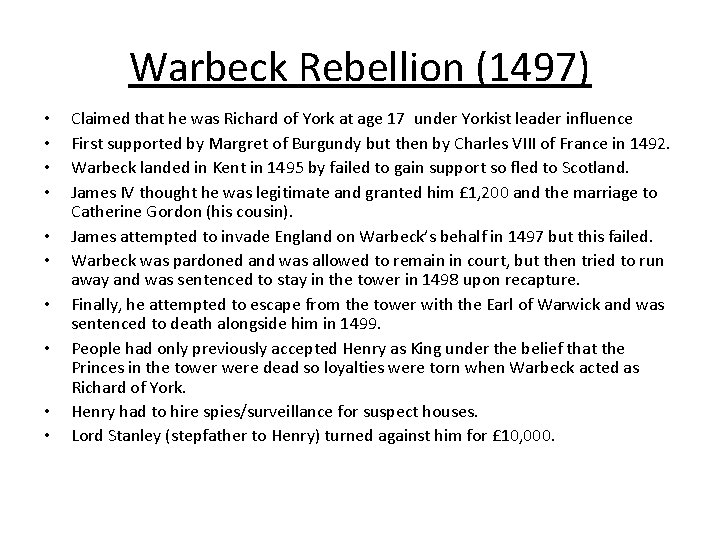
Warbeck Rebellion (1497) • • • Claimed that he was Richard of York at age 17 under Yorkist leader influence First supported by Margret of Burgundy but then by Charles VIII of France in 1492. Warbeck landed in Kent in 1495 by failed to gain support so fled to Scotland. James IV thought he was legitimate and granted him £ 1, 200 and the marriage to Catherine Gordon (his cousin). James attempted to invade England on Warbeck’s behalf in 1497 but this failed. Warbeck was pardoned and was allowed to remain in court, but then tried to run away and was sentenced to stay in the tower in 1498 upon recapture. Finally, he attempted to escape from the tower with the Earl of Warwick and was sentenced to death alongside him in 1499. People had only previously accepted Henry as King under the belief that the Princes in the tower were dead so loyalties were torn when Warbeck acted as Richard of York. Henry had to hire spies/surveillance for suspect houses. Lord Stanley (stepfather to Henry) turned against him for £ 10, 000.
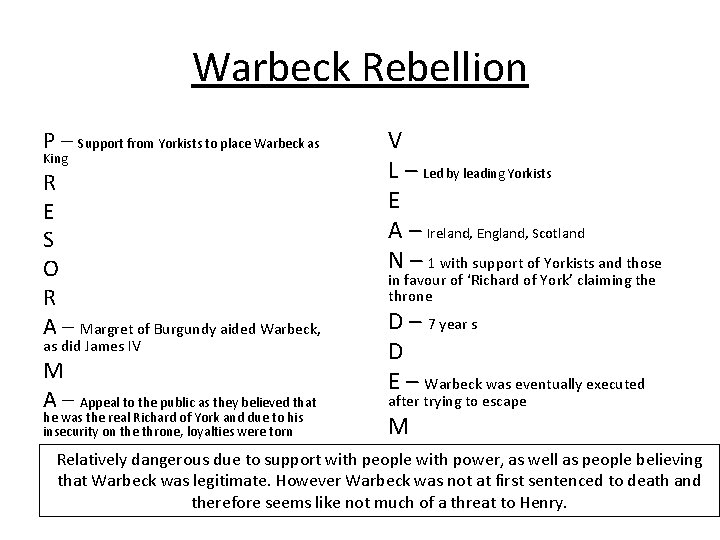
Warbeck Rebellion P – Support from Yorkists to place Warbeck as King R E S O R A – Margret of Burgundy aided Warbeck, as did James IV M A – Appeal to the public as they believed that he was the real Richard of York and due to his insecurity on the throne, loyalties were torn V L – Led by leading Yorkists E A – Ireland, England, Scotland N – 1 with support of Yorkists and those in favour of ‘Richard of York’ claiming the throne D – 7 year s D E – Warbeck was eventually executed after trying to escape M Relatively dangerous due to support with people with power, as well as people believing that Warbeck was legitimate. However Warbeck was not at first sentenced to death and therefore seems like not much of a threat to Henry.
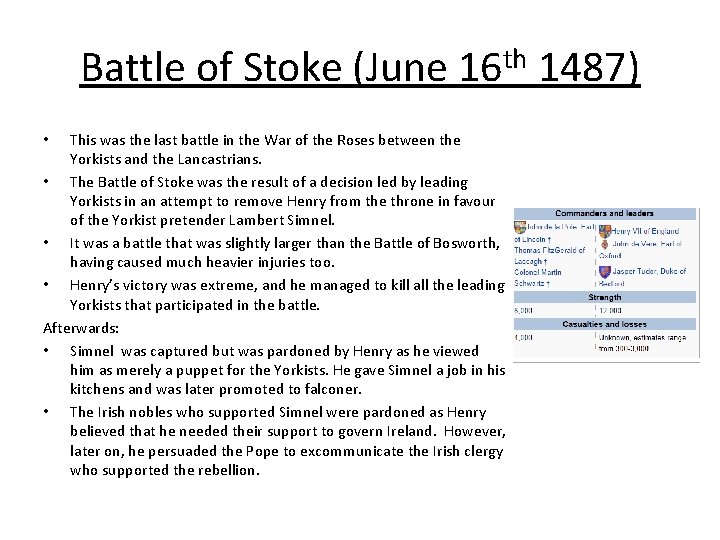
Battle of Stoke (June 16 th 1487) This was the last battle in the War of the Roses between the Yorkists and the Lancastrians. • The Battle of Stoke was the result of a decision led by leading Yorkists in an attempt to remove Henry from the throne in favour of the Yorkist pretender Lambert Simnel. • It was a battle that was slightly larger than the Battle of Bosworth, having caused much heavier injuries too. • Henry’s victory was extreme, and he managed to kill all the leading Yorkists that participated in the battle. Afterwards: • Simnel was captured but was pardoned by Henry as he viewed him as merely a puppet for the Yorkists. He gave Simnel a job in his kitchens and was later promoted to falconer. • The Irish nobles who supported Simnel were pardoned as Henry believed that he needed their support to govern Ireland. However, later on, he persuaded the Pope to excommunicate the Irish clergy who supported the rebellion. •
Early foreign policy: Europe in 1485, the Breton crisis
Europe in 1485 • Henry VII faced a difficult international situation from the moment he became king. • England's relationships with foreign powers were closely tied to developments in England especially marriage alliances. • France was a much smaller country and several areas of the country such as Brittany were virtually independent from the French king. Calais was controlled by England. • Spain was becoming united under Ferdinand of Aragon and Isabell of castile- though both provinces were mostly ruled separately.
• Henry regarded friendship with Spain as a vital counter balance to French power in Europe. • Henry felt he owed the Duke of Brittany a debt of gratitude for sheltering him from the Yorkist's • France was England's traditional rival, after becoming king of England Henry Vii was suspicious of a revival of French power • Burgundy was a major trading partner of England but Edward IV’s mother was married to the duke of burgundy so relations were tense.
Breton crisis • Henry was put into a difficult position when France, a country that encouraged his fight to the throne, decided to absorb Brittany who Henry had also depended on during his 14 year exile. This created the Breton crisis • The way in which the crisis unfolded tells us lots about Henrys aims and methods in foreign policy. Henry did not rush towards war, because he believed it would be dangerous to annoy France especially with pretenders to the throne were active and also lacked funds. • Henry instead, opened negotiations with France whilst secretly allowing troops to go to Brittany to help repel the French army. these manoeuvres failed and then tried to win support from home and abroad for a short campaign. The treaty of median del campo brought off Spain and henry also approached the leaders of the Netherlands. • Parliament was summoned to make a grant of £ 100, 000 to finance a small force (between 3, 000 and 6, 000 men)
• The army crossed the channel in April 1489 • Henry made it clear to the French he was acting in defence of Brittany and there was no intention of going any further. • These reassurances did not satisfy the French, who showed their displeasure by receiving the pretender Perkin Warbeck and also poured their own troops into Brittany. • Henry took a great risk near the later stages of the war. He led £ 12, 000 troops into Brittany gambling France did not want a long conflict, which proved right. France got distracted with the Italian peninsula and wanted no other commitments. • This led to the Treaty of Etaples 1492 - Henrys army left France in return for a payment of 745, 000 crowns and also an agreement from the French king not to support Henrys enemies.
HENRY VII – Later Foreign policy
TREATY OF ETAPLES (1492) • Between Charles VIII of France and Henry VII. • It was an agreement that would stop French support for the pretender Perkin Warbeck and any other future pretenders. The French would also have to pay England £ 159, 000 in compensation for their involvement. • However England had to allow the French to regain control of Brittany
TREATY OF MEDINA DEL CAMPO (1489) • This was an agreement between England Spain. It had three main goals, these were: • The two countries would have to consult each other before any dealings with France • There would be a reduction of trade tariffs between the two. • There was a marriage arrangement between Arthur Tudor and Catherine of Aragon. • Treaty was successful at creating a strong lasting relationship between England Spain.
TREATY OF WINDSOR (1506) • Henry VII secured a stronger relationship with juana and philip of burgundy who had to take refuge in england after their ship wrecked at sea. • The earl of suffolk was returned which helped secure henrys dynasty, as patrt of intercursus malus. • Henry recognised juana and philip as rulers of castile strengthening their claim to the spanish throne. • A proposed marriage between henry and philips sister archduchess margaret. • However philip died shorthly after returning to spain and juanas father Ferdinand described her as going as having gone mad. • This allowed ferdinand to become regent of castile. • Ferdidnand ensured that the marriage between henry and catherine never took place
MALUS INTERCURSUS (1506) • It was ne of the outcomes of the treaty of Windsor • Henry demanded a trade deal which would have given a much stronger trading position for english merchants in the netherlands of it was ever enforced. • It also meant that maximillian and philip had to hand over the earl of suffolk who was a yorkist fugitive who henry then imprisoned.
Treaty of Redon 1489 • Made between England Brittany. • This ensured that Henry VII would send 6000 English troops to fight on the behalf of Brittany. • This was significant as Brittany was a very tactical geographical location and contained lots of deep military ports which were parallel to the southern coast. • This however failed as France claimed Brittany.
Treaty of Ayton 1497 • This was a treaty signed between Scotland’s James IV and England. • This was where Scotland refused to harbour English fugitives • Warbeck was handed over as James IV lost faith in his ability to overthrow the Tudors
Perpetual Peace 1502 • Made between England Scotland. • This was an agreement to halt the conflict which had been on and off. • Another aspect was the agreed marriage between James IV and Margret Tudor. • This however failed and some intermittent clashes continued to occur.
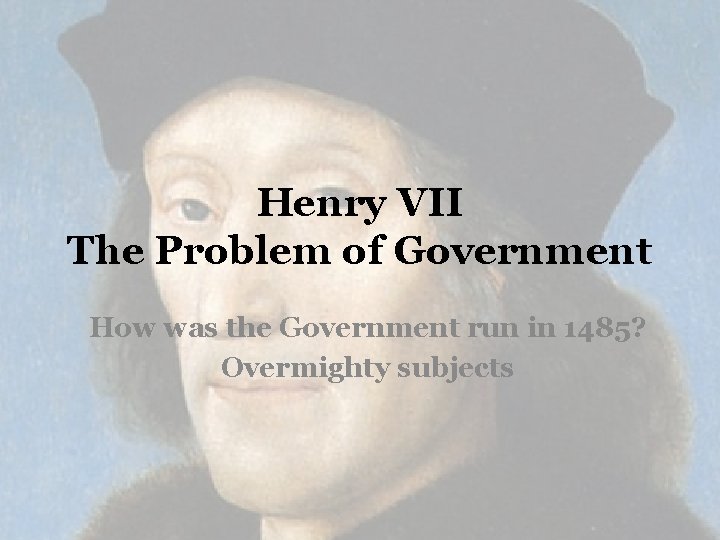
Henry VII The Problem of Government How was the Government run in 1485? Overmighty subjects
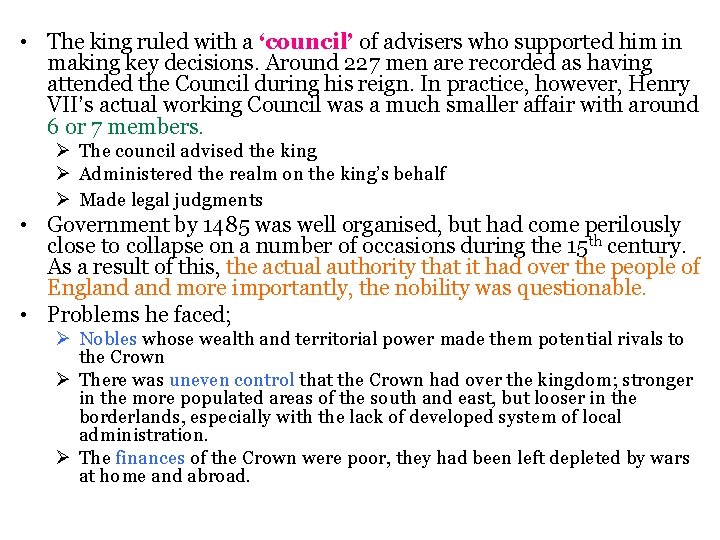
• The king ruled with a ‘council’ of advisers who supported him in making key decisions. Around 227 men are recorded as having attended the Council during his reign. In practice, however, Henry VII’s actual working Council was a much smaller affair with around 6 or 7 members. Ø The council advised the king Ø Administered the realm on the king’s behalf Ø Made legal judgments • Government by 1485 was well organised, but had come perilously close to collapse on a number of occasions during the 15 th century. As a result of this, the actual authority that it had over the people of England more importantly, the nobility was questionable. • Problems he faced; Ø Nobles whose wealth and territorial power made them potential rivals to the Crown Ø There was uneven control that the Crown had over the kingdom; stronger in the more populated areas of the south and east, but looser in the borderlands, especially with the lack of developed system of local administration. Ø The finances of the Crown were poor, they had been left depleted by wars at home and abroad.
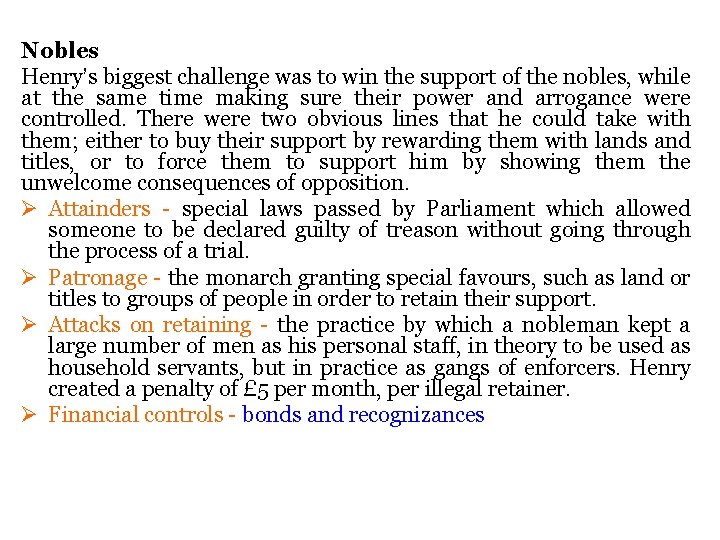
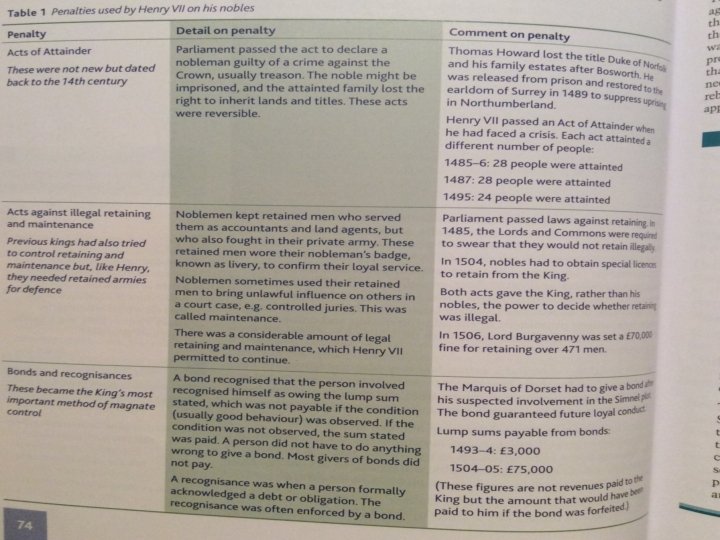
Nobles Henry’s biggest challenge was to win the support of the nobles, while at the same time making sure their power and arrogance were controlled. There were two obvious lines that he could take with them; either to buy their support by rewarding them with lands and titles, or to force them to support him by showing them the unwelcome consequences of opposition. Ø Attainders - special laws passed by Parliament which allowed someone to be declared guilty of treason without going through the process of a trial. Ø Patronage - the monarch granting special favours, such as land or titles to groups of people in order to retain their support. Ø Attacks on retaining - the practice by which a nobleman kept a large number of men as his personal staff, in theory to be used as household servants, but in practice as gangs of enforcers. Henry created a penalty of £ 5 per month, per illegal retainer. Ø Financial controls - bonds and recognizances
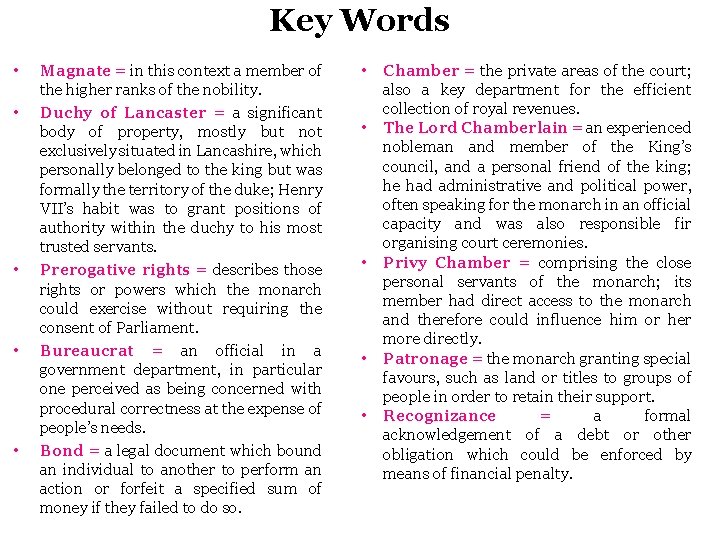
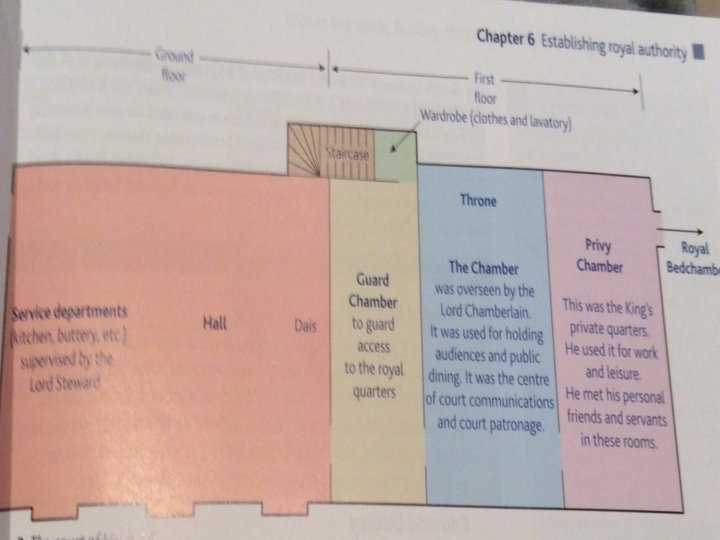
Key Words • • • Magnate = in this context a member of the higher ranks of the nobility. Duchy of Lancaster = a significant body of property, mostly but not exclusively situated in Lancashire, which personally belonged to the king but was formally the territory of the duke; Henry VII’s habit was to grant positions of authority within the duchy to his most trusted servants. Prerogative rights = describes those rights or powers which the monarch could exercise without requiring the consent of Parliament. Bureaucrat = an official in a government department, in particular one perceived as being concerned with procedural correctness at the expense of people’s needs. Bond = a legal document which bound an individual to another to perform an action or forfeit a specified sum of money if they failed to do so. • • • Chamber = the private areas of the court; also a key department for the efficient collection of royal revenues. The Lord Chamberlain = an experienced nobleman and member of the King’s council, and a personal friend of the king; he had administrative and political power, often speaking for the monarch in an official capacity and was also responsible fir organising court ceremonies. Privy Chamber = comprising the close personal servants of the monarch; its member had direct access to the monarch and therefore could influence him or her more directly. Patronage = the monarch granting special favours, such as land or titles to groups of people in order to retain their support. Recognizance = a formal acknowledgement of a debt or other obligation which could be enforced by means of financial penalty.
Henry VII changes to government By Ryan
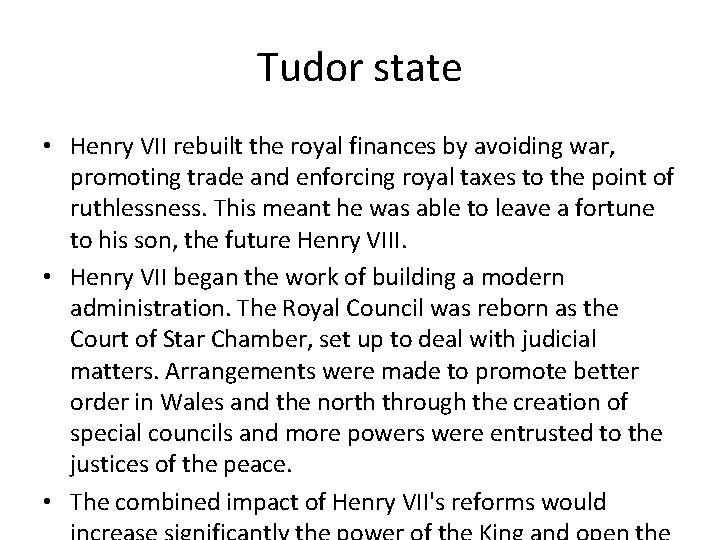
Tudor state • Henry VII rebuilt the royal finances by avoiding war, promoting trade and enforcing royal taxes to the point of ruthlessness. This meant he was able to leave a fortune to his son, the future Henry VIII. • Henry VII began the work of building a modern administration. The Royal Council was reborn as the Court of Star Chamber, set up to deal with judicial matters. Arrangements were made to promote better order in Wales and the north through the creation of special councils and more powers were entrusted to the justices of the peace. • The combined impact of Henry VII's reforms would
Changes in Finance Frankie Panayi
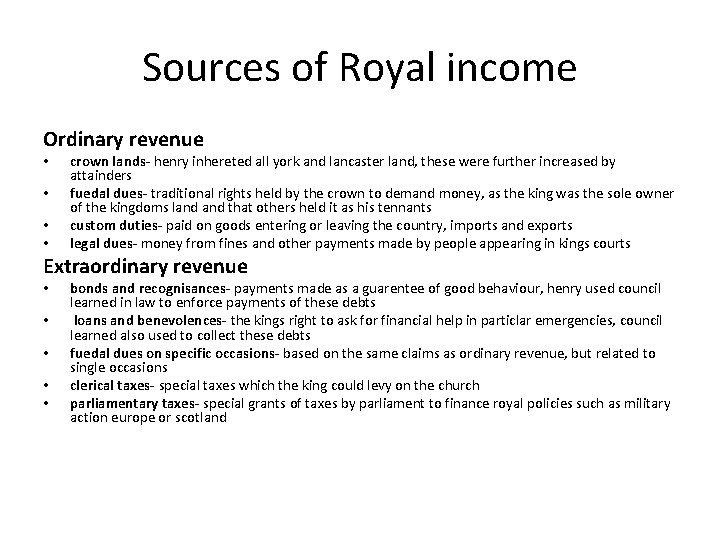
Sources of Royal income Ordinary revenue • • crown lands- henry inhereted all york and lancaster land, these were further increased by attainders fuedal dues- traditional rights held by the crown to demand money, as the king was the sole owner of the kingdoms land that others held it as his tennants custom duties- paid on goods entering or leaving the country, imports and exports legal dues- money from fines and other payments made by people appearing in kings courts Extraordinary revenue • • • bonds and recognisances- payments made as a guarentee of good behaviour, henry used council learned in law to enforce payments of these debts loans and benevolences- the kings right to ask for financial help in particlar emergencies, council learned also used to collect these debts fuedal dues on specific occasions- based on the same claims as ordinary revenue, but related to single occasions clerical taxes- special taxes which the king could levy on the church parliamentary taxes- special grants of taxes by parliament to finance royal policies such as military action europe or scotland
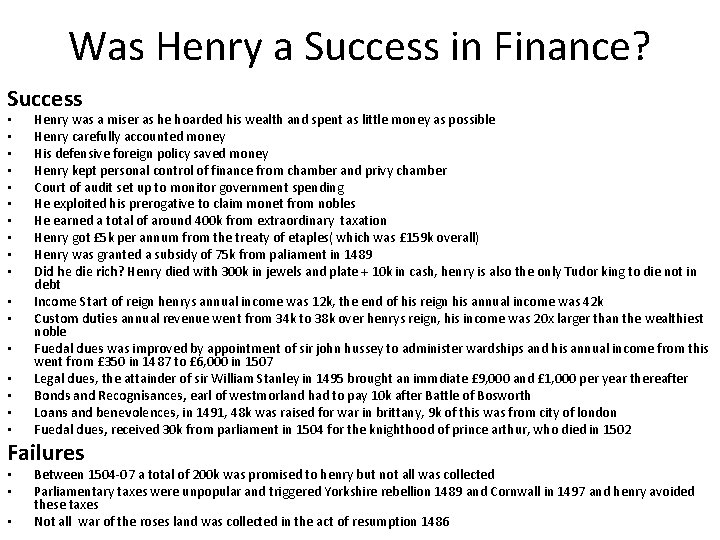
Was Henry a Success in Finance? Success • • • • • Henry was a miser as he hoarded his wealth and spent as little money as possible Henry carefully accounted money His defensive foreign policy saved money Henry kept personal control of finance from chamber and privy chamber Court of audit set up to monitor government spending He exploited his prerogative to claim monet from nobles He earned a total of around 400 k from extraordinary taxation Henry got £ 5 k per annum from the treaty of etaples( which was £ 159 k overall) Henry was granted a subsidy of 75 k from paliament in 1489 Did he die rich? Henry died with 300 k in jewels and plate + 10 k in cash, henry is also the only Tudor king to die not in debt Income Start of reign henrys annual income was 12 k, the end of his reign his annual income was 42 k Custom duties annual revenue went from 34 k to 38 k over henrys reign, his income was 20 x larger than the wealthiest noble Fuedal dues was improved by appointment of sir john hussey to administer wardships and his annual income from this went from £ 350 in 1487 to £ 6, 000 in 1507 Legal dues, the attainder of sir William Stanley in 1495 brought an immdiate £ 9, 000 and £ 1, 000 per year thereafter Bonds and Recognisances, earl of westmorland had to pay 10 k after Battle of Bosworth Loans and benevolences, in 1491, 48 k was raised for war in brittany, 9 k of this was from city of london Fuedal dues, received 30 k from parliament in 1504 for the knighthood of prince arthur, who died in 1502 Failures • • • Between 1504 -07 a total of 200 k was promised to henry but not all was collected Parliamentary taxes were unpopular and triggered Yorkshire rebellion 1489 and Cornwall in 1497 and henry avoided these taxes Not all war of the roses land was collected in the act of resumption 1486
Changes in society Ellie English
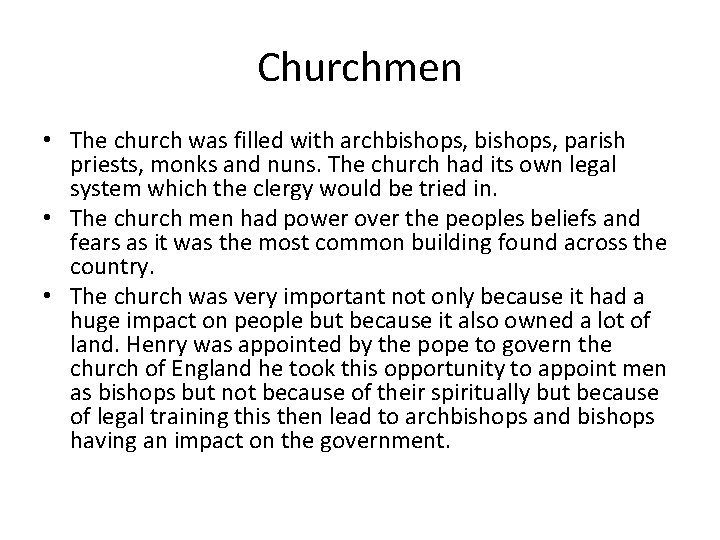
Churchmen • The church was filled with archbishops, parish priests, monks and nuns. The church had its own legal system which the clergy would be tried in. • The church men had power over the peoples beliefs and fears as it was the most common building found across the country. • The church was very important not only because it had a huge impact on people but because it also owned a lot of land. Henry was appointed by the pope to govern the church of England he took this opportunity to appoint men as bishops but not because of their spiritually but because of legal training this then lead to archbishops and bishops having an impact on the government.
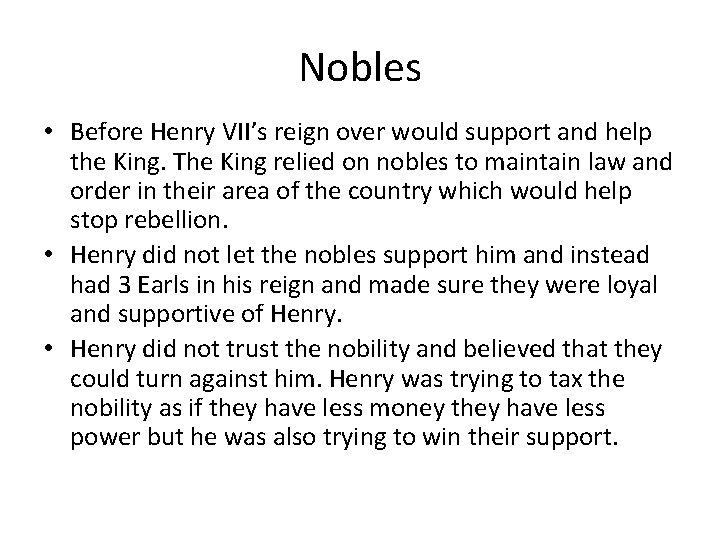
Nobles • Before Henry VII’s reign over would support and help the King. The King relied on nobles to maintain law and order in their area of the country which would help stop rebellion. • Henry did not let the nobles support him and instead had 3 Earls in his reign and made sure they were loyal and supportive of Henry. • Henry did not trust the nobility and believed that they could turn against him. Henry was trying to tax the nobility as if they have less money they have less power but he was also trying to win their support.
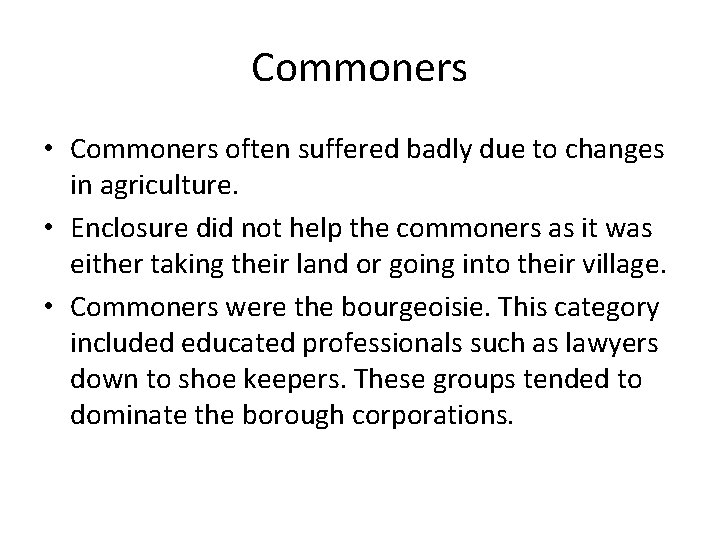
Commoners • Commoners often suffered badly due to changes in agriculture. • Enclosure did not help the commoners as it was either taking their land or going into their village. • Commoners were the bourgeoisie. This category included educated professionals such as lawyers down to shoe keepers. These groups tended to dominate the borough corporations.
Regional Divisions • South east- Farming predominated in the more densely populated countries. • North and west- pastoral farming predominated with rearing of sheep cattle and horses. • Contemporaries were aware of the regional differences. As an effect on this division Londoners would tend to look down upon northerners , whilst northerners would envy the southern riches. This may of caused tensions or rivalries with the two sides of the divide.
Yorkshire Rebellion 1489 – Causes • Parliament granted Henry VII a subsidy of £ 100, 000 to help defend Brittany, an ally of England in its war against France. King Henry sent Henry Percy, 4 th Earl of Northumberland to collect taxes to help raise more money for this campaign. • Many of the people in Northumberland Yorkshire claimed to have already paid their part through local taxes. They were unwilling to give more money to defend a country of no geographical threat to them, as Yorkshire and Northumberland are in Northern England, whereas Brittany is closer to Cornwall and London.
Yorkshire Rebellion – What happened? ! • Rebellion broke out in April 1489. The Earl met with the rebels, but a scuffle broke out and he was killed. The rebels then asked for pardon but were denied it by the king who sent a large army of 8000 to the north, led by Thomas, Earl of Surrey. • The rebels dispersed and the rebel leader, John à Chambre was hanged for treason, so they found a new leader in Sir John Egremont (an illegitimate member of the House of Percy). Unfortunately for the rebels, Egremont proved to be unreliable and fled to the Court of Margaret, Duchess of Burgundy, a staunch opposer to Henry's rule.
Yorkshire Rebellion - Effects • The results of this rebellion led the rebels to receive a royal pardon, and no further taxes were collected, thus Henry was unable to get enough money to defend Brittany. • He also became aware of the lawless nature of the North of England, which had been loyal to King Richard III, who had spent more time in the North than any previous King of England. • Thomas Howard, Earl of Surrey, who was sent to deal with the Yorkist threat, was made into Henry's Lieutenant in the North. With no estates or interests in the north, Surrey was able to spend many years reconciling the region to Tudor rule.
Cornish Rebellion 1497
The Gist • In 1496, Scotland had invaded England. • The rebels were protesting against the attempts of the new King, Henry VII, to levy new taxes to pay for a war in the north. The rebels aimed their complaints, not at Henry VII, but at his ministers. • The rebel army numbered 15, 000, and was led by a blacksmith known as Michael An Gof means 'blacksmith'. • The rebels marched on London, but were defeated by the royal army, which had cannons and a cavalry. • The Cornishmen surrendered. Henry sold all the prisoners as slaves, and An Gof was executed.
Cause • The Cornish Rebellion was a popular uprising by the people of Cornwall in the far southwest of Britain. Its primary cause was the people's response to the raising of war taxes by King Henry VII to pay for a campaign against Scotland. The new taxes overturned the previous rights granted by Edward I of England which exempted Cornwall from all taxes of 10 ths or 15 ths of income.
Background • In 1496, after disagreements regarding new regulations for the tin-mining industry, King Henry VII suspended the privileges of the Stannaries. • In late 1496 the council approved a forced loan to which Cornwall contributed a disproportionately large share. The primary cause of the rebellion was Henry VII's tax levy to pay for a war against the Scots. The terms of the levy violated the Stannary Charter of 1305 which prohibited taxes of 10 ths and 15 ths from being raised in Cornwall had already contributed significantly to the Scottish expedition, even though it was not affected by any border incursions.
• By 2 pm, Henry VII had returned to the City in triumph, knighting deserving parties on the way, to accept the acclamation of the Mayor and attend a service of thanksgiving at St Paul's. • In due course, severe monetary penalties, extracted by Crown agents, pauperised sections of Cornwall for years to come. Prisoners were sold into slavery and estates were seized and handed to more loyal subjects. The remaining rebels that escaped went home ending the rebellion. • An Gof and Flamank were both executed at Tyburn, London on 27 June 1497.
Trade & exploration under Henry VII • Trade: • • Customs duties were brought in under Henry vii which was paid on good entering and leaving the country to increase crown income. Tonnage and Poundage was also used under Henry, Tonnage was the fixed subsidy on every tonne of wine & other products imported & poundage which was a proportional tax on imported & exported goods. The Magnus Intercurcus (1496) was a treaty made after trading problems with burgundy both countries agreed to leave any other issues out of trade & aimed to improve relations between the two. The Intercurcus malus (1506) was also aimed at improving trade relations with burgundy suggesting the first treaty was not entirely successful & neither was this one as the marriage alliance between Henry & Phillip of Burgundy never took place. Also Henry recognised Phillip as rulers of castile however Phillip died shortly after this leaving the treaty unsuccessful. The Navigation acts only allowed English ships to carry certain products but it only had limited usefulness as foreign ships continued to do so regardless. Henry introduced this act not allowing English merchants to load their merchandise onto foreign ships if even if English ships weren't available, this upset the Hanseatic League of which England were left out and was the major trading power henry did a great deal to upset the leaders causing the Hanse leaders to forbid by law taking unfinished cloth from England eventually creating a law to forbid traders from taking any money out of England, attacks on Hanse Leaders in London and elsewhere went unpunished. There was a decline in the exportation price of wool and agriculture as the price of grain and animal products decreased, implying a decrease in farming profitability.
Exploration • • Henry was interested in overseas exploration. The royal council advised him not to finance the voyages of Christopher Columbus, as they believed the plans were too muddled for the next voyage. Henry did, however, finance the voyages of John Cabot. Lured by his belief that he would make a fortune by funding a route to the Far East by sailing west, Henry funded Cabot’s first journey, the sum of £ 50. Cabot reached the Newfoundland, in modern Canada in 1497 & discovered new fishing grounds. Portugal dominated the Spice trade, England were slower to engage in such activities, However seamen and sailors from Bristol were interested in the possibility of transatlantic discovery the likes of John Cabot & other sailors needed to find new fishing grounds as the Hanseatic League excluded English sailors from Icelandic waters, this is why Henry granted Cabot the funding and authorised transatlantic exploration. Henry did however fund the unsuccessful voyage of John Cabot’s son Sebastian, who set out to find ‘The North West Passage’ he was unsuccessful.
Prosperity and depression under Henry VII
Prosperity and depression • Prices seemed to remain steady during the 15 th century prices after a temporary rise in the 1480 s. Although there was a decline in the export price of wool and the price of grain and animal products in the 1490 s. Building workers and agricultural labours were better off during the 1490 s than they would of been throughout the whole Tudor period.
Engrossment • A negative effect came from enclosure which was engrossing. The engrossing of farms was where different farms would join together to make one profitable farm, however this sounds as if it is a benefit but it lead to families being evicted. • As this was happening Parliament did introduce two laws in 1489 which were seen as antienclosure. The laws were to stop depopulation of the farms because of the engrossing of the farms and to try to prevent the breakdown of law and order from people trying to abuse enclosure.
Enclosure • One aspect agriculturally that developed under Henry VII reign was enclosure. Enclosure was when land was fenced off and common rights over land were abolished. After enclosure was introduced the land owner could do whatever they want with the land such as the farming of animals or the growing of crops. With enclosure introduced farming could be done on a larger scale so it would become more profitable. • However there were some abuses of enclosure as land owners tried taking more land than they owed or other farmers tried taking land they did not own. Because of this for people who could not prove legal ownership of land faced eviction, which meant some lost out under enclosure. Enclosure was a step in the right direction for farming.
Agriculture (Agrarian Economy) • Income from land declined after the Black death of the 1300 s and 1400 s leaving England economically unstable. With population increasing in the 1480’s and 1490’s there was a greater move towards sheep farming. Sheep farming brought an increasing demand for wool, as the population grew and trade overseas developed. • This had a positive effect on the economy in England as with trades over seas England can become more financially stable as a country and make alliances with the trading countries. Significantly benefitting England economically.
Domestic industry • Industry under Henry VII was one of the most important reasons for the economic strength for England. The most valuable commodity under Henry VII was the woollen cloth trade, this made up of 90% of England’s exports. The three main areas for the production of woollen cloth was West Yorkshire, East Anglia and the West Country. • During the reign of Henry VII other aspects of textile production developed however this was on a small scale. The materials produced were Linen in Lancashire and hand knitted stockings in the Lake District. • A few other commodities came from England such as lead and tin were mined but was not always exported. Coal was mined and some of the coal was exported.
Recoinage • Henry VII introduced new coinage called the Sovereign coinage. On one side of the coin showed the King seated on the throne and on the other side shows the royal shield over a cross. • Henry introduced the sovereign coinage as it showed power and the coin was made out of Gold.
Henry VII Religion and the arts By Jenathan Singarajah
Henry VII: Church During Henry VII’s reign Tudor England was predominantly a Roman Catholic country where they practiced the Roman Catholic religion. During this time the head of the church in Henry VII’s reign was the Pope in Rome, so the Pope had the overall control over all matters religious or political in Tudor England up to the England Reformation in 1534 when Henry VIII was supreme head of church. Henry also received grants from the church from people like the archbishops of Canterbury and York. For the Catholics souls to be saved they must attend church regularly, believe in the sacraments and show their faith towards God. The Church had to practice 7 sacraments these were: • The Eucharist- commemoration of the Last supper of Jesus with his disciples • Baptism • Holy orders- granting status of priest after they complete religious training • Confirmation- recipient confirming acceptance of Gods spirit in their hearts • Marriage • Confession, leading to penance- doing tasks to show repentance • Unction- aka anointing the stick, part of the Last rites Success of the Church of England for Henry VII The pope trusted Henry VII to become the King of England, so the Pope had a major role into accepting Henry as the King. This is because as he was the head of the church many of the Roman Catholics were influenced by him, so if he did not like Henry or objected his rise to the throne then Henry would have no supporters or followers as they all believe in the Pope. In addition Henry received £ 25, 000 from the church to fund the war with France in 1489. Henry VII would also purposely not appoint a bishop so that Henry can receive £ 6, 000 for the time the bishop position is vacant.
Henry VII: Humanism and Arts • • Humanism is a cultural and intellectual movement of the Renaissance that emphasized human potential to attain excellence and promoted direct study of the literature. Henry VII commissioned new buildings, including a new place at Richmond and the Henry VII chapel in Westminster Abbey. Henry’s magnificence links the greatness of king with belief in the power of God. Humanism was a positive movement, out of optimism about the present and the future, these people were called humanists. Humanists were involved in the religious debate in England because they were disturbed by poor quality of the parish clergy and wanted to improve the standards of education among the clergy and laity( people not been trained or accepted as a priest). They attacked the Church’s exploitation of practices like selling indulgences to raise money. Indulgences was a document by Pope canceling punishment in purgatory. Also exploitation led souls away from God. Arts Henry VII was patron of arts in England as he encouraged writers, musicians, poets and artists to continue publishing due to his passion. Polydore Vergil was commissioned to write about the story of England leading up to the Tudor rule. John Skelton the poet was instructed to write enthusiastically about England's happiness under Henry VII’s own children received an education that reflected the renaissance, with reflected the Renaissance, with emphasis on foreign languages, classics, music and religion. Also they learned arts of being a courtier, which included dancing and hunting.